Proof Tree for finfrag-init (View conclusion)
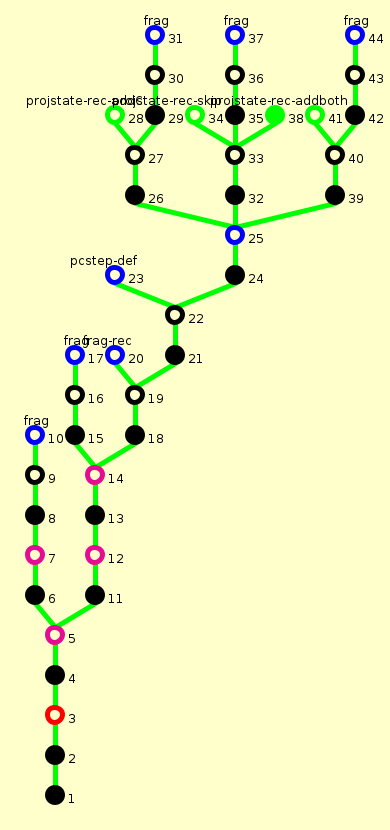
The following image shows the proof tree of sequent calculus. The proved goal is at the bottom. You can click on the nodes to view additional rules. See here for details on colors in a proof tree.
| ⊦ pcfrag(PCIOAut(pcinit(init, cinit), pcstep(step, cstep)))(⌜pcsl⌝ , ⌜pal⌝ ) → πs(pcsl, pal)[0] = pcsl[0].cs |
πs(pcsl, pal)[0] ≠ pcsl[0].cs, pcfrag(PCIOAut(pcinit(init, cinit), pcstep(step, cstep)))(⌜pcsl⌝ , ⌜pal⌝ ) ⊦
| πs(pcsl, pal)[0] ≠ pcsl[0].cs, pcfrag(PCIOAut(pcinit(init, cinit), pcstep(step, cstep)))(⌜pcsl⌝ , ⌜pal⌝ ) ⊦ |
pcsl[0] = s ×c cs, πs(pcsl, pal)[0] ≠ cs, pcfrag(PCIOAut(pcinit(init, cinit), pcstep(step, cstep)))(⌜pcsl⌝ , ⌜pal⌝ ) ⊦
Used simplifier rules: ⊦ st = pcs.st ∧ cs = pcs.cs ↔ pcs = st ×c cs; (elim) Used terms: pcsl[0], st, cs
| pcsl[0] = s ×c cs, πs(pcsl, pal)[0] ≠ cs, pcfrag(PCIOAut(pcinit(init, cinit), pcstep(step, cstep)))(⌜pcsl⌝ , ⌜pal⌝ ) ⊦ |
(pcs + pcsl0)[0] = s ×c cs, πs(pcs + pcsl0, pal)[0] ≠ cs, pcfrag(PCIOAut(pcinit(init, cinit), pcstep(step, cstep)))(⌜pcs + pcsl0⌝ , ⌜pal⌝ ), ∀ s, cs, pal, init, cinit, step, cstep. ¬(pcsl0[0] = s ×c cs ∧ πs(pcsl0, pal)[0] ≠ cs ∧ pcfrag(PCIOAut(pcinit(init, cinit), pcstep(step, cstep)))(⌜pcsl0⌝ , ⌜pal⌝ )) ⊦
Used simplifier rules: Pcstatelist freely generated by [], +;; ⊦ ⌜[]⌝ = []; (s) ⊦ ¬ pcfrag(PCIOAut(startf, stepf))([], α); (s)
| (pcs + pcsl0)[0] = s ×c cs, πs(pcs + pcsl0, pal)[0] ≠ cs, pcfrag(PCIOAut(pcinit(init, cinit), pcstep(step, cstep)))(⌜pcs + pcsl0⌝ , ⌜pal⌝ ), ∀ s, cs, pal, init, cinit, step, cstep. ¬(pcsl0[0] = s ×c cs ∧ πs(pcsl0, pal)[0] ≠ cs ∧ pcfrag(PCIOAut(pcinit(init, cinit), pcstep(step, cstep)))(⌜pcsl0⌝ , ⌜pal⌝ )) ⊦ |
πs((s ×c cs)' + pcsl0, pal)[0] ≠ cs, pcfrag(PCIOAut(pcinit(init, cinit), pcstep(step, cstep)))(⌜(s ×c cs)'⌝ + ⌜pcsl0⌝ , ⌜pal⌝ ), ∀ s0, cs0, pal0, init0, cinit0, step0, cstep0. pcsl0[0] ≠ s0 ×c cs0 ∨ πs(pcsl0, pal0)[0] = cs0 ∨ ¬ pcfrag(PCIOAut(pcinit(init0, cinit0), pcstep(step0, cstep0)))(⌜pcsl0⌝ , ⌜pal0⌝ ) ⊦
Used simplifier rules: a: ⊦ (x + y) + z = x + y + z; from specification list[IOrefine-def-RP-traceC-IOstatestream] ⊦ ⌜x + y⌝ = ⌜x⌝ + ⌜y⌝ ; (s) ⊦ a + x = a ' + x; (s) ⊦ (a ' + x)[0] = a; (s)
| πs((s ×c cs)' + pcsl0, pal)[0] ≠ cs, pcfrag(PCIOAut(pcinit(init, cinit), pcstep(step, cstep)))(⌜(s ×c cs)'⌝ + ⌜pcsl0⌝ , ⌜pal⌝ ), ∀ s0, cs0, pal0, init0, cinit0, step0, cstep0. pcsl0[0] ≠ s0 ×c cs0 ∨ πs(pcsl0, pal0)[0] = cs0 ∨ ¬ pcfrag(PCIOAut(pcinit(init0, cinit0), pcstep(step0, cstep0)))(⌜pcsl0⌝ , ⌜pal0⌝ ) ⊦ |
pcsl0 = [], πs((s ×c cs)' + pcsl0, pal)[0] ≠ cs, pcfrag(PCIOAut(pcinit(init, cinit), pcstep(step, cstep)))(⌜(s ×c cs)'⌝ + ⌜pcsl0⌝ , ⌜pal⌝ ), ∀ s0, cs0, pal0, init0, cinit0, step0, cstep0. pcsl0[0] ≠ s0 ×c cs0 ∨ πs(pcsl0, pal0)[0] = cs0 ∨ ¬ pcfrag(PCIOAut(pcinit(init0, cinit0), pcstep(step0, cstep0)))(⌜pcsl0⌝ , ⌜pal0⌝ ) ⊦
pcsl0 = pcs + pcsl, πs((s ×c cs)' + pcsl0, pal)[0] ≠ cs, pcfrag(PCIOAut(pcinit(init, cinit), pcstep(step, cstep)))(⌜(s ×c cs)'⌝ + ⌜pcsl0⌝ , ⌜pal⌝ ), ∀ s0, cs0, pal0, init0, cinit0, step0, cstep0. pcsl0[0] ≠ s0 ×c cs0 ∨ πs(pcsl0, pal0)[0] = cs0 ∨ ¬ pcfrag(PCIOAut(pcinit(init0, cinit0), pcstep(step0, cstep0)))(⌜pcsl0⌝ , ⌜pal0⌝ ) ⊦
Used simplifier rules: Pcstatelist freely generated by [], +;;
| pcsl0 = [], πs((s ×c cs)' + pcsl0, pal)[0] ≠ cs, pcfrag(PCIOAut(pcinit(init, cinit), pcstep(step, cstep)))(⌜(s ×c cs)'⌝ + ⌜pcsl0⌝ , ⌜pal⌝ ), ∀ s0, cs0, pal0, init0, cinit0, step0, cstep0. pcsl0[0] ≠ s0 ×c cs0 ∨ πs(pcsl0, pal0)[0] = cs0 ∨ ¬ pcfrag(PCIOAut(pcinit(init0, cinit0), pcstep(step0, cstep0)))(⌜pcsl0⌝ , ⌜pal0⌝ ) ⊦ |
πs((s ×c cs)', pal)[0] ≠ cs, pcfrag(PCIOAut(pcinit(init, cinit), pcstep(step, cstep)))(⌜(s ×c cs)'⌝ , ⌜pal⌝ ) ⊦
Used simplifier rules: ⊦ ¬ pcfrag(PCIOAut(startf, stepf))([], α); (s) ⊦ ⌜[]⌝ = []; (s) append-assoc: ⊦ (σ + σ1) + σ2 = σ + σ1 + σ2; from specification stream[IOrefine-def-RP-traceC-IOstatestream] ⊦ σ + [] = σ; (s) a: ⊦ (x + y) + z = x + y + z; from specification list[IOrefine-def-RP-traceC-IOstatestream] ⊦ x + [] = x; (s)
| πs((s ×c cs)', pal)[0] ≠ cs, pcfrag(PCIOAut(pcinit(init, cinit), pcstep(step, cstep)))(⌜(s ×c cs)'⌝ , ⌜pal⌝ ) ⊦ |
pal = pa + pal0, πs((s ×c cs)', pal)[0] ≠ cs, pcfrag(PCIOAut(pcinit(init, cinit), pcstep(step, cstep)))(⌜(s ×c cs)'⌝ , ⌜pal⌝ ) ⊦
Used simplifier rules: projstate-base: ⊦ πs((s ×c cs)', []) = cs '; Pactionlist freely generated by [], +;; ⊦ a '[0] = a; (s)
| pal = pa + pal0, πs((s ×c cs)', pal)[0] ≠ cs, pcfrag(PCIOAut(pcinit(init, cinit), pcstep(step, cstep)))(⌜(s ×c cs)'⌝ , ⌜pal⌝ ) ⊦ |
πs((s ×c cs)', pa ' + pal0)[0] ≠ cs, pcfrag(PCIOAut(pcinit(init, cinit), pcstep(step, cstep)))(⌜(s ×c cs)'⌝ , ⌜pa '⌝ + ⌜pal0⌝ ) ⊦
Used simplifier rules: a: ⊦ (x + y) + z = x + y + z; from specification list[IOrefine-def-RP-actionstream] ⊦ ⌜x + y⌝ = ⌜x⌝ + ⌜y⌝ ; (s) ⊦ a + x = a ' + x; (s)
| πs((s ×c cs)', pa ' + pal0)[0] ≠ cs, pcfrag(PCIOAut(pcinit(init, cinit), pcstep(step, cstep)))(⌜(s ×c cs)'⌝ , ⌜pa '⌝ + ⌜pal0⌝ ) ⊦ |
⊦ pcfrag(PCIOAut(startf, stepf))(σ, β) ↔ # σ = # β + ⌜1⌝ ∧ (∀ n. ⌜n⌝ < # β → stepf(σ[n], β[n], σ[n +1]))
Used simplifier rules: ⊦ # ⌜x⌝ = ⌜# x⌝ ; (s) ⊦ # a ' = 0 +1; (s) ⊦ #(σ + σ1) = # σ + # σ1; (s) ⊦ # a ' = 0 +1; (s) ⊦ # ⌜x⌝ = ⌜# x⌝ ; (s) append-assoc: ⊦ (σ + σ1) + σ2 = σ + σ1 + σ2; from specification stream[IOrefine-def-RP-actionstream] ⊦ ⌜(* n)⌝ + ⌜(* m)⌝ = ⌜n + m⌝ ; (s) a: ⊦ (m + n0) + n1 = m + n0 + n1; from specification nat-basic c: ⊦ m + n = n + m; from specification nat-basic ⊦ n < m → (⌜(* n)⌝ = ⌜(* m)⌝ + n∞2 ↔ false); (s) add-assoc: ⊦ (n∞ + n∞1) + n∞2 = n∞ + n∞1 + n∞2; from specification nat-inf add-comm: ⊦ n∞1 + n∞2 = n∞2 + n∞1; from specification nat-inf Used terms: pcinit(init, cinit), pcstep(step, cstep), ⌜(s ×c cs)'⌝ , ⌜pa '⌝ + ⌜pal0⌝
| ⊦ pcfrag(PCIOAut(startf, stepf))(σ, β) ↔ # σ = # β + ⌜1⌝ ∧ (∀ n. ⌜n⌝ < # β → stepf(σ[n], β[n], σ[n +1])) |
| pcsl0 = pcs + pcsl, πs((s ×c cs)' + pcsl0, pal)[0] ≠ cs, pcfrag(PCIOAut(pcinit(init, cinit), pcstep(step, cstep)))(⌜(s ×c cs)'⌝ + ⌜pcsl0⌝ , ⌜pal⌝ ), ∀ s0, cs0, pal0, init0, cinit0, step0, cstep0. pcsl0[0] ≠ s0 ×c cs0 ∨ πs(pcsl0, pal0)[0] = cs0 ∨ ¬ pcfrag(PCIOAut(pcinit(init0, cinit0), pcstep(step0, cstep0)))(⌜pcsl0⌝ , ⌜pal0⌝ ) ⊦ |
πs((s ×c cs)' + pcs ' + pcsl, pal)[0] ≠ cs, pcfrag(PCIOAut(pcinit(init, cinit), pcstep(step, cstep)))(⌜(s ×c cs)'⌝ + ⌜pcs '⌝ + ⌜pcsl⌝ , ⌜pal⌝ ), ∀ s0, cs0, pal0, init0, cinit0, step0, cstep0. pcs ≠ s0 ×c cs0 ∨ πs((s0 ×c cs0)' + pcsl, pal0)[0] = cs0 ∨ ¬ pcfrag(PCIOAut(pcinit(init0, cinit0), pcstep(step0, cstep0)))(⌜(s0 ×c cs0)'⌝ + ⌜pcsl⌝ , ⌜pal0⌝ ) ⊦
Used simplifier rules: a: ⊦ (x + y) + z = x + y + z; from specification list[IOrefine-def-RP-traceC-IOstatestream] ⊦ ⌜x + y⌝ = ⌜x⌝ + ⌜y⌝ ; (s) ⊦ a + x = a ' + x; (s) ⊦ (a ' + x)[0] = a; (s) append-assoc: ⊦ (σ + σ1) + σ2 = σ + σ1 + σ2; from specification stream[IOrefine-def-RP-traceC-IOstatestream]
| πs((s ×c cs)' + pcs ' + pcsl, pal)[0] ≠ cs, pcfrag(PCIOAut(pcinit(init, cinit), pcstep(step, cstep)))(⌜(s ×c cs)'⌝ + ⌜pcs '⌝ + ⌜pcsl⌝ , ⌜pal⌝ ), ∀ s0, cs0, pal0, init0, cinit0, step0, cstep0. pcs ≠ s0 ×c cs0 ∨ πs((s0 ×c cs0)' + pcsl, pal0)[0] = cs0 ∨ ¬ pcfrag(PCIOAut(pcinit(init0, cinit0), pcstep(step0, cstep0)))(⌜(s0 ×c cs0)'⌝ + ⌜pcsl⌝ , ⌜pal0⌝ ) ⊦ |
pcs = s1 ×c cs1, πs((s ×c cs)' + pcs ' + pcsl, pal)[0] ≠ cs, pcfrag(PCIOAut(pcinit(init, cinit), pcstep(step, cstep)))(⌜(s ×c cs)'⌝ + ⌜pcs '⌝ + ⌜pcsl⌝ , ⌜pal⌝ ), ∀ s0, cs0, pal0, init0, cinit0, step0, cstep0. pcs ≠ s0 ×c cs0 ∨ πs((s0 ×c cs0)' + pcsl, pal0)[0] = cs0 ∨ ¬ pcfrag(PCIOAut(pcinit(init0, cinit0), pcstep(step0, cstep0)))(⌜(s0 ×c cs0)'⌝ + ⌜pcsl⌝ , ⌜pal0⌝ ) ⊦
Used simplifier rules: Pcstate freely generated by ×c;;
| pcs = s1 ×c cs1, πs((s ×c cs)' + pcs ' + pcsl, pal)[0] ≠ cs, pcfrag(PCIOAut(pcinit(init, cinit), pcstep(step, cstep)))(⌜(s ×c cs)'⌝ + ⌜pcs '⌝ + ⌜pcsl⌝ , ⌜pal⌝ ), ∀ s0, cs0, pal0, init0, cinit0, step0, cstep0. pcs ≠ s0 ×c cs0 ∨ πs((s0 ×c cs0)' + pcsl, pal0)[0] = cs0 ∨ ¬ pcfrag(PCIOAut(pcinit(init0, cinit0), pcstep(step0, cstep0)))(⌜(s0 ×c cs0)'⌝ + ⌜pcsl⌝ , ⌜pal0⌝ ) ⊦ |
πs((s ×c cs)' + (s1 ×c cs1)' + pcsl, pal)[0] ≠ cs, pcfrag(PCIOAut(pcinit(init, cinit), pcstep(step, cstep)))(⌜(s ×c cs)'⌝ + ⌜(s1 ×c cs1)'⌝ + ⌜pcsl⌝ , ⌜pal⌝ ), ∀ s0, cs0, pal0, init0, cinit0, step0, cstep0. s1 ×c cs1 ≠ s0 ×c cs0 ∨ πs((s0 ×c cs0)' + pcsl, pal0)[0] = cs0 ∨ ¬ pcfrag(PCIOAut(pcinit(init0, cinit0), pcstep(step0, cstep0)))(⌜(s0 ×c cs0)'⌝ + ⌜pcsl⌝ , ⌜pal0⌝ ) ⊦
| πs((s ×c cs)' + (s1 ×c cs1)' + pcsl, pal)[0] ≠ cs, pcfrag(PCIOAut(pcinit(init, cinit), pcstep(step, cstep)))(⌜(s ×c cs)'⌝ + ⌜(s1 ×c cs1)'⌝ + ⌜pcsl⌝ , ⌜pal⌝ ), ∀ s0, cs0, pal0, init0, cinit0, step0, cstep0. s1 ×c cs1 ≠ s0 ×c cs0 ∨ πs((s0 ×c cs0)' + pcsl, pal0)[0] = cs0 ∨ ¬ pcfrag(PCIOAut(pcinit(init0, cinit0), pcstep(step0, cstep0)))(⌜(s0 ×c cs0)'⌝ + ⌜pcsl⌝ , ⌜pal0⌝ ) ⊦ |
pal = [], πs((s ×c cs)' + (s1 ×c cs1)' + pcsl, pal)[0] ≠ cs, pcfrag(PCIOAut(pcinit(init, cinit), pcstep(step, cstep)))(⌜(s ×c cs)'⌝ + ⌜(s1 ×c cs1)'⌝ + ⌜pcsl⌝ , ⌜pal⌝ ), ∀ s0, cs0, pal0, init0, cinit0, step0, cstep0. s1 ×c cs1 ≠ s0 ×c cs0 ∨ πs((s0 ×c cs0)' + pcsl, pal0)[0] = cs0 ∨ ¬ pcfrag(PCIOAut(pcinit(init0, cinit0), pcstep(step0, cstep0)))(⌜(s0 ×c cs0)'⌝ + ⌜pcsl⌝ , ⌜pal0⌝ ) ⊦
pal = pa + pal1, πs((s ×c cs)' + (s1 ×c cs1)' + pcsl, pal)[0] ≠ cs, pcfrag(PCIOAut(pcinit(init, cinit), pcstep(step, cstep)))(⌜(s ×c cs)'⌝ + ⌜(s1 ×c cs1)'⌝ + ⌜pcsl⌝ , ⌜pal⌝ ), ∀ s0, cs0, pal0, init0, cinit0, step0, cstep0. s1 ×c cs1 ≠ s0 ×c cs0 ∨ πs((s0 ×c cs0)' + pcsl, pal0)[0] = cs0 ∨ ¬ pcfrag(PCIOAut(pcinit(init0, cinit0), pcstep(step0, cstep0)))(⌜(s0 ×c cs0)'⌝ + ⌜pcsl⌝ , ⌜pal0⌝ ) ⊦
Used simplifier rules: Pactionlist freely generated by [], +;;
| pal = [], πs((s ×c cs)' + (s1 ×c cs1)' + pcsl, pal)[0] ≠ cs, pcfrag(PCIOAut(pcinit(init, cinit), pcstep(step, cstep)))(⌜(s ×c cs)'⌝ + ⌜(s1 ×c cs1)'⌝ + ⌜pcsl⌝ , ⌜pal⌝ ), ∀ s0, cs0, pal0, init0, cinit0, step0, cstep0. s1 ×c cs1 ≠ s0 ×c cs0 ∨ πs((s0 ×c cs0)' + pcsl, pal0)[0] = cs0 ∨ ¬ pcfrag(PCIOAut(pcinit(init0, cinit0), pcstep(step0, cstep0)))(⌜(s0 ×c cs0)'⌝ + ⌜pcsl⌝ , ⌜pal0⌝ ) ⊦ |
πs((s ×c cs)' + (s1 ×c cs1)' + pcsl, [])[0] ≠ cs, pcfrag(PCIOAut(pcinit(init, cinit), pcstep(step, cstep)))(⌜(s ×c cs)'⌝ + ⌜(s1 ×c cs1)'⌝ + ⌜pcsl⌝ , []), ∀ s0, cs0, pal0, init0, cinit0, step0, cstep0. s1 ×c cs1 ≠ s0 ×c cs0 ∨ πs((s0 ×c cs0)' + pcsl, pal0)[0] = cs0 ∨ ¬ pcfrag(PCIOAut(pcinit(init0, cinit0), pcstep(step0, cstep0)))(⌜(s0 ×c cs0)'⌝ + ⌜pcsl⌝ , ⌜pal0⌝ ) ⊦
Used simplifier rules: ⊦ ⌜[]⌝ = []; (s)
| πs((s ×c cs)' + (s1 ×c cs1)' + pcsl, [])[0] ≠ cs, pcfrag(PCIOAut(pcinit(init, cinit), pcstep(step, cstep)))(⌜(s ×c cs)'⌝ + ⌜(s1 ×c cs1)'⌝ + ⌜pcsl⌝ , []), ∀ s0, cs0, pal0, init0, cinit0, step0, cstep0. s1 ×c cs1 ≠ s0 ×c cs0 ∨ πs((s0 ×c cs0)' + pcsl, pal0)[0] = cs0 ∨ ¬ pcfrag(PCIOAut(pcinit(init0, cinit0), pcstep(step0, cstep0)))(⌜(s0 ×c cs0)'⌝ + ⌜pcsl⌝ , ⌜pal0⌝ ) ⊦ |
⊦ pcfrag(PCIOAut(startf, stepf))(σ, β) ↔ # σ = # β + ⌜1⌝ ∧ (∀ n. ⌜n⌝ < # β → stepf(σ[n], β[n], σ[n +1]))
Used simplifier rules: ⊦ #(σ + σ1) = # σ + # σ1; (s) ⊦ # a ' = 0 +1; (s) ⊦ # ⌜x⌝ = ⌜# x⌝ ; (s) append-assoc: ⊦ (σ + σ1) + σ2 = σ + σ1 + σ2; from specification stream[IOrefine-def-RP-traceC-IOstatestream] ⊦ # [] = ⌜0⌝ ; (s) ⊦ ⌜(* n)⌝ + ⌜(* m)⌝ = ⌜n + m⌝ ; (s) a: ⊦ (m + n0) + n1 = m + n0 + n1; from specification nat-basic c: ⊦ m + n = n + m; from specification nat-basic ⊦ n < m → (⌜(* n)⌝ = ⌜(* m)⌝ + n∞2 ↔ false); (s) add-assoc: ⊦ (n∞ + n∞1) + n∞2 = n∞ + n∞1 + n∞2; from specification nat-inf add-comm: ⊦ n∞1 + n∞2 = n∞2 + n∞1; from specification nat-inf Used terms: pcinit(init, cinit), pcstep(step, cstep), ⌜(s ×c cs)'⌝ + ⌜(s1 ×c cs1)'⌝ + ⌜pcsl⌝ , []
| ⊦ pcfrag(PCIOAut(startf, stepf))(σ, β) ↔ # σ = # β + ⌜1⌝ ∧ (∀ n. ⌜n⌝ < # β → stepf(σ[n], β[n], σ[n +1])) |
| pal = pa + pal1, πs((s ×c cs)' + (s1 ×c cs1)' + pcsl, pal)[0] ≠ cs, pcfrag(PCIOAut(pcinit(init, cinit), pcstep(step, cstep)))(⌜(s ×c cs)'⌝ + ⌜(s1 ×c cs1)'⌝ + ⌜pcsl⌝ , ⌜pal⌝ ), ∀ s0, cs0, pal0, init0, cinit0, step0, cstep0. s1 ×c cs1 ≠ s0 ×c cs0 ∨ πs((s0 ×c cs0)' + pcsl, pal0)[0] = cs0 ∨ ¬ pcfrag(PCIOAut(pcinit(init0, cinit0), pcstep(step0, cstep0)))(⌜(s0 ×c cs0)'⌝ + ⌜pcsl⌝ , ⌜pal0⌝ ) ⊦ |
πs((s ×c cs)' + (s1 ×c cs1)' + pcsl, pa ' + pal1)[0] ≠ cs, pcfrag(PCIOAut(pcinit(init, cinit), pcstep(step, cstep)))(⌜(s ×c cs)'⌝ + ⌜(s1 ×c cs1)'⌝ + ⌜pcsl⌝ , ⌜pa '⌝ + ⌜pal1⌝ ), ∀ s0, cs0, pal0, init0, cinit0, step0, cstep0. s1 ×c cs1 ≠ s0 ×c cs0 ∨ πs((s0 ×c cs0)' + pcsl, pal0)[0] = cs0 ∨ ¬ pcfrag(PCIOAut(pcinit(init0, cinit0), pcstep(step0, cstep0)))(⌜(s0 ×c cs0)'⌝ + ⌜pcsl⌝ , ⌜pal0⌝ ) ⊦
Used simplifier rules: a: ⊦ (x + y) + z = x + y + z; from specification list[IOrefine-def-RP-actionstream] ⊦ ⌜x + y⌝ = ⌜x⌝ + ⌜y⌝ ; (s) ⊦ a + x = a ' + x; (s)
| πs((s ×c cs)' + (s1 ×c cs1)' + pcsl, pa ' + pal1)[0] ≠ cs, pcfrag(PCIOAut(pcinit(init, cinit), pcstep(step, cstep)))(⌜(s ×c cs)'⌝ + ⌜(s1 ×c cs1)'⌝ + ⌜pcsl⌝ , ⌜pa '⌝ + ⌜pal1⌝ ), ∀ s0, cs0, pal0, init0, cinit0, step0, cstep0. s1 ×c cs1 ≠ s0 ×c cs0 ∨ πs((s0 ×c cs0)' + pcsl, pal0)[0] = cs0 ∨ ¬ pcfrag(PCIOAut(pcinit(init0, cinit0), pcstep(step0, cstep0)))(⌜(s0 ×c cs0)'⌝ + ⌜pcsl⌝ , ⌜pal0⌝ ) ⊦ |
⊦ pcfrag(PCIOAut(startf, stepf))(⌜s '⌝ + σ, ⌜a '⌝ + α) ↔ stepf(s, a, hd(σ)) ∧ pcfrag(PCIOAut(startf, stepf))(σ, α)
πs((s ×c cs)' + (s1 ×c cs1)' + pcsl, pa ' + pal1)[0] ≠ cs, pcfrag(PCIOAut(pcinit(init, cinit), pcstep(step, cstep)))(⌜(s1 ×c cs1)'⌝ + ⌜pcsl⌝ , ⌜pal1⌝ ), pcstep(step, cstep)(s ×c cs, pa, hd(⌜(s1 ×c cs1)'⌝ + ⌜pcsl⌝ )), ∀ s0, cs0, pal0, init0, cinit0, step0, cstep0. s1 ×c cs1 ≠ s0 ×c cs0 ∨ πs((s0 ×c cs0)' + pcsl, pal0)[0] = cs0 ∨ ¬ pcfrag(PCIOAut(pcinit(init0, cinit0), pcstep(step0, cstep0)))(⌜(s0 ×c cs0)'⌝ + ⌜pcsl⌝ , ⌜pal0⌝ ) ⊦
Used terms: s ×c cs, ⌜pal1⌝ , pa, ⌜(s1 ×c cs1)'⌝ + ⌜pcsl⌝ , pcinit(init, cinit), pcstep(step, cstep)
| ⊦ pcfrag(PCIOAut(startf, stepf))(⌜s '⌝ + σ, ⌜a '⌝ + α) ↔ stepf(s, a, hd(σ)) ∧ pcfrag(PCIOAut(startf, stepf))(σ, α) |
| πs((s ×c cs)' + (s1 ×c cs1)' + pcsl, pa ' + pal1)[0] ≠ cs, pcfrag(PCIOAut(pcinit(init, cinit), pcstep(step, cstep)))(⌜(s1 ×c cs1)'⌝ + ⌜pcsl⌝ , ⌜pal1⌝ ), pcstep(step, cstep)(s ×c cs, pa, hd(⌜(s1 ×c cs1)'⌝ + ⌜pcsl⌝ )), ∀ s0, cs0, pal0, init0, cinit0, step0, cstep0. s1 ×c cs1 ≠ s0 ×c cs0 ∨ πs((s0 ×c cs0)' + pcsl, pal0)[0] = cs0 ∨ ¬ pcfrag(PCIOAut(pcinit(init0, cinit0), pcstep(step0, cstep0)))(⌜(s0 ×c cs0)'⌝ + ⌜pcsl⌝ , ⌜pal0⌝ ) ⊦ |
πs((s ×c cs)' + (s1 ×c cs1)' + pcsl, pa ' + pal1)[0] ≠ cs, pcfrag(PCIOAut(pcinit(init, cinit), pcstep(step, cstep)))(⌜(s1 ×c cs1)'⌝ + ⌜pcsl⌝ , ⌜pal1⌝ ), pcstep(step, cstep)(s ×c cs, pa, s1 ×c cs1), ∀ s0, cs0, pal0, init0, cinit0, step0, cstep0. s1 ×c cs1 ≠ s0 ×c cs0 ∨ πs((s0 ×c cs0)' + pcsl, pal0)[0] = cs0 ∨ ¬ pcfrag(PCIOAut(pcinit(init0, cinit0), pcstep(step0, cstep0)))(⌜(s0 ×c cs0)'⌝ + ⌜pcsl⌝ , ⌜pal0⌝ ) ⊦
Used simplifier rules: append-assoc: ⊦ (σ + σ1) + σ2 = σ + σ1 + σ2; from specification stream[IOrefine-def-RP-traceC-IOstatestream] ⊦ hd(⌜a '⌝ + ⌜x⌝ ) = a; (s)
| πs((s ×c cs)' + (s1 ×c cs1)' + pcsl, pa ' + pal1)[0] ≠ cs, pcfrag(PCIOAut(pcinit(init, cinit), pcstep(step, cstep)))(⌜(s1 ×c cs1)'⌝ + ⌜pcsl⌝ , ⌜pal1⌝ ), pcstep(step, cstep)(s ×c cs, pa, s1 ×c cs1), ∀ s0, cs0, pal0, init0, cinit0, step0, cstep0. s1 ×c cs1 ≠ s0 ×c cs0 ∨ πs((s0 ×c cs0)' + pcsl, pal0)[0] = cs0 ∨ ¬ pcfrag(PCIOAut(pcinit(init0, cinit0), pcstep(step0, cstep0)))(⌜(s0 ×c cs0)'⌝ + ⌜pcsl⌝ , ⌜pal0⌝ ) ⊦ |
⊦ pcstep(rstep, cstep)(s ×c cs, pa, s0 ×c cs0) ↔ s = s0 ∧ (∃ a. cstep(cs, a, cs0) ∧ pa = ren(a)) ∧ ¬ rext(pa) ∨ cs = cs0 ∧ (∃ ra. rstep(s, ra, s0) ∧ pa = rren(ra)) ∧ ¬ cext(pa) ∨ (∃ a, ra. rstep(s, ra, s0) ∧ pa ≠ τ ∧ pa = rren(ra) ∧ cstep(cs, a, cs0) ∧ pa = ren(a))
πs((s ×c cs)' + (s1 ×c cs1)' + pcsl, pa ' + pal1)[0] ≠ cs, pcfrag(PCIOAut(pcinit(init, cinit), pcstep(step, cstep)))(⌜(s1 ×c cs1)'⌝ + ⌜pcsl⌝ , ⌜pal1⌝ ), ∀ s0, cs0, pal0, init0, cinit0, step0, cstep0. s1 ×c cs1 ≠ s0 ×c cs0 ∨ πs((s0 ×c cs0)' + pcsl, pal0)[0] = cs0 ∨ ¬ pcfrag(PCIOAut(pcinit(init0, cinit0), pcstep(step0, cstep0)))(⌜(s0 ×c cs0)'⌝ + ⌜pcsl⌝ , ⌜pal0⌝ ), s = s1 ∧ (∃ a. cstep(cs, a, cs1) ∧ pa = ren(a)) ∧ ¬ rext(pa) ∨ cs = cs1 ∧ (∃ ra. step(s, ra, s1) ∧ pa = rren(ra)) ∧ ¬ cext(pa) ∨ (∃ a, ra. step(s, ra, s1) ∧ pa ≠ τ ∧ pa = rren(ra) ∧ cstep(cs, a, cs1) ∧ pa = ren(a)) ⊦
Used terms: cs, s1, cstep, cs1, step, s, pa
| ⊦ pcstep(rstep, cstep)(s ×c cs, pa, s0 ×c cs0) ↔ s = s0 ∧ (∃ a. cstep(cs, a, cs0) ∧ pa = ren(a)) ∧ ¬ rext(pa) ∨ cs = cs0 ∧ (∃ ra. rstep(s, ra, s0) ∧ pa = rren(ra)) ∧ ¬ cext(pa) ∨ (∃ a, ra. rstep(s, ra, s0) ∧ pa ≠ τ ∧ pa = rren(ra) ∧ cstep(cs, a, cs0) ∧ pa = ren(a)) |
| πs((s ×c cs)' + (s1 ×c cs1)' + pcsl, pa ' + pal1)[0] ≠ cs, pcfrag(PCIOAut(pcinit(init, cinit), pcstep(step, cstep)))(⌜(s1 ×c cs1)'⌝ + ⌜pcsl⌝ , ⌜pal1⌝ ), ∀ s0, cs0, pal0, init0, cinit0, step0, cstep0. s1 ×c cs1 ≠ s0 ×c cs0 ∨ πs((s0 ×c cs0)' + pcsl, pal0)[0] = cs0 ∨ ¬ pcfrag(PCIOAut(pcinit(init0, cinit0), pcstep(step0, cstep0)))(⌜(s0 ×c cs0)'⌝ + ⌜pcsl⌝ , ⌜pal0⌝ ), s = s1 ∧ (∃ a. cstep(cs, a, cs1) ∧ pa = ren(a)) ∧ ¬ rext(pa) ∨ cs = cs1 ∧ (∃ ra. step(s, ra, s1) ∧ pa = rren(ra)) ∧ ¬ cext(pa) ∨ (∃ a, ra. step(s, ra, s1) ∧ pa ≠ τ ∧ pa = rren(ra) ∧ cstep(cs, a, cs1) ∧ pa = ren(a)) ⊦ |
πs((s ×c cs)' + (s1 ×c cs1)' + pcsl, pa ' + pal1)[0] ≠ cs, pcfrag(PCIOAut(pcinit(init, cinit), pcstep(step, cstep)))(⌜(s1 ×c cs1)'⌝ + ⌜pcsl⌝ , ⌜pal1⌝ ), ∀ s0, cs0, pal0, init0, cinit0, step0, cstep0. s1 ×c cs1 ≠ s0 ×c cs0 ∨ πs((s0 ×c cs0)' + pcsl, pal0)[0] = cs0 ∨ ¬ pcfrag(PCIOAut(pcinit(init0, cinit0), pcstep(step0, cstep0)))(⌜(s0 ×c cs0)'⌝ + ⌜pcsl⌝ , ⌜pal0⌝ ), s = s1 ∧ cstep(cs, a, cs1) ∧ pa = ren(a) ∧ ¬ rext(ren(a)) ∨ cs = cs1 ∧ step(s, ra, s1) ∧ pa = rren(ra) ∧ ¬ cext(rren(ra)) ∨ step(s, ra0, s1) ∧ a0 ≠ τ ∧ ren(a0) = rren(ra0) ∧ cstep(cs, a0, cs1) ∧ pa = ren(a0) ⊦
Used simplifier rules: ⊦ ren(a) = τ ↔ a = τ; (s)
| πs((s ×c cs)' + (s1 ×c cs1)' + pcsl, pa ' + pal1)[0] ≠ cs, pcfrag(PCIOAut(pcinit(init, cinit), pcstep(step, cstep)))(⌜(s1 ×c cs1)'⌝ + ⌜pcsl⌝ , ⌜pal1⌝ ), ∀ s0, cs0, pal0, init0, cinit0, step0, cstep0. s1 ×c cs1 ≠ s0 ×c cs0 ∨ πs((s0 ×c cs0)' + pcsl, pal0)[0] = cs0 ∨ ¬ pcfrag(PCIOAut(pcinit(init0, cinit0), pcstep(step0, cstep0)))(⌜(s0 ×c cs0)'⌝ + ⌜pcsl⌝ , ⌜pal0⌝ ), s = s1 ∧ cstep(cs, a, cs1) ∧ pa = ren(a) ∧ ¬ rext(ren(a)) ∨ cs = cs1 ∧ step(s, ra, s1) ∧ pa = rren(ra) ∧ ¬ cext(rren(ra)) ∨ step(s, ra0, s1) ∧ a0 ≠ τ ∧ ren(a0) = rren(ra0) ∧ cstep(cs, a0, cs1) ∧ pa = ren(a0) ⊦ |
pa = ren(a), s = s1, πs((s ×c cs)' + (s1 ×c cs1)' + pcsl, pa ' + pal1)[0] ≠ cs, cstep(cs, a, cs1), pcfrag(PCIOAut(pcinit(init, cinit), pcstep(step, cstep)))(⌜(s1 ×c cs1)'⌝ + ⌜pcsl⌝ , ⌜pal1⌝ ), ¬ rext(ren(a)), ∀ s0, cs0, pal0, init0, cinit0, step0, cstep0. s1 ×c cs1 ≠ s0 ×c cs0 ∨ πs((s0 ×c cs0)' + pcsl, pal0)[0] = cs0 ∨ ¬ pcfrag(PCIOAut(pcinit(init0, cinit0), pcstep(step0, cstep0)))(⌜(s0 ×c cs0)'⌝ + ⌜pcsl⌝ , ⌜pal0⌝ ) ⊦
cs = cs1, pa = rren(ra), πs((s ×c cs)' + (s1 ×c cs1)' + pcsl, pa ' + pal1)[0] ≠ cs, pcfrag(PCIOAut(pcinit(init, cinit), pcstep(step, cstep)))(⌜(s1 ×c cs1)'⌝ + ⌜pcsl⌝ , ⌜pal1⌝ ), step(s, ra, s1), ¬ cext(rren(ra)), ∀ s0, cs0, pal0, init0, cinit0, step0, cstep0. s1 ×c cs1 ≠ s0 ×c cs0 ∨ πs((s0 ×c cs0)' + pcsl, pal0)[0] = cs0 ∨ ¬ pcfrag(PCIOAut(pcinit(init0, cinit0), pcstep(step0, cstep0)))(⌜(s0 ×c cs0)'⌝ + ⌜pcsl⌝ , ⌜pal0⌝ ) ⊦
pa = ren(a0), ren(a0) = rren(ra0), πs((s ×c cs)' + (s1 ×c cs1)' + pcsl, pa ' + pal1)[0] ≠ cs, a0 ≠ τ, cstep(cs, a0, cs1), pcfrag(PCIOAut(pcinit(init, cinit), pcstep(step, cstep)))(⌜(s1 ×c cs1)'⌝ + ⌜pcsl⌝ , ⌜pal1⌝ ), step(s, ra0, s1), ∀ s0, cs0, pal0, init0, cinit0, step0, cstep0. s1 ×c cs1 ≠ s0 ×c cs0 ∨ πs((s0 ×c cs0)' + pcsl, pal0)[0] = cs0 ∨ ¬ pcfrag(PCIOAut(pcinit(init0, cinit0), pcstep(step0, cstep0)))(⌜(s0 ×c cs0)'⌝ + ⌜pcsl⌝ , ⌜pal0⌝ ) ⊦
| pa = ren(a), s = s1, πs((s ×c cs)' + (s1 ×c cs1)' + pcsl, pa ' + pal1)[0] ≠ cs, cstep(cs, a, cs1), pcfrag(PCIOAut(pcinit(init, cinit), pcstep(step, cstep)))(⌜(s1 ×c cs1)'⌝ + ⌜pcsl⌝ , ⌜pal1⌝ ), ¬ rext(ren(a)), ∀ s0, cs0, pal0, init0, cinit0, step0, cstep0. s1 ×c cs1 ≠ s0 ×c cs0 ∨ πs((s0 ×c cs0)' + pcsl, pal0)[0] = cs0 ∨ ¬ pcfrag(PCIOAut(pcinit(init0, cinit0), pcstep(step0, cstep0)))(⌜(s0 ×c cs0)'⌝ + ⌜pcsl⌝ , ⌜pal0⌝ ) ⊦ |
πs((s1 ×c cs)' + (s1 ×c cs1)' + pcsl, ren(a) ' + pal1)[0] ≠ cs, cstep(cs, a, cs1), pcfrag(PCIOAut(pcinit(init, cinit), pcstep(step, cstep)))(⌜(s1 ×c cs1)'⌝ + ⌜pcsl⌝ , ⌜pal1⌝ ), ¬ rext(ren(a)), ∀ s0, cs0, pal0, init0, cinit0, step0, cstep0. s1 ×c cs1 ≠ s0 ×c cs0 ∨ πs((s0 ×c cs0)' + pcsl, pal0)[0] = cs0 ∨ ¬ pcfrag(PCIOAut(pcinit(init0, cinit0), pcstep(step0, cstep0)))(⌜(s0 ×c cs0)'⌝ + ⌜pcsl⌝ , ⌜pal0⌝ ) ⊦
| πs((s1 ×c cs)' + (s1 ×c cs1)' + pcsl, ren(a) ' + pal1)[0] ≠ cs, cstep(cs, a, cs1), pcfrag(PCIOAut(pcinit(init, cinit), pcstep(step, cstep)))(⌜(s1 ×c cs1)'⌝ + ⌜pcsl⌝ , ⌜pal1⌝ ), ¬ rext(ren(a)), ∀ s0, cs0, pal0, init0, cinit0, step0, cstep0. s1 ×c cs1 ≠ s0 ×c cs0 ∨ πs((s0 ×c cs0)' + pcsl, pal0)[0] = cs0 ∨ ¬ pcfrag(PCIOAut(pcinit(init0, cinit0), pcstep(step0, cstep0)))(⌜(s0 ×c cs0)'⌝ + ⌜pcsl⌝ , ⌜pal0⌝ ) ⊦ |
⊦ # pcsl = # pal ∧ cstep(cs, a, cs0) ∧ ¬ rext(ren(a)) → πs((s ×c cs)' + (s ×c cs0)' + pcsl, ren(a) ' + pal) = cs ' + πs((s ×c cs0) + pcsl, pal)
πs((s1 ×c cs)' + (s1 ×c cs1)' + pcsl, ren(a) ' + pal1)[0] ≠ cs, cstep(cs, a, cs1), pcfrag(PCIOAut(pcinit(init, cinit), pcstep(step, cstep)))(⌜(s1 ×c cs1)'⌝ + ⌜pcsl⌝ , ⌜pal1⌝ ), ¬ rext(ren(a)), ∀ s0, cs0, pal0, init0, cinit0, step0, cstep0. s1 ×c cs1 ≠ s0 ×c cs0 ∨ πs((s0 ×c cs0)' + pcsl, pal0)[0] = cs0 ∨ ¬ pcfrag(PCIOAut(pcinit(init0, cinit0), pcstep(step0, cstep0)))(⌜(s0 ×c cs0)'⌝ + ⌜pcsl⌝ , ⌜pal0⌝ ) ⊦ # pcsl = # pal1 ∧ cstep(cs, a, cs1) ∧ ¬ rext(ren(a))
Used simplifier rules: ⊦ a + x = a ' + x; (s) ⊦ (a ' + x)[0] = a; (s) a: ⊦ (x + y) + z = x + y + z; from specification list[traceC-IOstatestream] Used terms: cs, a, cstep, cs1, s1, pcsl, pal1
| ⊦ # pcsl = # pal ∧ cstep(cs, a, cs0) ∧ ¬ rext(ren(a)) → πs((s ×c cs)' + (s ×c cs0)' + pcsl, ren(a) ' + pal) = cs ' + πs((s ×c cs0) + pcsl, pal) |
| πs((s1 ×c cs)' + (s1 ×c cs1)' + pcsl, ren(a) ' + pal1)[0] ≠ cs, cstep(cs, a, cs1), pcfrag(PCIOAut(pcinit(init, cinit), pcstep(step, cstep)))(⌜(s1 ×c cs1)'⌝ + ⌜pcsl⌝ , ⌜pal1⌝ ), ¬ rext(ren(a)), ∀ s0, cs0, pal0, init0, cinit0, step0, cstep0. s1 ×c cs1 ≠ s0 ×c cs0 ∨ πs((s0 ×c cs0)' + pcsl, pal0)[0] = cs0 ∨ ¬ pcfrag(PCIOAut(pcinit(init0, cinit0), pcstep(step0, cstep0)))(⌜(s0 ×c cs0)'⌝ + ⌜pcsl⌝ , ⌜pal0⌝ ) ⊦ # pcsl = # pal1 ∧ cstep(cs, a, cs1) ∧ ¬ rext(ren(a)) |
# pcsl ≠ # pal1, πs((s1 ×c cs)' + (s1 ×c cs1)' + pcsl, ren(a) ' + pal1)[0] ≠ cs, cstep(cs, a, cs1), pcfrag(PCIOAut(pcinit(init, cinit), pcstep(step, cstep)))(⌜(s1 ×c cs1)'⌝ + ⌜pcsl⌝ , ⌜pal1⌝ ), ¬ rext(ren(a)), ∀ s0, cs0, pal0, init0, cinit0, step0, cstep0. s1 ×c cs1 ≠ s0 ×c cs0 ∨ πs((s0 ×c cs0)' + pcsl, pal0)[0] = cs0 ∨ ¬ pcfrag(PCIOAut(pcinit(init0, cinit0), pcstep(step0, cstep0)))(⌜(s0 ×c cs0)'⌝ + ⌜pcsl⌝ , ⌜pal0⌝ ) ⊦
| # pcsl ≠ # pal1, πs((s1 ×c cs)' + (s1 ×c cs1)' + pcsl, ren(a) ' + pal1)[0] ≠ cs, cstep(cs, a, cs1), pcfrag(PCIOAut(pcinit(init, cinit), pcstep(step, cstep)))(⌜(s1 ×c cs1)'⌝ + ⌜pcsl⌝ , ⌜pal1⌝ ), ¬ rext(ren(a)), ∀ s0, cs0, pal0, init0, cinit0, step0, cstep0. s1 ×c cs1 ≠ s0 ×c cs0 ∨ πs((s0 ×c cs0)' + pcsl, pal0)[0] = cs0 ∨ ¬ pcfrag(PCIOAut(pcinit(init0, cinit0), pcstep(step0, cstep0)))(⌜(s0 ×c cs0)'⌝ + ⌜pcsl⌝ , ⌜pal0⌝ ) ⊦ |
⊦ pcfrag(PCIOAut(startf, stepf))(σ, β) ↔ # σ = # β + ⌜1⌝ ∧ (∀ n. ⌜n⌝ < # β → stepf(σ[n], β[n], σ[n +1]))
Used simplifier rules: ⊦ #(σ + σ1) = # σ + # σ1; (s) ⊦ # a ' = 0 +1; (s) ⊦ # ⌜x⌝ = ⌜# x⌝ ; (s) append-assoc: ⊦ (σ + σ1) + σ2 = σ + σ1 + σ2; from specification stream[IOrefine-def-RP-traceC-IOstatestream] ⊦ # ⌜x⌝ = ⌜# x⌝ ; (s) ⊦ m ≤ n → (⌜(* n)⌝ + n∞1 = ⌜(* m)⌝ + n∞2 ↔ ⌜n - m⌝ + n∞1 = n∞2); (s) ⊦ n∞ + ⌜0⌝ = n∞; (s) ⊦ ⌜n⌝ = ⌜n0⌝ ↔ n = n0; (s) add-assoc: ⊦ (n∞ + n∞1) + n∞2 = n∞ + n∞1 + n∞2; from specification nat-inf add-comm: ⊦ n∞1 + n∞2 = n∞2 + n∞1; from specification nat-inf Used terms: pcinit(init, cinit), pcstep(step, cstep), ⌜(s1 ×c cs1)'⌝ + ⌜pcsl⌝ , ⌜pal1⌝
| ⊦ pcfrag(PCIOAut(startf, stepf))(σ, β) ↔ # σ = # β + ⌜1⌝ ∧ (∀ n. ⌜n⌝ < # β → stepf(σ[n], β[n], σ[n +1])) |
| cs = cs1, pa = rren(ra), πs((s ×c cs)' + (s1 ×c cs1)' + pcsl, pa ' + pal1)[0] ≠ cs, pcfrag(PCIOAut(pcinit(init, cinit), pcstep(step, cstep)))(⌜(s1 ×c cs1)'⌝ + ⌜pcsl⌝ , ⌜pal1⌝ ), step(s, ra, s1), ¬ cext(rren(ra)), ∀ s0, cs0, pal0, init0, cinit0, step0, cstep0. s1 ×c cs1 ≠ s0 ×c cs0 ∨ πs((s0 ×c cs0)' + pcsl, pal0)[0] = cs0 ∨ ¬ pcfrag(PCIOAut(pcinit(init0, cinit0), pcstep(step0, cstep0)))(⌜(s0 ×c cs0)'⌝ + ⌜pcsl⌝ , ⌜pal0⌝ ) ⊦ |
πs((s ×c cs1)' + (s1 ×c cs1)' + pcsl, rren(ra) ' + pal1)[0] ≠ cs1, pcfrag(PCIOAut(pcinit(init, cinit), pcstep(step, cstep)))(⌜(s1 ×c cs1)'⌝ + ⌜pcsl⌝ , ⌜pal1⌝ ), step(s, ra, s1), ¬ cext(rren(ra)), ∀ s0, cs0, pal0, init0, cinit0, step0, cstep0. s1 ×c cs1 ≠ s0 ×c cs0 ∨ πs((s0 ×c cs0)' + pcsl, pal0)[0] = cs0 ∨ ¬ pcfrag(PCIOAut(pcinit(init0, cinit0), pcstep(step0, cstep0)))(⌜(s0 ×c cs0)'⌝ + ⌜pcsl⌝ , ⌜pal0⌝ ) ⊦
| πs((s ×c cs1)' + (s1 ×c cs1)' + pcsl, rren(ra) ' + pal1)[0] ≠ cs1, pcfrag(PCIOAut(pcinit(init, cinit), pcstep(step, cstep)))(⌜(s1 ×c cs1)'⌝ + ⌜pcsl⌝ , ⌜pal1⌝ ), step(s, ra, s1), ¬ cext(rren(ra)), ∀ s0, cs0, pal0, init0, cinit0, step0, cstep0. s1 ×c cs1 ≠ s0 ×c cs0 ∨ πs((s0 ×c cs0)' + pcsl, pal0)[0] = cs0 ∨ ¬ pcfrag(PCIOAut(pcinit(init0, cinit0), pcstep(step0, cstep0)))(⌜(s0 ×c cs0)'⌝ + ⌜pcsl⌝ , ⌜pal0⌝ ) ⊦ |
⊦ # pcsl = # pal ∧ step(s, ra, s0) ∧ ¬ cext(rren(ra)) → πs((s ×c cs)' + (s0 ×c cs)' + pcsl, rren(ra) ' + pal) = πs((s0 ×c cs)' + pcsl, pal)
πs((s ×c cs1)' + (s1 ×c cs1)' + pcsl, rren(ra) ' + pal1)[0] ≠ cs1, pcfrag(PCIOAut(pcinit(init, cinit), pcstep(step, cstep)))(⌜(s1 ×c cs1)'⌝ + ⌜pcsl⌝ , ⌜pal1⌝ ), step(s, ra, s1), ¬ cext(rren(ra)), ∀ s0, cs0, pal0, init0, cinit0, step0, cstep0. s1 ×c cs1 ≠ s0 ×c cs0 ∨ πs((s0 ×c cs0)' + pcsl, pal0)[0] = cs0 ∨ ¬ pcfrag(PCIOAut(pcinit(init0, cinit0), pcstep(step0, cstep0)))(⌜(s0 ×c cs0)'⌝ + ⌜pcsl⌝ , ⌜pal0⌝ ) ⊦ # pcsl = # pal1 ∧ step(s, ra, s1) ∧ ¬ cext(rren(ra))
# pcsl = # pal1, πs((s1 ×c cs1)' + pcsl, pal1)[0] ≠ cs1, pcfrag(PCIOAut(pcinit(init, cinit), pcstep(step, cstep)))(⌜(s1 ×c cs1)'⌝ + ⌜pcsl⌝ , ⌜pal1⌝ ), step(s, ra, s1), ¬ cext(rren(ra)), ∀ s0, cs0, pal0, init0, cinit0, step0, cstep0. s1 ×c cs1 ≠ s0 ×c cs0 ∨ πs((s0 ×c cs0)' + pcsl, pal0)[0] = cs0 ∨ ¬ pcfrag(PCIOAut(pcinit(init0, cinit0), pcstep(step0, cstep0)))(⌜(s0 ×c cs0)'⌝ + ⌜pcsl⌝ , ⌜pal0⌝ ) ⊦
Used terms: ra, cs1, s1, step, s, pcsl, pal1
| ⊦ # pcsl = # pal ∧ step(s, ra, s0) ∧ ¬ cext(rren(ra)) → πs((s ×c cs)' + (s0 ×c cs)' + pcsl, rren(ra) ' + pal) = πs((s0 ×c cs)' + pcsl, pal) |
| πs((s ×c cs1)' + (s1 ×c cs1)' + pcsl, rren(ra) ' + pal1)[0] ≠ cs1, pcfrag(PCIOAut(pcinit(init, cinit), pcstep(step, cstep)))(⌜(s1 ×c cs1)'⌝ + ⌜pcsl⌝ , ⌜pal1⌝ ), step(s, ra, s1), ¬ cext(rren(ra)), ∀ s0, cs0, pal0, init0, cinit0, step0, cstep0. s1 ×c cs1 ≠ s0 ×c cs0 ∨ πs((s0 ×c cs0)' + pcsl, pal0)[0] = cs0 ∨ ¬ pcfrag(PCIOAut(pcinit(init0, cinit0), pcstep(step0, cstep0)))(⌜(s0 ×c cs0)'⌝ + ⌜pcsl⌝ , ⌜pal0⌝ ) ⊦ # pcsl = # pal1 ∧ step(s, ra, s1) ∧ ¬ cext(rren(ra)) |
# pcsl ≠ # pal1, πs((s ×c cs1)' + (s1 ×c cs1)' + pcsl, rren(ra) ' + pal1)[0] ≠ cs1, pcfrag(PCIOAut(pcinit(init, cinit), pcstep(step, cstep)))(⌜(s1 ×c cs1)'⌝ + ⌜pcsl⌝ , ⌜pal1⌝ ), step(s, ra, s1), ¬ cext(rren(ra)), ∀ s0, cs0, pal0, init0, cinit0, step0, cstep0. s1 ×c cs1 ≠ s0 ×c cs0 ∨ πs((s0 ×c cs0)' + pcsl, pal0)[0] = cs0 ∨ ¬ pcfrag(PCIOAut(pcinit(init0, cinit0), pcstep(step0, cstep0)))(⌜(s0 ×c cs0)'⌝ + ⌜pcsl⌝ , ⌜pal0⌝ ) ⊦
| # pcsl ≠ # pal1, πs((s ×c cs1)' + (s1 ×c cs1)' + pcsl, rren(ra) ' + pal1)[0] ≠ cs1, pcfrag(PCIOAut(pcinit(init, cinit), pcstep(step, cstep)))(⌜(s1 ×c cs1)'⌝ + ⌜pcsl⌝ , ⌜pal1⌝ ), step(s, ra, s1), ¬ cext(rren(ra)), ∀ s0, cs0, pal0, init0, cinit0, step0, cstep0. s1 ×c cs1 ≠ s0 ×c cs0 ∨ πs((s0 ×c cs0)' + pcsl, pal0)[0] = cs0 ∨ ¬ pcfrag(PCIOAut(pcinit(init0, cinit0), pcstep(step0, cstep0)))(⌜(s0 ×c cs0)'⌝ + ⌜pcsl⌝ , ⌜pal0⌝ ) ⊦ |
⊦ pcfrag(PCIOAut(startf, stepf))(σ, β) ↔ # σ = # β + ⌜1⌝ ∧ (∀ n. ⌜n⌝ < # β → stepf(σ[n], β[n], σ[n +1]))
Used simplifier rules: ⊦ #(σ + σ1) = # σ + # σ1; (s) ⊦ # a ' = 0 +1; (s) ⊦ # ⌜x⌝ = ⌜# x⌝ ; (s) append-assoc: ⊦ (σ + σ1) + σ2 = σ + σ1 + σ2; from specification stream[IOrefine-def-RP-traceC-IOstatestream] ⊦ # ⌜x⌝ = ⌜# x⌝ ; (s) ⊦ m ≤ n → (⌜(* n)⌝ + n∞1 = ⌜(* m)⌝ + n∞2 ↔ ⌜n - m⌝ + n∞1 = n∞2); (s) ⊦ n∞ + ⌜0⌝ = n∞; (s) ⊦ ⌜n⌝ = ⌜n0⌝ ↔ n = n0; (s) add-assoc: ⊦ (n∞ + n∞1) + n∞2 = n∞ + n∞1 + n∞2; from specification nat-inf add-comm: ⊦ n∞1 + n∞2 = n∞2 + n∞1; from specification nat-inf Used terms: pcinit(init, cinit), pcstep(step, cstep), ⌜(s1 ×c cs1)'⌝ + ⌜pcsl⌝ , ⌜pal1⌝
| ⊦ pcfrag(PCIOAut(startf, stepf))(σ, β) ↔ # σ = # β + ⌜1⌝ ∧ (∀ n. ⌜n⌝ < # β → stepf(σ[n], β[n], σ[n +1])) |
| # pcsl = # pal1, πs((s1 ×c cs1)' + pcsl, pal1)[0] ≠ cs1, pcfrag(PCIOAut(pcinit(init, cinit), pcstep(step, cstep)))(⌜(s1 ×c cs1)'⌝ + ⌜pcsl⌝ , ⌜pal1⌝ ), step(s, ra, s1), ¬ cext(rren(ra)), ∀ s0, cs0, pal0, init0, cinit0, step0, cstep0. s1 ×c cs1 ≠ s0 ×c cs0 ∨ πs((s0 ×c cs0)' + pcsl, pal0)[0] = cs0 ∨ ¬ pcfrag(PCIOAut(pcinit(init0, cinit0), pcstep(step0, cstep0)))(⌜(s0 ×c cs0)'⌝ + ⌜pcsl⌝ , ⌜pal0⌝ ) ⊦ |
Used terms: s1, cs1, pal1, init, cinit, step, cstep
| pa = ren(a0), ren(a0) = rren(ra0), πs((s ×c cs)' + (s1 ×c cs1)' + pcsl, pa ' + pal1)[0] ≠ cs, a0 ≠ τ, cstep(cs, a0, cs1), pcfrag(PCIOAut(pcinit(init, cinit), pcstep(step, cstep)))(⌜(s1 ×c cs1)'⌝ + ⌜pcsl⌝ , ⌜pal1⌝ ), step(s, ra0, s1), ∀ s0, cs0, pal0, init0, cinit0, step0, cstep0. s1 ×c cs1 ≠ s0 ×c cs0 ∨ πs((s0 ×c cs0)' + pcsl, pal0)[0] = cs0 ∨ ¬ pcfrag(PCIOAut(pcinit(init0, cinit0), pcstep(step0, cstep0)))(⌜(s0 ×c cs0)'⌝ + ⌜pcsl⌝ , ⌜pal0⌝ ) ⊦ |
ren(a0) = rren(ra0), πs((s ×c cs)' + (s1 ×c cs1)' + pcsl, rren(ra0) ' + pal1)[0] ≠ cs, a0 ≠ τ, cstep(cs, a0, cs1), pcfrag(PCIOAut(pcinit(init, cinit), pcstep(step, cstep)))(⌜(s1 ×c cs1)'⌝ + ⌜pcsl⌝ , ⌜pal1⌝ ), step(s, ra0, s1), ∀ s0, cs0, pal0, init0, cinit0, step0, cstep0. s1 ×c cs1 ≠ s0 ×c cs0 ∨ πs((s0 ×c cs0)' + pcsl, pal0)[0] = cs0 ∨ ¬ pcfrag(PCIOAut(pcinit(init0, cinit0), pcstep(step0, cstep0)))(⌜(s0 ×c cs0)'⌝ + ⌜pcsl⌝ , ⌜pal0⌝ ) ⊦
| ren(a0) = rren(ra0), πs((s ×c cs)' + (s1 ×c cs1)' + pcsl, rren(ra0) ' + pal1)[0] ≠ cs, a0 ≠ τ, cstep(cs, a0, cs1), pcfrag(PCIOAut(pcinit(init, cinit), pcstep(step, cstep)))(⌜(s1 ×c cs1)'⌝ + ⌜pcsl⌝ , ⌜pal1⌝ ), step(s, ra0, s1), ∀ s0, cs0, pal0, init0, cinit0, step0, cstep0. s1 ×c cs1 ≠ s0 ×c cs0 ∨ πs((s0 ×c cs0)' + pcsl, pal0)[0] = cs0 ∨ ¬ pcfrag(PCIOAut(pcinit(init0, cinit0), pcstep(step0, cstep0)))(⌜(s0 ×c cs0)'⌝ + ⌜pcsl⌝ , ⌜pal0⌝ ) ⊦ |
pa = rren(ra), pa ≠ τ ⊦ # pcsl = # pal ∧ cstep(cs, a, cs0) ∧ rren(ra) = ren(a) ∧ step(s, ra, s0) → πs((s ×c cs)' + (s0 ×c cs0)' + pcsl, pa ' + pal) = cs ' + πs((s0 ×c cs0) + pcsl, pal)
ren(a0) = rren(ra0), πs((s ×c cs)' + (s1 ×c cs1)' + pcsl, rren(ra0) ' + pal1)[0] ≠ cs, a0 ≠ τ, cstep(cs, a0, cs1), pcfrag(PCIOAut(pcinit(init, cinit), pcstep(step, cstep)))(⌜(s1 ×c cs1)'⌝ + ⌜pcsl⌝ , ⌜pal1⌝ ), step(s, ra0, s1), ∀ s0, cs0, pal0, init0, cinit0, step0, cstep0. s1 ×c cs1 ≠ s0 ×c cs0 ∨ πs((s0 ×c cs0)' + pcsl, pal0)[0] = cs0 ∨ ¬ pcfrag(PCIOAut(pcinit(init0, cinit0), pcstep(step0, cstep0)))(⌜(s0 ×c cs0)'⌝ + ⌜pcsl⌝ , ⌜pal0⌝ ) ⊦ rren(ra0) = rren(ra0) ∧ rren(ra0) ≠ τ ∧ # pcsl = # pal1 ∧ cstep(cs, a0, cs1) ∧ rren(ra0) = ren(a0) ∧ step(s, ra0, s1)
Used simplifier rules: ⊦ a + x = a ' + x; (s) ⊦ (a ' + x)[0] = a; (s) a: ⊦ (x + y) + z = x + y + z; from specification list[traceC-IOstatestream] Used terms: ra0, cs, s1, a0, cstep, cs1, step, s, rren(ra0), pcsl, pal1
| pa = rren(ra), pa ≠ τ ⊦ # pcsl = # pal ∧ cstep(cs, a, cs0) ∧ rren(ra) = ren(a) ∧ step(s, ra, s0) → πs((s ×c cs)' + (s0 ×c cs0)' + pcsl, pa ' + pal) = cs ' + πs((s0 ×c cs0) + pcsl, pal) |
| ren(a0) = rren(ra0), πs((s ×c cs)' + (s1 ×c cs1)' + pcsl, rren(ra0) ' + pal1)[0] ≠ cs, a0 ≠ τ, cstep(cs, a0, cs1), pcfrag(PCIOAut(pcinit(init, cinit), pcstep(step, cstep)))(⌜(s1 ×c cs1)'⌝ + ⌜pcsl⌝ , ⌜pal1⌝ ), step(s, ra0, s1), ∀ s0, cs0, pal0, init0, cinit0, step0, cstep0. s1 ×c cs1 ≠ s0 ×c cs0 ∨ πs((s0 ×c cs0)' + pcsl, pal0)[0] = cs0 ∨ ¬ pcfrag(PCIOAut(pcinit(init0, cinit0), pcstep(step0, cstep0)))(⌜(s0 ×c cs0)'⌝ + ⌜pcsl⌝ , ⌜pal0⌝ ) ⊦ rren(ra0) = rren(ra0) ∧ rren(ra0) ≠ τ ∧ # pcsl = # pal1 ∧ cstep(cs, a0, cs1) ∧ rren(ra0) = ren(a0) ∧ step(s, ra0, s1) |
ren(a0) = rren(ra0), # pcsl ≠ # pal1, πs((s ×c cs)' + (s1 ×c cs1)' + pcsl, rren(ra0) ' + pal1)[0] ≠ cs, a0 ≠ τ, ra0 ≠ τ, cstep(cs, a0, cs1), pcfrag(PCIOAut(pcinit(init, cinit), pcstep(step, cstep)))(⌜(s1 ×c cs1)'⌝ + ⌜pcsl⌝ , ⌜pal1⌝ ), step(s, ra0, s1), ∀ s0, cs0, pal0, init0, cinit0, step0, cstep0. s1 ×c cs1 ≠ s0 ×c cs0 ∨ πs((s0 ×c cs0)' + pcsl, pal0)[0] = cs0 ∨ ¬ pcfrag(PCIOAut(pcinit(init0, cinit0), pcstep(step0, cstep0)))(⌜(s0 ×c cs0)'⌝ + ⌜pcsl⌝ , ⌜pal0⌝ ) ⊦
Used simplifier rules: ⊦ ren(a) = τ ↔ a = τ; (s) ⊦ rren(τ) = τ; (s) ⊦ rren(ra) = τ ↔ ra = τ; (s)
| ren(a0) = rren(ra0), # pcsl ≠ # pal1, πs((s ×c cs)' + (s1 ×c cs1)' + pcsl, rren(ra0) ' + pal1)[0] ≠ cs, a0 ≠ τ, ra0 ≠ τ, cstep(cs, a0, cs1), pcfrag(PCIOAut(pcinit(init, cinit), pcstep(step, cstep)))(⌜(s1 ×c cs1)'⌝ + ⌜pcsl⌝ , ⌜pal1⌝ ), step(s, ra0, s1), ∀ s0, cs0, pal0, init0, cinit0, step0, cstep0. s1 ×c cs1 ≠ s0 ×c cs0 ∨ πs((s0 ×c cs0)' + pcsl, pal0)[0] = cs0 ∨ ¬ pcfrag(PCIOAut(pcinit(init0, cinit0), pcstep(step0, cstep0)))(⌜(s0 ×c cs0)'⌝ + ⌜pcsl⌝ , ⌜pal0⌝ ) ⊦ |
⊦ pcfrag(PCIOAut(startf, stepf))(σ, β) ↔ # σ = # β + ⌜1⌝ ∧ (∀ n. ⌜n⌝ < # β → stepf(σ[n], β[n], σ[n +1]))
Used simplifier rules: ⊦ #(σ + σ1) = # σ + # σ1; (s) ⊦ # a ' = 0 +1; (s) ⊦ # ⌜x⌝ = ⌜# x⌝ ; (s) append-assoc: ⊦ (σ + σ1) + σ2 = σ + σ1 + σ2; from specification stream[IOrefine-def-RP-traceC-IOstatestream] ⊦ # ⌜x⌝ = ⌜# x⌝ ; (s) ⊦ m ≤ n → (⌜(* n)⌝ + n∞1 = ⌜(* m)⌝ + n∞2 ↔ ⌜n - m⌝ + n∞1 = n∞2); (s) ⊦ n∞ + ⌜0⌝ = n∞; (s) ⊦ ⌜n⌝ = ⌜n0⌝ ↔ n = n0; (s) add-assoc: ⊦ (n∞ + n∞1) + n∞2 = n∞ + n∞1 + n∞2; from specification nat-inf add-comm: ⊦ n∞1 + n∞2 = n∞2 + n∞1; from specification nat-inf Used terms: pcinit(init, cinit), pcstep(step, cstep), ⌜(s1 ×c cs1)'⌝ + ⌜pcsl⌝ , ⌜pal1⌝
| ⊦ pcfrag(PCIOAut(startf, stepf))(σ, β) ↔ # σ = # β + ⌜1⌝ ∧ (∀ n. ⌜n⌝ < # β → stepf(σ[n], β[n], σ[n +1])) |
The following image shows the proof tree of sequent calculus. The proved goal is at the bottom. You can click on the nodes to view additional rules. See here for details on colors in a proof tree.