[Imprint][Data Privacy Statement][E-Mail]
View long theorem info.
View the proof.
Back to main index.
View the specification.
View theorem base summary,
View theorem base listing,
the used properties by spec,
the dependency list,
the symbol table,
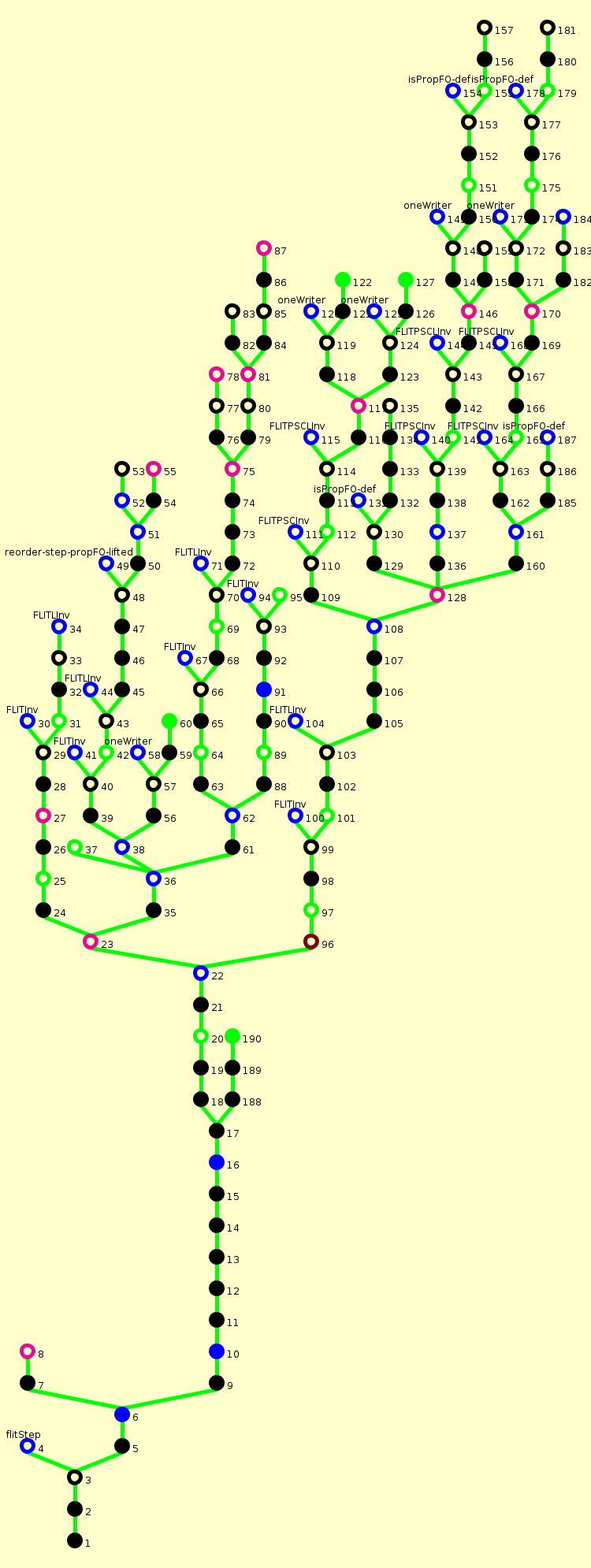
Proof step 1 from proof step-absstep-PROP_FO-doWriteFO (conclusion)
(back to tree)
| oneMember(tid, als.l, gs.fwriters), FLITInv(gs, lsf, pcf), FLITInv(gs0, lsf0, pcf0), FLITPSCInv(ags, alsf, apcf),
flitStep(mkstate(gs, lsf, pcf), doWriteFO(tid, l), mkstate(gs0, lsf0, pcf0)), abs(mkstate(gs, lsf, pcf), mkstate(ags, alsf, apcf))
⊦ ∃ ags0, alsf0, apcf0.
flitpscStep(mkstate(ags, alsf, apcf), pwbPSC(tid, l), mkstate(ags0, alsf0, apcf0)) ∧ abs(mkstate(gs0, lsf0, pcf0), mkstate(ags0, alsf0, apcf0)) |
System applied rule normalize
And obtained the following new goals
- Proof step 2:
FLITInv(gs0, lsf0, pcf0), FLITInv(gs, lsf, pcf), FLITPSCInv(ags, alsf, apcf), abs(mkstate(gs, lsf, pcf), mkstate(ags, alsf, apcf)),
flitStep(mkstate(gs, lsf, pcf), doWriteFO(tid, l), mkstate(gs0, lsf0, pcf0)), oneMember(tid, als.l, gs.fwriters)
⊦ ∃ ags0, alsf0, apcf0.
flitpscStep(mkstate(ags, alsf, apcf), pwbPSC(tid, l), mkstate(ags0, alsf0, apcf0)) ∧ abs(mkstate(gs0, lsf0, pcf0), mkstate(ags0, alsf0, apcf0))
Rule argument
Additional information
Proof step 2 from proof step-absstep-PROP_FO-doWriteFO (previous step)
(back to tree)
| FLITInv(gs0, lsf0, pcf0), FLITInv(gs, lsf, pcf), FLITPSCInv(ags, alsf, apcf), abs(mkstate(gs, lsf, pcf), mkstate(ags, alsf, apcf)),
flitStep(mkstate(gs, lsf, pcf), doWriteFO(tid, l), mkstate(gs0, lsf0, pcf0)), oneMember(tid, als.l, gs.fwriters)
⊦ ∃ ags0, alsf0, apcf0.
flitpscStep(mkstate(ags, alsf, apcf), pwbPSC(tid, l), mkstate(ags0, alsf0, apcf0)) ∧ abs(mkstate(gs0, lsf0, pcf0), mkstate(ags0, alsf0, apcf0)) |
Heuristic simplifier applied rule simplifier
And obtained the following new goals
- Proof step 3:
ags.ctr = gs.fctr, ags.mem = gs.pmem, ags.writers = gs.fwriters, FLITInv(gs, lsf, pcf), FLITInv(gs0, lsf0, pcf0), FLITPSCInv(ags, alsf, apcf),
flitStep(mkstate(gs, lsf, pcf), doWriteFO(tid, l), mkstate(gs0, lsf0, pcf0)), oneMember(tid, als.l, gs.fwriters), reorder(ags.p, gs.pq, gs.rfo),
∀ t. labs(gs, lsf(t), pcf(t), ags, alsf(t), apcf(t))
⊦ ∃ ags0, alsf0, apcf0.
(∃ t.
pre(ags, alsf(t), apcf(t), pwbPSC(tid, l)) ∧ ags0 = gstepf(ags, alsf(t), apcf(t), pwbPSC(tid, l))
∧ alsf0 = alsf(t := lstepf(ags, alsf(t), apcf(t), pwbPSC(tid, l))) ∧ apcf0 = apcf(t := pcstepf(ags, alsf(t), apcf(t), pwbPSC(tid, l))))
∧ ags0.mem = gs0.pmem ∧ ags0.ctr = gs0.fctr ∧ reorder(ags0.p, gs0.pq, gs0.rfo) ∧ ags0.writers = gs0.fwriters
∧ (∀ t. labs(gs0, lsf0(t), pcf0(t), ags0, alsf0(t), apcf0(t)))
Rule argument
Additional information
Used simplifier rules:
abs-def: ⊦ abs(mkstate(gs, lsf, pcf), mkstate(ags, alsf, apcf))
↔ gabs(gs, lsf, pcf, ags, alsf, apcf)
∧ (∀ t. labs(gs, lsf(t), pcf(t), ags, alsf(t), apcf(t)));
gabs-def: ⊦ gabs(gs, lsf, pcf, ags, alsf, apcf)
↔ ags.mem = gs.pmem ∧ ags.ctr = gs.fctr ∧ reorder(ags.p, gs.pq, gs.rfo)
∧ ags.writers = gs.fwriters;
⊦ globalPSCCRASH ≠ pwbPSC(t, l); (s)
⊦ globalPSCPERSIST_FO(l) ≠ pwbPSC(t, l0); (s)
⊦ globalPSCPERSIST_W(l) ≠ pwbPSC(t, l0); (s)
⊦ lstep(gs, ls, pc, a, gs0, ls0, pc0)
↔ pre(gs, ls, pc, a) ∧ ls0 = lstepf(gs, ls, pc, a) ∧ gs0 = gstepf(gs, ls, pc, a)
∧ pc0 = pcstepf(gs, ls, pc, a); (s)
⊦ flitpscStep(mkstate(gs, lsf, pcf), a, mkstate(gs0, lsf0, pcf0))
↔ (∃ t, ls, pc.
lstep(gs, lsf(t), pcf(t), a, gs0, ls, pc) ∧ lsf0 = lsf(t := ls)
∧ pcf0 = pcf(t := pc))
∨ (∃ l.
a = globalPSCPERSIST_W(l) ∧ firstPersistW(gs.p(l)) < # gs.p(l)
∧ gs0
= (gs.mem:= gs.mem(l := gs.p(l)[firstPersistW(gs.p(l))].val))
.p:= gs.p(l := gs.p(l) -p firstPersistW(gs.p(l)))
∧ lsf0 = lsf ∧ pcf0 = pcf)
∨ (∃ l.
a = globalPSCPERSIST_FO(l)
∧ (∃ n. isPersistFO(n, gs.p(l)) ∧ gs0 = gs.p:= gs.p(l := gs.p(l) -p n))
∧ lsf0 = lsf ∧ pcf0 = pcf)
∨ a = globalPSCCRASH ∧ gs0 = mkFLITPSCgs(gs.mem, λ l. [], λ l. 0, λ l. ∅, λ l. ∅)
∧ lsf0 = lsf ∧ pcf0 = (λ t. (pcf(t) = idle ⊃ idle;crashed)); (s)
Proof step 3 from proof step-absstep-PROP_FO-doWriteFO (previous step)
(back to tree)
| ags.ctr = gs.fctr, ags.mem = gs.pmem, ags.writers = gs.fwriters, FLITInv(gs, lsf, pcf), FLITInv(gs0, lsf0, pcf0), FLITPSCInv(ags, alsf, apcf),
flitStep(mkstate(gs, lsf, pcf), doWriteFO(tid, l), mkstate(gs0, lsf0, pcf0)), oneMember(tid, als.l, gs.fwriters), reorder(ags.p, gs.pq, gs.rfo),
∀ t. labs(gs, lsf(t), pcf(t), ags, alsf(t), apcf(t))
⊦ ∃ ags0, alsf0, apcf0.
(∃ t.
pre(ags, alsf(t), apcf(t), pwbPSC(tid, l)) ∧ ags0 = gstepf(ags, alsf(t), apcf(t), pwbPSC(tid, l))
∧ alsf0 = alsf(t := lstepf(ags, alsf(t), apcf(t), pwbPSC(tid, l))) ∧ apcf0 = apcf(t := pcstepf(ags, alsf(t), apcf(t), pwbPSC(tid, l))))
∧ ags0.mem = gs0.pmem ∧ ags0.ctr = gs0.fctr ∧ reorder(ags0.p, gs0.pq, gs0.rfo) ∧ ags0.writers = gs0.fwriters
∧ (∀ t. labs(gs0, lsf0(t), pcf0(t), ags0, alsf0(t), apcf0(t))) |
User applied rule apply rewrite lemma
And obtained the following new goals
- Proof step 4:
⊦ flitStep(mkstate(gs, lsf, pcf), a, mkstate(gs0, lsf0, pcf0))
↔ (∃ t, ls, pc. lstep(gs, lsf(t), pcf(t), a, gs0, ls, pc) ∧ lsf0 = lsf(t := ls) ∧ pcf0 = pcf(t := pc))
∨ (∃ tid.
a = doWrite(tid, gs.bq(tid).head.l, gs.bq(tid).head.v) ∧ (gs.bq(tid) ≠ [] ∧ gs.bq(tid).head.W?)
∧ gs0 = (gs.pq:= gs.pq(gs.bq(tid).head.l := gs.pq(gs.bq(tid).head.l) + W(gs.bq(tid).head.v, tid))).bq:= gs.bq(tid := gs.bq(tid).tail)
∧ lsf0 = lsf ∧ pcf0 = pcf)
∨ (∃ tid, l.
a = (oneMember(tid, l, gs.fwriters) ⊃ doWriteFO(tid, l);propFO(tid, l)) ∧ (∃ n. n < # gs.bq(tid) ∧ isPropFO(n, l, gs.bq(tid)))
∧ ⟨fwriters := gs.fwriters, pq := gs.pq, bq := gs.bq, rfo := gs.rfo; PROP_FO(tid, l, fwriters; pq, bq, rfo);
gs := ((gs.pq:= pq).bq:= bq).rfo:= rfo⟩ (gs0 = gs ∧ lsf0 = lsf ∧ pcf0 = pcf))
∨ (∃ tid.
a = propSF(tid) ∧ (gs.bq(tid) ≠ [] ∧ gs.bq(tid).head = SF ∧ (∀ l. ¬ FO(tid) ∈ gs.pq(l))) ∧ gs0 = gs.bq:= gs.bq(tid := gs.bq(tid).tail)
∧ lsf0 = lsf ∧ pcf0 = pcf)
∨ (∃ loc.
a = globalPERSIST_W(loc) ∧ (gs.pq(loc) ≠ [] ∧ gs.pq(loc).head.W?)
∧ gs0 = (gs.pmem:= gs.pmem(loc := gs.pq(loc).head.val)).pq:= gs.pq(loc := gs.pq(loc).tail) ∧ lsf0 = lsf ∧ pcf0 = pcf)
∨ (∃ loc.
a = globalPERSIST_FO(loc) ∧ (gs.pq(loc) ≠ [] ∧ gs.pq(loc).head.FO?) ∧ gs0 = gs.pq:= gs.pq(loc := gs.pq(loc).tail) ∧ lsf0 = lsf ∧ pcf0 = pcf)
∨ a = globalCRASH
∧ ⟨pq := gs.pq, fctr := gs.fctr, bq := gs.bq, fwriters := gs.fwriters, freaders := gs.freaders, rfo := gs.rfo;
CRASH(; pq, fctr, bq, fwriters, freaders, rfo, pcf);
gs := (((((gs.pq:= pq).fctr:= fctr).bq:= bq).fwriters:= fwriters).freaders:= freaders).rfo:= rfo⟩ (gs0 = gs ∧ lsf0 = lsf ∧ pcf0 = pcf)
- Proof step 5:
(∃ t, ls, pc. lstep(gs, lsf(t), pcf(t), doWriteFO(tid, l), gs0, ls, pc) ∧ lsf0 = lsf(t := ls) ∧ pcf0 = pcf(t := pc))
∨ (∃ tid0.
doWriteFO(tid, l) = doWrite(tid0, gs.bq(tid0).head.l, gs.bq(tid0).head.v) ∧ (gs.bq(tid0) ≠ [] ∧ gs.bq(tid0).head.W?)
∧ gs0 = (gs.pq:= gs.pq(gs.bq(tid0).head.l := gs.pq(gs.bq(tid0).head.l) + W(gs.bq(tid0).head.v, tid0))).bq:= gs.bq(tid0 := gs.bq(tid0).tail)
∧ lsf0 = lsf ∧ pcf0 = pcf)
∨ (∃ tid0, l0.
doWriteFO(tid, l) = (oneMember(tid0, l0, gs.fwriters) ⊃ doWriteFO(tid0, l0);propFO(tid0, l0))
∧ (∃ n. n < # gs.bq(tid0) ∧ isPropFO(n, l0, gs.bq(tid0)))
∧ ⟨fwriters := gs.fwriters, pq := gs.pq, bq := gs.bq, rfo := gs.rfo; PROP_FO(tid0, l0, fwriters; pq, bq, rfo);
gs := ((gs.pq:= pq).bq:= bq).rfo:= rfo⟩ (gs0 = gs ∧ lsf0 = lsf ∧ pcf0 = pcf))
∨ (∃ tid0.
doWriteFO(tid, l) = propSF(tid0) ∧ (gs.bq(tid0) ≠ [] ∧ gs.bq(tid0).head = SF ∧ (∀ l. ¬ FO(tid0) ∈ gs.pq(l)))
∧ gs0 = gs.bq:= gs.bq(tid0 := gs.bq(tid0).tail) ∧ lsf0 = lsf ∧ pcf0 = pcf)
∨ (∃ loc.
doWriteFO(tid, l) = globalPERSIST_W(loc) ∧ (gs.pq(loc) ≠ [] ∧ gs.pq(loc).head.W?)
∧ gs0 = (gs.pmem:= gs.pmem(loc := gs.pq(loc).head.val)).pq:= gs.pq(loc := gs.pq(loc).tail) ∧ lsf0 = lsf ∧ pcf0 = pcf)
∨ (∃ loc.
doWriteFO(tid, l) = globalPERSIST_FO(loc) ∧ (gs.pq(loc) ≠ [] ∧ gs.pq(loc).head.FO?) ∧ gs0 = gs.pq:= gs.pq(loc := gs.pq(loc).tail) ∧ lsf0 = lsf
∧ pcf0 = pcf)
∨ doWriteFO(tid, l) = globalCRASH
∧ ⟨pq := gs.pq, fctr := gs.fctr, bq := gs.bq, fwriters := gs.fwriters, freaders := gs.freaders, rfo := gs.rfo;
CRASH(; pq, fctr, bq, fwriters, freaders, rfo, pcf);
gs := (((((gs.pq:= pq).fctr:= fctr).bq:= bq).fwriters:= fwriters).freaders:= freaders).rfo:= rfo⟩ (gs0 = gs ∧ lsf0 = lsf ∧ pcf0 = pcf),
ags.ctr = gs.fctr, ags.mem = gs.pmem, ags.writers = gs.fwriters, FLITInv(gs0, lsf0, pcf0), FLITInv(gs, lsf, pcf), FLITPSCInv(ags, alsf, apcf),
oneMember(tid, als.l, gs.fwriters), reorder(ags.p, gs.pq, gs.rfo), ∀ t. labs(gs, lsf(t), pcf(t), ags, alsf(t), apcf(t))
⊦ ∃ ags0, alsf0, apcf0.
(∃ t.
pre(ags, alsf(t), apcf(t), pwbPSC(tid, l)) ∧ ags0 = gstepf(ags, alsf(t), apcf(t), pwbPSC(tid, l))
∧ alsf0 = alsf(t := lstepf(ags, alsf(t), apcf(t), pwbPSC(tid, l))) ∧ apcf0 = apcf(t := pcstepf(ags, alsf(t), apcf(t), pwbPSC(tid, l))))
∧ ags0.mem = gs0.pmem ∧ ags0.ctr = gs0.fctr ∧ reorder(ags0.p, gs0.pq, gs0.rfo) ∧ ags0.writers = gs0.fwriters
∧ (∀ t. labs(gs0, lsf0(t), pcf0(t), ags0, alsf0(t), apcf0(t)))
Rule argument
spec: FLIT, name:flitStep,
seq:⊦ flitStep(mkstate(gs, lsf, pcf), a, mkstate(gs0, lsf0, pcf0))
↔ (∃ t, ls, pc.
lstep(gs, lsf(t), pcf(t), a, gs0, ls, pc) ∧ lsf0 = lsf(t := ls)
∧ pcf0 = pcf(t := pc))
∨ (∃ tid.
a = doWrite(tid, gs.bq(tid).head.l, gs.bq(tid).head.v)
∧ (gs.bq(tid) ≠ [] ∧ gs.bq(tid).head.W?)
∧ gs0
= ( gs
.pq:= gs.pq
(gs.bq(tid).head.l
:= gs.pq(gs.bq(tid).head.l) + W(gs.bq(tid).head.v, tid)
))
.bq:= gs.bq(tid := gs.bq(tid).tail)
∧ lsf0 = lsf ∧ pcf0 = pcf)
∨ (∃ tid, l.
a = (oneMember(tid, l, gs.fwriters) ⊃ doWriteFO(tid, l);propFO(tid, l))
∧ (∃ n. n < # gs.bq(tid) ∧ isPropFO(n, l, gs.bq(tid)))
∧ ⟨fwriters := gs.fwriters, pq := gs.pq, bq := gs.bq, rfo := gs.rfo;
PROP_FO(tid, l, fwriters; pq, bq, rfo);
gs := ((gs.pq:= pq).bq:= bq).rfo:= rfo⟩
(gs0 = gs ∧ lsf0 = lsf ∧ pcf0 = pcf))
∨ (∃ tid.
a = propSF(tid)
∧ (gs.bq(tid) ≠ [] ∧ gs.bq(tid).head = SF ∧ (∀ l. ¬ FO(tid) ∈ gs.pq(l)))
∧ gs0 = gs.bq:= gs.bq(tid := gs.bq(tid).tail) ∧ lsf0 = lsf ∧ pcf0 = pcf)
∨ (∃ loc.
a = globalPERSIST_W(loc) ∧ (gs.pq(loc) ≠ [] ∧ gs.pq(loc).head.W?)
∧ gs0
= (gs.pmem:= gs.pmem(loc := gs.pq(loc).head.val))
.pq:= gs.pq(loc := gs.pq(loc).tail)
∧ lsf0 = lsf ∧ pcf0 = pcf)
∨ (∃ loc.
a = globalPERSIST_FO(loc) ∧ (gs.pq(loc) ≠ [] ∧ gs.pq(loc).head.FO?)
∧ gs0 = gs.pq:= gs.pq(loc := gs.pq(loc).tail) ∧ lsf0 = lsf ∧ pcf0 = pcf)
∨ a = globalCRASH
∧ ⟨pq := gs.pq, fctr := gs.fctr, bq := gs.bq, fwriters := gs.fwriters,
freaders := gs.freaders, rfo := gs.rfo;
CRASH(; pq, fctr, bq, fwriters, freaders, rfo, pcf);
gs
:= ( ( (((gs.pq:= pq).fctr:= fctr).bq:= bq)
.fwriters:= fwriters)
.freaders:= freaders)
.rfo:= rfo⟩ (gs0 = gs ∧ lsf0 = lsf ∧ pcf0 = pcf),
subst:[lsf, gs, lsf0, a, pcf, pcf0, gs0]
→ [lsf, gs, lsf0, doWriteFO(tid, l), pcf, pcf0, gs0],
<all paths>
Additional information
Used terms: pcf0, doWriteFO(tid, l), lsf, gs0, pcf, lsf0, gs
Proof step 4 from proof step-absstep-PROP_FO-doWriteFO (previous step)
(back to tree)
| ⊦ flitStep(mkstate(gs, lsf, pcf), a, mkstate(gs0, lsf0, pcf0))
↔ (∃ t, ls, pc. lstep(gs, lsf(t), pcf(t), a, gs0, ls, pc) ∧ lsf0 = lsf(t := ls) ∧ pcf0 = pcf(t := pc))
∨ (∃ tid.
a = doWrite(tid, gs.bq(tid).head.l, gs.bq(tid).head.v) ∧ (gs.bq(tid) ≠ [] ∧ gs.bq(tid).head.W?)
∧ gs0 = (gs.pq:= gs.pq(gs.bq(tid).head.l := gs.pq(gs.bq(tid).head.l) + W(gs.bq(tid).head.v, tid))).bq:= gs.bq(tid := gs.bq(tid).tail)
∧ lsf0 = lsf ∧ pcf0 = pcf)
∨ (∃ tid, l.
a = (oneMember(tid, l, gs.fwriters) ⊃ doWriteFO(tid, l);propFO(tid, l)) ∧ (∃ n. n < # gs.bq(tid) ∧ isPropFO(n, l, gs.bq(tid)))
∧ ⟨fwriters := gs.fwriters, pq := gs.pq, bq := gs.bq, rfo := gs.rfo; PROP_FO(tid, l, fwriters; pq, bq, rfo);
gs := ((gs.pq:= pq).bq:= bq).rfo:= rfo⟩ (gs0 = gs ∧ lsf0 = lsf ∧ pcf0 = pcf))
∨ (∃ tid.
a = propSF(tid) ∧ (gs.bq(tid) ≠ [] ∧ gs.bq(tid).head = SF ∧ (∀ l. ¬ FO(tid) ∈ gs.pq(l))) ∧ gs0 = gs.bq:= gs.bq(tid := gs.bq(tid).tail)
∧ lsf0 = lsf ∧ pcf0 = pcf)
∨ (∃ loc.
a = globalPERSIST_W(loc) ∧ (gs.pq(loc) ≠ [] ∧ gs.pq(loc).head.W?)
∧ gs0 = (gs.pmem:= gs.pmem(loc := gs.pq(loc).head.val)).pq:= gs.pq(loc := gs.pq(loc).tail) ∧ lsf0 = lsf ∧ pcf0 = pcf)
∨ (∃ loc.
a = globalPERSIST_FO(loc) ∧ (gs.pq(loc) ≠ [] ∧ gs.pq(loc).head.FO?) ∧ gs0 = gs.pq:= gs.pq(loc := gs.pq(loc).tail) ∧ lsf0 = lsf ∧ pcf0 = pcf)
∨ a = globalCRASH
∧ ⟨pq := gs.pq, fctr := gs.fctr, bq := gs.bq, fwriters := gs.fwriters, freaders := gs.freaders, rfo := gs.rfo;
CRASH(; pq, fctr, bq, fwriters, freaders, rfo, pcf);
gs := (((((gs.pq:= pq).fctr:= fctr).bq:= bq).fwriters:= fwriters).freaders:= freaders).rfo:= rfo⟩ (gs0 = gs ∧ lsf0 = lsf ∧ pcf0 = pcf) |
A spec-lemma
Proof step 5 from proof step-absstep-PROP_FO-doWriteFO (previous step)
(back to tree)
| (∃ t, ls, pc. lstep(gs, lsf(t), pcf(t), doWriteFO(tid, l), gs0, ls, pc) ∧ lsf0 = lsf(t := ls) ∧ pcf0 = pcf(t := pc))
∨ (∃ tid0.
doWriteFO(tid, l) = doWrite(tid0, gs.bq(tid0).head.l, gs.bq(tid0).head.v) ∧ (gs.bq(tid0) ≠ [] ∧ gs.bq(tid0).head.W?)
∧ gs0 = (gs.pq:= gs.pq(gs.bq(tid0).head.l := gs.pq(gs.bq(tid0).head.l) + W(gs.bq(tid0).head.v, tid0))).bq:= gs.bq(tid0 := gs.bq(tid0).tail)
∧ lsf0 = lsf ∧ pcf0 = pcf)
∨ (∃ tid0, l0.
doWriteFO(tid, l) = (oneMember(tid0, l0, gs.fwriters) ⊃ doWriteFO(tid0, l0);propFO(tid0, l0))
∧ (∃ n. n < # gs.bq(tid0) ∧ isPropFO(n, l0, gs.bq(tid0)))
∧ ⟨fwriters := gs.fwriters, pq := gs.pq, bq := gs.bq, rfo := gs.rfo; PROP_FO(tid0, l0, fwriters; pq, bq, rfo);
gs := ((gs.pq:= pq).bq:= bq).rfo:= rfo⟩ (gs0 = gs ∧ lsf0 = lsf ∧ pcf0 = pcf))
∨ (∃ tid0.
doWriteFO(tid, l) = propSF(tid0) ∧ (gs.bq(tid0) ≠ [] ∧ gs.bq(tid0).head = SF ∧ (∀ l. ¬ FO(tid0) ∈ gs.pq(l)))
∧ gs0 = gs.bq:= gs.bq(tid0 := gs.bq(tid0).tail) ∧ lsf0 = lsf ∧ pcf0 = pcf)
∨ (∃ loc.
doWriteFO(tid, l) = globalPERSIST_W(loc) ∧ (gs.pq(loc) ≠ [] ∧ gs.pq(loc).head.W?)
∧ gs0 = (gs.pmem:= gs.pmem(loc := gs.pq(loc).head.val)).pq:= gs.pq(loc := gs.pq(loc).tail) ∧ lsf0 = lsf ∧ pcf0 = pcf)
∨ (∃ loc.
doWriteFO(tid, l) = globalPERSIST_FO(loc) ∧ (gs.pq(loc) ≠ [] ∧ gs.pq(loc).head.FO?) ∧ gs0 = gs.pq:= gs.pq(loc := gs.pq(loc).tail) ∧ lsf0 = lsf
∧ pcf0 = pcf)
∨ doWriteFO(tid, l) = globalCRASH
∧ ⟨pq := gs.pq, fctr := gs.fctr, bq := gs.bq, fwriters := gs.fwriters, freaders := gs.freaders, rfo := gs.rfo;
CRASH(; pq, fctr, bq, fwriters, freaders, rfo, pcf);
gs := (((((gs.pq:= pq).fctr:= fctr).bq:= bq).fwriters:= fwriters).freaders:= freaders).rfo:= rfo⟩ (gs0 = gs ∧ lsf0 = lsf ∧ pcf0 = pcf),
ags.ctr = gs.fctr, ags.mem = gs.pmem, ags.writers = gs.fwriters, FLITInv(gs0, lsf0, pcf0), FLITInv(gs, lsf, pcf), FLITPSCInv(ags, alsf, apcf),
oneMember(tid, als.l, gs.fwriters), reorder(ags.p, gs.pq, gs.rfo), ∀ t. labs(gs, lsf(t), pcf(t), ags, alsf(t), apcf(t))
⊦ ∃ ags0, alsf0, apcf0.
(∃ t.
pre(ags, alsf(t), apcf(t), pwbPSC(tid, l)) ∧ ags0 = gstepf(ags, alsf(t), apcf(t), pwbPSC(tid, l))
∧ alsf0 = alsf(t := lstepf(ags, alsf(t), apcf(t), pwbPSC(tid, l))) ∧ apcf0 = apcf(t := pcstepf(ags, alsf(t), apcf(t), pwbPSC(tid, l))))
∧ ags0.mem = gs0.pmem ∧ ags0.ctr = gs0.fctr ∧ reorder(ags0.p, gs0.pq, gs0.rfo) ∧ ags0.writers = gs0.fwriters
∧ (∀ t. labs(gs0, lsf0(t), pcf0(t), ags0, alsf0(t), apcf0(t))) |
Heuristic simplifier applied rule simplifier
And obtained the following new goals
- Proof step 6:
pre(gs, lsf(t), pcf(t), doWriteFO(tid, l)) ∧ ls = lstepf(gs, lsf(t), pcf(t), doWriteFO(tid, l))
∧ gs0 = gstepf(gs, lsf(t), pcf(t), doWriteFO(tid, l)) ∧ pc = pcstepf(gs, lsf(t), pcf(t), doWriteFO(tid, l))
∧ lsf0 = lsf(t := lstepf(gs, lsf(t), pcf(t), doWriteFO(tid, l))) ∧ pcf0 = pcf(t := pcstepf(gs, lsf(t), pcf(t), doWriteFO(tid, l)))
∨ doWriteFO(tid, l) = (oneMember(tid0, l0, gs.fwriters) ⊃ doWriteFO(tid0, l0);propFO(tid0, l0)) ∧ n < # gs.bq(tid0)
∧ isPropFO(n, l0, gs.bq(tid0))
∧ ⟨fwriters := gs.fwriters, pq := gs.pq, bq := gs.bq, rfo := gs.rfo; PROP_FO(tid0, l0, fwriters; pq, bq, rfo);
gs := ((gs.pq:= pq).bq:= bq).rfo:= rfo⟩ (gs0 = gs ∧ lsf0 = lsf ∧ pcf0 = pcf),
ags.ctr = gs.fctr, ags.mem = gs.pmem, ags.writers = gs.fwriters, FLITInv(gs, lsf, pcf), FLITInv(gs0, lsf0, pcf0), FLITPSCInv(ags, alsf, apcf),
oneMember(tid, als.l, gs.fwriters), reorder(ags.p, gs.pq, gs.rfo), ∀ t. labs(gs, lsf(t), pcf(t), ags, alsf(t), apcf(t))
⊦ ∃ ags0, alsf0, apcf0.
(∃ t.
pre(ags, alsf(t), apcf(t), pwbPSC(tid, l)) ∧ ags0 = gstepf(ags, alsf(t), apcf(t), pwbPSC(tid, l))
∧ alsf0 = alsf(t := lstepf(ags, alsf(t), apcf(t), pwbPSC(tid, l))) ∧ apcf0 = apcf(t := pcstepf(ags, alsf(t), apcf(t), pwbPSC(tid, l))))
∧ ags0.mem = gs0.pmem ∧ ags0.ctr = gs0.fctr ∧ reorder(ags0.p, gs0.pq, gs0.rfo) ∧ ags0.writers = gs0.fwriters
∧ (∀ t. labs(gs0, lsf0(t), pcf0(t), ags0, alsf0(t), apcf0(t)))
Rule argument
Additional information
Used simplifier rules:
⊦ doWriteFO(t, loc) ≠ globalCRASH; (s)
⊦ doWriteFO(t, loc) ≠ globalPERSIST_FO(loc0); (s)
⊦ doWriteFO(t, loc) ≠ globalPERSIST_W(loc0); (s)
⊦ doWriteFO(t, loc) ≠ propSF(t0); (s)
⊦ doWrite(t, loc, v) ≠ doWriteFO(t0, loc0); (s)
⊦ lstep(gs, ls, pc, a, gs0, ls0, pc0)
↔ pre(gs, ls, pc, a) ∧ ls0 = lstepf(gs, ls, pc, a) ∧ gs0 = gstepf(gs, ls, pc, a)
∧ pc0 = pcstepf(gs, ls, pc, a); (s)
Proof step 6 from proof step-absstep-PROP_FO-doWriteFO (previous step)
(back to tree)
| pre(gs, lsf(t), pcf(t), doWriteFO(tid, l)) ∧ ls = lstepf(gs, lsf(t), pcf(t), doWriteFO(tid, l))
∧ gs0 = gstepf(gs, lsf(t), pcf(t), doWriteFO(tid, l)) ∧ pc = pcstepf(gs, lsf(t), pcf(t), doWriteFO(tid, l))
∧ lsf0 = lsf(t := lstepf(gs, lsf(t), pcf(t), doWriteFO(tid, l))) ∧ pcf0 = pcf(t := pcstepf(gs, lsf(t), pcf(t), doWriteFO(tid, l)))
∨ doWriteFO(tid, l) = (oneMember(tid0, l0, gs.fwriters) ⊃ doWriteFO(tid0, l0);propFO(tid0, l0)) ∧ n < # gs.bq(tid0)
∧ isPropFO(n, l0, gs.bq(tid0))
∧ ⟨fwriters := gs.fwriters, pq := gs.pq, bq := gs.bq, rfo := gs.rfo; PROP_FO(tid0, l0, fwriters; pq, bq, rfo);
gs := ((gs.pq:= pq).bq:= bq).rfo:= rfo⟩ (gs0 = gs ∧ lsf0 = lsf ∧ pcf0 = pcf),
ags.ctr = gs.fctr, ags.mem = gs.pmem, ags.writers = gs.fwriters, FLITInv(gs, lsf, pcf), FLITInv(gs0, lsf0, pcf0), FLITPSCInv(ags, alsf, apcf),
oneMember(tid, als.l, gs.fwriters), reorder(ags.p, gs.pq, gs.rfo), ∀ t. labs(gs, lsf(t), pcf(t), ags, alsf(t), apcf(t))
⊦ ∃ ags0, alsf0, apcf0.
(∃ t.
pre(ags, alsf(t), apcf(t), pwbPSC(tid, l)) ∧ ags0 = gstepf(ags, alsf(t), apcf(t), pwbPSC(tid, l))
∧ alsf0 = alsf(t := lstepf(ags, alsf(t), apcf(t), pwbPSC(tid, l))) ∧ apcf0 = apcf(t := pcstepf(ags, alsf(t), apcf(t), pwbPSC(tid, l))))
∧ ags0.mem = gs0.pmem ∧ ags0.ctr = gs0.fctr ∧ reorder(ags0.p, gs0.pq, gs0.rfo) ∧ ags0.writers = gs0.fwriters
∧ (∀ t. labs(gs0, lsf0(t), pcf0(t), ags0, alsf0(t), apcf0(t))) |
Heuristic if-then-else split applied rule case distinction
And obtained the following new goals
- Proof step 7:
ags.ctr = gs.fctr, ags.mem = gs.pmem, ags.writers = gs.fwriters, gs0 = gstepf(gs, lsf(t), pcf(t), doWriteFO(tid, l)),
ls = lstepf(gs, lsf(t), pcf(t), doWriteFO(tid, l)), lsf0 = lsf(t := lstepf(gs, lsf(t), pcf(t), doWriteFO(tid, l))),
pc = pcstepf(gs, lsf(t), pcf(t), doWriteFO(tid, l)), pcf0 = pcf(t := pcstepf(gs, lsf(t), pcf(t), doWriteFO(tid, l))), FLITInv(gs0, lsf0, pcf0),
FLITInv(gs, lsf, pcf), FLITPSCInv(ags, alsf, apcf), oneMember(tid, als.l, gs.fwriters), pre(gs, lsf(t), pcf(t), doWriteFO(tid, l)),
reorder(ags.p, gs.pq, gs.rfo), ∀ t. labs(gs, lsf(t), pcf(t), ags, alsf(t), apcf(t))
⊦ ∃ ags0, alsf0, apcf0.
(∃ t.
pre(ags, alsf(t), apcf(t), pwbPSC(tid, l)) ∧ ags0 = gstepf(ags, alsf(t), apcf(t), pwbPSC(tid, l))
∧ alsf0 = alsf(t := lstepf(ags, alsf(t), apcf(t), pwbPSC(tid, l))) ∧ apcf0 = apcf(t := pcstepf(ags, alsf(t), apcf(t), pwbPSC(tid, l))))
∧ ags0.mem = gs0.pmem ∧ ags0.ctr = gs0.fctr ∧ reorder(ags0.p, gs0.pq, gs0.rfo) ∧ ags0.writers = gs0.fwriters
∧ (∀ t. labs(gs0, lsf0(t), pcf0(t), ags0, alsf0(t), apcf0(t)))
- Proof step 9:
⟨fwriters := gs.fwriters, pq := gs.pq, bq := gs.bq, rfo := gs.rfo; PROP_FO(tid0, l0, fwriters; pq, bq, rfo); gs := ((gs.pq:= pq).bq:= bq).rfo:= rfo⟩
(gs0 = gs ∧ lsf0 = lsf ∧ pcf0 = pcf),
ags.ctr = gs.fctr, ags.mem = gs.pmem, ags.writers = gs.fwriters,
doWriteFO(tid, l) = (oneMember(tid0, l0, gs.fwriters) ⊃ doWriteFO(tid0, l0);propFO(tid0, l0)), n < # gs.bq(tid0), FLITInv(gs0, lsf0, pcf0),
FLITInv(gs, lsf, pcf), FLITPSCInv(ags, alsf, apcf), isPropFO(n, l0, gs.bq(tid0)), oneMember(tid, als.l, gs.fwriters), reorder(ags.p, gs.pq, gs.rfo),
∀ t. labs(gs, lsf(t), pcf(t), ags, alsf(t), apcf(t))
⊦ ∃ ags0, alsf0, apcf0.
(∃ t.
pre(ags, alsf(t), apcf(t), pwbPSC(tid, l)) ∧ ags0 = gstepf(ags, alsf(t), apcf(t), pwbPSC(tid, l))
∧ alsf0 = alsf(t := lstepf(ags, alsf(t), apcf(t), pwbPSC(tid, l))) ∧ apcf0 = apcf(t := pcstepf(ags, alsf(t), apcf(t), pwbPSC(tid, l))))
∧ ags0.mem = gs0.pmem ∧ ags0.ctr = gs0.fctr ∧ reorder(ags0.p, gs0.pq, gs0.rfo) ∧ ags0.writers = gs0.fwriters
∧ (∀ t. labs(gs0, lsf0(t), pcf0(t), ags0, alsf0(t), apcf0(t)))
Rule argument
pos: left 1
Additional information
Proof step 7 from proof step-absstep-PROP_FO-doWriteFO (previous step)
(back to tree)
| ags.ctr = gs.fctr, ags.mem = gs.pmem, ags.writers = gs.fwriters, gs0 = gstepf(gs, lsf(t), pcf(t), doWriteFO(tid, l)),
ls = lstepf(gs, lsf(t), pcf(t), doWriteFO(tid, l)), lsf0 = lsf(t := lstepf(gs, lsf(t), pcf(t), doWriteFO(tid, l))),
pc = pcstepf(gs, lsf(t), pcf(t), doWriteFO(tid, l)), pcf0 = pcf(t := pcstepf(gs, lsf(t), pcf(t), doWriteFO(tid, l))), FLITInv(gs0, lsf0, pcf0),
FLITInv(gs, lsf, pcf), FLITPSCInv(ags, alsf, apcf), oneMember(tid, als.l, gs.fwriters), pre(gs, lsf(t), pcf(t), doWriteFO(tid, l)),
reorder(ags.p, gs.pq, gs.rfo), ∀ t. labs(gs, lsf(t), pcf(t), ags, alsf(t), apcf(t))
⊦ ∃ ags0, alsf0, apcf0.
(∃ t.
pre(ags, alsf(t), apcf(t), pwbPSC(tid, l)) ∧ ags0 = gstepf(ags, alsf(t), apcf(t), pwbPSC(tid, l))
∧ alsf0 = alsf(t := lstepf(ags, alsf(t), apcf(t), pwbPSC(tid, l))) ∧ apcf0 = apcf(t := pcstepf(ags, alsf(t), apcf(t), pwbPSC(tid, l))))
∧ ags0.mem = gs0.pmem ∧ ags0.ctr = gs0.fctr ∧ reorder(ags0.p, gs0.pq, gs0.rfo) ∧ ags0.writers = gs0.fwriters
∧ (∀ t. labs(gs0, lsf0(t), pcf0(t), ags0, alsf0(t), apcf0(t))) |
Heuristic simplifier applied rule simplifier
And obtained the following new goals
- Proof step 8:
ags.ctr = gs.fctr, ags.mem = gs.pmem, ags.writers = gs.fwriters, FLITInv(gs, lsf, pcf),
FLITInv
(gstepf(gs, lsf(t), pcf(t), doWriteFO(tid, l)), lsf(t := lstepf(gs, lsf(t), pcf(t), doWriteFO(tid, l))),
pcf(t := pcstepf(gs, lsf(t), pcf(t), doWriteFO(tid, l)))),
FLITPSCInv(ags, alsf, apcf), oneMember(tid, als.l, gs.fwriters), pre(gs, lsf(t), pcf(t), doWriteFO(tid, l)), reorder(ags.p, gs.pq, gs.rfo),
∀ t. labs(gs, lsf(t), pcf(t), ags, alsf(t), apcf(t))
⊦ ∃ ags0, alsf0, apcf0.
(∃ t.
pre(ags, alsf(t), apcf(t), pwbPSC(tid, l)) ∧ ags0 = gstepf(ags, alsf(t), apcf(t), pwbPSC(tid, l))
∧ alsf0 = alsf(t := lstepf(ags, alsf(t), apcf(t), pwbPSC(tid, l))) ∧ apcf0 = apcf(t := pcstepf(ags, alsf(t), apcf(t), pwbPSC(tid, l))))
∧ ags0.mem = gstepf(gs, lsf(t), pcf(t), doWriteFO(tid, l)).pmem ∧ ags0.ctr = gstepf(gs, lsf(t), pcf(t), doWriteFO(tid, l)).fctr
∧ reorder(ags0.p, gstepf(gs, lsf(t), pcf(t), doWriteFO(tid, l)).pq, gstepf(gs, lsf(t), pcf(t), doWriteFO(tid, l)).rfo)
∧ ags0.writers = gstepf(gs, lsf(t), pcf(t), doWriteFO(tid, l)).fwriters
∧ (∀ t0.
labs
(gstepf(gs, lsf(t), pcf(t), doWriteFO(tid, l)), (t = t0 ⊃ lstepf(gs, lsf(t0), pcf(t0), doWriteFO(tid, l));lsf(t0)),
(t = t0 ⊃ pcstepf(gs, lsf(t0), pcf(t0), doWriteFO(tid, l));pcf(t0)), ags0, alsf0(t0), apcf0(t0)))
Rule argument
Additional information
Proof step 8 from proof step-absstep-PROP_FO-doWriteFO (previous step)
(back to tree)
| ags.ctr = gs.fctr, ags.mem = gs.pmem, ags.writers = gs.fwriters, FLITInv(gs, lsf, pcf),
FLITInv
(gstepf(gs, lsf(t), pcf(t), doWriteFO(tid, l)), lsf(t := lstepf(gs, lsf(t), pcf(t), doWriteFO(tid, l))),
pcf(t := pcstepf(gs, lsf(t), pcf(t), doWriteFO(tid, l)))),
FLITPSCInv(ags, alsf, apcf), oneMember(tid, als.l, gs.fwriters), pre(gs, lsf(t), pcf(t), doWriteFO(tid, l)), reorder(ags.p, gs.pq, gs.rfo),
∀ t. labs(gs, lsf(t), pcf(t), ags, alsf(t), apcf(t))
⊦ ∃ ags0, alsf0, apcf0.
(∃ t.
pre(ags, alsf(t), apcf(t), pwbPSC(tid, l)) ∧ ags0 = gstepf(ags, alsf(t), apcf(t), pwbPSC(tid, l))
∧ alsf0 = alsf(t := lstepf(ags, alsf(t), apcf(t), pwbPSC(tid, l))) ∧ apcf0 = apcf(t := pcstepf(ags, alsf(t), apcf(t), pwbPSC(tid, l))))
∧ ags0.mem = gstepf(gs, lsf(t), pcf(t), doWriteFO(tid, l)).pmem ∧ ags0.ctr = gstepf(gs, lsf(t), pcf(t), doWriteFO(tid, l)).fctr
∧ reorder(ags0.p, gstepf(gs, lsf(t), pcf(t), doWriteFO(tid, l)).pq, gstepf(gs, lsf(t), pcf(t), doWriteFO(tid, l)).rfo)
∧ ags0.writers = gstepf(gs, lsf(t), pcf(t), doWriteFO(tid, l)).fwriters
∧ (∀ t0.
labs
(gstepf(gs, lsf(t), pcf(t), doWriteFO(tid, l)), (t = t0 ⊃ lstepf(gs, lsf(t0), pcf(t0), doWriteFO(tid, l));lsf(t0)),
(t = t0 ⊃ pcstepf(gs, lsf(t0), pcf(t0), doWriteFO(tid, l));pcf(t0)), ags0, alsf0(t0), apcf0(t0))) |
User applied rule constructor cut
And closed the goal!
Rule argument
term: pcf(t)
Additional information
Used simplifier rules:
FLITPC
freely generated by R1, R2, R3, R4, W1, W2, W3, W4, W5, W6, W7, crashed, idle, ready
;;
⊦ gstepf(gs, ls, ready, a) = gs; (s)
⊦ pre(gs, ls, ready, a)
↔ (∃ loc0, val0. a = invFLITWRITE(ls.t, loc0, val0))
∨ (∃ loc0. a = invFLITREAD(ls.t, loc0))
∨ a = callFLITCOMPLETE(ls.t) ∧ gs.bq(ls.t) = [] ∧ (∀ l. ¬ FO(ls.t) ∈ gs.pq(l)); (s)
⊦ doWriteFO(t, loc) ≠ invFLITWRITE(t0, loc0, v); (s)
⊦ doWriteFO(t, loc) ≠ invFLITREAD(t0, loc0); (s)
⊦ callFLITCOMPLETE(t) ≠ doWriteFO(t0, loc); (s)
⊦ pre(gs, ls, idle, a) ↔ a = callRUN(ls.t); (s)
⊦ callRUN(t) ≠ doWriteFO(t0, loc); (s)
⊦ pre(gs, ls, crashed, a) ↔ false; (s)
⊦ pcstepf(gs, ls, W7, a) = ready; (s)
⊦ pre(gs, ls, W7, a) ↔ a = retFLITWRITE(ls.t); (s)
⊦ doWriteFO(t, loc) ≠ retFLITWRITE(t0); (s)
⊦ gstepf(gs, ls, W6, a)
= (gs.fctr:= gs.fctr(ls.loc := gs.fctr(ls.loc) - 1))
.fwriters:= gs.fwriters(ls.loc := gs.fwriters(ls.loc) -- ls.t); (s)
⊦ lstepf(gs, ls, W6, a) = ls; (s)
⊦ pcstepf(gs, ls, W6, a) = W7; (s)
⊦ pre(gs, ls, W6, a)
↔ (gs.bq(ls.t) = [] ∧ (∀ l. ¬ FO(ls.t) ∈ gs.pq(l))) ∧ a = ctrDec(ls.t, ls.loc); (s)
⊦ ctrDec(t, loc) ≠ doWriteFO(t0, loc0); (s)
⊦ pcstepf(gs, ls, W5, a) = W6; (s)
⊦ pre(gs, ls, W5, a) ↔ a = τ; (s)
⊦ doWriteFO(t, loc) ≠ τ; (s)
⊦ pcstepf(gs, ls, W4, a) = W5; (s)
⊦ pre(gs, ls, W4, a) ↔ a = τ; (s)
⊦ pcstepf(gs, ls, W3, a) = W4; (s)
⊦ pre(gs, ls, W3, a) ↔ a = τ; (s)
⊦ gstepf(gs, ls, W2, a)
= (gs.fctr:= gs.fctr(ls.loc := gs.fctr(ls.loc) + 1))
.fwriters:= gs.fwriters(ls.loc := gs.fwriters(ls.loc) ++ ls.t); (s)
⊦ lstepf(gs, ls, W2, a) = ls; (s)
⊦ pcstepf(gs, ls, W2, a) = W3; (s)
⊦ pre(gs, ls, W2, a)
↔ (gs.bq(ls.t) = [] ∧ (∀ l. ¬ FO(ls.t) ∈ gs.pq(l))) ∧ a = ctrInc(ls.t, ls.loc); (s)
⊦ ctrInc(t, loc) ≠ doWriteFO(t0, loc0); (s)
⊦ gstepf(gs, ls, W1, a) = gs.bq:= gs.bq(ls.t := gs.bq(ls.t) + SF); (s)
⊦ x + a = x + a '; (s)
⊦ lstepf(gs, ls, W1, a) = ls; (s)
⊦ pcstepf(gs, ls, W1, a) = W2; (s)
⊦ pre(gs, ls, W1, a) ↔ a = sfence(ls.t); (s)
⊦ doWriteFO(t, loc) ≠ sfence(t0); (s)
⊦ pcstepf(gs, ls, R4, a) = ready; (s)
⊦ pre(gs, ls, R4, a) ↔ a = retFLITREAD(ls.t, ls.val); (s)
⊦ doWriteFO(t, loc) ≠ retFLITREAD(t0, v); (s)
⊦ gstepf(gs, ls, R3, a)
= ( (gs.bq:= gs.bq(ls.t := gs.bq(ls.t) + FO(ls.loc)))
.rfo:= gs.rfo(ls.t := gs.rfo(ls.t) + FO(ls.loc)))
.freaders:= gs.freaders(ls.loc := gs.freaders(ls.loc) -- ls.t); (s)
⊦ lstepf(gs, ls, R3, a) = ls; (s)
⊦ pcstepf(gs, ls, R3, a) = R4; (s)
⊦ pre(gs, ls, R3, a) ↔ a = pwb(ls.t, ls.loc); (s)
⊦ doWriteFO(t, loc) ≠ pwb(t0, loc0); (s)
⊦ gstepf(gs, ls, R2, a)
= (gs.fctr(ls.loc) ≠ 0
⊃ gs
;gs.freaders:= gs.freaders(ls.loc := gs.freaders(ls.loc) -- ls.t)
); (s)
⊦ lstepf(gs, ls, R2, a) = ls; (s)
⊦ pcstepf(gs, ls, R2, a) = (gs.fctr(ls.loc) ≠ 0 ⊃ R3;R4); (s)
⊦ pre(gs, ls, R2, a) ↔ a = ctrRead(ls.t, ls.loc, gs.fctr(ls.loc)); (s)
⊦ ctrRead(t, loc, n) ≠ doWriteFO(t0, loc0); (s)
⊦ gstepf(gs, ls, R1, a) = gs.freaders:= gs.freaders(ls.loc := gs.freaders(ls.loc) ++ ls.t); (s)
⊦ lstepf(gs, ls, R1, a) = ls.val:= (((gs.pmem ⊕ gs.pq) ⊕ gs.bq(ls.t)))(ls.loc); (s)
⊦ pcstepf(gs, ls, R1, a) = R2; (s)
⊦ pre(gs, ls, R1, a) ↔ a = doRead(ls.t, ls.loc, ((gs.pmem ⊕ gs.pq))(ls.loc)); (s)
⊦ ((mem ⊕ p))(l) = mem(l) ⊕ p(l); (s)
⊦ reorder(p, pq, rfo) → v ⊕ pq(l) = v ⊕ p(l); (s)
⊦ doRead(t, loc, v) ≠ doWriteFO(t0, loc0); (s)
Proof step 9 from proof step-absstep-PROP_FO-doWriteFO (previous step)
(back to tree)
| ⟨fwriters := gs.fwriters, pq := gs.pq, bq := gs.bq, rfo := gs.rfo; PROP_FO(tid0, l0, fwriters; pq, bq, rfo); gs := ((gs.pq:= pq).bq:= bq).rfo:= rfo⟩
(gs0 = gs ∧ lsf0 = lsf ∧ pcf0 = pcf),
ags.ctr = gs.fctr, ags.mem = gs.pmem, ags.writers = gs.fwriters,
doWriteFO(tid, l) = (oneMember(tid0, l0, gs.fwriters) ⊃ doWriteFO(tid0, l0);propFO(tid0, l0)), n < # gs.bq(tid0), FLITInv(gs0, lsf0, pcf0),
FLITInv(gs, lsf, pcf), FLITPSCInv(ags, alsf, apcf), isPropFO(n, l0, gs.bq(tid0)), oneMember(tid, als.l, gs.fwriters), reorder(ags.p, gs.pq, gs.rfo),
∀ t. labs(gs, lsf(t), pcf(t), ags, alsf(t), apcf(t))
⊦ ∃ ags0, alsf0, apcf0.
(∃ t.
pre(ags, alsf(t), apcf(t), pwbPSC(tid, l)) ∧ ags0 = gstepf(ags, alsf(t), apcf(t), pwbPSC(tid, l))
∧ alsf0 = alsf(t := lstepf(ags, alsf(t), apcf(t), pwbPSC(tid, l))) ∧ apcf0 = apcf(t := pcstepf(ags, alsf(t), apcf(t), pwbPSC(tid, l))))
∧ ags0.mem = gs0.pmem ∧ ags0.ctr = gs0.fctr ∧ reorder(ags0.p, gs0.pq, gs0.rfo) ∧ ags0.writers = gs0.fwriters
∧ (∀ t. labs(gs0, lsf0(t), pcf0(t), ags0, alsf0(t), apcf0(t))) |
Heuristic simplifier applied rule simplifier
And obtained the following new goals
- Proof step 10:
⟨fwriters := gs.fwriters, pq := gs.pq, bq := gs.bq, rfo := gs.rfo; PROP_FO(tid0, l0, fwriters; pq, bq, rfo); gs := ((gs.pq:= pq).bq:= bq).rfo:= rfo⟩
(gs0 = gs ∧ lsf0 = lsf ∧ pcf0 = pcf),
ags.ctr = gs.fctr, ags.mem = gs.pmem, ags.writers = gs.fwriters,
doWriteFO(tid, l) = (oneMember(tid0, l0, gs.fwriters) ⊃ doWriteFO(tid0, l0);propFO(tid0, l0)), gs.bq(tid0) ≠ [], n < # gs.bq(tid0),
FLITInv(gs0, lsf0, pcf0), FLITInv(gs, lsf, pcf), FLITPSCInv(ags, alsf, apcf), isPropFO(n, l0, gs.bq(tid0)), oneMember(tid, als.l, gs.fwriters),
reorder(ags.p, gs.pq, gs.rfo), ∀ t. labs(gs, lsf(t), pcf(t), ags, alsf(t), apcf(t))
⊦ ∃ ags0, alsf0, apcf0.
(∃ t.
pre(ags, alsf(t), apcf(t), pwbPSC(tid, l)) ∧ ags0 = gstepf(ags, alsf(t), apcf(t), pwbPSC(tid, l))
∧ alsf0 = alsf(t := lstepf(ags, alsf(t), apcf(t), pwbPSC(tid, l))) ∧ apcf0 = apcf(t := pcstepf(ags, alsf(t), apcf(t), pwbPSC(tid, l))))
∧ ags0.mem = gs0.pmem ∧ ags0.ctr = gs0.fctr ∧ reorder(ags0.p, gs0.pq, gs0.rfo) ∧ ags0.writers = gs0.fwriters
∧ (∀ t. labs(gs0, lsf0(t), pcf0(t), ags0, alsf0(t), apcf0(t)))
Rule argument
Additional information
Used simplifier rules:
⊦ # x = 0 ↔ x = []; (s)
f: ⊦ m < n → n ≠ 0; (forward) from specification nat-basic
Proof step 10 from proof step-absstep-PROP_FO-doWriteFO (previous step)
(back to tree)
| ⟨fwriters := gs.fwriters, pq := gs.pq, bq := gs.bq, rfo := gs.rfo; PROP_FO(tid0, l0, fwriters; pq, bq, rfo); gs := ((gs.pq:= pq).bq:= bq).rfo:= rfo⟩
(gs0 = gs ∧ lsf0 = lsf ∧ pcf0 = pcf),
ags.ctr = gs.fctr, ags.mem = gs.pmem, ags.writers = gs.fwriters,
doWriteFO(tid, l) = (oneMember(tid0, l0, gs.fwriters) ⊃ doWriteFO(tid0, l0);propFO(tid0, l0)), gs.bq(tid0) ≠ [], n < # gs.bq(tid0),
FLITInv(gs0, lsf0, pcf0), FLITInv(gs, lsf, pcf), FLITPSCInv(ags, alsf, apcf), isPropFO(n, l0, gs.bq(tid0)), oneMember(tid, als.l, gs.fwriters),
reorder(ags.p, gs.pq, gs.rfo), ∀ t. labs(gs, lsf(t), pcf(t), ags, alsf(t), apcf(t))
⊦ ∃ ags0, alsf0, apcf0.
(∃ t.
pre(ags, alsf(t), apcf(t), pwbPSC(tid, l)) ∧ ags0 = gstepf(ags, alsf(t), apcf(t), pwbPSC(tid, l))
∧ alsf0 = alsf(t := lstepf(ags, alsf(t), apcf(t), pwbPSC(tid, l))) ∧ apcf0 = apcf(t := pcstepf(ags, alsf(t), apcf(t), pwbPSC(tid, l))))
∧ ags0.mem = gs0.pmem ∧ ags0.ctr = gs0.fctr ∧ reorder(ags0.p, gs0.pq, gs0.rfo) ∧ ags0.writers = gs0.fwriters
∧ (∀ t. labs(gs0, lsf0(t), pcf0(t), ags0, alsf0(t), apcf0(t))) |
Heuristic nonsplitting cut applied rule cut formula
And obtained the following new goals
- Proof step 11:
⟨fwriters := gs.fwriters, pq := gs.pq, bq := gs.bq, rfo := gs.rfo; PROP_FO(tid0, l0, fwriters; pq, bq, rfo); gs := ((gs.pq:= pq).bq:= bq).rfo:= rfo⟩
(gs0 = gs ∧ lsf0 = lsf ∧ pcf0 = pcf),
ags.ctr = gs.fctr, ags.mem = gs.pmem, ags.writers = gs.fwriters,
doWriteFO(tid, l) = (oneMember(tid0, l0, gs.fwriters) ⊃ doWriteFO(tid0, l0);propFO(tid0, l0)), gs.bq(tid0) ≠ [], n < # gs.bq(tid0),
FLITInv(gs, lsf, pcf), FLITInv(gs0, lsf0, pcf0), FLITPSCInv(ags, alsf, apcf), isPropFO(n, l0, gs.bq(tid0)), oneMember(tid, als.l, gs.fwriters),
oneMember(tid0, l0, gs.fwriters), reorder(ags.p, gs.pq, gs.rfo), ∀ t. labs(gs, lsf(t), pcf(t), ags, alsf(t), apcf(t))
⊦ ∃ ags0, alsf0, apcf0.
(∃ t.
pre(ags, alsf(t), apcf(t), pwbPSC(tid, l)) ∧ ags0 = gstepf(ags, alsf(t), apcf(t), pwbPSC(tid, l))
∧ alsf0 = alsf(t := lstepf(ags, alsf(t), apcf(t), pwbPSC(tid, l))) ∧ apcf0 = apcf(t := pcstepf(ags, alsf(t), apcf(t), pwbPSC(tid, l))))
∧ ags0.mem = gs0.pmem ∧ ags0.ctr = gs0.fctr ∧ reorder(ags0.p, gs0.pq, gs0.rfo) ∧ ags0.writers = gs0.fwriters
∧ (∀ t. labs(gs0, lsf0(t), pcf0(t), ags0, alsf0(t), apcf0(t)))
Rule argument
fma: oneMember(tid0, l0, gs.fwriters)
Additional information
Used simplifier rules:
⊦ doWriteFO(t, loc) ≠ propFO(t0, loc0); (s)
Used formulas: oneMember(tid0, l0, gs.fwriters)
Proof step 11 from proof step-absstep-PROP_FO-doWriteFO (previous step)
(back to tree)
| ⟨fwriters := gs.fwriters, pq := gs.pq, bq := gs.bq, rfo := gs.rfo; PROP_FO(tid0, l0, fwriters; pq, bq, rfo); gs := ((gs.pq:= pq).bq:= bq).rfo:= rfo⟩
(gs0 = gs ∧ lsf0 = lsf ∧ pcf0 = pcf),
ags.ctr = gs.fctr, ags.mem = gs.pmem, ags.writers = gs.fwriters,
doWriteFO(tid, l) = (oneMember(tid0, l0, gs.fwriters) ⊃ doWriteFO(tid0, l0);propFO(tid0, l0)), gs.bq(tid0) ≠ [], n < # gs.bq(tid0),
FLITInv(gs, lsf, pcf), FLITInv(gs0, lsf0, pcf0), FLITPSCInv(ags, alsf, apcf), isPropFO(n, l0, gs.bq(tid0)), oneMember(tid, als.l, gs.fwriters),
oneMember(tid0, l0, gs.fwriters), reorder(ags.p, gs.pq, gs.rfo), ∀ t. labs(gs, lsf(t), pcf(t), ags, alsf(t), apcf(t))
⊦ ∃ ags0, alsf0, apcf0.
(∃ t.
pre(ags, alsf(t), apcf(t), pwbPSC(tid, l)) ∧ ags0 = gstepf(ags, alsf(t), apcf(t), pwbPSC(tid, l))
∧ alsf0 = alsf(t := lstepf(ags, alsf(t), apcf(t), pwbPSC(tid, l))) ∧ apcf0 = apcf(t := pcstepf(ags, alsf(t), apcf(t), pwbPSC(tid, l))))
∧ ags0.mem = gs0.pmem ∧ ags0.ctr = gs0.fctr ∧ reorder(ags0.p, gs0.pq, gs0.rfo) ∧ ags0.writers = gs0.fwriters
∧ (∀ t. labs(gs0, lsf0(t), pcf0(t), ags0, alsf0(t), apcf0(t))) |
Heuristic simplifier applied rule simplifier
And obtained the following new goals
- Proof step 12:
⟨fwriters := gs.fwriters, pq := gs.pq, bq := gs.bq, rfo := gs.rfo; PROP_FO(tid0, l0, fwriters; pq, bq, rfo); gs := ((gs.pq:= pq).bq:= bq).rfo:= rfo⟩
(gs0 = gs ∧ lsf0 = lsf ∧ pcf0 = pcf),
ags.ctr = gs.fctr, ags.mem = gs.pmem, ags.writers = gs.fwriters, gs.bq(tid0) ≠ [], n < # gs.bq(tid0), FLITInv(gs, lsf, pcf),
FLITInv(gs0, lsf0, pcf0), FLITPSCInv(ags, alsf, apcf), isPropFO(n, l0, gs.bq(tid0)), oneMember(tid0, als.l, gs.fwriters),
oneMember(tid0, l0, gs.fwriters), reorder(ags.p, gs.pq, gs.rfo), ∀ t. labs(gs, lsf(t), pcf(t), ags, alsf(t), apcf(t))
⊦ ∃ ags0, alsf0, apcf0.
(∃ t.
pre(ags, alsf(t), apcf(t), pwbPSC(tid0, l0)) ∧ ags0 = gstepf(ags, alsf(t), apcf(t), pwbPSC(tid0, l0))
∧ alsf0 = alsf(t := lstepf(ags, alsf(t), apcf(t), pwbPSC(tid0, l0))) ∧ apcf0 = apcf(t := pcstepf(ags, alsf(t), apcf(t), pwbPSC(tid0, l0))))
∧ ags0.mem = gs0.pmem ∧ ags0.ctr = gs0.fctr ∧ reorder(ags0.p, gs0.pq, gs0.rfo) ∧ ags0.writers = gs0.fwriters
∧ (∀ t. labs(gs0, lsf0(t), pcf0(t), ags0, alsf0(t), apcf0(t)))
Rule argument
Additional information
Used simplifier rules:
⊦ doWriteFO(t, loc) = doWriteFO(t0, loc0) ↔ t = t0 ∧ loc = loc0; (ws)
Proof step 12 from proof step-absstep-PROP_FO-doWriteFO (previous step)
(back to tree)
| ⟨fwriters := gs.fwriters, pq := gs.pq, bq := gs.bq, rfo := gs.rfo; PROP_FO(tid0, l0, fwriters; pq, bq, rfo); gs := ((gs.pq:= pq).bq:= bq).rfo:= rfo⟩
(gs0 = gs ∧ lsf0 = lsf ∧ pcf0 = pcf),
ags.ctr = gs.fctr, ags.mem = gs.pmem, ags.writers = gs.fwriters, gs.bq(tid0) ≠ [], n < # gs.bq(tid0), FLITInv(gs, lsf, pcf),
FLITInv(gs0, lsf0, pcf0), FLITPSCInv(ags, alsf, apcf), isPropFO(n, l0, gs.bq(tid0)), oneMember(tid0, als.l, gs.fwriters),
oneMember(tid0, l0, gs.fwriters), reorder(ags.p, gs.pq, gs.rfo), ∀ t. labs(gs, lsf(t), pcf(t), ags, alsf(t), apcf(t))
⊦ ∃ ags0, alsf0, apcf0.
(∃ t.
pre(ags, alsf(t), apcf(t), pwbPSC(tid0, l0)) ∧ ags0 = gstepf(ags, alsf(t), apcf(t), pwbPSC(tid0, l0))
∧ alsf0 = alsf(t := lstepf(ags, alsf(t), apcf(t), pwbPSC(tid0, l0))) ∧ apcf0 = apcf(t := pcstepf(ags, alsf(t), apcf(t), pwbPSC(tid0, l0))))
∧ ags0.mem = gs0.pmem ∧ ags0.ctr = gs0.fctr ∧ reorder(ags0.p, gs0.pq, gs0.rfo) ∧ ags0.writers = gs0.fwriters
∧ (∀ t. labs(gs0, lsf0(t), pcf0(t), ags0, alsf0(t), apcf0(t))) |
Heuristic symbolic execution applied rule assign left
And obtained the following new goals
- Proof step 13:
⟨PROP_FO(tid0, l0, fwriters; pq, bq, rfo); gs := ((gs.pq:= pq).bq:= bq).rfo:= rfo⟩ (gs0 = gs ∧ lsf0 = lsf ∧ pcf0 = pcf), ags.ctr = gs.fctr,
ags.mem = gs.pmem, ags.writers = gs.fwriters, bq = gs.bq, fwriters = gs.fwriters, pq = gs.pq, rfo = gs.rfo, gs.bq(tid0) ≠ [], n < # gs.bq(tid0),
FLITInv(gs0, lsf0, pcf0), FLITInv(gs, lsf, pcf), FLITPSCInv(ags, alsf, apcf), isPropFO(n, l0, gs.bq(tid0)), oneMember(tid0, l0, gs.fwriters),
oneMember(tid0, als.l, gs.fwriters), reorder(ags.p, gs.pq, gs.rfo), ∀ t. labs(gs, lsf(t), pcf(t), ags, alsf(t), apcf(t))
⊦ ∃ ags0, alsf0, apcf0.
(∃ t.
pre(ags, alsf(t), apcf(t), pwbPSC(tid0, l0)) ∧ ags0 = gstepf(ags, alsf(t), apcf(t), pwbPSC(tid0, l0))
∧ alsf0 = alsf(t := lstepf(ags, alsf(t), apcf(t), pwbPSC(tid0, l0))) ∧ apcf0 = apcf(t := pcstepf(ags, alsf(t), apcf(t), pwbPSC(tid0, l0))))
∧ ags0.mem = gs0.pmem ∧ ags0.ctr = gs0.fctr ∧ reorder(ags0.p, gs0.pq, gs0.rfo) ∧ ags0.writers = gs0.fwriters
∧ (∀ t. labs(gs0, lsf0(t), pcf0(t), ags0, alsf0(t), apcf0(t)))
Rule argument
Additional information
Proof step 13 from proof step-absstep-PROP_FO-doWriteFO (previous step)
(back to tree)
| ⟨PROP_FO(tid0, l0, fwriters; pq, bq, rfo); gs := ((gs.pq:= pq).bq:= bq).rfo:= rfo⟩ (gs0 = gs ∧ lsf0 = lsf ∧ pcf0 = pcf), ags.ctr = gs.fctr,
ags.mem = gs.pmem, ags.writers = gs.fwriters, bq = gs.bq, fwriters = gs.fwriters, pq = gs.pq, rfo = gs.rfo, gs.bq(tid0) ≠ [], n < # gs.bq(tid0),
FLITInv(gs0, lsf0, pcf0), FLITInv(gs, lsf, pcf), FLITPSCInv(ags, alsf, apcf), isPropFO(n, l0, gs.bq(tid0)), oneMember(tid0, l0, gs.fwriters),
oneMember(tid0, als.l, gs.fwriters), reorder(ags.p, gs.pq, gs.rfo), ∀ t. labs(gs, lsf(t), pcf(t), ags, alsf(t), apcf(t))
⊦ ∃ ags0, alsf0, apcf0.
(∃ t.
pre(ags, alsf(t), apcf(t), pwbPSC(tid0, l0)) ∧ ags0 = gstepf(ags, alsf(t), apcf(t), pwbPSC(tid0, l0))
∧ alsf0 = alsf(t := lstepf(ags, alsf(t), apcf(t), pwbPSC(tid0, l0))) ∧ apcf0 = apcf(t := pcstepf(ags, alsf(t), apcf(t), pwbPSC(tid0, l0))))
∧ ags0.mem = gs0.pmem ∧ ags0.ctr = gs0.fctr ∧ reorder(ags0.p, gs0.pq, gs0.rfo) ∧ ags0.writers = gs0.fwriters
∧ (∀ t. labs(gs0, lsf0(t), pcf0(t), ags0, alsf0(t), apcf0(t))) |
Heuristic split applied rule split left
And obtained the following new goals
- Proof step 14:
⟨gs := ((gs.pq:= pq0).bq:= bq0).rfo:= rfo0⟩ (gs0 = gs ∧ lsf0 = lsf ∧ pcf0 = pcf),
⟨PROP_FO(tid0, l0, fwriters; pq, bq, rfo)⟩ (pq = pq0 ∧ bq = bq0 ∧ rfo = rfo0), ags.ctr = gs.fctr, ags.mem = gs.pmem, ags.writers = gs.fwriters,
bq = gs.bq, fwriters = gs.fwriters, pq = gs.pq, rfo = gs.rfo, gs.bq(tid0) ≠ [], n < # gs.bq(tid0), FLITInv(gs, lsf, pcf),
FLITInv(gs0, lsf0, pcf0), FLITPSCInv(ags, alsf, apcf), isPropFO(n, l0, gs.bq(tid0)), oneMember(tid0, als.l, gs.fwriters),
oneMember(tid0, l0, gs.fwriters), reorder(ags.p, gs.pq, gs.rfo), ∀ t. labs(gs, lsf(t), pcf(t), ags, alsf(t), apcf(t))
⊦ ∃ ags0, alsf0, apcf0.
(∃ t.
pre(ags, alsf(t), apcf(t), pwbPSC(tid0, l0)) ∧ ags0 = gstepf(ags, alsf(t), apcf(t), pwbPSC(tid0, l0))
∧ alsf0 = alsf(t := lstepf(ags, alsf(t), apcf(t), pwbPSC(tid0, l0))) ∧ apcf0 = apcf(t := pcstepf(ags, alsf(t), apcf(t), pwbPSC(tid0, l0))))
∧ ags0.mem = gs0.pmem ∧ ags0.ctr = gs0.fctr ∧ reorder(ags0.p, gs0.pq, gs0.rfo) ∧ ags0.writers = gs0.fwriters
∧ (∀ t. labs(gs0, lsf0(t), pcf0(t), ags0, alsf0(t), apcf0(t)))
Rule argument
pos: left 1
Additional information
Proof step 14 from proof step-absstep-PROP_FO-doWriteFO (previous step)
(back to tree)
| ⟨gs := ((gs.pq:= pq0).bq:= bq0).rfo:= rfo0⟩ (gs0 = gs ∧ lsf0 = lsf ∧ pcf0 = pcf),
⟨PROP_FO(tid0, l0, fwriters; pq, bq, rfo)⟩ (pq = pq0 ∧ bq = bq0 ∧ rfo = rfo0), ags.ctr = gs.fctr, ags.mem = gs.pmem, ags.writers = gs.fwriters,
bq = gs.bq, fwriters = gs.fwriters, pq = gs.pq, rfo = gs.rfo, gs.bq(tid0) ≠ [], n < # gs.bq(tid0), FLITInv(gs, lsf, pcf),
FLITInv(gs0, lsf0, pcf0), FLITPSCInv(ags, alsf, apcf), isPropFO(n, l0, gs.bq(tid0)), oneMember(tid0, als.l, gs.fwriters),
oneMember(tid0, l0, gs.fwriters), reorder(ags.p, gs.pq, gs.rfo), ∀ t. labs(gs, lsf(t), pcf(t), ags, alsf(t), apcf(t))
⊦ ∃ ags0, alsf0, apcf0.
(∃ t.
pre(ags, alsf(t), apcf(t), pwbPSC(tid0, l0)) ∧ ags0 = gstepf(ags, alsf(t), apcf(t), pwbPSC(tid0, l0))
∧ alsf0 = alsf(t := lstepf(ags, alsf(t), apcf(t), pwbPSC(tid0, l0))) ∧ apcf0 = apcf(t := pcstepf(ags, alsf(t), apcf(t), pwbPSC(tid0, l0))))
∧ ags0.mem = gs0.pmem ∧ ags0.ctr = gs0.fctr ∧ reorder(ags0.p, gs0.pq, gs0.rfo) ∧ ags0.writers = gs0.fwriters
∧ (∀ t. labs(gs0, lsf0(t), pcf0(t), ags0, alsf0(t), apcf0(t))) |
Heuristic symbolic execution applied rule assign left
And obtained the following new goals
- Proof step 15:
⟨PROP_FO(tid0, l0, fwriters; pq, bq, rfo)⟩ (pq = pq0 ∧ bq = bq0 ∧ rfo = rfo0), ags.ctr = gs.fctr, ags.mem = gs.pmem, ags.writers = gs.fwriters,
bq = gs.bq, fwriters = gs.fwriters, gs0 = ((gs.pq:= pq0).bq:= bq0).rfo:= rfo0, lsf0 = lsf, pcf0 = pcf, pq = gs.pq, rfo = gs.rfo, gs.bq(tid0) ≠ [],
n < # gs.bq(tid0), FLITInv(gs0, lsf0, pcf0), FLITInv(gs, lsf, pcf), FLITPSCInv(ags, alsf, apcf), isPropFO(n, l0, gs.bq(tid0)),
oneMember(tid0, l0, gs.fwriters), oneMember(tid0, als.l, gs.fwriters), reorder(ags.p, gs.pq, gs.rfo),
∀ t. labs(gs, lsf(t), pcf(t), ags, alsf(t), apcf(t))
⊦ ∃ ags0, alsf0, apcf0.
(∃ t.
pre(ags, alsf(t), apcf(t), pwbPSC(tid0, l0)) ∧ ags0 = gstepf(ags, alsf(t), apcf(t), pwbPSC(tid0, l0))
∧ alsf0 = alsf(t := lstepf(ags, alsf(t), apcf(t), pwbPSC(tid0, l0))) ∧ apcf0 = apcf(t := pcstepf(ags, alsf(t), apcf(t), pwbPSC(tid0, l0))))
∧ ags0.mem = gs0.pmem ∧ ags0.ctr = gs0.fctr ∧ reorder(ags0.p, gs0.pq, gs0.rfo) ∧ ags0.writers = gs0.fwriters
∧ (∀ t. labs(gs0, lsf0(t), pcf0(t), ags0, alsf0(t), apcf0(t)))
Rule argument
Additional information
Proof step 15 from proof step-absstep-PROP_FO-doWriteFO (previous step)
(back to tree)
| ⟨PROP_FO(tid0, l0, fwriters; pq, bq, rfo)⟩ (pq = pq0 ∧ bq = bq0 ∧ rfo = rfo0), ags.ctr = gs.fctr, ags.mem = gs.pmem, ags.writers = gs.fwriters,
bq = gs.bq, fwriters = gs.fwriters, gs0 = ((gs.pq:= pq0).bq:= bq0).rfo:= rfo0, lsf0 = lsf, pcf0 = pcf, pq = gs.pq, rfo = gs.rfo, gs.bq(tid0) ≠ [],
n < # gs.bq(tid0), FLITInv(gs0, lsf0, pcf0), FLITInv(gs, lsf, pcf), FLITPSCInv(ags, alsf, apcf), isPropFO(n, l0, gs.bq(tid0)),
oneMember(tid0, l0, gs.fwriters), oneMember(tid0, als.l, gs.fwriters), reorder(ags.p, gs.pq, gs.rfo),
∀ t. labs(gs, lsf(t), pcf(t), ags, alsf(t), apcf(t))
⊦ ∃ ags0, alsf0, apcf0.
(∃ t.
pre(ags, alsf(t), apcf(t), pwbPSC(tid0, l0)) ∧ ags0 = gstepf(ags, alsf(t), apcf(t), pwbPSC(tid0, l0))
∧ alsf0 = alsf(t := lstepf(ags, alsf(t), apcf(t), pwbPSC(tid0, l0))) ∧ apcf0 = apcf(t := pcstepf(ags, alsf(t), apcf(t), pwbPSC(tid0, l0))))
∧ ags0.mem = gs0.pmem ∧ ags0.ctr = gs0.fctr ∧ reorder(ags0.p, gs0.pq, gs0.rfo) ∧ ags0.writers = gs0.fwriters
∧ (∀ t. labs(gs0, lsf0(t), pcf0(t), ags0, alsf0(t), apcf0(t))) |
Heuristic simplifier applied rule simplifier
And obtained the following new goals
- Proof step 16:
⟨PROP_FO(tid0, l0, gs.fwriters; pq, bq, rfo)⟩ (pq = pq0 ∧ bq = bq0 ∧ rfo = rfo0), ags.ctr = gs.fctr, ags.mem = gs.pmem, ags.writers = gs.fwriters,
bq = gs.bq, pq = gs.pq, rfo = gs.rfo, gs.bq(tid0) ≠ [], n < # gs.bq(tid0), FLITInv(((gs.pq:= pq0).bq:= bq0).rfo:= rfo0, lsf, pcf),
FLITInv(gs, lsf, pcf), FLITPSCInv(ags, alsf, apcf), isPropFO(n, l0, gs.bq(tid0)), oneMember(tid0, l0, gs.fwriters),
oneMember(tid0, als.l, gs.fwriters), reorder(ags.p, gs.pq, gs.rfo), ∀ t. labs(gs, lsf(t), pcf(t), ags, alsf(t), apcf(t))
⊦ ∃ ags0, alsf0, apcf0.
(∃ t.
pre(ags, alsf(t), apcf(t), pwbPSC(tid0, l0)) ∧ ags0 = gstepf(ags, alsf(t), apcf(t), pwbPSC(tid0, l0))
∧ alsf0 = alsf(t := lstepf(ags, alsf(t), apcf(t), pwbPSC(tid0, l0))) ∧ apcf0 = apcf(t := pcstepf(ags, alsf(t), apcf(t), pwbPSC(tid0, l0))))
∧ ags0.mem = gs.pmem ∧ ags0.ctr = gs.fctr ∧ reorder(ags0.p, pq0, rfo0) ∧ ags0.writers = gs.fwriters
∧ (∀ t. labs(((gs.pq:= pq0).bq:= bq0).rfo:= rfo0, lsf(t), pcf(t), ags0, alsf0(t), apcf0(t)))
Rule argument
Additional information
Used simplifier rules:
⊦ (gs.pq:= pq).fwriters = gs.fwriters; (s)
⊦ (gs.bq:= bq).fwriters = gs.fwriters; (s)
⊦ (gs.rfo:= bq0).fwriters = gs.fwriters; (s)
⊦ (gs.rfo:= bq0).rfo = bq0; (s)
⊦ (gs.pq:= pq).pq = pq; (s)
⊦ (gs.bq:= bq).pq = gs.pq; (s)
⊦ (gs.rfo:= bq0).pq = gs.pq; (s)
⊦ (gs.pq:= pq).fctr = gs.fctr; (s)
⊦ (gs.bq:= bq).fctr = gs.fctr; (s)
⊦ (gs.rfo:= bq0).fctr = gs.fctr; (s)
⊦ (gs.pq:= pq).pmem = gs.pmem; (s)
⊦ (gs.bq:= bq).pmem = gs.pmem; (s)
⊦ (gs.rfo:= bq0).pmem = gs.pmem; (s)
Proof step 16 from proof step-absstep-PROP_FO-doWriteFO (previous step)
(back to tree)
| ⟨PROP_FO(tid0, l0, gs.fwriters; pq, bq, rfo)⟩ (pq = pq0 ∧ bq = bq0 ∧ rfo = rfo0), ags.ctr = gs.fctr, ags.mem = gs.pmem, ags.writers = gs.fwriters,
bq = gs.bq, pq = gs.pq, rfo = gs.rfo, gs.bq(tid0) ≠ [], n < # gs.bq(tid0), FLITInv(((gs.pq:= pq0).bq:= bq0).rfo:= rfo0, lsf, pcf),
FLITInv(gs, lsf, pcf), FLITPSCInv(ags, alsf, apcf), isPropFO(n, l0, gs.bq(tid0)), oneMember(tid0, l0, gs.fwriters),
oneMember(tid0, als.l, gs.fwriters), reorder(ags.p, gs.pq, gs.rfo), ∀ t. labs(gs, lsf(t), pcf(t), ags, alsf(t), apcf(t))
⊦ ∃ ags0, alsf0, apcf0.
(∃ t.
pre(ags, alsf(t), apcf(t), pwbPSC(tid0, l0)) ∧ ags0 = gstepf(ags, alsf(t), apcf(t), pwbPSC(tid0, l0))
∧ alsf0 = alsf(t := lstepf(ags, alsf(t), apcf(t), pwbPSC(tid0, l0))) ∧ apcf0 = apcf(t := pcstepf(ags, alsf(t), apcf(t), pwbPSC(tid0, l0))))
∧ ags0.mem = gs.pmem ∧ ags0.ctr = gs.fctr ∧ reorder(ags0.p, pq0, rfo0) ∧ ags0.writers = gs.fwriters
∧ (∀ t. labs(((gs.pq:= pq0).bq:= bq0).rfo:= rfo0, lsf(t), pcf(t), ags0, alsf0(t), apcf0(t))) |
Heuristic unfold applied rule call left
And obtained the following new goals
- Proof step 17:
⟨choose n
with n < # bq(tid) ∧ isPropFO(n, l, bq(tid))
in pq(l) := pq(l) + FO(tid), bq(tid) := bq(tid) -p n, rfo(tid) := (tid ∈ fwriters(l) ⊃ rfo(tid);rfo(tid) -p n)
ifnone skip⟩ (pq = pq0 ∧ bq = bq0 ∧ rfo = rfo0),
ags.ctr = gs.fctr, ags.mem = gs.pmem, ags.writers = gs.fwriters, bq = gs.bq, fwriters = gs.fwriters, l = l0, pq = gs.pq, rfo = gs.rfo, tid = tid0,
gs.bq(tid0) ≠ [], n < # gs.bq(tid0), FLITInv(gs, lsf, pcf), FLITInv(((gs.pq:= pq0).bq:= bq0).rfo:= rfo0, lsf, pcf), FLITPSCInv(ags, alsf, apcf),
isPropFO(n, l0, gs.bq(tid0)), oneMember(tid0, als.l, gs.fwriters), oneMember(tid0, l0, gs.fwriters), reorder(ags.p, gs.pq, gs.rfo),
∀ t. labs(gs, lsf(t), pcf(t), ags, alsf(t), apcf(t))
⊦ ∃ ags0, alsf0, apcf0.
(∃ t.
pre(ags, alsf(t), apcf(t), pwbPSC(tid0, l0)) ∧ ags0 = gstepf(ags, alsf(t), apcf(t), pwbPSC(tid0, l0))
∧ alsf0 = alsf(t := lstepf(ags, alsf(t), apcf(t), pwbPSC(tid0, l0))) ∧ apcf0 = apcf(t := pcstepf(ags, alsf(t), apcf(t), pwbPSC(tid0, l0))))
∧ ags0.mem = gs.pmem ∧ ags0.ctr = gs.fctr ∧ reorder(ags0.p, pq0, rfo0) ∧ ags0.writers = gs.fwriters
∧ (∀ t. labs(((gs.pq:= pq0).bq:= bq0).rfo:= rfo0, lsf(t), pcf(t), ags0, alsf0(t), apcf0(t)))
Rule argument
pos: left 1
Additional information
Used simplifier rules:
decl: PROP_FO(tid, l, fwriters; pq, bq, rfo)
{choose n
with n < # bq(tid) ∧ isPropFO(n, l, bq(tid))
in pq(l) := pq(l) + FO(tid), bq(tid) := bq(tid) -p n,
rfo(tid) := (tid ∈ fwriters(l) ⊃ rfo(tid);rfo(tid) -p n)
ifnone skip
};
Proof step 17 from proof step-absstep-PROP_FO-doWriteFO (previous step)
(back to tree)
| ⟨choose n
with n < # bq(tid) ∧ isPropFO(n, l, bq(tid))
in pq(l) := pq(l) + FO(tid), bq(tid) := bq(tid) -p n, rfo(tid) := (tid ∈ fwriters(l) ⊃ rfo(tid);rfo(tid) -p n)
ifnone skip⟩ (pq = pq0 ∧ bq = bq0 ∧ rfo = rfo0),
ags.ctr = gs.fctr, ags.mem = gs.pmem, ags.writers = gs.fwriters, bq = gs.bq, fwriters = gs.fwriters, l = l0, pq = gs.pq, rfo = gs.rfo, tid = tid0,
gs.bq(tid0) ≠ [], n < # gs.bq(tid0), FLITInv(gs, lsf, pcf), FLITInv(((gs.pq:= pq0).bq:= bq0).rfo:= rfo0, lsf, pcf), FLITPSCInv(ags, alsf, apcf),
isPropFO(n, l0, gs.bq(tid0)), oneMember(tid0, als.l, gs.fwriters), oneMember(tid0, l0, gs.fwriters), reorder(ags.p, gs.pq, gs.rfo),
∀ t. labs(gs, lsf(t), pcf(t), ags, alsf(t), apcf(t))
⊦ ∃ ags0, alsf0, apcf0.
(∃ t.
pre(ags, alsf(t), apcf(t), pwbPSC(tid0, l0)) ∧ ags0 = gstepf(ags, alsf(t), apcf(t), pwbPSC(tid0, l0))
∧ alsf0 = alsf(t := lstepf(ags, alsf(t), apcf(t), pwbPSC(tid0, l0))) ∧ apcf0 = apcf(t := pcstepf(ags, alsf(t), apcf(t), pwbPSC(tid0, l0))))
∧ ags0.mem = gs.pmem ∧ ags0.ctr = gs.fctr ∧ reorder(ags0.p, pq0, rfo0) ∧ ags0.writers = gs.fwriters
∧ (∀ t. labs(((gs.pq:= pq0).bq:= bq0).rfo:= rfo0, lsf(t), pcf(t), ags0, alsf0(t), apcf0(t))) |
Heuristic symbolic execution applied rule choose left
And obtained the following new goals
- Proof step 18:
⟨pq(l) := pq(l) + FO(tid), bq(tid) := bq(tid) -p n, rfo(tid) := (tid ∈ fwriters(l) ⊃ rfo(tid);rfo(tid) -p n)⟩ (pq = pq0 ∧ bq = bq0 ∧ rfo = rfo0),
ags.ctr = gs.fctr, ags.mem = gs.pmem, ags.writers = gs.fwriters, bq = gs.bq, fwriters = gs.fwriters, l = l0, pq = gs.pq, rfo = gs.rfo, tid = tid0,
gs.bq(tid0) ≠ [], n0 < # gs.bq(tid0), n < # bq(tid), FLITInv(((gs.pq:= pq0).bq:= bq0).rfo:= rfo0, lsf, pcf), FLITInv(gs, lsf, pcf),
FLITPSCInv(ags, alsf, apcf), isPropFO(n0, l0, gs.bq(tid0)), isPropFO(n, l, bq(tid)), oneMember(tid0, l0, gs.fwriters),
oneMember(tid0, als.l, gs.fwriters), reorder(ags.p, gs.pq, gs.rfo), ∀ t. labs(gs, lsf(t), pcf(t), ags, alsf(t), apcf(t))
⊦ ∃ ags0, alsf0, apcf0.
(∃ t.
pre(ags, alsf(t), apcf(t), pwbPSC(tid0, l0)) ∧ ags0 = gstepf(ags, alsf(t), apcf(t), pwbPSC(tid0, l0))
∧ alsf0 = alsf(t := lstepf(ags, alsf(t), apcf(t), pwbPSC(tid0, l0))) ∧ apcf0 = apcf(t := pcstepf(ags, alsf(t), apcf(t), pwbPSC(tid0, l0))))
∧ ags0.mem = gs.pmem ∧ ags0.ctr = gs.fctr ∧ reorder(ags0.p, pq0, rfo0) ∧ ags0.writers = gs.fwriters
∧ (∀ t. labs(((gs.pq:= pq0).bq:= bq0).rfo:= rfo0, lsf(t), pcf(t), ags0, alsf0(t), apcf0(t)))
- Proof step 188:
⟨skip⟩ (pq = pq0 ∧ bq = bq0 ∧ rfo = rfo0), ags.ctr = gs.fctr, ags.mem = gs.pmem, ags.writers = gs.fwriters, bq = gs.bq, fwriters = gs.fwriters, l = l0,
pq = gs.pq, rfo = gs.rfo, tid = tid0, gs.bq(tid0) ≠ [], n < # gs.bq(tid0), FLITInv(((gs.pq:= pq0).bq:= bq0).rfo:= rfo0, lsf, pcf),
FLITInv(gs, lsf, pcf), FLITPSCInv(ags, alsf, apcf), isPropFO(n, l0, gs.bq(tid0)), oneMember(tid0, l0, gs.fwriters),
oneMember(tid0, als.l, gs.fwriters), reorder(ags.p, gs.pq, gs.rfo), ∀ t. labs(gs, lsf(t), pcf(t), ags, alsf(t), apcf(t)),
∀ n. ¬(n < # bq(tid) ∧ isPropFO(n, l, bq(tid)))
⊦ ∃ ags0, alsf0, apcf0.
(∃ t.
pre(ags, alsf(t), apcf(t), pwbPSC(tid0, l0)) ∧ ags0 = gstepf(ags, alsf(t), apcf(t), pwbPSC(tid0, l0))
∧ alsf0 = alsf(t := lstepf(ags, alsf(t), apcf(t), pwbPSC(tid0, l0))) ∧ apcf0 = apcf(t := pcstepf(ags, alsf(t), apcf(t), pwbPSC(tid0, l0))))
∧ ags0.mem = gs.pmem ∧ ags0.ctr = gs.fctr ∧ reorder(ags0.p, pq0, rfo0) ∧ ags0.writers = gs.fwriters
∧ (∀ t. labs(((gs.pq:= pq0).bq:= bq0).rfo:= rfo0, lsf(t), pcf(t), ags0, alsf0(t), apcf0(t)))
Rule argument
Additional information
Proof step 18 from proof step-absstep-PROP_FO-doWriteFO (previous step)
(back to tree)
| ⟨pq(l) := pq(l) + FO(tid), bq(tid) := bq(tid) -p n, rfo(tid) := (tid ∈ fwriters(l) ⊃ rfo(tid);rfo(tid) -p n)⟩ (pq = pq0 ∧ bq = bq0 ∧ rfo = rfo0),
ags.ctr = gs.fctr, ags.mem = gs.pmem, ags.writers = gs.fwriters, bq = gs.bq, fwriters = gs.fwriters, l = l0, pq = gs.pq, rfo = gs.rfo, tid = tid0,
gs.bq(tid0) ≠ [], n0 < # gs.bq(tid0), n < # bq(tid), FLITInv(((gs.pq:= pq0).bq:= bq0).rfo:= rfo0, lsf, pcf), FLITInv(gs, lsf, pcf),
FLITPSCInv(ags, alsf, apcf), isPropFO(n0, l0, gs.bq(tid0)), isPropFO(n, l, bq(tid)), oneMember(tid0, l0, gs.fwriters),
oneMember(tid0, als.l, gs.fwriters), reorder(ags.p, gs.pq, gs.rfo), ∀ t. labs(gs, lsf(t), pcf(t), ags, alsf(t), apcf(t))
⊦ ∃ ags0, alsf0, apcf0.
(∃ t.
pre(ags, alsf(t), apcf(t), pwbPSC(tid0, l0)) ∧ ags0 = gstepf(ags, alsf(t), apcf(t), pwbPSC(tid0, l0))
∧ alsf0 = alsf(t := lstepf(ags, alsf(t), apcf(t), pwbPSC(tid0, l0))) ∧ apcf0 = apcf(t := pcstepf(ags, alsf(t), apcf(t), pwbPSC(tid0, l0))))
∧ ags0.mem = gs.pmem ∧ ags0.ctr = gs.fctr ∧ reorder(ags0.p, pq0, rfo0) ∧ ags0.writers = gs.fwriters
∧ (∀ t. labs(((gs.pq:= pq0).bq:= bq0).rfo:= rfo0, lsf(t), pcf(t), ags0, alsf0(t), apcf0(t))) |
Heuristic symbolic execution applied rule assign left
And obtained the following new goals
- Proof step 19:
pq(l := pq(l) + FO(tid)) = pq0, bq(tid := bq(tid) -p n) = bq0, rfo(tid := (tid ∈ fwriters(l) ⊃ rfo(tid);rfo(tid) -p n)) = rfo0, ags.ctr = gs.fctr,
ags.mem = gs.pmem, ags.writers = gs.fwriters, bq = gs.bq, fwriters = gs.fwriters, l = l0, pq = gs.pq, rfo = gs.rfo, tid = tid0, gs.bq(tid0) ≠ [],
n < # bq(tid), n0 < # gs.bq(tid0), FLITInv(gs, lsf, pcf), FLITInv(((gs.pq:= pq0).bq:= bq0).rfo:= rfo0, lsf, pcf),
FLITPSCInv(ags, alsf, apcf), isPropFO(n, l, bq(tid)), isPropFO(n0, l0, gs.bq(tid0)), oneMember(tid0, als.l, gs.fwriters),
oneMember(tid0, l0, gs.fwriters), reorder(ags.p, gs.pq, gs.rfo), ∀ t. labs(gs, lsf(t), pcf(t), ags, alsf(t), apcf(t))
⊦ ∃ ags0, alsf0, apcf0.
(∃ t.
pre(ags, alsf(t), apcf(t), pwbPSC(tid0, l0)) ∧ ags0 = gstepf(ags, alsf(t), apcf(t), pwbPSC(tid0, l0))
∧ alsf0 = alsf(t := lstepf(ags, alsf(t), apcf(t), pwbPSC(tid0, l0))) ∧ apcf0 = apcf(t := pcstepf(ags, alsf(t), apcf(t), pwbPSC(tid0, l0))))
∧ ags0.mem = gs.pmem ∧ ags0.ctr = gs.fctr ∧ reorder(ags0.p, pq0, rfo0) ∧ ags0.writers = gs.fwriters
∧ (∀ t. labs(((gs.pq:= pq0).bq:= bq0).rfo:= rfo0, lsf(t), pcf(t), ags0, alsf0(t), apcf0(t)))
Rule argument
Additional information
Proof step 19 from proof step-absstep-PROP_FO-doWriteFO (previous step)
(back to tree)
| pq(l := pq(l) + FO(tid)) = pq0, bq(tid := bq(tid) -p n) = bq0, rfo(tid := (tid ∈ fwriters(l) ⊃ rfo(tid);rfo(tid) -p n)) = rfo0, ags.ctr = gs.fctr,
ags.mem = gs.pmem, ags.writers = gs.fwriters, bq = gs.bq, fwriters = gs.fwriters, l = l0, pq = gs.pq, rfo = gs.rfo, tid = tid0, gs.bq(tid0) ≠ [],
n < # bq(tid), n0 < # gs.bq(tid0), FLITInv(gs, lsf, pcf), FLITInv(((gs.pq:= pq0).bq:= bq0).rfo:= rfo0, lsf, pcf),
FLITPSCInv(ags, alsf, apcf), isPropFO(n, l, bq(tid)), isPropFO(n0, l0, gs.bq(tid0)), oneMember(tid0, als.l, gs.fwriters),
oneMember(tid0, l0, gs.fwriters), reorder(ags.p, gs.pq, gs.rfo), ∀ t. labs(gs, lsf(t), pcf(t), ags, alsf(t), apcf(t))
⊦ ∃ ags0, alsf0, apcf0.
(∃ t.
pre(ags, alsf(t), apcf(t), pwbPSC(tid0, l0)) ∧ ags0 = gstepf(ags, alsf(t), apcf(t), pwbPSC(tid0, l0))
∧ alsf0 = alsf(t := lstepf(ags, alsf(t), apcf(t), pwbPSC(tid0, l0))) ∧ apcf0 = apcf(t := pcstepf(ags, alsf(t), apcf(t), pwbPSC(tid0, l0))))
∧ ags0.mem = gs.pmem ∧ ags0.ctr = gs.fctr ∧ reorder(ags0.p, pq0, rfo0) ∧ ags0.writers = gs.fwriters
∧ (∀ t. labs(((gs.pq:= pq0).bq:= bq0).rfo:= rfo0, lsf(t), pcf(t), ags0, alsf0(t), apcf0(t))) |
Heuristic simplifier applied rule simplifier
And obtained the following new goals
- Proof step 20:
ags.ctr = gs.fctr, ags.mem = gs.pmem, ags.writers = gs.fwriters, gs.bq(tid0) ≠ [], n0 < # gs.bq(tid0), n < # gs.bq(tid0),
FLITInv(gs, lsf, pcf),
FLITInv
( ((gs.pq:= gs.pq(l0 := gs.pq(l0) + FO(tid0) ')).bq:= gs.bq(tid0 := gs.bq(tid0) -p n))
.rfo:= gs.rfo(tid0 := (als.l = l0 ⊃ gs.rfo(tid0);gs.rfo(tid0) -p n)),
lsf, pcf),
FLITPSCInv(ags, alsf, apcf), isPropFO(n0, l0, gs.bq(tid0)), isPropFO(n, l0, gs.bq(tid0)), oneMember(tid0, l0, gs.fwriters),
oneMember(tid0, als.l, gs.fwriters), reorder(ags.p, gs.pq, gs.rfo), ∀ t. labs(gs, lsf(t), pcf(t), ags, alsf(t), apcf(t))
⊦ ∃ ags0, alsf0, apcf0.
(∃ t.
pre(ags, alsf(t), apcf(t), pwbPSC(tid0, l0)) ∧ ags0 = gstepf(ags, alsf(t), apcf(t), pwbPSC(tid0, l0))
∧ alsf0 = alsf(t := lstepf(ags, alsf(t), apcf(t), pwbPSC(tid0, l0))) ∧ apcf0 = apcf(t := pcstepf(ags, alsf(t), apcf(t), pwbPSC(tid0, l0))))
∧ ags0.mem = gs.pmem ∧ ags0.ctr = gs.fctr
∧ reorder(ags0.p, gs.pq(l0 := gs.pq(l0) + FO(tid0) '), gs.rfo(tid0 := (als.l = l0 ⊃ gs.rfo(tid0);gs.rfo(tid0) -p n))) ∧ ags0.writers = gs.fwriters
∧ (∀ t.
labs
( ((gs.pq:= gs.pq(l0 := gs.pq(l0) + FO(tid0) ')).bq:= gs.bq(tid0 := gs.bq(tid0) -p n))
.rfo:= gs.rfo(tid0 := (als.l = l0 ⊃ gs.rfo(tid0);gs.rfo(tid0) -p n)),
lsf(t), pcf(t), ags0, alsf0(t), apcf0(t)))
Rule argument
Additional information
Used simplifier rules:
⊦ oneMember(t, l, tsf) → (t ∈ tsf(l0) ↔ l = l0); (s)
⊦ x + a = x + a '; (s)
Proof step 20 from proof step-absstep-PROP_FO-doWriteFO (previous step)
(back to tree)
| ags.ctr = gs.fctr, ags.mem = gs.pmem, ags.writers = gs.fwriters, gs.bq(tid0) ≠ [], n0 < # gs.bq(tid0), n < # gs.bq(tid0),
FLITInv(gs, lsf, pcf),
FLITInv
( ((gs.pq:= gs.pq(l0 := gs.pq(l0) + FO(tid0) ')).bq:= gs.bq(tid0 := gs.bq(tid0) -p n))
.rfo:= gs.rfo(tid0 := (als.l = l0 ⊃ gs.rfo(tid0);gs.rfo(tid0) -p n)),
lsf, pcf),
FLITPSCInv(ags, alsf, apcf), isPropFO(n0, l0, gs.bq(tid0)), isPropFO(n, l0, gs.bq(tid0)), oneMember(tid0, l0, gs.fwriters),
oneMember(tid0, als.l, gs.fwriters), reorder(ags.p, gs.pq, gs.rfo), ∀ t. labs(gs, lsf(t), pcf(t), ags, alsf(t), apcf(t))
⊦ ∃ ags0, alsf0, apcf0.
(∃ t.
pre(ags, alsf(t), apcf(t), pwbPSC(tid0, l0)) ∧ ags0 = gstepf(ags, alsf(t), apcf(t), pwbPSC(tid0, l0))
∧ alsf0 = alsf(t := lstepf(ags, alsf(t), apcf(t), pwbPSC(tid0, l0))) ∧ apcf0 = apcf(t := pcstepf(ags, alsf(t), apcf(t), pwbPSC(tid0, l0))))
∧ ags0.mem = gs.pmem ∧ ags0.ctr = gs.fctr
∧ reorder(ags0.p, gs.pq(l0 := gs.pq(l0) + FO(tid0) '), gs.rfo(tid0 := (als.l = l0 ⊃ gs.rfo(tid0);gs.rfo(tid0) -p n))) ∧ ags0.writers = gs.fwriters
∧ (∀ t.
labs
( ((gs.pq:= gs.pq(l0 := gs.pq(l0) + FO(tid0) ')).bq:= gs.bq(tid0 := gs.bq(tid0) -p n))
.rfo:= gs.rfo(tid0 := (als.l = l0 ⊃ gs.rfo(tid0);gs.rfo(tid0) -p n)),
lsf(t), pcf(t), ags0, alsf0(t), apcf0(t))) |
User applied rule exists right
And obtained the following new goals
- Proof step 21:
ags.ctr = gs.fctr, ags.mem = gs.pmem, ags.writers = gs.fwriters, gs.bq(tid0) ≠ [], n < # gs.bq(tid0), n0 < # gs.bq(tid0),
FLITInv
( ((gs.pq:= gs.pq(l0 := gs.pq(l0) + FO(tid0) ')).bq:= gs.bq(tid0 := gs.bq(tid0) -p n))
.rfo:= gs.rfo(tid0 := (als.l = l0 ⊃ gs.rfo(tid0);gs.rfo(tid0) -p n)),
lsf, pcf),
FLITInv(gs, lsf, pcf), FLITPSCInv(ags, alsf, apcf), isPropFO(n, l0, gs.bq(tid0)), isPropFO(n0, l0, gs.bq(tid0)), oneMember(tid0, als.l, gs.fwriters),
oneMember(tid0, l0, gs.fwriters), reorder(ags.p, gs.pq, gs.rfo), ∀ t. labs(gs, lsf(t), pcf(t), ags, alsf(t), apcf(t))
⊦ (∃ t.
pre(ags, alsf(t), apcf(t), pwbPSC(tid0, l0))
∧ gstepf(ags, alsf(tid0), apcf(tid0), pwbPSC(tid0, l0)) = gstepf(ags, alsf(t), apcf(t), pwbPSC(tid0, l0))
∧ alsf(tid0 := lstepf(ags, alsf(tid0), apcf(tid0), pwbPSC(tid0, l0))) = alsf(t := lstepf(ags, alsf(t), apcf(t), pwbPSC(tid0, l0)))
∧ apcf(tid0 := pcstepf(ags, alsf(tid0), apcf(tid0), pwbPSC(tid0, l0))) = apcf(t := pcstepf(ags, alsf(t), apcf(t), pwbPSC(tid0, l0))))
∧ gstepf(ags, alsf(tid0), apcf(tid0), pwbPSC(tid0, l0)).mem = gs.pmem ∧ gstepf(ags, alsf(tid0), apcf(tid0), pwbPSC(tid0, l0)).ctr = gs.fctr
∧ reorder
(gstepf(ags, alsf(tid0), apcf(tid0), pwbPSC(tid0, l0)).p, gs.pq(l0 := gs.pq(l0) + FO(tid0) '),
gs.rfo(tid0 := (als.l = l0 ⊃ gs.rfo(tid0);gs.rfo(tid0) -p n)))
∧ gstepf(ags, alsf(tid0), apcf(tid0), pwbPSC(tid0, l0)).writers = gs.fwriters
∧ (∀ t.
labs
( ((gs.pq:= gs.pq(l0 := gs.pq(l0) + FO(tid0) ')).bq:= gs.bq(tid0 := gs.bq(tid0) -p n))
.rfo:= gs.rfo(tid0 := (als.l = l0 ⊃ gs.rfo(tid0);gs.rfo(tid0) -p n)),
lsf(t), pcf(t), gstepf(ags, alsf(tid0), apcf(tid0), pwbPSC(tid0, l0)), alsf(tid0 := lstepf(ags, alsf(tid0), apcf(tid0), pwbPSC(tid0, l0)))(t),
apcf(tid0 := pcstepf(ags, alsf(tid0), apcf(tid0), pwbPSC(tid0, l0)))(t)))
Rule argument
pos: right 1
terms: gstepf(ags, alsf(tid0), apcf(tid0), pwbPSC(tid0, l0)),
alsf(tid0 := lstepf(ags, alsf(tid0), apcf(tid0), pwbPSC(tid0, l0))),
apcf(tid0 := pcstepf(ags, alsf(tid0), apcf(tid0), pwbPSC(tid0, l0)))
abort: F
discard: T
computed: F
Additional information
Used terms: gstepf(ags, alsf(tid0), apcf(tid0), pwbPSC(tid0, l0)), alsf(tid0 := lstepf(ags, alsf(tid0), apcf(tid0), pwbPSC(tid0, l0))), apcf(tid0 := pcstepf(ags, alsf(tid0), apcf(tid0), pwbPSC(tid0, l0)))
Proof step 21 from proof step-absstep-PROP_FO-doWriteFO (previous step)
(back to tree)
| ags.ctr = gs.fctr, ags.mem = gs.pmem, ags.writers = gs.fwriters, gs.bq(tid0) ≠ [], n < # gs.bq(tid0), n0 < # gs.bq(tid0),
FLITInv
( ((gs.pq:= gs.pq(l0 := gs.pq(l0) + FO(tid0) ')).bq:= gs.bq(tid0 := gs.bq(tid0) -p n))
.rfo:= gs.rfo(tid0 := (als.l = l0 ⊃ gs.rfo(tid0);gs.rfo(tid0) -p n)),
lsf, pcf),
FLITInv(gs, lsf, pcf), FLITPSCInv(ags, alsf, apcf), isPropFO(n, l0, gs.bq(tid0)), isPropFO(n0, l0, gs.bq(tid0)), oneMember(tid0, als.l, gs.fwriters),
oneMember(tid0, l0, gs.fwriters), reorder(ags.p, gs.pq, gs.rfo), ∀ t. labs(gs, lsf(t), pcf(t), ags, alsf(t), apcf(t))
⊦ (∃ t.
pre(ags, alsf(t), apcf(t), pwbPSC(tid0, l0))
∧ gstepf(ags, alsf(tid0), apcf(tid0), pwbPSC(tid0, l0)) = gstepf(ags, alsf(t), apcf(t), pwbPSC(tid0, l0))
∧ alsf(tid0 := lstepf(ags, alsf(tid0), apcf(tid0), pwbPSC(tid0, l0))) = alsf(t := lstepf(ags, alsf(t), apcf(t), pwbPSC(tid0, l0)))
∧ apcf(tid0 := pcstepf(ags, alsf(tid0), apcf(tid0), pwbPSC(tid0, l0))) = apcf(t := pcstepf(ags, alsf(t), apcf(t), pwbPSC(tid0, l0))))
∧ gstepf(ags, alsf(tid0), apcf(tid0), pwbPSC(tid0, l0)).mem = gs.pmem ∧ gstepf(ags, alsf(tid0), apcf(tid0), pwbPSC(tid0, l0)).ctr = gs.fctr
∧ reorder
(gstepf(ags, alsf(tid0), apcf(tid0), pwbPSC(tid0, l0)).p, gs.pq(l0 := gs.pq(l0) + FO(tid0) '),
gs.rfo(tid0 := (als.l = l0 ⊃ gs.rfo(tid0);gs.rfo(tid0) -p n)))
∧ gstepf(ags, alsf(tid0), apcf(tid0), pwbPSC(tid0, l0)).writers = gs.fwriters
∧ (∀ t.
labs
( ((gs.pq:= gs.pq(l0 := gs.pq(l0) + FO(tid0) ')).bq:= gs.bq(tid0 := gs.bq(tid0) -p n))
.rfo:= gs.rfo(tid0 := (als.l = l0 ⊃ gs.rfo(tid0);gs.rfo(tid0) -p n)),
lsf(t), pcf(t), gstepf(ags, alsf(tid0), apcf(tid0), pwbPSC(tid0, l0)), alsf(tid0 := lstepf(ags, alsf(tid0), apcf(tid0), pwbPSC(tid0, l0)))(t),
apcf(tid0 := pcstepf(ags, alsf(tid0), apcf(tid0), pwbPSC(tid0, l0)))(t))) |
Heuristic simplifier applied rule simplifier
And obtained the following new goals
- Proof step 22:
ags.ctr = gs.fctr, ags.mem = gs.pmem, ags.writers = gs.fwriters, gs.bq(tid0) ≠ [], n0 < # gs.bq(tid0), n < # gs.bq(tid0),
FLITInv(gs, lsf, pcf),
FLITInv
( ((gs.pq:= gs.pq(l0 := gs.pq(l0) + FO(tid0) ')).bq:= gs.bq(tid0 := gs.bq(tid0) -p n))
.rfo:= gs.rfo(tid0 := (als.l = l0 ⊃ gs.rfo(tid0);gs.rfo(tid0) -p n)),
lsf, pcf),
FLITPSCInv(ags, alsf, apcf), isPropFO(n0, l0, gs.bq(tid0)), isPropFO(n, l0, gs.bq(tid0)), oneMember(tid0, l0, gs.fwriters),
oneMember(tid0, als.l, gs.fwriters), reorder(ags.p, gs.pq, gs.rfo), ∀ t. labs(gs, lsf(t), pcf(t), ags, alsf(t), apcf(t))
⊦ (∃ t.
pre(ags, alsf(t), apcf(t), pwbPSC(tid0, l0))
∧ gstepf(ags, alsf(tid0), apcf(tid0), pwbPSC(tid0, l0)) = gstepf(ags, alsf(t), apcf(t), pwbPSC(tid0, l0))
∧ alsf(tid0 := lstepf(ags, alsf(tid0), apcf(tid0), pwbPSC(tid0, l0))) = alsf(t := lstepf(ags, alsf(t), apcf(t), pwbPSC(tid0, l0)))
∧ apcf(tid0 := pcstepf(ags, alsf(tid0), apcf(tid0), pwbPSC(tid0, l0))) = apcf(t := pcstepf(ags, alsf(t), apcf(t), pwbPSC(tid0, l0))))
∧ gstepf(ags, alsf(tid0), apcf(tid0), pwbPSC(tid0, l0)).mem = gs.pmem ∧ gstepf(ags, alsf(tid0), apcf(tid0), pwbPSC(tid0, l0)).ctr = gs.fctr
∧ reorder
(gstepf(ags, alsf(tid0), apcf(tid0), pwbPSC(tid0, l0)).p, gs.pq(l0 := gs.pq(l0) + FO(tid0) '),
gs.rfo(tid0 := (als.l = l0 ⊃ gs.rfo(tid0);gs.rfo(tid0) -p n)))
∧ gstepf(ags, alsf(tid0), apcf(tid0), pwbPSC(tid0, l0)).writers = gs.fwriters
∧ labs
( ((gs.pq:= gs.pq(l0 := gs.pq(l0) + FO(tid0) ')).bq:= gs.bq(tid0 := gs.bq(tid0) -p n))
.rfo:= gs.rfo(tid0 := (als.l = l0 ⊃ gs.rfo(tid0);gs.rfo(tid0) -p n)),
lsf(t), pcf(t), gstepf(ags, alsf(tid0), apcf(tid0), pwbPSC(tid0, l0)), (tid0 = t ⊃ lstepf(ags, alsf(t), apcf(t), pwbPSC(t, l0));alsf(t)),
(tid0 = t ⊃ pcstepf(ags, alsf(t), apcf(t), pwbPSC(t, l0));apcf(t)))
Rule argument
Additional information
Proof step 22 from proof step-absstep-PROP_FO-doWriteFO (previous step)
(back to tree)
| ags.ctr = gs.fctr, ags.mem = gs.pmem, ags.writers = gs.fwriters, gs.bq(tid0) ≠ [], n0 < # gs.bq(tid0), n < # gs.bq(tid0),
FLITInv(gs, lsf, pcf),
FLITInv
( ((gs.pq:= gs.pq(l0 := gs.pq(l0) + FO(tid0) ')).bq:= gs.bq(tid0 := gs.bq(tid0) -p n))
.rfo:= gs.rfo(tid0 := (als.l = l0 ⊃ gs.rfo(tid0);gs.rfo(tid0) -p n)),
lsf, pcf),
FLITPSCInv(ags, alsf, apcf), isPropFO(n0, l0, gs.bq(tid0)), isPropFO(n, l0, gs.bq(tid0)), oneMember(tid0, l0, gs.fwriters),
oneMember(tid0, als.l, gs.fwriters), reorder(ags.p, gs.pq, gs.rfo), ∀ t. labs(gs, lsf(t), pcf(t), ags, alsf(t), apcf(t))
⊦ (∃ t.
pre(ags, alsf(t), apcf(t), pwbPSC(tid0, l0))
∧ gstepf(ags, alsf(tid0), apcf(tid0), pwbPSC(tid0, l0)) = gstepf(ags, alsf(t), apcf(t), pwbPSC(tid0, l0))
∧ alsf(tid0 := lstepf(ags, alsf(tid0), apcf(tid0), pwbPSC(tid0, l0))) = alsf(t := lstepf(ags, alsf(t), apcf(t), pwbPSC(tid0, l0)))
∧ apcf(tid0 := pcstepf(ags, alsf(tid0), apcf(tid0), pwbPSC(tid0, l0))) = apcf(t := pcstepf(ags, alsf(t), apcf(t), pwbPSC(tid0, l0))))
∧ gstepf(ags, alsf(tid0), apcf(tid0), pwbPSC(tid0, l0)).mem = gs.pmem ∧ gstepf(ags, alsf(tid0), apcf(tid0), pwbPSC(tid0, l0)).ctr = gs.fctr
∧ reorder
(gstepf(ags, alsf(tid0), apcf(tid0), pwbPSC(tid0, l0)).p, gs.pq(l0 := gs.pq(l0) + FO(tid0) '),
gs.rfo(tid0 := (als.l = l0 ⊃ gs.rfo(tid0);gs.rfo(tid0) -p n)))
∧ gstepf(ags, alsf(tid0), apcf(tid0), pwbPSC(tid0, l0)).writers = gs.fwriters
∧ labs
( ((gs.pq:= gs.pq(l0 := gs.pq(l0) + FO(tid0) ')).bq:= gs.bq(tid0 := gs.bq(tid0) -p n))
.rfo:= gs.rfo(tid0 := (als.l = l0 ⊃ gs.rfo(tid0);gs.rfo(tid0) -p n)),
lsf(t), pcf(t), gstepf(ags, alsf(tid0), apcf(tid0), pwbPSC(tid0, l0)), (tid0 = t ⊃ lstepf(ags, alsf(t), apcf(t), pwbPSC(t, l0));alsf(t)),
(tid0 = t ⊃ pcstepf(ags, alsf(t), apcf(t), pwbPSC(t, l0));apcf(t))) |
User applied rule cut formula
And obtained the following new goals
- Proof step 23:
ags.ctr = gs.fctr, ags.mem = gs.pmem, ags.writers = gs.fwriters, gs.bq(tid0) ≠ [], n < # gs.bq(tid0), n0 < # gs.bq(tid0),
FLITInv
( ((gs.pq:= gs.pq(l0 := gs.pq(l0) + FO(tid0) ')).bq:= gs.bq(tid0 := gs.bq(tid0) -p n))
.rfo:= gs.rfo(tid0 := (als.l = l0 ⊃ gs.rfo(tid0);gs.rfo(tid0) -p n)),
lsf, pcf),
FLITInv(gs, lsf, pcf), FLITPSCInv(ags, alsf, apcf), isPropFO(n, l0, gs.bq(tid0)), isPropFO(n0, l0, gs.bq(tid0)), oneMember(tid0, als.l, gs.fwriters),
oneMember(tid0, l0, gs.fwriters), pre(ags, alsf(tid0), apcf(tid0), pwbPSC(tid0, l0)), reorder(ags.p, gs.pq, gs.rfo),
∀ t. labs(gs, lsf(t), pcf(t), ags, alsf(t), apcf(t))
⊦ (∃ t.
pre(ags, alsf(t), apcf(t), pwbPSC(tid0, l0))
∧ gstepf(ags, alsf(tid0), apcf(tid0), pwbPSC(tid0, l0)) = gstepf(ags, alsf(t), apcf(t), pwbPSC(tid0, l0))
∧ alsf(tid0 := lstepf(ags, alsf(tid0), apcf(tid0), pwbPSC(tid0, l0))) = alsf(t := lstepf(ags, alsf(t), apcf(t), pwbPSC(tid0, l0)))
∧ apcf(tid0 := pcstepf(ags, alsf(tid0), apcf(tid0), pwbPSC(tid0, l0))) = apcf(t := pcstepf(ags, alsf(t), apcf(t), pwbPSC(tid0, l0))))
∧ gstepf(ags, alsf(tid0), apcf(tid0), pwbPSC(tid0, l0)).mem = gs.pmem ∧ gstepf(ags, alsf(tid0), apcf(tid0), pwbPSC(tid0, l0)).ctr = gs.fctr
∧ reorder
(gstepf(ags, alsf(tid0), apcf(tid0), pwbPSC(tid0, l0)).p, gs.pq(l0 := gs.pq(l0) + FO(tid0) '),
gs.rfo(tid0 := (als.l = l0 ⊃ gs.rfo(tid0);gs.rfo(tid0) -p n)))
∧ gstepf(ags, alsf(tid0), apcf(tid0), pwbPSC(tid0, l0)).writers = gs.fwriters
∧ labs
( ((gs.pq:= gs.pq(l0 := gs.pq(l0) + FO(tid0) ')).bq:= gs.bq(tid0 := gs.bq(tid0) -p n))
.rfo:= gs.rfo(tid0 := (als.l = l0 ⊃ gs.rfo(tid0);gs.rfo(tid0) -p n)),
lsf(t), pcf(t), gstepf(ags, alsf(tid0), apcf(tid0), pwbPSC(tid0, l0)), (tid0 = t ⊃ lstepf(ags, alsf(t), apcf(t), pwbPSC(t, l0));alsf(t)),
(tid0 = t ⊃ pcstepf(ags, alsf(t), apcf(t), pwbPSC(t, l0));apcf(t)))
- Proof step 96:
ags.ctr = gs.fctr, ags.mem = gs.pmem, ags.writers = gs.fwriters, gs.bq(tid0) ≠ [], n < # gs.bq(tid0), n0 < # gs.bq(tid0),
FLITInv
( ((gs.pq:= gs.pq(l0 := gs.pq(l0) + FO(tid0) ')).bq:= gs.bq(tid0 := gs.bq(tid0) -p n))
.rfo:= gs.rfo(tid0 := (als.l = l0 ⊃ gs.rfo(tid0);gs.rfo(tid0) -p n)),
lsf, pcf),
FLITInv(gs, lsf, pcf), FLITPSCInv(ags, alsf, apcf), isPropFO(n, l0, gs.bq(tid0)), isPropFO(n0, l0, gs.bq(tid0)), oneMember(tid0, als.l, gs.fwriters),
oneMember(tid0, l0, gs.fwriters), reorder(ags.p, gs.pq, gs.rfo), ¬ pre(ags, alsf(tid0), apcf(tid0), pwbPSC(tid0, l0)),
∀ t. labs(gs, lsf(t), pcf(t), ags, alsf(t), apcf(t))
⊦ (∃ t.
pre(ags, alsf(t), apcf(t), pwbPSC(tid0, l0))
∧ gstepf(ags, alsf(tid0), apcf(tid0), pwbPSC(tid0, l0)) = gstepf(ags, alsf(t), apcf(t), pwbPSC(tid0, l0))
∧ alsf(tid0 := lstepf(ags, alsf(tid0), apcf(tid0), pwbPSC(tid0, l0))) = alsf(t := lstepf(ags, alsf(t), apcf(t), pwbPSC(tid0, l0)))
∧ apcf(tid0 := pcstepf(ags, alsf(tid0), apcf(tid0), pwbPSC(tid0, l0))) = apcf(t := pcstepf(ags, alsf(t), apcf(t), pwbPSC(tid0, l0))))
∧ gstepf(ags, alsf(tid0), apcf(tid0), pwbPSC(tid0, l0)).mem = gs.pmem ∧ gstepf(ags, alsf(tid0), apcf(tid0), pwbPSC(tid0, l0)).ctr = gs.fctr
∧ reorder
(gstepf(ags, alsf(tid0), apcf(tid0), pwbPSC(tid0, l0)).p, gs.pq(l0 := gs.pq(l0) + FO(tid0) '),
gs.rfo(tid0 := (als.l = l0 ⊃ gs.rfo(tid0);gs.rfo(tid0) -p n)))
∧ gstepf(ags, alsf(tid0), apcf(tid0), pwbPSC(tid0, l0)).writers = gs.fwriters
∧ labs
( ((gs.pq:= gs.pq(l0 := gs.pq(l0) + FO(tid0) ')).bq:= gs.bq(tid0 := gs.bq(tid0) -p n))
.rfo:= gs.rfo(tid0 := (als.l = l0 ⊃ gs.rfo(tid0);gs.rfo(tid0) -p n)),
lsf(t), pcf(t), gstepf(ags, alsf(tid0), apcf(tid0), pwbPSC(tid0, l0)), (tid0 = t ⊃ lstepf(ags, alsf(t), apcf(t), pwbPSC(t, l0));alsf(t)),
(tid0 = t ⊃ pcstepf(ags, alsf(t), apcf(t), pwbPSC(t, l0));apcf(t)))
Rule argument
fma: pre(ags, alsf(tid0), apcf(tid0), pwbPSC(tid0, l0))
Additional information
Used formulas: pre(ags, alsf(tid0), apcf(tid0), pwbPSC(tid0, l0))
Proof step 23 from proof step-absstep-PROP_FO-doWriteFO (previous step)
(back to tree)
| ags.ctr = gs.fctr, ags.mem = gs.pmem, ags.writers = gs.fwriters, gs.bq(tid0) ≠ [], n < # gs.bq(tid0), n0 < # gs.bq(tid0),
FLITInv
( ((gs.pq:= gs.pq(l0 := gs.pq(l0) + FO(tid0) ')).bq:= gs.bq(tid0 := gs.bq(tid0) -p n))
.rfo:= gs.rfo(tid0 := (als.l = l0 ⊃ gs.rfo(tid0);gs.rfo(tid0) -p n)),
lsf, pcf),
FLITInv(gs, lsf, pcf), FLITPSCInv(ags, alsf, apcf), isPropFO(n, l0, gs.bq(tid0)), isPropFO(n0, l0, gs.bq(tid0)), oneMember(tid0, als.l, gs.fwriters),
oneMember(tid0, l0, gs.fwriters), pre(ags, alsf(tid0), apcf(tid0), pwbPSC(tid0, l0)), reorder(ags.p, gs.pq, gs.rfo),
∀ t. labs(gs, lsf(t), pcf(t), ags, alsf(t), apcf(t))
⊦ (∃ t.
pre(ags, alsf(t), apcf(t), pwbPSC(tid0, l0))
∧ gstepf(ags, alsf(tid0), apcf(tid0), pwbPSC(tid0, l0)) = gstepf(ags, alsf(t), apcf(t), pwbPSC(tid0, l0))
∧ alsf(tid0 := lstepf(ags, alsf(tid0), apcf(tid0), pwbPSC(tid0, l0))) = alsf(t := lstepf(ags, alsf(t), apcf(t), pwbPSC(tid0, l0)))
∧ apcf(tid0 := pcstepf(ags, alsf(tid0), apcf(tid0), pwbPSC(tid0, l0))) = apcf(t := pcstepf(ags, alsf(t), apcf(t), pwbPSC(tid0, l0))))
∧ gstepf(ags, alsf(tid0), apcf(tid0), pwbPSC(tid0, l0)).mem = gs.pmem ∧ gstepf(ags, alsf(tid0), apcf(tid0), pwbPSC(tid0, l0)).ctr = gs.fctr
∧ reorder
(gstepf(ags, alsf(tid0), apcf(tid0), pwbPSC(tid0, l0)).p, gs.pq(l0 := gs.pq(l0) + FO(tid0) '),
gs.rfo(tid0 := (als.l = l0 ⊃ gs.rfo(tid0);gs.rfo(tid0) -p n)))
∧ gstepf(ags, alsf(tid0), apcf(tid0), pwbPSC(tid0, l0)).writers = gs.fwriters
∧ labs
( ((gs.pq:= gs.pq(l0 := gs.pq(l0) + FO(tid0) ')).bq:= gs.bq(tid0 := gs.bq(tid0) -p n))
.rfo:= gs.rfo(tid0 := (als.l = l0 ⊃ gs.rfo(tid0);gs.rfo(tid0) -p n)),
lsf(t), pcf(t), gstepf(ags, alsf(tid0), apcf(tid0), pwbPSC(tid0, l0)), (tid0 = t ⊃ lstepf(ags, alsf(t), apcf(t), pwbPSC(t, l0));alsf(t)),
(tid0 = t ⊃ pcstepf(ags, alsf(t), apcf(t), pwbPSC(t, l0));apcf(t))) |
User applied rule constructor cut
And obtained the following new goals
- Proof step 24:
ags.ctr = gs.fctr, ags.mem = gs.pmem, ags.writers = gs.fwriters, apcf(tid0) = R3, gs.bq(tid0) ≠ [], n0 < # gs.bq(tid0),
n < # gs.bq(tid0), FLITInv(gs, lsf, pcf),
FLITInv
( ((gs.pq:= gs.pq(l0 := gs.pq(l0) + FO(tid0) ')).bq:= gs.bq(tid0 := gs.bq(tid0) -p n))
.rfo:= gs.rfo(tid0 := (als.l = l0 ⊃ gs.rfo(tid0);gs.rfo(tid0) -p n)),
lsf, pcf),
FLITPSCInv(ags, alsf, apcf), isPropFO(n0, l0, gs.bq(tid0)), isPropFO(n, l0, gs.bq(tid0)), oneMember(tid0, l0, gs.fwriters),
oneMember(tid0, als.l, gs.fwriters), pre(ags, alsf(tid0), apcf(tid0), pwbPSC(tid0, l0)), reorder(ags.p, gs.pq, gs.rfo),
∀ t. labs(gs, lsf(t), pcf(t), ags, alsf(t), apcf(t))
⊦ (∃ t.
pre(ags, alsf(t), apcf(t), pwbPSC(tid0, l0))
∧ gstepf(ags, alsf(tid0), apcf(tid0), pwbPSC(tid0, l0)) = gstepf(ags, alsf(t), apcf(t), pwbPSC(tid0, l0))
∧ alsf(tid0 := lstepf(ags, alsf(tid0), apcf(tid0), pwbPSC(tid0, l0))) = alsf(t := lstepf(ags, alsf(t), apcf(t), pwbPSC(tid0, l0)))
∧ apcf(tid0 := pcstepf(ags, alsf(tid0), apcf(tid0), pwbPSC(tid0, l0))) = apcf(t := pcstepf(ags, alsf(t), apcf(t), pwbPSC(tid0, l0))))
∧ gstepf(ags, alsf(tid0), apcf(tid0), pwbPSC(tid0, l0)).mem = gs.pmem ∧ gstepf(ags, alsf(tid0), apcf(tid0), pwbPSC(tid0, l0)).ctr = gs.fctr
∧ reorder
(gstepf(ags, alsf(tid0), apcf(tid0), pwbPSC(tid0, l0)).p, gs.pq(l0 := gs.pq(l0) + FO(tid0) '),
gs.rfo(tid0 := (als.l = l0 ⊃ gs.rfo(tid0);gs.rfo(tid0) -p n)))
∧ gstepf(ags, alsf(tid0), apcf(tid0), pwbPSC(tid0, l0)).writers = gs.fwriters
∧ labs
( ((gs.pq:= gs.pq(l0 := gs.pq(l0) + FO(tid0) ')).bq:= gs.bq(tid0 := gs.bq(tid0) -p n))
.rfo:= gs.rfo(tid0 := (als.l = l0 ⊃ gs.rfo(tid0);gs.rfo(tid0) -p n)),
lsf(t), pcf(t), gstepf(ags, alsf(tid0), apcf(tid0), pwbPSC(tid0, l0)), (tid0 = t ⊃ lstepf(ags, alsf(t), apcf(t), pwbPSC(t, l0));alsf(t)),
(tid0 = t ⊃ pcstepf(ags, alsf(t), apcf(t), pwbPSC(t, l0));apcf(t)))
- Proof step 35:
ags.ctr = gs.fctr, ags.mem = gs.pmem, ags.writers = gs.fwriters, apcf(tid0) = W4, gs.bq(tid0) ≠ [], n0 < # gs.bq(tid0),
n < # gs.bq(tid0), FLITInv(gs, lsf, pcf),
FLITInv
( ((gs.pq:= gs.pq(l0 := gs.pq(l0) + FO(tid0) ')).bq:= gs.bq(tid0 := gs.bq(tid0) -p n))
.rfo:= gs.rfo(tid0 := (als.l = l0 ⊃ gs.rfo(tid0);gs.rfo(tid0) -p n)),
lsf, pcf),
FLITPSCInv(ags, alsf, apcf), isPropFO(n0, l0, gs.bq(tid0)), isPropFO(n, l0, gs.bq(tid0)), oneMember(tid0, l0, gs.fwriters),
oneMember(tid0, als.l, gs.fwriters), pre(ags, alsf(tid0), apcf(tid0), pwbPSC(tid0, l0)), reorder(ags.p, gs.pq, gs.rfo),
∀ t. labs(gs, lsf(t), pcf(t), ags, alsf(t), apcf(t))
⊦ (∃ t.
pre(ags, alsf(t), apcf(t), pwbPSC(tid0, l0))
∧ gstepf(ags, alsf(tid0), apcf(tid0), pwbPSC(tid0, l0)) = gstepf(ags, alsf(t), apcf(t), pwbPSC(tid0, l0))
∧ alsf(tid0 := lstepf(ags, alsf(tid0), apcf(tid0), pwbPSC(tid0, l0))) = alsf(t := lstepf(ags, alsf(t), apcf(t), pwbPSC(tid0, l0)))
∧ apcf(tid0 := pcstepf(ags, alsf(tid0), apcf(tid0), pwbPSC(tid0, l0))) = apcf(t := pcstepf(ags, alsf(t), apcf(t), pwbPSC(tid0, l0))))
∧ gstepf(ags, alsf(tid0), apcf(tid0), pwbPSC(tid0, l0)).mem = gs.pmem ∧ gstepf(ags, alsf(tid0), apcf(tid0), pwbPSC(tid0, l0)).ctr = gs.fctr
∧ reorder
(gstepf(ags, alsf(tid0), apcf(tid0), pwbPSC(tid0, l0)).p, gs.pq(l0 := gs.pq(l0) + FO(tid0) '),
gs.rfo(tid0 := (als.l = l0 ⊃ gs.rfo(tid0);gs.rfo(tid0) -p n)))
∧ gstepf(ags, alsf(tid0), apcf(tid0), pwbPSC(tid0, l0)).writers = gs.fwriters
∧ labs
( ((gs.pq:= gs.pq(l0 := gs.pq(l0) + FO(tid0) ')).bq:= gs.bq(tid0 := gs.bq(tid0) -p n))
.rfo:= gs.rfo(tid0 := (als.l = l0 ⊃ gs.rfo(tid0);gs.rfo(tid0) -p n)),
lsf(t), pcf(t), gstepf(ags, alsf(tid0), apcf(tid0), pwbPSC(tid0, l0)), (tid0 = t ⊃ lstepf(ags, alsf(t), apcf(t), pwbPSC(t, l0));alsf(t)),
(tid0 = t ⊃ pcstepf(ags, alsf(t), apcf(t), pwbPSC(t, l0));apcf(t)))
Rule argument
term: apcf(tid0)
Additional information
Used simplifier rules:
FLITPSCPC
freely generated by R1, R2, R3, R4, W1, W2, W3, W4, W5, W6, W7, crashed, idle, ready
;;
⊦ pre(gs, ls, ready, a)
↔ (∃ l0, v0. a = invFLITPSCWRITE(ls.t, l0, v0)) ∨ (∃ l0. a = invFLITPSCREAD(ls.t, l0))
∨ a = callPSCCOMPLETE(ls.t) ∧ (∀ l. ¬ FO(ls.t) ∈ gs.p(l)); (s)
⊦ invFLITPSCWRITE(t, l, v) ≠ pwbPSC(t0, l0); (s)
⊦ invFLITPSCREAD(t, l) ≠ pwbPSC(t0, l0); (s)
⊦ callPSCCOMPLETE(t) ≠ pwbPSC(t0, l); (s)
⊦ pre(gs, ls, idle, a) ↔ a = callPSCRUN(ls.t); (s)
⊦ callPSCRUN(t) ≠ pwbPSC(t0, l); (s)
⊦ pre(gs, ls, crashed, a) ↔ false; (s)
⊦ pre(gs, ls, W7, a) ↔ a = retFLITPSCWRITE(ls.t); (s)
⊦ pwbPSC(t, l) ≠ retFLITPSCWRITE(t0); (s)
⊦ pre(gs, ls, W6, a) ↔ a = ctrDecPSC(ls.t, ls.l); (s)
⊦ ctrDecPSC(t, l) ≠ pwbPSC(t0, l0); (s)
⊦ pre(gs, ls, W5, a) ↔ (∀ l. ¬ FO(ls.t) ∈ gs.p(l)) ∧ a = sfencePSC(ls.t); (s)
⊦ reorder(p, pq, rfo) → (FO(t) ∈ p(l) ↔ FO(t) ∈ pq(l) ∨ FO(l) ∈ rfo(t)); (s)
⊦ pwbPSC(t, l) ≠ sfencePSC(t0); (s)
⊦ pre(gs, ls, W3, a) ↔ a = doWritePSC(ls.t, ls.l, ls.v); (s)
⊦ doWritePSC(t, l, v) ≠ pwbPSC(t0, l0); (s)
⊦ pre(gs, ls, W2, a) ↔ a = ctrIncPSC(ls.t, ls.l); (s)
⊦ ctrIncPSC(t, l) ≠ pwbPSC(t0, l0); (s)
⊦ pre(gs, ls, W1, a) ↔ (∀ l. ¬ FO(ls.t) ∈ gs.p(l)) ∧ a = sfencePSC(ls.t); (s)
⊦ pre(gs, ls, R4, a) ↔ a = retFLITPSCREAD(ls.t, ls.v); (s)
⊦ pwbPSC(t, l) ≠ retFLITPSCREAD(t0, v); (s)
⊦ pre(gs, ls, R2, a) ↔ a = ctrReadPSC(ls.t, ls.l, gs.ctr(ls.l)); (s)
⊦ ctrReadPSC(t, l, n) ≠ pwbPSC(t0, l0); (s)
⊦ pre(gs, ls, R1, a) ↔ a = doReadPSC(ls.t, ls.l, ((gs.mem ⊕ gs.p))(ls.l)); (s)
⊦ ((mem ⊕ p))(l) = mem(l) ⊕ p(l); (s)
⊦ doReadPSC(t, l, v) ≠ pwbPSC(t0, l0); (s)
Proof step 24 from proof step-absstep-PROP_FO-doWriteFO (previous step)
(back to tree)
| ags.ctr = gs.fctr, ags.mem = gs.pmem, ags.writers = gs.fwriters, apcf(tid0) = R3, gs.bq(tid0) ≠ [], n0 < # gs.bq(tid0),
n < # gs.bq(tid0), FLITInv(gs, lsf, pcf),
FLITInv
( ((gs.pq:= gs.pq(l0 := gs.pq(l0) + FO(tid0) ')).bq:= gs.bq(tid0 := gs.bq(tid0) -p n))
.rfo:= gs.rfo(tid0 := (als.l = l0 ⊃ gs.rfo(tid0);gs.rfo(tid0) -p n)),
lsf, pcf),
FLITPSCInv(ags, alsf, apcf), isPropFO(n0, l0, gs.bq(tid0)), isPropFO(n, l0, gs.bq(tid0)), oneMember(tid0, l0, gs.fwriters),
oneMember(tid0, als.l, gs.fwriters), pre(ags, alsf(tid0), apcf(tid0), pwbPSC(tid0, l0)), reorder(ags.p, gs.pq, gs.rfo),
∀ t. labs(gs, lsf(t), pcf(t), ags, alsf(t), apcf(t))
⊦ (∃ t.
pre(ags, alsf(t), apcf(t), pwbPSC(tid0, l0))
∧ gstepf(ags, alsf(tid0), apcf(tid0), pwbPSC(tid0, l0)) = gstepf(ags, alsf(t), apcf(t), pwbPSC(tid0, l0))
∧ alsf(tid0 := lstepf(ags, alsf(tid0), apcf(tid0), pwbPSC(tid0, l0))) = alsf(t := lstepf(ags, alsf(t), apcf(t), pwbPSC(tid0, l0)))
∧ apcf(tid0 := pcstepf(ags, alsf(tid0), apcf(tid0), pwbPSC(tid0, l0))) = apcf(t := pcstepf(ags, alsf(t), apcf(t), pwbPSC(tid0, l0))))
∧ gstepf(ags, alsf(tid0), apcf(tid0), pwbPSC(tid0, l0)).mem = gs.pmem ∧ gstepf(ags, alsf(tid0), apcf(tid0), pwbPSC(tid0, l0)).ctr = gs.fctr
∧ reorder
(gstepf(ags, alsf(tid0), apcf(tid0), pwbPSC(tid0, l0)).p, gs.pq(l0 := gs.pq(l0) + FO(tid0) '),
gs.rfo(tid0 := (als.l = l0 ⊃ gs.rfo(tid0);gs.rfo(tid0) -p n)))
∧ gstepf(ags, alsf(tid0), apcf(tid0), pwbPSC(tid0, l0)).writers = gs.fwriters
∧ labs
( ((gs.pq:= gs.pq(l0 := gs.pq(l0) + FO(tid0) ')).bq:= gs.bq(tid0 := gs.bq(tid0) -p n))
.rfo:= gs.rfo(tid0 := (als.l = l0 ⊃ gs.rfo(tid0);gs.rfo(tid0) -p n)),
lsf(t), pcf(t), gstepf(ags, alsf(tid0), apcf(tid0), pwbPSC(tid0, l0)), (tid0 = t ⊃ lstepf(ags, alsf(t), apcf(t), pwbPSC(t, l0));alsf(t)),
(tid0 = t ⊃ pcstepf(ags, alsf(t), apcf(t), pwbPSC(t, l0));apcf(t))) |
Heuristic simplifier applied rule simplifier
And obtained the following new goals
- Proof step 25:
ags.ctr = gs.fctr, ags.mem = gs.pmem, ags.writers = gs.fwriters, apcf(tid0) = R3, tid0 = alsf(tid0).t, gs.bq(tid0) ≠ [], n < # gs.bq(tid0),
n0 < # gs.bq(tid0),
FLITInv
( ((gs.pq:= gs.pq(alsf(tid0).l := gs.pq(alsf(tid0).l) + FO(tid0) ')).bq:= gs.bq(tid0 := gs.bq(tid0) -p n))
.rfo:= gs.rfo(tid0 := (als.l = alsf(tid0).l ⊃ gs.rfo(tid0);gs.rfo(tid0) -p n)),
lsf, pcf),
FLITInv(gs, lsf, pcf), FLITPSCInv(ags, alsf, apcf), isPropFO(n, alsf(tid0).l, gs.bq(tid0)), isPropFO(n0, alsf(tid0).l, gs.bq(tid0)),
oneMember(tid0, als.l, gs.fwriters), oneMember(tid0, alsf(tid0).l, gs.fwriters), reorder(ags.p, gs.pq, gs.rfo),
∀ t. labs(gs, lsf(t), pcf(t), ags, alsf(t), apcf(t))
⊦ (∃ t0.
pre(ags, alsf(t0), apcf(t0), pwbPSC(tid0, alsf(tid0).l))
∧ (ags.p:= ags.p(alsf(tid0).l := ags.p(alsf(tid0).l) + FO(tid0) ')).readers:= ags.readers(alsf(tid0).l := ags.readers(alsf(tid0).l) -- tid0)
= gstepf(ags, alsf(t0), apcf(t0), pwbPSC(tid0, alsf(tid0).l))
∧ alsf(tid0 := alsf(tid0)) = alsf(t0 := lstepf(ags, alsf(t0), apcf(t0), pwbPSC(tid0, alsf(tid0).l)))
∧ apcf(tid0 := R4) = apcf(t0 := pcstepf(ags, alsf(t0), apcf(t0), pwbPSC(tid0, alsf(tid0).l))))
∧ reorder
(ags.p(alsf(tid0).l := ags.p(alsf(tid0).l) + FO(tid0) '), gs.pq(alsf(tid0).l := gs.pq(alsf(tid0).l) + FO(tid0) '),
gs.rfo(tid0 := (als.l = alsf(tid0).l ⊃ gs.rfo(tid0);gs.rfo(tid0) -p n)))
∧ labs
( ((gs.pq:= gs.pq(alsf(tid0).l := gs.pq(alsf(tid0).l) + FO(tid0) ')).bq:= gs.bq(tid0 := gs.bq(tid0) -p n))
.rfo:= gs.rfo(tid0 := (als.l = alsf(tid0).l ⊃ gs.rfo(tid0);gs.rfo(tid0) -p n)),
lsf(t), pcf(t),
(ags.p:= ags.p(alsf(tid0).l := ags.p(alsf(tid0).l) + FO(tid0) ')).readers:= ags.readers(alsf(tid0).l := ags.readers(alsf(tid0).l) -- tid0),
(tid0 = t ⊃ lstepf(ags, alsf(t), apcf(t), pwbPSC(t, alsf(t).l));alsf(t)),
(tid0 = t ⊃ pcstepf(ags, alsf(t), apcf(t), pwbPSC(t, alsf(t).l));apcf(t)))
Rule argument
Additional information
Used simplifier rules:
⊦ x + a = x + a '; (s)
⊦ gstepf(gs, ls, R3, a)
= (gs.p:= gs.p(ls.l := gs.p(ls.l) + FO(ls.t)))
.readers:= gs.readers(ls.l := gs.readers(ls.l) -- ls.t); (s)
⊦ (gs.p:= p).writers = gs.writers; (s)
⊦ (gs.readers:= writers0).writers = gs.writers; (s)
⊦ (gs.p:= p).p = p; (s)
⊦ (gs.readers:= writers0).p = gs.p; (s)
⊦ (gs.p:= p).ctr = gs.ctr; (s)
⊦ (gs.readers:= writers0).ctr = gs.ctr; (s)
⊦ (gs.p:= p).mem = gs.mem; (s)
⊦ (gs.readers:= writers0).mem = gs.mem; (s)
⊦ pcstepf(gs, ls, R3, a) = R4; (s)
⊦ lstepf(gs, ls, R3, a) = ls; (s)
⊦ pwbPSC(t, l) = pwbPSC(t0, l0) ↔ t = t0 ∧ l = l0; (ws)
⊦ pre(gs, ls, R3, a) ↔ a = pwbPSC(ls.t, ls.l); (s)
Proof step 25 from proof step-absstep-PROP_FO-doWriteFO (previous step)
(back to tree)
| ags.ctr = gs.fctr, ags.mem = gs.pmem, ags.writers = gs.fwriters, apcf(tid0) = R3, tid0 = alsf(tid0).t, gs.bq(tid0) ≠ [], n < # gs.bq(tid0),
n0 < # gs.bq(tid0),
FLITInv
( ((gs.pq:= gs.pq(alsf(tid0).l := gs.pq(alsf(tid0).l) + FO(tid0) ')).bq:= gs.bq(tid0 := gs.bq(tid0) -p n))
.rfo:= gs.rfo(tid0 := (als.l = alsf(tid0).l ⊃ gs.rfo(tid0);gs.rfo(tid0) -p n)),
lsf, pcf),
FLITInv(gs, lsf, pcf), FLITPSCInv(ags, alsf, apcf), isPropFO(n, alsf(tid0).l, gs.bq(tid0)), isPropFO(n0, alsf(tid0).l, gs.bq(tid0)),
oneMember(tid0, als.l, gs.fwriters), oneMember(tid0, alsf(tid0).l, gs.fwriters), reorder(ags.p, gs.pq, gs.rfo),
∀ t. labs(gs, lsf(t), pcf(t), ags, alsf(t), apcf(t))
⊦ (∃ t0.
pre(ags, alsf(t0), apcf(t0), pwbPSC(tid0, alsf(tid0).l))
∧ (ags.p:= ags.p(alsf(tid0).l := ags.p(alsf(tid0).l) + FO(tid0) ')).readers:= ags.readers(alsf(tid0).l := ags.readers(alsf(tid0).l) -- tid0)
= gstepf(ags, alsf(t0), apcf(t0), pwbPSC(tid0, alsf(tid0).l))
∧ alsf(tid0 := alsf(tid0)) = alsf(t0 := lstepf(ags, alsf(t0), apcf(t0), pwbPSC(tid0, alsf(tid0).l)))
∧ apcf(tid0 := R4) = apcf(t0 := pcstepf(ags, alsf(t0), apcf(t0), pwbPSC(tid0, alsf(tid0).l))))
∧ reorder
(ags.p(alsf(tid0).l := ags.p(alsf(tid0).l) + FO(tid0) '), gs.pq(alsf(tid0).l := gs.pq(alsf(tid0).l) + FO(tid0) '),
gs.rfo(tid0 := (als.l = alsf(tid0).l ⊃ gs.rfo(tid0);gs.rfo(tid0) -p n)))
∧ labs
( ((gs.pq:= gs.pq(alsf(tid0).l := gs.pq(alsf(tid0).l) + FO(tid0) ')).bq:= gs.bq(tid0 := gs.bq(tid0) -p n))
.rfo:= gs.rfo(tid0 := (als.l = alsf(tid0).l ⊃ gs.rfo(tid0);gs.rfo(tid0) -p n)),
lsf(t), pcf(t),
(ags.p:= ags.p(alsf(tid0).l := ags.p(alsf(tid0).l) + FO(tid0) ')).readers:= ags.readers(alsf(tid0).l := ags.readers(alsf(tid0).l) -- tid0),
(tid0 = t ⊃ lstepf(ags, alsf(t), apcf(t), pwbPSC(t, alsf(t).l));alsf(t)),
(tid0 = t ⊃ pcstepf(ags, alsf(t), apcf(t), pwbPSC(t, alsf(t).l));apcf(t))) |
User applied rule all left
And obtained the following new goals
- Proof step 26:
ags.ctr = gs.fctr, ags.mem = gs.pmem, ags.writers = gs.fwriters, apcf(tid0) = R3, tid0 = alsf(tid0).t, gs.bq(tid0) ≠ [], n0 < # gs.bq(tid0),
n < # gs.bq(tid0), FLITInv(gs, lsf, pcf),
FLITInv
( ((gs.pq:= gs.pq(alsf(tid0).l := gs.pq(alsf(tid0).l) + FO(tid0) ')).bq:= gs.bq(tid0 := gs.bq(tid0) -p n))
.rfo:= gs.rfo(tid0 := (als.l = alsf(tid0).l ⊃ gs.rfo(tid0);gs.rfo(tid0) -p n)),
lsf, pcf),
FLITPSCInv(ags, alsf, apcf), isPropFO(n0, alsf(tid0).l, gs.bq(tid0)), isPropFO(n, alsf(tid0).l, gs.bq(tid0)),
labs(gs, lsf(tid0), pcf(tid0), ags, alsf(tid0), apcf(tid0)), oneMember(tid0, alsf(tid0).l, gs.fwriters), oneMember(tid0, als.l, gs.fwriters),
reorder(ags.p, gs.pq, gs.rfo)
⊦ (∃ t0.
pre(ags, alsf(t0), apcf(t0), pwbPSC(tid0, alsf(tid0).l))
∧ (ags.p:= ags.p(alsf(tid0).l := ags.p(alsf(tid0).l) + FO(tid0) ')).readers:= ags.readers(alsf(tid0).l := ags.readers(alsf(tid0).l) -- tid0)
= gstepf(ags, alsf(t0), apcf(t0), pwbPSC(tid0, alsf(tid0).l))
∧ alsf(tid0 := alsf(tid0)) = alsf(t0 := lstepf(ags, alsf(t0), apcf(t0), pwbPSC(tid0, alsf(tid0).l)))
∧ apcf(tid0 := R4) = apcf(t0 := pcstepf(ags, alsf(t0), apcf(t0), pwbPSC(tid0, alsf(tid0).l))))
∧ reorder
(ags.p(alsf(tid0).l := ags.p(alsf(tid0).l) + FO(tid0) '), gs.pq(alsf(tid0).l := gs.pq(alsf(tid0).l) + FO(tid0) '),
gs.rfo(tid0 := (als.l = alsf(tid0).l ⊃ gs.rfo(tid0);gs.rfo(tid0) -p n)))
∧ labs
( ((gs.pq:= gs.pq(alsf(tid0).l := gs.pq(alsf(tid0).l) + FO(tid0) ')).bq:= gs.bq(tid0 := gs.bq(tid0) -p n))
.rfo:= gs.rfo(tid0 := (als.l = alsf(tid0).l ⊃ gs.rfo(tid0);gs.rfo(tid0) -p n)),
lsf(t), pcf(t),
(ags.p:= ags.p(alsf(tid0).l := ags.p(alsf(tid0).l) + FO(tid0) ')).readers:= ags.readers(alsf(tid0).l := ags.readers(alsf(tid0).l) -- tid0),
(tid0 = t ⊃ lstepf(ags, alsf(t), apcf(t), pwbPSC(t, alsf(t).l));alsf(t)),
(tid0 = t ⊃ pcstepf(ags, alsf(t), apcf(t), pwbPSC(t, alsf(t).l));apcf(t)))
Rule argument
pos: left 17 terms: tid0 abort: F discard: T computed: F
Additional information
Used terms: tid0
Proof step 26 from proof step-absstep-PROP_FO-doWriteFO (previous step)
(back to tree)
| ags.ctr = gs.fctr, ags.mem = gs.pmem, ags.writers = gs.fwriters, apcf(tid0) = R3, tid0 = alsf(tid0).t, gs.bq(tid0) ≠ [], n0 < # gs.bq(tid0),
n < # gs.bq(tid0), FLITInv(gs, lsf, pcf),
FLITInv
( ((gs.pq:= gs.pq(alsf(tid0).l := gs.pq(alsf(tid0).l) + FO(tid0) ')).bq:= gs.bq(tid0 := gs.bq(tid0) -p n))
.rfo:= gs.rfo(tid0 := (als.l = alsf(tid0).l ⊃ gs.rfo(tid0);gs.rfo(tid0) -p n)),
lsf, pcf),
FLITPSCInv(ags, alsf, apcf), isPropFO(n0, alsf(tid0).l, gs.bq(tid0)), isPropFO(n, alsf(tid0).l, gs.bq(tid0)),
labs(gs, lsf(tid0), pcf(tid0), ags, alsf(tid0), apcf(tid0)), oneMember(tid0, alsf(tid0).l, gs.fwriters), oneMember(tid0, als.l, gs.fwriters),
reorder(ags.p, gs.pq, gs.rfo)
⊦ (∃ t0.
pre(ags, alsf(t0), apcf(t0), pwbPSC(tid0, alsf(tid0).l))
∧ (ags.p:= ags.p(alsf(tid0).l := ags.p(alsf(tid0).l) + FO(tid0) ')).readers:= ags.readers(alsf(tid0).l := ags.readers(alsf(tid0).l) -- tid0)
= gstepf(ags, alsf(t0), apcf(t0), pwbPSC(tid0, alsf(tid0).l))
∧ alsf(tid0 := alsf(tid0)) = alsf(t0 := lstepf(ags, alsf(t0), apcf(t0), pwbPSC(tid0, alsf(tid0).l)))
∧ apcf(tid0 := R4) = apcf(t0 := pcstepf(ags, alsf(t0), apcf(t0), pwbPSC(tid0, alsf(tid0).l))))
∧ reorder
(ags.p(alsf(tid0).l := ags.p(alsf(tid0).l) + FO(tid0) '), gs.pq(alsf(tid0).l := gs.pq(alsf(tid0).l) + FO(tid0) '),
gs.rfo(tid0 := (als.l = alsf(tid0).l ⊃ gs.rfo(tid0);gs.rfo(tid0) -p n)))
∧ labs
( ((gs.pq:= gs.pq(alsf(tid0).l := gs.pq(alsf(tid0).l) + FO(tid0) ')).bq:= gs.bq(tid0 := gs.bq(tid0) -p n))
.rfo:= gs.rfo(tid0 := (als.l = alsf(tid0).l ⊃ gs.rfo(tid0);gs.rfo(tid0) -p n)),
lsf(t), pcf(t),
(ags.p:= ags.p(alsf(tid0).l := ags.p(alsf(tid0).l) + FO(tid0) ')).readers:= ags.readers(alsf(tid0).l := ags.readers(alsf(tid0).l) -- tid0),
(tid0 = t ⊃ lstepf(ags, alsf(t), apcf(t), pwbPSC(t, alsf(t).l));alsf(t)),
(tid0 = t ⊃ pcstepf(ags, alsf(t), apcf(t), pwbPSC(t, alsf(t).l));apcf(t))) |
Heuristic simplifier applied rule simplifier
And obtained the following new goals
- Proof step 27:
ags.ctr = gs.fctr, ags.mem = gs.pmem, lsf(tid0).t = tid0, ags.writers = gs.fwriters, apcf(tid0) = R3, tid0 = alsf(tid0).t, gs.bq(tid0) ≠ [],
pcf(tid0) ≠ W7, pcf(tid0) ≠ W6, pcf(tid0) ≠ W5, pcf(tid0) ≠ W4, pcf(tid0) ≠ W3, pcf(tid0) ≠ W2, pcf(tid0) ≠ W1, pcf(tid0) ≠ R4, pcf(tid0) ≠ R2,
pcf(tid0) ≠ R1, pcf(tid0) ≠ crashed, pcf(tid0) ≠ ready, pcf(tid0) ≠ idle, n0 < # gs.bq(tid0), n < # gs.bq(tid0), FLITInv(gs, lsf, pcf),
FLITInv
( ((gs.pq:= gs.pq(alsf(tid0).l := gs.pq(alsf(tid0).l) + FO(tid0) ')).bq:= gs.bq(tid0 := gs.bq(tid0) -p n))
.rfo:= gs.rfo(tid0 := (als.l = alsf(tid0).l ⊃ gs.rfo(tid0);gs.rfo(tid0) -p n)),
lsf, pcf),
FLITPSCInv(ags, alsf, apcf), isPropFO(n0, alsf(tid0).l, gs.bq(tid0)), isPropFO(n, alsf(tid0).l, gs.bq(tid0)),
oneMember(tid0, alsf(tid0).l, gs.fwriters), oneMember(tid0, als.l, gs.fwriters), reorder(ags.p, gs.pq, gs.rfo),
pcf(tid0) = R3 → lsf(tid0).val = alsf(tid0).v, pcf(tid0) = R3 → lsf(tid0).loc = alsf(tid0).l
⊦ (∃ t0.
pre(ags, alsf(t0), apcf(t0), pwbPSC(tid0, alsf(tid0).l))
∧ (ags.p:= ags.p(alsf(tid0).l := ags.p(alsf(tid0).l) + FO(tid0) ')).readers:= ags.readers(alsf(tid0).l := ags.readers(alsf(tid0).l) -- tid0)
= gstepf(ags, alsf(t0), apcf(t0), pwbPSC(tid0, alsf(tid0).l))
∧ alsf(tid0 := alsf(tid0)) = alsf(t0 := lstepf(ags, alsf(t0), apcf(t0), pwbPSC(tid0, alsf(tid0).l)))
∧ apcf(tid0 := R4) = apcf(t0 := pcstepf(ags, alsf(t0), apcf(t0), pwbPSC(tid0, alsf(tid0).l))))
∧ reorder
(ags.p(alsf(tid0).l := ags.p(alsf(tid0).l) + FO(tid0) '), gs.pq(alsf(tid0).l := gs.pq(alsf(tid0).l) + FO(tid0) '),
gs.rfo(tid0 := (als.l = alsf(tid0).l ⊃ gs.rfo(tid0);gs.rfo(tid0) -p n)))
∧ labs
( ((gs.pq:= gs.pq(alsf(tid0).l := gs.pq(alsf(tid0).l) + FO(tid0) ')).bq:= gs.bq(tid0 := gs.bq(tid0) -p n))
.rfo:= gs.rfo(tid0 := (als.l = alsf(tid0).l ⊃ gs.rfo(tid0);gs.rfo(tid0) -p n)),
lsf(t), pcf(t),
(ags.p:= ags.p(alsf(tid0).l := ags.p(alsf(tid0).l) + FO(tid0) ')).readers:= ags.readers(alsf(tid0).l := ags.readers(alsf(tid0).l) -- tid0),
(tid0 = t ⊃ lstepf(ags, alsf(t), apcf(t), pwbPSC(t, alsf(t).l));alsf(t)),
(tid0 = t ⊃ pcstepf(ags, alsf(t), apcf(t), pwbPSC(t, alsf(t).l));apcf(t)))
Rule argument
Additional information
Used simplifier rules:
labs-def: ⊦ labs(gs, ls, pc, ags, als, apc)
↔ ls.t = als.t ∧ (pc = idle → apc = idle) ∧ (pc = ready → apc = ready)
∧ (pc = crashed → apc = crashed) ∧ (pc = R1 → apc = R1) ∧ (pc = R2 → apc = R2)
∧ (pc = R3 → apc = R3) ∧ (pc = R4 → apc = R4)
∧ (pc = R1 ∨ pc = R2 ∨ pc = R3 ∨ pc = R4 → ls.loc = als.l)
∧ (pc = R2 ∨ pc = R3 ∨ pc = R4 → ls.val = als.v) ∧ (pc = W1 → apc = W1)
∧ (pc = W2 → apc = (SF ∈ gs.bq(ls.t) ⊃ W1;W2)) ∧ (pc = W3 → apc = W3)
∧ (pc = W4 → apc = (W(ls.loc, ls.val) ∈ gs.bq(ls.t) ⊃ W3;W4))
∧ ( pc = W5
→ apc = (W(ls.loc, ls.val) ∈ gs.bq(ls.t) ⊃ W3;(FO(ls.loc) ∈ gs.bq(ls.t) ⊃ W4;W5)))
∧ ( pc = W6
→ apc
= (W(ls.loc, ls.val) ∈ gs.bq(ls.t)
⊃ W3
;(FO(ls.loc) ∈ gs.bq(ls.t) ⊃ W4;(SF ∈ gs.bq(ls.t) ⊃ W5;W6))
))
∧ (pc = W7 → apc = W7)
∧ ( pc = W1 ∨ pc = W2 ∨ pc = W3 ∨ pc = W4 ∨ pc = W5 ∨ pc = W6 ∨ pc = W7
→ ls.loc = als.l)
∧ ( pc = W1 ∨ pc = W2 ∨ pc = W3 ∨ pc = W4 ∨ pc = W5 ∨ pc = W6 ∨ pc = W7
→ ls.val = als.v);
⊦ R3 ≠ idle; (s)
⊦ R3 ≠ ready; (s)
⊦ R3 ≠ crashed; (s)
⊦ R1 ≠ R3; (s)
⊦ R2 ≠ R3; (s)
⊦ R3 ≠ R4; (s)
⊦ R3 ≠ W1; (s)
⊦ R3 ≠ W2; (s)
⊦ R3 ≠ W3; (s)
⊦ R3 ≠ W4; (s)
⊦ R3 ≠ W5; (s)
⊦ R3 ≠ W6; (s)
⊦ R3 ≠ W7; (s)
Proof step 27 from proof step-absstep-PROP_FO-doWriteFO (previous step)
(back to tree)
| ags.ctr = gs.fctr, ags.mem = gs.pmem, lsf(tid0).t = tid0, ags.writers = gs.fwriters, apcf(tid0) = R3, tid0 = alsf(tid0).t, gs.bq(tid0) ≠ [],
pcf(tid0) ≠ W7, pcf(tid0) ≠ W6, pcf(tid0) ≠ W5, pcf(tid0) ≠ W4, pcf(tid0) ≠ W3, pcf(tid0) ≠ W2, pcf(tid0) ≠ W1, pcf(tid0) ≠ R4, pcf(tid0) ≠ R2,
pcf(tid0) ≠ R1, pcf(tid0) ≠ crashed, pcf(tid0) ≠ ready, pcf(tid0) ≠ idle, n0 < # gs.bq(tid0), n < # gs.bq(tid0), FLITInv(gs, lsf, pcf),
FLITInv
( ((gs.pq:= gs.pq(alsf(tid0).l := gs.pq(alsf(tid0).l) + FO(tid0) ')).bq:= gs.bq(tid0 := gs.bq(tid0) -p n))
.rfo:= gs.rfo(tid0 := (als.l = alsf(tid0).l ⊃ gs.rfo(tid0);gs.rfo(tid0) -p n)),
lsf, pcf),
FLITPSCInv(ags, alsf, apcf), isPropFO(n0, alsf(tid0).l, gs.bq(tid0)), isPropFO(n, alsf(tid0).l, gs.bq(tid0)),
oneMember(tid0, alsf(tid0).l, gs.fwriters), oneMember(tid0, als.l, gs.fwriters), reorder(ags.p, gs.pq, gs.rfo),
pcf(tid0) = R3 → lsf(tid0).val = alsf(tid0).v, pcf(tid0) = R3 → lsf(tid0).loc = alsf(tid0).l
⊦ (∃ t0.
pre(ags, alsf(t0), apcf(t0), pwbPSC(tid0, alsf(tid0).l))
∧ (ags.p:= ags.p(alsf(tid0).l := ags.p(alsf(tid0).l) + FO(tid0) ')).readers:= ags.readers(alsf(tid0).l := ags.readers(alsf(tid0).l) -- tid0)
= gstepf(ags, alsf(t0), apcf(t0), pwbPSC(tid0, alsf(tid0).l))
∧ alsf(tid0 := alsf(tid0)) = alsf(t0 := lstepf(ags, alsf(t0), apcf(t0), pwbPSC(tid0, alsf(tid0).l)))
∧ apcf(tid0 := R4) = apcf(t0 := pcstepf(ags, alsf(t0), apcf(t0), pwbPSC(tid0, alsf(tid0).l))))
∧ reorder
(ags.p(alsf(tid0).l := ags.p(alsf(tid0).l) + FO(tid0) '), gs.pq(alsf(tid0).l := gs.pq(alsf(tid0).l) + FO(tid0) '),
gs.rfo(tid0 := (als.l = alsf(tid0).l ⊃ gs.rfo(tid0);gs.rfo(tid0) -p n)))
∧ labs
( ((gs.pq:= gs.pq(alsf(tid0).l := gs.pq(alsf(tid0).l) + FO(tid0) ')).bq:= gs.bq(tid0 := gs.bq(tid0) -p n))
.rfo:= gs.rfo(tid0 := (als.l = alsf(tid0).l ⊃ gs.rfo(tid0);gs.rfo(tid0) -p n)),
lsf(t), pcf(t),
(ags.p:= ags.p(alsf(tid0).l := ags.p(alsf(tid0).l) + FO(tid0) ')).readers:= ags.readers(alsf(tid0).l := ags.readers(alsf(tid0).l) -- tid0),
(tid0 = t ⊃ lstepf(ags, alsf(t), apcf(t), pwbPSC(t, alsf(t).l));alsf(t)),
(tid0 = t ⊃ pcstepf(ags, alsf(t), apcf(t), pwbPSC(t, alsf(t).l));apcf(t))) |
User applied rule constructor cut
And obtained the following new goals
- Proof step 28:
ags.ctr = gs.fctr, ags.mem = gs.pmem, lsf(tid0).t = tid0, ags.writers = gs.fwriters, apcf(tid0) = R3, pcf(tid0) = R3, tid0 = alsf(tid0).t,
gs.bq(tid0) ≠ [], pcf(tid0) ≠ W7, pcf(tid0) ≠ W6, pcf(tid0) ≠ W5, pcf(tid0) ≠ W4, pcf(tid0) ≠ W3, pcf(tid0) ≠ W2, pcf(tid0) ≠ W1, pcf(tid0) ≠ R4,
pcf(tid0) ≠ R2, pcf(tid0) ≠ R1, pcf(tid0) ≠ crashed, pcf(tid0) ≠ ready, pcf(tid0) ≠ idle, n < # gs.bq(tid0), n0 < # gs.bq(tid0),
FLITInv
( ((gs.pq:= gs.pq(alsf(tid0).l := gs.pq(alsf(tid0).l) + FO(tid0) ')).bq:= gs.bq(tid0 := gs.bq(tid0) -p n))
.rfo:= gs.rfo(tid0 := (als.l = alsf(tid0).l ⊃ gs.rfo(tid0);gs.rfo(tid0) -p n)),
lsf, pcf),
FLITInv(gs, lsf, pcf), FLITPSCInv(ags, alsf, apcf), isPropFO(n, alsf(tid0).l, gs.bq(tid0)), isPropFO(n0, alsf(tid0).l, gs.bq(tid0)),
oneMember(tid0, als.l, gs.fwriters), oneMember(tid0, alsf(tid0).l, gs.fwriters), reorder(ags.p, gs.pq, gs.rfo),
pcf(tid0) = R3 → lsf(tid0).loc = alsf(tid0).l, pcf(tid0) = R3 → lsf(tid0).val = alsf(tid0).v
⊦ (∃ t0.
pre(ags, alsf(t0), apcf(t0), pwbPSC(tid0, alsf(tid0).l))
∧ (ags.p:= ags.p(alsf(tid0).l := ags.p(alsf(tid0).l) + FO(tid0) ')).readers:= ags.readers(alsf(tid0).l := ags.readers(alsf(tid0).l) -- tid0)
= gstepf(ags, alsf(t0), apcf(t0), pwbPSC(tid0, alsf(tid0).l))
∧ alsf(tid0 := alsf(tid0)) = alsf(t0 := lstepf(ags, alsf(t0), apcf(t0), pwbPSC(tid0, alsf(tid0).l)))
∧ apcf(tid0 := R4) = apcf(t0 := pcstepf(ags, alsf(t0), apcf(t0), pwbPSC(tid0, alsf(tid0).l))))
∧ reorder
(ags.p(alsf(tid0).l := ags.p(alsf(tid0).l) + FO(tid0) '), gs.pq(alsf(tid0).l := gs.pq(alsf(tid0).l) + FO(tid0) '),
gs.rfo(tid0 := (als.l = alsf(tid0).l ⊃ gs.rfo(tid0);gs.rfo(tid0) -p n)))
∧ labs
( ((gs.pq:= gs.pq(alsf(tid0).l := gs.pq(alsf(tid0).l) + FO(tid0) ')).bq:= gs.bq(tid0 := gs.bq(tid0) -p n))
.rfo:= gs.rfo(tid0 := (als.l = alsf(tid0).l ⊃ gs.rfo(tid0);gs.rfo(tid0) -p n)),
lsf(t), pcf(t),
(ags.p:= ags.p(alsf(tid0).l := ags.p(alsf(tid0).l) + FO(tid0) ')).readers:= ags.readers(alsf(tid0).l := ags.readers(alsf(tid0).l) -- tid0),
(tid0 = t ⊃ lstepf(ags, alsf(t), apcf(t), pwbPSC(t, alsf(t).l));alsf(t)),
(tid0 = t ⊃ pcstepf(ags, alsf(t), apcf(t), pwbPSC(t, alsf(t).l));apcf(t)))
Rule argument
term: pcf(tid0)
Additional information
Used simplifier rules:
FLITPC
freely generated by R1, R2, R3, R4, W1, W2, W3, W4, W5, W6, W7, crashed, idle, ready
;;
Proof step 28 from proof step-absstep-PROP_FO-doWriteFO (previous step)
(back to tree)
| ags.ctr = gs.fctr, ags.mem = gs.pmem, lsf(tid0).t = tid0, ags.writers = gs.fwriters, apcf(tid0) = R3, pcf(tid0) = R3, tid0 = alsf(tid0).t,
gs.bq(tid0) ≠ [], pcf(tid0) ≠ W7, pcf(tid0) ≠ W6, pcf(tid0) ≠ W5, pcf(tid0) ≠ W4, pcf(tid0) ≠ W3, pcf(tid0) ≠ W2, pcf(tid0) ≠ W1, pcf(tid0) ≠ R4,
pcf(tid0) ≠ R2, pcf(tid0) ≠ R1, pcf(tid0) ≠ crashed, pcf(tid0) ≠ ready, pcf(tid0) ≠ idle, n < # gs.bq(tid0), n0 < # gs.bq(tid0),
FLITInv
( ((gs.pq:= gs.pq(alsf(tid0).l := gs.pq(alsf(tid0).l) + FO(tid0) ')).bq:= gs.bq(tid0 := gs.bq(tid0) -p n))
.rfo:= gs.rfo(tid0 := (als.l = alsf(tid0).l ⊃ gs.rfo(tid0);gs.rfo(tid0) -p n)),
lsf, pcf),
FLITInv(gs, lsf, pcf), FLITPSCInv(ags, alsf, apcf), isPropFO(n, alsf(tid0).l, gs.bq(tid0)), isPropFO(n0, alsf(tid0).l, gs.bq(tid0)),
oneMember(tid0, als.l, gs.fwriters), oneMember(tid0, alsf(tid0).l, gs.fwriters), reorder(ags.p, gs.pq, gs.rfo),
pcf(tid0) = R3 → lsf(tid0).loc = alsf(tid0).l, pcf(tid0) = R3 → lsf(tid0).val = alsf(tid0).v
⊦ (∃ t0.
pre(ags, alsf(t0), apcf(t0), pwbPSC(tid0, alsf(tid0).l))
∧ (ags.p:= ags.p(alsf(tid0).l := ags.p(alsf(tid0).l) + FO(tid0) ')).readers:= ags.readers(alsf(tid0).l := ags.readers(alsf(tid0).l) -- tid0)
= gstepf(ags, alsf(t0), apcf(t0), pwbPSC(tid0, alsf(tid0).l))
∧ alsf(tid0 := alsf(tid0)) = alsf(t0 := lstepf(ags, alsf(t0), apcf(t0), pwbPSC(tid0, alsf(tid0).l)))
∧ apcf(tid0 := R4) = apcf(t0 := pcstepf(ags, alsf(t0), apcf(t0), pwbPSC(tid0, alsf(tid0).l))))
∧ reorder
(ags.p(alsf(tid0).l := ags.p(alsf(tid0).l) + FO(tid0) '), gs.pq(alsf(tid0).l := gs.pq(alsf(tid0).l) + FO(tid0) '),
gs.rfo(tid0 := (als.l = alsf(tid0).l ⊃ gs.rfo(tid0);gs.rfo(tid0) -p n)))
∧ labs
( ((gs.pq:= gs.pq(alsf(tid0).l := gs.pq(alsf(tid0).l) + FO(tid0) ')).bq:= gs.bq(tid0 := gs.bq(tid0) -p n))
.rfo:= gs.rfo(tid0 := (als.l = alsf(tid0).l ⊃ gs.rfo(tid0);gs.rfo(tid0) -p n)),
lsf(t), pcf(t),
(ags.p:= ags.p(alsf(tid0).l := ags.p(alsf(tid0).l) + FO(tid0) ')).readers:= ags.readers(alsf(tid0).l := ags.readers(alsf(tid0).l) -- tid0),
(tid0 = t ⊃ lstepf(ags, alsf(t), apcf(t), pwbPSC(t, alsf(t).l));alsf(t)),
(tid0 = t ⊃ pcstepf(ags, alsf(t), apcf(t), pwbPSC(t, alsf(t).l));apcf(t))) |
Heuristic simplifier applied rule simplifier
And obtained the following new goals
- Proof step 29:
ags.ctr = gs.fctr, lsf(tid0).loc = alsf(tid0).l, ags.mem = gs.pmem, lsf(tid0).t = tid0, lsf(tid0).val = alsf(tid0).v, ags.writers = gs.fwriters,
apcf(tid0) = R3, pcf(tid0) = R3, tid0 = alsf(tid0).t, gs.bq(tid0) ≠ [], n < # gs.bq(tid0), n0 < # gs.bq(tid0),
FLITInv
( ((gs.pq:= gs.pq(alsf(tid0).l := gs.pq(alsf(tid0).l) + FO(tid0) ')).bq:= gs.bq(tid0 := gs.bq(tid0) -p n))
.rfo:= gs.rfo(tid0 := (als.l = alsf(tid0).l ⊃ gs.rfo(tid0);gs.rfo(tid0) -p n)),
lsf, pcf),
FLITInv(gs, lsf, pcf), FLITPSCInv(ags, alsf, apcf), isPropFO(n, alsf(tid0).l, gs.bq(tid0)), isPropFO(n0, alsf(tid0).l, gs.bq(tid0)),
oneMember(tid0, als.l, gs.fwriters), oneMember(tid0, alsf(tid0).l, gs.fwriters), reorder(ags.p, gs.pq, gs.rfo)
⊦ (∃ t0.
pre(ags, alsf(t0), apcf(t0), pwbPSC(tid0, alsf(tid0).l))
∧ (ags.p:= ags.p(alsf(tid0).l := ags.p(alsf(tid0).l) + FO(tid0) ')).readers:= ags.readers(alsf(tid0).l := ags.readers(alsf(tid0).l) -- tid0)
= gstepf(ags, alsf(t0), apcf(t0), pwbPSC(tid0, alsf(tid0).l))
∧ alsf(tid0 := alsf(tid0)) = alsf(t0 := lstepf(ags, alsf(t0), apcf(t0), pwbPSC(tid0, alsf(tid0).l)))
∧ apcf(tid0 := R4) = apcf(t0 := pcstepf(ags, alsf(t0), apcf(t0), pwbPSC(tid0, alsf(tid0).l))))
∧ reorder
(ags.p(alsf(tid0).l := ags.p(alsf(tid0).l) + FO(tid0) '), gs.pq(alsf(tid0).l := gs.pq(alsf(tid0).l) + FO(tid0) '),
gs.rfo(tid0 := (als.l = alsf(tid0).l ⊃ gs.rfo(tid0);gs.rfo(tid0) -p n)))
∧ labs
( ((gs.pq:= gs.pq(alsf(tid0).l := gs.pq(alsf(tid0).l) + FO(tid0) ')).bq:= gs.bq(tid0 := gs.bq(tid0) -p n))
.rfo:= gs.rfo(tid0 := (als.l = alsf(tid0).l ⊃ gs.rfo(tid0);gs.rfo(tid0) -p n)),
lsf(t), pcf(t),
(ags.p:= ags.p(alsf(tid0).l := ags.p(alsf(tid0).l) + FO(tid0) ')).readers:= ags.readers(alsf(tid0).l := ags.readers(alsf(tid0).l) -- tid0),
(tid0 = t ⊃ lstepf(ags, alsf(t), apcf(t), pwbPSC(t, alsf(t).l));alsf(t)),
(tid0 = t ⊃ pcstepf(ags, alsf(t), apcf(t), pwbPSC(t, alsf(t).l));apcf(t)))
Rule argument
Additional information
Used simplifier rules:
⊦ R3 ≠ W7; (s)
⊦ R3 ≠ W6; (s)
⊦ R3 ≠ W5; (s)
⊦ R3 ≠ W4; (s)
⊦ R3 ≠ W3; (s)
⊦ R3 ≠ W2; (s)
⊦ R3 ≠ W1; (s)
⊦ R3 ≠ R4; (s)
⊦ R2 ≠ R3; (s)
⊦ R1 ≠ R3; (s)
⊦ R3 ≠ crashed; (s)
⊦ R3 ≠ ready; (s)
⊦ R3 ≠ idle; (s)
Proof step 29 from proof step-absstep-PROP_FO-doWriteFO (previous step)
(back to tree)
| ags.ctr = gs.fctr, lsf(tid0).loc = alsf(tid0).l, ags.mem = gs.pmem, lsf(tid0).t = tid0, lsf(tid0).val = alsf(tid0).v, ags.writers = gs.fwriters,
apcf(tid0) = R3, pcf(tid0) = R3, tid0 = alsf(tid0).t, gs.bq(tid0) ≠ [], n < # gs.bq(tid0), n0 < # gs.bq(tid0),
FLITInv
( ((gs.pq:= gs.pq(alsf(tid0).l := gs.pq(alsf(tid0).l) + FO(tid0) ')).bq:= gs.bq(tid0 := gs.bq(tid0) -p n))
.rfo:= gs.rfo(tid0 := (als.l = alsf(tid0).l ⊃ gs.rfo(tid0);gs.rfo(tid0) -p n)),
lsf, pcf),
FLITInv(gs, lsf, pcf), FLITPSCInv(ags, alsf, apcf), isPropFO(n, alsf(tid0).l, gs.bq(tid0)), isPropFO(n0, alsf(tid0).l, gs.bq(tid0)),
oneMember(tid0, als.l, gs.fwriters), oneMember(tid0, alsf(tid0).l, gs.fwriters), reorder(ags.p, gs.pq, gs.rfo)
⊦ (∃ t0.
pre(ags, alsf(t0), apcf(t0), pwbPSC(tid0, alsf(tid0).l))
∧ (ags.p:= ags.p(alsf(tid0).l := ags.p(alsf(tid0).l) + FO(tid0) ')).readers:= ags.readers(alsf(tid0).l := ags.readers(alsf(tid0).l) -- tid0)
= gstepf(ags, alsf(t0), apcf(t0), pwbPSC(tid0, alsf(tid0).l))
∧ alsf(tid0 := alsf(tid0)) = alsf(t0 := lstepf(ags, alsf(t0), apcf(t0), pwbPSC(tid0, alsf(tid0).l)))
∧ apcf(tid0 := R4) = apcf(t0 := pcstepf(ags, alsf(t0), apcf(t0), pwbPSC(tid0, alsf(tid0).l))))
∧ reorder
(ags.p(alsf(tid0).l := ags.p(alsf(tid0).l) + FO(tid0) '), gs.pq(alsf(tid0).l := gs.pq(alsf(tid0).l) + FO(tid0) '),
gs.rfo(tid0 := (als.l = alsf(tid0).l ⊃ gs.rfo(tid0);gs.rfo(tid0) -p n)))
∧ labs
( ((gs.pq:= gs.pq(alsf(tid0).l := gs.pq(alsf(tid0).l) + FO(tid0) ')).bq:= gs.bq(tid0 := gs.bq(tid0) -p n))
.rfo:= gs.rfo(tid0 := (als.l = alsf(tid0).l ⊃ gs.rfo(tid0);gs.rfo(tid0) -p n)),
lsf(t), pcf(t),
(ags.p:= ags.p(alsf(tid0).l := ags.p(alsf(tid0).l) + FO(tid0) ')).readers:= ags.readers(alsf(tid0).l := ags.readers(alsf(tid0).l) -- tid0),
(tid0 = t ⊃ lstepf(ags, alsf(t), apcf(t), pwbPSC(t, alsf(t).l));alsf(t)),
(tid0 = t ⊃ pcstepf(ags, alsf(t), apcf(t), pwbPSC(t, alsf(t).l));apcf(t))) |
User applied rule apply rewrite lemma
And obtained the following new goals
- Proof step 30:
⊦ FLITInv(gs, lsf, pcf) ↔ FLITGInv(gs) ∧ (∀ t. lsf(t).t = t ∧ FLITLInv(gs, lsf(t), pcf(t)))
- Proof step 31:
ags.ctr = gs.fctr, lsf(tid0).loc = alsf(tid0).l, ags.mem = gs.pmem, lsf(tid0).t = tid0, lsf(tid0).val = alsf(tid0).v, ags.writers = gs.fwriters,
apcf(tid0) = R3, pcf(tid0) = R3, tid0 = alsf(tid0).t, gs.bq(tid0) ≠ [], n0 < # gs.bq(tid0), n < # gs.bq(tid0), FLITGInv(gs),
FLITInv
( ((gs.pq:= gs.pq(alsf(tid0).l := gs.pq(alsf(tid0).l) + FO(tid0) ')).bq:= gs.bq(tid0 := gs.bq(tid0) -p n))
.rfo:= gs.rfo(tid0 := (als.l = alsf(tid0).l ⊃ gs.rfo(tid0);gs.rfo(tid0) -p n)),
lsf, pcf),
FLITPSCInv(ags, alsf, apcf), isPropFO(n0, alsf(tid0).l, gs.bq(tid0)), isPropFO(n, alsf(tid0).l, gs.bq(tid0)),
oneMember(tid0, alsf(tid0).l, gs.fwriters), oneMember(tid0, als.l, gs.fwriters), reorder(ags.p, gs.pq, gs.rfo),
∀ t. lsf(t).t = t ∧ FLITLInv(gs, lsf(t), pcf(t))
⊦ (∃ t0.
pre(ags, alsf(t0), apcf(t0), pwbPSC(tid0, alsf(tid0).l))
∧ (ags.p:= ags.p(alsf(tid0).l := ags.p(alsf(tid0).l) + FO(tid0) ')).readers:= ags.readers(alsf(tid0).l := ags.readers(alsf(tid0).l) -- tid0)
= gstepf(ags, alsf(t0), apcf(t0), pwbPSC(tid0, alsf(tid0).l))
∧ alsf(tid0 := alsf(tid0)) = alsf(t0 := lstepf(ags, alsf(t0), apcf(t0), pwbPSC(tid0, alsf(tid0).l)))
∧ apcf(tid0 := R4) = apcf(t0 := pcstepf(ags, alsf(t0), apcf(t0), pwbPSC(tid0, alsf(tid0).l))))
∧ reorder
(ags.p(alsf(tid0).l := ags.p(alsf(tid0).l) + FO(tid0) '), gs.pq(alsf(tid0).l := gs.pq(alsf(tid0).l) + FO(tid0) '),
gs.rfo(tid0 := (als.l = alsf(tid0).l ⊃ gs.rfo(tid0);gs.rfo(tid0) -p n)))
∧ labs
( ((gs.pq:= gs.pq(alsf(tid0).l := gs.pq(alsf(tid0).l) + FO(tid0) ')).bq:= gs.bq(tid0 := gs.bq(tid0) -p n))
.rfo:= gs.rfo(tid0 := (als.l = alsf(tid0).l ⊃ gs.rfo(tid0);gs.rfo(tid0) -p n)),
lsf(t), pcf(t),
(ags.p:= ags.p(alsf(tid0).l := ags.p(alsf(tid0).l) + FO(tid0) ')).readers:= ags.readers(alsf(tid0).l := ags.readers(alsf(tid0).l) -- tid0),
(tid0 = t ⊃ lstepf(ags, alsf(t), apcf(t), pwbPSC(t, alsf(t).l));alsf(t)),
(tid0 = t ⊃ pcstepf(ags, alsf(t), apcf(t), pwbPSC(t, alsf(t).l));apcf(t)))
Rule argument
spec: FLIT, name:FLITInv,
seq:⊦ FLITInv(gs, lsf, pcf)
↔ FLITGInv(gs) ∧ (∀ t. lsf(t).t = t ∧ FLITLInv(gs, lsf(t), pcf(t))),
subst:[gs, lsf, pcf] → [gs, lsf, pcf], <all paths>
Additional information
Used terms: gs, lsf, pcf
Proof step 30 from proof step-absstep-PROP_FO-doWriteFO (previous step)
(back to tree)
| ⊦ FLITInv(gs, lsf, pcf) ↔ FLITGInv(gs) ∧ (∀ t. lsf(t).t = t ∧ FLITLInv(gs, lsf(t), pcf(t))) |
A spec-lemma
Proof step 31 from proof step-absstep-PROP_FO-doWriteFO (previous step)
(back to tree)
| ags.ctr = gs.fctr, lsf(tid0).loc = alsf(tid0).l, ags.mem = gs.pmem, lsf(tid0).t = tid0, lsf(tid0).val = alsf(tid0).v, ags.writers = gs.fwriters,
apcf(tid0) = R3, pcf(tid0) = R3, tid0 = alsf(tid0).t, gs.bq(tid0) ≠ [], n0 < # gs.bq(tid0), n < # gs.bq(tid0), FLITGInv(gs),
FLITInv
( ((gs.pq:= gs.pq(alsf(tid0).l := gs.pq(alsf(tid0).l) + FO(tid0) ')).bq:= gs.bq(tid0 := gs.bq(tid0) -p n))
.rfo:= gs.rfo(tid0 := (als.l = alsf(tid0).l ⊃ gs.rfo(tid0);gs.rfo(tid0) -p n)),
lsf, pcf),
FLITPSCInv(ags, alsf, apcf), isPropFO(n0, alsf(tid0).l, gs.bq(tid0)), isPropFO(n, alsf(tid0).l, gs.bq(tid0)),
oneMember(tid0, alsf(tid0).l, gs.fwriters), oneMember(tid0, als.l, gs.fwriters), reorder(ags.p, gs.pq, gs.rfo),
∀ t. lsf(t).t = t ∧ FLITLInv(gs, lsf(t), pcf(t))
⊦ (∃ t0.
pre(ags, alsf(t0), apcf(t0), pwbPSC(tid0, alsf(tid0).l))
∧ (ags.p:= ags.p(alsf(tid0).l := ags.p(alsf(tid0).l) + FO(tid0) ')).readers:= ags.readers(alsf(tid0).l := ags.readers(alsf(tid0).l) -- tid0)
= gstepf(ags, alsf(t0), apcf(t0), pwbPSC(tid0, alsf(tid0).l))
∧ alsf(tid0 := alsf(tid0)) = alsf(t0 := lstepf(ags, alsf(t0), apcf(t0), pwbPSC(tid0, alsf(tid0).l)))
∧ apcf(tid0 := R4) = apcf(t0 := pcstepf(ags, alsf(t0), apcf(t0), pwbPSC(tid0, alsf(tid0).l))))
∧ reorder
(ags.p(alsf(tid0).l := ags.p(alsf(tid0).l) + FO(tid0) '), gs.pq(alsf(tid0).l := gs.pq(alsf(tid0).l) + FO(tid0) '),
gs.rfo(tid0 := (als.l = alsf(tid0).l ⊃ gs.rfo(tid0);gs.rfo(tid0) -p n)))
∧ labs
( ((gs.pq:= gs.pq(alsf(tid0).l := gs.pq(alsf(tid0).l) + FO(tid0) ')).bq:= gs.bq(tid0 := gs.bq(tid0) -p n))
.rfo:= gs.rfo(tid0 := (als.l = alsf(tid0).l ⊃ gs.rfo(tid0);gs.rfo(tid0) -p n)),
lsf(t), pcf(t),
(ags.p:= ags.p(alsf(tid0).l := ags.p(alsf(tid0).l) + FO(tid0) ')).readers:= ags.readers(alsf(tid0).l := ags.readers(alsf(tid0).l) -- tid0),
(tid0 = t ⊃ lstepf(ags, alsf(t), apcf(t), pwbPSC(t, alsf(t).l));alsf(t)),
(tid0 = t ⊃ pcstepf(ags, alsf(t), apcf(t), pwbPSC(t, alsf(t).l));apcf(t))) |
User applied rule all left
And obtained the following new goals
- Proof step 32:
ags.ctr = gs.fctr, lsf(tid0).loc = alsf(tid0).l, ags.mem = gs.pmem, lsf(tid0).t = tid0, lsf(tid0).val = alsf(tid0).v, ags.writers = gs.fwriters,
apcf(tid0) = R3, pcf(tid0) = R3, tid0 = alsf(tid0).t, gs.bq(tid0) ≠ [], n < # gs.bq(tid0), n0 < # gs.bq(tid0), FLITGInv(gs),
FLITInv
( ((gs.pq:= gs.pq(alsf(tid0).l := gs.pq(alsf(tid0).l) + FO(tid0) ')).bq:= gs.bq(tid0 := gs.bq(tid0) -p n))
.rfo:= gs.rfo(tid0 := (als.l = alsf(tid0).l ⊃ gs.rfo(tid0);gs.rfo(tid0) -p n)),
lsf, pcf),
FLITLInv(gs, lsf(tid0), pcf(tid0)), FLITPSCInv(ags, alsf, apcf), isPropFO(n, alsf(tid0).l, gs.bq(tid0)), isPropFO(n0, alsf(tid0).l, gs.bq(tid0)),
oneMember(tid0, als.l, gs.fwriters), oneMember(tid0, alsf(tid0).l, gs.fwriters), reorder(ags.p, gs.pq, gs.rfo)
⊦ (∃ t0.
pre(ags, alsf(t0), apcf(t0), pwbPSC(tid0, alsf(tid0).l))
∧ (ags.p:= ags.p(alsf(tid0).l := ags.p(alsf(tid0).l) + FO(tid0) ')).readers:= ags.readers(alsf(tid0).l := ags.readers(alsf(tid0).l) -- tid0)
= gstepf(ags, alsf(t0), apcf(t0), pwbPSC(tid0, alsf(tid0).l))
∧ alsf(tid0 := alsf(tid0)) = alsf(t0 := lstepf(ags, alsf(t0), apcf(t0), pwbPSC(tid0, alsf(tid0).l)))
∧ apcf(tid0 := R4) = apcf(t0 := pcstepf(ags, alsf(t0), apcf(t0), pwbPSC(tid0, alsf(tid0).l))))
∧ reorder
(ags.p(alsf(tid0).l := ags.p(alsf(tid0).l) + FO(tid0) '), gs.pq(alsf(tid0).l := gs.pq(alsf(tid0).l) + FO(tid0) '),
gs.rfo(tid0 := (als.l = alsf(tid0).l ⊃ gs.rfo(tid0);gs.rfo(tid0) -p n)))
∧ labs
( ((gs.pq:= gs.pq(alsf(tid0).l := gs.pq(alsf(tid0).l) + FO(tid0) ')).bq:= gs.bq(tid0 := gs.bq(tid0) -p n))
.rfo:= gs.rfo(tid0 := (als.l = alsf(tid0).l ⊃ gs.rfo(tid0);gs.rfo(tid0) -p n)),
lsf(t), pcf(t),
(ags.p:= ags.p(alsf(tid0).l := ags.p(alsf(tid0).l) + FO(tid0) ')).readers:= ags.readers(alsf(tid0).l := ags.readers(alsf(tid0).l) -- tid0),
(tid0 = t ⊃ lstepf(ags, alsf(t), apcf(t), pwbPSC(t, alsf(t).l));alsf(t)),
(tid0 = t ⊃ pcstepf(ags, alsf(t), apcf(t), pwbPSC(t, alsf(t).l));apcf(t)))
Rule argument
pos: left 21 terms: tid0 abort: F discard: T computed: F
Additional information
Used terms: tid0
Proof step 32 from proof step-absstep-PROP_FO-doWriteFO (previous step)
(back to tree)
| ags.ctr = gs.fctr, lsf(tid0).loc = alsf(tid0).l, ags.mem = gs.pmem, lsf(tid0).t = tid0, lsf(tid0).val = alsf(tid0).v, ags.writers = gs.fwriters,
apcf(tid0) = R3, pcf(tid0) = R3, tid0 = alsf(tid0).t, gs.bq(tid0) ≠ [], n < # gs.bq(tid0), n0 < # gs.bq(tid0), FLITGInv(gs),
FLITInv
( ((gs.pq:= gs.pq(alsf(tid0).l := gs.pq(alsf(tid0).l) + FO(tid0) ')).bq:= gs.bq(tid0 := gs.bq(tid0) -p n))
.rfo:= gs.rfo(tid0 := (als.l = alsf(tid0).l ⊃ gs.rfo(tid0);gs.rfo(tid0) -p n)),
lsf, pcf),
FLITLInv(gs, lsf(tid0), pcf(tid0)), FLITPSCInv(ags, alsf, apcf), isPropFO(n, alsf(tid0).l, gs.bq(tid0)), isPropFO(n0, alsf(tid0).l, gs.bq(tid0)),
oneMember(tid0, als.l, gs.fwriters), oneMember(tid0, alsf(tid0).l, gs.fwriters), reorder(ags.p, gs.pq, gs.rfo)
⊦ (∃ t0.
pre(ags, alsf(t0), apcf(t0), pwbPSC(tid0, alsf(tid0).l))
∧ (ags.p:= ags.p(alsf(tid0).l := ags.p(alsf(tid0).l) + FO(tid0) ')).readers:= ags.readers(alsf(tid0).l := ags.readers(alsf(tid0).l) -- tid0)
= gstepf(ags, alsf(t0), apcf(t0), pwbPSC(tid0, alsf(tid0).l))
∧ alsf(tid0 := alsf(tid0)) = alsf(t0 := lstepf(ags, alsf(t0), apcf(t0), pwbPSC(tid0, alsf(tid0).l)))
∧ apcf(tid0 := R4) = apcf(t0 := pcstepf(ags, alsf(t0), apcf(t0), pwbPSC(tid0, alsf(tid0).l))))
∧ reorder
(ags.p(alsf(tid0).l := ags.p(alsf(tid0).l) + FO(tid0) '), gs.pq(alsf(tid0).l := gs.pq(alsf(tid0).l) + FO(tid0) '),
gs.rfo(tid0 := (als.l = alsf(tid0).l ⊃ gs.rfo(tid0);gs.rfo(tid0) -p n)))
∧ labs
( ((gs.pq:= gs.pq(alsf(tid0).l := gs.pq(alsf(tid0).l) + FO(tid0) ')).bq:= gs.bq(tid0 := gs.bq(tid0) -p n))
.rfo:= gs.rfo(tid0 := (als.l = alsf(tid0).l ⊃ gs.rfo(tid0);gs.rfo(tid0) -p n)),
lsf(t), pcf(t),
(ags.p:= ags.p(alsf(tid0).l := ags.p(alsf(tid0).l) + FO(tid0) ')).readers:= ags.readers(alsf(tid0).l := ags.readers(alsf(tid0).l) -- tid0),
(tid0 = t ⊃ lstepf(ags, alsf(t), apcf(t), pwbPSC(t, alsf(t).l));alsf(t)),
(tid0 = t ⊃ pcstepf(ags, alsf(t), apcf(t), pwbPSC(t, alsf(t).l));apcf(t))) |
Heuristic simplifier applied rule simplifier
And obtained the following new goals
- Proof step 33:
ags.ctr = gs.fctr, lsf(tid0).loc = alsf(tid0).l, ags.mem = gs.pmem, lsf(tid0).t = tid0, lsf(tid0).val = alsf(tid0).v, ags.writers = gs.fwriters,
apcf(tid0) = R3, pcf(tid0) = R3, tid0 = alsf(tid0).t, gs.bq(tid0) ≠ [], n0 < # gs.bq(tid0), n < # gs.bq(tid0), FLITGInv(gs),
FLITInv
( ((gs.pq:= gs.pq(alsf(tid0).l := gs.pq(alsf(tid0).l) + FO(tid0) ')).bq:= gs.bq(tid0 := gs.bq(tid0) -p n))
.rfo:= gs.rfo(tid0 := (als.l = alsf(tid0).l ⊃ gs.rfo(tid0);gs.rfo(tid0) -p n)),
lsf, pcf),
FLITLInv(gs, lsf(tid0), R3), FLITPSCInv(ags, alsf, apcf), isPropFO(n0, alsf(tid0).l, gs.bq(tid0)), isPropFO(n, alsf(tid0).l, gs.bq(tid0)),
oneMember(tid0, alsf(tid0).l, gs.fwriters), oneMember(tid0, als.l, gs.fwriters), reorder(ags.p, gs.pq, gs.rfo)
⊦ (∃ t0.
pre(ags, alsf(t0), apcf(t0), pwbPSC(tid0, alsf(tid0).l))
∧ (ags.p:= ags.p(alsf(tid0).l := ags.p(alsf(tid0).l) + FO(tid0) ')).readers:= ags.readers(alsf(tid0).l := ags.readers(alsf(tid0).l) -- tid0)
= gstepf(ags, alsf(t0), apcf(t0), pwbPSC(tid0, alsf(tid0).l))
∧ alsf(tid0 := alsf(tid0)) = alsf(t0 := lstepf(ags, alsf(t0), apcf(t0), pwbPSC(tid0, alsf(tid0).l)))
∧ apcf(tid0 := R4) = apcf(t0 := pcstepf(ags, alsf(t0), apcf(t0), pwbPSC(tid0, alsf(tid0).l))))
∧ reorder
(ags.p(alsf(tid0).l := ags.p(alsf(tid0).l) + FO(tid0) '), gs.pq(alsf(tid0).l := gs.pq(alsf(tid0).l) + FO(tid0) '),
gs.rfo(tid0 := (als.l = alsf(tid0).l ⊃ gs.rfo(tid0);gs.rfo(tid0) -p n)))
∧ labs
( ((gs.pq:= gs.pq(alsf(tid0).l := gs.pq(alsf(tid0).l) + FO(tid0) ')).bq:= gs.bq(tid0 := gs.bq(tid0) -p n))
.rfo:= gs.rfo(tid0 := (als.l = alsf(tid0).l ⊃ gs.rfo(tid0);gs.rfo(tid0) -p n)),
lsf(t), pcf(t),
(ags.p:= ags.p(alsf(tid0).l := ags.p(alsf(tid0).l) + FO(tid0) ')).readers:= ags.readers(alsf(tid0).l := ags.readers(alsf(tid0).l) -- tid0),
(tid0 = t ⊃ lstepf(ags, alsf(t), apcf(t), pwbPSC(t, alsf(t).l));alsf(t)),
(tid0 = t ⊃ pcstepf(ags, alsf(t), apcf(t), pwbPSC(t, alsf(t).l));apcf(t)))
Rule argument
Additional information
Proof step 33 from proof step-absstep-PROP_FO-doWriteFO (previous step)
(back to tree)
| ags.ctr = gs.fctr, lsf(tid0).loc = alsf(tid0).l, ags.mem = gs.pmem, lsf(tid0).t = tid0, lsf(tid0).val = alsf(tid0).v, ags.writers = gs.fwriters,
apcf(tid0) = R3, pcf(tid0) = R3, tid0 = alsf(tid0).t, gs.bq(tid0) ≠ [], n0 < # gs.bq(tid0), n < # gs.bq(tid0), FLITGInv(gs),
FLITInv
( ((gs.pq:= gs.pq(alsf(tid0).l := gs.pq(alsf(tid0).l) + FO(tid0) ')).bq:= gs.bq(tid0 := gs.bq(tid0) -p n))
.rfo:= gs.rfo(tid0 := (als.l = alsf(tid0).l ⊃ gs.rfo(tid0);gs.rfo(tid0) -p n)),
lsf, pcf),
FLITLInv(gs, lsf(tid0), R3), FLITPSCInv(ags, alsf, apcf), isPropFO(n0, alsf(tid0).l, gs.bq(tid0)), isPropFO(n, alsf(tid0).l, gs.bq(tid0)),
oneMember(tid0, alsf(tid0).l, gs.fwriters), oneMember(tid0, als.l, gs.fwriters), reorder(ags.p, gs.pq, gs.rfo)
⊦ (∃ t0.
pre(ags, alsf(t0), apcf(t0), pwbPSC(tid0, alsf(tid0).l))
∧ (ags.p:= ags.p(alsf(tid0).l := ags.p(alsf(tid0).l) + FO(tid0) ')).readers:= ags.readers(alsf(tid0).l := ags.readers(alsf(tid0).l) -- tid0)
= gstepf(ags, alsf(t0), apcf(t0), pwbPSC(tid0, alsf(tid0).l))
∧ alsf(tid0 := alsf(tid0)) = alsf(t0 := lstepf(ags, alsf(t0), apcf(t0), pwbPSC(tid0, alsf(tid0).l)))
∧ apcf(tid0 := R4) = apcf(t0 := pcstepf(ags, alsf(t0), apcf(t0), pwbPSC(tid0, alsf(tid0).l))))
∧ reorder
(ags.p(alsf(tid0).l := ags.p(alsf(tid0).l) + FO(tid0) '), gs.pq(alsf(tid0).l := gs.pq(alsf(tid0).l) + FO(tid0) '),
gs.rfo(tid0 := (als.l = alsf(tid0).l ⊃ gs.rfo(tid0);gs.rfo(tid0) -p n)))
∧ labs
( ((gs.pq:= gs.pq(alsf(tid0).l := gs.pq(alsf(tid0).l) + FO(tid0) ')).bq:= gs.bq(tid0 := gs.bq(tid0) -p n))
.rfo:= gs.rfo(tid0 := (als.l = alsf(tid0).l ⊃ gs.rfo(tid0);gs.rfo(tid0) -p n)),
lsf(t), pcf(t),
(ags.p:= ags.p(alsf(tid0).l := ags.p(alsf(tid0).l) + FO(tid0) ')).readers:= ags.readers(alsf(tid0).l := ags.readers(alsf(tid0).l) -- tid0),
(tid0 = t ⊃ lstepf(ags, alsf(t), apcf(t), pwbPSC(t, alsf(t).l));alsf(t)),
(tid0 = t ⊃ pcstepf(ags, alsf(t), apcf(t), pwbPSC(t, alsf(t).l));apcf(t))) |
User applied rule apply rewrite lemma
And obtained the following new goals
- Proof step 34:
⊦ FLITLInv(gs, ls, pc)
↔ (pc = W1 ∨ pc = W2 ∨ pc = W3 ∨ pc = W4 ∨ pc = W5 ∨ pc = W6 ∨ pc = W7 → notMember(ls.t, gs.freaders))
∧ (pc = W1 ∨ pc = W2 ∨ pc = W7 → notMember(ls.t, gs.fwriters)) ∧ (pc = W3 ∨ pc = W4 ∨ pc = W5 ∨ pc = W6 → oneMember(ls.t, ls.loc, gs.fwriters))
∧ (pc = W1 ∨ pc = W2 → noPendingW(ls.t, gs.bq, gs.pq)) ∧ (pc = W3 ∨ pc = W7 → noPending(ls.t, gs.bq, gs.pq))
∧ (pc = W5 ∨ pc = W6 → FOFollowsW(ls.t, gs.bq(ls.t), gs.pq(ls.loc), ls.loc))
∧ (pc = W1 ∨ pc = W3 ∨ pc = W4 ∨ pc = W5 ∨ pc = W7 → ¬ SF ∈ gs.bq(ls.t)) ∧ (pc = W3 ∨ pc = W4 ∨ pc = W5 ∨ pc = W6 ∨ pc = W7 → gs.rfo(ls.t) = [])
∧ (pc = W3 → gs.bq(ls.t) = []) ∧ (pc = W4 → gs.bq(ls.t) = [] ∨ gs.bq(ls.t) = W(ls.loc, ls.val) ')
∧ (pc = W5 → gs.bq(ls.t) = [] ∨ gs.bq(ls.t) = FO(ls.loc) ' ∨ gs.bq(ls.t) = W(ls.loc, ls.val) ' + FO(ls.loc) ')
∧ (pc = W6 → gs.bq(ls.t) = [] ∨ gs.bq(ls.t) = SF ' ∨ gs.bq(ls.t) = FO(ls.loc) ' + SF ' ∨ gs.bq(ls.t) = W(ls.loc, ls.val) ' + FO(ls.loc) ' + SF ')
∧ (pc = W4 ∨ pc = W5 ∨ pc = W6 → gs.bq(ls.t) ≠ [] ∧ gs.bq(ls.t).head.W? → gs.bq(ls.t).head = W(ls.loc, ls.val))
∧ (pc = W1 ∨ pc = W7 → gs.rfo(ls.t) = gs.bq(ls.t)) ∧ (pc = W2 → gs.rfo(ls.t) = gs.bq(ls.t) ∨ gs.rfo(ls.t) + SF ' = gs.bq(ls.t))
∧ (pc = R1 ∨ pc = R2 ∨ pc = R3 ∨ pc = R4 → noPendingW(ls.t, gs.bq, gs.pq))
∧ (pc = R1 ∨ pc = R2 ∨ pc = R3 ∨ pc = R4 → notMember(ls.t, gs.fwriters)) ∧ (pc = R1 ∨ pc = R4 → notMember(ls.t, gs.freaders))
∧ (pc = R2 ∨ pc = R3 → oneMember(ls.t, ls.loc, gs.freaders)) ∧ (pc = R1 ∨ pc = R2 ∨ pc = R3 ∨ pc = R4 → ¬ SF ∈ gs.bq(ls.t))
∧ (pc = R1 ∨ pc = R2 ∨ pc = R3 ∨ pc = R4 → gs.rfo(ls.t) = gs.bq(ls.t)) ∧ (pc = idle ∨ pc = ready ∨ pc = crashed → notMember(ls.t, gs.fwriters))
∧ (pc = idle ∨ pc = ready ∨ pc = crashed → notMember(ls.t, gs.freaders))
∧ (pc = idle ∨ pc = ready ∨ pc = crashed → noPendingW(ls.t, gs.bq, gs.pq)) ∧ (pc = idle ∨ pc = crashed → noPending(ls.t, gs.bq, gs.pq))
∧ (pc = idle ∨ pc = ready ∨ pc = crashed → ¬ SF ∈ gs.bq(ls.t)) ∧ (pc = idle ∨ pc = ready ∨ pc = crashed → gs.rfo(ls.t) = gs.bq(ls.t))
Rule argument
spec: FLIT, name:FLITLInv,
seq:⊦ FLITLInv(gs, ls, pc)
↔ ( pc = W1 ∨ pc = W2 ∨ pc = W3 ∨ pc = W4 ∨ pc = W5 ∨ pc = W6 ∨ pc = W7
→ notMember(ls.t, gs.freaders))
∧ (pc = W1 ∨ pc = W2 ∨ pc = W7 → notMember(ls.t, gs.fwriters))
∧ (pc = W3 ∨ pc = W4 ∨ pc = W5 ∨ pc = W6 → oneMember(ls.t, ls.loc, gs.fwriters))
∧ (pc = W1 ∨ pc = W2 → noPendingW(ls.t, gs.bq, gs.pq))
∧ (pc = W3 ∨ pc = W7 → noPending(ls.t, gs.bq, gs.pq))
∧ (pc = W5 ∨ pc = W6 → FOFollowsW(ls.t, gs.bq(ls.t), gs.pq(ls.loc), ls.loc))
∧ (pc = W1 ∨ pc = W3 ∨ pc = W4 ∨ pc = W5 ∨ pc = W7 → ¬ SF ∈ gs.bq(ls.t))
∧ (pc = W3 ∨ pc = W4 ∨ pc = W5 ∨ pc = W6 ∨ pc = W7 → gs.rfo(ls.t) = [])
∧ (pc = W3 → gs.bq(ls.t) = [])
∧ (pc = W4 → gs.bq(ls.t) = [] ∨ gs.bq(ls.t) = W(ls.loc, ls.val) ')
∧ ( pc = W5
→ gs.bq(ls.t) = [] ∨ gs.bq(ls.t) = FO(ls.loc) '
∨ gs.bq(ls.t) = W(ls.loc, ls.val) ' + FO(ls.loc) ')
∧ ( pc = W6
→ gs.bq(ls.t) = [] ∨ gs.bq(ls.t) = SF ' ∨ gs.bq(ls.t) = FO(ls.loc) ' + SF '
∨ gs.bq(ls.t) = W(ls.loc, ls.val) ' + FO(ls.loc) ' + SF ')
∧ ( pc = W4 ∨ pc = W5 ∨ pc = W6 → gs.bq(ls.t) ≠ [] ∧ gs.bq(ls.t).head.W?
→ gs.bq(ls.t).head = W(ls.loc, ls.val))
∧ (pc = W1 ∨ pc = W7 → gs.rfo(ls.t) = gs.bq(ls.t))
∧ (pc = W2 → gs.rfo(ls.t) = gs.bq(ls.t) ∨ gs.rfo(ls.t) + SF ' = gs.bq(ls.t))
∧ (pc = R1 ∨ pc = R2 ∨ pc = R3 ∨ pc = R4 → noPendingW(ls.t, gs.bq, gs.pq))
∧ (pc = R1 ∨ pc = R2 ∨ pc = R3 ∨ pc = R4 → notMember(ls.t, gs.fwriters))
∧ (pc = R1 ∨ pc = R4 → notMember(ls.t, gs.freaders))
∧ (pc = R2 ∨ pc = R3 → oneMember(ls.t, ls.loc, gs.freaders))
∧ (pc = R1 ∨ pc = R2 ∨ pc = R3 ∨ pc = R4 → ¬ SF ∈ gs.bq(ls.t))
∧ (pc = R1 ∨ pc = R2 ∨ pc = R3 ∨ pc = R4 → gs.rfo(ls.t) = gs.bq(ls.t))
∧ (pc = idle ∨ pc = ready ∨ pc = crashed → notMember(ls.t, gs.fwriters))
∧ (pc = idle ∨ pc = ready ∨ pc = crashed → notMember(ls.t, gs.freaders))
∧ (pc = idle ∨ pc = ready ∨ pc = crashed → noPendingW(ls.t, gs.bq, gs.pq))
∧ (pc = idle ∨ pc = crashed → noPending(ls.t, gs.bq, gs.pq))
∧ (pc = idle ∨ pc = ready ∨ pc = crashed → ¬ SF ∈ gs.bq(ls.t))
∧ (pc = idle ∨ pc = ready ∨ pc = crashed → gs.rfo(ls.t) = gs.bq(ls.t)),
subst:[gs, ls, pc] → [gs, lsf(tid0), R3], <all paths>
Additional information
Used simplifier rules:
⊦ R3 ≠ idle; (s)
⊦ R3 ≠ ready; (s)
⊦ R3 ≠ crashed; (s)
⊦ R3 ≠ R4; (s)
⊦ R1 ≠ R3; (s)
⊦ R2 ≠ R3; (s)
⊦ R3 ≠ W1; (s)
⊦ R3 ≠ W2; (s)
⊦ R3 ≠ W3; (s)
⊦ R3 ≠ W4; (s)
⊦ R3 ≠ W5; (s)
⊦ R3 ≠ W6; (s)
⊦ R3 ≠ W7; (s)
⊦ oneMember(t, l, tsf) → ¬ notMember(t, tsf); (as)
Used terms: gs, lsf(tid0), R3
Proof step 34 from proof step-absstep-PROP_FO-doWriteFO (previous step)
(back to tree)
| ⊦ FLITLInv(gs, ls, pc)
↔ (pc = W1 ∨ pc = W2 ∨ pc = W3 ∨ pc = W4 ∨ pc = W5 ∨ pc = W6 ∨ pc = W7 → notMember(ls.t, gs.freaders))
∧ (pc = W1 ∨ pc = W2 ∨ pc = W7 → notMember(ls.t, gs.fwriters)) ∧ (pc = W3 ∨ pc = W4 ∨ pc = W5 ∨ pc = W6 → oneMember(ls.t, ls.loc, gs.fwriters))
∧ (pc = W1 ∨ pc = W2 → noPendingW(ls.t, gs.bq, gs.pq)) ∧ (pc = W3 ∨ pc = W7 → noPending(ls.t, gs.bq, gs.pq))
∧ (pc = W5 ∨ pc = W6 → FOFollowsW(ls.t, gs.bq(ls.t), gs.pq(ls.loc), ls.loc))
∧ (pc = W1 ∨ pc = W3 ∨ pc = W4 ∨ pc = W5 ∨ pc = W7 → ¬ SF ∈ gs.bq(ls.t)) ∧ (pc = W3 ∨ pc = W4 ∨ pc = W5 ∨ pc = W6 ∨ pc = W7 → gs.rfo(ls.t) = [])
∧ (pc = W3 → gs.bq(ls.t) = []) ∧ (pc = W4 → gs.bq(ls.t) = [] ∨ gs.bq(ls.t) = W(ls.loc, ls.val) ')
∧ (pc = W5 → gs.bq(ls.t) = [] ∨ gs.bq(ls.t) = FO(ls.loc) ' ∨ gs.bq(ls.t) = W(ls.loc, ls.val) ' + FO(ls.loc) ')
∧ (pc = W6 → gs.bq(ls.t) = [] ∨ gs.bq(ls.t) = SF ' ∨ gs.bq(ls.t) = FO(ls.loc) ' + SF ' ∨ gs.bq(ls.t) = W(ls.loc, ls.val) ' + FO(ls.loc) ' + SF ')
∧ (pc = W4 ∨ pc = W5 ∨ pc = W6 → gs.bq(ls.t) ≠ [] ∧ gs.bq(ls.t).head.W? → gs.bq(ls.t).head = W(ls.loc, ls.val))
∧ (pc = W1 ∨ pc = W7 → gs.rfo(ls.t) = gs.bq(ls.t)) ∧ (pc = W2 → gs.rfo(ls.t) = gs.bq(ls.t) ∨ gs.rfo(ls.t) + SF ' = gs.bq(ls.t))
∧ (pc = R1 ∨ pc = R2 ∨ pc = R3 ∨ pc = R4 → noPendingW(ls.t, gs.bq, gs.pq))
∧ (pc = R1 ∨ pc = R2 ∨ pc = R3 ∨ pc = R4 → notMember(ls.t, gs.fwriters)) ∧ (pc = R1 ∨ pc = R4 → notMember(ls.t, gs.freaders))
∧ (pc = R2 ∨ pc = R3 → oneMember(ls.t, ls.loc, gs.freaders)) ∧ (pc = R1 ∨ pc = R2 ∨ pc = R3 ∨ pc = R4 → ¬ SF ∈ gs.bq(ls.t))
∧ (pc = R1 ∨ pc = R2 ∨ pc = R3 ∨ pc = R4 → gs.rfo(ls.t) = gs.bq(ls.t)) ∧ (pc = idle ∨ pc = ready ∨ pc = crashed → notMember(ls.t, gs.fwriters))
∧ (pc = idle ∨ pc = ready ∨ pc = crashed → notMember(ls.t, gs.freaders))
∧ (pc = idle ∨ pc = ready ∨ pc = crashed → noPendingW(ls.t, gs.bq, gs.pq)) ∧ (pc = idle ∨ pc = crashed → noPending(ls.t, gs.bq, gs.pq))
∧ (pc = idle ∨ pc = ready ∨ pc = crashed → ¬ SF ∈ gs.bq(ls.t)) ∧ (pc = idle ∨ pc = ready ∨ pc = crashed → gs.rfo(ls.t) = gs.bq(ls.t)) |
A spec-lemma
Proof step 35 from proof step-absstep-PROP_FO-doWriteFO (previous step)
(back to tree)
| ags.ctr = gs.fctr, ags.mem = gs.pmem, ags.writers = gs.fwriters, apcf(tid0) = W4, gs.bq(tid0) ≠ [], n0 < # gs.bq(tid0),
n < # gs.bq(tid0), FLITInv(gs, lsf, pcf),
FLITInv
( ((gs.pq:= gs.pq(l0 := gs.pq(l0) + FO(tid0) ')).bq:= gs.bq(tid0 := gs.bq(tid0) -p n))
.rfo:= gs.rfo(tid0 := (als.l = l0 ⊃ gs.rfo(tid0);gs.rfo(tid0) -p n)),
lsf, pcf),
FLITPSCInv(ags, alsf, apcf), isPropFO(n0, l0, gs.bq(tid0)), isPropFO(n, l0, gs.bq(tid0)), oneMember(tid0, l0, gs.fwriters),
oneMember(tid0, als.l, gs.fwriters), pre(ags, alsf(tid0), apcf(tid0), pwbPSC(tid0, l0)), reorder(ags.p, gs.pq, gs.rfo),
∀ t. labs(gs, lsf(t), pcf(t), ags, alsf(t), apcf(t))
⊦ (∃ t.
pre(ags, alsf(t), apcf(t), pwbPSC(tid0, l0))
∧ gstepf(ags, alsf(tid0), apcf(tid0), pwbPSC(tid0, l0)) = gstepf(ags, alsf(t), apcf(t), pwbPSC(tid0, l0))
∧ alsf(tid0 := lstepf(ags, alsf(tid0), apcf(tid0), pwbPSC(tid0, l0))) = alsf(t := lstepf(ags, alsf(t), apcf(t), pwbPSC(tid0, l0)))
∧ apcf(tid0 := pcstepf(ags, alsf(tid0), apcf(tid0), pwbPSC(tid0, l0))) = apcf(t := pcstepf(ags, alsf(t), apcf(t), pwbPSC(tid0, l0))))
∧ gstepf(ags, alsf(tid0), apcf(tid0), pwbPSC(tid0, l0)).mem = gs.pmem ∧ gstepf(ags, alsf(tid0), apcf(tid0), pwbPSC(tid0, l0)).ctr = gs.fctr
∧ reorder
(gstepf(ags, alsf(tid0), apcf(tid0), pwbPSC(tid0, l0)).p, gs.pq(l0 := gs.pq(l0) + FO(tid0) '),
gs.rfo(tid0 := (als.l = l0 ⊃ gs.rfo(tid0);gs.rfo(tid0) -p n)))
∧ gstepf(ags, alsf(tid0), apcf(tid0), pwbPSC(tid0, l0)).writers = gs.fwriters
∧ labs
( ((gs.pq:= gs.pq(l0 := gs.pq(l0) + FO(tid0) ')).bq:= gs.bq(tid0 := gs.bq(tid0) -p n))
.rfo:= gs.rfo(tid0 := (als.l = l0 ⊃ gs.rfo(tid0);gs.rfo(tid0) -p n)),
lsf(t), pcf(t), gstepf(ags, alsf(tid0), apcf(tid0), pwbPSC(tid0, l0)), (tid0 = t ⊃ lstepf(ags, alsf(t), apcf(t), pwbPSC(t, l0));alsf(t)),
(tid0 = t ⊃ pcstepf(ags, alsf(t), apcf(t), pwbPSC(t, l0));apcf(t))) |
Heuristic simplifier applied rule simplifier
And obtained the following new goals
- Proof step 36:
ags.ctr = gs.fctr, ags.mem = gs.pmem, ags.writers = gs.fwriters, apcf(tid0) = W4, tid0 = alsf(tid0).t, gs.bq(tid0) ≠ [], n < # gs.bq(tid0),
n0 < # gs.bq(tid0),
FLITInv
( ((gs.pq:= gs.pq(alsf(tid0).l := gs.pq(alsf(tid0).l) + FO(tid0) ')).bq:= gs.bq(tid0 := gs.bq(tid0) -p n))
.rfo:= gs.rfo(tid0 := (als.l = alsf(tid0).l ⊃ gs.rfo(tid0);gs.rfo(tid0) -p n)),
lsf, pcf),
FLITInv(gs, lsf, pcf), FLITPSCInv(ags, alsf, apcf), isPropFO(n, alsf(tid0).l, gs.bq(tid0)), isPropFO(n0, alsf(tid0).l, gs.bq(tid0)),
oneMember(tid0, als.l, gs.fwriters), oneMember(tid0, alsf(tid0).l, gs.fwriters), reorder(ags.p, gs.pq, gs.rfo),
∀ t. labs(gs, lsf(t), pcf(t), ags, alsf(t), apcf(t))
⊦ (∃ t0.
pre(ags, alsf(t0), apcf(t0), pwbPSC(tid0, alsf(tid0).l))
∧ ags.p:= ags.p(alsf(tid0).l := ags.p(alsf(tid0).l) + FO(tid0) ') = gstepf(ags, alsf(t0), apcf(t0), pwbPSC(tid0, alsf(tid0).l))
∧ alsf(tid0 := alsf(tid0)) = alsf(t0 := lstepf(ags, alsf(t0), apcf(t0), pwbPSC(tid0, alsf(tid0).l)))
∧ apcf(tid0 := W5) = apcf(t0 := pcstepf(ags, alsf(t0), apcf(t0), pwbPSC(tid0, alsf(tid0).l))))
∧ reorder
(ags.p(alsf(tid0).l := ags.p(alsf(tid0).l) + FO(tid0) '), gs.pq(alsf(tid0).l := gs.pq(alsf(tid0).l) + FO(tid0) '),
gs.rfo(tid0 := (als.l = alsf(tid0).l ⊃ gs.rfo(tid0);gs.rfo(tid0) -p n)))
∧ labs
( ((gs.pq:= gs.pq(alsf(tid0).l := gs.pq(alsf(tid0).l) + FO(tid0) ')).bq:= gs.bq(tid0 := gs.bq(tid0) -p n))
.rfo:= gs.rfo(tid0 := (als.l = alsf(tid0).l ⊃ gs.rfo(tid0);gs.rfo(tid0) -p n)),
lsf(t), pcf(t), ags.p:= ags.p(alsf(tid0).l := ags.p(alsf(tid0).l) + FO(tid0) '),
(tid0 = t ⊃ lstepf(ags, alsf(t), apcf(t), pwbPSC(t, alsf(t).l));alsf(t)),
(tid0 = t ⊃ pcstepf(ags, alsf(t), apcf(t), pwbPSC(t, alsf(t).l));apcf(t)))
Rule argument
Additional information
Used simplifier rules:
⊦ x + a = x + a '; (s)
⊦ gstepf(gs, ls, W4, a) = gs.p:= gs.p(ls.l := gs.p(ls.l) + FO(ls.t)); (s)
⊦ (gs.p:= p).writers = gs.writers; (s)
⊦ (gs.p:= p).p = p; (s)
⊦ (gs.p:= p).ctr = gs.ctr; (s)
⊦ (gs.p:= p).mem = gs.mem; (s)
⊦ pcstepf(gs, ls, W4, a) = W5; (s)
⊦ lstepf(gs, ls, W4, a) = ls; (s)
⊦ pwbPSC(t, l) = pwbPSC(t0, l0) ↔ t = t0 ∧ l = l0; (ws)
⊦ pre(gs, ls, W4, a) ↔ a = pwbPSC(ls.t, ls.l); (s)
Proof step 36 from proof step-absstep-PROP_FO-doWriteFO (previous step)
(back to tree)
| ags.ctr = gs.fctr, ags.mem = gs.pmem, ags.writers = gs.fwriters, apcf(tid0) = W4, tid0 = alsf(tid0).t, gs.bq(tid0) ≠ [], n < # gs.bq(tid0),
n0 < # gs.bq(tid0),
FLITInv
( ((gs.pq:= gs.pq(alsf(tid0).l := gs.pq(alsf(tid0).l) + FO(tid0) ')).bq:= gs.bq(tid0 := gs.bq(tid0) -p n))
.rfo:= gs.rfo(tid0 := (als.l = alsf(tid0).l ⊃ gs.rfo(tid0);gs.rfo(tid0) -p n)),
lsf, pcf),
FLITInv(gs, lsf, pcf), FLITPSCInv(ags, alsf, apcf), isPropFO(n, alsf(tid0).l, gs.bq(tid0)), isPropFO(n0, alsf(tid0).l, gs.bq(tid0)),
oneMember(tid0, als.l, gs.fwriters), oneMember(tid0, alsf(tid0).l, gs.fwriters), reorder(ags.p, gs.pq, gs.rfo),
∀ t. labs(gs, lsf(t), pcf(t), ags, alsf(t), apcf(t))
⊦ (∃ t0.
pre(ags, alsf(t0), apcf(t0), pwbPSC(tid0, alsf(tid0).l))
∧ ags.p:= ags.p(alsf(tid0).l := ags.p(alsf(tid0).l) + FO(tid0) ') = gstepf(ags, alsf(t0), apcf(t0), pwbPSC(tid0, alsf(tid0).l))
∧ alsf(tid0 := alsf(tid0)) = alsf(t0 := lstepf(ags, alsf(t0), apcf(t0), pwbPSC(tid0, alsf(tid0).l)))
∧ apcf(tid0 := W5) = apcf(t0 := pcstepf(ags, alsf(t0), apcf(t0), pwbPSC(tid0, alsf(tid0).l))))
∧ reorder
(ags.p(alsf(tid0).l := ags.p(alsf(tid0).l) + FO(tid0) '), gs.pq(alsf(tid0).l := gs.pq(alsf(tid0).l) + FO(tid0) '),
gs.rfo(tid0 := (als.l = alsf(tid0).l ⊃ gs.rfo(tid0);gs.rfo(tid0) -p n)))
∧ labs
( ((gs.pq:= gs.pq(alsf(tid0).l := gs.pq(alsf(tid0).l) + FO(tid0) ')).bq:= gs.bq(tid0 := gs.bq(tid0) -p n))
.rfo:= gs.rfo(tid0 := (als.l = alsf(tid0).l ⊃ gs.rfo(tid0);gs.rfo(tid0) -p n)),
lsf(t), pcf(t), ags.p:= ags.p(alsf(tid0).l := ags.p(alsf(tid0).l) + FO(tid0) '),
(tid0 = t ⊃ lstepf(ags, alsf(t), apcf(t), pwbPSC(t, alsf(t).l));alsf(t)),
(tid0 = t ⊃ pcstepf(ags, alsf(t), apcf(t), pwbPSC(t, alsf(t).l));apcf(t))) |
User applied rule case distinction
And obtained the following new goals
- Proof step 37:
ags.ctr = gs.fctr, ags.mem = gs.pmem, ags.writers = gs.fwriters, apcf(tid0) = W4, tid0 = alsf(tid0).t, gs.bq(tid0) ≠ [], n0 < # gs.bq(tid0),
n < # gs.bq(tid0), FLITInv(gs, lsf, pcf),
FLITInv
( ((gs.pq:= gs.pq(alsf(tid0).l := gs.pq(alsf(tid0).l) + FO(tid0) ')).bq:= gs.bq(tid0 := gs.bq(tid0) -p n))
.rfo:= gs.rfo(tid0 := (als.l = alsf(tid0).l ⊃ gs.rfo(tid0);gs.rfo(tid0) -p n)),
lsf, pcf),
FLITPSCInv(ags, alsf, apcf), isPropFO(n0, alsf(tid0).l, gs.bq(tid0)), isPropFO(n, alsf(tid0).l, gs.bq(tid0)),
oneMember(tid0, alsf(tid0).l, gs.fwriters), oneMember(tid0, als.l, gs.fwriters), reorder(ags.p, gs.pq, gs.rfo),
∀ t. labs(gs, lsf(t), pcf(t), ags, alsf(t), apcf(t))
⊦ ∃ t0.
pre(ags, alsf(t0), apcf(t0), pwbPSC(tid0, alsf(tid0).l))
∧ ags.p:= ags.p(alsf(tid0).l := ags.p(alsf(tid0).l) + FO(tid0) ') = gstepf(ags, alsf(t0), apcf(t0), pwbPSC(tid0, alsf(tid0).l))
∧ alsf(tid0 := alsf(tid0)) = alsf(t0 := lstepf(ags, alsf(t0), apcf(t0), pwbPSC(tid0, alsf(tid0).l)))
∧ apcf(tid0 := W5) = apcf(t0 := pcstepf(ags, alsf(t0), apcf(t0), pwbPSC(tid0, alsf(tid0).l)))
- Proof step 38:
ags.ctr = gs.fctr, ags.mem = gs.pmem, ags.writers = gs.fwriters, apcf(tid0) = W4, tid0 = alsf(tid0).t, gs.bq(tid0) ≠ [], n0 < # gs.bq(tid0),
n < # gs.bq(tid0), FLITInv(gs, lsf, pcf),
FLITInv
( ((gs.pq:= gs.pq(alsf(tid0).l := gs.pq(alsf(tid0).l) + FO(tid0) ')).bq:= gs.bq(tid0 := gs.bq(tid0) -p n))
.rfo:= gs.rfo(tid0 := (als.l = alsf(tid0).l ⊃ gs.rfo(tid0);gs.rfo(tid0) -p n)),
lsf, pcf),
FLITPSCInv(ags, alsf, apcf), isPropFO(n0, alsf(tid0).l, gs.bq(tid0)), isPropFO(n, alsf(tid0).l, gs.bq(tid0)),
oneMember(tid0, alsf(tid0).l, gs.fwriters), oneMember(tid0, als.l, gs.fwriters), reorder(ags.p, gs.pq, gs.rfo),
¬
reorder
(ags.p(alsf(tid0).l := ags.p(alsf(tid0).l) + FO(tid0) '), gs.pq(alsf(tid0).l := gs.pq(alsf(tid0).l) + FO(tid0) '),
gs.rfo(tid0 := (als.l = alsf(tid0).l ⊃ gs.rfo(tid0);gs.rfo(tid0) -p n))),
∀ t. labs(gs, lsf(t), pcf(t), ags, alsf(t), apcf(t))
⊦
- Proof step 61:
ags.ctr = gs.fctr, ags.mem = gs.pmem, ags.writers = gs.fwriters, apcf(tid0) = W4, tid0 = alsf(tid0).t, gs.bq(tid0) ≠ [], n0 < # gs.bq(tid0),
n < # gs.bq(tid0), FLITInv(gs, lsf, pcf),
FLITInv
( ((gs.pq:= gs.pq(alsf(tid0).l := gs.pq(alsf(tid0).l) + FO(tid0) ')).bq:= gs.bq(tid0 := gs.bq(tid0) -p n))
.rfo:= gs.rfo(tid0 := (als.l = alsf(tid0).l ⊃ gs.rfo(tid0);gs.rfo(tid0) -p n)),
lsf, pcf),
FLITPSCInv(ags, alsf, apcf), isPropFO(n0, alsf(tid0).l, gs.bq(tid0)), isPropFO(n, alsf(tid0).l, gs.bq(tid0)),
oneMember(tid0, alsf(tid0).l, gs.fwriters), oneMember(tid0, als.l, gs.fwriters), reorder(ags.p, gs.pq, gs.rfo),
¬
labs
( ((gs.pq:= gs.pq(alsf(tid0).l := gs.pq(alsf(tid0).l) + FO(tid0) ')).bq:= gs.bq(tid0 := gs.bq(tid0) -p n))
.rfo:= gs.rfo(tid0 := (als.l = alsf(tid0).l ⊃ gs.rfo(tid0);gs.rfo(tid0) -p n)),
lsf(t), pcf(t), ags.p:= ags.p(alsf(tid0).l := ags.p(alsf(tid0).l) + FO(tid0) '),
(tid0 = t ⊃ lstepf(ags, alsf(t), apcf(t), pwbPSC(t, alsf(t).l));alsf(t)), (tid0 = t ⊃ pcstepf(ags, alsf(t), apcf(t), pwbPSC(t, alsf(t).l));apcf(t))),
∀ t. labs(gs, lsf(t), pcf(t), ags, alsf(t), apcf(t))
⊦
Rule argument
pos: right 1
Additional information
Proof step 37 from proof step-absstep-PROP_FO-doWriteFO (previous step)
(back to tree)
| ags.ctr = gs.fctr, ags.mem = gs.pmem, ags.writers = gs.fwriters, apcf(tid0) = W4, tid0 = alsf(tid0).t, gs.bq(tid0) ≠ [], n0 < # gs.bq(tid0),
n < # gs.bq(tid0), FLITInv(gs, lsf, pcf),
FLITInv
( ((gs.pq:= gs.pq(alsf(tid0).l := gs.pq(alsf(tid0).l) + FO(tid0) ')).bq:= gs.bq(tid0 := gs.bq(tid0) -p n))
.rfo:= gs.rfo(tid0 := (als.l = alsf(tid0).l ⊃ gs.rfo(tid0);gs.rfo(tid0) -p n)),
lsf, pcf),
FLITPSCInv(ags, alsf, apcf), isPropFO(n0, alsf(tid0).l, gs.bq(tid0)), isPropFO(n, alsf(tid0).l, gs.bq(tid0)),
oneMember(tid0, alsf(tid0).l, gs.fwriters), oneMember(tid0, als.l, gs.fwriters), reorder(ags.p, gs.pq, gs.rfo),
∀ t. labs(gs, lsf(t), pcf(t), ags, alsf(t), apcf(t))
⊦ ∃ t0.
pre(ags, alsf(t0), apcf(t0), pwbPSC(tid0, alsf(tid0).l))
∧ ags.p:= ags.p(alsf(tid0).l := ags.p(alsf(tid0).l) + FO(tid0) ') = gstepf(ags, alsf(t0), apcf(t0), pwbPSC(tid0, alsf(tid0).l))
∧ alsf(tid0 := alsf(tid0)) = alsf(t0 := lstepf(ags, alsf(t0), apcf(t0), pwbPSC(tid0, alsf(tid0).l)))
∧ apcf(tid0 := W5) = apcf(t0 := pcstepf(ags, alsf(t0), apcf(t0), pwbPSC(tid0, alsf(tid0).l))) |
User applied rule exists right
And closed the goal!
Rule argument
pos: right 1 terms: tid0 abort: F discard: T computed: F
Additional information
Used simplifier rules:
⊦ pre(gs, ls, W4, a) ↔ a = pwbPSC(ls.t, ls.l); (s)
⊦ pwbPSC(t, l) = pwbPSC(t0, l0) ↔ t = t0 ∧ l = l0; (ws)
⊦ gstepf(gs, ls, W4, a) = gs.p:= gs.p(ls.l := gs.p(ls.l) + FO(ls.t)); (s)
⊦ x + a = x + a '; (s)
⊦ lstepf(gs, ls, W4, a) = ls; (s)
⊦ pcstepf(gs, ls, W4, a) = W5; (s)
Used terms: tid0
Proof step 38 from proof step-absstep-PROP_FO-doWriteFO (previous step)
(back to tree)
| ags.ctr = gs.fctr, ags.mem = gs.pmem, ags.writers = gs.fwriters, apcf(tid0) = W4, tid0 = alsf(tid0).t, gs.bq(tid0) ≠ [], n0 < # gs.bq(tid0),
n < # gs.bq(tid0), FLITInv(gs, lsf, pcf),
FLITInv
( ((gs.pq:= gs.pq(alsf(tid0).l := gs.pq(alsf(tid0).l) + FO(tid0) ')).bq:= gs.bq(tid0 := gs.bq(tid0) -p n))
.rfo:= gs.rfo(tid0 := (als.l = alsf(tid0).l ⊃ gs.rfo(tid0);gs.rfo(tid0) -p n)),
lsf, pcf),
FLITPSCInv(ags, alsf, apcf), isPropFO(n0, alsf(tid0).l, gs.bq(tid0)), isPropFO(n, alsf(tid0).l, gs.bq(tid0)),
oneMember(tid0, alsf(tid0).l, gs.fwriters), oneMember(tid0, als.l, gs.fwriters), reorder(ags.p, gs.pq, gs.rfo),
¬
reorder
(ags.p(alsf(tid0).l := ags.p(alsf(tid0).l) + FO(tid0) '), gs.pq(alsf(tid0).l := gs.pq(alsf(tid0).l) + FO(tid0) '),
gs.rfo(tid0 := (als.l = alsf(tid0).l ⊃ gs.rfo(tid0);gs.rfo(tid0) -p n))),
∀ t. labs(gs, lsf(t), pcf(t), ags, alsf(t), apcf(t))
⊦ |
User applied rule case distinction
And obtained the following new goals
- Proof step 39:
ags.ctr = gs.fctr, als.l = alsf(tid0).l, ags.mem = gs.pmem, ags.writers = gs.fwriters, apcf(tid0) = W4, tid0 = alsf(tid0).t, gs.bq(tid0) ≠ [],
n < # gs.bq(tid0), n0 < # gs.bq(tid0),
FLITInv
( ((gs.pq:= gs.pq(alsf(tid0).l := gs.pq(alsf(tid0).l) + FO(tid0) ')).bq:= gs.bq(tid0 := gs.bq(tid0) -p n))
.rfo:= gs.rfo(tid0 := (als.l = alsf(tid0).l ⊃ gs.rfo(tid0);gs.rfo(tid0) -p n)),
lsf, pcf),
FLITInv(gs, lsf, pcf), FLITPSCInv(ags, alsf, apcf), isPropFO(n, alsf(tid0).l, gs.bq(tid0)), isPropFO(n0, alsf(tid0).l, gs.bq(tid0)),
oneMember(tid0, als.l, gs.fwriters), oneMember(tid0, alsf(tid0).l, gs.fwriters), reorder(ags.p, gs.pq, gs.rfo),
¬
reorder
(ags.p(alsf(tid0).l := ags.p(alsf(tid0).l) + FO(tid0) '), gs.pq(alsf(tid0).l := gs.pq(alsf(tid0).l) + FO(tid0) '), gs.rfo(tid0 := gs.rfo(tid0))),
∀ t. labs(gs, lsf(t), pcf(t), ags, alsf(t), apcf(t))
⊦
- Proof step 56:
ags.ctr = gs.fctr, ags.mem = gs.pmem, ags.writers = gs.fwriters, apcf(tid0) = W4, tid0 = alsf(tid0).t, gs.bq(tid0) ≠ [], als.l ≠ alsf(tid0).l,
n < # gs.bq(tid0), n0 < # gs.bq(tid0),
FLITInv
( ((gs.pq:= gs.pq(alsf(tid0).l := gs.pq(alsf(tid0).l) + FO(tid0) ')).bq:= gs.bq(tid0 := gs.bq(tid0) -p n))
.rfo:= gs.rfo(tid0 := (als.l = alsf(tid0).l ⊃ gs.rfo(tid0);gs.rfo(tid0) -p n)),
lsf, pcf),
FLITInv(gs, lsf, pcf), FLITPSCInv(ags, alsf, apcf), isPropFO(n, alsf(tid0).l, gs.bq(tid0)), isPropFO(n0, alsf(tid0).l, gs.bq(tid0)),
oneMember(tid0, als.l, gs.fwriters), oneMember(tid0, alsf(tid0).l, gs.fwriters), reorder(ags.p, gs.pq, gs.rfo),
¬
reorder
(ags.p(alsf(tid0).l := ags.p(alsf(tid0).l) + FO(tid0) '), gs.pq(alsf(tid0).l := gs.pq(alsf(tid0).l) + FO(tid0) '), gs.rfo(tid0 := gs.rfo(tid0) -p n)),
∀ t. labs(gs, lsf(t), pcf(t), ags, alsf(t), apcf(t))
⊦
Rule argument
pos: left 17
Additional information
Proof step 39 from proof step-absstep-PROP_FO-doWriteFO (previous step)
(back to tree)
| ags.ctr = gs.fctr, als.l = alsf(tid0).l, ags.mem = gs.pmem, ags.writers = gs.fwriters, apcf(tid0) = W4, tid0 = alsf(tid0).t, gs.bq(tid0) ≠ [],
n < # gs.bq(tid0), n0 < # gs.bq(tid0),
FLITInv
( ((gs.pq:= gs.pq(alsf(tid0).l := gs.pq(alsf(tid0).l) + FO(tid0) ')).bq:= gs.bq(tid0 := gs.bq(tid0) -p n))
.rfo:= gs.rfo(tid0 := (als.l = alsf(tid0).l ⊃ gs.rfo(tid0);gs.rfo(tid0) -p n)),
lsf, pcf),
FLITInv(gs, lsf, pcf), FLITPSCInv(ags, alsf, apcf), isPropFO(n, alsf(tid0).l, gs.bq(tid0)), isPropFO(n0, alsf(tid0).l, gs.bq(tid0)),
oneMember(tid0, als.l, gs.fwriters), oneMember(tid0, alsf(tid0).l, gs.fwriters), reorder(ags.p, gs.pq, gs.rfo),
¬
reorder
(ags.p(alsf(tid0).l := ags.p(alsf(tid0).l) + FO(tid0) '), gs.pq(alsf(tid0).l := gs.pq(alsf(tid0).l) + FO(tid0) '), gs.rfo(tid0 := gs.rfo(tid0))),
∀ t. labs(gs, lsf(t), pcf(t), ags, alsf(t), apcf(t))
⊦ |
Heuristic simplifier applied rule simplifier
And obtained the following new goals
- Proof step 40:
ags.ctr = gs.fctr, als.l = alsf(tid0).l, ags.mem = gs.pmem, ags.writers = gs.fwriters, apcf(tid0) = W4, tid0 = alsf(tid0).t, gs.bq(tid0) ≠ [],
n0 < # gs.bq(tid0), n < # gs.bq(tid0), FLITInv(gs, lsf, pcf),
FLITInv(((gs.pq:= gs.pq(als.l := gs.pq(als.l) + FO(tid0) ')).bq:= gs.bq(tid0 := gs.bq(tid0) -p n)).rfo:= gs.rfo(tid0 := gs.rfo(tid0)), lsf, pcf),
FLITPSCInv(ags, alsf, apcf), isPropFO(n0, als.l, gs.bq(tid0)), isPropFO(n, als.l, gs.bq(tid0)), oneMember(tid0, als.l, gs.fwriters),
reorder(ags.p, gs.pq, gs.rfo),
¬ reorder(ags.p(als.l := ags.p(als.l) + FO(tid0) '), gs.pq(als.l := gs.pq(als.l) + FO(tid0) '), gs.rfo(tid0 := gs.rfo(tid0))),
∀ t. labs(gs, lsf(t), pcf(t), ags, alsf(t), apcf(t))
⊦
Rule argument
Additional information
Proof step 40 from proof step-absstep-PROP_FO-doWriteFO (previous step)
(back to tree)
| ags.ctr = gs.fctr, als.l = alsf(tid0).l, ags.mem = gs.pmem, ags.writers = gs.fwriters, apcf(tid0) = W4, tid0 = alsf(tid0).t, gs.bq(tid0) ≠ [],
n0 < # gs.bq(tid0), n < # gs.bq(tid0), FLITInv(gs, lsf, pcf),
FLITInv(((gs.pq:= gs.pq(als.l := gs.pq(als.l) + FO(tid0) ')).bq:= gs.bq(tid0 := gs.bq(tid0) -p n)).rfo:= gs.rfo(tid0 := gs.rfo(tid0)), lsf, pcf),
FLITPSCInv(ags, alsf, apcf), isPropFO(n0, als.l, gs.bq(tid0)), isPropFO(n, als.l, gs.bq(tid0)), oneMember(tid0, als.l, gs.fwriters),
reorder(ags.p, gs.pq, gs.rfo),
¬ reorder(ags.p(als.l := ags.p(als.l) + FO(tid0) '), gs.pq(als.l := gs.pq(als.l) + FO(tid0) '), gs.rfo(tid0 := gs.rfo(tid0))),
∀ t. labs(gs, lsf(t), pcf(t), ags, alsf(t), apcf(t))
⊦ |
User applied rule apply rewrite lemma
And obtained the following new goals
- Proof step 41:
⊦ FLITInv(gs, lsf, pcf) ↔ FLITGInv(gs) ∧ (∀ t. lsf(t).t = t ∧ FLITLInv(gs, lsf(t), pcf(t)))
- Proof step 42:
ags.ctr = gs.fctr, als.l = alsf(tid0).l, ags.mem = gs.pmem, ags.writers = gs.fwriters, apcf(tid0) = W4, tid0 = alsf(tid0).t, gs.bq(tid0) ≠ [],
n < # gs.bq(tid0), n0 < # gs.bq(tid0), FLITGInv(gs),
FLITInv(((gs.pq:= gs.pq(als.l := gs.pq(als.l) + FO(tid0) ')).bq:= gs.bq(tid0 := gs.bq(tid0) -p n)).rfo:= gs.rfo(tid0 := gs.rfo(tid0)), lsf, pcf),
FLITPSCInv(ags, alsf, apcf), isPropFO(n, als.l, gs.bq(tid0)), isPropFO(n0, als.l, gs.bq(tid0)), oneMember(tid0, als.l, gs.fwriters),
reorder(ags.p, gs.pq, gs.rfo),
¬ reorder(ags.p(als.l := ags.p(als.l) + FO(tid0) '), gs.pq(als.l := gs.pq(als.l) + FO(tid0) '), gs.rfo(tid0 := gs.rfo(tid0))),
∀ t. labs(gs, lsf(t), pcf(t), ags, alsf(t), apcf(t)), ∀ t. lsf(t).t = t ∧ FLITLInv(gs, lsf(t), pcf(t))
⊦
Rule argument
spec: FLIT, name:FLITInv,
seq:⊦ FLITInv(gs, lsf, pcf)
↔ FLITGInv(gs) ∧ (∀ t. lsf(t).t = t ∧ FLITLInv(gs, lsf(t), pcf(t))),
subst:[gs, lsf, pcf] → [gs, lsf, pcf], <all paths>
Additional information
Used terms: gs, lsf, pcf
Proof step 41 from proof step-absstep-PROP_FO-doWriteFO (previous step)
(back to tree)
| ⊦ FLITInv(gs, lsf, pcf) ↔ FLITGInv(gs) ∧ (∀ t. lsf(t).t = t ∧ FLITLInv(gs, lsf(t), pcf(t))) |
A spec-lemma
Proof step 42 from proof step-absstep-PROP_FO-doWriteFO (previous step)
(back to tree)
| ags.ctr = gs.fctr, als.l = alsf(tid0).l, ags.mem = gs.pmem, ags.writers = gs.fwriters, apcf(tid0) = W4, tid0 = alsf(tid0).t, gs.bq(tid0) ≠ [],
n < # gs.bq(tid0), n0 < # gs.bq(tid0), FLITGInv(gs),
FLITInv(((gs.pq:= gs.pq(als.l := gs.pq(als.l) + FO(tid0) ')).bq:= gs.bq(tid0 := gs.bq(tid0) -p n)).rfo:= gs.rfo(tid0 := gs.rfo(tid0)), lsf, pcf),
FLITPSCInv(ags, alsf, apcf), isPropFO(n, als.l, gs.bq(tid0)), isPropFO(n0, als.l, gs.bq(tid0)), oneMember(tid0, als.l, gs.fwriters),
reorder(ags.p, gs.pq, gs.rfo),
¬ reorder(ags.p(als.l := ags.p(als.l) + FO(tid0) '), gs.pq(als.l := gs.pq(als.l) + FO(tid0) '), gs.rfo(tid0 := gs.rfo(tid0))),
∀ t. labs(gs, lsf(t), pcf(t), ags, alsf(t), apcf(t)), ∀ t. lsf(t).t = t ∧ FLITLInv(gs, lsf(t), pcf(t))
⊦ |
User applied rule all left
And obtained the following new goals
- Proof step 43:
ags.ctr = gs.fctr, als.l = alsf(tid0).l, ags.mem = gs.pmem, lsf(tid0).t = tid0, ags.writers = gs.fwriters, apcf(tid0) = W4, tid0 = alsf(tid0).t,
gs.bq(tid0) ≠ [], n0 < # gs.bq(tid0), n < # gs.bq(tid0), FLITGInv(gs),
FLITInv(((gs.pq:= gs.pq(als.l := gs.pq(als.l) + FO(tid0) ')).bq:= gs.bq(tid0 := gs.bq(tid0) -p n)).rfo:= gs.rfo(tid0 := gs.rfo(tid0)), lsf, pcf),
FLITLInv(gs, lsf(tid0), pcf(tid0)), FLITPSCInv(ags, alsf, apcf), isPropFO(n0, als.l, gs.bq(tid0)), isPropFO(n, als.l, gs.bq(tid0)),
oneMember(tid0, als.l, gs.fwriters), reorder(ags.p, gs.pq, gs.rfo),
¬ reorder(ags.p(als.l := ags.p(als.l) + FO(tid0) '), gs.pq(als.l := gs.pq(als.l) + FO(tid0) '), gs.rfo(tid0 := gs.rfo(tid0))),
∀ t. labs(gs, lsf(t), pcf(t), ags, alsf(t), apcf(t))
⊦
Rule argument
pos: left 19 terms: tid0 abort: F discard: T computed: F
Additional information
Used terms: tid0
Proof step 43 from proof step-absstep-PROP_FO-doWriteFO (previous step)
(back to tree)
| ags.ctr = gs.fctr, als.l = alsf(tid0).l, ags.mem = gs.pmem, lsf(tid0).t = tid0, ags.writers = gs.fwriters, apcf(tid0) = W4, tid0 = alsf(tid0).t,
gs.bq(tid0) ≠ [], n0 < # gs.bq(tid0), n < # gs.bq(tid0), FLITGInv(gs),
FLITInv(((gs.pq:= gs.pq(als.l := gs.pq(als.l) + FO(tid0) ')).bq:= gs.bq(tid0 := gs.bq(tid0) -p n)).rfo:= gs.rfo(tid0 := gs.rfo(tid0)), lsf, pcf),
FLITLInv(gs, lsf(tid0), pcf(tid0)), FLITPSCInv(ags, alsf, apcf), isPropFO(n0, als.l, gs.bq(tid0)), isPropFO(n, als.l, gs.bq(tid0)),
oneMember(tid0, als.l, gs.fwriters), reorder(ags.p, gs.pq, gs.rfo),
¬ reorder(ags.p(als.l := ags.p(als.l) + FO(tid0) '), gs.pq(als.l := gs.pq(als.l) + FO(tid0) '), gs.rfo(tid0 := gs.rfo(tid0))),
∀ t. labs(gs, lsf(t), pcf(t), ags, alsf(t), apcf(t))
⊦ |
User applied rule apply rewrite lemma
And obtained the following new goals
- Proof step 44:
⊦ FLITLInv(gs, ls, pc)
↔ (pc = W1 ∨ pc = W2 ∨ pc = W3 ∨ pc = W4 ∨ pc = W5 ∨ pc = W6 ∨ pc = W7 → notMember(ls.t, gs.freaders))
∧ (pc = W1 ∨ pc = W2 ∨ pc = W7 → notMember(ls.t, gs.fwriters)) ∧ (pc = W3 ∨ pc = W4 ∨ pc = W5 ∨ pc = W6 → oneMember(ls.t, ls.loc, gs.fwriters))
∧ (pc = W1 ∨ pc = W2 → noPendingW(ls.t, gs.bq, gs.pq)) ∧ (pc = W3 ∨ pc = W7 → noPending(ls.t, gs.bq, gs.pq))
∧ (pc = W5 ∨ pc = W6 → FOFollowsW(ls.t, gs.bq(ls.t), gs.pq(ls.loc), ls.loc))
∧ (pc = W1 ∨ pc = W3 ∨ pc = W4 ∨ pc = W5 ∨ pc = W7 → ¬ SF ∈ gs.bq(ls.t)) ∧ (pc = W3 ∨ pc = W4 ∨ pc = W5 ∨ pc = W6 ∨ pc = W7 → gs.rfo(ls.t) = [])
∧ (pc = W3 → gs.bq(ls.t) = []) ∧ (pc = W4 → gs.bq(ls.t) = [] ∨ gs.bq(ls.t) = W(ls.loc, ls.val) ')
∧ (pc = W5 → gs.bq(ls.t) = [] ∨ gs.bq(ls.t) = FO(ls.loc) ' ∨ gs.bq(ls.t) = W(ls.loc, ls.val) ' + FO(ls.loc) ')
∧ (pc = W6 → gs.bq(ls.t) = [] ∨ gs.bq(ls.t) = SF ' ∨ gs.bq(ls.t) = FO(ls.loc) ' + SF ' ∨ gs.bq(ls.t) = W(ls.loc, ls.val) ' + FO(ls.loc) ' + SF ')
∧ (pc = W4 ∨ pc = W5 ∨ pc = W6 → gs.bq(ls.t) ≠ [] ∧ gs.bq(ls.t).head.W? → gs.bq(ls.t).head = W(ls.loc, ls.val))
∧ (pc = W1 ∨ pc = W7 → gs.rfo(ls.t) = gs.bq(ls.t)) ∧ (pc = W2 → gs.rfo(ls.t) = gs.bq(ls.t) ∨ gs.rfo(ls.t) + SF ' = gs.bq(ls.t))
∧ (pc = R1 ∨ pc = R2 ∨ pc = R3 ∨ pc = R4 → noPendingW(ls.t, gs.bq, gs.pq))
∧ (pc = R1 ∨ pc = R2 ∨ pc = R3 ∨ pc = R4 → notMember(ls.t, gs.fwriters)) ∧ (pc = R1 ∨ pc = R4 → notMember(ls.t, gs.freaders))
∧ (pc = R2 ∨ pc = R3 → oneMember(ls.t, ls.loc, gs.freaders)) ∧ (pc = R1 ∨ pc = R2 ∨ pc = R3 ∨ pc = R4 → ¬ SF ∈ gs.bq(ls.t))
∧ (pc = R1 ∨ pc = R2 ∨ pc = R3 ∨ pc = R4 → gs.rfo(ls.t) = gs.bq(ls.t)) ∧ (pc = idle ∨ pc = ready ∨ pc = crashed → notMember(ls.t, gs.fwriters))
∧ (pc = idle ∨ pc = ready ∨ pc = crashed → notMember(ls.t, gs.freaders))
∧ (pc = idle ∨ pc = ready ∨ pc = crashed → noPendingW(ls.t, gs.bq, gs.pq)) ∧ (pc = idle ∨ pc = crashed → noPending(ls.t, gs.bq, gs.pq))
∧ (pc = idle ∨ pc = ready ∨ pc = crashed → ¬ SF ∈ gs.bq(ls.t)) ∧ (pc = idle ∨ pc = ready ∨ pc = crashed → gs.rfo(ls.t) = gs.bq(ls.t))
- Proof step 45:
ags.ctr = gs.fctr, als.l = alsf(tid0).l, ags.mem = gs.pmem, lsf(tid0).t = tid0, ags.writers = gs.fwriters, apcf(tid0) = W4, tid0 = alsf(tid0).t,
gs.bq(tid0) ≠ [], n < # gs.bq(tid0), n0 < # gs.bq(tid0), FLITGInv(gs),
FLITInv(((gs.pq:= gs.pq(als.l := gs.pq(als.l) + FO(tid0) ')).bq:= gs.bq(tid0 := gs.bq(tid0) -p n)).rfo:= gs.rfo(tid0 := gs.rfo(tid0)), lsf, pcf),
FLITPSCInv(ags, alsf, apcf), isPropFO(n, als.l, gs.bq(tid0)), isPropFO(n0, als.l, gs.bq(tid0)), oneMember(tid0, als.l, gs.fwriters),
reorder(ags.p, gs.pq, gs.rfo),
¬ reorder(ags.p(als.l := ags.p(als.l) + FO(tid0) '), gs.pq(als.l := gs.pq(als.l) + FO(tid0) '), gs.rfo(tid0 := gs.rfo(tid0))),
pcf(tid0) = W1 ∨ pcf(tid0) = W2 ∨ pcf(tid0) = W3 ∨ pcf(tid0) = W4 ∨ pcf(tid0) = W5 ∨ pcf(tid0) = W6 ∨ pcf(tid0) = W7
→ notMember(lsf(tid0).t, gs.freaders),
pcf(tid0) = W1 ∨ pcf(tid0) = W2 ∨ pcf(tid0) = W7 → notMember(lsf(tid0).t, gs.fwriters),
pcf(tid0) = W3 ∨ pcf(tid0) = W4 ∨ pcf(tid0) = W5 ∨ pcf(tid0) = W6 → oneMember(lsf(tid0).t, lsf(tid0).loc, gs.fwriters),
pcf(tid0) = W1 ∨ pcf(tid0) = W2 → noPendingW(lsf(tid0).t, gs.bq, gs.pq), pcf(tid0) = W3 ∨ pcf(tid0) = W7 → noPending(lsf(tid0).t, gs.bq, gs.pq),
pcf(tid0) = W5 ∨ pcf(tid0) = W6 → FOFollowsW(lsf(tid0).t, gs.bq(lsf(tid0).t), gs.pq(lsf(tid0).loc), lsf(tid0).loc),
pcf(tid0) = W1 ∨ pcf(tid0) = W3 ∨ pcf(tid0) = W4 ∨ pcf(tid0) = W5 ∨ pcf(tid0) = W7 → ¬ SF ∈ gs.bq(lsf(tid0).t),
pcf(tid0) = W3 ∨ pcf(tid0) = W4 ∨ pcf(tid0) = W5 ∨ pcf(tid0) = W6 ∨ pcf(tid0) = W7 → gs.rfo(lsf(tid0).t) = [],
pcf(tid0) = W3 → gs.bq(lsf(tid0).t) = [], pcf(tid0) = W4 → gs.bq(lsf(tid0).t) = [] ∨ gs.bq(lsf(tid0).t) = W(lsf(tid0).loc, lsf(tid0).val) ',
pcf(tid0) = W5
→ gs.bq(lsf(tid0).t) = [] ∨ gs.bq(lsf(tid0).t) = FO(lsf(tid0).loc) ' ∨ gs.bq(lsf(tid0).t) = W(lsf(tid0).loc, lsf(tid0).val) ' + FO(lsf(tid0).loc) ',
pcf(tid0) = W6
→ gs.bq(lsf(tid0).t) = [] ∨ gs.bq(lsf(tid0).t) = SF ' ∨ gs.bq(lsf(tid0).t) = FO(lsf(tid0).loc) ' + SF '
∨ gs.bq(lsf(tid0).t) = W(lsf(tid0).loc, lsf(tid0).val) ' + FO(lsf(tid0).loc) ' + SF ',
pcf(tid0) = W4 ∨ pcf(tid0) = W5 ∨ pcf(tid0) = W6 → gs.bq(lsf(tid0).t) ≠ [] ∧ gs.bq(lsf(tid0).t).head.W?
→ gs.bq(lsf(tid0).t).head = W(lsf(tid0).loc, lsf(tid0).val),
pcf(tid0) = W1 ∨ pcf(tid0) = W7 → gs.rfo(lsf(tid0).t) = gs.bq(lsf(tid0).t),
pcf(tid0) = W2 → gs.rfo(lsf(tid0).t) = gs.bq(lsf(tid0).t) ∨ gs.rfo(lsf(tid0).t) + SF ' = gs.bq(lsf(tid0).t),
pcf(tid0) = R1 ∨ pcf(tid0) = R2 ∨ pcf(tid0) = R3 ∨ pcf(tid0) = R4 → noPendingW(lsf(tid0).t, gs.bq, gs.pq),
pcf(tid0) = R1 ∨ pcf(tid0) = R2 ∨ pcf(tid0) = R3 ∨ pcf(tid0) = R4 → notMember(lsf(tid0).t, gs.fwriters),
pcf(tid0) = R1 ∨ pcf(tid0) = R4 → notMember(lsf(tid0).t, gs.freaders),
pcf(tid0) = R2 ∨ pcf(tid0) = R3 → oneMember(lsf(tid0).t, lsf(tid0).loc, gs.freaders),
pcf(tid0) = R1 ∨ pcf(tid0) = R2 ∨ pcf(tid0) = R3 ∨ pcf(tid0) = R4 → ¬ SF ∈ gs.bq(lsf(tid0).t),
pcf(tid0) = R1 ∨ pcf(tid0) = R2 ∨ pcf(tid0) = R3 ∨ pcf(tid0) = R4 → gs.rfo(lsf(tid0).t) = gs.bq(lsf(tid0).t),
pcf(tid0) = idle ∨ pcf(tid0) = ready ∨ pcf(tid0) = crashed → notMember(lsf(tid0).t, gs.fwriters),
pcf(tid0) = idle ∨ pcf(tid0) = ready ∨ pcf(tid0) = crashed → notMember(lsf(tid0).t, gs.freaders),
pcf(tid0) = idle ∨ pcf(tid0) = ready ∨ pcf(tid0) = crashed → noPendingW(lsf(tid0).t, gs.bq, gs.pq),
pcf(tid0) = idle ∨ pcf(tid0) = crashed → noPending(lsf(tid0).t, gs.bq, gs.pq),
pcf(tid0) = idle ∨ pcf(tid0) = ready ∨ pcf(tid0) = crashed → ¬ SF ∈ gs.bq(lsf(tid0).t),
pcf(tid0) = idle ∨ pcf(tid0) = ready ∨ pcf(tid0) = crashed → gs.rfo(lsf(tid0).t) = gs.bq(lsf(tid0).t),
∀ t. labs(gs, lsf(t), pcf(t), ags, alsf(t), apcf(t))
⊦
Rule argument
spec: FLIT, name:FLITLInv,
seq:⊦ FLITLInv(gs, ls, pc)
↔ ( pc = W1 ∨ pc = W2 ∨ pc = W3 ∨ pc = W4 ∨ pc = W5 ∨ pc = W6 ∨ pc = W7
→ notMember(ls.t, gs.freaders))
∧ (pc = W1 ∨ pc = W2 ∨ pc = W7 → notMember(ls.t, gs.fwriters))
∧ (pc = W3 ∨ pc = W4 ∨ pc = W5 ∨ pc = W6 → oneMember(ls.t, ls.loc, gs.fwriters))
∧ (pc = W1 ∨ pc = W2 → noPendingW(ls.t, gs.bq, gs.pq))
∧ (pc = W3 ∨ pc = W7 → noPending(ls.t, gs.bq, gs.pq))
∧ (pc = W5 ∨ pc = W6 → FOFollowsW(ls.t, gs.bq(ls.t), gs.pq(ls.loc), ls.loc))
∧ (pc = W1 ∨ pc = W3 ∨ pc = W4 ∨ pc = W5 ∨ pc = W7 → ¬ SF ∈ gs.bq(ls.t))
∧ (pc = W3 ∨ pc = W4 ∨ pc = W5 ∨ pc = W6 ∨ pc = W7 → gs.rfo(ls.t) = [])
∧ (pc = W3 → gs.bq(ls.t) = [])
∧ (pc = W4 → gs.bq(ls.t) = [] ∨ gs.bq(ls.t) = W(ls.loc, ls.val) ')
∧ ( pc = W5
→ gs.bq(ls.t) = [] ∨ gs.bq(ls.t) = FO(ls.loc) '
∨ gs.bq(ls.t) = W(ls.loc, ls.val) ' + FO(ls.loc) ')
∧ ( pc = W6
→ gs.bq(ls.t) = [] ∨ gs.bq(ls.t) = SF ' ∨ gs.bq(ls.t) = FO(ls.loc) ' + SF '
∨ gs.bq(ls.t) = W(ls.loc, ls.val) ' + FO(ls.loc) ' + SF ')
∧ ( pc = W4 ∨ pc = W5 ∨ pc = W6 → gs.bq(ls.t) ≠ [] ∧ gs.bq(ls.t).head.W?
→ gs.bq(ls.t).head = W(ls.loc, ls.val))
∧ (pc = W1 ∨ pc = W7 → gs.rfo(ls.t) = gs.bq(ls.t))
∧ (pc = W2 → gs.rfo(ls.t) = gs.bq(ls.t) ∨ gs.rfo(ls.t) + SF ' = gs.bq(ls.t))
∧ (pc = R1 ∨ pc = R2 ∨ pc = R3 ∨ pc = R4 → noPendingW(ls.t, gs.bq, gs.pq))
∧ (pc = R1 ∨ pc = R2 ∨ pc = R3 ∨ pc = R4 → notMember(ls.t, gs.fwriters))
∧ (pc = R1 ∨ pc = R4 → notMember(ls.t, gs.freaders))
∧ (pc = R2 ∨ pc = R3 → oneMember(ls.t, ls.loc, gs.freaders))
∧ (pc = R1 ∨ pc = R2 ∨ pc = R3 ∨ pc = R4 → ¬ SF ∈ gs.bq(ls.t))
∧ (pc = R1 ∨ pc = R2 ∨ pc = R3 ∨ pc = R4 → gs.rfo(ls.t) = gs.bq(ls.t))
∧ (pc = idle ∨ pc = ready ∨ pc = crashed → notMember(ls.t, gs.fwriters))
∧ (pc = idle ∨ pc = ready ∨ pc = crashed → notMember(ls.t, gs.freaders))
∧ (pc = idle ∨ pc = ready ∨ pc = crashed → noPendingW(ls.t, gs.bq, gs.pq))
∧ (pc = idle ∨ pc = crashed → noPending(ls.t, gs.bq, gs.pq))
∧ (pc = idle ∨ pc = ready ∨ pc = crashed → ¬ SF ∈ gs.bq(ls.t))
∧ (pc = idle ∨ pc = ready ∨ pc = crashed → gs.rfo(ls.t) = gs.bq(ls.t)),
subst:[gs, ls, pc] → [gs, lsf(tid0), pcf(tid0)], <all paths>
Additional information
Used terms: gs, lsf(tid0), pcf(tid0)
Proof step 44 from proof step-absstep-PROP_FO-doWriteFO (previous step)
(back to tree)
| ⊦ FLITLInv(gs, ls, pc)
↔ (pc = W1 ∨ pc = W2 ∨ pc = W3 ∨ pc = W4 ∨ pc = W5 ∨ pc = W6 ∨ pc = W7 → notMember(ls.t, gs.freaders))
∧ (pc = W1 ∨ pc = W2 ∨ pc = W7 → notMember(ls.t, gs.fwriters)) ∧ (pc = W3 ∨ pc = W4 ∨ pc = W5 ∨ pc = W6 → oneMember(ls.t, ls.loc, gs.fwriters))
∧ (pc = W1 ∨ pc = W2 → noPendingW(ls.t, gs.bq, gs.pq)) ∧ (pc = W3 ∨ pc = W7 → noPending(ls.t, gs.bq, gs.pq))
∧ (pc = W5 ∨ pc = W6 → FOFollowsW(ls.t, gs.bq(ls.t), gs.pq(ls.loc), ls.loc))
∧ (pc = W1 ∨ pc = W3 ∨ pc = W4 ∨ pc = W5 ∨ pc = W7 → ¬ SF ∈ gs.bq(ls.t)) ∧ (pc = W3 ∨ pc = W4 ∨ pc = W5 ∨ pc = W6 ∨ pc = W7 → gs.rfo(ls.t) = [])
∧ (pc = W3 → gs.bq(ls.t) = []) ∧ (pc = W4 → gs.bq(ls.t) = [] ∨ gs.bq(ls.t) = W(ls.loc, ls.val) ')
∧ (pc = W5 → gs.bq(ls.t) = [] ∨ gs.bq(ls.t) = FO(ls.loc) ' ∨ gs.bq(ls.t) = W(ls.loc, ls.val) ' + FO(ls.loc) ')
∧ (pc = W6 → gs.bq(ls.t) = [] ∨ gs.bq(ls.t) = SF ' ∨ gs.bq(ls.t) = FO(ls.loc) ' + SF ' ∨ gs.bq(ls.t) = W(ls.loc, ls.val) ' + FO(ls.loc) ' + SF ')
∧ (pc = W4 ∨ pc = W5 ∨ pc = W6 → gs.bq(ls.t) ≠ [] ∧ gs.bq(ls.t).head.W? → gs.bq(ls.t).head = W(ls.loc, ls.val))
∧ (pc = W1 ∨ pc = W7 → gs.rfo(ls.t) = gs.bq(ls.t)) ∧ (pc = W2 → gs.rfo(ls.t) = gs.bq(ls.t) ∨ gs.rfo(ls.t) + SF ' = gs.bq(ls.t))
∧ (pc = R1 ∨ pc = R2 ∨ pc = R3 ∨ pc = R4 → noPendingW(ls.t, gs.bq, gs.pq))
∧ (pc = R1 ∨ pc = R2 ∨ pc = R3 ∨ pc = R4 → notMember(ls.t, gs.fwriters)) ∧ (pc = R1 ∨ pc = R4 → notMember(ls.t, gs.freaders))
∧ (pc = R2 ∨ pc = R3 → oneMember(ls.t, ls.loc, gs.freaders)) ∧ (pc = R1 ∨ pc = R2 ∨ pc = R3 ∨ pc = R4 → ¬ SF ∈ gs.bq(ls.t))
∧ (pc = R1 ∨ pc = R2 ∨ pc = R3 ∨ pc = R4 → gs.rfo(ls.t) = gs.bq(ls.t)) ∧ (pc = idle ∨ pc = ready ∨ pc = crashed → notMember(ls.t, gs.fwriters))
∧ (pc = idle ∨ pc = ready ∨ pc = crashed → notMember(ls.t, gs.freaders))
∧ (pc = idle ∨ pc = ready ∨ pc = crashed → noPendingW(ls.t, gs.bq, gs.pq)) ∧ (pc = idle ∨ pc = crashed → noPending(ls.t, gs.bq, gs.pq))
∧ (pc = idle ∨ pc = ready ∨ pc = crashed → ¬ SF ∈ gs.bq(ls.t)) ∧ (pc = idle ∨ pc = ready ∨ pc = crashed → gs.rfo(ls.t) = gs.bq(ls.t)) |
A spec-lemma
Proof step 45 from proof step-absstep-PROP_FO-doWriteFO (previous step)
(back to tree)
| ags.ctr = gs.fctr, als.l = alsf(tid0).l, ags.mem = gs.pmem, lsf(tid0).t = tid0, ags.writers = gs.fwriters, apcf(tid0) = W4, tid0 = alsf(tid0).t,
gs.bq(tid0) ≠ [], n < # gs.bq(tid0), n0 < # gs.bq(tid0), FLITGInv(gs),
FLITInv(((gs.pq:= gs.pq(als.l := gs.pq(als.l) + FO(tid0) ')).bq:= gs.bq(tid0 := gs.bq(tid0) -p n)).rfo:= gs.rfo(tid0 := gs.rfo(tid0)), lsf, pcf),
FLITPSCInv(ags, alsf, apcf), isPropFO(n, als.l, gs.bq(tid0)), isPropFO(n0, als.l, gs.bq(tid0)), oneMember(tid0, als.l, gs.fwriters),
reorder(ags.p, gs.pq, gs.rfo),
¬ reorder(ags.p(als.l := ags.p(als.l) + FO(tid0) '), gs.pq(als.l := gs.pq(als.l) + FO(tid0) '), gs.rfo(tid0 := gs.rfo(tid0))),
pcf(tid0) = W1 ∨ pcf(tid0) = W2 ∨ pcf(tid0) = W3 ∨ pcf(tid0) = W4 ∨ pcf(tid0) = W5 ∨ pcf(tid0) = W6 ∨ pcf(tid0) = W7
→ notMember(lsf(tid0).t, gs.freaders),
pcf(tid0) = W1 ∨ pcf(tid0) = W2 ∨ pcf(tid0) = W7 → notMember(lsf(tid0).t, gs.fwriters),
pcf(tid0) = W3 ∨ pcf(tid0) = W4 ∨ pcf(tid0) = W5 ∨ pcf(tid0) = W6 → oneMember(lsf(tid0).t, lsf(tid0).loc, gs.fwriters),
pcf(tid0) = W1 ∨ pcf(tid0) = W2 → noPendingW(lsf(tid0).t, gs.bq, gs.pq), pcf(tid0) = W3 ∨ pcf(tid0) = W7 → noPending(lsf(tid0).t, gs.bq, gs.pq),
pcf(tid0) = W5 ∨ pcf(tid0) = W6 → FOFollowsW(lsf(tid0).t, gs.bq(lsf(tid0).t), gs.pq(lsf(tid0).loc), lsf(tid0).loc),
pcf(tid0) = W1 ∨ pcf(tid0) = W3 ∨ pcf(tid0) = W4 ∨ pcf(tid0) = W5 ∨ pcf(tid0) = W7 → ¬ SF ∈ gs.bq(lsf(tid0).t),
pcf(tid0) = W3 ∨ pcf(tid0) = W4 ∨ pcf(tid0) = W5 ∨ pcf(tid0) = W6 ∨ pcf(tid0) = W7 → gs.rfo(lsf(tid0).t) = [],
pcf(tid0) = W3 → gs.bq(lsf(tid0).t) = [], pcf(tid0) = W4 → gs.bq(lsf(tid0).t) = [] ∨ gs.bq(lsf(tid0).t) = W(lsf(tid0).loc, lsf(tid0).val) ',
pcf(tid0) = W5
→ gs.bq(lsf(tid0).t) = [] ∨ gs.bq(lsf(tid0).t) = FO(lsf(tid0).loc) ' ∨ gs.bq(lsf(tid0).t) = W(lsf(tid0).loc, lsf(tid0).val) ' + FO(lsf(tid0).loc) ',
pcf(tid0) = W6
→ gs.bq(lsf(tid0).t) = [] ∨ gs.bq(lsf(tid0).t) = SF ' ∨ gs.bq(lsf(tid0).t) = FO(lsf(tid0).loc) ' + SF '
∨ gs.bq(lsf(tid0).t) = W(lsf(tid0).loc, lsf(tid0).val) ' + FO(lsf(tid0).loc) ' + SF ',
pcf(tid0) = W4 ∨ pcf(tid0) = W5 ∨ pcf(tid0) = W6 → gs.bq(lsf(tid0).t) ≠ [] ∧ gs.bq(lsf(tid0).t).head.W?
→ gs.bq(lsf(tid0).t).head = W(lsf(tid0).loc, lsf(tid0).val),
pcf(tid0) = W1 ∨ pcf(tid0) = W7 → gs.rfo(lsf(tid0).t) = gs.bq(lsf(tid0).t),
pcf(tid0) = W2 → gs.rfo(lsf(tid0).t) = gs.bq(lsf(tid0).t) ∨ gs.rfo(lsf(tid0).t) + SF ' = gs.bq(lsf(tid0).t),
pcf(tid0) = R1 ∨ pcf(tid0) = R2 ∨ pcf(tid0) = R3 ∨ pcf(tid0) = R4 → noPendingW(lsf(tid0).t, gs.bq, gs.pq),
pcf(tid0) = R1 ∨ pcf(tid0) = R2 ∨ pcf(tid0) = R3 ∨ pcf(tid0) = R4 → notMember(lsf(tid0).t, gs.fwriters),
pcf(tid0) = R1 ∨ pcf(tid0) = R4 → notMember(lsf(tid0).t, gs.freaders),
pcf(tid0) = R2 ∨ pcf(tid0) = R3 → oneMember(lsf(tid0).t, lsf(tid0).loc, gs.freaders),
pcf(tid0) = R1 ∨ pcf(tid0) = R2 ∨ pcf(tid0) = R3 ∨ pcf(tid0) = R4 → ¬ SF ∈ gs.bq(lsf(tid0).t),
pcf(tid0) = R1 ∨ pcf(tid0) = R2 ∨ pcf(tid0) = R3 ∨ pcf(tid0) = R4 → gs.rfo(lsf(tid0).t) = gs.bq(lsf(tid0).t),
pcf(tid0) = idle ∨ pcf(tid0) = ready ∨ pcf(tid0) = crashed → notMember(lsf(tid0).t, gs.fwriters),
pcf(tid0) = idle ∨ pcf(tid0) = ready ∨ pcf(tid0) = crashed → notMember(lsf(tid0).t, gs.freaders),
pcf(tid0) = idle ∨ pcf(tid0) = ready ∨ pcf(tid0) = crashed → noPendingW(lsf(tid0).t, gs.bq, gs.pq),
pcf(tid0) = idle ∨ pcf(tid0) = crashed → noPending(lsf(tid0).t, gs.bq, gs.pq),
pcf(tid0) = idle ∨ pcf(tid0) = ready ∨ pcf(tid0) = crashed → ¬ SF ∈ gs.bq(lsf(tid0).t),
pcf(tid0) = idle ∨ pcf(tid0) = ready ∨ pcf(tid0) = crashed → gs.rfo(lsf(tid0).t) = gs.bq(lsf(tid0).t),
∀ t. labs(gs, lsf(t), pcf(t), ags, alsf(t), apcf(t))
⊦ |
Heuristic simplifier applied rule simplifier
And obtained the following new goals
- Proof step 46:
ags.ctr = gs.fctr, als.l = alsf(tid0).l, ags.mem = gs.pmem, lsf(tid0).t = tid0, ags.writers = gs.fwriters, apcf(tid0) = W4, tid0 = alsf(tid0).t,
gs.bq(tid0) ≠ [], pcf(tid0) ≠ W1, pcf(tid0) ≠ W2, pcf(tid0) ≠ W7, pcf(tid0) ≠ W3, pcf(tid0) ≠ R1, pcf(tid0) ≠ R2, pcf(tid0) ≠ R3, pcf(tid0) ≠ R4,
pcf(tid0) ≠ idle, pcf(tid0) ≠ ready, pcf(tid0) ≠ crashed, n < # gs.bq(tid0), n0 < # gs.bq(tid0), FLITGInv(gs),
FLITInv(((gs.pq:= gs.pq(als.l := gs.pq(als.l) + FO(tid0) ')).bq:= gs.bq(tid0 := gs.bq(tid0) -p n)).rfo:= gs.rfo(tid0 := gs.rfo(tid0)), lsf, pcf),
FLITPSCInv(ags, alsf, apcf), isPropFO(n, als.l, gs.bq(tid0)), isPropFO(n0, als.l, gs.bq(tid0)), oneMember(tid0, als.l, gs.fwriters),
reorder(ags.p, gs.pq, gs.rfo),
¬ reorder(ags.p(als.l := ags.p(als.l) + FO(tid0) '), gs.pq(als.l := gs.pq(als.l) + FO(tid0) '), gs.rfo(tid0 := gs.rfo(tid0))),
pcf(tid0) = W5 ∨ pcf(tid0) = W6 → FOFollowsW(tid0, gs.bq(tid0), gs.pq(lsf(tid0).loc), lsf(tid0).loc),
pcf(tid0) = W4 → gs.bq(tid0) = W(lsf(tid0).loc, lsf(tid0).val) ',
pcf(tid0) = W5 → gs.bq(tid0) = FO(lsf(tid0).loc) ' ∨ gs.bq(tid0) = W(lsf(tid0).loc, lsf(tid0).val) ' + FO(lsf(tid0).loc) ',
pcf(tid0) = W6
→ gs.bq(tid0) = SF ' ∨ gs.bq(tid0) = FO(lsf(tid0).loc) ' + SF ' ∨ gs.bq(tid0) = W(lsf(tid0).loc, lsf(tid0).val) ' + FO(lsf(tid0).loc) ' + SF ',
pcf(tid0) = W4 ∨ pcf(tid0) = W5 ∨ pcf(tid0) = W6 → gs.bq(tid0).head.W? → gs.bq(tid0).head = W(lsf(tid0).loc, lsf(tid0).val),
pcf(tid0) = W4 ∨ pcf(tid0) = W5 ∨ pcf(tid0) = W6 → notMember(tid0, gs.freaders), pcf(tid0) = W4 ∨ pcf(tid0) = W5 → ¬ SF ∈ gs.bq(tid0),
pcf(tid0) = W4 ∨ pcf(tid0) = W5 ∨ pcf(tid0) = W6 → gs.rfo(tid0) = [],
pcf(tid0) = W4 ∨ pcf(tid0) = W5 ∨ pcf(tid0) = W6 → oneMember(tid0, lsf(tid0).loc, gs.fwriters), ∀ t. labs(gs, lsf(t), pcf(t), ags, alsf(t), apcf(t))
⊦
Rule argument
Additional information
Used simplifier rules:
⊦ oneMember(t, l, tsf) → ¬ notMember(t, tsf); (as)
Proof step 46 from proof step-absstep-PROP_FO-doWriteFO (previous step)
(back to tree)
| ags.ctr = gs.fctr, als.l = alsf(tid0).l, ags.mem = gs.pmem, lsf(tid0).t = tid0, ags.writers = gs.fwriters, apcf(tid0) = W4, tid0 = alsf(tid0).t,
gs.bq(tid0) ≠ [], pcf(tid0) ≠ W1, pcf(tid0) ≠ W2, pcf(tid0) ≠ W7, pcf(tid0) ≠ W3, pcf(tid0) ≠ R1, pcf(tid0) ≠ R2, pcf(tid0) ≠ R3, pcf(tid0) ≠ R4,
pcf(tid0) ≠ idle, pcf(tid0) ≠ ready, pcf(tid0) ≠ crashed, n < # gs.bq(tid0), n0 < # gs.bq(tid0), FLITGInv(gs),
FLITInv(((gs.pq:= gs.pq(als.l := gs.pq(als.l) + FO(tid0) ')).bq:= gs.bq(tid0 := gs.bq(tid0) -p n)).rfo:= gs.rfo(tid0 := gs.rfo(tid0)), lsf, pcf),
FLITPSCInv(ags, alsf, apcf), isPropFO(n, als.l, gs.bq(tid0)), isPropFO(n0, als.l, gs.bq(tid0)), oneMember(tid0, als.l, gs.fwriters),
reorder(ags.p, gs.pq, gs.rfo),
¬ reorder(ags.p(als.l := ags.p(als.l) + FO(tid0) '), gs.pq(als.l := gs.pq(als.l) + FO(tid0) '), gs.rfo(tid0 := gs.rfo(tid0))),
pcf(tid0) = W5 ∨ pcf(tid0) = W6 → FOFollowsW(tid0, gs.bq(tid0), gs.pq(lsf(tid0).loc), lsf(tid0).loc),
pcf(tid0) = W4 → gs.bq(tid0) = W(lsf(tid0).loc, lsf(tid0).val) ',
pcf(tid0) = W5 → gs.bq(tid0) = FO(lsf(tid0).loc) ' ∨ gs.bq(tid0) = W(lsf(tid0).loc, lsf(tid0).val) ' + FO(lsf(tid0).loc) ',
pcf(tid0) = W6
→ gs.bq(tid0) = SF ' ∨ gs.bq(tid0) = FO(lsf(tid0).loc) ' + SF ' ∨ gs.bq(tid0) = W(lsf(tid0).loc, lsf(tid0).val) ' + FO(lsf(tid0).loc) ' + SF ',
pcf(tid0) = W4 ∨ pcf(tid0) = W5 ∨ pcf(tid0) = W6 → gs.bq(tid0).head.W? → gs.bq(tid0).head = W(lsf(tid0).loc, lsf(tid0).val),
pcf(tid0) = W4 ∨ pcf(tid0) = W5 ∨ pcf(tid0) = W6 → notMember(tid0, gs.freaders), pcf(tid0) = W4 ∨ pcf(tid0) = W5 → ¬ SF ∈ gs.bq(tid0),
pcf(tid0) = W4 ∨ pcf(tid0) = W5 ∨ pcf(tid0) = W6 → gs.rfo(tid0) = [],
pcf(tid0) = W4 ∨ pcf(tid0) = W5 ∨ pcf(tid0) = W6 → oneMember(tid0, lsf(tid0).loc, gs.fwriters), ∀ t. labs(gs, lsf(t), pcf(t), ags, alsf(t), apcf(t))
⊦ |
Heuristic elimination applied rule apply elim lemma
And obtained the following new goals
- Proof step 47:
gs.bq(tid0) = head + bel, ags.ctr = gs.fctr, als.l = alsf(tid0).l, ags.mem = gs.pmem, lsf(tid0).t = tid0, ags.writers = gs.fwriters, apcf(tid0) = W4,
tid0 = alsf(tid0).t, gs.bq(tid0) ≠ [], pcf(tid0) ≠ W1, pcf(tid0) ≠ W2, pcf(tid0) ≠ W7, pcf(tid0) ≠ W3, pcf(tid0) ≠ R1, pcf(tid0) ≠ R2, pcf(tid0) ≠ R3,
pcf(tid0) ≠ R4, pcf(tid0) ≠ idle, pcf(tid0) ≠ ready, pcf(tid0) ≠ crashed, n0 < # gs.bq(tid0), n < # gs.bq(tid0), FLITGInv(gs),
FLITInv(((gs.pq:= gs.pq(als.l := gs.pq(als.l) + FO(tid0) ')).bq:= gs.bq(tid0 := gs.bq(tid0) -p n)).rfo:= gs.rfo(tid0 := gs.rfo(tid0)), lsf, pcf),
FLITPSCInv(ags, alsf, apcf), isPropFO(n0, als.l, gs.bq(tid0)), isPropFO(n, als.l, gs.bq(tid0)), oneMember(tid0, als.l, gs.fwriters),
reorder(ags.p, gs.pq, gs.rfo),
¬ reorder(ags.p(als.l := ags.p(als.l) + FO(tid0) '), gs.pq(als.l := gs.pq(als.l) + FO(tid0) '), gs.rfo(tid0 := gs.rfo(tid0))),
pcf(tid0) = W4 ∨ pcf(tid0) = W5 ∨ pcf(tid0) = W6 → oneMember(tid0, lsf(tid0).loc, gs.fwriters),
pcf(tid0) = W4 ∨ pcf(tid0) = W5 ∨ pcf(tid0) = W6 → gs.rfo(tid0) = [], pcf(tid0) = W4 ∨ pcf(tid0) = W5 → ¬ SF ∈ gs.bq(tid0),
pcf(tid0) = W4 ∨ pcf(tid0) = W5 ∨ pcf(tid0) = W6 → notMember(tid0, gs.freaders),
pcf(tid0) = W4 ∨ pcf(tid0) = W5 ∨ pcf(tid0) = W6 → head.W? → head = W(lsf(tid0).loc, lsf(tid0).val),
pcf(tid0) = W6
→ gs.bq(tid0) = SF ' ∨ gs.bq(tid0) = FO(lsf(tid0).loc) ' + SF ' ∨ gs.bq(tid0) = W(lsf(tid0).loc, lsf(tid0).val) ' + FO(lsf(tid0).loc) ' + SF ',
pcf(tid0) = W5 → gs.bq(tid0) = FO(lsf(tid0).loc) ' ∨ gs.bq(tid0) = W(lsf(tid0).loc, lsf(tid0).val) ' + FO(lsf(tid0).loc) ',
pcf(tid0) = W4 → gs.bq(tid0) = W(lsf(tid0).loc, lsf(tid0).val) ',
pcf(tid0) = W5 ∨ pcf(tid0) = W6 → FOFollowsW(tid0, gs.bq(tid0), gs.pq(lsf(tid0).loc), lsf(tid0).loc),
∀ t. labs(gs, lsf(t), pcf(t), ags, alsf(t), apcf(t))
⊦
Rule argument
spec: list-data, name:elim-add,
seq: ⊦ x ≠ [] → (head = x.head ∧ tail = x.tail ↔ x = head + tail),
subst:[x, head, tail] → [gs.bq(tid0), head, bel]; ['a] → [Bevent]
Additional information
Used simplifier rules:
⊦ x ≠ [] → (head = x.head ∧ tail = x.tail ↔ x = head + tail); (elim)
Used terms: gs.bq(tid0), head, bel
Proof step 47 from proof step-absstep-PROP_FO-doWriteFO (previous step)
(back to tree)
| gs.bq(tid0) = head + bel, ags.ctr = gs.fctr, als.l = alsf(tid0).l, ags.mem = gs.pmem, lsf(tid0).t = tid0, ags.writers = gs.fwriters, apcf(tid0) = W4,
tid0 = alsf(tid0).t, gs.bq(tid0) ≠ [], pcf(tid0) ≠ W1, pcf(tid0) ≠ W2, pcf(tid0) ≠ W7, pcf(tid0) ≠ W3, pcf(tid0) ≠ R1, pcf(tid0) ≠ R2, pcf(tid0) ≠ R3,
pcf(tid0) ≠ R4, pcf(tid0) ≠ idle, pcf(tid0) ≠ ready, pcf(tid0) ≠ crashed, n0 < # gs.bq(tid0), n < # gs.bq(tid0), FLITGInv(gs),
FLITInv(((gs.pq:= gs.pq(als.l := gs.pq(als.l) + FO(tid0) ')).bq:= gs.bq(tid0 := gs.bq(tid0) -p n)).rfo:= gs.rfo(tid0 := gs.rfo(tid0)), lsf, pcf),
FLITPSCInv(ags, alsf, apcf), isPropFO(n0, als.l, gs.bq(tid0)), isPropFO(n, als.l, gs.bq(tid0)), oneMember(tid0, als.l, gs.fwriters),
reorder(ags.p, gs.pq, gs.rfo),
¬ reorder(ags.p(als.l := ags.p(als.l) + FO(tid0) '), gs.pq(als.l := gs.pq(als.l) + FO(tid0) '), gs.rfo(tid0 := gs.rfo(tid0))),
pcf(tid0) = W4 ∨ pcf(tid0) = W5 ∨ pcf(tid0) = W6 → oneMember(tid0, lsf(tid0).loc, gs.fwriters),
pcf(tid0) = W4 ∨ pcf(tid0) = W5 ∨ pcf(tid0) = W6 → gs.rfo(tid0) = [], pcf(tid0) = W4 ∨ pcf(tid0) = W5 → ¬ SF ∈ gs.bq(tid0),
pcf(tid0) = W4 ∨ pcf(tid0) = W5 ∨ pcf(tid0) = W6 → notMember(tid0, gs.freaders),
pcf(tid0) = W4 ∨ pcf(tid0) = W5 ∨ pcf(tid0) = W6 → head.W? → head = W(lsf(tid0).loc, lsf(tid0).val),
pcf(tid0) = W6
→ gs.bq(tid0) = SF ' ∨ gs.bq(tid0) = FO(lsf(tid0).loc) ' + SF ' ∨ gs.bq(tid0) = W(lsf(tid0).loc, lsf(tid0).val) ' + FO(lsf(tid0).loc) ' + SF ',
pcf(tid0) = W5 → gs.bq(tid0) = FO(lsf(tid0).loc) ' ∨ gs.bq(tid0) = W(lsf(tid0).loc, lsf(tid0).val) ' + FO(lsf(tid0).loc) ',
pcf(tid0) = W4 → gs.bq(tid0) = W(lsf(tid0).loc, lsf(tid0).val) ',
pcf(tid0) = W5 ∨ pcf(tid0) = W6 → FOFollowsW(tid0, gs.bq(tid0), gs.pq(lsf(tid0).loc), lsf(tid0).loc),
∀ t. labs(gs, lsf(t), pcf(t), ags, alsf(t), apcf(t))
⊦ |
Heuristic simplifier applied rule simplifier
And obtained the following new goals
- Proof step 48:
gs.bq(tid0) = head ' + bel, ags.ctr = gs.fctr, als.l = alsf(tid0).l, ags.mem = gs.pmem, lsf(tid0).t = tid0, ags.writers = gs.fwriters, apcf(tid0) = W4,
tid0 = alsf(tid0).t, pcf(tid0) ≠ W1, pcf(tid0) ≠ W2, pcf(tid0) ≠ W7, pcf(tid0) ≠ W3, pcf(tid0) ≠ R1, pcf(tid0) ≠ R2, pcf(tid0) ≠ R3, pcf(tid0) ≠ R4,
pcf(tid0) ≠ idle, pcf(tid0) ≠ ready, pcf(tid0) ≠ crashed, FLITGInv(gs),
FLITInv(((gs.pq:= gs.pq(als.l := gs.pq(als.l) + FO(tid0) ')).bq:= gs.bq(tid0 := (head ' + bel) -p n)).rfo:= gs.rfo(tid0 := gs.rfo(tid0)), lsf, pcf),
FLITPSCInv(ags, alsf, apcf), isPropFO(n, als.l, head ' + bel), isPropFO(n0, als.l, head ' + bel), oneMember(tid0, als.l, gs.fwriters),
reorder(ags.p, gs.pq, gs.rfo), n ≤ # bel, n0 ≤ # bel,
¬ reorder(ags.p(als.l := ags.p(als.l) + FO(tid0) '), gs.pq(als.l := gs.pq(als.l) + FO(tid0) '), gs.rfo(tid0 := gs.rfo(tid0))),
pcf(tid0) = W4 ∨ pcf(tid0) = W5 → SF ≠ head ∧ ¬ SF ∈ bel,
pcf(tid0) = W5 ∨ pcf(tid0) = W6 → FOFollowsW(tid0, head ' + bel, gs.pq(lsf(tid0).loc), lsf(tid0).loc),
pcf(tid0) = W4 → head ' + bel = W(lsf(tid0).loc, lsf(tid0).val) ',
pcf(tid0) = W5 → head ' + bel = FO(lsf(tid0).loc) ' ∨ head ' + bel = W(lsf(tid0).loc, lsf(tid0).val) ' + FO(lsf(tid0).loc) ',
pcf(tid0) = W6
→ head ' + bel = SF ' ∨ head ' + bel = FO(lsf(tid0).loc) ' + SF ' ∨ head ' + bel = W(lsf(tid0).loc, lsf(tid0).val) ' + FO(lsf(tid0).loc) ' + SF ',
pcf(tid0) = W4 ∨ pcf(tid0) = W5 ∨ pcf(tid0) = W6 → head.W? → head = W(lsf(tid0).loc, lsf(tid0).val),
pcf(tid0) = W4 ∨ pcf(tid0) = W5 ∨ pcf(tid0) = W6 → notMember(tid0, gs.freaders), pcf(tid0) = W4 ∨ pcf(tid0) = W5 ∨ pcf(tid0) = W6 → gs.rfo(tid0) = [],
pcf(tid0) = W4 ∨ pcf(tid0) = W5 ∨ pcf(tid0) = W6 → oneMember(tid0, lsf(tid0).loc, gs.fwriters), ∀ t. labs(gs, lsf(t), pcf(t), ags, alsf(t), apcf(t))
⊦
Rule argument
Additional information
Used simplifier rules:
a: ⊦ (x + y) + z = x + y + z; from specification list
⊦ a ∈ a0 ' + x ↔ a = a0 ∨ a ∈ x; (s)
⊦ m < n ↔ ¬ n ≤ m; (ss)
c: ⊦ m + n = n + m; from specification nat-basic
a: ⊦ (m + n0) + n1 = m + n0 + n1; from specification nat-basic
⊦ m < n + 1 ↔ ¬ n < m; (s)
⊦ m +1 = m + 1; (s)
⊦ #(a ' + x) = (# x)+1; (s)
⊦ a ' ≠ []; (s)
⊦ x + y = [] ↔ x = [] ∧ y = []; (s)
⊦ m + 1 ≠ 0; (s)
f: ⊦ m < n → n ≠ 0; (forward) from specification nat-basic
in-14: ⊦ a ' + x = y → a ∈ y; (forward) from specification list
⊦ a + x = a ' + x; (s)
Proof step 48 from proof step-absstep-PROP_FO-doWriteFO (previous step)
(back to tree)
| gs.bq(tid0) = head ' + bel, ags.ctr = gs.fctr, als.l = alsf(tid0).l, ags.mem = gs.pmem, lsf(tid0).t = tid0, ags.writers = gs.fwriters, apcf(tid0) = W4,
tid0 = alsf(tid0).t, pcf(tid0) ≠ W1, pcf(tid0) ≠ W2, pcf(tid0) ≠ W7, pcf(tid0) ≠ W3, pcf(tid0) ≠ R1, pcf(tid0) ≠ R2, pcf(tid0) ≠ R3, pcf(tid0) ≠ R4,
pcf(tid0) ≠ idle, pcf(tid0) ≠ ready, pcf(tid0) ≠ crashed, FLITGInv(gs),
FLITInv(((gs.pq:= gs.pq(als.l := gs.pq(als.l) + FO(tid0) ')).bq:= gs.bq(tid0 := (head ' + bel) -p n)).rfo:= gs.rfo(tid0 := gs.rfo(tid0)), lsf, pcf),
FLITPSCInv(ags, alsf, apcf), isPropFO(n, als.l, head ' + bel), isPropFO(n0, als.l, head ' + bel), oneMember(tid0, als.l, gs.fwriters),
reorder(ags.p, gs.pq, gs.rfo), n ≤ # bel, n0 ≤ # bel,
¬ reorder(ags.p(als.l := ags.p(als.l) + FO(tid0) '), gs.pq(als.l := gs.pq(als.l) + FO(tid0) '), gs.rfo(tid0 := gs.rfo(tid0))),
pcf(tid0) = W4 ∨ pcf(tid0) = W5 → SF ≠ head ∧ ¬ SF ∈ bel,
pcf(tid0) = W5 ∨ pcf(tid0) = W6 → FOFollowsW(tid0, head ' + bel, gs.pq(lsf(tid0).loc), lsf(tid0).loc),
pcf(tid0) = W4 → head ' + bel = W(lsf(tid0).loc, lsf(tid0).val) ',
pcf(tid0) = W5 → head ' + bel = FO(lsf(tid0).loc) ' ∨ head ' + bel = W(lsf(tid0).loc, lsf(tid0).val) ' + FO(lsf(tid0).loc) ',
pcf(tid0) = W6
→ head ' + bel = SF ' ∨ head ' + bel = FO(lsf(tid0).loc) ' + SF ' ∨ head ' + bel = W(lsf(tid0).loc, lsf(tid0).val) ' + FO(lsf(tid0).loc) ' + SF ',
pcf(tid0) = W4 ∨ pcf(tid0) = W5 ∨ pcf(tid0) = W6 → head.W? → head = W(lsf(tid0).loc, lsf(tid0).val),
pcf(tid0) = W4 ∨ pcf(tid0) = W5 ∨ pcf(tid0) = W6 → notMember(tid0, gs.freaders), pcf(tid0) = W4 ∨ pcf(tid0) = W5 ∨ pcf(tid0) = W6 → gs.rfo(tid0) = [],
pcf(tid0) = W4 ∨ pcf(tid0) = W5 ∨ pcf(tid0) = W6 → oneMember(tid0, lsf(tid0).loc, gs.fwriters), ∀ t. labs(gs, lsf(t), pcf(t), ags, alsf(t), apcf(t))
⊦ |
User applied rule apply rewrite lemma
And obtained the following new goals
- Proof step 49:
⊦ reorder(p, pq, rfo) ∧ rfo(t) = [] → reorder(p(l := p(l) + FO(t) '), pq(l := pq(l) + FO(t) '), rfo)
- Proof step 50:
gs.bq(tid0) = head ' + bel, ags.ctr = gs.fctr, als.l = alsf(tid0).l, ags.mem = gs.pmem, lsf(tid0).t = tid0, ags.writers = gs.fwriters, apcf(tid0) = W4,
tid0 = alsf(tid0).t, pcf(tid0) ≠ W1, pcf(tid0) ≠ W2, pcf(tid0) ≠ W7, pcf(tid0) ≠ W3, pcf(tid0) ≠ R1, pcf(tid0) ≠ R2, pcf(tid0) ≠ R3, pcf(tid0) ≠ R4,
pcf(tid0) ≠ idle, pcf(tid0) ≠ ready, pcf(tid0) ≠ crashed, FLITGInv(gs),
FLITInv(((gs.pq:= gs.pq(als.l := gs.pq(als.l) + FO(tid0) ')).bq:= gs.bq(tid0 := (head ' + bel) -p n)).rfo:= gs.rfo(tid0 := gs.rfo(tid0)), lsf, pcf),
FLITPSCInv(ags, alsf, apcf), isPropFO(n0, als.l, head ' + bel), isPropFO(n, als.l, head ' + bel), oneMember(tid0, als.l, gs.fwriters),
reorder(ags.p, gs.pq, gs.rfo), n0 ≤ # bel, n ≤ # bel,
¬ reorder(ags.p(als.l := ags.p(als.l) + FO(tid0) '), gs.pq(als.l := gs.pq(als.l) + FO(tid0) '), gs.rfo(tid0 := gs.rfo(tid0))),
pcf(tid0) = W4 ∨ pcf(tid0) = W5 ∨ pcf(tid0) = W6 → oneMember(tid0, lsf(tid0).loc, gs.fwriters),
pcf(tid0) = W4 ∨ pcf(tid0) = W5 ∨ pcf(tid0) = W6 → gs.rfo(tid0) = [], pcf(tid0) = W4 ∨ pcf(tid0) = W5 ∨ pcf(tid0) = W6 → notMember(tid0, gs.freaders),
pcf(tid0) = W4 ∨ pcf(tid0) = W5 ∨ pcf(tid0) = W6 → head.W? → head = W(lsf(tid0).loc, lsf(tid0).val),
pcf(tid0) = W6
→ head ' + bel = SF ' ∨ head ' + bel = FO(lsf(tid0).loc) ' + SF ' ∨ head ' + bel = W(lsf(tid0).loc, lsf(tid0).val) ' + FO(lsf(tid0).loc) ' + SF ',
pcf(tid0) = W5 → head ' + bel = FO(lsf(tid0).loc) ' ∨ head ' + bel = W(lsf(tid0).loc, lsf(tid0).val) ' + FO(lsf(tid0).loc) ',
pcf(tid0) = W4 → head ' + bel = W(lsf(tid0).loc, lsf(tid0).val) ',
pcf(tid0) = W5 ∨ pcf(tid0) = W6 → FOFollowsW(tid0, head ' + bel, gs.pq(lsf(tid0).loc), lsf(tid0).loc),
pcf(tid0) = W4 ∨ pcf(tid0) = W5 → SF ≠ head ∧ ¬ SF ∈ bel, ∀ t. labs(gs, lsf(t), pcf(t), ags, alsf(t), apcf(t))
⊦ reorder(ags.p, gs.pq, gs.rfo(tid0 := gs.rfo(tid0))) ∧ gs.rfo(tid0 := gs.rfo(tid0))(tid0) = []
Rule argument
spec: abs-FLIT-FLITPSCweak, name:reorder-step-propFO-lifted,
seq:⊦ reorder(p, pq, rfo) ∧ rfo(t) = []
→ reorder(p(l := p(l) + FO(t) '), pq(l := pq(l) + FO(t) '), rfo),
subst:[t, l, p, pq, rfo] → [tid0, als.l, ags.p, gs.pq, gs.rfo(tid0 := gs.rfo(tid0))],
<all paths>
Additional information
Used terms: als.l, gs.rfo(tid0 := gs.rfo(tid0)), tid0, gs.pq, ags.p
Proof step 49 from proof step-absstep-PROP_FO-doWriteFO (previous step)
(back to tree)
| ⊦ reorder(p, pq, rfo) ∧ rfo(t) = [] → reorder(p(l := p(l) + FO(t) '), pq(l := pq(l) + FO(t) '), rfo) |
A spec-lemma
Proof step 50 from proof step-absstep-PROP_FO-doWriteFO (previous step)
(back to tree)
| gs.bq(tid0) = head ' + bel, ags.ctr = gs.fctr, als.l = alsf(tid0).l, ags.mem = gs.pmem, lsf(tid0).t = tid0, ags.writers = gs.fwriters, apcf(tid0) = W4,
tid0 = alsf(tid0).t, pcf(tid0) ≠ W1, pcf(tid0) ≠ W2, pcf(tid0) ≠ W7, pcf(tid0) ≠ W3, pcf(tid0) ≠ R1, pcf(tid0) ≠ R2, pcf(tid0) ≠ R3, pcf(tid0) ≠ R4,
pcf(tid0) ≠ idle, pcf(tid0) ≠ ready, pcf(tid0) ≠ crashed, FLITGInv(gs),
FLITInv(((gs.pq:= gs.pq(als.l := gs.pq(als.l) + FO(tid0) ')).bq:= gs.bq(tid0 := (head ' + bel) -p n)).rfo:= gs.rfo(tid0 := gs.rfo(tid0)), lsf, pcf),
FLITPSCInv(ags, alsf, apcf), isPropFO(n0, als.l, head ' + bel), isPropFO(n, als.l, head ' + bel), oneMember(tid0, als.l, gs.fwriters),
reorder(ags.p, gs.pq, gs.rfo), n0 ≤ # bel, n ≤ # bel,
¬ reorder(ags.p(als.l := ags.p(als.l) + FO(tid0) '), gs.pq(als.l := gs.pq(als.l) + FO(tid0) '), gs.rfo(tid0 := gs.rfo(tid0))),
pcf(tid0) = W4 ∨ pcf(tid0) = W5 ∨ pcf(tid0) = W6 → oneMember(tid0, lsf(tid0).loc, gs.fwriters),
pcf(tid0) = W4 ∨ pcf(tid0) = W5 ∨ pcf(tid0) = W6 → gs.rfo(tid0) = [], pcf(tid0) = W4 ∨ pcf(tid0) = W5 ∨ pcf(tid0) = W6 → notMember(tid0, gs.freaders),
pcf(tid0) = W4 ∨ pcf(tid0) = W5 ∨ pcf(tid0) = W6 → head.W? → head = W(lsf(tid0).loc, lsf(tid0).val),
pcf(tid0) = W6
→ head ' + bel = SF ' ∨ head ' + bel = FO(lsf(tid0).loc) ' + SF ' ∨ head ' + bel = W(lsf(tid0).loc, lsf(tid0).val) ' + FO(lsf(tid0).loc) ' + SF ',
pcf(tid0) = W5 → head ' + bel = FO(lsf(tid0).loc) ' ∨ head ' + bel = W(lsf(tid0).loc, lsf(tid0).val) ' + FO(lsf(tid0).loc) ',
pcf(tid0) = W4 → head ' + bel = W(lsf(tid0).loc, lsf(tid0).val) ',
pcf(tid0) = W5 ∨ pcf(tid0) = W6 → FOFollowsW(tid0, head ' + bel, gs.pq(lsf(tid0).loc), lsf(tid0).loc),
pcf(tid0) = W4 ∨ pcf(tid0) = W5 → SF ≠ head ∧ ¬ SF ∈ bel, ∀ t. labs(gs, lsf(t), pcf(t), ags, alsf(t), apcf(t))
⊦ reorder(ags.p, gs.pq, gs.rfo(tid0 := gs.rfo(tid0))) ∧ gs.rfo(tid0 := gs.rfo(tid0))(tid0) = [] |
Heuristic simplifier applied rule simplifier
And obtained the following new goals
- Proof step 51:
gs.bq(tid0) = head ' + bel, ags.ctr = gs.fctr, als.l = alsf(tid0).l, ags.mem = gs.pmem, lsf(tid0).t = tid0, ags.writers = gs.fwriters, apcf(tid0) = W4,
tid0 = alsf(tid0).t, pcf(tid0) ≠ W1, pcf(tid0) ≠ W2, pcf(tid0) ≠ W7, pcf(tid0) ≠ W3, pcf(tid0) ≠ R1, pcf(tid0) ≠ R2, pcf(tid0) ≠ R3, pcf(tid0) ≠ R4,
pcf(tid0) ≠ idle, pcf(tid0) ≠ ready, pcf(tid0) ≠ crashed, FLITGInv(gs),
FLITInv(((gs.pq:= gs.pq(als.l := gs.pq(als.l) + FO(tid0) ')).bq:= gs.bq(tid0 := (head ' + bel) -p n)).rfo:= gs.rfo(tid0 := gs.rfo(tid0)), lsf, pcf),
FLITPSCInv(ags, alsf, apcf), isPropFO(n, als.l, head ' + bel), isPropFO(n0, als.l, head ' + bel), oneMember(tid0, als.l, gs.fwriters),
reorder(ags.p, gs.pq, gs.rfo), n ≤ # bel, n0 ≤ # bel,
¬ reorder(ags.p(als.l := ags.p(als.l) + FO(tid0) '), gs.pq(als.l := gs.pq(als.l) + FO(tid0) '), gs.rfo(tid0 := gs.rfo(tid0))),
pcf(tid0) = W4 ∨ pcf(tid0) = W5 → SF ≠ head ∧ ¬ SF ∈ bel,
pcf(tid0) = W5 ∨ pcf(tid0) = W6 → FOFollowsW(tid0, head ' + bel, gs.pq(lsf(tid0).loc), lsf(tid0).loc),
pcf(tid0) = W4 → head ' + bel = W(lsf(tid0).loc, lsf(tid0).val) ',
pcf(tid0) = W5 → head ' + bel = FO(lsf(tid0).loc) ' ∨ head ' + bel = W(lsf(tid0).loc, lsf(tid0).val) ' + FO(lsf(tid0).loc) ',
pcf(tid0) = W6
→ head ' + bel = SF ' ∨ head ' + bel = FO(lsf(tid0).loc) ' + SF ' ∨ head ' + bel = W(lsf(tid0).loc, lsf(tid0).val) ' + FO(lsf(tid0).loc) ' + SF ',
pcf(tid0) = W4 ∨ pcf(tid0) = W5 ∨ pcf(tid0) = W6 → head.W? → head = W(lsf(tid0).loc, lsf(tid0).val),
pcf(tid0) = W4 ∨ pcf(tid0) = W5 ∨ pcf(tid0) = W6 → notMember(tid0, gs.freaders), pcf(tid0) = W4 ∨ pcf(tid0) = W5 ∨ pcf(tid0) = W6 → gs.rfo(tid0) = [],
pcf(tid0) = W4 ∨ pcf(tid0) = W5 ∨ pcf(tid0) = W6 → oneMember(tid0, lsf(tid0).loc, gs.fwriters), ∀ t. labs(gs, lsf(t), pcf(t), ags, alsf(t), apcf(t))
⊦ reorder(ags.p, gs.pq, gs.rfo(tid0 := gs.rfo(tid0))) ∧ gs.rfo(tid0) = []
Rule argument
Additional information
Proof step 51 from proof step-absstep-PROP_FO-doWriteFO (previous step)
(back to tree)
| gs.bq(tid0) = head ' + bel, ags.ctr = gs.fctr, als.l = alsf(tid0).l, ags.mem = gs.pmem, lsf(tid0).t = tid0, ags.writers = gs.fwriters, apcf(tid0) = W4,
tid0 = alsf(tid0).t, pcf(tid0) ≠ W1, pcf(tid0) ≠ W2, pcf(tid0) ≠ W7, pcf(tid0) ≠ W3, pcf(tid0) ≠ R1, pcf(tid0) ≠ R2, pcf(tid0) ≠ R3, pcf(tid0) ≠ R4,
pcf(tid0) ≠ idle, pcf(tid0) ≠ ready, pcf(tid0) ≠ crashed, FLITGInv(gs),
FLITInv(((gs.pq:= gs.pq(als.l := gs.pq(als.l) + FO(tid0) ')).bq:= gs.bq(tid0 := (head ' + bel) -p n)).rfo:= gs.rfo(tid0 := gs.rfo(tid0)), lsf, pcf),
FLITPSCInv(ags, alsf, apcf), isPropFO(n, als.l, head ' + bel), isPropFO(n0, als.l, head ' + bel), oneMember(tid0, als.l, gs.fwriters),
reorder(ags.p, gs.pq, gs.rfo), n ≤ # bel, n0 ≤ # bel,
¬ reorder(ags.p(als.l := ags.p(als.l) + FO(tid0) '), gs.pq(als.l := gs.pq(als.l) + FO(tid0) '), gs.rfo(tid0 := gs.rfo(tid0))),
pcf(tid0) = W4 ∨ pcf(tid0) = W5 → SF ≠ head ∧ ¬ SF ∈ bel,
pcf(tid0) = W5 ∨ pcf(tid0) = W6 → FOFollowsW(tid0, head ' + bel, gs.pq(lsf(tid0).loc), lsf(tid0).loc),
pcf(tid0) = W4 → head ' + bel = W(lsf(tid0).loc, lsf(tid0).val) ',
pcf(tid0) = W5 → head ' + bel = FO(lsf(tid0).loc) ' ∨ head ' + bel = W(lsf(tid0).loc, lsf(tid0).val) ' + FO(lsf(tid0).loc) ',
pcf(tid0) = W6
→ head ' + bel = SF ' ∨ head ' + bel = FO(lsf(tid0).loc) ' + SF ' ∨ head ' + bel = W(lsf(tid0).loc, lsf(tid0).val) ' + FO(lsf(tid0).loc) ' + SF ',
pcf(tid0) = W4 ∨ pcf(tid0) = W5 ∨ pcf(tid0) = W6 → head.W? → head = W(lsf(tid0).loc, lsf(tid0).val),
pcf(tid0) = W4 ∨ pcf(tid0) = W5 ∨ pcf(tid0) = W6 → notMember(tid0, gs.freaders), pcf(tid0) = W4 ∨ pcf(tid0) = W5 ∨ pcf(tid0) = W6 → gs.rfo(tid0) = [],
pcf(tid0) = W4 ∨ pcf(tid0) = W5 ∨ pcf(tid0) = W6 → oneMember(tid0, lsf(tid0).loc, gs.fwriters), ∀ t. labs(gs, lsf(t), pcf(t), ags, alsf(t), apcf(t))
⊦ reorder(ags.p, gs.pq, gs.rfo(tid0 := gs.rfo(tid0))) ∧ gs.rfo(tid0) = [] |
User applied rule case distinction
And obtained the following new goals
- Proof step 52:
gs.bq(tid0) = head ' + bel, ags.ctr = gs.fctr, als.l = alsf(tid0).l, ags.mem = gs.pmem, lsf(tid0).t = tid0, ags.writers = gs.fwriters, apcf(tid0) = W4,
tid0 = alsf(tid0).t, pcf(tid0) ≠ W1, pcf(tid0) ≠ W2, pcf(tid0) ≠ W7, pcf(tid0) ≠ W3, pcf(tid0) ≠ R1, pcf(tid0) ≠ R2, pcf(tid0) ≠ R3, pcf(tid0) ≠ R4,
pcf(tid0) ≠ idle, pcf(tid0) ≠ ready, pcf(tid0) ≠ crashed, FLITGInv(gs),
FLITInv(((gs.pq:= gs.pq(als.l := gs.pq(als.l) + FO(tid0) ')).bq:= gs.bq(tid0 := (head ' + bel) -p n)).rfo:= gs.rfo(tid0 := gs.rfo(tid0)), lsf, pcf),
FLITPSCInv(ags, alsf, apcf), isPropFO(n0, als.l, head ' + bel), isPropFO(n, als.l, head ' + bel), oneMember(tid0, als.l, gs.fwriters),
reorder(ags.p, gs.pq, gs.rfo), n0 ≤ # bel, n ≤ # bel, ¬ reorder(ags.p, gs.pq, gs.rfo(tid0 := gs.rfo(tid0))),
¬ reorder(ags.p(als.l := ags.p(als.l) + FO(tid0) '), gs.pq(als.l := gs.pq(als.l) + FO(tid0) '), gs.rfo(tid0 := gs.rfo(tid0))),
pcf(tid0) = W4 ∨ pcf(tid0) = W5 ∨ pcf(tid0) = W6 → oneMember(tid0, lsf(tid0).loc, gs.fwriters),
pcf(tid0) = W4 ∨ pcf(tid0) = W5 ∨ pcf(tid0) = W6 → gs.rfo(tid0) = [], pcf(tid0) = W4 ∨ pcf(tid0) = W5 ∨ pcf(tid0) = W6 → notMember(tid0, gs.freaders),
pcf(tid0) = W4 ∨ pcf(tid0) = W5 ∨ pcf(tid0) = W6 → head.W? → head = W(lsf(tid0).loc, lsf(tid0).val),
pcf(tid0) = W6
→ head ' + bel = SF ' ∨ head ' + bel = FO(lsf(tid0).loc) ' + SF ' ∨ head ' + bel = W(lsf(tid0).loc, lsf(tid0).val) ' + FO(lsf(tid0).loc) ' + SF ',
pcf(tid0) = W5 → head ' + bel = FO(lsf(tid0).loc) ' ∨ head ' + bel = W(lsf(tid0).loc, lsf(tid0).val) ' + FO(lsf(tid0).loc) ',
pcf(tid0) = W4 → head ' + bel = W(lsf(tid0).loc, lsf(tid0).val) ',
pcf(tid0) = W5 ∨ pcf(tid0) = W6 → FOFollowsW(tid0, head ' + bel, gs.pq(lsf(tid0).loc), lsf(tid0).loc),
pcf(tid0) = W4 ∨ pcf(tid0) = W5 → SF ≠ head ∧ ¬ SF ∈ bel, ∀ t. labs(gs, lsf(t), pcf(t), ags, alsf(t), apcf(t))
⊦
- Proof step 54:
gs.bq(tid0) = head ' + bel, ags.ctr = gs.fctr, als.l = alsf(tid0).l, ags.mem = gs.pmem, lsf(tid0).t = tid0, ags.writers = gs.fwriters, apcf(tid0) = W4,
tid0 = alsf(tid0).t, gs.rfo(tid0) ≠ [], pcf(tid0) ≠ W1, pcf(tid0) ≠ W2, pcf(tid0) ≠ W7, pcf(tid0) ≠ W3, pcf(tid0) ≠ R1, pcf(tid0) ≠ R2, pcf(tid0) ≠ R3,
pcf(tid0) ≠ R4, pcf(tid0) ≠ idle, pcf(tid0) ≠ ready, pcf(tid0) ≠ crashed, FLITGInv(gs),
FLITInv(((gs.pq:= gs.pq(als.l := gs.pq(als.l) + FO(tid0) ')).bq:= gs.bq(tid0 := (head ' + bel) -p n)).rfo:= gs.rfo(tid0 := gs.rfo(tid0)), lsf, pcf),
FLITPSCInv(ags, alsf, apcf), isPropFO(n0, als.l, head ' + bel), isPropFO(n, als.l, head ' + bel), oneMember(tid0, als.l, gs.fwriters),
reorder(ags.p, gs.pq, gs.rfo), n0 ≤ # bel, n ≤ # bel,
¬ reorder(ags.p(als.l := ags.p(als.l) + FO(tid0) '), gs.pq(als.l := gs.pq(als.l) + FO(tid0) '), gs.rfo(tid0 := gs.rfo(tid0))),
pcf(tid0) = W4 ∨ pcf(tid0) = W5 ∨ pcf(tid0) = W6 → oneMember(tid0, lsf(tid0).loc, gs.fwriters),
pcf(tid0) = W4 ∨ pcf(tid0) = W5 ∨ pcf(tid0) = W6 → gs.rfo(tid0) = [], pcf(tid0) = W4 ∨ pcf(tid0) = W5 ∨ pcf(tid0) = W6 → notMember(tid0, gs.freaders),
pcf(tid0) = W4 ∨ pcf(tid0) = W5 ∨ pcf(tid0) = W6 → head.W? → head = W(lsf(tid0).loc, lsf(tid0).val),
pcf(tid0) = W6
→ head ' + bel = SF ' ∨ head ' + bel = FO(lsf(tid0).loc) ' + SF ' ∨ head ' + bel = W(lsf(tid0).loc, lsf(tid0).val) ' + FO(lsf(tid0).loc) ' + SF ',
pcf(tid0) = W5 → head ' + bel = FO(lsf(tid0).loc) ' ∨ head ' + bel = W(lsf(tid0).loc, lsf(tid0).val) ' + FO(lsf(tid0).loc) ',
pcf(tid0) = W4 → head ' + bel = W(lsf(tid0).loc, lsf(tid0).val) ',
pcf(tid0) = W5 ∨ pcf(tid0) = W6 → FOFollowsW(tid0, head ' + bel, gs.pq(lsf(tid0).loc), lsf(tid0).loc),
pcf(tid0) = W4 ∨ pcf(tid0) = W5 → SF ≠ head ∧ ¬ SF ∈ bel, ∀ t. labs(gs, lsf(t), pcf(t), ags, alsf(t), apcf(t))
⊦
Rule argument
pos: right 1
Additional information
Proof step 52 from proof step-absstep-PROP_FO-doWriteFO (previous step)
(back to tree)
| gs.bq(tid0) = head ' + bel, ags.ctr = gs.fctr, als.l = alsf(tid0).l, ags.mem = gs.pmem, lsf(tid0).t = tid0, ags.writers = gs.fwriters, apcf(tid0) = W4,
tid0 = alsf(tid0).t, pcf(tid0) ≠ W1, pcf(tid0) ≠ W2, pcf(tid0) ≠ W7, pcf(tid0) ≠ W3, pcf(tid0) ≠ R1, pcf(tid0) ≠ R2, pcf(tid0) ≠ R3, pcf(tid0) ≠ R4,
pcf(tid0) ≠ idle, pcf(tid0) ≠ ready, pcf(tid0) ≠ crashed, FLITGInv(gs),
FLITInv(((gs.pq:= gs.pq(als.l := gs.pq(als.l) + FO(tid0) ')).bq:= gs.bq(tid0 := (head ' + bel) -p n)).rfo:= gs.rfo(tid0 := gs.rfo(tid0)), lsf, pcf),
FLITPSCInv(ags, alsf, apcf), isPropFO(n0, als.l, head ' + bel), isPropFO(n, als.l, head ' + bel), oneMember(tid0, als.l, gs.fwriters),
reorder(ags.p, gs.pq, gs.rfo), n0 ≤ # bel, n ≤ # bel, ¬ reorder(ags.p, gs.pq, gs.rfo(tid0 := gs.rfo(tid0))),
¬ reorder(ags.p(als.l := ags.p(als.l) + FO(tid0) '), gs.pq(als.l := gs.pq(als.l) + FO(tid0) '), gs.rfo(tid0 := gs.rfo(tid0))),
pcf(tid0) = W4 ∨ pcf(tid0) = W5 ∨ pcf(tid0) = W6 → oneMember(tid0, lsf(tid0).loc, gs.fwriters),
pcf(tid0) = W4 ∨ pcf(tid0) = W5 ∨ pcf(tid0) = W6 → gs.rfo(tid0) = [], pcf(tid0) = W4 ∨ pcf(tid0) = W5 ∨ pcf(tid0) = W6 → notMember(tid0, gs.freaders),
pcf(tid0) = W4 ∨ pcf(tid0) = W5 ∨ pcf(tid0) = W6 → head.W? → head = W(lsf(tid0).loc, lsf(tid0).val),
pcf(tid0) = W6
→ head ' + bel = SF ' ∨ head ' + bel = FO(lsf(tid0).loc) ' + SF ' ∨ head ' + bel = W(lsf(tid0).loc, lsf(tid0).val) ' + FO(lsf(tid0).loc) ' + SF ',
pcf(tid0) = W5 → head ' + bel = FO(lsf(tid0).loc) ' ∨ head ' + bel = W(lsf(tid0).loc, lsf(tid0).val) ' + FO(lsf(tid0).loc) ',
pcf(tid0) = W4 → head ' + bel = W(lsf(tid0).loc, lsf(tid0).val) ',
pcf(tid0) = W5 ∨ pcf(tid0) = W6 → FOFollowsW(tid0, head ' + bel, gs.pq(lsf(tid0).loc), lsf(tid0).loc),
pcf(tid0) = W4 ∨ pcf(tid0) = W5 → SF ≠ head ∧ ¬ SF ∈ bel, ∀ t. labs(gs, lsf(t), pcf(t), ags, alsf(t), apcf(t))
⊦ |
User applied rule cut formula
And obtained the following new goals
- Proof step 53:
gs.rfo(tid0 := gs.rfo(tid0)) = gs.rfo, gs.bq(tid0) = head ' + bel, ags.ctr = gs.fctr, als.l = alsf(tid0).l, ags.mem = gs.pmem, lsf(tid0).t = tid0,
ags.writers = gs.fwriters, apcf(tid0) = W4, tid0 = alsf(tid0).t, pcf(tid0) ≠ W1, pcf(tid0) ≠ W2, pcf(tid0) ≠ W7, pcf(tid0) ≠ W3, pcf(tid0) ≠ R1,
pcf(tid0) ≠ R2, pcf(tid0) ≠ R3, pcf(tid0) ≠ R4, pcf(tid0) ≠ idle, pcf(tid0) ≠ ready, pcf(tid0) ≠ crashed, FLITGInv(gs),
FLITInv(((gs.pq:= gs.pq(als.l := gs.pq(als.l) + FO(tid0) ')).bq:= gs.bq(tid0 := (head ' + bel) -p n)).rfo:= gs.rfo(tid0 := gs.rfo(tid0)), lsf, pcf),
FLITPSCInv(ags, alsf, apcf), isPropFO(n, als.l, head ' + bel), isPropFO(n0, als.l, head ' + bel), oneMember(tid0, als.l, gs.fwriters),
reorder(ags.p, gs.pq, gs.rfo), n ≤ # bel, n0 ≤ # bel, ¬ reorder(ags.p, gs.pq, gs.rfo(tid0 := gs.rfo(tid0))),
¬ reorder(ags.p(als.l := ags.p(als.l) + FO(tid0) '), gs.pq(als.l := gs.pq(als.l) + FO(tid0) '), gs.rfo(tid0 := gs.rfo(tid0))),
pcf(tid0) = W4 ∨ pcf(tid0) = W5 → SF ≠ head ∧ ¬ SF ∈ bel,
pcf(tid0) = W5 ∨ pcf(tid0) = W6 → FOFollowsW(tid0, head ' + bel, gs.pq(lsf(tid0).loc), lsf(tid0).loc),
pcf(tid0) = W4 → head ' + bel = W(lsf(tid0).loc, lsf(tid0).val) ',
pcf(tid0) = W5 → head ' + bel = FO(lsf(tid0).loc) ' ∨ head ' + bel = W(lsf(tid0).loc, lsf(tid0).val) ' + FO(lsf(tid0).loc) ',
pcf(tid0) = W6
→ head ' + bel = SF ' ∨ head ' + bel = FO(lsf(tid0).loc) ' + SF ' ∨ head ' + bel = W(lsf(tid0).loc, lsf(tid0).val) ' + FO(lsf(tid0).loc) ' + SF ',
pcf(tid0) = W4 ∨ pcf(tid0) = W5 ∨ pcf(tid0) = W6 → head.W? → head = W(lsf(tid0).loc, lsf(tid0).val),
pcf(tid0) = W4 ∨ pcf(tid0) = W5 ∨ pcf(tid0) = W6 → notMember(tid0, gs.freaders), pcf(tid0) = W4 ∨ pcf(tid0) = W5 ∨ pcf(tid0) = W6 → gs.rfo(tid0) = [],
pcf(tid0) = W4 ∨ pcf(tid0) = W5 ∨ pcf(tid0) = W6 → oneMember(tid0, lsf(tid0).loc, gs.fwriters), ∀ t. labs(gs, lsf(t), pcf(t), ags, alsf(t), apcf(t))
⊦
Rule argument
fma: gs.rfo(tid0 := gs.rfo(tid0)) = gs.rfo
Additional information
Used formulas: gs.rfo(tid0 := gs.rfo(tid0)) = gs.rfo
Proof step 53 from proof step-absstep-PROP_FO-doWriteFO (previous step)
(back to tree)
| gs.rfo(tid0 := gs.rfo(tid0)) = gs.rfo, gs.bq(tid0) = head ' + bel, ags.ctr = gs.fctr, als.l = alsf(tid0).l, ags.mem = gs.pmem, lsf(tid0).t = tid0,
ags.writers = gs.fwriters, apcf(tid0) = W4, tid0 = alsf(tid0).t, pcf(tid0) ≠ W1, pcf(tid0) ≠ W2, pcf(tid0) ≠ W7, pcf(tid0) ≠ W3, pcf(tid0) ≠ R1,
pcf(tid0) ≠ R2, pcf(tid0) ≠ R3, pcf(tid0) ≠ R4, pcf(tid0) ≠ idle, pcf(tid0) ≠ ready, pcf(tid0) ≠ crashed, FLITGInv(gs),
FLITInv(((gs.pq:= gs.pq(als.l := gs.pq(als.l) + FO(tid0) ')).bq:= gs.bq(tid0 := (head ' + bel) -p n)).rfo:= gs.rfo(tid0 := gs.rfo(tid0)), lsf, pcf),
FLITPSCInv(ags, alsf, apcf), isPropFO(n, als.l, head ' + bel), isPropFO(n0, als.l, head ' + bel), oneMember(tid0, als.l, gs.fwriters),
reorder(ags.p, gs.pq, gs.rfo), n ≤ # bel, n0 ≤ # bel, ¬ reorder(ags.p, gs.pq, gs.rfo(tid0 := gs.rfo(tid0))),
¬ reorder(ags.p(als.l := ags.p(als.l) + FO(tid0) '), gs.pq(als.l := gs.pq(als.l) + FO(tid0) '), gs.rfo(tid0 := gs.rfo(tid0))),
pcf(tid0) = W4 ∨ pcf(tid0) = W5 → SF ≠ head ∧ ¬ SF ∈ bel,
pcf(tid0) = W5 ∨ pcf(tid0) = W6 → FOFollowsW(tid0, head ' + bel, gs.pq(lsf(tid0).loc), lsf(tid0).loc),
pcf(tid0) = W4 → head ' + bel = W(lsf(tid0).loc, lsf(tid0).val) ',
pcf(tid0) = W5 → head ' + bel = FO(lsf(tid0).loc) ' ∨ head ' + bel = W(lsf(tid0).loc, lsf(tid0).val) ' + FO(lsf(tid0).loc) ',
pcf(tid0) = W6
→ head ' + bel = SF ' ∨ head ' + bel = FO(lsf(tid0).loc) ' + SF ' ∨ head ' + bel = W(lsf(tid0).loc, lsf(tid0).val) ' + FO(lsf(tid0).loc) ' + SF ',
pcf(tid0) = W4 ∨ pcf(tid0) = W5 ∨ pcf(tid0) = W6 → head.W? → head = W(lsf(tid0).loc, lsf(tid0).val),
pcf(tid0) = W4 ∨ pcf(tid0) = W5 ∨ pcf(tid0) = W6 → notMember(tid0, gs.freaders), pcf(tid0) = W4 ∨ pcf(tid0) = W5 ∨ pcf(tid0) = W6 → gs.rfo(tid0) = [],
pcf(tid0) = W4 ∨ pcf(tid0) = W5 ∨ pcf(tid0) = W6 → oneMember(tid0, lsf(tid0).loc, gs.fwriters), ∀ t. labs(gs, lsf(t), pcf(t), ags, alsf(t), apcf(t))
⊦ |
User applied rule subst equation
And closed the goal!
Rule argument
pos: left 1, flags: discard
Additional information
Proof step 54 from proof step-absstep-PROP_FO-doWriteFO (previous step)
(back to tree)
| gs.bq(tid0) = head ' + bel, ags.ctr = gs.fctr, als.l = alsf(tid0).l, ags.mem = gs.pmem, lsf(tid0).t = tid0, ags.writers = gs.fwriters, apcf(tid0) = W4,
tid0 = alsf(tid0).t, gs.rfo(tid0) ≠ [], pcf(tid0) ≠ W1, pcf(tid0) ≠ W2, pcf(tid0) ≠ W7, pcf(tid0) ≠ W3, pcf(tid0) ≠ R1, pcf(tid0) ≠ R2, pcf(tid0) ≠ R3,
pcf(tid0) ≠ R4, pcf(tid0) ≠ idle, pcf(tid0) ≠ ready, pcf(tid0) ≠ crashed, FLITGInv(gs),
FLITInv(((gs.pq:= gs.pq(als.l := gs.pq(als.l) + FO(tid0) ')).bq:= gs.bq(tid0 := (head ' + bel) -p n)).rfo:= gs.rfo(tid0 := gs.rfo(tid0)), lsf, pcf),
FLITPSCInv(ags, alsf, apcf), isPropFO(n0, als.l, head ' + bel), isPropFO(n, als.l, head ' + bel), oneMember(tid0, als.l, gs.fwriters),
reorder(ags.p, gs.pq, gs.rfo), n0 ≤ # bel, n ≤ # bel,
¬ reorder(ags.p(als.l := ags.p(als.l) + FO(tid0) '), gs.pq(als.l := gs.pq(als.l) + FO(tid0) '), gs.rfo(tid0 := gs.rfo(tid0))),
pcf(tid0) = W4 ∨ pcf(tid0) = W5 ∨ pcf(tid0) = W6 → oneMember(tid0, lsf(tid0).loc, gs.fwriters),
pcf(tid0) = W4 ∨ pcf(tid0) = W5 ∨ pcf(tid0) = W6 → gs.rfo(tid0) = [], pcf(tid0) = W4 ∨ pcf(tid0) = W5 ∨ pcf(tid0) = W6 → notMember(tid0, gs.freaders),
pcf(tid0) = W4 ∨ pcf(tid0) = W5 ∨ pcf(tid0) = W6 → head.W? → head = W(lsf(tid0).loc, lsf(tid0).val),
pcf(tid0) = W6
→ head ' + bel = SF ' ∨ head ' + bel = FO(lsf(tid0).loc) ' + SF ' ∨ head ' + bel = W(lsf(tid0).loc, lsf(tid0).val) ' + FO(lsf(tid0).loc) ' + SF ',
pcf(tid0) = W5 → head ' + bel = FO(lsf(tid0).loc) ' ∨ head ' + bel = W(lsf(tid0).loc, lsf(tid0).val) ' + FO(lsf(tid0).loc) ',
pcf(tid0) = W4 → head ' + bel = W(lsf(tid0).loc, lsf(tid0).val) ',
pcf(tid0) = W5 ∨ pcf(tid0) = W6 → FOFollowsW(tid0, head ' + bel, gs.pq(lsf(tid0).loc), lsf(tid0).loc),
pcf(tid0) = W4 ∨ pcf(tid0) = W5 → SF ≠ head ∧ ¬ SF ∈ bel, ∀ t. labs(gs, lsf(t), pcf(t), ags, alsf(t), apcf(t))
⊦ |
Heuristic simplifier applied rule simplifier
And obtained the following new goals
- Proof step 55:
gs.bq(tid0) = head ' + bel, ags.ctr = gs.fctr, als.l = alsf(tid0).l, ags.mem = gs.pmem, lsf(tid0).t = tid0, ags.writers = gs.fwriters, apcf(tid0) = W4,
tid0 = alsf(tid0).t, gs.rfo(tid0) ≠ [], pcf(tid0) ≠ W1, pcf(tid0) ≠ W2, pcf(tid0) ≠ W7, pcf(tid0) ≠ W3, pcf(tid0) ≠ R1, pcf(tid0) ≠ R2, pcf(tid0) ≠ R3,
pcf(tid0) ≠ R4, pcf(tid0) ≠ idle, pcf(tid0) ≠ ready, pcf(tid0) ≠ crashed, pcf(tid0) ≠ W4, pcf(tid0) ≠ W5, pcf(tid0) ≠ W6, FLITGInv(gs),
FLITInv(((gs.pq:= gs.pq(als.l := gs.pq(als.l) + FO(tid0) ')).bq:= gs.bq(tid0 := (head ' + bel) -p n)).rfo:= gs.rfo(tid0 := gs.rfo(tid0)), lsf, pcf),
FLITPSCInv(ags, alsf, apcf), isPropFO(n, als.l, head ' + bel), isPropFO(n0, als.l, head ' + bel), oneMember(tid0, als.l, gs.fwriters),
reorder(ags.p, gs.pq, gs.rfo), n ≤ # bel, n0 ≤ # bel,
¬ reorder(ags.p(als.l := ags.p(als.l) + FO(tid0) '), gs.pq(als.l := gs.pq(als.l) + FO(tid0) '), gs.rfo(tid0 := gs.rfo(tid0))),
∀ t. labs(gs, lsf(t), pcf(t), ags, alsf(t), apcf(t))
⊦
Rule argument
Additional information
Proof step 55 from proof step-absstep-PROP_FO-doWriteFO (previous step)
(back to tree)
| gs.bq(tid0) = head ' + bel, ags.ctr = gs.fctr, als.l = alsf(tid0).l, ags.mem = gs.pmem, lsf(tid0).t = tid0, ags.writers = gs.fwriters, apcf(tid0) = W4,
tid0 = alsf(tid0).t, gs.rfo(tid0) ≠ [], pcf(tid0) ≠ W1, pcf(tid0) ≠ W2, pcf(tid0) ≠ W7, pcf(tid0) ≠ W3, pcf(tid0) ≠ R1, pcf(tid0) ≠ R2, pcf(tid0) ≠ R3,
pcf(tid0) ≠ R4, pcf(tid0) ≠ idle, pcf(tid0) ≠ ready, pcf(tid0) ≠ crashed, pcf(tid0) ≠ W4, pcf(tid0) ≠ W5, pcf(tid0) ≠ W6, FLITGInv(gs),
FLITInv(((gs.pq:= gs.pq(als.l := gs.pq(als.l) + FO(tid0) ')).bq:= gs.bq(tid0 := (head ' + bel) -p n)).rfo:= gs.rfo(tid0 := gs.rfo(tid0)), lsf, pcf),
FLITPSCInv(ags, alsf, apcf), isPropFO(n, als.l, head ' + bel), isPropFO(n0, als.l, head ' + bel), oneMember(tid0, als.l, gs.fwriters),
reorder(ags.p, gs.pq, gs.rfo), n ≤ # bel, n0 ≤ # bel,
¬ reorder(ags.p(als.l := ags.p(als.l) + FO(tid0) '), gs.pq(als.l := gs.pq(als.l) + FO(tid0) '), gs.rfo(tid0 := gs.rfo(tid0))),
∀ t. labs(gs, lsf(t), pcf(t), ags, alsf(t), apcf(t))
⊦ |
User applied rule constructor cut
And closed the goal!
Rule argument
term: pcf(tid0)
Additional information
Used simplifier rules:
FLITPC
freely generated by R1, R2, R3, R4, W1, W2, W3, W4, W5, W6, W7, crashed, idle, ready
;;
Proof step 56 from proof step-absstep-PROP_FO-doWriteFO (previous step)
(back to tree)
| ags.ctr = gs.fctr, ags.mem = gs.pmem, ags.writers = gs.fwriters, apcf(tid0) = W4, tid0 = alsf(tid0).t, gs.bq(tid0) ≠ [], als.l ≠ alsf(tid0).l,
n < # gs.bq(tid0), n0 < # gs.bq(tid0),
FLITInv
( ((gs.pq:= gs.pq(alsf(tid0).l := gs.pq(alsf(tid0).l) + FO(tid0) ')).bq:= gs.bq(tid0 := gs.bq(tid0) -p n))
.rfo:= gs.rfo(tid0 := (als.l = alsf(tid0).l ⊃ gs.rfo(tid0);gs.rfo(tid0) -p n)),
lsf, pcf),
FLITInv(gs, lsf, pcf), FLITPSCInv(ags, alsf, apcf), isPropFO(n, alsf(tid0).l, gs.bq(tid0)), isPropFO(n0, alsf(tid0).l, gs.bq(tid0)),
oneMember(tid0, als.l, gs.fwriters), oneMember(tid0, alsf(tid0).l, gs.fwriters), reorder(ags.p, gs.pq, gs.rfo),
¬
reorder
(ags.p(alsf(tid0).l := ags.p(alsf(tid0).l) + FO(tid0) '), gs.pq(alsf(tid0).l := gs.pq(alsf(tid0).l) + FO(tid0) '), gs.rfo(tid0 := gs.rfo(tid0) -p n)),
∀ t. labs(gs, lsf(t), pcf(t), ags, alsf(t), apcf(t))
⊦ |
Heuristic simplifier applied rule simplifier
And obtained the following new goals
- Proof step 57:
ags.ctr = gs.fctr, ags.mem = gs.pmem, ags.writers = gs.fwriters, apcf(tid0) = W4, tid0 = alsf(tid0).t, gs.bq(tid0) ≠ [], als.l ≠ alsf(tid0).l,
n0 < # gs.bq(tid0), n < # gs.bq(tid0), FLITInv(gs, lsf, pcf),
FLITInv
(((gs.pq:= gs.pq(alsf(tid0).l := gs.pq(alsf(tid0).l) + FO(tid0) ')).bq:= gs.bq(tid0 := gs.bq(tid0) -p n)).rfo:= gs.rfo(tid0 := gs.rfo(tid0) -p n), lsf,
pcf),
FLITPSCInv(ags, alsf, apcf), isPropFO(n0, alsf(tid0).l, gs.bq(tid0)), isPropFO(n, alsf(tid0).l, gs.bq(tid0)),
oneMember(tid0, alsf(tid0).l, gs.fwriters), oneMember(tid0, als.l, gs.fwriters), reorder(ags.p, gs.pq, gs.rfo),
¬
reorder
(ags.p(alsf(tid0).l := ags.p(alsf(tid0).l) + FO(tid0) '), gs.pq(alsf(tid0).l := gs.pq(alsf(tid0).l) + FO(tid0) '), gs.rfo(tid0 := gs.rfo(tid0) -p n)),
∀ t. labs(gs, lsf(t), pcf(t), ags, alsf(t), apcf(t))
⊦
Rule argument
Additional information
Proof step 57 from proof step-absstep-PROP_FO-doWriteFO (previous step)
(back to tree)
| ags.ctr = gs.fctr, ags.mem = gs.pmem, ags.writers = gs.fwriters, apcf(tid0) = W4, tid0 = alsf(tid0).t, gs.bq(tid0) ≠ [], als.l ≠ alsf(tid0).l,
n0 < # gs.bq(tid0), n < # gs.bq(tid0), FLITInv(gs, lsf, pcf),
FLITInv
(((gs.pq:= gs.pq(alsf(tid0).l := gs.pq(alsf(tid0).l) + FO(tid0) ')).bq:= gs.bq(tid0 := gs.bq(tid0) -p n)).rfo:= gs.rfo(tid0 := gs.rfo(tid0) -p n), lsf,
pcf),
FLITPSCInv(ags, alsf, apcf), isPropFO(n0, alsf(tid0).l, gs.bq(tid0)), isPropFO(n, alsf(tid0).l, gs.bq(tid0)),
oneMember(tid0, alsf(tid0).l, gs.fwriters), oneMember(tid0, als.l, gs.fwriters), reorder(ags.p, gs.pq, gs.rfo),
¬
reorder
(ags.p(alsf(tid0).l := ags.p(alsf(tid0).l) + FO(tid0) '), gs.pq(alsf(tid0).l := gs.pq(alsf(tid0).l) + FO(tid0) '), gs.rfo(tid0 := gs.rfo(tid0) -p n)),
∀ t. labs(gs, lsf(t), pcf(t), ags, alsf(t), apcf(t))
⊦ |
User applied rule apply rewrite lemma
And obtained the following new goals
- Proof step 58:
⊦ oneMember(t, l, tsf) ↔ (∀ l0. t ∈ tsf(l0) ↔ l0 = l)
- Proof step 59:
ags.ctr = gs.fctr, ags.mem = gs.pmem, ags.writers = gs.fwriters, apcf(tid0) = W4, tid0 = alsf(tid0).t, gs.bq(tid0) ≠ [], als.l ≠ alsf(tid0).l,
n < # gs.bq(tid0), n0 < # gs.bq(tid0),
FLITInv
(((gs.pq:= gs.pq(alsf(tid0).l := gs.pq(alsf(tid0).l) + FO(tid0) ')).bq:= gs.bq(tid0 := gs.bq(tid0) -p n)).rfo:= gs.rfo(tid0 := gs.rfo(tid0) -p n), lsf,
pcf),
FLITInv(gs, lsf, pcf), FLITPSCInv(ags, alsf, apcf), isPropFO(n, alsf(tid0).l, gs.bq(tid0)), isPropFO(n0, alsf(tid0).l, gs.bq(tid0)),
oneMember(tid0, als.l, gs.fwriters), reorder(ags.p, gs.pq, gs.rfo),
¬
reorder
(ags.p(alsf(tid0).l := ags.p(alsf(tid0).l) + FO(tid0) '), gs.pq(alsf(tid0).l := gs.pq(alsf(tid0).l) + FO(tid0) '), gs.rfo(tid0 := gs.rfo(tid0) -p n)),
∀ t. labs(gs, lsf(t), pcf(t), ags, alsf(t), apcf(t)), ∀ l0. tid0 ∈ gs.fwriters(l0) ↔ l0 = alsf(tid0).l
⊦
Rule argument
spec: FLITPSC-preds, name:oneWriter,
seq: ⊦ oneMember(t, l, tsf) ↔ (∀ l0. t ∈ tsf(l0) ↔ l0 = l),
subst:[t, l, tsf] → [tid0, alsf(tid0).l, gs.fwriters], <all paths>
Additional information
Used terms: tid0, alsf(tid0).l, gs.fwriters
Proof step 58 from proof step-absstep-PROP_FO-doWriteFO (previous step)
(back to tree)
| ⊦ oneMember(t, l, tsf) ↔ (∀ l0. t ∈ tsf(l0) ↔ l0 = l) |
A spec-lemma
Proof step 59 from proof step-absstep-PROP_FO-doWriteFO (previous step)
(back to tree)
| ags.ctr = gs.fctr, ags.mem = gs.pmem, ags.writers = gs.fwriters, apcf(tid0) = W4, tid0 = alsf(tid0).t, gs.bq(tid0) ≠ [], als.l ≠ alsf(tid0).l,
n < # gs.bq(tid0), n0 < # gs.bq(tid0),
FLITInv
(((gs.pq:= gs.pq(alsf(tid0).l := gs.pq(alsf(tid0).l) + FO(tid0) ')).bq:= gs.bq(tid0 := gs.bq(tid0) -p n)).rfo:= gs.rfo(tid0 := gs.rfo(tid0) -p n), lsf,
pcf),
FLITInv(gs, lsf, pcf), FLITPSCInv(ags, alsf, apcf), isPropFO(n, alsf(tid0).l, gs.bq(tid0)), isPropFO(n0, alsf(tid0).l, gs.bq(tid0)),
oneMember(tid0, als.l, gs.fwriters), reorder(ags.p, gs.pq, gs.rfo),
¬
reorder
(ags.p(alsf(tid0).l := ags.p(alsf(tid0).l) + FO(tid0) '), gs.pq(alsf(tid0).l := gs.pq(alsf(tid0).l) + FO(tid0) '), gs.rfo(tid0 := gs.rfo(tid0) -p n)),
∀ t. labs(gs, lsf(t), pcf(t), ags, alsf(t), apcf(t)), ∀ l0. tid0 ∈ gs.fwriters(l0) ↔ l0 = alsf(tid0).l
⊦ |
Heuristic simplifier applied rule simplifier
And obtained the following new goals
- Proof step 60:
ags.ctr = gs.fctr, ags.mem = gs.pmem, ags.writers = gs.fwriters, apcf(tid0) = W4, tid0 = alsf(tid0).t, gs.bq(tid0) ≠ [], als.l ≠ alsf(tid0).l,
n0 < # gs.bq(tid0), n < # gs.bq(tid0), FLITInv(gs, lsf, pcf),
FLITInv
(((gs.pq:= gs.pq(alsf(tid0).l := gs.pq(alsf(tid0).l) + FO(tid0) ')).bq:= gs.bq(tid0 := gs.bq(tid0) -p n)).rfo:= gs.rfo(tid0 := gs.rfo(tid0) -p n), lsf,
pcf),
FLITPSCInv(ags, alsf, apcf), isPropFO(n0, alsf(tid0).l, gs.bq(tid0)), isPropFO(n, alsf(tid0).l, gs.bq(tid0)), oneMember(tid0, als.l, gs.fwriters),
reorder(ags.p, gs.pq, gs.rfo),
¬
reorder
(ags.p(alsf(tid0).l := ags.p(alsf(tid0).l) + FO(tid0) '), gs.pq(alsf(tid0).l := gs.pq(alsf(tid0).l) + FO(tid0) '), gs.rfo(tid0 := gs.rfo(tid0) -p n)),
∀ t. labs(gs, lsf(t), pcf(t), ags, alsf(t), apcf(t)), ∀ l0. als.l = l0 ↔ l0 = alsf(tid0).l
⊦
Rule argument
Additional information
Used simplifier rules:
⊦ oneMember(t, l, tsf) → (t ∈ tsf(l0) ↔ l = l0); (s)
Proof step 60 from proof step-absstep-PROP_FO-doWriteFO (previous step)
(back to tree)
| ags.ctr = gs.fctr, ags.mem = gs.pmem, ags.writers = gs.fwriters, apcf(tid0) = W4, tid0 = alsf(tid0).t, gs.bq(tid0) ≠ [], als.l ≠ alsf(tid0).l,
n0 < # gs.bq(tid0), n < # gs.bq(tid0), FLITInv(gs, lsf, pcf),
FLITInv
(((gs.pq:= gs.pq(alsf(tid0).l := gs.pq(alsf(tid0).l) + FO(tid0) ')).bq:= gs.bq(tid0 := gs.bq(tid0) -p n)).rfo:= gs.rfo(tid0 := gs.rfo(tid0) -p n), lsf,
pcf),
FLITPSCInv(ags, alsf, apcf), isPropFO(n0, alsf(tid0).l, gs.bq(tid0)), isPropFO(n, alsf(tid0).l, gs.bq(tid0)), oneMember(tid0, als.l, gs.fwriters),
reorder(ags.p, gs.pq, gs.rfo),
¬
reorder
(ags.p(alsf(tid0).l := ags.p(alsf(tid0).l) + FO(tid0) '), gs.pq(alsf(tid0).l := gs.pq(alsf(tid0).l) + FO(tid0) '), gs.rfo(tid0 := gs.rfo(tid0) -p n)),
∀ t. labs(gs, lsf(t), pcf(t), ags, alsf(t), apcf(t)), ∀ l0. als.l = l0 ↔ l0 = alsf(tid0).l
⊦ |
Heuristic quantifier closing applied rule all left
And closed the goal!
Rule argument
pos: left 19 terms: alsf(tid0).l
Additional information
Used terms: alsf(tid0).l
Proof step 61 from proof step-absstep-PROP_FO-doWriteFO (previous step)
(back to tree)
| ags.ctr = gs.fctr, ags.mem = gs.pmem, ags.writers = gs.fwriters, apcf(tid0) = W4, tid0 = alsf(tid0).t, gs.bq(tid0) ≠ [], n0 < # gs.bq(tid0),
n < # gs.bq(tid0), FLITInv(gs, lsf, pcf),
FLITInv
( ((gs.pq:= gs.pq(alsf(tid0).l := gs.pq(alsf(tid0).l) + FO(tid0) ')).bq:= gs.bq(tid0 := gs.bq(tid0) -p n))
.rfo:= gs.rfo(tid0 := (als.l = alsf(tid0).l ⊃ gs.rfo(tid0);gs.rfo(tid0) -p n)),
lsf, pcf),
FLITPSCInv(ags, alsf, apcf), isPropFO(n0, alsf(tid0).l, gs.bq(tid0)), isPropFO(n, alsf(tid0).l, gs.bq(tid0)),
oneMember(tid0, alsf(tid0).l, gs.fwriters), oneMember(tid0, als.l, gs.fwriters), reorder(ags.p, gs.pq, gs.rfo),
¬
labs
( ((gs.pq:= gs.pq(alsf(tid0).l := gs.pq(alsf(tid0).l) + FO(tid0) ')).bq:= gs.bq(tid0 := gs.bq(tid0) -p n))
.rfo:= gs.rfo(tid0 := (als.l = alsf(tid0).l ⊃ gs.rfo(tid0);gs.rfo(tid0) -p n)),
lsf(t), pcf(t), ags.p:= ags.p(alsf(tid0).l := ags.p(alsf(tid0).l) + FO(tid0) '),
(tid0 = t ⊃ lstepf(ags, alsf(t), apcf(t), pwbPSC(t, alsf(t).l));alsf(t)), (tid0 = t ⊃ pcstepf(ags, alsf(t), apcf(t), pwbPSC(t, alsf(t).l));apcf(t))),
∀ t. labs(gs, lsf(t), pcf(t), ags, alsf(t), apcf(t))
⊦ |
Heuristic simplifier applied rule simplifier
And obtained the following new goals
- Proof step 62:
ags.ctr = gs.fctr, ags.mem = gs.pmem, ags.writers = gs.fwriters, apcf(tid0) = W4, tid0 = alsf(tid0).t, gs.bq(tid0) ≠ [], n < # gs.bq(tid0),
n0 < # gs.bq(tid0),
FLITInv
( ((gs.pq:= gs.pq(alsf(tid0).l := gs.pq(alsf(tid0).l) + FO(tid0) ')).bq:= gs.bq(tid0 := gs.bq(tid0) -p n))
.rfo:= gs.rfo(tid0 := (als.l = alsf(tid0).l ⊃ gs.rfo(tid0);gs.rfo(tid0) -p n)),
lsf, pcf),
FLITInv(gs, lsf, pcf), FLITPSCInv(ags, alsf, apcf), isPropFO(n, alsf(tid0).l, gs.bq(tid0)), isPropFO(n0, alsf(tid0).l, gs.bq(tid0)),
oneMember(tid0, als.l, gs.fwriters), oneMember(tid0, alsf(tid0).l, gs.fwriters), reorder(ags.p, gs.pq, gs.rfo),
∀ t. labs(gs, lsf(t), pcf(t), ags, alsf(t), apcf(t))
⊦ lsf(t).t = (tid0 = t ⊃ lstepf(ags, alsf(t), apcf(t), pwbPSC(t, alsf(t).l));alsf(t)).t
∧ (pcf(t) = idle → (tid0 = t ⊃ pcstepf(ags, alsf(t), apcf(t), pwbPSC(t, alsf(t).l));apcf(t)) = idle)
∧ (pcf(t) = ready → (tid0 = t ⊃ pcstepf(ags, alsf(t), apcf(t), pwbPSC(t, alsf(t).l));apcf(t)) = ready)
∧ (pcf(t) = crashed → (tid0 = t ⊃ pcstepf(ags, alsf(t), apcf(t), pwbPSC(t, alsf(t).l));apcf(t)) = crashed)
∧ (pcf(t) = R1 → (tid0 = t ⊃ pcstepf(ags, alsf(t), apcf(t), pwbPSC(t, alsf(t).l));apcf(t)) = R1)
∧ (pcf(t) = R2 → (tid0 = t ⊃ pcstepf(ags, alsf(t), apcf(t), pwbPSC(t, alsf(t).l));apcf(t)) = R2)
∧ (pcf(t) = R3 → (tid0 = t ⊃ pcstepf(ags, alsf(t), apcf(t), pwbPSC(t, alsf(t).l));apcf(t)) = R3)
∧ (pcf(t) = R4 → (tid0 = t ⊃ pcstepf(ags, alsf(t), apcf(t), pwbPSC(t, alsf(t).l));apcf(t)) = R4)
∧ (pcf(t) = R1 ∨ pcf(t) = R2 ∨ pcf(t) = R3 ∨ pcf(t) = R4 → lsf(t).loc = (tid0 = t ⊃ lstepf(ags, alsf(t), apcf(t), pwbPSC(t, alsf(t).l));alsf(t)).l)
∧ (pcf(t) = R2 ∨ pcf(t) = R3 ∨ pcf(t) = R4 → lsf(t).val = (tid0 = t ⊃ lstepf(ags, alsf(t), apcf(t), pwbPSC(t, alsf(t).l));alsf(t)).v)
∧ (pcf(t) = W1 → (tid0 = t ⊃ pcstepf(ags, alsf(t), apcf(t), pwbPSC(t, alsf(t).l));apcf(t)) = W1)
∧ ( pcf(t) = W2
→ (tid0 = t ⊃ pcstepf(ags, alsf(t), apcf(t), pwbPSC(t, alsf(t).l));apcf(t))
= (SF ∈ (tid0 = lsf(t).t ⊃ gs.bq(lsf(t).t) -p n;gs.bq(lsf(t).t)) ⊃ W1;W2))
∧ (pcf(t) = W3 → (tid0 = t ⊃ pcstepf(ags, alsf(t), apcf(t), pwbPSC(t, alsf(t).l));apcf(t)) = W3)
∧ ( pcf(t) = W4
→ (tid0 = t ⊃ pcstepf(ags, alsf(t), apcf(t), pwbPSC(t, alsf(t).l));apcf(t))
= (W(lsf(t).loc, lsf(t).val) ∈ (tid0 = lsf(t).t ⊃ gs.bq(lsf(t).t) -p n;gs.bq(lsf(t).t)) ⊃ W3;W4))
∧ ( pcf(t) = W5
→ (tid0 = t ⊃ pcstepf(ags, alsf(t), apcf(t), pwbPSC(t, alsf(t).l));apcf(t))
= (W(lsf(t).loc, lsf(t).val) ∈ (tid0 = lsf(t).t ⊃ gs.bq(lsf(t).t) -p n;gs.bq(lsf(t).t))
⊃ W3
;(FO(lsf(t).loc) ∈ (tid0 = lsf(t).t ⊃ gs.bq(lsf(t).t) -p n;gs.bq(lsf(t).t)) ⊃ W4;W5)
))
∧ ( pcf(t) = W6
→ (tid0 = t ⊃ pcstepf(ags, alsf(t), apcf(t), pwbPSC(t, alsf(t).l));apcf(t))
= (W(lsf(t).loc, lsf(t).val) ∈ (tid0 = lsf(t).t ⊃ gs.bq(lsf(t).t) -p n;gs.bq(lsf(t).t))
⊃ W3
;(FO(lsf(t).loc) ∈ (tid0 = lsf(t).t ⊃ gs.bq(lsf(t).t) -p n;gs.bq(lsf(t).t))
⊃ W4
;(SF ∈ (tid0 = lsf(t).t ⊃ gs.bq(lsf(t).t) -p n;gs.bq(lsf(t).t)) ⊃ W5;W6)
)
))
∧ (pcf(t) = W7 → (tid0 = t ⊃ pcstepf(ags, alsf(t), apcf(t), pwbPSC(t, alsf(t).l));apcf(t)) = W7)
∧ ( pcf(t) = W1 ∨ pcf(t) = W2 ∨ pcf(t) = W3 ∨ pcf(t) = W4 ∨ pcf(t) = W5 ∨ pcf(t) = W6 ∨ pcf(t) = W7
→ lsf(t).loc = (tid0 = t ⊃ lstepf(ags, alsf(t), apcf(t), pwbPSC(t, alsf(t).l));alsf(t)).l)
∧ ( pcf(t) = W1 ∨ pcf(t) = W2 ∨ pcf(t) = W3 ∨ pcf(t) = W4 ∨ pcf(t) = W5 ∨ pcf(t) = W6 ∨ pcf(t) = W7
→ lsf(t).val = (tid0 = t ⊃ lstepf(ags, alsf(t), apcf(t), pwbPSC(t, alsf(t).l));alsf(t)).v)
Rule argument
Additional information
Used simplifier rules:
labs-def: ⊦ labs(gs, ls, pc, ags, als, apc)
↔ ls.t = als.t ∧ (pc = idle → apc = idle) ∧ (pc = ready → apc = ready)
∧ (pc = crashed → apc = crashed) ∧ (pc = R1 → apc = R1) ∧ (pc = R2 → apc = R2)
∧ (pc = R3 → apc = R3) ∧ (pc = R4 → apc = R4)
∧ (pc = R1 ∨ pc = R2 ∨ pc = R3 ∨ pc = R4 → ls.loc = als.l)
∧ (pc = R2 ∨ pc = R3 ∨ pc = R4 → ls.val = als.v) ∧ (pc = W1 → apc = W1)
∧ (pc = W2 → apc = (SF ∈ gs.bq(ls.t) ⊃ W1;W2)) ∧ (pc = W3 → apc = W3)
∧ (pc = W4 → apc = (W(ls.loc, ls.val) ∈ gs.bq(ls.t) ⊃ W3;W4))
∧ ( pc = W5
→ apc = (W(ls.loc, ls.val) ∈ gs.bq(ls.t) ⊃ W3;(FO(ls.loc) ∈ gs.bq(ls.t) ⊃ W4;W5)))
∧ ( pc = W6
→ apc
= (W(ls.loc, ls.val) ∈ gs.bq(ls.t)
⊃ W3
;(FO(ls.loc) ∈ gs.bq(ls.t) ⊃ W4;(SF ∈ gs.bq(ls.t) ⊃ W5;W6))
))
∧ (pc = W7 → apc = W7)
∧ ( pc = W1 ∨ pc = W2 ∨ pc = W3 ∨ pc = W4 ∨ pc = W5 ∨ pc = W6 ∨ pc = W7
→ ls.loc = als.l)
∧ ( pc = W1 ∨ pc = W2 ∨ pc = W3 ∨ pc = W4 ∨ pc = W5 ∨ pc = W6 ∨ pc = W7
→ ls.val = als.v);
⊦ (gs.bq:= bq).bq = bq; (s)
⊦ (gs.rfo:= bq0).bq = gs.bq; (s)
Proof step 62 from proof step-absstep-PROP_FO-doWriteFO (previous step)
(back to tree)
| ags.ctr = gs.fctr, ags.mem = gs.pmem, ags.writers = gs.fwriters, apcf(tid0) = W4, tid0 = alsf(tid0).t, gs.bq(tid0) ≠ [], n < # gs.bq(tid0),
n0 < # gs.bq(tid0),
FLITInv
( ((gs.pq:= gs.pq(alsf(tid0).l := gs.pq(alsf(tid0).l) + FO(tid0) ')).bq:= gs.bq(tid0 := gs.bq(tid0) -p n))
.rfo:= gs.rfo(tid0 := (als.l = alsf(tid0).l ⊃ gs.rfo(tid0);gs.rfo(tid0) -p n)),
lsf, pcf),
FLITInv(gs, lsf, pcf), FLITPSCInv(ags, alsf, apcf), isPropFO(n, alsf(tid0).l, gs.bq(tid0)), isPropFO(n0, alsf(tid0).l, gs.bq(tid0)),
oneMember(tid0, als.l, gs.fwriters), oneMember(tid0, alsf(tid0).l, gs.fwriters), reorder(ags.p, gs.pq, gs.rfo),
∀ t. labs(gs, lsf(t), pcf(t), ags, alsf(t), apcf(t))
⊦ lsf(t).t = (tid0 = t ⊃ lstepf(ags, alsf(t), apcf(t), pwbPSC(t, alsf(t).l));alsf(t)).t
∧ (pcf(t) = idle → (tid0 = t ⊃ pcstepf(ags, alsf(t), apcf(t), pwbPSC(t, alsf(t).l));apcf(t)) = idle)
∧ (pcf(t) = ready → (tid0 = t ⊃ pcstepf(ags, alsf(t), apcf(t), pwbPSC(t, alsf(t).l));apcf(t)) = ready)
∧ (pcf(t) = crashed → (tid0 = t ⊃ pcstepf(ags, alsf(t), apcf(t), pwbPSC(t, alsf(t).l));apcf(t)) = crashed)
∧ (pcf(t) = R1 → (tid0 = t ⊃ pcstepf(ags, alsf(t), apcf(t), pwbPSC(t, alsf(t).l));apcf(t)) = R1)
∧ (pcf(t) = R2 → (tid0 = t ⊃ pcstepf(ags, alsf(t), apcf(t), pwbPSC(t, alsf(t).l));apcf(t)) = R2)
∧ (pcf(t) = R3 → (tid0 = t ⊃ pcstepf(ags, alsf(t), apcf(t), pwbPSC(t, alsf(t).l));apcf(t)) = R3)
∧ (pcf(t) = R4 → (tid0 = t ⊃ pcstepf(ags, alsf(t), apcf(t), pwbPSC(t, alsf(t).l));apcf(t)) = R4)
∧ (pcf(t) = R1 ∨ pcf(t) = R2 ∨ pcf(t) = R3 ∨ pcf(t) = R4 → lsf(t).loc = (tid0 = t ⊃ lstepf(ags, alsf(t), apcf(t), pwbPSC(t, alsf(t).l));alsf(t)).l)
∧ (pcf(t) = R2 ∨ pcf(t) = R3 ∨ pcf(t) = R4 → lsf(t).val = (tid0 = t ⊃ lstepf(ags, alsf(t), apcf(t), pwbPSC(t, alsf(t).l));alsf(t)).v)
∧ (pcf(t) = W1 → (tid0 = t ⊃ pcstepf(ags, alsf(t), apcf(t), pwbPSC(t, alsf(t).l));apcf(t)) = W1)
∧ ( pcf(t) = W2
→ (tid0 = t ⊃ pcstepf(ags, alsf(t), apcf(t), pwbPSC(t, alsf(t).l));apcf(t))
= (SF ∈ (tid0 = lsf(t).t ⊃ gs.bq(lsf(t).t) -p n;gs.bq(lsf(t).t)) ⊃ W1;W2))
∧ (pcf(t) = W3 → (tid0 = t ⊃ pcstepf(ags, alsf(t), apcf(t), pwbPSC(t, alsf(t).l));apcf(t)) = W3)
∧ ( pcf(t) = W4
→ (tid0 = t ⊃ pcstepf(ags, alsf(t), apcf(t), pwbPSC(t, alsf(t).l));apcf(t))
= (W(lsf(t).loc, lsf(t).val) ∈ (tid0 = lsf(t).t ⊃ gs.bq(lsf(t).t) -p n;gs.bq(lsf(t).t)) ⊃ W3;W4))
∧ ( pcf(t) = W5
→ (tid0 = t ⊃ pcstepf(ags, alsf(t), apcf(t), pwbPSC(t, alsf(t).l));apcf(t))
= (W(lsf(t).loc, lsf(t).val) ∈ (tid0 = lsf(t).t ⊃ gs.bq(lsf(t).t) -p n;gs.bq(lsf(t).t))
⊃ W3
;(FO(lsf(t).loc) ∈ (tid0 = lsf(t).t ⊃ gs.bq(lsf(t).t) -p n;gs.bq(lsf(t).t)) ⊃ W4;W5)
))
∧ ( pcf(t) = W6
→ (tid0 = t ⊃ pcstepf(ags, alsf(t), apcf(t), pwbPSC(t, alsf(t).l));apcf(t))
= (W(lsf(t).loc, lsf(t).val) ∈ (tid0 = lsf(t).t ⊃ gs.bq(lsf(t).t) -p n;gs.bq(lsf(t).t))
⊃ W3
;(FO(lsf(t).loc) ∈ (tid0 = lsf(t).t ⊃ gs.bq(lsf(t).t) -p n;gs.bq(lsf(t).t))
⊃ W4
;(SF ∈ (tid0 = lsf(t).t ⊃ gs.bq(lsf(t).t) -p n;gs.bq(lsf(t).t)) ⊃ W5;W6)
)
))
∧ (pcf(t) = W7 → (tid0 = t ⊃ pcstepf(ags, alsf(t), apcf(t), pwbPSC(t, alsf(t).l));apcf(t)) = W7)
∧ ( pcf(t) = W1 ∨ pcf(t) = W2 ∨ pcf(t) = W3 ∨ pcf(t) = W4 ∨ pcf(t) = W5 ∨ pcf(t) = W6 ∨ pcf(t) = W7
→ lsf(t).loc = (tid0 = t ⊃ lstepf(ags, alsf(t), apcf(t), pwbPSC(t, alsf(t).l));alsf(t)).l)
∧ ( pcf(t) = W1 ∨ pcf(t) = W2 ∨ pcf(t) = W3 ∨ pcf(t) = W4 ∨ pcf(t) = W5 ∨ pcf(t) = W6 ∨ pcf(t) = W7
→ lsf(t).val = (tid0 = t ⊃ lstepf(ags, alsf(t), apcf(t), pwbPSC(t, alsf(t).l));alsf(t)).v) |
User applied rule cut formula
And obtained the following new goals
- Proof step 63:
ags.ctr = gs.fctr, ags.mem = gs.pmem, ags.writers = gs.fwriters, apcf(tid0) = W4, tid0 = alsf(tid0).t, tid0 = t, gs.bq(tid0) ≠ [],
n0 < # gs.bq(tid0), n < # gs.bq(tid0), FLITInv(gs, lsf, pcf),
FLITInv
( ((gs.pq:= gs.pq(alsf(tid0).l := gs.pq(alsf(tid0).l) + FO(tid0) ')).bq:= gs.bq(tid0 := gs.bq(tid0) -p n))
.rfo:= gs.rfo(tid0 := (als.l = alsf(tid0).l ⊃ gs.rfo(tid0);gs.rfo(tid0) -p n)),
lsf, pcf),
FLITPSCInv(ags, alsf, apcf), isPropFO(n0, alsf(tid0).l, gs.bq(tid0)), isPropFO(n, alsf(tid0).l, gs.bq(tid0)),
oneMember(tid0, alsf(tid0).l, gs.fwriters), oneMember(tid0, als.l, gs.fwriters), reorder(ags.p, gs.pq, gs.rfo),
∀ t. labs(gs, lsf(t), pcf(t), ags, alsf(t), apcf(t))
⊦ lsf(t).t = (tid0 = t ⊃ lstepf(ags, alsf(t), apcf(t), pwbPSC(t, alsf(t).l));alsf(t)).t
∧ (pcf(t) = idle → (tid0 = t ⊃ pcstepf(ags, alsf(t), apcf(t), pwbPSC(t, alsf(t).l));apcf(t)) = idle)
∧ (pcf(t) = ready → (tid0 = t ⊃ pcstepf(ags, alsf(t), apcf(t), pwbPSC(t, alsf(t).l));apcf(t)) = ready)
∧ (pcf(t) = crashed → (tid0 = t ⊃ pcstepf(ags, alsf(t), apcf(t), pwbPSC(t, alsf(t).l));apcf(t)) = crashed)
∧ (pcf(t) = R1 → (tid0 = t ⊃ pcstepf(ags, alsf(t), apcf(t), pwbPSC(t, alsf(t).l));apcf(t)) = R1)
∧ (pcf(t) = R2 → (tid0 = t ⊃ pcstepf(ags, alsf(t), apcf(t), pwbPSC(t, alsf(t).l));apcf(t)) = R2)
∧ (pcf(t) = R3 → (tid0 = t ⊃ pcstepf(ags, alsf(t), apcf(t), pwbPSC(t, alsf(t).l));apcf(t)) = R3)
∧ (pcf(t) = R4 → (tid0 = t ⊃ pcstepf(ags, alsf(t), apcf(t), pwbPSC(t, alsf(t).l));apcf(t)) = R4)
∧ (pcf(t) = R1 ∨ pcf(t) = R2 ∨ pcf(t) = R3 ∨ pcf(t) = R4 → lsf(t).loc = (tid0 = t ⊃ lstepf(ags, alsf(t), apcf(t), pwbPSC(t, alsf(t).l));alsf(t)).l)
∧ (pcf(t) = R2 ∨ pcf(t) = R3 ∨ pcf(t) = R4 → lsf(t).val = (tid0 = t ⊃ lstepf(ags, alsf(t), apcf(t), pwbPSC(t, alsf(t).l));alsf(t)).v)
∧ (pcf(t) = W1 → (tid0 = t ⊃ pcstepf(ags, alsf(t), apcf(t), pwbPSC(t, alsf(t).l));apcf(t)) = W1)
∧ ( pcf(t) = W2
→ (tid0 = t ⊃ pcstepf(ags, alsf(t), apcf(t), pwbPSC(t, alsf(t).l));apcf(t))
= (SF ∈ (tid0 = lsf(t).t ⊃ gs.bq(lsf(t).t) -p n;gs.bq(lsf(t).t)) ⊃ W1;W2))
∧ (pcf(t) = W3 → (tid0 = t ⊃ pcstepf(ags, alsf(t), apcf(t), pwbPSC(t, alsf(t).l));apcf(t)) = W3)
∧ ( pcf(t) = W4
→ (tid0 = t ⊃ pcstepf(ags, alsf(t), apcf(t), pwbPSC(t, alsf(t).l));apcf(t))
= (W(lsf(t).loc, lsf(t).val) ∈ (tid0 = lsf(t).t ⊃ gs.bq(lsf(t).t) -p n;gs.bq(lsf(t).t)) ⊃ W3;W4))
∧ ( pcf(t) = W5
→ (tid0 = t ⊃ pcstepf(ags, alsf(t), apcf(t), pwbPSC(t, alsf(t).l));apcf(t))
= (W(lsf(t).loc, lsf(t).val) ∈ (tid0 = lsf(t).t ⊃ gs.bq(lsf(t).t) -p n;gs.bq(lsf(t).t))
⊃ W3
;(FO(lsf(t).loc) ∈ (tid0 = lsf(t).t ⊃ gs.bq(lsf(t).t) -p n;gs.bq(lsf(t).t)) ⊃ W4;W5)
))
∧ ( pcf(t) = W6
→ (tid0 = t ⊃ pcstepf(ags, alsf(t), apcf(t), pwbPSC(t, alsf(t).l));apcf(t))
= (W(lsf(t).loc, lsf(t).val) ∈ (tid0 = lsf(t).t ⊃ gs.bq(lsf(t).t) -p n;gs.bq(lsf(t).t))
⊃ W3
;(FO(lsf(t).loc) ∈ (tid0 = lsf(t).t ⊃ gs.bq(lsf(t).t) -p n;gs.bq(lsf(t).t))
⊃ W4
;(SF ∈ (tid0 = lsf(t).t ⊃ gs.bq(lsf(t).t) -p n;gs.bq(lsf(t).t)) ⊃ W5;W6)
)
))
∧ (pcf(t) = W7 → (tid0 = t ⊃ pcstepf(ags, alsf(t), apcf(t), pwbPSC(t, alsf(t).l));apcf(t)) = W7)
∧ ( pcf(t) = W1 ∨ pcf(t) = W2 ∨ pcf(t) = W3 ∨ pcf(t) = W4 ∨ pcf(t) = W5 ∨ pcf(t) = W6 ∨ pcf(t) = W7
→ lsf(t).loc = (tid0 = t ⊃ lstepf(ags, alsf(t), apcf(t), pwbPSC(t, alsf(t).l));alsf(t)).l)
∧ ( pcf(t) = W1 ∨ pcf(t) = W2 ∨ pcf(t) = W3 ∨ pcf(t) = W4 ∨ pcf(t) = W5 ∨ pcf(t) = W6 ∨ pcf(t) = W7
→ lsf(t).val = (tid0 = t ⊃ lstepf(ags, alsf(t), apcf(t), pwbPSC(t, alsf(t).l));alsf(t)).v)
- Proof step 88:
ags.ctr = gs.fctr, ags.mem = gs.pmem, ags.writers = gs.fwriters, apcf(tid0) = W4, tid0 = alsf(tid0).t, gs.bq(tid0) ≠ [], tid0 ≠ t,
n0 < # gs.bq(tid0), n < # gs.bq(tid0), FLITInv(gs, lsf, pcf),
FLITInv
( ((gs.pq:= gs.pq(alsf(tid0).l := gs.pq(alsf(tid0).l) + FO(tid0) ')).bq:= gs.bq(tid0 := gs.bq(tid0) -p n))
.rfo:= gs.rfo(tid0 := (als.l = alsf(tid0).l ⊃ gs.rfo(tid0);gs.rfo(tid0) -p n)),
lsf, pcf),
FLITPSCInv(ags, alsf, apcf), isPropFO(n0, alsf(tid0).l, gs.bq(tid0)), isPropFO(n, alsf(tid0).l, gs.bq(tid0)),
oneMember(tid0, alsf(tid0).l, gs.fwriters), oneMember(tid0, als.l, gs.fwriters), reorder(ags.p, gs.pq, gs.rfo),
∀ t. labs(gs, lsf(t), pcf(t), ags, alsf(t), apcf(t))
⊦ lsf(t).t = (tid0 = t ⊃ lstepf(ags, alsf(t), apcf(t), pwbPSC(t, alsf(t).l));alsf(t)).t
∧ (pcf(t) = idle → (tid0 = t ⊃ pcstepf(ags, alsf(t), apcf(t), pwbPSC(t, alsf(t).l));apcf(t)) = idle)
∧ (pcf(t) = ready → (tid0 = t ⊃ pcstepf(ags, alsf(t), apcf(t), pwbPSC(t, alsf(t).l));apcf(t)) = ready)
∧ (pcf(t) = crashed → (tid0 = t ⊃ pcstepf(ags, alsf(t), apcf(t), pwbPSC(t, alsf(t).l));apcf(t)) = crashed)
∧ (pcf(t) = R1 → (tid0 = t ⊃ pcstepf(ags, alsf(t), apcf(t), pwbPSC(t, alsf(t).l));apcf(t)) = R1)
∧ (pcf(t) = R2 → (tid0 = t ⊃ pcstepf(ags, alsf(t), apcf(t), pwbPSC(t, alsf(t).l));apcf(t)) = R2)
∧ (pcf(t) = R3 → (tid0 = t ⊃ pcstepf(ags, alsf(t), apcf(t), pwbPSC(t, alsf(t).l));apcf(t)) = R3)
∧ (pcf(t) = R4 → (tid0 = t ⊃ pcstepf(ags, alsf(t), apcf(t), pwbPSC(t, alsf(t).l));apcf(t)) = R4)
∧ (pcf(t) = R1 ∨ pcf(t) = R2 ∨ pcf(t) = R3 ∨ pcf(t) = R4 → lsf(t).loc = (tid0 = t ⊃ lstepf(ags, alsf(t), apcf(t), pwbPSC(t, alsf(t).l));alsf(t)).l)
∧ (pcf(t) = R2 ∨ pcf(t) = R3 ∨ pcf(t) = R4 → lsf(t).val = (tid0 = t ⊃ lstepf(ags, alsf(t), apcf(t), pwbPSC(t, alsf(t).l));alsf(t)).v)
∧ (pcf(t) = W1 → (tid0 = t ⊃ pcstepf(ags, alsf(t), apcf(t), pwbPSC(t, alsf(t).l));apcf(t)) = W1)
∧ ( pcf(t) = W2
→ (tid0 = t ⊃ pcstepf(ags, alsf(t), apcf(t), pwbPSC(t, alsf(t).l));apcf(t))
= (SF ∈ (tid0 = lsf(t).t ⊃ gs.bq(lsf(t).t) -p n;gs.bq(lsf(t).t)) ⊃ W1;W2))
∧ (pcf(t) = W3 → (tid0 = t ⊃ pcstepf(ags, alsf(t), apcf(t), pwbPSC(t, alsf(t).l));apcf(t)) = W3)
∧ ( pcf(t) = W4
→ (tid0 = t ⊃ pcstepf(ags, alsf(t), apcf(t), pwbPSC(t, alsf(t).l));apcf(t))
= (W(lsf(t).loc, lsf(t).val) ∈ (tid0 = lsf(t).t ⊃ gs.bq(lsf(t).t) -p n;gs.bq(lsf(t).t)) ⊃ W3;W4))
∧ ( pcf(t) = W5
→ (tid0 = t ⊃ pcstepf(ags, alsf(t), apcf(t), pwbPSC(t, alsf(t).l));apcf(t))
= (W(lsf(t).loc, lsf(t).val) ∈ (tid0 = lsf(t).t ⊃ gs.bq(lsf(t).t) -p n;gs.bq(lsf(t).t))
⊃ W3
;(FO(lsf(t).loc) ∈ (tid0 = lsf(t).t ⊃ gs.bq(lsf(t).t) -p n;gs.bq(lsf(t).t)) ⊃ W4;W5)
))
∧ ( pcf(t) = W6
→ (tid0 = t ⊃ pcstepf(ags, alsf(t), apcf(t), pwbPSC(t, alsf(t).l));apcf(t))
= (W(lsf(t).loc, lsf(t).val) ∈ (tid0 = lsf(t).t ⊃ gs.bq(lsf(t).t) -p n;gs.bq(lsf(t).t))
⊃ W3
;(FO(lsf(t).loc) ∈ (tid0 = lsf(t).t ⊃ gs.bq(lsf(t).t) -p n;gs.bq(lsf(t).t))
⊃ W4
;(SF ∈ (tid0 = lsf(t).t ⊃ gs.bq(lsf(t).t) -p n;gs.bq(lsf(t).t)) ⊃ W5;W6)
)
))
∧ (pcf(t) = W7 → (tid0 = t ⊃ pcstepf(ags, alsf(t), apcf(t), pwbPSC(t, alsf(t).l));apcf(t)) = W7)
∧ ( pcf(t) = W1 ∨ pcf(t) = W2 ∨ pcf(t) = W3 ∨ pcf(t) = W4 ∨ pcf(t) = W5 ∨ pcf(t) = W6 ∨ pcf(t) = W7
→ lsf(t).loc = (tid0 = t ⊃ lstepf(ags, alsf(t), apcf(t), pwbPSC(t, alsf(t).l));alsf(t)).l)
∧ ( pcf(t) = W1 ∨ pcf(t) = W2 ∨ pcf(t) = W3 ∨ pcf(t) = W4 ∨ pcf(t) = W5 ∨ pcf(t) = W6 ∨ pcf(t) = W7
→ lsf(t).val = (tid0 = t ⊃ lstepf(ags, alsf(t), apcf(t), pwbPSC(t, alsf(t).l));alsf(t)).v)
Rule argument
fma: tid0 = t
Additional information
Used formulas: tid0 = t
Proof step 63 from proof step-absstep-PROP_FO-doWriteFO (previous step)
(back to tree)
| ags.ctr = gs.fctr, ags.mem = gs.pmem, ags.writers = gs.fwriters, apcf(tid0) = W4, tid0 = alsf(tid0).t, tid0 = t, gs.bq(tid0) ≠ [],
n0 < # gs.bq(tid0), n < # gs.bq(tid0), FLITInv(gs, lsf, pcf),
FLITInv
( ((gs.pq:= gs.pq(alsf(tid0).l := gs.pq(alsf(tid0).l) + FO(tid0) ')).bq:= gs.bq(tid0 := gs.bq(tid0) -p n))
.rfo:= gs.rfo(tid0 := (als.l = alsf(tid0).l ⊃ gs.rfo(tid0);gs.rfo(tid0) -p n)),
lsf, pcf),
FLITPSCInv(ags, alsf, apcf), isPropFO(n0, alsf(tid0).l, gs.bq(tid0)), isPropFO(n, alsf(tid0).l, gs.bq(tid0)),
oneMember(tid0, alsf(tid0).l, gs.fwriters), oneMember(tid0, als.l, gs.fwriters), reorder(ags.p, gs.pq, gs.rfo),
∀ t. labs(gs, lsf(t), pcf(t), ags, alsf(t), apcf(t))
⊦ lsf(t).t = (tid0 = t ⊃ lstepf(ags, alsf(t), apcf(t), pwbPSC(t, alsf(t).l));alsf(t)).t
∧ (pcf(t) = idle → (tid0 = t ⊃ pcstepf(ags, alsf(t), apcf(t), pwbPSC(t, alsf(t).l));apcf(t)) = idle)
∧ (pcf(t) = ready → (tid0 = t ⊃ pcstepf(ags, alsf(t), apcf(t), pwbPSC(t, alsf(t).l));apcf(t)) = ready)
∧ (pcf(t) = crashed → (tid0 = t ⊃ pcstepf(ags, alsf(t), apcf(t), pwbPSC(t, alsf(t).l));apcf(t)) = crashed)
∧ (pcf(t) = R1 → (tid0 = t ⊃ pcstepf(ags, alsf(t), apcf(t), pwbPSC(t, alsf(t).l));apcf(t)) = R1)
∧ (pcf(t) = R2 → (tid0 = t ⊃ pcstepf(ags, alsf(t), apcf(t), pwbPSC(t, alsf(t).l));apcf(t)) = R2)
∧ (pcf(t) = R3 → (tid0 = t ⊃ pcstepf(ags, alsf(t), apcf(t), pwbPSC(t, alsf(t).l));apcf(t)) = R3)
∧ (pcf(t) = R4 → (tid0 = t ⊃ pcstepf(ags, alsf(t), apcf(t), pwbPSC(t, alsf(t).l));apcf(t)) = R4)
∧ (pcf(t) = R1 ∨ pcf(t) = R2 ∨ pcf(t) = R3 ∨ pcf(t) = R4 → lsf(t).loc = (tid0 = t ⊃ lstepf(ags, alsf(t), apcf(t), pwbPSC(t, alsf(t).l));alsf(t)).l)
∧ (pcf(t) = R2 ∨ pcf(t) = R3 ∨ pcf(t) = R4 → lsf(t).val = (tid0 = t ⊃ lstepf(ags, alsf(t), apcf(t), pwbPSC(t, alsf(t).l));alsf(t)).v)
∧ (pcf(t) = W1 → (tid0 = t ⊃ pcstepf(ags, alsf(t), apcf(t), pwbPSC(t, alsf(t).l));apcf(t)) = W1)
∧ ( pcf(t) = W2
→ (tid0 = t ⊃ pcstepf(ags, alsf(t), apcf(t), pwbPSC(t, alsf(t).l));apcf(t))
= (SF ∈ (tid0 = lsf(t).t ⊃ gs.bq(lsf(t).t) -p n;gs.bq(lsf(t).t)) ⊃ W1;W2))
∧ (pcf(t) = W3 → (tid0 = t ⊃ pcstepf(ags, alsf(t), apcf(t), pwbPSC(t, alsf(t).l));apcf(t)) = W3)
∧ ( pcf(t) = W4
→ (tid0 = t ⊃ pcstepf(ags, alsf(t), apcf(t), pwbPSC(t, alsf(t).l));apcf(t))
= (W(lsf(t).loc, lsf(t).val) ∈ (tid0 = lsf(t).t ⊃ gs.bq(lsf(t).t) -p n;gs.bq(lsf(t).t)) ⊃ W3;W4))
∧ ( pcf(t) = W5
→ (tid0 = t ⊃ pcstepf(ags, alsf(t), apcf(t), pwbPSC(t, alsf(t).l));apcf(t))
= (W(lsf(t).loc, lsf(t).val) ∈ (tid0 = lsf(t).t ⊃ gs.bq(lsf(t).t) -p n;gs.bq(lsf(t).t))
⊃ W3
;(FO(lsf(t).loc) ∈ (tid0 = lsf(t).t ⊃ gs.bq(lsf(t).t) -p n;gs.bq(lsf(t).t)) ⊃ W4;W5)
))
∧ ( pcf(t) = W6
→ (tid0 = t ⊃ pcstepf(ags, alsf(t), apcf(t), pwbPSC(t, alsf(t).l));apcf(t))
= (W(lsf(t).loc, lsf(t).val) ∈ (tid0 = lsf(t).t ⊃ gs.bq(lsf(t).t) -p n;gs.bq(lsf(t).t))
⊃ W3
;(FO(lsf(t).loc) ∈ (tid0 = lsf(t).t ⊃ gs.bq(lsf(t).t) -p n;gs.bq(lsf(t).t))
⊃ W4
;(SF ∈ (tid0 = lsf(t).t ⊃ gs.bq(lsf(t).t) -p n;gs.bq(lsf(t).t)) ⊃ W5;W6)
)
))
∧ (pcf(t) = W7 → (tid0 = t ⊃ pcstepf(ags, alsf(t), apcf(t), pwbPSC(t, alsf(t).l));apcf(t)) = W7)
∧ ( pcf(t) = W1 ∨ pcf(t) = W2 ∨ pcf(t) = W3 ∨ pcf(t) = W4 ∨ pcf(t) = W5 ∨ pcf(t) = W6 ∨ pcf(t) = W7
→ lsf(t).loc = (tid0 = t ⊃ lstepf(ags, alsf(t), apcf(t), pwbPSC(t, alsf(t).l));alsf(t)).l)
∧ ( pcf(t) = W1 ∨ pcf(t) = W2 ∨ pcf(t) = W3 ∨ pcf(t) = W4 ∨ pcf(t) = W5 ∨ pcf(t) = W6 ∨ pcf(t) = W7
→ lsf(t).val = (tid0 = t ⊃ lstepf(ags, alsf(t), apcf(t), pwbPSC(t, alsf(t).l));alsf(t)).v) |
Heuristic simplifier applied rule simplifier
And obtained the following new goals
- Proof step 64:
ags.ctr = gs.fctr, ags.mem = gs.pmem, ags.writers = gs.fwriters, apcf(t) = W4, t = alsf(t).t, gs.bq(t) ≠ [], n < # gs.bq(t),
n0 < # gs.bq(t),
FLITInv
( ((gs.pq:= gs.pq(alsf(t).l := gs.pq(alsf(t).l) + FO(t) ')).bq:= gs.bq(t := gs.bq(t) -p n))
.rfo:= gs.rfo(t := (als.l = alsf(t).l ⊃ gs.rfo(t);gs.rfo(t) -p n)),
lsf, pcf),
FLITInv(gs, lsf, pcf), FLITPSCInv(ags, alsf, apcf), isPropFO(n, alsf(t).l, gs.bq(t)), isPropFO(n0, alsf(t).l, gs.bq(t)),
oneMember(t, als.l, gs.fwriters), oneMember(t, alsf(t).l, gs.fwriters), reorder(ags.p, gs.pq, gs.rfo),
∀ t. labs(gs, lsf(t), pcf(t), ags, alsf(t), apcf(t))
⊦ lsf(t).t = t ∧ pcf(t) ≠ idle ∧ pcf(t) ≠ ready ∧ pcf(t) ≠ crashed ∧ pcf(t) ≠ R1 ∧ pcf(t) ≠ R2 ∧ pcf(t) ≠ R3 ∧ pcf(t) ≠ R4 ∧ pcf(t) ≠ W1
∧ pcf(t) ≠ W2 ∧ pcf(t) ≠ W3 ∧ pcf(t) ≠ W4
∧ (pcf(t) = W5 → ¬ W(lsf(t).loc, lsf(t).val) ∈ gs.bq(lsf(t).t) -p n ∧ ¬ FO(lsf(t).loc) ∈ gs.bq(lsf(t).t) -p n)
∧ (pcf(t) = W6 → ¬ W(lsf(t).loc, lsf(t).val) ∈ gs.bq(lsf(t).t) -p n ∧ ¬ FO(lsf(t).loc) ∈ gs.bq(lsf(t).t) -p n ∧ SF ∈ gs.bq(lsf(t).t) -p n)
∧ pcf(t) ≠ W7 ∧ (pcf(t) = W5 ∨ pcf(t) = W6 → lsf(t).loc = alsf(t).l) ∧ (pcf(t) = W5 ∨ pcf(t) = W6 → lsf(t).val = alsf(t).v)
Rule argument
Additional information
Used simplifier rules:
⊦ lstepf(gs, ls, W4, a) = ls; (s)
⊦ W5 ≠ W7; (s)
⊦ pcstepf(gs, ls, W4, a) = W5; (s)
⊦ W5 ≠ W6; (s)
⊦ W4 ≠ W5; (s)
⊦ W3 ≠ W5; (s)
⊦ W2 ≠ W5; (s)
⊦ W1 ≠ W5; (s)
⊦ R4 ≠ W5; (s)
⊦ R3 ≠ W5; (s)
⊦ R2 ≠ W5; (s)
⊦ R1 ≠ W5; (s)
⊦ W5 ≠ crashed; (s)
⊦ W5 ≠ ready; (s)
⊦ W5 ≠ idle; (s)
⊦ # x = 0 ↔ x = []; (s)
f: ⊦ m < n → n ≠ 0; (forward) from specification nat-basic
Proof step 64 from proof step-absstep-PROP_FO-doWriteFO (previous step)
(back to tree)
| ags.ctr = gs.fctr, ags.mem = gs.pmem, ags.writers = gs.fwriters, apcf(t) = W4, t = alsf(t).t, gs.bq(t) ≠ [], n < # gs.bq(t),
n0 < # gs.bq(t),
FLITInv
( ((gs.pq:= gs.pq(alsf(t).l := gs.pq(alsf(t).l) + FO(t) ')).bq:= gs.bq(t := gs.bq(t) -p n))
.rfo:= gs.rfo(t := (als.l = alsf(t).l ⊃ gs.rfo(t);gs.rfo(t) -p n)),
lsf, pcf),
FLITInv(gs, lsf, pcf), FLITPSCInv(ags, alsf, apcf), isPropFO(n, alsf(t).l, gs.bq(t)), isPropFO(n0, alsf(t).l, gs.bq(t)),
oneMember(t, als.l, gs.fwriters), oneMember(t, alsf(t).l, gs.fwriters), reorder(ags.p, gs.pq, gs.rfo),
∀ t. labs(gs, lsf(t), pcf(t), ags, alsf(t), apcf(t))
⊦ lsf(t).t = t ∧ pcf(t) ≠ idle ∧ pcf(t) ≠ ready ∧ pcf(t) ≠ crashed ∧ pcf(t) ≠ R1 ∧ pcf(t) ≠ R2 ∧ pcf(t) ≠ R3 ∧ pcf(t) ≠ R4 ∧ pcf(t) ≠ W1
∧ pcf(t) ≠ W2 ∧ pcf(t) ≠ W3 ∧ pcf(t) ≠ W4
∧ (pcf(t) = W5 → ¬ W(lsf(t).loc, lsf(t).val) ∈ gs.bq(lsf(t).t) -p n ∧ ¬ FO(lsf(t).loc) ∈ gs.bq(lsf(t).t) -p n)
∧ (pcf(t) = W6 → ¬ W(lsf(t).loc, lsf(t).val) ∈ gs.bq(lsf(t).t) -p n ∧ ¬ FO(lsf(t).loc) ∈ gs.bq(lsf(t).t) -p n ∧ SF ∈ gs.bq(lsf(t).t) -p n)
∧ pcf(t) ≠ W7 ∧ (pcf(t) = W5 ∨ pcf(t) = W6 → lsf(t).loc = alsf(t).l) ∧ (pcf(t) = W5 ∨ pcf(t) = W6 → lsf(t).val = alsf(t).v) |
User applied rule all left
And obtained the following new goals
- Proof step 65:
ags.ctr = gs.fctr, ags.mem = gs.pmem, ags.writers = gs.fwriters, apcf(t) = W4, t = alsf(t).t, gs.bq(t) ≠ [], n0 < # gs.bq(t),
n < # gs.bq(t), FLITInv(gs, lsf, pcf),
FLITInv
( ((gs.pq:= gs.pq(alsf(t).l := gs.pq(alsf(t).l) + FO(t) ')).bq:= gs.bq(t := gs.bq(t) -p n))
.rfo:= gs.rfo(t := (als.l = alsf(t).l ⊃ gs.rfo(t);gs.rfo(t) -p n)),
lsf, pcf),
FLITPSCInv(ags, alsf, apcf), isPropFO(n0, alsf(t).l, gs.bq(t)), isPropFO(n, alsf(t).l, gs.bq(t)), labs(gs, lsf(t), pcf(t), ags, alsf(t), apcf(t)),
oneMember(t, alsf(t).l, gs.fwriters), oneMember(t, als.l, gs.fwriters), reorder(ags.p, gs.pq, gs.rfo)
⊦ lsf(t).t = t ∧ pcf(t) ≠ idle ∧ pcf(t) ≠ ready ∧ pcf(t) ≠ crashed ∧ pcf(t) ≠ R1 ∧ pcf(t) ≠ R2 ∧ pcf(t) ≠ R3 ∧ pcf(t) ≠ R4 ∧ pcf(t) ≠ W1
∧ pcf(t) ≠ W2 ∧ pcf(t) ≠ W3 ∧ pcf(t) ≠ W4
∧ (pcf(t) = W5 → ¬ W(lsf(t).loc, lsf(t).val) ∈ gs.bq(lsf(t).t) -p n ∧ ¬ FO(lsf(t).loc) ∈ gs.bq(lsf(t).t) -p n)
∧ (pcf(t) = W6 → ¬ W(lsf(t).loc, lsf(t).val) ∈ gs.bq(lsf(t).t) -p n ∧ ¬ FO(lsf(t).loc) ∈ gs.bq(lsf(t).t) -p n ∧ SF ∈ gs.bq(lsf(t).t) -p n)
∧ pcf(t) ≠ W7 ∧ (pcf(t) = W5 ∨ pcf(t) = W6 → lsf(t).loc = alsf(t).l) ∧ (pcf(t) = W5 ∨ pcf(t) = W6 → lsf(t).val = alsf(t).v)
Rule argument
pos: left 17 terms: t abort: F discard: T computed: F
Additional information
Used terms: t
Proof step 65 from proof step-absstep-PROP_FO-doWriteFO (previous step)
(back to tree)
| ags.ctr = gs.fctr, ags.mem = gs.pmem, ags.writers = gs.fwriters, apcf(t) = W4, t = alsf(t).t, gs.bq(t) ≠ [], n0 < # gs.bq(t),
n < # gs.bq(t), FLITInv(gs, lsf, pcf),
FLITInv
( ((gs.pq:= gs.pq(alsf(t).l := gs.pq(alsf(t).l) + FO(t) ')).bq:= gs.bq(t := gs.bq(t) -p n))
.rfo:= gs.rfo(t := (als.l = alsf(t).l ⊃ gs.rfo(t);gs.rfo(t) -p n)),
lsf, pcf),
FLITPSCInv(ags, alsf, apcf), isPropFO(n0, alsf(t).l, gs.bq(t)), isPropFO(n, alsf(t).l, gs.bq(t)), labs(gs, lsf(t), pcf(t), ags, alsf(t), apcf(t)),
oneMember(t, alsf(t).l, gs.fwriters), oneMember(t, als.l, gs.fwriters), reorder(ags.p, gs.pq, gs.rfo)
⊦ lsf(t).t = t ∧ pcf(t) ≠ idle ∧ pcf(t) ≠ ready ∧ pcf(t) ≠ crashed ∧ pcf(t) ≠ R1 ∧ pcf(t) ≠ R2 ∧ pcf(t) ≠ R3 ∧ pcf(t) ≠ R4 ∧ pcf(t) ≠ W1
∧ pcf(t) ≠ W2 ∧ pcf(t) ≠ W3 ∧ pcf(t) ≠ W4
∧ (pcf(t) = W5 → ¬ W(lsf(t).loc, lsf(t).val) ∈ gs.bq(lsf(t).t) -p n ∧ ¬ FO(lsf(t).loc) ∈ gs.bq(lsf(t).t) -p n)
∧ (pcf(t) = W6 → ¬ W(lsf(t).loc, lsf(t).val) ∈ gs.bq(lsf(t).t) -p n ∧ ¬ FO(lsf(t).loc) ∈ gs.bq(lsf(t).t) -p n ∧ SF ∈ gs.bq(lsf(t).t) -p n)
∧ pcf(t) ≠ W7 ∧ (pcf(t) = W5 ∨ pcf(t) = W6 → lsf(t).loc = alsf(t).l) ∧ (pcf(t) = W5 ∨ pcf(t) = W6 → lsf(t).val = alsf(t).v) |
Heuristic simplifier applied rule simplifier
And obtained the following new goals
- Proof step 66:
ags.ctr = gs.fctr, ags.mem = gs.pmem, lsf(t).t = t, ags.writers = gs.fwriters, apcf(t) = W4, t = alsf(t).t, gs.bq(t) ≠ [], pcf(t) ≠ W7, pcf(t) ≠ W3,
pcf(t) ≠ W2, pcf(t) ≠ W1, pcf(t) ≠ R4, pcf(t) ≠ R3, pcf(t) ≠ R2, pcf(t) ≠ R1, pcf(t) ≠ crashed, pcf(t) ≠ ready, pcf(t) ≠ idle, n0 < # gs.bq(t),
n < # gs.bq(t), FLITInv(gs, lsf, pcf),
FLITInv
( ((gs.pq:= gs.pq(alsf(t).l := gs.pq(alsf(t).l) + FO(t) ')).bq:= gs.bq(t := gs.bq(t) -p n))
.rfo:= gs.rfo(t := (als.l = alsf(t).l ⊃ gs.rfo(t);gs.rfo(t) -p n)),
lsf, pcf),
FLITPSCInv(ags, alsf, apcf), isPropFO(n0, alsf(t).l, gs.bq(t)), isPropFO(n, alsf(t).l, gs.bq(t)), oneMember(t, alsf(t).l, gs.fwriters),
oneMember(t, als.l, gs.fwriters), reorder(ags.p, gs.pq, gs.rfo), pcf(t) = W6 → ¬ W(lsf(t).loc, lsf(t).val) ∈ gs.bq(t) ∧ FO(lsf(t).loc) ∈ gs.bq(t),
pcf(t) = W5 → ¬ W(lsf(t).loc, lsf(t).val) ∈ gs.bq(t) ∧ FO(lsf(t).loc) ∈ gs.bq(t), pcf(t) = W4 → ¬ W(lsf(t).loc, lsf(t).val) ∈ gs.bq(t),
pcf(t) = W4 ∨ pcf(t) = W5 ∨ pcf(t) = W6 → lsf(t).val = alsf(t).v, pcf(t) = W4 ∨ pcf(t) = W5 ∨ pcf(t) = W6 → lsf(t).loc = alsf(t).l
⊦ pcf(t) ≠ W4 ∧ (pcf(t) = W5 → ¬ W(lsf(t).loc, lsf(t).val) ∈ gs.bq(t) -p n ∧ ¬ FO(lsf(t).loc) ∈ gs.bq(t) -p n)
∧ (pcf(t) = W6 → ¬ W(lsf(t).loc, lsf(t).val) ∈ gs.bq(t) -p n ∧ ¬ FO(lsf(t).loc) ∈ gs.bq(t) -p n ∧ SF ∈ gs.bq(t))
∧ (pcf(t) = W5 ∨ pcf(t) = W6 → lsf(t).loc = alsf(t).l) ∧ (pcf(t) = W5 ∨ pcf(t) = W6 → lsf(t).val = alsf(t).v)
Rule argument
Additional information
Used simplifier rules:
labs-def: ⊦ labs(gs, ls, pc, ags, als, apc)
↔ ls.t = als.t ∧ (pc = idle → apc = idle) ∧ (pc = ready → apc = ready)
∧ (pc = crashed → apc = crashed) ∧ (pc = R1 → apc = R1) ∧ (pc = R2 → apc = R2)
∧ (pc = R3 → apc = R3) ∧ (pc = R4 → apc = R4)
∧ (pc = R1 ∨ pc = R2 ∨ pc = R3 ∨ pc = R4 → ls.loc = als.l)
∧ (pc = R2 ∨ pc = R3 ∨ pc = R4 → ls.val = als.v) ∧ (pc = W1 → apc = W1)
∧ (pc = W2 → apc = (SF ∈ gs.bq(ls.t) ⊃ W1;W2)) ∧ (pc = W3 → apc = W3)
∧ (pc = W4 → apc = (W(ls.loc, ls.val) ∈ gs.bq(ls.t) ⊃ W3;W4))
∧ ( pc = W5
→ apc = (W(ls.loc, ls.val) ∈ gs.bq(ls.t) ⊃ W3;(FO(ls.loc) ∈ gs.bq(ls.t) ⊃ W4;W5)))
∧ ( pc = W6
→ apc
= (W(ls.loc, ls.val) ∈ gs.bq(ls.t)
⊃ W3
;(FO(ls.loc) ∈ gs.bq(ls.t) ⊃ W4;(SF ∈ gs.bq(ls.t) ⊃ W5;W6))
))
∧ (pc = W7 → apc = W7)
∧ ( pc = W1 ∨ pc = W2 ∨ pc = W3 ∨ pc = W4 ∨ pc = W5 ∨ pc = W6 ∨ pc = W7
→ ls.loc = als.l)
∧ ( pc = W1 ∨ pc = W2 ∨ pc = W3 ∨ pc = W4 ∨ pc = W5 ∨ pc = W6 ∨ pc = W7
→ ls.val = als.v);
⊦ isPropFO(n, l, bel) → (SF ∈ bel -p n ↔ SF ∈ bel); (s)
⊦ W4 ≠ idle; (s)
⊦ W4 ≠ ready; (s)
⊦ W4 ≠ crashed; (s)
⊦ R1 ≠ W4; (s)
⊦ R2 ≠ W4; (s)
⊦ R3 ≠ W4; (s)
⊦ R4 ≠ W4; (s)
⊦ W1 ≠ W4; (s)
⊦ W2 ≠ W4; (s)
⊦ W3 ≠ W4; (s)
⊦ W4 ≠ W5; (s)
⊦ W4 ≠ W6; (s)
⊦ W4 ≠ W7; (s)
Proof step 66 from proof step-absstep-PROP_FO-doWriteFO (previous step)
(back to tree)
| ags.ctr = gs.fctr, ags.mem = gs.pmem, lsf(t).t = t, ags.writers = gs.fwriters, apcf(t) = W4, t = alsf(t).t, gs.bq(t) ≠ [], pcf(t) ≠ W7, pcf(t) ≠ W3,
pcf(t) ≠ W2, pcf(t) ≠ W1, pcf(t) ≠ R4, pcf(t) ≠ R3, pcf(t) ≠ R2, pcf(t) ≠ R1, pcf(t) ≠ crashed, pcf(t) ≠ ready, pcf(t) ≠ idle, n0 < # gs.bq(t),
n < # gs.bq(t), FLITInv(gs, lsf, pcf),
FLITInv
( ((gs.pq:= gs.pq(alsf(t).l := gs.pq(alsf(t).l) + FO(t) ')).bq:= gs.bq(t := gs.bq(t) -p n))
.rfo:= gs.rfo(t := (als.l = alsf(t).l ⊃ gs.rfo(t);gs.rfo(t) -p n)),
lsf, pcf),
FLITPSCInv(ags, alsf, apcf), isPropFO(n0, alsf(t).l, gs.bq(t)), isPropFO(n, alsf(t).l, gs.bq(t)), oneMember(t, alsf(t).l, gs.fwriters),
oneMember(t, als.l, gs.fwriters), reorder(ags.p, gs.pq, gs.rfo), pcf(t) = W6 → ¬ W(lsf(t).loc, lsf(t).val) ∈ gs.bq(t) ∧ FO(lsf(t).loc) ∈ gs.bq(t),
pcf(t) = W5 → ¬ W(lsf(t).loc, lsf(t).val) ∈ gs.bq(t) ∧ FO(lsf(t).loc) ∈ gs.bq(t), pcf(t) = W4 → ¬ W(lsf(t).loc, lsf(t).val) ∈ gs.bq(t),
pcf(t) = W4 ∨ pcf(t) = W5 ∨ pcf(t) = W6 → lsf(t).val = alsf(t).v, pcf(t) = W4 ∨ pcf(t) = W5 ∨ pcf(t) = W6 → lsf(t).loc = alsf(t).l
⊦ pcf(t) ≠ W4 ∧ (pcf(t) = W5 → ¬ W(lsf(t).loc, lsf(t).val) ∈ gs.bq(t) -p n ∧ ¬ FO(lsf(t).loc) ∈ gs.bq(t) -p n)
∧ (pcf(t) = W6 → ¬ W(lsf(t).loc, lsf(t).val) ∈ gs.bq(t) -p n ∧ ¬ FO(lsf(t).loc) ∈ gs.bq(t) -p n ∧ SF ∈ gs.bq(t))
∧ (pcf(t) = W5 ∨ pcf(t) = W6 → lsf(t).loc = alsf(t).l) ∧ (pcf(t) = W5 ∨ pcf(t) = W6 → lsf(t).val = alsf(t).v) |
User applied rule apply rewrite lemma
And obtained the following new goals
- Proof step 67:
⊦ FLITInv(gs, lsf, pcf) ↔ FLITGInv(gs) ∧ (∀ t. lsf(t).t = t ∧ FLITLInv(gs, lsf(t), pcf(t)))
- Proof step 68:
ags.ctr = gs.fctr, ags.mem = gs.pmem, lsf(t).t = t, ags.writers = gs.fwriters, apcf(t) = W4, t = alsf(t).t, gs.bq(t) ≠ [], pcf(t) ≠ W7, pcf(t) ≠ W3,
pcf(t) ≠ W2, pcf(t) ≠ W1, pcf(t) ≠ R4, pcf(t) ≠ R3, pcf(t) ≠ R2, pcf(t) ≠ R1, pcf(t) ≠ crashed, pcf(t) ≠ ready, pcf(t) ≠ idle, n < # gs.bq(t),
n0 < # gs.bq(t), FLITGInv(gs),
FLITInv
( ((gs.pq:= gs.pq(alsf(t).l := gs.pq(alsf(t).l) + FO(t) ')).bq:= gs.bq(t := gs.bq(t) -p n))
.rfo:= gs.rfo(t := (als.l = alsf(t).l ⊃ gs.rfo(t);gs.rfo(t) -p n)),
lsf, pcf),
FLITPSCInv(ags, alsf, apcf), isPropFO(n, alsf(t).l, gs.bq(t)), isPropFO(n0, alsf(t).l, gs.bq(t)), oneMember(t, als.l, gs.fwriters),
oneMember(t, alsf(t).l, gs.fwriters), reorder(ags.p, gs.pq, gs.rfo), pcf(t) = W4 ∨ pcf(t) = W5 ∨ pcf(t) = W6 → lsf(t).loc = alsf(t).l,
pcf(t) = W4 ∨ pcf(t) = W5 ∨ pcf(t) = W6 → lsf(t).val = alsf(t).v, pcf(t) = W4 → ¬ W(lsf(t).loc, lsf(t).val) ∈ gs.bq(t),
pcf(t) = W5 → ¬ W(lsf(t).loc, lsf(t).val) ∈ gs.bq(t) ∧ FO(lsf(t).loc) ∈ gs.bq(t),
pcf(t) = W6 → ¬ W(lsf(t).loc, lsf(t).val) ∈ gs.bq(t) ∧ FO(lsf(t).loc) ∈ gs.bq(t), ∀ t. lsf(t).t = t ∧ FLITLInv(gs, lsf(t), pcf(t))
⊦ pcf(t) ≠ W4 ∧ (pcf(t) = W5 → ¬ W(lsf(t).loc, lsf(t).val) ∈ gs.bq(t) -p n ∧ ¬ FO(lsf(t).loc) ∈ gs.bq(t) -p n)
∧ (pcf(t) = W6 → ¬ W(lsf(t).loc, lsf(t).val) ∈ gs.bq(t) -p n ∧ ¬ FO(lsf(t).loc) ∈ gs.bq(t) -p n ∧ SF ∈ gs.bq(t))
∧ (pcf(t) = W5 ∨ pcf(t) = W6 → lsf(t).loc = alsf(t).l) ∧ (pcf(t) = W5 ∨ pcf(t) = W6 → lsf(t).val = alsf(t).v)
Rule argument
spec: FLIT, name:FLITInv,
seq:⊦ FLITInv(gs, lsf, pcf)
↔ FLITGInv(gs) ∧ (∀ t. lsf(t).t = t ∧ FLITLInv(gs, lsf(t), pcf(t))),
subst:[gs, lsf, pcf] → [gs, lsf, pcf], <all paths>
Additional information
Used terms: gs, lsf, pcf
Proof step 67 from proof step-absstep-PROP_FO-doWriteFO (previous step)
(back to tree)
| ⊦ FLITInv(gs, lsf, pcf) ↔ FLITGInv(gs) ∧ (∀ t. lsf(t).t = t ∧ FLITLInv(gs, lsf(t), pcf(t))) |
A spec-lemma
Proof step 68 from proof step-absstep-PROP_FO-doWriteFO (previous step)
(back to tree)
| ags.ctr = gs.fctr, ags.mem = gs.pmem, lsf(t).t = t, ags.writers = gs.fwriters, apcf(t) = W4, t = alsf(t).t, gs.bq(t) ≠ [], pcf(t) ≠ W7, pcf(t) ≠ W3,
pcf(t) ≠ W2, pcf(t) ≠ W1, pcf(t) ≠ R4, pcf(t) ≠ R3, pcf(t) ≠ R2, pcf(t) ≠ R1, pcf(t) ≠ crashed, pcf(t) ≠ ready, pcf(t) ≠ idle, n < # gs.bq(t),
n0 < # gs.bq(t), FLITGInv(gs),
FLITInv
( ((gs.pq:= gs.pq(alsf(t).l := gs.pq(alsf(t).l) + FO(t) ')).bq:= gs.bq(t := gs.bq(t) -p n))
.rfo:= gs.rfo(t := (als.l = alsf(t).l ⊃ gs.rfo(t);gs.rfo(t) -p n)),
lsf, pcf),
FLITPSCInv(ags, alsf, apcf), isPropFO(n, alsf(t).l, gs.bq(t)), isPropFO(n0, alsf(t).l, gs.bq(t)), oneMember(t, als.l, gs.fwriters),
oneMember(t, alsf(t).l, gs.fwriters), reorder(ags.p, gs.pq, gs.rfo), pcf(t) = W4 ∨ pcf(t) = W5 ∨ pcf(t) = W6 → lsf(t).loc = alsf(t).l,
pcf(t) = W4 ∨ pcf(t) = W5 ∨ pcf(t) = W6 → lsf(t).val = alsf(t).v, pcf(t) = W4 → ¬ W(lsf(t).loc, lsf(t).val) ∈ gs.bq(t),
pcf(t) = W5 → ¬ W(lsf(t).loc, lsf(t).val) ∈ gs.bq(t) ∧ FO(lsf(t).loc) ∈ gs.bq(t),
pcf(t) = W6 → ¬ W(lsf(t).loc, lsf(t).val) ∈ gs.bq(t) ∧ FO(lsf(t).loc) ∈ gs.bq(t), ∀ t. lsf(t).t = t ∧ FLITLInv(gs, lsf(t), pcf(t))
⊦ pcf(t) ≠ W4 ∧ (pcf(t) = W5 → ¬ W(lsf(t).loc, lsf(t).val) ∈ gs.bq(t) -p n ∧ ¬ FO(lsf(t).loc) ∈ gs.bq(t) -p n)
∧ (pcf(t) = W6 → ¬ W(lsf(t).loc, lsf(t).val) ∈ gs.bq(t) -p n ∧ ¬ FO(lsf(t).loc) ∈ gs.bq(t) -p n ∧ SF ∈ gs.bq(t))
∧ (pcf(t) = W5 ∨ pcf(t) = W6 → lsf(t).loc = alsf(t).l) ∧ (pcf(t) = W5 ∨ pcf(t) = W6 → lsf(t).val = alsf(t).v) |
Heuristic simplifier applied rule simplifier
And obtained the following new goals
- Proof step 69:
ags.ctr = gs.fctr, ags.mem = gs.pmem, lsf(t).t = t, ags.writers = gs.fwriters, apcf(t) = W4, t = alsf(t).t, gs.bq(t) ≠ [], pcf(t) ≠ W7, pcf(t) ≠ W3,
pcf(t) ≠ W2, pcf(t) ≠ W1, pcf(t) ≠ R4, pcf(t) ≠ R3, pcf(t) ≠ R2, pcf(t) ≠ R1, pcf(t) ≠ crashed, pcf(t) ≠ ready, pcf(t) ≠ idle, n0 < # gs.bq(t),
n < # gs.bq(t), FLITGInv(gs),
FLITInv
( ((gs.pq:= gs.pq(alsf(t).l := gs.pq(alsf(t).l) + FO(t) ')).bq:= gs.bq(t := gs.bq(t) -p n))
.rfo:= gs.rfo(t := (als.l = alsf(t).l ⊃ gs.rfo(t);gs.rfo(t) -p n)),
lsf, pcf),
FLITPSCInv(ags, alsf, apcf), isPropFO(n0, alsf(t).l, gs.bq(t)), isPropFO(n, alsf(t).l, gs.bq(t)), oneMember(t, alsf(t).l, gs.fwriters),
oneMember(t, als.l, gs.fwriters), reorder(ags.p, gs.pq, gs.rfo), pcf(t) = W6 → ¬ W(lsf(t).loc, lsf(t).val) ∈ gs.bq(t) ∧ FO(lsf(t).loc) ∈ gs.bq(t),
pcf(t) = W5 → ¬ W(lsf(t).loc, lsf(t).val) ∈ gs.bq(t) ∧ FO(lsf(t).loc) ∈ gs.bq(t), pcf(t) = W4 → ¬ W(lsf(t).loc, lsf(t).val) ∈ gs.bq(t),
pcf(t) = W4 ∨ pcf(t) = W5 ∨ pcf(t) = W6 → lsf(t).val = alsf(t).v, pcf(t) = W4 ∨ pcf(t) = W5 ∨ pcf(t) = W6 → lsf(t).loc = alsf(t).l,
∀ t. lsf(t).t = t ∧ FLITLInv(gs, lsf(t), pcf(t))
⊦ pcf(t) ≠ W4 ∧ (pcf(t) = W5 → ¬ W(lsf(t).loc, lsf(t).val) ∈ gs.bq(t) -p n ∧ ¬ FO(lsf(t).loc) ∈ gs.bq(t) -p n)
∧ (pcf(t) = W6 → ¬ W(lsf(t).loc, lsf(t).val) ∈ gs.bq(t) -p n ∧ ¬ FO(lsf(t).loc) ∈ gs.bq(t) -p n ∧ SF ∈ gs.bq(t))
∧ (pcf(t) = W5 ∨ pcf(t) = W6 → lsf(t).loc = alsf(t).l) ∧ (pcf(t) = W5 ∨ pcf(t) = W6 → lsf(t).val = alsf(t).v)
Rule argument
Additional information
Proof step 69 from proof step-absstep-PROP_FO-doWriteFO (previous step)
(back to tree)
| ags.ctr = gs.fctr, ags.mem = gs.pmem, lsf(t).t = t, ags.writers = gs.fwriters, apcf(t) = W4, t = alsf(t).t, gs.bq(t) ≠ [], pcf(t) ≠ W7, pcf(t) ≠ W3,
pcf(t) ≠ W2, pcf(t) ≠ W1, pcf(t) ≠ R4, pcf(t) ≠ R3, pcf(t) ≠ R2, pcf(t) ≠ R1, pcf(t) ≠ crashed, pcf(t) ≠ ready, pcf(t) ≠ idle, n0 < # gs.bq(t),
n < # gs.bq(t), FLITGInv(gs),
FLITInv
( ((gs.pq:= gs.pq(alsf(t).l := gs.pq(alsf(t).l) + FO(t) ')).bq:= gs.bq(t := gs.bq(t) -p n))
.rfo:= gs.rfo(t := (als.l = alsf(t).l ⊃ gs.rfo(t);gs.rfo(t) -p n)),
lsf, pcf),
FLITPSCInv(ags, alsf, apcf), isPropFO(n0, alsf(t).l, gs.bq(t)), isPropFO(n, alsf(t).l, gs.bq(t)), oneMember(t, alsf(t).l, gs.fwriters),
oneMember(t, als.l, gs.fwriters), reorder(ags.p, gs.pq, gs.rfo), pcf(t) = W6 → ¬ W(lsf(t).loc, lsf(t).val) ∈ gs.bq(t) ∧ FO(lsf(t).loc) ∈ gs.bq(t),
pcf(t) = W5 → ¬ W(lsf(t).loc, lsf(t).val) ∈ gs.bq(t) ∧ FO(lsf(t).loc) ∈ gs.bq(t), pcf(t) = W4 → ¬ W(lsf(t).loc, lsf(t).val) ∈ gs.bq(t),
pcf(t) = W4 ∨ pcf(t) = W5 ∨ pcf(t) = W6 → lsf(t).val = alsf(t).v, pcf(t) = W4 ∨ pcf(t) = W5 ∨ pcf(t) = W6 → lsf(t).loc = alsf(t).l,
∀ t. lsf(t).t = t ∧ FLITLInv(gs, lsf(t), pcf(t))
⊦ pcf(t) ≠ W4 ∧ (pcf(t) = W5 → ¬ W(lsf(t).loc, lsf(t).val) ∈ gs.bq(t) -p n ∧ ¬ FO(lsf(t).loc) ∈ gs.bq(t) -p n)
∧ (pcf(t) = W6 → ¬ W(lsf(t).loc, lsf(t).val) ∈ gs.bq(t) -p n ∧ ¬ FO(lsf(t).loc) ∈ gs.bq(t) -p n ∧ SF ∈ gs.bq(t))
∧ (pcf(t) = W5 ∨ pcf(t) = W6 → lsf(t).loc = alsf(t).l) ∧ (pcf(t) = W5 ∨ pcf(t) = W6 → lsf(t).val = alsf(t).v) |
User applied rule all left
And obtained the following new goals
- Proof step 70:
ags.ctr = gs.fctr, ags.mem = gs.pmem, lsf(t).t = t, ags.writers = gs.fwriters, apcf(t) = W4, t = alsf(t).t, gs.bq(t) ≠ [], pcf(t) ≠ W7, pcf(t) ≠ W3,
pcf(t) ≠ W2, pcf(t) ≠ W1, pcf(t) ≠ R4, pcf(t) ≠ R3, pcf(t) ≠ R2, pcf(t) ≠ R1, pcf(t) ≠ crashed, pcf(t) ≠ ready, pcf(t) ≠ idle, n < # gs.bq(t),
n0 < # gs.bq(t), FLITGInv(gs),
FLITInv
( ((gs.pq:= gs.pq(alsf(t).l := gs.pq(alsf(t).l) + FO(t) ')).bq:= gs.bq(t := gs.bq(t) -p n))
.rfo:= gs.rfo(t := (als.l = alsf(t).l ⊃ gs.rfo(t);gs.rfo(t) -p n)),
lsf, pcf),
FLITLInv(gs, lsf(t), pcf(t)), FLITPSCInv(ags, alsf, apcf), isPropFO(n, alsf(t).l, gs.bq(t)), isPropFO(n0, alsf(t).l, gs.bq(t)),
oneMember(t, als.l, gs.fwriters), oneMember(t, alsf(t).l, gs.fwriters), reorder(ags.p, gs.pq, gs.rfo),
pcf(t) = W4 ∨ pcf(t) = W5 ∨ pcf(t) = W6 → lsf(t).loc = alsf(t).l, pcf(t) = W4 ∨ pcf(t) = W5 ∨ pcf(t) = W6 → lsf(t).val = alsf(t).v,
pcf(t) = W4 → ¬ W(lsf(t).loc, lsf(t).val) ∈ gs.bq(t), pcf(t) = W5 → ¬ W(lsf(t).loc, lsf(t).val) ∈ gs.bq(t) ∧ FO(lsf(t).loc) ∈ gs.bq(t),
pcf(t) = W6 → ¬ W(lsf(t).loc, lsf(t).val) ∈ gs.bq(t) ∧ FO(lsf(t).loc) ∈ gs.bq(t), ∀ t. lsf(t).t = t ∧ FLITLInv(gs, lsf(t), pcf(t))
⊦ pcf(t) ≠ W4 ∧ (pcf(t) = W5 → ¬ W(lsf(t).loc, lsf(t).val) ∈ gs.bq(t) -p n ∧ ¬ FO(lsf(t).loc) ∈ gs.bq(t) -p n)
∧ (pcf(t) = W6 → ¬ W(lsf(t).loc, lsf(t).val) ∈ gs.bq(t) -p n ∧ ¬ FO(lsf(t).loc) ∈ gs.bq(t) -p n ∧ SF ∈ gs.bq(t))
∧ (pcf(t) = W5 ∨ pcf(t) = W6 → lsf(t).loc = alsf(t).l) ∧ (pcf(t) = W5 ∨ pcf(t) = W6 → lsf(t).val = alsf(t).v)
Rule argument
pos: left 34 terms: t abort: F discard: F computed: F
Additional information
Used terms: t
Proof step 70 from proof step-absstep-PROP_FO-doWriteFO (previous step)
(back to tree)
| ags.ctr = gs.fctr, ags.mem = gs.pmem, lsf(t).t = t, ags.writers = gs.fwriters, apcf(t) = W4, t = alsf(t).t, gs.bq(t) ≠ [], pcf(t) ≠ W7, pcf(t) ≠ W3,
pcf(t) ≠ W2, pcf(t) ≠ W1, pcf(t) ≠ R4, pcf(t) ≠ R3, pcf(t) ≠ R2, pcf(t) ≠ R1, pcf(t) ≠ crashed, pcf(t) ≠ ready, pcf(t) ≠ idle, n < # gs.bq(t),
n0 < # gs.bq(t), FLITGInv(gs),
FLITInv
( ((gs.pq:= gs.pq(alsf(t).l := gs.pq(alsf(t).l) + FO(t) ')).bq:= gs.bq(t := gs.bq(t) -p n))
.rfo:= gs.rfo(t := (als.l = alsf(t).l ⊃ gs.rfo(t);gs.rfo(t) -p n)),
lsf, pcf),
FLITLInv(gs, lsf(t), pcf(t)), FLITPSCInv(ags, alsf, apcf), isPropFO(n, alsf(t).l, gs.bq(t)), isPropFO(n0, alsf(t).l, gs.bq(t)),
oneMember(t, als.l, gs.fwriters), oneMember(t, alsf(t).l, gs.fwriters), reorder(ags.p, gs.pq, gs.rfo),
pcf(t) = W4 ∨ pcf(t) = W5 ∨ pcf(t) = W6 → lsf(t).loc = alsf(t).l, pcf(t) = W4 ∨ pcf(t) = W5 ∨ pcf(t) = W6 → lsf(t).val = alsf(t).v,
pcf(t) = W4 → ¬ W(lsf(t).loc, lsf(t).val) ∈ gs.bq(t), pcf(t) = W5 → ¬ W(lsf(t).loc, lsf(t).val) ∈ gs.bq(t) ∧ FO(lsf(t).loc) ∈ gs.bq(t),
pcf(t) = W6 → ¬ W(lsf(t).loc, lsf(t).val) ∈ gs.bq(t) ∧ FO(lsf(t).loc) ∈ gs.bq(t), ∀ t. lsf(t).t = t ∧ FLITLInv(gs, lsf(t), pcf(t))
⊦ pcf(t) ≠ W4 ∧ (pcf(t) = W5 → ¬ W(lsf(t).loc, lsf(t).val) ∈ gs.bq(t) -p n ∧ ¬ FO(lsf(t).loc) ∈ gs.bq(t) -p n)
∧ (pcf(t) = W6 → ¬ W(lsf(t).loc, lsf(t).val) ∈ gs.bq(t) -p n ∧ ¬ FO(lsf(t).loc) ∈ gs.bq(t) -p n ∧ SF ∈ gs.bq(t))
∧ (pcf(t) = W5 ∨ pcf(t) = W6 → lsf(t).loc = alsf(t).l) ∧ (pcf(t) = W5 ∨ pcf(t) = W6 → lsf(t).val = alsf(t).v) |
User applied rule apply rewrite lemma
And obtained the following new goals
- Proof step 71:
⊦ FLITLInv(gs, ls, pc)
↔ (pc = W1 ∨ pc = W2 ∨ pc = W3 ∨ pc = W4 ∨ pc = W5 ∨ pc = W6 ∨ pc = W7 → notMember(ls.t, gs.freaders))
∧ (pc = W1 ∨ pc = W2 ∨ pc = W7 → notMember(ls.t, gs.fwriters)) ∧ (pc = W3 ∨ pc = W4 ∨ pc = W5 ∨ pc = W6 → oneMember(ls.t, ls.loc, gs.fwriters))
∧ (pc = W1 ∨ pc = W2 → noPendingW(ls.t, gs.bq, gs.pq)) ∧ (pc = W3 ∨ pc = W7 → noPending(ls.t, gs.bq, gs.pq))
∧ (pc = W5 ∨ pc = W6 → FOFollowsW(ls.t, gs.bq(ls.t), gs.pq(ls.loc), ls.loc))
∧ (pc = W1 ∨ pc = W3 ∨ pc = W4 ∨ pc = W5 ∨ pc = W7 → ¬ SF ∈ gs.bq(ls.t)) ∧ (pc = W3 ∨ pc = W4 ∨ pc = W5 ∨ pc = W6 ∨ pc = W7 → gs.rfo(ls.t) = [])
∧ (pc = W3 → gs.bq(ls.t) = []) ∧ (pc = W4 → gs.bq(ls.t) = [] ∨ gs.bq(ls.t) = W(ls.loc, ls.val) ')
∧ (pc = W5 → gs.bq(ls.t) = [] ∨ gs.bq(ls.t) = FO(ls.loc) ' ∨ gs.bq(ls.t) = W(ls.loc, ls.val) ' + FO(ls.loc) ')
∧ (pc = W6 → gs.bq(ls.t) = [] ∨ gs.bq(ls.t) = SF ' ∨ gs.bq(ls.t) = FO(ls.loc) ' + SF ' ∨ gs.bq(ls.t) = W(ls.loc, ls.val) ' + FO(ls.loc) ' + SF ')
∧ (pc = W4 ∨ pc = W5 ∨ pc = W6 → gs.bq(ls.t) ≠ [] ∧ gs.bq(ls.t).head.W? → gs.bq(ls.t).head = W(ls.loc, ls.val))
∧ (pc = W1 ∨ pc = W7 → gs.rfo(ls.t) = gs.bq(ls.t)) ∧ (pc = W2 → gs.rfo(ls.t) = gs.bq(ls.t) ∨ gs.rfo(ls.t) + SF ' = gs.bq(ls.t))
∧ (pc = R1 ∨ pc = R2 ∨ pc = R3 ∨ pc = R4 → noPendingW(ls.t, gs.bq, gs.pq))
∧ (pc = R1 ∨ pc = R2 ∨ pc = R3 ∨ pc = R4 → notMember(ls.t, gs.fwriters)) ∧ (pc = R1 ∨ pc = R4 → notMember(ls.t, gs.freaders))
∧ (pc = R2 ∨ pc = R3 → oneMember(ls.t, ls.loc, gs.freaders)) ∧ (pc = R1 ∨ pc = R2 ∨ pc = R3 ∨ pc = R4 → ¬ SF ∈ gs.bq(ls.t))
∧ (pc = R1 ∨ pc = R2 ∨ pc = R3 ∨ pc = R4 → gs.rfo(ls.t) = gs.bq(ls.t)) ∧ (pc = idle ∨ pc = ready ∨ pc = crashed → notMember(ls.t, gs.fwriters))
∧ (pc = idle ∨ pc = ready ∨ pc = crashed → notMember(ls.t, gs.freaders))
∧ (pc = idle ∨ pc = ready ∨ pc = crashed → noPendingW(ls.t, gs.bq, gs.pq)) ∧ (pc = idle ∨ pc = crashed → noPending(ls.t, gs.bq, gs.pq))
∧ (pc = idle ∨ pc = ready ∨ pc = crashed → ¬ SF ∈ gs.bq(ls.t)) ∧ (pc = idle ∨ pc = ready ∨ pc = crashed → gs.rfo(ls.t) = gs.bq(ls.t))
- Proof step 72:
ags.ctr = gs.fctr, ags.mem = gs.pmem, lsf(t).t = t, ags.writers = gs.fwriters, apcf(t) = W4, t = alsf(t).t, gs.bq(t) ≠ [], pcf(t) ≠ W7, pcf(t) ≠ W3,
pcf(t) ≠ W2, pcf(t) ≠ W1, pcf(t) ≠ R4, pcf(t) ≠ R3, pcf(t) ≠ R2, pcf(t) ≠ R1, pcf(t) ≠ crashed, pcf(t) ≠ ready, pcf(t) ≠ idle, n0 < # gs.bq(t),
n < # gs.bq(t), FLITGInv(gs),
FLITInv
( ((gs.pq:= gs.pq(alsf(t).l := gs.pq(alsf(t).l) + FO(t) ')).bq:= gs.bq(t := gs.bq(t) -p n))
.rfo:= gs.rfo(t := (als.l = alsf(t).l ⊃ gs.rfo(t);gs.rfo(t) -p n)),
lsf, pcf),
FLITPSCInv(ags, alsf, apcf), isPropFO(n0, alsf(t).l, gs.bq(t)), isPropFO(n, alsf(t).l, gs.bq(t)), oneMember(t, alsf(t).l, gs.fwriters),
oneMember(t, als.l, gs.fwriters), reorder(ags.p, gs.pq, gs.rfo), pcf(t) = W6 → ¬ W(lsf(t).loc, lsf(t).val) ∈ gs.bq(t) ∧ FO(lsf(t).loc) ∈ gs.bq(t),
pcf(t) = W5 → ¬ W(lsf(t).loc, lsf(t).val) ∈ gs.bq(t) ∧ FO(lsf(t).loc) ∈ gs.bq(t), pcf(t) = W4 → ¬ W(lsf(t).loc, lsf(t).val) ∈ gs.bq(t),
pcf(t) = W4 ∨ pcf(t) = W5 ∨ pcf(t) = W6 → lsf(t).val = alsf(t).v, pcf(t) = W4 ∨ pcf(t) = W5 ∨ pcf(t) = W6 → lsf(t).loc = alsf(t).l,
pcf(t) = W1 ∨ pcf(t) = W2 ∨ pcf(t) = W3 ∨ pcf(t) = W4 ∨ pcf(t) = W5 ∨ pcf(t) = W6 ∨ pcf(t) = W7 → notMember(lsf(t).t, gs.freaders),
pcf(t) = W1 ∨ pcf(t) = W2 ∨ pcf(t) = W7 → notMember(lsf(t).t, gs.fwriters),
pcf(t) = W3 ∨ pcf(t) = W4 ∨ pcf(t) = W5 ∨ pcf(t) = W6 → oneMember(lsf(t).t, lsf(t).loc, gs.fwriters),
pcf(t) = W1 ∨ pcf(t) = W2 → noPendingW(lsf(t).t, gs.bq, gs.pq), pcf(t) = W3 ∨ pcf(t) = W7 → noPending(lsf(t).t, gs.bq, gs.pq),
pcf(t) = W5 ∨ pcf(t) = W6 → FOFollowsW(lsf(t).t, gs.bq(lsf(t).t), gs.pq(lsf(t).loc), lsf(t).loc),
pcf(t) = W1 ∨ pcf(t) = W3 ∨ pcf(t) = W4 ∨ pcf(t) = W5 ∨ pcf(t) = W7 → ¬ SF ∈ gs.bq(lsf(t).t),
pcf(t) = W3 ∨ pcf(t) = W4 ∨ pcf(t) = W5 ∨ pcf(t) = W6 ∨ pcf(t) = W7 → gs.rfo(lsf(t).t) = [], pcf(t) = W3 → gs.bq(lsf(t).t) = [],
pcf(t) = W4 → gs.bq(lsf(t).t) = [] ∨ gs.bq(lsf(t).t) = W(lsf(t).loc, lsf(t).val) ',
pcf(t) = W5 → gs.bq(lsf(t).t) = [] ∨ gs.bq(lsf(t).t) = FO(lsf(t).loc) ' ∨ gs.bq(lsf(t).t) = W(lsf(t).loc, lsf(t).val) ' + FO(lsf(t).loc) ',
pcf(t) = W6
→ gs.bq(lsf(t).t) = [] ∨ gs.bq(lsf(t).t) = SF ' ∨ gs.bq(lsf(t).t) = FO(lsf(t).loc) ' + SF '
∨ gs.bq(lsf(t).t) = W(lsf(t).loc, lsf(t).val) ' + FO(lsf(t).loc) ' + SF ',
pcf(t) = W4 ∨ pcf(t) = W5 ∨ pcf(t) = W6 → gs.bq(lsf(t).t) ≠ [] ∧ gs.bq(lsf(t).t).head.W? → gs.bq(lsf(t).t).head = W(lsf(t).loc, lsf(t).val),
pcf(t) = W1 ∨ pcf(t) = W7 → gs.rfo(lsf(t).t) = gs.bq(lsf(t).t),
pcf(t) = W2 → gs.rfo(lsf(t).t) = gs.bq(lsf(t).t) ∨ gs.rfo(lsf(t).t) + SF ' = gs.bq(lsf(t).t),
pcf(t) = R1 ∨ pcf(t) = R2 ∨ pcf(t) = R3 ∨ pcf(t) = R4 → noPendingW(lsf(t).t, gs.bq, gs.pq),
pcf(t) = R1 ∨ pcf(t) = R2 ∨ pcf(t) = R3 ∨ pcf(t) = R4 → notMember(lsf(t).t, gs.fwriters), pcf(t) = R1 ∨ pcf(t) = R4 → notMember(lsf(t).t, gs.freaders),
pcf(t) = R2 ∨ pcf(t) = R3 → oneMember(lsf(t).t, lsf(t).loc, gs.freaders),
pcf(t) = R1 ∨ pcf(t) = R2 ∨ pcf(t) = R3 ∨ pcf(t) = R4 → ¬ SF ∈ gs.bq(lsf(t).t),
pcf(t) = R1 ∨ pcf(t) = R2 ∨ pcf(t) = R3 ∨ pcf(t) = R4 → gs.rfo(lsf(t).t) = gs.bq(lsf(t).t),
pcf(t) = idle ∨ pcf(t) = ready ∨ pcf(t) = crashed → notMember(lsf(t).t, gs.fwriters),
pcf(t) = idle ∨ pcf(t) = ready ∨ pcf(t) = crashed → notMember(lsf(t).t, gs.freaders),
pcf(t) = idle ∨ pcf(t) = ready ∨ pcf(t) = crashed → noPendingW(lsf(t).t, gs.bq, gs.pq),
pcf(t) = idle ∨ pcf(t) = crashed → noPending(lsf(t).t, gs.bq, gs.pq), pcf(t) = idle ∨ pcf(t) = ready ∨ pcf(t) = crashed → ¬ SF ∈ gs.bq(lsf(t).t),
pcf(t) = idle ∨ pcf(t) = ready ∨ pcf(t) = crashed → gs.rfo(lsf(t).t) = gs.bq(lsf(t).t), ∀ t. lsf(t).t = t ∧ FLITLInv(gs, lsf(t), pcf(t))
⊦ pcf(t) ≠ W4 ∧ (pcf(t) = W5 → ¬ W(lsf(t).loc, lsf(t).val) ∈ gs.bq(t) -p n ∧ ¬ FO(lsf(t).loc) ∈ gs.bq(t) -p n)
∧ (pcf(t) = W6 → ¬ W(lsf(t).loc, lsf(t).val) ∈ gs.bq(t) -p n ∧ ¬ FO(lsf(t).loc) ∈ gs.bq(t) -p n ∧ SF ∈ gs.bq(t))
∧ (pcf(t) = W5 ∨ pcf(t) = W6 → lsf(t).loc = alsf(t).l) ∧ (pcf(t) = W5 ∨ pcf(t) = W6 → lsf(t).val = alsf(t).v)
Rule argument
spec: FLIT, name:FLITLInv,
seq:⊦ FLITLInv(gs, ls, pc)
↔ ( pc = W1 ∨ pc = W2 ∨ pc = W3 ∨ pc = W4 ∨ pc = W5 ∨ pc = W6 ∨ pc = W7
→ notMember(ls.t, gs.freaders))
∧ (pc = W1 ∨ pc = W2 ∨ pc = W7 → notMember(ls.t, gs.fwriters))
∧ (pc = W3 ∨ pc = W4 ∨ pc = W5 ∨ pc = W6 → oneMember(ls.t, ls.loc, gs.fwriters))
∧ (pc = W1 ∨ pc = W2 → noPendingW(ls.t, gs.bq, gs.pq))
∧ (pc = W3 ∨ pc = W7 → noPending(ls.t, gs.bq, gs.pq))
∧ (pc = W5 ∨ pc = W6 → FOFollowsW(ls.t, gs.bq(ls.t), gs.pq(ls.loc), ls.loc))
∧ (pc = W1 ∨ pc = W3 ∨ pc = W4 ∨ pc = W5 ∨ pc = W7 → ¬ SF ∈ gs.bq(ls.t))
∧ (pc = W3 ∨ pc = W4 ∨ pc = W5 ∨ pc = W6 ∨ pc = W7 → gs.rfo(ls.t) = [])
∧ (pc = W3 → gs.bq(ls.t) = [])
∧ (pc = W4 → gs.bq(ls.t) = [] ∨ gs.bq(ls.t) = W(ls.loc, ls.val) ')
∧ ( pc = W5
→ gs.bq(ls.t) = [] ∨ gs.bq(ls.t) = FO(ls.loc) '
∨ gs.bq(ls.t) = W(ls.loc, ls.val) ' + FO(ls.loc) ')
∧ ( pc = W6
→ gs.bq(ls.t) = [] ∨ gs.bq(ls.t) = SF ' ∨ gs.bq(ls.t) = FO(ls.loc) ' + SF '
∨ gs.bq(ls.t) = W(ls.loc, ls.val) ' + FO(ls.loc) ' + SF ')
∧ ( pc = W4 ∨ pc = W5 ∨ pc = W6 → gs.bq(ls.t) ≠ [] ∧ gs.bq(ls.t).head.W?
→ gs.bq(ls.t).head = W(ls.loc, ls.val))
∧ (pc = W1 ∨ pc = W7 → gs.rfo(ls.t) = gs.bq(ls.t))
∧ (pc = W2 → gs.rfo(ls.t) = gs.bq(ls.t) ∨ gs.rfo(ls.t) + SF ' = gs.bq(ls.t))
∧ (pc = R1 ∨ pc = R2 ∨ pc = R3 ∨ pc = R4 → noPendingW(ls.t, gs.bq, gs.pq))
∧ (pc = R1 ∨ pc = R2 ∨ pc = R3 ∨ pc = R4 → notMember(ls.t, gs.fwriters))
∧ (pc = R1 ∨ pc = R4 → notMember(ls.t, gs.freaders))
∧ (pc = R2 ∨ pc = R3 → oneMember(ls.t, ls.loc, gs.freaders))
∧ (pc = R1 ∨ pc = R2 ∨ pc = R3 ∨ pc = R4 → ¬ SF ∈ gs.bq(ls.t))
∧ (pc = R1 ∨ pc = R2 ∨ pc = R3 ∨ pc = R4 → gs.rfo(ls.t) = gs.bq(ls.t))
∧ (pc = idle ∨ pc = ready ∨ pc = crashed → notMember(ls.t, gs.fwriters))
∧ (pc = idle ∨ pc = ready ∨ pc = crashed → notMember(ls.t, gs.freaders))
∧ (pc = idle ∨ pc = ready ∨ pc = crashed → noPendingW(ls.t, gs.bq, gs.pq))
∧ (pc = idle ∨ pc = crashed → noPending(ls.t, gs.bq, gs.pq))
∧ (pc = idle ∨ pc = ready ∨ pc = crashed → ¬ SF ∈ gs.bq(ls.t))
∧ (pc = idle ∨ pc = ready ∨ pc = crashed → gs.rfo(ls.t) = gs.bq(ls.t)),
subst:[gs, ls, pc] → [gs, lsf(t), pcf(t)], <all paths>
Additional information
Used terms: gs, lsf(t), pcf(t)
Proof step 71 from proof step-absstep-PROP_FO-doWriteFO (previous step)
(back to tree)
| ⊦ FLITLInv(gs, ls, pc)
↔ (pc = W1 ∨ pc = W2 ∨ pc = W3 ∨ pc = W4 ∨ pc = W5 ∨ pc = W6 ∨ pc = W7 → notMember(ls.t, gs.freaders))
∧ (pc = W1 ∨ pc = W2 ∨ pc = W7 → notMember(ls.t, gs.fwriters)) ∧ (pc = W3 ∨ pc = W4 ∨ pc = W5 ∨ pc = W6 → oneMember(ls.t, ls.loc, gs.fwriters))
∧ (pc = W1 ∨ pc = W2 → noPendingW(ls.t, gs.bq, gs.pq)) ∧ (pc = W3 ∨ pc = W7 → noPending(ls.t, gs.bq, gs.pq))
∧ (pc = W5 ∨ pc = W6 → FOFollowsW(ls.t, gs.bq(ls.t), gs.pq(ls.loc), ls.loc))
∧ (pc = W1 ∨ pc = W3 ∨ pc = W4 ∨ pc = W5 ∨ pc = W7 → ¬ SF ∈ gs.bq(ls.t)) ∧ (pc = W3 ∨ pc = W4 ∨ pc = W5 ∨ pc = W6 ∨ pc = W7 → gs.rfo(ls.t) = [])
∧ (pc = W3 → gs.bq(ls.t) = []) ∧ (pc = W4 → gs.bq(ls.t) = [] ∨ gs.bq(ls.t) = W(ls.loc, ls.val) ')
∧ (pc = W5 → gs.bq(ls.t) = [] ∨ gs.bq(ls.t) = FO(ls.loc) ' ∨ gs.bq(ls.t) = W(ls.loc, ls.val) ' + FO(ls.loc) ')
∧ (pc = W6 → gs.bq(ls.t) = [] ∨ gs.bq(ls.t) = SF ' ∨ gs.bq(ls.t) = FO(ls.loc) ' + SF ' ∨ gs.bq(ls.t) = W(ls.loc, ls.val) ' + FO(ls.loc) ' + SF ')
∧ (pc = W4 ∨ pc = W5 ∨ pc = W6 → gs.bq(ls.t) ≠ [] ∧ gs.bq(ls.t).head.W? → gs.bq(ls.t).head = W(ls.loc, ls.val))
∧ (pc = W1 ∨ pc = W7 → gs.rfo(ls.t) = gs.bq(ls.t)) ∧ (pc = W2 → gs.rfo(ls.t) = gs.bq(ls.t) ∨ gs.rfo(ls.t) + SF ' = gs.bq(ls.t))
∧ (pc = R1 ∨ pc = R2 ∨ pc = R3 ∨ pc = R4 → noPendingW(ls.t, gs.bq, gs.pq))
∧ (pc = R1 ∨ pc = R2 ∨ pc = R3 ∨ pc = R4 → notMember(ls.t, gs.fwriters)) ∧ (pc = R1 ∨ pc = R4 → notMember(ls.t, gs.freaders))
∧ (pc = R2 ∨ pc = R3 → oneMember(ls.t, ls.loc, gs.freaders)) ∧ (pc = R1 ∨ pc = R2 ∨ pc = R3 ∨ pc = R4 → ¬ SF ∈ gs.bq(ls.t))
∧ (pc = R1 ∨ pc = R2 ∨ pc = R3 ∨ pc = R4 → gs.rfo(ls.t) = gs.bq(ls.t)) ∧ (pc = idle ∨ pc = ready ∨ pc = crashed → notMember(ls.t, gs.fwriters))
∧ (pc = idle ∨ pc = ready ∨ pc = crashed → notMember(ls.t, gs.freaders))
∧ (pc = idle ∨ pc = ready ∨ pc = crashed → noPendingW(ls.t, gs.bq, gs.pq)) ∧ (pc = idle ∨ pc = crashed → noPending(ls.t, gs.bq, gs.pq))
∧ (pc = idle ∨ pc = ready ∨ pc = crashed → ¬ SF ∈ gs.bq(ls.t)) ∧ (pc = idle ∨ pc = ready ∨ pc = crashed → gs.rfo(ls.t) = gs.bq(ls.t)) |
A spec-lemma
Proof step 72 from proof step-absstep-PROP_FO-doWriteFO (previous step)
(back to tree)
| ags.ctr = gs.fctr, ags.mem = gs.pmem, lsf(t).t = t, ags.writers = gs.fwriters, apcf(t) = W4, t = alsf(t).t, gs.bq(t) ≠ [], pcf(t) ≠ W7, pcf(t) ≠ W3,
pcf(t) ≠ W2, pcf(t) ≠ W1, pcf(t) ≠ R4, pcf(t) ≠ R3, pcf(t) ≠ R2, pcf(t) ≠ R1, pcf(t) ≠ crashed, pcf(t) ≠ ready, pcf(t) ≠ idle, n0 < # gs.bq(t),
n < # gs.bq(t), FLITGInv(gs),
FLITInv
( ((gs.pq:= gs.pq(alsf(t).l := gs.pq(alsf(t).l) + FO(t) ')).bq:= gs.bq(t := gs.bq(t) -p n))
.rfo:= gs.rfo(t := (als.l = alsf(t).l ⊃ gs.rfo(t);gs.rfo(t) -p n)),
lsf, pcf),
FLITPSCInv(ags, alsf, apcf), isPropFO(n0, alsf(t).l, gs.bq(t)), isPropFO(n, alsf(t).l, gs.bq(t)), oneMember(t, alsf(t).l, gs.fwriters),
oneMember(t, als.l, gs.fwriters), reorder(ags.p, gs.pq, gs.rfo), pcf(t) = W6 → ¬ W(lsf(t).loc, lsf(t).val) ∈ gs.bq(t) ∧ FO(lsf(t).loc) ∈ gs.bq(t),
pcf(t) = W5 → ¬ W(lsf(t).loc, lsf(t).val) ∈ gs.bq(t) ∧ FO(lsf(t).loc) ∈ gs.bq(t), pcf(t) = W4 → ¬ W(lsf(t).loc, lsf(t).val) ∈ gs.bq(t),
pcf(t) = W4 ∨ pcf(t) = W5 ∨ pcf(t) = W6 → lsf(t).val = alsf(t).v, pcf(t) = W4 ∨ pcf(t) = W5 ∨ pcf(t) = W6 → lsf(t).loc = alsf(t).l,
pcf(t) = W1 ∨ pcf(t) = W2 ∨ pcf(t) = W3 ∨ pcf(t) = W4 ∨ pcf(t) = W5 ∨ pcf(t) = W6 ∨ pcf(t) = W7 → notMember(lsf(t).t, gs.freaders),
pcf(t) = W1 ∨ pcf(t) = W2 ∨ pcf(t) = W7 → notMember(lsf(t).t, gs.fwriters),
pcf(t) = W3 ∨ pcf(t) = W4 ∨ pcf(t) = W5 ∨ pcf(t) = W6 → oneMember(lsf(t).t, lsf(t).loc, gs.fwriters),
pcf(t) = W1 ∨ pcf(t) = W2 → noPendingW(lsf(t).t, gs.bq, gs.pq), pcf(t) = W3 ∨ pcf(t) = W7 → noPending(lsf(t).t, gs.bq, gs.pq),
pcf(t) = W5 ∨ pcf(t) = W6 → FOFollowsW(lsf(t).t, gs.bq(lsf(t).t), gs.pq(lsf(t).loc), lsf(t).loc),
pcf(t) = W1 ∨ pcf(t) = W3 ∨ pcf(t) = W4 ∨ pcf(t) = W5 ∨ pcf(t) = W7 → ¬ SF ∈ gs.bq(lsf(t).t),
pcf(t) = W3 ∨ pcf(t) = W4 ∨ pcf(t) = W5 ∨ pcf(t) = W6 ∨ pcf(t) = W7 → gs.rfo(lsf(t).t) = [], pcf(t) = W3 → gs.bq(lsf(t).t) = [],
pcf(t) = W4 → gs.bq(lsf(t).t) = [] ∨ gs.bq(lsf(t).t) = W(lsf(t).loc, lsf(t).val) ',
pcf(t) = W5 → gs.bq(lsf(t).t) = [] ∨ gs.bq(lsf(t).t) = FO(lsf(t).loc) ' ∨ gs.bq(lsf(t).t) = W(lsf(t).loc, lsf(t).val) ' + FO(lsf(t).loc) ',
pcf(t) = W6
→ gs.bq(lsf(t).t) = [] ∨ gs.bq(lsf(t).t) = SF ' ∨ gs.bq(lsf(t).t) = FO(lsf(t).loc) ' + SF '
∨ gs.bq(lsf(t).t) = W(lsf(t).loc, lsf(t).val) ' + FO(lsf(t).loc) ' + SF ',
pcf(t) = W4 ∨ pcf(t) = W5 ∨ pcf(t) = W6 → gs.bq(lsf(t).t) ≠ [] ∧ gs.bq(lsf(t).t).head.W? → gs.bq(lsf(t).t).head = W(lsf(t).loc, lsf(t).val),
pcf(t) = W1 ∨ pcf(t) = W7 → gs.rfo(lsf(t).t) = gs.bq(lsf(t).t),
pcf(t) = W2 → gs.rfo(lsf(t).t) = gs.bq(lsf(t).t) ∨ gs.rfo(lsf(t).t) + SF ' = gs.bq(lsf(t).t),
pcf(t) = R1 ∨ pcf(t) = R2 ∨ pcf(t) = R3 ∨ pcf(t) = R4 → noPendingW(lsf(t).t, gs.bq, gs.pq),
pcf(t) = R1 ∨ pcf(t) = R2 ∨ pcf(t) = R3 ∨ pcf(t) = R4 → notMember(lsf(t).t, gs.fwriters), pcf(t) = R1 ∨ pcf(t) = R4 → notMember(lsf(t).t, gs.freaders),
pcf(t) = R2 ∨ pcf(t) = R3 → oneMember(lsf(t).t, lsf(t).loc, gs.freaders),
pcf(t) = R1 ∨ pcf(t) = R2 ∨ pcf(t) = R3 ∨ pcf(t) = R4 → ¬ SF ∈ gs.bq(lsf(t).t),
pcf(t) = R1 ∨ pcf(t) = R2 ∨ pcf(t) = R3 ∨ pcf(t) = R4 → gs.rfo(lsf(t).t) = gs.bq(lsf(t).t),
pcf(t) = idle ∨ pcf(t) = ready ∨ pcf(t) = crashed → notMember(lsf(t).t, gs.fwriters),
pcf(t) = idle ∨ pcf(t) = ready ∨ pcf(t) = crashed → notMember(lsf(t).t, gs.freaders),
pcf(t) = idle ∨ pcf(t) = ready ∨ pcf(t) = crashed → noPendingW(lsf(t).t, gs.bq, gs.pq),
pcf(t) = idle ∨ pcf(t) = crashed → noPending(lsf(t).t, gs.bq, gs.pq), pcf(t) = idle ∨ pcf(t) = ready ∨ pcf(t) = crashed → ¬ SF ∈ gs.bq(lsf(t).t),
pcf(t) = idle ∨ pcf(t) = ready ∨ pcf(t) = crashed → gs.rfo(lsf(t).t) = gs.bq(lsf(t).t), ∀ t. lsf(t).t = t ∧ FLITLInv(gs, lsf(t), pcf(t))
⊦ pcf(t) ≠ W4 ∧ (pcf(t) = W5 → ¬ W(lsf(t).loc, lsf(t).val) ∈ gs.bq(t) -p n ∧ ¬ FO(lsf(t).loc) ∈ gs.bq(t) -p n)
∧ (pcf(t) = W6 → ¬ W(lsf(t).loc, lsf(t).val) ∈ gs.bq(t) -p n ∧ ¬ FO(lsf(t).loc) ∈ gs.bq(t) -p n ∧ SF ∈ gs.bq(t))
∧ (pcf(t) = W5 ∨ pcf(t) = W6 → lsf(t).loc = alsf(t).l) ∧ (pcf(t) = W5 ∨ pcf(t) = W6 → lsf(t).val = alsf(t).v) |
Heuristic simplifier applied rule simplifier
And obtained the following new goals
- Proof step 73:
ags.ctr = gs.fctr, ags.mem = gs.pmem, lsf(t).t = t, ags.writers = gs.fwriters, apcf(t) = W4, t = alsf(t).t, gs.bq(t) ≠ [], pcf(t) ≠ idle,
pcf(t) ≠ ready, pcf(t) ≠ crashed, pcf(t) ≠ R1, pcf(t) ≠ R2, pcf(t) ≠ R3, pcf(t) ≠ R4, pcf(t) ≠ W1, pcf(t) ≠ W2, pcf(t) ≠ W3, pcf(t) ≠ W7,
n0 < # gs.bq(t), n < # gs.bq(t), FLITGInv(gs),
FLITInv
( ((gs.pq:= gs.pq(alsf(t).l := gs.pq(alsf(t).l) + FO(t) ')).bq:= gs.bq(t := gs.bq(t) -p n))
.rfo:= gs.rfo(t := (als.l = alsf(t).l ⊃ gs.rfo(t);gs.rfo(t) -p n)),
lsf, pcf),
FLITPSCInv(ags, alsf, apcf), isPropFO(n0, alsf(t).l, gs.bq(t)), isPropFO(n, alsf(t).l, gs.bq(t)), oneMember(t, alsf(t).l, gs.fwriters),
oneMember(t, als.l, gs.fwriters), reorder(ags.p, gs.pq, gs.rfo), pcf(t) = W4 ∨ pcf(t) = W5 ∨ pcf(t) = W6 → notMember(t, gs.freaders),
pcf(t) = W4 ∨ pcf(t) = W5 ∨ pcf(t) = W6 → oneMember(t, lsf(t).loc, gs.fwriters), pcf(t) = W4 ∨ pcf(t) = W5 → ¬ SF ∈ gs.bq(t),
pcf(t) = W4 ∨ pcf(t) = W5 ∨ pcf(t) = W6 → gs.rfo(t) = [], pcf(t) = W6 → ¬ W(lsf(t).loc, lsf(t).val) ∈ gs.bq(t) ∧ FO(lsf(t).loc) ∈ gs.bq(t),
pcf(t) = W5 → ¬ W(lsf(t).loc, lsf(t).val) ∈ gs.bq(t) ∧ FO(lsf(t).loc) ∈ gs.bq(t), pcf(t) = W4 → ¬ W(lsf(t).loc, lsf(t).val) ∈ gs.bq(t),
pcf(t) = W4 ∨ pcf(t) = W5 ∨ pcf(t) = W6 → lsf(t).val = alsf(t).v, pcf(t) = W4 ∨ pcf(t) = W5 ∨ pcf(t) = W6 → lsf(t).loc = alsf(t).l,
pcf(t) = W5 ∨ pcf(t) = W6 → FOFollowsW(t, gs.bq(t), gs.pq(lsf(t).loc), lsf(t).loc), pcf(t) = W4 → gs.bq(t) = W(lsf(t).loc, lsf(t).val) ',
pcf(t) = W5 → gs.bq(t) = FO(lsf(t).loc) ' ∨ gs.bq(t) = W(lsf(t).loc, lsf(t).val) ' + FO(lsf(t).loc) ',
pcf(t) = W6 → gs.bq(t) = SF ' ∨ gs.bq(t) = FO(lsf(t).loc) ' + SF ' ∨ gs.bq(t) = W(lsf(t).loc, lsf(t).val) ' + FO(lsf(t).loc) ' + SF ',
pcf(t) = W4 ∨ pcf(t) = W5 ∨ pcf(t) = W6 → gs.bq(t).head.W? → gs.bq(t).head = W(lsf(t).loc, lsf(t).val),
∀ t. lsf(t).t = t ∧ FLITLInv(gs, lsf(t), pcf(t))
⊦ pcf(t) ≠ W4 ∧ (pcf(t) = W5 → ¬ W(lsf(t).loc, lsf(t).val) ∈ gs.bq(t) -p n ∧ ¬ FO(lsf(t).loc) ∈ gs.bq(t) -p n)
∧ (pcf(t) = W6 → ¬ W(lsf(t).loc, lsf(t).val) ∈ gs.bq(t) -p n ∧ ¬ FO(lsf(t).loc) ∈ gs.bq(t) -p n ∧ SF ∈ gs.bq(t))
∧ (pcf(t) = W5 ∨ pcf(t) = W6 → lsf(t).loc = alsf(t).l) ∧ (pcf(t) = W5 ∨ pcf(t) = W6 → lsf(t).val = alsf(t).v)
Rule argument
Additional information
Proof step 73 from proof step-absstep-PROP_FO-doWriteFO (previous step)
(back to tree)
| ags.ctr = gs.fctr, ags.mem = gs.pmem, lsf(t).t = t, ags.writers = gs.fwriters, apcf(t) = W4, t = alsf(t).t, gs.bq(t) ≠ [], pcf(t) ≠ idle,
pcf(t) ≠ ready, pcf(t) ≠ crashed, pcf(t) ≠ R1, pcf(t) ≠ R2, pcf(t) ≠ R3, pcf(t) ≠ R4, pcf(t) ≠ W1, pcf(t) ≠ W2, pcf(t) ≠ W3, pcf(t) ≠ W7,
n0 < # gs.bq(t), n < # gs.bq(t), FLITGInv(gs),
FLITInv
( ((gs.pq:= gs.pq(alsf(t).l := gs.pq(alsf(t).l) + FO(t) ')).bq:= gs.bq(t := gs.bq(t) -p n))
.rfo:= gs.rfo(t := (als.l = alsf(t).l ⊃ gs.rfo(t);gs.rfo(t) -p n)),
lsf, pcf),
FLITPSCInv(ags, alsf, apcf), isPropFO(n0, alsf(t).l, gs.bq(t)), isPropFO(n, alsf(t).l, gs.bq(t)), oneMember(t, alsf(t).l, gs.fwriters),
oneMember(t, als.l, gs.fwriters), reorder(ags.p, gs.pq, gs.rfo), pcf(t) = W4 ∨ pcf(t) = W5 ∨ pcf(t) = W6 → notMember(t, gs.freaders),
pcf(t) = W4 ∨ pcf(t) = W5 ∨ pcf(t) = W6 → oneMember(t, lsf(t).loc, gs.fwriters), pcf(t) = W4 ∨ pcf(t) = W5 → ¬ SF ∈ gs.bq(t),
pcf(t) = W4 ∨ pcf(t) = W5 ∨ pcf(t) = W6 → gs.rfo(t) = [], pcf(t) = W6 → ¬ W(lsf(t).loc, lsf(t).val) ∈ gs.bq(t) ∧ FO(lsf(t).loc) ∈ gs.bq(t),
pcf(t) = W5 → ¬ W(lsf(t).loc, lsf(t).val) ∈ gs.bq(t) ∧ FO(lsf(t).loc) ∈ gs.bq(t), pcf(t) = W4 → ¬ W(lsf(t).loc, lsf(t).val) ∈ gs.bq(t),
pcf(t) = W4 ∨ pcf(t) = W5 ∨ pcf(t) = W6 → lsf(t).val = alsf(t).v, pcf(t) = W4 ∨ pcf(t) = W5 ∨ pcf(t) = W6 → lsf(t).loc = alsf(t).l,
pcf(t) = W5 ∨ pcf(t) = W6 → FOFollowsW(t, gs.bq(t), gs.pq(lsf(t).loc), lsf(t).loc), pcf(t) = W4 → gs.bq(t) = W(lsf(t).loc, lsf(t).val) ',
pcf(t) = W5 → gs.bq(t) = FO(lsf(t).loc) ' ∨ gs.bq(t) = W(lsf(t).loc, lsf(t).val) ' + FO(lsf(t).loc) ',
pcf(t) = W6 → gs.bq(t) = SF ' ∨ gs.bq(t) = FO(lsf(t).loc) ' + SF ' ∨ gs.bq(t) = W(lsf(t).loc, lsf(t).val) ' + FO(lsf(t).loc) ' + SF ',
pcf(t) = W4 ∨ pcf(t) = W5 ∨ pcf(t) = W6 → gs.bq(t).head.W? → gs.bq(t).head = W(lsf(t).loc, lsf(t).val),
∀ t. lsf(t).t = t ∧ FLITLInv(gs, lsf(t), pcf(t))
⊦ pcf(t) ≠ W4 ∧ (pcf(t) = W5 → ¬ W(lsf(t).loc, lsf(t).val) ∈ gs.bq(t) -p n ∧ ¬ FO(lsf(t).loc) ∈ gs.bq(t) -p n)
∧ (pcf(t) = W6 → ¬ W(lsf(t).loc, lsf(t).val) ∈ gs.bq(t) -p n ∧ ¬ FO(lsf(t).loc) ∈ gs.bq(t) -p n ∧ SF ∈ gs.bq(t))
∧ (pcf(t) = W5 ∨ pcf(t) = W6 → lsf(t).loc = alsf(t).l) ∧ (pcf(t) = W5 ∨ pcf(t) = W6 → lsf(t).val = alsf(t).v) |
Heuristic elimination applied rule apply elim lemma
And obtained the following new goals
- Proof step 74:
gs.bq(t) = head + bel, ags.ctr = gs.fctr, ags.mem = gs.pmem, lsf(t).t = t, ags.writers = gs.fwriters, apcf(t) = W4, t = alsf(t).t, gs.bq(t) ≠ [],
pcf(t) ≠ idle, pcf(t) ≠ ready, pcf(t) ≠ crashed, pcf(t) ≠ R1, pcf(t) ≠ R2, pcf(t) ≠ R3, pcf(t) ≠ R4, pcf(t) ≠ W1, pcf(t) ≠ W2, pcf(t) ≠ W3,
pcf(t) ≠ W7, n < # gs.bq(t), n0 < # gs.bq(t), FLITGInv(gs),
FLITInv
( ((gs.pq:= gs.pq(alsf(t).l := gs.pq(alsf(t).l) + FO(t) ')).bq:= gs.bq(t := gs.bq(t) -p n))
.rfo:= gs.rfo(t := (als.l = alsf(t).l ⊃ gs.rfo(t);gs.rfo(t) -p n)),
lsf, pcf),
FLITPSCInv(ags, alsf, apcf), isPropFO(n, alsf(t).l, gs.bq(t)), isPropFO(n0, alsf(t).l, gs.bq(t)), oneMember(t, als.l, gs.fwriters),
oneMember(t, alsf(t).l, gs.fwriters), reorder(ags.p, gs.pq, gs.rfo),
pcf(t) = W4 ∨ pcf(t) = W5 ∨ pcf(t) = W6 → head.W? → head = W(lsf(t).loc, lsf(t).val),
pcf(t) = W6 → gs.bq(t) = SF ' ∨ gs.bq(t) = FO(lsf(t).loc) ' + SF ' ∨ gs.bq(t) = W(lsf(t).loc, lsf(t).val) ' + FO(lsf(t).loc) ' + SF ',
pcf(t) = W5 → gs.bq(t) = FO(lsf(t).loc) ' ∨ gs.bq(t) = W(lsf(t).loc, lsf(t).val) ' + FO(lsf(t).loc) ',
pcf(t) = W4 → gs.bq(t) = W(lsf(t).loc, lsf(t).val) ', pcf(t) = W5 ∨ pcf(t) = W6 → FOFollowsW(t, gs.bq(t), gs.pq(lsf(t).loc), lsf(t).loc),
pcf(t) = W4 ∨ pcf(t) = W5 ∨ pcf(t) = W6 → lsf(t).loc = alsf(t).l, pcf(t) = W4 ∨ pcf(t) = W5 ∨ pcf(t) = W6 → lsf(t).val = alsf(t).v,
pcf(t) = W4 → ¬ W(lsf(t).loc, lsf(t).val) ∈ gs.bq(t), pcf(t) = W5 → ¬ W(lsf(t).loc, lsf(t).val) ∈ gs.bq(t) ∧ FO(lsf(t).loc) ∈ gs.bq(t),
pcf(t) = W6 → ¬ W(lsf(t).loc, lsf(t).val) ∈ gs.bq(t) ∧ FO(lsf(t).loc) ∈ gs.bq(t), pcf(t) = W4 ∨ pcf(t) = W5 ∨ pcf(t) = W6 → gs.rfo(t) = [],
pcf(t) = W4 ∨ pcf(t) = W5 → ¬ SF ∈ gs.bq(t), pcf(t) = W4 ∨ pcf(t) = W5 ∨ pcf(t) = W6 → oneMember(t, lsf(t).loc, gs.fwriters),
pcf(t) = W4 ∨ pcf(t) = W5 ∨ pcf(t) = W6 → notMember(t, gs.freaders), ∀ t. lsf(t).t = t ∧ FLITLInv(gs, lsf(t), pcf(t))
⊦ pcf(t) ≠ W4 ∧ (pcf(t) = W5 → ¬ W(lsf(t).loc, lsf(t).val) ∈ gs.bq(t) -p n ∧ ¬ FO(lsf(t).loc) ∈ gs.bq(t) -p n)
∧ (pcf(t) = W6 → ¬ W(lsf(t).loc, lsf(t).val) ∈ gs.bq(t) -p n ∧ ¬ FO(lsf(t).loc) ∈ gs.bq(t) -p n ∧ SF ∈ gs.bq(t))
∧ (pcf(t) = W5 ∨ pcf(t) = W6 → lsf(t).loc = alsf(t).l) ∧ (pcf(t) = W5 ∨ pcf(t) = W6 → lsf(t).val = alsf(t).v)
Rule argument
spec: list-data, name:elim-add,
seq: ⊦ x ≠ [] → (head = x.head ∧ tail = x.tail ↔ x = head + tail),
subst:[x, head, tail] → [gs.bq(t), head, bel]; ['a] → [Bevent]
Additional information
Used simplifier rules:
⊦ x ≠ [] → (head = x.head ∧ tail = x.tail ↔ x = head + tail); (elim)
Used terms: gs.bq(t), head, bel
Proof step 74 from proof step-absstep-PROP_FO-doWriteFO (previous step)
(back to tree)
| gs.bq(t) = head + bel, ags.ctr = gs.fctr, ags.mem = gs.pmem, lsf(t).t = t, ags.writers = gs.fwriters, apcf(t) = W4, t = alsf(t).t, gs.bq(t) ≠ [],
pcf(t) ≠ idle, pcf(t) ≠ ready, pcf(t) ≠ crashed, pcf(t) ≠ R1, pcf(t) ≠ R2, pcf(t) ≠ R3, pcf(t) ≠ R4, pcf(t) ≠ W1, pcf(t) ≠ W2, pcf(t) ≠ W3,
pcf(t) ≠ W7, n < # gs.bq(t), n0 < # gs.bq(t), FLITGInv(gs),
FLITInv
( ((gs.pq:= gs.pq(alsf(t).l := gs.pq(alsf(t).l) + FO(t) ')).bq:= gs.bq(t := gs.bq(t) -p n))
.rfo:= gs.rfo(t := (als.l = alsf(t).l ⊃ gs.rfo(t);gs.rfo(t) -p n)),
lsf, pcf),
FLITPSCInv(ags, alsf, apcf), isPropFO(n, alsf(t).l, gs.bq(t)), isPropFO(n0, alsf(t).l, gs.bq(t)), oneMember(t, als.l, gs.fwriters),
oneMember(t, alsf(t).l, gs.fwriters), reorder(ags.p, gs.pq, gs.rfo),
pcf(t) = W4 ∨ pcf(t) = W5 ∨ pcf(t) = W6 → head.W? → head = W(lsf(t).loc, lsf(t).val),
pcf(t) = W6 → gs.bq(t) = SF ' ∨ gs.bq(t) = FO(lsf(t).loc) ' + SF ' ∨ gs.bq(t) = W(lsf(t).loc, lsf(t).val) ' + FO(lsf(t).loc) ' + SF ',
pcf(t) = W5 → gs.bq(t) = FO(lsf(t).loc) ' ∨ gs.bq(t) = W(lsf(t).loc, lsf(t).val) ' + FO(lsf(t).loc) ',
pcf(t) = W4 → gs.bq(t) = W(lsf(t).loc, lsf(t).val) ', pcf(t) = W5 ∨ pcf(t) = W6 → FOFollowsW(t, gs.bq(t), gs.pq(lsf(t).loc), lsf(t).loc),
pcf(t) = W4 ∨ pcf(t) = W5 ∨ pcf(t) = W6 → lsf(t).loc = alsf(t).l, pcf(t) = W4 ∨ pcf(t) = W5 ∨ pcf(t) = W6 → lsf(t).val = alsf(t).v,
pcf(t) = W4 → ¬ W(lsf(t).loc, lsf(t).val) ∈ gs.bq(t), pcf(t) = W5 → ¬ W(lsf(t).loc, lsf(t).val) ∈ gs.bq(t) ∧ FO(lsf(t).loc) ∈ gs.bq(t),
pcf(t) = W6 → ¬ W(lsf(t).loc, lsf(t).val) ∈ gs.bq(t) ∧ FO(lsf(t).loc) ∈ gs.bq(t), pcf(t) = W4 ∨ pcf(t) = W5 ∨ pcf(t) = W6 → gs.rfo(t) = [],
pcf(t) = W4 ∨ pcf(t) = W5 → ¬ SF ∈ gs.bq(t), pcf(t) = W4 ∨ pcf(t) = W5 ∨ pcf(t) = W6 → oneMember(t, lsf(t).loc, gs.fwriters),
pcf(t) = W4 ∨ pcf(t) = W5 ∨ pcf(t) = W6 → notMember(t, gs.freaders), ∀ t. lsf(t).t = t ∧ FLITLInv(gs, lsf(t), pcf(t))
⊦ pcf(t) ≠ W4 ∧ (pcf(t) = W5 → ¬ W(lsf(t).loc, lsf(t).val) ∈ gs.bq(t) -p n ∧ ¬ FO(lsf(t).loc) ∈ gs.bq(t) -p n)
∧ (pcf(t) = W6 → ¬ W(lsf(t).loc, lsf(t).val) ∈ gs.bq(t) -p n ∧ ¬ FO(lsf(t).loc) ∈ gs.bq(t) -p n ∧ SF ∈ gs.bq(t))
∧ (pcf(t) = W5 ∨ pcf(t) = W6 → lsf(t).loc = alsf(t).l) ∧ (pcf(t) = W5 ∨ pcf(t) = W6 → lsf(t).val = alsf(t).v) |
Heuristic simplifier applied rule simplifier
And obtained the following new goals
- Proof step 75:
gs.bq(t) = head ' + bel, ags.ctr = gs.fctr, ags.mem = gs.pmem, lsf(t).t = t, ags.writers = gs.fwriters, apcf(t) = W4, t = alsf(t).t, pcf(t) ≠ idle,
pcf(t) ≠ ready, pcf(t) ≠ crashed, pcf(t) ≠ R1, pcf(t) ≠ R2, pcf(t) ≠ R3, pcf(t) ≠ R4, pcf(t) ≠ W1, pcf(t) ≠ W2, pcf(t) ≠ W3, pcf(t) ≠ W7, FLITGInv(gs),
FLITInv
( ((gs.pq:= gs.pq(alsf(t).l := gs.pq(alsf(t).l) + FO(t) ')).bq:= gs.bq(t := (head ' + bel) -p n))
.rfo:= gs.rfo(t := (als.l = alsf(t).l ⊃ gs.rfo(t);gs.rfo(t) -p n)),
lsf, pcf),
FLITPSCInv(ags, alsf, apcf), isPropFO(n0, alsf(t).l, head ' + bel), isPropFO(n, alsf(t).l, head ' + bel), oneMember(t, alsf(t).l, gs.fwriters),
oneMember(t, als.l, gs.fwriters), reorder(ags.p, gs.pq, gs.rfo), n0 ≤ # bel, n ≤ # bel, pcf(t) = W4 ∨ pcf(t) = W5 → SF ≠ head ∧ ¬ SF ∈ bel,
pcf(t) = W6 → W(lsf(t).loc, lsf(t).val) ≠ head ∧ ¬ W(lsf(t).loc, lsf(t).val) ∈ bel ∧ (FO(lsf(t).loc) = head ∨ FO(lsf(t).loc) ∈ bel),
pcf(t) = W5 → W(lsf(t).loc, lsf(t).val) ≠ head ∧ ¬ W(lsf(t).loc, lsf(t).val) ∈ bel ∧ (FO(lsf(t).loc) = head ∨ FO(lsf(t).loc) ∈ bel),
pcf(t) = W4 → W(lsf(t).loc, lsf(t).val) ≠ head ∧ ¬ W(lsf(t).loc, lsf(t).val) ∈ bel,
pcf(t) = W4 ∨ pcf(t) = W5 ∨ pcf(t) = W6 → notMember(t, gs.freaders), pcf(t) = W4 ∨ pcf(t) = W5 ∨ pcf(t) = W6 → oneMember(t, lsf(t).loc, gs.fwriters),
pcf(t) = W4 ∨ pcf(t) = W5 ∨ pcf(t) = W6 → gs.rfo(t) = [], pcf(t) = W4 ∨ pcf(t) = W5 ∨ pcf(t) = W6 → lsf(t).val = alsf(t).v,
pcf(t) = W4 ∨ pcf(t) = W5 ∨ pcf(t) = W6 → lsf(t).loc = alsf(t).l,
pcf(t) = W5 ∨ pcf(t) = W6 → FOFollowsW(t, head ' + bel, gs.pq(lsf(t).loc), lsf(t).loc), pcf(t) = W4 → head ' + bel = W(lsf(t).loc, lsf(t).val) ',
pcf(t) = W5 → head ' + bel = FO(lsf(t).loc) ' ∨ head ' + bel = W(lsf(t).loc, lsf(t).val) ' + FO(lsf(t).loc) ',
pcf(t) = W6 → head ' + bel = SF ' ∨ head ' + bel = FO(lsf(t).loc) ' + SF ' ∨ head ' + bel = W(lsf(t).loc, lsf(t).val) ' + FO(lsf(t).loc) ' + SF ',
pcf(t) = W4 ∨ pcf(t) = W5 ∨ pcf(t) = W6 → head.W? → head = W(lsf(t).loc, lsf(t).val), ∀ t. lsf(t).t = t ∧ FLITLInv(gs, lsf(t), pcf(t))
⊦ pcf(t) ≠ W4 ∧ (pcf(t) = W5 → ¬ W(lsf(t).loc, lsf(t).val) ∈ (head ' + bel) -p n ∧ ¬ FO(lsf(t).loc) ∈ (head ' + bel) -p n)
∧ (pcf(t) = W6 → ¬ W(lsf(t).loc, lsf(t).val) ∈ (head ' + bel) -p n ∧ ¬ FO(lsf(t).loc) ∈ (head ' + bel) -p n ∧ (SF = head ∨ SF ∈ bel))
∧ (pcf(t) = W5 ∨ pcf(t) = W6 → lsf(t).loc = alsf(t).l) ∧ (pcf(t) = W5 ∨ pcf(t) = W6 → lsf(t).val = alsf(t).v)
Rule argument
Additional information
Used simplifier rules:
a: ⊦ (x + y) + z = x + y + z; from specification list
⊦ a ∈ a0 ' + x ↔ a = a0 ∨ a ∈ x; (s)
⊦ m < n ↔ ¬ n ≤ m; (ss)
c: ⊦ m + n = n + m; from specification nat-basic
a: ⊦ (m + n0) + n1 = m + n0 + n1; from specification nat-basic
⊦ m < n + 1 ↔ ¬ n < m; (s)
⊦ m +1 = m + 1; (s)
⊦ #(a ' + x) = (# x)+1; (s)
⊦ a ' ≠ []; (s)
⊦ x + y = [] ↔ x = [] ∧ y = []; (s)
⊦ m + 1 ≠ 0; (s)
f: ⊦ m < n → n ≠ 0; (forward) from specification nat-basic
in-14: ⊦ a ' + x = y → a ∈ y; (forward) from specification list
⊦ a + x = a ' + x; (s)
Proof step 75 from proof step-absstep-PROP_FO-doWriteFO (previous step)
(back to tree)
| gs.bq(t) = head ' + bel, ags.ctr = gs.fctr, ags.mem = gs.pmem, lsf(t).t = t, ags.writers = gs.fwriters, apcf(t) = W4, t = alsf(t).t, pcf(t) ≠ idle,
pcf(t) ≠ ready, pcf(t) ≠ crashed, pcf(t) ≠ R1, pcf(t) ≠ R2, pcf(t) ≠ R3, pcf(t) ≠ R4, pcf(t) ≠ W1, pcf(t) ≠ W2, pcf(t) ≠ W3, pcf(t) ≠ W7, FLITGInv(gs),
FLITInv
( ((gs.pq:= gs.pq(alsf(t).l := gs.pq(alsf(t).l) + FO(t) ')).bq:= gs.bq(t := (head ' + bel) -p n))
.rfo:= gs.rfo(t := (als.l = alsf(t).l ⊃ gs.rfo(t);gs.rfo(t) -p n)),
lsf, pcf),
FLITPSCInv(ags, alsf, apcf), isPropFO(n0, alsf(t).l, head ' + bel), isPropFO(n, alsf(t).l, head ' + bel), oneMember(t, alsf(t).l, gs.fwriters),
oneMember(t, als.l, gs.fwriters), reorder(ags.p, gs.pq, gs.rfo), n0 ≤ # bel, n ≤ # bel, pcf(t) = W4 ∨ pcf(t) = W5 → SF ≠ head ∧ ¬ SF ∈ bel,
pcf(t) = W6 → W(lsf(t).loc, lsf(t).val) ≠ head ∧ ¬ W(lsf(t).loc, lsf(t).val) ∈ bel ∧ (FO(lsf(t).loc) = head ∨ FO(lsf(t).loc) ∈ bel),
pcf(t) = W5 → W(lsf(t).loc, lsf(t).val) ≠ head ∧ ¬ W(lsf(t).loc, lsf(t).val) ∈ bel ∧ (FO(lsf(t).loc) = head ∨ FO(lsf(t).loc) ∈ bel),
pcf(t) = W4 → W(lsf(t).loc, lsf(t).val) ≠ head ∧ ¬ W(lsf(t).loc, lsf(t).val) ∈ bel,
pcf(t) = W4 ∨ pcf(t) = W5 ∨ pcf(t) = W6 → notMember(t, gs.freaders), pcf(t) = W4 ∨ pcf(t) = W5 ∨ pcf(t) = W6 → oneMember(t, lsf(t).loc, gs.fwriters),
pcf(t) = W4 ∨ pcf(t) = W5 ∨ pcf(t) = W6 → gs.rfo(t) = [], pcf(t) = W4 ∨ pcf(t) = W5 ∨ pcf(t) = W6 → lsf(t).val = alsf(t).v,
pcf(t) = W4 ∨ pcf(t) = W5 ∨ pcf(t) = W6 → lsf(t).loc = alsf(t).l,
pcf(t) = W5 ∨ pcf(t) = W6 → FOFollowsW(t, head ' + bel, gs.pq(lsf(t).loc), lsf(t).loc), pcf(t) = W4 → head ' + bel = W(lsf(t).loc, lsf(t).val) ',
pcf(t) = W5 → head ' + bel = FO(lsf(t).loc) ' ∨ head ' + bel = W(lsf(t).loc, lsf(t).val) ' + FO(lsf(t).loc) ',
pcf(t) = W6 → head ' + bel = SF ' ∨ head ' + bel = FO(lsf(t).loc) ' + SF ' ∨ head ' + bel = W(lsf(t).loc, lsf(t).val) ' + FO(lsf(t).loc) ' + SF ',
pcf(t) = W4 ∨ pcf(t) = W5 ∨ pcf(t) = W6 → head.W? → head = W(lsf(t).loc, lsf(t).val), ∀ t. lsf(t).t = t ∧ FLITLInv(gs, lsf(t), pcf(t))
⊦ pcf(t) ≠ W4 ∧ (pcf(t) = W5 → ¬ W(lsf(t).loc, lsf(t).val) ∈ (head ' + bel) -p n ∧ ¬ FO(lsf(t).loc) ∈ (head ' + bel) -p n)
∧ (pcf(t) = W6 → ¬ W(lsf(t).loc, lsf(t).val) ∈ (head ' + bel) -p n ∧ ¬ FO(lsf(t).loc) ∈ (head ' + bel) -p n ∧ (SF = head ∨ SF ∈ bel))
∧ (pcf(t) = W5 ∨ pcf(t) = W6 → lsf(t).loc = alsf(t).l) ∧ (pcf(t) = W5 ∨ pcf(t) = W6 → lsf(t).val = alsf(t).v) |
User applied rule constructor cut
And obtained the following new goals
- Proof step 76:
gs.bq(t) = head ' + bel, ags.ctr = gs.fctr, ags.mem = gs.pmem, lsf(t).t = t, ags.writers = gs.fwriters, apcf(t) = W4, head = W(l, v), t = alsf(t).t,
pcf(t) ≠ idle, pcf(t) ≠ ready, pcf(t) ≠ crashed, pcf(t) ≠ R1, pcf(t) ≠ R2, pcf(t) ≠ R3, pcf(t) ≠ R4, pcf(t) ≠ W1, pcf(t) ≠ W2, pcf(t) ≠ W3,
pcf(t) ≠ W7, FLITGInv(gs),
FLITInv
( ((gs.pq:= gs.pq(alsf(t).l := gs.pq(alsf(t).l) + FO(t) ')).bq:= gs.bq(t := (head ' + bel) -p n))
.rfo:= gs.rfo(t := (als.l = alsf(t).l ⊃ gs.rfo(t);gs.rfo(t) -p n)),
lsf, pcf),
FLITPSCInv(ags, alsf, apcf), isPropFO(n, alsf(t).l, head ' + bel), isPropFO(n0, alsf(t).l, head ' + bel), oneMember(t, als.l, gs.fwriters),
oneMember(t, alsf(t).l, gs.fwriters), reorder(ags.p, gs.pq, gs.rfo), n ≤ # bel, n0 ≤ # bel,
pcf(t) = W4 ∨ pcf(t) = W5 ∨ pcf(t) = W6 → head.W? → head = W(lsf(t).loc, lsf(t).val),
pcf(t) = W6 → head ' + bel = SF ' ∨ head ' + bel = FO(lsf(t).loc) ' + SF ' ∨ head ' + bel = W(lsf(t).loc, lsf(t).val) ' + FO(lsf(t).loc) ' + SF ',
pcf(t) = W5 → head ' + bel = FO(lsf(t).loc) ' ∨ head ' + bel = W(lsf(t).loc, lsf(t).val) ' + FO(lsf(t).loc) ',
pcf(t) = W4 → head ' + bel = W(lsf(t).loc, lsf(t).val) ', pcf(t) = W5 ∨ pcf(t) = W6 → FOFollowsW(t, head ' + bel, gs.pq(lsf(t).loc), lsf(t).loc),
pcf(t) = W4 ∨ pcf(t) = W5 ∨ pcf(t) = W6 → lsf(t).loc = alsf(t).l, pcf(t) = W4 ∨ pcf(t) = W5 ∨ pcf(t) = W6 → lsf(t).val = alsf(t).v,
pcf(t) = W4 ∨ pcf(t) = W5 ∨ pcf(t) = W6 → gs.rfo(t) = [], pcf(t) = W4 ∨ pcf(t) = W5 ∨ pcf(t) = W6 → oneMember(t, lsf(t).loc, gs.fwriters),
pcf(t) = W4 ∨ pcf(t) = W5 ∨ pcf(t) = W6 → notMember(t, gs.freaders),
pcf(t) = W4 → W(lsf(t).loc, lsf(t).val) ≠ head ∧ ¬ W(lsf(t).loc, lsf(t).val) ∈ bel,
pcf(t) = W5 → W(lsf(t).loc, lsf(t).val) ≠ head ∧ ¬ W(lsf(t).loc, lsf(t).val) ∈ bel ∧ (FO(lsf(t).loc) = head ∨ FO(lsf(t).loc) ∈ bel),
pcf(t) = W6 → W(lsf(t).loc, lsf(t).val) ≠ head ∧ ¬ W(lsf(t).loc, lsf(t).val) ∈ bel ∧ (FO(lsf(t).loc) = head ∨ FO(lsf(t).loc) ∈ bel),
pcf(t) = W4 ∨ pcf(t) = W5 → SF ≠ head ∧ ¬ SF ∈ bel, ∀ t. lsf(t).t = t ∧ FLITLInv(gs, lsf(t), pcf(t))
⊦ pcf(t) ≠ W4 ∧ (pcf(t) = W5 → ¬ W(lsf(t).loc, lsf(t).val) ∈ (head ' + bel) -p n ∧ ¬ FO(lsf(t).loc) ∈ (head ' + bel) -p n)
∧ (pcf(t) = W6 → ¬ W(lsf(t).loc, lsf(t).val) ∈ (head ' + bel) -p n ∧ ¬ FO(lsf(t).loc) ∈ (head ' + bel) -p n ∧ (SF = head ∨ SF ∈ bel))
∧ (pcf(t) = W5 ∨ pcf(t) = W6 → lsf(t).loc = alsf(t).l) ∧ (pcf(t) = W5 ∨ pcf(t) = W6 → lsf(t).val = alsf(t).v)
- Proof step 79:
gs.bq(t) = head ' + bel, ags.ctr = gs.fctr, ags.mem = gs.pmem, lsf(t).t = t, ags.writers = gs.fwriters, apcf(t) = W4, head = FO(l), t = alsf(t).t,
pcf(t) ≠ idle, pcf(t) ≠ ready, pcf(t) ≠ crashed, pcf(t) ≠ R1, pcf(t) ≠ R2, pcf(t) ≠ R3, pcf(t) ≠ R4, pcf(t) ≠ W1, pcf(t) ≠ W2, pcf(t) ≠ W3,
pcf(t) ≠ W7, FLITGInv(gs),
FLITInv
( ((gs.pq:= gs.pq(alsf(t).l := gs.pq(alsf(t).l) + FO(t) ')).bq:= gs.bq(t := (head ' + bel) -p n))
.rfo:= gs.rfo(t := (als.l = alsf(t).l ⊃ gs.rfo(t);gs.rfo(t) -p n)),
lsf, pcf),
FLITPSCInv(ags, alsf, apcf), isPropFO(n, alsf(t).l, head ' + bel), isPropFO(n0, alsf(t).l, head ' + bel), oneMember(t, als.l, gs.fwriters),
oneMember(t, alsf(t).l, gs.fwriters), reorder(ags.p, gs.pq, gs.rfo), n ≤ # bel, n0 ≤ # bel,
pcf(t) = W4 ∨ pcf(t) = W5 ∨ pcf(t) = W6 → head.W? → head = W(lsf(t).loc, lsf(t).val),
pcf(t) = W6 → head ' + bel = SF ' ∨ head ' + bel = FO(lsf(t).loc) ' + SF ' ∨ head ' + bel = W(lsf(t).loc, lsf(t).val) ' + FO(lsf(t).loc) ' + SF ',
pcf(t) = W5 → head ' + bel = FO(lsf(t).loc) ' ∨ head ' + bel = W(lsf(t).loc, lsf(t).val) ' + FO(lsf(t).loc) ',
pcf(t) = W4 → head ' + bel = W(lsf(t).loc, lsf(t).val) ', pcf(t) = W5 ∨ pcf(t) = W6 → FOFollowsW(t, head ' + bel, gs.pq(lsf(t).loc), lsf(t).loc),
pcf(t) = W4 ∨ pcf(t) = W5 ∨ pcf(t) = W6 → lsf(t).loc = alsf(t).l, pcf(t) = W4 ∨ pcf(t) = W5 ∨ pcf(t) = W6 → lsf(t).val = alsf(t).v,
pcf(t) = W4 ∨ pcf(t) = W5 ∨ pcf(t) = W6 → gs.rfo(t) = [], pcf(t) = W4 ∨ pcf(t) = W5 ∨ pcf(t) = W6 → oneMember(t, lsf(t).loc, gs.fwriters),
pcf(t) = W4 ∨ pcf(t) = W5 ∨ pcf(t) = W6 → notMember(t, gs.freaders),
pcf(t) = W4 → W(lsf(t).loc, lsf(t).val) ≠ head ∧ ¬ W(lsf(t).loc, lsf(t).val) ∈ bel,
pcf(t) = W5 → W(lsf(t).loc, lsf(t).val) ≠ head ∧ ¬ W(lsf(t).loc, lsf(t).val) ∈ bel ∧ (FO(lsf(t).loc) = head ∨ FO(lsf(t).loc) ∈ bel),
pcf(t) = W6 → W(lsf(t).loc, lsf(t).val) ≠ head ∧ ¬ W(lsf(t).loc, lsf(t).val) ∈ bel ∧ (FO(lsf(t).loc) = head ∨ FO(lsf(t).loc) ∈ bel),
pcf(t) = W4 ∨ pcf(t) = W5 → SF ≠ head ∧ ¬ SF ∈ bel, ∀ t. lsf(t).t = t ∧ FLITLInv(gs, lsf(t), pcf(t))
⊦ pcf(t) ≠ W4 ∧ (pcf(t) = W5 → ¬ W(lsf(t).loc, lsf(t).val) ∈ (head ' + bel) -p n ∧ ¬ FO(lsf(t).loc) ∈ (head ' + bel) -p n)
∧ (pcf(t) = W6 → ¬ W(lsf(t).loc, lsf(t).val) ∈ (head ' + bel) -p n ∧ ¬ FO(lsf(t).loc) ∈ (head ' + bel) -p n ∧ (SF = head ∨ SF ∈ bel))
∧ (pcf(t) = W5 ∨ pcf(t) = W6 → lsf(t).loc = alsf(t).l) ∧ (pcf(t) = W5 ∨ pcf(t) = W6 → lsf(t).val = alsf(t).v)
Rule argument
var: head
Additional information
Used simplifier rules:
Bevent freely generated by SF, W, FO;;
⊦ ¬ isPropFO(n, l, SF ' + bel); (s)
a: ⊦ (x + y) + z = x + y + z; from specification list
Proof step 76 from proof step-absstep-PROP_FO-doWriteFO (previous step)
(back to tree)
| gs.bq(t) = head ' + bel, ags.ctr = gs.fctr, ags.mem = gs.pmem, lsf(t).t = t, ags.writers = gs.fwriters, apcf(t) = W4, head = W(l, v), t = alsf(t).t,
pcf(t) ≠ idle, pcf(t) ≠ ready, pcf(t) ≠ crashed, pcf(t) ≠ R1, pcf(t) ≠ R2, pcf(t) ≠ R3, pcf(t) ≠ R4, pcf(t) ≠ W1, pcf(t) ≠ W2, pcf(t) ≠ W3,
pcf(t) ≠ W7, FLITGInv(gs),
FLITInv
( ((gs.pq:= gs.pq(alsf(t).l := gs.pq(alsf(t).l) + FO(t) ')).bq:= gs.bq(t := (head ' + bel) -p n))
.rfo:= gs.rfo(t := (als.l = alsf(t).l ⊃ gs.rfo(t);gs.rfo(t) -p n)),
lsf, pcf),
FLITPSCInv(ags, alsf, apcf), isPropFO(n, alsf(t).l, head ' + bel), isPropFO(n0, alsf(t).l, head ' + bel), oneMember(t, als.l, gs.fwriters),
oneMember(t, alsf(t).l, gs.fwriters), reorder(ags.p, gs.pq, gs.rfo), n ≤ # bel, n0 ≤ # bel,
pcf(t) = W4 ∨ pcf(t) = W5 ∨ pcf(t) = W6 → head.W? → head = W(lsf(t).loc, lsf(t).val),
pcf(t) = W6 → head ' + bel = SF ' ∨ head ' + bel = FO(lsf(t).loc) ' + SF ' ∨ head ' + bel = W(lsf(t).loc, lsf(t).val) ' + FO(lsf(t).loc) ' + SF ',
pcf(t) = W5 → head ' + bel = FO(lsf(t).loc) ' ∨ head ' + bel = W(lsf(t).loc, lsf(t).val) ' + FO(lsf(t).loc) ',
pcf(t) = W4 → head ' + bel = W(lsf(t).loc, lsf(t).val) ', pcf(t) = W5 ∨ pcf(t) = W6 → FOFollowsW(t, head ' + bel, gs.pq(lsf(t).loc), lsf(t).loc),
pcf(t) = W4 ∨ pcf(t) = W5 ∨ pcf(t) = W6 → lsf(t).loc = alsf(t).l, pcf(t) = W4 ∨ pcf(t) = W5 ∨ pcf(t) = W6 → lsf(t).val = alsf(t).v,
pcf(t) = W4 ∨ pcf(t) = W5 ∨ pcf(t) = W6 → gs.rfo(t) = [], pcf(t) = W4 ∨ pcf(t) = W5 ∨ pcf(t) = W6 → oneMember(t, lsf(t).loc, gs.fwriters),
pcf(t) = W4 ∨ pcf(t) = W5 ∨ pcf(t) = W6 → notMember(t, gs.freaders),
pcf(t) = W4 → W(lsf(t).loc, lsf(t).val) ≠ head ∧ ¬ W(lsf(t).loc, lsf(t).val) ∈ bel,
pcf(t) = W5 → W(lsf(t).loc, lsf(t).val) ≠ head ∧ ¬ W(lsf(t).loc, lsf(t).val) ∈ bel ∧ (FO(lsf(t).loc) = head ∨ FO(lsf(t).loc) ∈ bel),
pcf(t) = W6 → W(lsf(t).loc, lsf(t).val) ≠ head ∧ ¬ W(lsf(t).loc, lsf(t).val) ∈ bel ∧ (FO(lsf(t).loc) = head ∨ FO(lsf(t).loc) ∈ bel),
pcf(t) = W4 ∨ pcf(t) = W5 → SF ≠ head ∧ ¬ SF ∈ bel, ∀ t. lsf(t).t = t ∧ FLITLInv(gs, lsf(t), pcf(t))
⊦ pcf(t) ≠ W4 ∧ (pcf(t) = W5 → ¬ W(lsf(t).loc, lsf(t).val) ∈ (head ' + bel) -p n ∧ ¬ FO(lsf(t).loc) ∈ (head ' + bel) -p n)
∧ (pcf(t) = W6 → ¬ W(lsf(t).loc, lsf(t).val) ∈ (head ' + bel) -p n ∧ ¬ FO(lsf(t).loc) ∈ (head ' + bel) -p n ∧ (SF = head ∨ SF ∈ bel))
∧ (pcf(t) = W5 ∨ pcf(t) = W6 → lsf(t).loc = alsf(t).l) ∧ (pcf(t) = W5 ∨ pcf(t) = W6 → lsf(t).val = alsf(t).v) |
Heuristic simplifier applied rule simplifier
And obtained the following new goals
- Proof step 77:
gs.bq(t) = W(l, v) ' + bel, ags.ctr = gs.fctr, ags.mem = gs.pmem, lsf(t).t = t, ags.writers = gs.fwriters, apcf(t) = W4, t = alsf(t).t, pcf(t) ≠ idle,
pcf(t) ≠ ready, pcf(t) ≠ crashed, pcf(t) ≠ R1, pcf(t) ≠ R2, pcf(t) ≠ R3, pcf(t) ≠ R4, pcf(t) ≠ W1, pcf(t) ≠ W2, pcf(t) ≠ W3, pcf(t) ≠ W7, FLITGInv(gs),
FLITInv
( ((gs.pq:= gs.pq(alsf(t).l := gs.pq(alsf(t).l) + FO(t) ')).bq:= gs.bq(t := gs.bq(t) -p n))
.rfo:= gs.rfo(t := (als.l = alsf(t).l ⊃ gs.rfo(t);gs.rfo(t) -p n)),
lsf, pcf),
FLITPSCInv(ags, alsf, apcf), isPropFO(n0, alsf(t).l, gs.bq(t)), isPropFO(n, alsf(t).l, gs.bq(t)), oneMember(t, alsf(t).l, gs.fwriters),
oneMember(t, als.l, gs.fwriters), reorder(ags.p, gs.pq, gs.rfo), W(l, v) ∈ gs.bq(t), n0 ≤ # bel, n ≤ # bel,
pcf(t) = W4 → W(lsf(t).loc, lsf(t).val) ≠ W(l, v) ∧ ¬ W(lsf(t).loc, lsf(t).val) ∈ bel,
pcf(t) = W4 ∨ pcf(t) = W5 ∨ pcf(t) = W6 → notMember(t, gs.freaders), pcf(t) = W4 ∨ pcf(t) = W5 ∨ pcf(t) = W6 → oneMember(t, lsf(t).loc, gs.fwriters),
pcf(t) = W4 ∨ pcf(t) = W5 ∨ pcf(t) = W6 → gs.rfo(t) = [], pcf(t) = W4 ∨ pcf(t) = W5 ∨ pcf(t) = W6 → lsf(t).val = alsf(t).v,
pcf(t) = W4 ∨ pcf(t) = W5 ∨ pcf(t) = W6 → lsf(t).loc = alsf(t).l, pcf(t) = W5 ∨ pcf(t) = W6 → FOFollowsW(t, gs.bq(t), gs.pq(lsf(t).loc), lsf(t).loc),
pcf(t) = W4 → gs.bq(t) = W(lsf(t).loc, lsf(t).val) ',
pcf(t) = W5 → gs.bq(t) = FO(lsf(t).loc) ' ∨ gs.bq(t) = W(lsf(t).loc, lsf(t).val) ' + FO(lsf(t).loc) ',
pcf(t) = W6 → gs.bq(t) = SF ' ∨ gs.bq(t) = FO(lsf(t).loc) ' + SF ' ∨ gs.bq(t) = W(lsf(t).loc, lsf(t).val) ' + FO(lsf(t).loc) ' + SF ',
pcf(t) = W4 ∨ pcf(t) = W5 → ¬ SF ∈ bel, pcf(t) = W6 → W(lsf(t).loc, lsf(t).val) ≠ W(l, v) ∧ ¬ W(lsf(t).loc, lsf(t).val) ∈ bel ∧ FO(lsf(t).loc) ∈ bel,
pcf(t) = W5 → W(lsf(t).loc, lsf(t).val) ≠ W(l, v) ∧ ¬ W(lsf(t).loc, lsf(t).val) ∈ bel ∧ FO(lsf(t).loc) ∈ bel,
pcf(t) = W4 ∨ pcf(t) = W5 ∨ pcf(t) = W6 → W(l, v) = W(lsf(t).loc, lsf(t).val), ∀ t. lsf(t).t = t ∧ FLITLInv(gs, lsf(t), pcf(t))
⊦ pcf(t) ≠ W4 ∧ (pcf(t) = W5 → ¬ W(lsf(t).loc, lsf(t).val) ∈ gs.bq(t) -p n ∧ ¬ FO(lsf(t).loc) ∈ gs.bq(t) -p n)
∧ (pcf(t) = W6 → ¬ W(lsf(t).loc, lsf(t).val) ∈ gs.bq(t) -p n ∧ ¬ FO(lsf(t).loc) ∈ gs.bq(t) -p n ∧ SF ∈ bel)
∧ (pcf(t) = W5 ∨ pcf(t) = W6 → lsf(t).loc = alsf(t).l) ∧ (pcf(t) = W5 ∨ pcf(t) = W6 → lsf(t).val = alsf(t).v)
Rule argument
Additional information
Used simplifier rules:
a: ⊦ (x + y) + z = x + y + z; from specification list
in-14: ⊦ a ' + x = y → a ∈ y; (forward) from specification list
⊦ W(l, v) ≠ SF; (s)
⊦ W(l, v).W?; (s)
⊦ W(l, v) ≠ FO(l0); (s)
Proof step 77 from proof step-absstep-PROP_FO-doWriteFO (previous step)
(back to tree)
| gs.bq(t) = W(l, v) ' + bel, ags.ctr = gs.fctr, ags.mem = gs.pmem, lsf(t).t = t, ags.writers = gs.fwriters, apcf(t) = W4, t = alsf(t).t, pcf(t) ≠ idle,
pcf(t) ≠ ready, pcf(t) ≠ crashed, pcf(t) ≠ R1, pcf(t) ≠ R2, pcf(t) ≠ R3, pcf(t) ≠ R4, pcf(t) ≠ W1, pcf(t) ≠ W2, pcf(t) ≠ W3, pcf(t) ≠ W7, FLITGInv(gs),
FLITInv
( ((gs.pq:= gs.pq(alsf(t).l := gs.pq(alsf(t).l) + FO(t) ')).bq:= gs.bq(t := gs.bq(t) -p n))
.rfo:= gs.rfo(t := (als.l = alsf(t).l ⊃ gs.rfo(t);gs.rfo(t) -p n)),
lsf, pcf),
FLITPSCInv(ags, alsf, apcf), isPropFO(n0, alsf(t).l, gs.bq(t)), isPropFO(n, alsf(t).l, gs.bq(t)), oneMember(t, alsf(t).l, gs.fwriters),
oneMember(t, als.l, gs.fwriters), reorder(ags.p, gs.pq, gs.rfo), W(l, v) ∈ gs.bq(t), n0 ≤ # bel, n ≤ # bel,
pcf(t) = W4 → W(lsf(t).loc, lsf(t).val) ≠ W(l, v) ∧ ¬ W(lsf(t).loc, lsf(t).val) ∈ bel,
pcf(t) = W4 ∨ pcf(t) = W5 ∨ pcf(t) = W6 → notMember(t, gs.freaders), pcf(t) = W4 ∨ pcf(t) = W5 ∨ pcf(t) = W6 → oneMember(t, lsf(t).loc, gs.fwriters),
pcf(t) = W4 ∨ pcf(t) = W5 ∨ pcf(t) = W6 → gs.rfo(t) = [], pcf(t) = W4 ∨ pcf(t) = W5 ∨ pcf(t) = W6 → lsf(t).val = alsf(t).v,
pcf(t) = W4 ∨ pcf(t) = W5 ∨ pcf(t) = W6 → lsf(t).loc = alsf(t).l, pcf(t) = W5 ∨ pcf(t) = W6 → FOFollowsW(t, gs.bq(t), gs.pq(lsf(t).loc), lsf(t).loc),
pcf(t) = W4 → gs.bq(t) = W(lsf(t).loc, lsf(t).val) ',
pcf(t) = W5 → gs.bq(t) = FO(lsf(t).loc) ' ∨ gs.bq(t) = W(lsf(t).loc, lsf(t).val) ' + FO(lsf(t).loc) ',
pcf(t) = W6 → gs.bq(t) = SF ' ∨ gs.bq(t) = FO(lsf(t).loc) ' + SF ' ∨ gs.bq(t) = W(lsf(t).loc, lsf(t).val) ' + FO(lsf(t).loc) ' + SF ',
pcf(t) = W4 ∨ pcf(t) = W5 → ¬ SF ∈ bel, pcf(t) = W6 → W(lsf(t).loc, lsf(t).val) ≠ W(l, v) ∧ ¬ W(lsf(t).loc, lsf(t).val) ∈ bel ∧ FO(lsf(t).loc) ∈ bel,
pcf(t) = W5 → W(lsf(t).loc, lsf(t).val) ≠ W(l, v) ∧ ¬ W(lsf(t).loc, lsf(t).val) ∈ bel ∧ FO(lsf(t).loc) ∈ bel,
pcf(t) = W4 ∨ pcf(t) = W5 ∨ pcf(t) = W6 → W(l, v) = W(lsf(t).loc, lsf(t).val), ∀ t. lsf(t).t = t ∧ FLITLInv(gs, lsf(t), pcf(t))
⊦ pcf(t) ≠ W4 ∧ (pcf(t) = W5 → ¬ W(lsf(t).loc, lsf(t).val) ∈ gs.bq(t) -p n ∧ ¬ FO(lsf(t).loc) ∈ gs.bq(t) -p n)
∧ (pcf(t) = W6 → ¬ W(lsf(t).loc, lsf(t).val) ∈ gs.bq(t) -p n ∧ ¬ FO(lsf(t).loc) ∈ gs.bq(t) -p n ∧ SF ∈ bel)
∧ (pcf(t) = W5 ∨ pcf(t) = W6 → lsf(t).loc = alsf(t).l) ∧ (pcf(t) = W5 ∨ pcf(t) = W6 → lsf(t).val = alsf(t).v) |
User applied rule subst equation
And obtained the following new goals
- Proof step 78:
gs.bq(t) = W(l, v) ' + bel, ags.ctr = gs.fctr, ags.mem = gs.pmem, lsf(t).t = t, ags.writers = gs.fwriters, apcf(t) = W4, t = alsf(t).t, pcf(t) ≠ idle,
pcf(t) ≠ ready, pcf(t) ≠ crashed, pcf(t) ≠ R1, pcf(t) ≠ R2, pcf(t) ≠ R3, pcf(t) ≠ R4, pcf(t) ≠ W1, pcf(t) ≠ W2, pcf(t) ≠ W3, pcf(t) ≠ W7, FLITGInv(gs),
FLITInv
( ((gs.pq:= gs.pq(alsf(t).l := gs.pq(alsf(t).l) + FO(t) ')).bq:= gs.bq(t := (W(l, v) ' + bel) -p n))
.rfo:= gs.rfo(t := (als.l = alsf(t).l ⊃ gs.rfo(t);gs.rfo(t) -p n)),
lsf, pcf),
FLITPSCInv(ags, alsf, apcf), isPropFO(n, alsf(t).l, W(l, v) ' + bel), isPropFO(n0, alsf(t).l, W(l, v) ' + bel), oneMember(t, als.l, gs.fwriters),
oneMember(t, alsf(t).l, gs.fwriters), reorder(ags.p, gs.pq, gs.rfo), W(l, v) ∈ W(l, v) ' + bel, n ≤ # bel, n0 ≤ # bel,
pcf(t) = W4 ∨ pcf(t) = W5 ∨ pcf(t) = W6 → W(l, v) = W(lsf(t).loc, lsf(t).val),
pcf(t) = W5 → W(lsf(t).loc, lsf(t).val) ≠ W(l, v) ∧ ¬ W(lsf(t).loc, lsf(t).val) ∈ bel ∧ FO(lsf(t).loc) ∈ bel,
pcf(t) = W6 → W(lsf(t).loc, lsf(t).val) ≠ W(l, v) ∧ ¬ W(lsf(t).loc, lsf(t).val) ∈ bel ∧ FO(lsf(t).loc) ∈ bel, pcf(t) = W4 ∨ pcf(t) = W5 → ¬ SF ∈ bel,
pcf(t) = W6
→ W(l, v) ' + bel = SF ' ∨ W(l, v) ' + bel = FO(lsf(t).loc) ' + SF ' ∨ W(l, v) ' + bel = W(lsf(t).loc, lsf(t).val) ' + FO(lsf(t).loc) ' + SF ',
pcf(t) = W5 → W(l, v) ' + bel = FO(lsf(t).loc) ' ∨ W(l, v) ' + bel = W(lsf(t).loc, lsf(t).val) ' + FO(lsf(t).loc) ',
pcf(t) = W4 → W(l, v) ' + bel = W(lsf(t).loc, lsf(t).val) ', pcf(t) = W5 ∨ pcf(t) = W6 → FOFollowsW(t, W(l, v) ' + bel, gs.pq(lsf(t).loc), lsf(t).loc),
pcf(t) = W4 ∨ pcf(t) = W5 ∨ pcf(t) = W6 → lsf(t).loc = alsf(t).l, pcf(t) = W4 ∨ pcf(t) = W5 ∨ pcf(t) = W6 → lsf(t).val = alsf(t).v,
pcf(t) = W4 ∨ pcf(t) = W5 ∨ pcf(t) = W6 → gs.rfo(t) = [], pcf(t) = W4 ∨ pcf(t) = W5 ∨ pcf(t) = W6 → oneMember(t, lsf(t).loc, gs.fwriters),
pcf(t) = W4 ∨ pcf(t) = W5 ∨ pcf(t) = W6 → notMember(t, gs.freaders),
pcf(t) = W4 → W(lsf(t).loc, lsf(t).val) ≠ W(l, v) ∧ ¬ W(lsf(t).loc, lsf(t).val) ∈ bel, ∀ t. lsf(t).t = t ∧ FLITLInv(gs, lsf(t), pcf(t))
⊦ pcf(t) ≠ W4 ∧ (pcf(t) = W5 → ¬ W(lsf(t).loc, lsf(t).val) ∈ (W(l, v) ' + bel) -p n ∧ ¬ FO(lsf(t).loc) ∈ (W(l, v) ' + bel) -p n)
∧ (pcf(t) = W6 → ¬ W(lsf(t).loc, lsf(t).val) ∈ (W(l, v) ' + bel) -p n ∧ ¬ FO(lsf(t).loc) ∈ (W(l, v) ' + bel) -p n ∧ SF ∈ bel)
∧ (pcf(t) = W5 ∨ pcf(t) = W6 → lsf(t).loc = alsf(t).l) ∧ (pcf(t) = W5 ∨ pcf(t) = W6 → lsf(t).val = alsf(t).v)
Rule argument
pos: left 1, flags:
Additional information
Proof step 78 from proof step-absstep-PROP_FO-doWriteFO (previous step)
(back to tree)
| gs.bq(t) = W(l, v) ' + bel, ags.ctr = gs.fctr, ags.mem = gs.pmem, lsf(t).t = t, ags.writers = gs.fwriters, apcf(t) = W4, t = alsf(t).t, pcf(t) ≠ idle,
pcf(t) ≠ ready, pcf(t) ≠ crashed, pcf(t) ≠ R1, pcf(t) ≠ R2, pcf(t) ≠ R3, pcf(t) ≠ R4, pcf(t) ≠ W1, pcf(t) ≠ W2, pcf(t) ≠ W3, pcf(t) ≠ W7, FLITGInv(gs),
FLITInv
( ((gs.pq:= gs.pq(alsf(t).l := gs.pq(alsf(t).l) + FO(t) ')).bq:= gs.bq(t := (W(l, v) ' + bel) -p n))
.rfo:= gs.rfo(t := (als.l = alsf(t).l ⊃ gs.rfo(t);gs.rfo(t) -p n)),
lsf, pcf),
FLITPSCInv(ags, alsf, apcf), isPropFO(n, alsf(t).l, W(l, v) ' + bel), isPropFO(n0, alsf(t).l, W(l, v) ' + bel), oneMember(t, als.l, gs.fwriters),
oneMember(t, alsf(t).l, gs.fwriters), reorder(ags.p, gs.pq, gs.rfo), W(l, v) ∈ W(l, v) ' + bel, n ≤ # bel, n0 ≤ # bel,
pcf(t) = W4 ∨ pcf(t) = W5 ∨ pcf(t) = W6 → W(l, v) = W(lsf(t).loc, lsf(t).val),
pcf(t) = W5 → W(lsf(t).loc, lsf(t).val) ≠ W(l, v) ∧ ¬ W(lsf(t).loc, lsf(t).val) ∈ bel ∧ FO(lsf(t).loc) ∈ bel,
pcf(t) = W6 → W(lsf(t).loc, lsf(t).val) ≠ W(l, v) ∧ ¬ W(lsf(t).loc, lsf(t).val) ∈ bel ∧ FO(lsf(t).loc) ∈ bel, pcf(t) = W4 ∨ pcf(t) = W5 → ¬ SF ∈ bel,
pcf(t) = W6
→ W(l, v) ' + bel = SF ' ∨ W(l, v) ' + bel = FO(lsf(t).loc) ' + SF ' ∨ W(l, v) ' + bel = W(lsf(t).loc, lsf(t).val) ' + FO(lsf(t).loc) ' + SF ',
pcf(t) = W5 → W(l, v) ' + bel = FO(lsf(t).loc) ' ∨ W(l, v) ' + bel = W(lsf(t).loc, lsf(t).val) ' + FO(lsf(t).loc) ',
pcf(t) = W4 → W(l, v) ' + bel = W(lsf(t).loc, lsf(t).val) ', pcf(t) = W5 ∨ pcf(t) = W6 → FOFollowsW(t, W(l, v) ' + bel, gs.pq(lsf(t).loc), lsf(t).loc),
pcf(t) = W4 ∨ pcf(t) = W5 ∨ pcf(t) = W6 → lsf(t).loc = alsf(t).l, pcf(t) = W4 ∨ pcf(t) = W5 ∨ pcf(t) = W6 → lsf(t).val = alsf(t).v,
pcf(t) = W4 ∨ pcf(t) = W5 ∨ pcf(t) = W6 → gs.rfo(t) = [], pcf(t) = W4 ∨ pcf(t) = W5 ∨ pcf(t) = W6 → oneMember(t, lsf(t).loc, gs.fwriters),
pcf(t) = W4 ∨ pcf(t) = W5 ∨ pcf(t) = W6 → notMember(t, gs.freaders),
pcf(t) = W4 → W(lsf(t).loc, lsf(t).val) ≠ W(l, v) ∧ ¬ W(lsf(t).loc, lsf(t).val) ∈ bel, ∀ t. lsf(t).t = t ∧ FLITLInv(gs, lsf(t), pcf(t))
⊦ pcf(t) ≠ W4 ∧ (pcf(t) = W5 → ¬ W(lsf(t).loc, lsf(t).val) ∈ (W(l, v) ' + bel) -p n ∧ ¬ FO(lsf(t).loc) ∈ (W(l, v) ' + bel) -p n)
∧ (pcf(t) = W6 → ¬ W(lsf(t).loc, lsf(t).val) ∈ (W(l, v) ' + bel) -p n ∧ ¬ FO(lsf(t).loc) ∈ (W(l, v) ' + bel) -p n ∧ SF ∈ bel)
∧ (pcf(t) = W5 ∨ pcf(t) = W6 → lsf(t).loc = alsf(t).l) ∧ (pcf(t) = W5 ∨ pcf(t) = W6 → lsf(t).val = alsf(t).v) |
User applied rule constructor cut
And closed the goal!
Rule argument
term: pcf(t)
Additional information
Used simplifier rules:
FLITPC
freely generated by R1, R2, R3, R4, W1, W2, W3, W4, W5, W6, W7, crashed, idle, ready
;;
⊦ a ∈ a0 ' + x ↔ a = a0 ∨ a ∈ x; (s)
a: ⊦ (x + y) + z = x + y + z; from specification list
⊦ W(l, v) = W(l0, v0) ↔ l = l0 ∧ v = v0; (ws)
⊦ a ' = a0 ' + x ↔ a = a0 ∧ x = []; (ws)
Proof step 79 from proof step-absstep-PROP_FO-doWriteFO (previous step)
(back to tree)
| gs.bq(t) = head ' + bel, ags.ctr = gs.fctr, ags.mem = gs.pmem, lsf(t).t = t, ags.writers = gs.fwriters, apcf(t) = W4, head = FO(l), t = alsf(t).t,
pcf(t) ≠ idle, pcf(t) ≠ ready, pcf(t) ≠ crashed, pcf(t) ≠ R1, pcf(t) ≠ R2, pcf(t) ≠ R3, pcf(t) ≠ R4, pcf(t) ≠ W1, pcf(t) ≠ W2, pcf(t) ≠ W3,
pcf(t) ≠ W7, FLITGInv(gs),
FLITInv
( ((gs.pq:= gs.pq(alsf(t).l := gs.pq(alsf(t).l) + FO(t) ')).bq:= gs.bq(t := (head ' + bel) -p n))
.rfo:= gs.rfo(t := (als.l = alsf(t).l ⊃ gs.rfo(t);gs.rfo(t) -p n)),
lsf, pcf),
FLITPSCInv(ags, alsf, apcf), isPropFO(n, alsf(t).l, head ' + bel), isPropFO(n0, alsf(t).l, head ' + bel), oneMember(t, als.l, gs.fwriters),
oneMember(t, alsf(t).l, gs.fwriters), reorder(ags.p, gs.pq, gs.rfo), n ≤ # bel, n0 ≤ # bel,
pcf(t) = W4 ∨ pcf(t) = W5 ∨ pcf(t) = W6 → head.W? → head = W(lsf(t).loc, lsf(t).val),
pcf(t) = W6 → head ' + bel = SF ' ∨ head ' + bel = FO(lsf(t).loc) ' + SF ' ∨ head ' + bel = W(lsf(t).loc, lsf(t).val) ' + FO(lsf(t).loc) ' + SF ',
pcf(t) = W5 → head ' + bel = FO(lsf(t).loc) ' ∨ head ' + bel = W(lsf(t).loc, lsf(t).val) ' + FO(lsf(t).loc) ',
pcf(t) = W4 → head ' + bel = W(lsf(t).loc, lsf(t).val) ', pcf(t) = W5 ∨ pcf(t) = W6 → FOFollowsW(t, head ' + bel, gs.pq(lsf(t).loc), lsf(t).loc),
pcf(t) = W4 ∨ pcf(t) = W5 ∨ pcf(t) = W6 → lsf(t).loc = alsf(t).l, pcf(t) = W4 ∨ pcf(t) = W5 ∨ pcf(t) = W6 → lsf(t).val = alsf(t).v,
pcf(t) = W4 ∨ pcf(t) = W5 ∨ pcf(t) = W6 → gs.rfo(t) = [], pcf(t) = W4 ∨ pcf(t) = W5 ∨ pcf(t) = W6 → oneMember(t, lsf(t).loc, gs.fwriters),
pcf(t) = W4 ∨ pcf(t) = W5 ∨ pcf(t) = W6 → notMember(t, gs.freaders),
pcf(t) = W4 → W(lsf(t).loc, lsf(t).val) ≠ head ∧ ¬ W(lsf(t).loc, lsf(t).val) ∈ bel,
pcf(t) = W5 → W(lsf(t).loc, lsf(t).val) ≠ head ∧ ¬ W(lsf(t).loc, lsf(t).val) ∈ bel ∧ (FO(lsf(t).loc) = head ∨ FO(lsf(t).loc) ∈ bel),
pcf(t) = W6 → W(lsf(t).loc, lsf(t).val) ≠ head ∧ ¬ W(lsf(t).loc, lsf(t).val) ∈ bel ∧ (FO(lsf(t).loc) = head ∨ FO(lsf(t).loc) ∈ bel),
pcf(t) = W4 ∨ pcf(t) = W5 → SF ≠ head ∧ ¬ SF ∈ bel, ∀ t. lsf(t).t = t ∧ FLITLInv(gs, lsf(t), pcf(t))
⊦ pcf(t) ≠ W4 ∧ (pcf(t) = W5 → ¬ W(lsf(t).loc, lsf(t).val) ∈ (head ' + bel) -p n ∧ ¬ FO(lsf(t).loc) ∈ (head ' + bel) -p n)
∧ (pcf(t) = W6 → ¬ W(lsf(t).loc, lsf(t).val) ∈ (head ' + bel) -p n ∧ ¬ FO(lsf(t).loc) ∈ (head ' + bel) -p n ∧ (SF = head ∨ SF ∈ bel))
∧ (pcf(t) = W5 ∨ pcf(t) = W6 → lsf(t).loc = alsf(t).l) ∧ (pcf(t) = W5 ∨ pcf(t) = W6 → lsf(t).val = alsf(t).v) |
Heuristic simplifier applied rule simplifier
And obtained the following new goals
- Proof step 80:
gs.bq(t) = FO(l) ' + bel, ags.ctr = gs.fctr, ags.mem = gs.pmem, lsf(t).t = t, ags.writers = gs.fwriters, apcf(t) = W4, t = alsf(t).t, pcf(t) ≠ idle,
pcf(t) ≠ ready, pcf(t) ≠ crashed, pcf(t) ≠ R1, pcf(t) ≠ R2, pcf(t) ≠ R3, pcf(t) ≠ R4, pcf(t) ≠ W1, pcf(t) ≠ W2, pcf(t) ≠ W3, pcf(t) ≠ W7, FLITGInv(gs),
FLITInv
( ((gs.pq:= gs.pq(alsf(t).l := gs.pq(alsf(t).l) + FO(t) ')).bq:= gs.bq(t := gs.bq(t) -p n))
.rfo:= gs.rfo(t := (als.l = alsf(t).l ⊃ gs.rfo(t);gs.rfo(t) -p n)),
lsf, pcf),
FLITPSCInv(ags, alsf, apcf), isPropFO(n0, alsf(t).l, gs.bq(t)), isPropFO(n, alsf(t).l, gs.bq(t)), oneMember(t, alsf(t).l, gs.fwriters),
oneMember(t, als.l, gs.fwriters), reorder(ags.p, gs.pq, gs.rfo), FO(l) ∈ gs.bq(t), n0 ≤ # bel, n ≤ # bel,
pcf(t) = W4 ∨ pcf(t) = W5 ∨ pcf(t) = W6 → notMember(t, gs.freaders), pcf(t) = W4 ∨ pcf(t) = W5 ∨ pcf(t) = W6 → oneMember(t, lsf(t).loc, gs.fwriters),
pcf(t) = W4 ∨ pcf(t) = W5 ∨ pcf(t) = W6 → gs.rfo(t) = [], pcf(t) = W4 ∨ pcf(t) = W5 ∨ pcf(t) = W6 → lsf(t).val = alsf(t).v,
pcf(t) = W4 ∨ pcf(t) = W5 ∨ pcf(t) = W6 → lsf(t).loc = alsf(t).l, pcf(t) = W5 ∨ pcf(t) = W6 → FOFollowsW(t, gs.bq(t), gs.pq(lsf(t).loc), lsf(t).loc),
pcf(t) = W4 → gs.bq(t) = W(lsf(t).loc, lsf(t).val) ',
pcf(t) = W5 → gs.bq(t) = FO(lsf(t).loc) ' ∨ gs.bq(t) = W(lsf(t).loc, lsf(t).val) ' + FO(lsf(t).loc) ',
pcf(t) = W6 → gs.bq(t) = SF ' ∨ gs.bq(t) = FO(lsf(t).loc) ' + SF ' ∨ gs.bq(t) = W(lsf(t).loc, lsf(t).val) ' + FO(lsf(t).loc) ' + SF ',
pcf(t) = W4 ∨ pcf(t) = W5 → ¬ SF ∈ bel, pcf(t) = W6 → ¬ W(lsf(t).loc, lsf(t).val) ∈ bel ∧ (lsf(t).loc = l ∨ FO(lsf(t).loc) ∈ bel),
pcf(t) = W5 → ¬ W(lsf(t).loc, lsf(t).val) ∈ bel ∧ (lsf(t).loc = l ∨ FO(lsf(t).loc) ∈ bel), pcf(t) = W4 → ¬ W(lsf(t).loc, lsf(t).val) ∈ bel,
∀ t. lsf(t).t = t ∧ FLITLInv(gs, lsf(t), pcf(t))
⊦ pcf(t) ≠ W4 ∧ (pcf(t) = W5 → ¬ W(lsf(t).loc, lsf(t).val) ∈ gs.bq(t) -p n ∧ ¬ FO(lsf(t).loc) ∈ gs.bq(t) -p n)
∧ (pcf(t) = W6 → ¬ W(lsf(t).loc, lsf(t).val) ∈ gs.bq(t) -p n ∧ ¬ FO(lsf(t).loc) ∈ gs.bq(t) -p n ∧ SF ∈ bel)
∧ (pcf(t) = W5 ∨ pcf(t) = W6 → lsf(t).loc = alsf(t).l) ∧ (pcf(t) = W5 ∨ pcf(t) = W6 → lsf(t).val = alsf(t).v)
Rule argument
Additional information
Used simplifier rules:
a: ⊦ (x + y) + z = x + y + z; from specification list
in-14: ⊦ a ' + x = y → a ∈ y; (forward) from specification list
⊦ FO(l) ≠ SF; (s)
⊦ ¬ FO(l).W?; (s)
⊦ W(l, v) ≠ FO(l0); (s)
⊦ FO(l) = FO(l0) ↔ l = l0; (s)
Proof step 80 from proof step-absstep-PROP_FO-doWriteFO (previous step)
(back to tree)
| gs.bq(t) = FO(l) ' + bel, ags.ctr = gs.fctr, ags.mem = gs.pmem, lsf(t).t = t, ags.writers = gs.fwriters, apcf(t) = W4, t = alsf(t).t, pcf(t) ≠ idle,
pcf(t) ≠ ready, pcf(t) ≠ crashed, pcf(t) ≠ R1, pcf(t) ≠ R2, pcf(t) ≠ R3, pcf(t) ≠ R4, pcf(t) ≠ W1, pcf(t) ≠ W2, pcf(t) ≠ W3, pcf(t) ≠ W7, FLITGInv(gs),
FLITInv
( ((gs.pq:= gs.pq(alsf(t).l := gs.pq(alsf(t).l) + FO(t) ')).bq:= gs.bq(t := gs.bq(t) -p n))
.rfo:= gs.rfo(t := (als.l = alsf(t).l ⊃ gs.rfo(t);gs.rfo(t) -p n)),
lsf, pcf),
FLITPSCInv(ags, alsf, apcf), isPropFO(n0, alsf(t).l, gs.bq(t)), isPropFO(n, alsf(t).l, gs.bq(t)), oneMember(t, alsf(t).l, gs.fwriters),
oneMember(t, als.l, gs.fwriters), reorder(ags.p, gs.pq, gs.rfo), FO(l) ∈ gs.bq(t), n0 ≤ # bel, n ≤ # bel,
pcf(t) = W4 ∨ pcf(t) = W5 ∨ pcf(t) = W6 → notMember(t, gs.freaders), pcf(t) = W4 ∨ pcf(t) = W5 ∨ pcf(t) = W6 → oneMember(t, lsf(t).loc, gs.fwriters),
pcf(t) = W4 ∨ pcf(t) = W5 ∨ pcf(t) = W6 → gs.rfo(t) = [], pcf(t) = W4 ∨ pcf(t) = W5 ∨ pcf(t) = W6 → lsf(t).val = alsf(t).v,
pcf(t) = W4 ∨ pcf(t) = W5 ∨ pcf(t) = W6 → lsf(t).loc = alsf(t).l, pcf(t) = W5 ∨ pcf(t) = W6 → FOFollowsW(t, gs.bq(t), gs.pq(lsf(t).loc), lsf(t).loc),
pcf(t) = W4 → gs.bq(t) = W(lsf(t).loc, lsf(t).val) ',
pcf(t) = W5 → gs.bq(t) = FO(lsf(t).loc) ' ∨ gs.bq(t) = W(lsf(t).loc, lsf(t).val) ' + FO(lsf(t).loc) ',
pcf(t) = W6 → gs.bq(t) = SF ' ∨ gs.bq(t) = FO(lsf(t).loc) ' + SF ' ∨ gs.bq(t) = W(lsf(t).loc, lsf(t).val) ' + FO(lsf(t).loc) ' + SF ',
pcf(t) = W4 ∨ pcf(t) = W5 → ¬ SF ∈ bel, pcf(t) = W6 → ¬ W(lsf(t).loc, lsf(t).val) ∈ bel ∧ (lsf(t).loc = l ∨ FO(lsf(t).loc) ∈ bel),
pcf(t) = W5 → ¬ W(lsf(t).loc, lsf(t).val) ∈ bel ∧ (lsf(t).loc = l ∨ FO(lsf(t).loc) ∈ bel), pcf(t) = W4 → ¬ W(lsf(t).loc, lsf(t).val) ∈ bel,
∀ t. lsf(t).t = t ∧ FLITLInv(gs, lsf(t), pcf(t))
⊦ pcf(t) ≠ W4 ∧ (pcf(t) = W5 → ¬ W(lsf(t).loc, lsf(t).val) ∈ gs.bq(t) -p n ∧ ¬ FO(lsf(t).loc) ∈ gs.bq(t) -p n)
∧ (pcf(t) = W6 → ¬ W(lsf(t).loc, lsf(t).val) ∈ gs.bq(t) -p n ∧ ¬ FO(lsf(t).loc) ∈ gs.bq(t) -p n ∧ SF ∈ bel)
∧ (pcf(t) = W5 ∨ pcf(t) = W6 → lsf(t).loc = alsf(t).l) ∧ (pcf(t) = W5 ∨ pcf(t) = W6 → lsf(t).val = alsf(t).v) |
User applied rule subst equation
And obtained the following new goals
- Proof step 81:
gs.bq(t) = FO(l) ' + bel, ags.ctr = gs.fctr, ags.mem = gs.pmem, lsf(t).t = t, ags.writers = gs.fwriters, apcf(t) = W4, t = alsf(t).t, pcf(t) ≠ idle,
pcf(t) ≠ ready, pcf(t) ≠ crashed, pcf(t) ≠ R1, pcf(t) ≠ R2, pcf(t) ≠ R3, pcf(t) ≠ R4, pcf(t) ≠ W1, pcf(t) ≠ W2, pcf(t) ≠ W3, pcf(t) ≠ W7, FLITGInv(gs),
FLITInv
( ((gs.pq:= gs.pq(alsf(t).l := gs.pq(alsf(t).l) + FO(t) ')).bq:= gs.bq(t := (FO(l) ' + bel) -p n))
.rfo:= gs.rfo(t := (als.l = alsf(t).l ⊃ gs.rfo(t);gs.rfo(t) -p n)),
lsf, pcf),
FLITPSCInv(ags, alsf, apcf), isPropFO(n, alsf(t).l, FO(l) ' + bel), isPropFO(n0, alsf(t).l, FO(l) ' + bel), oneMember(t, als.l, gs.fwriters),
oneMember(t, alsf(t).l, gs.fwriters), reorder(ags.p, gs.pq, gs.rfo), FO(l) ∈ FO(l) ' + bel, n ≤ # bel, n0 ≤ # bel,
pcf(t) = W4 → ¬ W(lsf(t).loc, lsf(t).val) ∈ bel, pcf(t) = W5 → ¬ W(lsf(t).loc, lsf(t).val) ∈ bel ∧ (lsf(t).loc = l ∨ FO(lsf(t).loc) ∈ bel),
pcf(t) = W6 → ¬ W(lsf(t).loc, lsf(t).val) ∈ bel ∧ (lsf(t).loc = l ∨ FO(lsf(t).loc) ∈ bel), pcf(t) = W4 ∨ pcf(t) = W5 → ¬ SF ∈ bel,
pcf(t) = W6 → FO(l) ' + bel = SF ' ∨ FO(l) ' + bel = FO(lsf(t).loc) ' + SF ' ∨ FO(l) ' + bel = W(lsf(t).loc, lsf(t).val) ' + FO(lsf(t).loc) ' + SF ',
pcf(t) = W5 → FO(l) ' + bel = FO(lsf(t).loc) ' ∨ FO(l) ' + bel = W(lsf(t).loc, lsf(t).val) ' + FO(lsf(t).loc) ',
pcf(t) = W4 → FO(l) ' + bel = W(lsf(t).loc, lsf(t).val) ', pcf(t) = W5 ∨ pcf(t) = W6 → FOFollowsW(t, FO(l) ' + bel, gs.pq(lsf(t).loc), lsf(t).loc),
pcf(t) = W4 ∨ pcf(t) = W5 ∨ pcf(t) = W6 → lsf(t).loc = alsf(t).l, pcf(t) = W4 ∨ pcf(t) = W5 ∨ pcf(t) = W6 → lsf(t).val = alsf(t).v,
pcf(t) = W4 ∨ pcf(t) = W5 ∨ pcf(t) = W6 → gs.rfo(t) = [], pcf(t) = W4 ∨ pcf(t) = W5 ∨ pcf(t) = W6 → oneMember(t, lsf(t).loc, gs.fwriters),
pcf(t) = W4 ∨ pcf(t) = W5 ∨ pcf(t) = W6 → notMember(t, gs.freaders), ∀ t. lsf(t).t = t ∧ FLITLInv(gs, lsf(t), pcf(t))
⊦ pcf(t) ≠ W4 ∧ (pcf(t) = W5 → ¬ W(lsf(t).loc, lsf(t).val) ∈ (FO(l) ' + bel) -p n ∧ ¬ FO(lsf(t).loc) ∈ (FO(l) ' + bel) -p n)
∧ (pcf(t) = W6 → ¬ W(lsf(t).loc, lsf(t).val) ∈ (FO(l) ' + bel) -p n ∧ ¬ FO(lsf(t).loc) ∈ (FO(l) ' + bel) -p n ∧ SF ∈ bel)
∧ (pcf(t) = W5 ∨ pcf(t) = W6 → lsf(t).loc = alsf(t).l) ∧ (pcf(t) = W5 ∨ pcf(t) = W6 → lsf(t).val = alsf(t).v)
Rule argument
pos: left 1, flags:
Additional information
Proof step 81 from proof step-absstep-PROP_FO-doWriteFO (previous step)
(back to tree)
| gs.bq(t) = FO(l) ' + bel, ags.ctr = gs.fctr, ags.mem = gs.pmem, lsf(t).t = t, ags.writers = gs.fwriters, apcf(t) = W4, t = alsf(t).t, pcf(t) ≠ idle,
pcf(t) ≠ ready, pcf(t) ≠ crashed, pcf(t) ≠ R1, pcf(t) ≠ R2, pcf(t) ≠ R3, pcf(t) ≠ R4, pcf(t) ≠ W1, pcf(t) ≠ W2, pcf(t) ≠ W3, pcf(t) ≠ W7, FLITGInv(gs),
FLITInv
( ((gs.pq:= gs.pq(alsf(t).l := gs.pq(alsf(t).l) + FO(t) ')).bq:= gs.bq(t := (FO(l) ' + bel) -p n))
.rfo:= gs.rfo(t := (als.l = alsf(t).l ⊃ gs.rfo(t);gs.rfo(t) -p n)),
lsf, pcf),
FLITPSCInv(ags, alsf, apcf), isPropFO(n, alsf(t).l, FO(l) ' + bel), isPropFO(n0, alsf(t).l, FO(l) ' + bel), oneMember(t, als.l, gs.fwriters),
oneMember(t, alsf(t).l, gs.fwriters), reorder(ags.p, gs.pq, gs.rfo), FO(l) ∈ FO(l) ' + bel, n ≤ # bel, n0 ≤ # bel,
pcf(t) = W4 → ¬ W(lsf(t).loc, lsf(t).val) ∈ bel, pcf(t) = W5 → ¬ W(lsf(t).loc, lsf(t).val) ∈ bel ∧ (lsf(t).loc = l ∨ FO(lsf(t).loc) ∈ bel),
pcf(t) = W6 → ¬ W(lsf(t).loc, lsf(t).val) ∈ bel ∧ (lsf(t).loc = l ∨ FO(lsf(t).loc) ∈ bel), pcf(t) = W4 ∨ pcf(t) = W5 → ¬ SF ∈ bel,
pcf(t) = W6 → FO(l) ' + bel = SF ' ∨ FO(l) ' + bel = FO(lsf(t).loc) ' + SF ' ∨ FO(l) ' + bel = W(lsf(t).loc, lsf(t).val) ' + FO(lsf(t).loc) ' + SF ',
pcf(t) = W5 → FO(l) ' + bel = FO(lsf(t).loc) ' ∨ FO(l) ' + bel = W(lsf(t).loc, lsf(t).val) ' + FO(lsf(t).loc) ',
pcf(t) = W4 → FO(l) ' + bel = W(lsf(t).loc, lsf(t).val) ', pcf(t) = W5 ∨ pcf(t) = W6 → FOFollowsW(t, FO(l) ' + bel, gs.pq(lsf(t).loc), lsf(t).loc),
pcf(t) = W4 ∨ pcf(t) = W5 ∨ pcf(t) = W6 → lsf(t).loc = alsf(t).l, pcf(t) = W4 ∨ pcf(t) = W5 ∨ pcf(t) = W6 → lsf(t).val = alsf(t).v,
pcf(t) = W4 ∨ pcf(t) = W5 ∨ pcf(t) = W6 → gs.rfo(t) = [], pcf(t) = W4 ∨ pcf(t) = W5 ∨ pcf(t) = W6 → oneMember(t, lsf(t).loc, gs.fwriters),
pcf(t) = W4 ∨ pcf(t) = W5 ∨ pcf(t) = W6 → notMember(t, gs.freaders), ∀ t. lsf(t).t = t ∧ FLITLInv(gs, lsf(t), pcf(t))
⊦ pcf(t) ≠ W4 ∧ (pcf(t) = W5 → ¬ W(lsf(t).loc, lsf(t).val) ∈ (FO(l) ' + bel) -p n ∧ ¬ FO(lsf(t).loc) ∈ (FO(l) ' + bel) -p n)
∧ (pcf(t) = W6 → ¬ W(lsf(t).loc, lsf(t).val) ∈ (FO(l) ' + bel) -p n ∧ ¬ FO(lsf(t).loc) ∈ (FO(l) ' + bel) -p n ∧ SF ∈ bel)
∧ (pcf(t) = W5 ∨ pcf(t) = W6 → lsf(t).loc = alsf(t).l) ∧ (pcf(t) = W5 ∨ pcf(t) = W6 → lsf(t).val = alsf(t).v) |
User applied rule constructor cut
And obtained the following new goals
- Proof step 82:
gs.bq(t) = FO(l) ' + bel, ags.ctr = gs.fctr, ags.mem = gs.pmem, lsf(t).t = t, ags.writers = gs.fwriters, apcf(t) = W4, pcf(t) = W5, t = alsf(t).t,
pcf(t) ≠ idle, pcf(t) ≠ ready, pcf(t) ≠ crashed, pcf(t) ≠ R1, pcf(t) ≠ R2, pcf(t) ≠ R3, pcf(t) ≠ R4, pcf(t) ≠ W1, pcf(t) ≠ W2, pcf(t) ≠ W3,
pcf(t) ≠ W7, FLITGInv(gs),
FLITInv
( ((gs.pq:= gs.pq(alsf(t).l := gs.pq(alsf(t).l) + FO(t) ')).bq:= gs.bq(t := (FO(l) ' + bel) -p n))
.rfo:= gs.rfo(t := (als.l = alsf(t).l ⊃ gs.rfo(t);gs.rfo(t) -p n)),
lsf, pcf),
FLITPSCInv(ags, alsf, apcf), isPropFO(n0, alsf(t).l, FO(l) ' + bel), isPropFO(n, alsf(t).l, FO(l) ' + bel), oneMember(t, alsf(t).l, gs.fwriters),
oneMember(t, als.l, gs.fwriters), reorder(ags.p, gs.pq, gs.rfo), FO(l) ∈ FO(l) ' + bel, n0 ≤ # bel, n ≤ # bel,
pcf(t) = W4 ∨ pcf(t) = W5 ∨ pcf(t) = W6 → notMember(t, gs.freaders), pcf(t) = W4 ∨ pcf(t) = W5 ∨ pcf(t) = W6 → oneMember(t, lsf(t).loc, gs.fwriters),
pcf(t) = W4 ∨ pcf(t) = W5 ∨ pcf(t) = W6 → gs.rfo(t) = [], pcf(t) = W4 ∨ pcf(t) = W5 ∨ pcf(t) = W6 → lsf(t).val = alsf(t).v,
pcf(t) = W4 ∨ pcf(t) = W5 ∨ pcf(t) = W6 → lsf(t).loc = alsf(t).l,
pcf(t) = W5 ∨ pcf(t) = W6 → FOFollowsW(t, FO(l) ' + bel, gs.pq(lsf(t).loc), lsf(t).loc), pcf(t) = W4 → FO(l) ' + bel = W(lsf(t).loc, lsf(t).val) ',
pcf(t) = W5 → FO(l) ' + bel = FO(lsf(t).loc) ' ∨ FO(l) ' + bel = W(lsf(t).loc, lsf(t).val) ' + FO(lsf(t).loc) ',
pcf(t) = W6 → FO(l) ' + bel = SF ' ∨ FO(l) ' + bel = FO(lsf(t).loc) ' + SF ' ∨ FO(l) ' + bel = W(lsf(t).loc, lsf(t).val) ' + FO(lsf(t).loc) ' + SF ',
pcf(t) = W4 ∨ pcf(t) = W5 → ¬ SF ∈ bel, pcf(t) = W6 → ¬ W(lsf(t).loc, lsf(t).val) ∈ bel ∧ (lsf(t).loc = l ∨ FO(lsf(t).loc) ∈ bel),
pcf(t) = W5 → ¬ W(lsf(t).loc, lsf(t).val) ∈ bel ∧ (lsf(t).loc = l ∨ FO(lsf(t).loc) ∈ bel), pcf(t) = W4 → ¬ W(lsf(t).loc, lsf(t).val) ∈ bel,
∀ t. lsf(t).t = t ∧ FLITLInv(gs, lsf(t), pcf(t))
⊦ pcf(t) ≠ W4 ∧ (pcf(t) = W5 → ¬ W(lsf(t).loc, lsf(t).val) ∈ (FO(l) ' + bel) -p n ∧ ¬ FO(lsf(t).loc) ∈ (FO(l) ' + bel) -p n)
∧ (pcf(t) = W6 → ¬ W(lsf(t).loc, lsf(t).val) ∈ (FO(l) ' + bel) -p n ∧ ¬ FO(lsf(t).loc) ∈ (FO(l) ' + bel) -p n ∧ SF ∈ bel)
∧ (pcf(t) = W5 ∨ pcf(t) = W6 → lsf(t).loc = alsf(t).l) ∧ (pcf(t) = W5 ∨ pcf(t) = W6 → lsf(t).val = alsf(t).v)
- Proof step 84:
gs.bq(t) = FO(l) ' + bel, ags.ctr = gs.fctr, ags.mem = gs.pmem, lsf(t).t = t, ags.writers = gs.fwriters, apcf(t) = W4, pcf(t) = W6, t = alsf(t).t,
pcf(t) ≠ idle, pcf(t) ≠ ready, pcf(t) ≠ crashed, pcf(t) ≠ R1, pcf(t) ≠ R2, pcf(t) ≠ R3, pcf(t) ≠ R4, pcf(t) ≠ W1, pcf(t) ≠ W2, pcf(t) ≠ W3,
pcf(t) ≠ W7, FLITGInv(gs),
FLITInv
( ((gs.pq:= gs.pq(alsf(t).l := gs.pq(alsf(t).l) + FO(t) ')).bq:= gs.bq(t := (FO(l) ' + bel) -p n))
.rfo:= gs.rfo(t := (als.l = alsf(t).l ⊃ gs.rfo(t);gs.rfo(t) -p n)),
lsf, pcf),
FLITPSCInv(ags, alsf, apcf), isPropFO(n0, alsf(t).l, FO(l) ' + bel), isPropFO(n, alsf(t).l, FO(l) ' + bel), oneMember(t, alsf(t).l, gs.fwriters),
oneMember(t, als.l, gs.fwriters), reorder(ags.p, gs.pq, gs.rfo), FO(l) ∈ FO(l) ' + bel, n0 ≤ # bel, n ≤ # bel,
pcf(t) = W4 ∨ pcf(t) = W5 ∨ pcf(t) = W6 → notMember(t, gs.freaders), pcf(t) = W4 ∨ pcf(t) = W5 ∨ pcf(t) = W6 → oneMember(t, lsf(t).loc, gs.fwriters),
pcf(t) = W4 ∨ pcf(t) = W5 ∨ pcf(t) = W6 → gs.rfo(t) = [], pcf(t) = W4 ∨ pcf(t) = W5 ∨ pcf(t) = W6 → lsf(t).val = alsf(t).v,
pcf(t) = W4 ∨ pcf(t) = W5 ∨ pcf(t) = W6 → lsf(t).loc = alsf(t).l,
pcf(t) = W5 ∨ pcf(t) = W6 → FOFollowsW(t, FO(l) ' + bel, gs.pq(lsf(t).loc), lsf(t).loc), pcf(t) = W4 → FO(l) ' + bel = W(lsf(t).loc, lsf(t).val) ',
pcf(t) = W5 → FO(l) ' + bel = FO(lsf(t).loc) ' ∨ FO(l) ' + bel = W(lsf(t).loc, lsf(t).val) ' + FO(lsf(t).loc) ',
pcf(t) = W6 → FO(l) ' + bel = SF ' ∨ FO(l) ' + bel = FO(lsf(t).loc) ' + SF ' ∨ FO(l) ' + bel = W(lsf(t).loc, lsf(t).val) ' + FO(lsf(t).loc) ' + SF ',
pcf(t) = W4 ∨ pcf(t) = W5 → ¬ SF ∈ bel, pcf(t) = W6 → ¬ W(lsf(t).loc, lsf(t).val) ∈ bel ∧ (lsf(t).loc = l ∨ FO(lsf(t).loc) ∈ bel),
pcf(t) = W5 → ¬ W(lsf(t).loc, lsf(t).val) ∈ bel ∧ (lsf(t).loc = l ∨ FO(lsf(t).loc) ∈ bel), pcf(t) = W4 → ¬ W(lsf(t).loc, lsf(t).val) ∈ bel,
∀ t. lsf(t).t = t ∧ FLITLInv(gs, lsf(t), pcf(t))
⊦ pcf(t) ≠ W4 ∧ (pcf(t) = W5 → ¬ W(lsf(t).loc, lsf(t).val) ∈ (FO(l) ' + bel) -p n ∧ ¬ FO(lsf(t).loc) ∈ (FO(l) ' + bel) -p n)
∧ (pcf(t) = W6 → ¬ W(lsf(t).loc, lsf(t).val) ∈ (FO(l) ' + bel) -p n ∧ ¬ FO(lsf(t).loc) ∈ (FO(l) ' + bel) -p n ∧ SF ∈ bel)
∧ (pcf(t) = W5 ∨ pcf(t) = W6 → lsf(t).loc = alsf(t).l) ∧ (pcf(t) = W5 ∨ pcf(t) = W6 → lsf(t).val = alsf(t).v)
Rule argument
term: pcf(t)
Additional information
Used simplifier rules:
FLITPC
freely generated by R1, R2, R3, R4, W1, W2, W3, W4, W5, W6, W7, crashed, idle, ready
;;
⊦ a ∈ a0 ' + x ↔ a = a0 ∨ a ∈ x; (s)
⊦ a ' = a0 ' + x ↔ a = a0 ∧ x = []; (ws)
⊦ W(l, v) ≠ FO(l0); (s)
a: ⊦ (x + y) + z = x + y + z; from specification list
Proof step 82 from proof step-absstep-PROP_FO-doWriteFO (previous step)
(back to tree)
| gs.bq(t) = FO(l) ' + bel, ags.ctr = gs.fctr, ags.mem = gs.pmem, lsf(t).t = t, ags.writers = gs.fwriters, apcf(t) = W4, pcf(t) = W5, t = alsf(t).t,
pcf(t) ≠ idle, pcf(t) ≠ ready, pcf(t) ≠ crashed, pcf(t) ≠ R1, pcf(t) ≠ R2, pcf(t) ≠ R3, pcf(t) ≠ R4, pcf(t) ≠ W1, pcf(t) ≠ W2, pcf(t) ≠ W3,
pcf(t) ≠ W7, FLITGInv(gs),
FLITInv
( ((gs.pq:= gs.pq(alsf(t).l := gs.pq(alsf(t).l) + FO(t) ')).bq:= gs.bq(t := (FO(l) ' + bel) -p n))
.rfo:= gs.rfo(t := (als.l = alsf(t).l ⊃ gs.rfo(t);gs.rfo(t) -p n)),
lsf, pcf),
FLITPSCInv(ags, alsf, apcf), isPropFO(n0, alsf(t).l, FO(l) ' + bel), isPropFO(n, alsf(t).l, FO(l) ' + bel), oneMember(t, alsf(t).l, gs.fwriters),
oneMember(t, als.l, gs.fwriters), reorder(ags.p, gs.pq, gs.rfo), FO(l) ∈ FO(l) ' + bel, n0 ≤ # bel, n ≤ # bel,
pcf(t) = W4 ∨ pcf(t) = W5 ∨ pcf(t) = W6 → notMember(t, gs.freaders), pcf(t) = W4 ∨ pcf(t) = W5 ∨ pcf(t) = W6 → oneMember(t, lsf(t).loc, gs.fwriters),
pcf(t) = W4 ∨ pcf(t) = W5 ∨ pcf(t) = W6 → gs.rfo(t) = [], pcf(t) = W4 ∨ pcf(t) = W5 ∨ pcf(t) = W6 → lsf(t).val = alsf(t).v,
pcf(t) = W4 ∨ pcf(t) = W5 ∨ pcf(t) = W6 → lsf(t).loc = alsf(t).l,
pcf(t) = W5 ∨ pcf(t) = W6 → FOFollowsW(t, FO(l) ' + bel, gs.pq(lsf(t).loc), lsf(t).loc), pcf(t) = W4 → FO(l) ' + bel = W(lsf(t).loc, lsf(t).val) ',
pcf(t) = W5 → FO(l) ' + bel = FO(lsf(t).loc) ' ∨ FO(l) ' + bel = W(lsf(t).loc, lsf(t).val) ' + FO(lsf(t).loc) ',
pcf(t) = W6 → FO(l) ' + bel = SF ' ∨ FO(l) ' + bel = FO(lsf(t).loc) ' + SF ' ∨ FO(l) ' + bel = W(lsf(t).loc, lsf(t).val) ' + FO(lsf(t).loc) ' + SF ',
pcf(t) = W4 ∨ pcf(t) = W5 → ¬ SF ∈ bel, pcf(t) = W6 → ¬ W(lsf(t).loc, lsf(t).val) ∈ bel ∧ (lsf(t).loc = l ∨ FO(lsf(t).loc) ∈ bel),
pcf(t) = W5 → ¬ W(lsf(t).loc, lsf(t).val) ∈ bel ∧ (lsf(t).loc = l ∨ FO(lsf(t).loc) ∈ bel), pcf(t) = W4 → ¬ W(lsf(t).loc, lsf(t).val) ∈ bel,
∀ t. lsf(t).t = t ∧ FLITLInv(gs, lsf(t), pcf(t))
⊦ pcf(t) ≠ W4 ∧ (pcf(t) = W5 → ¬ W(lsf(t).loc, lsf(t).val) ∈ (FO(l) ' + bel) -p n ∧ ¬ FO(lsf(t).loc) ∈ (FO(l) ' + bel) -p n)
∧ (pcf(t) = W6 → ¬ W(lsf(t).loc, lsf(t).val) ∈ (FO(l) ' + bel) -p n ∧ ¬ FO(lsf(t).loc) ∈ (FO(l) ' + bel) -p n ∧ SF ∈ bel)
∧ (pcf(t) = W5 ∨ pcf(t) = W6 → lsf(t).loc = alsf(t).l) ∧ (pcf(t) = W5 ∨ pcf(t) = W6 → lsf(t).val = alsf(t).v) |
Heuristic simplifier applied rule simplifier
And obtained the following new goals
- Proof step 83:
gs.bq(t) = FO(alsf(t).l) ', gs.bq(t) = FO(l) ' + bel, ags.ctr = gs.fctr, lsf(t).loc = alsf(t).l, ags.mem = gs.pmem, gs.rfo(t) = [], lsf(t).t = t,
lsf(t).val = alsf(t).v, ags.writers = gs.fwriters, apcf(t) = W4, pcf(t) = W5, t = alsf(t).t, FLITGInv(gs),
FLITInv(((gs.pq:= gs.pq(alsf(t).l := gs.pq(alsf(t).l) + FO(t) ')).bq:= gs.bq(t := gs.bq(t) -p n)).rfo:= gs.rfo(t := []), lsf, pcf),
FLITPSCInv(ags, alsf, apcf), FOFollowsW(t, gs.bq(t), gs.pq(alsf(t).l), alsf(t).l), isPropFO(n, alsf(t).l, gs.bq(t)), isPropFO(n0, alsf(t).l, gs.bq(t)),
notMember(t, gs.freaders), oneMember(t, als.l, gs.fwriters), oneMember(t, alsf(t).l, gs.fwriters), reorder(ags.p, gs.pq, gs.rfo), n ≤ # bel,
n0 ≤ # bel, ¬ W(alsf(t).l, alsf(t).v) ∈ bel, ¬ SF ∈ bel, ∀ t. lsf(t).t = t ∧ FLITLInv(gs, lsf(t), pcf(t)), alsf(t).l = l ∨ FO(alsf(t).l) ∈ bel
⊦ ¬ W(alsf(t).l, alsf(t).v) ∈ gs.bq(t) ∧ ¬ FO(alsf(t).l) ∈ gs.bq(t) -p n
Rule argument
Additional information
Used simplifier rules:
a: ⊦ (x + y) + z = x + y + z; from specification list
⊦ a ' ≠ []; (s)
⊦ x = y + x ↔ y = []; (s)
⊦ W5 ≠ W6; (s)
⊦ isPropFO(n, l, bel) → (W(l, v) ∈ bel -p n ↔ W(l, v) ∈ bel); (s)
⊦ W4 ≠ W5; (s)
⊦ W(l, v) ≠ FO(l0); (s)
in-15: ⊦ x + a ' = y → a ∈ y; (forward) from specification list
in-14: ⊦ a ' + x = y → a ∈ y; (forward) from specification list
eq-05: ⊦ x = a ' + y ∧ x = a0 ' + z → a = a0 ∧ y = z; (forward) from specification list
⊦ [] -p n = []; (s)
⊦ W5 ≠ idle; (s)
⊦ W5 ≠ ready; (s)
⊦ W5 ≠ crashed; (s)
⊦ R1 ≠ W5; (s)
⊦ R2 ≠ W5; (s)
⊦ R3 ≠ W5; (s)
⊦ R4 ≠ W5; (s)
⊦ W1 ≠ W5; (s)
⊦ W2 ≠ W5; (s)
⊦ W3 ≠ W5; (s)
⊦ W5 ≠ W7; (s)
⊦ a ∈ a0 ' + x ↔ a = a0 ∨ a ∈ x; (s)
Proof step 83 from proof step-absstep-PROP_FO-doWriteFO (previous step)
(back to tree)
| gs.bq(t) = FO(alsf(t).l) ', gs.bq(t) = FO(l) ' + bel, ags.ctr = gs.fctr, lsf(t).loc = alsf(t).l, ags.mem = gs.pmem, gs.rfo(t) = [], lsf(t).t = t,
lsf(t).val = alsf(t).v, ags.writers = gs.fwriters, apcf(t) = W4, pcf(t) = W5, t = alsf(t).t, FLITGInv(gs),
FLITInv(((gs.pq:= gs.pq(alsf(t).l := gs.pq(alsf(t).l) + FO(t) ')).bq:= gs.bq(t := gs.bq(t) -p n)).rfo:= gs.rfo(t := []), lsf, pcf),
FLITPSCInv(ags, alsf, apcf), FOFollowsW(t, gs.bq(t), gs.pq(alsf(t).l), alsf(t).l), isPropFO(n, alsf(t).l, gs.bq(t)), isPropFO(n0, alsf(t).l, gs.bq(t)),
notMember(t, gs.freaders), oneMember(t, als.l, gs.fwriters), oneMember(t, alsf(t).l, gs.fwriters), reorder(ags.p, gs.pq, gs.rfo), n ≤ # bel,
n0 ≤ # bel, ¬ W(alsf(t).l, alsf(t).v) ∈ bel, ¬ SF ∈ bel, ∀ t. lsf(t).t = t ∧ FLITLInv(gs, lsf(t), pcf(t)), alsf(t).l = l ∨ FO(alsf(t).l) ∈ bel
⊦ ¬ W(alsf(t).l, alsf(t).v) ∈ gs.bq(t) ∧ ¬ FO(alsf(t).l) ∈ gs.bq(t) -p n |
User applied rule subst equation
And closed the goal!
Rule argument
pos: left 1, flags: discard
Additional information
Used simplifier rules:
⊦ a ' = a0 ' + x ↔ a = a0 ∧ x = []; (ws)
⊦ FO(l) = FO(l0) ↔ l = l0; (s)
a: ⊦ (x + y) + z = x + y + z; from specification list
⊦ a ∈ a0 ' ↔ a = a0; (s)
⊦ W(l, v) ≠ FO(l0); (s)
⊦ # [] = 0; (s)
⊦ m ≤ 0 ↔ m = 0; (s)
⊦ a ' -p 0 = []; (s)
⊦ ¬ a ∈ []; (s)
Proof step 84 from proof step-absstep-PROP_FO-doWriteFO (previous step)
(back to tree)
| gs.bq(t) = FO(l) ' + bel, ags.ctr = gs.fctr, ags.mem = gs.pmem, lsf(t).t = t, ags.writers = gs.fwriters, apcf(t) = W4, pcf(t) = W6, t = alsf(t).t,
pcf(t) ≠ idle, pcf(t) ≠ ready, pcf(t) ≠ crashed, pcf(t) ≠ R1, pcf(t) ≠ R2, pcf(t) ≠ R3, pcf(t) ≠ R4, pcf(t) ≠ W1, pcf(t) ≠ W2, pcf(t) ≠ W3,
pcf(t) ≠ W7, FLITGInv(gs),
FLITInv
( ((gs.pq:= gs.pq(alsf(t).l := gs.pq(alsf(t).l) + FO(t) ')).bq:= gs.bq(t := (FO(l) ' + bel) -p n))
.rfo:= gs.rfo(t := (als.l = alsf(t).l ⊃ gs.rfo(t);gs.rfo(t) -p n)),
lsf, pcf),
FLITPSCInv(ags, alsf, apcf), isPropFO(n0, alsf(t).l, FO(l) ' + bel), isPropFO(n, alsf(t).l, FO(l) ' + bel), oneMember(t, alsf(t).l, gs.fwriters),
oneMember(t, als.l, gs.fwriters), reorder(ags.p, gs.pq, gs.rfo), FO(l) ∈ FO(l) ' + bel, n0 ≤ # bel, n ≤ # bel,
pcf(t) = W4 ∨ pcf(t) = W5 ∨ pcf(t) = W6 → notMember(t, gs.freaders), pcf(t) = W4 ∨ pcf(t) = W5 ∨ pcf(t) = W6 → oneMember(t, lsf(t).loc, gs.fwriters),
pcf(t) = W4 ∨ pcf(t) = W5 ∨ pcf(t) = W6 → gs.rfo(t) = [], pcf(t) = W4 ∨ pcf(t) = W5 ∨ pcf(t) = W6 → lsf(t).val = alsf(t).v,
pcf(t) = W4 ∨ pcf(t) = W5 ∨ pcf(t) = W6 → lsf(t).loc = alsf(t).l,
pcf(t) = W5 ∨ pcf(t) = W6 → FOFollowsW(t, FO(l) ' + bel, gs.pq(lsf(t).loc), lsf(t).loc), pcf(t) = W4 → FO(l) ' + bel = W(lsf(t).loc, lsf(t).val) ',
pcf(t) = W5 → FO(l) ' + bel = FO(lsf(t).loc) ' ∨ FO(l) ' + bel = W(lsf(t).loc, lsf(t).val) ' + FO(lsf(t).loc) ',
pcf(t) = W6 → FO(l) ' + bel = SF ' ∨ FO(l) ' + bel = FO(lsf(t).loc) ' + SF ' ∨ FO(l) ' + bel = W(lsf(t).loc, lsf(t).val) ' + FO(lsf(t).loc) ' + SF ',
pcf(t) = W4 ∨ pcf(t) = W5 → ¬ SF ∈ bel, pcf(t) = W6 → ¬ W(lsf(t).loc, lsf(t).val) ∈ bel ∧ (lsf(t).loc = l ∨ FO(lsf(t).loc) ∈ bel),
pcf(t) = W5 → ¬ W(lsf(t).loc, lsf(t).val) ∈ bel ∧ (lsf(t).loc = l ∨ FO(lsf(t).loc) ∈ bel), pcf(t) = W4 → ¬ W(lsf(t).loc, lsf(t).val) ∈ bel,
∀ t. lsf(t).t = t ∧ FLITLInv(gs, lsf(t), pcf(t))
⊦ pcf(t) ≠ W4 ∧ (pcf(t) = W5 → ¬ W(lsf(t).loc, lsf(t).val) ∈ (FO(l) ' + bel) -p n ∧ ¬ FO(lsf(t).loc) ∈ (FO(l) ' + bel) -p n)
∧ (pcf(t) = W6 → ¬ W(lsf(t).loc, lsf(t).val) ∈ (FO(l) ' + bel) -p n ∧ ¬ FO(lsf(t).loc) ∈ (FO(l) ' + bel) -p n ∧ SF ∈ bel)
∧ (pcf(t) = W5 ∨ pcf(t) = W6 → lsf(t).loc = alsf(t).l) ∧ (pcf(t) = W5 ∨ pcf(t) = W6 → lsf(t).val = alsf(t).v) |
Heuristic simplifier applied rule simplifier
And obtained the following new goals
- Proof step 85:
gs.bq(t) = FO(l) ' + bel, ags.ctr = gs.fctr, lsf(t).loc = alsf(t).l, ags.mem = gs.pmem, gs.rfo(t) = [], lsf(t).t = t, lsf(t).val = alsf(t).v,
ags.writers = gs.fwriters, apcf(t) = W4, pcf(t) = W6, t = alsf(t).t, gs.bq(t) ≠ W(alsf(t).l, alsf(t).v) ' + FO(alsf(t).l) ' + SF ', FLITGInv(gs),
FLITInv(((gs.pq:= gs.pq(alsf(t).l := gs.pq(alsf(t).l) + FO(t) ')).bq:= gs.bq(t := gs.bq(t) -p n)).rfo:= gs.rfo(t := []), lsf, pcf),
FLITPSCInv(ags, alsf, apcf), FOFollowsW(t, gs.bq(t), gs.pq(alsf(t).l), alsf(t).l), isPropFO(n0, alsf(t).l, gs.bq(t)), isPropFO(n, alsf(t).l, gs.bq(t)),
notMember(t, gs.freaders), oneMember(t, als.l, gs.fwriters), oneMember(t, alsf(t).l, gs.fwriters), reorder(ags.p, gs.pq, gs.rfo), n0 ≤ # bel,
n ≤ # bel, ¬ W(alsf(t).l, alsf(t).v) ∈ bel, ∀ t. lsf(t).t = t ∧ FLITLInv(gs, lsf(t), pcf(t)), alsf(t).l = l ∨ FO(alsf(t).l) ∈ bel,
gs.bq(t) = FO(alsf(t).l) ' + SF ' ∨ gs.bq(t) = SF '
⊦ ¬ W(alsf(t).l, alsf(t).v) ∈ gs.bq(t) ∧ ¬ FO(alsf(t).l) ∈ gs.bq(t) -p n ∧ SF ∈ bel
Rule argument
Additional information
Used simplifier rules:
⊦ isPropFO(n, l, bel) → (W(l, v) ∈ bel -p n ↔ W(l, v) ∈ bel); (s)
⊦ W4 ≠ W6; (s)
⊦ W(l, v) ≠ FO(l0); (s)
a: ⊦ (x + y) + z = x + y + z; from specification list
in-15: ⊦ x + a ' = y → a ∈ y; (forward) from specification list
in-14: ⊦ a ' + x = y → a ∈ y; (forward) from specification list
eq-05: ⊦ x = a ' + y ∧ x = a0 ' + z → a = a0 ∧ y = z; (forward) from specification list
⊦ W5 ≠ W6; (s)
⊦ [] -p n = []; (s)
⊦ W6 ≠ idle; (s)
⊦ W6 ≠ ready; (s)
⊦ W6 ≠ crashed; (s)
⊦ R1 ≠ W6; (s)
⊦ R2 ≠ W6; (s)
⊦ R3 ≠ W6; (s)
⊦ R4 ≠ W6; (s)
⊦ W1 ≠ W6; (s)
⊦ W2 ≠ W6; (s)
⊦ W3 ≠ W6; (s)
⊦ W6 ≠ W7; (s)
⊦ a ∈ a0 ' + x ↔ a = a0 ∨ a ∈ x; (s)
Proof step 85 from proof step-absstep-PROP_FO-doWriteFO (previous step)
(back to tree)
| gs.bq(t) = FO(l) ' + bel, ags.ctr = gs.fctr, lsf(t).loc = alsf(t).l, ags.mem = gs.pmem, gs.rfo(t) = [], lsf(t).t = t, lsf(t).val = alsf(t).v,
ags.writers = gs.fwriters, apcf(t) = W4, pcf(t) = W6, t = alsf(t).t, gs.bq(t) ≠ W(alsf(t).l, alsf(t).v) ' + FO(alsf(t).l) ' + SF ', FLITGInv(gs),
FLITInv(((gs.pq:= gs.pq(alsf(t).l := gs.pq(alsf(t).l) + FO(t) ')).bq:= gs.bq(t := gs.bq(t) -p n)).rfo:= gs.rfo(t := []), lsf, pcf),
FLITPSCInv(ags, alsf, apcf), FOFollowsW(t, gs.bq(t), gs.pq(alsf(t).l), alsf(t).l), isPropFO(n0, alsf(t).l, gs.bq(t)), isPropFO(n, alsf(t).l, gs.bq(t)),
notMember(t, gs.freaders), oneMember(t, als.l, gs.fwriters), oneMember(t, alsf(t).l, gs.fwriters), reorder(ags.p, gs.pq, gs.rfo), n0 ≤ # bel,
n ≤ # bel, ¬ W(alsf(t).l, alsf(t).v) ∈ bel, ∀ t. lsf(t).t = t ∧ FLITLInv(gs, lsf(t), pcf(t)), alsf(t).l = l ∨ FO(alsf(t).l) ∈ bel,
gs.bq(t) = FO(alsf(t).l) ' + SF ' ∨ gs.bq(t) = SF '
⊦ ¬ W(alsf(t).l, alsf(t).v) ∈ gs.bq(t) ∧ ¬ FO(alsf(t).l) ∈ gs.bq(t) -p n ∧ SF ∈ bel |
User applied rule subst equation
And obtained the following new goals
- Proof step 86:
ags.ctr = gs.fctr, lsf(t).loc = alsf(t).l, ags.mem = gs.pmem, gs.rfo(t) = [], lsf(t).t = t, lsf(t).val = alsf(t).v, ags.writers = gs.fwriters,
apcf(t) = W4, pcf(t) = W6, t = alsf(t).t, FO(l) ' + bel ≠ W(alsf(t).l, alsf(t).v) ' + FO(alsf(t).l) ' + SF ', FLITGInv(gs),
FLITInv(((gs.pq:= gs.pq(alsf(t).l := gs.pq(alsf(t).l) + FO(t) ')).bq:= gs.bq(t := (FO(l) ' + bel) -p n)).rfo:= gs.rfo(t := []), lsf, pcf),
FLITPSCInv(ags, alsf, apcf), FOFollowsW(t, FO(l) ' + bel, gs.pq(alsf(t).l), alsf(t).l), isPropFO(n, alsf(t).l, FO(l) ' + bel),
isPropFO(n0, alsf(t).l, FO(l) ' + bel), notMember(t, gs.freaders), oneMember(t, alsf(t).l, gs.fwriters), oneMember(t, als.l, gs.fwriters),
reorder(ags.p, gs.pq, gs.rfo), n ≤ # bel, n0 ≤ # bel, ¬ W(alsf(t).l, alsf(t).v) ∈ bel, ∀ t. lsf(t).t = t ∧ FLITLInv(gs, lsf(t), pcf(t)),
FO(l) ' + bel = FO(alsf(t).l) ' + SF ' ∨ FO(l) ' + bel = SF ', alsf(t).l = l ∨ FO(alsf(t).l) ∈ bel
⊦ ¬ W(alsf(t).l, alsf(t).v) ∈ FO(l) ' + bel ∧ ¬ FO(alsf(t).l) ∈ (FO(l) ' + bel) -p n ∧ SF ∈ bel
Rule argument
pos: left 1, flags: discard
Additional information
Proof step 86 from proof step-absstep-PROP_FO-doWriteFO (previous step)
(back to tree)
| ags.ctr = gs.fctr, lsf(t).loc = alsf(t).l, ags.mem = gs.pmem, gs.rfo(t) = [], lsf(t).t = t, lsf(t).val = alsf(t).v, ags.writers = gs.fwriters,
apcf(t) = W4, pcf(t) = W6, t = alsf(t).t, FO(l) ' + bel ≠ W(alsf(t).l, alsf(t).v) ' + FO(alsf(t).l) ' + SF ', FLITGInv(gs),
FLITInv(((gs.pq:= gs.pq(alsf(t).l := gs.pq(alsf(t).l) + FO(t) ')).bq:= gs.bq(t := (FO(l) ' + bel) -p n)).rfo:= gs.rfo(t := []), lsf, pcf),
FLITPSCInv(ags, alsf, apcf), FOFollowsW(t, FO(l) ' + bel, gs.pq(alsf(t).l), alsf(t).l), isPropFO(n, alsf(t).l, FO(l) ' + bel),
isPropFO(n0, alsf(t).l, FO(l) ' + bel), notMember(t, gs.freaders), oneMember(t, alsf(t).l, gs.fwriters), oneMember(t, als.l, gs.fwriters),
reorder(ags.p, gs.pq, gs.rfo), n ≤ # bel, n0 ≤ # bel, ¬ W(alsf(t).l, alsf(t).v) ∈ bel, ∀ t. lsf(t).t = t ∧ FLITLInv(gs, lsf(t), pcf(t)),
FO(l) ' + bel = FO(alsf(t).l) ' + SF ' ∨ FO(l) ' + bel = SF ', alsf(t).l = l ∨ FO(alsf(t).l) ∈ bel
⊦ ¬ W(alsf(t).l, alsf(t).v) ∈ FO(l) ' + bel ∧ ¬ FO(alsf(t).l) ∈ (FO(l) ' + bel) -p n ∧ SF ∈ bel |
Heuristic simplifier applied rule simplifier
And obtained the following new goals
- Proof step 87:
ags.ctr = gs.fctr, lsf(t).loc = alsf(t).l, ags.mem = gs.pmem, gs.rfo(t) = [], lsf(t).t = t, lsf(t).val = alsf(t).v, ags.writers = gs.fwriters,
apcf(t) = W4, pcf(t) = W6, t = alsf(t).t, FLITGInv(gs),
FLITInv(((gs.pq:= gs.pq(alsf(t).l := gs.pq(alsf(t).l) + FO(t) ')).bq:= gs.bq(t := (FO(alsf(t).l) ' -p n) + SF ')).rfo:= gs.rfo(t := []), lsf, pcf),
FLITPSCInv(ags, alsf, apcf), FOFollowsW(t, FO(alsf(t).l) ' + SF ', gs.pq(alsf(t).l), alsf(t).l), isPropFO(n0, alsf(t).l, FO(alsf(t).l) ' + SF '),
isPropFO(n, alsf(t).l, FO(alsf(t).l) ' + SF '), notMember(t, gs.freaders), oneMember(t, als.l, gs.fwriters), oneMember(t, alsf(t).l, gs.fwriters),
reorder(ags.p, gs.pq, gs.rfo), FO(alsf(t).l) ∈ FO(alsf(t).l) ' -p n, n0 ≤ 1, n ≤ 1, ∀ t. lsf(t).t = t ∧ FLITLInv(gs, lsf(t), pcf(t))
⊦
Rule argument
Additional information
Used simplifier rules:
⊦ a ∈ a0 ' ↔ a = a0; (s)
a: ⊦ (x + y) + z = x + y + z; from specification list
⊦ FO(l) ≠ SF; (s)
⊦ a ∈ x + y ↔ a ∈ x ∨ a ∈ y; (s)
⊦ isPropFO(n, l, bel + SF ') → (bel + SF ') -p n = (bel -p n) + SF '; (s)
⊦ W(l, v) ≠ SF; (s)
⊦ # a ' = 0 +1; (s)
⊦ a ' ≠ []; (s)
⊦ a ' = x + a0 ' ↔ a = a0 ∧ x = []; (ws)
⊦ # y = # y0 → (x + y = z + y0 ↔ x = z ∧ y = y0); (ws)
⊦ FO(l) = FO(l0) ↔ l = l0; (s)
⊦ a ' + x = a0 ' + y ↔ a = a0 ∧ x = y; (ws)
⊦ a ' = a0 ' + x ↔ a = a0 ∧ x = []; (ws)
⊦ W(l, v) ≠ FO(l0); (s)
⊦ ¬ a ∈ x → (a ∈ a0 ' + x ↔ a = a0); (s)
Proof step 87 from proof step-absstep-PROP_FO-doWriteFO (previous step)
(back to tree)
| ags.ctr = gs.fctr, lsf(t).loc = alsf(t).l, ags.mem = gs.pmem, gs.rfo(t) = [], lsf(t).t = t, lsf(t).val = alsf(t).v, ags.writers = gs.fwriters,
apcf(t) = W4, pcf(t) = W6, t = alsf(t).t, FLITGInv(gs),
FLITInv(((gs.pq:= gs.pq(alsf(t).l := gs.pq(alsf(t).l) + FO(t) ')).bq:= gs.bq(t := (FO(alsf(t).l) ' -p n) + SF ')).rfo:= gs.rfo(t := []), lsf, pcf),
FLITPSCInv(ags, alsf, apcf), FOFollowsW(t, FO(alsf(t).l) ' + SF ', gs.pq(alsf(t).l), alsf(t).l), isPropFO(n0, alsf(t).l, FO(alsf(t).l) ' + SF '),
isPropFO(n, alsf(t).l, FO(alsf(t).l) ' + SF '), notMember(t, gs.freaders), oneMember(t, als.l, gs.fwriters), oneMember(t, alsf(t).l, gs.fwriters),
reorder(ags.p, gs.pq, gs.rfo), FO(alsf(t).l) ∈ FO(alsf(t).l) ' -p n, n0 ≤ 1, n ≤ 1, ∀ t. lsf(t).t = t ∧ FLITLInv(gs, lsf(t), pcf(t))
⊦ |
User applied rule constructor cut
And closed the goal!
Rule argument
var: n
Additional information
Used simplifier rules:
Nat freely generated by 0, +1;;
⊦ m ≠ 0 → (m + n ≤ 1 ↔ m = 1 ∧ n = 0); (ws)
⊦ m +1 = m + 1; (s)
⊦ ¬ isPropFO(n + 1, l, FO(l) ' + bel); (s)
a: ⊦ (x + y) + z = x + y + z; from specification list
a: ⊦ (m + n0) + n1 = m + n0 + n1; from specification nat-basic
c: ⊦ m + n = n + m; from specification nat-basic
⊦ a ' -p 0 = []; (s)
⊦ ¬ a ∈ []; (s)
Proof step 88 from proof step-absstep-PROP_FO-doWriteFO (previous step)
(back to tree)
| ags.ctr = gs.fctr, ags.mem = gs.pmem, ags.writers = gs.fwriters, apcf(tid0) = W4, tid0 = alsf(tid0).t, gs.bq(tid0) ≠ [], tid0 ≠ t,
n0 < # gs.bq(tid0), n < # gs.bq(tid0), FLITInv(gs, lsf, pcf),
FLITInv
( ((gs.pq:= gs.pq(alsf(tid0).l := gs.pq(alsf(tid0).l) + FO(tid0) ')).bq:= gs.bq(tid0 := gs.bq(tid0) -p n))
.rfo:= gs.rfo(tid0 := (als.l = alsf(tid0).l ⊃ gs.rfo(tid0);gs.rfo(tid0) -p n)),
lsf, pcf),
FLITPSCInv(ags, alsf, apcf), isPropFO(n0, alsf(tid0).l, gs.bq(tid0)), isPropFO(n, alsf(tid0).l, gs.bq(tid0)),
oneMember(tid0, alsf(tid0).l, gs.fwriters), oneMember(tid0, als.l, gs.fwriters), reorder(ags.p, gs.pq, gs.rfo),
∀ t. labs(gs, lsf(t), pcf(t), ags, alsf(t), apcf(t))
⊦ lsf(t).t = (tid0 = t ⊃ lstepf(ags, alsf(t), apcf(t), pwbPSC(t, alsf(t).l));alsf(t)).t
∧ (pcf(t) = idle → (tid0 = t ⊃ pcstepf(ags, alsf(t), apcf(t), pwbPSC(t, alsf(t).l));apcf(t)) = idle)
∧ (pcf(t) = ready → (tid0 = t ⊃ pcstepf(ags, alsf(t), apcf(t), pwbPSC(t, alsf(t).l));apcf(t)) = ready)
∧ (pcf(t) = crashed → (tid0 = t ⊃ pcstepf(ags, alsf(t), apcf(t), pwbPSC(t, alsf(t).l));apcf(t)) = crashed)
∧ (pcf(t) = R1 → (tid0 = t ⊃ pcstepf(ags, alsf(t), apcf(t), pwbPSC(t, alsf(t).l));apcf(t)) = R1)
∧ (pcf(t) = R2 → (tid0 = t ⊃ pcstepf(ags, alsf(t), apcf(t), pwbPSC(t, alsf(t).l));apcf(t)) = R2)
∧ (pcf(t) = R3 → (tid0 = t ⊃ pcstepf(ags, alsf(t), apcf(t), pwbPSC(t, alsf(t).l));apcf(t)) = R3)
∧ (pcf(t) = R4 → (tid0 = t ⊃ pcstepf(ags, alsf(t), apcf(t), pwbPSC(t, alsf(t).l));apcf(t)) = R4)
∧ (pcf(t) = R1 ∨ pcf(t) = R2 ∨ pcf(t) = R3 ∨ pcf(t) = R4 → lsf(t).loc = (tid0 = t ⊃ lstepf(ags, alsf(t), apcf(t), pwbPSC(t, alsf(t).l));alsf(t)).l)
∧ (pcf(t) = R2 ∨ pcf(t) = R3 ∨ pcf(t) = R4 → lsf(t).val = (tid0 = t ⊃ lstepf(ags, alsf(t), apcf(t), pwbPSC(t, alsf(t).l));alsf(t)).v)
∧ (pcf(t) = W1 → (tid0 = t ⊃ pcstepf(ags, alsf(t), apcf(t), pwbPSC(t, alsf(t).l));apcf(t)) = W1)
∧ ( pcf(t) = W2
→ (tid0 = t ⊃ pcstepf(ags, alsf(t), apcf(t), pwbPSC(t, alsf(t).l));apcf(t))
= (SF ∈ (tid0 = lsf(t).t ⊃ gs.bq(lsf(t).t) -p n;gs.bq(lsf(t).t)) ⊃ W1;W2))
∧ (pcf(t) = W3 → (tid0 = t ⊃ pcstepf(ags, alsf(t), apcf(t), pwbPSC(t, alsf(t).l));apcf(t)) = W3)
∧ ( pcf(t) = W4
→ (tid0 = t ⊃ pcstepf(ags, alsf(t), apcf(t), pwbPSC(t, alsf(t).l));apcf(t))
= (W(lsf(t).loc, lsf(t).val) ∈ (tid0 = lsf(t).t ⊃ gs.bq(lsf(t).t) -p n;gs.bq(lsf(t).t)) ⊃ W3;W4))
∧ ( pcf(t) = W5
→ (tid0 = t ⊃ pcstepf(ags, alsf(t), apcf(t), pwbPSC(t, alsf(t).l));apcf(t))
= (W(lsf(t).loc, lsf(t).val) ∈ (tid0 = lsf(t).t ⊃ gs.bq(lsf(t).t) -p n;gs.bq(lsf(t).t))
⊃ W3
;(FO(lsf(t).loc) ∈ (tid0 = lsf(t).t ⊃ gs.bq(lsf(t).t) -p n;gs.bq(lsf(t).t)) ⊃ W4;W5)
))
∧ ( pcf(t) = W6
→ (tid0 = t ⊃ pcstepf(ags, alsf(t), apcf(t), pwbPSC(t, alsf(t).l));apcf(t))
= (W(lsf(t).loc, lsf(t).val) ∈ (tid0 = lsf(t).t ⊃ gs.bq(lsf(t).t) -p n;gs.bq(lsf(t).t))
⊃ W3
;(FO(lsf(t).loc) ∈ (tid0 = lsf(t).t ⊃ gs.bq(lsf(t).t) -p n;gs.bq(lsf(t).t))
⊃ W4
;(SF ∈ (tid0 = lsf(t).t ⊃ gs.bq(lsf(t).t) -p n;gs.bq(lsf(t).t)) ⊃ W5;W6)
)
))
∧ (pcf(t) = W7 → (tid0 = t ⊃ pcstepf(ags, alsf(t), apcf(t), pwbPSC(t, alsf(t).l));apcf(t)) = W7)
∧ ( pcf(t) = W1 ∨ pcf(t) = W2 ∨ pcf(t) = W3 ∨ pcf(t) = W4 ∨ pcf(t) = W5 ∨ pcf(t) = W6 ∨ pcf(t) = W7
→ lsf(t).loc = (tid0 = t ⊃ lstepf(ags, alsf(t), apcf(t), pwbPSC(t, alsf(t).l));alsf(t)).l)
∧ ( pcf(t) = W1 ∨ pcf(t) = W2 ∨ pcf(t) = W3 ∨ pcf(t) = W4 ∨ pcf(t) = W5 ∨ pcf(t) = W6 ∨ pcf(t) = W7
→ lsf(t).val = (tid0 = t ⊃ lstepf(ags, alsf(t), apcf(t), pwbPSC(t, alsf(t).l));alsf(t)).v) |
Heuristic simplifier applied rule simplifier
And obtained the following new goals
- Proof step 89:
ags.ctr = gs.fctr, ags.mem = gs.pmem, ags.writers = gs.fwriters, apcf(tid0) = W4, tid0 = alsf(tid0).t, gs.bq(tid0) ≠ [], tid0 ≠ t,
n < # gs.bq(tid0), n0 < # gs.bq(tid0),
FLITInv
( ((gs.pq:= gs.pq(alsf(tid0).l := gs.pq(alsf(tid0).l) + FO(tid0) ')).bq:= gs.bq(tid0 := gs.bq(tid0) -p n))
.rfo:= gs.rfo(tid0 := (als.l = alsf(tid0).l ⊃ gs.rfo(tid0);gs.rfo(tid0) -p n)),
lsf, pcf),
FLITInv(gs, lsf, pcf), FLITPSCInv(ags, alsf, apcf), isPropFO(n, alsf(tid0).l, gs.bq(tid0)), isPropFO(n0, alsf(tid0).l, gs.bq(tid0)),
oneMember(tid0, als.l, gs.fwriters), oneMember(tid0, alsf(tid0).l, gs.fwriters), reorder(ags.p, gs.pq, gs.rfo),
∀ t. labs(gs, lsf(t), pcf(t), ags, alsf(t), apcf(t))
⊦ lsf(t).t = alsf(t).t ∧ (pcf(t) = idle → apcf(t) = idle) ∧ (pcf(t) = ready → apcf(t) = ready) ∧ (pcf(t) = crashed → apcf(t) = crashed)
∧ (pcf(t) = R1 → apcf(t) = R1) ∧ (pcf(t) = R2 → apcf(t) = R2) ∧ (pcf(t) = R3 → apcf(t) = R3) ∧ (pcf(t) = R4 → apcf(t) = R4)
∧ (pcf(t) = R1 ∨ pcf(t) = R2 ∨ pcf(t) = R3 ∨ pcf(t) = R4 → lsf(t).loc = alsf(t).l)
∧ (pcf(t) = R2 ∨ pcf(t) = R3 ∨ pcf(t) = R4 → lsf(t).val = alsf(t).v) ∧ (pcf(t) = W1 → apcf(t) = W1)
∧ (pcf(t) = W2 → apcf(t) = (SF ∈ (tid0 = lsf(t).t ⊃ gs.bq(lsf(t).t) -p n;gs.bq(lsf(t).t)) ⊃ W1;W2)) ∧ (pcf(t) = W3 → apcf(t) = W3)
∧ (pcf(t) = W4 → apcf(t) = (W(lsf(t).loc, lsf(t).val) ∈ (tid0 = lsf(t).t ⊃ gs.bq(lsf(t).t) -p n;gs.bq(lsf(t).t)) ⊃ W3;W4))
∧ ( pcf(t) = W5
→ apcf(t)
= (W(lsf(t).loc, lsf(t).val) ∈ (tid0 = lsf(t).t ⊃ gs.bq(lsf(t).t) -p n;gs.bq(lsf(t).t))
⊃ W3
;(FO(lsf(t).loc) ∈ (tid0 = lsf(t).t ⊃ gs.bq(lsf(t).t) -p n;gs.bq(lsf(t).t)) ⊃ W4;W5)
))
∧ ( pcf(t) = W6
→ apcf(t)
= (W(lsf(t).loc, lsf(t).val) ∈ (tid0 = lsf(t).t ⊃ gs.bq(lsf(t).t) -p n;gs.bq(lsf(t).t))
⊃ W3
;(FO(lsf(t).loc) ∈ (tid0 = lsf(t).t ⊃ gs.bq(lsf(t).t) -p n;gs.bq(lsf(t).t))
⊃ W4
;(SF ∈ (tid0 = lsf(t).t ⊃ gs.bq(lsf(t).t) -p n;gs.bq(lsf(t).t)) ⊃ W5;W6)
)
))
∧ (pcf(t) = W7 → apcf(t) = W7)
∧ (pcf(t) = W1 ∨ pcf(t) = W2 ∨ pcf(t) = W3 ∨ pcf(t) = W4 ∨ pcf(t) = W5 ∨ pcf(t) = W6 ∨ pcf(t) = W7 → lsf(t).loc = alsf(t).l)
∧ (pcf(t) = W1 ∨ pcf(t) = W2 ∨ pcf(t) = W3 ∨ pcf(t) = W4 ∨ pcf(t) = W5 ∨ pcf(t) = W6 ∨ pcf(t) = W7 → lsf(t).val = alsf(t).v)
Rule argument
Additional information
Proof step 89 from proof step-absstep-PROP_FO-doWriteFO (previous step)
(back to tree)
| ags.ctr = gs.fctr, ags.mem = gs.pmem, ags.writers = gs.fwriters, apcf(tid0) = W4, tid0 = alsf(tid0).t, gs.bq(tid0) ≠ [], tid0 ≠ t,
n < # gs.bq(tid0), n0 < # gs.bq(tid0),
FLITInv
( ((gs.pq:= gs.pq(alsf(tid0).l := gs.pq(alsf(tid0).l) + FO(tid0) ')).bq:= gs.bq(tid0 := gs.bq(tid0) -p n))
.rfo:= gs.rfo(tid0 := (als.l = alsf(tid0).l ⊃ gs.rfo(tid0);gs.rfo(tid0) -p n)),
lsf, pcf),
FLITInv(gs, lsf, pcf), FLITPSCInv(ags, alsf, apcf), isPropFO(n, alsf(tid0).l, gs.bq(tid0)), isPropFO(n0, alsf(tid0).l, gs.bq(tid0)),
oneMember(tid0, als.l, gs.fwriters), oneMember(tid0, alsf(tid0).l, gs.fwriters), reorder(ags.p, gs.pq, gs.rfo),
∀ t. labs(gs, lsf(t), pcf(t), ags, alsf(t), apcf(t))
⊦ lsf(t).t = alsf(t).t ∧ (pcf(t) = idle → apcf(t) = idle) ∧ (pcf(t) = ready → apcf(t) = ready) ∧ (pcf(t) = crashed → apcf(t) = crashed)
∧ (pcf(t) = R1 → apcf(t) = R1) ∧ (pcf(t) = R2 → apcf(t) = R2) ∧ (pcf(t) = R3 → apcf(t) = R3) ∧ (pcf(t) = R4 → apcf(t) = R4)
∧ (pcf(t) = R1 ∨ pcf(t) = R2 ∨ pcf(t) = R3 ∨ pcf(t) = R4 → lsf(t).loc = alsf(t).l)
∧ (pcf(t) = R2 ∨ pcf(t) = R3 ∨ pcf(t) = R4 → lsf(t).val = alsf(t).v) ∧ (pcf(t) = W1 → apcf(t) = W1)
∧ (pcf(t) = W2 → apcf(t) = (SF ∈ (tid0 = lsf(t).t ⊃ gs.bq(lsf(t).t) -p n;gs.bq(lsf(t).t)) ⊃ W1;W2)) ∧ (pcf(t) = W3 → apcf(t) = W3)
∧ (pcf(t) = W4 → apcf(t) = (W(lsf(t).loc, lsf(t).val) ∈ (tid0 = lsf(t).t ⊃ gs.bq(lsf(t).t) -p n;gs.bq(lsf(t).t)) ⊃ W3;W4))
∧ ( pcf(t) = W5
→ apcf(t)
= (W(lsf(t).loc, lsf(t).val) ∈ (tid0 = lsf(t).t ⊃ gs.bq(lsf(t).t) -p n;gs.bq(lsf(t).t))
⊃ W3
;(FO(lsf(t).loc) ∈ (tid0 = lsf(t).t ⊃ gs.bq(lsf(t).t) -p n;gs.bq(lsf(t).t)) ⊃ W4;W5)
))
∧ ( pcf(t) = W6
→ apcf(t)
= (W(lsf(t).loc, lsf(t).val) ∈ (tid0 = lsf(t).t ⊃ gs.bq(lsf(t).t) -p n;gs.bq(lsf(t).t))
⊃ W3
;(FO(lsf(t).loc) ∈ (tid0 = lsf(t).t ⊃ gs.bq(lsf(t).t) -p n;gs.bq(lsf(t).t))
⊃ W4
;(SF ∈ (tid0 = lsf(t).t ⊃ gs.bq(lsf(t).t) -p n;gs.bq(lsf(t).t)) ⊃ W5;W6)
)
))
∧ (pcf(t) = W7 → apcf(t) = W7)
∧ (pcf(t) = W1 ∨ pcf(t) = W2 ∨ pcf(t) = W3 ∨ pcf(t) = W4 ∨ pcf(t) = W5 ∨ pcf(t) = W6 ∨ pcf(t) = W7 → lsf(t).loc = alsf(t).l)
∧ (pcf(t) = W1 ∨ pcf(t) = W2 ∨ pcf(t) = W3 ∨ pcf(t) = W4 ∨ pcf(t) = W5 ∨ pcf(t) = W6 ∨ pcf(t) = W7 → lsf(t).val = alsf(t).v) |
User applied rule all left
And obtained the following new goals
- Proof step 90:
ags.ctr = gs.fctr, ags.mem = gs.pmem, ags.writers = gs.fwriters, apcf(tid0) = W4, tid0 = alsf(tid0).t, gs.bq(tid0) ≠ [], tid0 ≠ t,
n0 < # gs.bq(tid0), n < # gs.bq(tid0), FLITInv(gs, lsf, pcf),
FLITInv
( ((gs.pq:= gs.pq(alsf(tid0).l := gs.pq(alsf(tid0).l) + FO(tid0) ')).bq:= gs.bq(tid0 := gs.bq(tid0) -p n))
.rfo:= gs.rfo(tid0 := (als.l = alsf(tid0).l ⊃ gs.rfo(tid0);gs.rfo(tid0) -p n)),
lsf, pcf),
FLITPSCInv(ags, alsf, apcf), isPropFO(n0, alsf(tid0).l, gs.bq(tid0)), isPropFO(n, alsf(tid0).l, gs.bq(tid0)),
labs(gs, lsf(t), pcf(t), ags, alsf(t), apcf(t)), oneMember(tid0, alsf(tid0).l, gs.fwriters), oneMember(tid0, als.l, gs.fwriters),
reorder(ags.p, gs.pq, gs.rfo), ∀ t. labs(gs, lsf(t), pcf(t), ags, alsf(t), apcf(t))
⊦ lsf(t).t = alsf(t).t ∧ (pcf(t) = idle → apcf(t) = idle) ∧ (pcf(t) = ready → apcf(t) = ready) ∧ (pcf(t) = crashed → apcf(t) = crashed)
∧ (pcf(t) = R1 → apcf(t) = R1) ∧ (pcf(t) = R2 → apcf(t) = R2) ∧ (pcf(t) = R3 → apcf(t) = R3) ∧ (pcf(t) = R4 → apcf(t) = R4)
∧ (pcf(t) = R1 ∨ pcf(t) = R2 ∨ pcf(t) = R3 ∨ pcf(t) = R4 → lsf(t).loc = alsf(t).l)
∧ (pcf(t) = R2 ∨ pcf(t) = R3 ∨ pcf(t) = R4 → lsf(t).val = alsf(t).v) ∧ (pcf(t) = W1 → apcf(t) = W1)
∧ (pcf(t) = W2 → apcf(t) = (SF ∈ (tid0 = lsf(t).t ⊃ gs.bq(lsf(t).t) -p n;gs.bq(lsf(t).t)) ⊃ W1;W2)) ∧ (pcf(t) = W3 → apcf(t) = W3)
∧ (pcf(t) = W4 → apcf(t) = (W(lsf(t).loc, lsf(t).val) ∈ (tid0 = lsf(t).t ⊃ gs.bq(lsf(t).t) -p n;gs.bq(lsf(t).t)) ⊃ W3;W4))
∧ ( pcf(t) = W5
→ apcf(t)
= (W(lsf(t).loc, lsf(t).val) ∈ (tid0 = lsf(t).t ⊃ gs.bq(lsf(t).t) -p n;gs.bq(lsf(t).t))
⊃ W3
;(FO(lsf(t).loc) ∈ (tid0 = lsf(t).t ⊃ gs.bq(lsf(t).t) -p n;gs.bq(lsf(t).t)) ⊃ W4;W5)
))
∧ ( pcf(t) = W6
→ apcf(t)
= (W(lsf(t).loc, lsf(t).val) ∈ (tid0 = lsf(t).t ⊃ gs.bq(lsf(t).t) -p n;gs.bq(lsf(t).t))
⊃ W3
;(FO(lsf(t).loc) ∈ (tid0 = lsf(t).t ⊃ gs.bq(lsf(t).t) -p n;gs.bq(lsf(t).t))
⊃ W4
;(SF ∈ (tid0 = lsf(t).t ⊃ gs.bq(lsf(t).t) -p n;gs.bq(lsf(t).t)) ⊃ W5;W6)
)
))
∧ (pcf(t) = W7 → apcf(t) = W7)
∧ (pcf(t) = W1 ∨ pcf(t) = W2 ∨ pcf(t) = W3 ∨ pcf(t) = W4 ∨ pcf(t) = W5 ∨ pcf(t) = W6 ∨ pcf(t) = W7 → lsf(t).loc = alsf(t).l)
∧ (pcf(t) = W1 ∨ pcf(t) = W2 ∨ pcf(t) = W3 ∨ pcf(t) = W4 ∨ pcf(t) = W5 ∨ pcf(t) = W6 ∨ pcf(t) = W7 → lsf(t).val = alsf(t).v)
Rule argument
pos: left 18 terms: t abort: F discard: F computed: F
Additional information
Used terms: t
Proof step 90 from proof step-absstep-PROP_FO-doWriteFO (previous step)
(back to tree)
| ags.ctr = gs.fctr, ags.mem = gs.pmem, ags.writers = gs.fwriters, apcf(tid0) = W4, tid0 = alsf(tid0).t, gs.bq(tid0) ≠ [], tid0 ≠ t,
n0 < # gs.bq(tid0), n < # gs.bq(tid0), FLITInv(gs, lsf, pcf),
FLITInv
( ((gs.pq:= gs.pq(alsf(tid0).l := gs.pq(alsf(tid0).l) + FO(tid0) ')).bq:= gs.bq(tid0 := gs.bq(tid0) -p n))
.rfo:= gs.rfo(tid0 := (als.l = alsf(tid0).l ⊃ gs.rfo(tid0);gs.rfo(tid0) -p n)),
lsf, pcf),
FLITPSCInv(ags, alsf, apcf), isPropFO(n0, alsf(tid0).l, gs.bq(tid0)), isPropFO(n, alsf(tid0).l, gs.bq(tid0)),
labs(gs, lsf(t), pcf(t), ags, alsf(t), apcf(t)), oneMember(tid0, alsf(tid0).l, gs.fwriters), oneMember(tid0, als.l, gs.fwriters),
reorder(ags.p, gs.pq, gs.rfo), ∀ t. labs(gs, lsf(t), pcf(t), ags, alsf(t), apcf(t))
⊦ lsf(t).t = alsf(t).t ∧ (pcf(t) = idle → apcf(t) = idle) ∧ (pcf(t) = ready → apcf(t) = ready) ∧ (pcf(t) = crashed → apcf(t) = crashed)
∧ (pcf(t) = R1 → apcf(t) = R1) ∧ (pcf(t) = R2 → apcf(t) = R2) ∧ (pcf(t) = R3 → apcf(t) = R3) ∧ (pcf(t) = R4 → apcf(t) = R4)
∧ (pcf(t) = R1 ∨ pcf(t) = R2 ∨ pcf(t) = R3 ∨ pcf(t) = R4 → lsf(t).loc = alsf(t).l)
∧ (pcf(t) = R2 ∨ pcf(t) = R3 ∨ pcf(t) = R4 → lsf(t).val = alsf(t).v) ∧ (pcf(t) = W1 → apcf(t) = W1)
∧ (pcf(t) = W2 → apcf(t) = (SF ∈ (tid0 = lsf(t).t ⊃ gs.bq(lsf(t).t) -p n;gs.bq(lsf(t).t)) ⊃ W1;W2)) ∧ (pcf(t) = W3 → apcf(t) = W3)
∧ (pcf(t) = W4 → apcf(t) = (W(lsf(t).loc, lsf(t).val) ∈ (tid0 = lsf(t).t ⊃ gs.bq(lsf(t).t) -p n;gs.bq(lsf(t).t)) ⊃ W3;W4))
∧ ( pcf(t) = W5
→ apcf(t)
= (W(lsf(t).loc, lsf(t).val) ∈ (tid0 = lsf(t).t ⊃ gs.bq(lsf(t).t) -p n;gs.bq(lsf(t).t))
⊃ W3
;(FO(lsf(t).loc) ∈ (tid0 = lsf(t).t ⊃ gs.bq(lsf(t).t) -p n;gs.bq(lsf(t).t)) ⊃ W4;W5)
))
∧ ( pcf(t) = W6
→ apcf(t)
= (W(lsf(t).loc, lsf(t).val) ∈ (tid0 = lsf(t).t ⊃ gs.bq(lsf(t).t) -p n;gs.bq(lsf(t).t))
⊃ W3
;(FO(lsf(t).loc) ∈ (tid0 = lsf(t).t ⊃ gs.bq(lsf(t).t) -p n;gs.bq(lsf(t).t))
⊃ W4
;(SF ∈ (tid0 = lsf(t).t ⊃ gs.bq(lsf(t).t) -p n;gs.bq(lsf(t).t)) ⊃ W5;W6)
)
))
∧ (pcf(t) = W7 → apcf(t) = W7)
∧ (pcf(t) = W1 ∨ pcf(t) = W2 ∨ pcf(t) = W3 ∨ pcf(t) = W4 ∨ pcf(t) = W5 ∨ pcf(t) = W6 ∨ pcf(t) = W7 → lsf(t).loc = alsf(t).l)
∧ (pcf(t) = W1 ∨ pcf(t) = W2 ∨ pcf(t) = W3 ∨ pcf(t) = W4 ∨ pcf(t) = W5 ∨ pcf(t) = W6 ∨ pcf(t) = W7 → lsf(t).val = alsf(t).v) |
Heuristic simplifier applied rule simplifier
And obtained the following new goals
- Proof step 91:
ags.ctr = gs.fctr, ags.mem = gs.pmem, lsf(t).t = alsf(t).t, ags.writers = gs.fwriters, apcf(tid0) = W4, tid0 = alsf(tid0).t, gs.bq(tid0) ≠ [],
tid0 ≠ t, n < # gs.bq(tid0), n0 < # gs.bq(tid0),
FLITInv
( ((gs.pq:= gs.pq(alsf(tid0).l := gs.pq(alsf(tid0).l) + FO(tid0) ')).bq:= gs.bq(tid0 := gs.bq(tid0) -p n))
.rfo:= gs.rfo(tid0 := (als.l = alsf(tid0).l ⊃ gs.rfo(tid0);gs.rfo(tid0) -p n)),
lsf, pcf),
FLITInv(gs, lsf, pcf), FLITPSCInv(ags, alsf, apcf), isPropFO(n, alsf(tid0).l, gs.bq(tid0)), isPropFO(n0, alsf(tid0).l, gs.bq(tid0)),
oneMember(tid0, als.l, gs.fwriters), oneMember(tid0, alsf(tid0).l, gs.fwriters), reorder(ags.p, gs.pq, gs.rfo), pcf(t) = idle → apcf(t) = idle,
pcf(t) = ready → apcf(t) = ready, pcf(t) = crashed → apcf(t) = crashed, pcf(t) = R1 → apcf(t) = R1, pcf(t) = R2 → apcf(t) = R2,
pcf(t) = R3 → apcf(t) = R3, pcf(t) = R4 → apcf(t) = R4, pcf(t) = R1 ∨ pcf(t) = R2 ∨ pcf(t) = R3 ∨ pcf(t) = R4 → lsf(t).loc = alsf(t).l,
pcf(t) = R2 ∨ pcf(t) = R3 ∨ pcf(t) = R4 → lsf(t).val = alsf(t).v, pcf(t) = W1 → apcf(t) = W1, pcf(t) = W2 → apcf(t) = (SF ∈ gs.bq(alsf(t).t) ⊃ W1;W2),
pcf(t) = W3 → apcf(t) = W3, pcf(t) = W4 → apcf(t) = (W(lsf(t).loc, lsf(t).val) ∈ gs.bq(alsf(t).t) ⊃ W3;W4),
pcf(t) = W5 → apcf(t) = (W(lsf(t).loc, lsf(t).val) ∈ gs.bq(alsf(t).t) ⊃ W3;(FO(lsf(t).loc) ∈ gs.bq(alsf(t).t) ⊃ W4;W5)),
pcf(t) = W6 → apcf(t) = (W(lsf(t).loc, lsf(t).val) ∈ gs.bq(alsf(t).t) ⊃ W3;(FO(lsf(t).loc) ∈ gs.bq(alsf(t).t) ⊃ W4;(SF ∈ gs.bq(alsf(t).t) ⊃ W5;W6))),
pcf(t) = W7 → apcf(t) = W7, pcf(t) = W1 ∨ pcf(t) = W2 ∨ pcf(t) = W3 ∨ pcf(t) = W4 ∨ pcf(t) = W5 ∨ pcf(t) = W6 ∨ pcf(t) = W7 → lsf(t).loc = alsf(t).l,
pcf(t) = W1 ∨ pcf(t) = W2 ∨ pcf(t) = W3 ∨ pcf(t) = W4 ∨ pcf(t) = W5 ∨ pcf(t) = W6 ∨ pcf(t) = W7 → lsf(t).val = alsf(t).v,
∀ t. labs(gs, lsf(t), pcf(t), ags, alsf(t), apcf(t))
⊦ (pcf(t) = W2 → apcf(t) = (SF ∈ (tid0 = alsf(t).t ⊃ gs.bq(alsf(t).t) -p n;gs.bq(alsf(t).t)) ⊃ W1;W2))
∧ (pcf(t) = W4 → apcf(t) = (W(lsf(t).loc, lsf(t).val) ∈ (tid0 = alsf(t).t ⊃ gs.bq(alsf(t).t) -p n;gs.bq(alsf(t).t)) ⊃ W3;W4))
∧ ( pcf(t) = W5
→ apcf(t)
= (W(lsf(t).loc, lsf(t).val) ∈ (tid0 = alsf(t).t ⊃ gs.bq(alsf(t).t) -p n;gs.bq(alsf(t).t))
⊃ W3
;(FO(lsf(t).loc) ∈ (tid0 = alsf(t).t ⊃ gs.bq(alsf(t).t) -p n;gs.bq(alsf(t).t)) ⊃ W4;W5)
))
∧ ( pcf(t) = W6
→ apcf(t)
= (W(lsf(t).loc, lsf(t).val) ∈ (tid0 = alsf(t).t ⊃ gs.bq(alsf(t).t) -p n;gs.bq(alsf(t).t))
⊃ W3
;(FO(lsf(t).loc) ∈ (tid0 = alsf(t).t ⊃ gs.bq(alsf(t).t) -p n;gs.bq(alsf(t).t))
⊃ W4
;(SF ∈ (tid0 = alsf(t).t ⊃ gs.bq(alsf(t).t) -p n;gs.bq(alsf(t).t)) ⊃ W5;W6)
)
))
Rule argument
Additional information
Used simplifier rules:
labs-def: ⊦ labs(gs, ls, pc, ags, als, apc)
↔ ls.t = als.t ∧ (pc = idle → apc = idle) ∧ (pc = ready → apc = ready)
∧ (pc = crashed → apc = crashed) ∧ (pc = R1 → apc = R1) ∧ (pc = R2 → apc = R2)
∧ (pc = R3 → apc = R3) ∧ (pc = R4 → apc = R4)
∧ (pc = R1 ∨ pc = R2 ∨ pc = R3 ∨ pc = R4 → ls.loc = als.l)
∧ (pc = R2 ∨ pc = R3 ∨ pc = R4 → ls.val = als.v) ∧ (pc = W1 → apc = W1)
∧ (pc = W2 → apc = (SF ∈ gs.bq(ls.t) ⊃ W1;W2)) ∧ (pc = W3 → apc = W3)
∧ (pc = W4 → apc = (W(ls.loc, ls.val) ∈ gs.bq(ls.t) ⊃ W3;W4))
∧ ( pc = W5
→ apc = (W(ls.loc, ls.val) ∈ gs.bq(ls.t) ⊃ W3;(FO(ls.loc) ∈ gs.bq(ls.t) ⊃ W4;W5)))
∧ ( pc = W6
→ apc
= (W(ls.loc, ls.val) ∈ gs.bq(ls.t)
⊃ W3
;(FO(ls.loc) ∈ gs.bq(ls.t) ⊃ W4;(SF ∈ gs.bq(ls.t) ⊃ W5;W6))
))
∧ (pc = W7 → apc = W7)
∧ ( pc = W1 ∨ pc = W2 ∨ pc = W3 ∨ pc = W4 ∨ pc = W5 ∨ pc = W6 ∨ pc = W7
→ ls.loc = als.l)
∧ ( pc = W1 ∨ pc = W2 ∨ pc = W3 ∨ pc = W4 ∨ pc = W5 ∨ pc = W6 ∨ pc = W7
→ ls.val = als.v);
Proof step 91 from proof step-absstep-PROP_FO-doWriteFO (previous step)
(back to tree)
| ags.ctr = gs.fctr, ags.mem = gs.pmem, lsf(t).t = alsf(t).t, ags.writers = gs.fwriters, apcf(tid0) = W4, tid0 = alsf(tid0).t, gs.bq(tid0) ≠ [],
tid0 ≠ t, n < # gs.bq(tid0), n0 < # gs.bq(tid0),
FLITInv
( ((gs.pq:= gs.pq(alsf(tid0).l := gs.pq(alsf(tid0).l) + FO(tid0) ')).bq:= gs.bq(tid0 := gs.bq(tid0) -p n))
.rfo:= gs.rfo(tid0 := (als.l = alsf(tid0).l ⊃ gs.rfo(tid0);gs.rfo(tid0) -p n)),
lsf, pcf),
FLITInv(gs, lsf, pcf), FLITPSCInv(ags, alsf, apcf), isPropFO(n, alsf(tid0).l, gs.bq(tid0)), isPropFO(n0, alsf(tid0).l, gs.bq(tid0)),
oneMember(tid0, als.l, gs.fwriters), oneMember(tid0, alsf(tid0).l, gs.fwriters), reorder(ags.p, gs.pq, gs.rfo), pcf(t) = idle → apcf(t) = idle,
pcf(t) = ready → apcf(t) = ready, pcf(t) = crashed → apcf(t) = crashed, pcf(t) = R1 → apcf(t) = R1, pcf(t) = R2 → apcf(t) = R2,
pcf(t) = R3 → apcf(t) = R3, pcf(t) = R4 → apcf(t) = R4, pcf(t) = R1 ∨ pcf(t) = R2 ∨ pcf(t) = R3 ∨ pcf(t) = R4 → lsf(t).loc = alsf(t).l,
pcf(t) = R2 ∨ pcf(t) = R3 ∨ pcf(t) = R4 → lsf(t).val = alsf(t).v, pcf(t) = W1 → apcf(t) = W1, pcf(t) = W2 → apcf(t) = (SF ∈ gs.bq(alsf(t).t) ⊃ W1;W2),
pcf(t) = W3 → apcf(t) = W3, pcf(t) = W4 → apcf(t) = (W(lsf(t).loc, lsf(t).val) ∈ gs.bq(alsf(t).t) ⊃ W3;W4),
pcf(t) = W5 → apcf(t) = (W(lsf(t).loc, lsf(t).val) ∈ gs.bq(alsf(t).t) ⊃ W3;(FO(lsf(t).loc) ∈ gs.bq(alsf(t).t) ⊃ W4;W5)),
pcf(t) = W6 → apcf(t) = (W(lsf(t).loc, lsf(t).val) ∈ gs.bq(alsf(t).t) ⊃ W3;(FO(lsf(t).loc) ∈ gs.bq(alsf(t).t) ⊃ W4;(SF ∈ gs.bq(alsf(t).t) ⊃ W5;W6))),
pcf(t) = W7 → apcf(t) = W7, pcf(t) = W1 ∨ pcf(t) = W2 ∨ pcf(t) = W3 ∨ pcf(t) = W4 ∨ pcf(t) = W5 ∨ pcf(t) = W6 ∨ pcf(t) = W7 → lsf(t).loc = alsf(t).l,
pcf(t) = W1 ∨ pcf(t) = W2 ∨ pcf(t) = W3 ∨ pcf(t) = W4 ∨ pcf(t) = W5 ∨ pcf(t) = W6 ∨ pcf(t) = W7 → lsf(t).val = alsf(t).v,
∀ t. labs(gs, lsf(t), pcf(t), ags, alsf(t), apcf(t))
⊦ (pcf(t) = W2 → apcf(t) = (SF ∈ (tid0 = alsf(t).t ⊃ gs.bq(alsf(t).t) -p n;gs.bq(alsf(t).t)) ⊃ W1;W2))
∧ (pcf(t) = W4 → apcf(t) = (W(lsf(t).loc, lsf(t).val) ∈ (tid0 = alsf(t).t ⊃ gs.bq(alsf(t).t) -p n;gs.bq(alsf(t).t)) ⊃ W3;W4))
∧ ( pcf(t) = W5
→ apcf(t)
= (W(lsf(t).loc, lsf(t).val) ∈ (tid0 = alsf(t).t ⊃ gs.bq(alsf(t).t) -p n;gs.bq(alsf(t).t))
⊃ W3
;(FO(lsf(t).loc) ∈ (tid0 = alsf(t).t ⊃ gs.bq(alsf(t).t) -p n;gs.bq(alsf(t).t)) ⊃ W4;W5)
))
∧ ( pcf(t) = W6
→ apcf(t)
= (W(lsf(t).loc, lsf(t).val) ∈ (tid0 = alsf(t).t ⊃ gs.bq(alsf(t).t) -p n;gs.bq(alsf(t).t))
⊃ W3
;(FO(lsf(t).loc) ∈ (tid0 = alsf(t).t ⊃ gs.bq(alsf(t).t) -p n;gs.bq(alsf(t).t))
⊃ W4
;(SF ∈ (tid0 = alsf(t).t ⊃ gs.bq(alsf(t).t) -p n;gs.bq(alsf(t).t)) ⊃ W5;W6)
)
)) |
Heuristic nonsplitting cut applied rule cut formula
And obtained the following new goals
- Proof step 92:
ags.ctr = gs.fctr, ags.mem = gs.pmem, lsf(t).t = alsf(t).t, ags.writers = gs.fwriters, apcf(tid0) = W4, tid0 = alsf(tid0).t, tid0 = alsf(t).t,
gs.bq(tid0) ≠ [], tid0 ≠ t, n0 < # gs.bq(tid0), n < # gs.bq(tid0), FLITInv(gs, lsf, pcf),
FLITInv
( ((gs.pq:= gs.pq(alsf(tid0).l := gs.pq(alsf(tid0).l) + FO(tid0) ')).bq:= gs.bq(tid0 := gs.bq(tid0) -p n))
.rfo:= gs.rfo(tid0 := (als.l = alsf(tid0).l ⊃ gs.rfo(tid0);gs.rfo(tid0) -p n)),
lsf, pcf),
FLITPSCInv(ags, alsf, apcf), isPropFO(n0, alsf(tid0).l, gs.bq(tid0)), isPropFO(n, alsf(tid0).l, gs.bq(tid0)),
oneMember(tid0, alsf(tid0).l, gs.fwriters), oneMember(tid0, als.l, gs.fwriters), reorder(ags.p, gs.pq, gs.rfo),
pcf(t) = W1 ∨ pcf(t) = W2 ∨ pcf(t) = W3 ∨ pcf(t) = W4 ∨ pcf(t) = W5 ∨ pcf(t) = W6 ∨ pcf(t) = W7 → lsf(t).val = alsf(t).v,
pcf(t) = W1 ∨ pcf(t) = W2 ∨ pcf(t) = W3 ∨ pcf(t) = W4 ∨ pcf(t) = W5 ∨ pcf(t) = W6 ∨ pcf(t) = W7 → lsf(t).loc = alsf(t).l, pcf(t) = W7 → apcf(t) = W7,
pcf(t) = W6 → apcf(t) = (W(lsf(t).loc, lsf(t).val) ∈ gs.bq(alsf(t).t) ⊃ W3;(FO(lsf(t).loc) ∈ gs.bq(alsf(t).t) ⊃ W4;(SF ∈ gs.bq(alsf(t).t) ⊃ W5;W6))),
pcf(t) = W5 → apcf(t) = (W(lsf(t).loc, lsf(t).val) ∈ gs.bq(alsf(t).t) ⊃ W3;(FO(lsf(t).loc) ∈ gs.bq(alsf(t).t) ⊃ W4;W5)),
pcf(t) = W4 → apcf(t) = (W(lsf(t).loc, lsf(t).val) ∈ gs.bq(alsf(t).t) ⊃ W3;W4), pcf(t) = W3 → apcf(t) = W3,
pcf(t) = W2 → apcf(t) = (SF ∈ gs.bq(alsf(t).t) ⊃ W1;W2), pcf(t) = W1 → apcf(t) = W1, pcf(t) = R2 ∨ pcf(t) = R3 ∨ pcf(t) = R4 → lsf(t).val = alsf(t).v,
pcf(t) = R1 ∨ pcf(t) = R2 ∨ pcf(t) = R3 ∨ pcf(t) = R4 → lsf(t).loc = alsf(t).l, pcf(t) = R4 → apcf(t) = R4, pcf(t) = R3 → apcf(t) = R3,
pcf(t) = R2 → apcf(t) = R2, pcf(t) = R1 → apcf(t) = R1, pcf(t) = crashed → apcf(t) = crashed, pcf(t) = ready → apcf(t) = ready,
pcf(t) = idle → apcf(t) = idle, ∀ t. labs(gs, lsf(t), pcf(t), ags, alsf(t), apcf(t))
⊦ (pcf(t) = W2 → apcf(t) = (SF ∈ (tid0 = alsf(t).t ⊃ gs.bq(alsf(t).t) -p n;gs.bq(alsf(t).t)) ⊃ W1;W2))
∧ (pcf(t) = W4 → apcf(t) = (W(lsf(t).loc, lsf(t).val) ∈ (tid0 = alsf(t).t ⊃ gs.bq(alsf(t).t) -p n;gs.bq(alsf(t).t)) ⊃ W3;W4))
∧ ( pcf(t) = W5
→ apcf(t)
= (W(lsf(t).loc, lsf(t).val) ∈ (tid0 = alsf(t).t ⊃ gs.bq(alsf(t).t) -p n;gs.bq(alsf(t).t))
⊃ W3
;(FO(lsf(t).loc) ∈ (tid0 = alsf(t).t ⊃ gs.bq(alsf(t).t) -p n;gs.bq(alsf(t).t)) ⊃ W4;W5)
))
∧ ( pcf(t) = W6
→ apcf(t)
= (W(lsf(t).loc, lsf(t).val) ∈ (tid0 = alsf(t).t ⊃ gs.bq(alsf(t).t) -p n;gs.bq(alsf(t).t))
⊃ W3
;(FO(lsf(t).loc) ∈ (tid0 = alsf(t).t ⊃ gs.bq(alsf(t).t) -p n;gs.bq(alsf(t).t))
⊃ W4
;(SF ∈ (tid0 = alsf(t).t ⊃ gs.bq(alsf(t).t) -p n;gs.bq(alsf(t).t)) ⊃ W5;W6)
)
))
Rule argument
fma: tid0 = alsf(t).t
Additional information
Used formulas: tid0 = alsf(t).t
Proof step 92 from proof step-absstep-PROP_FO-doWriteFO (previous step)
(back to tree)
| ags.ctr = gs.fctr, ags.mem = gs.pmem, lsf(t).t = alsf(t).t, ags.writers = gs.fwriters, apcf(tid0) = W4, tid0 = alsf(tid0).t, tid0 = alsf(t).t,
gs.bq(tid0) ≠ [], tid0 ≠ t, n0 < # gs.bq(tid0), n < # gs.bq(tid0), FLITInv(gs, lsf, pcf),
FLITInv
( ((gs.pq:= gs.pq(alsf(tid0).l := gs.pq(alsf(tid0).l) + FO(tid0) ')).bq:= gs.bq(tid0 := gs.bq(tid0) -p n))
.rfo:= gs.rfo(tid0 := (als.l = alsf(tid0).l ⊃ gs.rfo(tid0);gs.rfo(tid0) -p n)),
lsf, pcf),
FLITPSCInv(ags, alsf, apcf), isPropFO(n0, alsf(tid0).l, gs.bq(tid0)), isPropFO(n, alsf(tid0).l, gs.bq(tid0)),
oneMember(tid0, alsf(tid0).l, gs.fwriters), oneMember(tid0, als.l, gs.fwriters), reorder(ags.p, gs.pq, gs.rfo),
pcf(t) = W1 ∨ pcf(t) = W2 ∨ pcf(t) = W3 ∨ pcf(t) = W4 ∨ pcf(t) = W5 ∨ pcf(t) = W6 ∨ pcf(t) = W7 → lsf(t).val = alsf(t).v,
pcf(t) = W1 ∨ pcf(t) = W2 ∨ pcf(t) = W3 ∨ pcf(t) = W4 ∨ pcf(t) = W5 ∨ pcf(t) = W6 ∨ pcf(t) = W7 → lsf(t).loc = alsf(t).l, pcf(t) = W7 → apcf(t) = W7,
pcf(t) = W6 → apcf(t) = (W(lsf(t).loc, lsf(t).val) ∈ gs.bq(alsf(t).t) ⊃ W3;(FO(lsf(t).loc) ∈ gs.bq(alsf(t).t) ⊃ W4;(SF ∈ gs.bq(alsf(t).t) ⊃ W5;W6))),
pcf(t) = W5 → apcf(t) = (W(lsf(t).loc, lsf(t).val) ∈ gs.bq(alsf(t).t) ⊃ W3;(FO(lsf(t).loc) ∈ gs.bq(alsf(t).t) ⊃ W4;W5)),
pcf(t) = W4 → apcf(t) = (W(lsf(t).loc, lsf(t).val) ∈ gs.bq(alsf(t).t) ⊃ W3;W4), pcf(t) = W3 → apcf(t) = W3,
pcf(t) = W2 → apcf(t) = (SF ∈ gs.bq(alsf(t).t) ⊃ W1;W2), pcf(t) = W1 → apcf(t) = W1, pcf(t) = R2 ∨ pcf(t) = R3 ∨ pcf(t) = R4 → lsf(t).val = alsf(t).v,
pcf(t) = R1 ∨ pcf(t) = R2 ∨ pcf(t) = R3 ∨ pcf(t) = R4 → lsf(t).loc = alsf(t).l, pcf(t) = R4 → apcf(t) = R4, pcf(t) = R3 → apcf(t) = R3,
pcf(t) = R2 → apcf(t) = R2, pcf(t) = R1 → apcf(t) = R1, pcf(t) = crashed → apcf(t) = crashed, pcf(t) = ready → apcf(t) = ready,
pcf(t) = idle → apcf(t) = idle, ∀ t. labs(gs, lsf(t), pcf(t), ags, alsf(t), apcf(t))
⊦ (pcf(t) = W2 → apcf(t) = (SF ∈ (tid0 = alsf(t).t ⊃ gs.bq(alsf(t).t) -p n;gs.bq(alsf(t).t)) ⊃ W1;W2))
∧ (pcf(t) = W4 → apcf(t) = (W(lsf(t).loc, lsf(t).val) ∈ (tid0 = alsf(t).t ⊃ gs.bq(alsf(t).t) -p n;gs.bq(alsf(t).t)) ⊃ W3;W4))
∧ ( pcf(t) = W5
→ apcf(t)
= (W(lsf(t).loc, lsf(t).val) ∈ (tid0 = alsf(t).t ⊃ gs.bq(alsf(t).t) -p n;gs.bq(alsf(t).t))
⊃ W3
;(FO(lsf(t).loc) ∈ (tid0 = alsf(t).t ⊃ gs.bq(alsf(t).t) -p n;gs.bq(alsf(t).t)) ⊃ W4;W5)
))
∧ ( pcf(t) = W6
→ apcf(t)
= (W(lsf(t).loc, lsf(t).val) ∈ (tid0 = alsf(t).t ⊃ gs.bq(alsf(t).t) -p n;gs.bq(alsf(t).t))
⊃ W3
;(FO(lsf(t).loc) ∈ (tid0 = alsf(t).t ⊃ gs.bq(alsf(t).t) -p n;gs.bq(alsf(t).t))
⊃ W4
;(SF ∈ (tid0 = alsf(t).t ⊃ gs.bq(alsf(t).t) -p n;gs.bq(alsf(t).t)) ⊃ W5;W6)
)
)) |
Heuristic simplifier applied rule simplifier
And obtained the following new goals
- Proof step 93:
ags.ctr = gs.fctr, ags.mem = gs.pmem, lsf(t).t = alsf(t).t, alsf(t).t = alsf(alsf(t).t).t, ags.writers = gs.fwriters, apcf(alsf(t).t) = W4,
gs.bq(alsf(t).t) ≠ [], alsf(t).t ≠ t, n0 < # gs.bq(alsf(t).t), n < # gs.bq(alsf(t).t), FLITInv(gs, lsf, pcf),
FLITInv
( ((gs.pq:= gs.pq(alsf(alsf(t).t).l := gs.pq(alsf(alsf(t).t).l) + FO(alsf(t).t) ')).bq:= gs.bq(alsf(t).t := gs.bq(alsf(t).t) -p n))
.rfo:= gs.rfo(alsf(t).t := (als.l = alsf(alsf(t).t).l ⊃ gs.rfo(alsf(t).t);gs.rfo(alsf(t).t) -p n)),
lsf, pcf),
FLITPSCInv(ags, alsf, apcf), isPropFO(n0, alsf(alsf(t).t).l, gs.bq(alsf(t).t)), isPropFO(n, alsf(alsf(t).t).l, gs.bq(alsf(t).t)),
oneMember(alsf(t).t, alsf(alsf(t).t).l, gs.fwriters), oneMember(alsf(t).t, als.l, gs.fwriters), reorder(ags.p, gs.pq, gs.rfo),
pcf(t) = W1 ∨ pcf(t) = W2 ∨ pcf(t) = W3 ∨ pcf(t) = W4 ∨ pcf(t) = W5 ∨ pcf(t) = W6 ∨ pcf(t) = W7 → lsf(t).val = alsf(t).v,
pcf(t) = W1 ∨ pcf(t) = W2 ∨ pcf(t) = W3 ∨ pcf(t) = W4 ∨ pcf(t) = W5 ∨ pcf(t) = W6 ∨ pcf(t) = W7 → lsf(t).loc = alsf(t).l, pcf(t) = W7 → apcf(t) = W7,
pcf(t) = W6 → apcf(t) = (W(lsf(t).loc, lsf(t).val) ∈ gs.bq(alsf(t).t) ⊃ W3;(FO(lsf(t).loc) ∈ gs.bq(alsf(t).t) ⊃ W4;(SF ∈ gs.bq(alsf(t).t) ⊃ W5;W6))),
pcf(t) = W5 → apcf(t) = (W(lsf(t).loc, lsf(t).val) ∈ gs.bq(alsf(t).t) ⊃ W3;(FO(lsf(t).loc) ∈ gs.bq(alsf(t).t) ⊃ W4;W5)),
pcf(t) = W4 → apcf(t) = (W(lsf(t).loc, lsf(t).val) ∈ gs.bq(alsf(t).t) ⊃ W3;W4), pcf(t) = W3 → apcf(t) = W3,
pcf(t) = W2 → apcf(t) = (SF ∈ gs.bq(alsf(t).t) ⊃ W1;W2), pcf(t) = W1 → apcf(t) = W1, pcf(t) = R2 ∨ pcf(t) = R3 ∨ pcf(t) = R4 → lsf(t).val = alsf(t).v,
pcf(t) = R1 ∨ pcf(t) = R2 ∨ pcf(t) = R3 ∨ pcf(t) = R4 → lsf(t).loc = alsf(t).l, pcf(t) = R4 → apcf(t) = R4, pcf(t) = R3 → apcf(t) = R3,
pcf(t) = R2 → apcf(t) = R2, pcf(t) = R1 → apcf(t) = R1, pcf(t) = crashed → apcf(t) = crashed, pcf(t) = ready → apcf(t) = ready,
pcf(t) = idle → apcf(t) = idle, ∀ t. labs(gs, lsf(t), pcf(t), ags, alsf(t), apcf(t))
⊦ (pcf(t) = W4 → apcf(t) = (W(lsf(t).loc, lsf(t).val) ∈ gs.bq(alsf(t).t) -p n ⊃ W3;W4))
∧ (pcf(t) = W5 → apcf(t) = (W(lsf(t).loc, lsf(t).val) ∈ gs.bq(alsf(t).t) -p n ⊃ W3;(FO(lsf(t).loc) ∈ gs.bq(alsf(t).t) -p n ⊃ W4;W5)))
∧ ( pcf(t) = W6
→ apcf(t)
= (W(lsf(t).loc, lsf(t).val) ∈ gs.bq(alsf(t).t) -p n ⊃ W3;(FO(lsf(t).loc) ∈ gs.bq(alsf(t).t) -p n ⊃ W4;(SF ∈ gs.bq(alsf(t).t) ⊃ W5;W6))))
Rule argument
Additional information
Used simplifier rules:
⊦ # x = 0 ↔ x = []; (s)
f: ⊦ m < n → n ≠ 0; (forward) from specification nat-basic
⊦ isPropFO(n, l, bel) → (SF ∈ bel -p n ↔ SF ∈ bel); (s)
Proof step 93 from proof step-absstep-PROP_FO-doWriteFO (previous step)
(back to tree)
| ags.ctr = gs.fctr, ags.mem = gs.pmem, lsf(t).t = alsf(t).t, alsf(t).t = alsf(alsf(t).t).t, ags.writers = gs.fwriters, apcf(alsf(t).t) = W4,
gs.bq(alsf(t).t) ≠ [], alsf(t).t ≠ t, n0 < # gs.bq(alsf(t).t), n < # gs.bq(alsf(t).t), FLITInv(gs, lsf, pcf),
FLITInv
( ((gs.pq:= gs.pq(alsf(alsf(t).t).l := gs.pq(alsf(alsf(t).t).l) + FO(alsf(t).t) ')).bq:= gs.bq(alsf(t).t := gs.bq(alsf(t).t) -p n))
.rfo:= gs.rfo(alsf(t).t := (als.l = alsf(alsf(t).t).l ⊃ gs.rfo(alsf(t).t);gs.rfo(alsf(t).t) -p n)),
lsf, pcf),
FLITPSCInv(ags, alsf, apcf), isPropFO(n0, alsf(alsf(t).t).l, gs.bq(alsf(t).t)), isPropFO(n, alsf(alsf(t).t).l, gs.bq(alsf(t).t)),
oneMember(alsf(t).t, alsf(alsf(t).t).l, gs.fwriters), oneMember(alsf(t).t, als.l, gs.fwriters), reorder(ags.p, gs.pq, gs.rfo),
pcf(t) = W1 ∨ pcf(t) = W2 ∨ pcf(t) = W3 ∨ pcf(t) = W4 ∨ pcf(t) = W5 ∨ pcf(t) = W6 ∨ pcf(t) = W7 → lsf(t).val = alsf(t).v,
pcf(t) = W1 ∨ pcf(t) = W2 ∨ pcf(t) = W3 ∨ pcf(t) = W4 ∨ pcf(t) = W5 ∨ pcf(t) = W6 ∨ pcf(t) = W7 → lsf(t).loc = alsf(t).l, pcf(t) = W7 → apcf(t) = W7,
pcf(t) = W6 → apcf(t) = (W(lsf(t).loc, lsf(t).val) ∈ gs.bq(alsf(t).t) ⊃ W3;(FO(lsf(t).loc) ∈ gs.bq(alsf(t).t) ⊃ W4;(SF ∈ gs.bq(alsf(t).t) ⊃ W5;W6))),
pcf(t) = W5 → apcf(t) = (W(lsf(t).loc, lsf(t).val) ∈ gs.bq(alsf(t).t) ⊃ W3;(FO(lsf(t).loc) ∈ gs.bq(alsf(t).t) ⊃ W4;W5)),
pcf(t) = W4 → apcf(t) = (W(lsf(t).loc, lsf(t).val) ∈ gs.bq(alsf(t).t) ⊃ W3;W4), pcf(t) = W3 → apcf(t) = W3,
pcf(t) = W2 → apcf(t) = (SF ∈ gs.bq(alsf(t).t) ⊃ W1;W2), pcf(t) = W1 → apcf(t) = W1, pcf(t) = R2 ∨ pcf(t) = R3 ∨ pcf(t) = R4 → lsf(t).val = alsf(t).v,
pcf(t) = R1 ∨ pcf(t) = R2 ∨ pcf(t) = R3 ∨ pcf(t) = R4 → lsf(t).loc = alsf(t).l, pcf(t) = R4 → apcf(t) = R4, pcf(t) = R3 → apcf(t) = R3,
pcf(t) = R2 → apcf(t) = R2, pcf(t) = R1 → apcf(t) = R1, pcf(t) = crashed → apcf(t) = crashed, pcf(t) = ready → apcf(t) = ready,
pcf(t) = idle → apcf(t) = idle, ∀ t. labs(gs, lsf(t), pcf(t), ags, alsf(t), apcf(t))
⊦ (pcf(t) = W4 → apcf(t) = (W(lsf(t).loc, lsf(t).val) ∈ gs.bq(alsf(t).t) -p n ⊃ W3;W4))
∧ (pcf(t) = W5 → apcf(t) = (W(lsf(t).loc, lsf(t).val) ∈ gs.bq(alsf(t).t) -p n ⊃ W3;(FO(lsf(t).loc) ∈ gs.bq(alsf(t).t) -p n ⊃ W4;W5)))
∧ ( pcf(t) = W6
→ apcf(t)
= (W(lsf(t).loc, lsf(t).val) ∈ gs.bq(alsf(t).t) -p n ⊃ W3;(FO(lsf(t).loc) ∈ gs.bq(alsf(t).t) -p n ⊃ W4;(SF ∈ gs.bq(alsf(t).t) ⊃ W5;W6)))) |
User applied rule apply rewrite lemma
And obtained the following new goals
- Proof step 94:
⊦ FLITInv(gs, lsf, pcf) ↔ FLITGInv(gs) ∧ (∀ t. lsf(t).t = t ∧ FLITLInv(gs, lsf(t), pcf(t)))
- Proof step 95:
ags.ctr = gs.fctr, ags.mem = gs.pmem, alsf(t).t = alsf(alsf(t).t).t, lsf(t).t = alsf(t).t, ags.writers = gs.fwriters, apcf(alsf(t).t) = W4,
gs.bq(alsf(t).t) ≠ [], alsf(t).t ≠ t, n < # gs.bq(alsf(t).t), n0 < # gs.bq(alsf(t).t), FLITGInv(gs),
FLITInv
( ((gs.pq:= gs.pq(alsf(alsf(t).t).l := gs.pq(alsf(alsf(t).t).l) + FO(alsf(t).t) ')).bq:= gs.bq(alsf(t).t := gs.bq(alsf(t).t) -p n))
.rfo:= gs.rfo(alsf(t).t := (als.l = alsf(alsf(t).t).l ⊃ gs.rfo(alsf(t).t);gs.rfo(alsf(t).t) -p n)),
lsf, pcf),
FLITPSCInv(ags, alsf, apcf), isPropFO(n, alsf(alsf(t).t).l, gs.bq(alsf(t).t)), isPropFO(n0, alsf(alsf(t).t).l, gs.bq(alsf(t).t)),
oneMember(alsf(t).t, als.l, gs.fwriters), oneMember(alsf(t).t, alsf(alsf(t).t).l, gs.fwriters), reorder(ags.p, gs.pq, gs.rfo),
pcf(t) = idle → apcf(t) = idle, pcf(t) = ready → apcf(t) = ready, pcf(t) = crashed → apcf(t) = crashed, pcf(t) = R1 → apcf(t) = R1,
pcf(t) = R2 → apcf(t) = R2, pcf(t) = R3 → apcf(t) = R3, pcf(t) = R4 → apcf(t) = R4,
pcf(t) = R1 ∨ pcf(t) = R2 ∨ pcf(t) = R3 ∨ pcf(t) = R4 → lsf(t).loc = alsf(t).l, pcf(t) = R2 ∨ pcf(t) = R3 ∨ pcf(t) = R4 → lsf(t).val = alsf(t).v,
pcf(t) = W1 → apcf(t) = W1, pcf(t) = W2 → apcf(t) = (SF ∈ gs.bq(alsf(t).t) ⊃ W1;W2), pcf(t) = W3 → apcf(t) = W3,
pcf(t) = W4 → apcf(t) = (W(lsf(t).loc, lsf(t).val) ∈ gs.bq(alsf(t).t) ⊃ W3;W4),
pcf(t) = W5 → apcf(t) = (W(lsf(t).loc, lsf(t).val) ∈ gs.bq(alsf(t).t) ⊃ W3;(FO(lsf(t).loc) ∈ gs.bq(alsf(t).t) ⊃ W4;W5)),
pcf(t) = W6 → apcf(t) = (W(lsf(t).loc, lsf(t).val) ∈ gs.bq(alsf(t).t) ⊃ W3;(FO(lsf(t).loc) ∈ gs.bq(alsf(t).t) ⊃ W4;(SF ∈ gs.bq(alsf(t).t) ⊃ W5;W6))),
pcf(t) = W7 → apcf(t) = W7, pcf(t) = W1 ∨ pcf(t) = W2 ∨ pcf(t) = W3 ∨ pcf(t) = W4 ∨ pcf(t) = W5 ∨ pcf(t) = W6 ∨ pcf(t) = W7 → lsf(t).loc = alsf(t).l,
pcf(t) = W1 ∨ pcf(t) = W2 ∨ pcf(t) = W3 ∨ pcf(t) = W4 ∨ pcf(t) = W5 ∨ pcf(t) = W6 ∨ pcf(t) = W7 → lsf(t).val = alsf(t).v,
∀ t. labs(gs, lsf(t), pcf(t), ags, alsf(t), apcf(t)), ∀ t. lsf(t).t = t ∧ FLITLInv(gs, lsf(t), pcf(t))
⊦ (pcf(t) = W4 → apcf(t) = (W(lsf(t).loc, lsf(t).val) ∈ gs.bq(alsf(t).t) -p n ⊃ W3;W4))
∧ (pcf(t) = W5 → apcf(t) = (W(lsf(t).loc, lsf(t).val) ∈ gs.bq(alsf(t).t) -p n ⊃ W3;(FO(lsf(t).loc) ∈ gs.bq(alsf(t).t) -p n ⊃ W4;W5)))
∧ ( pcf(t) = W6
→ apcf(t)
= (W(lsf(t).loc, lsf(t).val) ∈ gs.bq(alsf(t).t) -p n ⊃ W3;(FO(lsf(t).loc) ∈ gs.bq(alsf(t).t) -p n ⊃ W4;(SF ∈ gs.bq(alsf(t).t) ⊃ W5;W6))))
Rule argument
spec: FLIT, name:FLITInv,
seq:⊦ FLITInv(gs, lsf, pcf)
↔ FLITGInv(gs) ∧ (∀ t. lsf(t).t = t ∧ FLITLInv(gs, lsf(t), pcf(t))),
subst:[gs, lsf, pcf] → [gs, lsf, pcf], <all paths>
Additional information
Used terms: gs, lsf, pcf
Proof step 94 from proof step-absstep-PROP_FO-doWriteFO (previous step)
(back to tree)
| ⊦ FLITInv(gs, lsf, pcf) ↔ FLITGInv(gs) ∧ (∀ t. lsf(t).t = t ∧ FLITLInv(gs, lsf(t), pcf(t))) |
A spec-lemma
Proof step 95 from proof step-absstep-PROP_FO-doWriteFO (previous step)
(back to tree)
| ags.ctr = gs.fctr, ags.mem = gs.pmem, alsf(t).t = alsf(alsf(t).t).t, lsf(t).t = alsf(t).t, ags.writers = gs.fwriters, apcf(alsf(t).t) = W4,
gs.bq(alsf(t).t) ≠ [], alsf(t).t ≠ t, n < # gs.bq(alsf(t).t), n0 < # gs.bq(alsf(t).t), FLITGInv(gs),
FLITInv
( ((gs.pq:= gs.pq(alsf(alsf(t).t).l := gs.pq(alsf(alsf(t).t).l) + FO(alsf(t).t) ')).bq:= gs.bq(alsf(t).t := gs.bq(alsf(t).t) -p n))
.rfo:= gs.rfo(alsf(t).t := (als.l = alsf(alsf(t).t).l ⊃ gs.rfo(alsf(t).t);gs.rfo(alsf(t).t) -p n)),
lsf, pcf),
FLITPSCInv(ags, alsf, apcf), isPropFO(n, alsf(alsf(t).t).l, gs.bq(alsf(t).t)), isPropFO(n0, alsf(alsf(t).t).l, gs.bq(alsf(t).t)),
oneMember(alsf(t).t, als.l, gs.fwriters), oneMember(alsf(t).t, alsf(alsf(t).t).l, gs.fwriters), reorder(ags.p, gs.pq, gs.rfo),
pcf(t) = idle → apcf(t) = idle, pcf(t) = ready → apcf(t) = ready, pcf(t) = crashed → apcf(t) = crashed, pcf(t) = R1 → apcf(t) = R1,
pcf(t) = R2 → apcf(t) = R2, pcf(t) = R3 → apcf(t) = R3, pcf(t) = R4 → apcf(t) = R4,
pcf(t) = R1 ∨ pcf(t) = R2 ∨ pcf(t) = R3 ∨ pcf(t) = R4 → lsf(t).loc = alsf(t).l, pcf(t) = R2 ∨ pcf(t) = R3 ∨ pcf(t) = R4 → lsf(t).val = alsf(t).v,
pcf(t) = W1 → apcf(t) = W1, pcf(t) = W2 → apcf(t) = (SF ∈ gs.bq(alsf(t).t) ⊃ W1;W2), pcf(t) = W3 → apcf(t) = W3,
pcf(t) = W4 → apcf(t) = (W(lsf(t).loc, lsf(t).val) ∈ gs.bq(alsf(t).t) ⊃ W3;W4),
pcf(t) = W5 → apcf(t) = (W(lsf(t).loc, lsf(t).val) ∈ gs.bq(alsf(t).t) ⊃ W3;(FO(lsf(t).loc) ∈ gs.bq(alsf(t).t) ⊃ W4;W5)),
pcf(t) = W6 → apcf(t) = (W(lsf(t).loc, lsf(t).val) ∈ gs.bq(alsf(t).t) ⊃ W3;(FO(lsf(t).loc) ∈ gs.bq(alsf(t).t) ⊃ W4;(SF ∈ gs.bq(alsf(t).t) ⊃ W5;W6))),
pcf(t) = W7 → apcf(t) = W7, pcf(t) = W1 ∨ pcf(t) = W2 ∨ pcf(t) = W3 ∨ pcf(t) = W4 ∨ pcf(t) = W5 ∨ pcf(t) = W6 ∨ pcf(t) = W7 → lsf(t).loc = alsf(t).l,
pcf(t) = W1 ∨ pcf(t) = W2 ∨ pcf(t) = W3 ∨ pcf(t) = W4 ∨ pcf(t) = W5 ∨ pcf(t) = W6 ∨ pcf(t) = W7 → lsf(t).val = alsf(t).v,
∀ t. labs(gs, lsf(t), pcf(t), ags, alsf(t), apcf(t)), ∀ t. lsf(t).t = t ∧ FLITLInv(gs, lsf(t), pcf(t))
⊦ (pcf(t) = W4 → apcf(t) = (W(lsf(t).loc, lsf(t).val) ∈ gs.bq(alsf(t).t) -p n ⊃ W3;W4))
∧ (pcf(t) = W5 → apcf(t) = (W(lsf(t).loc, lsf(t).val) ∈ gs.bq(alsf(t).t) -p n ⊃ W3;(FO(lsf(t).loc) ∈ gs.bq(alsf(t).t) -p n ⊃ W4;W5)))
∧ ( pcf(t) = W6
→ apcf(t)
= (W(lsf(t).loc, lsf(t).val) ∈ gs.bq(alsf(t).t) -p n ⊃ W3;(FO(lsf(t).loc) ∈ gs.bq(alsf(t).t) -p n ⊃ W4;(SF ∈ gs.bq(alsf(t).t) ⊃ W5;W6)))) |
User applied rule all left
And closed the goal!
Rule argument
pos: left 38 terms: t abort: F discard: F computed: T
Additional information
Used simplifier rules:
f: ⊦ m < n → n ≠ 0; (forward) from specification nat-basic
Used terms: t
Proof step 96 from proof step-absstep-PROP_FO-doWriteFO (previous step)
(back to tree)
| ags.ctr = gs.fctr, ags.mem = gs.pmem, ags.writers = gs.fwriters, gs.bq(tid0) ≠ [], n < # gs.bq(tid0), n0 < # gs.bq(tid0),
FLITInv
( ((gs.pq:= gs.pq(l0 := gs.pq(l0) + FO(tid0) ')).bq:= gs.bq(tid0 := gs.bq(tid0) -p n))
.rfo:= gs.rfo(tid0 := (als.l = l0 ⊃ gs.rfo(tid0);gs.rfo(tid0) -p n)),
lsf, pcf),
FLITInv(gs, lsf, pcf), FLITPSCInv(ags, alsf, apcf), isPropFO(n, l0, gs.bq(tid0)), isPropFO(n0, l0, gs.bq(tid0)), oneMember(tid0, als.l, gs.fwriters),
oneMember(tid0, l0, gs.fwriters), reorder(ags.p, gs.pq, gs.rfo), ¬ pre(ags, alsf(tid0), apcf(tid0), pwbPSC(tid0, l0)),
∀ t. labs(gs, lsf(t), pcf(t), ags, alsf(t), apcf(t))
⊦ (∃ t.
pre(ags, alsf(t), apcf(t), pwbPSC(tid0, l0))
∧ gstepf(ags, alsf(tid0), apcf(tid0), pwbPSC(tid0, l0)) = gstepf(ags, alsf(t), apcf(t), pwbPSC(tid0, l0))
∧ alsf(tid0 := lstepf(ags, alsf(tid0), apcf(tid0), pwbPSC(tid0, l0))) = alsf(t := lstepf(ags, alsf(t), apcf(t), pwbPSC(tid0, l0)))
∧ apcf(tid0 := pcstepf(ags, alsf(tid0), apcf(tid0), pwbPSC(tid0, l0))) = apcf(t := pcstepf(ags, alsf(t), apcf(t), pwbPSC(tid0, l0))))
∧ gstepf(ags, alsf(tid0), apcf(tid0), pwbPSC(tid0, l0)).mem = gs.pmem ∧ gstepf(ags, alsf(tid0), apcf(tid0), pwbPSC(tid0, l0)).ctr = gs.fctr
∧ reorder
(gstepf(ags, alsf(tid0), apcf(tid0), pwbPSC(tid0, l0)).p, gs.pq(l0 := gs.pq(l0) + FO(tid0) '),
gs.rfo(tid0 := (als.l = l0 ⊃ gs.rfo(tid0);gs.rfo(tid0) -p n)))
∧ gstepf(ags, alsf(tid0), apcf(tid0), pwbPSC(tid0, l0)).writers = gs.fwriters
∧ labs
( ((gs.pq:= gs.pq(l0 := gs.pq(l0) + FO(tid0) ')).bq:= gs.bq(tid0 := gs.bq(tid0) -p n))
.rfo:= gs.rfo(tid0 := (als.l = l0 ⊃ gs.rfo(tid0);gs.rfo(tid0) -p n)),
lsf(t), pcf(t), gstepf(ags, alsf(tid0), apcf(tid0), pwbPSC(tid0, l0)), (tid0 = t ⊃ lstepf(ags, alsf(t), apcf(t), pwbPSC(t, l0));alsf(t)),
(tid0 = t ⊃ pcstepf(ags, alsf(t), apcf(t), pwbPSC(t, l0));apcf(t))) |
User applied rule weakening
And obtained the following new goals
- Proof step 97:
ags.ctr = gs.fctr, ags.mem = gs.pmem, ags.writers = gs.fwriters, gs.bq(tid0) ≠ [], n0 < # gs.bq(tid0), n < # gs.bq(tid0),
FLITInv(gs, lsf, pcf),
FLITInv
( ((gs.pq:= gs.pq(l0 := gs.pq(l0) + FO(tid0) ')).bq:= gs.bq(tid0 := gs.bq(tid0) -p n))
.rfo:= gs.rfo(tid0 := (als.l = l0 ⊃ gs.rfo(tid0);gs.rfo(tid0) -p n)),
lsf, pcf),
FLITPSCInv(ags, alsf, apcf), isPropFO(n0, l0, gs.bq(tid0)), isPropFO(n, l0, gs.bq(tid0)), oneMember(tid0, l0, gs.fwriters),
oneMember(tid0, als.l, gs.fwriters), reorder(ags.p, gs.pq, gs.rfo), ¬ pre(ags, alsf(tid0), apcf(tid0), pwbPSC(tid0, l0)),
∀ t. labs(gs, lsf(t), pcf(t), ags, alsf(t), apcf(t))
⊦
Rule argument
poslist: right 1
Additional information
Proof step 97 from proof step-absstep-PROP_FO-doWriteFO (previous step)
(back to tree)
| ags.ctr = gs.fctr, ags.mem = gs.pmem, ags.writers = gs.fwriters, gs.bq(tid0) ≠ [], n0 < # gs.bq(tid0), n < # gs.bq(tid0),
FLITInv(gs, lsf, pcf),
FLITInv
( ((gs.pq:= gs.pq(l0 := gs.pq(l0) + FO(tid0) ')).bq:= gs.bq(tid0 := gs.bq(tid0) -p n))
.rfo:= gs.rfo(tid0 := (als.l = l0 ⊃ gs.rfo(tid0);gs.rfo(tid0) -p n)),
lsf, pcf),
FLITPSCInv(ags, alsf, apcf), isPropFO(n0, l0, gs.bq(tid0)), isPropFO(n, l0, gs.bq(tid0)), oneMember(tid0, l0, gs.fwriters),
oneMember(tid0, als.l, gs.fwriters), reorder(ags.p, gs.pq, gs.rfo), ¬ pre(ags, alsf(tid0), apcf(tid0), pwbPSC(tid0, l0)),
∀ t. labs(gs, lsf(t), pcf(t), ags, alsf(t), apcf(t))
⊦ |
User applied rule all left
And obtained the following new goals
- Proof step 98:
ags.ctr = gs.fctr, ags.mem = gs.pmem, ags.writers = gs.fwriters, gs.bq(tid0) ≠ [], n < # gs.bq(tid0), n0 < # gs.bq(tid0),
FLITInv
( ((gs.pq:= gs.pq(l0 := gs.pq(l0) + FO(tid0) ')).bq:= gs.bq(tid0 := gs.bq(tid0) -p n))
.rfo:= gs.rfo(tid0 := (als.l = l0 ⊃ gs.rfo(tid0);gs.rfo(tid0) -p n)),
lsf, pcf),
FLITInv(gs, lsf, pcf), FLITPSCInv(ags, alsf, apcf), isPropFO(n, l0, gs.bq(tid0)), isPropFO(n0, l0, gs.bq(tid0)),
labs(gs, lsf(tid0), pcf(tid0), ags, alsf(tid0), apcf(tid0)), oneMember(tid0, als.l, gs.fwriters), oneMember(tid0, l0, gs.fwriters),
reorder(ags.p, gs.pq, gs.rfo), ¬ pre(ags, alsf(tid0), apcf(tid0), pwbPSC(tid0, l0)), ∀ t. labs(gs, lsf(t), pcf(t), ags, alsf(t), apcf(t))
⊦
Rule argument
pos: left 16 terms: tid0 abort: F discard: F computed: T
Additional information
Used terms: tid0
Proof step 98 from proof step-absstep-PROP_FO-doWriteFO (previous step)
(back to tree)
| ags.ctr = gs.fctr, ags.mem = gs.pmem, ags.writers = gs.fwriters, gs.bq(tid0) ≠ [], n < # gs.bq(tid0), n0 < # gs.bq(tid0),
FLITInv
( ((gs.pq:= gs.pq(l0 := gs.pq(l0) + FO(tid0) ')).bq:= gs.bq(tid0 := gs.bq(tid0) -p n))
.rfo:= gs.rfo(tid0 := (als.l = l0 ⊃ gs.rfo(tid0);gs.rfo(tid0) -p n)),
lsf, pcf),
FLITInv(gs, lsf, pcf), FLITPSCInv(ags, alsf, apcf), isPropFO(n, l0, gs.bq(tid0)), isPropFO(n0, l0, gs.bq(tid0)),
labs(gs, lsf(tid0), pcf(tid0), ags, alsf(tid0), apcf(tid0)), oneMember(tid0, als.l, gs.fwriters), oneMember(tid0, l0, gs.fwriters),
reorder(ags.p, gs.pq, gs.rfo), ¬ pre(ags, alsf(tid0), apcf(tid0), pwbPSC(tid0, l0)), ∀ t. labs(gs, lsf(t), pcf(t), ags, alsf(t), apcf(t))
⊦ |
Heuristic simplifier applied rule simplifier
And obtained the following new goals
- Proof step 99:
ags.ctr = gs.fctr, ags.mem = gs.pmem, lsf(tid0).t = alsf(tid0).t, ags.writers = gs.fwriters, gs.bq(tid0) ≠ [], n0 < # gs.bq(tid0),
n < # gs.bq(tid0), FLITInv(gs, lsf, pcf),
FLITInv
( ((gs.pq:= gs.pq(l0 := gs.pq(l0) + FO(tid0) ')).bq:= gs.bq(tid0 := gs.bq(tid0) -p n))
.rfo:= gs.rfo(tid0 := (als.l = l0 ⊃ gs.rfo(tid0);gs.rfo(tid0) -p n)),
lsf, pcf),
FLITPSCInv(ags, alsf, apcf), isPropFO(n0, l0, gs.bq(tid0)), isPropFO(n, l0, gs.bq(tid0)), oneMember(tid0, l0, gs.fwriters),
oneMember(tid0, als.l, gs.fwriters), reorder(ags.p, gs.pq, gs.rfo), ¬ pre(ags, alsf(tid0), apcf(tid0), pwbPSC(tid0, l0)),
pcf(tid0) = idle → apcf(tid0) = idle, pcf(tid0) = ready → apcf(tid0) = ready, pcf(tid0) = crashed → apcf(tid0) = crashed,
pcf(tid0) = R1 → apcf(tid0) = R1, pcf(tid0) = R2 → apcf(tid0) = R2, pcf(tid0) = R3 → apcf(tid0) = R3, pcf(tid0) = R4 → apcf(tid0) = R4,
pcf(tid0) = R1 ∨ pcf(tid0) = R2 ∨ pcf(tid0) = R3 ∨ pcf(tid0) = R4 → lsf(tid0).loc = alsf(tid0).l,
pcf(tid0) = R2 ∨ pcf(tid0) = R3 ∨ pcf(tid0) = R4 → lsf(tid0).val = alsf(tid0).v, pcf(tid0) = W1 → apcf(tid0) = W1,
pcf(tid0) = W2 → apcf(tid0) = (SF ∈ gs.bq(alsf(tid0).t) ⊃ W1;W2), pcf(tid0) = W3 → apcf(tid0) = W3,
pcf(tid0) = W4 → apcf(tid0) = (W(lsf(tid0).loc, lsf(tid0).val) ∈ gs.bq(alsf(tid0).t) ⊃ W3;W4),
pcf(tid0) = W5 → apcf(tid0) = (W(lsf(tid0).loc, lsf(tid0).val) ∈ gs.bq(alsf(tid0).t) ⊃ W3;(FO(lsf(tid0).loc) ∈ gs.bq(alsf(tid0).t) ⊃ W4;W5)),
pcf(tid0) = W6
→ apcf(tid0)
= (W(lsf(tid0).loc, lsf(tid0).val) ∈ gs.bq(alsf(tid0).t) ⊃ W3;(FO(lsf(tid0).loc) ∈ gs.bq(alsf(tid0).t) ⊃ W4;(SF ∈ gs.bq(alsf(tid0).t) ⊃ W5;W6))),
pcf(tid0) = W7 → apcf(tid0) = W7,
pcf(tid0) = W1 ∨ pcf(tid0) = W2 ∨ pcf(tid0) = W3 ∨ pcf(tid0) = W4 ∨ pcf(tid0) = W5 ∨ pcf(tid0) = W6 ∨ pcf(tid0) = W7 → lsf(tid0).loc = alsf(tid0).l,
pcf(tid0) = W1 ∨ pcf(tid0) = W2 ∨ pcf(tid0) = W3 ∨ pcf(tid0) = W4 ∨ pcf(tid0) = W5 ∨ pcf(tid0) = W6 ∨ pcf(tid0) = W7 → lsf(tid0).val = alsf(tid0).v,
∀ t. labs(gs, lsf(t), pcf(t), ags, alsf(t), apcf(t))
⊦
Rule argument
Additional information
Used simplifier rules:
labs-def: ⊦ labs(gs, ls, pc, ags, als, apc)
↔ ls.t = als.t ∧ (pc = idle → apc = idle) ∧ (pc = ready → apc = ready)
∧ (pc = crashed → apc = crashed) ∧ (pc = R1 → apc = R1) ∧ (pc = R2 → apc = R2)
∧ (pc = R3 → apc = R3) ∧ (pc = R4 → apc = R4)
∧ (pc = R1 ∨ pc = R2 ∨ pc = R3 ∨ pc = R4 → ls.loc = als.l)
∧ (pc = R2 ∨ pc = R3 ∨ pc = R4 → ls.val = als.v) ∧ (pc = W1 → apc = W1)
∧ (pc = W2 → apc = (SF ∈ gs.bq(ls.t) ⊃ W1;W2)) ∧ (pc = W3 → apc = W3)
∧ (pc = W4 → apc = (W(ls.loc, ls.val) ∈ gs.bq(ls.t) ⊃ W3;W4))
∧ ( pc = W5
→ apc = (W(ls.loc, ls.val) ∈ gs.bq(ls.t) ⊃ W3;(FO(ls.loc) ∈ gs.bq(ls.t) ⊃ W4;W5)))
∧ ( pc = W6
→ apc
= (W(ls.loc, ls.val) ∈ gs.bq(ls.t)
⊃ W3
;(FO(ls.loc) ∈ gs.bq(ls.t) ⊃ W4;(SF ∈ gs.bq(ls.t) ⊃ W5;W6))
))
∧ (pc = W7 → apc = W7)
∧ ( pc = W1 ∨ pc = W2 ∨ pc = W3 ∨ pc = W4 ∨ pc = W5 ∨ pc = W6 ∨ pc = W7
→ ls.loc = als.l)
∧ ( pc = W1 ∨ pc = W2 ∨ pc = W3 ∨ pc = W4 ∨ pc = W5 ∨ pc = W6 ∨ pc = W7
→ ls.val = als.v);
Proof step 99 from proof step-absstep-PROP_FO-doWriteFO (previous step)
(back to tree)
| ags.ctr = gs.fctr, ags.mem = gs.pmem, lsf(tid0).t = alsf(tid0).t, ags.writers = gs.fwriters, gs.bq(tid0) ≠ [], n0 < # gs.bq(tid0),
n < # gs.bq(tid0), FLITInv(gs, lsf, pcf),
FLITInv
( ((gs.pq:= gs.pq(l0 := gs.pq(l0) + FO(tid0) ')).bq:= gs.bq(tid0 := gs.bq(tid0) -p n))
.rfo:= gs.rfo(tid0 := (als.l = l0 ⊃ gs.rfo(tid0);gs.rfo(tid0) -p n)),
lsf, pcf),
FLITPSCInv(ags, alsf, apcf), isPropFO(n0, l0, gs.bq(tid0)), isPropFO(n, l0, gs.bq(tid0)), oneMember(tid0, l0, gs.fwriters),
oneMember(tid0, als.l, gs.fwriters), reorder(ags.p, gs.pq, gs.rfo), ¬ pre(ags, alsf(tid0), apcf(tid0), pwbPSC(tid0, l0)),
pcf(tid0) = idle → apcf(tid0) = idle, pcf(tid0) = ready → apcf(tid0) = ready, pcf(tid0) = crashed → apcf(tid0) = crashed,
pcf(tid0) = R1 → apcf(tid0) = R1, pcf(tid0) = R2 → apcf(tid0) = R2, pcf(tid0) = R3 → apcf(tid0) = R3, pcf(tid0) = R4 → apcf(tid0) = R4,
pcf(tid0) = R1 ∨ pcf(tid0) = R2 ∨ pcf(tid0) = R3 ∨ pcf(tid0) = R4 → lsf(tid0).loc = alsf(tid0).l,
pcf(tid0) = R2 ∨ pcf(tid0) = R3 ∨ pcf(tid0) = R4 → lsf(tid0).val = alsf(tid0).v, pcf(tid0) = W1 → apcf(tid0) = W1,
pcf(tid0) = W2 → apcf(tid0) = (SF ∈ gs.bq(alsf(tid0).t) ⊃ W1;W2), pcf(tid0) = W3 → apcf(tid0) = W3,
pcf(tid0) = W4 → apcf(tid0) = (W(lsf(tid0).loc, lsf(tid0).val) ∈ gs.bq(alsf(tid0).t) ⊃ W3;W4),
pcf(tid0) = W5 → apcf(tid0) = (W(lsf(tid0).loc, lsf(tid0).val) ∈ gs.bq(alsf(tid0).t) ⊃ W3;(FO(lsf(tid0).loc) ∈ gs.bq(alsf(tid0).t) ⊃ W4;W5)),
pcf(tid0) = W6
→ apcf(tid0)
= (W(lsf(tid0).loc, lsf(tid0).val) ∈ gs.bq(alsf(tid0).t) ⊃ W3;(FO(lsf(tid0).loc) ∈ gs.bq(alsf(tid0).t) ⊃ W4;(SF ∈ gs.bq(alsf(tid0).t) ⊃ W5;W6))),
pcf(tid0) = W7 → apcf(tid0) = W7,
pcf(tid0) = W1 ∨ pcf(tid0) = W2 ∨ pcf(tid0) = W3 ∨ pcf(tid0) = W4 ∨ pcf(tid0) = W5 ∨ pcf(tid0) = W6 ∨ pcf(tid0) = W7 → lsf(tid0).loc = alsf(tid0).l,
pcf(tid0) = W1 ∨ pcf(tid0) = W2 ∨ pcf(tid0) = W3 ∨ pcf(tid0) = W4 ∨ pcf(tid0) = W5 ∨ pcf(tid0) = W6 ∨ pcf(tid0) = W7 → lsf(tid0).val = alsf(tid0).v,
∀ t. labs(gs, lsf(t), pcf(t), ags, alsf(t), apcf(t))
⊦ |
User applied rule apply rewrite lemma
And obtained the following new goals
- Proof step 100:
⊦ FLITInv(gs, lsf, pcf) ↔ FLITGInv(gs) ∧ (∀ t. lsf(t).t = t ∧ FLITLInv(gs, lsf(t), pcf(t)))
- Proof step 101:
ags.ctr = gs.fctr, ags.mem = gs.pmem, lsf(tid0).t = alsf(tid0).t, ags.writers = gs.fwriters, gs.bq(tid0) ≠ [], n < # gs.bq(tid0),
n0 < # gs.bq(tid0), FLITGInv(gs),
FLITInv
( ((gs.pq:= gs.pq(l0 := gs.pq(l0) + FO(tid0) ')).bq:= gs.bq(tid0 := gs.bq(tid0) -p n))
.rfo:= gs.rfo(tid0 := (als.l = l0 ⊃ gs.rfo(tid0);gs.rfo(tid0) -p n)),
lsf, pcf),
FLITPSCInv(ags, alsf, apcf), isPropFO(n, l0, gs.bq(tid0)), isPropFO(n0, l0, gs.bq(tid0)), oneMember(tid0, als.l, gs.fwriters),
oneMember(tid0, l0, gs.fwriters), reorder(ags.p, gs.pq, gs.rfo), ¬ pre(ags, alsf(tid0), apcf(tid0), pwbPSC(tid0, l0)),
pcf(tid0) = W1 ∨ pcf(tid0) = W2 ∨ pcf(tid0) = W3 ∨ pcf(tid0) = W4 ∨ pcf(tid0) = W5 ∨ pcf(tid0) = W6 ∨ pcf(tid0) = W7 → lsf(tid0).val = alsf(tid0).v,
pcf(tid0) = W1 ∨ pcf(tid0) = W2 ∨ pcf(tid0) = W3 ∨ pcf(tid0) = W4 ∨ pcf(tid0) = W5 ∨ pcf(tid0) = W6 ∨ pcf(tid0) = W7 → lsf(tid0).loc = alsf(tid0).l,
pcf(tid0) = W7 → apcf(tid0) = W7,
pcf(tid0) = W6
→ apcf(tid0)
= (W(lsf(tid0).loc, lsf(tid0).val) ∈ gs.bq(alsf(tid0).t) ⊃ W3;(FO(lsf(tid0).loc) ∈ gs.bq(alsf(tid0).t) ⊃ W4;(SF ∈ gs.bq(alsf(tid0).t) ⊃ W5;W6))),
pcf(tid0) = W5 → apcf(tid0) = (W(lsf(tid0).loc, lsf(tid0).val) ∈ gs.bq(alsf(tid0).t) ⊃ W3;(FO(lsf(tid0).loc) ∈ gs.bq(alsf(tid0).t) ⊃ W4;W5)),
pcf(tid0) = W4 → apcf(tid0) = (W(lsf(tid0).loc, lsf(tid0).val) ∈ gs.bq(alsf(tid0).t) ⊃ W3;W4), pcf(tid0) = W3 → apcf(tid0) = W3,
pcf(tid0) = W2 → apcf(tid0) = (SF ∈ gs.bq(alsf(tid0).t) ⊃ W1;W2), pcf(tid0) = W1 → apcf(tid0) = W1,
pcf(tid0) = R2 ∨ pcf(tid0) = R3 ∨ pcf(tid0) = R4 → lsf(tid0).val = alsf(tid0).v,
pcf(tid0) = R1 ∨ pcf(tid0) = R2 ∨ pcf(tid0) = R3 ∨ pcf(tid0) = R4 → lsf(tid0).loc = alsf(tid0).l, pcf(tid0) = R4 → apcf(tid0) = R4,
pcf(tid0) = R3 → apcf(tid0) = R3, pcf(tid0) = R2 → apcf(tid0) = R2, pcf(tid0) = R1 → apcf(tid0) = R1, pcf(tid0) = crashed → apcf(tid0) = crashed,
pcf(tid0) = ready → apcf(tid0) = ready, pcf(tid0) = idle → apcf(tid0) = idle, ∀ t. labs(gs, lsf(t), pcf(t), ags, alsf(t), apcf(t)),
∀ t. lsf(t).t = t ∧ FLITLInv(gs, lsf(t), pcf(t))
⊦
Rule argument
spec: FLIT, name:FLITInv,
seq:⊦ FLITInv(gs, lsf, pcf)
↔ FLITGInv(gs) ∧ (∀ t. lsf(t).t = t ∧ FLITLInv(gs, lsf(t), pcf(t))),
subst:[gs, lsf, pcf] → [gs, lsf, pcf], <all paths>
Additional information
Used terms: gs, lsf, pcf
Proof step 100 from proof step-absstep-PROP_FO-doWriteFO (previous step)
(back to tree)
| ⊦ FLITInv(gs, lsf, pcf) ↔ FLITGInv(gs) ∧ (∀ t. lsf(t).t = t ∧ FLITLInv(gs, lsf(t), pcf(t))) |
A spec-lemma
Proof step 101 from proof step-absstep-PROP_FO-doWriteFO (previous step)
(back to tree)
| ags.ctr = gs.fctr, ags.mem = gs.pmem, lsf(tid0).t = alsf(tid0).t, ags.writers = gs.fwriters, gs.bq(tid0) ≠ [], n < # gs.bq(tid0),
n0 < # gs.bq(tid0), FLITGInv(gs),
FLITInv
( ((gs.pq:= gs.pq(l0 := gs.pq(l0) + FO(tid0) ')).bq:= gs.bq(tid0 := gs.bq(tid0) -p n))
.rfo:= gs.rfo(tid0 := (als.l = l0 ⊃ gs.rfo(tid0);gs.rfo(tid0) -p n)),
lsf, pcf),
FLITPSCInv(ags, alsf, apcf), isPropFO(n, l0, gs.bq(tid0)), isPropFO(n0, l0, gs.bq(tid0)), oneMember(tid0, als.l, gs.fwriters),
oneMember(tid0, l0, gs.fwriters), reorder(ags.p, gs.pq, gs.rfo), ¬ pre(ags, alsf(tid0), apcf(tid0), pwbPSC(tid0, l0)),
pcf(tid0) = W1 ∨ pcf(tid0) = W2 ∨ pcf(tid0) = W3 ∨ pcf(tid0) = W4 ∨ pcf(tid0) = W5 ∨ pcf(tid0) = W6 ∨ pcf(tid0) = W7 → lsf(tid0).val = alsf(tid0).v,
pcf(tid0) = W1 ∨ pcf(tid0) = W2 ∨ pcf(tid0) = W3 ∨ pcf(tid0) = W4 ∨ pcf(tid0) = W5 ∨ pcf(tid0) = W6 ∨ pcf(tid0) = W7 → lsf(tid0).loc = alsf(tid0).l,
pcf(tid0) = W7 → apcf(tid0) = W7,
pcf(tid0) = W6
→ apcf(tid0)
= (W(lsf(tid0).loc, lsf(tid0).val) ∈ gs.bq(alsf(tid0).t) ⊃ W3;(FO(lsf(tid0).loc) ∈ gs.bq(alsf(tid0).t) ⊃ W4;(SF ∈ gs.bq(alsf(tid0).t) ⊃ W5;W6))),
pcf(tid0) = W5 → apcf(tid0) = (W(lsf(tid0).loc, lsf(tid0).val) ∈ gs.bq(alsf(tid0).t) ⊃ W3;(FO(lsf(tid0).loc) ∈ gs.bq(alsf(tid0).t) ⊃ W4;W5)),
pcf(tid0) = W4 → apcf(tid0) = (W(lsf(tid0).loc, lsf(tid0).val) ∈ gs.bq(alsf(tid0).t) ⊃ W3;W4), pcf(tid0) = W3 → apcf(tid0) = W3,
pcf(tid0) = W2 → apcf(tid0) = (SF ∈ gs.bq(alsf(tid0).t) ⊃ W1;W2), pcf(tid0) = W1 → apcf(tid0) = W1,
pcf(tid0) = R2 ∨ pcf(tid0) = R3 ∨ pcf(tid0) = R4 → lsf(tid0).val = alsf(tid0).v,
pcf(tid0) = R1 ∨ pcf(tid0) = R2 ∨ pcf(tid0) = R3 ∨ pcf(tid0) = R4 → lsf(tid0).loc = alsf(tid0).l, pcf(tid0) = R4 → apcf(tid0) = R4,
pcf(tid0) = R3 → apcf(tid0) = R3, pcf(tid0) = R2 → apcf(tid0) = R2, pcf(tid0) = R1 → apcf(tid0) = R1, pcf(tid0) = crashed → apcf(tid0) = crashed,
pcf(tid0) = ready → apcf(tid0) = ready, pcf(tid0) = idle → apcf(tid0) = idle, ∀ t. labs(gs, lsf(t), pcf(t), ags, alsf(t), apcf(t)),
∀ t. lsf(t).t = t ∧ FLITLInv(gs, lsf(t), pcf(t))
⊦ |
User applied rule all left
And obtained the following new goals
- Proof step 102:
ags.ctr = gs.fctr, ags.mem = gs.pmem, lsf(tid0).t = alsf(tid0).t, lsf(tid0).t = tid0, ags.writers = gs.fwriters, gs.bq(tid0) ≠ [],
n0 < # gs.bq(tid0), n < # gs.bq(tid0), FLITGInv(gs),
FLITInv
( ((gs.pq:= gs.pq(l0 := gs.pq(l0) + FO(tid0) ')).bq:= gs.bq(tid0 := gs.bq(tid0) -p n))
.rfo:= gs.rfo(tid0 := (als.l = l0 ⊃ gs.rfo(tid0);gs.rfo(tid0) -p n)),
lsf, pcf),
FLITLInv(gs, lsf(tid0), pcf(tid0)), FLITPSCInv(ags, alsf, apcf), isPropFO(n0, l0, gs.bq(tid0)), isPropFO(n, l0, gs.bq(tid0)),
oneMember(tid0, l0, gs.fwriters), oneMember(tid0, als.l, gs.fwriters), reorder(ags.p, gs.pq, gs.rfo),
¬ pre(ags, alsf(tid0), apcf(tid0), pwbPSC(tid0, l0)), pcf(tid0) = idle → apcf(tid0) = idle, pcf(tid0) = ready → apcf(tid0) = ready,
pcf(tid0) = crashed → apcf(tid0) = crashed, pcf(tid0) = R1 → apcf(tid0) = R1, pcf(tid0) = R2 → apcf(tid0) = R2, pcf(tid0) = R3 → apcf(tid0) = R3,
pcf(tid0) = R4 → apcf(tid0) = R4, pcf(tid0) = R1 ∨ pcf(tid0) = R2 ∨ pcf(tid0) = R3 ∨ pcf(tid0) = R4 → lsf(tid0).loc = alsf(tid0).l,
pcf(tid0) = R2 ∨ pcf(tid0) = R3 ∨ pcf(tid0) = R4 → lsf(tid0).val = alsf(tid0).v, pcf(tid0) = W1 → apcf(tid0) = W1,
pcf(tid0) = W2 → apcf(tid0) = (SF ∈ gs.bq(alsf(tid0).t) ⊃ W1;W2), pcf(tid0) = W3 → apcf(tid0) = W3,
pcf(tid0) = W4 → apcf(tid0) = (W(lsf(tid0).loc, lsf(tid0).val) ∈ gs.bq(alsf(tid0).t) ⊃ W3;W4),
pcf(tid0) = W5 → apcf(tid0) = (W(lsf(tid0).loc, lsf(tid0).val) ∈ gs.bq(alsf(tid0).t) ⊃ W3;(FO(lsf(tid0).loc) ∈ gs.bq(alsf(tid0).t) ⊃ W4;W5)),
pcf(tid0) = W6
→ apcf(tid0)
= (W(lsf(tid0).loc, lsf(tid0).val) ∈ gs.bq(alsf(tid0).t) ⊃ W3;(FO(lsf(tid0).loc) ∈ gs.bq(alsf(tid0).t) ⊃ W4;(SF ∈ gs.bq(alsf(tid0).t) ⊃ W5;W6))),
pcf(tid0) = W7 → apcf(tid0) = W7,
pcf(tid0) = W1 ∨ pcf(tid0) = W2 ∨ pcf(tid0) = W3 ∨ pcf(tid0) = W4 ∨ pcf(tid0) = W5 ∨ pcf(tid0) = W6 ∨ pcf(tid0) = W7 → lsf(tid0).loc = alsf(tid0).l,
pcf(tid0) = W1 ∨ pcf(tid0) = W2 ∨ pcf(tid0) = W3 ∨ pcf(tid0) = W4 ∨ pcf(tid0) = W5 ∨ pcf(tid0) = W6 ∨ pcf(tid0) = W7 → lsf(tid0).val = alsf(tid0).v,
∀ t. lsf(t).t = t ∧ FLITLInv(gs, lsf(t), pcf(t)), ∀ t. labs(gs, lsf(t), pcf(t), ags, alsf(t), apcf(t))
⊦
Rule argument
pos: left 36 terms: tid0 abort: F discard: F computed: F
Additional information
Used terms: tid0
Proof step 102 from proof step-absstep-PROP_FO-doWriteFO (previous step)
(back to tree)
| ags.ctr = gs.fctr, ags.mem = gs.pmem, lsf(tid0).t = alsf(tid0).t, lsf(tid0).t = tid0, ags.writers = gs.fwriters, gs.bq(tid0) ≠ [],
n0 < # gs.bq(tid0), n < # gs.bq(tid0), FLITGInv(gs),
FLITInv
( ((gs.pq:= gs.pq(l0 := gs.pq(l0) + FO(tid0) ')).bq:= gs.bq(tid0 := gs.bq(tid0) -p n))
.rfo:= gs.rfo(tid0 := (als.l = l0 ⊃ gs.rfo(tid0);gs.rfo(tid0) -p n)),
lsf, pcf),
FLITLInv(gs, lsf(tid0), pcf(tid0)), FLITPSCInv(ags, alsf, apcf), isPropFO(n0, l0, gs.bq(tid0)), isPropFO(n, l0, gs.bq(tid0)),
oneMember(tid0, l0, gs.fwriters), oneMember(tid0, als.l, gs.fwriters), reorder(ags.p, gs.pq, gs.rfo),
¬ pre(ags, alsf(tid0), apcf(tid0), pwbPSC(tid0, l0)), pcf(tid0) = idle → apcf(tid0) = idle, pcf(tid0) = ready → apcf(tid0) = ready,
pcf(tid0) = crashed → apcf(tid0) = crashed, pcf(tid0) = R1 → apcf(tid0) = R1, pcf(tid0) = R2 → apcf(tid0) = R2, pcf(tid0) = R3 → apcf(tid0) = R3,
pcf(tid0) = R4 → apcf(tid0) = R4, pcf(tid0) = R1 ∨ pcf(tid0) = R2 ∨ pcf(tid0) = R3 ∨ pcf(tid0) = R4 → lsf(tid0).loc = alsf(tid0).l,
pcf(tid0) = R2 ∨ pcf(tid0) = R3 ∨ pcf(tid0) = R4 → lsf(tid0).val = alsf(tid0).v, pcf(tid0) = W1 → apcf(tid0) = W1,
pcf(tid0) = W2 → apcf(tid0) = (SF ∈ gs.bq(alsf(tid0).t) ⊃ W1;W2), pcf(tid0) = W3 → apcf(tid0) = W3,
pcf(tid0) = W4 → apcf(tid0) = (W(lsf(tid0).loc, lsf(tid0).val) ∈ gs.bq(alsf(tid0).t) ⊃ W3;W4),
pcf(tid0) = W5 → apcf(tid0) = (W(lsf(tid0).loc, lsf(tid0).val) ∈ gs.bq(alsf(tid0).t) ⊃ W3;(FO(lsf(tid0).loc) ∈ gs.bq(alsf(tid0).t) ⊃ W4;W5)),
pcf(tid0) = W6
→ apcf(tid0)
= (W(lsf(tid0).loc, lsf(tid0).val) ∈ gs.bq(alsf(tid0).t) ⊃ W3;(FO(lsf(tid0).loc) ∈ gs.bq(alsf(tid0).t) ⊃ W4;(SF ∈ gs.bq(alsf(tid0).t) ⊃ W5;W6))),
pcf(tid0) = W7 → apcf(tid0) = W7,
pcf(tid0) = W1 ∨ pcf(tid0) = W2 ∨ pcf(tid0) = W3 ∨ pcf(tid0) = W4 ∨ pcf(tid0) = W5 ∨ pcf(tid0) = W6 ∨ pcf(tid0) = W7 → lsf(tid0).loc = alsf(tid0).l,
pcf(tid0) = W1 ∨ pcf(tid0) = W2 ∨ pcf(tid0) = W3 ∨ pcf(tid0) = W4 ∨ pcf(tid0) = W5 ∨ pcf(tid0) = W6 ∨ pcf(tid0) = W7 → lsf(tid0).val = alsf(tid0).v,
∀ t. lsf(t).t = t ∧ FLITLInv(gs, lsf(t), pcf(t)), ∀ t. labs(gs, lsf(t), pcf(t), ags, alsf(t), apcf(t))
⊦ |
Heuristic simplifier applied rule simplifier
And obtained the following new goals
- Proof step 103:
ags.ctr = gs.fctr, ags.mem = gs.pmem, alsf(tid0).t = tid0, lsf(tid0).t = tid0, ags.writers = gs.fwriters, gs.bq(tid0) ≠ [], n < # gs.bq(tid0),
n0 < # gs.bq(tid0), FLITGInv(gs),
FLITInv
( ((gs.pq:= gs.pq(l0 := gs.pq(l0) + FO(tid0) ')).bq:= gs.bq(tid0 := gs.bq(tid0) -p n))
.rfo:= gs.rfo(tid0 := (als.l = l0 ⊃ gs.rfo(tid0);gs.rfo(tid0) -p n)),
lsf, pcf),
FLITLInv(gs, lsf(tid0), pcf(tid0)), FLITPSCInv(ags, alsf, apcf), isPropFO(n, l0, gs.bq(tid0)), isPropFO(n0, l0, gs.bq(tid0)),
oneMember(tid0, als.l, gs.fwriters), oneMember(tid0, l0, gs.fwriters), reorder(ags.p, gs.pq, gs.rfo),
¬ pre(ags, alsf(tid0), apcf(tid0), pwbPSC(tid0, l0)),
pcf(tid0) = W1 ∨ pcf(tid0) = W2 ∨ pcf(tid0) = W3 ∨ pcf(tid0) = W4 ∨ pcf(tid0) = W5 ∨ pcf(tid0) = W6 ∨ pcf(tid0) = W7 → lsf(tid0).val = alsf(tid0).v,
pcf(tid0) = W1 ∨ pcf(tid0) = W2 ∨ pcf(tid0) = W3 ∨ pcf(tid0) = W4 ∨ pcf(tid0) = W5 ∨ pcf(tid0) = W6 ∨ pcf(tid0) = W7 → lsf(tid0).loc = alsf(tid0).l,
pcf(tid0) = W7 → apcf(tid0) = W7,
pcf(tid0) = W6 → apcf(tid0) = (W(lsf(tid0).loc, lsf(tid0).val) ∈ gs.bq(tid0) ⊃ W3;(FO(lsf(tid0).loc) ∈ gs.bq(tid0) ⊃ W4;(SF ∈ gs.bq(tid0) ⊃ W5;W6))),
pcf(tid0) = W5 → apcf(tid0) = (W(lsf(tid0).loc, lsf(tid0).val) ∈ gs.bq(tid0) ⊃ W3;(FO(lsf(tid0).loc) ∈ gs.bq(tid0) ⊃ W4;W5)),
pcf(tid0) = W4 → apcf(tid0) = (W(lsf(tid0).loc, lsf(tid0).val) ∈ gs.bq(tid0) ⊃ W3;W4), pcf(tid0) = W3 → apcf(tid0) = W3,
pcf(tid0) = W2 → apcf(tid0) = (SF ∈ gs.bq(tid0) ⊃ W1;W2), pcf(tid0) = W1 → apcf(tid0) = W1,
pcf(tid0) = R2 ∨ pcf(tid0) = R3 ∨ pcf(tid0) = R4 → lsf(tid0).val = alsf(tid0).v,
pcf(tid0) = R1 ∨ pcf(tid0) = R2 ∨ pcf(tid0) = R3 ∨ pcf(tid0) = R4 → lsf(tid0).loc = alsf(tid0).l, pcf(tid0) = R4 → apcf(tid0) = R4,
pcf(tid0) = R3 → apcf(tid0) = R3, pcf(tid0) = R2 → apcf(tid0) = R2, pcf(tid0) = R1 → apcf(tid0) = R1, pcf(tid0) = crashed → apcf(tid0) = crashed,
pcf(tid0) = ready → apcf(tid0) = ready, pcf(tid0) = idle → apcf(tid0) = idle, ∀ t. labs(gs, lsf(t), pcf(t), ags, alsf(t), apcf(t)),
∀ t. lsf(t).t = t ∧ FLITLInv(gs, lsf(t), pcf(t))
⊦
Rule argument
Additional information
Proof step 103 from proof step-absstep-PROP_FO-doWriteFO (previous step)
(back to tree)
| ags.ctr = gs.fctr, ags.mem = gs.pmem, alsf(tid0).t = tid0, lsf(tid0).t = tid0, ags.writers = gs.fwriters, gs.bq(tid0) ≠ [], n < # gs.bq(tid0),
n0 < # gs.bq(tid0), FLITGInv(gs),
FLITInv
( ((gs.pq:= gs.pq(l0 := gs.pq(l0) + FO(tid0) ')).bq:= gs.bq(tid0 := gs.bq(tid0) -p n))
.rfo:= gs.rfo(tid0 := (als.l = l0 ⊃ gs.rfo(tid0);gs.rfo(tid0) -p n)),
lsf, pcf),
FLITLInv(gs, lsf(tid0), pcf(tid0)), FLITPSCInv(ags, alsf, apcf), isPropFO(n, l0, gs.bq(tid0)), isPropFO(n0, l0, gs.bq(tid0)),
oneMember(tid0, als.l, gs.fwriters), oneMember(tid0, l0, gs.fwriters), reorder(ags.p, gs.pq, gs.rfo),
¬ pre(ags, alsf(tid0), apcf(tid0), pwbPSC(tid0, l0)),
pcf(tid0) = W1 ∨ pcf(tid0) = W2 ∨ pcf(tid0) = W3 ∨ pcf(tid0) = W4 ∨ pcf(tid0) = W5 ∨ pcf(tid0) = W6 ∨ pcf(tid0) = W7 → lsf(tid0).val = alsf(tid0).v,
pcf(tid0) = W1 ∨ pcf(tid0) = W2 ∨ pcf(tid0) = W3 ∨ pcf(tid0) = W4 ∨ pcf(tid0) = W5 ∨ pcf(tid0) = W6 ∨ pcf(tid0) = W7 → lsf(tid0).loc = alsf(tid0).l,
pcf(tid0) = W7 → apcf(tid0) = W7,
pcf(tid0) = W6 → apcf(tid0) = (W(lsf(tid0).loc, lsf(tid0).val) ∈ gs.bq(tid0) ⊃ W3;(FO(lsf(tid0).loc) ∈ gs.bq(tid0) ⊃ W4;(SF ∈ gs.bq(tid0) ⊃ W5;W6))),
pcf(tid0) = W5 → apcf(tid0) = (W(lsf(tid0).loc, lsf(tid0).val) ∈ gs.bq(tid0) ⊃ W3;(FO(lsf(tid0).loc) ∈ gs.bq(tid0) ⊃ W4;W5)),
pcf(tid0) = W4 → apcf(tid0) = (W(lsf(tid0).loc, lsf(tid0).val) ∈ gs.bq(tid0) ⊃ W3;W4), pcf(tid0) = W3 → apcf(tid0) = W3,
pcf(tid0) = W2 → apcf(tid0) = (SF ∈ gs.bq(tid0) ⊃ W1;W2), pcf(tid0) = W1 → apcf(tid0) = W1,
pcf(tid0) = R2 ∨ pcf(tid0) = R3 ∨ pcf(tid0) = R4 → lsf(tid0).val = alsf(tid0).v,
pcf(tid0) = R1 ∨ pcf(tid0) = R2 ∨ pcf(tid0) = R3 ∨ pcf(tid0) = R4 → lsf(tid0).loc = alsf(tid0).l, pcf(tid0) = R4 → apcf(tid0) = R4,
pcf(tid0) = R3 → apcf(tid0) = R3, pcf(tid0) = R2 → apcf(tid0) = R2, pcf(tid0) = R1 → apcf(tid0) = R1, pcf(tid0) = crashed → apcf(tid0) = crashed,
pcf(tid0) = ready → apcf(tid0) = ready, pcf(tid0) = idle → apcf(tid0) = idle, ∀ t. labs(gs, lsf(t), pcf(t), ags, alsf(t), apcf(t)),
∀ t. lsf(t).t = t ∧ FLITLInv(gs, lsf(t), pcf(t))
⊦ |
User applied rule apply rewrite lemma
And obtained the following new goals
- Proof step 104:
⊦ FLITLInv(gs, ls, pc)
↔ (pc = W1 ∨ pc = W2 ∨ pc = W3 ∨ pc = W4 ∨ pc = W5 ∨ pc = W6 ∨ pc = W7 → notMember(ls.t, gs.freaders))
∧ (pc = W1 ∨ pc = W2 ∨ pc = W7 → notMember(ls.t, gs.fwriters)) ∧ (pc = W3 ∨ pc = W4 ∨ pc = W5 ∨ pc = W6 → oneMember(ls.t, ls.loc, gs.fwriters))
∧ (pc = W1 ∨ pc = W2 → noPendingW(ls.t, gs.bq, gs.pq)) ∧ (pc = W3 ∨ pc = W7 → noPending(ls.t, gs.bq, gs.pq))
∧ (pc = W5 ∨ pc = W6 → FOFollowsW(ls.t, gs.bq(ls.t), gs.pq(ls.loc), ls.loc))
∧ (pc = W1 ∨ pc = W3 ∨ pc = W4 ∨ pc = W5 ∨ pc = W7 → ¬ SF ∈ gs.bq(ls.t)) ∧ (pc = W3 ∨ pc = W4 ∨ pc = W5 ∨ pc = W6 ∨ pc = W7 → gs.rfo(ls.t) = [])
∧ (pc = W3 → gs.bq(ls.t) = []) ∧ (pc = W4 → gs.bq(ls.t) = [] ∨ gs.bq(ls.t) = W(ls.loc, ls.val) ')
∧ (pc = W5 → gs.bq(ls.t) = [] ∨ gs.bq(ls.t) = FO(ls.loc) ' ∨ gs.bq(ls.t) = W(ls.loc, ls.val) ' + FO(ls.loc) ')
∧ (pc = W6 → gs.bq(ls.t) = [] ∨ gs.bq(ls.t) = SF ' ∨ gs.bq(ls.t) = FO(ls.loc) ' + SF ' ∨ gs.bq(ls.t) = W(ls.loc, ls.val) ' + FO(ls.loc) ' + SF ')
∧ (pc = W4 ∨ pc = W5 ∨ pc = W6 → gs.bq(ls.t) ≠ [] ∧ gs.bq(ls.t).head.W? → gs.bq(ls.t).head = W(ls.loc, ls.val))
∧ (pc = W1 ∨ pc = W7 → gs.rfo(ls.t) = gs.bq(ls.t)) ∧ (pc = W2 → gs.rfo(ls.t) = gs.bq(ls.t) ∨ gs.rfo(ls.t) + SF ' = gs.bq(ls.t))
∧ (pc = R1 ∨ pc = R2 ∨ pc = R3 ∨ pc = R4 → noPendingW(ls.t, gs.bq, gs.pq))
∧ (pc = R1 ∨ pc = R2 ∨ pc = R3 ∨ pc = R4 → notMember(ls.t, gs.fwriters)) ∧ (pc = R1 ∨ pc = R4 → notMember(ls.t, gs.freaders))
∧ (pc = R2 ∨ pc = R3 → oneMember(ls.t, ls.loc, gs.freaders)) ∧ (pc = R1 ∨ pc = R2 ∨ pc = R3 ∨ pc = R4 → ¬ SF ∈ gs.bq(ls.t))
∧ (pc = R1 ∨ pc = R2 ∨ pc = R3 ∨ pc = R4 → gs.rfo(ls.t) = gs.bq(ls.t)) ∧ (pc = idle ∨ pc = ready ∨ pc = crashed → notMember(ls.t, gs.fwriters))
∧ (pc = idle ∨ pc = ready ∨ pc = crashed → notMember(ls.t, gs.freaders))
∧ (pc = idle ∨ pc = ready ∨ pc = crashed → noPendingW(ls.t, gs.bq, gs.pq)) ∧ (pc = idle ∨ pc = crashed → noPending(ls.t, gs.bq, gs.pq))
∧ (pc = idle ∨ pc = ready ∨ pc = crashed → ¬ SF ∈ gs.bq(ls.t)) ∧ (pc = idle ∨ pc = ready ∨ pc = crashed → gs.rfo(ls.t) = gs.bq(ls.t))
- Proof step 105:
ags.ctr = gs.fctr, ags.mem = gs.pmem, lsf(tid0).t = tid0, alsf(tid0).t = tid0, ags.writers = gs.fwriters, gs.bq(tid0) ≠ [], n0 < # gs.bq(tid0),
n < # gs.bq(tid0), FLITGInv(gs),
FLITInv
( ((gs.pq:= gs.pq(l0 := gs.pq(l0) + FO(tid0) ')).bq:= gs.bq(tid0 := gs.bq(tid0) -p n))
.rfo:= gs.rfo(tid0 := (als.l = l0 ⊃ gs.rfo(tid0);gs.rfo(tid0) -p n)),
lsf, pcf),
FLITPSCInv(ags, alsf, apcf), isPropFO(n0, l0, gs.bq(tid0)), isPropFO(n, l0, gs.bq(tid0)), oneMember(tid0, l0, gs.fwriters),
oneMember(tid0, als.l, gs.fwriters), reorder(ags.p, gs.pq, gs.rfo), ¬ pre(ags, alsf(tid0), apcf(tid0), pwbPSC(tid0, l0)),
pcf(tid0) = idle → apcf(tid0) = idle, pcf(tid0) = ready → apcf(tid0) = ready, pcf(tid0) = crashed → apcf(tid0) = crashed,
pcf(tid0) = R1 → apcf(tid0) = R1, pcf(tid0) = R2 → apcf(tid0) = R2, pcf(tid0) = R3 → apcf(tid0) = R3, pcf(tid0) = R4 → apcf(tid0) = R4,
pcf(tid0) = R1 ∨ pcf(tid0) = R2 ∨ pcf(tid0) = R3 ∨ pcf(tid0) = R4 → lsf(tid0).loc = alsf(tid0).l,
pcf(tid0) = R2 ∨ pcf(tid0) = R3 ∨ pcf(tid0) = R4 → lsf(tid0).val = alsf(tid0).v, pcf(tid0) = W1 → apcf(tid0) = W1,
pcf(tid0) = W2 → apcf(tid0) = (SF ∈ gs.bq(tid0) ⊃ W1;W2), pcf(tid0) = W3 → apcf(tid0) = W3,
pcf(tid0) = W4 → apcf(tid0) = (W(lsf(tid0).loc, lsf(tid0).val) ∈ gs.bq(tid0) ⊃ W3;W4),
pcf(tid0) = W5 → apcf(tid0) = (W(lsf(tid0).loc, lsf(tid0).val) ∈ gs.bq(tid0) ⊃ W3;(FO(lsf(tid0).loc) ∈ gs.bq(tid0) ⊃ W4;W5)),
pcf(tid0) = W6 → apcf(tid0) = (W(lsf(tid0).loc, lsf(tid0).val) ∈ gs.bq(tid0) ⊃ W3;(FO(lsf(tid0).loc) ∈ gs.bq(tid0) ⊃ W4;(SF ∈ gs.bq(tid0) ⊃ W5;W6))),
pcf(tid0) = W7 → apcf(tid0) = W7,
pcf(tid0) = W1 ∨ pcf(tid0) = W2 ∨ pcf(tid0) = W3 ∨ pcf(tid0) = W4 ∨ pcf(tid0) = W5 ∨ pcf(tid0) = W6 ∨ pcf(tid0) = W7 → lsf(tid0).loc = alsf(tid0).l,
pcf(tid0) = W1 ∨ pcf(tid0) = W2 ∨ pcf(tid0) = W3 ∨ pcf(tid0) = W4 ∨ pcf(tid0) = W5 ∨ pcf(tid0) = W6 ∨ pcf(tid0) = W7 → lsf(tid0).val = alsf(tid0).v,
pcf(tid0) = W1 ∨ pcf(tid0) = W2 ∨ pcf(tid0) = W3 ∨ pcf(tid0) = W4 ∨ pcf(tid0) = W5 ∨ pcf(tid0) = W6 ∨ pcf(tid0) = W7
→ notMember(lsf(tid0).t, gs.freaders),
pcf(tid0) = W1 ∨ pcf(tid0) = W2 ∨ pcf(tid0) = W7 → notMember(lsf(tid0).t, gs.fwriters),
pcf(tid0) = W3 ∨ pcf(tid0) = W4 ∨ pcf(tid0) = W5 ∨ pcf(tid0) = W6 → oneMember(lsf(tid0).t, lsf(tid0).loc, gs.fwriters),
pcf(tid0) = W1 ∨ pcf(tid0) = W2 → noPendingW(lsf(tid0).t, gs.bq, gs.pq), pcf(tid0) = W3 ∨ pcf(tid0) = W7 → noPending(lsf(tid0).t, gs.bq, gs.pq),
pcf(tid0) = W5 ∨ pcf(tid0) = W6 → FOFollowsW(lsf(tid0).t, gs.bq(lsf(tid0).t), gs.pq(lsf(tid0).loc), lsf(tid0).loc),
pcf(tid0) = W1 ∨ pcf(tid0) = W3 ∨ pcf(tid0) = W4 ∨ pcf(tid0) = W5 ∨ pcf(tid0) = W7 → ¬ SF ∈ gs.bq(lsf(tid0).t),
pcf(tid0) = W3 ∨ pcf(tid0) = W4 ∨ pcf(tid0) = W5 ∨ pcf(tid0) = W6 ∨ pcf(tid0) = W7 → gs.rfo(lsf(tid0).t) = [],
pcf(tid0) = W3 → gs.bq(lsf(tid0).t) = [], pcf(tid0) = W4 → gs.bq(lsf(tid0).t) = [] ∨ gs.bq(lsf(tid0).t) = W(lsf(tid0).loc, lsf(tid0).val) ',
pcf(tid0) = W5
→ gs.bq(lsf(tid0).t) = [] ∨ gs.bq(lsf(tid0).t) = FO(lsf(tid0).loc) ' ∨ gs.bq(lsf(tid0).t) = W(lsf(tid0).loc, lsf(tid0).val) ' + FO(lsf(tid0).loc) ',
pcf(tid0) = W6
→ gs.bq(lsf(tid0).t) = [] ∨ gs.bq(lsf(tid0).t) = SF ' ∨ gs.bq(lsf(tid0).t) = FO(lsf(tid0).loc) ' + SF '
∨ gs.bq(lsf(tid0).t) = W(lsf(tid0).loc, lsf(tid0).val) ' + FO(lsf(tid0).loc) ' + SF ',
pcf(tid0) = W4 ∨ pcf(tid0) = W5 ∨ pcf(tid0) = W6 → gs.bq(lsf(tid0).t) ≠ [] ∧ gs.bq(lsf(tid0).t).head.W?
→ gs.bq(lsf(tid0).t).head = W(lsf(tid0).loc, lsf(tid0).val),
pcf(tid0) = W1 ∨ pcf(tid0) = W7 → gs.rfo(lsf(tid0).t) = gs.bq(lsf(tid0).t),
pcf(tid0) = W2 → gs.rfo(lsf(tid0).t) = gs.bq(lsf(tid0).t) ∨ gs.rfo(lsf(tid0).t) + SF ' = gs.bq(lsf(tid0).t),
pcf(tid0) = R1 ∨ pcf(tid0) = R2 ∨ pcf(tid0) = R3 ∨ pcf(tid0) = R4 → noPendingW(lsf(tid0).t, gs.bq, gs.pq),
pcf(tid0) = R1 ∨ pcf(tid0) = R2 ∨ pcf(tid0) = R3 ∨ pcf(tid0) = R4 → notMember(lsf(tid0).t, gs.fwriters),
pcf(tid0) = R1 ∨ pcf(tid0) = R4 → notMember(lsf(tid0).t, gs.freaders),
pcf(tid0) = R2 ∨ pcf(tid0) = R3 → oneMember(lsf(tid0).t, lsf(tid0).loc, gs.freaders),
pcf(tid0) = R1 ∨ pcf(tid0) = R2 ∨ pcf(tid0) = R3 ∨ pcf(tid0) = R4 → ¬ SF ∈ gs.bq(lsf(tid0).t),
pcf(tid0) = R1 ∨ pcf(tid0) = R2 ∨ pcf(tid0) = R3 ∨ pcf(tid0) = R4 → gs.rfo(lsf(tid0).t) = gs.bq(lsf(tid0).t),
pcf(tid0) = idle ∨ pcf(tid0) = ready ∨ pcf(tid0) = crashed → notMember(lsf(tid0).t, gs.fwriters),
pcf(tid0) = idle ∨ pcf(tid0) = ready ∨ pcf(tid0) = crashed → notMember(lsf(tid0).t, gs.freaders),
pcf(tid0) = idle ∨ pcf(tid0) = ready ∨ pcf(tid0) = crashed → noPendingW(lsf(tid0).t, gs.bq, gs.pq),
pcf(tid0) = idle ∨ pcf(tid0) = crashed → noPending(lsf(tid0).t, gs.bq, gs.pq),
pcf(tid0) = idle ∨ pcf(tid0) = ready ∨ pcf(tid0) = crashed → ¬ SF ∈ gs.bq(lsf(tid0).t),
pcf(tid0) = idle ∨ pcf(tid0) = ready ∨ pcf(tid0) = crashed → gs.rfo(lsf(tid0).t) = gs.bq(lsf(tid0).t),
∀ t. lsf(t).t = t ∧ FLITLInv(gs, lsf(t), pcf(t)), ∀ t. labs(gs, lsf(t), pcf(t), ags, alsf(t), apcf(t))
⊦
Rule argument
spec: FLIT, name:FLITLInv,
seq:⊦ FLITLInv(gs, ls, pc)
↔ ( pc = W1 ∨ pc = W2 ∨ pc = W3 ∨ pc = W4 ∨ pc = W5 ∨ pc = W6 ∨ pc = W7
→ notMember(ls.t, gs.freaders))
∧ (pc = W1 ∨ pc = W2 ∨ pc = W7 → notMember(ls.t, gs.fwriters))
∧ (pc = W3 ∨ pc = W4 ∨ pc = W5 ∨ pc = W6 → oneMember(ls.t, ls.loc, gs.fwriters))
∧ (pc = W1 ∨ pc = W2 → noPendingW(ls.t, gs.bq, gs.pq))
∧ (pc = W3 ∨ pc = W7 → noPending(ls.t, gs.bq, gs.pq))
∧ (pc = W5 ∨ pc = W6 → FOFollowsW(ls.t, gs.bq(ls.t), gs.pq(ls.loc), ls.loc))
∧ (pc = W1 ∨ pc = W3 ∨ pc = W4 ∨ pc = W5 ∨ pc = W7 → ¬ SF ∈ gs.bq(ls.t))
∧ (pc = W3 ∨ pc = W4 ∨ pc = W5 ∨ pc = W6 ∨ pc = W7 → gs.rfo(ls.t) = [])
∧ (pc = W3 → gs.bq(ls.t) = [])
∧ (pc = W4 → gs.bq(ls.t) = [] ∨ gs.bq(ls.t) = W(ls.loc, ls.val) ')
∧ ( pc = W5
→ gs.bq(ls.t) = [] ∨ gs.bq(ls.t) = FO(ls.loc) '
∨ gs.bq(ls.t) = W(ls.loc, ls.val) ' + FO(ls.loc) ')
∧ ( pc = W6
→ gs.bq(ls.t) = [] ∨ gs.bq(ls.t) = SF ' ∨ gs.bq(ls.t) = FO(ls.loc) ' + SF '
∨ gs.bq(ls.t) = W(ls.loc, ls.val) ' + FO(ls.loc) ' + SF ')
∧ ( pc = W4 ∨ pc = W5 ∨ pc = W6 → gs.bq(ls.t) ≠ [] ∧ gs.bq(ls.t).head.W?
→ gs.bq(ls.t).head = W(ls.loc, ls.val))
∧ (pc = W1 ∨ pc = W7 → gs.rfo(ls.t) = gs.bq(ls.t))
∧ (pc = W2 → gs.rfo(ls.t) = gs.bq(ls.t) ∨ gs.rfo(ls.t) + SF ' = gs.bq(ls.t))
∧ (pc = R1 ∨ pc = R2 ∨ pc = R3 ∨ pc = R4 → noPendingW(ls.t, gs.bq, gs.pq))
∧ (pc = R1 ∨ pc = R2 ∨ pc = R3 ∨ pc = R4 → notMember(ls.t, gs.fwriters))
∧ (pc = R1 ∨ pc = R4 → notMember(ls.t, gs.freaders))
∧ (pc = R2 ∨ pc = R3 → oneMember(ls.t, ls.loc, gs.freaders))
∧ (pc = R1 ∨ pc = R2 ∨ pc = R3 ∨ pc = R4 → ¬ SF ∈ gs.bq(ls.t))
∧ (pc = R1 ∨ pc = R2 ∨ pc = R3 ∨ pc = R4 → gs.rfo(ls.t) = gs.bq(ls.t))
∧ (pc = idle ∨ pc = ready ∨ pc = crashed → notMember(ls.t, gs.fwriters))
∧ (pc = idle ∨ pc = ready ∨ pc = crashed → notMember(ls.t, gs.freaders))
∧ (pc = idle ∨ pc = ready ∨ pc = crashed → noPendingW(ls.t, gs.bq, gs.pq))
∧ (pc = idle ∨ pc = crashed → noPending(ls.t, gs.bq, gs.pq))
∧ (pc = idle ∨ pc = ready ∨ pc = crashed → ¬ SF ∈ gs.bq(ls.t))
∧ (pc = idle ∨ pc = ready ∨ pc = crashed → gs.rfo(ls.t) = gs.bq(ls.t)),
subst:[gs, ls, pc] → [gs, lsf(tid0), pcf(tid0)], <all paths>
Additional information
Used terms: gs, lsf(tid0), pcf(tid0)
Proof step 104 from proof step-absstep-PROP_FO-doWriteFO (previous step)
(back to tree)
| ⊦ FLITLInv(gs, ls, pc)
↔ (pc = W1 ∨ pc = W2 ∨ pc = W3 ∨ pc = W4 ∨ pc = W5 ∨ pc = W6 ∨ pc = W7 → notMember(ls.t, gs.freaders))
∧ (pc = W1 ∨ pc = W2 ∨ pc = W7 → notMember(ls.t, gs.fwriters)) ∧ (pc = W3 ∨ pc = W4 ∨ pc = W5 ∨ pc = W6 → oneMember(ls.t, ls.loc, gs.fwriters))
∧ (pc = W1 ∨ pc = W2 → noPendingW(ls.t, gs.bq, gs.pq)) ∧ (pc = W3 ∨ pc = W7 → noPending(ls.t, gs.bq, gs.pq))
∧ (pc = W5 ∨ pc = W6 → FOFollowsW(ls.t, gs.bq(ls.t), gs.pq(ls.loc), ls.loc))
∧ (pc = W1 ∨ pc = W3 ∨ pc = W4 ∨ pc = W5 ∨ pc = W7 → ¬ SF ∈ gs.bq(ls.t)) ∧ (pc = W3 ∨ pc = W4 ∨ pc = W5 ∨ pc = W6 ∨ pc = W7 → gs.rfo(ls.t) = [])
∧ (pc = W3 → gs.bq(ls.t) = []) ∧ (pc = W4 → gs.bq(ls.t) = [] ∨ gs.bq(ls.t) = W(ls.loc, ls.val) ')
∧ (pc = W5 → gs.bq(ls.t) = [] ∨ gs.bq(ls.t) = FO(ls.loc) ' ∨ gs.bq(ls.t) = W(ls.loc, ls.val) ' + FO(ls.loc) ')
∧ (pc = W6 → gs.bq(ls.t) = [] ∨ gs.bq(ls.t) = SF ' ∨ gs.bq(ls.t) = FO(ls.loc) ' + SF ' ∨ gs.bq(ls.t) = W(ls.loc, ls.val) ' + FO(ls.loc) ' + SF ')
∧ (pc = W4 ∨ pc = W5 ∨ pc = W6 → gs.bq(ls.t) ≠ [] ∧ gs.bq(ls.t).head.W? → gs.bq(ls.t).head = W(ls.loc, ls.val))
∧ (pc = W1 ∨ pc = W7 → gs.rfo(ls.t) = gs.bq(ls.t)) ∧ (pc = W2 → gs.rfo(ls.t) = gs.bq(ls.t) ∨ gs.rfo(ls.t) + SF ' = gs.bq(ls.t))
∧ (pc = R1 ∨ pc = R2 ∨ pc = R3 ∨ pc = R4 → noPendingW(ls.t, gs.bq, gs.pq))
∧ (pc = R1 ∨ pc = R2 ∨ pc = R3 ∨ pc = R4 → notMember(ls.t, gs.fwriters)) ∧ (pc = R1 ∨ pc = R4 → notMember(ls.t, gs.freaders))
∧ (pc = R2 ∨ pc = R3 → oneMember(ls.t, ls.loc, gs.freaders)) ∧ (pc = R1 ∨ pc = R2 ∨ pc = R3 ∨ pc = R4 → ¬ SF ∈ gs.bq(ls.t))
∧ (pc = R1 ∨ pc = R2 ∨ pc = R3 ∨ pc = R4 → gs.rfo(ls.t) = gs.bq(ls.t)) ∧ (pc = idle ∨ pc = ready ∨ pc = crashed → notMember(ls.t, gs.fwriters))
∧ (pc = idle ∨ pc = ready ∨ pc = crashed → notMember(ls.t, gs.freaders))
∧ (pc = idle ∨ pc = ready ∨ pc = crashed → noPendingW(ls.t, gs.bq, gs.pq)) ∧ (pc = idle ∨ pc = crashed → noPending(ls.t, gs.bq, gs.pq))
∧ (pc = idle ∨ pc = ready ∨ pc = crashed → ¬ SF ∈ gs.bq(ls.t)) ∧ (pc = idle ∨ pc = ready ∨ pc = crashed → gs.rfo(ls.t) = gs.bq(ls.t)) |
A spec-lemma
Proof step 105 from proof step-absstep-PROP_FO-doWriteFO (previous step)
(back to tree)
| ags.ctr = gs.fctr, ags.mem = gs.pmem, lsf(tid0).t = tid0, alsf(tid0).t = tid0, ags.writers = gs.fwriters, gs.bq(tid0) ≠ [], n0 < # gs.bq(tid0),
n < # gs.bq(tid0), FLITGInv(gs),
FLITInv
( ((gs.pq:= gs.pq(l0 := gs.pq(l0) + FO(tid0) ')).bq:= gs.bq(tid0 := gs.bq(tid0) -p n))
.rfo:= gs.rfo(tid0 := (als.l = l0 ⊃ gs.rfo(tid0);gs.rfo(tid0) -p n)),
lsf, pcf),
FLITPSCInv(ags, alsf, apcf), isPropFO(n0, l0, gs.bq(tid0)), isPropFO(n, l0, gs.bq(tid0)), oneMember(tid0, l0, gs.fwriters),
oneMember(tid0, als.l, gs.fwriters), reorder(ags.p, gs.pq, gs.rfo), ¬ pre(ags, alsf(tid0), apcf(tid0), pwbPSC(tid0, l0)),
pcf(tid0) = idle → apcf(tid0) = idle, pcf(tid0) = ready → apcf(tid0) = ready, pcf(tid0) = crashed → apcf(tid0) = crashed,
pcf(tid0) = R1 → apcf(tid0) = R1, pcf(tid0) = R2 → apcf(tid0) = R2, pcf(tid0) = R3 → apcf(tid0) = R3, pcf(tid0) = R4 → apcf(tid0) = R4,
pcf(tid0) = R1 ∨ pcf(tid0) = R2 ∨ pcf(tid0) = R3 ∨ pcf(tid0) = R4 → lsf(tid0).loc = alsf(tid0).l,
pcf(tid0) = R2 ∨ pcf(tid0) = R3 ∨ pcf(tid0) = R4 → lsf(tid0).val = alsf(tid0).v, pcf(tid0) = W1 → apcf(tid0) = W1,
pcf(tid0) = W2 → apcf(tid0) = (SF ∈ gs.bq(tid0) ⊃ W1;W2), pcf(tid0) = W3 → apcf(tid0) = W3,
pcf(tid0) = W4 → apcf(tid0) = (W(lsf(tid0).loc, lsf(tid0).val) ∈ gs.bq(tid0) ⊃ W3;W4),
pcf(tid0) = W5 → apcf(tid0) = (W(lsf(tid0).loc, lsf(tid0).val) ∈ gs.bq(tid0) ⊃ W3;(FO(lsf(tid0).loc) ∈ gs.bq(tid0) ⊃ W4;W5)),
pcf(tid0) = W6 → apcf(tid0) = (W(lsf(tid0).loc, lsf(tid0).val) ∈ gs.bq(tid0) ⊃ W3;(FO(lsf(tid0).loc) ∈ gs.bq(tid0) ⊃ W4;(SF ∈ gs.bq(tid0) ⊃ W5;W6))),
pcf(tid0) = W7 → apcf(tid0) = W7,
pcf(tid0) = W1 ∨ pcf(tid0) = W2 ∨ pcf(tid0) = W3 ∨ pcf(tid0) = W4 ∨ pcf(tid0) = W5 ∨ pcf(tid0) = W6 ∨ pcf(tid0) = W7 → lsf(tid0).loc = alsf(tid0).l,
pcf(tid0) = W1 ∨ pcf(tid0) = W2 ∨ pcf(tid0) = W3 ∨ pcf(tid0) = W4 ∨ pcf(tid0) = W5 ∨ pcf(tid0) = W6 ∨ pcf(tid0) = W7 → lsf(tid0).val = alsf(tid0).v,
pcf(tid0) = W1 ∨ pcf(tid0) = W2 ∨ pcf(tid0) = W3 ∨ pcf(tid0) = W4 ∨ pcf(tid0) = W5 ∨ pcf(tid0) = W6 ∨ pcf(tid0) = W7
→ notMember(lsf(tid0).t, gs.freaders),
pcf(tid0) = W1 ∨ pcf(tid0) = W2 ∨ pcf(tid0) = W7 → notMember(lsf(tid0).t, gs.fwriters),
pcf(tid0) = W3 ∨ pcf(tid0) = W4 ∨ pcf(tid0) = W5 ∨ pcf(tid0) = W6 → oneMember(lsf(tid0).t, lsf(tid0).loc, gs.fwriters),
pcf(tid0) = W1 ∨ pcf(tid0) = W2 → noPendingW(lsf(tid0).t, gs.bq, gs.pq), pcf(tid0) = W3 ∨ pcf(tid0) = W7 → noPending(lsf(tid0).t, gs.bq, gs.pq),
pcf(tid0) = W5 ∨ pcf(tid0) = W6 → FOFollowsW(lsf(tid0).t, gs.bq(lsf(tid0).t), gs.pq(lsf(tid0).loc), lsf(tid0).loc),
pcf(tid0) = W1 ∨ pcf(tid0) = W3 ∨ pcf(tid0) = W4 ∨ pcf(tid0) = W5 ∨ pcf(tid0) = W7 → ¬ SF ∈ gs.bq(lsf(tid0).t),
pcf(tid0) = W3 ∨ pcf(tid0) = W4 ∨ pcf(tid0) = W5 ∨ pcf(tid0) = W6 ∨ pcf(tid0) = W7 → gs.rfo(lsf(tid0).t) = [],
pcf(tid0) = W3 → gs.bq(lsf(tid0).t) = [], pcf(tid0) = W4 → gs.bq(lsf(tid0).t) = [] ∨ gs.bq(lsf(tid0).t) = W(lsf(tid0).loc, lsf(tid0).val) ',
pcf(tid0) = W5
→ gs.bq(lsf(tid0).t) = [] ∨ gs.bq(lsf(tid0).t) = FO(lsf(tid0).loc) ' ∨ gs.bq(lsf(tid0).t) = W(lsf(tid0).loc, lsf(tid0).val) ' + FO(lsf(tid0).loc) ',
pcf(tid0) = W6
→ gs.bq(lsf(tid0).t) = [] ∨ gs.bq(lsf(tid0).t) = SF ' ∨ gs.bq(lsf(tid0).t) = FO(lsf(tid0).loc) ' + SF '
∨ gs.bq(lsf(tid0).t) = W(lsf(tid0).loc, lsf(tid0).val) ' + FO(lsf(tid0).loc) ' + SF ',
pcf(tid0) = W4 ∨ pcf(tid0) = W5 ∨ pcf(tid0) = W6 → gs.bq(lsf(tid0).t) ≠ [] ∧ gs.bq(lsf(tid0).t).head.W?
→ gs.bq(lsf(tid0).t).head = W(lsf(tid0).loc, lsf(tid0).val),
pcf(tid0) = W1 ∨ pcf(tid0) = W7 → gs.rfo(lsf(tid0).t) = gs.bq(lsf(tid0).t),
pcf(tid0) = W2 → gs.rfo(lsf(tid0).t) = gs.bq(lsf(tid0).t) ∨ gs.rfo(lsf(tid0).t) + SF ' = gs.bq(lsf(tid0).t),
pcf(tid0) = R1 ∨ pcf(tid0) = R2 ∨ pcf(tid0) = R3 ∨ pcf(tid0) = R4 → noPendingW(lsf(tid0).t, gs.bq, gs.pq),
pcf(tid0) = R1 ∨ pcf(tid0) = R2 ∨ pcf(tid0) = R3 ∨ pcf(tid0) = R4 → notMember(lsf(tid0).t, gs.fwriters),
pcf(tid0) = R1 ∨ pcf(tid0) = R4 → notMember(lsf(tid0).t, gs.freaders),
pcf(tid0) = R2 ∨ pcf(tid0) = R3 → oneMember(lsf(tid0).t, lsf(tid0).loc, gs.freaders),
pcf(tid0) = R1 ∨ pcf(tid0) = R2 ∨ pcf(tid0) = R3 ∨ pcf(tid0) = R4 → ¬ SF ∈ gs.bq(lsf(tid0).t),
pcf(tid0) = R1 ∨ pcf(tid0) = R2 ∨ pcf(tid0) = R3 ∨ pcf(tid0) = R4 → gs.rfo(lsf(tid0).t) = gs.bq(lsf(tid0).t),
pcf(tid0) = idle ∨ pcf(tid0) = ready ∨ pcf(tid0) = crashed → notMember(lsf(tid0).t, gs.fwriters),
pcf(tid0) = idle ∨ pcf(tid0) = ready ∨ pcf(tid0) = crashed → notMember(lsf(tid0).t, gs.freaders),
pcf(tid0) = idle ∨ pcf(tid0) = ready ∨ pcf(tid0) = crashed → noPendingW(lsf(tid0).t, gs.bq, gs.pq),
pcf(tid0) = idle ∨ pcf(tid0) = crashed → noPending(lsf(tid0).t, gs.bq, gs.pq),
pcf(tid0) = idle ∨ pcf(tid0) = ready ∨ pcf(tid0) = crashed → ¬ SF ∈ gs.bq(lsf(tid0).t),
pcf(tid0) = idle ∨ pcf(tid0) = ready ∨ pcf(tid0) = crashed → gs.rfo(lsf(tid0).t) = gs.bq(lsf(tid0).t),
∀ t. lsf(t).t = t ∧ FLITLInv(gs, lsf(t), pcf(t)), ∀ t. labs(gs, lsf(t), pcf(t), ags, alsf(t), apcf(t))
⊦ |
Heuristic simplifier applied rule simplifier
And obtained the following new goals
- Proof step 106:
ags.ctr = gs.fctr, ags.mem = gs.pmem, lsf(tid0).t = tid0, alsf(tid0).t = tid0, ags.writers = gs.fwriters, gs.bq(tid0) ≠ [], pcf(tid0) ≠ W1,
pcf(tid0) ≠ W2, pcf(tid0) ≠ W7, pcf(tid0) ≠ W3, pcf(tid0) ≠ R1, pcf(tid0) ≠ R2, pcf(tid0) ≠ R3, pcf(tid0) ≠ R4, pcf(tid0) ≠ idle, pcf(tid0) ≠ ready,
pcf(tid0) ≠ crashed, n0 < # gs.bq(tid0), n < # gs.bq(tid0), FLITGInv(gs),
FLITInv
( ((gs.pq:= gs.pq(l0 := gs.pq(l0) + FO(tid0) ')).bq:= gs.bq(tid0 := gs.bq(tid0) -p n))
.rfo:= gs.rfo(tid0 := (als.l = l0 ⊃ gs.rfo(tid0);gs.rfo(tid0) -p n)),
lsf, pcf),
FLITPSCInv(ags, alsf, apcf), isPropFO(n0, l0, gs.bq(tid0)), isPropFO(n, l0, gs.bq(tid0)), oneMember(tid0, l0, gs.fwriters),
oneMember(tid0, als.l, gs.fwriters), reorder(ags.p, gs.pq, gs.rfo), ¬ pre(ags, alsf(tid0), apcf(tid0), pwbPSC(tid0, l0)),
pcf(tid0) = W4 → apcf(tid0) = (W(lsf(tid0).loc, lsf(tid0).val) ∈ gs.bq(tid0) ⊃ W3;W4),
pcf(tid0) = W5 → apcf(tid0) = (W(lsf(tid0).loc, lsf(tid0).val) ∈ gs.bq(tid0) ⊃ W3;(FO(lsf(tid0).loc) ∈ gs.bq(tid0) ⊃ W4;W5)),
pcf(tid0) = W6 → apcf(tid0) = (W(lsf(tid0).loc, lsf(tid0).val) ∈ gs.bq(tid0) ⊃ W3;(FO(lsf(tid0).loc) ∈ gs.bq(tid0) ⊃ W4;(SF ∈ gs.bq(tid0) ⊃ W5;W6))),
pcf(tid0) = W5 ∨ pcf(tid0) = W6 → FOFollowsW(tid0, gs.bq(tid0), gs.pq(lsf(tid0).loc), lsf(tid0).loc),
pcf(tid0) = W4 → gs.bq(tid0) = W(lsf(tid0).loc, lsf(tid0).val) ',
pcf(tid0) = W5 → gs.bq(tid0) = FO(lsf(tid0).loc) ' ∨ gs.bq(tid0) = W(lsf(tid0).loc, lsf(tid0).val) ' + FO(lsf(tid0).loc) ',
pcf(tid0) = W6
→ gs.bq(tid0) = SF ' ∨ gs.bq(tid0) = FO(lsf(tid0).loc) ' + SF ' ∨ gs.bq(tid0) = W(lsf(tid0).loc, lsf(tid0).val) ' + FO(lsf(tid0).loc) ' + SF ',
pcf(tid0) = W4 ∨ pcf(tid0) = W5 ∨ pcf(tid0) = W6 → gs.bq(tid0).head.W? → gs.bq(tid0).head = W(lsf(tid0).loc, lsf(tid0).val),
pcf(tid0) = W4 ∨ pcf(tid0) = W5 ∨ pcf(tid0) = W6 → lsf(tid0).loc = alsf(tid0).l,
pcf(tid0) = W4 ∨ pcf(tid0) = W5 ∨ pcf(tid0) = W6 → lsf(tid0).val = alsf(tid0).v,
pcf(tid0) = W4 ∨ pcf(tid0) = W5 ∨ pcf(tid0) = W6 → notMember(tid0, gs.freaders), pcf(tid0) = W4 ∨ pcf(tid0) = W5 → ¬ SF ∈ gs.bq(tid0),
pcf(tid0) = W4 ∨ pcf(tid0) = W5 ∨ pcf(tid0) = W6 → gs.rfo(tid0) = [],
pcf(tid0) = W4 ∨ pcf(tid0) = W5 ∨ pcf(tid0) = W6 → oneMember(tid0, lsf(tid0).loc, gs.fwriters), ∀ t. lsf(t).t = t ∧ FLITLInv(gs, lsf(t), pcf(t)),
∀ t. labs(gs, lsf(t), pcf(t), ags, alsf(t), apcf(t))
⊦
Rule argument
Additional information
Used simplifier rules:
⊦ oneMember(t, l, tsf) → ¬ notMember(t, tsf); (as)
Proof step 106 from proof step-absstep-PROP_FO-doWriteFO (previous step)
(back to tree)
| ags.ctr = gs.fctr, ags.mem = gs.pmem, lsf(tid0).t = tid0, alsf(tid0).t = tid0, ags.writers = gs.fwriters, gs.bq(tid0) ≠ [], pcf(tid0) ≠ W1,
pcf(tid0) ≠ W2, pcf(tid0) ≠ W7, pcf(tid0) ≠ W3, pcf(tid0) ≠ R1, pcf(tid0) ≠ R2, pcf(tid0) ≠ R3, pcf(tid0) ≠ R4, pcf(tid0) ≠ idle, pcf(tid0) ≠ ready,
pcf(tid0) ≠ crashed, n0 < # gs.bq(tid0), n < # gs.bq(tid0), FLITGInv(gs),
FLITInv
( ((gs.pq:= gs.pq(l0 := gs.pq(l0) + FO(tid0) ')).bq:= gs.bq(tid0 := gs.bq(tid0) -p n))
.rfo:= gs.rfo(tid0 := (als.l = l0 ⊃ gs.rfo(tid0);gs.rfo(tid0) -p n)),
lsf, pcf),
FLITPSCInv(ags, alsf, apcf), isPropFO(n0, l0, gs.bq(tid0)), isPropFO(n, l0, gs.bq(tid0)), oneMember(tid0, l0, gs.fwriters),
oneMember(tid0, als.l, gs.fwriters), reorder(ags.p, gs.pq, gs.rfo), ¬ pre(ags, alsf(tid0), apcf(tid0), pwbPSC(tid0, l0)),
pcf(tid0) = W4 → apcf(tid0) = (W(lsf(tid0).loc, lsf(tid0).val) ∈ gs.bq(tid0) ⊃ W3;W4),
pcf(tid0) = W5 → apcf(tid0) = (W(lsf(tid0).loc, lsf(tid0).val) ∈ gs.bq(tid0) ⊃ W3;(FO(lsf(tid0).loc) ∈ gs.bq(tid0) ⊃ W4;W5)),
pcf(tid0) = W6 → apcf(tid0) = (W(lsf(tid0).loc, lsf(tid0).val) ∈ gs.bq(tid0) ⊃ W3;(FO(lsf(tid0).loc) ∈ gs.bq(tid0) ⊃ W4;(SF ∈ gs.bq(tid0) ⊃ W5;W6))),
pcf(tid0) = W5 ∨ pcf(tid0) = W6 → FOFollowsW(tid0, gs.bq(tid0), gs.pq(lsf(tid0).loc), lsf(tid0).loc),
pcf(tid0) = W4 → gs.bq(tid0) = W(lsf(tid0).loc, lsf(tid0).val) ',
pcf(tid0) = W5 → gs.bq(tid0) = FO(lsf(tid0).loc) ' ∨ gs.bq(tid0) = W(lsf(tid0).loc, lsf(tid0).val) ' + FO(lsf(tid0).loc) ',
pcf(tid0) = W6
→ gs.bq(tid0) = SF ' ∨ gs.bq(tid0) = FO(lsf(tid0).loc) ' + SF ' ∨ gs.bq(tid0) = W(lsf(tid0).loc, lsf(tid0).val) ' + FO(lsf(tid0).loc) ' + SF ',
pcf(tid0) = W4 ∨ pcf(tid0) = W5 ∨ pcf(tid0) = W6 → gs.bq(tid0).head.W? → gs.bq(tid0).head = W(lsf(tid0).loc, lsf(tid0).val),
pcf(tid0) = W4 ∨ pcf(tid0) = W5 ∨ pcf(tid0) = W6 → lsf(tid0).loc = alsf(tid0).l,
pcf(tid0) = W4 ∨ pcf(tid0) = W5 ∨ pcf(tid0) = W6 → lsf(tid0).val = alsf(tid0).v,
pcf(tid0) = W4 ∨ pcf(tid0) = W5 ∨ pcf(tid0) = W6 → notMember(tid0, gs.freaders), pcf(tid0) = W4 ∨ pcf(tid0) = W5 → ¬ SF ∈ gs.bq(tid0),
pcf(tid0) = W4 ∨ pcf(tid0) = W5 ∨ pcf(tid0) = W6 → gs.rfo(tid0) = [],
pcf(tid0) = W4 ∨ pcf(tid0) = W5 ∨ pcf(tid0) = W6 → oneMember(tid0, lsf(tid0).loc, gs.fwriters), ∀ t. lsf(t).t = t ∧ FLITLInv(gs, lsf(t), pcf(t)),
∀ t. labs(gs, lsf(t), pcf(t), ags, alsf(t), apcf(t))
⊦ |
Heuristic elimination applied rule apply elim lemma
And obtained the following new goals
- Proof step 107:
gs.bq(tid0) = head + bel, ags.ctr = gs.fctr, ags.mem = gs.pmem, alsf(tid0).t = tid0, lsf(tid0).t = tid0, ags.writers = gs.fwriters, gs.bq(tid0) ≠ [],
pcf(tid0) ≠ W1, pcf(tid0) ≠ W2, pcf(tid0) ≠ W7, pcf(tid0) ≠ W3, pcf(tid0) ≠ R1, pcf(tid0) ≠ R2, pcf(tid0) ≠ R3, pcf(tid0) ≠ R4, pcf(tid0) ≠ idle,
pcf(tid0) ≠ ready, pcf(tid0) ≠ crashed, n < # gs.bq(tid0), n0 < # gs.bq(tid0), FLITGInv(gs),
FLITInv
( ((gs.pq:= gs.pq(l0 := gs.pq(l0) + FO(tid0) ')).bq:= gs.bq(tid0 := gs.bq(tid0) -p n))
.rfo:= gs.rfo(tid0 := (als.l = l0 ⊃ gs.rfo(tid0);gs.rfo(tid0) -p n)),
lsf, pcf),
FLITPSCInv(ags, alsf, apcf), isPropFO(n, l0, gs.bq(tid0)), isPropFO(n0, l0, gs.bq(tid0)), oneMember(tid0, als.l, gs.fwriters),
oneMember(tid0, l0, gs.fwriters), reorder(ags.p, gs.pq, gs.rfo), ¬ pre(ags, alsf(tid0), apcf(tid0), pwbPSC(tid0, l0)),
pcf(tid0) = W4 ∨ pcf(tid0) = W5 ∨ pcf(tid0) = W6 → oneMember(tid0, lsf(tid0).loc, gs.fwriters),
pcf(tid0) = W4 ∨ pcf(tid0) = W5 ∨ pcf(tid0) = W6 → gs.rfo(tid0) = [], pcf(tid0) = W4 ∨ pcf(tid0) = W5 → ¬ SF ∈ gs.bq(tid0),
pcf(tid0) = W4 ∨ pcf(tid0) = W5 ∨ pcf(tid0) = W6 → notMember(tid0, gs.freaders),
pcf(tid0) = W4 ∨ pcf(tid0) = W5 ∨ pcf(tid0) = W6 → lsf(tid0).val = alsf(tid0).v,
pcf(tid0) = W4 ∨ pcf(tid0) = W5 ∨ pcf(tid0) = W6 → lsf(tid0).loc = alsf(tid0).l,
pcf(tid0) = W4 ∨ pcf(tid0) = W5 ∨ pcf(tid0) = W6 → head.W? → head = W(lsf(tid0).loc, lsf(tid0).val),
pcf(tid0) = W6
→ gs.bq(tid0) = SF ' ∨ gs.bq(tid0) = FO(lsf(tid0).loc) ' + SF ' ∨ gs.bq(tid0) = W(lsf(tid0).loc, lsf(tid0).val) ' + FO(lsf(tid0).loc) ' + SF ',
pcf(tid0) = W5 → gs.bq(tid0) = FO(lsf(tid0).loc) ' ∨ gs.bq(tid0) = W(lsf(tid0).loc, lsf(tid0).val) ' + FO(lsf(tid0).loc) ',
pcf(tid0) = W4 → gs.bq(tid0) = W(lsf(tid0).loc, lsf(tid0).val) ',
pcf(tid0) = W5 ∨ pcf(tid0) = W6 → FOFollowsW(tid0, gs.bq(tid0), gs.pq(lsf(tid0).loc), lsf(tid0).loc),
pcf(tid0) = W6 → apcf(tid0) = (W(lsf(tid0).loc, lsf(tid0).val) ∈ gs.bq(tid0) ⊃ W3;(FO(lsf(tid0).loc) ∈ gs.bq(tid0) ⊃ W4;(SF ∈ gs.bq(tid0) ⊃ W5;W6))),
pcf(tid0) = W5 → apcf(tid0) = (W(lsf(tid0).loc, lsf(tid0).val) ∈ gs.bq(tid0) ⊃ W3;(FO(lsf(tid0).loc) ∈ gs.bq(tid0) ⊃ W4;W5)),
pcf(tid0) = W4 → apcf(tid0) = (W(lsf(tid0).loc, lsf(tid0).val) ∈ gs.bq(tid0) ⊃ W3;W4), ∀ t. labs(gs, lsf(t), pcf(t), ags, alsf(t), apcf(t)),
∀ t. lsf(t).t = t ∧ FLITLInv(gs, lsf(t), pcf(t))
⊦
Rule argument
spec: list-data, name:elim-add,
seq: ⊦ x ≠ [] → (head = x.head ∧ tail = x.tail ↔ x = head + tail),
subst:[x, head, tail] → [gs.bq(tid0), head, bel]; ['a] → [Bevent]
Additional information
Used simplifier rules:
⊦ x ≠ [] → (head = x.head ∧ tail = x.tail ↔ x = head + tail); (elim)
Used terms: gs.bq(tid0), head, bel
Proof step 107 from proof step-absstep-PROP_FO-doWriteFO (previous step)
(back to tree)
| gs.bq(tid0) = head + bel, ags.ctr = gs.fctr, ags.mem = gs.pmem, alsf(tid0).t = tid0, lsf(tid0).t = tid0, ags.writers = gs.fwriters, gs.bq(tid0) ≠ [],
pcf(tid0) ≠ W1, pcf(tid0) ≠ W2, pcf(tid0) ≠ W7, pcf(tid0) ≠ W3, pcf(tid0) ≠ R1, pcf(tid0) ≠ R2, pcf(tid0) ≠ R3, pcf(tid0) ≠ R4, pcf(tid0) ≠ idle,
pcf(tid0) ≠ ready, pcf(tid0) ≠ crashed, n < # gs.bq(tid0), n0 < # gs.bq(tid0), FLITGInv(gs),
FLITInv
( ((gs.pq:= gs.pq(l0 := gs.pq(l0) + FO(tid0) ')).bq:= gs.bq(tid0 := gs.bq(tid0) -p n))
.rfo:= gs.rfo(tid0 := (als.l = l0 ⊃ gs.rfo(tid0);gs.rfo(tid0) -p n)),
lsf, pcf),
FLITPSCInv(ags, alsf, apcf), isPropFO(n, l0, gs.bq(tid0)), isPropFO(n0, l0, gs.bq(tid0)), oneMember(tid0, als.l, gs.fwriters),
oneMember(tid0, l0, gs.fwriters), reorder(ags.p, gs.pq, gs.rfo), ¬ pre(ags, alsf(tid0), apcf(tid0), pwbPSC(tid0, l0)),
pcf(tid0) = W4 ∨ pcf(tid0) = W5 ∨ pcf(tid0) = W6 → oneMember(tid0, lsf(tid0).loc, gs.fwriters),
pcf(tid0) = W4 ∨ pcf(tid0) = W5 ∨ pcf(tid0) = W6 → gs.rfo(tid0) = [], pcf(tid0) = W4 ∨ pcf(tid0) = W5 → ¬ SF ∈ gs.bq(tid0),
pcf(tid0) = W4 ∨ pcf(tid0) = W5 ∨ pcf(tid0) = W6 → notMember(tid0, gs.freaders),
pcf(tid0) = W4 ∨ pcf(tid0) = W5 ∨ pcf(tid0) = W6 → lsf(tid0).val = alsf(tid0).v,
pcf(tid0) = W4 ∨ pcf(tid0) = W5 ∨ pcf(tid0) = W6 → lsf(tid0).loc = alsf(tid0).l,
pcf(tid0) = W4 ∨ pcf(tid0) = W5 ∨ pcf(tid0) = W6 → head.W? → head = W(lsf(tid0).loc, lsf(tid0).val),
pcf(tid0) = W6
→ gs.bq(tid0) = SF ' ∨ gs.bq(tid0) = FO(lsf(tid0).loc) ' + SF ' ∨ gs.bq(tid0) = W(lsf(tid0).loc, lsf(tid0).val) ' + FO(lsf(tid0).loc) ' + SF ',
pcf(tid0) = W5 → gs.bq(tid0) = FO(lsf(tid0).loc) ' ∨ gs.bq(tid0) = W(lsf(tid0).loc, lsf(tid0).val) ' + FO(lsf(tid0).loc) ',
pcf(tid0) = W4 → gs.bq(tid0) = W(lsf(tid0).loc, lsf(tid0).val) ',
pcf(tid0) = W5 ∨ pcf(tid0) = W6 → FOFollowsW(tid0, gs.bq(tid0), gs.pq(lsf(tid0).loc), lsf(tid0).loc),
pcf(tid0) = W6 → apcf(tid0) = (W(lsf(tid0).loc, lsf(tid0).val) ∈ gs.bq(tid0) ⊃ W3;(FO(lsf(tid0).loc) ∈ gs.bq(tid0) ⊃ W4;(SF ∈ gs.bq(tid0) ⊃ W5;W6))),
pcf(tid0) = W5 → apcf(tid0) = (W(lsf(tid0).loc, lsf(tid0).val) ∈ gs.bq(tid0) ⊃ W3;(FO(lsf(tid0).loc) ∈ gs.bq(tid0) ⊃ W4;W5)),
pcf(tid0) = W4 → apcf(tid0) = (W(lsf(tid0).loc, lsf(tid0).val) ∈ gs.bq(tid0) ⊃ W3;W4), ∀ t. labs(gs, lsf(t), pcf(t), ags, alsf(t), apcf(t)),
∀ t. lsf(t).t = t ∧ FLITLInv(gs, lsf(t), pcf(t))
⊦ |
Heuristic simplifier applied rule simplifier
And obtained the following new goals
- Proof step 108:
gs.bq(tid0) = head ' + bel, ags.ctr = gs.fctr, ags.mem = gs.pmem, lsf(tid0).t = tid0, alsf(tid0).t = tid0, ags.writers = gs.fwriters, pcf(tid0) ≠ W1,
pcf(tid0) ≠ W2, pcf(tid0) ≠ W7, pcf(tid0) ≠ W3, pcf(tid0) ≠ R1, pcf(tid0) ≠ R2, pcf(tid0) ≠ R3, pcf(tid0) ≠ R4, pcf(tid0) ≠ idle, pcf(tid0) ≠ ready,
pcf(tid0) ≠ crashed, FLITGInv(gs),
FLITInv
( ((gs.pq:= gs.pq(l0 := gs.pq(l0) + FO(tid0) ')).bq:= gs.bq(tid0 := (head ' + bel) -p n))
.rfo:= gs.rfo(tid0 := (als.l = l0 ⊃ gs.rfo(tid0);gs.rfo(tid0) -p n)),
lsf, pcf),
FLITPSCInv(ags, alsf, apcf), isPropFO(n0, l0, head ' + bel), isPropFO(n, l0, head ' + bel), oneMember(tid0, l0, gs.fwriters),
oneMember(tid0, als.l, gs.fwriters), reorder(ags.p, gs.pq, gs.rfo), n0 ≤ # bel, n ≤ # bel,
¬ pre(ags, alsf(tid0), apcf(tid0), pwbPSC(tid0, l0)),
pcf(tid0) = W4 → apcf(tid0) = (W(lsf(tid0).loc, lsf(tid0).val) = head ∨ W(lsf(tid0).loc, lsf(tid0).val) ∈ bel ⊃ W3;W4),
pcf(tid0) = W5
→ apcf(tid0)
= (W(lsf(tid0).loc, lsf(tid0).val) = head ∨ W(lsf(tid0).loc, lsf(tid0).val) ∈ bel ⊃ W3;(FO(lsf(tid0).loc) = head ∨ FO(lsf(tid0).loc) ∈ bel ⊃ W4;W5)),
pcf(tid0) = W6
→ apcf(tid0)
= (W(lsf(tid0).loc, lsf(tid0).val) = head ∨ W(lsf(tid0).loc, lsf(tid0).val) ∈ bel
⊃ W3
;(FO(lsf(tid0).loc) = head ∨ FO(lsf(tid0).loc) ∈ bel ⊃ W4;(SF = head ∨ SF ∈ bel ⊃ W5;W6))
),
pcf(tid0) = W4 ∨ pcf(tid0) = W5 → SF ≠ head ∧ ¬ SF ∈ bel,
pcf(tid0) = W5 ∨ pcf(tid0) = W6 → FOFollowsW(tid0, head ' + bel, gs.pq(lsf(tid0).loc), lsf(tid0).loc),
pcf(tid0) = W4 → head ' + bel = W(lsf(tid0).loc, lsf(tid0).val) ',
pcf(tid0) = W5 → head ' + bel = FO(lsf(tid0).loc) ' ∨ head ' + bel = W(lsf(tid0).loc, lsf(tid0).val) ' + FO(lsf(tid0).loc) ',
pcf(tid0) = W6
→ head ' + bel = SF ' ∨ head ' + bel = FO(lsf(tid0).loc) ' + SF ' ∨ head ' + bel = W(lsf(tid0).loc, lsf(tid0).val) ' + FO(lsf(tid0).loc) ' + SF ',
pcf(tid0) = W4 ∨ pcf(tid0) = W5 ∨ pcf(tid0) = W6 → head.W? → head = W(lsf(tid0).loc, lsf(tid0).val),
pcf(tid0) = W4 ∨ pcf(tid0) = W5 ∨ pcf(tid0) = W6 → lsf(tid0).loc = alsf(tid0).l,
pcf(tid0) = W4 ∨ pcf(tid0) = W5 ∨ pcf(tid0) = W6 → lsf(tid0).val = alsf(tid0).v,
pcf(tid0) = W4 ∨ pcf(tid0) = W5 ∨ pcf(tid0) = W6 → notMember(tid0, gs.freaders), pcf(tid0) = W4 ∨ pcf(tid0) = W5 ∨ pcf(tid0) = W6 → gs.rfo(tid0) = [],
pcf(tid0) = W4 ∨ pcf(tid0) = W5 ∨ pcf(tid0) = W6 → oneMember(tid0, lsf(tid0).loc, gs.fwriters), ∀ t. lsf(t).t = t ∧ FLITLInv(gs, lsf(t), pcf(t)),
∀ t. labs(gs, lsf(t), pcf(t), ags, alsf(t), apcf(t))
⊦
Rule argument
Additional information
Used simplifier rules:
a: ⊦ (x + y) + z = x + y + z; from specification list
⊦ a ∈ a0 ' + x ↔ a = a0 ∨ a ∈ x; (s)
⊦ m < n ↔ ¬ n ≤ m; (ss)
c: ⊦ m + n = n + m; from specification nat-basic
a: ⊦ (m + n0) + n1 = m + n0 + n1; from specification nat-basic
⊦ m < n + 1 ↔ ¬ n < m; (s)
⊦ m +1 = m + 1; (s)
⊦ #(a ' + x) = (# x)+1; (s)
⊦ a ' ≠ []; (s)
⊦ x + y = [] ↔ x = [] ∧ y = []; (s)
⊦ m + 1 ≠ 0; (s)
f: ⊦ m < n → n ≠ 0; (forward) from specification nat-basic
in-14: ⊦ a ' + x = y → a ∈ y; (forward) from specification list
⊦ a + x = a ' + x; (s)
Proof step 108 from proof step-absstep-PROP_FO-doWriteFO (previous step)
(back to tree)
| gs.bq(tid0) = head ' + bel, ags.ctr = gs.fctr, ags.mem = gs.pmem, lsf(tid0).t = tid0, alsf(tid0).t = tid0, ags.writers = gs.fwriters, pcf(tid0) ≠ W1,
pcf(tid0) ≠ W2, pcf(tid0) ≠ W7, pcf(tid0) ≠ W3, pcf(tid0) ≠ R1, pcf(tid0) ≠ R2, pcf(tid0) ≠ R3, pcf(tid0) ≠ R4, pcf(tid0) ≠ idle, pcf(tid0) ≠ ready,
pcf(tid0) ≠ crashed, FLITGInv(gs),
FLITInv
( ((gs.pq:= gs.pq(l0 := gs.pq(l0) + FO(tid0) ')).bq:= gs.bq(tid0 := (head ' + bel) -p n))
.rfo:= gs.rfo(tid0 := (als.l = l0 ⊃ gs.rfo(tid0);gs.rfo(tid0) -p n)),
lsf, pcf),
FLITPSCInv(ags, alsf, apcf), isPropFO(n0, l0, head ' + bel), isPropFO(n, l0, head ' + bel), oneMember(tid0, l0, gs.fwriters),
oneMember(tid0, als.l, gs.fwriters), reorder(ags.p, gs.pq, gs.rfo), n0 ≤ # bel, n ≤ # bel,
¬ pre(ags, alsf(tid0), apcf(tid0), pwbPSC(tid0, l0)),
pcf(tid0) = W4 → apcf(tid0) = (W(lsf(tid0).loc, lsf(tid0).val) = head ∨ W(lsf(tid0).loc, lsf(tid0).val) ∈ bel ⊃ W3;W4),
pcf(tid0) = W5
→ apcf(tid0)
= (W(lsf(tid0).loc, lsf(tid0).val) = head ∨ W(lsf(tid0).loc, lsf(tid0).val) ∈ bel ⊃ W3;(FO(lsf(tid0).loc) = head ∨ FO(lsf(tid0).loc) ∈ bel ⊃ W4;W5)),
pcf(tid0) = W6
→ apcf(tid0)
= (W(lsf(tid0).loc, lsf(tid0).val) = head ∨ W(lsf(tid0).loc, lsf(tid0).val) ∈ bel
⊃ W3
;(FO(lsf(tid0).loc) = head ∨ FO(lsf(tid0).loc) ∈ bel ⊃ W4;(SF = head ∨ SF ∈ bel ⊃ W5;W6))
),
pcf(tid0) = W4 ∨ pcf(tid0) = W5 → SF ≠ head ∧ ¬ SF ∈ bel,
pcf(tid0) = W5 ∨ pcf(tid0) = W6 → FOFollowsW(tid0, head ' + bel, gs.pq(lsf(tid0).loc), lsf(tid0).loc),
pcf(tid0) = W4 → head ' + bel = W(lsf(tid0).loc, lsf(tid0).val) ',
pcf(tid0) = W5 → head ' + bel = FO(lsf(tid0).loc) ' ∨ head ' + bel = W(lsf(tid0).loc, lsf(tid0).val) ' + FO(lsf(tid0).loc) ',
pcf(tid0) = W6
→ head ' + bel = SF ' ∨ head ' + bel = FO(lsf(tid0).loc) ' + SF ' ∨ head ' + bel = W(lsf(tid0).loc, lsf(tid0).val) ' + FO(lsf(tid0).loc) ' + SF ',
pcf(tid0) = W4 ∨ pcf(tid0) = W5 ∨ pcf(tid0) = W6 → head.W? → head = W(lsf(tid0).loc, lsf(tid0).val),
pcf(tid0) = W4 ∨ pcf(tid0) = W5 ∨ pcf(tid0) = W6 → lsf(tid0).loc = alsf(tid0).l,
pcf(tid0) = W4 ∨ pcf(tid0) = W5 ∨ pcf(tid0) = W6 → lsf(tid0).val = alsf(tid0).v,
pcf(tid0) = W4 ∨ pcf(tid0) = W5 ∨ pcf(tid0) = W6 → notMember(tid0, gs.freaders), pcf(tid0) = W4 ∨ pcf(tid0) = W5 ∨ pcf(tid0) = W6 → gs.rfo(tid0) = [],
pcf(tid0) = W4 ∨ pcf(tid0) = W5 ∨ pcf(tid0) = W6 → oneMember(tid0, lsf(tid0).loc, gs.fwriters), ∀ t. lsf(t).t = t ∧ FLITLInv(gs, lsf(t), pcf(t)),
∀ t. labs(gs, lsf(t), pcf(t), ags, alsf(t), apcf(t))
⊦ |
User applied rule cut formula
And obtained the following new goals
- Proof step 109:
gs.bq(tid0) = head ' + bel, ags.ctr = gs.fctr, ags.mem = gs.pmem, alsf(tid0).t = tid0, lsf(tid0).t = tid0, ags.writers = gs.fwriters, apcf(tid0) = W4,
pcf(tid0) ≠ W1, pcf(tid0) ≠ W2, pcf(tid0) ≠ W7, pcf(tid0) ≠ W3, pcf(tid0) ≠ R1, pcf(tid0) ≠ R2, pcf(tid0) ≠ R3, pcf(tid0) ≠ R4, pcf(tid0) ≠ idle,
pcf(tid0) ≠ ready, pcf(tid0) ≠ crashed, FLITGInv(gs),
FLITInv
( ((gs.pq:= gs.pq(l0 := gs.pq(l0) + FO(tid0) ')).bq:= gs.bq(tid0 := (head ' + bel) -p n))
.rfo:= gs.rfo(tid0 := (als.l = l0 ⊃ gs.rfo(tid0);gs.rfo(tid0) -p n)),
lsf, pcf),
FLITPSCInv(ags, alsf, apcf), isPropFO(n, l0, head ' + bel), isPropFO(n0, l0, head ' + bel), oneMember(tid0, als.l, gs.fwriters),
oneMember(tid0, l0, gs.fwriters), reorder(ags.p, gs.pq, gs.rfo), n ≤ # bel, n0 ≤ # bel, ¬ pre(ags, alsf(tid0), apcf(tid0), pwbPSC(tid0, l0)),
pcf(tid0) = W4 ∨ pcf(tid0) = W5 ∨ pcf(tid0) = W6 → oneMember(tid0, lsf(tid0).loc, gs.fwriters),
pcf(tid0) = W4 ∨ pcf(tid0) = W5 ∨ pcf(tid0) = W6 → gs.rfo(tid0) = [], pcf(tid0) = W4 ∨ pcf(tid0) = W5 ∨ pcf(tid0) = W6 → notMember(tid0, gs.freaders),
pcf(tid0) = W4 ∨ pcf(tid0) = W5 ∨ pcf(tid0) = W6 → lsf(tid0).val = alsf(tid0).v,
pcf(tid0) = W4 ∨ pcf(tid0) = W5 ∨ pcf(tid0) = W6 → lsf(tid0).loc = alsf(tid0).l,
pcf(tid0) = W4 ∨ pcf(tid0) = W5 ∨ pcf(tid0) = W6 → head.W? → head = W(lsf(tid0).loc, lsf(tid0).val),
pcf(tid0) = W6
→ head ' + bel = SF ' ∨ head ' + bel = FO(lsf(tid0).loc) ' + SF ' ∨ head ' + bel = W(lsf(tid0).loc, lsf(tid0).val) ' + FO(lsf(tid0).loc) ' + SF ',
pcf(tid0) = W5 → head ' + bel = FO(lsf(tid0).loc) ' ∨ head ' + bel = W(lsf(tid0).loc, lsf(tid0).val) ' + FO(lsf(tid0).loc) ',
pcf(tid0) = W4 → head ' + bel = W(lsf(tid0).loc, lsf(tid0).val) ',
pcf(tid0) = W5 ∨ pcf(tid0) = W6 → FOFollowsW(tid0, head ' + bel, gs.pq(lsf(tid0).loc), lsf(tid0).loc),
pcf(tid0) = W4 ∨ pcf(tid0) = W5 → SF ≠ head ∧ ¬ SF ∈ bel,
pcf(tid0) = W6
→ apcf(tid0)
= (W(lsf(tid0).loc, lsf(tid0).val) = head ∨ W(lsf(tid0).loc, lsf(tid0).val) ∈ bel
⊃ W3
;(FO(lsf(tid0).loc) = head ∨ FO(lsf(tid0).loc) ∈ bel ⊃ W4;(SF = head ∨ SF ∈ bel ⊃ W5;W6))
),
pcf(tid0) = W5
→ apcf(tid0)
= (W(lsf(tid0).loc, lsf(tid0).val) = head ∨ W(lsf(tid0).loc, lsf(tid0).val) ∈ bel ⊃ W3;(FO(lsf(tid0).loc) = head ∨ FO(lsf(tid0).loc) ∈ bel ⊃ W4;W5)),
pcf(tid0) = W4 → apcf(tid0) = (W(lsf(tid0).loc, lsf(tid0).val) = head ∨ W(lsf(tid0).loc, lsf(tid0).val) ∈ bel ⊃ W3;W4),
∀ t. labs(gs, lsf(t), pcf(t), ags, alsf(t), apcf(t)), ∀ t. lsf(t).t = t ∧ FLITLInv(gs, lsf(t), pcf(t))
⊦
- Proof step 128:
gs.bq(tid0) = head ' + bel, ags.ctr = gs.fctr, ags.mem = gs.pmem, alsf(tid0).t = tid0, lsf(tid0).t = tid0, ags.writers = gs.fwriters, apcf(tid0) ≠ W4,
pcf(tid0) ≠ W1, pcf(tid0) ≠ W2, pcf(tid0) ≠ W7, pcf(tid0) ≠ W3, pcf(tid0) ≠ R1, pcf(tid0) ≠ R2, pcf(tid0) ≠ R3, pcf(tid0) ≠ R4, pcf(tid0) ≠ idle,
pcf(tid0) ≠ ready, pcf(tid0) ≠ crashed, FLITGInv(gs),
FLITInv
( ((gs.pq:= gs.pq(l0 := gs.pq(l0) + FO(tid0) ')).bq:= gs.bq(tid0 := (head ' + bel) -p n))
.rfo:= gs.rfo(tid0 := (als.l = l0 ⊃ gs.rfo(tid0);gs.rfo(tid0) -p n)),
lsf, pcf),
FLITPSCInv(ags, alsf, apcf), isPropFO(n, l0, head ' + bel), isPropFO(n0, l0, head ' + bel), oneMember(tid0, als.l, gs.fwriters),
oneMember(tid0, l0, gs.fwriters), reorder(ags.p, gs.pq, gs.rfo), n ≤ # bel, n0 ≤ # bel, ¬ pre(ags, alsf(tid0), apcf(tid0), pwbPSC(tid0, l0)),
pcf(tid0) = W4 ∨ pcf(tid0) = W5 ∨ pcf(tid0) = W6 → oneMember(tid0, lsf(tid0).loc, gs.fwriters),
pcf(tid0) = W4 ∨ pcf(tid0) = W5 ∨ pcf(tid0) = W6 → gs.rfo(tid0) = [], pcf(tid0) = W4 ∨ pcf(tid0) = W5 ∨ pcf(tid0) = W6 → notMember(tid0, gs.freaders),
pcf(tid0) = W4 ∨ pcf(tid0) = W5 ∨ pcf(tid0) = W6 → lsf(tid0).val = alsf(tid0).v,
pcf(tid0) = W4 ∨ pcf(tid0) = W5 ∨ pcf(tid0) = W6 → lsf(tid0).loc = alsf(tid0).l,
pcf(tid0) = W4 ∨ pcf(tid0) = W5 ∨ pcf(tid0) = W6 → head.W? → head = W(lsf(tid0).loc, lsf(tid0).val),
pcf(tid0) = W6
→ head ' + bel = SF ' ∨ head ' + bel = FO(lsf(tid0).loc) ' + SF ' ∨ head ' + bel = W(lsf(tid0).loc, lsf(tid0).val) ' + FO(lsf(tid0).loc) ' + SF ',
pcf(tid0) = W5 → head ' + bel = FO(lsf(tid0).loc) ' ∨ head ' + bel = W(lsf(tid0).loc, lsf(tid0).val) ' + FO(lsf(tid0).loc) ',
pcf(tid0) = W4 → head ' + bel = W(lsf(tid0).loc, lsf(tid0).val) ',
pcf(tid0) = W5 ∨ pcf(tid0) = W6 → FOFollowsW(tid0, head ' + bel, gs.pq(lsf(tid0).loc), lsf(tid0).loc),
pcf(tid0) = W4 ∨ pcf(tid0) = W5 → SF ≠ head ∧ ¬ SF ∈ bel,
pcf(tid0) = W6
→ apcf(tid0)
= (W(lsf(tid0).loc, lsf(tid0).val) = head ∨ W(lsf(tid0).loc, lsf(tid0).val) ∈ bel
⊃ W3
;(FO(lsf(tid0).loc) = head ∨ FO(lsf(tid0).loc) ∈ bel ⊃ W4;(SF = head ∨ SF ∈ bel ⊃ W5;W6))
),
pcf(tid0) = W5
→ apcf(tid0)
= (W(lsf(tid0).loc, lsf(tid0).val) = head ∨ W(lsf(tid0).loc, lsf(tid0).val) ∈ bel ⊃ W3;(FO(lsf(tid0).loc) = head ∨ FO(lsf(tid0).loc) ∈ bel ⊃ W4;W5)),
pcf(tid0) = W4 → apcf(tid0) = (W(lsf(tid0).loc, lsf(tid0).val) = head ∨ W(lsf(tid0).loc, lsf(tid0).val) ∈ bel ⊃ W3;W4),
∀ t. labs(gs, lsf(t), pcf(t), ags, alsf(t), apcf(t)), ∀ t. lsf(t).t = t ∧ FLITLInv(gs, lsf(t), pcf(t))
⊦
Rule argument
fma: apcf(tid0) = W4
Additional information
Used formulas: apcf(tid0) = W4
Proof step 109 from proof step-absstep-PROP_FO-doWriteFO (previous step)
(back to tree)
| gs.bq(tid0) = head ' + bel, ags.ctr = gs.fctr, ags.mem = gs.pmem, alsf(tid0).t = tid0, lsf(tid0).t = tid0, ags.writers = gs.fwriters, apcf(tid0) = W4,
pcf(tid0) ≠ W1, pcf(tid0) ≠ W2, pcf(tid0) ≠ W7, pcf(tid0) ≠ W3, pcf(tid0) ≠ R1, pcf(tid0) ≠ R2, pcf(tid0) ≠ R3, pcf(tid0) ≠ R4, pcf(tid0) ≠ idle,
pcf(tid0) ≠ ready, pcf(tid0) ≠ crashed, FLITGInv(gs),
FLITInv
( ((gs.pq:= gs.pq(l0 := gs.pq(l0) + FO(tid0) ')).bq:= gs.bq(tid0 := (head ' + bel) -p n))
.rfo:= gs.rfo(tid0 := (als.l = l0 ⊃ gs.rfo(tid0);gs.rfo(tid0) -p n)),
lsf, pcf),
FLITPSCInv(ags, alsf, apcf), isPropFO(n, l0, head ' + bel), isPropFO(n0, l0, head ' + bel), oneMember(tid0, als.l, gs.fwriters),
oneMember(tid0, l0, gs.fwriters), reorder(ags.p, gs.pq, gs.rfo), n ≤ # bel, n0 ≤ # bel, ¬ pre(ags, alsf(tid0), apcf(tid0), pwbPSC(tid0, l0)),
pcf(tid0) = W4 ∨ pcf(tid0) = W5 ∨ pcf(tid0) = W6 → oneMember(tid0, lsf(tid0).loc, gs.fwriters),
pcf(tid0) = W4 ∨ pcf(tid0) = W5 ∨ pcf(tid0) = W6 → gs.rfo(tid0) = [], pcf(tid0) = W4 ∨ pcf(tid0) = W5 ∨ pcf(tid0) = W6 → notMember(tid0, gs.freaders),
pcf(tid0) = W4 ∨ pcf(tid0) = W5 ∨ pcf(tid0) = W6 → lsf(tid0).val = alsf(tid0).v,
pcf(tid0) = W4 ∨ pcf(tid0) = W5 ∨ pcf(tid0) = W6 → lsf(tid0).loc = alsf(tid0).l,
pcf(tid0) = W4 ∨ pcf(tid0) = W5 ∨ pcf(tid0) = W6 → head.W? → head = W(lsf(tid0).loc, lsf(tid0).val),
pcf(tid0) = W6
→ head ' + bel = SF ' ∨ head ' + bel = FO(lsf(tid0).loc) ' + SF ' ∨ head ' + bel = W(lsf(tid0).loc, lsf(tid0).val) ' + FO(lsf(tid0).loc) ' + SF ',
pcf(tid0) = W5 → head ' + bel = FO(lsf(tid0).loc) ' ∨ head ' + bel = W(lsf(tid0).loc, lsf(tid0).val) ' + FO(lsf(tid0).loc) ',
pcf(tid0) = W4 → head ' + bel = W(lsf(tid0).loc, lsf(tid0).val) ',
pcf(tid0) = W5 ∨ pcf(tid0) = W6 → FOFollowsW(tid0, head ' + bel, gs.pq(lsf(tid0).loc), lsf(tid0).loc),
pcf(tid0) = W4 ∨ pcf(tid0) = W5 → SF ≠ head ∧ ¬ SF ∈ bel,
pcf(tid0) = W6
→ apcf(tid0)
= (W(lsf(tid0).loc, lsf(tid0).val) = head ∨ W(lsf(tid0).loc, lsf(tid0).val) ∈ bel
⊃ W3
;(FO(lsf(tid0).loc) = head ∨ FO(lsf(tid0).loc) ∈ bel ⊃ W4;(SF = head ∨ SF ∈ bel ⊃ W5;W6))
),
pcf(tid0) = W5
→ apcf(tid0)
= (W(lsf(tid0).loc, lsf(tid0).val) = head ∨ W(lsf(tid0).loc, lsf(tid0).val) ∈ bel ⊃ W3;(FO(lsf(tid0).loc) = head ∨ FO(lsf(tid0).loc) ∈ bel ⊃ W4;W5)),
pcf(tid0) = W4 → apcf(tid0) = (W(lsf(tid0).loc, lsf(tid0).val) = head ∨ W(lsf(tid0).loc, lsf(tid0).val) ∈ bel ⊃ W3;W4),
∀ t. labs(gs, lsf(t), pcf(t), ags, alsf(t), apcf(t)), ∀ t. lsf(t).t = t ∧ FLITLInv(gs, lsf(t), pcf(t))
⊦ |
Heuristic simplifier applied rule simplifier
And obtained the following new goals
- Proof step 110:
gs.bq(tid0) = head ' + bel, ags.ctr = gs.fctr, ags.mem = gs.pmem, alsf(tid0).t = tid0, lsf(tid0).t = tid0, ags.writers = gs.fwriters, apcf(tid0) = W4,
l0 ≠ alsf(tid0).l, pcf(tid0) ≠ crashed, pcf(tid0) ≠ ready, pcf(tid0) ≠ idle, pcf(tid0) ≠ R4, pcf(tid0) ≠ R3, pcf(tid0) ≠ R2, pcf(tid0) ≠ R1,
pcf(tid0) ≠ W3, pcf(tid0) ≠ W7, pcf(tid0) ≠ W2, pcf(tid0) ≠ W1, FLITGInv(gs),
FLITInv
( ((gs.pq:= gs.pq(l0 := gs.pq(l0) + FO(tid0) ')).bq:= gs.bq(tid0 := (head ' + bel) -p n))
.rfo:= gs.rfo(tid0 := (als.l = l0 ⊃ gs.rfo(tid0);gs.rfo(tid0) -p n)),
lsf, pcf),
FLITPSCInv(ags, alsf, apcf), isPropFO(n, l0, head ' + bel), isPropFO(n0, l0, head ' + bel), oneMember(tid0, als.l, gs.fwriters),
oneMember(tid0, l0, gs.fwriters), reorder(ags.p, gs.pq, gs.rfo), n ≤ # bel, n0 ≤ # bel,
pcf(tid0) = W4 ∨ pcf(tid0) = W5 ∨ pcf(tid0) = W6 → oneMember(tid0, lsf(tid0).loc, gs.fwriters),
pcf(tid0) = W4 ∨ pcf(tid0) = W5 ∨ pcf(tid0) = W6 → gs.rfo(tid0) = [], pcf(tid0) = W4 ∨ pcf(tid0) = W5 ∨ pcf(tid0) = W6 → notMember(tid0, gs.freaders),
pcf(tid0) = W4 ∨ pcf(tid0) = W5 ∨ pcf(tid0) = W6 → lsf(tid0).val = alsf(tid0).v,
pcf(tid0) = W4 ∨ pcf(tid0) = W5 ∨ pcf(tid0) = W6 → lsf(tid0).loc = alsf(tid0).l,
pcf(tid0) = W4 ∨ pcf(tid0) = W5 ∨ pcf(tid0) = W6 → head.W? → head = W(lsf(tid0).loc, lsf(tid0).val),
pcf(tid0) = W6
→ head ' + bel = SF ' ∨ head ' + bel = FO(lsf(tid0).loc) ' + SF ' ∨ head ' + bel = W(lsf(tid0).loc, lsf(tid0).val) ' + FO(lsf(tid0).loc) ' + SF ',
pcf(tid0) = W5 → head ' + bel = FO(lsf(tid0).loc) ' ∨ head ' + bel = W(lsf(tid0).loc, lsf(tid0).val) ' + FO(lsf(tid0).loc) ',
pcf(tid0) = W4 → head ' + bel = W(lsf(tid0).loc, lsf(tid0).val) ',
pcf(tid0) = W5 ∨ pcf(tid0) = W6 → FOFollowsW(tid0, head ' + bel, gs.pq(lsf(tid0).loc), lsf(tid0).loc),
pcf(tid0) = W4 ∨ pcf(tid0) = W5 → SF ≠ head ∧ ¬ SF ∈ bel,
pcf(tid0) = W4 → W(lsf(tid0).loc, lsf(tid0).val) ≠ head ∧ ¬ W(lsf(tid0).loc, lsf(tid0).val) ∈ bel,
pcf(tid0) = W6
→ W(lsf(tid0).loc, lsf(tid0).val) ≠ head ∧ ¬ W(lsf(tid0).loc, lsf(tid0).val) ∈ bel ∧ (FO(lsf(tid0).loc) = head ∨ FO(lsf(tid0).loc) ∈ bel),
pcf(tid0) = W5
→ W(lsf(tid0).loc, lsf(tid0).val) ≠ head ∧ ¬ W(lsf(tid0).loc, lsf(tid0).val) ∈ bel ∧ (FO(lsf(tid0).loc) = head ∨ FO(lsf(tid0).loc) ∈ bel),
∀ t. labs(gs, lsf(t), pcf(t), ags, alsf(t), apcf(t)), ∀ t. lsf(t).t = t ∧ FLITLInv(gs, lsf(t), pcf(t))
⊦
Rule argument
Additional information
Used simplifier rules:
⊦ W3 ≠ W4; (s)
⊦ W4 ≠ W5; (s)
⊦ W4 ≠ W6; (s)
⊦ pwbPSC(t, l) = pwbPSC(t0, l0) ↔ t = t0 ∧ l = l0; (ws)
⊦ pre(gs, ls, W4, a) ↔ a = pwbPSC(ls.t, ls.l); (s)
Proof step 110 from proof step-absstep-PROP_FO-doWriteFO (previous step)
(back to tree)
| gs.bq(tid0) = head ' + bel, ags.ctr = gs.fctr, ags.mem = gs.pmem, alsf(tid0).t = tid0, lsf(tid0).t = tid0, ags.writers = gs.fwriters, apcf(tid0) = W4,
l0 ≠ alsf(tid0).l, pcf(tid0) ≠ crashed, pcf(tid0) ≠ ready, pcf(tid0) ≠ idle, pcf(tid0) ≠ R4, pcf(tid0) ≠ R3, pcf(tid0) ≠ R2, pcf(tid0) ≠ R1,
pcf(tid0) ≠ W3, pcf(tid0) ≠ W7, pcf(tid0) ≠ W2, pcf(tid0) ≠ W1, FLITGInv(gs),
FLITInv
( ((gs.pq:= gs.pq(l0 := gs.pq(l0) + FO(tid0) ')).bq:= gs.bq(tid0 := (head ' + bel) -p n))
.rfo:= gs.rfo(tid0 := (als.l = l0 ⊃ gs.rfo(tid0);gs.rfo(tid0) -p n)),
lsf, pcf),
FLITPSCInv(ags, alsf, apcf), isPropFO(n, l0, head ' + bel), isPropFO(n0, l0, head ' + bel), oneMember(tid0, als.l, gs.fwriters),
oneMember(tid0, l0, gs.fwriters), reorder(ags.p, gs.pq, gs.rfo), n ≤ # bel, n0 ≤ # bel,
pcf(tid0) = W4 ∨ pcf(tid0) = W5 ∨ pcf(tid0) = W6 → oneMember(tid0, lsf(tid0).loc, gs.fwriters),
pcf(tid0) = W4 ∨ pcf(tid0) = W5 ∨ pcf(tid0) = W6 → gs.rfo(tid0) = [], pcf(tid0) = W4 ∨ pcf(tid0) = W5 ∨ pcf(tid0) = W6 → notMember(tid0, gs.freaders),
pcf(tid0) = W4 ∨ pcf(tid0) = W5 ∨ pcf(tid0) = W6 → lsf(tid0).val = alsf(tid0).v,
pcf(tid0) = W4 ∨ pcf(tid0) = W5 ∨ pcf(tid0) = W6 → lsf(tid0).loc = alsf(tid0).l,
pcf(tid0) = W4 ∨ pcf(tid0) = W5 ∨ pcf(tid0) = W6 → head.W? → head = W(lsf(tid0).loc, lsf(tid0).val),
pcf(tid0) = W6
→ head ' + bel = SF ' ∨ head ' + bel = FO(lsf(tid0).loc) ' + SF ' ∨ head ' + bel = W(lsf(tid0).loc, lsf(tid0).val) ' + FO(lsf(tid0).loc) ' + SF ',
pcf(tid0) = W5 → head ' + bel = FO(lsf(tid0).loc) ' ∨ head ' + bel = W(lsf(tid0).loc, lsf(tid0).val) ' + FO(lsf(tid0).loc) ',
pcf(tid0) = W4 → head ' + bel = W(lsf(tid0).loc, lsf(tid0).val) ',
pcf(tid0) = W5 ∨ pcf(tid0) = W6 → FOFollowsW(tid0, head ' + bel, gs.pq(lsf(tid0).loc), lsf(tid0).loc),
pcf(tid0) = W4 ∨ pcf(tid0) = W5 → SF ≠ head ∧ ¬ SF ∈ bel,
pcf(tid0) = W4 → W(lsf(tid0).loc, lsf(tid0).val) ≠ head ∧ ¬ W(lsf(tid0).loc, lsf(tid0).val) ∈ bel,
pcf(tid0) = W6
→ W(lsf(tid0).loc, lsf(tid0).val) ≠ head ∧ ¬ W(lsf(tid0).loc, lsf(tid0).val) ∈ bel ∧ (FO(lsf(tid0).loc) = head ∨ FO(lsf(tid0).loc) ∈ bel),
pcf(tid0) = W5
→ W(lsf(tid0).loc, lsf(tid0).val) ≠ head ∧ ¬ W(lsf(tid0).loc, lsf(tid0).val) ∈ bel ∧ (FO(lsf(tid0).loc) = head ∨ FO(lsf(tid0).loc) ∈ bel),
∀ t. labs(gs, lsf(t), pcf(t), ags, alsf(t), apcf(t)), ∀ t. lsf(t).t = t ∧ FLITLInv(gs, lsf(t), pcf(t))
⊦ |
User applied rule apply rewrite lemma
And obtained the following new goals
- Proof step 111:
⊦ FLITPSCInv(gs, lsf, pcf) ↔ FLITPSCGInv(gs) ∧ (∀ t. lsf(t).t = t ∧ FLITPSCLInv(gs, lsf(t), pcf(t)))
- Proof step 112:
gs.bq(tid0) = head ' + bel, ags.ctr = gs.fctr, ags.mem = gs.pmem, lsf(tid0).t = tid0, alsf(tid0).t = tid0, ags.writers = gs.fwriters, apcf(tid0) = W4,
l0 ≠ alsf(tid0).l, pcf(tid0) ≠ crashed, pcf(tid0) ≠ ready, pcf(tid0) ≠ idle, pcf(tid0) ≠ R4, pcf(tid0) ≠ R3, pcf(tid0) ≠ R2, pcf(tid0) ≠ R1,
pcf(tid0) ≠ W3, pcf(tid0) ≠ W7, pcf(tid0) ≠ W2, pcf(tid0) ≠ W1, FLITGInv(gs),
FLITInv
( ((gs.pq:= gs.pq(l0 := gs.pq(l0) + FO(tid0) ')).bq:= gs.bq(tid0 := (head ' + bel) -p n))
.rfo:= gs.rfo(tid0 := (als.l = l0 ⊃ gs.rfo(tid0);gs.rfo(tid0) -p n)),
lsf, pcf),
FLITPSCGInv(ags), isPropFO(n0, l0, head ' + bel), isPropFO(n, l0, head ' + bel), oneMember(tid0, l0, gs.fwriters), oneMember(tid0, als.l, gs.fwriters),
reorder(ags.p, gs.pq, gs.rfo), n0 ≤ # bel, n ≤ # bel,
pcf(tid0) = W5
→ W(lsf(tid0).loc, lsf(tid0).val) ≠ head ∧ ¬ W(lsf(tid0).loc, lsf(tid0).val) ∈ bel ∧ (FO(lsf(tid0).loc) = head ∨ FO(lsf(tid0).loc) ∈ bel),
pcf(tid0) = W6
→ W(lsf(tid0).loc, lsf(tid0).val) ≠ head ∧ ¬ W(lsf(tid0).loc, lsf(tid0).val) ∈ bel ∧ (FO(lsf(tid0).loc) = head ∨ FO(lsf(tid0).loc) ∈ bel),
pcf(tid0) = W4 → W(lsf(tid0).loc, lsf(tid0).val) ≠ head ∧ ¬ W(lsf(tid0).loc, lsf(tid0).val) ∈ bel,
pcf(tid0) = W4 ∨ pcf(tid0) = W5 → SF ≠ head ∧ ¬ SF ∈ bel,
pcf(tid0) = W5 ∨ pcf(tid0) = W6 → FOFollowsW(tid0, head ' + bel, gs.pq(lsf(tid0).loc), lsf(tid0).loc),
pcf(tid0) = W4 → head ' + bel = W(lsf(tid0).loc, lsf(tid0).val) ',
pcf(tid0) = W5 → head ' + bel = FO(lsf(tid0).loc) ' ∨ head ' + bel = W(lsf(tid0).loc, lsf(tid0).val) ' + FO(lsf(tid0).loc) ',
pcf(tid0) = W6
→ head ' + bel = SF ' ∨ head ' + bel = FO(lsf(tid0).loc) ' + SF ' ∨ head ' + bel = W(lsf(tid0).loc, lsf(tid0).val) ' + FO(lsf(tid0).loc) ' + SF ',
pcf(tid0) = W4 ∨ pcf(tid0) = W5 ∨ pcf(tid0) = W6 → head.W? → head = W(lsf(tid0).loc, lsf(tid0).val),
pcf(tid0) = W4 ∨ pcf(tid0) = W5 ∨ pcf(tid0) = W6 → lsf(tid0).loc = alsf(tid0).l,
pcf(tid0) = W4 ∨ pcf(tid0) = W5 ∨ pcf(tid0) = W6 → lsf(tid0).val = alsf(tid0).v,
pcf(tid0) = W4 ∨ pcf(tid0) = W5 ∨ pcf(tid0) = W6 → notMember(tid0, gs.freaders), pcf(tid0) = W4 ∨ pcf(tid0) = W5 ∨ pcf(tid0) = W6 → gs.rfo(tid0) = [],
pcf(tid0) = W4 ∨ pcf(tid0) = W5 ∨ pcf(tid0) = W6 → oneMember(tid0, lsf(tid0).loc, gs.fwriters), ∀ t. lsf(t).t = t ∧ FLITLInv(gs, lsf(t), pcf(t)),
∀ t. labs(gs, lsf(t), pcf(t), ags, alsf(t), apcf(t)), ∀ t. alsf(t).t = t ∧ FLITPSCLInv(ags, alsf(t), apcf(t))
⊦
Rule argument
spec: FLITPSCweak, name:FLITPSCInv,
seq:⊦ FLITPSCInv(gs, lsf, pcf)
↔ FLITPSCGInv(gs) ∧ (∀ t. lsf(t).t = t ∧ FLITPSCLInv(gs, lsf(t), pcf(t))),
subst:[gs, lsf, pcf] → [ags, alsf, apcf], <all paths>
Additional information
Used terms: ags, alsf, apcf
Proof step 111 from proof step-absstep-PROP_FO-doWriteFO (previous step)
(back to tree)
| ⊦ FLITPSCInv(gs, lsf, pcf) ↔ FLITPSCGInv(gs) ∧ (∀ t. lsf(t).t = t ∧ FLITPSCLInv(gs, lsf(t), pcf(t))) |
A spec-lemma
Proof step 112 from proof step-absstep-PROP_FO-doWriteFO (previous step)
(back to tree)
| gs.bq(tid0) = head ' + bel, ags.ctr = gs.fctr, ags.mem = gs.pmem, lsf(tid0).t = tid0, alsf(tid0).t = tid0, ags.writers = gs.fwriters, apcf(tid0) = W4,
l0 ≠ alsf(tid0).l, pcf(tid0) ≠ crashed, pcf(tid0) ≠ ready, pcf(tid0) ≠ idle, pcf(tid0) ≠ R4, pcf(tid0) ≠ R3, pcf(tid0) ≠ R2, pcf(tid0) ≠ R1,
pcf(tid0) ≠ W3, pcf(tid0) ≠ W7, pcf(tid0) ≠ W2, pcf(tid0) ≠ W1, FLITGInv(gs),
FLITInv
( ((gs.pq:= gs.pq(l0 := gs.pq(l0) + FO(tid0) ')).bq:= gs.bq(tid0 := (head ' + bel) -p n))
.rfo:= gs.rfo(tid0 := (als.l = l0 ⊃ gs.rfo(tid0);gs.rfo(tid0) -p n)),
lsf, pcf),
FLITPSCGInv(ags), isPropFO(n0, l0, head ' + bel), isPropFO(n, l0, head ' + bel), oneMember(tid0, l0, gs.fwriters), oneMember(tid0, als.l, gs.fwriters),
reorder(ags.p, gs.pq, gs.rfo), n0 ≤ # bel, n ≤ # bel,
pcf(tid0) = W5
→ W(lsf(tid0).loc, lsf(tid0).val) ≠ head ∧ ¬ W(lsf(tid0).loc, lsf(tid0).val) ∈ bel ∧ (FO(lsf(tid0).loc) = head ∨ FO(lsf(tid0).loc) ∈ bel),
pcf(tid0) = W6
→ W(lsf(tid0).loc, lsf(tid0).val) ≠ head ∧ ¬ W(lsf(tid0).loc, lsf(tid0).val) ∈ bel ∧ (FO(lsf(tid0).loc) = head ∨ FO(lsf(tid0).loc) ∈ bel),
pcf(tid0) = W4 → W(lsf(tid0).loc, lsf(tid0).val) ≠ head ∧ ¬ W(lsf(tid0).loc, lsf(tid0).val) ∈ bel,
pcf(tid0) = W4 ∨ pcf(tid0) = W5 → SF ≠ head ∧ ¬ SF ∈ bel,
pcf(tid0) = W5 ∨ pcf(tid0) = W6 → FOFollowsW(tid0, head ' + bel, gs.pq(lsf(tid0).loc), lsf(tid0).loc),
pcf(tid0) = W4 → head ' + bel = W(lsf(tid0).loc, lsf(tid0).val) ',
pcf(tid0) = W5 → head ' + bel = FO(lsf(tid0).loc) ' ∨ head ' + bel = W(lsf(tid0).loc, lsf(tid0).val) ' + FO(lsf(tid0).loc) ',
pcf(tid0) = W6
→ head ' + bel = SF ' ∨ head ' + bel = FO(lsf(tid0).loc) ' + SF ' ∨ head ' + bel = W(lsf(tid0).loc, lsf(tid0).val) ' + FO(lsf(tid0).loc) ' + SF ',
pcf(tid0) = W4 ∨ pcf(tid0) = W5 ∨ pcf(tid0) = W6 → head.W? → head = W(lsf(tid0).loc, lsf(tid0).val),
pcf(tid0) = W4 ∨ pcf(tid0) = W5 ∨ pcf(tid0) = W6 → lsf(tid0).loc = alsf(tid0).l,
pcf(tid0) = W4 ∨ pcf(tid0) = W5 ∨ pcf(tid0) = W6 → lsf(tid0).val = alsf(tid0).v,
pcf(tid0) = W4 ∨ pcf(tid0) = W5 ∨ pcf(tid0) = W6 → notMember(tid0, gs.freaders), pcf(tid0) = W4 ∨ pcf(tid0) = W5 ∨ pcf(tid0) = W6 → gs.rfo(tid0) = [],
pcf(tid0) = W4 ∨ pcf(tid0) = W5 ∨ pcf(tid0) = W6 → oneMember(tid0, lsf(tid0).loc, gs.fwriters), ∀ t. lsf(t).t = t ∧ FLITLInv(gs, lsf(t), pcf(t)),
∀ t. labs(gs, lsf(t), pcf(t), ags, alsf(t), apcf(t)), ∀ t. alsf(t).t = t ∧ FLITPSCLInv(ags, alsf(t), apcf(t))
⊦ |
User applied rule all left
And obtained the following new goals
- Proof step 113:
gs.bq(tid0) = head ' + bel, ags.ctr = gs.fctr, ags.mem = gs.pmem, lsf(tid0).t = tid0, alsf(tid0).t = tid0, ags.writers = gs.fwriters, apcf(tid0) = W4,
l0 ≠ alsf(tid0).l, pcf(tid0) ≠ crashed, pcf(tid0) ≠ ready, pcf(tid0) ≠ idle, pcf(tid0) ≠ R4, pcf(tid0) ≠ R3, pcf(tid0) ≠ R2, pcf(tid0) ≠ R1,
pcf(tid0) ≠ W3, pcf(tid0) ≠ W7, pcf(tid0) ≠ W2, pcf(tid0) ≠ W1, FLITGInv(gs),
FLITInv
( ((gs.pq:= gs.pq(l0 := gs.pq(l0) + FO(tid0) ')).bq:= gs.bq(tid0 := (head ' + bel) -p n))
.rfo:= gs.rfo(tid0 := (als.l = l0 ⊃ gs.rfo(tid0);gs.rfo(tid0) -p n)),
lsf, pcf),
FLITPSCGInv(ags), FLITPSCLInv(ags, alsf(tid0), apcf(tid0)), isPropFO(n, l0, head ' + bel), isPropFO(n0, l0, head ' + bel),
oneMember(tid0, als.l, gs.fwriters), oneMember(tid0, l0, gs.fwriters), reorder(ags.p, gs.pq, gs.rfo), n ≤ # bel, n0 ≤ # bel,
pcf(tid0) = W4 ∨ pcf(tid0) = W5 ∨ pcf(tid0) = W6 → oneMember(tid0, lsf(tid0).loc, gs.fwriters),
pcf(tid0) = W4 ∨ pcf(tid0) = W5 ∨ pcf(tid0) = W6 → gs.rfo(tid0) = [], pcf(tid0) = W4 ∨ pcf(tid0) = W5 ∨ pcf(tid0) = W6 → notMember(tid0, gs.freaders),
pcf(tid0) = W4 ∨ pcf(tid0) = W5 ∨ pcf(tid0) = W6 → lsf(tid0).val = alsf(tid0).v,
pcf(tid0) = W4 ∨ pcf(tid0) = W5 ∨ pcf(tid0) = W6 → lsf(tid0).loc = alsf(tid0).l,
pcf(tid0) = W4 ∨ pcf(tid0) = W5 ∨ pcf(tid0) = W6 → head.W? → head = W(lsf(tid0).loc, lsf(tid0).val),
pcf(tid0) = W6
→ head ' + bel = SF ' ∨ head ' + bel = FO(lsf(tid0).loc) ' + SF ' ∨ head ' + bel = W(lsf(tid0).loc, lsf(tid0).val) ' + FO(lsf(tid0).loc) ' + SF ',
pcf(tid0) = W5 → head ' + bel = FO(lsf(tid0).loc) ' ∨ head ' + bel = W(lsf(tid0).loc, lsf(tid0).val) ' + FO(lsf(tid0).loc) ',
pcf(tid0) = W4 → head ' + bel = W(lsf(tid0).loc, lsf(tid0).val) ',
pcf(tid0) = W5 ∨ pcf(tid0) = W6 → FOFollowsW(tid0, head ' + bel, gs.pq(lsf(tid0).loc), lsf(tid0).loc),
pcf(tid0) = W4 ∨ pcf(tid0) = W5 → SF ≠ head ∧ ¬ SF ∈ bel,
pcf(tid0) = W4 → W(lsf(tid0).loc, lsf(tid0).val) ≠ head ∧ ¬ W(lsf(tid0).loc, lsf(tid0).val) ∈ bel,
pcf(tid0) = W6
→ W(lsf(tid0).loc, lsf(tid0).val) ≠ head ∧ ¬ W(lsf(tid0).loc, lsf(tid0).val) ∈ bel ∧ (FO(lsf(tid0).loc) = head ∨ FO(lsf(tid0).loc) ∈ bel),
pcf(tid0) = W5
→ W(lsf(tid0).loc, lsf(tid0).val) ≠ head ∧ ¬ W(lsf(tid0).loc, lsf(tid0).val) ∈ bel ∧ (FO(lsf(tid0).loc) = head ∨ FO(lsf(tid0).loc) ∈ bel),
∀ t. alsf(t).t = t ∧ FLITPSCLInv(ags, alsf(t), apcf(t)), ∀ t. labs(gs, lsf(t), pcf(t), ags, alsf(t), apcf(t)),
∀ t. lsf(t).t = t ∧ FLITLInv(gs, lsf(t), pcf(t))
⊦
Rule argument
pos: left 46 terms: tid0 abort: F discard: F computed: F
Additional information
Used terms: tid0
Proof step 113 from proof step-absstep-PROP_FO-doWriteFO (previous step)
(back to tree)
| gs.bq(tid0) = head ' + bel, ags.ctr = gs.fctr, ags.mem = gs.pmem, lsf(tid0).t = tid0, alsf(tid0).t = tid0, ags.writers = gs.fwriters, apcf(tid0) = W4,
l0 ≠ alsf(tid0).l, pcf(tid0) ≠ crashed, pcf(tid0) ≠ ready, pcf(tid0) ≠ idle, pcf(tid0) ≠ R4, pcf(tid0) ≠ R3, pcf(tid0) ≠ R2, pcf(tid0) ≠ R1,
pcf(tid0) ≠ W3, pcf(tid0) ≠ W7, pcf(tid0) ≠ W2, pcf(tid0) ≠ W1, FLITGInv(gs),
FLITInv
( ((gs.pq:= gs.pq(l0 := gs.pq(l0) + FO(tid0) ')).bq:= gs.bq(tid0 := (head ' + bel) -p n))
.rfo:= gs.rfo(tid0 := (als.l = l0 ⊃ gs.rfo(tid0);gs.rfo(tid0) -p n)),
lsf, pcf),
FLITPSCGInv(ags), FLITPSCLInv(ags, alsf(tid0), apcf(tid0)), isPropFO(n, l0, head ' + bel), isPropFO(n0, l0, head ' + bel),
oneMember(tid0, als.l, gs.fwriters), oneMember(tid0, l0, gs.fwriters), reorder(ags.p, gs.pq, gs.rfo), n ≤ # bel, n0 ≤ # bel,
pcf(tid0) = W4 ∨ pcf(tid0) = W5 ∨ pcf(tid0) = W6 → oneMember(tid0, lsf(tid0).loc, gs.fwriters),
pcf(tid0) = W4 ∨ pcf(tid0) = W5 ∨ pcf(tid0) = W6 → gs.rfo(tid0) = [], pcf(tid0) = W4 ∨ pcf(tid0) = W5 ∨ pcf(tid0) = W6 → notMember(tid0, gs.freaders),
pcf(tid0) = W4 ∨ pcf(tid0) = W5 ∨ pcf(tid0) = W6 → lsf(tid0).val = alsf(tid0).v,
pcf(tid0) = W4 ∨ pcf(tid0) = W5 ∨ pcf(tid0) = W6 → lsf(tid0).loc = alsf(tid0).l,
pcf(tid0) = W4 ∨ pcf(tid0) = W5 ∨ pcf(tid0) = W6 → head.W? → head = W(lsf(tid0).loc, lsf(tid0).val),
pcf(tid0) = W6
→ head ' + bel = SF ' ∨ head ' + bel = FO(lsf(tid0).loc) ' + SF ' ∨ head ' + bel = W(lsf(tid0).loc, lsf(tid0).val) ' + FO(lsf(tid0).loc) ' + SF ',
pcf(tid0) = W5 → head ' + bel = FO(lsf(tid0).loc) ' ∨ head ' + bel = W(lsf(tid0).loc, lsf(tid0).val) ' + FO(lsf(tid0).loc) ',
pcf(tid0) = W4 → head ' + bel = W(lsf(tid0).loc, lsf(tid0).val) ',
pcf(tid0) = W5 ∨ pcf(tid0) = W6 → FOFollowsW(tid0, head ' + bel, gs.pq(lsf(tid0).loc), lsf(tid0).loc),
pcf(tid0) = W4 ∨ pcf(tid0) = W5 → SF ≠ head ∧ ¬ SF ∈ bel,
pcf(tid0) = W4 → W(lsf(tid0).loc, lsf(tid0).val) ≠ head ∧ ¬ W(lsf(tid0).loc, lsf(tid0).val) ∈ bel,
pcf(tid0) = W6
→ W(lsf(tid0).loc, lsf(tid0).val) ≠ head ∧ ¬ W(lsf(tid0).loc, lsf(tid0).val) ∈ bel ∧ (FO(lsf(tid0).loc) = head ∨ FO(lsf(tid0).loc) ∈ bel),
pcf(tid0) = W5
→ W(lsf(tid0).loc, lsf(tid0).val) ≠ head ∧ ¬ W(lsf(tid0).loc, lsf(tid0).val) ∈ bel ∧ (FO(lsf(tid0).loc) = head ∨ FO(lsf(tid0).loc) ∈ bel),
∀ t. alsf(t).t = t ∧ FLITPSCLInv(ags, alsf(t), apcf(t)), ∀ t. labs(gs, lsf(t), pcf(t), ags, alsf(t), apcf(t)),
∀ t. lsf(t).t = t ∧ FLITLInv(gs, lsf(t), pcf(t))
⊦ |
Heuristic simplifier applied rule simplifier
And obtained the following new goals
- Proof step 114:
gs.bq(tid0) = head ' + bel, ags.ctr = gs.fctr, ags.mem = gs.pmem, alsf(tid0).t = tid0, lsf(tid0).t = tid0, ags.writers = gs.fwriters, apcf(tid0) = W4,
l0 ≠ alsf(tid0).l, pcf(tid0) ≠ crashed, pcf(tid0) ≠ ready, pcf(tid0) ≠ idle, pcf(tid0) ≠ R4, pcf(tid0) ≠ R3, pcf(tid0) ≠ R2, pcf(tid0) ≠ R1,
pcf(tid0) ≠ W3, pcf(tid0) ≠ W7, pcf(tid0) ≠ W2, pcf(tid0) ≠ W1, FLITGInv(gs),
FLITInv
( ((gs.pq:= gs.pq(l0 := gs.pq(l0) + FO(tid0) ')).bq:= gs.bq(tid0 := (head ' + bel) -p n))
.rfo:= gs.rfo(tid0 := (als.l = l0 ⊃ gs.rfo(tid0);gs.rfo(tid0) -p n)),
lsf, pcf),
FLITPSCGInv(ags), FLITPSCLInv(ags, alsf(tid0), W4), isPropFO(n0, l0, head ' + bel), isPropFO(n, l0, head ' + bel), oneMember(tid0, l0, gs.fwriters),
oneMember(tid0, als.l, gs.fwriters), reorder(ags.p, gs.pq, gs.rfo), n0 ≤ # bel, n ≤ # bel,
pcf(tid0) = W5
→ W(lsf(tid0).loc, lsf(tid0).val) ≠ head ∧ ¬ W(lsf(tid0).loc, lsf(tid0).val) ∈ bel ∧ (FO(lsf(tid0).loc) = head ∨ FO(lsf(tid0).loc) ∈ bel),
pcf(tid0) = W6
→ W(lsf(tid0).loc, lsf(tid0).val) ≠ head ∧ ¬ W(lsf(tid0).loc, lsf(tid0).val) ∈ bel ∧ (FO(lsf(tid0).loc) = head ∨ FO(lsf(tid0).loc) ∈ bel),
pcf(tid0) = W4 → W(lsf(tid0).loc, lsf(tid0).val) ≠ head ∧ ¬ W(lsf(tid0).loc, lsf(tid0).val) ∈ bel,
pcf(tid0) = W4 ∨ pcf(tid0) = W5 → SF ≠ head ∧ ¬ SF ∈ bel,
pcf(tid0) = W5 ∨ pcf(tid0) = W6 → FOFollowsW(tid0, head ' + bel, gs.pq(lsf(tid0).loc), lsf(tid0).loc),
pcf(tid0) = W4 → head ' + bel = W(lsf(tid0).loc, lsf(tid0).val) ',
pcf(tid0) = W5 → head ' + bel = FO(lsf(tid0).loc) ' ∨ head ' + bel = W(lsf(tid0).loc, lsf(tid0).val) ' + FO(lsf(tid0).loc) ',
pcf(tid0) = W6
→ head ' + bel = SF ' ∨ head ' + bel = FO(lsf(tid0).loc) ' + SF ' ∨ head ' + bel = W(lsf(tid0).loc, lsf(tid0).val) ' + FO(lsf(tid0).loc) ' + SF ',
pcf(tid0) = W4 ∨ pcf(tid0) = W5 ∨ pcf(tid0) = W6 → head.W? → head = W(lsf(tid0).loc, lsf(tid0).val),
pcf(tid0) = W4 ∨ pcf(tid0) = W5 ∨ pcf(tid0) = W6 → lsf(tid0).loc = alsf(tid0).l,
pcf(tid0) = W4 ∨ pcf(tid0) = W5 ∨ pcf(tid0) = W6 → lsf(tid0).val = alsf(tid0).v,
pcf(tid0) = W4 ∨ pcf(tid0) = W5 ∨ pcf(tid0) = W6 → notMember(tid0, gs.freaders), pcf(tid0) = W4 ∨ pcf(tid0) = W5 ∨ pcf(tid0) = W6 → gs.rfo(tid0) = [],
pcf(tid0) = W4 ∨ pcf(tid0) = W5 ∨ pcf(tid0) = W6 → oneMember(tid0, lsf(tid0).loc, gs.fwriters), ∀ t. lsf(t).t = t ∧ FLITLInv(gs, lsf(t), pcf(t)),
∀ t. labs(gs, lsf(t), pcf(t), ags, alsf(t), apcf(t)), ∀ t. alsf(t).t = t ∧ FLITPSCLInv(ags, alsf(t), apcf(t))
⊦
Rule argument
Additional information
Proof step 114 from proof step-absstep-PROP_FO-doWriteFO (previous step)
(back to tree)
| gs.bq(tid0) = head ' + bel, ags.ctr = gs.fctr, ags.mem = gs.pmem, alsf(tid0).t = tid0, lsf(tid0).t = tid0, ags.writers = gs.fwriters, apcf(tid0) = W4,
l0 ≠ alsf(tid0).l, pcf(tid0) ≠ crashed, pcf(tid0) ≠ ready, pcf(tid0) ≠ idle, pcf(tid0) ≠ R4, pcf(tid0) ≠ R3, pcf(tid0) ≠ R2, pcf(tid0) ≠ R1,
pcf(tid0) ≠ W3, pcf(tid0) ≠ W7, pcf(tid0) ≠ W2, pcf(tid0) ≠ W1, FLITGInv(gs),
FLITInv
( ((gs.pq:= gs.pq(l0 := gs.pq(l0) + FO(tid0) ')).bq:= gs.bq(tid0 := (head ' + bel) -p n))
.rfo:= gs.rfo(tid0 := (als.l = l0 ⊃ gs.rfo(tid0);gs.rfo(tid0) -p n)),
lsf, pcf),
FLITPSCGInv(ags), FLITPSCLInv(ags, alsf(tid0), W4), isPropFO(n0, l0, head ' + bel), isPropFO(n, l0, head ' + bel), oneMember(tid0, l0, gs.fwriters),
oneMember(tid0, als.l, gs.fwriters), reorder(ags.p, gs.pq, gs.rfo), n0 ≤ # bel, n ≤ # bel,
pcf(tid0) = W5
→ W(lsf(tid0).loc, lsf(tid0).val) ≠ head ∧ ¬ W(lsf(tid0).loc, lsf(tid0).val) ∈ bel ∧ (FO(lsf(tid0).loc) = head ∨ FO(lsf(tid0).loc) ∈ bel),
pcf(tid0) = W6
→ W(lsf(tid0).loc, lsf(tid0).val) ≠ head ∧ ¬ W(lsf(tid0).loc, lsf(tid0).val) ∈ bel ∧ (FO(lsf(tid0).loc) = head ∨ FO(lsf(tid0).loc) ∈ bel),
pcf(tid0) = W4 → W(lsf(tid0).loc, lsf(tid0).val) ≠ head ∧ ¬ W(lsf(tid0).loc, lsf(tid0).val) ∈ bel,
pcf(tid0) = W4 ∨ pcf(tid0) = W5 → SF ≠ head ∧ ¬ SF ∈ bel,
pcf(tid0) = W5 ∨ pcf(tid0) = W6 → FOFollowsW(tid0, head ' + bel, gs.pq(lsf(tid0).loc), lsf(tid0).loc),
pcf(tid0) = W4 → head ' + bel = W(lsf(tid0).loc, lsf(tid0).val) ',
pcf(tid0) = W5 → head ' + bel = FO(lsf(tid0).loc) ' ∨ head ' + bel = W(lsf(tid0).loc, lsf(tid0).val) ' + FO(lsf(tid0).loc) ',
pcf(tid0) = W6
→ head ' + bel = SF ' ∨ head ' + bel = FO(lsf(tid0).loc) ' + SF ' ∨ head ' + bel = W(lsf(tid0).loc, lsf(tid0).val) ' + FO(lsf(tid0).loc) ' + SF ',
pcf(tid0) = W4 ∨ pcf(tid0) = W5 ∨ pcf(tid0) = W6 → head.W? → head = W(lsf(tid0).loc, lsf(tid0).val),
pcf(tid0) = W4 ∨ pcf(tid0) = W5 ∨ pcf(tid0) = W6 → lsf(tid0).loc = alsf(tid0).l,
pcf(tid0) = W4 ∨ pcf(tid0) = W5 ∨ pcf(tid0) = W6 → lsf(tid0).val = alsf(tid0).v,
pcf(tid0) = W4 ∨ pcf(tid0) = W5 ∨ pcf(tid0) = W6 → notMember(tid0, gs.freaders), pcf(tid0) = W4 ∨ pcf(tid0) = W5 ∨ pcf(tid0) = W6 → gs.rfo(tid0) = [],
pcf(tid0) = W4 ∨ pcf(tid0) = W5 ∨ pcf(tid0) = W6 → oneMember(tid0, lsf(tid0).loc, gs.fwriters), ∀ t. lsf(t).t = t ∧ FLITLInv(gs, lsf(t), pcf(t)),
∀ t. labs(gs, lsf(t), pcf(t), ags, alsf(t), apcf(t)), ∀ t. alsf(t).t = t ∧ FLITPSCLInv(ags, alsf(t), apcf(t))
⊦ |
User applied rule apply rewrite lemma
And obtained the following new goals
- Proof step 115:
⊦ FLITPSCLInv(gs, ls, pc)
↔ (pc = W1 ∨ pc = W2 ∨ pc = W3 ∨ pc = W4 ∨ pc = W5 ∨ pc = W6 ∨ pc = W7 → notMember(ls.t, gs.readers))
∧ (pc = W1 ∨ pc = W2 ∨ pc = W7 → notMember(ls.t, gs.writers)) ∧ (pc = W3 ∨ pc = W4 ∨ pc = W5 ∨ pc = W6 → oneMember(ls.t, ls.l, gs.writers))
∧ (pc = W1 ∨ pc = W2 → noPendingW(ls.t, gs.p)) ∧ (pc = W2 ∨ pc = W3 ∨ pc = W6 ∨ pc = W7 → noPending(ls.t, gs.p))
∧ (pc = W4 ∨ pc = W5 → onePendingW(ls.t, ls.l, gs.p)) ∧ (pc = W5 → FOFollowsW(ls.t, gs.p(ls.l)))
∧ (pc = R1 ∨ pc = R2 ∨ pc = R3 ∨ pc = R4 → notMember(ls.t, gs.writers)) ∧ (pc = R1 ∨ pc = R4 → notMember(ls.t, gs.readers))
∧ (pc = R2 ∨ pc = R3 → oneMember(ls.t, ls.l, gs.readers)) ∧ (pc = R1 ∨ pc = R2 ∨ pc = R3 ∨ pc = R4 → noPendingW(ls.t, gs.p))
∧ (pc = idle ∨ pc = ready → notMember(ls.t, gs.writers)) ∧ (pc = idle ∨ pc = ready → notMember(ls.t, gs.readers))
∧ (pc = idle ∨ pc = ready → noPendingW(ls.t, gs.p)) ∧ (pc = idle → noPending(ls.t, gs.p))
- Proof step 116:
gs.bq(tid0) = head ' + bel, ags.ctr = gs.fctr, ags.mem = gs.pmem, lsf(tid0).t = tid0, alsf(tid0).t = tid0, ags.writers = gs.fwriters, apcf(tid0) = W4,
l0 ≠ alsf(tid0).l, pcf(tid0) ≠ crashed, pcf(tid0) ≠ ready, pcf(tid0) ≠ idle, pcf(tid0) ≠ R4, pcf(tid0) ≠ R3, pcf(tid0) ≠ R2, pcf(tid0) ≠ R1,
pcf(tid0) ≠ W3, pcf(tid0) ≠ W7, pcf(tid0) ≠ W2, pcf(tid0) ≠ W1, FLITGInv(gs),
FLITInv
( ((gs.pq:= gs.pq(l0 := gs.pq(l0) + FO(tid0) ')).bq:= gs.bq(tid0 := (head ' + bel) -p n))
.rfo:= gs.rfo(tid0 := (als.l = l0 ⊃ gs.rfo(tid0);gs.rfo(tid0) -p n)),
lsf, pcf),
FLITPSCGInv(ags), isPropFO(n, l0, head ' + bel), isPropFO(n0, l0, head ' + bel), oneMember(tid0, als.l, gs.fwriters), oneMember(tid0, l0, gs.fwriters),
reorder(ags.p, gs.pq, gs.rfo), n ≤ # bel, n0 ≤ # bel,
pcf(tid0) = W4 ∨ pcf(tid0) = W5 ∨ pcf(tid0) = W6 → oneMember(tid0, lsf(tid0).loc, gs.fwriters),
pcf(tid0) = W4 ∨ pcf(tid0) = W5 ∨ pcf(tid0) = W6 → gs.rfo(tid0) = [], pcf(tid0) = W4 ∨ pcf(tid0) = W5 ∨ pcf(tid0) = W6 → notMember(tid0, gs.freaders),
pcf(tid0) = W4 ∨ pcf(tid0) = W5 ∨ pcf(tid0) = W6 → lsf(tid0).val = alsf(tid0).v,
pcf(tid0) = W4 ∨ pcf(tid0) = W5 ∨ pcf(tid0) = W6 → lsf(tid0).loc = alsf(tid0).l,
pcf(tid0) = W4 ∨ pcf(tid0) = W5 ∨ pcf(tid0) = W6 → head.W? → head = W(lsf(tid0).loc, lsf(tid0).val),
pcf(tid0) = W6
→ head ' + bel = SF ' ∨ head ' + bel = FO(lsf(tid0).loc) ' + SF ' ∨ head ' + bel = W(lsf(tid0).loc, lsf(tid0).val) ' + FO(lsf(tid0).loc) ' + SF ',
pcf(tid0) = W5 → head ' + bel = FO(lsf(tid0).loc) ' ∨ head ' + bel = W(lsf(tid0).loc, lsf(tid0).val) ' + FO(lsf(tid0).loc) ',
pcf(tid0) = W4 → head ' + bel = W(lsf(tid0).loc, lsf(tid0).val) ',
pcf(tid0) = W5 ∨ pcf(tid0) = W6 → FOFollowsW(tid0, head ' + bel, gs.pq(lsf(tid0).loc), lsf(tid0).loc),
pcf(tid0) = W4 ∨ pcf(tid0) = W5 → SF ≠ head ∧ ¬ SF ∈ bel,
pcf(tid0) = W4 → W(lsf(tid0).loc, lsf(tid0).val) ≠ head ∧ ¬ W(lsf(tid0).loc, lsf(tid0).val) ∈ bel,
pcf(tid0) = W6
→ W(lsf(tid0).loc, lsf(tid0).val) ≠ head ∧ ¬ W(lsf(tid0).loc, lsf(tid0).val) ∈ bel ∧ (FO(lsf(tid0).loc) = head ∨ FO(lsf(tid0).loc) ∈ bel),
pcf(tid0) = W5
→ W(lsf(tid0).loc, lsf(tid0).val) ≠ head ∧ ¬ W(lsf(tid0).loc, lsf(tid0).val) ∈ bel ∧ (FO(lsf(tid0).loc) = head ∨ FO(lsf(tid0).loc) ∈ bel),
W4 = W1 ∨ W4 = W2 ∨ W4 = W3 ∨ W4 = W4 ∨ W4 = W5 ∨ W4 = W6 ∨ W4 = W7 → notMember(alsf(tid0).t, ags.readers),
W4 = W1 ∨ W4 = W2 ∨ W4 = W7 → notMember(alsf(tid0).t, ags.writers),
W4 = W3 ∨ W4 = W4 ∨ W4 = W5 ∨ W4 = W6 → oneMember(alsf(tid0).t, alsf(tid0).l, ags.writers), W4 = W1 ∨ W4 = W2 → noPendingW(alsf(tid0).t, ags.p),
W4 = W2 ∨ W4 = W3 ∨ W4 = W6 ∨ W4 = W7 → noPending(alsf(tid0).t, ags.p), W4 = W4 ∨ W4 = W5 → onePendingW(alsf(tid0).t, alsf(tid0).l, ags.p),
W4 = W5 → FOFollowsW(alsf(tid0).t, ags.p(alsf(tid0).l)), W4 = R1 ∨ W4 = R2 ∨ W4 = R3 ∨ W4 = R4 → notMember(alsf(tid0).t, ags.writers),
W4 = R1 ∨ W4 = R4 → notMember(alsf(tid0).t, ags.readers), W4 = R2 ∨ W4 = R3 → oneMember(alsf(tid0).t, alsf(tid0).l, ags.readers),
W4 = R1 ∨ W4 = R2 ∨ W4 = R3 ∨ W4 = R4 → noPendingW(alsf(tid0).t, ags.p), W4 = idle ∨ W4 = ready → notMember(alsf(tid0).t, ags.writers),
W4 = idle ∨ W4 = ready → notMember(alsf(tid0).t, ags.readers), W4 = idle ∨ W4 = ready → noPendingW(alsf(tid0).t, ags.p),
W4 = idle → noPending(alsf(tid0).t, ags.p), ∀ t. alsf(t).t = t ∧ FLITPSCLInv(ags, alsf(t), apcf(t)),
∀ t. labs(gs, lsf(t), pcf(t), ags, alsf(t), apcf(t)), ∀ t. lsf(t).t = t ∧ FLITLInv(gs, lsf(t), pcf(t))
⊦
Rule argument
spec: FLITPSCweak, name:FLITPSCLInv,
seq:⊦ FLITPSCLInv(gs, ls, pc)
↔ ( pc = W1 ∨ pc = W2 ∨ pc = W3 ∨ pc = W4 ∨ pc = W5 ∨ pc = W6 ∨ pc = W7
→ notMember(ls.t, gs.readers))
∧ (pc = W1 ∨ pc = W2 ∨ pc = W7 → notMember(ls.t, gs.writers))
∧ (pc = W3 ∨ pc = W4 ∨ pc = W5 ∨ pc = W6 → oneMember(ls.t, ls.l, gs.writers))
∧ (pc = W1 ∨ pc = W2 → noPendingW(ls.t, gs.p))
∧ (pc = W2 ∨ pc = W3 ∨ pc = W6 ∨ pc = W7 → noPending(ls.t, gs.p))
∧ (pc = W4 ∨ pc = W5 → onePendingW(ls.t, ls.l, gs.p))
∧ (pc = W5 → FOFollowsW(ls.t, gs.p(ls.l)))
∧ (pc = R1 ∨ pc = R2 ∨ pc = R3 ∨ pc = R4 → notMember(ls.t, gs.writers))
∧ (pc = R1 ∨ pc = R4 → notMember(ls.t, gs.readers))
∧ (pc = R2 ∨ pc = R3 → oneMember(ls.t, ls.l, gs.readers))
∧ (pc = R1 ∨ pc = R2 ∨ pc = R3 ∨ pc = R4 → noPendingW(ls.t, gs.p))
∧ (pc = idle ∨ pc = ready → notMember(ls.t, gs.writers))
∧ (pc = idle ∨ pc = ready → notMember(ls.t, gs.readers))
∧ (pc = idle ∨ pc = ready → noPendingW(ls.t, gs.p))
∧ (pc = idle → noPending(ls.t, gs.p)),
subst:[gs, ls, pc] → [ags, alsf(tid0), W4], <all paths>
Additional information
Used terms: ags, alsf(tid0), W4
Proof step 115 from proof step-absstep-PROP_FO-doWriteFO (previous step)
(back to tree)
| ⊦ FLITPSCLInv(gs, ls, pc)
↔ (pc = W1 ∨ pc = W2 ∨ pc = W3 ∨ pc = W4 ∨ pc = W5 ∨ pc = W6 ∨ pc = W7 → notMember(ls.t, gs.readers))
∧ (pc = W1 ∨ pc = W2 ∨ pc = W7 → notMember(ls.t, gs.writers)) ∧ (pc = W3 ∨ pc = W4 ∨ pc = W5 ∨ pc = W6 → oneMember(ls.t, ls.l, gs.writers))
∧ (pc = W1 ∨ pc = W2 → noPendingW(ls.t, gs.p)) ∧ (pc = W2 ∨ pc = W3 ∨ pc = W6 ∨ pc = W7 → noPending(ls.t, gs.p))
∧ (pc = W4 ∨ pc = W5 → onePendingW(ls.t, ls.l, gs.p)) ∧ (pc = W5 → FOFollowsW(ls.t, gs.p(ls.l)))
∧ (pc = R1 ∨ pc = R2 ∨ pc = R3 ∨ pc = R4 → notMember(ls.t, gs.writers)) ∧ (pc = R1 ∨ pc = R4 → notMember(ls.t, gs.readers))
∧ (pc = R2 ∨ pc = R3 → oneMember(ls.t, ls.l, gs.readers)) ∧ (pc = R1 ∨ pc = R2 ∨ pc = R3 ∨ pc = R4 → noPendingW(ls.t, gs.p))
∧ (pc = idle ∨ pc = ready → notMember(ls.t, gs.writers)) ∧ (pc = idle ∨ pc = ready → notMember(ls.t, gs.readers))
∧ (pc = idle ∨ pc = ready → noPendingW(ls.t, gs.p)) ∧ (pc = idle → noPending(ls.t, gs.p)) |
A spec-lemma
Proof step 116 from proof step-absstep-PROP_FO-doWriteFO (previous step)
(back to tree)
| gs.bq(tid0) = head ' + bel, ags.ctr = gs.fctr, ags.mem = gs.pmem, lsf(tid0).t = tid0, alsf(tid0).t = tid0, ags.writers = gs.fwriters, apcf(tid0) = W4,
l0 ≠ alsf(tid0).l, pcf(tid0) ≠ crashed, pcf(tid0) ≠ ready, pcf(tid0) ≠ idle, pcf(tid0) ≠ R4, pcf(tid0) ≠ R3, pcf(tid0) ≠ R2, pcf(tid0) ≠ R1,
pcf(tid0) ≠ W3, pcf(tid0) ≠ W7, pcf(tid0) ≠ W2, pcf(tid0) ≠ W1, FLITGInv(gs),
FLITInv
( ((gs.pq:= gs.pq(l0 := gs.pq(l0) + FO(tid0) ')).bq:= gs.bq(tid0 := (head ' + bel) -p n))
.rfo:= gs.rfo(tid0 := (als.l = l0 ⊃ gs.rfo(tid0);gs.rfo(tid0) -p n)),
lsf, pcf),
FLITPSCGInv(ags), isPropFO(n, l0, head ' + bel), isPropFO(n0, l0, head ' + bel), oneMember(tid0, als.l, gs.fwriters), oneMember(tid0, l0, gs.fwriters),
reorder(ags.p, gs.pq, gs.rfo), n ≤ # bel, n0 ≤ # bel,
pcf(tid0) = W4 ∨ pcf(tid0) = W5 ∨ pcf(tid0) = W6 → oneMember(tid0, lsf(tid0).loc, gs.fwriters),
pcf(tid0) = W4 ∨ pcf(tid0) = W5 ∨ pcf(tid0) = W6 → gs.rfo(tid0) = [], pcf(tid0) = W4 ∨ pcf(tid0) = W5 ∨ pcf(tid0) = W6 → notMember(tid0, gs.freaders),
pcf(tid0) = W4 ∨ pcf(tid0) = W5 ∨ pcf(tid0) = W6 → lsf(tid0).val = alsf(tid0).v,
pcf(tid0) = W4 ∨ pcf(tid0) = W5 ∨ pcf(tid0) = W6 → lsf(tid0).loc = alsf(tid0).l,
pcf(tid0) = W4 ∨ pcf(tid0) = W5 ∨ pcf(tid0) = W6 → head.W? → head = W(lsf(tid0).loc, lsf(tid0).val),
pcf(tid0) = W6
→ head ' + bel = SF ' ∨ head ' + bel = FO(lsf(tid0).loc) ' + SF ' ∨ head ' + bel = W(lsf(tid0).loc, lsf(tid0).val) ' + FO(lsf(tid0).loc) ' + SF ',
pcf(tid0) = W5 → head ' + bel = FO(lsf(tid0).loc) ' ∨ head ' + bel = W(lsf(tid0).loc, lsf(tid0).val) ' + FO(lsf(tid0).loc) ',
pcf(tid0) = W4 → head ' + bel = W(lsf(tid0).loc, lsf(tid0).val) ',
pcf(tid0) = W5 ∨ pcf(tid0) = W6 → FOFollowsW(tid0, head ' + bel, gs.pq(lsf(tid0).loc), lsf(tid0).loc),
pcf(tid0) = W4 ∨ pcf(tid0) = W5 → SF ≠ head ∧ ¬ SF ∈ bel,
pcf(tid0) = W4 → W(lsf(tid0).loc, lsf(tid0).val) ≠ head ∧ ¬ W(lsf(tid0).loc, lsf(tid0).val) ∈ bel,
pcf(tid0) = W6
→ W(lsf(tid0).loc, lsf(tid0).val) ≠ head ∧ ¬ W(lsf(tid0).loc, lsf(tid0).val) ∈ bel ∧ (FO(lsf(tid0).loc) = head ∨ FO(lsf(tid0).loc) ∈ bel),
pcf(tid0) = W5
→ W(lsf(tid0).loc, lsf(tid0).val) ≠ head ∧ ¬ W(lsf(tid0).loc, lsf(tid0).val) ∈ bel ∧ (FO(lsf(tid0).loc) = head ∨ FO(lsf(tid0).loc) ∈ bel),
W4 = W1 ∨ W4 = W2 ∨ W4 = W3 ∨ W4 = W4 ∨ W4 = W5 ∨ W4 = W6 ∨ W4 = W7 → notMember(alsf(tid0).t, ags.readers),
W4 = W1 ∨ W4 = W2 ∨ W4 = W7 → notMember(alsf(tid0).t, ags.writers),
W4 = W3 ∨ W4 = W4 ∨ W4 = W5 ∨ W4 = W6 → oneMember(alsf(tid0).t, alsf(tid0).l, ags.writers), W4 = W1 ∨ W4 = W2 → noPendingW(alsf(tid0).t, ags.p),
W4 = W2 ∨ W4 = W3 ∨ W4 = W6 ∨ W4 = W7 → noPending(alsf(tid0).t, ags.p), W4 = W4 ∨ W4 = W5 → onePendingW(alsf(tid0).t, alsf(tid0).l, ags.p),
W4 = W5 → FOFollowsW(alsf(tid0).t, ags.p(alsf(tid0).l)), W4 = R1 ∨ W4 = R2 ∨ W4 = R3 ∨ W4 = R4 → notMember(alsf(tid0).t, ags.writers),
W4 = R1 ∨ W4 = R4 → notMember(alsf(tid0).t, ags.readers), W4 = R2 ∨ W4 = R3 → oneMember(alsf(tid0).t, alsf(tid0).l, ags.readers),
W4 = R1 ∨ W4 = R2 ∨ W4 = R3 ∨ W4 = R4 → noPendingW(alsf(tid0).t, ags.p), W4 = idle ∨ W4 = ready → notMember(alsf(tid0).t, ags.writers),
W4 = idle ∨ W4 = ready → notMember(alsf(tid0).t, ags.readers), W4 = idle ∨ W4 = ready → noPendingW(alsf(tid0).t, ags.p),
W4 = idle → noPending(alsf(tid0).t, ags.p), ∀ t. alsf(t).t = t ∧ FLITPSCLInv(ags, alsf(t), apcf(t)),
∀ t. labs(gs, lsf(t), pcf(t), ags, alsf(t), apcf(t)), ∀ t. lsf(t).t = t ∧ FLITLInv(gs, lsf(t), pcf(t))
⊦ |
Heuristic simplifier applied rule simplifier
And obtained the following new goals
- Proof step 117:
gs.bq(tid0) = head ' + bel, ags.ctr = gs.fctr, ags.mem = gs.pmem, alsf(tid0).t = tid0, lsf(tid0).t = tid0, ags.writers = gs.fwriters, apcf(tid0) = W4,
l0 ≠ alsf(tid0).l, pcf(tid0) ≠ crashed, pcf(tid0) ≠ ready, pcf(tid0) ≠ idle, pcf(tid0) ≠ R4, pcf(tid0) ≠ R3, pcf(tid0) ≠ R2, pcf(tid0) ≠ R1,
pcf(tid0) ≠ W3, pcf(tid0) ≠ W7, pcf(tid0) ≠ W2, pcf(tid0) ≠ W1, FLITGInv(gs),
FLITInv
( ((gs.pq:= gs.pq(l0 := gs.pq(l0) + FO(tid0) ')).bq:= gs.bq(tid0 := (head ' + bel) -p n))
.rfo:= gs.rfo(tid0 := (als.l = l0 ⊃ gs.rfo(tid0);gs.rfo(tid0) -p n)),
lsf, pcf),
FLITPSCGInv(ags), isPropFO(n0, l0, head ' + bel), isPropFO(n, l0, head ' + bel), notMember(tid0, ags.readers), oneMember(tid0, l0, gs.fwriters),
oneMember(tid0, als.l, gs.fwriters), oneMember(tid0, alsf(tid0).l, gs.fwriters), onePendingW(tid0, alsf(tid0).l, ags.p), reorder(ags.p, gs.pq, gs.rfo),
n0 ≤ # bel, n ≤ # bel,
pcf(tid0) = W5
→ W(lsf(tid0).loc, lsf(tid0).val) ≠ head ∧ ¬ W(lsf(tid0).loc, lsf(tid0).val) ∈ bel ∧ (FO(lsf(tid0).loc) = head ∨ FO(lsf(tid0).loc) ∈ bel),
pcf(tid0) = W6
→ W(lsf(tid0).loc, lsf(tid0).val) ≠ head ∧ ¬ W(lsf(tid0).loc, lsf(tid0).val) ∈ bel ∧ (FO(lsf(tid0).loc) = head ∨ FO(lsf(tid0).loc) ∈ bel),
pcf(tid0) = W4 → W(lsf(tid0).loc, lsf(tid0).val) ≠ head ∧ ¬ W(lsf(tid0).loc, lsf(tid0).val) ∈ bel,
pcf(tid0) = W4 ∨ pcf(tid0) = W5 → SF ≠ head ∧ ¬ SF ∈ bel,
pcf(tid0) = W5 ∨ pcf(tid0) = W6 → FOFollowsW(tid0, head ' + bel, gs.pq(lsf(tid0).loc), lsf(tid0).loc),
pcf(tid0) = W4 → head ' + bel = W(lsf(tid0).loc, lsf(tid0).val) ',
pcf(tid0) = W5 → head ' + bel = FO(lsf(tid0).loc) ' ∨ head ' + bel = W(lsf(tid0).loc, lsf(tid0).val) ' + FO(lsf(tid0).loc) ',
pcf(tid0) = W6
→ head ' + bel = SF ' ∨ head ' + bel = FO(lsf(tid0).loc) ' + SF ' ∨ head ' + bel = W(lsf(tid0).loc, lsf(tid0).val) ' + FO(lsf(tid0).loc) ' + SF ',
pcf(tid0) = W4 ∨ pcf(tid0) = W5 ∨ pcf(tid0) = W6 → head.W? → head = W(lsf(tid0).loc, lsf(tid0).val),
pcf(tid0) = W4 ∨ pcf(tid0) = W5 ∨ pcf(tid0) = W6 → lsf(tid0).loc = alsf(tid0).l,
pcf(tid0) = W4 ∨ pcf(tid0) = W5 ∨ pcf(tid0) = W6 → lsf(tid0).val = alsf(tid0).v,
pcf(tid0) = W4 ∨ pcf(tid0) = W5 ∨ pcf(tid0) = W6 → notMember(tid0, gs.freaders), pcf(tid0) = W4 ∨ pcf(tid0) = W5 ∨ pcf(tid0) = W6 → gs.rfo(tid0) = [],
pcf(tid0) = W4 ∨ pcf(tid0) = W5 ∨ pcf(tid0) = W6 → oneMember(tid0, lsf(tid0).loc, gs.fwriters), ∀ t. lsf(t).t = t ∧ FLITLInv(gs, lsf(t), pcf(t)),
∀ t. labs(gs, lsf(t), pcf(t), ags, alsf(t), apcf(t)), ∀ t. alsf(t).t = t ∧ FLITPSCLInv(ags, alsf(t), apcf(t))
⊦
Rule argument
Additional information
Used simplifier rules:
⊦ W3 ≠ W4; (s)
⊦ W2 ≠ W4; (s)
⊦ W1 ≠ W4; (s)
⊦ W4 ≠ W7; (s)
⊦ W4 ≠ W6; (s)
⊦ W4 ≠ W5; (s)
⊦ R4 ≠ W4; (s)
⊦ R3 ≠ W4; (s)
⊦ R2 ≠ W4; (s)
⊦ R1 ≠ W4; (s)
⊦ W4 ≠ ready; (s)
⊦ W4 ≠ idle; (s)
Proof step 117 from proof step-absstep-PROP_FO-doWriteFO (previous step)
(back to tree)
| gs.bq(tid0) = head ' + bel, ags.ctr = gs.fctr, ags.mem = gs.pmem, alsf(tid0).t = tid0, lsf(tid0).t = tid0, ags.writers = gs.fwriters, apcf(tid0) = W4,
l0 ≠ alsf(tid0).l, pcf(tid0) ≠ crashed, pcf(tid0) ≠ ready, pcf(tid0) ≠ idle, pcf(tid0) ≠ R4, pcf(tid0) ≠ R3, pcf(tid0) ≠ R2, pcf(tid0) ≠ R1,
pcf(tid0) ≠ W3, pcf(tid0) ≠ W7, pcf(tid0) ≠ W2, pcf(tid0) ≠ W1, FLITGInv(gs),
FLITInv
( ((gs.pq:= gs.pq(l0 := gs.pq(l0) + FO(tid0) ')).bq:= gs.bq(tid0 := (head ' + bel) -p n))
.rfo:= gs.rfo(tid0 := (als.l = l0 ⊃ gs.rfo(tid0);gs.rfo(tid0) -p n)),
lsf, pcf),
FLITPSCGInv(ags), isPropFO(n0, l0, head ' + bel), isPropFO(n, l0, head ' + bel), notMember(tid0, ags.readers), oneMember(tid0, l0, gs.fwriters),
oneMember(tid0, als.l, gs.fwriters), oneMember(tid0, alsf(tid0).l, gs.fwriters), onePendingW(tid0, alsf(tid0).l, ags.p), reorder(ags.p, gs.pq, gs.rfo),
n0 ≤ # bel, n ≤ # bel,
pcf(tid0) = W5
→ W(lsf(tid0).loc, lsf(tid0).val) ≠ head ∧ ¬ W(lsf(tid0).loc, lsf(tid0).val) ∈ bel ∧ (FO(lsf(tid0).loc) = head ∨ FO(lsf(tid0).loc) ∈ bel),
pcf(tid0) = W6
→ W(lsf(tid0).loc, lsf(tid0).val) ≠ head ∧ ¬ W(lsf(tid0).loc, lsf(tid0).val) ∈ bel ∧ (FO(lsf(tid0).loc) = head ∨ FO(lsf(tid0).loc) ∈ bel),
pcf(tid0) = W4 → W(lsf(tid0).loc, lsf(tid0).val) ≠ head ∧ ¬ W(lsf(tid0).loc, lsf(tid0).val) ∈ bel,
pcf(tid0) = W4 ∨ pcf(tid0) = W5 → SF ≠ head ∧ ¬ SF ∈ bel,
pcf(tid0) = W5 ∨ pcf(tid0) = W6 → FOFollowsW(tid0, head ' + bel, gs.pq(lsf(tid0).loc), lsf(tid0).loc),
pcf(tid0) = W4 → head ' + bel = W(lsf(tid0).loc, lsf(tid0).val) ',
pcf(tid0) = W5 → head ' + bel = FO(lsf(tid0).loc) ' ∨ head ' + bel = W(lsf(tid0).loc, lsf(tid0).val) ' + FO(lsf(tid0).loc) ',
pcf(tid0) = W6
→ head ' + bel = SF ' ∨ head ' + bel = FO(lsf(tid0).loc) ' + SF ' ∨ head ' + bel = W(lsf(tid0).loc, lsf(tid0).val) ' + FO(lsf(tid0).loc) ' + SF ',
pcf(tid0) = W4 ∨ pcf(tid0) = W5 ∨ pcf(tid0) = W6 → head.W? → head = W(lsf(tid0).loc, lsf(tid0).val),
pcf(tid0) = W4 ∨ pcf(tid0) = W5 ∨ pcf(tid0) = W6 → lsf(tid0).loc = alsf(tid0).l,
pcf(tid0) = W4 ∨ pcf(tid0) = W5 ∨ pcf(tid0) = W6 → lsf(tid0).val = alsf(tid0).v,
pcf(tid0) = W4 ∨ pcf(tid0) = W5 ∨ pcf(tid0) = W6 → notMember(tid0, gs.freaders), pcf(tid0) = W4 ∨ pcf(tid0) = W5 ∨ pcf(tid0) = W6 → gs.rfo(tid0) = [],
pcf(tid0) = W4 ∨ pcf(tid0) = W5 ∨ pcf(tid0) = W6 → oneMember(tid0, lsf(tid0).loc, gs.fwriters), ∀ t. lsf(t).t = t ∧ FLITLInv(gs, lsf(t), pcf(t)),
∀ t. labs(gs, lsf(t), pcf(t), ags, alsf(t), apcf(t)), ∀ t. alsf(t).t = t ∧ FLITPSCLInv(ags, alsf(t), apcf(t))
⊦ |
User applied rule constructor cut
And obtained the following new goals
- Proof step 118:
gs.bq(tid0) = head ' + bel, ags.ctr = gs.fctr, ags.mem = gs.pmem, lsf(tid0).t = tid0, alsf(tid0).t = tid0, ags.writers = gs.fwriters, apcf(tid0) = W4,
pcf(tid0) = W5, l0 ≠ alsf(tid0).l, pcf(tid0) ≠ crashed, pcf(tid0) ≠ ready, pcf(tid0) ≠ idle, pcf(tid0) ≠ R4, pcf(tid0) ≠ R3, pcf(tid0) ≠ R2,
pcf(tid0) ≠ R1, pcf(tid0) ≠ W3, pcf(tid0) ≠ W7, pcf(tid0) ≠ W2, pcf(tid0) ≠ W1, FLITGInv(gs),
FLITInv
( ((gs.pq:= gs.pq(l0 := gs.pq(l0) + FO(tid0) ')).bq:= gs.bq(tid0 := (head ' + bel) -p n))
.rfo:= gs.rfo(tid0 := (als.l = l0 ⊃ gs.rfo(tid0);gs.rfo(tid0) -p n)),
lsf, pcf),
FLITPSCGInv(ags), isPropFO(n, l0, head ' + bel), isPropFO(n0, l0, head ' + bel), notMember(tid0, ags.readers),
oneMember(tid0, alsf(tid0).l, gs.fwriters), oneMember(tid0, als.l, gs.fwriters), oneMember(tid0, l0, gs.fwriters),
onePendingW(tid0, alsf(tid0).l, ags.p), reorder(ags.p, gs.pq, gs.rfo), n ≤ # bel, n0 ≤ # bel,
pcf(tid0) = W4 ∨ pcf(tid0) = W5 ∨ pcf(tid0) = W6 → oneMember(tid0, lsf(tid0).loc, gs.fwriters),
pcf(tid0) = W4 ∨ pcf(tid0) = W5 ∨ pcf(tid0) = W6 → gs.rfo(tid0) = [], pcf(tid0) = W4 ∨ pcf(tid0) = W5 ∨ pcf(tid0) = W6 → notMember(tid0, gs.freaders),
pcf(tid0) = W4 ∨ pcf(tid0) = W5 ∨ pcf(tid0) = W6 → lsf(tid0).val = alsf(tid0).v,
pcf(tid0) = W4 ∨ pcf(tid0) = W5 ∨ pcf(tid0) = W6 → lsf(tid0).loc = alsf(tid0).l,
pcf(tid0) = W4 ∨ pcf(tid0) = W5 ∨ pcf(tid0) = W6 → head.W? → head = W(lsf(tid0).loc, lsf(tid0).val),
pcf(tid0) = W6
→ head ' + bel = SF ' ∨ head ' + bel = FO(lsf(tid0).loc) ' + SF ' ∨ head ' + bel = W(lsf(tid0).loc, lsf(tid0).val) ' + FO(lsf(tid0).loc) ' + SF ',
pcf(tid0) = W5 → head ' + bel = FO(lsf(tid0).loc) ' ∨ head ' + bel = W(lsf(tid0).loc, lsf(tid0).val) ' + FO(lsf(tid0).loc) ',
pcf(tid0) = W4 → head ' + bel = W(lsf(tid0).loc, lsf(tid0).val) ',
pcf(tid0) = W5 ∨ pcf(tid0) = W6 → FOFollowsW(tid0, head ' + bel, gs.pq(lsf(tid0).loc), lsf(tid0).loc),
pcf(tid0) = W4 ∨ pcf(tid0) = W5 → SF ≠ head ∧ ¬ SF ∈ bel,
pcf(tid0) = W4 → W(lsf(tid0).loc, lsf(tid0).val) ≠ head ∧ ¬ W(lsf(tid0).loc, lsf(tid0).val) ∈ bel,
pcf(tid0) = W6
→ W(lsf(tid0).loc, lsf(tid0).val) ≠ head ∧ ¬ W(lsf(tid0).loc, lsf(tid0).val) ∈ bel ∧ (FO(lsf(tid0).loc) = head ∨ FO(lsf(tid0).loc) ∈ bel),
pcf(tid0) = W5
→ W(lsf(tid0).loc, lsf(tid0).val) ≠ head ∧ ¬ W(lsf(tid0).loc, lsf(tid0).val) ∈ bel ∧ (FO(lsf(tid0).loc) = head ∨ FO(lsf(tid0).loc) ∈ bel),
∀ t. alsf(t).t = t ∧ FLITPSCLInv(ags, alsf(t), apcf(t)), ∀ t. labs(gs, lsf(t), pcf(t), ags, alsf(t), apcf(t)),
∀ t. lsf(t).t = t ∧ FLITLInv(gs, lsf(t), pcf(t))
⊦
- Proof step 123:
gs.bq(tid0) = head ' + bel, ags.ctr = gs.fctr, ags.mem = gs.pmem, lsf(tid0).t = tid0, alsf(tid0).t = tid0, ags.writers = gs.fwriters, apcf(tid0) = W4,
pcf(tid0) = W6, l0 ≠ alsf(tid0).l, pcf(tid0) ≠ crashed, pcf(tid0) ≠ ready, pcf(tid0) ≠ idle, pcf(tid0) ≠ R4, pcf(tid0) ≠ R3, pcf(tid0) ≠ R2,
pcf(tid0) ≠ R1, pcf(tid0) ≠ W3, pcf(tid0) ≠ W7, pcf(tid0) ≠ W2, pcf(tid0) ≠ W1, FLITGInv(gs),
FLITInv
( ((gs.pq:= gs.pq(l0 := gs.pq(l0) + FO(tid0) ')).bq:= gs.bq(tid0 := (head ' + bel) -p n))
.rfo:= gs.rfo(tid0 := (als.l = l0 ⊃ gs.rfo(tid0);gs.rfo(tid0) -p n)),
lsf, pcf),
FLITPSCGInv(ags), isPropFO(n, l0, head ' + bel), isPropFO(n0, l0, head ' + bel), notMember(tid0, ags.readers),
oneMember(tid0, alsf(tid0).l, gs.fwriters), oneMember(tid0, als.l, gs.fwriters), oneMember(tid0, l0, gs.fwriters),
onePendingW(tid0, alsf(tid0).l, ags.p), reorder(ags.p, gs.pq, gs.rfo), n ≤ # bel, n0 ≤ # bel,
pcf(tid0) = W4 ∨ pcf(tid0) = W5 ∨ pcf(tid0) = W6 → oneMember(tid0, lsf(tid0).loc, gs.fwriters),
pcf(tid0) = W4 ∨ pcf(tid0) = W5 ∨ pcf(tid0) = W6 → gs.rfo(tid0) = [], pcf(tid0) = W4 ∨ pcf(tid0) = W5 ∨ pcf(tid0) = W6 → notMember(tid0, gs.freaders),
pcf(tid0) = W4 ∨ pcf(tid0) = W5 ∨ pcf(tid0) = W6 → lsf(tid0).val = alsf(tid0).v,
pcf(tid0) = W4 ∨ pcf(tid0) = W5 ∨ pcf(tid0) = W6 → lsf(tid0).loc = alsf(tid0).l,
pcf(tid0) = W4 ∨ pcf(tid0) = W5 ∨ pcf(tid0) = W6 → head.W? → head = W(lsf(tid0).loc, lsf(tid0).val),
pcf(tid0) = W6
→ head ' + bel = SF ' ∨ head ' + bel = FO(lsf(tid0).loc) ' + SF ' ∨ head ' + bel = W(lsf(tid0).loc, lsf(tid0).val) ' + FO(lsf(tid0).loc) ' + SF ',
pcf(tid0) = W5 → head ' + bel = FO(lsf(tid0).loc) ' ∨ head ' + bel = W(lsf(tid0).loc, lsf(tid0).val) ' + FO(lsf(tid0).loc) ',
pcf(tid0) = W4 → head ' + bel = W(lsf(tid0).loc, lsf(tid0).val) ',
pcf(tid0) = W5 ∨ pcf(tid0) = W6 → FOFollowsW(tid0, head ' + bel, gs.pq(lsf(tid0).loc), lsf(tid0).loc),
pcf(tid0) = W4 ∨ pcf(tid0) = W5 → SF ≠ head ∧ ¬ SF ∈ bel,
pcf(tid0) = W4 → W(lsf(tid0).loc, lsf(tid0).val) ≠ head ∧ ¬ W(lsf(tid0).loc, lsf(tid0).val) ∈ bel,
pcf(tid0) = W6
→ W(lsf(tid0).loc, lsf(tid0).val) ≠ head ∧ ¬ W(lsf(tid0).loc, lsf(tid0).val) ∈ bel ∧ (FO(lsf(tid0).loc) = head ∨ FO(lsf(tid0).loc) ∈ bel),
pcf(tid0) = W5
→ W(lsf(tid0).loc, lsf(tid0).val) ≠ head ∧ ¬ W(lsf(tid0).loc, lsf(tid0).val) ∈ bel ∧ (FO(lsf(tid0).loc) = head ∨ FO(lsf(tid0).loc) ∈ bel),
∀ t. alsf(t).t = t ∧ FLITPSCLInv(ags, alsf(t), apcf(t)), ∀ t. labs(gs, lsf(t), pcf(t), ags, alsf(t), apcf(t)),
∀ t. lsf(t).t = t ∧ FLITLInv(gs, lsf(t), pcf(t))
⊦
Rule argument
term: pcf(tid0)
Additional information
Used simplifier rules:
FLITPC
freely generated by R1, R2, R3, R4, W1, W2, W3, W4, W5, W6, W7, crashed, idle, ready
;;
⊦ a ' = a0 ' + x ↔ a = a0 ∧ x = []; (ws)
a: ⊦ (x + y) + z = x + y + z; from specification list
Proof step 118 from proof step-absstep-PROP_FO-doWriteFO (previous step)
(back to tree)
| gs.bq(tid0) = head ' + bel, ags.ctr = gs.fctr, ags.mem = gs.pmem, lsf(tid0).t = tid0, alsf(tid0).t = tid0, ags.writers = gs.fwriters, apcf(tid0) = W4,
pcf(tid0) = W5, l0 ≠ alsf(tid0).l, pcf(tid0) ≠ crashed, pcf(tid0) ≠ ready, pcf(tid0) ≠ idle, pcf(tid0) ≠ R4, pcf(tid0) ≠ R3, pcf(tid0) ≠ R2,
pcf(tid0) ≠ R1, pcf(tid0) ≠ W3, pcf(tid0) ≠ W7, pcf(tid0) ≠ W2, pcf(tid0) ≠ W1, FLITGInv(gs),
FLITInv
( ((gs.pq:= gs.pq(l0 := gs.pq(l0) + FO(tid0) ')).bq:= gs.bq(tid0 := (head ' + bel) -p n))
.rfo:= gs.rfo(tid0 := (als.l = l0 ⊃ gs.rfo(tid0);gs.rfo(tid0) -p n)),
lsf, pcf),
FLITPSCGInv(ags), isPropFO(n, l0, head ' + bel), isPropFO(n0, l0, head ' + bel), notMember(tid0, ags.readers),
oneMember(tid0, alsf(tid0).l, gs.fwriters), oneMember(tid0, als.l, gs.fwriters), oneMember(tid0, l0, gs.fwriters),
onePendingW(tid0, alsf(tid0).l, ags.p), reorder(ags.p, gs.pq, gs.rfo), n ≤ # bel, n0 ≤ # bel,
pcf(tid0) = W4 ∨ pcf(tid0) = W5 ∨ pcf(tid0) = W6 → oneMember(tid0, lsf(tid0).loc, gs.fwriters),
pcf(tid0) = W4 ∨ pcf(tid0) = W5 ∨ pcf(tid0) = W6 → gs.rfo(tid0) = [], pcf(tid0) = W4 ∨ pcf(tid0) = W5 ∨ pcf(tid0) = W6 → notMember(tid0, gs.freaders),
pcf(tid0) = W4 ∨ pcf(tid0) = W5 ∨ pcf(tid0) = W6 → lsf(tid0).val = alsf(tid0).v,
pcf(tid0) = W4 ∨ pcf(tid0) = W5 ∨ pcf(tid0) = W6 → lsf(tid0).loc = alsf(tid0).l,
pcf(tid0) = W4 ∨ pcf(tid0) = W5 ∨ pcf(tid0) = W6 → head.W? → head = W(lsf(tid0).loc, lsf(tid0).val),
pcf(tid0) = W6
→ head ' + bel = SF ' ∨ head ' + bel = FO(lsf(tid0).loc) ' + SF ' ∨ head ' + bel = W(lsf(tid0).loc, lsf(tid0).val) ' + FO(lsf(tid0).loc) ' + SF ',
pcf(tid0) = W5 → head ' + bel = FO(lsf(tid0).loc) ' ∨ head ' + bel = W(lsf(tid0).loc, lsf(tid0).val) ' + FO(lsf(tid0).loc) ',
pcf(tid0) = W4 → head ' + bel = W(lsf(tid0).loc, lsf(tid0).val) ',
pcf(tid0) = W5 ∨ pcf(tid0) = W6 → FOFollowsW(tid0, head ' + bel, gs.pq(lsf(tid0).loc), lsf(tid0).loc),
pcf(tid0) = W4 ∨ pcf(tid0) = W5 → SF ≠ head ∧ ¬ SF ∈ bel,
pcf(tid0) = W4 → W(lsf(tid0).loc, lsf(tid0).val) ≠ head ∧ ¬ W(lsf(tid0).loc, lsf(tid0).val) ∈ bel,
pcf(tid0) = W6
→ W(lsf(tid0).loc, lsf(tid0).val) ≠ head ∧ ¬ W(lsf(tid0).loc, lsf(tid0).val) ∈ bel ∧ (FO(lsf(tid0).loc) = head ∨ FO(lsf(tid0).loc) ∈ bel),
pcf(tid0) = W5
→ W(lsf(tid0).loc, lsf(tid0).val) ≠ head ∧ ¬ W(lsf(tid0).loc, lsf(tid0).val) ∈ bel ∧ (FO(lsf(tid0).loc) = head ∨ FO(lsf(tid0).loc) ∈ bel),
∀ t. alsf(t).t = t ∧ FLITPSCLInv(ags, alsf(t), apcf(t)), ∀ t. labs(gs, lsf(t), pcf(t), ags, alsf(t), apcf(t)),
∀ t. lsf(t).t = t ∧ FLITLInv(gs, lsf(t), pcf(t))
⊦ |
Heuristic simplifier applied rule simplifier
And obtained the following new goals
- Proof step 119:
gs.bq(tid0) = FO(alsf(tid0).l) ', ags.ctr = gs.fctr, lsf(tid0).loc = alsf(tid0).l, ags.mem = gs.pmem, gs.rfo(tid0) = [], lsf(tid0).t = tid0,
alsf(tid0).t = tid0, lsf(tid0).val = alsf(tid0).v, ags.writers = gs.fwriters, apcf(tid0) = W4, pcf(tid0) = W5, l0 ≠ alsf(tid0).l, FLITGInv(gs),
FLITInv(((gs.pq:= gs.pq(l0 := gs.pq(l0) + FO(tid0) ')).bq:= gs.bq(tid0 := gs.bq(tid0) -p 0)).rfo:= gs.rfo(tid0 := []), lsf, pcf), FLITPSCGInv(ags),
FOFollowsW(tid0, gs.bq(tid0), gs.pq(alsf(tid0).l), alsf(tid0).l), isPropFO(0, l0, gs.bq(tid0)), notMember(tid0, ags.readers),
notMember(tid0, gs.freaders), oneMember(tid0, als.l, gs.fwriters), oneMember(tid0, l0, gs.fwriters), oneMember(tid0, alsf(tid0).l, gs.fwriters),
onePendingW(tid0, alsf(tid0).l, ags.p), reorder(ags.p, gs.pq, gs.rfo), ∀ t. alsf(t).t = t ∧ FLITPSCLInv(ags, alsf(t), apcf(t)),
∀ t. labs(gs, lsf(t), pcf(t), ags, alsf(t), apcf(t)), ∀ t. lsf(t).t = t ∧ FLITLInv(gs, lsf(t), pcf(t))
⊦
Rule argument
Additional information
Used simplifier rules:
⊦ ¬ FO(l).W?; (s)
⊦ ¬ a ∈ []; (s)
a: ⊦ (x + y) + z = x + y + z; from specification list
⊦ x + [] = x; (s)
⊦ m ≤ 0 ↔ m = 0; (s)
⊦ # [] = 0; (s)
⊦ FO(l) ≠ SF; (s)
⊦ W(l, v) ≠ FO(l0); (s)
⊦ a ' ≠ []; (s)
⊦ a ' = x + a0 ' ↔ a = a0 ∧ x = []; (ws)
⊦ a ' = a0 ' + x ↔ a = a0 ∧ x = []; (ws)
⊦ a ' + x = a0 ' + y ↔ a = a0 ∧ x = y; (ws)
⊦ W4 ≠ W5; (s)
⊦ W5 ≠ W6; (s)
⊦ [] -p n = []; (s)
⊦ W5 ≠ crashed; (s)
⊦ W5 ≠ ready; (s)
⊦ W5 ≠ idle; (s)
⊦ R4 ≠ W5; (s)
⊦ R3 ≠ W5; (s)
⊦ R2 ≠ W5; (s)
⊦ R1 ≠ W5; (s)
⊦ W3 ≠ W5; (s)
⊦ W5 ≠ W7; (s)
⊦ W2 ≠ W5; (s)
⊦ W1 ≠ W5; (s)
Proof step 119 from proof step-absstep-PROP_FO-doWriteFO (previous step)
(back to tree)
| gs.bq(tid0) = FO(alsf(tid0).l) ', ags.ctr = gs.fctr, lsf(tid0).loc = alsf(tid0).l, ags.mem = gs.pmem, gs.rfo(tid0) = [], lsf(tid0).t = tid0,
alsf(tid0).t = tid0, lsf(tid0).val = alsf(tid0).v, ags.writers = gs.fwriters, apcf(tid0) = W4, pcf(tid0) = W5, l0 ≠ alsf(tid0).l, FLITGInv(gs),
FLITInv(((gs.pq:= gs.pq(l0 := gs.pq(l0) + FO(tid0) ')).bq:= gs.bq(tid0 := gs.bq(tid0) -p 0)).rfo:= gs.rfo(tid0 := []), lsf, pcf), FLITPSCGInv(ags),
FOFollowsW(tid0, gs.bq(tid0), gs.pq(alsf(tid0).l), alsf(tid0).l), isPropFO(0, l0, gs.bq(tid0)), notMember(tid0, ags.readers),
notMember(tid0, gs.freaders), oneMember(tid0, als.l, gs.fwriters), oneMember(tid0, l0, gs.fwriters), oneMember(tid0, alsf(tid0).l, gs.fwriters),
onePendingW(tid0, alsf(tid0).l, ags.p), reorder(ags.p, gs.pq, gs.rfo), ∀ t. alsf(t).t = t ∧ FLITPSCLInv(ags, alsf(t), apcf(t)),
∀ t. labs(gs, lsf(t), pcf(t), ags, alsf(t), apcf(t)), ∀ t. lsf(t).t = t ∧ FLITLInv(gs, lsf(t), pcf(t))
⊦ |
User applied rule apply rewrite lemma
And obtained the following new goals
- Proof step 120:
⊦ oneMember(t, l, tsf) ↔ (∀ l0. t ∈ tsf(l0) ↔ l0 = l)
- Proof step 121:
gs.bq(tid0) = FO(alsf(tid0).l) ', ags.ctr = gs.fctr, lsf(tid0).loc = alsf(tid0).l, ags.mem = gs.pmem, gs.rfo(tid0) = [], alsf(tid0).t = tid0,
lsf(tid0).t = tid0, lsf(tid0).val = alsf(tid0).v, ags.writers = gs.fwriters, apcf(tid0) = W4, pcf(tid0) = W5, l0 ≠ alsf(tid0).l, FLITGInv(gs),
FLITInv(((gs.pq:= gs.pq(l0 := gs.pq(l0) + FO(tid0) ')).bq:= gs.bq(tid0 := gs.bq(tid0) -p 0)).rfo:= gs.rfo(tid0 := []), lsf, pcf), FLITPSCGInv(ags),
FOFollowsW(tid0, gs.bq(tid0), gs.pq(alsf(tid0).l), alsf(tid0).l), isPropFO(0, l0, gs.bq(tid0)), notMember(tid0, gs.freaders),
notMember(tid0, ags.readers), oneMember(tid0, l0, gs.fwriters), oneMember(tid0, als.l, gs.fwriters), onePendingW(tid0, alsf(tid0).l, ags.p),
reorder(ags.p, gs.pq, gs.rfo), ∀ t. lsf(t).t = t ∧ FLITLInv(gs, lsf(t), pcf(t)), ∀ t. labs(gs, lsf(t), pcf(t), ags, alsf(t), apcf(t)),
∀ t. alsf(t).t = t ∧ FLITPSCLInv(ags, alsf(t), apcf(t)), ∀ l0. tid0 ∈ gs.fwriters(l0) ↔ l0 = alsf(tid0).l
⊦
Rule argument
spec: FLITPSC-preds, name:oneWriter,
seq: ⊦ oneMember(t, l, tsf) ↔ (∀ l0. t ∈ tsf(l0) ↔ l0 = l),
subst:[t, l, tsf] → [tid0, alsf(tid0).l, gs.fwriters], <all paths>
Additional information
Used terms: tid0, alsf(tid0).l, gs.fwriters
Proof step 120 from proof step-absstep-PROP_FO-doWriteFO (previous step)
(back to tree)
| ⊦ oneMember(t, l, tsf) ↔ (∀ l0. t ∈ tsf(l0) ↔ l0 = l) |
A spec-lemma
Proof step 121 from proof step-absstep-PROP_FO-doWriteFO (previous step)
(back to tree)
| gs.bq(tid0) = FO(alsf(tid0).l) ', ags.ctr = gs.fctr, lsf(tid0).loc = alsf(tid0).l, ags.mem = gs.pmem, gs.rfo(tid0) = [], alsf(tid0).t = tid0,
lsf(tid0).t = tid0, lsf(tid0).val = alsf(tid0).v, ags.writers = gs.fwriters, apcf(tid0) = W4, pcf(tid0) = W5, l0 ≠ alsf(tid0).l, FLITGInv(gs),
FLITInv(((gs.pq:= gs.pq(l0 := gs.pq(l0) + FO(tid0) ')).bq:= gs.bq(tid0 := gs.bq(tid0) -p 0)).rfo:= gs.rfo(tid0 := []), lsf, pcf), FLITPSCGInv(ags),
FOFollowsW(tid0, gs.bq(tid0), gs.pq(alsf(tid0).l), alsf(tid0).l), isPropFO(0, l0, gs.bq(tid0)), notMember(tid0, gs.freaders),
notMember(tid0, ags.readers), oneMember(tid0, l0, gs.fwriters), oneMember(tid0, als.l, gs.fwriters), onePendingW(tid0, alsf(tid0).l, ags.p),
reorder(ags.p, gs.pq, gs.rfo), ∀ t. lsf(t).t = t ∧ FLITLInv(gs, lsf(t), pcf(t)), ∀ t. labs(gs, lsf(t), pcf(t), ags, alsf(t), apcf(t)),
∀ t. alsf(t).t = t ∧ FLITPSCLInv(ags, alsf(t), apcf(t)), ∀ l0. tid0 ∈ gs.fwriters(l0) ↔ l0 = alsf(tid0).l
⊦ |
Heuristic simplifier applied rule simplifier
And obtained the following new goals
- Proof step 122:
gs.bq(tid0) = FO(alsf(tid0).l) ', ags.ctr = gs.fctr, lsf(tid0).loc = alsf(tid0).l, ags.mem = gs.pmem, gs.rfo(tid0) = [], lsf(tid0).t = tid0,
alsf(tid0).t = tid0, lsf(tid0).val = alsf(tid0).v, ags.writers = gs.fwriters, apcf(tid0) = W4, pcf(tid0) = W5, l0 ≠ alsf(tid0).l, FLITGInv(gs),
FLITInv(((gs.pq:= gs.pq(l0 := gs.pq(l0) + FO(tid0) ')).bq:= gs.bq(tid0 := gs.bq(tid0) -p 0)).rfo:= gs.rfo(tid0 := []), lsf, pcf), FLITPSCGInv(ags),
FOFollowsW(tid0, gs.bq(tid0), gs.pq(alsf(tid0).l), alsf(tid0).l), isPropFO(0, l0, gs.bq(tid0)), notMember(tid0, ags.readers),
notMember(tid0, gs.freaders), oneMember(tid0, als.l, gs.fwriters), oneMember(tid0, l0, gs.fwriters), onePendingW(tid0, alsf(tid0).l, ags.p),
reorder(ags.p, gs.pq, gs.rfo), ∀ t. alsf(t).t = t ∧ FLITPSCLInv(ags, alsf(t), apcf(t)), ∀ t. labs(gs, lsf(t), pcf(t), ags, alsf(t), apcf(t)),
∀ t. lsf(t).t = t ∧ FLITLInv(gs, lsf(t), pcf(t)), ∀ l. l0 = l ↔ l = alsf(tid0).l
⊦
Rule argument
Additional information
Used simplifier rules:
⊦ oneMember(t, l, tsf) → (t ∈ tsf(l0) ↔ l = l0); (s)
Proof step 122 from proof step-absstep-PROP_FO-doWriteFO (previous step)
(back to tree)
| gs.bq(tid0) = FO(alsf(tid0).l) ', ags.ctr = gs.fctr, lsf(tid0).loc = alsf(tid0).l, ags.mem = gs.pmem, gs.rfo(tid0) = [], lsf(tid0).t = tid0,
alsf(tid0).t = tid0, lsf(tid0).val = alsf(tid0).v, ags.writers = gs.fwriters, apcf(tid0) = W4, pcf(tid0) = W5, l0 ≠ alsf(tid0).l, FLITGInv(gs),
FLITInv(((gs.pq:= gs.pq(l0 := gs.pq(l0) + FO(tid0) ')).bq:= gs.bq(tid0 := gs.bq(tid0) -p 0)).rfo:= gs.rfo(tid0 := []), lsf, pcf), FLITPSCGInv(ags),
FOFollowsW(tid0, gs.bq(tid0), gs.pq(alsf(tid0).l), alsf(tid0).l), isPropFO(0, l0, gs.bq(tid0)), notMember(tid0, ags.readers),
notMember(tid0, gs.freaders), oneMember(tid0, als.l, gs.fwriters), oneMember(tid0, l0, gs.fwriters), onePendingW(tid0, alsf(tid0).l, ags.p),
reorder(ags.p, gs.pq, gs.rfo), ∀ t. alsf(t).t = t ∧ FLITPSCLInv(ags, alsf(t), apcf(t)), ∀ t. labs(gs, lsf(t), pcf(t), ags, alsf(t), apcf(t)),
∀ t. lsf(t).t = t ∧ FLITLInv(gs, lsf(t), pcf(t)), ∀ l. l0 = l ↔ l = alsf(tid0).l
⊦ |
Heuristic quantifier closing applied rule all left
And closed the goal!
Rule argument
pos: left 27 terms: alsf(tid0).l
Additional information
Used terms: alsf(tid0).l
Proof step 123 from proof step-absstep-PROP_FO-doWriteFO (previous step)
(back to tree)
| gs.bq(tid0) = head ' + bel, ags.ctr = gs.fctr, ags.mem = gs.pmem, lsf(tid0).t = tid0, alsf(tid0).t = tid0, ags.writers = gs.fwriters, apcf(tid0) = W4,
pcf(tid0) = W6, l0 ≠ alsf(tid0).l, pcf(tid0) ≠ crashed, pcf(tid0) ≠ ready, pcf(tid0) ≠ idle, pcf(tid0) ≠ R4, pcf(tid0) ≠ R3, pcf(tid0) ≠ R2,
pcf(tid0) ≠ R1, pcf(tid0) ≠ W3, pcf(tid0) ≠ W7, pcf(tid0) ≠ W2, pcf(tid0) ≠ W1, FLITGInv(gs),
FLITInv
( ((gs.pq:= gs.pq(l0 := gs.pq(l0) + FO(tid0) ')).bq:= gs.bq(tid0 := (head ' + bel) -p n))
.rfo:= gs.rfo(tid0 := (als.l = l0 ⊃ gs.rfo(tid0);gs.rfo(tid0) -p n)),
lsf, pcf),
FLITPSCGInv(ags), isPropFO(n, l0, head ' + bel), isPropFO(n0, l0, head ' + bel), notMember(tid0, ags.readers),
oneMember(tid0, alsf(tid0).l, gs.fwriters), oneMember(tid0, als.l, gs.fwriters), oneMember(tid0, l0, gs.fwriters),
onePendingW(tid0, alsf(tid0).l, ags.p), reorder(ags.p, gs.pq, gs.rfo), n ≤ # bel, n0 ≤ # bel,
pcf(tid0) = W4 ∨ pcf(tid0) = W5 ∨ pcf(tid0) = W6 → oneMember(tid0, lsf(tid0).loc, gs.fwriters),
pcf(tid0) = W4 ∨ pcf(tid0) = W5 ∨ pcf(tid0) = W6 → gs.rfo(tid0) = [], pcf(tid0) = W4 ∨ pcf(tid0) = W5 ∨ pcf(tid0) = W6 → notMember(tid0, gs.freaders),
pcf(tid0) = W4 ∨ pcf(tid0) = W5 ∨ pcf(tid0) = W6 → lsf(tid0).val = alsf(tid0).v,
pcf(tid0) = W4 ∨ pcf(tid0) = W5 ∨ pcf(tid0) = W6 → lsf(tid0).loc = alsf(tid0).l,
pcf(tid0) = W4 ∨ pcf(tid0) = W5 ∨ pcf(tid0) = W6 → head.W? → head = W(lsf(tid0).loc, lsf(tid0).val),
pcf(tid0) = W6
→ head ' + bel = SF ' ∨ head ' + bel = FO(lsf(tid0).loc) ' + SF ' ∨ head ' + bel = W(lsf(tid0).loc, lsf(tid0).val) ' + FO(lsf(tid0).loc) ' + SF ',
pcf(tid0) = W5 → head ' + bel = FO(lsf(tid0).loc) ' ∨ head ' + bel = W(lsf(tid0).loc, lsf(tid0).val) ' + FO(lsf(tid0).loc) ',
pcf(tid0) = W4 → head ' + bel = W(lsf(tid0).loc, lsf(tid0).val) ',
pcf(tid0) = W5 ∨ pcf(tid0) = W6 → FOFollowsW(tid0, head ' + bel, gs.pq(lsf(tid0).loc), lsf(tid0).loc),
pcf(tid0) = W4 ∨ pcf(tid0) = W5 → SF ≠ head ∧ ¬ SF ∈ bel,
pcf(tid0) = W4 → W(lsf(tid0).loc, lsf(tid0).val) ≠ head ∧ ¬ W(lsf(tid0).loc, lsf(tid0).val) ∈ bel,
pcf(tid0) = W6
→ W(lsf(tid0).loc, lsf(tid0).val) ≠ head ∧ ¬ W(lsf(tid0).loc, lsf(tid0).val) ∈ bel ∧ (FO(lsf(tid0).loc) = head ∨ FO(lsf(tid0).loc) ∈ bel),
pcf(tid0) = W5
→ W(lsf(tid0).loc, lsf(tid0).val) ≠ head ∧ ¬ W(lsf(tid0).loc, lsf(tid0).val) ∈ bel ∧ (FO(lsf(tid0).loc) = head ∨ FO(lsf(tid0).loc) ∈ bel),
∀ t. alsf(t).t = t ∧ FLITPSCLInv(ags, alsf(t), apcf(t)), ∀ t. labs(gs, lsf(t), pcf(t), ags, alsf(t), apcf(t)),
∀ t. lsf(t).t = t ∧ FLITLInv(gs, lsf(t), pcf(t))
⊦ |
Heuristic simplifier applied rule simplifier
And obtained the following new goals
- Proof step 124:
gs.bq(tid0) = head ' + bel, ags.ctr = gs.fctr, lsf(tid0).loc = alsf(tid0).l, ags.mem = gs.pmem, gs.rfo(tid0) = [], lsf(tid0).t = tid0,
alsf(tid0).t = tid0, lsf(tid0).val = alsf(tid0).v, ags.writers = gs.fwriters, apcf(tid0) = W4, pcf(tid0) = W6,
head ' + bel ≠ W(alsf(tid0).l, alsf(tid0).v) ' + FO(alsf(tid0).l) ' + SF ', W(alsf(tid0).l, alsf(tid0).v) ≠ head, l0 ≠ alsf(tid0).l, FLITGInv(gs),
FLITInv(((gs.pq:= gs.pq(l0 := gs.pq(l0) + FO(tid0) ')).bq:= gs.bq(tid0 := (head ' + bel) -p n)).rfo:= gs.rfo(tid0 := []), lsf, pcf), FLITPSCGInv(ags),
FOFollowsW(tid0, head ' + bel, gs.pq(alsf(tid0).l), alsf(tid0).l), isPropFO(n, l0, head ' + bel), isPropFO(n0, l0, head ' + bel),
notMember(tid0, ags.readers), notMember(tid0, gs.freaders), oneMember(tid0, als.l, gs.fwriters), oneMember(tid0, l0, gs.fwriters),
oneMember(tid0, alsf(tid0).l, gs.fwriters), onePendingW(tid0, alsf(tid0).l, ags.p), reorder(ags.p, gs.pq, gs.rfo), n ≤ # bel, n0 ≤ # bel,
¬ head.W?, ¬ W(alsf(tid0).l, alsf(tid0).v) ∈ bel, ∀ t. alsf(t).t = t ∧ FLITPSCLInv(ags, alsf(t), apcf(t)),
∀ t. labs(gs, lsf(t), pcf(t), ags, alsf(t), apcf(t)), ∀ t. lsf(t).t = t ∧ FLITLInv(gs, lsf(t), pcf(t)),
FO(alsf(tid0).l) = head ∨ FO(alsf(tid0).l) ∈ bel, head ' + bel = FO(alsf(tid0).l) ' + SF ' ∨ head ' + bel = SF '
⊦
Rule argument
Additional information
Used simplifier rules:
⊦ W5 ≠ W6; (s)
⊦ W4 ≠ W6; (s)
a: ⊦ (x + y) + z = x + y + z; from specification list
⊦ a ' + x = a0 ' + y ↔ a = a0 ∧ x = y; (ws)
⊦ [] -p n = []; (s)
⊦ W6 ≠ crashed; (s)
⊦ W6 ≠ ready; (s)
⊦ W6 ≠ idle; (s)
⊦ R4 ≠ W6; (s)
⊦ R3 ≠ W6; (s)
⊦ R2 ≠ W6; (s)
⊦ R1 ≠ W6; (s)
⊦ W3 ≠ W6; (s)
⊦ W6 ≠ W7; (s)
⊦ W2 ≠ W6; (s)
⊦ W1 ≠ W6; (s)
Proof step 124 from proof step-absstep-PROP_FO-doWriteFO (previous step)
(back to tree)
| gs.bq(tid0) = head ' + bel, ags.ctr = gs.fctr, lsf(tid0).loc = alsf(tid0).l, ags.mem = gs.pmem, gs.rfo(tid0) = [], lsf(tid0).t = tid0,
alsf(tid0).t = tid0, lsf(tid0).val = alsf(tid0).v, ags.writers = gs.fwriters, apcf(tid0) = W4, pcf(tid0) = W6,
head ' + bel ≠ W(alsf(tid0).l, alsf(tid0).v) ' + FO(alsf(tid0).l) ' + SF ', W(alsf(tid0).l, alsf(tid0).v) ≠ head, l0 ≠ alsf(tid0).l, FLITGInv(gs),
FLITInv(((gs.pq:= gs.pq(l0 := gs.pq(l0) + FO(tid0) ')).bq:= gs.bq(tid0 := (head ' + bel) -p n)).rfo:= gs.rfo(tid0 := []), lsf, pcf), FLITPSCGInv(ags),
FOFollowsW(tid0, head ' + bel, gs.pq(alsf(tid0).l), alsf(tid0).l), isPropFO(n, l0, head ' + bel), isPropFO(n0, l0, head ' + bel),
notMember(tid0, ags.readers), notMember(tid0, gs.freaders), oneMember(tid0, als.l, gs.fwriters), oneMember(tid0, l0, gs.fwriters),
oneMember(tid0, alsf(tid0).l, gs.fwriters), onePendingW(tid0, alsf(tid0).l, ags.p), reorder(ags.p, gs.pq, gs.rfo), n ≤ # bel, n0 ≤ # bel,
¬ head.W?, ¬ W(alsf(tid0).l, alsf(tid0).v) ∈ bel, ∀ t. alsf(t).t = t ∧ FLITPSCLInv(ags, alsf(t), apcf(t)),
∀ t. labs(gs, lsf(t), pcf(t), ags, alsf(t), apcf(t)), ∀ t. lsf(t).t = t ∧ FLITLInv(gs, lsf(t), pcf(t)),
FO(alsf(tid0).l) = head ∨ FO(alsf(tid0).l) ∈ bel, head ' + bel = FO(alsf(tid0).l) ' + SF ' ∨ head ' + bel = SF '
⊦ |
User applied rule apply rewrite lemma
And obtained the following new goals
- Proof step 125:
⊦ oneMember(t, l, tsf) ↔ (∀ l0. t ∈ tsf(l0) ↔ l0 = l)
- Proof step 126:
gs.bq(tid0) = head ' + bel, ags.ctr = gs.fctr, lsf(tid0).loc = alsf(tid0).l, ags.mem = gs.pmem, gs.rfo(tid0) = [], alsf(tid0).t = tid0,
lsf(tid0).t = tid0, lsf(tid0).val = alsf(tid0).v, ags.writers = gs.fwriters, apcf(tid0) = W4, pcf(tid0) = W6,
head ' + bel ≠ W(alsf(tid0).l, alsf(tid0).v) ' + FO(alsf(tid0).l) ' + SF ', W(alsf(tid0).l, alsf(tid0).v) ≠ head, l0 ≠ alsf(tid0).l, FLITGInv(gs),
FLITInv(((gs.pq:= gs.pq(l0 := gs.pq(l0) + FO(tid0) ')).bq:= gs.bq(tid0 := (head ' + bel) -p n)).rfo:= gs.rfo(tid0 := []), lsf, pcf), FLITPSCGInv(ags),
FOFollowsW(tid0, head ' + bel, gs.pq(alsf(tid0).l), alsf(tid0).l), isPropFO(n0, l0, head ' + bel), isPropFO(n, l0, head ' + bel),
notMember(tid0, gs.freaders), notMember(tid0, ags.readers), oneMember(tid0, l0, gs.fwriters), oneMember(tid0, als.l, gs.fwriters),
onePendingW(tid0, alsf(tid0).l, ags.p), reorder(ags.p, gs.pq, gs.rfo), n0 ≤ # bel, n ≤ # bel, ¬ head.W?, ¬ W(alsf(tid0).l, alsf(tid0).v) ∈ bel,
∀ t. lsf(t).t = t ∧ FLITLInv(gs, lsf(t), pcf(t)), ∀ t. labs(gs, lsf(t), pcf(t), ags, alsf(t), apcf(t)),
∀ t. alsf(t).t = t ∧ FLITPSCLInv(ags, alsf(t), apcf(t)), ∀ l0. tid0 ∈ gs.fwriters(l0) ↔ l0 = alsf(tid0).l,
head ' + bel = FO(alsf(tid0).l) ' + SF ' ∨ head ' + bel = SF ', FO(alsf(tid0).l) = head ∨ FO(alsf(tid0).l) ∈ bel
⊦
Rule argument
spec: FLITPSC-preds, name:oneWriter,
seq: ⊦ oneMember(t, l, tsf) ↔ (∀ l0. t ∈ tsf(l0) ↔ l0 = l),
subst:[t, l, tsf] → [tid0, alsf(tid0).l, gs.fwriters], <all paths>
Additional information
Used terms: tid0, alsf(tid0).l, gs.fwriters
Proof step 125 from proof step-absstep-PROP_FO-doWriteFO (previous step)
(back to tree)
| ⊦ oneMember(t, l, tsf) ↔ (∀ l0. t ∈ tsf(l0) ↔ l0 = l) |
A spec-lemma
Proof step 126 from proof step-absstep-PROP_FO-doWriteFO (previous step)
(back to tree)
| gs.bq(tid0) = head ' + bel, ags.ctr = gs.fctr, lsf(tid0).loc = alsf(tid0).l, ags.mem = gs.pmem, gs.rfo(tid0) = [], alsf(tid0).t = tid0,
lsf(tid0).t = tid0, lsf(tid0).val = alsf(tid0).v, ags.writers = gs.fwriters, apcf(tid0) = W4, pcf(tid0) = W6,
head ' + bel ≠ W(alsf(tid0).l, alsf(tid0).v) ' + FO(alsf(tid0).l) ' + SF ', W(alsf(tid0).l, alsf(tid0).v) ≠ head, l0 ≠ alsf(tid0).l, FLITGInv(gs),
FLITInv(((gs.pq:= gs.pq(l0 := gs.pq(l0) + FO(tid0) ')).bq:= gs.bq(tid0 := (head ' + bel) -p n)).rfo:= gs.rfo(tid0 := []), lsf, pcf), FLITPSCGInv(ags),
FOFollowsW(tid0, head ' + bel, gs.pq(alsf(tid0).l), alsf(tid0).l), isPropFO(n0, l0, head ' + bel), isPropFO(n, l0, head ' + bel),
notMember(tid0, gs.freaders), notMember(tid0, ags.readers), oneMember(tid0, l0, gs.fwriters), oneMember(tid0, als.l, gs.fwriters),
onePendingW(tid0, alsf(tid0).l, ags.p), reorder(ags.p, gs.pq, gs.rfo), n0 ≤ # bel, n ≤ # bel, ¬ head.W?, ¬ W(alsf(tid0).l, alsf(tid0).v) ∈ bel,
∀ t. lsf(t).t = t ∧ FLITLInv(gs, lsf(t), pcf(t)), ∀ t. labs(gs, lsf(t), pcf(t), ags, alsf(t), apcf(t)),
∀ t. alsf(t).t = t ∧ FLITPSCLInv(ags, alsf(t), apcf(t)), ∀ l0. tid0 ∈ gs.fwriters(l0) ↔ l0 = alsf(tid0).l,
head ' + bel = FO(alsf(tid0).l) ' + SF ' ∨ head ' + bel = SF ', FO(alsf(tid0).l) = head ∨ FO(alsf(tid0).l) ∈ bel
⊦ |
Heuristic simplifier applied rule simplifier
And obtained the following new goals
- Proof step 127:
gs.bq(tid0) = head ' + bel, ags.ctr = gs.fctr, lsf(tid0).loc = alsf(tid0).l, ags.mem = gs.pmem, gs.rfo(tid0) = [], lsf(tid0).t = tid0,
alsf(tid0).t = tid0, lsf(tid0).val = alsf(tid0).v, ags.writers = gs.fwriters, apcf(tid0) = W4, pcf(tid0) = W6,
head ' + bel ≠ W(alsf(tid0).l, alsf(tid0).v) ' + FO(alsf(tid0).l) ' + SF ', W(alsf(tid0).l, alsf(tid0).v) ≠ head, l0 ≠ alsf(tid0).l, FLITGInv(gs),
FLITInv(((gs.pq:= gs.pq(l0 := gs.pq(l0) + FO(tid0) ')).bq:= gs.bq(tid0 := (head ' + bel) -p n)).rfo:= gs.rfo(tid0 := []), lsf, pcf), FLITPSCGInv(ags),
FOFollowsW(tid0, head ' + bel, gs.pq(alsf(tid0).l), alsf(tid0).l), isPropFO(n, l0, head ' + bel), isPropFO(n0, l0, head ' + bel),
notMember(tid0, ags.readers), notMember(tid0, gs.freaders), oneMember(tid0, als.l, gs.fwriters), oneMember(tid0, l0, gs.fwriters),
onePendingW(tid0, alsf(tid0).l, ags.p), reorder(ags.p, gs.pq, gs.rfo), n ≤ # bel, n0 ≤ # bel, ¬ head.W?, ¬ W(alsf(tid0).l, alsf(tid0).v) ∈ bel,
∀ t. alsf(t).t = t ∧ FLITPSCLInv(ags, alsf(t), apcf(t)), ∀ t. labs(gs, lsf(t), pcf(t), ags, alsf(t), apcf(t)),
∀ t. lsf(t).t = t ∧ FLITLInv(gs, lsf(t), pcf(t)), ∀ l. l0 = l ↔ l = alsf(tid0).l, FO(alsf(tid0).l) = head ∨ FO(alsf(tid0).l) ∈ bel,
head ' + bel = FO(alsf(tid0).l) ' + SF ' ∨ head ' + bel = SF '
⊦
Rule argument
Additional information
Used simplifier rules:
⊦ oneMember(t, l, tsf) → (t ∈ tsf(l0) ↔ l = l0); (s)
Proof step 127 from proof step-absstep-PROP_FO-doWriteFO (previous step)
(back to tree)
| gs.bq(tid0) = head ' + bel, ags.ctr = gs.fctr, lsf(tid0).loc = alsf(tid0).l, ags.mem = gs.pmem, gs.rfo(tid0) = [], lsf(tid0).t = tid0,
alsf(tid0).t = tid0, lsf(tid0).val = alsf(tid0).v, ags.writers = gs.fwriters, apcf(tid0) = W4, pcf(tid0) = W6,
head ' + bel ≠ W(alsf(tid0).l, alsf(tid0).v) ' + FO(alsf(tid0).l) ' + SF ', W(alsf(tid0).l, alsf(tid0).v) ≠ head, l0 ≠ alsf(tid0).l, FLITGInv(gs),
FLITInv(((gs.pq:= gs.pq(l0 := gs.pq(l0) + FO(tid0) ')).bq:= gs.bq(tid0 := (head ' + bel) -p n)).rfo:= gs.rfo(tid0 := []), lsf, pcf), FLITPSCGInv(ags),
FOFollowsW(tid0, head ' + bel, gs.pq(alsf(tid0).l), alsf(tid0).l), isPropFO(n, l0, head ' + bel), isPropFO(n0, l0, head ' + bel),
notMember(tid0, ags.readers), notMember(tid0, gs.freaders), oneMember(tid0, als.l, gs.fwriters), oneMember(tid0, l0, gs.fwriters),
onePendingW(tid0, alsf(tid0).l, ags.p), reorder(ags.p, gs.pq, gs.rfo), n ≤ # bel, n0 ≤ # bel, ¬ head.W?, ¬ W(alsf(tid0).l, alsf(tid0).v) ∈ bel,
∀ t. alsf(t).t = t ∧ FLITPSCLInv(ags, alsf(t), apcf(t)), ∀ t. labs(gs, lsf(t), pcf(t), ags, alsf(t), apcf(t)),
∀ t. lsf(t).t = t ∧ FLITLInv(gs, lsf(t), pcf(t)), ∀ l. l0 = l ↔ l = alsf(tid0).l, FO(alsf(tid0).l) = head ∨ FO(alsf(tid0).l) ∈ bel,
head ' + bel = FO(alsf(tid0).l) ' + SF ' ∨ head ' + bel = SF '
⊦ |
Heuristic quantifier closing applied rule all left
And closed the goal!
Rule argument
pos: left 34 terms: alsf(tid0).l
Additional information
Used terms: alsf(tid0).l
Proof step 128 from proof step-absstep-PROP_FO-doWriteFO (previous step)
(back to tree)
| gs.bq(tid0) = head ' + bel, ags.ctr = gs.fctr, ags.mem = gs.pmem, alsf(tid0).t = tid0, lsf(tid0).t = tid0, ags.writers = gs.fwriters, apcf(tid0) ≠ W4,
pcf(tid0) ≠ W1, pcf(tid0) ≠ W2, pcf(tid0) ≠ W7, pcf(tid0) ≠ W3, pcf(tid0) ≠ R1, pcf(tid0) ≠ R2, pcf(tid0) ≠ R3, pcf(tid0) ≠ R4, pcf(tid0) ≠ idle,
pcf(tid0) ≠ ready, pcf(tid0) ≠ crashed, FLITGInv(gs),
FLITInv
( ((gs.pq:= gs.pq(l0 := gs.pq(l0) + FO(tid0) ')).bq:= gs.bq(tid0 := (head ' + bel) -p n))
.rfo:= gs.rfo(tid0 := (als.l = l0 ⊃ gs.rfo(tid0);gs.rfo(tid0) -p n)),
lsf, pcf),
FLITPSCInv(ags, alsf, apcf), isPropFO(n, l0, head ' + bel), isPropFO(n0, l0, head ' + bel), oneMember(tid0, als.l, gs.fwriters),
oneMember(tid0, l0, gs.fwriters), reorder(ags.p, gs.pq, gs.rfo), n ≤ # bel, n0 ≤ # bel, ¬ pre(ags, alsf(tid0), apcf(tid0), pwbPSC(tid0, l0)),
pcf(tid0) = W4 ∨ pcf(tid0) = W5 ∨ pcf(tid0) = W6 → oneMember(tid0, lsf(tid0).loc, gs.fwriters),
pcf(tid0) = W4 ∨ pcf(tid0) = W5 ∨ pcf(tid0) = W6 → gs.rfo(tid0) = [], pcf(tid0) = W4 ∨ pcf(tid0) = W5 ∨ pcf(tid0) = W6 → notMember(tid0, gs.freaders),
pcf(tid0) = W4 ∨ pcf(tid0) = W5 ∨ pcf(tid0) = W6 → lsf(tid0).val = alsf(tid0).v,
pcf(tid0) = W4 ∨ pcf(tid0) = W5 ∨ pcf(tid0) = W6 → lsf(tid0).loc = alsf(tid0).l,
pcf(tid0) = W4 ∨ pcf(tid0) = W5 ∨ pcf(tid0) = W6 → head.W? → head = W(lsf(tid0).loc, lsf(tid0).val),
pcf(tid0) = W6
→ head ' + bel = SF ' ∨ head ' + bel = FO(lsf(tid0).loc) ' + SF ' ∨ head ' + bel = W(lsf(tid0).loc, lsf(tid0).val) ' + FO(lsf(tid0).loc) ' + SF ',
pcf(tid0) = W5 → head ' + bel = FO(lsf(tid0).loc) ' ∨ head ' + bel = W(lsf(tid0).loc, lsf(tid0).val) ' + FO(lsf(tid0).loc) ',
pcf(tid0) = W4 → head ' + bel = W(lsf(tid0).loc, lsf(tid0).val) ',
pcf(tid0) = W5 ∨ pcf(tid0) = W6 → FOFollowsW(tid0, head ' + bel, gs.pq(lsf(tid0).loc), lsf(tid0).loc),
pcf(tid0) = W4 ∨ pcf(tid0) = W5 → SF ≠ head ∧ ¬ SF ∈ bel,
pcf(tid0) = W6
→ apcf(tid0)
= (W(lsf(tid0).loc, lsf(tid0).val) = head ∨ W(lsf(tid0).loc, lsf(tid0).val) ∈ bel
⊃ W3
;(FO(lsf(tid0).loc) = head ∨ FO(lsf(tid0).loc) ∈ bel ⊃ W4;(SF = head ∨ SF ∈ bel ⊃ W5;W6))
),
pcf(tid0) = W5
→ apcf(tid0)
= (W(lsf(tid0).loc, lsf(tid0).val) = head ∨ W(lsf(tid0).loc, lsf(tid0).val) ∈ bel ⊃ W3;(FO(lsf(tid0).loc) = head ∨ FO(lsf(tid0).loc) ∈ bel ⊃ W4;W5)),
pcf(tid0) = W4 → apcf(tid0) = (W(lsf(tid0).loc, lsf(tid0).val) = head ∨ W(lsf(tid0).loc, lsf(tid0).val) ∈ bel ⊃ W3;W4),
∀ t. labs(gs, lsf(t), pcf(t), ags, alsf(t), apcf(t)), ∀ t. lsf(t).t = t ∧ FLITLInv(gs, lsf(t), pcf(t))
⊦ |
User applied rule constructor cut
And obtained the following new goals
- Proof step 129:
gs.bq(tid0) = head ' + bel, ags.ctr = gs.fctr, ags.mem = gs.pmem, lsf(tid0).t = tid0, alsf(tid0).t = tid0, ags.writers = gs.fwriters, pcf(tid0) = W4,
apcf(tid0) ≠ W4, pcf(tid0) ≠ W1, pcf(tid0) ≠ W2, pcf(tid0) ≠ W7, pcf(tid0) ≠ W3, pcf(tid0) ≠ R1, pcf(tid0) ≠ R2, pcf(tid0) ≠ R3, pcf(tid0) ≠ R4,
pcf(tid0) ≠ idle, pcf(tid0) ≠ ready, pcf(tid0) ≠ crashed, FLITGInv(gs),
FLITInv
( ((gs.pq:= gs.pq(l0 := gs.pq(l0) + FO(tid0) ')).bq:= gs.bq(tid0 := (head ' + bel) -p n))
.rfo:= gs.rfo(tid0 := (als.l = l0 ⊃ gs.rfo(tid0);gs.rfo(tid0) -p n)),
lsf, pcf),
FLITPSCInv(ags, alsf, apcf), isPropFO(n0, l0, head ' + bel), isPropFO(n, l0, head ' + bel), oneMember(tid0, l0, gs.fwriters),
oneMember(tid0, als.l, gs.fwriters), reorder(ags.p, gs.pq, gs.rfo), n0 ≤ # bel, n ≤ # bel,
¬ pre(ags, alsf(tid0), apcf(tid0), pwbPSC(tid0, l0)),
pcf(tid0) = W4 → apcf(tid0) = (W(lsf(tid0).loc, lsf(tid0).val) = head ∨ W(lsf(tid0).loc, lsf(tid0).val) ∈ bel ⊃ W3;W4),
pcf(tid0) = W5
→ apcf(tid0)
= (W(lsf(tid0).loc, lsf(tid0).val) = head ∨ W(lsf(tid0).loc, lsf(tid0).val) ∈ bel ⊃ W3;(FO(lsf(tid0).loc) = head ∨ FO(lsf(tid0).loc) ∈ bel ⊃ W4;W5)),
pcf(tid0) = W6
→ apcf(tid0)
= (W(lsf(tid0).loc, lsf(tid0).val) = head ∨ W(lsf(tid0).loc, lsf(tid0).val) ∈ bel
⊃ W3
;(FO(lsf(tid0).loc) = head ∨ FO(lsf(tid0).loc) ∈ bel ⊃ W4;(SF = head ∨ SF ∈ bel ⊃ W5;W6))
),
pcf(tid0) = W4 ∨ pcf(tid0) = W5 → SF ≠ head ∧ ¬ SF ∈ bel,
pcf(tid0) = W5 ∨ pcf(tid0) = W6 → FOFollowsW(tid0, head ' + bel, gs.pq(lsf(tid0).loc), lsf(tid0).loc),
pcf(tid0) = W4 → head ' + bel = W(lsf(tid0).loc, lsf(tid0).val) ',
pcf(tid0) = W5 → head ' + bel = FO(lsf(tid0).loc) ' ∨ head ' + bel = W(lsf(tid0).loc, lsf(tid0).val) ' + FO(lsf(tid0).loc) ',
pcf(tid0) = W6
→ head ' + bel = SF ' ∨ head ' + bel = FO(lsf(tid0).loc) ' + SF ' ∨ head ' + bel = W(lsf(tid0).loc, lsf(tid0).val) ' + FO(lsf(tid0).loc) ' + SF ',
pcf(tid0) = W4 ∨ pcf(tid0) = W5 ∨ pcf(tid0) = W6 → head.W? → head = W(lsf(tid0).loc, lsf(tid0).val),
pcf(tid0) = W4 ∨ pcf(tid0) = W5 ∨ pcf(tid0) = W6 → lsf(tid0).loc = alsf(tid0).l,
pcf(tid0) = W4 ∨ pcf(tid0) = W5 ∨ pcf(tid0) = W6 → lsf(tid0).val = alsf(tid0).v,
pcf(tid0) = W4 ∨ pcf(tid0) = W5 ∨ pcf(tid0) = W6 → notMember(tid0, gs.freaders), pcf(tid0) = W4 ∨ pcf(tid0) = W5 ∨ pcf(tid0) = W6 → gs.rfo(tid0) = [],
pcf(tid0) = W4 ∨ pcf(tid0) = W5 ∨ pcf(tid0) = W6 → oneMember(tid0, lsf(tid0).loc, gs.fwriters), ∀ t. lsf(t).t = t ∧ FLITLInv(gs, lsf(t), pcf(t)),
∀ t. labs(gs, lsf(t), pcf(t), ags, alsf(t), apcf(t))
⊦
- Proof step 136:
gs.bq(tid0) = head ' + bel, ags.ctr = gs.fctr, ags.mem = gs.pmem, lsf(tid0).t = tid0, alsf(tid0).t = tid0, ags.writers = gs.fwriters, pcf(tid0) = W5,
apcf(tid0) ≠ W4, pcf(tid0) ≠ W1, pcf(tid0) ≠ W2, pcf(tid0) ≠ W7, pcf(tid0) ≠ W3, pcf(tid0) ≠ R1, pcf(tid0) ≠ R2, pcf(tid0) ≠ R3, pcf(tid0) ≠ R4,
pcf(tid0) ≠ idle, pcf(tid0) ≠ ready, pcf(tid0) ≠ crashed, FLITGInv(gs),
FLITInv
( ((gs.pq:= gs.pq(l0 := gs.pq(l0) + FO(tid0) ')).bq:= gs.bq(tid0 := (head ' + bel) -p n))
.rfo:= gs.rfo(tid0 := (als.l = l0 ⊃ gs.rfo(tid0);gs.rfo(tid0) -p n)),
lsf, pcf),
FLITPSCInv(ags, alsf, apcf), isPropFO(n0, l0, head ' + bel), isPropFO(n, l0, head ' + bel), oneMember(tid0, l0, gs.fwriters),
oneMember(tid0, als.l, gs.fwriters), reorder(ags.p, gs.pq, gs.rfo), n0 ≤ # bel, n ≤ # bel,
¬ pre(ags, alsf(tid0), apcf(tid0), pwbPSC(tid0, l0)),
pcf(tid0) = W4 → apcf(tid0) = (W(lsf(tid0).loc, lsf(tid0).val) = head ∨ W(lsf(tid0).loc, lsf(tid0).val) ∈ bel ⊃ W3;W4),
pcf(tid0) = W5
→ apcf(tid0)
= (W(lsf(tid0).loc, lsf(tid0).val) = head ∨ W(lsf(tid0).loc, lsf(tid0).val) ∈ bel ⊃ W3;(FO(lsf(tid0).loc) = head ∨ FO(lsf(tid0).loc) ∈ bel ⊃ W4;W5)),
pcf(tid0) = W6
→ apcf(tid0)
= (W(lsf(tid0).loc, lsf(tid0).val) = head ∨ W(lsf(tid0).loc, lsf(tid0).val) ∈ bel
⊃ W3
;(FO(lsf(tid0).loc) = head ∨ FO(lsf(tid0).loc) ∈ bel ⊃ W4;(SF = head ∨ SF ∈ bel ⊃ W5;W6))
),
pcf(tid0) = W4 ∨ pcf(tid0) = W5 → SF ≠ head ∧ ¬ SF ∈ bel,
pcf(tid0) = W5 ∨ pcf(tid0) = W6 → FOFollowsW(tid0, head ' + bel, gs.pq(lsf(tid0).loc), lsf(tid0).loc),
pcf(tid0) = W4 → head ' + bel = W(lsf(tid0).loc, lsf(tid0).val) ',
pcf(tid0) = W5 → head ' + bel = FO(lsf(tid0).loc) ' ∨ head ' + bel = W(lsf(tid0).loc, lsf(tid0).val) ' + FO(lsf(tid0).loc) ',
pcf(tid0) = W6
→ head ' + bel = SF ' ∨ head ' + bel = FO(lsf(tid0).loc) ' + SF ' ∨ head ' + bel = W(lsf(tid0).loc, lsf(tid0).val) ' + FO(lsf(tid0).loc) ' + SF ',
pcf(tid0) = W4 ∨ pcf(tid0) = W5 ∨ pcf(tid0) = W6 → head.W? → head = W(lsf(tid0).loc, lsf(tid0).val),
pcf(tid0) = W4 ∨ pcf(tid0) = W5 ∨ pcf(tid0) = W6 → lsf(tid0).loc = alsf(tid0).l,
pcf(tid0) = W4 ∨ pcf(tid0) = W5 ∨ pcf(tid0) = W6 → lsf(tid0).val = alsf(tid0).v,
pcf(tid0) = W4 ∨ pcf(tid0) = W5 ∨ pcf(tid0) = W6 → notMember(tid0, gs.freaders), pcf(tid0) = W4 ∨ pcf(tid0) = W5 ∨ pcf(tid0) = W6 → gs.rfo(tid0) = [],
pcf(tid0) = W4 ∨ pcf(tid0) = W5 ∨ pcf(tid0) = W6 → oneMember(tid0, lsf(tid0).loc, gs.fwriters), ∀ t. lsf(t).t = t ∧ FLITLInv(gs, lsf(t), pcf(t)),
∀ t. labs(gs, lsf(t), pcf(t), ags, alsf(t), apcf(t))
⊦
- Proof step 160:
gs.bq(tid0) = head ' + bel, ags.ctr = gs.fctr, ags.mem = gs.pmem, lsf(tid0).t = tid0, alsf(tid0).t = tid0, ags.writers = gs.fwriters, pcf(tid0) = W6,
apcf(tid0) ≠ W4, pcf(tid0) ≠ W1, pcf(tid0) ≠ W2, pcf(tid0) ≠ W7, pcf(tid0) ≠ W3, pcf(tid0) ≠ R1, pcf(tid0) ≠ R2, pcf(tid0) ≠ R3, pcf(tid0) ≠ R4,
pcf(tid0) ≠ idle, pcf(tid0) ≠ ready, pcf(tid0) ≠ crashed, FLITGInv(gs),
FLITInv
( ((gs.pq:= gs.pq(l0 := gs.pq(l0) + FO(tid0) ')).bq:= gs.bq(tid0 := (head ' + bel) -p n))
.rfo:= gs.rfo(tid0 := (als.l = l0 ⊃ gs.rfo(tid0);gs.rfo(tid0) -p n)),
lsf, pcf),
FLITPSCInv(ags, alsf, apcf), isPropFO(n0, l0, head ' + bel), isPropFO(n, l0, head ' + bel), oneMember(tid0, l0, gs.fwriters),
oneMember(tid0, als.l, gs.fwriters), reorder(ags.p, gs.pq, gs.rfo), n0 ≤ # bel, n ≤ # bel,
¬ pre(ags, alsf(tid0), apcf(tid0), pwbPSC(tid0, l0)),
pcf(tid0) = W4 → apcf(tid0) = (W(lsf(tid0).loc, lsf(tid0).val) = head ∨ W(lsf(tid0).loc, lsf(tid0).val) ∈ bel ⊃ W3;W4),
pcf(tid0) = W5
→ apcf(tid0)
= (W(lsf(tid0).loc, lsf(tid0).val) = head ∨ W(lsf(tid0).loc, lsf(tid0).val) ∈ bel ⊃ W3;(FO(lsf(tid0).loc) = head ∨ FO(lsf(tid0).loc) ∈ bel ⊃ W4;W5)),
pcf(tid0) = W6
→ apcf(tid0)
= (W(lsf(tid0).loc, lsf(tid0).val) = head ∨ W(lsf(tid0).loc, lsf(tid0).val) ∈ bel
⊃ W3
;(FO(lsf(tid0).loc) = head ∨ FO(lsf(tid0).loc) ∈ bel ⊃ W4;(SF = head ∨ SF ∈ bel ⊃ W5;W6))
),
pcf(tid0) = W4 ∨ pcf(tid0) = W5 → SF ≠ head ∧ ¬ SF ∈ bel,
pcf(tid0) = W5 ∨ pcf(tid0) = W6 → FOFollowsW(tid0, head ' + bel, gs.pq(lsf(tid0).loc), lsf(tid0).loc),
pcf(tid0) = W4 → head ' + bel = W(lsf(tid0).loc, lsf(tid0).val) ',
pcf(tid0) = W5 → head ' + bel = FO(lsf(tid0).loc) ' ∨ head ' + bel = W(lsf(tid0).loc, lsf(tid0).val) ' + FO(lsf(tid0).loc) ',
pcf(tid0) = W6
→ head ' + bel = SF ' ∨ head ' + bel = FO(lsf(tid0).loc) ' + SF ' ∨ head ' + bel = W(lsf(tid0).loc, lsf(tid0).val) ' + FO(lsf(tid0).loc) ' + SF ',
pcf(tid0) = W4 ∨ pcf(tid0) = W5 ∨ pcf(tid0) = W6 → head.W? → head = W(lsf(tid0).loc, lsf(tid0).val),
pcf(tid0) = W4 ∨ pcf(tid0) = W5 ∨ pcf(tid0) = W6 → lsf(tid0).loc = alsf(tid0).l,
pcf(tid0) = W4 ∨ pcf(tid0) = W5 ∨ pcf(tid0) = W6 → lsf(tid0).val = alsf(tid0).v,
pcf(tid0) = W4 ∨ pcf(tid0) = W5 ∨ pcf(tid0) = W6 → notMember(tid0, gs.freaders), pcf(tid0) = W4 ∨ pcf(tid0) = W5 ∨ pcf(tid0) = W6 → gs.rfo(tid0) = [],
pcf(tid0) = W4 ∨ pcf(tid0) = W5 ∨ pcf(tid0) = W6 → oneMember(tid0, lsf(tid0).loc, gs.fwriters), ∀ t. lsf(t).t = t ∧ FLITLInv(gs, lsf(t), pcf(t)),
∀ t. labs(gs, lsf(t), pcf(t), ags, alsf(t), apcf(t))
⊦
Rule argument
term: pcf(tid0)
Additional information
Used simplifier rules:
FLITPC
freely generated by R1, R2, R3, R4, W1, W2, W3, W4, W5, W6, W7, crashed, idle, ready
;;
Proof step 129 from proof step-absstep-PROP_FO-doWriteFO (previous step)
(back to tree)
| gs.bq(tid0) = head ' + bel, ags.ctr = gs.fctr, ags.mem = gs.pmem, lsf(tid0).t = tid0, alsf(tid0).t = tid0, ags.writers = gs.fwriters, pcf(tid0) = W4,
apcf(tid0) ≠ W4, pcf(tid0) ≠ W1, pcf(tid0) ≠ W2, pcf(tid0) ≠ W7, pcf(tid0) ≠ W3, pcf(tid0) ≠ R1, pcf(tid0) ≠ R2, pcf(tid0) ≠ R3, pcf(tid0) ≠ R4,
pcf(tid0) ≠ idle, pcf(tid0) ≠ ready, pcf(tid0) ≠ crashed, FLITGInv(gs),
FLITInv
( ((gs.pq:= gs.pq(l0 := gs.pq(l0) + FO(tid0) ')).bq:= gs.bq(tid0 := (head ' + bel) -p n))
.rfo:= gs.rfo(tid0 := (als.l = l0 ⊃ gs.rfo(tid0);gs.rfo(tid0) -p n)),
lsf, pcf),
FLITPSCInv(ags, alsf, apcf), isPropFO(n0, l0, head ' + bel), isPropFO(n, l0, head ' + bel), oneMember(tid0, l0, gs.fwriters),
oneMember(tid0, als.l, gs.fwriters), reorder(ags.p, gs.pq, gs.rfo), n0 ≤ # bel, n ≤ # bel,
¬ pre(ags, alsf(tid0), apcf(tid0), pwbPSC(tid0, l0)),
pcf(tid0) = W4 → apcf(tid0) = (W(lsf(tid0).loc, lsf(tid0).val) = head ∨ W(lsf(tid0).loc, lsf(tid0).val) ∈ bel ⊃ W3;W4),
pcf(tid0) = W5
→ apcf(tid0)
= (W(lsf(tid0).loc, lsf(tid0).val) = head ∨ W(lsf(tid0).loc, lsf(tid0).val) ∈ bel ⊃ W3;(FO(lsf(tid0).loc) = head ∨ FO(lsf(tid0).loc) ∈ bel ⊃ W4;W5)),
pcf(tid0) = W6
→ apcf(tid0)
= (W(lsf(tid0).loc, lsf(tid0).val) = head ∨ W(lsf(tid0).loc, lsf(tid0).val) ∈ bel
⊃ W3
;(FO(lsf(tid0).loc) = head ∨ FO(lsf(tid0).loc) ∈ bel ⊃ W4;(SF = head ∨ SF ∈ bel ⊃ W5;W6))
),
pcf(tid0) = W4 ∨ pcf(tid0) = W5 → SF ≠ head ∧ ¬ SF ∈ bel,
pcf(tid0) = W5 ∨ pcf(tid0) = W6 → FOFollowsW(tid0, head ' + bel, gs.pq(lsf(tid0).loc), lsf(tid0).loc),
pcf(tid0) = W4 → head ' + bel = W(lsf(tid0).loc, lsf(tid0).val) ',
pcf(tid0) = W5 → head ' + bel = FO(lsf(tid0).loc) ' ∨ head ' + bel = W(lsf(tid0).loc, lsf(tid0).val) ' + FO(lsf(tid0).loc) ',
pcf(tid0) = W6
→ head ' + bel = SF ' ∨ head ' + bel = FO(lsf(tid0).loc) ' + SF ' ∨ head ' + bel = W(lsf(tid0).loc, lsf(tid0).val) ' + FO(lsf(tid0).loc) ' + SF ',
pcf(tid0) = W4 ∨ pcf(tid0) = W5 ∨ pcf(tid0) = W6 → head.W? → head = W(lsf(tid0).loc, lsf(tid0).val),
pcf(tid0) = W4 ∨ pcf(tid0) = W5 ∨ pcf(tid0) = W6 → lsf(tid0).loc = alsf(tid0).l,
pcf(tid0) = W4 ∨ pcf(tid0) = W5 ∨ pcf(tid0) = W6 → lsf(tid0).val = alsf(tid0).v,
pcf(tid0) = W4 ∨ pcf(tid0) = W5 ∨ pcf(tid0) = W6 → notMember(tid0, gs.freaders), pcf(tid0) = W4 ∨ pcf(tid0) = W5 ∨ pcf(tid0) = W6 → gs.rfo(tid0) = [],
pcf(tid0) = W4 ∨ pcf(tid0) = W5 ∨ pcf(tid0) = W6 → oneMember(tid0, lsf(tid0).loc, gs.fwriters), ∀ t. lsf(t).t = t ∧ FLITLInv(gs, lsf(t), pcf(t)),
∀ t. labs(gs, lsf(t), pcf(t), ags, alsf(t), apcf(t))
⊦ |
Heuristic simplifier applied rule simplifier
And obtained the following new goals
- Proof step 130:
gs.bq(tid0) = W(alsf(tid0).l, alsf(tid0).v) ', ags.ctr = gs.fctr, lsf(tid0).loc = alsf(tid0).l, ags.mem = gs.pmem, gs.rfo(tid0) = [],
alsf(tid0).t = tid0, lsf(tid0).t = tid0, lsf(tid0).val = alsf(tid0).v, ags.writers = gs.fwriters, apcf(tid0) = W3, pcf(tid0) = W4, FLITGInv(gs),
FLITInv(((gs.pq:= gs.pq(l0 := gs.pq(l0) + FO(tid0) ')).bq:= gs.bq(tid0 := gs.bq(tid0) -p 0)).rfo:= gs.rfo(tid0 := []), lsf, pcf),
FLITPSCInv(ags, alsf, apcf), isPropFO(0, l0, gs.bq(tid0)), notMember(tid0, gs.freaders), oneMember(tid0, als.l, gs.fwriters),
oneMember(tid0, l0, gs.fwriters), oneMember(tid0, alsf(tid0).l, gs.fwriters), reorder(ags.p, gs.pq, gs.rfo),
∀ t. labs(gs, lsf(t), pcf(t), ags, alsf(t), apcf(t)), ∀ t. lsf(t).t = t ∧ FLITLInv(gs, lsf(t), pcf(t))
⊦
Rule argument
Additional information
Used simplifier rules:
⊦ W4 ≠ W6; (s)
⊦ W4 ≠ W5; (s)
⊦ doWritePSC(t, l, v) ≠ pwbPSC(t0, l0); (s)
⊦ pre(gs, ls, W3, a) ↔ a = doWritePSC(ls.t, ls.l, ls.v); (s)
⊦ ¬ a ∈ []; (s)
⊦ m ≤ 0 ↔ m = 0; (s)
⊦ # [] = 0; (s)
a: ⊦ (x + y) + z = x + y + z; from specification list
⊦ x + [] = x; (s)
⊦ [] -p n = []; (s)
⊦ W3 ≠ W4; (s)
⊦ W1 ≠ W4; (s)
⊦ W2 ≠ W4; (s)
⊦ W4 ≠ W7; (s)
⊦ W3 ≠ W4; (s)
⊦ R1 ≠ W4; (s)
⊦ R2 ≠ W4; (s)
⊦ R3 ≠ W4; (s)
⊦ R4 ≠ W4; (s)
⊦ W4 ≠ idle; (s)
⊦ W4 ≠ ready; (s)
⊦ W4 ≠ crashed; (s)
⊦ W(l, v) ≠ SF; (s)
⊦ a ' = a0 ' + x ↔ a = a0 ∧ x = []; (ws)
Proof step 130 from proof step-absstep-PROP_FO-doWriteFO (previous step)
(back to tree)
| gs.bq(tid0) = W(alsf(tid0).l, alsf(tid0).v) ', ags.ctr = gs.fctr, lsf(tid0).loc = alsf(tid0).l, ags.mem = gs.pmem, gs.rfo(tid0) = [],
alsf(tid0).t = tid0, lsf(tid0).t = tid0, lsf(tid0).val = alsf(tid0).v, ags.writers = gs.fwriters, apcf(tid0) = W3, pcf(tid0) = W4, FLITGInv(gs),
FLITInv(((gs.pq:= gs.pq(l0 := gs.pq(l0) + FO(tid0) ')).bq:= gs.bq(tid0 := gs.bq(tid0) -p 0)).rfo:= gs.rfo(tid0 := []), lsf, pcf),
FLITPSCInv(ags, alsf, apcf), isPropFO(0, l0, gs.bq(tid0)), notMember(tid0, gs.freaders), oneMember(tid0, als.l, gs.fwriters),
oneMember(tid0, l0, gs.fwriters), oneMember(tid0, alsf(tid0).l, gs.fwriters), reorder(ags.p, gs.pq, gs.rfo),
∀ t. labs(gs, lsf(t), pcf(t), ags, alsf(t), apcf(t)), ∀ t. lsf(t).t = t ∧ FLITLInv(gs, lsf(t), pcf(t))
⊦ |
User applied rule apply rewrite lemma
And obtained the following new goals
- Proof step 131:
⊦ isPropFO(n, l, bel) ↔ n < # bel ∧ bel[n] = FO(l) ∧ (∀ m. m < n → bel[m] ≠ SF ∧ (bel[m].W? ∨ bel[m].FO? → bel[m].l ≠ l))
- Proof step 132:
gs.bq(tid0) = W(alsf(tid0).l, alsf(tid0).v) ', ags.ctr = gs.fctr, lsf(tid0).loc = alsf(tid0).l, ags.mem = gs.pmem, gs.rfo(tid0) = [],
lsf(tid0).t = tid0, alsf(tid0).t = tid0, lsf(tid0).val = alsf(tid0).v, ags.writers = gs.fwriters, gs.bq(tid0)[0] = FO(l0), apcf(tid0) = W3,
pcf(tid0) = W4, 0 < # gs.bq(tid0), FLITGInv(gs),
FLITInv(((gs.pq:= gs.pq(l0 := gs.pq(l0) + FO(tid0) ')).bq:= gs.bq(tid0 := gs.bq(tid0) -p 0)).rfo:= gs.rfo(tid0 := []), lsf, pcf),
FLITPSCInv(ags, alsf, apcf), notMember(tid0, gs.freaders), oneMember(tid0, alsf(tid0).l, gs.fwriters), oneMember(tid0, l0, gs.fwriters),
oneMember(tid0, als.l, gs.fwriters), reorder(ags.p, gs.pq, gs.rfo), ∀ t. lsf(t).t = t ∧ FLITLInv(gs, lsf(t), pcf(t)),
∀ t. labs(gs, lsf(t), pcf(t), ags, alsf(t), apcf(t)),
∀ m. m < 0 → gs.bq(tid0)[m] ≠ SF ∧ (gs.bq(tid0)[m].W? ∨ gs.bq(tid0)[m].FO? → gs.bq(tid0)[m].l ≠ l0)
⊦
Rule argument
spec: FLIT-preds, name:isPropFO-def,
seq:⊦ isPropFO(n, l, bel)
↔ n < # bel ∧ bel[n] = FO(l)
∧ (∀ m. m < n → bel[m] ≠ SF ∧ (bel[m].W? ∨ bel[m].FO? → bel[m].l ≠ l)),
subst:[n, l, bel] → [0, l0, gs.bq(tid0)], <all paths>
Additional information
Used terms: 0, l0, gs.bq(tid0)
Proof step 131 from proof step-absstep-PROP_FO-doWriteFO (previous step)
(back to tree)
| ⊦ isPropFO(n, l, bel) ↔ n < # bel ∧ bel[n] = FO(l) ∧ (∀ m. m < n → bel[m] ≠ SF ∧ (bel[m].W? ∨ bel[m].FO? → bel[m].l ≠ l)) |
A spec-lemma
Proof step 132 from proof step-absstep-PROP_FO-doWriteFO (previous step)
(back to tree)
| gs.bq(tid0) = W(alsf(tid0).l, alsf(tid0).v) ', ags.ctr = gs.fctr, lsf(tid0).loc = alsf(tid0).l, ags.mem = gs.pmem, gs.rfo(tid0) = [],
lsf(tid0).t = tid0, alsf(tid0).t = tid0, lsf(tid0).val = alsf(tid0).v, ags.writers = gs.fwriters, gs.bq(tid0)[0] = FO(l0), apcf(tid0) = W3,
pcf(tid0) = W4, 0 < # gs.bq(tid0), FLITGInv(gs),
FLITInv(((gs.pq:= gs.pq(l0 := gs.pq(l0) + FO(tid0) ')).bq:= gs.bq(tid0 := gs.bq(tid0) -p 0)).rfo:= gs.rfo(tid0 := []), lsf, pcf),
FLITPSCInv(ags, alsf, apcf), notMember(tid0, gs.freaders), oneMember(tid0, alsf(tid0).l, gs.fwriters), oneMember(tid0, l0, gs.fwriters),
oneMember(tid0, als.l, gs.fwriters), reorder(ags.p, gs.pq, gs.rfo), ∀ t. lsf(t).t = t ∧ FLITLInv(gs, lsf(t), pcf(t)),
∀ t. labs(gs, lsf(t), pcf(t), ags, alsf(t), apcf(t)),
∀ m. m < 0 → gs.bq(tid0)[m] ≠ SF ∧ (gs.bq(tid0)[m].W? ∨ gs.bq(tid0)[m].FO? → gs.bq(tid0)[m].l ≠ l0)
⊦ |
Heuristic simplifier applied rule simplifier
And obtained the following new goals
- Proof step 133:
gs.bq(tid0) = W(alsf(tid0).l, alsf(tid0).v) ', ags.ctr = gs.fctr, gs.bq(tid0).head = FO(l0), lsf(tid0).loc = alsf(tid0).l, ags.mem = gs.pmem,
gs.rfo(tid0) = [], alsf(tid0).t = tid0, lsf(tid0).t = tid0, lsf(tid0).val = alsf(tid0).v, ags.writers = gs.fwriters, apcf(tid0) = W3, pcf(tid0) = W4,
gs.bq(tid0) ≠ [], FLITGInv(gs),
FLITInv(((gs.pq:= gs.pq(l0 := gs.pq(l0) + FO(tid0) ')).bq:= gs.bq(tid0 := gs.bq(tid0) -p 0)).rfo:= gs.rfo(tid0 := []), lsf, pcf),
FLITPSCInv(ags, alsf, apcf), notMember(tid0, gs.freaders), oneMember(tid0, als.l, gs.fwriters), oneMember(tid0, l0, gs.fwriters),
oneMember(tid0, alsf(tid0).l, gs.fwriters), reorder(ags.p, gs.pq, gs.rfo), ∀ t. labs(gs, lsf(t), pcf(t), ags, alsf(t), apcf(t)),
∀ t. lsf(t).t = t ∧ FLITLInv(gs, lsf(t), pcf(t))
⊦
Rule argument
Additional information
Used simplifier rules:
⊦ ¬ n < 0; (s)
⊦ x ≠ [] → x[0] = x.head; (s)
⊦ # x = 0 ↔ x = []; (s)
⊦ 0 < m ↔ m ≠ 0; (s)
Proof step 133 from proof step-absstep-PROP_FO-doWriteFO (previous step)
(back to tree)
| gs.bq(tid0) = W(alsf(tid0).l, alsf(tid0).v) ', ags.ctr = gs.fctr, gs.bq(tid0).head = FO(l0), lsf(tid0).loc = alsf(tid0).l, ags.mem = gs.pmem,
gs.rfo(tid0) = [], alsf(tid0).t = tid0, lsf(tid0).t = tid0, lsf(tid0).val = alsf(tid0).v, ags.writers = gs.fwriters, apcf(tid0) = W3, pcf(tid0) = W4,
gs.bq(tid0) ≠ [], FLITGInv(gs),
FLITInv(((gs.pq:= gs.pq(l0 := gs.pq(l0) + FO(tid0) ')).bq:= gs.bq(tid0 := gs.bq(tid0) -p 0)).rfo:= gs.rfo(tid0 := []), lsf, pcf),
FLITPSCInv(ags, alsf, apcf), notMember(tid0, gs.freaders), oneMember(tid0, als.l, gs.fwriters), oneMember(tid0, l0, gs.fwriters),
oneMember(tid0, alsf(tid0).l, gs.fwriters), reorder(ags.p, gs.pq, gs.rfo), ∀ t. labs(gs, lsf(t), pcf(t), ags, alsf(t), apcf(t)),
∀ t. lsf(t).t = t ∧ FLITLInv(gs, lsf(t), pcf(t))
⊦ |
Heuristic elimination applied rule apply elim lemma
And obtained the following new goals
- Proof step 134:
gs.bq(tid0) = W(alsf(tid0).l, alsf(tid0).v) ', gs.bq(tid0) = head + bel, ags.ctr = gs.fctr, lsf(tid0).loc = alsf(tid0).l, ags.mem = gs.pmem,
gs.rfo(tid0) = [], lsf(tid0).t = tid0, alsf(tid0).t = tid0, lsf(tid0).val = alsf(tid0).v, ags.writers = gs.fwriters, apcf(tid0) = W3, head = FO(l0),
pcf(tid0) = W4, gs.bq(tid0) ≠ [], FLITGInv(gs),
FLITInv(((gs.pq:= gs.pq(l0 := gs.pq(l0) + FO(tid0) ')).bq:= gs.bq(tid0 := gs.bq(tid0) -p 0)).rfo:= gs.rfo(tid0 := []), lsf, pcf),
FLITPSCInv(ags, alsf, apcf), notMember(tid0, gs.freaders), oneMember(tid0, alsf(tid0).l, gs.fwriters), oneMember(tid0, l0, gs.fwriters),
oneMember(tid0, als.l, gs.fwriters), reorder(ags.p, gs.pq, gs.rfo), ∀ t. lsf(t).t = t ∧ FLITLInv(gs, lsf(t), pcf(t)),
∀ t. labs(gs, lsf(t), pcf(t), ags, alsf(t), apcf(t))
⊦
Rule argument
spec: list-data, name:elim-add,
seq: ⊦ x ≠ [] → (head = x.head ∧ tail = x.tail ↔ x = head + tail),
subst:[x, head, tail] → [gs.bq(tid0), head, bel]; ['a] → [Bevent]
Additional information
Used simplifier rules:
⊦ x ≠ [] → (head = x.head ∧ tail = x.tail ↔ x = head + tail); (elim)
Used terms: gs.bq(tid0), head, bel
Proof step 134 from proof step-absstep-PROP_FO-doWriteFO (previous step)
(back to tree)
| gs.bq(tid0) = W(alsf(tid0).l, alsf(tid0).v) ', gs.bq(tid0) = head + bel, ags.ctr = gs.fctr, lsf(tid0).loc = alsf(tid0).l, ags.mem = gs.pmem,
gs.rfo(tid0) = [], lsf(tid0).t = tid0, alsf(tid0).t = tid0, lsf(tid0).val = alsf(tid0).v, ags.writers = gs.fwriters, apcf(tid0) = W3, head = FO(l0),
pcf(tid0) = W4, gs.bq(tid0) ≠ [], FLITGInv(gs),
FLITInv(((gs.pq:= gs.pq(l0 := gs.pq(l0) + FO(tid0) ')).bq:= gs.bq(tid0 := gs.bq(tid0) -p 0)).rfo:= gs.rfo(tid0 := []), lsf, pcf),
FLITPSCInv(ags, alsf, apcf), notMember(tid0, gs.freaders), oneMember(tid0, alsf(tid0).l, gs.fwriters), oneMember(tid0, l0, gs.fwriters),
oneMember(tid0, als.l, gs.fwriters), reorder(ags.p, gs.pq, gs.rfo), ∀ t. lsf(t).t = t ∧ FLITLInv(gs, lsf(t), pcf(t)),
∀ t. labs(gs, lsf(t), pcf(t), ags, alsf(t), apcf(t))
⊦ |
Heuristic simplifier applied rule simplifier
And obtained the following new goals
- Proof step 135:
gs.bq(tid0) = W(alsf(tid0).l, alsf(tid0).v) ', gs.bq(tid0) = FO(l0) ' + bel, ags.ctr = gs.fctr, lsf(tid0).loc = alsf(tid0).l, ags.mem = gs.pmem,
gs.rfo(tid0) = [], alsf(tid0).t = tid0, lsf(tid0).t = tid0, lsf(tid0).val = alsf(tid0).v, ags.writers = gs.fwriters, apcf(tid0) = W3, pcf(tid0) = W4,
gs.bq(tid0) ≠ [], FLITGInv(gs),
FLITInv(((gs.pq:= gs.pq(l0 := gs.pq(l0) + FO(tid0) ')).bq:= gs.bq(tid0 := gs.bq(tid0) -p 0)).rfo:= gs.rfo(tid0 := []), lsf, pcf),
FLITPSCInv(ags, alsf, apcf), notMember(tid0, gs.freaders), oneMember(tid0, als.l, gs.fwriters), oneMember(tid0, l0, gs.fwriters),
oneMember(tid0, alsf(tid0).l, gs.fwriters), reorder(ags.p, gs.pq, gs.rfo), FO(l0) ∈ gs.bq(tid0), ∀ t. labs(gs, lsf(t), pcf(t), ags, alsf(t), apcf(t)),
∀ t. lsf(t).t = t ∧ FLITLInv(gs, lsf(t), pcf(t))
⊦
Rule argument
Additional information
Used simplifier rules:
a: ⊦ (x + y) + z = x + y + z; from specification list
in-14: ⊦ a ' + x = y → a ∈ y; (forward) from specification list
⊦ a + x = a ' + x; (s)
Proof step 135 from proof step-absstep-PROP_FO-doWriteFO (previous step)
(back to tree)
| gs.bq(tid0) = W(alsf(tid0).l, alsf(tid0).v) ', gs.bq(tid0) = FO(l0) ' + bel, ags.ctr = gs.fctr, lsf(tid0).loc = alsf(tid0).l, ags.mem = gs.pmem,
gs.rfo(tid0) = [], alsf(tid0).t = tid0, lsf(tid0).t = tid0, lsf(tid0).val = alsf(tid0).v, ags.writers = gs.fwriters, apcf(tid0) = W3, pcf(tid0) = W4,
gs.bq(tid0) ≠ [], FLITGInv(gs),
FLITInv(((gs.pq:= gs.pq(l0 := gs.pq(l0) + FO(tid0) ')).bq:= gs.bq(tid0 := gs.bq(tid0) -p 0)).rfo:= gs.rfo(tid0 := []), lsf, pcf),
FLITPSCInv(ags, alsf, apcf), notMember(tid0, gs.freaders), oneMember(tid0, als.l, gs.fwriters), oneMember(tid0, l0, gs.fwriters),
oneMember(tid0, alsf(tid0).l, gs.fwriters), reorder(ags.p, gs.pq, gs.rfo), FO(l0) ∈ gs.bq(tid0), ∀ t. labs(gs, lsf(t), pcf(t), ags, alsf(t), apcf(t)),
∀ t. lsf(t).t = t ∧ FLITLInv(gs, lsf(t), pcf(t))
⊦ |
User applied rule subst equation
And closed the goal!
Rule argument
pos: left 1, flags: discard
Additional information
Used simplifier rules:
⊦ a ' = a0 ' + x ↔ a = a0 ∧ x = []; (ws)
⊦ W(l, v) ≠ FO(l0); (s)
a: ⊦ (x + y) + z = x + y + z; from specification list
Proof step 136 from proof step-absstep-PROP_FO-doWriteFO (previous step)
(back to tree)
| gs.bq(tid0) = head ' + bel, ags.ctr = gs.fctr, ags.mem = gs.pmem, lsf(tid0).t = tid0, alsf(tid0).t = tid0, ags.writers = gs.fwriters, pcf(tid0) = W5,
apcf(tid0) ≠ W4, pcf(tid0) ≠ W1, pcf(tid0) ≠ W2, pcf(tid0) ≠ W7, pcf(tid0) ≠ W3, pcf(tid0) ≠ R1, pcf(tid0) ≠ R2, pcf(tid0) ≠ R3, pcf(tid0) ≠ R4,
pcf(tid0) ≠ idle, pcf(tid0) ≠ ready, pcf(tid0) ≠ crashed, FLITGInv(gs),
FLITInv
( ((gs.pq:= gs.pq(l0 := gs.pq(l0) + FO(tid0) ')).bq:= gs.bq(tid0 := (head ' + bel) -p n))
.rfo:= gs.rfo(tid0 := (als.l = l0 ⊃ gs.rfo(tid0);gs.rfo(tid0) -p n)),
lsf, pcf),
FLITPSCInv(ags, alsf, apcf), isPropFO(n0, l0, head ' + bel), isPropFO(n, l0, head ' + bel), oneMember(tid0, l0, gs.fwriters),
oneMember(tid0, als.l, gs.fwriters), reorder(ags.p, gs.pq, gs.rfo), n0 ≤ # bel, n ≤ # bel,
¬ pre(ags, alsf(tid0), apcf(tid0), pwbPSC(tid0, l0)),
pcf(tid0) = W4 → apcf(tid0) = (W(lsf(tid0).loc, lsf(tid0).val) = head ∨ W(lsf(tid0).loc, lsf(tid0).val) ∈ bel ⊃ W3;W4),
pcf(tid0) = W5
→ apcf(tid0)
= (W(lsf(tid0).loc, lsf(tid0).val) = head ∨ W(lsf(tid0).loc, lsf(tid0).val) ∈ bel ⊃ W3;(FO(lsf(tid0).loc) = head ∨ FO(lsf(tid0).loc) ∈ bel ⊃ W4;W5)),
pcf(tid0) = W6
→ apcf(tid0)
= (W(lsf(tid0).loc, lsf(tid0).val) = head ∨ W(lsf(tid0).loc, lsf(tid0).val) ∈ bel
⊃ W3
;(FO(lsf(tid0).loc) = head ∨ FO(lsf(tid0).loc) ∈ bel ⊃ W4;(SF = head ∨ SF ∈ bel ⊃ W5;W6))
),
pcf(tid0) = W4 ∨ pcf(tid0) = W5 → SF ≠ head ∧ ¬ SF ∈ bel,
pcf(tid0) = W5 ∨ pcf(tid0) = W6 → FOFollowsW(tid0, head ' + bel, gs.pq(lsf(tid0).loc), lsf(tid0).loc),
pcf(tid0) = W4 → head ' + bel = W(lsf(tid0).loc, lsf(tid0).val) ',
pcf(tid0) = W5 → head ' + bel = FO(lsf(tid0).loc) ' ∨ head ' + bel = W(lsf(tid0).loc, lsf(tid0).val) ' + FO(lsf(tid0).loc) ',
pcf(tid0) = W6
→ head ' + bel = SF ' ∨ head ' + bel = FO(lsf(tid0).loc) ' + SF ' ∨ head ' + bel = W(lsf(tid0).loc, lsf(tid0).val) ' + FO(lsf(tid0).loc) ' + SF ',
pcf(tid0) = W4 ∨ pcf(tid0) = W5 ∨ pcf(tid0) = W6 → head.W? → head = W(lsf(tid0).loc, lsf(tid0).val),
pcf(tid0) = W4 ∨ pcf(tid0) = W5 ∨ pcf(tid0) = W6 → lsf(tid0).loc = alsf(tid0).l,
pcf(tid0) = W4 ∨ pcf(tid0) = W5 ∨ pcf(tid0) = W6 → lsf(tid0).val = alsf(tid0).v,
pcf(tid0) = W4 ∨ pcf(tid0) = W5 ∨ pcf(tid0) = W6 → notMember(tid0, gs.freaders), pcf(tid0) = W4 ∨ pcf(tid0) = W5 ∨ pcf(tid0) = W6 → gs.rfo(tid0) = [],
pcf(tid0) = W4 ∨ pcf(tid0) = W5 ∨ pcf(tid0) = W6 → oneMember(tid0, lsf(tid0).loc, gs.fwriters), ∀ t. lsf(t).t = t ∧ FLITLInv(gs, lsf(t), pcf(t)),
∀ t. labs(gs, lsf(t), pcf(t), ags, alsf(t), apcf(t))
⊦ |
Heuristic simplifier applied rule simplifier
And obtained the following new goals
- Proof step 137:
gs.bq(tid0) = head ' + bel, ags.ctr = gs.fctr, lsf(tid0).loc = alsf(tid0).l, ags.mem = gs.pmem, gs.rfo(tid0) = [], lsf(tid0).t = tid0,
alsf(tid0).t = tid0, lsf(tid0).val = alsf(tid0).v, ags.writers = gs.fwriters,
apcf(tid0)
= (W(alsf(tid0).l, alsf(tid0).v) = head ∨ W(alsf(tid0).l, alsf(tid0).v) ∈ bel ⊃ W3;(FO(alsf(tid0).l) = head ∨ FO(alsf(tid0).l) ∈ bel ⊃ W4;W5)),
pcf(tid0) = W5, SF ≠ head, apcf(tid0) ≠ W4, FLITGInv(gs),
FLITInv(((gs.pq:= gs.pq(l0 := gs.pq(l0) + FO(tid0) ')).bq:= gs.bq(tid0 := (head ' + bel) -p n)).rfo:= gs.rfo(tid0 := []), lsf, pcf),
FLITPSCInv(ags, alsf, apcf), FOFollowsW(tid0, head ' + bel, gs.pq(alsf(tid0).l), alsf(tid0).l), isPropFO(n0, l0, head ' + bel),
isPropFO(n, l0, head ' + bel), notMember(tid0, gs.freaders), oneMember(tid0, l0, gs.fwriters), oneMember(tid0, als.l, gs.fwriters),
oneMember(tid0, alsf(tid0).l, gs.fwriters), reorder(ags.p, gs.pq, gs.rfo), n0 ≤ # bel, n ≤ # bel,
¬ pre(ags, alsf(tid0), apcf(tid0), pwbPSC(tid0, l0)), ¬ SF ∈ bel, head.W? → head = W(alsf(tid0).l, alsf(tid0).v),
∀ t. lsf(t).t = t ∧ FLITLInv(gs, lsf(t), pcf(t)), ∀ t. labs(gs, lsf(t), pcf(t), ags, alsf(t), apcf(t)),
head ' + bel = FO(alsf(tid0).l) ' ∨ head ' + bel = W(alsf(tid0).l, alsf(tid0).v) ' + FO(alsf(tid0).l) '
⊦
Rule argument
Additional information
Used simplifier rules:
⊦ W4 ≠ W5; (s)
⊦ W5 ≠ W6; (s)
⊦ [] -p n = []; (s)
⊦ W1 ≠ W5; (s)
⊦ W2 ≠ W5; (s)
⊦ W5 ≠ W7; (s)
⊦ W3 ≠ W5; (s)
⊦ R1 ≠ W5; (s)
⊦ R2 ≠ W5; (s)
⊦ R3 ≠ W5; (s)
⊦ R4 ≠ W5; (s)
⊦ W5 ≠ idle; (s)
⊦ W5 ≠ ready; (s)
⊦ W5 ≠ crashed; (s)
Proof step 137 from proof step-absstep-PROP_FO-doWriteFO (previous step)
(back to tree)
| gs.bq(tid0) = head ' + bel, ags.ctr = gs.fctr, lsf(tid0).loc = alsf(tid0).l, ags.mem = gs.pmem, gs.rfo(tid0) = [], lsf(tid0).t = tid0,
alsf(tid0).t = tid0, lsf(tid0).val = alsf(tid0).v, ags.writers = gs.fwriters,
apcf(tid0)
= (W(alsf(tid0).l, alsf(tid0).v) = head ∨ W(alsf(tid0).l, alsf(tid0).v) ∈ bel ⊃ W3;(FO(alsf(tid0).l) = head ∨ FO(alsf(tid0).l) ∈ bel ⊃ W4;W5)),
pcf(tid0) = W5, SF ≠ head, apcf(tid0) ≠ W4, FLITGInv(gs),
FLITInv(((gs.pq:= gs.pq(l0 := gs.pq(l0) + FO(tid0) ')).bq:= gs.bq(tid0 := (head ' + bel) -p n)).rfo:= gs.rfo(tid0 := []), lsf, pcf),
FLITPSCInv(ags, alsf, apcf), FOFollowsW(tid0, head ' + bel, gs.pq(alsf(tid0).l), alsf(tid0).l), isPropFO(n0, l0, head ' + bel),
isPropFO(n, l0, head ' + bel), notMember(tid0, gs.freaders), oneMember(tid0, l0, gs.fwriters), oneMember(tid0, als.l, gs.fwriters),
oneMember(tid0, alsf(tid0).l, gs.fwriters), reorder(ags.p, gs.pq, gs.rfo), n0 ≤ # bel, n ≤ # bel,
¬ pre(ags, alsf(tid0), apcf(tid0), pwbPSC(tid0, l0)), ¬ SF ∈ bel, head.W? → head = W(alsf(tid0).l, alsf(tid0).v),
∀ t. lsf(t).t = t ∧ FLITLInv(gs, lsf(t), pcf(t)), ∀ t. labs(gs, lsf(t), pcf(t), ags, alsf(t), apcf(t)),
head ' + bel = FO(alsf(tid0).l) ' ∨ head ' + bel = W(alsf(tid0).l, alsf(tid0).v) ' + FO(alsf(tid0).l) '
⊦ |
User applied rule case distinction
And obtained the following new goals
- Proof step 138:
gs.bq(tid0) = head ' + bel, ags.ctr = gs.fctr, lsf(tid0).loc = alsf(tid0).l, ags.mem = gs.pmem, gs.rfo(tid0) = [], alsf(tid0).t = tid0,
lsf(tid0).t = tid0, lsf(tid0).val = alsf(tid0).v, ags.writers = gs.fwriters, apcf(tid0) = W3, pcf(tid0) = W5, SF ≠ head, apcf(tid0) ≠ W4, FLITGInv(gs),
FLITInv(((gs.pq:= gs.pq(l0 := gs.pq(l0) + FO(tid0) ')).bq:= gs.bq(tid0 := (head ' + bel) -p n)).rfo:= gs.rfo(tid0 := []), lsf, pcf),
FLITPSCInv(ags, alsf, apcf), FOFollowsW(tid0, head ' + bel, gs.pq(alsf(tid0).l), alsf(tid0).l), isPropFO(n, l0, head ' + bel),
isPropFO(n0, l0, head ' + bel), notMember(tid0, gs.freaders), oneMember(tid0, alsf(tid0).l, gs.fwriters), oneMember(tid0, als.l, gs.fwriters),
oneMember(tid0, l0, gs.fwriters), reorder(ags.p, gs.pq, gs.rfo), n ≤ # bel, n0 ≤ # bel, ¬ pre(ags, alsf(tid0), apcf(tid0), pwbPSC(tid0, l0)),
¬ SF ∈ bel, head.W? → head = W(alsf(tid0).l, alsf(tid0).v), ∀ t. labs(gs, lsf(t), pcf(t), ags, alsf(t), apcf(t)),
∀ t. lsf(t).t = t ∧ FLITLInv(gs, lsf(t), pcf(t)),
head ' + bel = FO(alsf(tid0).l) ' ∨ head ' + bel = W(alsf(tid0).l, alsf(tid0).v) ' + FO(alsf(tid0).l) ',
W(alsf(tid0).l, alsf(tid0).v) = head ∨ W(alsf(tid0).l, alsf(tid0).v) ∈ bel
⊦
Rule argument
pos: left 10
Additional information
Used simplifier rules:
⊦ a ' = a0 ' + x ↔ a = a0 ∧ x = []; (ws)
⊦ a ' + x = a0 ' + y ↔ a = a0 ∧ x = y; (ws)
a: ⊦ (x + y) + z = x + y + z; from specification list
Proof step 138 from proof step-absstep-PROP_FO-doWriteFO (previous step)
(back to tree)
| gs.bq(tid0) = head ' + bel, ags.ctr = gs.fctr, lsf(tid0).loc = alsf(tid0).l, ags.mem = gs.pmem, gs.rfo(tid0) = [], alsf(tid0).t = tid0,
lsf(tid0).t = tid0, lsf(tid0).val = alsf(tid0).v, ags.writers = gs.fwriters, apcf(tid0) = W3, pcf(tid0) = W5, SF ≠ head, apcf(tid0) ≠ W4, FLITGInv(gs),
FLITInv(((gs.pq:= gs.pq(l0 := gs.pq(l0) + FO(tid0) ')).bq:= gs.bq(tid0 := (head ' + bel) -p n)).rfo:= gs.rfo(tid0 := []), lsf, pcf),
FLITPSCInv(ags, alsf, apcf), FOFollowsW(tid0, head ' + bel, gs.pq(alsf(tid0).l), alsf(tid0).l), isPropFO(n, l0, head ' + bel),
isPropFO(n0, l0, head ' + bel), notMember(tid0, gs.freaders), oneMember(tid0, alsf(tid0).l, gs.fwriters), oneMember(tid0, als.l, gs.fwriters),
oneMember(tid0, l0, gs.fwriters), reorder(ags.p, gs.pq, gs.rfo), n ≤ # bel, n0 ≤ # bel, ¬ pre(ags, alsf(tid0), apcf(tid0), pwbPSC(tid0, l0)),
¬ SF ∈ bel, head.W? → head = W(alsf(tid0).l, alsf(tid0).v), ∀ t. labs(gs, lsf(t), pcf(t), ags, alsf(t), apcf(t)),
∀ t. lsf(t).t = t ∧ FLITLInv(gs, lsf(t), pcf(t)),
head ' + bel = FO(alsf(tid0).l) ' ∨ head ' + bel = W(alsf(tid0).l, alsf(tid0).v) ' + FO(alsf(tid0).l) ',
W(alsf(tid0).l, alsf(tid0).v) = head ∨ W(alsf(tid0).l, alsf(tid0).v) ∈ bel
⊦ |
Heuristic simplifier applied rule simplifier
And obtained the following new goals
- Proof step 139:
gs.bq(tid0) = head ' + bel, ags.ctr = gs.fctr, lsf(tid0).loc = alsf(tid0).l, ags.mem = gs.pmem, gs.rfo(tid0) = [], alsf(tid0).t = tid0,
lsf(tid0).t = tid0, lsf(tid0).val = alsf(tid0).v, ags.writers = gs.fwriters, apcf(tid0) = W3, pcf(tid0) = W5, SF ≠ head, FLITGInv(gs),
FLITInv(((gs.pq:= gs.pq(l0 := gs.pq(l0) + FO(tid0) ')).bq:= gs.bq(tid0 := (head ' + bel) -p n)).rfo:= gs.rfo(tid0 := []), lsf, pcf),
FLITPSCInv(ags, alsf, apcf), FOFollowsW(tid0, head ' + bel, gs.pq(alsf(tid0).l), alsf(tid0).l), isPropFO(n, l0, head ' + bel),
isPropFO(n0, l0, head ' + bel), notMember(tid0, gs.freaders), oneMember(tid0, alsf(tid0).l, gs.fwriters), oneMember(tid0, als.l, gs.fwriters),
oneMember(tid0, l0, gs.fwriters), reorder(ags.p, gs.pq, gs.rfo), n ≤ # bel, n0 ≤ # bel, ¬ SF ∈ bel,
head.W? → head = W(alsf(tid0).l, alsf(tid0).v), ∀ t. labs(gs, lsf(t), pcf(t), ags, alsf(t), apcf(t)), ∀ t. lsf(t).t = t ∧ FLITLInv(gs, lsf(t), pcf(t)),
head ' + bel = FO(alsf(tid0).l) ' ∨ head ' + bel = W(alsf(tid0).l, alsf(tid0).v) ' + FO(alsf(tid0).l) ',
W(alsf(tid0).l, alsf(tid0).v) = head ∨ W(alsf(tid0).l, alsf(tid0).v) ∈ bel
⊦
Rule argument
Additional information
Used simplifier rules:
⊦ doWritePSC(t, l, v) ≠ pwbPSC(t0, l0); (s)
⊦ pre(gs, ls, W3, a) ↔ a = doWritePSC(ls.t, ls.l, ls.v); (s)
⊦ W3 ≠ W4; (s)
Proof step 139 from proof step-absstep-PROP_FO-doWriteFO (previous step)
(back to tree)
| gs.bq(tid0) = head ' + bel, ags.ctr = gs.fctr, lsf(tid0).loc = alsf(tid0).l, ags.mem = gs.pmem, gs.rfo(tid0) = [], alsf(tid0).t = tid0,
lsf(tid0).t = tid0, lsf(tid0).val = alsf(tid0).v, ags.writers = gs.fwriters, apcf(tid0) = W3, pcf(tid0) = W5, SF ≠ head, FLITGInv(gs),
FLITInv(((gs.pq:= gs.pq(l0 := gs.pq(l0) + FO(tid0) ')).bq:= gs.bq(tid0 := (head ' + bel) -p n)).rfo:= gs.rfo(tid0 := []), lsf, pcf),
FLITPSCInv(ags, alsf, apcf), FOFollowsW(tid0, head ' + bel, gs.pq(alsf(tid0).l), alsf(tid0).l), isPropFO(n, l0, head ' + bel),
isPropFO(n0, l0, head ' + bel), notMember(tid0, gs.freaders), oneMember(tid0, alsf(tid0).l, gs.fwriters), oneMember(tid0, als.l, gs.fwriters),
oneMember(tid0, l0, gs.fwriters), reorder(ags.p, gs.pq, gs.rfo), n ≤ # bel, n0 ≤ # bel, ¬ SF ∈ bel,
head.W? → head = W(alsf(tid0).l, alsf(tid0).v), ∀ t. labs(gs, lsf(t), pcf(t), ags, alsf(t), apcf(t)), ∀ t. lsf(t).t = t ∧ FLITLInv(gs, lsf(t), pcf(t)),
head ' + bel = FO(alsf(tid0).l) ' ∨ head ' + bel = W(alsf(tid0).l, alsf(tid0).v) ' + FO(alsf(tid0).l) ',
W(alsf(tid0).l, alsf(tid0).v) = head ∨ W(alsf(tid0).l, alsf(tid0).v) ∈ bel
⊦ |
User applied rule apply rewrite lemma
And obtained the following new goals
- Proof step 140:
⊦ FLITPSCInv(gs, lsf, pcf) ↔ FLITPSCGInv(gs) ∧ (∀ t. lsf(t).t = t ∧ FLITPSCLInv(gs, lsf(t), pcf(t)))
- Proof step 141:
gs.bq(tid0) = head ' + bel, ags.ctr = gs.fctr, lsf(tid0).loc = alsf(tid0).l, ags.mem = gs.pmem, gs.rfo(tid0) = [], lsf(tid0).t = tid0,
alsf(tid0).t = tid0, lsf(tid0).val = alsf(tid0).v, ags.writers = gs.fwriters, apcf(tid0) = W3, pcf(tid0) = W5, SF ≠ head, FLITGInv(gs),
FLITInv(((gs.pq:= gs.pq(l0 := gs.pq(l0) + FO(tid0) ')).bq:= gs.bq(tid0 := (head ' + bel) -p n)).rfo:= gs.rfo(tid0 := []), lsf, pcf), FLITPSCGInv(ags),
FOFollowsW(tid0, head ' + bel, gs.pq(alsf(tid0).l), alsf(tid0).l), isPropFO(n0, l0, head ' + bel), isPropFO(n, l0, head ' + bel),
notMember(tid0, gs.freaders), oneMember(tid0, l0, gs.fwriters), oneMember(tid0, als.l, gs.fwriters), oneMember(tid0, alsf(tid0).l, gs.fwriters),
reorder(ags.p, gs.pq, gs.rfo), n0 ≤ # bel, n ≤ # bel, ¬ SF ∈ bel, head.W? → head = W(alsf(tid0).l, alsf(tid0).v),
∀ t. lsf(t).t = t ∧ FLITLInv(gs, lsf(t), pcf(t)), ∀ t. labs(gs, lsf(t), pcf(t), ags, alsf(t), apcf(t)),
∀ t. alsf(t).t = t ∧ FLITPSCLInv(ags, alsf(t), apcf(t)), W(alsf(tid0).l, alsf(tid0).v) = head ∨ W(alsf(tid0).l, alsf(tid0).v) ∈ bel,
head ' + bel = FO(alsf(tid0).l) ' ∨ head ' + bel = W(alsf(tid0).l, alsf(tid0).v) ' + FO(alsf(tid0).l) '
⊦
Rule argument
spec: FLITPSCweak, name:FLITPSCInv,
seq:⊦ FLITPSCInv(gs, lsf, pcf)
↔ FLITPSCGInv(gs) ∧ (∀ t. lsf(t).t = t ∧ FLITPSCLInv(gs, lsf(t), pcf(t))),
subst:[gs, lsf, pcf] → [ags, alsf, apcf], <all paths>
Additional information
Used terms: ags, alsf, apcf
Proof step 140 from proof step-absstep-PROP_FO-doWriteFO (previous step)
(back to tree)
| ⊦ FLITPSCInv(gs, lsf, pcf) ↔ FLITPSCGInv(gs) ∧ (∀ t. lsf(t).t = t ∧ FLITPSCLInv(gs, lsf(t), pcf(t))) |
A spec-lemma
Proof step 141 from proof step-absstep-PROP_FO-doWriteFO (previous step)
(back to tree)
| gs.bq(tid0) = head ' + bel, ags.ctr = gs.fctr, lsf(tid0).loc = alsf(tid0).l, ags.mem = gs.pmem, gs.rfo(tid0) = [], lsf(tid0).t = tid0,
alsf(tid0).t = tid0, lsf(tid0).val = alsf(tid0).v, ags.writers = gs.fwriters, apcf(tid0) = W3, pcf(tid0) = W5, SF ≠ head, FLITGInv(gs),
FLITInv(((gs.pq:= gs.pq(l0 := gs.pq(l0) + FO(tid0) ')).bq:= gs.bq(tid0 := (head ' + bel) -p n)).rfo:= gs.rfo(tid0 := []), lsf, pcf), FLITPSCGInv(ags),
FOFollowsW(tid0, head ' + bel, gs.pq(alsf(tid0).l), alsf(tid0).l), isPropFO(n0, l0, head ' + bel), isPropFO(n, l0, head ' + bel),
notMember(tid0, gs.freaders), oneMember(tid0, l0, gs.fwriters), oneMember(tid0, als.l, gs.fwriters), oneMember(tid0, alsf(tid0).l, gs.fwriters),
reorder(ags.p, gs.pq, gs.rfo), n0 ≤ # bel, n ≤ # bel, ¬ SF ∈ bel, head.W? → head = W(alsf(tid0).l, alsf(tid0).v),
∀ t. lsf(t).t = t ∧ FLITLInv(gs, lsf(t), pcf(t)), ∀ t. labs(gs, lsf(t), pcf(t), ags, alsf(t), apcf(t)),
∀ t. alsf(t).t = t ∧ FLITPSCLInv(ags, alsf(t), apcf(t)), W(alsf(tid0).l, alsf(tid0).v) = head ∨ W(alsf(tid0).l, alsf(tid0).v) ∈ bel,
head ' + bel = FO(alsf(tid0).l) ' ∨ head ' + bel = W(alsf(tid0).l, alsf(tid0).v) ' + FO(alsf(tid0).l) '
⊦ |
User applied rule all left
And obtained the following new goals
- Proof step 142:
gs.bq(tid0) = head ' + bel, ags.ctr = gs.fctr, lsf(tid0).loc = alsf(tid0).l, ags.mem = gs.pmem, gs.rfo(tid0) = [], lsf(tid0).t = tid0,
alsf(tid0).t = tid0, lsf(tid0).val = alsf(tid0).v, ags.writers = gs.fwriters, apcf(tid0) = W3, pcf(tid0) = W5, SF ≠ head, FLITGInv(gs),
FLITInv(((gs.pq:= gs.pq(l0 := gs.pq(l0) + FO(tid0) ')).bq:= gs.bq(tid0 := (head ' + bel) -p n)).rfo:= gs.rfo(tid0 := []), lsf, pcf), FLITPSCGInv(ags),
FLITPSCLInv(ags, alsf(tid0), apcf(tid0)), FOFollowsW(tid0, head ' + bel, gs.pq(alsf(tid0).l), alsf(tid0).l), isPropFO(n, l0, head ' + bel),
isPropFO(n0, l0, head ' + bel), notMember(tid0, gs.freaders), oneMember(tid0, alsf(tid0).l, gs.fwriters), oneMember(tid0, als.l, gs.fwriters),
oneMember(tid0, l0, gs.fwriters), reorder(ags.p, gs.pq, gs.rfo), n ≤ # bel, n0 ≤ # bel, ¬ SF ∈ bel,
head.W? → head = W(alsf(tid0).l, alsf(tid0).v), ∀ t. alsf(t).t = t ∧ FLITPSCLInv(ags, alsf(t), apcf(t)),
∀ t. labs(gs, lsf(t), pcf(t), ags, alsf(t), apcf(t)), ∀ t. lsf(t).t = t ∧ FLITLInv(gs, lsf(t), pcf(t)),
head ' + bel = FO(alsf(tid0).l) ' ∨ head ' + bel = W(alsf(tid0).l, alsf(tid0).v) ' + FO(alsf(tid0).l) ',
W(alsf(tid0).l, alsf(tid0).v) = head ∨ W(alsf(tid0).l, alsf(tid0).v) ∈ bel
⊦
Rule argument
pos: left 30 terms: tid0 abort: F discard: F computed: F
Additional information
Used terms: tid0
Proof step 142 from proof step-absstep-PROP_FO-doWriteFO (previous step)
(back to tree)
| gs.bq(tid0) = head ' + bel, ags.ctr = gs.fctr, lsf(tid0).loc = alsf(tid0).l, ags.mem = gs.pmem, gs.rfo(tid0) = [], lsf(tid0).t = tid0,
alsf(tid0).t = tid0, lsf(tid0).val = alsf(tid0).v, ags.writers = gs.fwriters, apcf(tid0) = W3, pcf(tid0) = W5, SF ≠ head, FLITGInv(gs),
FLITInv(((gs.pq:= gs.pq(l0 := gs.pq(l0) + FO(tid0) ')).bq:= gs.bq(tid0 := (head ' + bel) -p n)).rfo:= gs.rfo(tid0 := []), lsf, pcf), FLITPSCGInv(ags),
FLITPSCLInv(ags, alsf(tid0), apcf(tid0)), FOFollowsW(tid0, head ' + bel, gs.pq(alsf(tid0).l), alsf(tid0).l), isPropFO(n, l0, head ' + bel),
isPropFO(n0, l0, head ' + bel), notMember(tid0, gs.freaders), oneMember(tid0, alsf(tid0).l, gs.fwriters), oneMember(tid0, als.l, gs.fwriters),
oneMember(tid0, l0, gs.fwriters), reorder(ags.p, gs.pq, gs.rfo), n ≤ # bel, n0 ≤ # bel, ¬ SF ∈ bel,
head.W? → head = W(alsf(tid0).l, alsf(tid0).v), ∀ t. alsf(t).t = t ∧ FLITPSCLInv(ags, alsf(t), apcf(t)),
∀ t. labs(gs, lsf(t), pcf(t), ags, alsf(t), apcf(t)), ∀ t. lsf(t).t = t ∧ FLITLInv(gs, lsf(t), pcf(t)),
head ' + bel = FO(alsf(tid0).l) ' ∨ head ' + bel = W(alsf(tid0).l, alsf(tid0).v) ' + FO(alsf(tid0).l) ',
W(alsf(tid0).l, alsf(tid0).v) = head ∨ W(alsf(tid0).l, alsf(tid0).v) ∈ bel
⊦ |
Heuristic simplifier applied rule simplifier
And obtained the following new goals
- Proof step 143:
gs.bq(tid0) = head ' + bel, ags.ctr = gs.fctr, lsf(tid0).loc = alsf(tid0).l, ags.mem = gs.pmem, gs.rfo(tid0) = [], alsf(tid0).t = tid0,
lsf(tid0).t = tid0, lsf(tid0).val = alsf(tid0).v, ags.writers = gs.fwriters, apcf(tid0) = W3, pcf(tid0) = W5, SF ≠ head, FLITGInv(gs),
FLITInv(((gs.pq:= gs.pq(l0 := gs.pq(l0) + FO(tid0) ')).bq:= gs.bq(tid0 := (head ' + bel) -p n)).rfo:= gs.rfo(tid0 := []), lsf, pcf), FLITPSCGInv(ags),
FLITPSCLInv(ags, alsf(tid0), W3), FOFollowsW(tid0, head ' + bel, gs.pq(alsf(tid0).l), alsf(tid0).l), isPropFO(n0, l0, head ' + bel),
isPropFO(n, l0, head ' + bel), notMember(tid0, gs.freaders), oneMember(tid0, l0, gs.fwriters), oneMember(tid0, als.l, gs.fwriters),
oneMember(tid0, alsf(tid0).l, gs.fwriters), reorder(ags.p, gs.pq, gs.rfo), n0 ≤ # bel, n ≤ # bel, ¬ SF ∈ bel,
head.W? → head = W(alsf(tid0).l, alsf(tid0).v), ∀ t. lsf(t).t = t ∧ FLITLInv(gs, lsf(t), pcf(t)), ∀ t. labs(gs, lsf(t), pcf(t), ags, alsf(t), apcf(t)),
∀ t. alsf(t).t = t ∧ FLITPSCLInv(ags, alsf(t), apcf(t)), W(alsf(tid0).l, alsf(tid0).v) = head ∨ W(alsf(tid0).l, alsf(tid0).v) ∈ bel,
head ' + bel = FO(alsf(tid0).l) ' ∨ head ' + bel = W(alsf(tid0).l, alsf(tid0).v) ' + FO(alsf(tid0).l) '
⊦
Rule argument
Additional information
Proof step 143 from proof step-absstep-PROP_FO-doWriteFO (previous step)
(back to tree)
| gs.bq(tid0) = head ' + bel, ags.ctr = gs.fctr, lsf(tid0).loc = alsf(tid0).l, ags.mem = gs.pmem, gs.rfo(tid0) = [], alsf(tid0).t = tid0,
lsf(tid0).t = tid0, lsf(tid0).val = alsf(tid0).v, ags.writers = gs.fwriters, apcf(tid0) = W3, pcf(tid0) = W5, SF ≠ head, FLITGInv(gs),
FLITInv(((gs.pq:= gs.pq(l0 := gs.pq(l0) + FO(tid0) ')).bq:= gs.bq(tid0 := (head ' + bel) -p n)).rfo:= gs.rfo(tid0 := []), lsf, pcf), FLITPSCGInv(ags),
FLITPSCLInv(ags, alsf(tid0), W3), FOFollowsW(tid0, head ' + bel, gs.pq(alsf(tid0).l), alsf(tid0).l), isPropFO(n0, l0, head ' + bel),
isPropFO(n, l0, head ' + bel), notMember(tid0, gs.freaders), oneMember(tid0, l0, gs.fwriters), oneMember(tid0, als.l, gs.fwriters),
oneMember(tid0, alsf(tid0).l, gs.fwriters), reorder(ags.p, gs.pq, gs.rfo), n0 ≤ # bel, n ≤ # bel, ¬ SF ∈ bel,
head.W? → head = W(alsf(tid0).l, alsf(tid0).v), ∀ t. lsf(t).t = t ∧ FLITLInv(gs, lsf(t), pcf(t)), ∀ t. labs(gs, lsf(t), pcf(t), ags, alsf(t), apcf(t)),
∀ t. alsf(t).t = t ∧ FLITPSCLInv(ags, alsf(t), apcf(t)), W(alsf(tid0).l, alsf(tid0).v) = head ∨ W(alsf(tid0).l, alsf(tid0).v) ∈ bel,
head ' + bel = FO(alsf(tid0).l) ' ∨ head ' + bel = W(alsf(tid0).l, alsf(tid0).v) ' + FO(alsf(tid0).l) '
⊦ |
User applied rule apply rewrite lemma
And obtained the following new goals
- Proof step 144:
⊦ FLITPSCLInv(gs, ls, pc)
↔ (pc = W1 ∨ pc = W2 ∨ pc = W3 ∨ pc = W4 ∨ pc = W5 ∨ pc = W6 ∨ pc = W7 → notMember(ls.t, gs.readers))
∧ (pc = W1 ∨ pc = W2 ∨ pc = W7 → notMember(ls.t, gs.writers)) ∧ (pc = W3 ∨ pc = W4 ∨ pc = W5 ∨ pc = W6 → oneMember(ls.t, ls.l, gs.writers))
∧ (pc = W1 ∨ pc = W2 → noPendingW(ls.t, gs.p)) ∧ (pc = W2 ∨ pc = W3 ∨ pc = W6 ∨ pc = W7 → noPending(ls.t, gs.p))
∧ (pc = W4 ∨ pc = W5 → onePendingW(ls.t, ls.l, gs.p)) ∧ (pc = W5 → FOFollowsW(ls.t, gs.p(ls.l)))
∧ (pc = R1 ∨ pc = R2 ∨ pc = R3 ∨ pc = R4 → notMember(ls.t, gs.writers)) ∧ (pc = R1 ∨ pc = R4 → notMember(ls.t, gs.readers))
∧ (pc = R2 ∨ pc = R3 → oneMember(ls.t, ls.l, gs.readers)) ∧ (pc = R1 ∨ pc = R2 ∨ pc = R3 ∨ pc = R4 → noPendingW(ls.t, gs.p))
∧ (pc = idle ∨ pc = ready → notMember(ls.t, gs.writers)) ∧ (pc = idle ∨ pc = ready → notMember(ls.t, gs.readers))
∧ (pc = idle ∨ pc = ready → noPendingW(ls.t, gs.p)) ∧ (pc = idle → noPending(ls.t, gs.p))
- Proof step 145:
gs.bq(tid0) = head ' + bel, ags.ctr = gs.fctr, lsf(tid0).loc = alsf(tid0).l, ags.mem = gs.pmem, gs.rfo(tid0) = [], lsf(tid0).t = tid0,
alsf(tid0).t = tid0, lsf(tid0).val = alsf(tid0).v, ags.writers = gs.fwriters, apcf(tid0) = W3, pcf(tid0) = W5, SF ≠ head, FLITGInv(gs),
FLITInv(((gs.pq:= gs.pq(l0 := gs.pq(l0) + FO(tid0) ')).bq:= gs.bq(tid0 := (head ' + bel) -p n)).rfo:= gs.rfo(tid0 := []), lsf, pcf), FLITPSCGInv(ags),
FOFollowsW(tid0, head ' + bel, gs.pq(alsf(tid0).l), alsf(tid0).l), isPropFO(n, l0, head ' + bel), isPropFO(n0, l0, head ' + bel),
notMember(tid0, gs.freaders), oneMember(tid0, alsf(tid0).l, gs.fwriters), oneMember(tid0, als.l, gs.fwriters), oneMember(tid0, l0, gs.fwriters),
reorder(ags.p, gs.pq, gs.rfo), n ≤ # bel, n0 ≤ # bel, ¬ SF ∈ bel, head.W? → head = W(alsf(tid0).l, alsf(tid0).v),
W3 = W1 ∨ W3 = W2 ∨ W3 = W3 ∨ W3 = W4 ∨ W3 = W5 ∨ W3 = W6 ∨ W3 = W7 → notMember(alsf(tid0).t, ags.readers),
W3 = W1 ∨ W3 = W2 ∨ W3 = W7 → notMember(alsf(tid0).t, ags.writers),
W3 = W3 ∨ W3 = W4 ∨ W3 = W5 ∨ W3 = W6 → oneMember(alsf(tid0).t, alsf(tid0).l, ags.writers), W3 = W1 ∨ W3 = W2 → noPendingW(alsf(tid0).t, ags.p),
W3 = W2 ∨ W3 = W3 ∨ W3 = W6 ∨ W3 = W7 → noPending(alsf(tid0).t, ags.p), W3 = W4 ∨ W3 = W5 → onePendingW(alsf(tid0).t, alsf(tid0).l, ags.p),
W3 = W5 → FOFollowsW(alsf(tid0).t, ags.p(alsf(tid0).l)), W3 = R1 ∨ W3 = R2 ∨ W3 = R3 ∨ W3 = R4 → notMember(alsf(tid0).t, ags.writers),
W3 = R1 ∨ W3 = R4 → notMember(alsf(tid0).t, ags.readers), W3 = R2 ∨ W3 = R3 → oneMember(alsf(tid0).t, alsf(tid0).l, ags.readers),
W3 = R1 ∨ W3 = R2 ∨ W3 = R3 ∨ W3 = R4 → noPendingW(alsf(tid0).t, ags.p), W3 = idle ∨ W3 = ready → notMember(alsf(tid0).t, ags.writers),
W3 = idle ∨ W3 = ready → notMember(alsf(tid0).t, ags.readers), W3 = idle ∨ W3 = ready → noPendingW(alsf(tid0).t, ags.p),
W3 = idle → noPending(alsf(tid0).t, ags.p), ∀ t. alsf(t).t = t ∧ FLITPSCLInv(ags, alsf(t), apcf(t)),
∀ t. labs(gs, lsf(t), pcf(t), ags, alsf(t), apcf(t)), ∀ t. lsf(t).t = t ∧ FLITLInv(gs, lsf(t), pcf(t)),
head ' + bel = FO(alsf(tid0).l) ' ∨ head ' + bel = W(alsf(tid0).l, alsf(tid0).v) ' + FO(alsf(tid0).l) ',
W(alsf(tid0).l, alsf(tid0).v) = head ∨ W(alsf(tid0).l, alsf(tid0).v) ∈ bel
⊦
Rule argument
spec: FLITPSCweak, name:FLITPSCLInv,
seq:⊦ FLITPSCLInv(gs, ls, pc)
↔ ( pc = W1 ∨ pc = W2 ∨ pc = W3 ∨ pc = W4 ∨ pc = W5 ∨ pc = W6 ∨ pc = W7
→ notMember(ls.t, gs.readers))
∧ (pc = W1 ∨ pc = W2 ∨ pc = W7 → notMember(ls.t, gs.writers))
∧ (pc = W3 ∨ pc = W4 ∨ pc = W5 ∨ pc = W6 → oneMember(ls.t, ls.l, gs.writers))
∧ (pc = W1 ∨ pc = W2 → noPendingW(ls.t, gs.p))
∧ (pc = W2 ∨ pc = W3 ∨ pc = W6 ∨ pc = W7 → noPending(ls.t, gs.p))
∧ (pc = W4 ∨ pc = W5 → onePendingW(ls.t, ls.l, gs.p))
∧ (pc = W5 → FOFollowsW(ls.t, gs.p(ls.l)))
∧ (pc = R1 ∨ pc = R2 ∨ pc = R3 ∨ pc = R4 → notMember(ls.t, gs.writers))
∧ (pc = R1 ∨ pc = R4 → notMember(ls.t, gs.readers))
∧ (pc = R2 ∨ pc = R3 → oneMember(ls.t, ls.l, gs.readers))
∧ (pc = R1 ∨ pc = R2 ∨ pc = R3 ∨ pc = R4 → noPendingW(ls.t, gs.p))
∧ (pc = idle ∨ pc = ready → notMember(ls.t, gs.writers))
∧ (pc = idle ∨ pc = ready → notMember(ls.t, gs.readers))
∧ (pc = idle ∨ pc = ready → noPendingW(ls.t, gs.p))
∧ (pc = idle → noPending(ls.t, gs.p)),
subst:[gs, ls, pc] → [ags, alsf(tid0), W3], <all paths>
Additional information
Used terms: ags, alsf(tid0), W3
Proof step 144 from proof step-absstep-PROP_FO-doWriteFO (previous step)
(back to tree)
| ⊦ FLITPSCLInv(gs, ls, pc)
↔ (pc = W1 ∨ pc = W2 ∨ pc = W3 ∨ pc = W4 ∨ pc = W5 ∨ pc = W6 ∨ pc = W7 → notMember(ls.t, gs.readers))
∧ (pc = W1 ∨ pc = W2 ∨ pc = W7 → notMember(ls.t, gs.writers)) ∧ (pc = W3 ∨ pc = W4 ∨ pc = W5 ∨ pc = W6 → oneMember(ls.t, ls.l, gs.writers))
∧ (pc = W1 ∨ pc = W2 → noPendingW(ls.t, gs.p)) ∧ (pc = W2 ∨ pc = W3 ∨ pc = W6 ∨ pc = W7 → noPending(ls.t, gs.p))
∧ (pc = W4 ∨ pc = W5 → onePendingW(ls.t, ls.l, gs.p)) ∧ (pc = W5 → FOFollowsW(ls.t, gs.p(ls.l)))
∧ (pc = R1 ∨ pc = R2 ∨ pc = R3 ∨ pc = R4 → notMember(ls.t, gs.writers)) ∧ (pc = R1 ∨ pc = R4 → notMember(ls.t, gs.readers))
∧ (pc = R2 ∨ pc = R3 → oneMember(ls.t, ls.l, gs.readers)) ∧ (pc = R1 ∨ pc = R2 ∨ pc = R3 ∨ pc = R4 → noPendingW(ls.t, gs.p))
∧ (pc = idle ∨ pc = ready → notMember(ls.t, gs.writers)) ∧ (pc = idle ∨ pc = ready → notMember(ls.t, gs.readers))
∧ (pc = idle ∨ pc = ready → noPendingW(ls.t, gs.p)) ∧ (pc = idle → noPending(ls.t, gs.p)) |
A spec-lemma
Proof step 145 from proof step-absstep-PROP_FO-doWriteFO (previous step)
(back to tree)
| gs.bq(tid0) = head ' + bel, ags.ctr = gs.fctr, lsf(tid0).loc = alsf(tid0).l, ags.mem = gs.pmem, gs.rfo(tid0) = [], lsf(tid0).t = tid0,
alsf(tid0).t = tid0, lsf(tid0).val = alsf(tid0).v, ags.writers = gs.fwriters, apcf(tid0) = W3, pcf(tid0) = W5, SF ≠ head, FLITGInv(gs),
FLITInv(((gs.pq:= gs.pq(l0 := gs.pq(l0) + FO(tid0) ')).bq:= gs.bq(tid0 := (head ' + bel) -p n)).rfo:= gs.rfo(tid0 := []), lsf, pcf), FLITPSCGInv(ags),
FOFollowsW(tid0, head ' + bel, gs.pq(alsf(tid0).l), alsf(tid0).l), isPropFO(n, l0, head ' + bel), isPropFO(n0, l0, head ' + bel),
notMember(tid0, gs.freaders), oneMember(tid0, alsf(tid0).l, gs.fwriters), oneMember(tid0, als.l, gs.fwriters), oneMember(tid0, l0, gs.fwriters),
reorder(ags.p, gs.pq, gs.rfo), n ≤ # bel, n0 ≤ # bel, ¬ SF ∈ bel, head.W? → head = W(alsf(tid0).l, alsf(tid0).v),
W3 = W1 ∨ W3 = W2 ∨ W3 = W3 ∨ W3 = W4 ∨ W3 = W5 ∨ W3 = W6 ∨ W3 = W7 → notMember(alsf(tid0).t, ags.readers),
W3 = W1 ∨ W3 = W2 ∨ W3 = W7 → notMember(alsf(tid0).t, ags.writers),
W3 = W3 ∨ W3 = W4 ∨ W3 = W5 ∨ W3 = W6 → oneMember(alsf(tid0).t, alsf(tid0).l, ags.writers), W3 = W1 ∨ W3 = W2 → noPendingW(alsf(tid0).t, ags.p),
W3 = W2 ∨ W3 = W3 ∨ W3 = W6 ∨ W3 = W7 → noPending(alsf(tid0).t, ags.p), W3 = W4 ∨ W3 = W5 → onePendingW(alsf(tid0).t, alsf(tid0).l, ags.p),
W3 = W5 → FOFollowsW(alsf(tid0).t, ags.p(alsf(tid0).l)), W3 = R1 ∨ W3 = R2 ∨ W3 = R3 ∨ W3 = R4 → notMember(alsf(tid0).t, ags.writers),
W3 = R1 ∨ W3 = R4 → notMember(alsf(tid0).t, ags.readers), W3 = R2 ∨ W3 = R3 → oneMember(alsf(tid0).t, alsf(tid0).l, ags.readers),
W3 = R1 ∨ W3 = R2 ∨ W3 = R3 ∨ W3 = R4 → noPendingW(alsf(tid0).t, ags.p), W3 = idle ∨ W3 = ready → notMember(alsf(tid0).t, ags.writers),
W3 = idle ∨ W3 = ready → notMember(alsf(tid0).t, ags.readers), W3 = idle ∨ W3 = ready → noPendingW(alsf(tid0).t, ags.p),
W3 = idle → noPending(alsf(tid0).t, ags.p), ∀ t. alsf(t).t = t ∧ FLITPSCLInv(ags, alsf(t), apcf(t)),
∀ t. labs(gs, lsf(t), pcf(t), ags, alsf(t), apcf(t)), ∀ t. lsf(t).t = t ∧ FLITLInv(gs, lsf(t), pcf(t)),
head ' + bel = FO(alsf(tid0).l) ' ∨ head ' + bel = W(alsf(tid0).l, alsf(tid0).v) ' + FO(alsf(tid0).l) ',
W(alsf(tid0).l, alsf(tid0).v) = head ∨ W(alsf(tid0).l, alsf(tid0).v) ∈ bel
⊦ |
Heuristic simplifier applied rule simplifier
And obtained the following new goals
- Proof step 146:
gs.bq(tid0) = head ' + bel, ags.ctr = gs.fctr, lsf(tid0).loc = alsf(tid0).l, ags.mem = gs.pmem, gs.rfo(tid0) = [], alsf(tid0).t = tid0,
lsf(tid0).t = tid0, lsf(tid0).val = alsf(tid0).v, ags.writers = gs.fwriters, apcf(tid0) = W3, pcf(tid0) = W5, SF ≠ head, FLITGInv(gs),
FLITInv(((gs.pq:= gs.pq(l0 := gs.pq(l0) + FO(tid0) ')).bq:= gs.bq(tid0 := (head ' + bel) -p n)).rfo:= gs.rfo(tid0 := []), lsf, pcf), FLITPSCGInv(ags),
FOFollowsW(tid0, head ' + bel, gs.pq(alsf(tid0).l), alsf(tid0).l), isPropFO(n0, l0, head ' + bel), isPropFO(n, l0, head ' + bel),
noPending(tid0, ags.p), notMember(tid0, gs.freaders), notMember(tid0, ags.readers), oneMember(tid0, l0, gs.fwriters),
oneMember(tid0, als.l, gs.fwriters), oneMember(tid0, alsf(tid0).l, gs.fwriters), reorder(ags.p, gs.pq, gs.rfo), n0 ≤ # bel, n ≤ # bel,
¬ SF ∈ bel, head.W? → head = W(alsf(tid0).l, alsf(tid0).v), ∀ t. lsf(t).t = t ∧ FLITLInv(gs, lsf(t), pcf(t)),
∀ t. labs(gs, lsf(t), pcf(t), ags, alsf(t), apcf(t)), ∀ t. alsf(t).t = t ∧ FLITPSCLInv(ags, alsf(t), apcf(t)),
W(alsf(tid0).l, alsf(tid0).v) = head ∨ W(alsf(tid0).l, alsf(tid0).v) ∈ bel,
head ' + bel = FO(alsf(tid0).l) ' ∨ head ' + bel = W(alsf(tid0).l, alsf(tid0).v) ' + FO(alsf(tid0).l) '
⊦
Rule argument
Additional information
Used simplifier rules:
⊦ W2 ≠ W3; (s)
⊦ W1 ≠ W3; (s)
⊦ W3 ≠ W7; (s)
⊦ W3 ≠ W5; (s)
⊦ W3 ≠ W4; (s)
⊦ R4 ≠ W3; (s)
⊦ R3 ≠ W3; (s)
⊦ R2 ≠ W3; (s)
⊦ R1 ≠ W3; (s)
⊦ W3 ≠ ready; (s)
⊦ W3 ≠ idle; (s)
Proof step 146 from proof step-absstep-PROP_FO-doWriteFO (previous step)
(back to tree)
| gs.bq(tid0) = head ' + bel, ags.ctr = gs.fctr, lsf(tid0).loc = alsf(tid0).l, ags.mem = gs.pmem, gs.rfo(tid0) = [], alsf(tid0).t = tid0,
lsf(tid0).t = tid0, lsf(tid0).val = alsf(tid0).v, ags.writers = gs.fwriters, apcf(tid0) = W3, pcf(tid0) = W5, SF ≠ head, FLITGInv(gs),
FLITInv(((gs.pq:= gs.pq(l0 := gs.pq(l0) + FO(tid0) ')).bq:= gs.bq(tid0 := (head ' + bel) -p n)).rfo:= gs.rfo(tid0 := []), lsf, pcf), FLITPSCGInv(ags),
FOFollowsW(tid0, head ' + bel, gs.pq(alsf(tid0).l), alsf(tid0).l), isPropFO(n0, l0, head ' + bel), isPropFO(n, l0, head ' + bel),
noPending(tid0, ags.p), notMember(tid0, gs.freaders), notMember(tid0, ags.readers), oneMember(tid0, l0, gs.fwriters),
oneMember(tid0, als.l, gs.fwriters), oneMember(tid0, alsf(tid0).l, gs.fwriters), reorder(ags.p, gs.pq, gs.rfo), n0 ≤ # bel, n ≤ # bel,
¬ SF ∈ bel, head.W? → head = W(alsf(tid0).l, alsf(tid0).v), ∀ t. lsf(t).t = t ∧ FLITLInv(gs, lsf(t), pcf(t)),
∀ t. labs(gs, lsf(t), pcf(t), ags, alsf(t), apcf(t)), ∀ t. alsf(t).t = t ∧ FLITPSCLInv(ags, alsf(t), apcf(t)),
W(alsf(tid0).l, alsf(tid0).v) = head ∨ W(alsf(tid0).l, alsf(tid0).v) ∈ bel,
head ' + bel = FO(alsf(tid0).l) ' ∨ head ' + bel = W(alsf(tid0).l, alsf(tid0).v) ' + FO(alsf(tid0).l) '
⊦ |
User applied rule constructor cut
And obtained the following new goals
- Proof step 147:
gs.bq(tid0) = head ' + bel, ags.ctr = gs.fctr, lsf(tid0).loc = alsf(tid0).l, ags.mem = gs.pmem, gs.rfo(tid0) = [], lsf(tid0).t = tid0,
alsf(tid0).t = tid0, lsf(tid0).val = alsf(tid0).v, ags.writers = gs.fwriters, apcf(tid0) = W3, head = W(l, v), pcf(tid0) = W5, SF ≠ head, FLITGInv(gs),
FLITInv(((gs.pq:= gs.pq(l0 := gs.pq(l0) + FO(tid0) ')).bq:= gs.bq(tid0 := (head ' + bel) -p n)).rfo:= gs.rfo(tid0 := []), lsf, pcf), FLITPSCGInv(ags),
FOFollowsW(tid0, head ' + bel, gs.pq(alsf(tid0).l), alsf(tid0).l), isPropFO(n, l0, head ' + bel), isPropFO(n0, l0, head ' + bel),
noPending(tid0, ags.p), notMember(tid0, ags.readers), notMember(tid0, gs.freaders), oneMember(tid0, alsf(tid0).l, gs.fwriters),
oneMember(tid0, als.l, gs.fwriters), oneMember(tid0, l0, gs.fwriters), reorder(ags.p, gs.pq, gs.rfo), n ≤ # bel, n0 ≤ # bel, ¬ SF ∈ bel,
head.W? → head = W(alsf(tid0).l, alsf(tid0).v), ∀ t. alsf(t).t = t ∧ FLITPSCLInv(ags, alsf(t), apcf(t)),
∀ t. labs(gs, lsf(t), pcf(t), ags, alsf(t), apcf(t)), ∀ t. lsf(t).t = t ∧ FLITLInv(gs, lsf(t), pcf(t)),
head ' + bel = FO(alsf(tid0).l) ' ∨ head ' + bel = W(alsf(tid0).l, alsf(tid0).v) ' + FO(alsf(tid0).l) ',
W(alsf(tid0).l, alsf(tid0).v) = head ∨ W(alsf(tid0).l, alsf(tid0).v) ∈ bel
⊦
- Proof step 158:
gs.bq(tid0) = head ' + bel, ags.ctr = gs.fctr, lsf(tid0).loc = alsf(tid0).l, ags.mem = gs.pmem, gs.rfo(tid0) = [], lsf(tid0).t = tid0,
alsf(tid0).t = tid0, lsf(tid0).val = alsf(tid0).v, ags.writers = gs.fwriters, apcf(tid0) = W3, head = FO(l), pcf(tid0) = W5, SF ≠ head, FLITGInv(gs),
FLITInv(((gs.pq:= gs.pq(l0 := gs.pq(l0) + FO(tid0) ')).bq:= gs.bq(tid0 := (head ' + bel) -p n)).rfo:= gs.rfo(tid0 := []), lsf, pcf), FLITPSCGInv(ags),
FOFollowsW(tid0, head ' + bel, gs.pq(alsf(tid0).l), alsf(tid0).l), isPropFO(n, l0, head ' + bel), isPropFO(n0, l0, head ' + bel),
noPending(tid0, ags.p), notMember(tid0, ags.readers), notMember(tid0, gs.freaders), oneMember(tid0, alsf(tid0).l, gs.fwriters),
oneMember(tid0, als.l, gs.fwriters), oneMember(tid0, l0, gs.fwriters), reorder(ags.p, gs.pq, gs.rfo), n ≤ # bel, n0 ≤ # bel, ¬ SF ∈ bel,
head.W? → head = W(alsf(tid0).l, alsf(tid0).v), ∀ t. alsf(t).t = t ∧ FLITPSCLInv(ags, alsf(t), apcf(t)),
∀ t. labs(gs, lsf(t), pcf(t), ags, alsf(t), apcf(t)), ∀ t. lsf(t).t = t ∧ FLITLInv(gs, lsf(t), pcf(t)),
head ' + bel = FO(alsf(tid0).l) ' ∨ head ' + bel = W(alsf(tid0).l, alsf(tid0).v) ' + FO(alsf(tid0).l) ',
W(alsf(tid0).l, alsf(tid0).v) = head ∨ W(alsf(tid0).l, alsf(tid0).v) ∈ bel
⊦
Rule argument
var: head
Additional information
Used simplifier rules:
Bevent freely generated by SF, W, FO;;
Proof step 147 from proof step-absstep-PROP_FO-doWriteFO (previous step)
(back to tree)
| gs.bq(tid0) = head ' + bel, ags.ctr = gs.fctr, lsf(tid0).loc = alsf(tid0).l, ags.mem = gs.pmem, gs.rfo(tid0) = [], lsf(tid0).t = tid0,
alsf(tid0).t = tid0, lsf(tid0).val = alsf(tid0).v, ags.writers = gs.fwriters, apcf(tid0) = W3, head = W(l, v), pcf(tid0) = W5, SF ≠ head, FLITGInv(gs),
FLITInv(((gs.pq:= gs.pq(l0 := gs.pq(l0) + FO(tid0) ')).bq:= gs.bq(tid0 := (head ' + bel) -p n)).rfo:= gs.rfo(tid0 := []), lsf, pcf), FLITPSCGInv(ags),
FOFollowsW(tid0, head ' + bel, gs.pq(alsf(tid0).l), alsf(tid0).l), isPropFO(n, l0, head ' + bel), isPropFO(n0, l0, head ' + bel),
noPending(tid0, ags.p), notMember(tid0, ags.readers), notMember(tid0, gs.freaders), oneMember(tid0, alsf(tid0).l, gs.fwriters),
oneMember(tid0, als.l, gs.fwriters), oneMember(tid0, l0, gs.fwriters), reorder(ags.p, gs.pq, gs.rfo), n ≤ # bel, n0 ≤ # bel, ¬ SF ∈ bel,
head.W? → head = W(alsf(tid0).l, alsf(tid0).v), ∀ t. alsf(t).t = t ∧ FLITPSCLInv(ags, alsf(t), apcf(t)),
∀ t. labs(gs, lsf(t), pcf(t), ags, alsf(t), apcf(t)), ∀ t. lsf(t).t = t ∧ FLITLInv(gs, lsf(t), pcf(t)),
head ' + bel = FO(alsf(tid0).l) ' ∨ head ' + bel = W(alsf(tid0).l, alsf(tid0).v) ' + FO(alsf(tid0).l) ',
W(alsf(tid0).l, alsf(tid0).v) = head ∨ W(alsf(tid0).l, alsf(tid0).v) ∈ bel
⊦ |
Heuristic simplifier applied rule simplifier
And obtained the following new goals
- Proof step 148:
gs.bq(tid0) = W(alsf(tid0).l, alsf(tid0).v) ' + bel, ags.ctr = gs.fctr, lsf(tid0).loc = alsf(tid0).l, ags.mem = gs.pmem, gs.rfo(tid0) = [],
lsf(tid0).t = tid0, alsf(tid0).t = tid0, lsf(tid0).val = alsf(tid0).v, ags.writers = gs.fwriters, apcf(tid0) = W3, pcf(tid0) = W5, FLITGInv(gs),
FLITInv(((gs.pq:= gs.pq(l0 := gs.pq(l0) + FO(tid0) ')).bq:= gs.bq(tid0 := gs.bq(tid0) -p n)).rfo:= gs.rfo(tid0 := []), lsf, pcf), FLITPSCGInv(ags),
FOFollowsW(tid0, gs.bq(tid0), gs.pq(alsf(tid0).l), alsf(tid0).l), isPropFO(n, l0, gs.bq(tid0)), isPropFO(n0, l0, gs.bq(tid0)), noPending(tid0, ags.p),
notMember(tid0, ags.readers), notMember(tid0, gs.freaders), oneMember(tid0, alsf(tid0).l, gs.fwriters), oneMember(tid0, als.l, gs.fwriters),
oneMember(tid0, l0, gs.fwriters), reorder(ags.p, gs.pq, gs.rfo), W(alsf(tid0).l, alsf(tid0).v) ∈ gs.bq(tid0), n ≤ # bel, n0 ≤ # bel,
¬ SF ∈ bel, ∀ t. alsf(t).t = t ∧ FLITPSCLInv(ags, alsf(t), apcf(t)), ∀ t. labs(gs, lsf(t), pcf(t), ags, alsf(t), apcf(t)),
∀ t. lsf(t).t = t ∧ FLITLInv(gs, lsf(t), pcf(t)),
gs.bq(tid0) = FO(alsf(tid0).l) ' ∨ gs.bq(tid0) = W(alsf(tid0).l, alsf(tid0).v) ' + FO(alsf(tid0).l) '
⊦
Rule argument
Additional information
Used simplifier rules:
a: ⊦ (x + y) + z = x + y + z; from specification list
in-14: ⊦ a ' + x = y → a ∈ y; (forward) from specification list
⊦ W(l, v) = W(l0, v0) ↔ l = l0 ∧ v = v0; (ws)
⊦ W(l, v).W?; (s)
⊦ W(l, v) ≠ SF; (s)
Proof step 148 from proof step-absstep-PROP_FO-doWriteFO (previous step)
(back to tree)
| gs.bq(tid0) = W(alsf(tid0).l, alsf(tid0).v) ' + bel, ags.ctr = gs.fctr, lsf(tid0).loc = alsf(tid0).l, ags.mem = gs.pmem, gs.rfo(tid0) = [],
lsf(tid0).t = tid0, alsf(tid0).t = tid0, lsf(tid0).val = alsf(tid0).v, ags.writers = gs.fwriters, apcf(tid0) = W3, pcf(tid0) = W5, FLITGInv(gs),
FLITInv(((gs.pq:= gs.pq(l0 := gs.pq(l0) + FO(tid0) ')).bq:= gs.bq(tid0 := gs.bq(tid0) -p n)).rfo:= gs.rfo(tid0 := []), lsf, pcf), FLITPSCGInv(ags),
FOFollowsW(tid0, gs.bq(tid0), gs.pq(alsf(tid0).l), alsf(tid0).l), isPropFO(n, l0, gs.bq(tid0)), isPropFO(n0, l0, gs.bq(tid0)), noPending(tid0, ags.p),
notMember(tid0, ags.readers), notMember(tid0, gs.freaders), oneMember(tid0, alsf(tid0).l, gs.fwriters), oneMember(tid0, als.l, gs.fwriters),
oneMember(tid0, l0, gs.fwriters), reorder(ags.p, gs.pq, gs.rfo), W(alsf(tid0).l, alsf(tid0).v) ∈ gs.bq(tid0), n ≤ # bel, n0 ≤ # bel,
¬ SF ∈ bel, ∀ t. alsf(t).t = t ∧ FLITPSCLInv(ags, alsf(t), apcf(t)), ∀ t. labs(gs, lsf(t), pcf(t), ags, alsf(t), apcf(t)),
∀ t. lsf(t).t = t ∧ FLITLInv(gs, lsf(t), pcf(t)),
gs.bq(tid0) = FO(alsf(tid0).l) ' ∨ gs.bq(tid0) = W(alsf(tid0).l, alsf(tid0).v) ' + FO(alsf(tid0).l) '
⊦ |
User applied rule apply rewrite lemma
And obtained the following new goals
- Proof step 149:
⊦ oneMember(t, l, tsf) ↔ (∀ l0. t ∈ tsf(l0) ↔ l0 = l)
- Proof step 150:
gs.bq(tid0) = W(alsf(tid0).l, alsf(tid0).v) ' + bel, ags.ctr = gs.fctr, lsf(tid0).loc = alsf(tid0).l, ags.mem = gs.pmem, gs.rfo(tid0) = [],
alsf(tid0).t = tid0, lsf(tid0).t = tid0, lsf(tid0).val = alsf(tid0).v, ags.writers = gs.fwriters, apcf(tid0) = W3, pcf(tid0) = W5, FLITGInv(gs),
FLITInv(((gs.pq:= gs.pq(l0 := gs.pq(l0) + FO(tid0) ')).bq:= gs.bq(tid0 := gs.bq(tid0) -p n)).rfo:= gs.rfo(tid0 := []), lsf, pcf), FLITPSCGInv(ags),
FOFollowsW(tid0, gs.bq(tid0), gs.pq(alsf(tid0).l), alsf(tid0).l), isPropFO(n0, l0, gs.bq(tid0)), isPropFO(n, l0, gs.bq(tid0)), noPending(tid0, ags.p),
notMember(tid0, gs.freaders), notMember(tid0, ags.readers), oneMember(tid0, l0, gs.fwriters), oneMember(tid0, als.l, gs.fwriters),
reorder(ags.p, gs.pq, gs.rfo), W(alsf(tid0).l, alsf(tid0).v) ∈ gs.bq(tid0), n0 ≤ # bel, n ≤ # bel, ¬ SF ∈ bel,
∀ t. lsf(t).t = t ∧ FLITLInv(gs, lsf(t), pcf(t)), ∀ t. labs(gs, lsf(t), pcf(t), ags, alsf(t), apcf(t)),
∀ t. alsf(t).t = t ∧ FLITPSCLInv(ags, alsf(t), apcf(t)), ∀ l0. tid0 ∈ gs.fwriters(l0) ↔ l0 = alsf(tid0).l,
gs.bq(tid0) = FO(alsf(tid0).l) ' ∨ gs.bq(tid0) = W(alsf(tid0).l, alsf(tid0).v) ' + FO(alsf(tid0).l) '
⊦
Rule argument
spec: FLITPSC-preds, name:oneWriter,
seq: ⊦ oneMember(t, l, tsf) ↔ (∀ l0. t ∈ tsf(l0) ↔ l0 = l),
subst:[t, l, tsf] → [tid0, alsf(tid0).l, gs.fwriters], <all paths>
Additional information
Used terms: tid0, alsf(tid0).l, gs.fwriters
Proof step 149 from proof step-absstep-PROP_FO-doWriteFO (previous step)
(back to tree)
| ⊦ oneMember(t, l, tsf) ↔ (∀ l0. t ∈ tsf(l0) ↔ l0 = l) |
A spec-lemma
Proof step 150 from proof step-absstep-PROP_FO-doWriteFO (previous step)
(back to tree)
| gs.bq(tid0) = W(alsf(tid0).l, alsf(tid0).v) ' + bel, ags.ctr = gs.fctr, lsf(tid0).loc = alsf(tid0).l, ags.mem = gs.pmem, gs.rfo(tid0) = [],
alsf(tid0).t = tid0, lsf(tid0).t = tid0, lsf(tid0).val = alsf(tid0).v, ags.writers = gs.fwriters, apcf(tid0) = W3, pcf(tid0) = W5, FLITGInv(gs),
FLITInv(((gs.pq:= gs.pq(l0 := gs.pq(l0) + FO(tid0) ')).bq:= gs.bq(tid0 := gs.bq(tid0) -p n)).rfo:= gs.rfo(tid0 := []), lsf, pcf), FLITPSCGInv(ags),
FOFollowsW(tid0, gs.bq(tid0), gs.pq(alsf(tid0).l), alsf(tid0).l), isPropFO(n0, l0, gs.bq(tid0)), isPropFO(n, l0, gs.bq(tid0)), noPending(tid0, ags.p),
notMember(tid0, gs.freaders), notMember(tid0, ags.readers), oneMember(tid0, l0, gs.fwriters), oneMember(tid0, als.l, gs.fwriters),
reorder(ags.p, gs.pq, gs.rfo), W(alsf(tid0).l, alsf(tid0).v) ∈ gs.bq(tid0), n0 ≤ # bel, n ≤ # bel, ¬ SF ∈ bel,
∀ t. lsf(t).t = t ∧ FLITLInv(gs, lsf(t), pcf(t)), ∀ t. labs(gs, lsf(t), pcf(t), ags, alsf(t), apcf(t)),
∀ t. alsf(t).t = t ∧ FLITPSCLInv(ags, alsf(t), apcf(t)), ∀ l0. tid0 ∈ gs.fwriters(l0) ↔ l0 = alsf(tid0).l,
gs.bq(tid0) = FO(alsf(tid0).l) ' ∨ gs.bq(tid0) = W(alsf(tid0).l, alsf(tid0).v) ' + FO(alsf(tid0).l) '
⊦ |
Heuristic simplifier applied rule simplifier
And obtained the following new goals
- Proof step 151:
gs.bq(tid0) = W(alsf(tid0).l, alsf(tid0).v) ' + bel, ags.ctr = gs.fctr, lsf(tid0).loc = alsf(tid0).l, ags.mem = gs.pmem, gs.rfo(tid0) = [],
lsf(tid0).t = tid0, alsf(tid0).t = tid0, lsf(tid0).val = alsf(tid0).v, ags.writers = gs.fwriters, apcf(tid0) = W3, pcf(tid0) = W5, FLITGInv(gs),
FLITInv(((gs.pq:= gs.pq(l0 := gs.pq(l0) + FO(tid0) ')).bq:= gs.bq(tid0 := gs.bq(tid0) -p n)).rfo:= gs.rfo(tid0 := []), lsf, pcf), FLITPSCGInv(ags),
FOFollowsW(tid0, gs.bq(tid0), gs.pq(alsf(tid0).l), alsf(tid0).l), isPropFO(n, l0, gs.bq(tid0)), isPropFO(n0, l0, gs.bq(tid0)), noPending(tid0, ags.p),
notMember(tid0, ags.readers), notMember(tid0, gs.freaders), oneMember(tid0, als.l, gs.fwriters), oneMember(tid0, l0, gs.fwriters),
reorder(ags.p, gs.pq, gs.rfo), W(alsf(tid0).l, alsf(tid0).v) ∈ gs.bq(tid0), n ≤ # bel, n0 ≤ # bel, ¬ SF ∈ bel,
∀ t. alsf(t).t = t ∧ FLITPSCLInv(ags, alsf(t), apcf(t)), ∀ t. labs(gs, lsf(t), pcf(t), ags, alsf(t), apcf(t)),
∀ t. lsf(t).t = t ∧ FLITLInv(gs, lsf(t), pcf(t)), ∀ l. l0 = l ↔ l = alsf(tid0).l,
gs.bq(tid0) = FO(alsf(tid0).l) ' ∨ gs.bq(tid0) = W(alsf(tid0).l, alsf(tid0).v) ' + FO(alsf(tid0).l) '
⊦
Rule argument
Additional information
Used simplifier rules:
⊦ oneMember(t, l, tsf) → (t ∈ tsf(l0) ↔ l = l0); (s)
Proof step 151 from proof step-absstep-PROP_FO-doWriteFO (previous step)
(back to tree)
| gs.bq(tid0) = W(alsf(tid0).l, alsf(tid0).v) ' + bel, ags.ctr = gs.fctr, lsf(tid0).loc = alsf(tid0).l, ags.mem = gs.pmem, gs.rfo(tid0) = [],
lsf(tid0).t = tid0, alsf(tid0).t = tid0, lsf(tid0).val = alsf(tid0).v, ags.writers = gs.fwriters, apcf(tid0) = W3, pcf(tid0) = W5, FLITGInv(gs),
FLITInv(((gs.pq:= gs.pq(l0 := gs.pq(l0) + FO(tid0) ')).bq:= gs.bq(tid0 := gs.bq(tid0) -p n)).rfo:= gs.rfo(tid0 := []), lsf, pcf), FLITPSCGInv(ags),
FOFollowsW(tid0, gs.bq(tid0), gs.pq(alsf(tid0).l), alsf(tid0).l), isPropFO(n, l0, gs.bq(tid0)), isPropFO(n0, l0, gs.bq(tid0)), noPending(tid0, ags.p),
notMember(tid0, ags.readers), notMember(tid0, gs.freaders), oneMember(tid0, als.l, gs.fwriters), oneMember(tid0, l0, gs.fwriters),
reorder(ags.p, gs.pq, gs.rfo), W(alsf(tid0).l, alsf(tid0).v) ∈ gs.bq(tid0), n ≤ # bel, n0 ≤ # bel, ¬ SF ∈ bel,
∀ t. alsf(t).t = t ∧ FLITPSCLInv(ags, alsf(t), apcf(t)), ∀ t. labs(gs, lsf(t), pcf(t), ags, alsf(t), apcf(t)),
∀ t. lsf(t).t = t ∧ FLITLInv(gs, lsf(t), pcf(t)), ∀ l. l0 = l ↔ l = alsf(tid0).l,
gs.bq(tid0) = FO(alsf(tid0).l) ' ∨ gs.bq(tid0) = W(alsf(tid0).l, alsf(tid0).v) ' + FO(alsf(tid0).l) '
⊦ |
User applied rule all left
And obtained the following new goals
- Proof step 152:
gs.bq(tid0) = W(alsf(tid0).l, alsf(tid0).v) ' + bel, ags.ctr = gs.fctr, lsf(tid0).loc = alsf(tid0).l, ags.mem = gs.pmem, gs.rfo(tid0) = [],
alsf(tid0).t = tid0, lsf(tid0).t = tid0, lsf(tid0).val = alsf(tid0).v, ags.writers = gs.fwriters, l0 = l0 ↔ l0 = alsf(tid0).l, apcf(tid0) = W3,
pcf(tid0) = W5, FLITGInv(gs),
FLITInv(((gs.pq:= gs.pq(l0 := gs.pq(l0) + FO(tid0) ')).bq:= gs.bq(tid0 := gs.bq(tid0) -p n)).rfo:= gs.rfo(tid0 := []), lsf, pcf), FLITPSCGInv(ags),
FOFollowsW(tid0, gs.bq(tid0), gs.pq(alsf(tid0).l), alsf(tid0).l), isPropFO(n0, l0, gs.bq(tid0)), isPropFO(n, l0, gs.bq(tid0)), noPending(tid0, ags.p),
notMember(tid0, gs.freaders), notMember(tid0, ags.readers), oneMember(tid0, l0, gs.fwriters), oneMember(tid0, als.l, gs.fwriters),
reorder(ags.p, gs.pq, gs.rfo), W(alsf(tid0).l, alsf(tid0).v) ∈ gs.bq(tid0), n0 ≤ # bel, n ≤ # bel, ¬ SF ∈ bel, ∀ l. l0 = l ↔ l = alsf(tid0).l,
∀ t. lsf(t).t = t ∧ FLITLInv(gs, lsf(t), pcf(t)), ∀ t. labs(gs, lsf(t), pcf(t), ags, alsf(t), apcf(t)),
∀ t. alsf(t).t = t ∧ FLITPSCLInv(ags, alsf(t), apcf(t)),
gs.bq(tid0) = FO(alsf(tid0).l) ' ∨ gs.bq(tid0) = W(alsf(tid0).l, alsf(tid0).v) ' + FO(alsf(tid0).l) '
⊦
Rule argument
pos: left 31 terms: l0 abort: F discard: F computed: T
Additional information
Used terms: l0
Proof step 152 from proof step-absstep-PROP_FO-doWriteFO (previous step)
(back to tree)
| gs.bq(tid0) = W(alsf(tid0).l, alsf(tid0).v) ' + bel, ags.ctr = gs.fctr, lsf(tid0).loc = alsf(tid0).l, ags.mem = gs.pmem, gs.rfo(tid0) = [],
alsf(tid0).t = tid0, lsf(tid0).t = tid0, lsf(tid0).val = alsf(tid0).v, ags.writers = gs.fwriters, l0 = l0 ↔ l0 = alsf(tid0).l, apcf(tid0) = W3,
pcf(tid0) = W5, FLITGInv(gs),
FLITInv(((gs.pq:= gs.pq(l0 := gs.pq(l0) + FO(tid0) ')).bq:= gs.bq(tid0 := gs.bq(tid0) -p n)).rfo:= gs.rfo(tid0 := []), lsf, pcf), FLITPSCGInv(ags),
FOFollowsW(tid0, gs.bq(tid0), gs.pq(alsf(tid0).l), alsf(tid0).l), isPropFO(n0, l0, gs.bq(tid0)), isPropFO(n, l0, gs.bq(tid0)), noPending(tid0, ags.p),
notMember(tid0, gs.freaders), notMember(tid0, ags.readers), oneMember(tid0, l0, gs.fwriters), oneMember(tid0, als.l, gs.fwriters),
reorder(ags.p, gs.pq, gs.rfo), W(alsf(tid0).l, alsf(tid0).v) ∈ gs.bq(tid0), n0 ≤ # bel, n ≤ # bel, ¬ SF ∈ bel, ∀ l. l0 = l ↔ l = alsf(tid0).l,
∀ t. lsf(t).t = t ∧ FLITLInv(gs, lsf(t), pcf(t)), ∀ t. labs(gs, lsf(t), pcf(t), ags, alsf(t), apcf(t)),
∀ t. alsf(t).t = t ∧ FLITPSCLInv(ags, alsf(t), apcf(t)),
gs.bq(tid0) = FO(alsf(tid0).l) ' ∨ gs.bq(tid0) = W(alsf(tid0).l, alsf(tid0).v) ' + FO(alsf(tid0).l) '
⊦ |
Heuristic simplifier applied rule simplifier
And obtained the following new goals
- Proof step 153:
gs.bq(tid0) = W(alsf(tid0).l, alsf(tid0).v) ' + bel, ags.ctr = gs.fctr, lsf(tid0).loc = alsf(tid0).l, ags.mem = gs.pmem, gs.rfo(tid0) = [],
alsf(tid0).t = tid0, lsf(tid0).t = tid0, lsf(tid0).val = alsf(tid0).v, ags.writers = gs.fwriters, apcf(tid0) = W3, pcf(tid0) = W5, FLITGInv(gs),
FLITInv(((gs.pq:= gs.pq(alsf(tid0).l := gs.pq(alsf(tid0).l) + FO(tid0) ')).bq:= gs.bq(tid0 := gs.bq(tid0) -p n)).rfo:= gs.rfo(tid0 := []), lsf, pcf),
FLITPSCGInv(ags), FOFollowsW(tid0, gs.bq(tid0), gs.pq(alsf(tid0).l), alsf(tid0).l), isPropFO(n0, alsf(tid0).l, gs.bq(tid0)),
isPropFO(n, alsf(tid0).l, gs.bq(tid0)), noPending(tid0, ags.p), notMember(tid0, gs.freaders), notMember(tid0, ags.readers),
oneMember(tid0, alsf(tid0).l, gs.fwriters), oneMember(tid0, als.l, gs.fwriters), reorder(ags.p, gs.pq, gs.rfo),
W(alsf(tid0).l, alsf(tid0).v) ∈ gs.bq(tid0), n0 ≤ # bel, n ≤ # bel, ¬ SF ∈ bel, ∀ t. lsf(t).t = t ∧ FLITLInv(gs, lsf(t), pcf(t)),
∀ t. labs(gs, lsf(t), pcf(t), ags, alsf(t), apcf(t)), ∀ t. alsf(t).t = t ∧ FLITPSCLInv(ags, alsf(t), apcf(t)),
gs.bq(tid0) = FO(alsf(tid0).l) ' ∨ gs.bq(tid0) = W(alsf(tid0).l, alsf(tid0).v) ' + FO(alsf(tid0).l) '
⊦
Rule argument
Additional information
Proof step 153 from proof step-absstep-PROP_FO-doWriteFO (previous step)
(back to tree)
| gs.bq(tid0) = W(alsf(tid0).l, alsf(tid0).v) ' + bel, ags.ctr = gs.fctr, lsf(tid0).loc = alsf(tid0).l, ags.mem = gs.pmem, gs.rfo(tid0) = [],
alsf(tid0).t = tid0, lsf(tid0).t = tid0, lsf(tid0).val = alsf(tid0).v, ags.writers = gs.fwriters, apcf(tid0) = W3, pcf(tid0) = W5, FLITGInv(gs),
FLITInv(((gs.pq:= gs.pq(alsf(tid0).l := gs.pq(alsf(tid0).l) + FO(tid0) ')).bq:= gs.bq(tid0 := gs.bq(tid0) -p n)).rfo:= gs.rfo(tid0 := []), lsf, pcf),
FLITPSCGInv(ags), FOFollowsW(tid0, gs.bq(tid0), gs.pq(alsf(tid0).l), alsf(tid0).l), isPropFO(n0, alsf(tid0).l, gs.bq(tid0)),
isPropFO(n, alsf(tid0).l, gs.bq(tid0)), noPending(tid0, ags.p), notMember(tid0, gs.freaders), notMember(tid0, ags.readers),
oneMember(tid0, alsf(tid0).l, gs.fwriters), oneMember(tid0, als.l, gs.fwriters), reorder(ags.p, gs.pq, gs.rfo),
W(alsf(tid0).l, alsf(tid0).v) ∈ gs.bq(tid0), n0 ≤ # bel, n ≤ # bel, ¬ SF ∈ bel, ∀ t. lsf(t).t = t ∧ FLITLInv(gs, lsf(t), pcf(t)),
∀ t. labs(gs, lsf(t), pcf(t), ags, alsf(t), apcf(t)), ∀ t. alsf(t).t = t ∧ FLITPSCLInv(ags, alsf(t), apcf(t)),
gs.bq(tid0) = FO(alsf(tid0).l) ' ∨ gs.bq(tid0) = W(alsf(tid0).l, alsf(tid0).v) ' + FO(alsf(tid0).l) '
⊦ |
User applied rule apply rewrite lemma
And obtained the following new goals
- Proof step 154:
⊦ isPropFO(n, l, bel) ↔ n < # bel ∧ bel[n] = FO(l) ∧ (∀ m. m < n → bel[m] ≠ SF ∧ (bel[m].W? ∨ bel[m].FO? → bel[m].l ≠ l))
- Proof step 155:
gs.bq(tid0) = W(alsf(tid0).l, alsf(tid0).v) ' + bel, ags.ctr = gs.fctr, lsf(tid0).loc = alsf(tid0).l, ags.mem = gs.pmem, gs.rfo(tid0) = [],
lsf(tid0).t = tid0, alsf(tid0).t = tid0, lsf(tid0).val = alsf(tid0).v, ags.writers = gs.fwriters, gs.bq(tid0)[n0] = FO(alsf(tid0).l), apcf(tid0) = W3,
pcf(tid0) = W5, n0 < # gs.bq(tid0), FLITGInv(gs),
FLITInv(((gs.pq:= gs.pq(alsf(tid0).l := gs.pq(alsf(tid0).l) + FO(tid0) ')).bq:= gs.bq(tid0 := gs.bq(tid0) -p n)).rfo:= gs.rfo(tid0 := []), lsf, pcf),
FLITPSCGInv(ags), FOFollowsW(tid0, gs.bq(tid0), gs.pq(alsf(tid0).l), alsf(tid0).l), isPropFO(n, alsf(tid0).l, gs.bq(tid0)), noPending(tid0, ags.p),
notMember(tid0, ags.readers), notMember(tid0, gs.freaders), oneMember(tid0, als.l, gs.fwriters), oneMember(tid0, alsf(tid0).l, gs.fwriters),
reorder(ags.p, gs.pq, gs.rfo), W(alsf(tid0).l, alsf(tid0).v) ∈ gs.bq(tid0), n ≤ # bel, n0 ≤ # bel, ¬ SF ∈ bel,
∀ t. alsf(t).t = t ∧ FLITPSCLInv(ags, alsf(t), apcf(t)), ∀ t. labs(gs, lsf(t), pcf(t), ags, alsf(t), apcf(t)),
∀ t. lsf(t).t = t ∧ FLITLInv(gs, lsf(t), pcf(t)),
∀ m. m < n0 → gs.bq(tid0)[m] ≠ SF ∧ (gs.bq(tid0)[m].W? ∨ gs.bq(tid0)[m].FO? → gs.bq(tid0)[m].l ≠ alsf(tid0).l),
gs.bq(tid0) = FO(alsf(tid0).l) ' ∨ gs.bq(tid0) = W(alsf(tid0).l, alsf(tid0).v) ' + FO(alsf(tid0).l) '
⊦
Rule argument
spec: FLIT-preds, name:isPropFO-def,
seq:⊦ isPropFO(n, l, bel)
↔ n < # bel ∧ bel[n] = FO(l)
∧ (∀ m. m < n → bel[m] ≠ SF ∧ (bel[m].W? ∨ bel[m].FO? → bel[m].l ≠ l)),
subst:[n, l, bel] → [n0, alsf(tid0).l, gs.bq(tid0)], <all paths>
Additional information
Used terms: n0, alsf(tid0).l, gs.bq(tid0)
Proof step 154 from proof step-absstep-PROP_FO-doWriteFO (previous step)
(back to tree)
| ⊦ isPropFO(n, l, bel) ↔ n < # bel ∧ bel[n] = FO(l) ∧ (∀ m. m < n → bel[m] ≠ SF ∧ (bel[m].W? ∨ bel[m].FO? → bel[m].l ≠ l)) |
A spec-lemma
Proof step 155 from proof step-absstep-PROP_FO-doWriteFO (previous step)
(back to tree)
| gs.bq(tid0) = W(alsf(tid0).l, alsf(tid0).v) ' + bel, ags.ctr = gs.fctr, lsf(tid0).loc = alsf(tid0).l, ags.mem = gs.pmem, gs.rfo(tid0) = [],
lsf(tid0).t = tid0, alsf(tid0).t = tid0, lsf(tid0).val = alsf(tid0).v, ags.writers = gs.fwriters, gs.bq(tid0)[n0] = FO(alsf(tid0).l), apcf(tid0) = W3,
pcf(tid0) = W5, n0 < # gs.bq(tid0), FLITGInv(gs),
FLITInv(((gs.pq:= gs.pq(alsf(tid0).l := gs.pq(alsf(tid0).l) + FO(tid0) ')).bq:= gs.bq(tid0 := gs.bq(tid0) -p n)).rfo:= gs.rfo(tid0 := []), lsf, pcf),
FLITPSCGInv(ags), FOFollowsW(tid0, gs.bq(tid0), gs.pq(alsf(tid0).l), alsf(tid0).l), isPropFO(n, alsf(tid0).l, gs.bq(tid0)), noPending(tid0, ags.p),
notMember(tid0, ags.readers), notMember(tid0, gs.freaders), oneMember(tid0, als.l, gs.fwriters), oneMember(tid0, alsf(tid0).l, gs.fwriters),
reorder(ags.p, gs.pq, gs.rfo), W(alsf(tid0).l, alsf(tid0).v) ∈ gs.bq(tid0), n ≤ # bel, n0 ≤ # bel, ¬ SF ∈ bel,
∀ t. alsf(t).t = t ∧ FLITPSCLInv(ags, alsf(t), apcf(t)), ∀ t. labs(gs, lsf(t), pcf(t), ags, alsf(t), apcf(t)),
∀ t. lsf(t).t = t ∧ FLITLInv(gs, lsf(t), pcf(t)),
∀ m. m < n0 → gs.bq(tid0)[m] ≠ SF ∧ (gs.bq(tid0)[m].W? ∨ gs.bq(tid0)[m].FO? → gs.bq(tid0)[m].l ≠ alsf(tid0).l),
gs.bq(tid0) = FO(alsf(tid0).l) ' ∨ gs.bq(tid0) = W(alsf(tid0).l, alsf(tid0).v) ' + FO(alsf(tid0).l) '
⊦ |
User applied rule all left
And obtained the following new goals
- Proof step 156:
gs.bq(tid0) = W(alsf(tid0).l, alsf(tid0).v) ' + bel, ags.ctr = gs.fctr, lsf(tid0).loc = alsf(tid0).l, ags.mem = gs.pmem, gs.rfo(tid0) = [],
alsf(tid0).t = tid0, lsf(tid0).t = tid0, lsf(tid0).val = alsf(tid0).v, ags.writers = gs.fwriters, gs.bq(tid0)[n0] = FO(alsf(tid0).l), apcf(tid0) = W3,
pcf(tid0) = W5, n0 < # gs.bq(tid0), FLITGInv(gs),
FLITInv(((gs.pq:= gs.pq(alsf(tid0).l := gs.pq(alsf(tid0).l) + FO(tid0) ')).bq:= gs.bq(tid0 := gs.bq(tid0) -p n)).rfo:= gs.rfo(tid0 := []), lsf, pcf),
FLITPSCGInv(ags), FOFollowsW(tid0, gs.bq(tid0), gs.pq(alsf(tid0).l), alsf(tid0).l), isPropFO(n, alsf(tid0).l, gs.bq(tid0)), noPending(tid0, ags.p),
notMember(tid0, gs.freaders), notMember(tid0, ags.readers), oneMember(tid0, alsf(tid0).l, gs.fwriters), oneMember(tid0, als.l, gs.fwriters),
reorder(ags.p, gs.pq, gs.rfo), W(alsf(tid0).l, alsf(tid0).v) ∈ gs.bq(tid0), n0 ≤ # bel, n ≤ # bel, ¬ SF ∈ bel,
0 < n0 → gs.bq(tid0)[0] ≠ SF ∧ (gs.bq(tid0)[0].W? ∨ gs.bq(tid0)[0].FO? → gs.bq(tid0)[0].l ≠ alsf(tid0).l),
∀ m. m < n0 → gs.bq(tid0)[m] ≠ SF ∧ (gs.bq(tid0)[m].W? ∨ gs.bq(tid0)[m].FO? → gs.bq(tid0)[m].l ≠ alsf(tid0).l),
∀ t. lsf(t).t = t ∧ FLITLInv(gs, lsf(t), pcf(t)), ∀ t. labs(gs, lsf(t), pcf(t), ags, alsf(t), apcf(t)),
∀ t. alsf(t).t = t ∧ FLITPSCLInv(ags, alsf(t), apcf(t)),
gs.bq(tid0) = FO(alsf(tid0).l) ' ∨ gs.bq(tid0) = W(alsf(tid0).l, alsf(tid0).v) ' + FO(alsf(tid0).l) '
⊦
Rule argument
pos: left 32 terms: 0 abort: F discard: F computed: F
Additional information
Used terms: 0
Proof step 156 from proof step-absstep-PROP_FO-doWriteFO (previous step)
(back to tree)
| gs.bq(tid0) = W(alsf(tid0).l, alsf(tid0).v) ' + bel, ags.ctr = gs.fctr, lsf(tid0).loc = alsf(tid0).l, ags.mem = gs.pmem, gs.rfo(tid0) = [],
alsf(tid0).t = tid0, lsf(tid0).t = tid0, lsf(tid0).val = alsf(tid0).v, ags.writers = gs.fwriters, gs.bq(tid0)[n0] = FO(alsf(tid0).l), apcf(tid0) = W3,
pcf(tid0) = W5, n0 < # gs.bq(tid0), FLITGInv(gs),
FLITInv(((gs.pq:= gs.pq(alsf(tid0).l := gs.pq(alsf(tid0).l) + FO(tid0) ')).bq:= gs.bq(tid0 := gs.bq(tid0) -p n)).rfo:= gs.rfo(tid0 := []), lsf, pcf),
FLITPSCGInv(ags), FOFollowsW(tid0, gs.bq(tid0), gs.pq(alsf(tid0).l), alsf(tid0).l), isPropFO(n, alsf(tid0).l, gs.bq(tid0)), noPending(tid0, ags.p),
notMember(tid0, gs.freaders), notMember(tid0, ags.readers), oneMember(tid0, alsf(tid0).l, gs.fwriters), oneMember(tid0, als.l, gs.fwriters),
reorder(ags.p, gs.pq, gs.rfo), W(alsf(tid0).l, alsf(tid0).v) ∈ gs.bq(tid0), n0 ≤ # bel, n ≤ # bel, ¬ SF ∈ bel,
0 < n0 → gs.bq(tid0)[0] ≠ SF ∧ (gs.bq(tid0)[0].W? ∨ gs.bq(tid0)[0].FO? → gs.bq(tid0)[0].l ≠ alsf(tid0).l),
∀ m. m < n0 → gs.bq(tid0)[m] ≠ SF ∧ (gs.bq(tid0)[m].W? ∨ gs.bq(tid0)[m].FO? → gs.bq(tid0)[m].l ≠ alsf(tid0).l),
∀ t. lsf(t).t = t ∧ FLITLInv(gs, lsf(t), pcf(t)), ∀ t. labs(gs, lsf(t), pcf(t), ags, alsf(t), apcf(t)),
∀ t. alsf(t).t = t ∧ FLITPSCLInv(ags, alsf(t), apcf(t)),
gs.bq(tid0) = FO(alsf(tid0).l) ' ∨ gs.bq(tid0) = W(alsf(tid0).l, alsf(tid0).v) ' + FO(alsf(tid0).l) '
⊦ |
Heuristic simplifier applied rule simplifier
And obtained the following new goals
- Proof step 157:
gs.bq(tid0) = W(alsf(tid0).l, alsf(tid0).v) ' + bel, ags.ctr = gs.fctr, lsf(tid0).loc = alsf(tid0).l, ags.mem = gs.pmem, gs.rfo(tid0) = [],
lsf(tid0).t = tid0, alsf(tid0).t = tid0, lsf(tid0).val = alsf(tid0).v, ags.writers = gs.fwriters, gs.bq(tid0)[n0] = FO(alsf(tid0).l), apcf(tid0) = W3,
pcf(tid0) = W5, n0 < # gs.bq(tid0), FLITGInv(gs),
FLITInv(((gs.pq:= gs.pq(alsf(tid0).l := gs.pq(alsf(tid0).l) + FO(tid0) ')).bq:= gs.bq(tid0 := gs.bq(tid0) -p n)).rfo:= gs.rfo(tid0 := []), lsf, pcf),
FLITPSCGInv(ags), FOFollowsW(tid0, gs.bq(tid0), gs.pq(alsf(tid0).l), alsf(tid0).l), isPropFO(n, alsf(tid0).l, gs.bq(tid0)), noPending(tid0, ags.p),
notMember(tid0, ags.readers), notMember(tid0, gs.freaders), oneMember(tid0, als.l, gs.fwriters), oneMember(tid0, alsf(tid0).l, gs.fwriters),
reorder(ags.p, gs.pq, gs.rfo), W(alsf(tid0).l, alsf(tid0).v) ∈ gs.bq(tid0), n ≤ # bel, n0 ≤ # bel, ¬ SF ∈ bel,
n0 ≠ 0 → gs.bq(tid0)[0] ≠ SF ∧ (gs.bq(tid0)[0].W? ∨ gs.bq(tid0)[0].FO? → gs.bq(tid0)[0].l ≠ alsf(tid0).l),
∀ t. alsf(t).t = t ∧ FLITPSCLInv(ags, alsf(t), apcf(t)), ∀ t. labs(gs, lsf(t), pcf(t), ags, alsf(t), apcf(t)),
∀ t. lsf(t).t = t ∧ FLITLInv(gs, lsf(t), pcf(t)),
∀ m. m < n0 → gs.bq(tid0)[m] ≠ SF ∧ (gs.bq(tid0)[m].W? ∨ gs.bq(tid0)[m].FO? → gs.bq(tid0)[m].l ≠ alsf(tid0).l),
gs.bq(tid0) = FO(alsf(tid0).l) ' ∨ gs.bq(tid0) = W(alsf(tid0).l, alsf(tid0).v) ' + FO(alsf(tid0).l) '
⊦
Rule argument
Additional information
Used simplifier rules:
⊦ 0 < m ↔ m ≠ 0; (s)
Proof step 157 from proof step-absstep-PROP_FO-doWriteFO (previous step)
(back to tree)
| gs.bq(tid0) = W(alsf(tid0).l, alsf(tid0).v) ' + bel, ags.ctr = gs.fctr, lsf(tid0).loc = alsf(tid0).l, ags.mem = gs.pmem, gs.rfo(tid0) = [],
lsf(tid0).t = tid0, alsf(tid0).t = tid0, lsf(tid0).val = alsf(tid0).v, ags.writers = gs.fwriters, gs.bq(tid0)[n0] = FO(alsf(tid0).l), apcf(tid0) = W3,
pcf(tid0) = W5, n0 < # gs.bq(tid0), FLITGInv(gs),
FLITInv(((gs.pq:= gs.pq(alsf(tid0).l := gs.pq(alsf(tid0).l) + FO(tid0) ')).bq:= gs.bq(tid0 := gs.bq(tid0) -p n)).rfo:= gs.rfo(tid0 := []), lsf, pcf),
FLITPSCGInv(ags), FOFollowsW(tid0, gs.bq(tid0), gs.pq(alsf(tid0).l), alsf(tid0).l), isPropFO(n, alsf(tid0).l, gs.bq(tid0)), noPending(tid0, ags.p),
notMember(tid0, ags.readers), notMember(tid0, gs.freaders), oneMember(tid0, als.l, gs.fwriters), oneMember(tid0, alsf(tid0).l, gs.fwriters),
reorder(ags.p, gs.pq, gs.rfo), W(alsf(tid0).l, alsf(tid0).v) ∈ gs.bq(tid0), n ≤ # bel, n0 ≤ # bel, ¬ SF ∈ bel,
n0 ≠ 0 → gs.bq(tid0)[0] ≠ SF ∧ (gs.bq(tid0)[0].W? ∨ gs.bq(tid0)[0].FO? → gs.bq(tid0)[0].l ≠ alsf(tid0).l),
∀ t. alsf(t).t = t ∧ FLITPSCLInv(ags, alsf(t), apcf(t)), ∀ t. labs(gs, lsf(t), pcf(t), ags, alsf(t), apcf(t)),
∀ t. lsf(t).t = t ∧ FLITLInv(gs, lsf(t), pcf(t)),
∀ m. m < n0 → gs.bq(tid0)[m] ≠ SF ∧ (gs.bq(tid0)[m].W? ∨ gs.bq(tid0)[m].FO? → gs.bq(tid0)[m].l ≠ alsf(tid0).l),
gs.bq(tid0) = FO(alsf(tid0).l) ' ∨ gs.bq(tid0) = W(alsf(tid0).l, alsf(tid0).v) ' + FO(alsf(tid0).l) '
⊦ |
User applied rule subst equation
And closed the goal!
Rule argument
pos: left 1, flags: discard
Additional information
Used simplifier rules:
⊦ a ∈ a0 ' + x ↔ a = a0 ∨ a ∈ x; (s)
⊦ ¬ isPropFO(n, l, W(l, v) ' + bel); (s)
a: ⊦ (x + y) + z = x + y + z; from specification list
Proof step 158 from proof step-absstep-PROP_FO-doWriteFO (previous step)
(back to tree)
| gs.bq(tid0) = head ' + bel, ags.ctr = gs.fctr, lsf(tid0).loc = alsf(tid0).l, ags.mem = gs.pmem, gs.rfo(tid0) = [], lsf(tid0).t = tid0,
alsf(tid0).t = tid0, lsf(tid0).val = alsf(tid0).v, ags.writers = gs.fwriters, apcf(tid0) = W3, head = FO(l), pcf(tid0) = W5, SF ≠ head, FLITGInv(gs),
FLITInv(((gs.pq:= gs.pq(l0 := gs.pq(l0) + FO(tid0) ')).bq:= gs.bq(tid0 := (head ' + bel) -p n)).rfo:= gs.rfo(tid0 := []), lsf, pcf), FLITPSCGInv(ags),
FOFollowsW(tid0, head ' + bel, gs.pq(alsf(tid0).l), alsf(tid0).l), isPropFO(n, l0, head ' + bel), isPropFO(n0, l0, head ' + bel),
noPending(tid0, ags.p), notMember(tid0, ags.readers), notMember(tid0, gs.freaders), oneMember(tid0, alsf(tid0).l, gs.fwriters),
oneMember(tid0, als.l, gs.fwriters), oneMember(tid0, l0, gs.fwriters), reorder(ags.p, gs.pq, gs.rfo), n ≤ # bel, n0 ≤ # bel, ¬ SF ∈ bel,
head.W? → head = W(alsf(tid0).l, alsf(tid0).v), ∀ t. alsf(t).t = t ∧ FLITPSCLInv(ags, alsf(t), apcf(t)),
∀ t. labs(gs, lsf(t), pcf(t), ags, alsf(t), apcf(t)), ∀ t. lsf(t).t = t ∧ FLITLInv(gs, lsf(t), pcf(t)),
head ' + bel = FO(alsf(tid0).l) ' ∨ head ' + bel = W(alsf(tid0).l, alsf(tid0).v) ' + FO(alsf(tid0).l) ',
W(alsf(tid0).l, alsf(tid0).v) = head ∨ W(alsf(tid0).l, alsf(tid0).v) ∈ bel
⊦ |
Heuristic simplifier applied rule simplifier
And obtained the following new goals
- Proof step 159:
gs.bq(tid0) = FO(alsf(tid0).l) ', gs.bq(tid0) = FO(l) ' + bel, ags.ctr = gs.fctr, lsf(tid0).loc = alsf(tid0).l, ags.mem = gs.pmem, gs.rfo(tid0) = [],
alsf(tid0).t = tid0, lsf(tid0).t = tid0, lsf(tid0).val = alsf(tid0).v, ags.writers = gs.fwriters, apcf(tid0) = W3, pcf(tid0) = W5, FLITGInv(gs),
FLITInv(((gs.pq:= gs.pq(l0 := gs.pq(l0) + FO(tid0) ')).bq:= gs.bq(tid0 := gs.bq(tid0) -p n)).rfo:= gs.rfo(tid0 := []), lsf, pcf), FLITPSCGInv(ags),
FOFollowsW(tid0, gs.bq(tid0), gs.pq(alsf(tid0).l), alsf(tid0).l), isPropFO(n0, l0, gs.bq(tid0)), isPropFO(n, l0, gs.bq(tid0)), noPending(tid0, ags.p),
notMember(tid0, gs.freaders), notMember(tid0, ags.readers), oneMember(tid0, l0, gs.fwriters), oneMember(tid0, als.l, gs.fwriters),
oneMember(tid0, alsf(tid0).l, gs.fwriters), reorder(ags.p, gs.pq, gs.rfo), W(alsf(tid0).l, alsf(tid0).v) ∈ bel, FO(l) ∈ gs.bq(tid0), n0 ≤ # bel,
n ≤ # bel, ¬ SF ∈ bel, ∀ t. lsf(t).t = t ∧ FLITLInv(gs, lsf(t), pcf(t)), ∀ t. labs(gs, lsf(t), pcf(t), ags, alsf(t), apcf(t)),
∀ t. alsf(t).t = t ∧ FLITPSCLInv(ags, alsf(t), apcf(t))
⊦
Rule argument
Additional information
Used simplifier rules:
a: ⊦ (x + y) + z = x + y + z; from specification list
⊦ a ' ≠ []; (s)
⊦ x = y + x ↔ y = []; (s)
⊦ W(l, v) ≠ FO(l0); (s)
in-15: ⊦ x + a ' = y → a ∈ y; (forward) from specification list
in-14: ⊦ a ' + x = y → a ∈ y; (forward) from specification list
eq-05: ⊦ x = a ' + y ∧ x = a0 ' + z → a = a0 ∧ y = z; (forward) from specification list
⊦ ¬ FO(l).W?; (s)
⊦ FO(l) ≠ SF; (s)
Proof step 159 from proof step-absstep-PROP_FO-doWriteFO (previous step)
(back to tree)
| gs.bq(tid0) = FO(alsf(tid0).l) ', gs.bq(tid0) = FO(l) ' + bel, ags.ctr = gs.fctr, lsf(tid0).loc = alsf(tid0).l, ags.mem = gs.pmem, gs.rfo(tid0) = [],
alsf(tid0).t = tid0, lsf(tid0).t = tid0, lsf(tid0).val = alsf(tid0).v, ags.writers = gs.fwriters, apcf(tid0) = W3, pcf(tid0) = W5, FLITGInv(gs),
FLITInv(((gs.pq:= gs.pq(l0 := gs.pq(l0) + FO(tid0) ')).bq:= gs.bq(tid0 := gs.bq(tid0) -p n)).rfo:= gs.rfo(tid0 := []), lsf, pcf), FLITPSCGInv(ags),
FOFollowsW(tid0, gs.bq(tid0), gs.pq(alsf(tid0).l), alsf(tid0).l), isPropFO(n0, l0, gs.bq(tid0)), isPropFO(n, l0, gs.bq(tid0)), noPending(tid0, ags.p),
notMember(tid0, gs.freaders), notMember(tid0, ags.readers), oneMember(tid0, l0, gs.fwriters), oneMember(tid0, als.l, gs.fwriters),
oneMember(tid0, alsf(tid0).l, gs.fwriters), reorder(ags.p, gs.pq, gs.rfo), W(alsf(tid0).l, alsf(tid0).v) ∈ bel, FO(l) ∈ gs.bq(tid0), n0 ≤ # bel,
n ≤ # bel, ¬ SF ∈ bel, ∀ t. lsf(t).t = t ∧ FLITLInv(gs, lsf(t), pcf(t)), ∀ t. labs(gs, lsf(t), pcf(t), ags, alsf(t), apcf(t)),
∀ t. alsf(t).t = t ∧ FLITPSCLInv(ags, alsf(t), apcf(t))
⊦ |
User applied rule subst equation
And closed the goal!
Rule argument
pos: left 1, flags: discard
Additional information
Used simplifier rules:
⊦ a ' = a0 ' + x ↔ a = a0 ∧ x = []; (ws)
a: ⊦ (x + y) + z = x + y + z; from specification list
⊦ a ∈ a0 ' ↔ a = a0; (s)
⊦ FO(l) = FO(l0) ↔ l = l0; (s)
⊦ ¬ a ∈ []; (s)
Proof step 160 from proof step-absstep-PROP_FO-doWriteFO (previous step)
(back to tree)
| gs.bq(tid0) = head ' + bel, ags.ctr = gs.fctr, ags.mem = gs.pmem, lsf(tid0).t = tid0, alsf(tid0).t = tid0, ags.writers = gs.fwriters, pcf(tid0) = W6,
apcf(tid0) ≠ W4, pcf(tid0) ≠ W1, pcf(tid0) ≠ W2, pcf(tid0) ≠ W7, pcf(tid0) ≠ W3, pcf(tid0) ≠ R1, pcf(tid0) ≠ R2, pcf(tid0) ≠ R3, pcf(tid0) ≠ R4,
pcf(tid0) ≠ idle, pcf(tid0) ≠ ready, pcf(tid0) ≠ crashed, FLITGInv(gs),
FLITInv
( ((gs.pq:= gs.pq(l0 := gs.pq(l0) + FO(tid0) ')).bq:= gs.bq(tid0 := (head ' + bel) -p n))
.rfo:= gs.rfo(tid0 := (als.l = l0 ⊃ gs.rfo(tid0);gs.rfo(tid0) -p n)),
lsf, pcf),
FLITPSCInv(ags, alsf, apcf), isPropFO(n0, l0, head ' + bel), isPropFO(n, l0, head ' + bel), oneMember(tid0, l0, gs.fwriters),
oneMember(tid0, als.l, gs.fwriters), reorder(ags.p, gs.pq, gs.rfo), n0 ≤ # bel, n ≤ # bel,
¬ pre(ags, alsf(tid0), apcf(tid0), pwbPSC(tid0, l0)),
pcf(tid0) = W4 → apcf(tid0) = (W(lsf(tid0).loc, lsf(tid0).val) = head ∨ W(lsf(tid0).loc, lsf(tid0).val) ∈ bel ⊃ W3;W4),
pcf(tid0) = W5
→ apcf(tid0)
= (W(lsf(tid0).loc, lsf(tid0).val) = head ∨ W(lsf(tid0).loc, lsf(tid0).val) ∈ bel ⊃ W3;(FO(lsf(tid0).loc) = head ∨ FO(lsf(tid0).loc) ∈ bel ⊃ W4;W5)),
pcf(tid0) = W6
→ apcf(tid0)
= (W(lsf(tid0).loc, lsf(tid0).val) = head ∨ W(lsf(tid0).loc, lsf(tid0).val) ∈ bel
⊃ W3
;(FO(lsf(tid0).loc) = head ∨ FO(lsf(tid0).loc) ∈ bel ⊃ W4;(SF = head ∨ SF ∈ bel ⊃ W5;W6))
),
pcf(tid0) = W4 ∨ pcf(tid0) = W5 → SF ≠ head ∧ ¬ SF ∈ bel,
pcf(tid0) = W5 ∨ pcf(tid0) = W6 → FOFollowsW(tid0, head ' + bel, gs.pq(lsf(tid0).loc), lsf(tid0).loc),
pcf(tid0) = W4 → head ' + bel = W(lsf(tid0).loc, lsf(tid0).val) ',
pcf(tid0) = W5 → head ' + bel = FO(lsf(tid0).loc) ' ∨ head ' + bel = W(lsf(tid0).loc, lsf(tid0).val) ' + FO(lsf(tid0).loc) ',
pcf(tid0) = W6
→ head ' + bel = SF ' ∨ head ' + bel = FO(lsf(tid0).loc) ' + SF ' ∨ head ' + bel = W(lsf(tid0).loc, lsf(tid0).val) ' + FO(lsf(tid0).loc) ' + SF ',
pcf(tid0) = W4 ∨ pcf(tid0) = W5 ∨ pcf(tid0) = W6 → head.W? → head = W(lsf(tid0).loc, lsf(tid0).val),
pcf(tid0) = W4 ∨ pcf(tid0) = W5 ∨ pcf(tid0) = W6 → lsf(tid0).loc = alsf(tid0).l,
pcf(tid0) = W4 ∨ pcf(tid0) = W5 ∨ pcf(tid0) = W6 → lsf(tid0).val = alsf(tid0).v,
pcf(tid0) = W4 ∨ pcf(tid0) = W5 ∨ pcf(tid0) = W6 → notMember(tid0, gs.freaders), pcf(tid0) = W4 ∨ pcf(tid0) = W5 ∨ pcf(tid0) = W6 → gs.rfo(tid0) = [],
pcf(tid0) = W4 ∨ pcf(tid0) = W5 ∨ pcf(tid0) = W6 → oneMember(tid0, lsf(tid0).loc, gs.fwriters), ∀ t. lsf(t).t = t ∧ FLITLInv(gs, lsf(t), pcf(t)),
∀ t. labs(gs, lsf(t), pcf(t), ags, alsf(t), apcf(t))
⊦ |
Heuristic simplifier applied rule simplifier
And obtained the following new goals
- Proof step 161:
gs.bq(tid0) = head ' + bel, ags.ctr = gs.fctr, lsf(tid0).loc = alsf(tid0).l, ags.mem = gs.pmem, gs.rfo(tid0) = [], lsf(tid0).t = tid0,
alsf(tid0).t = tid0, lsf(tid0).val = alsf(tid0).v, ags.writers = gs.fwriters,
apcf(tid0)
= (W(alsf(tid0).l, alsf(tid0).v) = head ∨ W(alsf(tid0).l, alsf(tid0).v) ∈ bel
⊃ W3
;(FO(alsf(tid0).l) = head ∨ FO(alsf(tid0).l) ∈ bel ⊃ W4;(SF = head ∨ SF ∈ bel ⊃ W5;W6))
),
pcf(tid0) = W6, apcf(tid0) ≠ W4, FLITGInv(gs),
FLITInv(((gs.pq:= gs.pq(l0 := gs.pq(l0) + FO(tid0) ')).bq:= gs.bq(tid0 := (head ' + bel) -p n)).rfo:= gs.rfo(tid0 := []), lsf, pcf),
FLITPSCInv(ags, alsf, apcf), FOFollowsW(tid0, head ' + bel, gs.pq(alsf(tid0).l), alsf(tid0).l), isPropFO(n0, l0, head ' + bel),
isPropFO(n, l0, head ' + bel), notMember(tid0, gs.freaders), oneMember(tid0, l0, gs.fwriters), oneMember(tid0, als.l, gs.fwriters),
oneMember(tid0, alsf(tid0).l, gs.fwriters), reorder(ags.p, gs.pq, gs.rfo), n0 ≤ # bel, n ≤ # bel,
¬ pre(ags, alsf(tid0), apcf(tid0), pwbPSC(tid0, l0)), head.W? → head = W(alsf(tid0).l, alsf(tid0).v), ∀ t. lsf(t).t = t ∧ FLITLInv(gs, lsf(t), pcf(t)),
∀ t. labs(gs, lsf(t), pcf(t), ags, alsf(t), apcf(t)),
head ' + bel = SF ' ∨ head ' + bel = FO(alsf(tid0).l) ' + SF ' ∨ head ' + bel = W(alsf(tid0).l, alsf(tid0).v) ' + FO(alsf(tid0).l) ' + SF '
⊦
Rule argument
Additional information
Used simplifier rules:
⊦ W5 ≠ W6; (s)
⊦ W4 ≠ W6; (s)
⊦ [] -p n = []; (s)
⊦ W1 ≠ W6; (s)
⊦ W2 ≠ W6; (s)
⊦ W6 ≠ W7; (s)
⊦ W3 ≠ W6; (s)
⊦ R1 ≠ W6; (s)
⊦ R2 ≠ W6; (s)
⊦ R3 ≠ W6; (s)
⊦ R4 ≠ W6; (s)
⊦ W6 ≠ idle; (s)
⊦ W6 ≠ ready; (s)
⊦ W6 ≠ crashed; (s)
Proof step 161 from proof step-absstep-PROP_FO-doWriteFO (previous step)
(back to tree)
| gs.bq(tid0) = head ' + bel, ags.ctr = gs.fctr, lsf(tid0).loc = alsf(tid0).l, ags.mem = gs.pmem, gs.rfo(tid0) = [], lsf(tid0).t = tid0,
alsf(tid0).t = tid0, lsf(tid0).val = alsf(tid0).v, ags.writers = gs.fwriters,
apcf(tid0)
= (W(alsf(tid0).l, alsf(tid0).v) = head ∨ W(alsf(tid0).l, alsf(tid0).v) ∈ bel
⊃ W3
;(FO(alsf(tid0).l) = head ∨ FO(alsf(tid0).l) ∈ bel ⊃ W4;(SF = head ∨ SF ∈ bel ⊃ W5;W6))
),
pcf(tid0) = W6, apcf(tid0) ≠ W4, FLITGInv(gs),
FLITInv(((gs.pq:= gs.pq(l0 := gs.pq(l0) + FO(tid0) ')).bq:= gs.bq(tid0 := (head ' + bel) -p n)).rfo:= gs.rfo(tid0 := []), lsf, pcf),
FLITPSCInv(ags, alsf, apcf), FOFollowsW(tid0, head ' + bel, gs.pq(alsf(tid0).l), alsf(tid0).l), isPropFO(n0, l0, head ' + bel),
isPropFO(n, l0, head ' + bel), notMember(tid0, gs.freaders), oneMember(tid0, l0, gs.fwriters), oneMember(tid0, als.l, gs.fwriters),
oneMember(tid0, alsf(tid0).l, gs.fwriters), reorder(ags.p, gs.pq, gs.rfo), n0 ≤ # bel, n ≤ # bel,
¬ pre(ags, alsf(tid0), apcf(tid0), pwbPSC(tid0, l0)), head.W? → head = W(alsf(tid0).l, alsf(tid0).v), ∀ t. lsf(t).t = t ∧ FLITLInv(gs, lsf(t), pcf(t)),
∀ t. labs(gs, lsf(t), pcf(t), ags, alsf(t), apcf(t)),
head ' + bel = SF ' ∨ head ' + bel = FO(alsf(tid0).l) ' + SF ' ∨ head ' + bel = W(alsf(tid0).l, alsf(tid0).v) ' + FO(alsf(tid0).l) ' + SF '
⊦ |
User applied rule case distinction
And obtained the following new goals
- Proof step 162:
gs.bq(tid0) = head ' + bel, ags.ctr = gs.fctr, lsf(tid0).loc = alsf(tid0).l, ags.mem = gs.pmem, gs.rfo(tid0) = [], alsf(tid0).t = tid0,
lsf(tid0).t = tid0, lsf(tid0).val = alsf(tid0).v, ags.writers = gs.fwriters, apcf(tid0) = W3, pcf(tid0) = W6, apcf(tid0) ≠ W4, FLITGInv(gs),
FLITInv(((gs.pq:= gs.pq(l0 := gs.pq(l0) + FO(tid0) ')).bq:= gs.bq(tid0 := (head ' + bel) -p n)).rfo:= gs.rfo(tid0 := []), lsf, pcf),
FLITPSCInv(ags, alsf, apcf), FOFollowsW(tid0, head ' + bel, gs.pq(alsf(tid0).l), alsf(tid0).l), isPropFO(n, l0, head ' + bel),
isPropFO(n0, l0, head ' + bel), notMember(tid0, gs.freaders), oneMember(tid0, alsf(tid0).l, gs.fwriters), oneMember(tid0, als.l, gs.fwriters),
oneMember(tid0, l0, gs.fwriters), reorder(ags.p, gs.pq, gs.rfo), n ≤ # bel, n0 ≤ # bel, ¬ pre(ags, alsf(tid0), apcf(tid0), pwbPSC(tid0, l0)),
head.W? → head = W(alsf(tid0).l, alsf(tid0).v), ∀ t. labs(gs, lsf(t), pcf(t), ags, alsf(t), apcf(t)), ∀ t. lsf(t).t = t ∧ FLITLInv(gs, lsf(t), pcf(t)),
head ' + bel = SF ' ∨ head ' + bel = FO(alsf(tid0).l) ' + SF ' ∨ head ' + bel = W(alsf(tid0).l, alsf(tid0).v) ' + FO(alsf(tid0).l) ' + SF ',
W(alsf(tid0).l, alsf(tid0).v) = head ∨ W(alsf(tid0).l, alsf(tid0).v) ∈ bel
⊦
- Proof step 185:
gs.bq(tid0) = head ' + bel, ags.ctr = gs.fctr, lsf(tid0).loc = alsf(tid0).l, ags.mem = gs.pmem, gs.rfo(tid0) = [], alsf(tid0).t = tid0,
lsf(tid0).t = tid0, lsf(tid0).val = alsf(tid0).v, ags.writers = gs.fwriters,
apcf(tid0) = (FO(alsf(tid0).l) = head ∨ FO(alsf(tid0).l) ∈ bel ⊃ W4;(SF = head ∨ SF ∈ bel ⊃ W5;W6)), pcf(tid0) = W6,
W(alsf(tid0).l, alsf(tid0).v) ≠ head, apcf(tid0) ≠ W4, FLITGInv(gs),
FLITInv(((gs.pq:= gs.pq(l0 := gs.pq(l0) + FO(tid0) ')).bq:= gs.bq(tid0 := (head ' + bel) -p n)).rfo:= gs.rfo(tid0 := []), lsf, pcf),
FLITPSCInv(ags, alsf, apcf), FOFollowsW(tid0, head ' + bel, gs.pq(alsf(tid0).l), alsf(tid0).l), isPropFO(n, l0, head ' + bel),
isPropFO(n0, l0, head ' + bel), notMember(tid0, gs.freaders), oneMember(tid0, alsf(tid0).l, gs.fwriters), oneMember(tid0, als.l, gs.fwriters),
oneMember(tid0, l0, gs.fwriters), reorder(ags.p, gs.pq, gs.rfo), n ≤ # bel, n0 ≤ # bel, ¬ pre(ags, alsf(tid0), apcf(tid0), pwbPSC(tid0, l0)),
¬ W(alsf(tid0).l, alsf(tid0).v) ∈ bel, head.W? → head = W(alsf(tid0).l, alsf(tid0).v), ∀ t. labs(gs, lsf(t), pcf(t), ags, alsf(t), apcf(t)),
∀ t. lsf(t).t = t ∧ FLITLInv(gs, lsf(t), pcf(t)),
head ' + bel = SF ' ∨ head ' + bel = FO(alsf(tid0).l) ' + SF ' ∨ head ' + bel = W(alsf(tid0).l, alsf(tid0).v) ' + FO(alsf(tid0).l) ' + SF '
⊦
Rule argument
pos: left 10
Additional information
Proof step 162 from proof step-absstep-PROP_FO-doWriteFO (previous step)
(back to tree)
| gs.bq(tid0) = head ' + bel, ags.ctr = gs.fctr, lsf(tid0).loc = alsf(tid0).l, ags.mem = gs.pmem, gs.rfo(tid0) = [], alsf(tid0).t = tid0,
lsf(tid0).t = tid0, lsf(tid0).val = alsf(tid0).v, ags.writers = gs.fwriters, apcf(tid0) = W3, pcf(tid0) = W6, apcf(tid0) ≠ W4, FLITGInv(gs),
FLITInv(((gs.pq:= gs.pq(l0 := gs.pq(l0) + FO(tid0) ')).bq:= gs.bq(tid0 := (head ' + bel) -p n)).rfo:= gs.rfo(tid0 := []), lsf, pcf),
FLITPSCInv(ags, alsf, apcf), FOFollowsW(tid0, head ' + bel, gs.pq(alsf(tid0).l), alsf(tid0).l), isPropFO(n, l0, head ' + bel),
isPropFO(n0, l0, head ' + bel), notMember(tid0, gs.freaders), oneMember(tid0, alsf(tid0).l, gs.fwriters), oneMember(tid0, als.l, gs.fwriters),
oneMember(tid0, l0, gs.fwriters), reorder(ags.p, gs.pq, gs.rfo), n ≤ # bel, n0 ≤ # bel, ¬ pre(ags, alsf(tid0), apcf(tid0), pwbPSC(tid0, l0)),
head.W? → head = W(alsf(tid0).l, alsf(tid0).v), ∀ t. labs(gs, lsf(t), pcf(t), ags, alsf(t), apcf(t)), ∀ t. lsf(t).t = t ∧ FLITLInv(gs, lsf(t), pcf(t)),
head ' + bel = SF ' ∨ head ' + bel = FO(alsf(tid0).l) ' + SF ' ∨ head ' + bel = W(alsf(tid0).l, alsf(tid0).v) ' + FO(alsf(tid0).l) ' + SF ',
W(alsf(tid0).l, alsf(tid0).v) = head ∨ W(alsf(tid0).l, alsf(tid0).v) ∈ bel
⊦ |
Heuristic simplifier applied rule simplifier
And obtained the following new goals
- Proof step 163:
gs.bq(tid0) = head ' + bel, ags.ctr = gs.fctr, lsf(tid0).loc = alsf(tid0).l, ags.mem = gs.pmem, gs.rfo(tid0) = [], alsf(tid0).t = tid0,
lsf(tid0).t = tid0, lsf(tid0).val = alsf(tid0).v, ags.writers = gs.fwriters, apcf(tid0) = W3, pcf(tid0) = W6, FLITGInv(gs),
FLITInv(((gs.pq:= gs.pq(l0 := gs.pq(l0) + FO(tid0) ')).bq:= gs.bq(tid0 := (head ' + bel) -p n)).rfo:= gs.rfo(tid0 := []), lsf, pcf),
FLITPSCInv(ags, alsf, apcf), FOFollowsW(tid0, head ' + bel, gs.pq(alsf(tid0).l), alsf(tid0).l), isPropFO(n, l0, head ' + bel),
isPropFO(n0, l0, head ' + bel), notMember(tid0, gs.freaders), oneMember(tid0, alsf(tid0).l, gs.fwriters), oneMember(tid0, als.l, gs.fwriters),
oneMember(tid0, l0, gs.fwriters), reorder(ags.p, gs.pq, gs.rfo), n ≤ # bel, n0 ≤ # bel, head.W? → head = W(alsf(tid0).l, alsf(tid0).v),
∀ t. labs(gs, lsf(t), pcf(t), ags, alsf(t), apcf(t)), ∀ t. lsf(t).t = t ∧ FLITLInv(gs, lsf(t), pcf(t)),
head ' + bel = SF ' ∨ head ' + bel = FO(alsf(tid0).l) ' + SF ' ∨ head ' + bel = W(alsf(tid0).l, alsf(tid0).v) ' + FO(alsf(tid0).l) ' + SF ',
W(alsf(tid0).l, alsf(tid0).v) = head ∨ W(alsf(tid0).l, alsf(tid0).v) ∈ bel
⊦
Rule argument
Additional information
Used simplifier rules:
⊦ doWritePSC(t, l, v) ≠ pwbPSC(t0, l0); (s)
⊦ pre(gs, ls, W3, a) ↔ a = doWritePSC(ls.t, ls.l, ls.v); (s)
⊦ W3 ≠ W4; (s)
Proof step 163 from proof step-absstep-PROP_FO-doWriteFO (previous step)
(back to tree)
| gs.bq(tid0) = head ' + bel, ags.ctr = gs.fctr, lsf(tid0).loc = alsf(tid0).l, ags.mem = gs.pmem, gs.rfo(tid0) = [], alsf(tid0).t = tid0,
lsf(tid0).t = tid0, lsf(tid0).val = alsf(tid0).v, ags.writers = gs.fwriters, apcf(tid0) = W3, pcf(tid0) = W6, FLITGInv(gs),
FLITInv(((gs.pq:= gs.pq(l0 := gs.pq(l0) + FO(tid0) ')).bq:= gs.bq(tid0 := (head ' + bel) -p n)).rfo:= gs.rfo(tid0 := []), lsf, pcf),
FLITPSCInv(ags, alsf, apcf), FOFollowsW(tid0, head ' + bel, gs.pq(alsf(tid0).l), alsf(tid0).l), isPropFO(n, l0, head ' + bel),
isPropFO(n0, l0, head ' + bel), notMember(tid0, gs.freaders), oneMember(tid0, alsf(tid0).l, gs.fwriters), oneMember(tid0, als.l, gs.fwriters),
oneMember(tid0, l0, gs.fwriters), reorder(ags.p, gs.pq, gs.rfo), n ≤ # bel, n0 ≤ # bel, head.W? → head = W(alsf(tid0).l, alsf(tid0).v),
∀ t. labs(gs, lsf(t), pcf(t), ags, alsf(t), apcf(t)), ∀ t. lsf(t).t = t ∧ FLITLInv(gs, lsf(t), pcf(t)),
head ' + bel = SF ' ∨ head ' + bel = FO(alsf(tid0).l) ' + SF ' ∨ head ' + bel = W(alsf(tid0).l, alsf(tid0).v) ' + FO(alsf(tid0).l) ' + SF ',
W(alsf(tid0).l, alsf(tid0).v) = head ∨ W(alsf(tid0).l, alsf(tid0).v) ∈ bel
⊦ |
User applied rule apply rewrite lemma
And obtained the following new goals
- Proof step 164:
⊦ FLITPSCInv(gs, lsf, pcf) ↔ FLITPSCGInv(gs) ∧ (∀ t. lsf(t).t = t ∧ FLITPSCLInv(gs, lsf(t), pcf(t)))
- Proof step 165:
gs.bq(tid0) = head ' + bel, ags.ctr = gs.fctr, lsf(tid0).loc = alsf(tid0).l, ags.mem = gs.pmem, gs.rfo(tid0) = [], lsf(tid0).t = tid0,
alsf(tid0).t = tid0, lsf(tid0).val = alsf(tid0).v, ags.writers = gs.fwriters, apcf(tid0) = W3, pcf(tid0) = W6, FLITGInv(gs),
FLITInv(((gs.pq:= gs.pq(l0 := gs.pq(l0) + FO(tid0) ')).bq:= gs.bq(tid0 := (head ' + bel) -p n)).rfo:= gs.rfo(tid0 := []), lsf, pcf), FLITPSCGInv(ags),
FOFollowsW(tid0, head ' + bel, gs.pq(alsf(tid0).l), alsf(tid0).l), isPropFO(n0, l0, head ' + bel), isPropFO(n, l0, head ' + bel),
notMember(tid0, gs.freaders), oneMember(tid0, l0, gs.fwriters), oneMember(tid0, als.l, gs.fwriters), oneMember(tid0, alsf(tid0).l, gs.fwriters),
reorder(ags.p, gs.pq, gs.rfo), n0 ≤ # bel, n ≤ # bel, head.W? → head = W(alsf(tid0).l, alsf(tid0).v),
∀ t. lsf(t).t = t ∧ FLITLInv(gs, lsf(t), pcf(t)), ∀ t. labs(gs, lsf(t), pcf(t), ags, alsf(t), apcf(t)),
∀ t. alsf(t).t = t ∧ FLITPSCLInv(ags, alsf(t), apcf(t)), W(alsf(tid0).l, alsf(tid0).v) = head ∨ W(alsf(tid0).l, alsf(tid0).v) ∈ bel,
head ' + bel = SF ' ∨ head ' + bel = FO(alsf(tid0).l) ' + SF ' ∨ head ' + bel = W(alsf(tid0).l, alsf(tid0).v) ' + FO(alsf(tid0).l) ' + SF '
⊦
Rule argument
spec: FLITPSCweak, name:FLITPSCInv,
seq:⊦ FLITPSCInv(gs, lsf, pcf)
↔ FLITPSCGInv(gs) ∧ (∀ t. lsf(t).t = t ∧ FLITPSCLInv(gs, lsf(t), pcf(t))),
subst:[gs, lsf, pcf] → [ags, alsf, apcf], <all paths>
Additional information
Used terms: ags, alsf, apcf
Proof step 164 from proof step-absstep-PROP_FO-doWriteFO (previous step)
(back to tree)
| ⊦ FLITPSCInv(gs, lsf, pcf) ↔ FLITPSCGInv(gs) ∧ (∀ t. lsf(t).t = t ∧ FLITPSCLInv(gs, lsf(t), pcf(t))) |
A spec-lemma
Proof step 165 from proof step-absstep-PROP_FO-doWriteFO (previous step)
(back to tree)
| gs.bq(tid0) = head ' + bel, ags.ctr = gs.fctr, lsf(tid0).loc = alsf(tid0).l, ags.mem = gs.pmem, gs.rfo(tid0) = [], lsf(tid0).t = tid0,
alsf(tid0).t = tid0, lsf(tid0).val = alsf(tid0).v, ags.writers = gs.fwriters, apcf(tid0) = W3, pcf(tid0) = W6, FLITGInv(gs),
FLITInv(((gs.pq:= gs.pq(l0 := gs.pq(l0) + FO(tid0) ')).bq:= gs.bq(tid0 := (head ' + bel) -p n)).rfo:= gs.rfo(tid0 := []), lsf, pcf), FLITPSCGInv(ags),
FOFollowsW(tid0, head ' + bel, gs.pq(alsf(tid0).l), alsf(tid0).l), isPropFO(n0, l0, head ' + bel), isPropFO(n, l0, head ' + bel),
notMember(tid0, gs.freaders), oneMember(tid0, l0, gs.fwriters), oneMember(tid0, als.l, gs.fwriters), oneMember(tid0, alsf(tid0).l, gs.fwriters),
reorder(ags.p, gs.pq, gs.rfo), n0 ≤ # bel, n ≤ # bel, head.W? → head = W(alsf(tid0).l, alsf(tid0).v),
∀ t. lsf(t).t = t ∧ FLITLInv(gs, lsf(t), pcf(t)), ∀ t. labs(gs, lsf(t), pcf(t), ags, alsf(t), apcf(t)),
∀ t. alsf(t).t = t ∧ FLITPSCLInv(ags, alsf(t), apcf(t)), W(alsf(tid0).l, alsf(tid0).v) = head ∨ W(alsf(tid0).l, alsf(tid0).v) ∈ bel,
head ' + bel = SF ' ∨ head ' + bel = FO(alsf(tid0).l) ' + SF ' ∨ head ' + bel = W(alsf(tid0).l, alsf(tid0).v) ' + FO(alsf(tid0).l) ' + SF '
⊦ |
User applied rule all left
And obtained the following new goals
- Proof step 166:
gs.bq(tid0) = head ' + bel, ags.ctr = gs.fctr, lsf(tid0).loc = alsf(tid0).l, ags.mem = gs.pmem, gs.rfo(tid0) = [], lsf(tid0).t = tid0,
alsf(tid0).t = tid0, lsf(tid0).val = alsf(tid0).v, ags.writers = gs.fwriters, apcf(tid0) = W3, pcf(tid0) = W6, FLITGInv(gs),
FLITInv(((gs.pq:= gs.pq(l0 := gs.pq(l0) + FO(tid0) ')).bq:= gs.bq(tid0 := (head ' + bel) -p n)).rfo:= gs.rfo(tid0 := []), lsf, pcf), FLITPSCGInv(ags),
FLITPSCLInv(ags, alsf(tid0), apcf(tid0)), FOFollowsW(tid0, head ' + bel, gs.pq(alsf(tid0).l), alsf(tid0).l), isPropFO(n, l0, head ' + bel),
isPropFO(n0, l0, head ' + bel), notMember(tid0, gs.freaders), oneMember(tid0, alsf(tid0).l, gs.fwriters), oneMember(tid0, als.l, gs.fwriters),
oneMember(tid0, l0, gs.fwriters), reorder(ags.p, gs.pq, gs.rfo), n ≤ # bel, n0 ≤ # bel, head.W? → head = W(alsf(tid0).l, alsf(tid0).v),
∀ t. alsf(t).t = t ∧ FLITPSCLInv(ags, alsf(t), apcf(t)), ∀ t. labs(gs, lsf(t), pcf(t), ags, alsf(t), apcf(t)),
∀ t. lsf(t).t = t ∧ FLITLInv(gs, lsf(t), pcf(t)),
head ' + bel = SF ' ∨ head ' + bel = FO(alsf(tid0).l) ' + SF ' ∨ head ' + bel = W(alsf(tid0).l, alsf(tid0).v) ' + FO(alsf(tid0).l) ' + SF ',
W(alsf(tid0).l, alsf(tid0).v) = head ∨ W(alsf(tid0).l, alsf(tid0).v) ∈ bel
⊦
Rule argument
pos: left 28 terms: tid0 abort: F discard: F computed: F
Additional information
Used terms: tid0
Proof step 166 from proof step-absstep-PROP_FO-doWriteFO (previous step)
(back to tree)
| gs.bq(tid0) = head ' + bel, ags.ctr = gs.fctr, lsf(tid0).loc = alsf(tid0).l, ags.mem = gs.pmem, gs.rfo(tid0) = [], lsf(tid0).t = tid0,
alsf(tid0).t = tid0, lsf(tid0).val = alsf(tid0).v, ags.writers = gs.fwriters, apcf(tid0) = W3, pcf(tid0) = W6, FLITGInv(gs),
FLITInv(((gs.pq:= gs.pq(l0 := gs.pq(l0) + FO(tid0) ')).bq:= gs.bq(tid0 := (head ' + bel) -p n)).rfo:= gs.rfo(tid0 := []), lsf, pcf), FLITPSCGInv(ags),
FLITPSCLInv(ags, alsf(tid0), apcf(tid0)), FOFollowsW(tid0, head ' + bel, gs.pq(alsf(tid0).l), alsf(tid0).l), isPropFO(n, l0, head ' + bel),
isPropFO(n0, l0, head ' + bel), notMember(tid0, gs.freaders), oneMember(tid0, alsf(tid0).l, gs.fwriters), oneMember(tid0, als.l, gs.fwriters),
oneMember(tid0, l0, gs.fwriters), reorder(ags.p, gs.pq, gs.rfo), n ≤ # bel, n0 ≤ # bel, head.W? → head = W(alsf(tid0).l, alsf(tid0).v),
∀ t. alsf(t).t = t ∧ FLITPSCLInv(ags, alsf(t), apcf(t)), ∀ t. labs(gs, lsf(t), pcf(t), ags, alsf(t), apcf(t)),
∀ t. lsf(t).t = t ∧ FLITLInv(gs, lsf(t), pcf(t)),
head ' + bel = SF ' ∨ head ' + bel = FO(alsf(tid0).l) ' + SF ' ∨ head ' + bel = W(alsf(tid0).l, alsf(tid0).v) ' + FO(alsf(tid0).l) ' + SF ',
W(alsf(tid0).l, alsf(tid0).v) = head ∨ W(alsf(tid0).l, alsf(tid0).v) ∈ bel
⊦ |
Heuristic simplifier applied rule simplifier
And obtained the following new goals
- Proof step 167:
gs.bq(tid0) = head ' + bel, ags.ctr = gs.fctr, lsf(tid0).loc = alsf(tid0).l, ags.mem = gs.pmem, gs.rfo(tid0) = [], alsf(tid0).t = tid0,
lsf(tid0).t = tid0, lsf(tid0).val = alsf(tid0).v, ags.writers = gs.fwriters, apcf(tid0) = W3, pcf(tid0) = W6, FLITGInv(gs),
FLITInv(((gs.pq:= gs.pq(l0 := gs.pq(l0) + FO(tid0) ')).bq:= gs.bq(tid0 := (head ' + bel) -p n)).rfo:= gs.rfo(tid0 := []), lsf, pcf), FLITPSCGInv(ags),
FLITPSCLInv(ags, alsf(tid0), W3), FOFollowsW(tid0, head ' + bel, gs.pq(alsf(tid0).l), alsf(tid0).l), isPropFO(n0, l0, head ' + bel),
isPropFO(n, l0, head ' + bel), notMember(tid0, gs.freaders), oneMember(tid0, l0, gs.fwriters), oneMember(tid0, als.l, gs.fwriters),
oneMember(tid0, alsf(tid0).l, gs.fwriters), reorder(ags.p, gs.pq, gs.rfo), n0 ≤ # bel, n ≤ # bel,
head.W? → head = W(alsf(tid0).l, alsf(tid0).v), ∀ t. lsf(t).t = t ∧ FLITLInv(gs, lsf(t), pcf(t)), ∀ t. labs(gs, lsf(t), pcf(t), ags, alsf(t), apcf(t)),
∀ t. alsf(t).t = t ∧ FLITPSCLInv(ags, alsf(t), apcf(t)), W(alsf(tid0).l, alsf(tid0).v) = head ∨ W(alsf(tid0).l, alsf(tid0).v) ∈ bel,
head ' + bel = SF ' ∨ head ' + bel = FO(alsf(tid0).l) ' + SF ' ∨ head ' + bel = W(alsf(tid0).l, alsf(tid0).v) ' + FO(alsf(tid0).l) ' + SF '
⊦
Rule argument
Additional information
Proof step 167 from proof step-absstep-PROP_FO-doWriteFO (previous step)
(back to tree)
| gs.bq(tid0) = head ' + bel, ags.ctr = gs.fctr, lsf(tid0).loc = alsf(tid0).l, ags.mem = gs.pmem, gs.rfo(tid0) = [], alsf(tid0).t = tid0,
lsf(tid0).t = tid0, lsf(tid0).val = alsf(tid0).v, ags.writers = gs.fwriters, apcf(tid0) = W3, pcf(tid0) = W6, FLITGInv(gs),
FLITInv(((gs.pq:= gs.pq(l0 := gs.pq(l0) + FO(tid0) ')).bq:= gs.bq(tid0 := (head ' + bel) -p n)).rfo:= gs.rfo(tid0 := []), lsf, pcf), FLITPSCGInv(ags),
FLITPSCLInv(ags, alsf(tid0), W3), FOFollowsW(tid0, head ' + bel, gs.pq(alsf(tid0).l), alsf(tid0).l), isPropFO(n0, l0, head ' + bel),
isPropFO(n, l0, head ' + bel), notMember(tid0, gs.freaders), oneMember(tid0, l0, gs.fwriters), oneMember(tid0, als.l, gs.fwriters),
oneMember(tid0, alsf(tid0).l, gs.fwriters), reorder(ags.p, gs.pq, gs.rfo), n0 ≤ # bel, n ≤ # bel,
head.W? → head = W(alsf(tid0).l, alsf(tid0).v), ∀ t. lsf(t).t = t ∧ FLITLInv(gs, lsf(t), pcf(t)), ∀ t. labs(gs, lsf(t), pcf(t), ags, alsf(t), apcf(t)),
∀ t. alsf(t).t = t ∧ FLITPSCLInv(ags, alsf(t), apcf(t)), W(alsf(tid0).l, alsf(tid0).v) = head ∨ W(alsf(tid0).l, alsf(tid0).v) ∈ bel,
head ' + bel = SF ' ∨ head ' + bel = FO(alsf(tid0).l) ' + SF ' ∨ head ' + bel = W(alsf(tid0).l, alsf(tid0).v) ' + FO(alsf(tid0).l) ' + SF '
⊦ |
User applied rule apply rewrite lemma
And obtained the following new goals
- Proof step 168:
⊦ FLITPSCLInv(gs, ls, pc)
↔ (pc = W1 ∨ pc = W2 ∨ pc = W3 ∨ pc = W4 ∨ pc = W5 ∨ pc = W6 ∨ pc = W7 → notMember(ls.t, gs.readers))
∧ (pc = W1 ∨ pc = W2 ∨ pc = W7 → notMember(ls.t, gs.writers)) ∧ (pc = W3 ∨ pc = W4 ∨ pc = W5 ∨ pc = W6 → oneMember(ls.t, ls.l, gs.writers))
∧ (pc = W1 ∨ pc = W2 → noPendingW(ls.t, gs.p)) ∧ (pc = W2 ∨ pc = W3 ∨ pc = W6 ∨ pc = W7 → noPending(ls.t, gs.p))
∧ (pc = W4 ∨ pc = W5 → onePendingW(ls.t, ls.l, gs.p)) ∧ (pc = W5 → FOFollowsW(ls.t, gs.p(ls.l)))
∧ (pc = R1 ∨ pc = R2 ∨ pc = R3 ∨ pc = R4 → notMember(ls.t, gs.writers)) ∧ (pc = R1 ∨ pc = R4 → notMember(ls.t, gs.readers))
∧ (pc = R2 ∨ pc = R3 → oneMember(ls.t, ls.l, gs.readers)) ∧ (pc = R1 ∨ pc = R2 ∨ pc = R3 ∨ pc = R4 → noPendingW(ls.t, gs.p))
∧ (pc = idle ∨ pc = ready → notMember(ls.t, gs.writers)) ∧ (pc = idle ∨ pc = ready → notMember(ls.t, gs.readers))
∧ (pc = idle ∨ pc = ready → noPendingW(ls.t, gs.p)) ∧ (pc = idle → noPending(ls.t, gs.p))
- Proof step 169:
gs.bq(tid0) = head ' + bel, ags.ctr = gs.fctr, lsf(tid0).loc = alsf(tid0).l, ags.mem = gs.pmem, gs.rfo(tid0) = [], lsf(tid0).t = tid0,
alsf(tid0).t = tid0, lsf(tid0).val = alsf(tid0).v, ags.writers = gs.fwriters, apcf(tid0) = W3, pcf(tid0) = W6, FLITGInv(gs),
FLITInv(((gs.pq:= gs.pq(l0 := gs.pq(l0) + FO(tid0) ')).bq:= gs.bq(tid0 := (head ' + bel) -p n)).rfo:= gs.rfo(tid0 := []), lsf, pcf), FLITPSCGInv(ags),
FOFollowsW(tid0, head ' + bel, gs.pq(alsf(tid0).l), alsf(tid0).l), isPropFO(n, l0, head ' + bel), isPropFO(n0, l0, head ' + bel),
notMember(tid0, gs.freaders), oneMember(tid0, alsf(tid0).l, gs.fwriters), oneMember(tid0, als.l, gs.fwriters), oneMember(tid0, l0, gs.fwriters),
reorder(ags.p, gs.pq, gs.rfo), n ≤ # bel, n0 ≤ # bel, head.W? → head = W(alsf(tid0).l, alsf(tid0).v),
W3 = W1 ∨ W3 = W2 ∨ W3 = W3 ∨ W3 = W4 ∨ W3 = W5 ∨ W3 = W6 ∨ W3 = W7 → notMember(alsf(tid0).t, ags.readers),
W3 = W1 ∨ W3 = W2 ∨ W3 = W7 → notMember(alsf(tid0).t, ags.writers),
W3 = W3 ∨ W3 = W4 ∨ W3 = W5 ∨ W3 = W6 → oneMember(alsf(tid0).t, alsf(tid0).l, ags.writers), W3 = W1 ∨ W3 = W2 → noPendingW(alsf(tid0).t, ags.p),
W3 = W2 ∨ W3 = W3 ∨ W3 = W6 ∨ W3 = W7 → noPending(alsf(tid0).t, ags.p), W3 = W4 ∨ W3 = W5 → onePendingW(alsf(tid0).t, alsf(tid0).l, ags.p),
W3 = W5 → FOFollowsW(alsf(tid0).t, ags.p(alsf(tid0).l)), W3 = R1 ∨ W3 = R2 ∨ W3 = R3 ∨ W3 = R4 → notMember(alsf(tid0).t, ags.writers),
W3 = R1 ∨ W3 = R4 → notMember(alsf(tid0).t, ags.readers), W3 = R2 ∨ W3 = R3 → oneMember(alsf(tid0).t, alsf(tid0).l, ags.readers),
W3 = R1 ∨ W3 = R2 ∨ W3 = R3 ∨ W3 = R4 → noPendingW(alsf(tid0).t, ags.p), W3 = idle ∨ W3 = ready → notMember(alsf(tid0).t, ags.writers),
W3 = idle ∨ W3 = ready → notMember(alsf(tid0).t, ags.readers), W3 = idle ∨ W3 = ready → noPendingW(alsf(tid0).t, ags.p),
W3 = idle → noPending(alsf(tid0).t, ags.p), ∀ t. alsf(t).t = t ∧ FLITPSCLInv(ags, alsf(t), apcf(t)),
∀ t. labs(gs, lsf(t), pcf(t), ags, alsf(t), apcf(t)), ∀ t. lsf(t).t = t ∧ FLITLInv(gs, lsf(t), pcf(t)),
head ' + bel = SF ' ∨ head ' + bel = FO(alsf(tid0).l) ' + SF ' ∨ head ' + bel = W(alsf(tid0).l, alsf(tid0).v) ' + FO(alsf(tid0).l) ' + SF ',
W(alsf(tid0).l, alsf(tid0).v) = head ∨ W(alsf(tid0).l, alsf(tid0).v) ∈ bel
⊦
Rule argument
spec: FLITPSCweak, name:FLITPSCLInv,
seq:⊦ FLITPSCLInv(gs, ls, pc)
↔ ( pc = W1 ∨ pc = W2 ∨ pc = W3 ∨ pc = W4 ∨ pc = W5 ∨ pc = W6 ∨ pc = W7
→ notMember(ls.t, gs.readers))
∧ (pc = W1 ∨ pc = W2 ∨ pc = W7 → notMember(ls.t, gs.writers))
∧ (pc = W3 ∨ pc = W4 ∨ pc = W5 ∨ pc = W6 → oneMember(ls.t, ls.l, gs.writers))
∧ (pc = W1 ∨ pc = W2 → noPendingW(ls.t, gs.p))
∧ (pc = W2 ∨ pc = W3 ∨ pc = W6 ∨ pc = W7 → noPending(ls.t, gs.p))
∧ (pc = W4 ∨ pc = W5 → onePendingW(ls.t, ls.l, gs.p))
∧ (pc = W5 → FOFollowsW(ls.t, gs.p(ls.l)))
∧ (pc = R1 ∨ pc = R2 ∨ pc = R3 ∨ pc = R4 → notMember(ls.t, gs.writers))
∧ (pc = R1 ∨ pc = R4 → notMember(ls.t, gs.readers))
∧ (pc = R2 ∨ pc = R3 → oneMember(ls.t, ls.l, gs.readers))
∧ (pc = R1 ∨ pc = R2 ∨ pc = R3 ∨ pc = R4 → noPendingW(ls.t, gs.p))
∧ (pc = idle ∨ pc = ready → notMember(ls.t, gs.writers))
∧ (pc = idle ∨ pc = ready → notMember(ls.t, gs.readers))
∧ (pc = idle ∨ pc = ready → noPendingW(ls.t, gs.p))
∧ (pc = idle → noPending(ls.t, gs.p)),
subst:[gs, ls, pc] → [ags, alsf(tid0), W3], <all paths>
Additional information
Used terms: ags, alsf(tid0), W3
Proof step 168 from proof step-absstep-PROP_FO-doWriteFO (previous step)
(back to tree)
| ⊦ FLITPSCLInv(gs, ls, pc)
↔ (pc = W1 ∨ pc = W2 ∨ pc = W3 ∨ pc = W4 ∨ pc = W5 ∨ pc = W6 ∨ pc = W7 → notMember(ls.t, gs.readers))
∧ (pc = W1 ∨ pc = W2 ∨ pc = W7 → notMember(ls.t, gs.writers)) ∧ (pc = W3 ∨ pc = W4 ∨ pc = W5 ∨ pc = W6 → oneMember(ls.t, ls.l, gs.writers))
∧ (pc = W1 ∨ pc = W2 → noPendingW(ls.t, gs.p)) ∧ (pc = W2 ∨ pc = W3 ∨ pc = W6 ∨ pc = W7 → noPending(ls.t, gs.p))
∧ (pc = W4 ∨ pc = W5 → onePendingW(ls.t, ls.l, gs.p)) ∧ (pc = W5 → FOFollowsW(ls.t, gs.p(ls.l)))
∧ (pc = R1 ∨ pc = R2 ∨ pc = R3 ∨ pc = R4 → notMember(ls.t, gs.writers)) ∧ (pc = R1 ∨ pc = R4 → notMember(ls.t, gs.readers))
∧ (pc = R2 ∨ pc = R3 → oneMember(ls.t, ls.l, gs.readers)) ∧ (pc = R1 ∨ pc = R2 ∨ pc = R3 ∨ pc = R4 → noPendingW(ls.t, gs.p))
∧ (pc = idle ∨ pc = ready → notMember(ls.t, gs.writers)) ∧ (pc = idle ∨ pc = ready → notMember(ls.t, gs.readers))
∧ (pc = idle ∨ pc = ready → noPendingW(ls.t, gs.p)) ∧ (pc = idle → noPending(ls.t, gs.p)) |
A spec-lemma
Proof step 169 from proof step-absstep-PROP_FO-doWriteFO (previous step)
(back to tree)
| gs.bq(tid0) = head ' + bel, ags.ctr = gs.fctr, lsf(tid0).loc = alsf(tid0).l, ags.mem = gs.pmem, gs.rfo(tid0) = [], lsf(tid0).t = tid0,
alsf(tid0).t = tid0, lsf(tid0).val = alsf(tid0).v, ags.writers = gs.fwriters, apcf(tid0) = W3, pcf(tid0) = W6, FLITGInv(gs),
FLITInv(((gs.pq:= gs.pq(l0 := gs.pq(l0) + FO(tid0) ')).bq:= gs.bq(tid0 := (head ' + bel) -p n)).rfo:= gs.rfo(tid0 := []), lsf, pcf), FLITPSCGInv(ags),
FOFollowsW(tid0, head ' + bel, gs.pq(alsf(tid0).l), alsf(tid0).l), isPropFO(n, l0, head ' + bel), isPropFO(n0, l0, head ' + bel),
notMember(tid0, gs.freaders), oneMember(tid0, alsf(tid0).l, gs.fwriters), oneMember(tid0, als.l, gs.fwriters), oneMember(tid0, l0, gs.fwriters),
reorder(ags.p, gs.pq, gs.rfo), n ≤ # bel, n0 ≤ # bel, head.W? → head = W(alsf(tid0).l, alsf(tid0).v),
W3 = W1 ∨ W3 = W2 ∨ W3 = W3 ∨ W3 = W4 ∨ W3 = W5 ∨ W3 = W6 ∨ W3 = W7 → notMember(alsf(tid0).t, ags.readers),
W3 = W1 ∨ W3 = W2 ∨ W3 = W7 → notMember(alsf(tid0).t, ags.writers),
W3 = W3 ∨ W3 = W4 ∨ W3 = W5 ∨ W3 = W6 → oneMember(alsf(tid0).t, alsf(tid0).l, ags.writers), W3 = W1 ∨ W3 = W2 → noPendingW(alsf(tid0).t, ags.p),
W3 = W2 ∨ W3 = W3 ∨ W3 = W6 ∨ W3 = W7 → noPending(alsf(tid0).t, ags.p), W3 = W4 ∨ W3 = W5 → onePendingW(alsf(tid0).t, alsf(tid0).l, ags.p),
W3 = W5 → FOFollowsW(alsf(tid0).t, ags.p(alsf(tid0).l)), W3 = R1 ∨ W3 = R2 ∨ W3 = R3 ∨ W3 = R4 → notMember(alsf(tid0).t, ags.writers),
W3 = R1 ∨ W3 = R4 → notMember(alsf(tid0).t, ags.readers), W3 = R2 ∨ W3 = R3 → oneMember(alsf(tid0).t, alsf(tid0).l, ags.readers),
W3 = R1 ∨ W3 = R2 ∨ W3 = R3 ∨ W3 = R4 → noPendingW(alsf(tid0).t, ags.p), W3 = idle ∨ W3 = ready → notMember(alsf(tid0).t, ags.writers),
W3 = idle ∨ W3 = ready → notMember(alsf(tid0).t, ags.readers), W3 = idle ∨ W3 = ready → noPendingW(alsf(tid0).t, ags.p),
W3 = idle → noPending(alsf(tid0).t, ags.p), ∀ t. alsf(t).t = t ∧ FLITPSCLInv(ags, alsf(t), apcf(t)),
∀ t. labs(gs, lsf(t), pcf(t), ags, alsf(t), apcf(t)), ∀ t. lsf(t).t = t ∧ FLITLInv(gs, lsf(t), pcf(t)),
head ' + bel = SF ' ∨ head ' + bel = FO(alsf(tid0).l) ' + SF ' ∨ head ' + bel = W(alsf(tid0).l, alsf(tid0).v) ' + FO(alsf(tid0).l) ' + SF ',
W(alsf(tid0).l, alsf(tid0).v) = head ∨ W(alsf(tid0).l, alsf(tid0).v) ∈ bel
⊦ |
Heuristic simplifier applied rule simplifier
And obtained the following new goals
- Proof step 170:
gs.bq(tid0) = head ' + bel, ags.ctr = gs.fctr, lsf(tid0).loc = alsf(tid0).l, ags.mem = gs.pmem, gs.rfo(tid0) = [], alsf(tid0).t = tid0,
lsf(tid0).t = tid0, lsf(tid0).val = alsf(tid0).v, ags.writers = gs.fwriters, apcf(tid0) = W3, pcf(tid0) = W6, FLITGInv(gs),
FLITInv(((gs.pq:= gs.pq(l0 := gs.pq(l0) + FO(tid0) ')).bq:= gs.bq(tid0 := (head ' + bel) -p n)).rfo:= gs.rfo(tid0 := []), lsf, pcf), FLITPSCGInv(ags),
FOFollowsW(tid0, head ' + bel, gs.pq(alsf(tid0).l), alsf(tid0).l), isPropFO(n0, l0, head ' + bel), isPropFO(n, l0, head ' + bel),
noPending(tid0, ags.p), notMember(tid0, gs.freaders), notMember(tid0, ags.readers), oneMember(tid0, l0, gs.fwriters),
oneMember(tid0, als.l, gs.fwriters), oneMember(tid0, alsf(tid0).l, gs.fwriters), reorder(ags.p, gs.pq, gs.rfo), n0 ≤ # bel, n ≤ # bel,
head.W? → head = W(alsf(tid0).l, alsf(tid0).v), ∀ t. lsf(t).t = t ∧ FLITLInv(gs, lsf(t), pcf(t)), ∀ t. labs(gs, lsf(t), pcf(t), ags, alsf(t), apcf(t)),
∀ t. alsf(t).t = t ∧ FLITPSCLInv(ags, alsf(t), apcf(t)), W(alsf(tid0).l, alsf(tid0).v) = head ∨ W(alsf(tid0).l, alsf(tid0).v) ∈ bel,
head ' + bel = SF ' ∨ head ' + bel = FO(alsf(tid0).l) ' + SF ' ∨ head ' + bel = W(alsf(tid0).l, alsf(tid0).v) ' + FO(alsf(tid0).l) ' + SF '
⊦
Rule argument
Additional information
Used simplifier rules:
⊦ W2 ≠ W3; (s)
⊦ W1 ≠ W3; (s)
⊦ W3 ≠ W7; (s)
⊦ W3 ≠ W5; (s)
⊦ W3 ≠ W4; (s)
⊦ R4 ≠ W3; (s)
⊦ R3 ≠ W3; (s)
⊦ R2 ≠ W3; (s)
⊦ R1 ≠ W3; (s)
⊦ W3 ≠ ready; (s)
⊦ W3 ≠ idle; (s)
Proof step 170 from proof step-absstep-PROP_FO-doWriteFO (previous step)
(back to tree)
| gs.bq(tid0) = head ' + bel, ags.ctr = gs.fctr, lsf(tid0).loc = alsf(tid0).l, ags.mem = gs.pmem, gs.rfo(tid0) = [], alsf(tid0).t = tid0,
lsf(tid0).t = tid0, lsf(tid0).val = alsf(tid0).v, ags.writers = gs.fwriters, apcf(tid0) = W3, pcf(tid0) = W6, FLITGInv(gs),
FLITInv(((gs.pq:= gs.pq(l0 := gs.pq(l0) + FO(tid0) ')).bq:= gs.bq(tid0 := (head ' + bel) -p n)).rfo:= gs.rfo(tid0 := []), lsf, pcf), FLITPSCGInv(ags),
FOFollowsW(tid0, head ' + bel, gs.pq(alsf(tid0).l), alsf(tid0).l), isPropFO(n0, l0, head ' + bel), isPropFO(n, l0, head ' + bel),
noPending(tid0, ags.p), notMember(tid0, gs.freaders), notMember(tid0, ags.readers), oneMember(tid0, l0, gs.fwriters),
oneMember(tid0, als.l, gs.fwriters), oneMember(tid0, alsf(tid0).l, gs.fwriters), reorder(ags.p, gs.pq, gs.rfo), n0 ≤ # bel, n ≤ # bel,
head.W? → head = W(alsf(tid0).l, alsf(tid0).v), ∀ t. lsf(t).t = t ∧ FLITLInv(gs, lsf(t), pcf(t)), ∀ t. labs(gs, lsf(t), pcf(t), ags, alsf(t), apcf(t)),
∀ t. alsf(t).t = t ∧ FLITPSCLInv(ags, alsf(t), apcf(t)), W(alsf(tid0).l, alsf(tid0).v) = head ∨ W(alsf(tid0).l, alsf(tid0).v) ∈ bel,
head ' + bel = SF ' ∨ head ' + bel = FO(alsf(tid0).l) ' + SF ' ∨ head ' + bel = W(alsf(tid0).l, alsf(tid0).v) ' + FO(alsf(tid0).l) ' + SF '
⊦ |
User applied rule constructor cut
And obtained the following new goals
- Proof step 171:
gs.bq(tid0) = head ' + bel, ags.ctr = gs.fctr, lsf(tid0).loc = alsf(tid0).l, ags.mem = gs.pmem, gs.rfo(tid0) = [], lsf(tid0).t = tid0,
alsf(tid0).t = tid0, lsf(tid0).val = alsf(tid0).v, ags.writers = gs.fwriters, apcf(tid0) = W3, head = W(l, v), pcf(tid0) = W6, FLITGInv(gs),
FLITInv(((gs.pq:= gs.pq(l0 := gs.pq(l0) + FO(tid0) ')).bq:= gs.bq(tid0 := (head ' + bel) -p n)).rfo:= gs.rfo(tid0 := []), lsf, pcf), FLITPSCGInv(ags),
FOFollowsW(tid0, head ' + bel, gs.pq(alsf(tid0).l), alsf(tid0).l), isPropFO(n, l0, head ' + bel), isPropFO(n0, l0, head ' + bel),
noPending(tid0, ags.p), notMember(tid0, ags.readers), notMember(tid0, gs.freaders), oneMember(tid0, alsf(tid0).l, gs.fwriters),
oneMember(tid0, als.l, gs.fwriters), oneMember(tid0, l0, gs.fwriters), reorder(ags.p, gs.pq, gs.rfo), n ≤ # bel, n0 ≤ # bel,
head.W? → head = W(alsf(tid0).l, alsf(tid0).v), ∀ t. alsf(t).t = t ∧ FLITPSCLInv(ags, alsf(t), apcf(t)),
∀ t. labs(gs, lsf(t), pcf(t), ags, alsf(t), apcf(t)), ∀ t. lsf(t).t = t ∧ FLITLInv(gs, lsf(t), pcf(t)),
head ' + bel = SF ' ∨ head ' + bel = FO(alsf(tid0).l) ' + SF ' ∨ head ' + bel = W(alsf(tid0).l, alsf(tid0).v) ' + FO(alsf(tid0).l) ' + SF ',
W(alsf(tid0).l, alsf(tid0).v) = head ∨ W(alsf(tid0).l, alsf(tid0).v) ∈ bel
⊦
- Proof step 182:
gs.bq(tid0) = head ' + bel, ags.ctr = gs.fctr, lsf(tid0).loc = alsf(tid0).l, ags.mem = gs.pmem, gs.rfo(tid0) = [], lsf(tid0).t = tid0,
alsf(tid0).t = tid0, lsf(tid0).val = alsf(tid0).v, ags.writers = gs.fwriters, apcf(tid0) = W3, head = FO(l), pcf(tid0) = W6, FLITGInv(gs),
FLITInv(((gs.pq:= gs.pq(l0 := gs.pq(l0) + FO(tid0) ')).bq:= gs.bq(tid0 := (head ' + bel) -p n)).rfo:= gs.rfo(tid0 := []), lsf, pcf), FLITPSCGInv(ags),
FOFollowsW(tid0, head ' + bel, gs.pq(alsf(tid0).l), alsf(tid0).l), isPropFO(n, l0, head ' + bel), isPropFO(n0, l0, head ' + bel),
noPending(tid0, ags.p), notMember(tid0, ags.readers), notMember(tid0, gs.freaders), oneMember(tid0, alsf(tid0).l, gs.fwriters),
oneMember(tid0, als.l, gs.fwriters), oneMember(tid0, l0, gs.fwriters), reorder(ags.p, gs.pq, gs.rfo), n ≤ # bel, n0 ≤ # bel,
head.W? → head = W(alsf(tid0).l, alsf(tid0).v), ∀ t. alsf(t).t = t ∧ FLITPSCLInv(ags, alsf(t), apcf(t)),
∀ t. labs(gs, lsf(t), pcf(t), ags, alsf(t), apcf(t)), ∀ t. lsf(t).t = t ∧ FLITLInv(gs, lsf(t), pcf(t)),
head ' + bel = SF ' ∨ head ' + bel = FO(alsf(tid0).l) ' + SF ' ∨ head ' + bel = W(alsf(tid0).l, alsf(tid0).v) ' + FO(alsf(tid0).l) ' + SF ',
W(alsf(tid0).l, alsf(tid0).v) = head ∨ W(alsf(tid0).l, alsf(tid0).v) ∈ bel
⊦
Rule argument
var: head
Additional information
Used simplifier rules:
Bevent freely generated by SF, W, FO;;
⊦ ¬ isPropFO(n, l, SF ' + bel); (s)
a: ⊦ (x + y) + z = x + y + z; from specification list
Proof step 171 from proof step-absstep-PROP_FO-doWriteFO (previous step)
(back to tree)
| gs.bq(tid0) = head ' + bel, ags.ctr = gs.fctr, lsf(tid0).loc = alsf(tid0).l, ags.mem = gs.pmem, gs.rfo(tid0) = [], lsf(tid0).t = tid0,
alsf(tid0).t = tid0, lsf(tid0).val = alsf(tid0).v, ags.writers = gs.fwriters, apcf(tid0) = W3, head = W(l, v), pcf(tid0) = W6, FLITGInv(gs),
FLITInv(((gs.pq:= gs.pq(l0 := gs.pq(l0) + FO(tid0) ')).bq:= gs.bq(tid0 := (head ' + bel) -p n)).rfo:= gs.rfo(tid0 := []), lsf, pcf), FLITPSCGInv(ags),
FOFollowsW(tid0, head ' + bel, gs.pq(alsf(tid0).l), alsf(tid0).l), isPropFO(n, l0, head ' + bel), isPropFO(n0, l0, head ' + bel),
noPending(tid0, ags.p), notMember(tid0, ags.readers), notMember(tid0, gs.freaders), oneMember(tid0, alsf(tid0).l, gs.fwriters),
oneMember(tid0, als.l, gs.fwriters), oneMember(tid0, l0, gs.fwriters), reorder(ags.p, gs.pq, gs.rfo), n ≤ # bel, n0 ≤ # bel,
head.W? → head = W(alsf(tid0).l, alsf(tid0).v), ∀ t. alsf(t).t = t ∧ FLITPSCLInv(ags, alsf(t), apcf(t)),
∀ t. labs(gs, lsf(t), pcf(t), ags, alsf(t), apcf(t)), ∀ t. lsf(t).t = t ∧ FLITLInv(gs, lsf(t), pcf(t)),
head ' + bel = SF ' ∨ head ' + bel = FO(alsf(tid0).l) ' + SF ' ∨ head ' + bel = W(alsf(tid0).l, alsf(tid0).v) ' + FO(alsf(tid0).l) ' + SF ',
W(alsf(tid0).l, alsf(tid0).v) = head ∨ W(alsf(tid0).l, alsf(tid0).v) ∈ bel
⊦ |
Heuristic simplifier applied rule simplifier
And obtained the following new goals
- Proof step 172:
gs.bq(tid0) = W(alsf(tid0).l, alsf(tid0).v) ' + bel, ags.ctr = gs.fctr, lsf(tid0).loc = alsf(tid0).l, ags.mem = gs.pmem, gs.rfo(tid0) = [],
lsf(tid0).t = tid0, alsf(tid0).t = tid0, lsf(tid0).val = alsf(tid0).v, ags.writers = gs.fwriters, apcf(tid0) = W3, pcf(tid0) = W6,
gs.bq(tid0) ≠ FO(alsf(tid0).l) ' + SF ', FLITGInv(gs),
FLITInv(((gs.pq:= gs.pq(l0 := gs.pq(l0) + FO(tid0) ')).bq:= gs.bq(tid0 := gs.bq(tid0) -p n)).rfo:= gs.rfo(tid0 := []), lsf, pcf), FLITPSCGInv(ags),
FOFollowsW(tid0, gs.bq(tid0), gs.pq(alsf(tid0).l), alsf(tid0).l), isPropFO(n, l0, gs.bq(tid0)), isPropFO(n0, l0, gs.bq(tid0)), noPending(tid0, ags.p),
notMember(tid0, ags.readers), notMember(tid0, gs.freaders), oneMember(tid0, alsf(tid0).l, gs.fwriters), oneMember(tid0, als.l, gs.fwriters),
oneMember(tid0, l0, gs.fwriters), reorder(ags.p, gs.pq, gs.rfo), W(alsf(tid0).l, alsf(tid0).v) ∈ gs.bq(tid0), n ≤ # bel, n0 ≤ # bel,
∀ t. alsf(t).t = t ∧ FLITPSCLInv(ags, alsf(t), apcf(t)), ∀ t. labs(gs, lsf(t), pcf(t), ags, alsf(t), apcf(t)),
∀ t. lsf(t).t = t ∧ FLITLInv(gs, lsf(t), pcf(t)), gs.bq(tid0) = W(alsf(tid0).l, alsf(tid0).v) ' + FO(alsf(tid0).l) ' + SF ' ∨ gs.bq(tid0) = SF '
⊦
Rule argument
Additional information
Used simplifier rules:
a: ⊦ (x + y) + z = x + y + z; from specification list
in-14: ⊦ a ' + x = y → a ∈ y; (forward) from specification list
⊦ W(l, v) ≠ FO(l0); (s)
in-15: ⊦ x + a ' = y → a ∈ y; (forward) from specification list
eq-05: ⊦ x = a ' + y ∧ x = a0 ' + z → a = a0 ∧ y = z; (forward) from specification list
⊦ W(l, v) = W(l0, v0) ↔ l = l0 ∧ v = v0; (ws)
⊦ W(l, v).W?; (s)
Proof step 172 from proof step-absstep-PROP_FO-doWriteFO (previous step)
(back to tree)
| gs.bq(tid0) = W(alsf(tid0).l, alsf(tid0).v) ' + bel, ags.ctr = gs.fctr, lsf(tid0).loc = alsf(tid0).l, ags.mem = gs.pmem, gs.rfo(tid0) = [],
lsf(tid0).t = tid0, alsf(tid0).t = tid0, lsf(tid0).val = alsf(tid0).v, ags.writers = gs.fwriters, apcf(tid0) = W3, pcf(tid0) = W6,
gs.bq(tid0) ≠ FO(alsf(tid0).l) ' + SF ', FLITGInv(gs),
FLITInv(((gs.pq:= gs.pq(l0 := gs.pq(l0) + FO(tid0) ')).bq:= gs.bq(tid0 := gs.bq(tid0) -p n)).rfo:= gs.rfo(tid0 := []), lsf, pcf), FLITPSCGInv(ags),
FOFollowsW(tid0, gs.bq(tid0), gs.pq(alsf(tid0).l), alsf(tid0).l), isPropFO(n, l0, gs.bq(tid0)), isPropFO(n0, l0, gs.bq(tid0)), noPending(tid0, ags.p),
notMember(tid0, ags.readers), notMember(tid0, gs.freaders), oneMember(tid0, alsf(tid0).l, gs.fwriters), oneMember(tid0, als.l, gs.fwriters),
oneMember(tid0, l0, gs.fwriters), reorder(ags.p, gs.pq, gs.rfo), W(alsf(tid0).l, alsf(tid0).v) ∈ gs.bq(tid0), n ≤ # bel, n0 ≤ # bel,
∀ t. alsf(t).t = t ∧ FLITPSCLInv(ags, alsf(t), apcf(t)), ∀ t. labs(gs, lsf(t), pcf(t), ags, alsf(t), apcf(t)),
∀ t. lsf(t).t = t ∧ FLITLInv(gs, lsf(t), pcf(t)), gs.bq(tid0) = W(alsf(tid0).l, alsf(tid0).v) ' + FO(alsf(tid0).l) ' + SF ' ∨ gs.bq(tid0) = SF '
⊦ |
User applied rule apply rewrite lemma
And obtained the following new goals
- Proof step 173:
⊦ oneMember(t, l, tsf) ↔ (∀ l0. t ∈ tsf(l0) ↔ l0 = l)
- Proof step 174:
gs.bq(tid0) = W(alsf(tid0).l, alsf(tid0).v) ' + bel, ags.ctr = gs.fctr, lsf(tid0).loc = alsf(tid0).l, ags.mem = gs.pmem, gs.rfo(tid0) = [],
alsf(tid0).t = tid0, lsf(tid0).t = tid0, lsf(tid0).val = alsf(tid0).v, ags.writers = gs.fwriters, apcf(tid0) = W3, pcf(tid0) = W6,
gs.bq(tid0) ≠ FO(alsf(tid0).l) ' + SF ', FLITGInv(gs),
FLITInv(((gs.pq:= gs.pq(l0 := gs.pq(l0) + FO(tid0) ')).bq:= gs.bq(tid0 := gs.bq(tid0) -p n)).rfo:= gs.rfo(tid0 := []), lsf, pcf), FLITPSCGInv(ags),
FOFollowsW(tid0, gs.bq(tid0), gs.pq(alsf(tid0).l), alsf(tid0).l), isPropFO(n0, l0, gs.bq(tid0)), isPropFO(n, l0, gs.bq(tid0)), noPending(tid0, ags.p),
notMember(tid0, gs.freaders), notMember(tid0, ags.readers), oneMember(tid0, l0, gs.fwriters), oneMember(tid0, als.l, gs.fwriters),
reorder(ags.p, gs.pq, gs.rfo), W(alsf(tid0).l, alsf(tid0).v) ∈ gs.bq(tid0), n0 ≤ # bel, n ≤ # bel,
∀ t. lsf(t).t = t ∧ FLITLInv(gs, lsf(t), pcf(t)), ∀ t. labs(gs, lsf(t), pcf(t), ags, alsf(t), apcf(t)),
∀ t. alsf(t).t = t ∧ FLITPSCLInv(ags, alsf(t), apcf(t)), ∀ l0. tid0 ∈ gs.fwriters(l0) ↔ l0 = alsf(tid0).l,
gs.bq(tid0) = W(alsf(tid0).l, alsf(tid0).v) ' + FO(alsf(tid0).l) ' + SF ' ∨ gs.bq(tid0) = SF '
⊦
Rule argument
spec: FLITPSC-preds, name:oneWriter,
seq: ⊦ oneMember(t, l, tsf) ↔ (∀ l0. t ∈ tsf(l0) ↔ l0 = l),
subst:[t, l, tsf] → [tid0, alsf(tid0).l, gs.fwriters], <all paths>
Additional information
Used terms: tid0, alsf(tid0).l, gs.fwriters
Proof step 173 from proof step-absstep-PROP_FO-doWriteFO (previous step)
(back to tree)
| ⊦ oneMember(t, l, tsf) ↔ (∀ l0. t ∈ tsf(l0) ↔ l0 = l) |
A spec-lemma
Proof step 174 from proof step-absstep-PROP_FO-doWriteFO (previous step)
(back to tree)
| gs.bq(tid0) = W(alsf(tid0).l, alsf(tid0).v) ' + bel, ags.ctr = gs.fctr, lsf(tid0).loc = alsf(tid0).l, ags.mem = gs.pmem, gs.rfo(tid0) = [],
alsf(tid0).t = tid0, lsf(tid0).t = tid0, lsf(tid0).val = alsf(tid0).v, ags.writers = gs.fwriters, apcf(tid0) = W3, pcf(tid0) = W6,
gs.bq(tid0) ≠ FO(alsf(tid0).l) ' + SF ', FLITGInv(gs),
FLITInv(((gs.pq:= gs.pq(l0 := gs.pq(l0) + FO(tid0) ')).bq:= gs.bq(tid0 := gs.bq(tid0) -p n)).rfo:= gs.rfo(tid0 := []), lsf, pcf), FLITPSCGInv(ags),
FOFollowsW(tid0, gs.bq(tid0), gs.pq(alsf(tid0).l), alsf(tid0).l), isPropFO(n0, l0, gs.bq(tid0)), isPropFO(n, l0, gs.bq(tid0)), noPending(tid0, ags.p),
notMember(tid0, gs.freaders), notMember(tid0, ags.readers), oneMember(tid0, l0, gs.fwriters), oneMember(tid0, als.l, gs.fwriters),
reorder(ags.p, gs.pq, gs.rfo), W(alsf(tid0).l, alsf(tid0).v) ∈ gs.bq(tid0), n0 ≤ # bel, n ≤ # bel,
∀ t. lsf(t).t = t ∧ FLITLInv(gs, lsf(t), pcf(t)), ∀ t. labs(gs, lsf(t), pcf(t), ags, alsf(t), apcf(t)),
∀ t. alsf(t).t = t ∧ FLITPSCLInv(ags, alsf(t), apcf(t)), ∀ l0. tid0 ∈ gs.fwriters(l0) ↔ l0 = alsf(tid0).l,
gs.bq(tid0) = W(alsf(tid0).l, alsf(tid0).v) ' + FO(alsf(tid0).l) ' + SF ' ∨ gs.bq(tid0) = SF '
⊦ |
Heuristic simplifier applied rule simplifier
And obtained the following new goals
- Proof step 175:
gs.bq(tid0) = W(alsf(tid0).l, alsf(tid0).v) ' + bel, ags.ctr = gs.fctr, lsf(tid0).loc = alsf(tid0).l, ags.mem = gs.pmem, gs.rfo(tid0) = [],
lsf(tid0).t = tid0, alsf(tid0).t = tid0, lsf(tid0).val = alsf(tid0).v, ags.writers = gs.fwriters, apcf(tid0) = W3, pcf(tid0) = W6,
gs.bq(tid0) ≠ FO(alsf(tid0).l) ' + SF ', FLITGInv(gs),
FLITInv(((gs.pq:= gs.pq(l0 := gs.pq(l0) + FO(tid0) ')).bq:= gs.bq(tid0 := gs.bq(tid0) -p n)).rfo:= gs.rfo(tid0 := []), lsf, pcf), FLITPSCGInv(ags),
FOFollowsW(tid0, gs.bq(tid0), gs.pq(alsf(tid0).l), alsf(tid0).l), isPropFO(n, l0, gs.bq(tid0)), isPropFO(n0, l0, gs.bq(tid0)), noPending(tid0, ags.p),
notMember(tid0, ags.readers), notMember(tid0, gs.freaders), oneMember(tid0, als.l, gs.fwriters), oneMember(tid0, l0, gs.fwriters),
reorder(ags.p, gs.pq, gs.rfo), W(alsf(tid0).l, alsf(tid0).v) ∈ gs.bq(tid0), n ≤ # bel, n0 ≤ # bel,
∀ t. alsf(t).t = t ∧ FLITPSCLInv(ags, alsf(t), apcf(t)), ∀ t. labs(gs, lsf(t), pcf(t), ags, alsf(t), apcf(t)),
∀ t. lsf(t).t = t ∧ FLITLInv(gs, lsf(t), pcf(t)), ∀ l. l0 = l ↔ l = alsf(tid0).l,
gs.bq(tid0) = W(alsf(tid0).l, alsf(tid0).v) ' + FO(alsf(tid0).l) ' + SF ' ∨ gs.bq(tid0) = SF '
⊦
Rule argument
Additional information
Used simplifier rules:
⊦ oneMember(t, l, tsf) → (t ∈ tsf(l0) ↔ l = l0); (s)
Proof step 175 from proof step-absstep-PROP_FO-doWriteFO (previous step)
(back to tree)
| gs.bq(tid0) = W(alsf(tid0).l, alsf(tid0).v) ' + bel, ags.ctr = gs.fctr, lsf(tid0).loc = alsf(tid0).l, ags.mem = gs.pmem, gs.rfo(tid0) = [],
lsf(tid0).t = tid0, alsf(tid0).t = tid0, lsf(tid0).val = alsf(tid0).v, ags.writers = gs.fwriters, apcf(tid0) = W3, pcf(tid0) = W6,
gs.bq(tid0) ≠ FO(alsf(tid0).l) ' + SF ', FLITGInv(gs),
FLITInv(((gs.pq:= gs.pq(l0 := gs.pq(l0) + FO(tid0) ')).bq:= gs.bq(tid0 := gs.bq(tid0) -p n)).rfo:= gs.rfo(tid0 := []), lsf, pcf), FLITPSCGInv(ags),
FOFollowsW(tid0, gs.bq(tid0), gs.pq(alsf(tid0).l), alsf(tid0).l), isPropFO(n, l0, gs.bq(tid0)), isPropFO(n0, l0, gs.bq(tid0)), noPending(tid0, ags.p),
notMember(tid0, ags.readers), notMember(tid0, gs.freaders), oneMember(tid0, als.l, gs.fwriters), oneMember(tid0, l0, gs.fwriters),
reorder(ags.p, gs.pq, gs.rfo), W(alsf(tid0).l, alsf(tid0).v) ∈ gs.bq(tid0), n ≤ # bel, n0 ≤ # bel,
∀ t. alsf(t).t = t ∧ FLITPSCLInv(ags, alsf(t), apcf(t)), ∀ t. labs(gs, lsf(t), pcf(t), ags, alsf(t), apcf(t)),
∀ t. lsf(t).t = t ∧ FLITLInv(gs, lsf(t), pcf(t)), ∀ l. l0 = l ↔ l = alsf(tid0).l,
gs.bq(tid0) = W(alsf(tid0).l, alsf(tid0).v) ' + FO(alsf(tid0).l) ' + SF ' ∨ gs.bq(tid0) = SF '
⊦ |
User applied rule all left
And obtained the following new goals
- Proof step 176:
gs.bq(tid0) = W(alsf(tid0).l, alsf(tid0).v) ' + bel, ags.ctr = gs.fctr, lsf(tid0).loc = alsf(tid0).l, ags.mem = gs.pmem, gs.rfo(tid0) = [],
alsf(tid0).t = tid0, lsf(tid0).t = tid0, lsf(tid0).val = alsf(tid0).v, ags.writers = gs.fwriters, l0 = l0 ↔ l0 = alsf(tid0).l, apcf(tid0) = W3,
pcf(tid0) = W6, gs.bq(tid0) ≠ FO(alsf(tid0).l) ' + SF ', FLITGInv(gs),
FLITInv(((gs.pq:= gs.pq(l0 := gs.pq(l0) + FO(tid0) ')).bq:= gs.bq(tid0 := gs.bq(tid0) -p n)).rfo:= gs.rfo(tid0 := []), lsf, pcf), FLITPSCGInv(ags),
FOFollowsW(tid0, gs.bq(tid0), gs.pq(alsf(tid0).l), alsf(tid0).l), isPropFO(n0, l0, gs.bq(tid0)), isPropFO(n, l0, gs.bq(tid0)), noPending(tid0, ags.p),
notMember(tid0, gs.freaders), notMember(tid0, ags.readers), oneMember(tid0, l0, gs.fwriters), oneMember(tid0, als.l, gs.fwriters),
reorder(ags.p, gs.pq, gs.rfo), W(alsf(tid0).l, alsf(tid0).v) ∈ gs.bq(tid0), n0 ≤ # bel, n ≤ # bel, ∀ l. l0 = l ↔ l = alsf(tid0).l,
∀ t. lsf(t).t = t ∧ FLITLInv(gs, lsf(t), pcf(t)), ∀ t. labs(gs, lsf(t), pcf(t), ags, alsf(t), apcf(t)),
∀ t. alsf(t).t = t ∧ FLITPSCLInv(ags, alsf(t), apcf(t)),
gs.bq(tid0) = W(alsf(tid0).l, alsf(tid0).v) ' + FO(alsf(tid0).l) ' + SF ' ∨ gs.bq(tid0) = SF '
⊦
Rule argument
pos: left 31 terms: l0 abort: F discard: F computed: T
Additional information
Used terms: l0
Proof step 176 from proof step-absstep-PROP_FO-doWriteFO (previous step)
(back to tree)
| gs.bq(tid0) = W(alsf(tid0).l, alsf(tid0).v) ' + bel, ags.ctr = gs.fctr, lsf(tid0).loc = alsf(tid0).l, ags.mem = gs.pmem, gs.rfo(tid0) = [],
alsf(tid0).t = tid0, lsf(tid0).t = tid0, lsf(tid0).val = alsf(tid0).v, ags.writers = gs.fwriters, l0 = l0 ↔ l0 = alsf(tid0).l, apcf(tid0) = W3,
pcf(tid0) = W6, gs.bq(tid0) ≠ FO(alsf(tid0).l) ' + SF ', FLITGInv(gs),
FLITInv(((gs.pq:= gs.pq(l0 := gs.pq(l0) + FO(tid0) ')).bq:= gs.bq(tid0 := gs.bq(tid0) -p n)).rfo:= gs.rfo(tid0 := []), lsf, pcf), FLITPSCGInv(ags),
FOFollowsW(tid0, gs.bq(tid0), gs.pq(alsf(tid0).l), alsf(tid0).l), isPropFO(n0, l0, gs.bq(tid0)), isPropFO(n, l0, gs.bq(tid0)), noPending(tid0, ags.p),
notMember(tid0, gs.freaders), notMember(tid0, ags.readers), oneMember(tid0, l0, gs.fwriters), oneMember(tid0, als.l, gs.fwriters),
reorder(ags.p, gs.pq, gs.rfo), W(alsf(tid0).l, alsf(tid0).v) ∈ gs.bq(tid0), n0 ≤ # bel, n ≤ # bel, ∀ l. l0 = l ↔ l = alsf(tid0).l,
∀ t. lsf(t).t = t ∧ FLITLInv(gs, lsf(t), pcf(t)), ∀ t. labs(gs, lsf(t), pcf(t), ags, alsf(t), apcf(t)),
∀ t. alsf(t).t = t ∧ FLITPSCLInv(ags, alsf(t), apcf(t)),
gs.bq(tid0) = W(alsf(tid0).l, alsf(tid0).v) ' + FO(alsf(tid0).l) ' + SF ' ∨ gs.bq(tid0) = SF '
⊦ |
Heuristic simplifier applied rule simplifier
And obtained the following new goals
- Proof step 177:
gs.bq(tid0) = W(alsf(tid0).l, alsf(tid0).v) ' + bel, ags.ctr = gs.fctr, lsf(tid0).loc = alsf(tid0).l, ags.mem = gs.pmem, gs.rfo(tid0) = [],
alsf(tid0).t = tid0, lsf(tid0).t = tid0, lsf(tid0).val = alsf(tid0).v, ags.writers = gs.fwriters, apcf(tid0) = W3, pcf(tid0) = W6,
gs.bq(tid0) ≠ FO(alsf(tid0).l) ' + SF ', FLITGInv(gs),
FLITInv(((gs.pq:= gs.pq(alsf(tid0).l := gs.pq(alsf(tid0).l) + FO(tid0) ')).bq:= gs.bq(tid0 := gs.bq(tid0) -p n)).rfo:= gs.rfo(tid0 := []), lsf, pcf),
FLITPSCGInv(ags), FOFollowsW(tid0, gs.bq(tid0), gs.pq(alsf(tid0).l), alsf(tid0).l), isPropFO(n0, alsf(tid0).l, gs.bq(tid0)),
isPropFO(n, alsf(tid0).l, gs.bq(tid0)), noPending(tid0, ags.p), notMember(tid0, gs.freaders), notMember(tid0, ags.readers),
oneMember(tid0, alsf(tid0).l, gs.fwriters), oneMember(tid0, als.l, gs.fwriters), reorder(ags.p, gs.pq, gs.rfo),
W(alsf(tid0).l, alsf(tid0).v) ∈ gs.bq(tid0), n0 ≤ # bel, n ≤ # bel, ∀ t. lsf(t).t = t ∧ FLITLInv(gs, lsf(t), pcf(t)),
∀ t. labs(gs, lsf(t), pcf(t), ags, alsf(t), apcf(t)), ∀ t. alsf(t).t = t ∧ FLITPSCLInv(ags, alsf(t), apcf(t)),
gs.bq(tid0) = W(alsf(tid0).l, alsf(tid0).v) ' + FO(alsf(tid0).l) ' + SF ' ∨ gs.bq(tid0) = SF '
⊦
Rule argument
Additional information
Proof step 177 from proof step-absstep-PROP_FO-doWriteFO (previous step)
(back to tree)
| gs.bq(tid0) = W(alsf(tid0).l, alsf(tid0).v) ' + bel, ags.ctr = gs.fctr, lsf(tid0).loc = alsf(tid0).l, ags.mem = gs.pmem, gs.rfo(tid0) = [],
alsf(tid0).t = tid0, lsf(tid0).t = tid0, lsf(tid0).val = alsf(tid0).v, ags.writers = gs.fwriters, apcf(tid0) = W3, pcf(tid0) = W6,
gs.bq(tid0) ≠ FO(alsf(tid0).l) ' + SF ', FLITGInv(gs),
FLITInv(((gs.pq:= gs.pq(alsf(tid0).l := gs.pq(alsf(tid0).l) + FO(tid0) ')).bq:= gs.bq(tid0 := gs.bq(tid0) -p n)).rfo:= gs.rfo(tid0 := []), lsf, pcf),
FLITPSCGInv(ags), FOFollowsW(tid0, gs.bq(tid0), gs.pq(alsf(tid0).l), alsf(tid0).l), isPropFO(n0, alsf(tid0).l, gs.bq(tid0)),
isPropFO(n, alsf(tid0).l, gs.bq(tid0)), noPending(tid0, ags.p), notMember(tid0, gs.freaders), notMember(tid0, ags.readers),
oneMember(tid0, alsf(tid0).l, gs.fwriters), oneMember(tid0, als.l, gs.fwriters), reorder(ags.p, gs.pq, gs.rfo),
W(alsf(tid0).l, alsf(tid0).v) ∈ gs.bq(tid0), n0 ≤ # bel, n ≤ # bel, ∀ t. lsf(t).t = t ∧ FLITLInv(gs, lsf(t), pcf(t)),
∀ t. labs(gs, lsf(t), pcf(t), ags, alsf(t), apcf(t)), ∀ t. alsf(t).t = t ∧ FLITPSCLInv(ags, alsf(t), apcf(t)),
gs.bq(tid0) = W(alsf(tid0).l, alsf(tid0).v) ' + FO(alsf(tid0).l) ' + SF ' ∨ gs.bq(tid0) = SF '
⊦ |
User applied rule apply rewrite lemma
And obtained the following new goals
- Proof step 178:
⊦ isPropFO(n, l, bel) ↔ n < # bel ∧ bel[n] = FO(l) ∧ (∀ m. m < n → bel[m] ≠ SF ∧ (bel[m].W? ∨ bel[m].FO? → bel[m].l ≠ l))
- Proof step 179:
gs.bq(tid0) = W(alsf(tid0).l, alsf(tid0).v) ' + bel, ags.ctr = gs.fctr, lsf(tid0).loc = alsf(tid0).l, ags.mem = gs.pmem, gs.rfo(tid0) = [],
lsf(tid0).t = tid0, alsf(tid0).t = tid0, lsf(tid0).val = alsf(tid0).v, ags.writers = gs.fwriters, gs.bq(tid0)[n0] = FO(alsf(tid0).l), apcf(tid0) = W3,
pcf(tid0) = W6, gs.bq(tid0) ≠ FO(alsf(tid0).l) ' + SF ', n0 < # gs.bq(tid0), FLITGInv(gs),
FLITInv(((gs.pq:= gs.pq(alsf(tid0).l := gs.pq(alsf(tid0).l) + FO(tid0) ')).bq:= gs.bq(tid0 := gs.bq(tid0) -p n)).rfo:= gs.rfo(tid0 := []), lsf, pcf),
FLITPSCGInv(ags), FOFollowsW(tid0, gs.bq(tid0), gs.pq(alsf(tid0).l), alsf(tid0).l), isPropFO(n, alsf(tid0).l, gs.bq(tid0)), noPending(tid0, ags.p),
notMember(tid0, ags.readers), notMember(tid0, gs.freaders), oneMember(tid0, als.l, gs.fwriters), oneMember(tid0, alsf(tid0).l, gs.fwriters),
reorder(ags.p, gs.pq, gs.rfo), W(alsf(tid0).l, alsf(tid0).v) ∈ gs.bq(tid0), n ≤ # bel, n0 ≤ # bel,
∀ t. alsf(t).t = t ∧ FLITPSCLInv(ags, alsf(t), apcf(t)), ∀ t. labs(gs, lsf(t), pcf(t), ags, alsf(t), apcf(t)),
∀ t. lsf(t).t = t ∧ FLITLInv(gs, lsf(t), pcf(t)),
∀ m. m < n0 → gs.bq(tid0)[m] ≠ SF ∧ (gs.bq(tid0)[m].W? ∨ gs.bq(tid0)[m].FO? → gs.bq(tid0)[m].l ≠ alsf(tid0).l),
gs.bq(tid0) = W(alsf(tid0).l, alsf(tid0).v) ' + FO(alsf(tid0).l) ' + SF ' ∨ gs.bq(tid0) = SF '
⊦
Rule argument
spec: FLIT-preds, name:isPropFO-def,
seq:⊦ isPropFO(n, l, bel)
↔ n < # bel ∧ bel[n] = FO(l)
∧ (∀ m. m < n → bel[m] ≠ SF ∧ (bel[m].W? ∨ bel[m].FO? → bel[m].l ≠ l)),
subst:[n, l, bel] → [n0, alsf(tid0).l, gs.bq(tid0)], <all paths>
Additional information
Used terms: n0, alsf(tid0).l, gs.bq(tid0)
Proof step 178 from proof step-absstep-PROP_FO-doWriteFO (previous step)
(back to tree)
| ⊦ isPropFO(n, l, bel) ↔ n < # bel ∧ bel[n] = FO(l) ∧ (∀ m. m < n → bel[m] ≠ SF ∧ (bel[m].W? ∨ bel[m].FO? → bel[m].l ≠ l)) |
A spec-lemma
Proof step 179 from proof step-absstep-PROP_FO-doWriteFO (previous step)
(back to tree)
| gs.bq(tid0) = W(alsf(tid0).l, alsf(tid0).v) ' + bel, ags.ctr = gs.fctr, lsf(tid0).loc = alsf(tid0).l, ags.mem = gs.pmem, gs.rfo(tid0) = [],
lsf(tid0).t = tid0, alsf(tid0).t = tid0, lsf(tid0).val = alsf(tid0).v, ags.writers = gs.fwriters, gs.bq(tid0)[n0] = FO(alsf(tid0).l), apcf(tid0) = W3,
pcf(tid0) = W6, gs.bq(tid0) ≠ FO(alsf(tid0).l) ' + SF ', n0 < # gs.bq(tid0), FLITGInv(gs),
FLITInv(((gs.pq:= gs.pq(alsf(tid0).l := gs.pq(alsf(tid0).l) + FO(tid0) ')).bq:= gs.bq(tid0 := gs.bq(tid0) -p n)).rfo:= gs.rfo(tid0 := []), lsf, pcf),
FLITPSCGInv(ags), FOFollowsW(tid0, gs.bq(tid0), gs.pq(alsf(tid0).l), alsf(tid0).l), isPropFO(n, alsf(tid0).l, gs.bq(tid0)), noPending(tid0, ags.p),
notMember(tid0, ags.readers), notMember(tid0, gs.freaders), oneMember(tid0, als.l, gs.fwriters), oneMember(tid0, alsf(tid0).l, gs.fwriters),
reorder(ags.p, gs.pq, gs.rfo), W(alsf(tid0).l, alsf(tid0).v) ∈ gs.bq(tid0), n ≤ # bel, n0 ≤ # bel,
∀ t. alsf(t).t = t ∧ FLITPSCLInv(ags, alsf(t), apcf(t)), ∀ t. labs(gs, lsf(t), pcf(t), ags, alsf(t), apcf(t)),
∀ t. lsf(t).t = t ∧ FLITLInv(gs, lsf(t), pcf(t)),
∀ m. m < n0 → gs.bq(tid0)[m] ≠ SF ∧ (gs.bq(tid0)[m].W? ∨ gs.bq(tid0)[m].FO? → gs.bq(tid0)[m].l ≠ alsf(tid0).l),
gs.bq(tid0) = W(alsf(tid0).l, alsf(tid0).v) ' + FO(alsf(tid0).l) ' + SF ' ∨ gs.bq(tid0) = SF '
⊦ |
User applied rule all left
And obtained the following new goals
- Proof step 180:
gs.bq(tid0) = W(alsf(tid0).l, alsf(tid0).v) ' + bel, ags.ctr = gs.fctr, lsf(tid0).loc = alsf(tid0).l, ags.mem = gs.pmem, gs.rfo(tid0) = [],
alsf(tid0).t = tid0, lsf(tid0).t = tid0, lsf(tid0).val = alsf(tid0).v, ags.writers = gs.fwriters, gs.bq(tid0)[n0] = FO(alsf(tid0).l), apcf(tid0) = W3,
pcf(tid0) = W6, gs.bq(tid0) ≠ FO(alsf(tid0).l) ' + SF ', n0 < # gs.bq(tid0), FLITGInv(gs),
FLITInv(((gs.pq:= gs.pq(alsf(tid0).l := gs.pq(alsf(tid0).l) + FO(tid0) ')).bq:= gs.bq(tid0 := gs.bq(tid0) -p n)).rfo:= gs.rfo(tid0 := []), lsf, pcf),
FLITPSCGInv(ags), FOFollowsW(tid0, gs.bq(tid0), gs.pq(alsf(tid0).l), alsf(tid0).l), isPropFO(n, alsf(tid0).l, gs.bq(tid0)), noPending(tid0, ags.p),
notMember(tid0, gs.freaders), notMember(tid0, ags.readers), oneMember(tid0, alsf(tid0).l, gs.fwriters), oneMember(tid0, als.l, gs.fwriters),
reorder(ags.p, gs.pq, gs.rfo), W(alsf(tid0).l, alsf(tid0).v) ∈ gs.bq(tid0), n0 ≤ # bel, n ≤ # bel,
0 < n0 → gs.bq(tid0)[0] ≠ SF ∧ (gs.bq(tid0)[0].W? ∨ gs.bq(tid0)[0].FO? → gs.bq(tid0)[0].l ≠ alsf(tid0).l),
∀ m. m < n0 → gs.bq(tid0)[m] ≠ SF ∧ (gs.bq(tid0)[m].W? ∨ gs.bq(tid0)[m].FO? → gs.bq(tid0)[m].l ≠ alsf(tid0).l),
∀ t. lsf(t).t = t ∧ FLITLInv(gs, lsf(t), pcf(t)), ∀ t. labs(gs, lsf(t), pcf(t), ags, alsf(t), apcf(t)),
∀ t. alsf(t).t = t ∧ FLITPSCLInv(ags, alsf(t), apcf(t)),
gs.bq(tid0) = W(alsf(tid0).l, alsf(tid0).v) ' + FO(alsf(tid0).l) ' + SF ' ∨ gs.bq(tid0) = SF '
⊦
Rule argument
pos: left 32 terms: 0 abort: F discard: F computed: F
Additional information
Used terms: 0
Proof step 180 from proof step-absstep-PROP_FO-doWriteFO (previous step)
(back to tree)
| gs.bq(tid0) = W(alsf(tid0).l, alsf(tid0).v) ' + bel, ags.ctr = gs.fctr, lsf(tid0).loc = alsf(tid0).l, ags.mem = gs.pmem, gs.rfo(tid0) = [],
alsf(tid0).t = tid0, lsf(tid0).t = tid0, lsf(tid0).val = alsf(tid0).v, ags.writers = gs.fwriters, gs.bq(tid0)[n0] = FO(alsf(tid0).l), apcf(tid0) = W3,
pcf(tid0) = W6, gs.bq(tid0) ≠ FO(alsf(tid0).l) ' + SF ', n0 < # gs.bq(tid0), FLITGInv(gs),
FLITInv(((gs.pq:= gs.pq(alsf(tid0).l := gs.pq(alsf(tid0).l) + FO(tid0) ')).bq:= gs.bq(tid0 := gs.bq(tid0) -p n)).rfo:= gs.rfo(tid0 := []), lsf, pcf),
FLITPSCGInv(ags), FOFollowsW(tid0, gs.bq(tid0), gs.pq(alsf(tid0).l), alsf(tid0).l), isPropFO(n, alsf(tid0).l, gs.bq(tid0)), noPending(tid0, ags.p),
notMember(tid0, gs.freaders), notMember(tid0, ags.readers), oneMember(tid0, alsf(tid0).l, gs.fwriters), oneMember(tid0, als.l, gs.fwriters),
reorder(ags.p, gs.pq, gs.rfo), W(alsf(tid0).l, alsf(tid0).v) ∈ gs.bq(tid0), n0 ≤ # bel, n ≤ # bel,
0 < n0 → gs.bq(tid0)[0] ≠ SF ∧ (gs.bq(tid0)[0].W? ∨ gs.bq(tid0)[0].FO? → gs.bq(tid0)[0].l ≠ alsf(tid0).l),
∀ m. m < n0 → gs.bq(tid0)[m] ≠ SF ∧ (gs.bq(tid0)[m].W? ∨ gs.bq(tid0)[m].FO? → gs.bq(tid0)[m].l ≠ alsf(tid0).l),
∀ t. lsf(t).t = t ∧ FLITLInv(gs, lsf(t), pcf(t)), ∀ t. labs(gs, lsf(t), pcf(t), ags, alsf(t), apcf(t)),
∀ t. alsf(t).t = t ∧ FLITPSCLInv(ags, alsf(t), apcf(t)),
gs.bq(tid0) = W(alsf(tid0).l, alsf(tid0).v) ' + FO(alsf(tid0).l) ' + SF ' ∨ gs.bq(tid0) = SF '
⊦ |
Heuristic simplifier applied rule simplifier
And obtained the following new goals
- Proof step 181:
gs.bq(tid0) = W(alsf(tid0).l, alsf(tid0).v) ' + bel, ags.ctr = gs.fctr, lsf(tid0).loc = alsf(tid0).l, ags.mem = gs.pmem, gs.rfo(tid0) = [],
lsf(tid0).t = tid0, alsf(tid0).t = tid0, lsf(tid0).val = alsf(tid0).v, ags.writers = gs.fwriters, gs.bq(tid0)[n0] = FO(alsf(tid0).l), apcf(tid0) = W3,
pcf(tid0) = W6, gs.bq(tid0) ≠ FO(alsf(tid0).l) ' + SF ', n0 < # gs.bq(tid0), FLITGInv(gs),
FLITInv(((gs.pq:= gs.pq(alsf(tid0).l := gs.pq(alsf(tid0).l) + FO(tid0) ')).bq:= gs.bq(tid0 := gs.bq(tid0) -p n)).rfo:= gs.rfo(tid0 := []), lsf, pcf),
FLITPSCGInv(ags), FOFollowsW(tid0, gs.bq(tid0), gs.pq(alsf(tid0).l), alsf(tid0).l), isPropFO(n, alsf(tid0).l, gs.bq(tid0)), noPending(tid0, ags.p),
notMember(tid0, ags.readers), notMember(tid0, gs.freaders), oneMember(tid0, als.l, gs.fwriters), oneMember(tid0, alsf(tid0).l, gs.fwriters),
reorder(ags.p, gs.pq, gs.rfo), W(alsf(tid0).l, alsf(tid0).v) ∈ gs.bq(tid0), n ≤ # bel, n0 ≤ # bel,
n0 ≠ 0 → gs.bq(tid0)[0] ≠ SF ∧ (gs.bq(tid0)[0].W? ∨ gs.bq(tid0)[0].FO? → gs.bq(tid0)[0].l ≠ alsf(tid0).l),
∀ t. alsf(t).t = t ∧ FLITPSCLInv(ags, alsf(t), apcf(t)), ∀ t. labs(gs, lsf(t), pcf(t), ags, alsf(t), apcf(t)),
∀ t. lsf(t).t = t ∧ FLITLInv(gs, lsf(t), pcf(t)),
∀ m. m < n0 → gs.bq(tid0)[m] ≠ SF ∧ (gs.bq(tid0)[m].W? ∨ gs.bq(tid0)[m].FO? → gs.bq(tid0)[m].l ≠ alsf(tid0).l),
gs.bq(tid0) = W(alsf(tid0).l, alsf(tid0).v) ' + FO(alsf(tid0).l) ' + SF ' ∨ gs.bq(tid0) = SF '
⊦
Rule argument
Additional information
Used simplifier rules:
⊦ 0 < m ↔ m ≠ 0; (s)
Proof step 181 from proof step-absstep-PROP_FO-doWriteFO (previous step)
(back to tree)
| gs.bq(tid0) = W(alsf(tid0).l, alsf(tid0).v) ' + bel, ags.ctr = gs.fctr, lsf(tid0).loc = alsf(tid0).l, ags.mem = gs.pmem, gs.rfo(tid0) = [],
lsf(tid0).t = tid0, alsf(tid0).t = tid0, lsf(tid0).val = alsf(tid0).v, ags.writers = gs.fwriters, gs.bq(tid0)[n0] = FO(alsf(tid0).l), apcf(tid0) = W3,
pcf(tid0) = W6, gs.bq(tid0) ≠ FO(alsf(tid0).l) ' + SF ', n0 < # gs.bq(tid0), FLITGInv(gs),
FLITInv(((gs.pq:= gs.pq(alsf(tid0).l := gs.pq(alsf(tid0).l) + FO(tid0) ')).bq:= gs.bq(tid0 := gs.bq(tid0) -p n)).rfo:= gs.rfo(tid0 := []), lsf, pcf),
FLITPSCGInv(ags), FOFollowsW(tid0, gs.bq(tid0), gs.pq(alsf(tid0).l), alsf(tid0).l), isPropFO(n, alsf(tid0).l, gs.bq(tid0)), noPending(tid0, ags.p),
notMember(tid0, ags.readers), notMember(tid0, gs.freaders), oneMember(tid0, als.l, gs.fwriters), oneMember(tid0, alsf(tid0).l, gs.fwriters),
reorder(ags.p, gs.pq, gs.rfo), W(alsf(tid0).l, alsf(tid0).v) ∈ gs.bq(tid0), n ≤ # bel, n0 ≤ # bel,
n0 ≠ 0 → gs.bq(tid0)[0] ≠ SF ∧ (gs.bq(tid0)[0].W? ∨ gs.bq(tid0)[0].FO? → gs.bq(tid0)[0].l ≠ alsf(tid0).l),
∀ t. alsf(t).t = t ∧ FLITPSCLInv(ags, alsf(t), apcf(t)), ∀ t. labs(gs, lsf(t), pcf(t), ags, alsf(t), apcf(t)),
∀ t. lsf(t).t = t ∧ FLITLInv(gs, lsf(t), pcf(t)),
∀ m. m < n0 → gs.bq(tid0)[m] ≠ SF ∧ (gs.bq(tid0)[m].W? ∨ gs.bq(tid0)[m].FO? → gs.bq(tid0)[m].l ≠ alsf(tid0).l),
gs.bq(tid0) = W(alsf(tid0).l, alsf(tid0).v) ' + FO(alsf(tid0).l) ' + SF ' ∨ gs.bq(tid0) = SF '
⊦ |
User applied rule subst equation
And closed the goal!
Rule argument
pos: left 1, flags: discard
Additional information
Used simplifier rules:
⊦ a ∈ a0 ' + x ↔ a = a0 ∨ a ∈ x; (s)
⊦ ¬ isPropFO(n, l, W(l, v) ' + bel); (s)
a: ⊦ (x + y) + z = x + y + z; from specification list
Proof step 182 from proof step-absstep-PROP_FO-doWriteFO (previous step)
(back to tree)
| gs.bq(tid0) = head ' + bel, ags.ctr = gs.fctr, lsf(tid0).loc = alsf(tid0).l, ags.mem = gs.pmem, gs.rfo(tid0) = [], lsf(tid0).t = tid0,
alsf(tid0).t = tid0, lsf(tid0).val = alsf(tid0).v, ags.writers = gs.fwriters, apcf(tid0) = W3, head = FO(l), pcf(tid0) = W6, FLITGInv(gs),
FLITInv(((gs.pq:= gs.pq(l0 := gs.pq(l0) + FO(tid0) ')).bq:= gs.bq(tid0 := (head ' + bel) -p n)).rfo:= gs.rfo(tid0 := []), lsf, pcf), FLITPSCGInv(ags),
FOFollowsW(tid0, head ' + bel, gs.pq(alsf(tid0).l), alsf(tid0).l), isPropFO(n, l0, head ' + bel), isPropFO(n0, l0, head ' + bel),
noPending(tid0, ags.p), notMember(tid0, ags.readers), notMember(tid0, gs.freaders), oneMember(tid0, alsf(tid0).l, gs.fwriters),
oneMember(tid0, als.l, gs.fwriters), oneMember(tid0, l0, gs.fwriters), reorder(ags.p, gs.pq, gs.rfo), n ≤ # bel, n0 ≤ # bel,
head.W? → head = W(alsf(tid0).l, alsf(tid0).v), ∀ t. alsf(t).t = t ∧ FLITPSCLInv(ags, alsf(t), apcf(t)),
∀ t. labs(gs, lsf(t), pcf(t), ags, alsf(t), apcf(t)), ∀ t. lsf(t).t = t ∧ FLITLInv(gs, lsf(t), pcf(t)),
head ' + bel = SF ' ∨ head ' + bel = FO(alsf(tid0).l) ' + SF ' ∨ head ' + bel = W(alsf(tid0).l, alsf(tid0).v) ' + FO(alsf(tid0).l) ' + SF ',
W(alsf(tid0).l, alsf(tid0).v) = head ∨ W(alsf(tid0).l, alsf(tid0).v) ∈ bel
⊦ |
Heuristic simplifier applied rule simplifier
And obtained the following new goals
- Proof step 183:
gs.bq(tid0) = FO(l) ' + bel, ags.ctr = gs.fctr, lsf(tid0).loc = alsf(tid0).l, ags.mem = gs.pmem, gs.rfo(tid0) = [], lsf(tid0).t = tid0,
alsf(tid0).t = tid0, lsf(tid0).val = alsf(tid0).v, ags.writers = gs.fwriters, apcf(tid0) = W3, pcf(tid0) = W6,
gs.bq(tid0) ≠ W(alsf(tid0).l, alsf(tid0).v) ' + FO(alsf(tid0).l) ' + SF ', FLITGInv(gs),
FLITInv(((gs.pq:= gs.pq(l0 := gs.pq(l0) + FO(tid0) ')).bq:= gs.bq(tid0 := gs.bq(tid0) -p n)).rfo:= gs.rfo(tid0 := []), lsf, pcf), FLITPSCGInv(ags),
FOFollowsW(tid0, gs.bq(tid0), gs.pq(alsf(tid0).l), alsf(tid0).l), isPropFO(n, l0, gs.bq(tid0)), isPropFO(n0, l0, gs.bq(tid0)), noPending(tid0, ags.p),
notMember(tid0, ags.readers), notMember(tid0, gs.freaders), oneMember(tid0, alsf(tid0).l, gs.fwriters), oneMember(tid0, als.l, gs.fwriters),
oneMember(tid0, l0, gs.fwriters), reorder(ags.p, gs.pq, gs.rfo), FO(l) ∈ gs.bq(tid0), W(alsf(tid0).l, alsf(tid0).v) ∈ bel, n ≤ # bel,
n0 ≤ # bel, ∀ t. alsf(t).t = t ∧ FLITPSCLInv(ags, alsf(t), apcf(t)), ∀ t. labs(gs, lsf(t), pcf(t), ags, alsf(t), apcf(t)),
∀ t. lsf(t).t = t ∧ FLITLInv(gs, lsf(t), pcf(t)), gs.bq(tid0) = FO(alsf(tid0).l) ' + SF ' ∨ gs.bq(tid0) = SF '
⊦
Rule argument
Additional information
Used simplifier rules:
⊦ W(l, v) ≠ FO(l0); (s)
a: ⊦ (x + y) + z = x + y + z; from specification list
in-15: ⊦ x + a ' = y → a ∈ y; (forward) from specification list
in-14: ⊦ a ' + x = y → a ∈ y; (forward) from specification list
eq-05: ⊦ x = a ' + y ∧ x = a0 ' + z → a = a0 ∧ y = z; (forward) from specification list
⊦ ¬ FO(l).W?; (s)
Proof step 183 from proof step-absstep-PROP_FO-doWriteFO (previous step)
(back to tree)
| gs.bq(tid0) = FO(l) ' + bel, ags.ctr = gs.fctr, lsf(tid0).loc = alsf(tid0).l, ags.mem = gs.pmem, gs.rfo(tid0) = [], lsf(tid0).t = tid0,
alsf(tid0).t = tid0, lsf(tid0).val = alsf(tid0).v, ags.writers = gs.fwriters, apcf(tid0) = W3, pcf(tid0) = W6,
gs.bq(tid0) ≠ W(alsf(tid0).l, alsf(tid0).v) ' + FO(alsf(tid0).l) ' + SF ', FLITGInv(gs),
FLITInv(((gs.pq:= gs.pq(l0 := gs.pq(l0) + FO(tid0) ')).bq:= gs.bq(tid0 := gs.bq(tid0) -p n)).rfo:= gs.rfo(tid0 := []), lsf, pcf), FLITPSCGInv(ags),
FOFollowsW(tid0, gs.bq(tid0), gs.pq(alsf(tid0).l), alsf(tid0).l), isPropFO(n, l0, gs.bq(tid0)), isPropFO(n0, l0, gs.bq(tid0)), noPending(tid0, ags.p),
notMember(tid0, ags.readers), notMember(tid0, gs.freaders), oneMember(tid0, alsf(tid0).l, gs.fwriters), oneMember(tid0, als.l, gs.fwriters),
oneMember(tid0, l0, gs.fwriters), reorder(ags.p, gs.pq, gs.rfo), FO(l) ∈ gs.bq(tid0), W(alsf(tid0).l, alsf(tid0).v) ∈ bel, n ≤ # bel,
n0 ≤ # bel, ∀ t. alsf(t).t = t ∧ FLITPSCLInv(ags, alsf(t), apcf(t)), ∀ t. labs(gs, lsf(t), pcf(t), ags, alsf(t), apcf(t)),
∀ t. lsf(t).t = t ∧ FLITLInv(gs, lsf(t), pcf(t)), gs.bq(tid0) = FO(alsf(tid0).l) ' + SF ' ∨ gs.bq(tid0) = SF '
⊦ |
User applied rule subst equation
And obtained the following new goals
- Proof step 184:
gs.bq(tid0) = FO(l) ' + bel, ags.ctr = gs.fctr, lsf(tid0).loc = alsf(tid0).l, ags.mem = gs.pmem, gs.rfo(tid0) = [], alsf(tid0).t = tid0,
lsf(tid0).t = tid0, lsf(tid0).val = alsf(tid0).v, ags.writers = gs.fwriters, apcf(tid0) = W3, pcf(tid0) = W6,
FO(l) ' + bel ≠ W(alsf(tid0).l, alsf(tid0).v) ' + FO(alsf(tid0).l) ' + SF ', FLITGInv(gs),
FLITInv(((gs.pq:= gs.pq(l0 := gs.pq(l0) + FO(tid0) ')).bq:= gs.bq(tid0 := (FO(l) ' + bel) -p n)).rfo:= gs.rfo(tid0 := []), lsf, pcf), FLITPSCGInv(ags),
FOFollowsW(tid0, FO(l) ' + bel, gs.pq(alsf(tid0).l), alsf(tid0).l), isPropFO(n0, l0, FO(l) ' + bel), isPropFO(n, l0, FO(l) ' + bel),
noPending(tid0, ags.p), notMember(tid0, gs.freaders), notMember(tid0, ags.readers), oneMember(tid0, l0, gs.fwriters),
oneMember(tid0, als.l, gs.fwriters), oneMember(tid0, alsf(tid0).l, gs.fwriters), reorder(ags.p, gs.pq, gs.rfo), W(alsf(tid0).l, alsf(tid0).v) ∈ bel,
FO(l) ∈ FO(l) ' + bel, n0 ≤ # bel, n ≤ # bel, ∀ t. lsf(t).t = t ∧ FLITLInv(gs, lsf(t), pcf(t)),
∀ t. labs(gs, lsf(t), pcf(t), ags, alsf(t), apcf(t)), ∀ t. alsf(t).t = t ∧ FLITPSCLInv(ags, alsf(t), apcf(t)),
FO(l) ' + bel = FO(alsf(tid0).l) ' + SF ' ∨ FO(l) ' + bel = SF '
⊦
Rule argument
pos: left 1, flags:
Additional information
Proof step 184 from proof step-absstep-PROP_FO-doWriteFO (previous step)
(back to tree)
| gs.bq(tid0) = FO(l) ' + bel, ags.ctr = gs.fctr, lsf(tid0).loc = alsf(tid0).l, ags.mem = gs.pmem, gs.rfo(tid0) = [], alsf(tid0).t = tid0,
lsf(tid0).t = tid0, lsf(tid0).val = alsf(tid0).v, ags.writers = gs.fwriters, apcf(tid0) = W3, pcf(tid0) = W6,
FO(l) ' + bel ≠ W(alsf(tid0).l, alsf(tid0).v) ' + FO(alsf(tid0).l) ' + SF ', FLITGInv(gs),
FLITInv(((gs.pq:= gs.pq(l0 := gs.pq(l0) + FO(tid0) ')).bq:= gs.bq(tid0 := (FO(l) ' + bel) -p n)).rfo:= gs.rfo(tid0 := []), lsf, pcf), FLITPSCGInv(ags),
FOFollowsW(tid0, FO(l) ' + bel, gs.pq(alsf(tid0).l), alsf(tid0).l), isPropFO(n0, l0, FO(l) ' + bel), isPropFO(n, l0, FO(l) ' + bel),
noPending(tid0, ags.p), notMember(tid0, gs.freaders), notMember(tid0, ags.readers), oneMember(tid0, l0, gs.fwriters),
oneMember(tid0, als.l, gs.fwriters), oneMember(tid0, alsf(tid0).l, gs.fwriters), reorder(ags.p, gs.pq, gs.rfo), W(alsf(tid0).l, alsf(tid0).v) ∈ bel,
FO(l) ∈ FO(l) ' + bel, n0 ≤ # bel, n ≤ # bel, ∀ t. lsf(t).t = t ∧ FLITLInv(gs, lsf(t), pcf(t)),
∀ t. labs(gs, lsf(t), pcf(t), ags, alsf(t), apcf(t)), ∀ t. alsf(t).t = t ∧ FLITPSCLInv(ags, alsf(t), apcf(t)),
FO(l) ' + bel = FO(alsf(tid0).l) ' + SF ' ∨ FO(l) ' + bel = SF '
⊦ |
User applied rule case distinction
And closed the goal!
Rule argument
pos: left 33
Additional information
Used simplifier rules:
⊦ a ' = a0 ' + x ↔ a = a0 ∧ x = []; (ws)
⊦ FO(l) ≠ SF; (s)
a: ⊦ (x + y) + z = x + y + z; from specification list
⊦ a ' + x = a0 ' + y ↔ a = a0 ∧ x = y; (ws)
⊦ FO(l) = FO(l0) ↔ l = l0; (s)
⊦ a ∈ a0 ' + x ↔ a = a0 ∨ a ∈ x; (s)
⊦ a ∈ a0 ' ↔ a = a0; (s)
⊦ W(l, v) ≠ SF; (s)
Proof step 185 from proof step-absstep-PROP_FO-doWriteFO (previous step)
(back to tree)
| gs.bq(tid0) = head ' + bel, ags.ctr = gs.fctr, lsf(tid0).loc = alsf(tid0).l, ags.mem = gs.pmem, gs.rfo(tid0) = [], alsf(tid0).t = tid0,
lsf(tid0).t = tid0, lsf(tid0).val = alsf(tid0).v, ags.writers = gs.fwriters,
apcf(tid0) = (FO(alsf(tid0).l) = head ∨ FO(alsf(tid0).l) ∈ bel ⊃ W4;(SF = head ∨ SF ∈ bel ⊃ W5;W6)), pcf(tid0) = W6,
W(alsf(tid0).l, alsf(tid0).v) ≠ head, apcf(tid0) ≠ W4, FLITGInv(gs),
FLITInv(((gs.pq:= gs.pq(l0 := gs.pq(l0) + FO(tid0) ')).bq:= gs.bq(tid0 := (head ' + bel) -p n)).rfo:= gs.rfo(tid0 := []), lsf, pcf),
FLITPSCInv(ags, alsf, apcf), FOFollowsW(tid0, head ' + bel, gs.pq(alsf(tid0).l), alsf(tid0).l), isPropFO(n, l0, head ' + bel),
isPropFO(n0, l0, head ' + bel), notMember(tid0, gs.freaders), oneMember(tid0, alsf(tid0).l, gs.fwriters), oneMember(tid0, als.l, gs.fwriters),
oneMember(tid0, l0, gs.fwriters), reorder(ags.p, gs.pq, gs.rfo), n ≤ # bel, n0 ≤ # bel, ¬ pre(ags, alsf(tid0), apcf(tid0), pwbPSC(tid0, l0)),
¬ W(alsf(tid0).l, alsf(tid0).v) ∈ bel, head.W? → head = W(alsf(tid0).l, alsf(tid0).v), ∀ t. labs(gs, lsf(t), pcf(t), ags, alsf(t), apcf(t)),
∀ t. lsf(t).t = t ∧ FLITLInv(gs, lsf(t), pcf(t)),
head ' + bel = SF ' ∨ head ' + bel = FO(alsf(tid0).l) ' + SF ' ∨ head ' + bel = W(alsf(tid0).l, alsf(tid0).v) ' + FO(alsf(tid0).l) ' + SF '
⊦ |
Heuristic simplifier applied rule simplifier
And obtained the following new goals
- Proof step 186:
gs.bq(tid0) = SF ', ags.ctr = gs.fctr, lsf(tid0).loc = alsf(tid0).l, ags.mem = gs.pmem, gs.rfo(tid0) = [], alsf(tid0).t = tid0, lsf(tid0).t = tid0,
lsf(tid0).val = alsf(tid0).v, ags.writers = gs.fwriters, apcf(tid0) = W5, pcf(tid0) = W6, FLITGInv(gs),
FLITInv(((gs.pq:= gs.pq(l0 := gs.pq(l0) + FO(tid0) ')).bq:= gs.bq(tid0 := [])).rfo:= gs.rfo(tid0 := []), lsf, pcf), FLITPSCInv(ags, alsf, apcf),
FOFollowsW(tid0, SF ', gs.pq(alsf(tid0).l), alsf(tid0).l), isPropFO(0, l0, SF '), notMember(tid0, gs.freaders),
oneMember(tid0, alsf(tid0).l, gs.fwriters), oneMember(tid0, als.l, gs.fwriters), oneMember(tid0, l0, gs.fwriters), reorder(ags.p, gs.pq, gs.rfo),
∀ t. labs(gs, lsf(t), pcf(t), ags, alsf(t), apcf(t)), ∀ t. lsf(t).t = t ∧ FLITLInv(gs, lsf(t), pcf(t))
⊦
Rule argument
Additional information
Used simplifier rules:
⊦ pwbPSC(t, l) ≠ sfencePSC(t0); (s)
⊦ reorder(p, pq, rfo) → (FO(t) ∈ p(l) ↔ FO(t) ∈ pq(l) ∨ FO(l) ∈ rfo(t)); (s)
⊦ pre(gs, ls, W5, a) ↔ (∀ l. ¬ FO(ls.t) ∈ gs.p(l)) ∧ a = sfencePSC(ls.t); (s)
⊦ a ' -p 0 = []; (s)
⊦ W4 ≠ W5; (s)
⊦ ¬ SF.W?; (s)
⊦ ¬ a ∈ []; (s)
a: ⊦ (x + y) + z = x + y + z; from specification list
⊦ x + [] = x; (s)
⊦ m ≤ 0 ↔ m = 0; (s)
⊦ # [] = 0; (s)
⊦ W(l, v) ≠ SF; (s)
⊦ a ' ≠ []; (s)
⊦ a ' = x + a0 ' ↔ a = a0 ∧ x = []; (ws)
⊦ x + y = [] ↔ x = [] ∧ y = []; (s)
⊦ FO(l) ≠ SF; (s)
⊦ a ' = a0 ' + x ↔ a = a0 ∧ x = []; (ws)
⊦ a ' + x = a0 ' + y ↔ a = a0 ∧ x = y; (ws)
Proof step 186 from proof step-absstep-PROP_FO-doWriteFO (previous step)
(back to tree)
| gs.bq(tid0) = SF ', ags.ctr = gs.fctr, lsf(tid0).loc = alsf(tid0).l, ags.mem = gs.pmem, gs.rfo(tid0) = [], alsf(tid0).t = tid0, lsf(tid0).t = tid0,
lsf(tid0).val = alsf(tid0).v, ags.writers = gs.fwriters, apcf(tid0) = W5, pcf(tid0) = W6, FLITGInv(gs),
FLITInv(((gs.pq:= gs.pq(l0 := gs.pq(l0) + FO(tid0) ')).bq:= gs.bq(tid0 := [])).rfo:= gs.rfo(tid0 := []), lsf, pcf), FLITPSCInv(ags, alsf, apcf),
FOFollowsW(tid0, SF ', gs.pq(alsf(tid0).l), alsf(tid0).l), isPropFO(0, l0, SF '), notMember(tid0, gs.freaders),
oneMember(tid0, alsf(tid0).l, gs.fwriters), oneMember(tid0, als.l, gs.fwriters), oneMember(tid0, l0, gs.fwriters), reorder(ags.p, gs.pq, gs.rfo),
∀ t. labs(gs, lsf(t), pcf(t), ags, alsf(t), apcf(t)), ∀ t. lsf(t).t = t ∧ FLITLInv(gs, lsf(t), pcf(t))
⊦ |
User applied rule apply rewrite lemma
And obtained the following new goals
Rule argument
spec: FLIT-preds, name:isPropFO-def,
seq:⊦ isPropFO(n, l, bel)
↔ n < # bel ∧ bel[n] = FO(l)
∧ (∀ m. m < n → bel[m] ≠ SF ∧ (bel[m].W? ∨ bel[m].FO? → bel[m].l ≠ l)),
subst:[n, l, bel] → [0, l0, SF '], <all paths>
Additional information
Used simplifier rules:
⊦ a '[0] = a; (s)
⊦ FO(l) ≠ SF; (s)
Used terms: 0, l0, SF '
Proof step 187 from proof step-absstep-PROP_FO-doWriteFO (previous step)
(back to tree)
| ⊦ isPropFO(n, l, bel) ↔ n < # bel ∧ bel[n] = FO(l) ∧ (∀ m. m < n → bel[m] ≠ SF ∧ (bel[m].W? ∨ bel[m].FO? → bel[m].l ≠ l)) |
A spec-lemma
Proof step 188 from proof step-absstep-PROP_FO-doWriteFO (previous step)
(back to tree)
| ⟨skip⟩ (pq = pq0 ∧ bq = bq0 ∧ rfo = rfo0), ags.ctr = gs.fctr, ags.mem = gs.pmem, ags.writers = gs.fwriters, bq = gs.bq, fwriters = gs.fwriters, l = l0,
pq = gs.pq, rfo = gs.rfo, tid = tid0, gs.bq(tid0) ≠ [], n < # gs.bq(tid0), FLITInv(((gs.pq:= pq0).bq:= bq0).rfo:= rfo0, lsf, pcf),
FLITInv(gs, lsf, pcf), FLITPSCInv(ags, alsf, apcf), isPropFO(n, l0, gs.bq(tid0)), oneMember(tid0, l0, gs.fwriters),
oneMember(tid0, als.l, gs.fwriters), reorder(ags.p, gs.pq, gs.rfo), ∀ t. labs(gs, lsf(t), pcf(t), ags, alsf(t), apcf(t)),
∀ n. ¬(n < # bq(tid) ∧ isPropFO(n, l, bq(tid)))
⊦ ∃ ags0, alsf0, apcf0.
(∃ t.
pre(ags, alsf(t), apcf(t), pwbPSC(tid0, l0)) ∧ ags0 = gstepf(ags, alsf(t), apcf(t), pwbPSC(tid0, l0))
∧ alsf0 = alsf(t := lstepf(ags, alsf(t), apcf(t), pwbPSC(tid0, l0))) ∧ apcf0 = apcf(t := pcstepf(ags, alsf(t), apcf(t), pwbPSC(tid0, l0))))
∧ ags0.mem = gs.pmem ∧ ags0.ctr = gs.fctr ∧ reorder(ags0.p, pq0, rfo0) ∧ ags0.writers = gs.fwriters
∧ (∀ t. labs(((gs.pq:= pq0).bq:= bq0).rfo:= rfo0, lsf(t), pcf(t), ags0, alsf0(t), apcf0(t))) |
Heuristic symbolic execution applied rule skip left
And obtained the following new goals
- Proof step 189:
ags.ctr = gs.fctr, ags.mem = gs.pmem, ags.writers = gs.fwriters, bq = gs.bq, bq = bq0, fwriters = gs.fwriters, l = l0, pq = gs.pq, pq = pq0,
rfo = gs.rfo, rfo = rfo0, tid = tid0, gs.bq(tid0) ≠ [], n < # gs.bq(tid0), FLITInv(gs, lsf, pcf),
FLITInv(((gs.pq:= pq0).bq:= bq0).rfo:= rfo0, lsf, pcf), FLITPSCInv(ags, alsf, apcf), isPropFO(n, l0, gs.bq(tid0)), oneMember(tid0, als.l, gs.fwriters),
oneMember(tid0, l0, gs.fwriters), reorder(ags.p, gs.pq, gs.rfo), ∀ n. ¬(n < # bq(tid) ∧ isPropFO(n, l, bq(tid))),
∀ t. labs(gs, lsf(t), pcf(t), ags, alsf(t), apcf(t))
⊦ ∃ ags0, alsf0, apcf0.
(∃ t.
pre(ags, alsf(t), apcf(t), pwbPSC(tid0, l0)) ∧ ags0 = gstepf(ags, alsf(t), apcf(t), pwbPSC(tid0, l0))
∧ alsf0 = alsf(t := lstepf(ags, alsf(t), apcf(t), pwbPSC(tid0, l0))) ∧ apcf0 = apcf(t := pcstepf(ags, alsf(t), apcf(t), pwbPSC(tid0, l0))))
∧ ags0.mem = gs.pmem ∧ ags0.ctr = gs.fctr ∧ reorder(ags0.p, pq0, rfo0) ∧ ags0.writers = gs.fwriters
∧ (∀ t. labs(((gs.pq:= pq0).bq:= bq0).rfo:= rfo0, lsf(t), pcf(t), ags0, alsf0(t), apcf0(t)))
Rule argument
Additional information
Proof step 189 from proof step-absstep-PROP_FO-doWriteFO (previous step)
(back to tree)
| ags.ctr = gs.fctr, ags.mem = gs.pmem, ags.writers = gs.fwriters, bq = gs.bq, bq = bq0, fwriters = gs.fwriters, l = l0, pq = gs.pq, pq = pq0,
rfo = gs.rfo, rfo = rfo0, tid = tid0, gs.bq(tid0) ≠ [], n < # gs.bq(tid0), FLITInv(gs, lsf, pcf),
FLITInv(((gs.pq:= pq0).bq:= bq0).rfo:= rfo0, lsf, pcf), FLITPSCInv(ags, alsf, apcf), isPropFO(n, l0, gs.bq(tid0)), oneMember(tid0, als.l, gs.fwriters),
oneMember(tid0, l0, gs.fwriters), reorder(ags.p, gs.pq, gs.rfo), ∀ n. ¬(n < # bq(tid) ∧ isPropFO(n, l, bq(tid))),
∀ t. labs(gs, lsf(t), pcf(t), ags, alsf(t), apcf(t))
⊦ ∃ ags0, alsf0, apcf0.
(∃ t.
pre(ags, alsf(t), apcf(t), pwbPSC(tid0, l0)) ∧ ags0 = gstepf(ags, alsf(t), apcf(t), pwbPSC(tid0, l0))
∧ alsf0 = alsf(t := lstepf(ags, alsf(t), apcf(t), pwbPSC(tid0, l0))) ∧ apcf0 = apcf(t := pcstepf(ags, alsf(t), apcf(t), pwbPSC(tid0, l0))))
∧ ags0.mem = gs.pmem ∧ ags0.ctr = gs.fctr ∧ reorder(ags0.p, pq0, rfo0) ∧ ags0.writers = gs.fwriters
∧ (∀ t. labs(((gs.pq:= pq0).bq:= bq0).rfo:= rfo0, lsf(t), pcf(t), ags0, alsf0(t), apcf0(t))) |
Heuristic simplifier applied rule simplifier
And obtained the following new goals
- Proof step 190:
ags.ctr = gs.fctr, ags.mem = gs.pmem, ags.writers = gs.fwriters, gs.bq(tid0) ≠ [], n < # gs.bq(tid0),
FLITInv(((gs.pq:= gs.pq).bq:= gs.bq).rfo:= gs.rfo, lsf, pcf), FLITInv(gs, lsf, pcf), FLITPSCInv(ags, alsf, apcf), isPropFO(n, l0, gs.bq(tid0)),
oneMember(tid0, l0, gs.fwriters), oneMember(tid0, als.l, gs.fwriters), reorder(ags.p, gs.pq, gs.rfo),
∀ t. labs(gs, lsf(t), pcf(t), ags, alsf(t), apcf(t)), ∀ n0. ¬ n0 < # gs.bq(tid0) ∨ ¬ isPropFO(n0, l0, gs.bq(tid0))
⊦ ∃ ags0, alsf0, apcf0.
(∃ t.
pre(ags, alsf(t), apcf(t), pwbPSC(tid0, l0)) ∧ ags0 = gstepf(ags, alsf(t), apcf(t), pwbPSC(tid0, l0))
∧ alsf0 = alsf(t := lstepf(ags, alsf(t), apcf(t), pwbPSC(tid0, l0))) ∧ apcf0 = apcf(t := pcstepf(ags, alsf(t), apcf(t), pwbPSC(tid0, l0))))
∧ ags0.mem = gs.pmem ∧ ags0.ctr = gs.fctr ∧ reorder(ags0.p, gs.pq, gs.rfo) ∧ ags0.writers = gs.fwriters
∧ (∀ t. labs(((gs.pq:= gs.pq).bq:= gs.bq).rfo:= gs.rfo, lsf(t), pcf(t), ags0, alsf0(t), apcf0(t)))
Rule argument
Additional information
Proof step 190 from proof step-absstep-PROP_FO-doWriteFO (previous step)
(back to tree)
| ags.ctr = gs.fctr, ags.mem = gs.pmem, ags.writers = gs.fwriters, gs.bq(tid0) ≠ [], n < # gs.bq(tid0),
FLITInv(((gs.pq:= gs.pq).bq:= gs.bq).rfo:= gs.rfo, lsf, pcf), FLITInv(gs, lsf, pcf), FLITPSCInv(ags, alsf, apcf), isPropFO(n, l0, gs.bq(tid0)),
oneMember(tid0, l0, gs.fwriters), oneMember(tid0, als.l, gs.fwriters), reorder(ags.p, gs.pq, gs.rfo),
∀ t. labs(gs, lsf(t), pcf(t), ags, alsf(t), apcf(t)), ∀ n0. ¬ n0 < # gs.bq(tid0) ∨ ¬ isPropFO(n0, l0, gs.bq(tid0))
⊦ ∃ ags0, alsf0, apcf0.
(∃ t.
pre(ags, alsf(t), apcf(t), pwbPSC(tid0, l0)) ∧ ags0 = gstepf(ags, alsf(t), apcf(t), pwbPSC(tid0, l0))
∧ alsf0 = alsf(t := lstepf(ags, alsf(t), apcf(t), pwbPSC(tid0, l0))) ∧ apcf0 = apcf(t := pcstepf(ags, alsf(t), apcf(t), pwbPSC(tid0, l0))))
∧ ags0.mem = gs.pmem ∧ ags0.ctr = gs.fctr ∧ reorder(ags0.p, gs.pq, gs.rfo) ∧ ags0.writers = gs.fwriters
∧ (∀ t. labs(((gs.pq:= gs.pq).bq:= gs.bq).rfo:= gs.rfo, lsf(t), pcf(t), ags0, alsf0(t), apcf0(t))) |
Heuristic quantifier closing applied rule all left
And closed the goal!
Rule argument
pos: left 14 terms: n
Additional information
Used terms: n
Proof Tree for step-absstep-PROP_FO-doWriteFO
(View conclusion)
The following image shows the proof tree of sequent calculus. The
proved goal is at the bottom. You can click on the nodes to view
additional rules. See here for details on colors in a proof
tree.