[Imprint][Data Privacy Statement][E-Mail]
View long theorem info.
View the proof.
Back to main index.
View the specification.
View theorem base summary,
View theorem base listing,
the used properties by spec,
the dependency list,
the symbol table,
Proof step 1 from proof absloc-no-W-leading-W (conclusion)
(back to tree)
| ⊦ fowl |W | t = [] → ¬ absloc(W(t, l, v) ' + el, rset, fowl) |
System applied rule normalize
And obtained the following new goals
- Proof step 2:
fowl |W | t = [], absloc(W(t, l, v) ' + el, rset, fowl) ⊦
Rule argument
Additional information
Proof step 2 from proof absloc-no-W-leading-W (previous step)
(back to tree)
| fowl |W | t = [], absloc(W(t, l, v) ' + el, rset, fowl) ⊦ |
User applied rule structural induction
And obtained the following new goals
- Proof step 3:
(fow + fowl0)|W | t = [], absloc(W(t, l, v) ' + el, rset, fow + fowl0),
∀ t, l, v, el, rset. ¬(fowl0 |W | t = [] ∧ absloc(W(t, l, v) ' + el, rset, fowl0))
⊦
Rule argument
term: fowl
Additional information
Used simplifier rules:
absloc-recW-empty: ⊦ ¬ absloc(W(t, l, v) ' + el, rset, []);
List('a) freely generated by [], +;;
⊦ [] |W = []; (s)
⊦ [] | t = []; (s)
a: ⊦ (x + y) + z = x + y + z; from specification list
Proof step 3 from proof absloc-no-W-leading-W (previous step)
(back to tree)
| (fow + fowl0)|W | t = [], absloc(W(t, l, v) ' + el, rset, fow + fowl0),
∀ t, l, v, el, rset. ¬(fowl0 |W | t = [] ∧ absloc(W(t, l, v) ' + el, rset, fowl0))
⊦ |
Heuristic simplifier applied rule simplifier
And obtained the following new goals
- Proof step 4:
fow ' |W | t = [], fowl0 |W | t = [], absloc(W(t, l, v) ' + el, rset, fow ' + fowl0),
∀ t0, l0, v0, el0, rset0. fowl0 |W | t0 ≠ [] ∨ ¬ absloc(W(t0, l0, v0) ' + el0, rset0, fowl0)
⊦
Rule argument
Additional information
Used simplifier rules:
⊦ a + x = a ' + x; (s)
a: ⊦ (x + y) + z = x + y + z; from specification list
⊦ x + y = [] ↔ x = [] ∧ y = []; (s)
⊦ fowl + fowl0 | t = (fowl | t) + (fowl0 | t); (s)
⊦ (fowl + fowl0)|W = fowl |W + fowl0 |W; (s)
Proof step 4 from proof absloc-no-W-leading-W (previous step)
(back to tree)
| fow ' |W | t = [], fowl0 |W | t = [], absloc(W(t, l, v) ' + el, rset, fow ' + fowl0),
∀ t0, l0, v0, el0, rset0. fowl0 |W | t0 ≠ [] ∨ ¬ absloc(W(t0, l0, v0) ' + el0, rset0, fowl0)
⊦ |
User applied rule constructor cut
And obtained the following new goals
- Proof step 5:
fow = FO(t1), fowl0 |W | t = [], fow ' |W | t = [], absloc(W(t, l, v) ' + el, rset, fow ' + fowl0),
∀ t0, l0, v0, el0, rset0. fowl0 |W | t0 ≠ [] ∨ ¬ absloc(W(t0, l0, v0) ' + el0, rset0, fowl0)
⊦
Rule argument
var: fow
Additional information
Used simplifier rules:
absloc-recW-W: ⊦ absloc(W(t, l, v) ' + el, rset, W(v0, t0) ' + fowl)
↔ t0 = t ∧ v0 = v ∧ absloc(el, rset, fowl);
FOW freely generated by FO, W;;
⊦ W(v, t) ' |W = W(v, t) '; (s)
⊦ fow ' | t = (t = fow.tid ⊃ fow ';[]); (s)
⊦ W(v, tid).tid = tid; (s)
⊦ a ' ≠ []; (s)
a: ⊦ (x + y) + z = x + y + z; from specification list
Proof step 5 from proof absloc-no-W-leading-W (previous step)
(back to tree)
| fow = FO(t1), fowl0 |W | t = [], fow ' |W | t = [], absloc(W(t, l, v) ' + el, rset, fow ' + fowl0),
∀ t0, l0, v0, el0, rset0. fowl0 |W | t0 ≠ [] ∨ ¬ absloc(W(t0, l0, v0) ' + el0, rset0, fowl0)
⊦ |
Heuristic simplifier applied rule simplifier
And obtained the following new goals
- Proof step 6:
fowl0 |W | t = [], absloc(W(t, l, v) ' + el, rset, fowl0),
∀ t0, l0, v0, el0, rset0. fowl0 |W | t0 ≠ [] ∨ ¬ absloc(W(t0, l0, v0) ' + el0, rset0, fowl0)
⊦
Rule argument
Additional information
Used simplifier rules:
absloc-recW-FO: ⊦ absloc(W(t, l, v) ' + el, rset, FO(t0) ' + fowl) ↔ absloc(W(t, l, v) ' + el, rset, fowl);
a: ⊦ (x + y) + z = x + y + z; from specification list
⊦ [] | t = []; (s)
⊦ FO(t) ' |W = []; (s)
Proof step 6 from proof absloc-no-W-leading-W (previous step)
(back to tree)
| fowl0 |W | t = [], absloc(W(t, l, v) ' + el, rset, fowl0),
∀ t0, l0, v0, el0, rset0. fowl0 |W | t0 ≠ [] ∨ ¬ absloc(W(t0, l0, v0) ' + el0, rset0, fowl0)
⊦ |
Heuristic quantifier closing applied rule all left
And closed the goal!
Rule argument
pos: left 3 terms: t, l, v, el, rset
Additional information
Used terms: t, l, v, el, rset
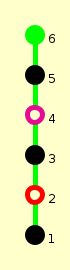
Proof Tree for absloc-no-W-leading-W
(View conclusion)
The following image shows the proof tree of sequent calculus. The
proved goal is at the bottom. You can click on the nodes to view
additional rules. See here for details on colors in a proof
tree.