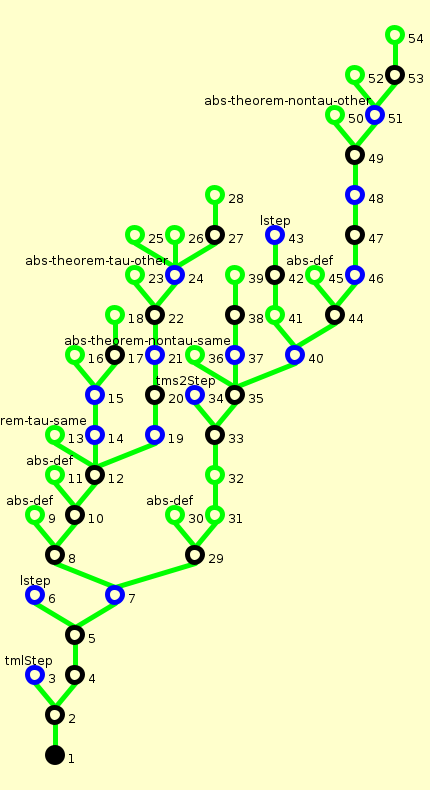
Proof Tree for copied-abs-theorem (View conclusion)
The following image shows the proof tree of sequent calculus. The proved goal is at the bottom. You can click on the nodes to view additional rules. See here for details on colors in a proof tree.
| TMLInv(gs, lsf, pcf), TMLInv(gs0, lsf0, pcf0), TMS2Inv(ags, alsf, apcf), tmlStep(mkstate(gs, lsf, pcf), a, mkstate(gs0, lsf0, pcf0)), abs(mkstate(gs, lsf, pcf), mkstate(ags, alsf, apcf)), ren(a, ags, alsf) = aa ⊦ (aa = τ ⊃ abs(mkstate(gs0, lsf0, pcf0), mkstate(ags, alsf, apcf)) ;∃ ags0, alsf0, apcf0. tms2Step(mkstate(ags, alsf, apcf), aa, mkstate(ags0, alsf0, apcf0)) ∧ abs(mkstate(gs0, lsf0, pcf0), mkstate(ags0, alsf0, apcf0)) ) |
ren(a, ags, alsf) = aa, TMLInv(gs0, lsf0, pcf0), TMLInv(gs, lsf, pcf), TMS2Inv(ags, alsf, apcf), abs(mkstate(gs, lsf, pcf), mkstate(ags, alsf, apcf)), tmlStep(mkstate(gs, lsf, pcf), a, mkstate(gs0, lsf0, pcf0)) ⊦ (aa = τ ⊃ abs(mkstate(gs0, lsf0, pcf0), mkstate(ags, alsf, apcf)) ;∃ ags0, alsf0, apcf0. tms2Step(mkstate(ags, alsf, apcf), aa, mkstate(ags0, alsf0, apcf0)) ∧ abs(mkstate(gs0, lsf0, pcf0), mkstate(ags0, alsf0, apcf0)) )
| ren(a, ags, alsf) = aa, TMLInv(gs0, lsf0, pcf0), TMLInv(gs, lsf, pcf), TMS2Inv(ags, alsf, apcf), abs(mkstate(gs, lsf, pcf), mkstate(ags, alsf, apcf)), tmlStep(mkstate(gs, lsf, pcf), a, mkstate(gs0, lsf0, pcf0)) ⊦ (aa = τ ⊃ abs(mkstate(gs0, lsf0, pcf0), mkstate(ags, alsf, apcf)) ;∃ ags0, alsf0, apcf0. tms2Step(mkstate(ags, alsf, apcf), aa, mkstate(ags0, alsf0, apcf0)) ∧ abs(mkstate(gs0, lsf0, pcf0), mkstate(ags0, alsf0, apcf0)) ) |
⊦ tmlStep(mkstate(gs, lsf, pcf), a, mkstate(gs0, lsf0, pcf0)) ↔ (∃ tid, ls, pc. lstep(gs, lsf(tid), pcf(tid), a, gs0, ls, pc) ∧ lsf0 = lsf(tid := ls) ∧ pcf0 = pcf(tid := pc))
ren(a, ags, alsf) = aa, TMLInv(gs, lsf, pcf), TMLInv(gs0, lsf0, pcf0), TMS2Inv(ags, alsf, apcf), abs(mkstate(gs, lsf, pcf), mkstate(ags, alsf, apcf)), ∃ tid, ls, pc. lstep(gs, lsf(tid), pcf(tid), a, gs0, ls, pc) ∧ lsf0 = lsf(tid := ls) ∧ pcf0 = pcf(tid := pc) ⊦ (aa = τ ⊃ abs(mkstate(gs0, lsf0, pcf0), mkstate(ags, alsf, apcf)) ;∃ ags0, alsf0, apcf0. tms2Step(mkstate(ags, alsf, apcf), aa, mkstate(ags0, alsf0, apcf0)) ∧ abs(mkstate(gs0, lsf0, pcf0), mkstate(ags0, alsf0, apcf0)) )
Used terms: lsf, gs0, gs, pcf0, pcf, a, lsf0
| ⊦ tmlStep(mkstate(gs, lsf, pcf), a, mkstate(gs0, lsf0, pcf0)) ↔ (∃ tid, ls, pc. lstep(gs, lsf(tid), pcf(tid), a, gs0, ls, pc) ∧ lsf0 = lsf(tid := ls) ∧ pcf0 = pcf(tid := pc)) |
| ren(a, ags, alsf) = aa, TMLInv(gs, lsf, pcf), TMLInv(gs0, lsf0, pcf0), TMS2Inv(ags, alsf, apcf), abs(mkstate(gs, lsf, pcf), mkstate(ags, alsf, apcf)), ∃ tid, ls, pc. lstep(gs, lsf(tid), pcf(tid), a, gs0, ls, pc) ∧ lsf0 = lsf(tid := ls) ∧ pcf0 = pcf(tid := pc) ⊦ (aa = τ ⊃ abs(mkstate(gs0, lsf0, pcf0), mkstate(ags, alsf, apcf)) ;∃ ags0, alsf0, apcf0. tms2Step(mkstate(ags, alsf, apcf), aa, mkstate(ags0, alsf0, apcf0)) ∧ abs(mkstate(gs0, lsf0, pcf0), mkstate(ags0, alsf0, apcf0)) ) |
lsf0 = lsf(tid := ls), pcf0 = pcf(tid := pc), ren(a, ags, alsf) = aa, TMLInv(gs0, lsf0, pcf0), TMLInv(gs, lsf, pcf), TMS2Inv(ags, alsf, apcf), abs(mkstate(gs, lsf, pcf), mkstate(ags, alsf, apcf)), lstep(gs, lsf(tid), pcf(tid), a, gs0, ls, pc) ⊦ (aa = τ ⊃ abs(mkstate(gs0, lsf0, pcf0), mkstate(ags, alsf, apcf)) ;∃ ags0, alsf0, apcf0. tms2Step(mkstate(ags, alsf, apcf), aa, mkstate(ags0, alsf0, apcf0)) ∧ abs(mkstate(gs0, lsf0, pcf0), mkstate(ags0, alsf0, apcf0)) )
| lsf0 = lsf(tid := ls), pcf0 = pcf(tid := pc), ren(a, ags, alsf) = aa, TMLInv(gs0, lsf0, pcf0), TMLInv(gs, lsf, pcf), TMS2Inv(ags, alsf, apcf), abs(mkstate(gs, lsf, pcf), mkstate(ags, alsf, apcf)), lstep(gs, lsf(tid), pcf(tid), a, gs0, ls, pc) ⊦ (aa = τ ⊃ abs(mkstate(gs0, lsf0, pcf0), mkstate(ags, alsf, apcf)) ;∃ ags0, alsf0, apcf0. tms2Step(mkstate(ags, alsf, apcf), aa, mkstate(ags0, alsf0, apcf0)) ∧ abs(mkstate(gs0, lsf0, pcf0), mkstate(ags0, alsf0, apcf0)) ) |
⊦ lstep(gs, ls, pc, a, gs0, ls0, pc0) ↔ pre(gs, ls, pc, a) ∧ ls0 = lstepf(gs, ls, pc, a) ∧ gs0 = gstepf(gs, ls, pc, a) ∧ pc0 = pcstepf(gs, ls, pc, a)
gs0 = gstepf(gs, lsf(tid), pcf(tid), a), ls = lstepf(gs, lsf(tid), pcf(tid), a), lsf0 = lsf(tid := ls), pc = pcstepf(gs, lsf(tid), pcf(tid), a), pcf0 = pcf(tid := pc), ren(a, ags, alsf) = aa, TMLInv(gs, lsf, pcf), TMLInv(gs0, lsf0, pcf0), TMS2Inv(ags, alsf, apcf), abs(mkstate(gs, lsf, pcf), mkstate(ags, alsf, apcf)), pre(gs, lsf(tid), pcf(tid), a) ⊦ (aa = τ ⊃ abs(mkstate(gs0, lsf0, pcf0), mkstate(ags, alsf, apcf)) ;∃ ags0, alsf0, apcf0. tms2Step(mkstate(ags, alsf, apcf), aa, mkstate(ags0, alsf0, apcf0)) ∧ abs(mkstate(gs0, lsf0, pcf0), mkstate(ags0, alsf0, apcf0)) )
Used terms: gs0, pc, gs, ls, pcf(tid), lsf(tid), a
| ⊦ lstep(gs, ls, pc, a, gs0, ls0, pc0) ↔ pre(gs, ls, pc, a) ∧ ls0 = lstepf(gs, ls, pc, a) ∧ gs0 = gstepf(gs, ls, pc, a) ∧ pc0 = pcstepf(gs, ls, pc, a) |
| gs0 = gstepf(gs, lsf(tid), pcf(tid), a), ls = lstepf(gs, lsf(tid), pcf(tid), a), lsf0 = lsf(tid := ls), pc = pcstepf(gs, lsf(tid), pcf(tid), a), pcf0 = pcf(tid := pc), ren(a, ags, alsf) = aa, TMLInv(gs, lsf, pcf), TMLInv(gs0, lsf0, pcf0), TMS2Inv(ags, alsf, apcf), abs(mkstate(gs, lsf, pcf), mkstate(ags, alsf, apcf)), pre(gs, lsf(tid), pcf(tid), a) ⊦ (aa = τ ⊃ abs(mkstate(gs0, lsf0, pcf0), mkstate(ags, alsf, apcf)) ;∃ ags0, alsf0, apcf0. tms2Step(mkstate(ags, alsf, apcf), aa, mkstate(ags0, alsf0, apcf0)) ∧ abs(mkstate(gs0, lsf0, pcf0), mkstate(ags0, alsf0, apcf0)) ) |
aa = τ, gs0 = gstepf(gs, lsf(tid), pcf(tid), a), ls = lstepf(gs, lsf(tid), pcf(tid), a), lsf0 = lsf(tid := ls), pc = pcstepf(gs, lsf(tid), pcf(tid), a), pcf0 = pcf(tid := pc), ren(a, ags, alsf) = aa, TMLInv(gs0, lsf0, pcf0), TMLInv(gs, lsf, pcf), TMS2Inv(ags, alsf, apcf), abs(mkstate(gs, lsf, pcf), mkstate(ags, alsf, apcf)), pre(gs, lsf(tid), pcf(tid), a), ¬ abs(mkstate(gs0, lsf0, pcf0), mkstate(ags, alsf, apcf)) ⊦
gs0 = gstepf(gs, lsf(tid), pcf(tid), a), ls = lstepf(gs, lsf(tid), pcf(tid), a), lsf0 = lsf(tid := ls), pc = pcstepf(gs, lsf(tid), pcf(tid), a), pcf0 = pcf(tid := pc), ren(a, ags, alsf) = aa, aa ≠ τ, TMLInv(gs0, lsf0, pcf0), TMLInv(gs, lsf, pcf), TMS2Inv(ags, alsf, apcf), abs(mkstate(gs, lsf, pcf), mkstate(ags, alsf, apcf)), pre(gs, lsf(tid), pcf(tid), a) ⊦ ∃ ags0, alsf0, apcf0. tms2Step(mkstate(ags, alsf, apcf), aa, mkstate(ags0, alsf0, apcf0)) ∧ abs(mkstate(gs0, lsf0, pcf0), mkstate(ags0, alsf0, apcf0))
| aa = τ, gs0 = gstepf(gs, lsf(tid), pcf(tid), a), ls = lstepf(gs, lsf(tid), pcf(tid), a), lsf0 = lsf(tid := ls), pc = pcstepf(gs, lsf(tid), pcf(tid), a), pcf0 = pcf(tid := pc), ren(a, ags, alsf) = aa, TMLInv(gs0, lsf0, pcf0), TMLInv(gs, lsf, pcf), TMS2Inv(ags, alsf, apcf), abs(mkstate(gs, lsf, pcf), mkstate(ags, alsf, apcf)), pre(gs, lsf(tid), pcf(tid), a), ¬ abs(mkstate(gs0, lsf0, pcf0), mkstate(ags, alsf, apcf)) ⊦ |
⊦ abs(mkstate(gs, lsf, pcf), mkstate(ags, alsf, apcf)) ↔ gabs(gs, lsf, pcf, ags, alsf, apcf) ∧ (∀ tid. labs(gs, lsf(tid), pcf(tid), ags, alsf(tid), apcf(tid)))
aa = τ, gs0 = gstepf(gs, lsf(tid), pcf(tid), a), ls = lstepf(gs, lsf(tid), pcf(tid), a), lsf0 = lsf(tid := ls), pc = pcstepf(gs, lsf(tid), pcf(tid), a), pcf0 = pcf(tid := pc), ren(a, ags, alsf) = aa, TMLInv(gs, lsf, pcf), TMLInv(gs0, lsf0, pcf0), TMS2Inv(ags, alsf, apcf), abs(mkstate(gs, lsf, pcf), mkstate(ags, alsf, apcf)), pre(gs, lsf(tid), pcf(tid), a), ¬ gabs(gs0, lsf0, pcf0, ags, alsf, apcf) ∨ (∃ tid. ¬ labs(gs0, lsf0(tid), pcf0(tid), ags, alsf(tid), apcf(tid))) ⊦
Used terms: lsf0, ags, alsf, gs0, apcf, pcf0
| ⊦ abs(mkstate(gs, lsf, pcf), mkstate(ags, alsf, apcf)) ↔ gabs(gs, lsf, pcf, ags, alsf, apcf) ∧ (∀ tid. labs(gs, lsf(tid), pcf(tid), ags, alsf(tid), apcf(tid))) |
| aa = τ, gs0 = gstepf(gs, lsf(tid), pcf(tid), a), ls = lstepf(gs, lsf(tid), pcf(tid), a), lsf0 = lsf(tid := ls), pc = pcstepf(gs, lsf(tid), pcf(tid), a), pcf0 = pcf(tid := pc), ren(a, ags, alsf) = aa, TMLInv(gs, lsf, pcf), TMLInv(gs0, lsf0, pcf0), TMS2Inv(ags, alsf, apcf), abs(mkstate(gs, lsf, pcf), mkstate(ags, alsf, apcf)), pre(gs, lsf(tid), pcf(tid), a), ¬ gabs(gs0, lsf0, pcf0, ags, alsf, apcf) ∨ (∃ tid. ¬ labs(gs0, lsf0(tid), pcf0(tid), ags, alsf(tid), apcf(tid))) ⊦ |
⊦ abs(mkstate(gs, lsf, pcf), mkstate(ags, alsf, apcf)) ↔ gabs(gs, lsf, pcf, ags, alsf, apcf) ∧ (∀ tid. labs(gs, lsf(tid), pcf(tid), ags, alsf(tid), apcf(tid)))
aa = τ, gs0 = gstepf(gs, lsf(tid), pcf(tid), a), ls = lstepf(gs, lsf(tid), pcf(tid), a), lsf0 = lsf(tid := ls), pc = pcstepf(gs, lsf(tid), pcf(tid), a), pcf0 = pcf(tid := pc), ren(a, ags, alsf) = aa, TMLInv(gs0, lsf0, pcf0), TMLInv(gs, lsf, pcf), TMS2Inv(ags, alsf, apcf), gabs(gs, lsf, pcf, ags, alsf, apcf), pre(gs, lsf(tid), pcf(tid), a), ∀ tid. labs(gs, lsf(tid), pcf(tid), ags, alsf(tid), apcf(tid)), ¬ gabs(gs0, lsf0, pcf0, ags, alsf, apcf) ∨ (∃ tid. ¬ labs(gs0, lsf0(tid), pcf0(tid), ags, alsf(tid), apcf(tid))) ⊦
Used terms: lsf, ags, alsf, gs, apcf, pcf
| ⊦ abs(mkstate(gs, lsf, pcf), mkstate(ags, alsf, apcf)) ↔ gabs(gs, lsf, pcf, ags, alsf, apcf) ∧ (∀ tid. labs(gs, lsf(tid), pcf(tid), ags, alsf(tid), apcf(tid))) |
| aa = τ, gs0 = gstepf(gs, lsf(tid), pcf(tid), a), ls = lstepf(gs, lsf(tid), pcf(tid), a), lsf0 = lsf(tid := ls), pc = pcstepf(gs, lsf(tid), pcf(tid), a), pcf0 = pcf(tid := pc), ren(a, ags, alsf) = aa, TMLInv(gs0, lsf0, pcf0), TMLInv(gs, lsf, pcf), TMS2Inv(ags, alsf, apcf), gabs(gs, lsf, pcf, ags, alsf, apcf), pre(gs, lsf(tid), pcf(tid), a), ∀ tid. labs(gs, lsf(tid), pcf(tid), ags, alsf(tid), apcf(tid)), ¬ gabs(gs0, lsf0, pcf0, ags, alsf, apcf) ∨ (∃ tid. ¬ labs(gs0, lsf0(tid), pcf0(tid), ags, alsf(tid), apcf(tid))) ⊦ |
TMLInv(gs, lsf, pcf), TMLInv(gs0, lsf0, pcf0), TMS2Inv(ags, alsf, apcf), ls = lsf(tid), pc = pcf(tid), pre(gs, ls, pc, a), gs0 = gstepf(gs, ls, pc, a), ls0 = lstepf(gs, ls, pc, a), pc0 = pcstepf(gs, ls, pc, a), lsf0 = lsf(tid := ls0), pcf0 = pcf(tid := pc0), gabs(gs, lsf, pcf, ags, alsf, apcf), labs(gs, ls, pc, ags, alsf(tid), apcf(tid)), ∀ tid0. tid0 ≠ tid → labs(gs, lsf(tid0), pcf(tid0), ags, alsf(tid0), apcf(tid0)), ren(a, ags, alsf) = aa, aa = τ ⊦ gabs(gs0, lsf0, pcf0, ags, alsf, apcf) ∧ labs(gs0, ls0, pc0, ags, alsf(tid), apcf(tid))
aa = τ, gs0 = gstepf(gs, lsf(tid), pcf(tid), a), ls = lstepf(gs, lsf(tid), pcf(tid), a), lsf0 = lsf(tid := ls), pc = pcstepf(gs, lsf(tid), pcf(tid), a), pcf0 = pcf(tid := pc), ren(a, ags, alsf) = aa, TMLInv(gs, lsf, pcf), TMLInv(gs0, lsf0, pcf0), TMS2Inv(ags, alsf, apcf), gabs(gs, lsf, pcf, ags, alsf, apcf), pre(gs, lsf(tid), pcf(tid), a), ∀ tid. labs(gs, lsf(tid), pcf(tid), ags, alsf(tid), apcf(tid)), ¬ gabs(gs0, lsf0, pcf0, ags, alsf, apcf) ∨ (∃ tid. ¬ labs(gs0, lsf0(tid), pcf0(tid), ags, alsf(tid), apcf(tid))) ⊦ lsf(tid) = lsf(tid) ∧ pcf(tid) = pcf(tid) ∧ labs(gs, lsf(tid), pcf(tid), ags, alsf(tid), apcf(tid)) ∧ (∀ tid0. tid0 ≠ tid → labs(gs, lsf(tid0), pcf(tid0), ags, alsf(tid0), apcf(tid0)))
aa = τ, gs0 = gstepf(gs, lsf(tid), pcf(tid), a), ls = lstepf(gs, lsf(tid), pcf(tid), a), lsf0 = lsf(tid := ls), pc = pcstepf(gs, lsf(tid), pcf(tid), a), pcf0 = pcf(tid := pc), ren(a, ags, alsf) = aa, TMLInv(gs, lsf, pcf), TMLInv(gs0, lsf0, pcf0), TMS2Inv(ags, alsf, apcf), gabs(gs, lsf, pcf, ags, alsf, apcf), gabs(gs0, lsf0, pcf0, ags, alsf, apcf), labs(gs0, ls, pc, ags, alsf(tid), apcf(tid)), pre(gs, lsf(tid), pcf(tid), a), ∀ tid. labs(gs, lsf(tid), pcf(tid), ags, alsf(tid), apcf(tid)), ¬ gabs(gs0, lsf0, pcf0, ags, alsf, apcf) ∨ (∃ tid. ¬ labs(gs0, lsf0(tid), pcf0(tid), ags, alsf(tid), apcf(tid))) ⊦
Used terms: lsf, ags, alsf, gs0, pc, aa, tid, gs, ls, pcf0, pcf(tid), apcf, pcf, lsf(tid), a, lsf0
| TMLInv(gs, lsf, pcf), TMLInv(gs0, lsf0, pcf0), TMS2Inv(ags, alsf, apcf), ls = lsf(tid), pc = pcf(tid), pre(gs, ls, pc, a), gs0 = gstepf(gs, ls, pc, a), ls0 = lstepf(gs, ls, pc, a), pc0 = pcstepf(gs, ls, pc, a), lsf0 = lsf(tid := ls0), pcf0 = pcf(tid := pc0), gabs(gs, lsf, pcf, ags, alsf, apcf), labs(gs, ls, pc, ags, alsf(tid), apcf(tid)), ∀ tid0. tid0 ≠ tid → labs(gs, lsf(tid0), pcf(tid0), ags, alsf(tid0), apcf(tid0)), ren(a, ags, alsf) = aa, aa = τ ⊦ gabs(gs0, lsf0, pcf0, ags, alsf, apcf) ∧ labs(gs0, ls0, pc0, ags, alsf(tid), apcf(tid)) |
| aa = τ, gs0 = gstepf(gs, lsf(tid), pcf(tid), a), ls = lstepf(gs, lsf(tid), pcf(tid), a), lsf0 = lsf(tid := ls), pc = pcstepf(gs, lsf(tid), pcf(tid), a), pcf0 = pcf(tid := pc), ren(a, ags, alsf) = aa, TMLInv(gs, lsf, pcf), TMLInv(gs0, lsf0, pcf0), TMS2Inv(ags, alsf, apcf), gabs(gs, lsf, pcf, ags, alsf, apcf), pre(gs, lsf(tid), pcf(tid), a), ∀ tid. labs(gs, lsf(tid), pcf(tid), ags, alsf(tid), apcf(tid)), ¬ gabs(gs0, lsf0, pcf0, ags, alsf, apcf) ∨ (∃ tid. ¬ labs(gs0, lsf0(tid), pcf0(tid), ags, alsf(tid), apcf(tid))) ⊦ lsf(tid) = lsf(tid) ∧ pcf(tid) = pcf(tid) ∧ labs(gs, lsf(tid), pcf(tid), ags, alsf(tid), apcf(tid)) ∧ (∀ tid0. tid0 ≠ tid → labs(gs, lsf(tid0), pcf(tid0), ags, alsf(tid0), apcf(tid0))) |
aa = τ, gs0 = gstepf(gs, lsf(tid), pcf(tid), a), ls = lstepf(gs, lsf(tid), pcf(tid), a), lsf0 = lsf(tid := ls), pc = pcstepf(gs, lsf(tid), pcf(tid), a), pcf0 = pcf(tid := pc), ren(a, ags, alsf) = aa, TMLInv(gs0, lsf0, pcf0), TMLInv(gs, lsf, pcf), TMS2Inv(ags, alsf, apcf), gabs(gs, lsf, pcf, ags, alsf, apcf), pre(gs, lsf(tid), pcf(tid), a), ∀ tid. labs(gs, lsf(tid), pcf(tid), ags, alsf(tid), apcf(tid)), ∃ tid. ¬ labs(gs0, lsf0(tid), pcf0(tid), ags, alsf(tid), apcf(tid)) ⊦ lsf(tid) = lsf(tid) ∧ pcf(tid) = pcf(tid) ∧ labs(gs, lsf(tid), pcf(tid), ags, alsf(tid), apcf(tid)) ∧ (∀ tid0. tid0 ≠ tid → labs(gs, lsf(tid0), pcf(tid0), ags, alsf(tid0), apcf(tid0)))
Used simplifier rules: gabs-def: ⊦ gabs(gs, lsf, pcf, ags, alsf, apcf) ↔ true;
| aa = τ, gs0 = gstepf(gs, lsf(tid), pcf(tid), a), ls = lstepf(gs, lsf(tid), pcf(tid), a), lsf0 = lsf(tid := ls), pc = pcstepf(gs, lsf(tid), pcf(tid), a), pcf0 = pcf(tid := pc), ren(a, ags, alsf) = aa, TMLInv(gs0, lsf0, pcf0), TMLInv(gs, lsf, pcf), TMS2Inv(ags, alsf, apcf), gabs(gs, lsf, pcf, ags, alsf, apcf), pre(gs, lsf(tid), pcf(tid), a), ∀ tid. labs(gs, lsf(tid), pcf(tid), ags, alsf(tid), apcf(tid)), ∃ tid. ¬ labs(gs0, lsf0(tid), pcf0(tid), ags, alsf(tid), apcf(tid)) ⊦ lsf(tid) = lsf(tid) ∧ pcf(tid) = pcf(tid) ∧ labs(gs, lsf(tid), pcf(tid), ags, alsf(tid), apcf(tid)) ∧ (∀ tid0. tid0 ≠ tid → labs(gs, lsf(tid0), pcf(tid0), ags, alsf(tid0), apcf(tid0))) |
aa = τ, gs0 = gstepf(gs, lsf(tid), pcf(tid), a), ls = lstepf(gs, lsf(tid), pcf(tid), a), lsf0 = lsf(tid := ls), pc = pcstepf(gs, lsf(tid), pcf(tid), a), pcf0 = pcf(tid := pc), ren(a, ags, alsf) = aa, TMLInv(gs, lsf, pcf), TMLInv(gs0, lsf0, pcf0), TMS2Inv(ags, alsf, apcf), gabs(gs, lsf, pcf, ags, alsf, apcf), pre(gs, lsf(tid), pcf(tid), a), ¬ labs(gs, lsf(tid), pcf(tid), ags, alsf(tid), apcf(tid)), ∀ tid. labs(gs, lsf(tid), pcf(tid), ags, alsf(tid), apcf(tid)), ∃ tid. ¬ labs(gs0, lsf0(tid), pcf0(tid), ags, alsf(tid), apcf(tid)) ⊦
aa = τ, gs0 = gstepf(gs, lsf(tid), pcf(tid), a), ls = lstepf(gs, lsf(tid), pcf(tid), a), lsf0 = lsf(tid := ls), pc = pcstepf(gs, lsf(tid), pcf(tid), a), pcf0 = pcf(tid := pc), ren(a, ags, alsf) = aa, TMLInv(gs, lsf, pcf), TMLInv(gs0, lsf0, pcf0), TMS2Inv(ags, alsf, apcf), gabs(gs, lsf, pcf, ags, alsf, apcf), pre(gs, lsf(tid), pcf(tid), a), ∀ tid. labs(gs, lsf(tid), pcf(tid), ags, alsf(tid), apcf(tid)), ∃ tid. ¬ labs(gs0, lsf0(tid), pcf0(tid), ags, alsf(tid), apcf(tid)) ⊦ ∀ tid0. tid0 ≠ tid → labs(gs, lsf(tid0), pcf(tid0), ags, alsf(tid0), apcf(tid0))
| aa = τ, gs0 = gstepf(gs, lsf(tid), pcf(tid), a), ls = lstepf(gs, lsf(tid), pcf(tid), a), lsf0 = lsf(tid := ls), pc = pcstepf(gs, lsf(tid), pcf(tid), a), pcf0 = pcf(tid := pc), ren(a, ags, alsf) = aa, TMLInv(gs, lsf, pcf), TMLInv(gs0, lsf0, pcf0), TMS2Inv(ags, alsf, apcf), gabs(gs, lsf, pcf, ags, alsf, apcf), pre(gs, lsf(tid), pcf(tid), a), ¬ labs(gs, lsf(tid), pcf(tid), ags, alsf(tid), apcf(tid)), ∀ tid. labs(gs, lsf(tid), pcf(tid), ags, alsf(tid), apcf(tid)), ∃ tid. ¬ labs(gs0, lsf0(tid), pcf0(tid), ags, alsf(tid), apcf(tid)) ⊦ |
Used terms: tid
| aa = τ, gs0 = gstepf(gs, lsf(tid), pcf(tid), a), ls = lstepf(gs, lsf(tid), pcf(tid), a), lsf0 = lsf(tid := ls), pc = pcstepf(gs, lsf(tid), pcf(tid), a), pcf0 = pcf(tid := pc), ren(a, ags, alsf) = aa, TMLInv(gs, lsf, pcf), TMLInv(gs0, lsf0, pcf0), TMS2Inv(ags, alsf, apcf), gabs(gs, lsf, pcf, ags, alsf, apcf), pre(gs, lsf(tid), pcf(tid), a), ∀ tid. labs(gs, lsf(tid), pcf(tid), ags, alsf(tid), apcf(tid)), ∃ tid. ¬ labs(gs0, lsf0(tid), pcf0(tid), ags, alsf(tid), apcf(tid)) ⊦ ∀ tid0. tid0 ≠ tid → labs(gs, lsf(tid0), pcf(tid0), ags, alsf(tid0), apcf(tid0)) |
aa = τ, gs0 = gstepf(gs, lsf(tid), pcf(tid), a), ls = lstepf(gs, lsf(tid), pcf(tid), a), lsf0 = lsf(tid := ls), pc = pcstepf(gs, lsf(tid), pcf(tid), a), pcf0 = pcf(tid := pc), ren(a, ags, alsf) = aa, tid0 ≠ tid, TMLInv(gs0, lsf0, pcf0), TMLInv(gs, lsf, pcf), TMS2Inv(ags, alsf, apcf), gabs(gs, lsf, pcf, ags, alsf, apcf), pre(gs, lsf(tid), pcf(tid), a), ¬ labs(gs, lsf(tid0), pcf(tid0), ags, alsf(tid0), apcf(tid0)), ∀ tid. labs(gs, lsf(tid), pcf(tid), ags, alsf(tid), apcf(tid)), ∃ tid. ¬ labs(gs0, lsf0(tid), pcf0(tid), ags, alsf(tid), apcf(tid)) ⊦
| aa = τ, gs0 = gstepf(gs, lsf(tid), pcf(tid), a), ls = lstepf(gs, lsf(tid), pcf(tid), a), lsf0 = lsf(tid := ls), pc = pcstepf(gs, lsf(tid), pcf(tid), a), pcf0 = pcf(tid := pc), ren(a, ags, alsf) = aa, tid0 ≠ tid, TMLInv(gs0, lsf0, pcf0), TMLInv(gs, lsf, pcf), TMS2Inv(ags, alsf, apcf), gabs(gs, lsf, pcf, ags, alsf, apcf), pre(gs, lsf(tid), pcf(tid), a), ¬ labs(gs, lsf(tid0), pcf(tid0), ags, alsf(tid0), apcf(tid0)), ∀ tid. labs(gs, lsf(tid), pcf(tid), ags, alsf(tid), apcf(tid)), ∃ tid. ¬ labs(gs0, lsf0(tid), pcf0(tid), ags, alsf(tid), apcf(tid)) ⊦ |
Used terms: tid0
| aa = τ, gs0 = gstepf(gs, lsf(tid), pcf(tid), a), ls = lstepf(gs, lsf(tid), pcf(tid), a), lsf0 = lsf(tid := ls), pc = pcstepf(gs, lsf(tid), pcf(tid), a), pcf0 = pcf(tid := pc), ren(a, ags, alsf) = aa, TMLInv(gs, lsf, pcf), TMLInv(gs0, lsf0, pcf0), TMS2Inv(ags, alsf, apcf), gabs(gs, lsf, pcf, ags, alsf, apcf), gabs(gs0, lsf0, pcf0, ags, alsf, apcf), labs(gs0, ls, pc, ags, alsf(tid), apcf(tid)), pre(gs, lsf(tid), pcf(tid), a), ∀ tid. labs(gs, lsf(tid), pcf(tid), ags, alsf(tid), apcf(tid)), ¬ gabs(gs0, lsf0, pcf0, ags, alsf, apcf) ∨ (∃ tid. ¬ labs(gs0, lsf0(tid), pcf0(tid), ags, alsf(tid), apcf(tid))) ⊦ |
aa = τ, gs0 = gstepf(gs, lsf(tid), pcf(tid), a), ls = lstepf(gs, lsf(tid), pcf(tid), a), lsf0 = lsf(tid := ls), pc = pcstepf(gs, lsf(tid), pcf(tid), a), pcf0 = pcf(tid := pc), ren(a, ags, alsf) = aa, TMLInv(gs0, lsf0, pcf0), TMLInv(gs, lsf, pcf), TMS2Inv(ags, alsf, apcf), gabs(gs0, lsf0, pcf0, ags, alsf, apcf), gabs(gs, lsf, pcf, ags, alsf, apcf), labs(gs0, ls, pc, ags, alsf(tid), apcf(tid)), pre(gs, lsf(tid), pcf(tid), a), ∀ tid. labs(gs, lsf(tid), pcf(tid), ags, alsf(tid), apcf(tid)), ∃ tid. ¬ labs(gs0, lsf0(tid), pcf0(tid), ags, alsf(tid), apcf(tid)) ⊦
| aa = τ, gs0 = gstepf(gs, lsf(tid), pcf(tid), a), ls = lstepf(gs, lsf(tid), pcf(tid), a), lsf0 = lsf(tid := ls), pc = pcstepf(gs, lsf(tid), pcf(tid), a), pcf0 = pcf(tid := pc), ren(a, ags, alsf) = aa, TMLInv(gs0, lsf0, pcf0), TMLInv(gs, lsf, pcf), TMS2Inv(ags, alsf, apcf), gabs(gs0, lsf0, pcf0, ags, alsf, apcf), gabs(gs, lsf, pcf, ags, alsf, apcf), labs(gs0, ls, pc, ags, alsf(tid), apcf(tid)), pre(gs, lsf(tid), pcf(tid), a), ∀ tid. labs(gs, lsf(tid), pcf(tid), ags, alsf(tid), apcf(tid)), ∃ tid. ¬ labs(gs0, lsf0(tid), pcf0(tid), ags, alsf(tid), apcf(tid)) ⊦ |
aa = τ, gs0 = gstepf(gs, lsf(tid), pcf(tid), a), ls = lstepf(gs, lsf(tid), pcf(tid), a), lsf0 = lsf(tid := ls), pc = pcstepf(gs, lsf(tid), pcf(tid), a), pcf0 = pcf(tid := pc), ren(a, ags, alsf) = aa, TMLInv(gs, lsf, pcf), TMLInv(gs0, lsf0, pcf0), TMS2Inv(ags, alsf, apcf), gabs(gs, lsf, pcf, ags, alsf, apcf), gabs(gs0, lsf0, pcf0, ags, alsf, apcf), labs(gs0, ls, pc, ags, alsf(tid), apcf(tid)), pre(gs, lsf(tid), pcf(tid), a), ¬ labs(gs0, lsf0(tid0), pcf0(tid0), ags, alsf(tid0), apcf(tid0)), ∀ tid. labs(gs, lsf(tid), pcf(tid), ags, alsf(tid), apcf(tid)) ⊦
| aa = τ, gs0 = gstepf(gs, lsf(tid), pcf(tid), a), ls = lstepf(gs, lsf(tid), pcf(tid), a), lsf0 = lsf(tid := ls), pc = pcstepf(gs, lsf(tid), pcf(tid), a), pcf0 = pcf(tid := pc), ren(a, ags, alsf) = aa, TMLInv(gs, lsf, pcf), TMLInv(gs0, lsf0, pcf0), TMS2Inv(ags, alsf, apcf), gabs(gs, lsf, pcf, ags, alsf, apcf), gabs(gs0, lsf0, pcf0, ags, alsf, apcf), labs(gs0, ls, pc, ags, alsf(tid), apcf(tid)), pre(gs, lsf(tid), pcf(tid), a), ¬ labs(gs0, lsf0(tid0), pcf0(tid0), ags, alsf(tid0), apcf(tid0)), ∀ tid. labs(gs, lsf(tid), pcf(tid), ags, alsf(tid), apcf(tid)) ⊦ |
aa = τ, gs0 = gstepf(gs, lsf(tid), pcf(tid), a), ls = lstepf(gs, lsf(tid), pcf(tid), a), lsf0 = lsf(tid := ls), pc = pcstepf(gs, lsf(tid), pcf(tid), a), pcf0 = pcf(tid := pc), ren(a, ags, alsf) = aa, tid0 ≠ tid, TMLInv(gs0, lsf0, pcf0), TMLInv(gs, lsf, pcf), TMS2Inv(ags, alsf, apcf), gabs(gs0, lsf0, pcf0, ags, alsf, apcf), gabs(gs, lsf, pcf, ags, alsf, apcf), labs(gs0, ls, pc, ags, alsf(tid), apcf(tid)), pre(gs, lsf(tid), pcf(tid), a), ¬ labs(gs0, lsf0(tid0), pcf0(tid0), ags, alsf(tid0), apcf(tid0)), ∀ tid. labs(gs, lsf(tid), pcf(tid), ags, alsf(tid), apcf(tid)) ⊦
Used simplifier rules: labs-def: ⊦ labs(gs, ls, pc, ags, als, apc) ↔ ls.tid = als.tid ∧ abspc(pc) = apc ∧ (pc = S ∨ pc = B1 ∨ pc = B2 ∨ pc = B3 ∨ pc = B4 → als.rdset = ∅ ∧ als.wrset = ∅) ∧ (even(ls.loc) → als.wrset = ∅) ∧ (pc = W1 ∨ pc = W2 ∨ pc = W3 ∨ pc = W4 ∨ pc = W5 → ls.l = als.il ∧ ls.v = als.ov) ∧ (pc = R1 ∨ pc = R2 ∨ pc = R4 → ls.l = als.il) ∧ (pc = R3 → ls.v = als.ov) ∧ (gs.w = None → gs.mem = ags.memories.last ∧ even(gs.glb)) ∧ (gs.w = Some(ls.tid) ⊃ (pc ≠ W4 → odd(ls.loc)) ∧ als.wrset ⊆ gs.mem ∧ gs.mem = ags.memories.last ⊕ als.wrset ∧ odd(gs.glb) ;pc ≠ E3 ∧ pc ≠ C → als.wrset = ∅ ) ∧ ( pc ≠ E3 ∧ pc ≠ C ∧ pc ≠ A ∧ pc ≠ B1 ∧ pc ≠ S → (gs.glb = ls.loc ∨ pc = W4 ⊃ als.rdset ⊆ ags.memories.last ;∃valid(als.beginIdx, als.rdset, ags.memories) )); gabs-def: ⊦ gabs(gs, lsf, pcf, ags, alsf, apcf) ↔ true; labs-def: ⊦ labs(gs, ls, pc, ags, als, apc) ↔ ls.tid = als.tid ∧ abspc(pc) = apc ∧ (pc = S ∨ pc = B1 ∨ pc = B2 ∨ pc = B3 ∨ pc = B4 → als.rdset = ∅ ∧ als.wrset = ∅) ∧ (even(ls.loc) → als.wrset = ∅) ∧ (pc = W1 ∨ pc = W2 ∨ pc = W3 ∨ pc = W4 ∨ pc = W5 → ls.l = als.il ∧ ls.v = als.ov) ∧ (pc = R1 ∨ pc = R2 ∨ pc = R4 → ls.l = als.il) ∧ (pc = R3 → ls.v = als.ov) ∧ (gs.w = None → gs.mem = ags.memories.last ∧ even(gs.glb)) ∧ (gs.w = Some(ls.tid) ⊃ (pc ≠ W4 → odd(ls.loc)) ∧ als.wrset ⊆ gs.mem ∧ gs.mem = ags.memories.last ⊕ als.wrset ∧ odd(gs.glb) ;pc ≠ E3 ∧ pc ≠ C → als.wrset = ∅ ) ∧ ( pc ≠ E3 ∧ pc ≠ C ∧ pc ≠ A ∧ pc ≠ B1 ∧ pc ≠ S → (gs.glb = ls.loc ∨ pc = W4 ⊃ als.rdset ⊆ ags.memories.last ;∃valid(als.beginIdx, als.rdset, ags.memories) )); Used formulas: tid0 = tid
| aa = τ, gs0 = gstepf(gs, lsf(tid), pcf(tid), a), ls = lstepf(gs, lsf(tid), pcf(tid), a), lsf0 = lsf(tid := ls), pc = pcstepf(gs, lsf(tid), pcf(tid), a), pcf0 = pcf(tid := pc), ren(a, ags, alsf) = aa, tid0 ≠ tid, TMLInv(gs0, lsf0, pcf0), TMLInv(gs, lsf, pcf), TMS2Inv(ags, alsf, apcf), gabs(gs0, lsf0, pcf0, ags, alsf, apcf), gabs(gs, lsf, pcf, ags, alsf, apcf), labs(gs0, ls, pc, ags, alsf(tid), apcf(tid)), pre(gs, lsf(tid), pcf(tid), a), ¬ labs(gs0, lsf0(tid0), pcf0(tid0), ags, alsf(tid0), apcf(tid0)), ∀ tid. labs(gs, lsf(tid), pcf(tid), ags, alsf(tid), apcf(tid)) ⊦ |
TMLInv(gs, lsf, pcf), TMLInv(gs0, lsf0, pcf0), TMS2Inv(ags, alsf, apcf), ls = lsf(tid), pc = pcf(tid), pre(gs, ls, pc, a), gs0 = gstepf(gs, ls, pc, a), ls0 = lstepf(gs, ls, pc, a), pc0 = pcstepf(gs, ls, pc, a), lsf0 = lsf(tid := ls0), pcf0 = pcf(tid := pc0), gabs(gs, lsf, pcf, ags, alsf, apcf), labs(gs, ls, pc, ags, alsf(tid), apcf(tid)), tid0 ≠ tid, labs(gs, lsf(tid0), pcf(tid0), ags, alsf(tid0), apcf(tid0)), ∀ tid1. tid1 ≠ tid ∧ tid0 ≠ tid → labs(gs, lsf(tid1), pcf(tid1), ags, alsf(tid1), apcf(tid1)), ren(a, ags, alsf) = aa, aa = τ ⊦ labs(gs0, lsf(tid0), pcf(tid0), ags, alsf(tid0), apcf(tid0))
aa = τ, gs0 = gstepf(gs, lsf(tid), pcf(tid), a), ls = lstepf(gs, lsf(tid), pcf(tid), a), lsf0 = lsf(tid := ls), pc = pcstepf(gs, lsf(tid), pcf(tid), a), pcf0 = pcf(tid := pc), ren(a, ags, alsf) = aa, tid0 ≠ tid, TMLInv(gs, lsf, pcf), TMLInv(gs0, lsf0, pcf0), TMS2Inv(ags, alsf, apcf), gabs(gs, lsf, pcf, ags, alsf, apcf), gabs(gs0, lsf0, pcf0, ags, alsf, apcf), labs(gs0, ls, pc, ags, alsf(tid), apcf(tid)), pre(gs, lsf(tid), pcf(tid), a), ¬ labs(gs0, lsf0(tid0), pcf0(tid0), ags, alsf(tid0), apcf(tid0)), ∀ tid. labs(gs, lsf(tid), pcf(tid), ags, alsf(tid), apcf(tid)) ⊦ lsf(tid) = lsf(tid) ∧ pcf(tid) = pcf(tid) ∧ labs(gs, lsf(tid), pcf(tid), ags, alsf(tid), apcf(tid)) ∧ labs(gs, lsf(tid0), pcf(tid0), ags, alsf(tid0), apcf(tid0)) ∧ (∀ tid1. tid1 ≠ tid ∧ tid0 ≠ tid → labs(gs, lsf(tid1), pcf(tid1), ags, alsf(tid1), apcf(tid1)))
Used simplifier rules: labs-def: ⊦ labs(gs, ls, pc, ags, als, apc) ↔ ls.tid = als.tid ∧ abspc(pc) = apc ∧ (pc = S ∨ pc = B1 ∨ pc = B2 ∨ pc = B3 ∨ pc = B4 → als.rdset = ∅ ∧ als.wrset = ∅) ∧ (even(ls.loc) → als.wrset = ∅) ∧ (pc = W1 ∨ pc = W2 ∨ pc = W3 ∨ pc = W4 ∨ pc = W5 → ls.l = als.il ∧ ls.v = als.ov) ∧ (pc = R1 ∨ pc = R2 ∨ pc = R4 → ls.l = als.il) ∧ (pc = R3 → ls.v = als.ov) ∧ (gs.w = None → gs.mem = ags.memories.last ∧ even(gs.glb)) ∧ (gs.w = Some(ls.tid) ⊃ (pc ≠ W4 → odd(ls.loc)) ∧ als.wrset ⊆ gs.mem ∧ gs.mem = ags.memories.last ⊕ als.wrset ∧ odd(gs.glb) ;pc ≠ E3 ∧ pc ≠ C → als.wrset = ∅ ) ∧ ( pc ≠ E3 ∧ pc ≠ C ∧ pc ≠ A ∧ pc ≠ B1 ∧ pc ≠ S → (gs.glb = ls.loc ∨ pc = W4 ⊃ als.rdset ⊆ ags.memories.last ;∃valid(als.beginIdx, als.rdset, ags.memories) )); gabs-def: ⊦ gabs(gs, lsf, pcf, ags, alsf, apcf) ↔ true; labs-def: ⊦ labs(gs, ls, pc, ags, als, apc) ↔ ls.tid = als.tid ∧ abspc(pc) = apc ∧ (pc = S ∨ pc = B1 ∨ pc = B2 ∨ pc = B3 ∨ pc = B4 → als.rdset = ∅ ∧ als.wrset = ∅) ∧ (even(ls.loc) → als.wrset = ∅) ∧ (pc = W1 ∨ pc = W2 ∨ pc = W3 ∨ pc = W4 ∨ pc = W5 → ls.l = als.il ∧ ls.v = als.ov) ∧ (pc = R1 ∨ pc = R2 ∨ pc = R4 → ls.l = als.il) ∧ (pc = R3 → ls.v = als.ov) ∧ (gs.w = None → gs.mem = ags.memories.last ∧ even(gs.glb)) ∧ (gs.w = Some(ls.tid) ⊃ (pc ≠ W4 → odd(ls.loc)) ∧ als.wrset ⊆ gs.mem ∧ gs.mem = ags.memories.last ⊕ als.wrset ∧ odd(gs.glb) ;pc ≠ E3 ∧ pc ≠ C → als.wrset = ∅ ) ∧ ( pc ≠ E3 ∧ pc ≠ C ∧ pc ≠ A ∧ pc ≠ B1 ∧ pc ≠ S → (gs.glb = ls.loc ∨ pc = W4 ⊃ als.rdset ⊆ ags.memories.last ;∃valid(als.beginIdx, als.rdset, ags.memories) )); Used terms: lsf, ags, alsf, gs0, pc, aa, tid0, tid, gs, ls, pcf0, pcf(tid), apcf, pcf, lsf(tid), a, lsf0
| TMLInv(gs, lsf, pcf), TMLInv(gs0, lsf0, pcf0), TMS2Inv(ags, alsf, apcf), ls = lsf(tid), pc = pcf(tid), pre(gs, ls, pc, a), gs0 = gstepf(gs, ls, pc, a), ls0 = lstepf(gs, ls, pc, a), pc0 = pcstepf(gs, ls, pc, a), lsf0 = lsf(tid := ls0), pcf0 = pcf(tid := pc0), gabs(gs, lsf, pcf, ags, alsf, apcf), labs(gs, ls, pc, ags, alsf(tid), apcf(tid)), tid0 ≠ tid, labs(gs, lsf(tid0), pcf(tid0), ags, alsf(tid0), apcf(tid0)), ∀ tid1. tid1 ≠ tid ∧ tid0 ≠ tid → labs(gs, lsf(tid1), pcf(tid1), ags, alsf(tid1), apcf(tid1)), ren(a, ags, alsf) = aa, aa = τ ⊦ labs(gs0, lsf(tid0), pcf(tid0), ags, alsf(tid0), apcf(tid0)) |
| aa = τ, gs0 = gstepf(gs, lsf(tid), pcf(tid), a), ls = lstepf(gs, lsf(tid), pcf(tid), a), lsf0 = lsf(tid := ls), pc = pcstepf(gs, lsf(tid), pcf(tid), a), pcf0 = pcf(tid := pc), ren(a, ags, alsf) = aa, tid0 ≠ tid, TMLInv(gs, lsf, pcf), TMLInv(gs0, lsf0, pcf0), TMS2Inv(ags, alsf, apcf), gabs(gs, lsf, pcf, ags, alsf, apcf), gabs(gs0, lsf0, pcf0, ags, alsf, apcf), labs(gs0, ls, pc, ags, alsf(tid), apcf(tid)), pre(gs, lsf(tid), pcf(tid), a), ¬ labs(gs0, lsf0(tid0), pcf0(tid0), ags, alsf(tid0), apcf(tid0)), ∀ tid. labs(gs, lsf(tid), pcf(tid), ags, alsf(tid), apcf(tid)) ⊦ lsf(tid) = lsf(tid) ∧ pcf(tid) = pcf(tid) ∧ labs(gs, lsf(tid), pcf(tid), ags, alsf(tid), apcf(tid)) ∧ labs(gs, lsf(tid0), pcf(tid0), ags, alsf(tid0), apcf(tid0)) ∧ (∀ tid1. tid1 ≠ tid ∧ tid0 ≠ tid → labs(gs, lsf(tid1), pcf(tid1), ags, alsf(tid1), apcf(tid1))) |
aa = τ, gs0 = gstepf(gs, lsf(tid), pcf(tid), a), ls = lstepf(gs, lsf(tid), pcf(tid), a), lsf0 = lsf(tid := ls), pc = pcstepf(gs, lsf(tid), pcf(tid), a), pcf0 = pcf(tid := pc), ren(a, ags, alsf) = aa, tid0 ≠ tid, TMLInv(gs0, lsf0, pcf0), TMLInv(gs, lsf, pcf), TMS2Inv(ags, alsf, apcf), gabs(gs0, lsf0, pcf0, ags, alsf, apcf), gabs(gs, lsf, pcf, ags, alsf, apcf), labs(gs0, ls, pc, ags, alsf(tid), apcf(tid)), pre(gs, lsf(tid), pcf(tid), a), ¬ labs(gs, lsf(tid), pcf(tid), ags, alsf(tid), apcf(tid)), ¬ labs(gs0, lsf0(tid0), pcf0(tid0), ags, alsf(tid0), apcf(tid0)), ∀ tid. labs(gs, lsf(tid), pcf(tid), ags, alsf(tid), apcf(tid)) ⊦
aa = τ, gs0 = gstepf(gs, lsf(tid), pcf(tid), a), ls = lstepf(gs, lsf(tid), pcf(tid), a), lsf0 = lsf(tid := ls), pc = pcstepf(gs, lsf(tid), pcf(tid), a), pcf0 = pcf(tid := pc), ren(a, ags, alsf) = aa, tid0 ≠ tid, TMLInv(gs0, lsf0, pcf0), TMLInv(gs, lsf, pcf), TMS2Inv(ags, alsf, apcf), gabs(gs0, lsf0, pcf0, ags, alsf, apcf), gabs(gs, lsf, pcf, ags, alsf, apcf), labs(gs0, ls, pc, ags, alsf(tid), apcf(tid)), pre(gs, lsf(tid), pcf(tid), a), ¬ labs(gs, lsf(tid0), pcf(tid0), ags, alsf(tid0), apcf(tid0)), ¬ labs(gs0, lsf0(tid0), pcf0(tid0), ags, alsf(tid0), apcf(tid0)), ∀ tid. labs(gs, lsf(tid), pcf(tid), ags, alsf(tid), apcf(tid)) ⊦
aa = τ, gs0 = gstepf(gs, lsf(tid), pcf(tid), a), ls = lstepf(gs, lsf(tid), pcf(tid), a), lsf0 = lsf(tid := ls), pc = pcstepf(gs, lsf(tid), pcf(tid), a), pcf0 = pcf(tid := pc), ren(a, ags, alsf) = aa, tid0 ≠ tid, TMLInv(gs0, lsf0, pcf0), TMLInv(gs, lsf, pcf), TMS2Inv(ags, alsf, apcf), gabs(gs0, lsf0, pcf0, ags, alsf, apcf), gabs(gs, lsf, pcf, ags, alsf, apcf), labs(gs0, ls, pc, ags, alsf(tid), apcf(tid)), pre(gs, lsf(tid), pcf(tid), a), ¬ labs(gs0, lsf0(tid0), pcf0(tid0), ags, alsf(tid0), apcf(tid0)), ∀ tid. labs(gs, lsf(tid), pcf(tid), ags, alsf(tid), apcf(tid)) ⊦ ∀ tid1. tid1 ≠ tid ∧ tid0 ≠ tid → labs(gs, lsf(tid1), pcf(tid1), ags, alsf(tid1), apcf(tid1))
| aa = τ, gs0 = gstepf(gs, lsf(tid), pcf(tid), a), ls = lstepf(gs, lsf(tid), pcf(tid), a), lsf0 = lsf(tid := ls), pc = pcstepf(gs, lsf(tid), pcf(tid), a), pcf0 = pcf(tid := pc), ren(a, ags, alsf) = aa, tid0 ≠ tid, TMLInv(gs0, lsf0, pcf0), TMLInv(gs, lsf, pcf), TMS2Inv(ags, alsf, apcf), gabs(gs0, lsf0, pcf0, ags, alsf, apcf), gabs(gs, lsf, pcf, ags, alsf, apcf), labs(gs0, ls, pc, ags, alsf(tid), apcf(tid)), pre(gs, lsf(tid), pcf(tid), a), ¬ labs(gs, lsf(tid), pcf(tid), ags, alsf(tid), apcf(tid)), ¬ labs(gs0, lsf0(tid0), pcf0(tid0), ags, alsf(tid0), apcf(tid0)), ∀ tid. labs(gs, lsf(tid), pcf(tid), ags, alsf(tid), apcf(tid)) ⊦ |
Used terms: tid
| aa = τ, gs0 = gstepf(gs, lsf(tid), pcf(tid), a), ls = lstepf(gs, lsf(tid), pcf(tid), a), lsf0 = lsf(tid := ls), pc = pcstepf(gs, lsf(tid), pcf(tid), a), pcf0 = pcf(tid := pc), ren(a, ags, alsf) = aa, tid0 ≠ tid, TMLInv(gs0, lsf0, pcf0), TMLInv(gs, lsf, pcf), TMS2Inv(ags, alsf, apcf), gabs(gs0, lsf0, pcf0, ags, alsf, apcf), gabs(gs, lsf, pcf, ags, alsf, apcf), labs(gs0, ls, pc, ags, alsf(tid), apcf(tid)), pre(gs, lsf(tid), pcf(tid), a), ¬ labs(gs, lsf(tid0), pcf(tid0), ags, alsf(tid0), apcf(tid0)), ¬ labs(gs0, lsf0(tid0), pcf0(tid0), ags, alsf(tid0), apcf(tid0)), ∀ tid. labs(gs, lsf(tid), pcf(tid), ags, alsf(tid), apcf(tid)) ⊦ |
Used terms: tid0
| aa = τ, gs0 = gstepf(gs, lsf(tid), pcf(tid), a), ls = lstepf(gs, lsf(tid), pcf(tid), a), lsf0 = lsf(tid := ls), pc = pcstepf(gs, lsf(tid), pcf(tid), a), pcf0 = pcf(tid := pc), ren(a, ags, alsf) = aa, tid0 ≠ tid, TMLInv(gs0, lsf0, pcf0), TMLInv(gs, lsf, pcf), TMS2Inv(ags, alsf, apcf), gabs(gs0, lsf0, pcf0, ags, alsf, apcf), gabs(gs, lsf, pcf, ags, alsf, apcf), labs(gs0, ls, pc, ags, alsf(tid), apcf(tid)), pre(gs, lsf(tid), pcf(tid), a), ¬ labs(gs0, lsf0(tid0), pcf0(tid0), ags, alsf(tid0), apcf(tid0)), ∀ tid. labs(gs, lsf(tid), pcf(tid), ags, alsf(tid), apcf(tid)) ⊦ ∀ tid1. tid1 ≠ tid ∧ tid0 ≠ tid → labs(gs, lsf(tid1), pcf(tid1), ags, alsf(tid1), apcf(tid1)) |
aa = τ, gs0 = gstepf(gs, lsf(tid), pcf(tid), a), ls = lstepf(gs, lsf(tid), pcf(tid), a), lsf0 = lsf(tid := ls), pc = pcstepf(gs, lsf(tid), pcf(tid), a), pcf0 = pcf(tid := pc), ren(a, ags, alsf) = aa, tid0 ≠ tid, tid1 ≠ tid, TMLInv(gs, lsf, pcf), TMLInv(gs0, lsf0, pcf0), TMS2Inv(ags, alsf, apcf), gabs(gs, lsf, pcf, ags, alsf, apcf), gabs(gs0, lsf0, pcf0, ags, alsf, apcf), labs(gs0, ls, pc, ags, alsf(tid), apcf(tid)), pre(gs, lsf(tid), pcf(tid), a), ¬ labs(gs, lsf(tid1), pcf(tid1), ags, alsf(tid1), apcf(tid1)), ¬ labs(gs0, lsf0(tid0), pcf0(tid0), ags, alsf(tid0), apcf(tid0)), ∀ tid. labs(gs, lsf(tid), pcf(tid), ags, alsf(tid), apcf(tid)) ⊦
| aa = τ, gs0 = gstepf(gs, lsf(tid), pcf(tid), a), ls = lstepf(gs, lsf(tid), pcf(tid), a), lsf0 = lsf(tid := ls), pc = pcstepf(gs, lsf(tid), pcf(tid), a), pcf0 = pcf(tid := pc), ren(a, ags, alsf) = aa, tid0 ≠ tid, tid1 ≠ tid, TMLInv(gs, lsf, pcf), TMLInv(gs0, lsf0, pcf0), TMS2Inv(ags, alsf, apcf), gabs(gs, lsf, pcf, ags, alsf, apcf), gabs(gs0, lsf0, pcf0, ags, alsf, apcf), labs(gs0, ls, pc, ags, alsf(tid), apcf(tid)), pre(gs, lsf(tid), pcf(tid), a), ¬ labs(gs, lsf(tid1), pcf(tid1), ags, alsf(tid1), apcf(tid1)), ¬ labs(gs0, lsf0(tid0), pcf0(tid0), ags, alsf(tid0), apcf(tid0)), ∀ tid. labs(gs, lsf(tid), pcf(tid), ags, alsf(tid), apcf(tid)) ⊦ |
Used terms: tid1
| gs0 = gstepf(gs, lsf(tid), pcf(tid), a), ls = lstepf(gs, lsf(tid), pcf(tid), a), lsf0 = lsf(tid := ls), pc = pcstepf(gs, lsf(tid), pcf(tid), a), pcf0 = pcf(tid := pc), ren(a, ags, alsf) = aa, aa ≠ τ, TMLInv(gs0, lsf0, pcf0), TMLInv(gs, lsf, pcf), TMS2Inv(ags, alsf, apcf), abs(mkstate(gs, lsf, pcf), mkstate(ags, alsf, apcf)), pre(gs, lsf(tid), pcf(tid), a) ⊦ ∃ ags0, alsf0, apcf0. tms2Step(mkstate(ags, alsf, apcf), aa, mkstate(ags0, alsf0, apcf0)) ∧ abs(mkstate(gs0, lsf0, pcf0), mkstate(ags0, alsf0, apcf0)) |
⊦ abs(mkstate(gs, lsf, pcf), mkstate(ags, alsf, apcf)) ↔ gabs(gs, lsf, pcf, ags, alsf, apcf) ∧ (∀ tid. labs(gs, lsf(tid), pcf(tid), ags, alsf(tid), apcf(tid)))
gs0 = gstepf(gs, lsf(tid), pcf(tid), a), ls = lstepf(gs, lsf(tid), pcf(tid), a), lsf0 = lsf(tid := ls), pc = pcstepf(gs, lsf(tid), pcf(tid), a), pcf0 = pcf(tid := pc), ren(a, ags, alsf) = aa, aa ≠ τ, TMLInv(gs, lsf, pcf), TMLInv(gs0, lsf0, pcf0), TMS2Inv(ags, alsf, apcf), gabs(gs, lsf, pcf, ags, alsf, apcf), pre(gs, lsf(tid), pcf(tid), a), ∀ tid. labs(gs, lsf(tid), pcf(tid), ags, alsf(tid), apcf(tid)) ⊦ ∃ ags0, alsf0, apcf0. tms2Step(mkstate(ags, alsf, apcf), aa, mkstate(ags0, alsf0, apcf0)) ∧ abs(mkstate(gs0, lsf0, pcf0), mkstate(ags0, alsf0, apcf0))
Used terms: lsf, ags, alsf, gs, apcf, pcf
| ⊦ abs(mkstate(gs, lsf, pcf), mkstate(ags, alsf, apcf)) ↔ gabs(gs, lsf, pcf, ags, alsf, apcf) ∧ (∀ tid. labs(gs, lsf(tid), pcf(tid), ags, alsf(tid), apcf(tid))) |
| gs0 = gstepf(gs, lsf(tid), pcf(tid), a), ls = lstepf(gs, lsf(tid), pcf(tid), a), lsf0 = lsf(tid := ls), pc = pcstepf(gs, lsf(tid), pcf(tid), a), pcf0 = pcf(tid := pc), ren(a, ags, alsf) = aa, aa ≠ τ, TMLInv(gs, lsf, pcf), TMLInv(gs0, lsf0, pcf0), TMS2Inv(ags, alsf, apcf), gabs(gs, lsf, pcf, ags, alsf, apcf), pre(gs, lsf(tid), pcf(tid), a), ∀ tid. labs(gs, lsf(tid), pcf(tid), ags, alsf(tid), apcf(tid)) ⊦ ∃ ags0, alsf0, apcf0. tms2Step(mkstate(ags, alsf, apcf), aa, mkstate(ags0, alsf0, apcf0)) ∧ abs(mkstate(gs0, lsf0, pcf0), mkstate(ags0, alsf0, apcf0)) |
gs0 = gstepf(gs, lsf(tid), pcf(tid), a), ls = lstepf(gs, lsf(tid), pcf(tid), a), lsf0 = lsf(tid := ls), pc = pcstepf(gs, lsf(tid), pcf(tid), a), pcf0 = pcf(tid := pc), ren(a, ags, alsf) = aa, aa ≠ τ, TMLInv(gs0, lsf0, pcf0), TMLInv(gs, lsf, pcf), TMS2Inv(ags, alsf, apcf), gabs(gs, lsf, pcf, ags, alsf, apcf), labs(gs, lsf(tid), pcf(tid), ags, alsf(tid), apcf(tid)), pre(gs, lsf(tid), pcf(tid), a), ∀ tid. labs(gs, lsf(tid), pcf(tid), ags, alsf(tid), apcf(tid)) ⊦ ∃ ags0, alsf0, apcf0. tms2Step(mkstate(ags, alsf, apcf), aa, mkstate(ags0, alsf0, apcf0)) ∧ abs(mkstate(gs0, lsf0, pcf0), mkstate(ags0, alsf0, apcf0))
Used terms: tid
| gs0 = gstepf(gs, lsf(tid), pcf(tid), a), ls = lstepf(gs, lsf(tid), pcf(tid), a), lsf0 = lsf(tid := ls), pc = pcstepf(gs, lsf(tid), pcf(tid), a), pcf0 = pcf(tid := pc), ren(a, ags, alsf) = aa, aa ≠ τ, TMLInv(gs0, lsf0, pcf0), TMLInv(gs, lsf, pcf), TMS2Inv(ags, alsf, apcf), gabs(gs, lsf, pcf, ags, alsf, apcf), labs(gs, lsf(tid), pcf(tid), ags, alsf(tid), apcf(tid)), pre(gs, lsf(tid), pcf(tid), a), ∀ tid. labs(gs, lsf(tid), pcf(tid), ags, alsf(tid), apcf(tid)) ⊦ ∃ ags0, alsf0, apcf0. tms2Step(mkstate(ags, alsf, apcf), aa, mkstate(ags0, alsf0, apcf0)) ∧ abs(mkstate(gs0, lsf0, pcf0), mkstate(ags0, alsf0, apcf0)) |
gs0 = gstepf(gs, lsf(tid), pcf(tid), a), ls = lstepf(gs, lsf(tid), pcf(tid), a), lsf0 = lsf(tid := ls), pc = pcstepf(gs, lsf(tid), pcf(tid), a), pcf0 = pcf(tid := pc), ren(a, ags, alsf) = aa, aa ≠ τ, TMLInv(gs, lsf, pcf), TMLInv(gs0, lsf0, pcf0), TMS2Inv(ags, alsf, apcf), gabs(gs, lsf, pcf, ags, alsf, apcf), labs(gs, lsf(tid), pcf(tid), ags, alsf(tid), apcf(tid)), pre(gs, lsf(tid), pcf(tid), a), ∀ tid. labs(gs, lsf(tid), pcf(tid), ags, alsf(tid), apcf(tid)) ⊦ tms2Step (mkstate(ags, alsf, apcf), aa, mkstate (gstepf(ags, alsf(tid), apcf(tid), aa), alsf(tid := lstepf(ags, alsf(tid), apcf(tid), aa)), apcf(tid := pcstepf(ags, alsf(tid), apcf(tid), aa)))) ∧ abs (mkstate(gs0, lsf0, pcf0), mkstate (gstepf(ags, alsf(tid), apcf(tid), aa), alsf(tid := lstepf(ags, alsf(tid), apcf(tid), aa)), apcf(tid := pcstepf(ags, alsf(tid), apcf(tid), aa))))
Used terms: gstepf(ags, alsf(tid), apcf(tid), aa), alsf(tid := lstepf(ags, alsf(tid), apcf(tid), aa)), apcf(tid := pcstepf(ags, alsf(tid), apcf(tid), aa))
| gs0 = gstepf(gs, lsf(tid), pcf(tid), a), ls = lstepf(gs, lsf(tid), pcf(tid), a), lsf0 = lsf(tid := ls), pc = pcstepf(gs, lsf(tid), pcf(tid), a), pcf0 = pcf(tid := pc), ren(a, ags, alsf) = aa, aa ≠ τ, TMLInv(gs, lsf, pcf), TMLInv(gs0, lsf0, pcf0), TMS2Inv(ags, alsf, apcf), gabs(gs, lsf, pcf, ags, alsf, apcf), labs(gs, lsf(tid), pcf(tid), ags, alsf(tid), apcf(tid)), pre(gs, lsf(tid), pcf(tid), a), ∀ tid. labs(gs, lsf(tid), pcf(tid), ags, alsf(tid), apcf(tid)) ⊦ tms2Step (mkstate(ags, alsf, apcf), aa, mkstate (gstepf(ags, alsf(tid), apcf(tid), aa), alsf(tid := lstepf(ags, alsf(tid), apcf(tid), aa)), apcf(tid := pcstepf(ags, alsf(tid), apcf(tid), aa)))) ∧ abs (mkstate(gs0, lsf0, pcf0), mkstate (gstepf(ags, alsf(tid), apcf(tid), aa), alsf(tid := lstepf(ags, alsf(tid), apcf(tid), aa)), apcf(tid := pcstepf(ags, alsf(tid), apcf(tid), aa)))) |
⊦ tms2Step(mkstate(gs, lsf, pcf), a, mkstate(gs0, lsf0, pcf0)) ↔ (∃ tid, ls, pc. lstep(gs, lsf(tid), pcf(tid), a, gs0, ls, pc) ∧ lsf0 = lsf(tid := ls) ∧ pcf0 = pcf(tid := pc))
gs0 = gstepf(gs, lsf(tid), pcf(tid), a), ls = lstepf(gs, lsf(tid), pcf(tid), a), lsf0 = lsf(tid := ls), pc = pcstepf(gs, lsf(tid), pcf(tid), a), pcf0 = pcf(tid := pc), ren(a, ags, alsf) = aa, aa ≠ τ, TMLInv(gs0, lsf0, pcf0), TMLInv(gs, lsf, pcf), TMS2Inv(ags, alsf, apcf), gabs(gs, lsf, pcf, ags, alsf, apcf), labs(gs, lsf(tid), pcf(tid), ags, alsf(tid), apcf(tid)), pre(gs, lsf(tid), pcf(tid), a), ∀ tid. labs(gs, lsf(tid), pcf(tid), ags, alsf(tid), apcf(tid)) ⊦ (∃ tid0, als, apc. lstep(ags, alsf(tid0), apcf(tid0), aa, gstepf(ags, alsf(tid), apcf(tid), aa), als, apc) ∧ alsf(tid := lstepf(ags, alsf(tid), apcf(tid), aa)) = alsf(tid0 := als) ∧ apcf(tid := pcstepf(ags, alsf(tid), apcf(tid), aa)) = apcf(tid0 := apc)) ∧ abs (mkstate(gs0, lsf0, pcf0), mkstate (gstepf(ags, alsf(tid), apcf(tid), aa), alsf(tid := lstepf(ags, alsf(tid), apcf(tid), aa)), apcf(tid := pcstepf(ags, alsf(tid), apcf(tid), aa))))
Used terms: alsf, ags, aa, alsf(tid := lstepf(ags, alsf(tid), apcf(tid), aa)), gstepf(ags, alsf(tid), apcf(tid), aa), apcf, apcf(tid := pcstepf(ags, alsf(tid), apcf(tid), aa))
| ⊦ tms2Step(mkstate(gs, lsf, pcf), a, mkstate(gs0, lsf0, pcf0)) ↔ (∃ tid, ls, pc. lstep(gs, lsf(tid), pcf(tid), a, gs0, ls, pc) ∧ lsf0 = lsf(tid := ls) ∧ pcf0 = pcf(tid := pc)) |
| gs0 = gstepf(gs, lsf(tid), pcf(tid), a), ls = lstepf(gs, lsf(tid), pcf(tid), a), lsf0 = lsf(tid := ls), pc = pcstepf(gs, lsf(tid), pcf(tid), a), pcf0 = pcf(tid := pc), ren(a, ags, alsf) = aa, aa ≠ τ, TMLInv(gs0, lsf0, pcf0), TMLInv(gs, lsf, pcf), TMS2Inv(ags, alsf, apcf), gabs(gs, lsf, pcf, ags, alsf, apcf), labs(gs, lsf(tid), pcf(tid), ags, alsf(tid), apcf(tid)), pre(gs, lsf(tid), pcf(tid), a), ∀ tid. labs(gs, lsf(tid), pcf(tid), ags, alsf(tid), apcf(tid)) ⊦ (∃ tid0, als, apc. lstep(ags, alsf(tid0), apcf(tid0), aa, gstepf(ags, alsf(tid), apcf(tid), aa), als, apc) ∧ alsf(tid := lstepf(ags, alsf(tid), apcf(tid), aa)) = alsf(tid0 := als) ∧ apcf(tid := pcstepf(ags, alsf(tid), apcf(tid), aa)) = apcf(tid0 := apc)) ∧ abs (mkstate(gs0, lsf0, pcf0), mkstate (gstepf(ags, alsf(tid), apcf(tid), aa), alsf(tid := lstepf(ags, alsf(tid), apcf(tid), aa)), apcf(tid := pcstepf(ags, alsf(tid), apcf(tid), aa)))) |
TMLInv(gs, lsf, pcf), TMLInv(gs0, lsf0, pcf0), TMS2Inv(ags, alsf, apcf), ls = lsf(tid), pc = pcf(tid), pre(gs, ls, pc, a), gs0 = gstepf(gs, ls, pc, a), ls0 = lstepf(gs, ls, pc, a), pc0 = pcstepf(gs, ls, pc, a), lsf0 = lsf(tid := ls0), pcf0 = pcf(tid := pc0), gabs(gs, lsf, pcf, ags, alsf, apcf), labs(gs, ls, pc, ags, alsf(tid), apcf(tid)), ∀ tid0. tid0 ≠ tid → labs(gs, lsf(tid0), pcf(tid0), ags, alsf(tid0), apcf(tid0)), ren(a, ags, alsf) = aa, aa ≠ τ, ags0 = gstepf(ags, alsf(tid), apcf(tid), aa), als0 = lstepf(ags, alsf(tid), apcf(tid), aa), apc0 = pcstepf(ags, alsf(tid), apcf(tid), aa), alsf0 = alsf(tid := als0), apcf0 = apcf(tid := apc0) ⊦ pre(ags, alsf(tid), apcf(tid), aa) ∧ gabs(gs0, lsf0, pcf0, ags0, alsf0, apcf0) ∧ labs(gs0, ls0, pc0, ags0, als0, apc0)
gs0 = gstepf(gs, lsf(tid), pcf(tid), a), ls = lstepf(gs, lsf(tid), pcf(tid), a), lsf0 = lsf(tid := ls), pc = pcstepf(gs, lsf(tid), pcf(tid), a), pcf0 = pcf(tid := pc), ren(a, ags, alsf) = aa, aa ≠ τ, TMLInv(gs, lsf, pcf), TMLInv(gs0, lsf0, pcf0), TMS2Inv(ags, alsf, apcf), gabs(gs, lsf, pcf, ags, alsf, apcf), labs(gs, lsf(tid), pcf(tid), ags, alsf(tid), apcf(tid)), pre(gs, lsf(tid), pcf(tid), a), ∀ tid. labs(gs, lsf(tid), pcf(tid), ags, alsf(tid), apcf(tid)) ⊦ (∃ tid0, als, apc. lstep(ags, alsf(tid0), apcf(tid0), aa, gstepf(ags, alsf(tid), apcf(tid), aa), als, apc) ∧ alsf(tid := lstepf(ags, alsf(tid), apcf(tid), aa)) = alsf(tid0 := als) ∧ apcf(tid := pcstepf(ags, alsf(tid), apcf(tid), aa)) = apcf(tid0 := apc)) ∧ abs (mkstate(gs0, lsf0, pcf0), mkstate (gstepf(ags, alsf(tid), apcf(tid), aa), alsf(tid := lstepf(ags, alsf(tid), apcf(tid), aa)), apcf(tid := pcstepf(ags, alsf(tid), apcf(tid), aa)))), lsf(tid) = lsf(tid) ∧ pcf(tid) = pcf(tid) ∧ (∀ tid0. tid0 ≠ tid → labs(gs, lsf(tid0), pcf(tid0), ags, alsf(tid0), apcf(tid0))) ∧ gstepf(ags, alsf(tid), apcf(tid), aa) = gstepf(ags, alsf(tid), apcf(tid), aa) ∧ lstepf(ags, alsf(tid), apcf(tid), aa) = lstepf(ags, alsf(tid), apcf(tid), aa) ∧ pcstepf(ags, alsf(tid), apcf(tid), aa) = pcstepf(ags, alsf(tid), apcf(tid), aa) ∧ alsf(tid := lstepf(ags, alsf(tid), apcf(tid), aa)) = alsf(tid := lstepf(ags, alsf(tid), apcf(tid), aa)) ∧ apcf(tid := pcstepf(ags, alsf(tid), apcf(tid), aa)) = apcf(tid := pcstepf(ags, alsf(tid), apcf(tid), aa))
gs0 = gstepf(gs, lsf(tid), pcf(tid), a), ls = lstepf(gs, lsf(tid), pcf(tid), a), lsf0 = lsf(tid := ls), pc = pcstepf(gs, lsf(tid), pcf(tid), a), pcf0 = pcf(tid := pc), ren(a, ags, alsf) = aa, aa ≠ τ, TMLInv(gs, lsf, pcf), TMLInv(gs0, lsf0, pcf0), TMS2Inv(ags, alsf, apcf), gabs(gs, lsf, pcf, ags, alsf, apcf), gabs (gs0, lsf0, pcf0, gstepf(ags, alsf(tid), apcf(tid), aa), alsf(tid := lstepf(ags, alsf(tid), apcf(tid), aa)), apcf(tid := pcstepf(ags, alsf(tid), apcf(tid), aa))), labs(gs, lsf(tid), pcf(tid), ags, alsf(tid), apcf(tid)), labs(gs0, ls, pc, gstepf(ags, alsf(tid), apcf(tid), aa), lstepf(ags, alsf(tid), apcf(tid), aa), pcstepf(ags, alsf(tid), apcf(tid), aa)), pre(gs, lsf(tid), pcf(tid), a), pre(ags, alsf(tid), apcf(tid), aa), ∀ tid. labs(gs, lsf(tid), pcf(tid), ags, alsf(tid), apcf(tid)) ⊦ (∃ tid0, als, apc. lstep(ags, alsf(tid0), apcf(tid0), aa, gstepf(ags, alsf(tid), apcf(tid), aa), als, apc) ∧ alsf(tid := lstepf(ags, alsf(tid), apcf(tid), aa)) = alsf(tid0 := als) ∧ apcf(tid := pcstepf(ags, alsf(tid), apcf(tid), aa)) = apcf(tid0 := apc)) ∧ abs (mkstate(gs0, lsf0, pcf0), mkstate (gstepf(ags, alsf(tid), apcf(tid), aa), alsf(tid := lstepf(ags, alsf(tid), apcf(tid), aa)), apcf(tid := pcstepf(ags, alsf(tid), apcf(tid), aa))))
Used terms: lsf, ags, apcf(tid := pcstepf(ags, alsf(tid), apcf(tid), aa)), gstepf(ags, alsf(tid), apcf(tid), aa), lstepf(ags, alsf(tid), apcf(tid), aa), alsf, gs0, pc, aa, alsf(tid := lstepf(ags, alsf(tid), apcf(tid), aa)), tid, gs, ls, pcf0, pcf(tid), apcf, pcf, lsf(tid), pcstepf(ags, alsf(tid), apcf(tid), aa), a, lsf0
| TMLInv(gs, lsf, pcf), TMLInv(gs0, lsf0, pcf0), TMS2Inv(ags, alsf, apcf), ls = lsf(tid), pc = pcf(tid), pre(gs, ls, pc, a), gs0 = gstepf(gs, ls, pc, a), ls0 = lstepf(gs, ls, pc, a), pc0 = pcstepf(gs, ls, pc, a), lsf0 = lsf(tid := ls0), pcf0 = pcf(tid := pc0), gabs(gs, lsf, pcf, ags, alsf, apcf), labs(gs, ls, pc, ags, alsf(tid), apcf(tid)), ∀ tid0. tid0 ≠ tid → labs(gs, lsf(tid0), pcf(tid0), ags, alsf(tid0), apcf(tid0)), ren(a, ags, alsf) = aa, aa ≠ τ, ags0 = gstepf(ags, alsf(tid), apcf(tid), aa), als0 = lstepf(ags, alsf(tid), apcf(tid), aa), apc0 = pcstepf(ags, alsf(tid), apcf(tid), aa), alsf0 = alsf(tid := als0), apcf0 = apcf(tid := apc0) ⊦ pre(ags, alsf(tid), apcf(tid), aa) ∧ gabs(gs0, lsf0, pcf0, ags0, alsf0, apcf0) ∧ labs(gs0, ls0, pc0, ags0, als0, apc0) |
| gs0 = gstepf(gs, lsf(tid), pcf(tid), a), ls = lstepf(gs, lsf(tid), pcf(tid), a), lsf0 = lsf(tid := ls), pc = pcstepf(gs, lsf(tid), pcf(tid), a), pcf0 = pcf(tid := pc), ren(a, ags, alsf) = aa, aa ≠ τ, TMLInv(gs, lsf, pcf), TMLInv(gs0, lsf0, pcf0), TMS2Inv(ags, alsf, apcf), gabs(gs, lsf, pcf, ags, alsf, apcf), labs(gs, lsf(tid), pcf(tid), ags, alsf(tid), apcf(tid)), pre(gs, lsf(tid), pcf(tid), a), ∀ tid. labs(gs, lsf(tid), pcf(tid), ags, alsf(tid), apcf(tid)) ⊦ (∃ tid0, als, apc. lstep(ags, alsf(tid0), apcf(tid0), aa, gstepf(ags, alsf(tid), apcf(tid), aa), als, apc) ∧ alsf(tid := lstepf(ags, alsf(tid), apcf(tid), aa)) = alsf(tid0 := als) ∧ apcf(tid := pcstepf(ags, alsf(tid), apcf(tid), aa)) = apcf(tid0 := apc)) ∧ abs (mkstate(gs0, lsf0, pcf0), mkstate (gstepf(ags, alsf(tid), apcf(tid), aa), alsf(tid := lstepf(ags, alsf(tid), apcf(tid), aa)), apcf(tid := pcstepf(ags, alsf(tid), apcf(tid), aa)))), lsf(tid) = lsf(tid) ∧ pcf(tid) = pcf(tid) ∧ (∀ tid0. tid0 ≠ tid → labs(gs, lsf(tid0), pcf(tid0), ags, alsf(tid0), apcf(tid0))) ∧ gstepf(ags, alsf(tid), apcf(tid), aa) = gstepf(ags, alsf(tid), apcf(tid), aa) ∧ lstepf(ags, alsf(tid), apcf(tid), aa) = lstepf(ags, alsf(tid), apcf(tid), aa) ∧ pcstepf(ags, alsf(tid), apcf(tid), aa) = pcstepf(ags, alsf(tid), apcf(tid), aa) ∧ alsf(tid := lstepf(ags, alsf(tid), apcf(tid), aa)) = alsf(tid := lstepf(ags, alsf(tid), apcf(tid), aa)) ∧ apcf(tid := pcstepf(ags, alsf(tid), apcf(tid), aa)) = apcf(tid := pcstepf(ags, alsf(tid), apcf(tid), aa)) |
gs0 = gstepf(gs, lsf(tid), pcf(tid), a), ls = lstepf(gs, lsf(tid), pcf(tid), a), lsf0 = lsf(tid := ls), pc = pcstepf(gs, lsf(tid), pcf(tid), a), pcf0 = pcf(tid := pc), ren(a, ags, alsf) = aa, aa ≠ τ, TMLInv(gs0, lsf0, pcf0), TMLInv(gs, lsf, pcf), TMS2Inv(ags, alsf, apcf), gabs(gs, lsf, pcf, ags, alsf, apcf), labs(gs, lsf(tid), pcf(tid), ags, alsf(tid), apcf(tid)), pre(gs, lsf(tid), pcf(tid), a), ∀ tid. labs(gs, lsf(tid), pcf(tid), ags, alsf(tid), apcf(tid)) ⊦ ∀ tid0. tid0 ≠ tid → labs(gs, lsf(tid0), pcf(tid0), ags, alsf(tid0), apcf(tid0)), (∃ tid0, als, apc. lstep(ags, alsf(tid0), apcf(tid0), aa, gstepf(ags, alsf(tid), apcf(tid), aa), als, apc) ∧ alsf(tid := lstepf(ags, alsf(tid), apcf(tid), aa)) = alsf(tid0 := als) ∧ apcf(tid := pcstepf(ags, alsf(tid), apcf(tid), aa)) = apcf(tid0 := apc)) ∧ abs (mkstate(gs0, lsf0, pcf0), mkstate (gstepf(ags, alsf(tid), apcf(tid), aa), alsf(tid := lstepf(ags, alsf(tid), apcf(tid), aa)), apcf(tid := pcstepf(ags, alsf(tid), apcf(tid), aa))))
| gs0 = gstepf(gs, lsf(tid), pcf(tid), a), ls = lstepf(gs, lsf(tid), pcf(tid), a), lsf0 = lsf(tid := ls), pc = pcstepf(gs, lsf(tid), pcf(tid), a), pcf0 = pcf(tid := pc), ren(a, ags, alsf) = aa, aa ≠ τ, TMLInv(gs0, lsf0, pcf0), TMLInv(gs, lsf, pcf), TMS2Inv(ags, alsf, apcf), gabs(gs, lsf, pcf, ags, alsf, apcf), labs(gs, lsf(tid), pcf(tid), ags, alsf(tid), apcf(tid)), pre(gs, lsf(tid), pcf(tid), a), ∀ tid. labs(gs, lsf(tid), pcf(tid), ags, alsf(tid), apcf(tid)) ⊦ ∀ tid0. tid0 ≠ tid → labs(gs, lsf(tid0), pcf(tid0), ags, alsf(tid0), apcf(tid0)), (∃ tid0, als, apc. lstep(ags, alsf(tid0), apcf(tid0), aa, gstepf(ags, alsf(tid), apcf(tid), aa), als, apc) ∧ alsf(tid := lstepf(ags, alsf(tid), apcf(tid), aa)) = alsf(tid0 := als) ∧ apcf(tid := pcstepf(ags, alsf(tid), apcf(tid), aa)) = apcf(tid0 := apc)) ∧ abs (mkstate(gs0, lsf0, pcf0), mkstate (gstepf(ags, alsf(tid), apcf(tid), aa), alsf(tid := lstepf(ags, alsf(tid), apcf(tid), aa)), apcf(tid := pcstepf(ags, alsf(tid), apcf(tid), aa)))) |
gs0 = gstepf(gs, lsf(tid), pcf(tid), a), ls = lstepf(gs, lsf(tid), pcf(tid), a), lsf0 = lsf(tid := ls), pc = pcstepf(gs, lsf(tid), pcf(tid), a), pcf0 = pcf(tid := pc), ren(a, ags, alsf) = aa, aa ≠ τ, tid0 ≠ tid, TMLInv(gs, lsf, pcf), TMLInv(gs0, lsf0, pcf0), TMS2Inv(ags, alsf, apcf), gabs(gs, lsf, pcf, ags, alsf, apcf), labs(gs, lsf(tid), pcf(tid), ags, alsf(tid), apcf(tid)), pre(gs, lsf(tid), pcf(tid), a), ¬ labs(gs, lsf(tid0), pcf(tid0), ags, alsf(tid0), apcf(tid0)), ∀ tid. labs(gs, lsf(tid), pcf(tid), ags, alsf(tid), apcf(tid)) ⊦ (∃ tid0, als, apc. lstep(ags, alsf(tid0), apcf(tid0), aa, gstepf(ags, alsf(tid), apcf(tid), aa), als, apc) ∧ alsf(tid := lstepf(ags, alsf(tid), apcf(tid), aa)) = alsf(tid0 := als) ∧ apcf(tid := pcstepf(ags, alsf(tid), apcf(tid), aa)) = apcf(tid0 := apc)) ∧ abs (mkstate(gs0, lsf0, pcf0), mkstate (gstepf(ags, alsf(tid), apcf(tid), aa), alsf(tid := lstepf(ags, alsf(tid), apcf(tid), aa)), apcf(tid := pcstepf(ags, alsf(tid), apcf(tid), aa))))
| gs0 = gstepf(gs, lsf(tid), pcf(tid), a), ls = lstepf(gs, lsf(tid), pcf(tid), a), lsf0 = lsf(tid := ls), pc = pcstepf(gs, lsf(tid), pcf(tid), a), pcf0 = pcf(tid := pc), ren(a, ags, alsf) = aa, aa ≠ τ, tid0 ≠ tid, TMLInv(gs, lsf, pcf), TMLInv(gs0, lsf0, pcf0), TMS2Inv(ags, alsf, apcf), gabs(gs, lsf, pcf, ags, alsf, apcf), labs(gs, lsf(tid), pcf(tid), ags, alsf(tid), apcf(tid)), pre(gs, lsf(tid), pcf(tid), a), ¬ labs(gs, lsf(tid0), pcf(tid0), ags, alsf(tid0), apcf(tid0)), ∀ tid. labs(gs, lsf(tid), pcf(tid), ags, alsf(tid), apcf(tid)) ⊦ (∃ tid0, als, apc. lstep(ags, alsf(tid0), apcf(tid0), aa, gstepf(ags, alsf(tid), apcf(tid), aa), als, apc) ∧ alsf(tid := lstepf(ags, alsf(tid), apcf(tid), aa)) = alsf(tid0 := als) ∧ apcf(tid := pcstepf(ags, alsf(tid), apcf(tid), aa)) = apcf(tid0 := apc)) ∧ abs (mkstate(gs0, lsf0, pcf0), mkstate (gstepf(ags, alsf(tid), apcf(tid), aa), alsf(tid := lstepf(ags, alsf(tid), apcf(tid), aa)), apcf(tid := pcstepf(ags, alsf(tid), apcf(tid), aa)))) |
Used terms: tid0
| gs0 = gstepf(gs, lsf(tid), pcf(tid), a), ls = lstepf(gs, lsf(tid), pcf(tid), a), lsf0 = lsf(tid := ls), pc = pcstepf(gs, lsf(tid), pcf(tid), a), pcf0 = pcf(tid := pc), ren(a, ags, alsf) = aa, aa ≠ τ, TMLInv(gs, lsf, pcf), TMLInv(gs0, lsf0, pcf0), TMS2Inv(ags, alsf, apcf), gabs(gs, lsf, pcf, ags, alsf, apcf), gabs (gs0, lsf0, pcf0, gstepf(ags, alsf(tid), apcf(tid), aa), alsf(tid := lstepf(ags, alsf(tid), apcf(tid), aa)), apcf(tid := pcstepf(ags, alsf(tid), apcf(tid), aa))), labs(gs, lsf(tid), pcf(tid), ags, alsf(tid), apcf(tid)), labs(gs0, ls, pc, gstepf(ags, alsf(tid), apcf(tid), aa), lstepf(ags, alsf(tid), apcf(tid), aa), pcstepf(ags, alsf(tid), apcf(tid), aa)), pre(gs, lsf(tid), pcf(tid), a), pre(ags, alsf(tid), apcf(tid), aa), ∀ tid. labs(gs, lsf(tid), pcf(tid), ags, alsf(tid), apcf(tid)) ⊦ (∃ tid0, als, apc. lstep(ags, alsf(tid0), apcf(tid0), aa, gstepf(ags, alsf(tid), apcf(tid), aa), als, apc) ∧ alsf(tid := lstepf(ags, alsf(tid), apcf(tid), aa)) = alsf(tid0 := als) ∧ apcf(tid := pcstepf(ags, alsf(tid), apcf(tid), aa)) = apcf(tid0 := apc)) ∧ abs (mkstate(gs0, lsf0, pcf0), mkstate (gstepf(ags, alsf(tid), apcf(tid), aa), alsf(tid := lstepf(ags, alsf(tid), apcf(tid), aa)), apcf(tid := pcstepf(ags, alsf(tid), apcf(tid), aa)))) |
gs0 = gstepf(gs, lsf(tid), pcf(tid), a), ls = lstepf(gs, lsf(tid), pcf(tid), a), lsf0 = lsf(tid := ls), pc = pcstepf(gs, lsf(tid), pcf(tid), a), pcf0 = pcf(tid := pc), ren(a, ags, alsf) = aa, aa ≠ τ, TMLInv(gs0, lsf0, pcf0), TMLInv(gs, lsf, pcf), TMS2Inv(ags, alsf, apcf), gabs (gs0, lsf0, pcf0, gstepf(ags, alsf(tid), apcf(tid), aa), alsf(tid := lstepf(ags, alsf(tid), apcf(tid), aa)), apcf(tid := pcstepf(ags, alsf(tid), apcf(tid), aa))), gabs(gs, lsf, pcf, ags, alsf, apcf), labs(gs0, ls, pc, gstepf(ags, alsf(tid), apcf(tid), aa), lstepf(ags, alsf(tid), apcf(tid), aa), pcstepf(ags, alsf(tid), apcf(tid), aa)), labs(gs, lsf(tid), pcf(tid), ags, alsf(tid), apcf(tid)), pre(ags, alsf(tid), apcf(tid), aa), pre(gs, lsf(tid), pcf(tid), a), ∀ tid. labs(gs, lsf(tid), pcf(tid), ags, alsf(tid), apcf(tid)) ⊦ ∃ tid0, als, apc. lstep(ags, alsf(tid0), apcf(tid0), aa, gstepf(ags, alsf(tid), apcf(tid), aa), als, apc) ∧ alsf(tid := lstepf(ags, alsf(tid), apcf(tid), aa)) = alsf(tid0 := als) ∧ apcf(tid := pcstepf(ags, alsf(tid), apcf(tid), aa)) = apcf(tid0 := apc)
gs0 = gstepf(gs, lsf(tid), pcf(tid), a), ls = lstepf(gs, lsf(tid), pcf(tid), a), lsf0 = lsf(tid := ls), pc = pcstepf(gs, lsf(tid), pcf(tid), a), pcf0 = pcf(tid := pc), ren(a, ags, alsf) = aa, aa ≠ τ, TMLInv(gs0, lsf0, pcf0), TMLInv(gs, lsf, pcf), TMS2Inv(ags, alsf, apcf), gabs (gs0, lsf0, pcf0, gstepf(ags, alsf(tid), apcf(tid), aa), alsf(tid := lstepf(ags, alsf(tid), apcf(tid), aa)), apcf(tid := pcstepf(ags, alsf(tid), apcf(tid), aa))), gabs(gs, lsf, pcf, ags, alsf, apcf), labs(gs0, ls, pc, gstepf(ags, alsf(tid), apcf(tid), aa), lstepf(ags, alsf(tid), apcf(tid), aa), pcstepf(ags, alsf(tid), apcf(tid), aa)), labs(gs, lsf(tid), pcf(tid), ags, alsf(tid), apcf(tid)), pre(ags, alsf(tid), apcf(tid), aa), pre(gs, lsf(tid), pcf(tid), a), ¬ abs (mkstate(gs0, lsf0, pcf0), mkstate (gstepf(ags, alsf(tid), apcf(tid), aa), alsf(tid := lstepf(ags, alsf(tid), apcf(tid), aa)), apcf(tid := pcstepf(ags, alsf(tid), apcf(tid), aa)))), ∀ tid. labs(gs, lsf(tid), pcf(tid), ags, alsf(tid), apcf(tid)) ⊦
| gs0 = gstepf(gs, lsf(tid), pcf(tid), a), ls = lstepf(gs, lsf(tid), pcf(tid), a), lsf0 = lsf(tid := ls), pc = pcstepf(gs, lsf(tid), pcf(tid), a), pcf0 = pcf(tid := pc), ren(a, ags, alsf) = aa, aa ≠ τ, TMLInv(gs0, lsf0, pcf0), TMLInv(gs, lsf, pcf), TMS2Inv(ags, alsf, apcf), gabs (gs0, lsf0, pcf0, gstepf(ags, alsf(tid), apcf(tid), aa), alsf(tid := lstepf(ags, alsf(tid), apcf(tid), aa)), apcf(tid := pcstepf(ags, alsf(tid), apcf(tid), aa))), gabs(gs, lsf, pcf, ags, alsf, apcf), labs(gs0, ls, pc, gstepf(ags, alsf(tid), apcf(tid), aa), lstepf(ags, alsf(tid), apcf(tid), aa), pcstepf(ags, alsf(tid), apcf(tid), aa)), labs(gs, lsf(tid), pcf(tid), ags, alsf(tid), apcf(tid)), pre(ags, alsf(tid), apcf(tid), aa), pre(gs, lsf(tid), pcf(tid), a), ∀ tid. labs(gs, lsf(tid), pcf(tid), ags, alsf(tid), apcf(tid)) ⊦ ∃ tid0, als, apc. lstep(ags, alsf(tid0), apcf(tid0), aa, gstepf(ags, alsf(tid), apcf(tid), aa), als, apc) ∧ alsf(tid := lstepf(ags, alsf(tid), apcf(tid), aa)) = alsf(tid0 := als) ∧ apcf(tid := pcstepf(ags, alsf(tid), apcf(tid), aa)) = apcf(tid0 := apc) |
gs0 = gstepf(gs, lsf(tid), pcf(tid), a), ls = lstepf(gs, lsf(tid), pcf(tid), a), lsf0 = lsf(tid := ls), pc = pcstepf(gs, lsf(tid), pcf(tid), a), pcf0 = pcf(tid := pc), ren(a, ags, alsf) = aa, aa ≠ τ, TMLInv(gs, lsf, pcf), TMLInv(gs0, lsf0, pcf0), TMS2Inv(ags, alsf, apcf), gabs(gs, lsf, pcf, ags, alsf, apcf), gabs (gs0, lsf0, pcf0, gstepf(ags, alsf(tid), apcf(tid), aa), alsf(tid := lstepf(ags, alsf(tid), apcf(tid), aa)), apcf(tid := pcstepf(ags, alsf(tid), apcf(tid), aa))), labs(gs, lsf(tid), pcf(tid), ags, alsf(tid), apcf(tid)), labs(gs0, ls, pc, gstepf(ags, alsf(tid), apcf(tid), aa), lstepf(ags, alsf(tid), apcf(tid), aa), pcstepf(ags, alsf(tid), apcf(tid), aa)), pre(gs, lsf(tid), pcf(tid), a), pre(ags, alsf(tid), apcf(tid), aa), ∀ tid. labs(gs, lsf(tid), pcf(tid), ags, alsf(tid), apcf(tid)) ⊦ lstep (ags, alsf(tid), apcf(tid), aa, gstepf(ags, alsf(tid), apcf(tid), aa), lstepf(ags, alsf(tid), apcf(tid), aa), pcstepf(ags, alsf(tid), apcf(tid), aa)) ∧ alsf(tid := lstepf(ags, alsf(tid), apcf(tid), aa)) = alsf(tid := lstepf(ags, alsf(tid), apcf(tid), aa)) ∧ apcf(tid := pcstepf(ags, alsf(tid), apcf(tid), aa)) = apcf(tid := pcstepf(ags, alsf(tid), apcf(tid), aa))
Used terms: tid, lstepf(ags, alsf(tid), apcf(tid), aa), pcstepf(ags, alsf(tid), apcf(tid), aa)
| gs0 = gstepf(gs, lsf(tid), pcf(tid), a), ls = lstepf(gs, lsf(tid), pcf(tid), a), lsf0 = lsf(tid := ls), pc = pcstepf(gs, lsf(tid), pcf(tid), a), pcf0 = pcf(tid := pc), ren(a, ags, alsf) = aa, aa ≠ τ, TMLInv(gs, lsf, pcf), TMLInv(gs0, lsf0, pcf0), TMS2Inv(ags, alsf, apcf), gabs(gs, lsf, pcf, ags, alsf, apcf), gabs (gs0, lsf0, pcf0, gstepf(ags, alsf(tid), apcf(tid), aa), alsf(tid := lstepf(ags, alsf(tid), apcf(tid), aa)), apcf(tid := pcstepf(ags, alsf(tid), apcf(tid), aa))), labs(gs, lsf(tid), pcf(tid), ags, alsf(tid), apcf(tid)), labs(gs0, ls, pc, gstepf(ags, alsf(tid), apcf(tid), aa), lstepf(ags, alsf(tid), apcf(tid), aa), pcstepf(ags, alsf(tid), apcf(tid), aa)), pre(gs, lsf(tid), pcf(tid), a), pre(ags, alsf(tid), apcf(tid), aa), ∀ tid. labs(gs, lsf(tid), pcf(tid), ags, alsf(tid), apcf(tid)) ⊦ lstep (ags, alsf(tid), apcf(tid), aa, gstepf(ags, alsf(tid), apcf(tid), aa), lstepf(ags, alsf(tid), apcf(tid), aa), pcstepf(ags, alsf(tid), apcf(tid), aa)) ∧ alsf(tid := lstepf(ags, alsf(tid), apcf(tid), aa)) = alsf(tid := lstepf(ags, alsf(tid), apcf(tid), aa)) ∧ apcf(tid := pcstepf(ags, alsf(tid), apcf(tid), aa)) = apcf(tid := pcstepf(ags, alsf(tid), apcf(tid), aa)) |
⊦ lstep(gs, ls, pc, a, gs0, ls0, pc0) ↔ pre(gs, ls, pc, a) ∧ ls0 = lstepf(gs, ls, pc, a) ∧ gs0 = gstepf(gs, ls, pc, a) ∧ pc0 = pcstepf(gs, ls, pc, a)
Used simplifier rules: labs-def: ⊦ labs(gs, ls, pc, ags, als, apc) ↔ ls.tid = als.tid ∧ abspc(pc) = apc ∧ (pc = S ∨ pc = B1 ∨ pc = B2 ∨ pc = B3 ∨ pc = B4 → als.rdset = ∅ ∧ als.wrset = ∅) ∧ (even(ls.loc) → als.wrset = ∅) ∧ (pc = W1 ∨ pc = W2 ∨ pc = W3 ∨ pc = W4 ∨ pc = W5 → ls.l = als.il ∧ ls.v = als.ov) ∧ (pc = R1 ∨ pc = R2 ∨ pc = R4 → ls.l = als.il) ∧ (pc = R3 → ls.v = als.ov) ∧ (gs.w = None → gs.mem = ags.memories.last ∧ even(gs.glb)) ∧ (gs.w = Some(ls.tid) ⊃ (pc ≠ W4 → odd(ls.loc)) ∧ als.wrset ⊆ gs.mem ∧ gs.mem = ags.memories.last ⊕ als.wrset ∧ odd(gs.glb) ;pc ≠ E3 ∧ pc ≠ C → als.wrset = ∅ ) ∧ ( pc ≠ E3 ∧ pc ≠ C ∧ pc ≠ A ∧ pc ≠ B1 ∧ pc ≠ S → (gs.glb = ls.loc ∨ pc = W4 ⊃ als.rdset ⊆ ags.memories.last ;∃valid(als.beginIdx, als.rdset, ags.memories) )); gabs-def: ⊦ gabs(gs, lsf, pcf, ags, alsf, apcf) ↔ true; Used terms: apcf(tid), alsf(tid), lstepf(ags, alsf(tid), apcf(tid), aa), ags, aa, gstepf(ags, alsf(tid), apcf(tid), aa), pcstepf(ags, alsf(tid), apcf(tid), aa)
| ⊦ lstep(gs, ls, pc, a, gs0, ls0, pc0) ↔ pre(gs, ls, pc, a) ∧ ls0 = lstepf(gs, ls, pc, a) ∧ gs0 = gstepf(gs, ls, pc, a) ∧ pc0 = pcstepf(gs, ls, pc, a) |
| gs0 = gstepf(gs, lsf(tid), pcf(tid), a), ls = lstepf(gs, lsf(tid), pcf(tid), a), lsf0 = lsf(tid := ls), pc = pcstepf(gs, lsf(tid), pcf(tid), a), pcf0 = pcf(tid := pc), ren(a, ags, alsf) = aa, aa ≠ τ, TMLInv(gs0, lsf0, pcf0), TMLInv(gs, lsf, pcf), TMS2Inv(ags, alsf, apcf), gabs (gs0, lsf0, pcf0, gstepf(ags, alsf(tid), apcf(tid), aa), alsf(tid := lstepf(ags, alsf(tid), apcf(tid), aa)), apcf(tid := pcstepf(ags, alsf(tid), apcf(tid), aa))), gabs(gs, lsf, pcf, ags, alsf, apcf), labs(gs0, ls, pc, gstepf(ags, alsf(tid), apcf(tid), aa), lstepf(ags, alsf(tid), apcf(tid), aa), pcstepf(ags, alsf(tid), apcf(tid), aa)), labs(gs, lsf(tid), pcf(tid), ags, alsf(tid), apcf(tid)), pre(ags, alsf(tid), apcf(tid), aa), pre(gs, lsf(tid), pcf(tid), a), ¬ abs (mkstate(gs0, lsf0, pcf0), mkstate (gstepf(ags, alsf(tid), apcf(tid), aa), alsf(tid := lstepf(ags, alsf(tid), apcf(tid), aa)), apcf(tid := pcstepf(ags, alsf(tid), apcf(tid), aa)))), ∀ tid. labs(gs, lsf(tid), pcf(tid), ags, alsf(tid), apcf(tid)) ⊦ |
⊦ abs(mkstate(gs, lsf, pcf), mkstate(ags, alsf, apcf)) ↔ gabs(gs, lsf, pcf, ags, alsf, apcf) ∧ (∀ tid. labs(gs, lsf(tid), pcf(tid), ags, alsf(tid), apcf(tid)))
gs0 = gstepf(gs, lsf(tid), pcf(tid), a), ls = lstepf(gs, lsf(tid), pcf(tid), a), lsf0 = lsf(tid := ls), pc = pcstepf(gs, lsf(tid), pcf(tid), a), pcf0 = pcf(tid := pc), ren(a, ags, alsf) = aa, aa ≠ τ, TMLInv(gs, lsf, pcf), TMLInv(gs0, lsf0, pcf0), TMS2Inv(ags, alsf, apcf), gabs(gs, lsf, pcf, ags, alsf, apcf), gabs (gs0, lsf0, pcf0, gstepf(ags, alsf(tid), apcf(tid), aa), alsf(tid := lstepf(ags, alsf(tid), apcf(tid), aa)), apcf(tid := pcstepf(ags, alsf(tid), apcf(tid), aa))), labs(gs, lsf(tid), pcf(tid), ags, alsf(tid), apcf(tid)), labs(gs0, ls, pc, gstepf(ags, alsf(tid), apcf(tid), aa), lstepf(ags, alsf(tid), apcf(tid), aa), pcstepf(ags, alsf(tid), apcf(tid), aa)), pre(gs, lsf(tid), pcf(tid), a), pre(ags, alsf(tid), apcf(tid), aa), ∀ tid. labs(gs, lsf(tid), pcf(tid), ags, alsf(tid), apcf(tid)), ¬ gabs (gs0, lsf0, pcf0, gstepf(ags, alsf(tid), apcf(tid), aa), alsf(tid := lstepf(ags, alsf(tid), apcf(tid), aa)), apcf(tid := pcstepf(ags, alsf(tid), apcf(tid), aa))) ∨ (∃ tid0. ¬ labs (gs0, lsf0(tid0), pcf0(tid0), gstepf(ags, alsf(tid), apcf(tid), aa), alsf(tid := lstepf(ags, alsf(tid), apcf(tid), aa))(tid0), apcf(tid := pcstepf(ags, alsf(tid), apcf(tid), aa))(tid0))) ⊦
Used terms: lsf0, gstepf(ags, alsf(tid), apcf(tid), aa), alsf(tid := lstepf(ags, alsf(tid), apcf(tid), aa)), gs0, apcf(tid := pcstepf(ags, alsf(tid), apcf(tid), aa)), pcf0
| ⊦ abs(mkstate(gs, lsf, pcf), mkstate(ags, alsf, apcf)) ↔ gabs(gs, lsf, pcf, ags, alsf, apcf) ∧ (∀ tid. labs(gs, lsf(tid), pcf(tid), ags, alsf(tid), apcf(tid))) |
| gs0 = gstepf(gs, lsf(tid), pcf(tid), a), ls = lstepf(gs, lsf(tid), pcf(tid), a), lsf0 = lsf(tid := ls), pc = pcstepf(gs, lsf(tid), pcf(tid), a), pcf0 = pcf(tid := pc), ren(a, ags, alsf) = aa, aa ≠ τ, TMLInv(gs, lsf, pcf), TMLInv(gs0, lsf0, pcf0), TMS2Inv(ags, alsf, apcf), gabs(gs, lsf, pcf, ags, alsf, apcf), gabs (gs0, lsf0, pcf0, gstepf(ags, alsf(tid), apcf(tid), aa), alsf(tid := lstepf(ags, alsf(tid), apcf(tid), aa)), apcf(tid := pcstepf(ags, alsf(tid), apcf(tid), aa))), labs(gs, lsf(tid), pcf(tid), ags, alsf(tid), apcf(tid)), labs(gs0, ls, pc, gstepf(ags, alsf(tid), apcf(tid), aa), lstepf(ags, alsf(tid), apcf(tid), aa), pcstepf(ags, alsf(tid), apcf(tid), aa)), pre(gs, lsf(tid), pcf(tid), a), pre(ags, alsf(tid), apcf(tid), aa), ∀ tid. labs(gs, lsf(tid), pcf(tid), ags, alsf(tid), apcf(tid)), ¬ gabs (gs0, lsf0, pcf0, gstepf(ags, alsf(tid), apcf(tid), aa), alsf(tid := lstepf(ags, alsf(tid), apcf(tid), aa)), apcf(tid := pcstepf(ags, alsf(tid), apcf(tid), aa))) ∨ (∃ tid0. ¬ labs (gs0, lsf0(tid0), pcf0(tid0), gstepf(ags, alsf(tid), apcf(tid), aa), alsf(tid := lstepf(ags, alsf(tid), apcf(tid), aa))(tid0), apcf(tid := pcstepf(ags, alsf(tid), apcf(tid), aa))(tid0))) ⊦ |
gs0 = gstepf(gs, lsf(tid), pcf(tid), a), ls = lstepf(gs, lsf(tid), pcf(tid), a), lsf0 = lsf(tid := ls), pc = pcstepf(gs, lsf(tid), pcf(tid), a), pcf0 = pcf(tid := pc), ren(a, ags, alsf) = aa, aa ≠ τ, TMLInv(gs0, lsf0, pcf0), TMLInv(gs, lsf, pcf), TMS2Inv(ags, alsf, apcf), gabs (gs0, lsf0, pcf0, gstepf(ags, alsf(tid), apcf(tid), aa), alsf(tid := lstepf(ags, alsf(tid), apcf(tid), aa)), apcf(tid := pcstepf(ags, alsf(tid), apcf(tid), aa))), gabs(gs, lsf, pcf, ags, alsf, apcf), labs(gs0, ls, pc, gstepf(ags, alsf(tid), apcf(tid), aa), lstepf(ags, alsf(tid), apcf(tid), aa), pcstepf(ags, alsf(tid), apcf(tid), aa)), labs(gs, lsf(tid), pcf(tid), ags, alsf(tid), apcf(tid)), pre(ags, alsf(tid), apcf(tid), aa), pre(gs, lsf(tid), pcf(tid), a), ∀ tid. labs(gs, lsf(tid), pcf(tid), ags, alsf(tid), apcf(tid)), ∃ tid0. ¬ labs (gs0, lsf0(tid0), pcf0(tid0), gstepf(ags, alsf(tid), apcf(tid), aa), alsf(tid := lstepf(ags, alsf(tid), apcf(tid), aa))(tid0), apcf(tid := pcstepf(ags, alsf(tid), apcf(tid), aa))(tid0)) ⊦
| gs0 = gstepf(gs, lsf(tid), pcf(tid), a), ls = lstepf(gs, lsf(tid), pcf(tid), a), lsf0 = lsf(tid := ls), pc = pcstepf(gs, lsf(tid), pcf(tid), a), pcf0 = pcf(tid := pc), ren(a, ags, alsf) = aa, aa ≠ τ, TMLInv(gs0, lsf0, pcf0), TMLInv(gs, lsf, pcf), TMS2Inv(ags, alsf, apcf), gabs (gs0, lsf0, pcf0, gstepf(ags, alsf(tid), apcf(tid), aa), alsf(tid := lstepf(ags, alsf(tid), apcf(tid), aa)), apcf(tid := pcstepf(ags, alsf(tid), apcf(tid), aa))), gabs(gs, lsf, pcf, ags, alsf, apcf), labs(gs0, ls, pc, gstepf(ags, alsf(tid), apcf(tid), aa), lstepf(ags, alsf(tid), apcf(tid), aa), pcstepf(ags, alsf(tid), apcf(tid), aa)), labs(gs, lsf(tid), pcf(tid), ags, alsf(tid), apcf(tid)), pre(ags, alsf(tid), apcf(tid), aa), pre(gs, lsf(tid), pcf(tid), a), ∀ tid. labs(gs, lsf(tid), pcf(tid), ags, alsf(tid), apcf(tid)), ∃ tid0. ¬ labs (gs0, lsf0(tid0), pcf0(tid0), gstepf(ags, alsf(tid), apcf(tid), aa), alsf(tid := lstepf(ags, alsf(tid), apcf(tid), aa))(tid0), apcf(tid := pcstepf(ags, alsf(tid), apcf(tid), aa))(tid0)) ⊦ |
gs0 = gstepf(gs, lsf(tid), pcf(tid), a), ls = lstepf(gs, lsf(tid), pcf(tid), a), lsf0 = lsf(tid := ls), pc = pcstepf(gs, lsf(tid), pcf(tid), a), pcf0 = pcf(tid := pc), ren(a, ags, alsf) = aa, aa ≠ τ, TMLInv(gs, lsf, pcf), TMLInv(gs0, lsf0, pcf0), TMS2Inv(ags, alsf, apcf), gabs(gs, lsf, pcf, ags, alsf, apcf), gabs (gs0, lsf0, pcf0, gstepf(ags, alsf(tid), apcf(tid), aa), alsf(tid := lstepf(ags, alsf(tid), apcf(tid), aa)), apcf(tid := pcstepf(ags, alsf(tid), apcf(tid), aa))), labs(gs, lsf(tid), pcf(tid), ags, alsf(tid), apcf(tid)), labs(gs0, ls, pc, gstepf(ags, alsf(tid), apcf(tid), aa), lstepf(ags, alsf(tid), apcf(tid), aa), pcstepf(ags, alsf(tid), apcf(tid), aa)), pre(gs, lsf(tid), pcf(tid), a), pre(ags, alsf(tid), apcf(tid), aa), ¬ labs (gs0, lsf0(tid0), pcf0(tid0), gstepf(ags, alsf(tid), apcf(tid), aa), alsf(tid := lstepf(ags, alsf(tid), apcf(tid), aa))(tid0), apcf(tid := pcstepf(ags, alsf(tid), apcf(tid), aa))(tid0)), ∀ tid. labs(gs, lsf(tid), pcf(tid), ags, alsf(tid), apcf(tid)) ⊦
| gs0 = gstepf(gs, lsf(tid), pcf(tid), a), ls = lstepf(gs, lsf(tid), pcf(tid), a), lsf0 = lsf(tid := ls), pc = pcstepf(gs, lsf(tid), pcf(tid), a), pcf0 = pcf(tid := pc), ren(a, ags, alsf) = aa, aa ≠ τ, TMLInv(gs, lsf, pcf), TMLInv(gs0, lsf0, pcf0), TMS2Inv(ags, alsf, apcf), gabs(gs, lsf, pcf, ags, alsf, apcf), gabs (gs0, lsf0, pcf0, gstepf(ags, alsf(tid), apcf(tid), aa), alsf(tid := lstepf(ags, alsf(tid), apcf(tid), aa)), apcf(tid := pcstepf(ags, alsf(tid), apcf(tid), aa))), labs(gs, lsf(tid), pcf(tid), ags, alsf(tid), apcf(tid)), labs(gs0, ls, pc, gstepf(ags, alsf(tid), apcf(tid), aa), lstepf(ags, alsf(tid), apcf(tid), aa), pcstepf(ags, alsf(tid), apcf(tid), aa)), pre(gs, lsf(tid), pcf(tid), a), pre(ags, alsf(tid), apcf(tid), aa), ¬ labs (gs0, lsf0(tid0), pcf0(tid0), gstepf(ags, alsf(tid), apcf(tid), aa), alsf(tid := lstepf(ags, alsf(tid), apcf(tid), aa))(tid0), apcf(tid := pcstepf(ags, alsf(tid), apcf(tid), aa))(tid0)), ∀ tid. labs(gs, lsf(tid), pcf(tid), ags, alsf(tid), apcf(tid)) ⊦ |
gs0 = gstepf(gs, lsf(tid), pcf(tid), a), ls = lstepf(gs, lsf(tid), pcf(tid), a), lsf0 = lsf(tid := ls), pc = pcstepf(gs, lsf(tid), pcf(tid), a), pcf0 = pcf(tid := pc), ren(a, ags, alsf) = aa, aa ≠ τ, tid0 ≠ tid, TMLInv(gs0, lsf0, pcf0), TMLInv(gs, lsf, pcf), TMS2Inv(ags, alsf, apcf), gabs (gs0, lsf0, pcf0, gstepf(ags, alsf(tid), apcf(tid), aa), alsf(tid := lstepf(ags, alsf(tid), apcf(tid), aa)), apcf(tid := pcstepf(ags, alsf(tid), apcf(tid), aa))), gabs(gs, lsf, pcf, ags, alsf, apcf), labs(gs0, ls, pc, gstepf(ags, alsf(tid), apcf(tid), aa), lstepf(ags, alsf(tid), apcf(tid), aa), pcstepf(ags, alsf(tid), apcf(tid), aa)), labs(gs, lsf(tid), pcf(tid), ags, alsf(tid), apcf(tid)), pre(ags, alsf(tid), apcf(tid), aa), pre(gs, lsf(tid), pcf(tid), a), ¬ labs (gs0, lsf0(tid0), pcf0(tid0), gstepf(ags, alsf(tid), apcf(tid), aa), alsf(tid := lstepf(ags, alsf(tid), apcf(tid), aa))(tid0), apcf(tid := pcstepf(ags, alsf(tid), apcf(tid), aa))(tid0)), ∀ tid. labs(gs, lsf(tid), pcf(tid), ags, alsf(tid), apcf(tid)) ⊦
Used simplifier rules: labs-def: ⊦ labs(gs, ls, pc, ags, als, apc) ↔ ls.tid = als.tid ∧ abspc(pc) = apc ∧ (pc = S ∨ pc = B1 ∨ pc = B2 ∨ pc = B3 ∨ pc = B4 → als.rdset = ∅ ∧ als.wrset = ∅) ∧ (even(ls.loc) → als.wrset = ∅) ∧ (pc = W1 ∨ pc = W2 ∨ pc = W3 ∨ pc = W4 ∨ pc = W5 → ls.l = als.il ∧ ls.v = als.ov) ∧ (pc = R1 ∨ pc = R2 ∨ pc = R4 → ls.l = als.il) ∧ (pc = R3 → ls.v = als.ov) ∧ (gs.w = None → gs.mem = ags.memories.last ∧ even(gs.glb)) ∧ (gs.w = Some(ls.tid) ⊃ (pc ≠ W4 → odd(ls.loc)) ∧ als.wrset ⊆ gs.mem ∧ gs.mem = ags.memories.last ⊕ als.wrset ∧ odd(gs.glb) ;pc ≠ E3 ∧ pc ≠ C → als.wrset = ∅ ) ∧ ( pc ≠ E3 ∧ pc ≠ C ∧ pc ≠ A ∧ pc ≠ B1 ∧ pc ≠ S → (gs.glb = ls.loc ∨ pc = W4 ⊃ als.rdset ⊆ ags.memories.last ;∃valid(als.beginIdx, als.rdset, ags.memories) )); gabs-def: ⊦ gabs(gs, lsf, pcf, ags, alsf, apcf) ↔ true; labs-def: ⊦ labs(gs, ls, pc, ags, als, apc) ↔ ls.tid = als.tid ∧ abspc(pc) = apc ∧ (pc = S ∨ pc = B1 ∨ pc = B2 ∨ pc = B3 ∨ pc = B4 → als.rdset = ∅ ∧ als.wrset = ∅) ∧ (even(ls.loc) → als.wrset = ∅) ∧ (pc = W1 ∨ pc = W2 ∨ pc = W3 ∨ pc = W4 ∨ pc = W5 → ls.l = als.il ∧ ls.v = als.ov) ∧ (pc = R1 ∨ pc = R2 ∨ pc = R4 → ls.l = als.il) ∧ (pc = R3 → ls.v = als.ov) ∧ (gs.w = None → gs.mem = ags.memories.last ∧ even(gs.glb)) ∧ (gs.w = Some(ls.tid) ⊃ (pc ≠ W4 → odd(ls.loc)) ∧ als.wrset ⊆ gs.mem ∧ gs.mem = ags.memories.last ⊕ als.wrset ∧ odd(gs.glb) ;pc ≠ E3 ∧ pc ≠ C → als.wrset = ∅ ) ∧ ( pc ≠ E3 ∧ pc ≠ C ∧ pc ≠ A ∧ pc ≠ B1 ∧ pc ≠ S → (gs.glb = ls.loc ∨ pc = W4 ⊃ als.rdset ⊆ ags.memories.last ;∃valid(als.beginIdx, als.rdset, ags.memories) )); Used formulas: tid0 = tid
| gs0 = gstepf(gs, lsf(tid), pcf(tid), a), ls = lstepf(gs, lsf(tid), pcf(tid), a), lsf0 = lsf(tid := ls), pc = pcstepf(gs, lsf(tid), pcf(tid), a), pcf0 = pcf(tid := pc), ren(a, ags, alsf) = aa, aa ≠ τ, tid0 ≠ tid, TMLInv(gs0, lsf0, pcf0), TMLInv(gs, lsf, pcf), TMS2Inv(ags, alsf, apcf), gabs (gs0, lsf0, pcf0, gstepf(ags, alsf(tid), apcf(tid), aa), alsf(tid := lstepf(ags, alsf(tid), apcf(tid), aa)), apcf(tid := pcstepf(ags, alsf(tid), apcf(tid), aa))), gabs(gs, lsf, pcf, ags, alsf, apcf), labs(gs0, ls, pc, gstepf(ags, alsf(tid), apcf(tid), aa), lstepf(ags, alsf(tid), apcf(tid), aa), pcstepf(ags, alsf(tid), apcf(tid), aa)), labs(gs, lsf(tid), pcf(tid), ags, alsf(tid), apcf(tid)), pre(ags, alsf(tid), apcf(tid), aa), pre(gs, lsf(tid), pcf(tid), a), ¬ labs (gs0, lsf0(tid0), pcf0(tid0), gstepf(ags, alsf(tid), apcf(tid), aa), alsf(tid := lstepf(ags, alsf(tid), apcf(tid), aa))(tid0), apcf(tid := pcstepf(ags, alsf(tid), apcf(tid), aa))(tid0)), ∀ tid. labs(gs, lsf(tid), pcf(tid), ags, alsf(tid), apcf(tid)) ⊦ |
TMLInv(gs, lsf, pcf), TMLInv(gs0, lsf0, pcf0), TMS2Inv(ags, alsf, apcf), ls = lsf(tid), pc = pcf(tid), pre(gs, ls, pc, a), gs0 = gstepf(gs, ls, pc, a), ls0 = lstepf(gs, ls, pc, a), pc0 = pcstepf(gs, ls, pc, a), lsf0 = lsf(tid := ls0), pcf0 = pcf(tid := pc0), tid0 ≠ tid, gabs(gs, lsf, pcf, ags, alsf, apcf), labs(gs, ls, pc, ags, alsf(tid), apcf(tid)), labs(gs, lsf(tid0), pcf(tid0), ags, alsf(tid0), apcf(tid0)), ∀ tid1. tid1 ≠ tid ∧ tid0 ≠ tid → labs(gs, lsf(tid1), pcf(tid1), ags, alsf(tid1), apcf(tid1)), ren(a, ags, alsf) = aa, aa ≠ τ, pre(ags, alsf(tid), apcf(tid), aa), ags0 = gstepf(ags, alsf(tid), apcf(tid), aa) ⊦ labs(gs0, lsf(tid0), pcf(tid0), ags0, alsf(tid0), apcf(tid0))
gs0 = gstepf(gs, lsf(tid), pcf(tid), a), ls = lstepf(gs, lsf(tid), pcf(tid), a), lsf0 = lsf(tid := ls), pc = pcstepf(gs, lsf(tid), pcf(tid), a), pcf0 = pcf(tid := pc), ren(a, ags, alsf) = aa, aa ≠ τ, tid0 ≠ tid, TMLInv(gs, lsf, pcf), TMLInv(gs0, lsf0, pcf0), TMS2Inv(ags, alsf, apcf), gabs(gs, lsf, pcf, ags, alsf, apcf), gabs (gs0, lsf0, pcf0, gstepf(ags, alsf(tid), apcf(tid), aa), alsf(tid := lstepf(ags, alsf(tid), apcf(tid), aa)), apcf(tid := pcstepf(ags, alsf(tid), apcf(tid), aa))), labs(gs, lsf(tid), pcf(tid), ags, alsf(tid), apcf(tid)), labs(gs0, ls, pc, gstepf(ags, alsf(tid), apcf(tid), aa), lstepf(ags, alsf(tid), apcf(tid), aa), pcstepf(ags, alsf(tid), apcf(tid), aa)), pre(gs, lsf(tid), pcf(tid), a), pre(ags, alsf(tid), apcf(tid), aa), ¬ labs (gs0, lsf0(tid0), pcf0(tid0), gstepf(ags, alsf(tid), apcf(tid), aa), alsf(tid := lstepf(ags, alsf(tid), apcf(tid), aa))(tid0), apcf(tid := pcstepf(ags, alsf(tid), apcf(tid), aa))(tid0)), ∀ tid. labs(gs, lsf(tid), pcf(tid), ags, alsf(tid), apcf(tid)) ⊦ lsf(tid) = lsf(tid) ∧ pcf(tid) = pcf(tid) ∧ labs(gs, lsf(tid0), pcf(tid0), ags, alsf(tid0), apcf(tid0)) ∧ (∀ tid1. tid1 ≠ tid ∧ tid0 ≠ tid → labs(gs, lsf(tid1), pcf(tid1), ags, alsf(tid1), apcf(tid1))) ∧ gstepf(ags, alsf(tid), apcf(tid), aa) = gstepf(ags, alsf(tid), apcf(tid), aa)
Used simplifier rules: labs-def: ⊦ labs(gs, ls, pc, ags, als, apc) ↔ ls.tid = als.tid ∧ abspc(pc) = apc ∧ (pc = S ∨ pc = B1 ∨ pc = B2 ∨ pc = B3 ∨ pc = B4 → als.rdset = ∅ ∧ als.wrset = ∅) ∧ (even(ls.loc) → als.wrset = ∅) ∧ (pc = W1 ∨ pc = W2 ∨ pc = W3 ∨ pc = W4 ∨ pc = W5 → ls.l = als.il ∧ ls.v = als.ov) ∧ (pc = R1 ∨ pc = R2 ∨ pc = R4 → ls.l = als.il) ∧ (pc = R3 → ls.v = als.ov) ∧ (gs.w = None → gs.mem = ags.memories.last ∧ even(gs.glb)) ∧ (gs.w = Some(ls.tid) ⊃ (pc ≠ W4 → odd(ls.loc)) ∧ als.wrset ⊆ gs.mem ∧ gs.mem = ags.memories.last ⊕ als.wrset ∧ odd(gs.glb) ;pc ≠ E3 ∧ pc ≠ C → als.wrset = ∅ ) ∧ ( pc ≠ E3 ∧ pc ≠ C ∧ pc ≠ A ∧ pc ≠ B1 ∧ pc ≠ S → (gs.glb = ls.loc ∨ pc = W4 ⊃ als.rdset ⊆ ags.memories.last ;∃valid(als.beginIdx, als.rdset, ags.memories) )); gabs-def: ⊦ gabs(gs, lsf, pcf, ags, alsf, apcf) ↔ true; labs-def: ⊦ labs(gs, ls, pc, ags, als, apc) ↔ ls.tid = als.tid ∧ abspc(pc) = apc ∧ (pc = S ∨ pc = B1 ∨ pc = B2 ∨ pc = B3 ∨ pc = B4 → als.rdset = ∅ ∧ als.wrset = ∅) ∧ (even(ls.loc) → als.wrset = ∅) ∧ (pc = W1 ∨ pc = W2 ∨ pc = W3 ∨ pc = W4 ∨ pc = W5 → ls.l = als.il ∧ ls.v = als.ov) ∧ (pc = R1 ∨ pc = R2 ∨ pc = R4 → ls.l = als.il) ∧ (pc = R3 → ls.v = als.ov) ∧ (gs.w = None → gs.mem = ags.memories.last ∧ even(gs.glb)) ∧ (gs.w = Some(ls.tid) ⊃ (pc ≠ W4 → odd(ls.loc)) ∧ als.wrset ⊆ gs.mem ∧ gs.mem = ags.memories.last ⊕ als.wrset ∧ odd(gs.glb) ;pc ≠ E3 ∧ pc ≠ C → als.wrset = ∅ ) ∧ ( pc ≠ E3 ∧ pc ≠ C ∧ pc ≠ A ∧ pc ≠ B1 ∧ pc ≠ S → (gs.glb = ls.loc ∨ pc = W4 ⊃ als.rdset ⊆ ags.memories.last ;∃valid(als.beginIdx, als.rdset, ags.memories) )); Used terms: lsf, ags, gstepf(ags, alsf(tid), apcf(tid), aa), alsf, gs0, pc, aa, tid0, tid, gs, ls, pcf0, pcf(tid), apcf, pcf, lsf(tid), a, lsf0
| TMLInv(gs, lsf, pcf), TMLInv(gs0, lsf0, pcf0), TMS2Inv(ags, alsf, apcf), ls = lsf(tid), pc = pcf(tid), pre(gs, ls, pc, a), gs0 = gstepf(gs, ls, pc, a), ls0 = lstepf(gs, ls, pc, a), pc0 = pcstepf(gs, ls, pc, a), lsf0 = lsf(tid := ls0), pcf0 = pcf(tid := pc0), tid0 ≠ tid, gabs(gs, lsf, pcf, ags, alsf, apcf), labs(gs, ls, pc, ags, alsf(tid), apcf(tid)), labs(gs, lsf(tid0), pcf(tid0), ags, alsf(tid0), apcf(tid0)), ∀ tid1. tid1 ≠ tid ∧ tid0 ≠ tid → labs(gs, lsf(tid1), pcf(tid1), ags, alsf(tid1), apcf(tid1)), ren(a, ags, alsf) = aa, aa ≠ τ, pre(ags, alsf(tid), apcf(tid), aa), ags0 = gstepf(ags, alsf(tid), apcf(tid), aa) ⊦ labs(gs0, lsf(tid0), pcf(tid0), ags0, alsf(tid0), apcf(tid0)) |
| gs0 = gstepf(gs, lsf(tid), pcf(tid), a), ls = lstepf(gs, lsf(tid), pcf(tid), a), lsf0 = lsf(tid := ls), pc = pcstepf(gs, lsf(tid), pcf(tid), a), pcf0 = pcf(tid := pc), ren(a, ags, alsf) = aa, aa ≠ τ, tid0 ≠ tid, TMLInv(gs, lsf, pcf), TMLInv(gs0, lsf0, pcf0), TMS2Inv(ags, alsf, apcf), gabs(gs, lsf, pcf, ags, alsf, apcf), gabs (gs0, lsf0, pcf0, gstepf(ags, alsf(tid), apcf(tid), aa), alsf(tid := lstepf(ags, alsf(tid), apcf(tid), aa)), apcf(tid := pcstepf(ags, alsf(tid), apcf(tid), aa))), labs(gs, lsf(tid), pcf(tid), ags, alsf(tid), apcf(tid)), labs(gs0, ls, pc, gstepf(ags, alsf(tid), apcf(tid), aa), lstepf(ags, alsf(tid), apcf(tid), aa), pcstepf(ags, alsf(tid), apcf(tid), aa)), pre(gs, lsf(tid), pcf(tid), a), pre(ags, alsf(tid), apcf(tid), aa), ¬ labs (gs0, lsf0(tid0), pcf0(tid0), gstepf(ags, alsf(tid), apcf(tid), aa), alsf(tid := lstepf(ags, alsf(tid), apcf(tid), aa))(tid0), apcf(tid := pcstepf(ags, alsf(tid), apcf(tid), aa))(tid0)), ∀ tid. labs(gs, lsf(tid), pcf(tid), ags, alsf(tid), apcf(tid)) ⊦ lsf(tid) = lsf(tid) ∧ pcf(tid) = pcf(tid) ∧ labs(gs, lsf(tid0), pcf(tid0), ags, alsf(tid0), apcf(tid0)) ∧ (∀ tid1. tid1 ≠ tid ∧ tid0 ≠ tid → labs(gs, lsf(tid1), pcf(tid1), ags, alsf(tid1), apcf(tid1))) ∧ gstepf(ags, alsf(tid), apcf(tid), aa) = gstepf(ags, alsf(tid), apcf(tid), aa) |
gs0 = gstepf(gs, lsf(tid), pcf(tid), a), ls = lstepf(gs, lsf(tid), pcf(tid), a), lsf0 = lsf(tid := ls), pc = pcstepf(gs, lsf(tid), pcf(tid), a), pcf0 = pcf(tid := pc), ren(a, ags, alsf) = aa, aa ≠ τ, tid0 ≠ tid, TMLInv(gs0, lsf0, pcf0), TMLInv(gs, lsf, pcf), TMS2Inv(ags, alsf, apcf), gabs (gs0, lsf0, pcf0, gstepf(ags, alsf(tid), apcf(tid), aa), alsf(tid := lstepf(ags, alsf(tid), apcf(tid), aa)), apcf(tid := pcstepf(ags, alsf(tid), apcf(tid), aa))), gabs(gs, lsf, pcf, ags, alsf, apcf), labs(gs0, ls, pc, gstepf(ags, alsf(tid), apcf(tid), aa), lstepf(ags, alsf(tid), apcf(tid), aa), pcstepf(ags, alsf(tid), apcf(tid), aa)), labs(gs, lsf(tid), pcf(tid), ags, alsf(tid), apcf(tid)), pre(ags, alsf(tid), apcf(tid), aa), pre(gs, lsf(tid), pcf(tid), a), ¬ labs(gs, lsf(tid0), pcf(tid0), ags, alsf(tid0), apcf(tid0)), ¬ labs (gs0, lsf0(tid0), pcf0(tid0), gstepf(ags, alsf(tid), apcf(tid), aa), alsf(tid := lstepf(ags, alsf(tid), apcf(tid), aa))(tid0), apcf(tid := pcstepf(ags, alsf(tid), apcf(tid), aa))(tid0)), ∀ tid. labs(gs, lsf(tid), pcf(tid), ags, alsf(tid), apcf(tid)) ⊦
gs0 = gstepf(gs, lsf(tid), pcf(tid), a), ls = lstepf(gs, lsf(tid), pcf(tid), a), lsf0 = lsf(tid := ls), pc = pcstepf(gs, lsf(tid), pcf(tid), a), pcf0 = pcf(tid := pc), ren(a, ags, alsf) = aa, aa ≠ τ, tid0 ≠ tid, TMLInv(gs0, lsf0, pcf0), TMLInv(gs, lsf, pcf), TMS2Inv(ags, alsf, apcf), gabs (gs0, lsf0, pcf0, gstepf(ags, alsf(tid), apcf(tid), aa), alsf(tid := lstepf(ags, alsf(tid), apcf(tid), aa)), apcf(tid := pcstepf(ags, alsf(tid), apcf(tid), aa))), gabs(gs, lsf, pcf, ags, alsf, apcf), labs(gs0, ls, pc, gstepf(ags, alsf(tid), apcf(tid), aa), lstepf(ags, alsf(tid), apcf(tid), aa), pcstepf(ags, alsf(tid), apcf(tid), aa)), labs(gs, lsf(tid), pcf(tid), ags, alsf(tid), apcf(tid)), pre(ags, alsf(tid), apcf(tid), aa), pre(gs, lsf(tid), pcf(tid), a), ¬ labs (gs0, lsf0(tid0), pcf0(tid0), gstepf(ags, alsf(tid), apcf(tid), aa), alsf(tid := lstepf(ags, alsf(tid), apcf(tid), aa))(tid0), apcf(tid := pcstepf(ags, alsf(tid), apcf(tid), aa))(tid0)), ∀ tid. labs(gs, lsf(tid), pcf(tid), ags, alsf(tid), apcf(tid)) ⊦ ∀ tid1. tid1 ≠ tid ∧ tid0 ≠ tid → labs(gs, lsf(tid1), pcf(tid1), ags, alsf(tid1), apcf(tid1))
| gs0 = gstepf(gs, lsf(tid), pcf(tid), a), ls = lstepf(gs, lsf(tid), pcf(tid), a), lsf0 = lsf(tid := ls), pc = pcstepf(gs, lsf(tid), pcf(tid), a), pcf0 = pcf(tid := pc), ren(a, ags, alsf) = aa, aa ≠ τ, tid0 ≠ tid, TMLInv(gs0, lsf0, pcf0), TMLInv(gs, lsf, pcf), TMS2Inv(ags, alsf, apcf), gabs (gs0, lsf0, pcf0, gstepf(ags, alsf(tid), apcf(tid), aa), alsf(tid := lstepf(ags, alsf(tid), apcf(tid), aa)), apcf(tid := pcstepf(ags, alsf(tid), apcf(tid), aa))), gabs(gs, lsf, pcf, ags, alsf, apcf), labs(gs0, ls, pc, gstepf(ags, alsf(tid), apcf(tid), aa), lstepf(ags, alsf(tid), apcf(tid), aa), pcstepf(ags, alsf(tid), apcf(tid), aa)), labs(gs, lsf(tid), pcf(tid), ags, alsf(tid), apcf(tid)), pre(ags, alsf(tid), apcf(tid), aa), pre(gs, lsf(tid), pcf(tid), a), ¬ labs(gs, lsf(tid0), pcf(tid0), ags, alsf(tid0), apcf(tid0)), ¬ labs (gs0, lsf0(tid0), pcf0(tid0), gstepf(ags, alsf(tid), apcf(tid), aa), alsf(tid := lstepf(ags, alsf(tid), apcf(tid), aa))(tid0), apcf(tid := pcstepf(ags, alsf(tid), apcf(tid), aa))(tid0)), ∀ tid. labs(gs, lsf(tid), pcf(tid), ags, alsf(tid), apcf(tid)) ⊦ |
Used terms: tid0
| gs0 = gstepf(gs, lsf(tid), pcf(tid), a), ls = lstepf(gs, lsf(tid), pcf(tid), a), lsf0 = lsf(tid := ls), pc = pcstepf(gs, lsf(tid), pcf(tid), a), pcf0 = pcf(tid := pc), ren(a, ags, alsf) = aa, aa ≠ τ, tid0 ≠ tid, TMLInv(gs0, lsf0, pcf0), TMLInv(gs, lsf, pcf), TMS2Inv(ags, alsf, apcf), gabs (gs0, lsf0, pcf0, gstepf(ags, alsf(tid), apcf(tid), aa), alsf(tid := lstepf(ags, alsf(tid), apcf(tid), aa)), apcf(tid := pcstepf(ags, alsf(tid), apcf(tid), aa))), gabs(gs, lsf, pcf, ags, alsf, apcf), labs(gs0, ls, pc, gstepf(ags, alsf(tid), apcf(tid), aa), lstepf(ags, alsf(tid), apcf(tid), aa), pcstepf(ags, alsf(tid), apcf(tid), aa)), labs(gs, lsf(tid), pcf(tid), ags, alsf(tid), apcf(tid)), pre(ags, alsf(tid), apcf(tid), aa), pre(gs, lsf(tid), pcf(tid), a), ¬ labs (gs0, lsf0(tid0), pcf0(tid0), gstepf(ags, alsf(tid), apcf(tid), aa), alsf(tid := lstepf(ags, alsf(tid), apcf(tid), aa))(tid0), apcf(tid := pcstepf(ags, alsf(tid), apcf(tid), aa))(tid0)), ∀ tid. labs(gs, lsf(tid), pcf(tid), ags, alsf(tid), apcf(tid)) ⊦ ∀ tid1. tid1 ≠ tid ∧ tid0 ≠ tid → labs(gs, lsf(tid1), pcf(tid1), ags, alsf(tid1), apcf(tid1)) |
gs0 = gstepf(gs, lsf(tid), pcf(tid), a), ls = lstepf(gs, lsf(tid), pcf(tid), a), lsf0 = lsf(tid := ls), pc = pcstepf(gs, lsf(tid), pcf(tid), a), pcf0 = pcf(tid := pc), ren(a, ags, alsf) = aa, aa ≠ τ, tid0 ≠ tid, tid1 ≠ tid, TMLInv(gs, lsf, pcf), TMLInv(gs0, lsf0, pcf0), TMS2Inv(ags, alsf, apcf), gabs(gs, lsf, pcf, ags, alsf, apcf), gabs (gs0, lsf0, pcf0, gstepf(ags, alsf(tid), apcf(tid), aa), alsf(tid := lstepf(ags, alsf(tid), apcf(tid), aa)), apcf(tid := pcstepf(ags, alsf(tid), apcf(tid), aa))), labs(gs, lsf(tid), pcf(tid), ags, alsf(tid), apcf(tid)), labs(gs0, ls, pc, gstepf(ags, alsf(tid), apcf(tid), aa), lstepf(ags, alsf(tid), apcf(tid), aa), pcstepf(ags, alsf(tid), apcf(tid), aa)), pre(gs, lsf(tid), pcf(tid), a), pre(ags, alsf(tid), apcf(tid), aa), ¬ labs(gs, lsf(tid1), pcf(tid1), ags, alsf(tid1), apcf(tid1)), ¬ labs (gs0, lsf0(tid0), pcf0(tid0), gstepf(ags, alsf(tid), apcf(tid), aa), alsf(tid := lstepf(ags, alsf(tid), apcf(tid), aa))(tid0), apcf(tid := pcstepf(ags, alsf(tid), apcf(tid), aa))(tid0)), ∀ tid. labs(gs, lsf(tid), pcf(tid), ags, alsf(tid), apcf(tid)) ⊦
| gs0 = gstepf(gs, lsf(tid), pcf(tid), a), ls = lstepf(gs, lsf(tid), pcf(tid), a), lsf0 = lsf(tid := ls), pc = pcstepf(gs, lsf(tid), pcf(tid), a), pcf0 = pcf(tid := pc), ren(a, ags, alsf) = aa, aa ≠ τ, tid0 ≠ tid, tid1 ≠ tid, TMLInv(gs, lsf, pcf), TMLInv(gs0, lsf0, pcf0), TMS2Inv(ags, alsf, apcf), gabs(gs, lsf, pcf, ags, alsf, apcf), gabs (gs0, lsf0, pcf0, gstepf(ags, alsf(tid), apcf(tid), aa), alsf(tid := lstepf(ags, alsf(tid), apcf(tid), aa)), apcf(tid := pcstepf(ags, alsf(tid), apcf(tid), aa))), labs(gs, lsf(tid), pcf(tid), ags, alsf(tid), apcf(tid)), labs(gs0, ls, pc, gstepf(ags, alsf(tid), apcf(tid), aa), lstepf(ags, alsf(tid), apcf(tid), aa), pcstepf(ags, alsf(tid), apcf(tid), aa)), pre(gs, lsf(tid), pcf(tid), a), pre(ags, alsf(tid), apcf(tid), aa), ¬ labs(gs, lsf(tid1), pcf(tid1), ags, alsf(tid1), apcf(tid1)), ¬ labs (gs0, lsf0(tid0), pcf0(tid0), gstepf(ags, alsf(tid), apcf(tid), aa), alsf(tid := lstepf(ags, alsf(tid), apcf(tid), aa))(tid0), apcf(tid := pcstepf(ags, alsf(tid), apcf(tid), aa))(tid0)), ∀ tid. labs(gs, lsf(tid), pcf(tid), ags, alsf(tid), apcf(tid)) ⊦ |
Used terms: tid1
The following image shows the proof tree of sequent calculus. The proved goal is at the bottom. You can click on the nodes to view additional rules. See here for details on colors in a proof tree.