Proof Tree for fwsim (View conclusion)
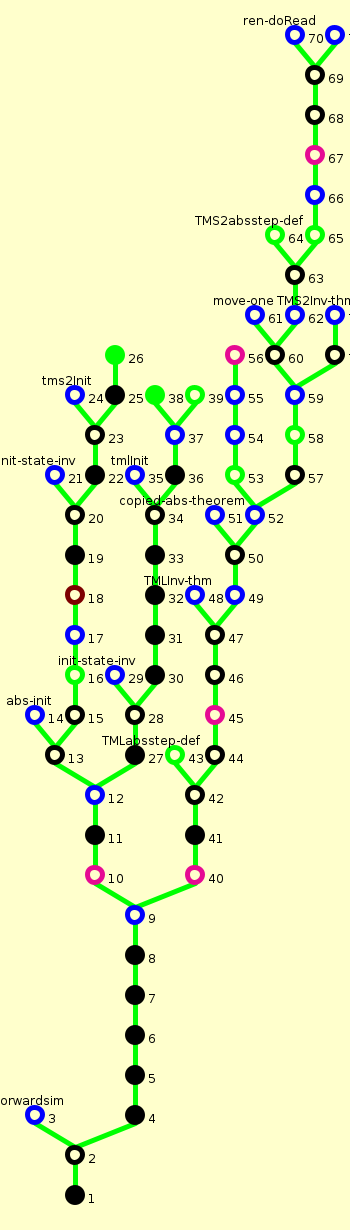
The following image shows the proof tree of sequent calculus. The proved goal is at the bottom. You can click on the nodes to view additional rules. See here for details on colors in a proof tree.
| ⊦ fwsim (CIOAut(tmlInit, TMLabsstep), AIOAut(tms2Init, TMS2absstep), λ as, cs. abs(cs, as) ∧ TMS2Inv(as.gstate, as.lsf, as.pcf) ∧ TMLInv(cs.gstate, cs.lsf, cs.pcf)) |
¬ fwsim (CIOAut(tmlInit, TMLabsstep), AIOAut(tms2Init, TMS2absstep), λ as, cs. abs(cs, as) ∧ TMS2Inv(as.gstate, as.lsf, as.pcf) ∧ TMLInv(cs.gstate, cs.lsf, cs.pcf)) ⊦
| ¬ fwsim (CIOAut(tmlInit, TMLabsstep), AIOAut(tms2Init, TMS2absstep), λ as, cs. abs(cs, as) ∧ TMS2Inv(as.gstate, as.lsf, as.pcf) ∧ TMLInv(cs.gstate, cs.lsf, cs.pcf)) ⊦ |
⊦ fwsim(CIOAut(cstartf, cstepf), AIOAut(astartf, astepf), r) ↔ (∀ cs. cstartf(cs) → (∃ as. r(as, cs) ∧ astartf(as))) ∧ (∀ cs, a, cs0, as. r(as, cs) ∧ cstepf(cs, a, cs0) → (∃ as0. amove(AIOAut(astartf, astepf))(as, ⌜a '⌝ ^, as0) ∧ r(as0, cs0)))
(∃ cs. ¬(tmlInit(cs) → (∃ as. (abs(cs, as) ∧ TMS2Inv(as.gstate, as.lsf, as.pcf) ∧ TMLInv(cs.gstate, cs.lsf, cs.pcf)) ∧ tms2Init(as)))) ∨ (∃ cs, aa, cs0, as. ¬ ( (abs(cs, as) ∧ TMS2Inv(as.gstate, as.lsf, as.pcf) ∧ TMLInv(cs.gstate, cs.lsf, cs.pcf)) ∧ TMLabsstep(cs, aa, cs0) → (∃ as0. amove(AIOAut(tms2Init, TMS2absstep))(as, ⌜aa '⌝ ^, as0) ∧ abs(cs0, as0) ∧ TMS2Inv(as0.gstate, as0.lsf, as0.pcf) ∧ TMLInv(cs0.gstate, cs0.lsf, cs0.pcf)))) ⊦
Used terms: tmlInit, λ as, cs. abs(cs, as) ∧ TMS2Inv(as.gstate, as.lsf, as.pcf) ∧ TMLInv(cs.gstate, cs.lsf, cs.pcf), tms2Init, TMLabsstep, TMS2absstep
| ⊦ fwsim(CIOAut(cstartf, cstepf), AIOAut(astartf, astepf), r) ↔ (∀ cs. cstartf(cs) → (∃ as. r(as, cs) ∧ astartf(as))) ∧ (∀ cs, a, cs0, as. r(as, cs) ∧ cstepf(cs, a, cs0) → (∃ as0. amove(AIOAut(astartf, astepf))(as, ⌜a '⌝ ^, as0) ∧ r(as0, cs0))) |
| (∃ cs. ¬(tmlInit(cs) → (∃ as. (abs(cs, as) ∧ TMS2Inv(as.gstate, as.lsf, as.pcf) ∧ TMLInv(cs.gstate, cs.lsf, cs.pcf)) ∧ tms2Init(as)))) ∨ (∃ cs, aa, cs0, as. ¬ ( (abs(cs, as) ∧ TMS2Inv(as.gstate, as.lsf, as.pcf) ∧ TMLInv(cs.gstate, cs.lsf, cs.pcf)) ∧ TMLabsstep(cs, aa, cs0) → (∃ as0. amove(AIOAut(tms2Init, TMS2absstep))(as, ⌜aa '⌝ ^, as0) ∧ abs(cs0, as0) ∧ TMS2Inv(as0.gstate, as0.lsf, as0.pcf) ∧ TMLInv(cs0.gstate, cs0.lsf, cs0.pcf)))) ⊦ |
¬(tmlInit(cs) → (∃ as. abs(cs, as) ∧ TMS2Inv(as.gstate, as.lsf, as.pcf) ∧ TMLInv(cs.gstate, cs.lsf, cs.pcf) ∧ tms2Init(as))) ∨ ¬ ( abs(cs0, as) ∧ TMS2Inv(as.gstate, as.lsf, as.pcf) ∧ TMLInv(cs0.gstate, cs0.lsf, cs0.pcf) ∧ TMLabsstep(cs0, aa, cs1) → (∃ as0. amove(AIOAut(tms2Init, TMS2absstep))(as, ⌜aa '⌝ ^, as0) ∧ abs(cs1, as0) ∧ TMS2Inv(as0.gstate, as0.lsf, as0.pcf) ∧ TMLInv(cs1.gstate, cs1.lsf, cs1.pcf))) ⊦
| ¬(tmlInit(cs) → (∃ as. abs(cs, as) ∧ TMS2Inv(as.gstate, as.lsf, as.pcf) ∧ TMLInv(cs.gstate, cs.lsf, cs.pcf) ∧ tms2Init(as))) ∨ ¬ ( abs(cs0, as) ∧ TMS2Inv(as.gstate, as.lsf, as.pcf) ∧ TMLInv(cs0.gstate, cs0.lsf, cs0.pcf) ∧ TMLabsstep(cs0, aa, cs1) → (∃ as0. amove(AIOAut(tms2Init, TMS2absstep))(as, ⌜aa '⌝ ^, as0) ∧ abs(cs1, as0) ∧ TMS2Inv(as0.gstate, as0.lsf, as0.pcf) ∧ TMLInv(cs1.gstate, cs1.lsf, cs1.pcf))) ⊦ |
as = mkstate(ags, alsf, apcf), ¬(tmlInit(cs) → (∃ as. abs(cs, as) ∧ TMS2Inv(as.gstate, as.lsf, as.pcf) ∧ TMLInv(cs.gstate, cs.lsf, cs.pcf) ∧ tms2Init(as))) ∨ ¬ ( abs(cs0, as) ∧ TMS2Inv(ags, alsf, apcf) ∧ TMLInv(cs0.gstate, cs0.lsf, cs0.pcf) ∧ TMLabsstep(cs0, aa, cs1) → (∃ as0. amove(AIOAut(tms2Init, TMS2absstep))(as, ⌜aa '⌝ ^, as0) ∧ abs(cs1, as0) ∧ TMS2Inv(as0.gstate, as0.lsf, as0.pcf) ∧ TMLInv(cs1.gstate, cs1.lsf, cs1.pcf))) ⊦
Used simplifier rules: ⊦ (gstate = s.gstate ∧ lsf = s.lsf) ∧ pcf = s.pcf ↔ s = mkstate(gstate, lsf, pcf); (elim) Used terms: as, ags, alsf, apcf
| as = mkstate(ags, alsf, apcf), ¬(tmlInit(cs) → (∃ as. abs(cs, as) ∧ TMS2Inv(as.gstate, as.lsf, as.pcf) ∧ TMLInv(cs.gstate, cs.lsf, cs.pcf) ∧ tms2Init(as))) ∨ ¬ ( abs(cs0, as) ∧ TMS2Inv(ags, alsf, apcf) ∧ TMLInv(cs0.gstate, cs0.lsf, cs0.pcf) ∧ TMLabsstep(cs0, aa, cs1) → (∃ as0. amove(AIOAut(tms2Init, TMS2absstep))(as, ⌜aa '⌝ ^, as0) ∧ abs(cs1, as0) ∧ TMS2Inv(as0.gstate, as0.lsf, as0.pcf) ∧ TMLInv(cs1.gstate, cs1.lsf, cs1.pcf))) ⊦ |
¬(tmlInit(cs) → (∃ as. abs(cs, as) ∧ TMS2Inv(as.gstate, as.lsf, as.pcf) ∧ TMLInv(cs.gstate, cs.lsf, cs.pcf) ∧ tms2Init(as))) ∨ ¬ ( abs(cs0, mkstate(ags, alsf, apcf)) ∧ TMS2Inv(ags, alsf, apcf) ∧ TMLInv(cs0.gstate, cs0.lsf, cs0.pcf) ∧ TMLabsstep(cs0, aa, cs1) → (∃ as0. amove(AIOAut(tms2Init, TMS2absstep))(mkstate(ags, alsf, apcf), ⌜aa '⌝ ^, as0) ∧ abs(cs1, as0) ∧ TMS2Inv(as0.gstate, as0.lsf, as0.pcf) ∧ TMLInv(cs1.gstate, cs1.lsf, cs1.pcf))) ⊦
| ¬(tmlInit(cs) → (∃ as. abs(cs, as) ∧ TMS2Inv(as.gstate, as.lsf, as.pcf) ∧ TMLInv(cs.gstate, cs.lsf, cs.pcf) ∧ tms2Init(as))) ∨ ¬ ( abs(cs0, mkstate(ags, alsf, apcf)) ∧ TMS2Inv(ags, alsf, apcf) ∧ TMLInv(cs0.gstate, cs0.lsf, cs0.pcf) ∧ TMLabsstep(cs0, aa, cs1) → (∃ as0. amove(AIOAut(tms2Init, TMS2absstep))(mkstate(ags, alsf, apcf), ⌜aa '⌝ ^, as0) ∧ abs(cs1, as0) ∧ TMS2Inv(as0.gstate, as0.lsf, as0.pcf) ∧ TMLInv(cs1.gstate, cs1.lsf, cs1.pcf))) ⊦ |
cs0 = mkstate(gs, lsf, pcf), ¬(tmlInit(cs) → (∃ as. abs(cs, as) ∧ TMS2Inv(as.gstate, as.lsf, as.pcf) ∧ TMLInv(cs.gstate, cs.lsf, cs.pcf) ∧ tms2Init(as))) ∨ ¬ ( abs(cs0, mkstate(ags, alsf, apcf)) ∧ TMS2Inv(ags, alsf, apcf) ∧ TMLInv(gs, lsf, pcf) ∧ TMLabsstep(cs0, aa, cs1) → (∃ as0. amove(AIOAut(tms2Init, TMS2absstep))(mkstate(ags, alsf, apcf), ⌜aa '⌝ ^, as0) ∧ abs(cs1, as0) ∧ TMS2Inv(as0.gstate, as0.lsf, as0.pcf) ∧ TMLInv(cs1.gstate, cs1.lsf, cs1.pcf))) ⊦
Used simplifier rules: ⊦ (gstate = s.gstate ∧ lsf = s.lsf) ∧ pcf = s.pcf ↔ s = mkstate(gstate, lsf, pcf); (elim) Used terms: cs0, gs, lsf, pcf
| cs0 = mkstate(gs, lsf, pcf), ¬(tmlInit(cs) → (∃ as. abs(cs, as) ∧ TMS2Inv(as.gstate, as.lsf, as.pcf) ∧ TMLInv(cs.gstate, cs.lsf, cs.pcf) ∧ tms2Init(as))) ∨ ¬ ( abs(cs0, mkstate(ags, alsf, apcf)) ∧ TMS2Inv(ags, alsf, apcf) ∧ TMLInv(gs, lsf, pcf) ∧ TMLabsstep(cs0, aa, cs1) → (∃ as0. amove(AIOAut(tms2Init, TMS2absstep))(mkstate(ags, alsf, apcf), ⌜aa '⌝ ^, as0) ∧ abs(cs1, as0) ∧ TMS2Inv(as0.gstate, as0.lsf, as0.pcf) ∧ TMLInv(cs1.gstate, cs1.lsf, cs1.pcf))) ⊦ |
¬(tmlInit(cs) → (∃ as. abs(cs, as) ∧ TMS2Inv(as.gstate, as.lsf, as.pcf) ∧ TMLInv(cs.gstate, cs.lsf, cs.pcf) ∧ tms2Init(as))) ∨ ¬ ( (∀ tid. labs(gs, lsf(tid), pcf(tid), ags, alsf(tid), apcf(tid))) ∧ TMS2Inv(ags, alsf, apcf) ∧ TMLInv(gs, lsf, pcf) ∧ TMLabsstep(mkstate(gs, lsf, pcf), aa, cs1) → (∃ as0. amove(AIOAut(tms2Init, TMS2absstep))(mkstate(ags, alsf, apcf), ⌜aa '⌝ ^, as0) ∧ abs(cs1, as0) ∧ TMS2Inv(as0.gstate, as0.lsf, as0.pcf) ∧ TMLInv(cs1.gstate, cs1.lsf, cs1.pcf))) ⊦
Used simplifier rules: ⊦ gabs(gs, lsf, pcf, ags, alsf, apcf) ↔ true; (s) ⊦ abs(mkstate(gs, lsf, pcf), mkstate(ags, alsf, apcf)) ↔ gabs(gs, lsf, pcf, ags, alsf, apcf) ∧ (∀ tid. labs(gs, lsf(tid), pcf(tid), ags, alsf(tid), apcf(tid))); (s)
| ¬(tmlInit(cs) → (∃ as. abs(cs, as) ∧ TMS2Inv(as.gstate, as.lsf, as.pcf) ∧ TMLInv(cs.gstate, cs.lsf, cs.pcf) ∧ tms2Init(as))) ∨ ¬ ( (∀ tid. labs(gs, lsf(tid), pcf(tid), ags, alsf(tid), apcf(tid))) ∧ TMS2Inv(ags, alsf, apcf) ∧ TMLInv(gs, lsf, pcf) ∧ TMLabsstep(mkstate(gs, lsf, pcf), aa, cs1) → (∃ as0. amove(AIOAut(tms2Init, TMS2absstep))(mkstate(ags, alsf, apcf), ⌜aa '⌝ ^, as0) ∧ abs(cs1, as0) ∧ TMS2Inv(as0.gstate, as0.lsf, as0.pcf) ∧ TMLInv(cs1.gstate, cs1.lsf, cs1.pcf))) ⊦ |
tmlInit(cs) ⊦ ∃ as. abs(cs, as) ∧ TMS2Inv(as.gstate, as.lsf, as.pcf) ∧ TMLInv(cs.gstate, cs.lsf, cs.pcf) ∧ tms2Init(as)
TMLInv(gs, lsf, pcf), TMLabsstep(mkstate(gs, lsf, pcf), aa, cs1), TMS2Inv(ags, alsf, apcf), ∀ tid. labs(gs, lsf(tid), pcf(tid), ags, alsf(tid), apcf(tid)) ⊦ ∃ as0. amove(AIOAut(tms2Init, TMS2absstep))(mkstate(ags, alsf, apcf), ⌜aa '⌝ ^, as0) ∧ abs(cs1, as0) ∧ TMS2Inv(as0.gstate, as0.lsf, as0.pcf) ∧ TMLInv(cs1.gstate, cs1.lsf, cs1.pcf)
| tmlInit(cs) ⊦ ∃ as. abs(cs, as) ∧ TMS2Inv(as.gstate, as.lsf, as.pcf) ∧ TMLInv(cs.gstate, cs.lsf, cs.pcf) ∧ tms2Init(as) |
cs = mkstate(gs, lsf, pcf), tmlInit(cs) ⊦ ∃ as. abs(cs, as) ∧ TMS2Inv(as.gstate, as.lsf, as.pcf) ∧ TMLInv(cs.gstate, cs.lsf, cs.pcf) ∧ tms2Init(as)
Used simplifier rules: TMLState freely generated by mkstate;;
| cs = mkstate(gs, lsf, pcf), tmlInit(cs) ⊦ ∃ as. abs(cs, as) ∧ TMS2Inv(as.gstate, as.lsf, as.pcf) ∧ TMLInv(cs.gstate, cs.lsf, cs.pcf) ∧ tms2Init(as) |
tmlInit(mkstate(gs, lsf, pcf)) ⊦ ∃ as. abs(mkstate(gs, lsf, pcf), as) ∧ TMS2Inv(as.gstate, as.lsf, as.pcf) ∧ TMLInv(gs, lsf, pcf) ∧ tms2Init(as)
Used simplifier rules: ⊦ mkstate(gstate, lsf, pcf).pcf = pcf; (s) ⊦ mkstate(gstate, lsf, pcf).lsf = lsf; (s) ⊦ mkstate(gstate, lsf, pcf).gstate = gstate; (s)
| tmlInit(mkstate(gs, lsf, pcf)) ⊦ ∃ as. abs(mkstate(gs, lsf, pcf), as) ∧ TMS2Inv(as.gstate, as.lsf, as.pcf) ∧ TMLInv(gs, lsf, pcf) ∧ tms2Init(as) |
TMLInv(gs, lsf, pcf), tmlInit(mkstate(gs, lsf, pcf)) ⊦ ∃ as. abs(mkstate(gs, lsf, pcf), as) ∧ TMS2Inv(as.gstate, as.lsf, as.pcf) ∧ TMLInv(gs, lsf, pcf) ∧ tms2Init(as)
tmlInit(mkstate(gs, lsf, pcf)), ¬ TMLInv(gs, lsf, pcf) ⊦ ∃ as. abs(mkstate(gs, lsf, pcf), as) ∧ TMS2Inv(as.gstate, as.lsf, as.pcf) ∧ TMLInv(gs, lsf, pcf) ∧ tms2Init(as)
Used formulas: TMLInv(gs, lsf, pcf)
| TMLInv(gs, lsf, pcf), tmlInit(mkstate(gs, lsf, pcf)) ⊦ ∃ as. abs(mkstate(gs, lsf, pcf), as) ∧ TMS2Inv(as.gstate, as.lsf, as.pcf) ∧ TMLInv(gs, lsf, pcf) ∧ tms2Init(as) |
tmlInit(mkstate(gs, lsf, pcf)), TMLInv(gs, lsf, pcf) ⊦ ∃ ags, alsf, apcf. tms2Init(mkstate(ags, alsf, apcf)) ∧ abs(mkstate(gs, lsf, pcf), mkstate(ags, alsf, apcf))
TMLInv(gs, lsf, pcf), tmlInit(mkstate(gs, lsf, pcf)), ∃ ags, alsf, apcf. tms2Init(mkstate(ags, alsf, apcf)) ∧ abs(mkstate(gs, lsf, pcf), mkstate(ags, alsf, apcf)) ⊦ ∃ as. abs(mkstate(gs, lsf, pcf), as) ∧ TMS2Inv(as.gstate, as.lsf, as.pcf) ∧ TMLInv(gs, lsf, pcf) ∧ tms2Init(as)
Used terms: gs, lsf, pcf
| tmlInit(mkstate(gs, lsf, pcf)), TMLInv(gs, lsf, pcf) ⊦ ∃ ags, alsf, apcf. tms2Init(mkstate(ags, alsf, apcf)) ∧ abs(mkstate(gs, lsf, pcf), mkstate(ags, alsf, apcf)) |
| TMLInv(gs, lsf, pcf), tmlInit(mkstate(gs, lsf, pcf)), ∃ ags, alsf, apcf. tms2Init(mkstate(ags, alsf, apcf)) ∧ abs(mkstate(gs, lsf, pcf), mkstate(ags, alsf, apcf)) ⊦ ∃ as. abs(mkstate(gs, lsf, pcf), as) ∧ TMS2Inv(as.gstate, as.lsf, as.pcf) ∧ TMLInv(gs, lsf, pcf) ∧ tms2Init(as) |
TMLInv(gs, lsf, pcf), abs(mkstate(gs, lsf, pcf), mkstate(ags, alsf, apcf)), tmlInit(mkstate(gs, lsf, pcf)), tms2Init(mkstate(ags, alsf, apcf)) ⊦ ∃ as. abs(mkstate(gs, lsf, pcf), as) ∧ TMS2Inv(as.gstate, as.lsf, as.pcf) ∧ TMLInv(gs, lsf, pcf) ∧ tms2Init(as)
| TMLInv(gs, lsf, pcf), abs(mkstate(gs, lsf, pcf), mkstate(ags, alsf, apcf)), tmlInit(mkstate(gs, lsf, pcf)), tms2Init(mkstate(ags, alsf, apcf)) ⊦ ∃ as. abs(mkstate(gs, lsf, pcf), as) ∧ TMS2Inv(as.gstate, as.lsf, as.pcf) ∧ TMLInv(gs, lsf, pcf) ∧ tms2Init(as) |
TMLInv(gs, lsf, pcf), abs(mkstate(gs, lsf, pcf), mkstate(ags, alsf, apcf)), tmlInit(mkstate(gs, lsf, pcf)), tms2Init(mkstate(ags, alsf, apcf)) ⊦ abs(mkstate(gs, lsf, pcf), mkstate(ags, alsf, apcf)) ∧ TMS2Inv(mkstate(ags, alsf, apcf).gstate, mkstate(ags, alsf, apcf).lsf, mkstate(ags, alsf, apcf).pcf) ∧ TMLInv(gs, lsf, pcf) ∧ tms2Init(mkstate(ags, alsf, apcf))
Used terms: mkstate(ags, alsf, apcf)
| TMLInv(gs, lsf, pcf), abs(mkstate(gs, lsf, pcf), mkstate(ags, alsf, apcf)), tmlInit(mkstate(gs, lsf, pcf)), tms2Init(mkstate(ags, alsf, apcf)) ⊦ abs(mkstate(gs, lsf, pcf), mkstate(ags, alsf, apcf)) ∧ TMS2Inv(mkstate(ags, alsf, apcf).gstate, mkstate(ags, alsf, apcf).lsf, mkstate(ags, alsf, apcf).pcf) ∧ TMLInv(gs, lsf, pcf) ∧ tms2Init(mkstate(ags, alsf, apcf)) |
TMLInv(gs, lsf, pcf), abs(mkstate(gs, lsf, pcf), mkstate(ags, alsf, apcf)), tmlInit(mkstate(gs, lsf, pcf)), tms2Init(mkstate(ags, alsf, apcf)), ¬ TMS2Inv(mkstate(ags, alsf, apcf).gstate, mkstate(ags, alsf, apcf).lsf, mkstate(ags, alsf, apcf).pcf) ⊦
| TMLInv(gs, lsf, pcf), abs(mkstate(gs, lsf, pcf), mkstate(ags, alsf, apcf)), tmlInit(mkstate(gs, lsf, pcf)), tms2Init(mkstate(ags, alsf, apcf)), ¬ TMS2Inv(mkstate(ags, alsf, apcf).gstate, mkstate(ags, alsf, apcf).lsf, mkstate(ags, alsf, apcf).pcf) ⊦ |
tms2Init(mkstate(ags, alsf, apcf)), ¬ TMS2Inv(mkstate(ags, alsf, apcf).gstate, mkstate(ags, alsf, apcf).lsf, mkstate(ags, alsf, apcf).pcf) ⊦
| tms2Init(mkstate(ags, alsf, apcf)), ¬ TMS2Inv(mkstate(ags, alsf, apcf).gstate, mkstate(ags, alsf, apcf).lsf, mkstate(ags, alsf, apcf).pcf) ⊦ |
tms2Init(mkstate(ags, alsf, apcf)), ¬ TMS2Inv(ags, alsf, apcf) ⊦
Used simplifier rules: ⊦ mkstate(gstate, lsf, pcf).pcf = pcf; (s) ⊦ mkstate(gstate, lsf, pcf).lsf = lsf; (s) ⊦ mkstate(gstate, lsf, pcf).gstate = gstate; (s)
| tms2Init(mkstate(ags, alsf, apcf)), ¬ TMS2Inv(ags, alsf, apcf) ⊦ |
(gs.memories = ∅ ' ∧ pcf = (λ tid. NotStarted)) ∧ (∀ tid. tid = lsf(tid).tid) ⊦ TMS2Inv(gs, lsf, pcf)
tms2Init(mkstate(ags, alsf, apcf)), ¬ TMS2Inv(ags, alsf, apcf) ⊦ ags.memories = ∅ ' ∧ apcf = (λ tid. NotStarted) ∧ (∀ tid. tid = alsf(tid).tid)
Used terms: ags, apcf, alsf
| (gs.memories = ∅ ' ∧ pcf = (λ tid. NotStarted)) ∧ (∀ tid. tid = lsf(tid).tid) ⊦ TMS2Inv(gs, lsf, pcf) |
| tms2Init(mkstate(ags, alsf, apcf)), ¬ TMS2Inv(ags, alsf, apcf) ⊦ ags.memories = ∅ ' ∧ apcf = (λ tid. NotStarted) ∧ (∀ tid. tid = alsf(tid).tid) |
tms2Init(mkstate(ags, alsf, apcf)), ¬ TMS2Inv(ags, alsf, apcf) ⊦ ags.memories = ∅ ' ∧ apcf(tid) = NotStarted ∧ tid0 = alsf(tid0).tid
| tms2Init(mkstate(ags, alsf, apcf)), ¬ TMS2Inv(ags, alsf, apcf) ⊦ ags.memories = ∅ ' ∧ apcf(tid) = NotStarted ∧ tid0 = alsf(tid0).tid |
⊦ tms2Init(mkstate(gs, lsf, pcf)) ↔ (gs.memories = ∅ ' ∧ pcf = (λ tid. NotStarted)) ∧ (∀ tid. lsf(tid).tid = tid)
ags.memories = ∅ ', apcf = (λ tid. NotStarted), ¬ TMS2Inv(ags, alsf, apcf), ∀ tid. alsf(tid).tid = tid ⊦ ags.memories = ∅ ' ∧ apcf(tid) = NotStarted ∧ tid0 = alsf(tid0).tid
Used terms: ags, alsf, apcf
| ⊦ tms2Init(mkstate(gs, lsf, pcf)) ↔ (gs.memories = ∅ ' ∧ pcf = (λ tid. NotStarted)) ∧ (∀ tid. lsf(tid).tid = tid) |
| ags.memories = ∅ ', apcf = (λ tid. NotStarted), ¬ TMS2Inv(ags, alsf, apcf), ∀ tid. alsf(tid).tid = tid ⊦ ags.memories = ∅ ' ∧ apcf(tid) = NotStarted ∧ tid0 = alsf(tid0).tid |
ags.memories = ∅ ', tid0 ≠ alsf(tid0).tid, ¬ TMS2Inv(ags, alsf, λ tid. NotStarted), ∀ tid. alsf(tid).tid = tid ⊦
| ags.memories = ∅ ', tid0 ≠ alsf(tid0).tid, ¬ TMS2Inv(ags, alsf, λ tid. NotStarted), ∀ tid. alsf(tid).tid = tid ⊦ |
Used terms: tid0
| tmlInit(mkstate(gs, lsf, pcf)), ¬ TMLInv(gs, lsf, pcf) ⊦ ∃ as. abs(mkstate(gs, lsf, pcf), as) ∧ TMS2Inv(as.gstate, as.lsf, as.pcf) ∧ TMLInv(gs, lsf, pcf) ∧ tms2Init(as) |
tmlInit(mkstate(gs, lsf, pcf)), ¬ TMLInv(gs, lsf, pcf) ⊦
| tmlInit(mkstate(gs, lsf, pcf)), ¬ TMLInv(gs, lsf, pcf) ⊦ |
(gs.glb = 0 ∧ (∀ l. gs.mem(l) = O) ∧ gs.w = None ∧ pcf = (λ tid. S)) ∧ (∀ tid. tid = lsf(tid).tid) ⊦ TMLInv(gs, lsf, pcf)
tmlInit(mkstate(gs, lsf, pcf)), ¬ TMLInv(gs, lsf, pcf) ⊦ gs.glb = 0 ∧ (∀ l. gs.mem(l) = O) ∧ gs.w = None ∧ pcf = (λ tid. S) ∧ (∀ tid. tid = lsf(tid).tid)
Used terms: gs, pcf, lsf
| (gs.glb = 0 ∧ (∀ l. gs.mem(l) = O) ∧ gs.w = None ∧ pcf = (λ tid. S)) ∧ (∀ tid. tid = lsf(tid).tid) ⊦ TMLInv(gs, lsf, pcf) |
| tmlInit(mkstate(gs, lsf, pcf)), ¬ TMLInv(gs, lsf, pcf) ⊦ gs.glb = 0 ∧ (∀ l. gs.mem(l) = O) ∧ gs.w = None ∧ pcf = (λ tid. S) ∧ (∀ tid. tid = lsf(tid).tid) |
tmlInit(mkstate(gs, lsf, pcf)), ¬ TMLInv(gs, lsf, pcf) ⊦ gs.glb = 0 ∧ gs.mem(l) = O ∧ gs.w = None ∧ pcf(tid) = S ∧ tid0 = lsf(tid0).tid
| tmlInit(mkstate(gs, lsf, pcf)), ¬ TMLInv(gs, lsf, pcf) ⊦ gs.glb = 0 ∧ gs.mem(l) = O ∧ gs.w = None ∧ pcf(tid) = S ∧ tid0 = lsf(tid0).tid |
gs = mkTMLgs(mem, glb, w), tmlInit(mkstate(gs, lsf, pcf)), ¬ TMLInv(gs, lsf, pcf) ⊦ glb = 0 ∧ mem(l) = O ∧ w = None ∧ pcf(tid) = S ∧ tid0 = lsf(tid0).tid
Used simplifier rules: ⊦ (mem = gs.mem ∧ glb = gs.glb) ∧ w = gs.w ↔ gs = mkTMLgs(mem, glb, w); (elim) Used terms: gs, mem, glb, w
| gs = mkTMLgs(mem, glb, w), tmlInit(mkstate(gs, lsf, pcf)), ¬ TMLInv(gs, lsf, pcf) ⊦ glb = 0 ∧ mem(l) = O ∧ w = None ∧ pcf(tid) = S ∧ tid0 = lsf(tid0).tid |
tmlInit(mkstate(mkTMLgs(mem, glb, w), lsf, pcf)), ¬ TMLInv(mkTMLgs(mem, glb, w), lsf, pcf) ⊦ glb = 0 ∧ mem(l) = O ∧ w = None ∧ pcf(tid) = S ∧ tid0 = lsf(tid0).tid
| tmlInit(mkstate(mkTMLgs(mem, glb, w), lsf, pcf)), ¬ TMLInv(mkTMLgs(mem, glb, w), lsf, pcf) ⊦ glb = 0 ∧ mem(l) = O ∧ w = None ∧ pcf(tid) = S ∧ tid0 = lsf(tid0).tid |
lsf(tid0) = mkTMLls(tid1, loc, l0, v), tmlInit(mkstate(mkTMLgs(mem, glb, w), lsf, pcf)), ¬ TMLInv(mkTMLgs(mem, glb, w), lsf, pcf) ⊦ glb = 0 ∧ mem(l) = O ∧ w = None ∧ pcf(tid) = S ∧ tid0 = tid1
Used simplifier rules: ⊦ ((tid = ls.tid ∧ loc = ls.loc) ∧ l = ls.l) ∧ v = ls.v ↔ ls = mkTMLls(tid, loc, l, v); (elim) Used terms: v, l0, tid1, lsf(tid0), loc
| lsf(tid0) = mkTMLls(tid1, loc, l0, v), tmlInit(mkstate(mkTMLgs(mem, glb, w), lsf, pcf)), ¬ TMLInv(mkTMLgs(mem, glb, w), lsf, pcf) ⊦ glb = 0 ∧ mem(l) = O ∧ w = None ∧ pcf(tid) = S ∧ tid0 = tid1 |
⊦ tmlInit(mkstate(gs, lsf, pcf)) ↔ (gs.glb = 0 ∧ (∀ l. gs.mem(l) = O) ∧ gs.w = None ∧ pcf = (λ tid. S)) ∧ (∀ tid. lsf(tid).tid = tid)
mkTMLgs(mem, glb, w).glb = 0, mkTMLgs(mem, glb, w).w = None, lsf(tid0) = mkTMLls(tid1, loc, l0, v), pcf = (λ tid. S), ¬ TMLInv(mkTMLgs(mem, glb, w), lsf, pcf), ∀ l. mkTMLgs(mem, glb, w).mem(l) = O, ∀ tid. lsf(tid).tid = tid ⊦ glb = 0 ∧ mem(l) = O ∧ w = None ∧ pcf(tid) = S ∧ tid0 = tid1
Used terms: mkTMLgs(mem, glb, w), lsf, pcf
| ⊦ tmlInit(mkstate(gs, lsf, pcf)) ↔ (gs.glb = 0 ∧ (∀ l. gs.mem(l) = O) ∧ gs.w = None ∧ pcf = (λ tid. S)) ∧ (∀ tid. lsf(tid).tid = tid) |
| mkTMLgs(mem, glb, w).glb = 0, mkTMLgs(mem, glb, w).w = None, lsf(tid0) = mkTMLls(tid1, loc, l0, v), pcf = (λ tid. S), ¬ TMLInv(mkTMLgs(mem, glb, w), lsf, pcf), ∀ l. mkTMLgs(mem, glb, w).mem(l) = O, ∀ tid. lsf(tid).tid = tid ⊦ glb = 0 ∧ mem(l) = O ∧ w = None ∧ pcf(tid) = S ∧ tid0 = tid1 |
lsf(tid0) = mkTMLls(tid1, loc, l0, v), ¬ TMLInv(mkTMLgs(mem, 0, None), lsf, λ tid. S), ∀ l1. mem(l1) = O, ∀ tid. lsf(tid).tid = tid ⊦ mem(l) = O ∧ tid0 = tid1
Used simplifier rules: ⊦ mkTMLgs(mem, glb, w).mem = mem; (s) ⊦ mkTMLgs(mem, glb, w).glb = glb; (s) ⊦ mkTMLgs(mem, glb, w).w = w; (s)
| lsf(tid0) = mkTMLls(tid1, loc, l0, v), ¬ TMLInv(mkTMLgs(mem, 0, None), lsf, λ tid. S), ∀ l1. mem(l1) = O, ∀ tid. lsf(tid).tid = tid ⊦ mem(l) = O ∧ tid0 = tid1 |
lsf(tid0) = mkTMLls(tid1, loc, l0, v), mem(l) ≠ O, ¬ TMLInv(mkTMLgs(mem, 0, None), lsf, λ tid. S), ∀ tid. lsf(tid).tid = tid, ∀ l1. mem(l1) = O ⊦
lsf(tid0) = mkTMLls(tid1, loc, l0, v), tid0 ≠ tid1, ¬ TMLInv(mkTMLgs(mem, 0, None), lsf, λ tid. S), ∀ tid. lsf(tid).tid = tid, ∀ l1. mem(l1) = O ⊦
| lsf(tid0) = mkTMLls(tid1, loc, l0, v), mem(l) ≠ O, ¬ TMLInv(mkTMLgs(mem, 0, None), lsf, λ tid. S), ∀ tid. lsf(tid).tid = tid, ∀ l1. mem(l1) = O ⊦ |
Used terms: l
| lsf(tid0) = mkTMLls(tid1, loc, l0, v), tid0 ≠ tid1, ¬ TMLInv(mkTMLgs(mem, 0, None), lsf, λ tid. S), ∀ tid. lsf(tid).tid = tid, ∀ l1. mem(l1) = O ⊦ |
Used simplifier rules: ⊦ mkTMLls(tid, loc, l, v).tid = tid; (s) Used terms: tid0
| TMLInv(gs, lsf, pcf), TMLabsstep(mkstate(gs, lsf, pcf), aa, cs1), TMS2Inv(ags, alsf, apcf), ∀ tid. labs(gs, lsf(tid), pcf(tid), ags, alsf(tid), apcf(tid)) ⊦ ∃ as0. amove(AIOAut(tms2Init, TMS2absstep))(mkstate(ags, alsf, apcf), ⌜aa '⌝ ^, as0) ∧ abs(cs1, as0) ∧ TMS2Inv(as0.gstate, as0.lsf, as0.pcf) ∧ TMLInv(cs1.gstate, cs1.lsf, cs1.pcf) |
gs = mkTMLgs(mem, glb, w), TMLInv(gs, lsf, pcf), TMLabsstep(mkstate(gs, lsf, pcf), aa, cs1), TMS2Inv(ags, alsf, apcf), ∀ tid. labs(gs, lsf(tid), pcf(tid), ags, alsf(tid), apcf(tid)) ⊦ ∃ as0. amove(AIOAut(tms2Init, TMS2absstep))(mkstate(ags, alsf, apcf), ⌜aa '⌝ ^, as0) ∧ abs(cs1, as0) ∧ TMS2Inv(as0.gstate, as0.lsf, as0.pcf) ∧ TMLInv(cs1.gstate, cs1.lsf, cs1.pcf)
Used simplifier rules: TMLGState freely generated by mkTMLgs;;
| gs = mkTMLgs(mem, glb, w), TMLInv(gs, lsf, pcf), TMLabsstep(mkstate(gs, lsf, pcf), aa, cs1), TMS2Inv(ags, alsf, apcf), ∀ tid. labs(gs, lsf(tid), pcf(tid), ags, alsf(tid), apcf(tid)) ⊦ ∃ as0. amove(AIOAut(tms2Init, TMS2absstep))(mkstate(ags, alsf, apcf), ⌜aa '⌝ ^, as0) ∧ abs(cs1, as0) ∧ TMS2Inv(as0.gstate, as0.lsf, as0.pcf) ∧ TMLInv(cs1.gstate, cs1.lsf, cs1.pcf) |
TMLInv(mkTMLgs(mem, glb, w), lsf, pcf), TMLabsstep(mkstate(mkTMLgs(mem, glb, w), lsf, pcf), aa, cs1), TMS2Inv(ags, alsf, apcf), ∀ tid. labs(mkTMLgs(mem, glb, w), lsf(tid), pcf(tid), ags, alsf(tid), apcf(tid)) ⊦ ∃ as0. amove(AIOAut(tms2Init, TMS2absstep))(mkstate(ags, alsf, apcf), ⌜aa '⌝ ^, as0) ∧ abs(cs1, as0) ∧ TMS2Inv(as0.gstate, as0.lsf, as0.pcf) ∧ TMLInv(cs1.gstate, cs1.lsf, cs1.pcf)
| TMLInv(mkTMLgs(mem, glb, w), lsf, pcf), TMLabsstep(mkstate(mkTMLgs(mem, glb, w), lsf, pcf), aa, cs1), TMS2Inv(ags, alsf, apcf), ∀ tid. labs(mkTMLgs(mem, glb, w), lsf(tid), pcf(tid), ags, alsf(tid), apcf(tid)) ⊦ ∃ as0. amove(AIOAut(tms2Init, TMS2absstep))(mkstate(ags, alsf, apcf), ⌜aa '⌝ ^, as0) ∧ abs(cs1, as0) ∧ TMS2Inv(as0.gstate, as0.lsf, as0.pcf) ∧ TMLInv(cs1.gstate, cs1.lsf, cs1.pcf) |
⊦ TMLabsstep(cs, aa, cs0) ↔ (∃ ca. aa = aabs(ren(ca)) ∧ tmlStep(cs, ca, cs0))
TMLInv(mkTMLgs(mem, glb, w), lsf, pcf), TMS2Inv(ags, alsf, apcf), ∀ tid. labs(mkTMLgs(mem, glb, w), lsf(tid), pcf(tid), ags, alsf(tid), apcf(tid)), ∃ ca. aa = aabs(ren(ca)) ∧ tmlStep(mkstate(mkTMLgs(mem, glb, w), lsf, pcf), ca, cs1) ⊦ ∃ as0. amove(AIOAut(tms2Init, TMS2absstep))(mkstate(ags, alsf, apcf), ⌜aa '⌝ ^, as0) ∧ abs(cs1, as0) ∧ TMS2Inv(as0.gstate, as0.lsf, as0.pcf) ∧ TMLInv(cs1.gstate, cs1.lsf, cs1.pcf)
Used terms: mkstate(mkTMLgs(mem, glb, w), lsf, pcf), aa, cs1
| ⊦ TMLabsstep(cs, aa, cs0) ↔ (∃ ca. aa = aabs(ren(ca)) ∧ tmlStep(cs, ca, cs0)) |
| TMLInv(mkTMLgs(mem, glb, w), lsf, pcf), TMS2Inv(ags, alsf, apcf), ∀ tid. labs(mkTMLgs(mem, glb, w), lsf(tid), pcf(tid), ags, alsf(tid), apcf(tid)), ∃ ca. aa = aabs(ren(ca)) ∧ tmlStep(mkstate(mkTMLgs(mem, glb, w), lsf, pcf), ca, cs1) ⊦ ∃ as0. amove(AIOAut(tms2Init, TMS2absstep))(mkstate(ags, alsf, apcf), ⌜aa '⌝ ^, as0) ∧ abs(cs1, as0) ∧ TMS2Inv(as0.gstate, as0.lsf, as0.pcf) ∧ TMLInv(cs1.gstate, cs1.lsf, cs1.pcf) |
aa = aabs(ren(ca)), TMLInv(mkTMLgs(mem, glb, w), lsf, pcf), TMS2Inv(ags, alsf, apcf), tmlStep(mkstate(mkTMLgs(mem, glb, w), lsf, pcf), ca, cs1), ∀ tid. labs(mkTMLgs(mem, glb, w), lsf(tid), pcf(tid), ags, alsf(tid), apcf(tid)) ⊦ ∃ as0. amove(AIOAut(tms2Init, TMS2absstep))(mkstate(ags, alsf, apcf), ⌜aa '⌝ ^, as0) ∧ abs(cs1, as0) ∧ TMS2Inv(as0.gstate, as0.lsf, as0.pcf) ∧ TMLInv(cs1.gstate, cs1.lsf, cs1.pcf)
| aa = aabs(ren(ca)), TMLInv(mkTMLgs(mem, glb, w), lsf, pcf), TMS2Inv(ags, alsf, apcf), tmlStep(mkstate(mkTMLgs(mem, glb, w), lsf, pcf), ca, cs1), ∀ tid. labs(mkTMLgs(mem, glb, w), lsf(tid), pcf(tid), ags, alsf(tid), apcf(tid)) ⊦ ∃ as0. amove(AIOAut(tms2Init, TMS2absstep))(mkstate(ags, alsf, apcf), ⌜aa '⌝ ^, as0) ∧ abs(cs1, as0) ∧ TMS2Inv(as0.gstate, as0.lsf, as0.pcf) ∧ TMLInv(cs1.gstate, cs1.lsf, cs1.pcf) |
aa = aabs(ren(ca)), cs1 = mkstate(gs, lsf0, pcf0), TMLInv(mkTMLgs(mem, glb, w), lsf, pcf), TMS2Inv(ags, alsf, apcf), tmlStep(mkstate(mkTMLgs(mem, glb, w), lsf, pcf), ca, cs1), ∀ tid. labs(mkTMLgs(mem, glb, w), lsf(tid), pcf(tid), ags, alsf(tid), apcf(tid)) ⊦ ∃ as0. amove(AIOAut(tms2Init, TMS2absstep))(mkstate(ags, alsf, apcf), ⌜aa '⌝ ^, as0) ∧ abs(cs1, as0) ∧ TMS2Inv(as0.gstate, as0.lsf, as0.pcf) ∧ TMLInv(cs1.gstate, cs1.lsf, cs1.pcf)
Used simplifier rules: TMLState freely generated by mkstate;;
| aa = aabs(ren(ca)), cs1 = mkstate(gs, lsf0, pcf0), TMLInv(mkTMLgs(mem, glb, w), lsf, pcf), TMS2Inv(ags, alsf, apcf), tmlStep(mkstate(mkTMLgs(mem, glb, w), lsf, pcf), ca, cs1), ∀ tid. labs(mkTMLgs(mem, glb, w), lsf(tid), pcf(tid), ags, alsf(tid), apcf(tid)) ⊦ ∃ as0. amove(AIOAut(tms2Init, TMS2absstep))(mkstate(ags, alsf, apcf), ⌜aa '⌝ ^, as0) ∧ abs(cs1, as0) ∧ TMS2Inv(as0.gstate, as0.lsf, as0.pcf) ∧ TMLInv(cs1.gstate, cs1.lsf, cs1.pcf) |
aa = aabs(ren(ca)), TMLInv(mkTMLgs(mem, glb, w), lsf, pcf), TMS2Inv(ags, alsf, apcf), tmlStep(mkstate(mkTMLgs(mem, glb, w), lsf, pcf), ca, mkstate(gs, lsf0, pcf0)), ∀ tid. labs(mkTMLgs(mem, glb, w), lsf(tid), pcf(tid), ags, alsf(tid), apcf(tid)) ⊦ ∃ as0. amove(AIOAut(tms2Init, TMS2absstep))(mkstate(ags, alsf, apcf), ⌜aa '⌝ ^, as0) ∧ abs(mkstate(gs, lsf0, pcf0), as0) ∧ TMS2Inv(as0.gstate, as0.lsf, as0.pcf) ∧ TMLInv(mkstate(gs, lsf0, pcf0).gstate, mkstate(gs, lsf0, pcf0).lsf, mkstate(gs, lsf0, pcf0).pcf)
| aa = aabs(ren(ca)), TMLInv(mkTMLgs(mem, glb, w), lsf, pcf), TMS2Inv(ags, alsf, apcf), tmlStep(mkstate(mkTMLgs(mem, glb, w), lsf, pcf), ca, mkstate(gs, lsf0, pcf0)), ∀ tid. labs(mkTMLgs(mem, glb, w), lsf(tid), pcf(tid), ags, alsf(tid), apcf(tid)) ⊦ ∃ as0. amove(AIOAut(tms2Init, TMS2absstep))(mkstate(ags, alsf, apcf), ⌜aa '⌝ ^, as0) ∧ abs(mkstate(gs, lsf0, pcf0), as0) ∧ TMS2Inv(as0.gstate, as0.lsf, as0.pcf) ∧ TMLInv(mkstate(gs, lsf0, pcf0).gstate, mkstate(gs, lsf0, pcf0).lsf, mkstate(gs, lsf0, pcf0).pcf) |
⊦ TMLInv(gs, lsf, pcf) ∧ tmlStep(mkstate(gs, lsf, pcf), a, mkstate(gs0, lsf0, pcf0)) → TMLInv(gs0, lsf0, pcf0)
aa = aabs(ren(ca)), TMLInv(mkTMLgs(mem, glb, w), lsf, pcf), TMS2Inv(ags, alsf, apcf), tmlStep(mkstate(mkTMLgs(mem, glb, w), lsf, pcf), ca, mkstate(gs, lsf0, pcf0)), TMLInv(mkTMLgs(mem, glb, w), lsf, pcf) ∧ tmlStep(mkstate(mkTMLgs(mem, glb, w), lsf, pcf), ca, mkstate(gs, lsf0, pcf0)) → TMLInv(gs, lsf0, pcf0), ∀ tid. labs(mkTMLgs(mem, glb, w), lsf(tid), pcf(tid), ags, alsf(tid), apcf(tid)) ⊦ ∃ as0. amove(AIOAut(tms2Init, TMS2absstep))(mkstate(ags, alsf, apcf), ⌜aa '⌝ ^, as0) ∧ abs(mkstate(gs, lsf0, pcf0), as0) ∧ TMS2Inv(as0.gstate, as0.lsf, as0.pcf) ∧ TMLInv(mkstate(gs, lsf0, pcf0).gstate, mkstate(gs, lsf0, pcf0).lsf, mkstate(gs, lsf0, pcf0).pcf)
Used terms: lsf, gs, mkTMLgs(mem, glb, w), pcf0, pcf, ca, lsf0
| ⊦ TMLInv(gs, lsf, pcf) ∧ tmlStep(mkstate(gs, lsf, pcf), a, mkstate(gs0, lsf0, pcf0)) → TMLInv(gs0, lsf0, pcf0) |
| aa = aabs(ren(ca)), TMLInv(mkTMLgs(mem, glb, w), lsf, pcf), TMS2Inv(ags, alsf, apcf), tmlStep(mkstate(mkTMLgs(mem, glb, w), lsf, pcf), ca, mkstate(gs, lsf0, pcf0)), TMLInv(mkTMLgs(mem, glb, w), lsf, pcf) ∧ tmlStep(mkstate(mkTMLgs(mem, glb, w), lsf, pcf), ca, mkstate(gs, lsf0, pcf0)) → TMLInv(gs, lsf0, pcf0), ∀ tid. labs(mkTMLgs(mem, glb, w), lsf(tid), pcf(tid), ags, alsf(tid), apcf(tid)) ⊦ ∃ as0. amove(AIOAut(tms2Init, TMS2absstep))(mkstate(ags, alsf, apcf), ⌜aa '⌝ ^, as0) ∧ abs(mkstate(gs, lsf0, pcf0), as0) ∧ TMS2Inv(as0.gstate, as0.lsf, as0.pcf) ∧ TMLInv(mkstate(gs, lsf0, pcf0).gstate, mkstate(gs, lsf0, pcf0).lsf, mkstate(gs, lsf0, pcf0).pcf) |
aa = aabs(ren(ca)), TMLInv(mkTMLgs(mem, glb, w), lsf, pcf), TMLInv(gs, lsf0, pcf0), TMS2Inv(ags, alsf, apcf), tmlStep(mkstate(mkTMLgs(mem, glb, w), lsf, pcf), ca, mkstate(gs, lsf0, pcf0)), ∀ tid. labs(mkTMLgs(mem, glb, w), lsf(tid), pcf(tid), ags, alsf(tid), apcf(tid)) ⊦ ∃ as0. amove(AIOAut(tms2Init, TMS2absstep))(mkstate(ags, alsf, apcf), ⌜aa '⌝ ^, as0) ∧ abs(mkstate(gs, lsf0, pcf0), as0) ∧ TMS2Inv(as0.gstate, as0.lsf, as0.pcf) ∧ TMLInv(mkstate(gs, lsf0, pcf0).gstate, mkstate(gs, lsf0, pcf0).lsf, mkstate(gs, lsf0, pcf0).pcf)
| aa = aabs(ren(ca)), TMLInv(mkTMLgs(mem, glb, w), lsf, pcf), TMLInv(gs, lsf0, pcf0), TMS2Inv(ags, alsf, apcf), tmlStep(mkstate(mkTMLgs(mem, glb, w), lsf, pcf), ca, mkstate(gs, lsf0, pcf0)), ∀ tid. labs(mkTMLgs(mem, glb, w), lsf(tid), pcf(tid), ags, alsf(tid), apcf(tid)) ⊦ ∃ as0. amove(AIOAut(tms2Init, TMS2absstep))(mkstate(ags, alsf, apcf), ⌜aa '⌝ ^, as0) ∧ abs(mkstate(gs, lsf0, pcf0), as0) ∧ TMS2Inv(as0.gstate, as0.lsf, as0.pcf) ∧ TMLInv(mkstate(gs, lsf0, pcf0).gstate, mkstate(gs, lsf0, pcf0).lsf, mkstate(gs, lsf0, pcf0).pcf) |
TMLInv(gs, lsf, pcf), TMLInv(gs0, lsf0, pcf0), TMS2Inv(ags, alsf, apcf), tmlStep(mkstate(gs, lsf, pcf), a, mkstate(gs0, lsf0, pcf0)), abs(mkstate(gs, lsf, pcf), mkstate(ags, alsf, apcf)), ren(a, ags, alsf) = aa ⊦ (aa = τ ⊃ abs(mkstate(gs0, lsf0, pcf0), mkstate(ags, alsf, apcf)) ;∃ ags0, alsf0, apcf0. tms2Step(mkstate(ags, alsf, apcf), aa, mkstate(ags0, alsf0, apcf0)) ∧ abs(mkstate(gs0, lsf0, pcf0), mkstate(ags0, alsf0, apcf0)) )
aa = aabs(ren(ca)), TMLInv(gs, lsf0, pcf0), TMLInv(mkTMLgs(mem, glb, w), lsf, pcf), TMS2Inv(ags, alsf, apcf), tmlStep(mkstate(mkTMLgs(mem, glb, w), lsf, pcf), ca, mkstate(gs, lsf0, pcf0)), (ren(ca, ags, alsf) = τ ⊃ abs(mkstate(gs, lsf0, pcf0), mkstate(ags, alsf, apcf)) ;∃ ags0, alsf0, apcf0. tms2Step(mkstate(ags, alsf, apcf), ren(ca, ags, alsf), mkstate(ags0, alsf0, apcf0)) ∧ abs(mkstate(gs, lsf0, pcf0), mkstate(ags0, alsf0, apcf0)) ), ∀ tid. labs(mkTMLgs(mem, glb, w), lsf(tid), pcf(tid), ags, alsf(tid), apcf(tid)) ⊦ ∃ as0. amove(AIOAut(tms2Init, TMS2absstep))(mkstate(ags, alsf, apcf), ⌜aa '⌝ ^, as0) ∧ abs(mkstate(gs, lsf0, pcf0), as0) ∧ TMS2Inv(as0.gstate, as0.lsf, as0.pcf) ∧ TMLInv(mkstate(gs, lsf0, pcf0).gstate, mkstate(gs, lsf0, pcf0).lsf, mkstate(gs, lsf0, pcf0).pcf)
Used simplifier rules: ⊦ abs(mkstate(gs, lsf, pcf), mkstate(ags, alsf, apcf)) ↔ gabs(gs, lsf, pcf, ags, alsf, apcf) ∧ (∀ tid. labs(gs, lsf(tid), pcf(tid), ags, alsf(tid), apcf(tid))); (s) ⊦ gabs(gs, lsf, pcf, ags, alsf, apcf) ↔ true; (s) Used terms: lsf, ags, alsf, gs, ren(ca, ags, alsf), mkTMLgs(mem, glb, w), pcf0, apcf, pcf, ca, lsf0
| TMLInv(gs, lsf, pcf), TMLInv(gs0, lsf0, pcf0), TMS2Inv(ags, alsf, apcf), tmlStep(mkstate(gs, lsf, pcf), a, mkstate(gs0, lsf0, pcf0)), abs(mkstate(gs, lsf, pcf), mkstate(ags, alsf, apcf)), ren(a, ags, alsf) = aa ⊦ (aa = τ ⊃ abs(mkstate(gs0, lsf0, pcf0), mkstate(ags, alsf, apcf)) ;∃ ags0, alsf0, apcf0. tms2Step(mkstate(ags, alsf, apcf), aa, mkstate(ags0, alsf0, apcf0)) ∧ abs(mkstate(gs0, lsf0, pcf0), mkstate(ags0, alsf0, apcf0)) ) |
| aa = aabs(ren(ca)), TMLInv(gs, lsf0, pcf0), TMLInv(mkTMLgs(mem, glb, w), lsf, pcf), TMS2Inv(ags, alsf, apcf), tmlStep(mkstate(mkTMLgs(mem, glb, w), lsf, pcf), ca, mkstate(gs, lsf0, pcf0)), (ren(ca, ags, alsf) = τ ⊃ abs(mkstate(gs, lsf0, pcf0), mkstate(ags, alsf, apcf)) ;∃ ags0, alsf0, apcf0. tms2Step(mkstate(ags, alsf, apcf), ren(ca, ags, alsf), mkstate(ags0, alsf0, apcf0)) ∧ abs(mkstate(gs, lsf0, pcf0), mkstate(ags0, alsf0, apcf0)) ), ∀ tid. labs(mkTMLgs(mem, glb, w), lsf(tid), pcf(tid), ags, alsf(tid), apcf(tid)) ⊦ ∃ as0. amove(AIOAut(tms2Init, TMS2absstep))(mkstate(ags, alsf, apcf), ⌜aa '⌝ ^, as0) ∧ abs(mkstate(gs, lsf0, pcf0), as0) ∧ TMS2Inv(as0.gstate, as0.lsf, as0.pcf) ∧ TMLInv(mkstate(gs, lsf0, pcf0).gstate, mkstate(gs, lsf0, pcf0).lsf, mkstate(gs, lsf0, pcf0).pcf) |
aa = aabs(ren(ca)), ren(ca, ags, alsf) = τ, TMLInv(mkTMLgs(mem, glb, w), lsf, pcf), TMLInv(gs, lsf0, pcf0), TMS2Inv(ags, alsf, apcf), abs(mkstate(gs, lsf0, pcf0), mkstate(ags, alsf, apcf)), tmlStep(mkstate(mkTMLgs(mem, glb, w), lsf, pcf), ca, mkstate(gs, lsf0, pcf0)), ∀ tid. labs(mkTMLgs(mem, glb, w), lsf(tid), pcf(tid), ags, alsf(tid), apcf(tid)) ⊦ ∃ as0. amove(AIOAut(tms2Init, TMS2absstep))(mkstate(ags, alsf, apcf), ⌜aa '⌝ ^, as0) ∧ abs(mkstate(gs, lsf0, pcf0), as0) ∧ TMS2Inv(as0.gstate, as0.lsf, as0.pcf) ∧ TMLInv(mkstate(gs, lsf0, pcf0).gstate, mkstate(gs, lsf0, pcf0).lsf, mkstate(gs, lsf0, pcf0).pcf)
aa = aabs(ren(ca)), ren(ca, ags, alsf) ≠ τ, TMLInv(mkTMLgs(mem, glb, w), lsf, pcf), TMLInv(gs, lsf0, pcf0), TMS2Inv(ags, alsf, apcf), tmlStep(mkstate(mkTMLgs(mem, glb, w), lsf, pcf), ca, mkstate(gs, lsf0, pcf0)), ∀ tid. labs(mkTMLgs(mem, glb, w), lsf(tid), pcf(tid), ags, alsf(tid), apcf(tid)), ∃ ags0, alsf0, apcf0. tms2Step(mkstate(ags, alsf, apcf), ren(ca, ags, alsf), mkstate(ags0, alsf0, apcf0)) ∧ abs(mkstate(gs, lsf0, pcf0), mkstate(ags0, alsf0, apcf0)) ⊦ ∃ as0. amove(AIOAut(tms2Init, TMS2absstep))(mkstate(ags, alsf, apcf), ⌜aa '⌝ ^, as0) ∧ abs(mkstate(gs, lsf0, pcf0), as0) ∧ TMS2Inv(as0.gstate, as0.lsf, as0.pcf) ∧ TMLInv(mkstate(gs, lsf0, pcf0).gstate, mkstate(gs, lsf0, pcf0).lsf, mkstate(gs, lsf0, pcf0).pcf)
| aa = aabs(ren(ca)), ren(ca, ags, alsf) = τ, TMLInv(mkTMLgs(mem, glb, w), lsf, pcf), TMLInv(gs, lsf0, pcf0), TMS2Inv(ags, alsf, apcf), abs(mkstate(gs, lsf0, pcf0), mkstate(ags, alsf, apcf)), tmlStep(mkstate(mkTMLgs(mem, glb, w), lsf, pcf), ca, mkstate(gs, lsf0, pcf0)), ∀ tid. labs(mkTMLgs(mem, glb, w), lsf(tid), pcf(tid), ags, alsf(tid), apcf(tid)) ⊦ ∃ as0. amove(AIOAut(tms2Init, TMS2absstep))(mkstate(ags, alsf, apcf), ⌜aa '⌝ ^, as0) ∧ abs(mkstate(gs, lsf0, pcf0), as0) ∧ TMS2Inv(as0.gstate, as0.lsf, as0.pcf) ∧ TMLInv(mkstate(gs, lsf0, pcf0).gstate, mkstate(gs, lsf0, pcf0).lsf, mkstate(gs, lsf0, pcf0).pcf) |
aa = aabs(ren(ca)), ren(ca, ags, alsf) = τ, TMLInv(gs, lsf0, pcf0), TMLInv(mkTMLgs(mem, glb, w), lsf, pcf), TMS2Inv(ags, alsf, apcf), abs(mkstate(gs, lsf0, pcf0), mkstate(ags, alsf, apcf)), tmlStep(mkstate(mkTMLgs(mem, glb, w), lsf, pcf), ca, mkstate(gs, lsf0, pcf0)), ∀ tid. labs(mkTMLgs(mem, glb, w), lsf(tid), pcf(tid), ags, alsf(tid), apcf(tid)) ⊦ amove(AIOAut(tms2Init, TMS2absstep))(mkstate(ags, alsf, apcf), ⌜aa '⌝ ^, mkstate(ags, alsf, apcf)) ∧ abs(mkstate(gs, lsf0, pcf0), mkstate(ags, alsf, apcf)) ∧ TMS2Inv(mkstate(ags, alsf, apcf).gstate, mkstate(ags, alsf, apcf).lsf, mkstate(ags, alsf, apcf).pcf) ∧ TMLInv(mkstate(gs, lsf0, pcf0).gstate, mkstate(gs, lsf0, pcf0).lsf, mkstate(gs, lsf0, pcf0).pcf)
Used terms: mkstate(ags, alsf, apcf)
| aa = aabs(ren(ca)), ren(ca, ags, alsf) = τ, TMLInv(gs, lsf0, pcf0), TMLInv(mkTMLgs(mem, glb, w), lsf, pcf), TMS2Inv(ags, alsf, apcf), abs(mkstate(gs, lsf0, pcf0), mkstate(ags, alsf, apcf)), tmlStep(mkstate(mkTMLgs(mem, glb, w), lsf, pcf), ca, mkstate(gs, lsf0, pcf0)), ∀ tid. labs(mkTMLgs(mem, glb, w), lsf(tid), pcf(tid), ags, alsf(tid), apcf(tid)) ⊦ amove(AIOAut(tms2Init, TMS2absstep))(mkstate(ags, alsf, apcf), ⌜aa '⌝ ^, mkstate(ags, alsf, apcf)) ∧ abs(mkstate(gs, lsf0, pcf0), mkstate(ags, alsf, apcf)) ∧ TMS2Inv(mkstate(ags, alsf, apcf).gstate, mkstate(ags, alsf, apcf).lsf, mkstate(ags, alsf, apcf).pcf) ∧ TMLInv(mkstate(gs, lsf0, pcf0).gstate, mkstate(gs, lsf0, pcf0).lsf, mkstate(gs, lsf0, pcf0).pcf) |
aa = aabs(ren(ca)), ren(ca, ags, alsf) = τ, TMLInv(mkTMLgs(mem, glb, w), lsf, pcf), TMLInv(gs, lsf0, pcf0), TMS2Inv(ags, alsf, apcf), abs(mkstate(gs, lsf0, pcf0), mkstate(ags, alsf, apcf)), tmlStep(mkstate(mkTMLgs(mem, glb, w), lsf, pcf), ca, mkstate(gs, lsf0, pcf0)), ¬ amove(AIOAut(tms2Init, TMS2absstep))(mkstate(ags, alsf, apcf), ⌜aa '⌝ ^, mkstate(ags, alsf, apcf)), ∀ tid. labs(mkTMLgs(mem, glb, w), lsf(tid), pcf(tid), ags, alsf(tid), apcf(tid)) ⊦
Used simplifier rules: ⊦ abs(mkstate(gs, lsf, pcf), mkstate(ags, alsf, apcf)) ↔ gabs(gs, lsf, pcf, ags, alsf, apcf) ∧ (∀ tid. labs(gs, lsf(tid), pcf(tid), ags, alsf(tid), apcf(tid))); (s) ⊦ gabs(gs, lsf, pcf, ags, alsf, apcf) ↔ true; (s) ⊦ mkstate(gstate, lsf, pcf).gstate = gstate; (s) ⊦ mkstate(gstate, lsf, pcf).lsf = lsf; (s) ⊦ mkstate(gstate, lsf, pcf).pcf = pcf; (s) ⊦ mkstate(gstate, lsf, pcf).gstate = gstate; (s) ⊦ mkstate(gstate, lsf, pcf).lsf = lsf; (s) ⊦ mkstate(gstate, lsf, pcf).pcf = pcf; (s)
| aa = aabs(ren(ca)), ren(ca, ags, alsf) = τ, TMLInv(mkTMLgs(mem, glb, w), lsf, pcf), TMLInv(gs, lsf0, pcf0), TMS2Inv(ags, alsf, apcf), abs(mkstate(gs, lsf0, pcf0), mkstate(ags, alsf, apcf)), tmlStep(mkstate(mkTMLgs(mem, glb, w), lsf, pcf), ca, mkstate(gs, lsf0, pcf0)), ¬ amove(AIOAut(tms2Init, TMS2absstep))(mkstate(ags, alsf, apcf), ⌜aa '⌝ ^, mkstate(ags, alsf, apcf)), ∀ tid. labs(mkTMLgs(mem, glb, w), lsf(tid), pcf(tid), ags, alsf(tid), apcf(tid)) ⊦ |
aa = aabs(ren(ca)), ren(ca, ags, alsf) = τ, aa ≠ τ, TMLInv(gs, lsf0, pcf0), TMLInv(mkTMLgs(mem, glb, w), lsf, pcf), TMS2Inv(ags, alsf, apcf), abs(mkstate(gs, lsf0, pcf0), mkstate(ags, alsf, apcf)), tmlStep(mkstate(mkTMLgs(mem, glb, w), lsf, pcf), ca, mkstate(gs, lsf0, pcf0)), ¬ amove(AIOAut(tms2Init, TMS2absstep))(mkstate(ags, alsf, apcf), ⌜aa '⌝ ^, mkstate(ags, alsf, apcf)), ∀ tid. labs(mkTMLgs(mem, glb, w), lsf(tid), pcf(tid), ags, alsf(tid), apcf(tid)) ⊦
Used simplifier rules: ⊦ abs(mkstate(gs, lsf, pcf), mkstate(ags, alsf, apcf)) ↔ gabs(gs, lsf, pcf, ags, alsf, apcf) ∧ (∀ tid. labs(gs, lsf(tid), pcf(tid), ags, alsf(tid), apcf(tid))); (s) ⊦ gabs(gs, lsf, pcf, ags, alsf, apcf) ↔ true; (s) ⊦ ⌜τ '⌝ ^ = []; (s) ⊦ amove(AIOAut(startf, stepf))(s, [], s); (s) Used formulas: aa = τ
| aa = aabs(ren(ca)), ren(ca, ags, alsf) = τ, aa ≠ τ, TMLInv(gs, lsf0, pcf0), TMLInv(mkTMLgs(mem, glb, w), lsf, pcf), TMS2Inv(ags, alsf, apcf), abs(mkstate(gs, lsf0, pcf0), mkstate(ags, alsf, apcf)), tmlStep(mkstate(mkTMLgs(mem, glb, w), lsf, pcf), ca, mkstate(gs, lsf0, pcf0)), ¬ amove(AIOAut(tms2Init, TMS2absstep))(mkstate(ags, alsf, apcf), ⌜aa '⌝ ^, mkstate(ags, alsf, apcf)), ∀ tid. labs(mkTMLgs(mem, glb, w), lsf(tid), pcf(tid), ags, alsf(tid), apcf(tid)) ⊦ |
Used simplifier rules: TMLAction freely generated by τ, doCommitReadOnly, doCommitWriter, doRead, doWrite, invTMBEGIN, invTMEND, invTMREAD, invTMWRITE, retAbort, retTMBEGIN, retTMEND, retTMREAD, retTMWRITE ;; ⊦ ren(retTMWRITE(tid), ags, alsf) = callRetTMWrite(tid); (s) ⊦ callRetTMWrite(tid) ≠ τ; (s) ⊦ ren(retTMREAD(tid, v), ags, alsf) = callRetTMRead(tid, v); (s) ⊦ callRetTMRead(tid, invInvTMWritev) ≠ τ; (s) ⊦ ren(retTMEND(tid), ags, alsf) = callRetTMEnd(tid); (s) ⊦ callRetTMEnd(tid) ≠ τ; (s) ⊦ ren(retTMBEGIN(tid), ags, alsf) = callRetTMBegin(tid); (s) ⊦ callRetTMBegin(tid) ≠ τ; (s) ⊦ ren(retAbort(tid), ags, alsf) = callRetAbort(tid); (s) ⊦ callRetAbort(tid) ≠ τ; (s) ⊦ ren(invTMWRITE(tid, l, v), ags, alsf) = callInvTMWrite(tid, l, v); (s) ⊦ callInvTMWrite(tid, invInvTMReadl, invInvTMWritev) ≠ τ; (s) ⊦ ren(invTMREAD(tid, l), ags, alsf) = callInvTMRead(tid, l); (s) ⊦ callInvTMRead(tid, invInvTMReadl) ≠ τ; (s) ⊦ ren(invTMEND(tid), ags, alsf) = callInvTMEnd(tid); (s) ⊦ callInvTMEnd(tid) ≠ τ; (s) ⊦ ren(invTMBEGIN(tid), ags, alsf) = callInvTMBegin(tid); (s) ⊦ callInvTMBegin(tid) ≠ τ; (s) ⊦ ren(doWrite(tid), ags, alsf) = callDoWrite(tid); (s) ⊦ callDoWrite(tid) ≠ τ; (s) ⊦ ren(doRead(tid), ags, alsf) = (alsf(tid).il ∈ alsf(tid).wrset ⊃ callDoReadWrSet(tid) ;callDoReadIx(tid, # ags.memories - 1) ); (s) ⊦ ren(doRead(tid)) = callDoReadWrSet(tid); (s) ⊦ aabs(callDoReadWrSet(tid)) = τ; (s) ⊦ ren(doCommitWriter(tid), ags, alsf) = callDoCommitWriter(tid); (s) ⊦ callDoCommitWriter(tid) ≠ τ; (s) ⊦ ren(doCommitReadOnly(tid), ags, alsf) = callDoCommitReadOnly(tid); (s) ⊦ callDoCommitReadOnly(tid) ≠ τ; (s) ⊦ ren(τ, ags, alsf) = τ; (s) ⊦ ren(τ) = τ; (s) ⊦ aabs(τ) = τ; (s)
| aa = aabs(ren(ca)), ren(ca, ags, alsf) ≠ τ, TMLInv(mkTMLgs(mem, glb, w), lsf, pcf), TMLInv(gs, lsf0, pcf0), TMS2Inv(ags, alsf, apcf), tmlStep(mkstate(mkTMLgs(mem, glb, w), lsf, pcf), ca, mkstate(gs, lsf0, pcf0)), ∀ tid. labs(mkTMLgs(mem, glb, w), lsf(tid), pcf(tid), ags, alsf(tid), apcf(tid)), ∃ ags0, alsf0, apcf0. tms2Step(mkstate(ags, alsf, apcf), ren(ca, ags, alsf), mkstate(ags0, alsf0, apcf0)) ∧ abs(mkstate(gs, lsf0, pcf0), mkstate(ags0, alsf0, apcf0)) ⊦ ∃ as0. amove(AIOAut(tms2Init, TMS2absstep))(mkstate(ags, alsf, apcf), ⌜aa '⌝ ^, as0) ∧ abs(mkstate(gs, lsf0, pcf0), as0) ∧ TMS2Inv(as0.gstate, as0.lsf, as0.pcf) ∧ TMLInv(mkstate(gs, lsf0, pcf0).gstate, mkstate(gs, lsf0, pcf0).lsf, mkstate(gs, lsf0, pcf0).pcf) |
aa = aabs(ren(ca)), ren(ca, ags, alsf) ≠ τ, TMLInv(gs, lsf0, pcf0), TMLInv(mkTMLgs(mem, glb, w), lsf, pcf), TMS2Inv(ags, alsf, apcf), abs(mkstate(gs, lsf0, pcf0), mkstate(ags0, alsf0, apcf0)), tmlStep(mkstate(mkTMLgs(mem, glb, w), lsf, pcf), ca, mkstate(gs, lsf0, pcf0)), tms2Step(mkstate(ags, alsf, apcf), ren(ca, ags, alsf), mkstate(ags0, alsf0, apcf0)), ∀ tid. labs(mkTMLgs(mem, glb, w), lsf(tid), pcf(tid), ags, alsf(tid), apcf(tid)) ⊦ ∃ as0. amove(AIOAut(tms2Init, TMS2absstep))(mkstate(ags, alsf, apcf), ⌜aa '⌝ ^, as0) ∧ abs(mkstate(gs, lsf0, pcf0), as0) ∧ TMS2Inv(as0.gstate, as0.lsf, as0.pcf) ∧ TMLInv(mkstate(gs, lsf0, pcf0).gstate, mkstate(gs, lsf0, pcf0).lsf, mkstate(gs, lsf0, pcf0).pcf)
| aa = aabs(ren(ca)), ren(ca, ags, alsf) ≠ τ, TMLInv(gs, lsf0, pcf0), TMLInv(mkTMLgs(mem, glb, w), lsf, pcf), TMS2Inv(ags, alsf, apcf), abs(mkstate(gs, lsf0, pcf0), mkstate(ags0, alsf0, apcf0)), tmlStep(mkstate(mkTMLgs(mem, glb, w), lsf, pcf), ca, mkstate(gs, lsf0, pcf0)), tms2Step(mkstate(ags, alsf, apcf), ren(ca, ags, alsf), mkstate(ags0, alsf0, apcf0)), ∀ tid. labs(mkTMLgs(mem, glb, w), lsf(tid), pcf(tid), ags, alsf(tid), apcf(tid)) ⊦ ∃ as0. amove(AIOAut(tms2Init, TMS2absstep))(mkstate(ags, alsf, apcf), ⌜aa '⌝ ^, as0) ∧ abs(mkstate(gs, lsf0, pcf0), as0) ∧ TMS2Inv(as0.gstate, as0.lsf, as0.pcf) ∧ TMLInv(mkstate(gs, lsf0, pcf0).gstate, mkstate(gs, lsf0, pcf0).lsf, mkstate(gs, lsf0, pcf0).pcf) |
aa = aabs(ren(ca)), ren(ca, ags, alsf) ≠ τ, TMLInv(mkTMLgs(mem, glb, w), lsf, pcf), TMLInv(gs, lsf0, pcf0), TMS2Inv(ags, alsf, apcf), abs(mkstate(gs, lsf0, pcf0), mkstate(ags0, alsf0, apcf0)), tmlStep(mkstate(mkTMLgs(mem, glb, w), lsf, pcf), ca, mkstate(gs, lsf0, pcf0)), tms2Step(mkstate(ags, alsf, apcf), ren(ca, ags, alsf), mkstate(ags0, alsf0, apcf0)), ∀ tid. labs(mkTMLgs(mem, glb, w), lsf(tid), pcf(tid), ags, alsf(tid), apcf(tid)) ⊦ amove(AIOAut(tms2Init, TMS2absstep))(mkstate(ags, alsf, apcf), ⌜aa '⌝ ^, mkstate(ags0, alsf0, apcf0)) ∧ abs(mkstate(gs, lsf0, pcf0), mkstate(ags0, alsf0, apcf0)) ∧ TMS2Inv(mkstate(ags0, alsf0, apcf0).gstate, mkstate(ags0, alsf0, apcf0).lsf, mkstate(ags0, alsf0, apcf0).pcf) ∧ TMLInv(mkstate(gs, lsf0, pcf0).gstate, mkstate(gs, lsf0, pcf0).lsf, mkstate(gs, lsf0, pcf0).pcf)
Used terms: mkstate(ags0, alsf0, apcf0)
| aa = aabs(ren(ca)), ren(ca, ags, alsf) ≠ τ, TMLInv(mkTMLgs(mem, glb, w), lsf, pcf), TMLInv(gs, lsf0, pcf0), TMS2Inv(ags, alsf, apcf), abs(mkstate(gs, lsf0, pcf0), mkstate(ags0, alsf0, apcf0)), tmlStep(mkstate(mkTMLgs(mem, glb, w), lsf, pcf), ca, mkstate(gs, lsf0, pcf0)), tms2Step(mkstate(ags, alsf, apcf), ren(ca, ags, alsf), mkstate(ags0, alsf0, apcf0)), ∀ tid. labs(mkTMLgs(mem, glb, w), lsf(tid), pcf(tid), ags, alsf(tid), apcf(tid)) ⊦ amove(AIOAut(tms2Init, TMS2absstep))(mkstate(ags, alsf, apcf), ⌜aa '⌝ ^, mkstate(ags0, alsf0, apcf0)) ∧ abs(mkstate(gs, lsf0, pcf0), mkstate(ags0, alsf0, apcf0)) ∧ TMS2Inv(mkstate(ags0, alsf0, apcf0).gstate, mkstate(ags0, alsf0, apcf0).lsf, mkstate(ags0, alsf0, apcf0).pcf) ∧ TMLInv(mkstate(gs, lsf0, pcf0).gstate, mkstate(gs, lsf0, pcf0).lsf, mkstate(gs, lsf0, pcf0).pcf) |
aa = aabs(ren(ca)), ren(ca, ags, alsf) ≠ τ, TMLInv(gs, lsf0, pcf0), TMLInv(mkTMLgs(mem, glb, w), lsf, pcf), TMS2Inv(ags, alsf, apcf), abs(mkstate(gs, lsf0, pcf0), mkstate(ags0, alsf0, apcf0)), tmlStep(mkstate(mkTMLgs(mem, glb, w), lsf, pcf), ca, mkstate(gs, lsf0, pcf0)), tms2Step(mkstate(ags, alsf, apcf), ren(ca, ags, alsf), mkstate(ags0, alsf0, apcf0)), ¬ amove(AIOAut(tms2Init, TMS2absstep))(mkstate(ags, alsf, apcf), ⌜aa '⌝ ^, mkstate(ags0, alsf0, apcf0)), ∀ tid. labs(mkTMLgs(mem, glb, w), lsf(tid), pcf(tid), ags, alsf(tid), apcf(tid)) ⊦
aa = aabs(ren(ca)), ren(ca, ags, alsf) ≠ τ, TMLInv(gs, lsf0, pcf0), TMLInv(mkTMLgs(mem, glb, w), lsf, pcf), TMS2Inv(ags, alsf, apcf), abs(mkstate(gs, lsf0, pcf0), mkstate(ags0, alsf0, apcf0)), tmlStep(mkstate(mkTMLgs(mem, glb, w), lsf, pcf), ca, mkstate(gs, lsf0, pcf0)), tms2Step(mkstate(ags, alsf, apcf), ren(ca, ags, alsf), mkstate(ags0, alsf0, apcf0)), ¬ TMS2Inv(mkstate(ags0, alsf0, apcf0).gstate, mkstate(ags0, alsf0, apcf0).lsf, mkstate(ags0, alsf0, apcf0).pcf), ∀ tid. labs(mkTMLgs(mem, glb, w), lsf(tid), pcf(tid), ags, alsf(tid), apcf(tid)) ⊦
Used simplifier rules: ⊦ abs(mkstate(gs, lsf, pcf), mkstate(ags, alsf, apcf)) ↔ gabs(gs, lsf, pcf, ags, alsf, apcf) ∧ (∀ tid. labs(gs, lsf(tid), pcf(tid), ags, alsf(tid), apcf(tid))); (s) ⊦ gabs(gs, lsf, pcf, ags, alsf, apcf) ↔ true; (s) ⊦ mkstate(gstate, lsf, pcf).gstate = gstate; (s) ⊦ mkstate(gstate, lsf, pcf).lsf = lsf; (s) ⊦ mkstate(gstate, lsf, pcf).pcf = pcf; (s)
| aa = aabs(ren(ca)), ren(ca, ags, alsf) ≠ τ, TMLInv(gs, lsf0, pcf0), TMLInv(mkTMLgs(mem, glb, w), lsf, pcf), TMS2Inv(ags, alsf, apcf), abs(mkstate(gs, lsf0, pcf0), mkstate(ags0, alsf0, apcf0)), tmlStep(mkstate(mkTMLgs(mem, glb, w), lsf, pcf), ca, mkstate(gs, lsf0, pcf0)), tms2Step(mkstate(ags, alsf, apcf), ren(ca, ags, alsf), mkstate(ags0, alsf0, apcf0)), ¬ amove(AIOAut(tms2Init, TMS2absstep))(mkstate(ags, alsf, apcf), ⌜aa '⌝ ^, mkstate(ags0, alsf0, apcf0)), ∀ tid. labs(mkTMLgs(mem, glb, w), lsf(tid), pcf(tid), ags, alsf(tid), apcf(tid)) ⊦ |
⊦ stepf(s, a, s0) ∧ AIOAut?(AIOAut(startf, stepf)) → amove(AIOAut(startf, stepf))(s, ⌜a '⌝ ^, s0)
aa = aabs(ren(ca)), ren(ca, ags, alsf) ≠ τ, TMLInv(mkTMLgs(mem, glb, w), lsf, pcf), TMLInv(gs, lsf0, pcf0), TMS2Inv(ags, alsf, apcf), abs(mkstate(gs, lsf0, pcf0), mkstate(ags0, alsf0, apcf0)), tmlStep(mkstate(mkTMLgs(mem, glb, w), lsf, pcf), ca, mkstate(gs, lsf0, pcf0)), tms2Step(mkstate(ags, alsf, apcf), ren(ca, ags, alsf), mkstate(ags0, alsf0, apcf0)), ¬ amove(AIOAut(tms2Init, TMS2absstep))(mkstate(ags, alsf, apcf), ⌜aa '⌝ ^, mkstate(ags0, alsf0, apcf0)), ∀ tid. labs(mkTMLgs(mem, glb, w), lsf(tid), pcf(tid), ags, alsf(tid), apcf(tid)) ⊦ TMS2absstep(mkstate(ags, alsf, apcf), aa, mkstate(ags0, alsf0, apcf0)) ∧ AIOAut?(AIOAut(tms2Init, TMS2absstep))
Used terms: tms2Init, aa, mkstate(ags0, alsf0, apcf0), TMS2absstep, mkstate(ags, alsf, apcf)
| ⊦ stepf(s, a, s0) ∧ AIOAut?(AIOAut(startf, stepf)) → amove(AIOAut(startf, stepf))(s, ⌜a '⌝ ^, s0) |
| aa = aabs(ren(ca)), ren(ca, ags, alsf) ≠ τ, TMLInv(mkTMLgs(mem, glb, w), lsf, pcf), TMLInv(gs, lsf0, pcf0), TMS2Inv(ags, alsf, apcf), abs(mkstate(gs, lsf0, pcf0), mkstate(ags0, alsf0, apcf0)), tmlStep(mkstate(mkTMLgs(mem, glb, w), lsf, pcf), ca, mkstate(gs, lsf0, pcf0)), tms2Step(mkstate(ags, alsf, apcf), ren(ca, ags, alsf), mkstate(ags0, alsf0, apcf0)), ¬ amove(AIOAut(tms2Init, TMS2absstep))(mkstate(ags, alsf, apcf), ⌜aa '⌝ ^, mkstate(ags0, alsf0, apcf0)), ∀ tid. labs(mkTMLgs(mem, glb, w), lsf(tid), pcf(tid), ags, alsf(tid), apcf(tid)) ⊦ TMS2absstep(mkstate(ags, alsf, apcf), aa, mkstate(ags0, alsf0, apcf0)) ∧ AIOAut?(AIOAut(tms2Init, TMS2absstep)) |
aa = aabs(ren(ca)), ren(ca, ags, alsf) ≠ τ, TMLInv(gs, lsf0, pcf0), TMLInv(mkTMLgs(mem, glb, w), lsf, pcf), TMS2Inv(ags, alsf, apcf), abs(mkstate(gs, lsf0, pcf0), mkstate(ags0, alsf0, apcf0)), tmlStep(mkstate(mkTMLgs(mem, glb, w), lsf, pcf), ca, mkstate(gs, lsf0, pcf0)), tms2Step(mkstate(ags, alsf, apcf), ren(ca, ags, alsf), mkstate(ags0, alsf0, apcf0)), ¬ TMS2absstep(mkstate(ags, alsf, apcf), aa, mkstate(ags0, alsf0, apcf0)), ¬ amove(AIOAut(tms2Init, TMS2absstep))(mkstate(ags, alsf, apcf), ⌜aa '⌝ ^, mkstate(ags0, alsf0, apcf0)), ∀ tid. labs(mkTMLgs(mem, glb, w), lsf(tid), pcf(tid), ags, alsf(tid), apcf(tid)) ⊦
Used simplifier rules: AIOAut-lem: ⊦ AIOAut?(AIOAut(tms2Init, TMS2absstep)); ⊦ abs(mkstate(gs, lsf, pcf), mkstate(ags, alsf, apcf)) ↔ gabs(gs, lsf, pcf, ags, alsf, apcf) ∧ (∀ tid. labs(gs, lsf(tid), pcf(tid), ags, alsf(tid), apcf(tid))); (s) ⊦ gabs(gs, lsf, pcf, ags, alsf, apcf) ↔ true; (s)
| aa = aabs(ren(ca)), ren(ca, ags, alsf) ≠ τ, TMLInv(gs, lsf0, pcf0), TMLInv(mkTMLgs(mem, glb, w), lsf, pcf), TMS2Inv(ags, alsf, apcf), abs(mkstate(gs, lsf0, pcf0), mkstate(ags0, alsf0, apcf0)), tmlStep(mkstate(mkTMLgs(mem, glb, w), lsf, pcf), ca, mkstate(gs, lsf0, pcf0)), tms2Step(mkstate(ags, alsf, apcf), ren(ca, ags, alsf), mkstate(ags0, alsf0, apcf0)), ¬ TMS2absstep(mkstate(ags, alsf, apcf), aa, mkstate(ags0, alsf0, apcf0)), ¬ amove(AIOAut(tms2Init, TMS2absstep))(mkstate(ags, alsf, apcf), ⌜aa '⌝ ^, mkstate(ags0, alsf0, apcf0)), ∀ tid. labs(mkTMLgs(mem, glb, w), lsf(tid), pcf(tid), ags, alsf(tid), apcf(tid)) ⊦ |
⊦ TMS2absstep(as, aa, as0) ↔ (∃ a. aa = aabs(a) ∧ tms2Step(as, a, as0))
aa = aabs(ren(ca)), ren(ca, ags, alsf) ≠ τ, TMLInv(mkTMLgs(mem, glb, w), lsf, pcf), TMLInv(gs, lsf0, pcf0), TMS2Inv(ags, alsf, apcf), abs(mkstate(gs, lsf0, pcf0), mkstate(ags0, alsf0, apcf0)), tmlStep(mkstate(mkTMLgs(mem, glb, w), lsf, pcf), ca, mkstate(gs, lsf0, pcf0)), tms2Step(mkstate(ags, alsf, apcf), ren(ca, ags, alsf), mkstate(ags0, alsf0, apcf0)), ¬ amove(AIOAut(tms2Init, TMS2absstep))(mkstate(ags, alsf, apcf), ⌜aa '⌝ ^, mkstate(ags0, alsf0, apcf0)), ∀ tid. labs(mkTMLgs(mem, glb, w), lsf(tid), pcf(tid), ags, alsf(tid), apcf(tid)), ∀ a. ¬(aa = aabs(a) ∧ tms2Step(mkstate(ags, alsf, apcf), a, mkstate(ags0, alsf0, apcf0))) ⊦
Used terms: mkstate(ags, alsf, apcf), aa, mkstate(ags0, alsf0, apcf0)
| ⊦ TMS2absstep(as, aa, as0) ↔ (∃ a. aa = aabs(a) ∧ tms2Step(as, a, as0)) |
| aa = aabs(ren(ca)), ren(ca, ags, alsf) ≠ τ, TMLInv(mkTMLgs(mem, glb, w), lsf, pcf), TMLInv(gs, lsf0, pcf0), TMS2Inv(ags, alsf, apcf), abs(mkstate(gs, lsf0, pcf0), mkstate(ags0, alsf0, apcf0)), tmlStep(mkstate(mkTMLgs(mem, glb, w), lsf, pcf), ca, mkstate(gs, lsf0, pcf0)), tms2Step(mkstate(ags, alsf, apcf), ren(ca, ags, alsf), mkstate(ags0, alsf0, apcf0)), ¬ amove(AIOAut(tms2Init, TMS2absstep))(mkstate(ags, alsf, apcf), ⌜aa '⌝ ^, mkstate(ags0, alsf0, apcf0)), ∀ tid. labs(mkTMLgs(mem, glb, w), lsf(tid), pcf(tid), ags, alsf(tid), apcf(tid)), ∀ a. ¬(aa = aabs(a) ∧ tms2Step(mkstate(ags, alsf, apcf), a, mkstate(ags0, alsf0, apcf0))) ⊦ |
aa = aabs(ren(ca)), ren(ca, ags, alsf) ≠ τ, TMLInv(gs, lsf0, pcf0), TMLInv(mkTMLgs(mem, glb, w), lsf, pcf), TMS2Inv(ags, alsf, apcf), abs(mkstate(gs, lsf0, pcf0), mkstate(ags0, alsf0, apcf0)), tmlStep(mkstate(mkTMLgs(mem, glb, w), lsf, pcf), ca, mkstate(gs, lsf0, pcf0)), tms2Step(mkstate(ags, alsf, apcf), ren(ca, ags, alsf), mkstate(ags0, alsf0, apcf0)), ¬ amove(AIOAut(tms2Init, TMS2absstep))(mkstate(ags, alsf, apcf), ⌜aa '⌝ ^, mkstate(ags0, alsf0, apcf0)), ∀ tid. labs(mkTMLgs(mem, glb, w), lsf(tid), pcf(tid), ags, alsf(tid), apcf(tid)) ⊦ aa = aabs(ren(ca, ags, alsf)) ∧ tms2Step(mkstate(ags, alsf, apcf), ren(ca, ags, alsf), mkstate(ags0, alsf0, apcf0))
Used terms: ren(ca, ags, alsf)
| aa = aabs(ren(ca)), ren(ca, ags, alsf) ≠ τ, TMLInv(gs, lsf0, pcf0), TMLInv(mkTMLgs(mem, glb, w), lsf, pcf), TMS2Inv(ags, alsf, apcf), abs(mkstate(gs, lsf0, pcf0), mkstate(ags0, alsf0, apcf0)), tmlStep(mkstate(mkTMLgs(mem, glb, w), lsf, pcf), ca, mkstate(gs, lsf0, pcf0)), tms2Step(mkstate(ags, alsf, apcf), ren(ca, ags, alsf), mkstate(ags0, alsf0, apcf0)), ¬ amove(AIOAut(tms2Init, TMS2absstep))(mkstate(ags, alsf, apcf), ⌜aa '⌝ ^, mkstate(ags0, alsf0, apcf0)), ∀ tid. labs(mkTMLgs(mem, glb, w), lsf(tid), pcf(tid), ags, alsf(tid), apcf(tid)) ⊦ aa = aabs(ren(ca, ags, alsf)) ∧ tms2Step(mkstate(ags, alsf, apcf), ren(ca, ags, alsf), mkstate(ags0, alsf0, apcf0)) |
aa = aabs(ren(ca)), aa ≠ aabs(ren(ca, ags, alsf)), ren(ca, ags, alsf) ≠ τ, TMLInv(mkTMLgs(mem, glb, w), lsf, pcf), TMLInv(gs, lsf0, pcf0), TMS2Inv(ags, alsf, apcf), abs(mkstate(gs, lsf0, pcf0), mkstate(ags0, alsf0, apcf0)), tmlStep(mkstate(mkTMLgs(mem, glb, w), lsf, pcf), ca, mkstate(gs, lsf0, pcf0)), tms2Step(mkstate(ags, alsf, apcf), ren(ca, ags, alsf), mkstate(ags0, alsf0, apcf0)), ¬ amove(AIOAut(tms2Init, TMS2absstep))(mkstate(ags, alsf, apcf), ⌜aa '⌝ ^, mkstate(ags0, alsf0, apcf0)), ∀ tid. labs(mkTMLgs(mem, glb, w), lsf(tid), pcf(tid), ags, alsf(tid), apcf(tid)) ⊦
| aa = aabs(ren(ca)), aa ≠ aabs(ren(ca, ags, alsf)), ren(ca, ags, alsf) ≠ τ, TMLInv(mkTMLgs(mem, glb, w), lsf, pcf), TMLInv(gs, lsf0, pcf0), TMS2Inv(ags, alsf, apcf), abs(mkstate(gs, lsf0, pcf0), mkstate(ags0, alsf0, apcf0)), tmlStep(mkstate(mkTMLgs(mem, glb, w), lsf, pcf), ca, mkstate(gs, lsf0, pcf0)), tms2Step(mkstate(ags, alsf, apcf), ren(ca, ags, alsf), mkstate(ags0, alsf0, apcf0)), ¬ amove(AIOAut(tms2Init, TMS2absstep))(mkstate(ags, alsf, apcf), ⌜aa '⌝ ^, mkstate(ags0, alsf0, apcf0)), ∀ tid. labs(mkTMLgs(mem, glb, w), lsf(tid), pcf(tid), ags, alsf(tid), apcf(tid)) ⊦ |
aa = aabs(ren(ca)), ca = doRead(tid0), aa ≠ aabs(ren(ca, ags, alsf)), ren(ca, ags, alsf) ≠ τ, TMLInv(gs, lsf0, pcf0), TMLInv(mkTMLgs(mem, glb, w), lsf, pcf), TMS2Inv(ags, alsf, apcf), abs(mkstate(gs, lsf0, pcf0), mkstate(ags0, alsf0, apcf0)), tmlStep(mkstate(mkTMLgs(mem, glb, w), lsf, pcf), ca, mkstate(gs, lsf0, pcf0)), tms2Step(mkstate(ags, alsf, apcf), ren(ca, ags, alsf), mkstate(ags0, alsf0, apcf0)), ¬ amove(AIOAut(tms2Init, TMS2absstep))(mkstate(ags, alsf, apcf), ⌜aa '⌝ ^, mkstate(ags0, alsf0, apcf0)), ∀ tid. labs(mkTMLgs(mem, glb, w), lsf(tid), pcf(tid), ags, alsf(tid), apcf(tid)) ⊦
Used simplifier rules: TMLAction freely generated by τ, doCommitReadOnly, doCommitWriter, doRead, doWrite, invTMBEGIN, invTMEND, invTMREAD, invTMWRITE, retAbort, retTMBEGIN, retTMEND, retTMREAD, retTMWRITE ;; ⊦ ren(retTMWRITE(tid)) = callRetTMWrite(tid); (s) ⊦ ren(retTMWRITE(tid), ags, alsf) = callRetTMWrite(tid); (s) ⊦ aabs(callRetTMWrite(tid)) = aRetTMWrite(tid); (s) ⊦ aRetTMWrite(tid) = aRetTMWrite(tid0) ↔ tid = tid0; (s) ⊦ ren(retTMREAD(tid, v)) = callRetTMRead(tid, v); (s) ⊦ ren(retTMREAD(tid, v), ags, alsf) = callRetTMRead(tid, v); (s) ⊦ aabs(callRetTMRead(tid, v)) = aRetTMRead(tid, v); (s) ⊦ aRetTMRead(tid, v) = aRetTMRead(tid0, v0) ↔ tid = tid0 ∧ v = v0; (ws) ⊦ ren(retTMEND(tid)) = callRetTMEnd(tid); (s) ⊦ ren(retTMEND(tid), ags, alsf) = callRetTMEnd(tid); (s) ⊦ aabs(callRetTMEnd(tid)) = aRetTMEnd(tid); (s) ⊦ aRetTMEnd(tid) = aRetTMEnd(tid0) ↔ tid = tid0; (s) ⊦ ren(retTMBEGIN(tid)) = callRetTMBegin(tid); (s) ⊦ ren(retTMBEGIN(tid), ags, alsf) = callRetTMBegin(tid); (s) ⊦ aabs(callRetTMBegin(tid)) = aRetTMBegin(tid); (s) ⊦ aRetTMBegin(tid) = aRetTMBegin(tid0) ↔ tid = tid0; (s) ⊦ ren(retAbort(tid)) = callRetAbort(tid); (s) ⊦ ren(retAbort(tid), ags, alsf) = callRetAbort(tid); (s) ⊦ aabs(callRetAbort(tid)) = aRetAbort(tid); (s) ⊦ aRetAbort(tid) = aRetAbort(tid0) ↔ tid = tid0; (s) ⊦ ren(invTMWRITE(tid, l, v)) = callInvTMWrite(tid, l, v); (s) ⊦ ren(invTMWRITE(tid, l, v), ags, alsf) = callInvTMWrite(tid, l, v); (s) ⊦ aabs(callInvTMWrite(tid, l, v)) = aInvTMWrite(tid, l, v); (s) ⊦ aInvTMWrite(tid, l, v) = aInvTMWrite(tid0, l0, v0) ↔ tid = tid0 ∧ l = l0 ∧ v = v0; (ws) ⊦ ren(invTMREAD(tid, l)) = callInvTMRead(tid, l); (s) ⊦ ren(invTMREAD(tid, l), ags, alsf) = callInvTMRead(tid, l); (s) ⊦ aabs(callInvTMRead(tid, l)) = aInvTMRead(tid, l); (s) ⊦ aInvTMRead(tid, l) = aInvTMRead(tid0, l0) ↔ tid = tid0 ∧ l = l0; (ws) ⊦ ren(invTMEND(tid)) = callInvTMEnd(tid); (s) ⊦ ren(invTMEND(tid), ags, alsf) = callInvTMEnd(tid); (s) ⊦ aabs(callInvTMEnd(tid)) = aInvTMEnd(tid); (s) ⊦ aInvTMEnd(tid) = aInvTMEnd(tid0) ↔ tid = tid0; (s) ⊦ ren(invTMBEGIN(tid)) = callInvTMBegin(tid); (s) ⊦ ren(invTMBEGIN(tid), ags, alsf) = callInvTMBegin(tid); (s) ⊦ aabs(callInvTMBegin(tid)) = aInvTMBegin(tid); (s) ⊦ aInvTMBegin(tid) = aInvTMBegin(tid0) ↔ tid = tid0; (s) ⊦ ren(doWrite(tid)) = callDoWrite(tid); (s) ⊦ ren(doWrite(tid), ags, alsf) = callDoWrite(tid); (s) ⊦ aabs(callDoWrite(tid)) = τ; (s) ⊦ ren(doCommitWriter(tid)) = callDoCommitWriter(tid); (s) ⊦ ren(doCommitWriter(tid), ags, alsf) = callDoCommitWriter(tid); (s) ⊦ aabs(callDoCommitWriter(tid)) = τ; (s) ⊦ ren(doCommitReadOnly(tid)) = callDoCommitReadOnly(tid); (s) ⊦ ren(doCommitReadOnly(tid), ags, alsf) = callDoCommitReadOnly(tid); (s) ⊦ aabs(callDoCommitReadOnly(tid)) = τ; (s) ⊦ ren(τ) = τ; (s) ⊦ ren(τ, ags, alsf) = τ; (s) ⊦ aabs(τ) = τ; (s)
| aa = aabs(ren(ca)), ca = doRead(tid0), aa ≠ aabs(ren(ca, ags, alsf)), ren(ca, ags, alsf) ≠ τ, TMLInv(gs, lsf0, pcf0), TMLInv(mkTMLgs(mem, glb, w), lsf, pcf), TMS2Inv(ags, alsf, apcf), abs(mkstate(gs, lsf0, pcf0), mkstate(ags0, alsf0, apcf0)), tmlStep(mkstate(mkTMLgs(mem, glb, w), lsf, pcf), ca, mkstate(gs, lsf0, pcf0)), tms2Step(mkstate(ags, alsf, apcf), ren(ca, ags, alsf), mkstate(ags0, alsf0, apcf0)), ¬ amove(AIOAut(tms2Init, TMS2absstep))(mkstate(ags, alsf, apcf), ⌜aa '⌝ ^, mkstate(ags0, alsf0, apcf0)), ∀ tid. labs(mkTMLgs(mem, glb, w), lsf(tid), pcf(tid), ags, alsf(tid), apcf(tid)) ⊦ |
aa = aabs(ren(doRead(tid0))), aa ≠ aabs(ren(doRead(tid0), ags, alsf)), ren(doRead(tid0), ags, alsf) ≠ τ, TMLInv(mkTMLgs(mem, glb, w), lsf, pcf), TMLInv(gs, lsf0, pcf0), TMS2Inv(ags, alsf, apcf), abs(mkstate(gs, lsf0, pcf0), mkstate(ags0, alsf0, apcf0)), tmlStep(mkstate(mkTMLgs(mem, glb, w), lsf, pcf), doRead(tid0), mkstate(gs, lsf0, pcf0)), tms2Step(mkstate(ags, alsf, apcf), ren(doRead(tid0), ags, alsf), mkstate(ags0, alsf0, apcf0)), ¬ amove(AIOAut(tms2Init, TMS2absstep))(mkstate(ags, alsf, apcf), ⌜aa '⌝ ^, mkstate(ags0, alsf0, apcf0)), ∀ tid. labs(mkTMLgs(mem, glb, w), lsf(tid), pcf(tid), ags, alsf(tid), apcf(tid)) ⊦
| aa = aabs(ren(doRead(tid0))), aa ≠ aabs(ren(doRead(tid0), ags, alsf)), ren(doRead(tid0), ags, alsf) ≠ τ, TMLInv(mkTMLgs(mem, glb, w), lsf, pcf), TMLInv(gs, lsf0, pcf0), TMS2Inv(ags, alsf, apcf), abs(mkstate(gs, lsf0, pcf0), mkstate(ags0, alsf0, apcf0)), tmlStep(mkstate(mkTMLgs(mem, glb, w), lsf, pcf), doRead(tid0), mkstate(gs, lsf0, pcf0)), tms2Step(mkstate(ags, alsf, apcf), ren(doRead(tid0), ags, alsf), mkstate(ags0, alsf0, apcf0)), ¬ amove(AIOAut(tms2Init, TMS2absstep))(mkstate(ags, alsf, apcf), ⌜aa '⌝ ^, mkstate(ags0, alsf0, apcf0)), ∀ tid. labs(mkTMLgs(mem, glb, w), lsf(tid), pcf(tid), ags, alsf(tid), apcf(tid)) ⊦ |
⊦ ren(doRead(tid), ags, alsf) = (alsf(tid).il ∈ alsf(tid).wrset ⊃ callDoReadWrSet(tid);callDoReadIx(tid, # ags.memories - 1))
aa = aabs(ren(doRead(tid0))), (alsf(tid0).il ∈ alsf(tid0).wrset ⊃ callDoReadWrSet(tid0);callDoReadIx(tid0, # ags.memories - 1)) ≠ τ, aa ≠ aabs((alsf(tid0).il ∈ alsf(tid0).wrset ⊃ callDoReadWrSet(tid0);callDoReadIx(tid0, # ags.memories - 1))), TMLInv(gs, lsf0, pcf0), TMLInv(mkTMLgs(mem, glb, w), lsf, pcf), TMS2Inv(ags, alsf, apcf), abs(mkstate(gs, lsf0, pcf0), mkstate(ags0, alsf0, apcf0)), tmlStep(mkstate(mkTMLgs(mem, glb, w), lsf, pcf), doRead(tid0), mkstate(gs, lsf0, pcf0)), tms2Step (mkstate(ags, alsf, apcf), (alsf(tid0).il ∈ alsf(tid0).wrset ⊃ callDoReadWrSet(tid0);callDoReadIx(tid0, # ags.memories - 1)), mkstate(ags0, alsf0, apcf0)), ¬ amove(AIOAut(tms2Init, TMS2absstep))(mkstate(ags, alsf, apcf), ⌜aa '⌝ ^, mkstate(ags0, alsf0, apcf0)), ∀ tid. labs(mkTMLgs(mem, glb, w), lsf(tid), pcf(tid), ags, alsf(tid), apcf(tid)) ⊦
Used terms: tid0, ags, alsf
| ⊦ ren(doRead(tid), ags, alsf) = (alsf(tid).il ∈ alsf(tid).wrset ⊃ callDoReadWrSet(tid);callDoReadIx(tid, # ags.memories - 1)) |
| aa = aabs(ren(doRead(tid0))), (alsf(tid0).il ∈ alsf(tid0).wrset ⊃ callDoReadWrSet(tid0);callDoReadIx(tid0, # ags.memories - 1)) ≠ τ, aa ≠ aabs((alsf(tid0).il ∈ alsf(tid0).wrset ⊃ callDoReadWrSet(tid0);callDoReadIx(tid0, # ags.memories - 1))), TMLInv(gs, lsf0, pcf0), TMLInv(mkTMLgs(mem, glb, w), lsf, pcf), TMS2Inv(ags, alsf, apcf), abs(mkstate(gs, lsf0, pcf0), mkstate(ags0, alsf0, apcf0)), tmlStep(mkstate(mkTMLgs(mem, glb, w), lsf, pcf), doRead(tid0), mkstate(gs, lsf0, pcf0)), tms2Step (mkstate(ags, alsf, apcf), (alsf(tid0).il ∈ alsf(tid0).wrset ⊃ callDoReadWrSet(tid0);callDoReadIx(tid0, # ags.memories - 1)), mkstate(ags0, alsf0, apcf0)), ¬ amove(AIOAut(tms2Init, TMS2absstep))(mkstate(ags, alsf, apcf), ⌜aa '⌝ ^, mkstate(ags0, alsf0, apcf0)), ∀ tid. labs(mkTMLgs(mem, glb, w), lsf(tid), pcf(tid), ags, alsf(tid), apcf(tid)) ⊦ |
Used simplifier rules: ⊦ ren(doRead(tid)) = callDoReadWrSet(tid); (s) ⊦ aabs(callDoReadWrSet(tid)) = τ; (s) ⊦ aabs(callDoReadIx(tid, n)) = τ; (s)
| aa = aabs(ren(ca)), ren(ca, ags, alsf) ≠ τ, TMLInv(gs, lsf0, pcf0), TMLInv(mkTMLgs(mem, glb, w), lsf, pcf), TMS2Inv(ags, alsf, apcf), abs(mkstate(gs, lsf0, pcf0), mkstate(ags0, alsf0, apcf0)), tmlStep(mkstate(mkTMLgs(mem, glb, w), lsf, pcf), ca, mkstate(gs, lsf0, pcf0)), tms2Step(mkstate(ags, alsf, apcf), ren(ca, ags, alsf), mkstate(ags0, alsf0, apcf0)), ¬ TMS2Inv(mkstate(ags0, alsf0, apcf0).gstate, mkstate(ags0, alsf0, apcf0).lsf, mkstate(ags0, alsf0, apcf0).pcf), ∀ tid. labs(mkTMLgs(mem, glb, w), lsf(tid), pcf(tid), ags, alsf(tid), apcf(tid)) ⊦ |
⊦ TMS2Inv(gs, lsf, pcf) ∧ tms2Step(mkstate(gs, lsf, pcf), a, mkstate(gs0, lsf0, pcf0)) → TMS2Inv(gs0, lsf0, pcf0)
Used simplifier rules: ⊦ abs(mkstate(gs, lsf, pcf), mkstate(ags, alsf, apcf)) ↔ gabs(gs, lsf, pcf, ags, alsf, apcf) ∧ (∀ tid. labs(gs, lsf(tid), pcf(tid), ags, alsf(tid), apcf(tid))); (s) ⊦ gabs(gs, lsf, pcf, ags, alsf, apcf) ↔ true; (s) ⊦ mkstate(gstate, lsf, pcf).gstate = gstate; (s) ⊦ mkstate(gstate, lsf, pcf).lsf = lsf; (s) ⊦ mkstate(gstate, lsf, pcf).pcf = pcf; (s) Used terms: alsf, ags, ren(ca, ags, alsf), alsf0, ags0, apcf, apcf0
| ⊦ TMS2Inv(gs, lsf, pcf) ∧ tms2Step(mkstate(gs, lsf, pcf), a, mkstate(gs0, lsf0, pcf0)) → TMS2Inv(gs0, lsf0, pcf0) |
The following image shows the proof tree of sequent calculus. The proved goal is at the bottom. You can click on the nodes to view additional rules. See here for details on colors in a proof tree.