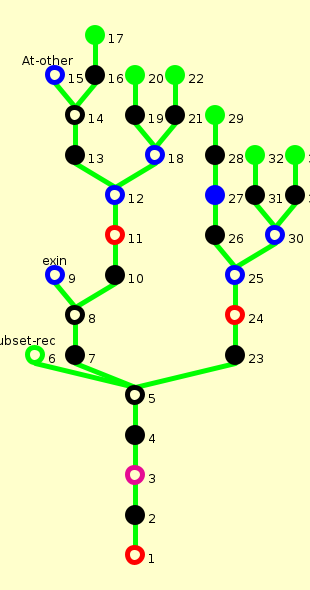
Proof Tree for subset-def (View conclusion)
The following image shows the proof tree of sequent calculus. The proved goal is at the bottom. You can click on the nodes to view additional rules. See here for details on colors in a proof tree.
| ⊦ rws ⊆ mem ↔ (∀ l. l ∈ rws → rws[l] = mem(l)) |
∀ rws0, mem. # rws0 < # rws → true → (rws0 ⊆ mem ↔ (∀ l. l ∈ rws0 → rws0[l] = mem(l))) ⊦ rws ⊆ mem ↔ (∀ l. l ∈ rws → rws[l] = mem(l))
Used simplifier rules: <; (wellfounded) Used terms: # rws
| ∀ rws0, mem. # rws0 < # rws → true → (rws0 ⊆ mem ↔ (∀ l. l ∈ rws0 → rws0[l] = mem(l))) ⊦ rws ⊆ mem ↔ (∀ l. l ∈ rws → rws[l] = mem(l)) |
∀ rws0, mem. # rws0 < # rws → true → (rws0 ⊆ mem ↔ (∀ l. l ∈ rws0 → rws0[l] = mem(l))) ⊦ rws ⊆ mem ↔ (∀ l. l ∈ rws → rws[l] = mem(l))
| ∀ rws0, mem. # rws0 < # rws → true → (rws0 ⊆ mem ↔ (∀ l. l ∈ rws0 → rws0[l] = mem(l))) ⊦ rws ⊆ mem ↔ (∀ l. l ∈ rws → rws[l] = mem(l)) |
rws = rws1[l0 := v], rws ≠ rws1, ∀ rws0, mem. # rws0 < # rws → true → (rws0 ⊆ mem ↔ (∀ l. l ∈ rws0 → rws0[l] = mem(l))) ⊦ rws ⊆ mem ↔ (∀ l. l ∈ rws → rws[l] = mem(l))
Used simplifier rules: subset-base: ⊦ ∅ ⊆ mem; Rwset generated by ∅, [ := ];; ⊦ ¬ a ∈ ∅; (s)
| rws = rws1[l0 := v], rws ≠ rws1, ∀ rws0, mem. # rws0 < # rws → true → (rws0 ⊆ mem ↔ (∀ l. l ∈ rws0 → rws0[l] = mem(l))) ⊦ rws ⊆ mem ↔ (∀ l. l ∈ rws → rws[l] = mem(l)) |
rws1[l0 := v] ≠ rws1, ∀ rws0, mem. # rws0 < # rws1[l0 := v] → true → (rws0 ⊆ mem ↔ (∀ l. l ∈ rws0 → rws0[l] = mem(l))) ⊦ rws1[l0 := v] ⊆ mem ↔ (∀ l. l ∈ rws1[l0 := v] → (rws1[l0 := v])[l] = mem(l))
| rws1[l0 := v] ≠ rws1, ∀ rws0, mem. # rws0 < # rws1[l0 := v] → true → (rws0 ⊆ mem ↔ (∀ l. l ∈ rws0 → rws0[l] = mem(l))) ⊦ rws1[l0 := v] ⊆ mem ↔ (∀ l. l ∈ rws1[l0 := v] → (rws1[l0 := v])[l] = mem(l)) |
⊦ ¬ l ∈ rws → (rws[l := v] ⊆ mem ↔ mem(l) = v ∧ rws ⊆ mem)
rws1[l0 := v] ≠ rws1, l0 ∈ rws1, ∀ rws0, mem. # rws0 < # rws1[l0 := v] → true → (rws0 ⊆ mem ↔ (∀ l. l ∈ rws0 → rws0[l] = mem(l))) ⊦ rws1[l0 := v] ⊆ mem ↔ (∀ l. l ∈ rws1[l0 := v] → (rws1[l0 := v])[l] = mem(l))
rws1[l0 := v] ≠ rws1, ¬ l0 ∈ rws1, ∀ rws0, mem. # rws0 < # rws1[l0 := v] → true → (rws0 ⊆ mem ↔ (∀ l. l ∈ rws0 → rws0[l] = mem(l))) ⊦ mem(l0) = v ∧ rws1 ⊆ mem ↔ (∀ l. l ∈ rws1[l0 := v] → (rws1[l0 := v])[l] = mem(l))
Used terms: mem, v, l0, rws1
| ⊦ ¬ l ∈ rws → (rws[l := v] ⊆ mem ↔ mem(l) = v ∧ rws ⊆ mem) |
| rws1[l0 := v] ≠ rws1, l0 ∈ rws1, ∀ rws0, mem. # rws0 < # rws1[l0 := v] → true → (rws0 ⊆ mem ↔ (∀ l. l ∈ rws0 → rws0[l] = mem(l))) ⊦ rws1[l0 := v] ⊆ mem ↔ (∀ l. l ∈ rws1[l0 := v] → (rws1[l0 := v])[l] = mem(l)) |
rws1[l0 := v] ≠ rws1, l0 ∈ rws1, ∀ rws0, mem. # rws0 < # rws1[l0 := v] → true → (rws0 ⊆ mem ↔ (∀ l. l ∈ rws0 → rws0[l] = mem(l))) ⊦ rws1[l0 := v] ⊆ mem ↔ (∀ l. l ∈ rws1[l0 := v] → (rws1[l0 := v])[l] = mem(l))
| rws1[l0 := v] ≠ rws1, l0 ∈ rws1, ∀ rws0, mem. # rws0 < # rws1[l0 := v] → true → (rws0 ⊆ mem ↔ (∀ l. l ∈ rws0 → rws0[l] = mem(l))) ⊦ rws1[l0 := v] ⊆ mem ↔ (∀ l. l ∈ rws1[l0 := v] → (rws1[l0 := v])[l] = mem(l)) |
⊦ a ∈ st ↔ (∃ d, st0. st = st0[a := d] ∧ ¬ a ∈ st0)
rws1[l0 := v] ≠ rws1, ∃ d, rws. rws1 = rws[l0 := d] ∧ ¬ l0 ∈ rws, ∀ rws0, mem. # rws0 < # rws1[l0 := v] → true → (rws0 ⊆ mem ↔ (∀ l. l ∈ rws0 → rws0[l] = mem(l))) ⊦ rws1[l0 := v] ⊆ mem ↔ (∀ l. l ∈ rws1[l0 := v] → (rws1[l0 := v])[l] = mem(l))
Used terms: rws1, l0
| ⊦ a ∈ st ↔ (∃ d, st0. st = st0[a := d] ∧ ¬ a ∈ st0) |
| rws1[l0 := v] ≠ rws1, ∃ d, rws. rws1 = rws[l0 := d] ∧ ¬ l0 ∈ rws, ∀ rws0, mem. # rws0 < # rws1[l0 := v] → true → (rws0 ⊆ mem ↔ (∀ l. l ∈ rws0 → rws0[l] = mem(l))) ⊦ rws1[l0 := v] ⊆ mem ↔ (∀ l. l ∈ rws1[l0 := v] → (rws1[l0 := v])[l] = mem(l)) |
v ≠ v0, ¬ l0 ∈ rws, ∀ rws0, mem. # rws0 < # (rws[l0 := v0])[l0 := v] → true → (rws0 ⊆ mem ↔ (∀ l. l ∈ rws0 → rws0[l] = mem(l))) ⊦ mem(l0) = v ∧ rws ⊆ mem ↔ (∀ l. l ∈ rws[l0 := v] → (rws[l0 := v])[l] = mem(l))
Used simplifier rules: subset-rec: ⊦ ¬ l ∈ rws → (rws[l := v] ⊆ mem ↔ mem(l) = v ∧ rws ⊆ mem); ⊦ (st[a := d0])[a := d] = st[a := d]; (s) ⊦ st[a := d0] = st[a := d1] ↔ d0 = d1; (s)
| v ≠ v0, ¬ l0 ∈ rws, ∀ rws0, mem. # rws0 < # (rws[l0 := v0])[l0 := v] → true → (rws0 ⊆ mem ↔ (∀ l. l ∈ rws0 → rws0[l] = mem(l))) ⊦ mem(l0) = v ∧ rws ⊆ mem ↔ (∀ l. l ∈ rws[l0 := v] → (rws[l0 := v])[l] = mem(l)) |
v ≠ v0, ¬ l0 ∈ rws, rws ⊆ mem ↔ (∀ l. l ∈ rws → rws[l] = mem(l)), ∀ rws0, mem. # rws0 < # (rws[l0 := v0])[l0 := v] → true → (rws0 ⊆ mem ↔ (∀ l. l ∈ rws0 → rws0[l] = mem(l))) ⊦ mem(l0) = v ∧ rws ⊆ mem ↔ (∀ l. l ∈ rws[l0 := v] → (rws[l0 := v])[l] = mem(l))
Used simplifier rules: ⊦ (st[a := d0])[a := d] = st[a := d]; (s) ⊦ ¬ a ∈ st → # st[a := d] = # st + 1; (s) ⊦ m < n + 1 ↔ ¬ n < m; (s) ⊦ ¬ n < n; (s) a: ⊦ (m + n0) + n1 = m + n0 + n1; from specification nat-basic c: ⊦ m + n = n + m; from specification nat-basic Used terms: rws, mem
| v ≠ v0, ¬ l0 ∈ rws, rws ⊆ mem ↔ (∀ l. l ∈ rws → rws[l] = mem(l)), ∀ rws0, mem. # rws0 < # (rws[l0 := v0])[l0 := v] → true → (rws0 ⊆ mem ↔ (∀ l. l ∈ rws0 → rws0[l] = mem(l))) ⊦ mem(l0) = v ∧ rws ⊆ mem ↔ (∀ l. l ∈ rws[l0 := v] → (rws[l0 := v])[l] = mem(l)) |
mem(l0) = v, v ≠ v0, rws ⊆ mem, ¬ l0 ∈ rws, rws ⊆ mem ↔ (∀ l. l ∈ rws → rws[l] = mem(l)), ∀ rws0, mem. # rws0 < # (rws[l0 := v0])[l0 := v] → true → (rws0 ⊆ mem ↔ (∀ l. l ∈ rws0 → rws0[l] = mem(l))) ⊦ ∀ l. l ∈ rws[l0 := v] → (rws[l0 := v])[l] = mem(l)
v ≠ v0, ¬ l0 ∈ rws, rws ⊆ mem ↔ (∀ l. l ∈ rws → rws[l] = mem(l)), ∀ l. l ∈ rws[l0 := v] → (rws[l0 := v])[l] = mem(l), ∀ rws0, mem. # rws0 < # (rws[l0 := v0])[l0 := v] → true → (rws0 ⊆ mem ↔ (∀ l. l ∈ rws0 → rws0[l] = mem(l))) ⊦ mem(l0) = v ∧ rws ⊆ mem
| mem(l0) = v, v ≠ v0, rws ⊆ mem, ¬ l0 ∈ rws, rws ⊆ mem ↔ (∀ l. l ∈ rws → rws[l] = mem(l)), ∀ rws0, mem. # rws0 < # (rws[l0 := v0])[l0 := v] → true → (rws0 ⊆ mem ↔ (∀ l. l ∈ rws0 → rws0[l] = mem(l))) ⊦ ∀ l. l ∈ rws[l0 := v] → (rws[l0 := v])[l] = mem(l) |
(rws[l0 := mem(l0)])[l] ≠ mem(l), mem(l0) ≠ v0, l ∈ rws[l0 := mem(l0)], rws ⊆ mem, ¬ l0 ∈ rws, ∀ l. l ∈ rws → rws[l] = mem(l), ∀ rws0, mem0. # rws0 < # (rws[l0 := v0])[l0 := mem(l0)] → true → (rws0 ⊆ mem0 ↔ (∀ l. l ∈ rws0 → rws0[l] = mem0(l))) ⊦
| (rws[l0 := mem(l0)])[l] ≠ mem(l), mem(l0) ≠ v0, l ∈ rws[l0 := mem(l0)], rws ⊆ mem, ¬ l0 ∈ rws, ∀ l. l ∈ rws → rws[l] = mem(l), ∀ rws0, mem0. # rws0 < # (rws[l0 := v0])[l0 := mem(l0)] → true → (rws0 ⊆ mem0 ↔ (∀ l. l ∈ rws0 → rws0[l] = mem0(l))) ⊦ |
⊦ a ≠ b → (st[b := d])[a] = st[a]
rws[l] ≠ mem(l), l ≠ l0, mem(l0) ≠ v0, l ∈ rws[l0 := mem(l0)], rws ⊆ mem, ¬ l0 ∈ rws, ∀ l. l ∈ rws → rws[l] = mem(l), ∀ rws0, mem0. # rws0 < # (rws[l0 := v0])[l0 := mem(l0)] → true → (rws0 ⊆ mem0 ↔ (∀ l. l ∈ rws0 → rws0[l] = mem0(l))) ⊦
Used simplifier rules: ⊦ a = b → (st[b := d])[a] = d; (s) Used terms: rws, l0, mem(l0), l
| ⊦ a ≠ b → (st[b := d])[a] = st[a] |
| rws[l] ≠ mem(l), l ≠ l0, mem(l0) ≠ v0, l ∈ rws[l0 := mem(l0)], rws ⊆ mem, ¬ l0 ∈ rws, ∀ l. l ∈ rws → rws[l] = mem(l), ∀ rws0, mem0. # rws0 < # (rws[l0 := v0])[l0 := mem(l0)] → true → (rws0 ⊆ mem0 ↔ (∀ l. l ∈ rws0 → rws0[l] = mem0(l))) ⊦ |
rws[l] ≠ mem(l), l ≠ l0, mem(l0) ≠ v0, l ∈ rws, rws ⊆ mem, ¬ l0 ∈ rws, ∀ l. l ∈ rws → rws[l] = mem(l), ∀ rws0, mem0. # rws0 < # (rws[l0 := v0])[l0 := mem(l0)] → true → (rws0 ⊆ mem0 ↔ (∀ l. l ∈ rws0 → rws0[l] = mem0(l))) ⊦
Used simplifier rules: ⊦ a ≠ b → (a ∈ st[b := d] ↔ a ∈ st); (s)
| rws[l] ≠ mem(l), l ≠ l0, mem(l0) ≠ v0, l ∈ rws, rws ⊆ mem, ¬ l0 ∈ rws, ∀ l. l ∈ rws → rws[l] = mem(l), ∀ rws0, mem0. # rws0 < # (rws[l0 := v0])[l0 := mem(l0)] → true → (rws0 ⊆ mem0 ↔ (∀ l. l ∈ rws0 → rws0[l] = mem0(l))) ⊦ |
Used terms: l
| v ≠ v0, ¬ l0 ∈ rws, rws ⊆ mem ↔ (∀ l. l ∈ rws → rws[l] = mem(l)), ∀ l. l ∈ rws[l0 := v] → (rws[l0 := v])[l] = mem(l), ∀ rws0, mem. # rws0 < # (rws[l0 := v0])[l0 := v] → true → (rws0 ⊆ mem ↔ (∀ l. l ∈ rws0 → rws0[l] = mem(l))) ⊦ mem(l0) = v ∧ rws ⊆ mem |
v ≠ v0, ¬ l0 ∈ rws, ¬ rws ⊆ mem, ∀ l. l ∈ rws[l0 := v] → (rws[l0 := v])[l] = mem(l), ∀ rws0, mem. # rws0 < # (rws[l0 := v0])[l0 := v] → true → (rws0 ⊆ mem ↔ (∀ l. l ∈ rws0 → rws0[l] = mem(l))) ⊦ ∀ l. l ∈ rws → rws[l] = mem(l), mem(l0) = v ∧ rws ⊆ mem
v ≠ v0, rws ⊆ mem, ¬ l0 ∈ rws, ∀ l. l ∈ rws[l0 := v] → (rws[l0 := v])[l] = mem(l), ∀ l. l ∈ rws → rws[l] = mem(l), ∀ rws0, mem. # rws0 < # (rws[l0 := v0])[l0 := v] → true → (rws0 ⊆ mem ↔ (∀ l. l ∈ rws0 → rws0[l] = mem(l))) ⊦ mem(l0) = v ∧ rws ⊆ mem
| v ≠ v0, ¬ l0 ∈ rws, ¬ rws ⊆ mem, ∀ l. l ∈ rws[l0 := v] → (rws[l0 := v])[l] = mem(l), ∀ rws0, mem. # rws0 < # (rws[l0 := v0])[l0 := v] → true → (rws0 ⊆ mem ↔ (∀ l. l ∈ rws0 → rws0[l] = mem(l))) ⊦ ∀ l. l ∈ rws → rws[l] = mem(l), mem(l0) = v ∧ rws ⊆ mem |
rws[l] ≠ mem(l), v ≠ v0, l ∈ rws, ¬ l0 ∈ rws, ¬ rws ⊆ mem, ∀ l. l ∈ rws[l0 := v] → (rws[l0 := v])[l] = mem(l), ∀ rws0, mem. # rws0 < # (rws[l0 := v0])[l0 := v] → true → (rws0 ⊆ mem ↔ (∀ l. l ∈ rws0 → rws0[l] = mem(l))) ⊦
| rws[l] ≠ mem(l), v ≠ v0, l ∈ rws, ¬ l0 ∈ rws, ¬ rws ⊆ mem, ∀ l. l ∈ rws[l0 := v] → (rws[l0 := v])[l] = mem(l), ∀ rws0, mem. # rws0 < # (rws[l0 := v0])[l0 := v] → true → (rws0 ⊆ mem ↔ (∀ l. l ∈ rws0 → rws0[l] = mem(l))) ⊦ |
Used simplifier rules: ⊦ b ∈ st ∧ ¬ a ∈ st → (st[a := d])[b] = st[b]; (s) ⊦ a ∈ st[b := d] ↔ a = b ∨ a ∈ st; (ws) Used terms: l
| v ≠ v0, rws ⊆ mem, ¬ l0 ∈ rws, ∀ l. l ∈ rws[l0 := v] → (rws[l0 := v])[l] = mem(l), ∀ l. l ∈ rws → rws[l] = mem(l), ∀ rws0, mem. # rws0 < # (rws[l0 := v0])[l0 := v] → true → (rws0 ⊆ mem ↔ (∀ l. l ∈ rws0 → rws0[l] = mem(l))) ⊦ mem(l0) = v ∧ rws ⊆ mem |
mem(l0) ≠ v, v ≠ v0, rws ⊆ mem, ¬ l0 ∈ rws, ∀ l. l ∈ rws → rws[l] = mem(l), ∀ l. l ∈ rws[l0 := v] → (rws[l0 := v])[l] = mem(l), ∀ rws0, mem. # rws0 < # (rws[l0 := v0])[l0 := v] → true → (rws0 ⊆ mem ↔ (∀ l. l ∈ rws0 → rws0[l] = mem(l))) ⊦
| mem(l0) ≠ v, v ≠ v0, rws ⊆ mem, ¬ l0 ∈ rws, ∀ l. l ∈ rws → rws[l] = mem(l), ∀ l. l ∈ rws[l0 := v] → (rws[l0 := v])[l] = mem(l), ∀ rws0, mem. # rws0 < # (rws[l0 := v0])[l0 := v] → true → (rws0 ⊆ mem ↔ (∀ l. l ∈ rws0 → rws0[l] = mem(l))) ⊦ |
Used simplifier rules: ⊦ a ∈ st[a := d]; (s) ⊦ a = b → (st[b := d])[a] = d; (s) Used terms: l0
| rws1[l0 := v] ≠ rws1, ¬ l0 ∈ rws1, ∀ rws0, mem. # rws0 < # rws1[l0 := v] → true → (rws0 ⊆ mem ↔ (∀ l. l ∈ rws0 → rws0[l] = mem(l))) ⊦ mem(l0) = v ∧ rws1 ⊆ mem ↔ (∀ l. l ∈ rws1[l0 := v] → (rws1[l0 := v])[l] = mem(l)) |
rws1[l0 := v] ≠ rws1, ¬ l0 ∈ rws1, ∀ rws0, mem. # rws0 < # rws1[l0 := v] → true → (rws0 ⊆ mem ↔ (∀ l. l ∈ rws0 → rws0[l] = mem(l))) ⊦ mem(l0) = v ∧ rws1 ⊆ mem ↔ (∀ l. l ∈ rws1[l0 := v] → (rws1[l0 := v])[l] = mem(l))
| rws1[l0 := v] ≠ rws1, ¬ l0 ∈ rws1, ∀ rws0, mem. # rws0 < # rws1[l0 := v] → true → (rws0 ⊆ mem ↔ (∀ l. l ∈ rws0 → rws0[l] = mem(l))) ⊦ mem(l0) = v ∧ rws1 ⊆ mem ↔ (∀ l. l ∈ rws1[l0 := v] → (rws1[l0 := v])[l] = mem(l)) |
rws1[l0 := v] ≠ rws1, ¬ l0 ∈ rws1, rws1 ⊆ mem ↔ (∀ l. l ∈ rws1 → rws1[l] = mem(l)), ∀ rws0, mem. # rws0 < # rws1[l0 := v] → true → (rws0 ⊆ mem ↔ (∀ l. l ∈ rws0 → rws0[l] = mem(l))) ⊦ mem(l0) = v ∧ rws1 ⊆ mem ↔ (∀ l. l ∈ rws1[l0 := v] → (rws1[l0 := v])[l] = mem(l))
Used simplifier rules: ⊦ ¬ a ∈ st → # st[a := d] = # st + 1; (s) ⊦ m < n + 1 ↔ ¬ n < m; (s) ⊦ ¬ n < n; (s) a: ⊦ (m + n0) + n1 = m + n0 + n1; from specification nat-basic c: ⊦ m + n = n + m; from specification nat-basic Used terms: rws1, mem
| rws1[l0 := v] ≠ rws1, ¬ l0 ∈ rws1, rws1 ⊆ mem ↔ (∀ l. l ∈ rws1 → rws1[l] = mem(l)), ∀ rws0, mem. # rws0 < # rws1[l0 := v] → true → (rws0 ⊆ mem ↔ (∀ l. l ∈ rws0 → rws0[l] = mem(l))) ⊦ mem(l0) = v ∧ rws1 ⊆ mem ↔ (∀ l. l ∈ rws1[l0 := v] → (rws1[l0 := v])[l] = mem(l)) |
mem(l0) = v, rws1[l0 := v] ≠ rws1, rws1 ⊆ mem, ¬ l0 ∈ rws1, rws1 ⊆ mem ↔ (∀ l. l ∈ rws1 → rws1[l] = mem(l)), ∀ rws0, mem. # rws0 < # rws1[l0 := v] → true → (rws0 ⊆ mem ↔ (∀ l. l ∈ rws0 → rws0[l] = mem(l))) ⊦ ∀ l. l ∈ rws1[l0 := v] → (rws1[l0 := v])[l] = mem(l)
rws1[l0 := v] ≠ rws1, ¬ l0 ∈ rws1, rws1 ⊆ mem ↔ (∀ l. l ∈ rws1 → rws1[l] = mem(l)), ∀ l. l ∈ rws1[l0 := v] → (rws1[l0 := v])[l] = mem(l), ∀ rws0, mem. # rws0 < # rws1[l0 := v] → true → (rws0 ⊆ mem ↔ (∀ l. l ∈ rws0 → rws0[l] = mem(l))) ⊦ mem(l0) = v ∧ rws1 ⊆ mem
| mem(l0) = v, rws1[l0 := v] ≠ rws1, rws1 ⊆ mem, ¬ l0 ∈ rws1, rws1 ⊆ mem ↔ (∀ l. l ∈ rws1 → rws1[l] = mem(l)), ∀ rws0, mem. # rws0 < # rws1[l0 := v] → true → (rws0 ⊆ mem ↔ (∀ l. l ∈ rws0 → rws0[l] = mem(l))) ⊦ ∀ l. l ∈ rws1[l0 := v] → (rws1[l0 := v])[l] = mem(l) |
(rws1[l0 := mem(l0)])[l] ≠ mem(l), rws1[l0 := mem(l0)] ≠ rws1, l ∈ rws1[l0 := mem(l0)], rws1 ⊆ mem, ¬ l0 ∈ rws1, ∀ l. l ∈ rws1 → rws1[l] = mem(l), ∀ rws0, mem0. # rws0 < # rws1[l0 := mem(l0)] → true → (rws0 ⊆ mem0 ↔ (∀ l. l ∈ rws0 → rws0[l] = mem0(l))) ⊦
| (rws1[l0 := mem(l0)])[l] ≠ mem(l), rws1[l0 := mem(l0)] ≠ rws1, l ∈ rws1[l0 := mem(l0)], rws1 ⊆ mem, ¬ l0 ∈ rws1, ∀ l. l ∈ rws1 → rws1[l] = mem(l), ∀ rws0, mem0. # rws0 < # rws1[l0 := mem(l0)] → true → (rws0 ⊆ mem0 ↔ (∀ l. l ∈ rws0 → rws0[l] = mem0(l))) ⊦ |
(rws1[l0 := mem(l0)])[l] ≠ mem(l), rws1[l0 := mem(l0)] ≠ rws1, l ≠ l0, l ∈ rws1[l0 := mem(l0)], rws1 ⊆ mem, ¬ l0 ∈ rws1, ∀ l. l ∈ rws1 → rws1[l] = mem(l), ∀ rws0, mem0. # rws0 < # rws1[l0 := mem(l0)] → true → (rws0 ⊆ mem0 ↔ (∀ l. l ∈ rws0 → rws0[l] = mem0(l))) ⊦
Used simplifier rules: ⊦ a = b → (st[b := d])[a] = d; (s) Used formulas: l = l0
| (rws1[l0 := mem(l0)])[l] ≠ mem(l), rws1[l0 := mem(l0)] ≠ rws1, l ≠ l0, l ∈ rws1[l0 := mem(l0)], rws1 ⊆ mem, ¬ l0 ∈ rws1, ∀ l. l ∈ rws1 → rws1[l] = mem(l), ∀ rws0, mem0. # rws0 < # rws1[l0 := mem(l0)] → true → (rws0 ⊆ mem0 ↔ (∀ l. l ∈ rws0 → rws0[l] = mem0(l))) ⊦ |
rws1[l0 := mem(l0)] ≠ rws1, rws1[l] ≠ mem(l), l ≠ l0, l ∈ rws1, rws1 ⊆ mem, ¬ l0 ∈ rws1, ∀ l. l ∈ rws1 → rws1[l] = mem(l), ∀ rws0, mem0. # rws0 < # rws1[l0 := mem(l0)] → true → (rws0 ⊆ mem0 ↔ (∀ l. l ∈ rws0 → rws0[l] = mem0(l))) ⊦
Used simplifier rules: ⊦ a ≠ b → (a ∈ st[b := d] ↔ a ∈ st); (s) ⊦ a ≠ b → (st[b := d])[a] = st[a]; (s)
| rws1[l0 := mem(l0)] ≠ rws1, rws1[l] ≠ mem(l), l ≠ l0, l ∈ rws1, rws1 ⊆ mem, ¬ l0 ∈ rws1, ∀ l. l ∈ rws1 → rws1[l] = mem(l), ∀ rws0, mem0. # rws0 < # rws1[l0 := mem(l0)] → true → (rws0 ⊆ mem0 ↔ (∀ l. l ∈ rws0 → rws0[l] = mem0(l))) ⊦ |
Used terms: l
| rws1[l0 := v] ≠ rws1, ¬ l0 ∈ rws1, rws1 ⊆ mem ↔ (∀ l. l ∈ rws1 → rws1[l] = mem(l)), ∀ l. l ∈ rws1[l0 := v] → (rws1[l0 := v])[l] = mem(l), ∀ rws0, mem. # rws0 < # rws1[l0 := v] → true → (rws0 ⊆ mem ↔ (∀ l. l ∈ rws0 → rws0[l] = mem(l))) ⊦ mem(l0) = v ∧ rws1 ⊆ mem |
rws1[l0 := v] ≠ rws1, ¬ l0 ∈ rws1, ¬ rws1 ⊆ mem, ∀ l. l ∈ rws1[l0 := v] → (rws1[l0 := v])[l] = mem(l), ∀ rws0, mem. # rws0 < # rws1[l0 := v] → true → (rws0 ⊆ mem ↔ (∀ l. l ∈ rws0 → rws0[l] = mem(l))) ⊦ ∀ l. l ∈ rws1 → rws1[l] = mem(l), mem(l0) = v ∧ rws1 ⊆ mem
rws1[l0 := v] ≠ rws1, rws1 ⊆ mem, ¬ l0 ∈ rws1, ∀ l. l ∈ rws1[l0 := v] → (rws1[l0 := v])[l] = mem(l), ∀ l. l ∈ rws1 → rws1[l] = mem(l), ∀ rws0, mem. # rws0 < # rws1[l0 := v] → true → (rws0 ⊆ mem ↔ (∀ l. l ∈ rws0 → rws0[l] = mem(l))) ⊦ mem(l0) = v ∧ rws1 ⊆ mem
| rws1[l0 := v] ≠ rws1, ¬ l0 ∈ rws1, ¬ rws1 ⊆ mem, ∀ l. l ∈ rws1[l0 := v] → (rws1[l0 := v])[l] = mem(l), ∀ rws0, mem. # rws0 < # rws1[l0 := v] → true → (rws0 ⊆ mem ↔ (∀ l. l ∈ rws0 → rws0[l] = mem(l))) ⊦ ∀ l. l ∈ rws1 → rws1[l] = mem(l), mem(l0) = v ∧ rws1 ⊆ mem |
rws1[l] ≠ mem(l), rws1[l0 := v] ≠ rws1, l ∈ rws1, ¬ l0 ∈ rws1, ¬ rws1 ⊆ mem, ∀ l. l ∈ rws1[l0 := v] → (rws1[l0 := v])[l] = mem(l), ∀ rws0, mem. # rws0 < # rws1[l0 := v] → true → (rws0 ⊆ mem ↔ (∀ l. l ∈ rws0 → rws0[l] = mem(l))) ⊦
| rws1[l] ≠ mem(l), rws1[l0 := v] ≠ rws1, l ∈ rws1, ¬ l0 ∈ rws1, ¬ rws1 ⊆ mem, ∀ l. l ∈ rws1[l0 := v] → (rws1[l0 := v])[l] = mem(l), ∀ rws0, mem. # rws0 < # rws1[l0 := v] → true → (rws0 ⊆ mem ↔ (∀ l. l ∈ rws0 → rws0[l] = mem(l))) ⊦ |
Used simplifier rules: ⊦ b ∈ st ∧ ¬ a ∈ st → (st[a := d])[b] = st[b]; (s) ⊦ a ∈ st[b := d] ↔ a = b ∨ a ∈ st; (ws) Used terms: l
| rws1[l0 := v] ≠ rws1, rws1 ⊆ mem, ¬ l0 ∈ rws1, ∀ l. l ∈ rws1[l0 := v] → (rws1[l0 := v])[l] = mem(l), ∀ l. l ∈ rws1 → rws1[l] = mem(l), ∀ rws0, mem. # rws0 < # rws1[l0 := v] → true → (rws0 ⊆ mem ↔ (∀ l. l ∈ rws0 → rws0[l] = mem(l))) ⊦ mem(l0) = v ∧ rws1 ⊆ mem |
rws1[l0 := v] ≠ rws1, mem(l0) ≠ v, rws1 ⊆ mem, ¬ l0 ∈ rws1, ∀ l. l ∈ rws1 → rws1[l] = mem(l), ∀ l. l ∈ rws1[l0 := v] → (rws1[l0 := v])[l] = mem(l), ∀ rws0, mem. # rws0 < # rws1[l0 := v] → true → (rws0 ⊆ mem ↔ (∀ l. l ∈ rws0 → rws0[l] = mem(l))) ⊦
| rws1[l0 := v] ≠ rws1, mem(l0) ≠ v, rws1 ⊆ mem, ¬ l0 ∈ rws1, ∀ l. l ∈ rws1 → rws1[l] = mem(l), ∀ l. l ∈ rws1[l0 := v] → (rws1[l0 := v])[l] = mem(l), ∀ rws0, mem. # rws0 < # rws1[l0 := v] → true → (rws0 ⊆ mem ↔ (∀ l. l ∈ rws0 → rws0[l] = mem(l))) ⊦ |
Used simplifier rules: ⊦ a ∈ st[a := d]; (s) ⊦ a = b → (st[b := d])[a] = d; (s) Used terms: l0
The following image shows the proof tree of sequent calculus. The proved goal is at the bottom. You can click on the nodes to view additional rules. See here for details on colors in a proof tree.