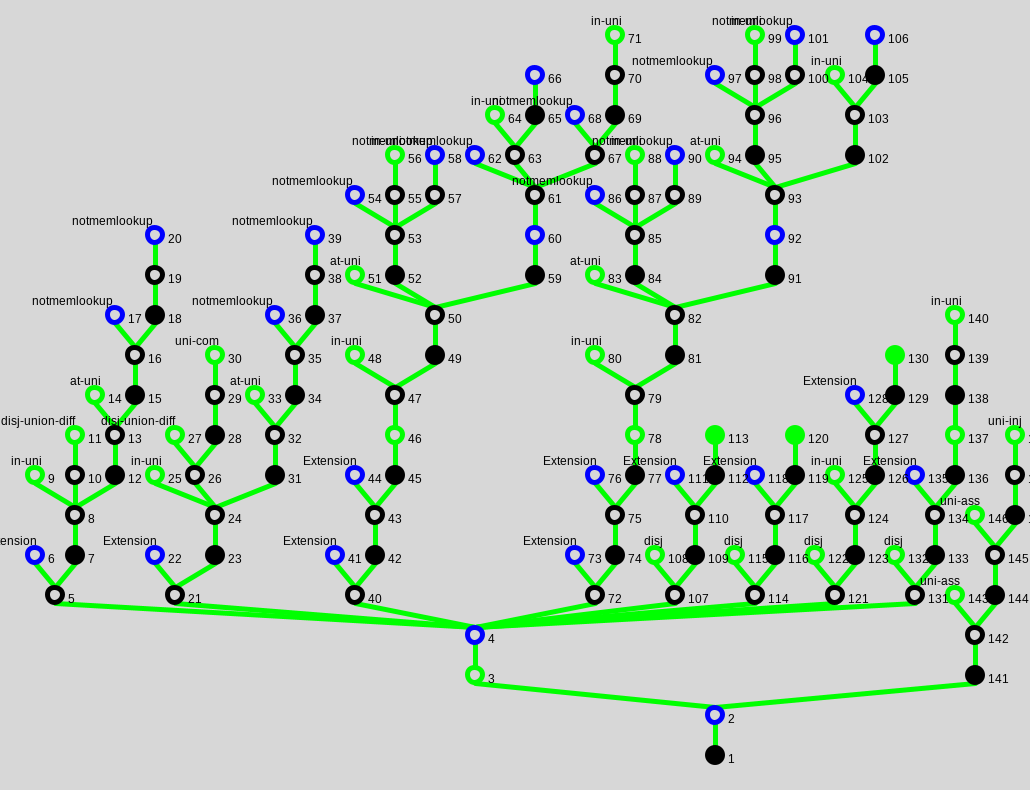
Proof Tree for union-split2 (View conclusion)
The following image shows the proof tree of sequent calculus. The proved goal is at the bottom. You can click on the nodes to view additional rules. See here for details on colors in a proof tree.
| h0 ⊥ h1, h2 ⊥ h3 ⊦ h0 ∪ h1 = h2 ∪ h3 ↔ (∃ h20, h21, h30, h31. h2 = h20 ∪ h21 ∧ h3 = h30 ∪ h31 ∧ h0 = h20 ∪ h30 ∧ h1 = h21 ∪ h31 ∧ h20 ⊥ h21 ∧ h30 ⊥ h31 ∧ h20 ⊥ h1 ∧ h30 ⊥ h1 ∧ h21 ⊥ h0 ∧ h31 ⊥ h0) |
h0 ⊥ h1, h2 ⊥ h3 ⊦ h0 ∪ h1 = h2 ∪ h3 ↔ (∃ h20, h21, h30, h31. h2 = h20 ∪ h21 ∧ h3 = h30 ∪ h31 ∧ h0 = h20 ∪ h30 ∧ h1 = h21 ∪ h31 ∧ h20 ⊥ h21 ∧ h30 ⊥ h31 ∧ h20 ⊥ h31 ∧ h30 ⊥ h21 ∧ h21 ⊥ h20 ∪ h30 ∧ h31 ⊥ h20 ∪ h30)
Used simplifier rules: disj-distr-uni-com: h1 ⊥ h2 ⊦ h1 ∪ h2 ⊥ h0 ↔ h0 ⊥ h1 ∧ h0 ⊥ h2; disj-distr-uni: h1 ⊥ h ⊦ h0 ⊥ h1 ∪ h ↔ h0 ⊥ h1 ∧ h0 ⊥ h;
| h0 ⊥ h1, h2 ⊥ h3 ⊦ h0 ∪ h1 = h2 ∪ h3 ↔ (∃ h20, h21, h30, h31. h2 = h20 ∪ h21 ∧ h3 = h30 ∪ h31 ∧ h0 = h20 ∪ h30 ∧ h1 = h21 ∪ h31 ∧ h20 ⊥ h21 ∧ h30 ⊥ h31 ∧ h20 ⊥ h31 ∧ h30 ⊥ h21 ∧ h21 ⊥ h20 ∪ h30 ∧ h31 ⊥ h20 ∪ h30) |
h0 ∪ h1 = h2 ∪ h3, h0 ⊥ h1, h2 ⊥ h3 ⊦ ∃ h20, h21, h30, h31. h2 = h20 ∪ h21 ∧ h3 = h30 ∪ h31 ∧ h0 = h20 ∪ h30 ∧ h1 = h21 ∪ h31 ∧ h20 ⊥ h21 ∧ h30 ⊥ h31 ∧ h20 ⊥ h31 ∧ h30 ⊥ h21 ∧ h21 ⊥ h20 ∪ h30 ∧ h31 ⊥ h20 ∪ h30
h0 ∪ h1 ≠ h2 ∪ h3, h0 ⊥ h1, h2 ⊥ h3, ∃ h20, h21, h30, h31. h2 = h20 ∪ h21 ∧ h3 = h30 ∪ h31 ∧ h0 = h20 ∪ h30 ∧ h1 = h21 ∪ h31 ∧ h20 ⊥ h21 ∧ h30 ⊥ h31 ∧ h20 ⊥ h31 ∧ h30 ⊥ h21 ∧ h21 ⊥ h20 ∪ h30 ∧ h31 ⊥ h20 ∪ h30 ⊦
| h0 ∪ h1 = h2 ∪ h3, h0 ⊥ h1, h2 ⊥ h3 ⊦ ∃ h20, h21, h30, h31. h2 = h20 ∪ h21 ∧ h3 = h30 ∪ h31 ∧ h0 = h20 ∪ h30 ∧ h1 = h21 ∪ h31 ∧ h20 ⊥ h21 ∧ h30 ⊥ h31 ∧ h20 ⊥ h31 ∧ h30 ⊥ h21 ∧ h21 ⊥ h20 ∪ h30 ∧ h31 ⊥ h20 ∪ h30 |
h0 ∪ h1 = h2 ∪ h3, h0 ⊥ h1, h2 ⊥ h3 ⊦ h2 = (h2 \ h1) ∪ (h2 \ h0) ∧ h3 = (h3 \ h1) ∪ (h3 \ h0) ∧ h0 = (h2 \ h1) ∪ (h3 \ h1) ∧ h1 = (h2 \ h0) ∪ (h3 \ h0) ∧ h2 \ h1 ⊥ h2 \ h0 ∧ h3 \ h1 ⊥ h3 \ h0 ∧ h2 \ h1 ⊥ h3 \ h0 ∧ h3 \ h1 ⊥ h2 \ h0 ∧ h2 \ h0 ⊥ (h2 \ h1) ∪ (h3 \ h1) ∧ h3 \ h0 ⊥ (h2 \ h1) ∪ (h3 \ h1)
Used terms: h2 \ h1, h2 \ h0, h3 \ h1, h3 \ h0
| h0 ∪ h1 = h2 ∪ h3, h0 ⊥ h1, h2 ⊥ h3 ⊦ h2 = (h2 \ h1) ∪ (h2 \ h0) ∧ h3 = (h3 \ h1) ∪ (h3 \ h0) ∧ h0 = (h2 \ h1) ∪ (h3 \ h1) ∧ h1 = (h2 \ h0) ∪ (h3 \ h0) ∧ h2 \ h1 ⊥ h2 \ h0 ∧ h3 \ h1 ⊥ h3 \ h0 ∧ h2 \ h1 ⊥ h3 \ h0 ∧ h3 \ h1 ⊥ h2 \ h0 ∧ h2 \ h0 ⊥ (h2 \ h1) ∪ (h3 \ h1) ∧ h3 \ h0 ⊥ (h2 \ h1) ∪ (h3 \ h1) |
h0 ∪ h1 = h2 ∪ h3, h2 ≠ (h2 \ h1) ∪ (h2 \ h0), h0 ⊥ h1, h2 ⊥ h3 ⊦
h0 ∪ h1 = h2 ∪ h3, h3 ≠ (h3 \ h1) ∪ (h3 \ h0), h0 ⊥ h1, h2 ⊥ h3 ⊦
h0 ∪ h1 = h2 ∪ h3, h0 ≠ (h2 \ h1) ∪ (h3 \ h1), h0 ⊥ h1, h2 ⊥ h3 ⊦
h0 ∪ h1 = h2 ∪ h3, h1 ≠ (h2 \ h0) ∪ (h3 \ h0), h0 ⊥ h1, h2 ⊥ h3 ⊦
h0 ∪ h1 = h2 ∪ h3, h0 ⊥ h1, h2 ⊥ h3, ¬ h2 \ h1 ⊥ h2 \ h0 ⊦
h0 ∪ h1 = h2 ∪ h3, h0 ⊥ h1, h2 ⊥ h3, ¬ h3 \ h1 ⊥ h3 \ h0 ⊦
h0 ∪ h1 = h2 ∪ h3, h0 ⊥ h1, h2 ⊥ h3, ¬ h2 \ h0 ⊥ (h2 \ h1) ∪ (h3 \ h1) ⊦
h0 ∪ h1 = h2 ∪ h3, h0 ⊥ h1, h2 ⊥ h3, ¬ h3 \ h0 ⊥ (h2 \ h1) ∪ (h3 \ h1) ⊦
Used simplifier rules: disj-diffb: h0 ⊥ h1 ⊦ h0 \ h2 ⊥ h1 \ h3; disj-com-rw: ⊦ h0 ⊥ h1 → h1 ⊥ h0; disj-diffb: h0 ⊥ h1 ⊦ h0 \ h2 ⊥ h1 \ h3;
| h0 ∪ h1 = h2 ∪ h3, h2 ≠ (h2 \ h1) ∪ (h2 \ h0), h0 ⊥ h1, h2 ⊥ h3 ⊦ |
⊦ st1 = st2 ↔ (∀ a. (a ∈ st1 ↔ a ∈ st2) ∧ st1(a) = st2(a))
h0 ∪ h1 = h2 ∪ h3, h0 ⊥ h1, h2 ⊥ h3, ∃ a. ¬((a ∈ (h2 \ h1) ∪ (h2 \ h0) ↔ a ∈ h2) ∧ ((h2 \ h1) ∪ (h2 \ h0))(a) = h2(a)) ⊦
Used terms: h2, (h2 \ h1) ∪ (h2 \ h0)
| ⊦ st1 = st2 ↔ (∀ a. (a ∈ st1 ↔ a ∈ st2) ∧ st1(a) = st2(a)) |
| h0 ∪ h1 = h2 ∪ h3, h0 ⊥ h1, h2 ⊥ h3, ∃ a. ¬((a ∈ (h2 \ h1) ∪ (h2 \ h0) ↔ a ∈ h2) ∧ ((h2 \ h1) ∪ (h2 \ h0))(a) = h2(a)) ⊦ |
h0 ∪ h1 = h2 ∪ h3, h0 ⊥ h1, h2 ⊥ h3 ⊦ (r ∈ (h2 \ h1) ∪ (h2 \ h0) ↔ r ∈ h2) ∧ ((h2 \ h1) ∪ (h2 \ h0))(r) = h2(r)
| h0 ∪ h1 = h2 ∪ h3, h0 ⊥ h1, h2 ⊥ h3 ⊦ (r ∈ (h2 \ h1) ∪ (h2 \ h0) ↔ r ∈ h2) ∧ ((h2 \ h1) ∪ (h2 \ h0))(r) = h2(r) |
⊦ h0 ⊥ h1 → (r ∈ h0 ∪ h1 ↔ r ∈ h0 ∨ r ∈ h1)
h0 ∪ h1 = h2 ∪ h3, h0 ⊥ h1, h2 ⊥ h3, ¬ h2 \ h1 ⊥ h2 \ h0 ⊦ (r ∈ (h2 \ h1) ∪ (h2 \ h0) ↔ r ∈ h2) ∧ ((h2 \ h1) ∪ (h2 \ h0))(r) = h2(r)
h0 ∪ h1 = h2 ∪ h3, h0 ⊥ h1, h2 ⊥ h3, h2 \ h1 ⊥ h2 \ h0 ⊦ (r ∈ h2 \ h1 ∨ r ∈ h2 \ h0 ↔ r ∈ h2) ∧ ((h2 \ h1) ∪ (h2 \ h0))(r) = h2(r)
Used terms: r, h2 \ h1, h2 \ h0
| ⊦ h0 ⊥ h1 → (r ∈ h0 ∪ h1 ↔ r ∈ h0 ∨ r ∈ h1) |
| h0 ∪ h1 = h2 ∪ h3, h0 ⊥ h1, h2 ⊥ h3, ¬ h2 \ h1 ⊥ h2 \ h0 ⊦ (r ∈ (h2 \ h1) ∪ (h2 \ h0) ↔ r ∈ h2) ∧ ((h2 \ h1) ∪ (h2 \ h0))(r) = h2(r) |
h0 ⊥ h2 ⊦ h ⊆ h0 ∪ h2 → h \ h2 ⊥ h \ h0
Used simplifier rules: subset-union: ⊦ h0 ⊥ h1 → h0 ⊆ h0 ∪ h1; Used terms: h2, h1, h0
| h0 ⊥ h2 ⊦ h ⊆ h0 ∪ h2 → h \ h2 ⊥ h \ h0 |
| h0 ∪ h1 = h2 ∪ h3, h0 ⊥ h1, h2 ⊥ h3, h2 \ h1 ⊥ h2 \ h0 ⊦ (r ∈ h2 \ h1 ∨ r ∈ h2 \ h0 ↔ r ∈ h2) ∧ ((h2 \ h1) ∪ (h2 \ h0))(r) = h2(r) |
h0 ∪ h1 = h2 ∪ h3, ((h2 \ h1) ∪ (h2 \ h0))(r) ≠ h2(r), h0 ⊥ h1, h2 \ h1 ⊥ h2 \ h0, h2 ⊥ h3 ⊦
Used simplifier rules: diff-in: ⊦ r ∈ h0 \ h1 ↔ r ∈ h0 ∧ ¬ r ∈ h1; disj-r: ⊦ r ∈ h1 ∧ h0 ⊥ h1 → (r ∈ h0 ↔ false);
| h0 ∪ h1 = h2 ∪ h3, ((h2 \ h1) ∪ (h2 \ h0))(r) ≠ h2(r), h0 ⊥ h1, h2 \ h1 ⊥ h2 \ h0, h2 ⊥ h3 ⊦ |
r ∈ h0 ∪ h1 ⊦ h0 ⊥ h1 → (h0 ∪ h1)(r) = (r ∈ h0 ⊃ h0(r);h1(r))
h0 ∪ h1 = h2 ∪ h3, ((h2 \ h1) ∪ (h2 \ h0))(r) ≠ h2(r), h0 ⊥ h1, h2 ⊥ h3, h2 \ h1 ⊥ h2 \ h0 ⊦ r ∈ (h2 \ h1) ∪ (h2 \ h0) ∧ h2 \ h1 ⊥ h2 \ h0
Used simplifier rules: in-uni: ⊦ h0 ⊥ h1 → (r ∈ h0 ∪ h1 ↔ r ∈ h0 ∨ r ∈ h1); diff-in: ⊦ r ∈ h0 \ h1 ↔ r ∈ h0 ∧ ¬ r ∈ h1; diff-at: r ∈ h0, ¬ r ∈ h1 ⊦ (h0 \ h1)(r) = h0(r); Used terms: h2 \ h1, h2 \ h0, r
| r ∈ h0 ∪ h1 ⊦ h0 ⊥ h1 → (h0 ∪ h1)(r) = (r ∈ h0 ⊃ h0(r);h1(r)) |
| h0 ∪ h1 = h2 ∪ h3, ((h2 \ h1) ∪ (h2 \ h0))(r) ≠ h2(r), h0 ⊥ h1, h2 ⊥ h3, h2 \ h1 ⊥ h2 \ h0 ⊦ r ∈ (h2 \ h1) ∪ (h2 \ h0) ∧ h2 \ h1 ⊥ h2 \ h0 |
h0 ∪ h1 = h2 ∪ h3, ((h2 \ h1) ∪ (h2 \ h0))(r) ≠ h2(r), h0 ⊥ h1, h2 \ h1 ⊥ h2 \ h0, h2 ⊥ h3 ⊦ r ∈ h2 ∧ ¬ r ∈ h1, r ∈ h2 ∧ ¬ r ∈ h0
Used simplifier rules: in-uni: ⊦ h0 ⊥ h1 → (r ∈ h0 ∪ h1 ↔ r ∈ h0 ∨ r ∈ h1); diff-in: ⊦ r ∈ h0 \ h1 ↔ r ∈ h0 ∧ ¬ r ∈ h1;
| h0 ∪ h1 = h2 ∪ h3, ((h2 \ h1) ∪ (h2 \ h0))(r) ≠ h2(r), h0 ⊥ h1, h2 \ h1 ⊥ h2 \ h0, h2 ⊥ h3 ⊦ r ∈ h2 ∧ ¬ r ∈ h1, r ∈ h2 ∧ ¬ r ∈ h0 |
⊦ ¬ a ∈ st → st(a) = ∅(a)
h0 ∪ h1 = h2 ∪ h3, ∅(r) ≠ h2(r), h0 ⊥ h1, h2 ⊥ h3, h2 \ h1 ⊥ h2 \ h0, ¬ r ∈ (h2 \ h1) ∪ (h2 \ h0) ⊦ r ∈ h2 ∧ ¬ r ∈ h0, r ∈ h2 ∧ ¬ r ∈ h1
Used simplifier rules: in-uni: ⊦ h0 ⊥ h1 → (r ∈ h0 ∪ h1 ↔ r ∈ h0 ∨ r ∈ h1); diff-in: ⊦ r ∈ h0 \ h1 ↔ r ∈ h0 ∧ ¬ r ∈ h1; Used terms: (h2 \ h1) ∪ (h2 \ h0), r
| ⊦ ¬ a ∈ st → st(a) = ∅(a) |
| h0 ∪ h1 = h2 ∪ h3, ∅(r) ≠ h2(r), h0 ⊥ h1, h2 ⊥ h3, h2 \ h1 ⊥ h2 \ h0, ¬ r ∈ (h2 \ h1) ∪ (h2 \ h0) ⊦ r ∈ h2 ∧ ¬ r ∈ h0, r ∈ h2 ∧ ¬ r ∈ h1 |
h0 ∪ h1 = h2 ∪ h3, ∅(r) ≠ h2(r), h0 ⊥ h1, h2 \ h1 ⊥ h2 \ h0, h2 ⊥ h3 ⊦ r ∈ h2 ∧ ¬ r ∈ h1, r ∈ h2 ∧ ¬ r ∈ h0
Used simplifier rules: in-uni: ⊦ h0 ⊥ h1 → (r ∈ h0 ∪ h1 ↔ r ∈ h0 ∨ r ∈ h1); diff-in: ⊦ r ∈ h0 \ h1 ↔ r ∈ h0 ∧ ¬ r ∈ h1;
| h0 ∪ h1 = h2 ∪ h3, ∅(r) ≠ h2(r), h0 ⊥ h1, h2 \ h1 ⊥ h2 \ h0, h2 ⊥ h3 ⊦ r ∈ h2 ∧ ¬ r ∈ h1, r ∈ h2 ∧ ¬ r ∈ h0 |
⊦ ¬ a ∈ st → st(a) = ∅(a)
Used simplifier rules: disj-r: ⊦ r ∈ h1 ∧ h0 ⊥ h1 → (r ∈ h0 ↔ false); Used terms: h2, r
| ⊦ ¬ a ∈ st → st(a) = ∅(a) |
| h0 ∪ h1 = h2 ∪ h3, h3 ≠ (h3 \ h1) ∪ (h3 \ h0), h0 ⊥ h1, h2 ⊥ h3 ⊦ |
⊦ st1 = st2 ↔ (∀ a. (a ∈ st1 ↔ a ∈ st2) ∧ st1(a) = st2(a))
h0 ∪ h1 = h2 ∪ h3, h0 ⊥ h1, h2 ⊥ h3, ∃ a. ¬((a ∈ (h3 \ h1) ∪ (h3 \ h0) ↔ a ∈ h3) ∧ ((h3 \ h1) ∪ (h3 \ h0))(a) = h3(a)) ⊦
Used terms: h3, (h3 \ h1) ∪ (h3 \ h0)
| ⊦ st1 = st2 ↔ (∀ a. (a ∈ st1 ↔ a ∈ st2) ∧ st1(a) = st2(a)) |
| h0 ∪ h1 = h2 ∪ h3, h0 ⊥ h1, h2 ⊥ h3, ∃ a. ¬((a ∈ (h3 \ h1) ∪ (h3 \ h0) ↔ a ∈ h3) ∧ ((h3 \ h1) ∪ (h3 \ h0))(a) = h3(a)) ⊦ |
h0 ∪ h1 = h2 ∪ h3, h0 ⊥ h1, h2 ⊥ h3 ⊦ (r ∈ (h3 \ h1) ∪ (h3 \ h0) ↔ r ∈ h3) ∧ ((h3 \ h1) ∪ (h3 \ h0))(r) = h3(r)
| h0 ∪ h1 = h2 ∪ h3, h0 ⊥ h1, h2 ⊥ h3 ⊦ (r ∈ (h3 \ h1) ∪ (h3 \ h0) ↔ r ∈ h3) ∧ ((h3 \ h1) ∪ (h3 \ h0))(r) = h3(r) |
⊦ h0 ⊥ h1 → (r ∈ h0 ∪ h1 ↔ r ∈ h0 ∨ r ∈ h1)
h0 ∪ h1 = h2 ∪ h3, h0 ⊥ h1, h2 ⊥ h3, ¬ h3 \ h1 ⊥ h3 \ h0 ⊦ (r ∈ (h3 \ h1) ∪ (h3 \ h0) ↔ r ∈ h3) ∧ ((h3 \ h1) ∪ (h3 \ h0))(r) = h3(r)
h0 ∪ h1 = h2 ∪ h3, h0 ⊥ h1, h2 ⊥ h3, h3 \ h1 ⊥ h3 \ h0 ⊦ (r ∈ h3 \ h1 ∨ r ∈ h3 \ h0 ↔ r ∈ h3) ∧ ((h3 \ h1) ∪ (h3 \ h0))(r) = h3(r)
Used terms: r, h3 \ h1, h3 \ h0
| ⊦ h0 ⊥ h1 → (r ∈ h0 ∪ h1 ↔ r ∈ h0 ∨ r ∈ h1) |
| h0 ∪ h1 = h2 ∪ h3, h0 ⊥ h1, h2 ⊥ h3, ¬ h3 \ h1 ⊥ h3 \ h0 ⊦ (r ∈ (h3 \ h1) ∪ (h3 \ h0) ↔ r ∈ h3) ∧ ((h3 \ h1) ∪ (h3 \ h0))(r) = h3(r) |
h0 ⊥ h2 ⊦ h ⊆ h0 ∪ h2 → h \ h2 ⊥ h \ h0
h0 ∪ h1 = h2 ∪ h3, h0 ⊥ h1, h2 ⊥ h3, ¬ h3 \ h1 ⊥ h3 \ h0 ⊦ h0 ⊥ h1 ∧ h3 ⊆ h0 ∪ h1, (r ∈ (h3 \ h1) ∪ (h3 \ h0) ↔ r ∈ h3) ∧ ((h3 \ h1) ∪ (h3 \ h0))(r) = h3(r)
Used terms: h3, h1, h0
| h0 ⊥ h2 ⊦ h ⊆ h0 ∪ h2 → h \ h2 ⊥ h \ h0 |
| h0 ∪ h1 = h2 ∪ h3, h0 ⊥ h1, h2 ⊥ h3, ¬ h3 \ h1 ⊥ h3 \ h0 ⊦ h0 ⊥ h1 ∧ h3 ⊆ h0 ∪ h1, (r ∈ (h3 \ h1) ∪ (h3 \ h0) ↔ r ∈ h3) ∧ ((h3 \ h1) ∪ (h3 \ h0))(r) = h3(r) |
h0 ∪ h1 = h2 ∪ h3, h0 ⊥ h1, h2 ⊥ h3, ¬ h3 \ h1 ⊥ h3 \ h0, ¬ h3 ⊆ h2 ∪ h3 ⊦ (r ∈ (h3 \ h1) ∪ (h3 \ h0) ↔ r ∈ h3) ∧ ((h3 \ h1) ∪ (h3 \ h0))(r) = h3(r)
| h0 ∪ h1 = h2 ∪ h3, h0 ⊥ h1, h2 ⊥ h3, ¬ h3 \ h1 ⊥ h3 \ h0, ¬ h3 ⊆ h2 ∪ h3 ⊦ (r ∈ (h3 \ h1) ∪ (h3 \ h0) ↔ r ∈ h3) ∧ ((h3 \ h1) ∪ (h3 \ h0))(r) = h3(r) |
⊦ h0 ⊥ h1 → h1 ∪ h0 = h0 ∪ h1
Used simplifier rules: disj-com-rw: ⊦ h0 ⊥ h1 → h1 ⊥ h0; subset-union: ⊦ h0 ⊥ h1 → h0 ⊆ h0 ∪ h1; Used terms: h2, h3
| ⊦ h0 ⊥ h1 → h1 ∪ h0 = h0 ∪ h1 |
| h0 ∪ h1 = h2 ∪ h3, h0 ⊥ h1, h2 ⊥ h3, h3 \ h1 ⊥ h3 \ h0 ⊦ (r ∈ h3 \ h1 ∨ r ∈ h3 \ h0 ↔ r ∈ h3) ∧ ((h3 \ h1) ∪ (h3 \ h0))(r) = h3(r) |
h0 ∪ h1 = h2 ∪ h3, ((h3 \ h1) ∪ (h3 \ h0))(r) ≠ h3(r), h0 ⊥ h1, h2 ⊥ h3, h3 \ h1 ⊥ h3 \ h0 ⊦
Used simplifier rules: diff-in: ⊦ r ∈ h0 \ h1 ↔ r ∈ h0 ∧ ¬ r ∈ h1; disj-r: ⊦ r ∈ h1 ∧ h0 ⊥ h1 → (r ∈ h0 ↔ false);
| h0 ∪ h1 = h2 ∪ h3, ((h3 \ h1) ∪ (h3 \ h0))(r) ≠ h3(r), h0 ⊥ h1, h2 ⊥ h3, h3 \ h1 ⊥ h3 \ h0 ⊦ |
r ∈ h0 ∪ h1 ⊦ h0 ⊥ h1 → (h0 ∪ h1)(r) = (r ∈ h0 ⊃ h0(r);h1(r))
h0 ∪ h1 = h2 ∪ h3, ((h3 \ h1) ∪ (h3 \ h0))(r) ≠ h3(r), h0 ⊥ h1, h2 ⊥ h3, h3 \ h1 ⊥ h3 \ h0 ⊦ r ∈ (h3 \ h1) ∪ (h3 \ h0) ∧ h3 \ h1 ⊥ h3 \ h0
Used simplifier rules: in-uni: ⊦ h0 ⊥ h1 → (r ∈ h0 ∪ h1 ↔ r ∈ h0 ∨ r ∈ h1); diff-in: ⊦ r ∈ h0 \ h1 ↔ r ∈ h0 ∧ ¬ r ∈ h1; diff-at: r ∈ h0, ¬ r ∈ h1 ⊦ (h0 \ h1)(r) = h0(r); Used terms: h3 \ h1, h3 \ h0, r
| r ∈ h0 ∪ h1 ⊦ h0 ⊥ h1 → (h0 ∪ h1)(r) = (r ∈ h0 ⊃ h0(r);h1(r)) |
| h0 ∪ h1 = h2 ∪ h3, ((h3 \ h1) ∪ (h3 \ h0))(r) ≠ h3(r), h0 ⊥ h1, h2 ⊥ h3, h3 \ h1 ⊥ h3 \ h0 ⊦ r ∈ (h3 \ h1) ∪ (h3 \ h0) ∧ h3 \ h1 ⊥ h3 \ h0 |
h0 ∪ h1 = h2 ∪ h3, ((h3 \ h1) ∪ (h3 \ h0))(r) ≠ h3(r), h0 ⊥ h1, h2 ⊥ h3, h3 \ h1 ⊥ h3 \ h0 ⊦ r ∈ h3 ∧ ¬ r ∈ h1, r ∈ h3 ∧ ¬ r ∈ h0
Used simplifier rules: in-uni: ⊦ h0 ⊥ h1 → (r ∈ h0 ∪ h1 ↔ r ∈ h0 ∨ r ∈ h1); diff-in: ⊦ r ∈ h0 \ h1 ↔ r ∈ h0 ∧ ¬ r ∈ h1;
| h0 ∪ h1 = h2 ∪ h3, ((h3 \ h1) ∪ (h3 \ h0))(r) ≠ h3(r), h0 ⊥ h1, h2 ⊥ h3, h3 \ h1 ⊥ h3 \ h0 ⊦ r ∈ h3 ∧ ¬ r ∈ h1, r ∈ h3 ∧ ¬ r ∈ h0 |
⊦ ¬ a ∈ st → st(a) = ∅(a)
h0 ∪ h1 = h2 ∪ h3, ∅(r) ≠ h3(r), h0 ⊥ h1, h2 ⊥ h3, h3 \ h1 ⊥ h3 \ h0, ¬ r ∈ (h3 \ h1) ∪ (h3 \ h0) ⊦ r ∈ h3 ∧ ¬ r ∈ h0, r ∈ h3 ∧ ¬ r ∈ h1
Used simplifier rules: in-uni: ⊦ h0 ⊥ h1 → (r ∈ h0 ∪ h1 ↔ r ∈ h0 ∨ r ∈ h1); diff-in: ⊦ r ∈ h0 \ h1 ↔ r ∈ h0 ∧ ¬ r ∈ h1; Used terms: (h3 \ h1) ∪ (h3 \ h0), r
| ⊦ ¬ a ∈ st → st(a) = ∅(a) |
| h0 ∪ h1 = h2 ∪ h3, ∅(r) ≠ h3(r), h0 ⊥ h1, h2 ⊥ h3, h3 \ h1 ⊥ h3 \ h0, ¬ r ∈ (h3 \ h1) ∪ (h3 \ h0) ⊦ r ∈ h3 ∧ ¬ r ∈ h0, r ∈ h3 ∧ ¬ r ∈ h1 |
h0 ∪ h1 = h2 ∪ h3, ∅(r) ≠ h3(r), h0 ⊥ h1, h2 ⊥ h3, h3 \ h1 ⊥ h3 \ h0 ⊦ r ∈ h3 ∧ ¬ r ∈ h1, r ∈ h3 ∧ ¬ r ∈ h0
Used simplifier rules: in-uni: ⊦ h0 ⊥ h1 → (r ∈ h0 ∪ h1 ↔ r ∈ h0 ∨ r ∈ h1); diff-in: ⊦ r ∈ h0 \ h1 ↔ r ∈ h0 ∧ ¬ r ∈ h1;
| h0 ∪ h1 = h2 ∪ h3, ∅(r) ≠ h3(r), h0 ⊥ h1, h2 ⊥ h3, h3 \ h1 ⊥ h3 \ h0 ⊦ r ∈ h3 ∧ ¬ r ∈ h1, r ∈ h3 ∧ ¬ r ∈ h0 |
⊦ ¬ a ∈ st → st(a) = ∅(a)
Used simplifier rules: disj-r: ⊦ r ∈ h1 ∧ h0 ⊥ h1 → (r ∈ h0 ↔ false); Used terms: h3, r
| ⊦ ¬ a ∈ st → st(a) = ∅(a) |
| h0 ∪ h1 = h2 ∪ h3, h0 ≠ (h2 \ h1) ∪ (h3 \ h1), h0 ⊥ h1, h2 ⊥ h3 ⊦ |
⊦ st1 = st2 ↔ (∀ a. (a ∈ st1 ↔ a ∈ st2) ∧ st1(a) = st2(a))
h0 ∪ h1 = h2 ∪ h3, h0 ⊥ h1, h2 ⊥ h3, ∃ a. ¬((a ∈ (h2 \ h1) ∪ (h3 \ h1) ↔ a ∈ h0) ∧ ((h2 \ h1) ∪ (h3 \ h1))(a) = h0(a)) ⊦
Used terms: h0, (h2 \ h1) ∪ (h3 \ h1)
| ⊦ st1 = st2 ↔ (∀ a. (a ∈ st1 ↔ a ∈ st2) ∧ st1(a) = st2(a)) |
| h0 ∪ h1 = h2 ∪ h3, h0 ⊥ h1, h2 ⊥ h3, ∃ a. ¬((a ∈ (h2 \ h1) ∪ (h3 \ h1) ↔ a ∈ h0) ∧ ((h2 \ h1) ∪ (h3 \ h1))(a) = h0(a)) ⊦ |
h0 ∪ h1 = h2 ∪ h3, h0 ⊥ h1, h2 ⊥ h3 ⊦ (r ∈ (h2 \ h1) ∪ (h3 \ h1) ↔ r ∈ h0) ∧ ((h2 \ h1) ∪ (h3 \ h1))(r) = h0(r)
| h0 ∪ h1 = h2 ∪ h3, h0 ⊥ h1, h2 ⊥ h3 ⊦ (r ∈ (h2 \ h1) ∪ (h3 \ h1) ↔ r ∈ h0) ∧ ((h2 \ h1) ∪ (h3 \ h1))(r) = h0(r) |
⊦ st1 = st2 ↔ (∀ a. (a ∈ st1 ↔ a ∈ st2) ∧ st1(a) = st2(a))
h0 ⊥ h1, h2 ⊥ h3, ∀ a. (a ∈ h0 ∪ h1 ↔ a ∈ h2 ∪ h3) ∧ (h0 ∪ h1)(a) = (h2 ∪ h3)(a) ⊦ (r ∈ (h2 \ h1) ∪ (h3 \ h1) ↔ r ∈ h0) ∧ ((h2 \ h1) ∪ (h3 \ h1))(r) = h0(r)
Used terms: h0 ∪ h1, h2 ∪ h3
| ⊦ st1 = st2 ↔ (∀ a. (a ∈ st1 ↔ a ∈ st2) ∧ st1(a) = st2(a)) |
| h0 ⊥ h1, h2 ⊥ h3, ∀ a. (a ∈ h0 ∪ h1 ↔ a ∈ h2 ∪ h3) ∧ (h0 ∪ h1)(a) = (h2 ∪ h3)(a) ⊦ (r ∈ (h2 \ h1) ∪ (h3 \ h1) ↔ r ∈ h0) ∧ ((h2 \ h1) ∪ (h3 \ h1))(r) = h0(r) |
h0 ⊥ h1, h2 ⊥ h3, ∀ a. (a ∈ h0 ∨ a ∈ h1 ↔ a ∈ h2 ∨ a ∈ h3) ∧ (h0 ∪ h1)(a) = (h2 ∪ h3)(a) ⊦ (r ∈ (h2 \ h1) ∪ (h3 \ h1) ↔ r ∈ h0) ∧ ((h2 \ h1) ∪ (h3 \ h1))(r) = h0(r)
Used simplifier rules: in-uni: ⊦ h0 ⊥ h1 → (r ∈ h0 ∪ h1 ↔ r ∈ h0 ∨ r ∈ h1);
| h0 ⊥ h1, h2 ⊥ h3, ∀ a. (a ∈ h0 ∨ a ∈ h1 ↔ a ∈ h2 ∨ a ∈ h3) ∧ (h0 ∪ h1)(a) = (h2 ∪ h3)(a) ⊦ (r ∈ (h2 \ h1) ∪ (h3 \ h1) ↔ r ∈ h0) ∧ ((h2 \ h1) ∪ (h3 \ h1))(r) = h0(r) |
(h0 ∪ h1)(r) = (h2 ∪ h3)(r), r ∈ h0 ∨ r ∈ h1 ↔ r ∈ h2 ∨ r ∈ h3, h0 ⊥ h1, h2 ⊥ h3 ⊦ (r ∈ (h2 \ h1) ∪ (h3 \ h1) ↔ r ∈ h0) ∧ ((h2 \ h1) ∪ (h3 \ h1))(r) = h0(r)
Used terms: r
| (h0 ∪ h1)(r) = (h2 ∪ h3)(r), r ∈ h0 ∨ r ∈ h1 ↔ r ∈ h2 ∨ r ∈ h3, h0 ⊥ h1, h2 ⊥ h3 ⊦ (r ∈ (h2 \ h1) ∪ (h3 \ h1) ↔ r ∈ h0) ∧ ((h2 \ h1) ∪ (h3 \ h1))(r) = h0(r) |
⊦ h0 ⊥ h1 → (r ∈ h0 ∪ h1 ↔ r ∈ h0 ∨ r ∈ h1)
(h0 ∪ h1)(r) = (h2 ∪ h3)(r), r ∈ h0 ∨ r ∈ h1 ↔ r ∈ h2 ∨ r ∈ h3, h0 ⊥ h1, h2 ⊥ h3, h2 \ h1 ⊥ h3 \ h1 ⊦ (r ∈ h2 \ h1 ∨ r ∈ h3 \ h1 ↔ r ∈ h0) ∧ ((h2 \ h1) ∪ (h3 \ h1))(r) = h0(r)
Used simplifier rules: disj-diffb: h0 ⊥ h1 ⊦ h0 \ h2 ⊥ h1 \ h3; Used terms: r, h2 \ h1, h3 \ h1
| ⊦ h0 ⊥ h1 → (r ∈ h0 ∪ h1 ↔ r ∈ h0 ∨ r ∈ h1) |
| (h0 ∪ h1)(r) = (h2 ∪ h3)(r), r ∈ h0 ∨ r ∈ h1 ↔ r ∈ h2 ∨ r ∈ h3, h0 ⊥ h1, h2 ⊥ h3, h2 \ h1 ⊥ h3 \ h1 ⊦ (r ∈ h2 \ h1 ∨ r ∈ h3 \ h1 ↔ r ∈ h0) ∧ ((h2 \ h1) ∪ (h3 \ h1))(r) = h0(r) |
(h0 ∪ h1)(r) = (h2 ∪ h3)(r), r ∈ h0 ∨ r ∈ h1 ↔ r ∈ h2 ∨ r ∈ h3, h0 ⊥ h1, h2 ⊥ h3 ⊦ (r ∈ h2 ∧ ¬ r ∈ h1 ∨ r ∈ h3 ∧ ¬ r ∈ h1 ↔ r ∈ h0) ∧ ((h2 \ h1) ∪ (h3 \ h1))(r) = h0(r)
Used simplifier rules: disj-diffb: h0 ⊥ h1 ⊦ h0 \ h2 ⊥ h1 \ h3; diff-in: ⊦ r ∈ h0 \ h1 ↔ r ∈ h0 ∧ ¬ r ∈ h1;
| (h0 ∪ h1)(r) = (h2 ∪ h3)(r), r ∈ h0 ∨ r ∈ h1 ↔ r ∈ h2 ∨ r ∈ h3, h0 ⊥ h1, h2 ⊥ h3 ⊦ (r ∈ h2 ∧ ¬ r ∈ h1 ∨ r ∈ h3 ∧ ¬ r ∈ h1 ↔ r ∈ h0) ∧ ((h2 \ h1) ∪ (h3 \ h1))(r) = h0(r) |
r ∈ h0 ∪ h1 ⊦ h0 ⊥ h1 → (h0 ∪ h1)(r) = (r ∈ h0 ⊃ h0(r);h1(r))
(h0 ∪ h1)(r) = (h2 ∪ h3)(r), r ∈ h0 ∨ r ∈ h1 ↔ r ∈ h2 ∨ r ∈ h3, h0 ⊥ h1, h2 ⊥ h3 ⊦ (r ∈ h2 ∧ ¬ r ∈ h1 ∨ r ∈ h3 ∧ ¬ r ∈ h1 ↔ r ∈ h0) ∧ ((h2 \ h1) ∪ (h3 \ h1))(r) = h0(r), r ∈ h0 ∪ h1 ∧ h0 ⊥ h1
(r ∈ h0 ⊃ h0(r);h1(r)) = (h2 ∪ h3)(r), r ∈ h0 ∨ r ∈ h1 ↔ r ∈ h2 ∨ r ∈ h3, h0 ⊥ h1, h2 ⊥ h3, r ∈ h0 ∪ h1 ⊦ (r ∈ h2 ∧ ¬ r ∈ h1 ∨ r ∈ h3 ∧ ¬ r ∈ h1 ↔ r ∈ h0) ∧ ((h2 \ h1) ∪ (h3 \ h1))(r) = h0(r)
Used terms: h0, h1, r
| r ∈ h0 ∪ h1 ⊦ h0 ⊥ h1 → (h0 ∪ h1)(r) = (r ∈ h0 ⊃ h0(r);h1(r)) |
| (h0 ∪ h1)(r) = (h2 ∪ h3)(r), r ∈ h0 ∨ r ∈ h1 ↔ r ∈ h2 ∨ r ∈ h3, h0 ⊥ h1, h2 ⊥ h3 ⊦ (r ∈ h2 ∧ ¬ r ∈ h1 ∨ r ∈ h3 ∧ ¬ r ∈ h1 ↔ r ∈ h0) ∧ ((h2 \ h1) ∪ (h3 \ h1))(r) = h0(r), r ∈ h0 ∪ h1 ∧ h0 ⊥ h1 |
(h0 ∪ h1)(r) = (h2 ∪ h3)(r), ((h2 \ h1) ∪ (h3 \ h1))(r) ≠ h0(r), h0 ⊥ h1, h2 ⊥ h3, ¬ r ∈ h0, ¬ r ∈ h1, ¬ r ∈ h2, ¬ r ∈ h3 ⊦
Used simplifier rules: in-uni: ⊦ h0 ⊥ h1 → (r ∈ h0 ∪ h1 ↔ r ∈ h0 ∨ r ∈ h1);
| (h0 ∪ h1)(r) = (h2 ∪ h3)(r), ((h2 \ h1) ∪ (h3 \ h1))(r) ≠ h0(r), h0 ⊥ h1, h2 ⊥ h3, ¬ r ∈ h0, ¬ r ∈ h1, ¬ r ∈ h2, ¬ r ∈ h3 ⊦ |
⊦ ¬ a ∈ st → st(a) = ∅(a)
(h0 ∪ h1)(r) = (h2 ∪ h3)(r), ((h2 \ h1) ∪ (h3 \ h1))(r) ≠ h0(r), h0 ⊥ h1, h2 ⊥ h3, r ∈ (h2 \ h1) ∪ (h3 \ h1), ¬ r ∈ h0, ¬ r ∈ h1, ¬ r ∈ h2, ¬ r ∈ h3 ⊦
(h0 ∪ h1)(r) = (h2 ∪ h3)(r), ∅(r) ≠ h0(r), h0 ⊥ h1, h2 ⊥ h3, ¬ r ∈ (h2 \ h1) ∪ (h3 \ h1), ¬ r ∈ h0, ¬ r ∈ h1, ¬ r ∈ h2, ¬ r ∈ h3 ⊦
Used terms: (h2 \ h1) ∪ (h3 \ h1), r
| ⊦ ¬ a ∈ st → st(a) = ∅(a) |
| (h0 ∪ h1)(r) = (h2 ∪ h3)(r), ((h2 \ h1) ∪ (h3 \ h1))(r) ≠ h0(r), h0 ⊥ h1, h2 ⊥ h3, r ∈ (h2 \ h1) ∪ (h3 \ h1), ¬ r ∈ h0, ¬ r ∈ h1, ¬ r ∈ h2, ¬ r ∈ h3 ⊦ |
⊦ h0 ⊥ h1 → (r ∈ h0 ∪ h1 ↔ r ∈ h0 ∨ r ∈ h1)
Used simplifier rules: disj-diffb: h0 ⊥ h1 ⊦ h0 \ h2 ⊥ h1 \ h3; in-uni: ⊦ h0 ⊥ h1 → (r ∈ h0 ∪ h1 ↔ r ∈ h0 ∨ r ∈ h1); at-uni: r ∈ h0 ∪ h1 ⊦ h0 ⊥ h1 → (h0 ∪ h1)(r) = (r ∈ h0 ⊃ h0(r);h1(r)); disj-diffb: h0 ⊥ h1 ⊦ h0 \ h2 ⊥ h1 \ h3; diff-in: ⊦ r ∈ h0 \ h1 ↔ r ∈ h0 ∧ ¬ r ∈ h1; Used terms: r, h2 \ h1, h3 \ h1
| ⊦ h0 ⊥ h1 → (r ∈ h0 ∪ h1 ↔ r ∈ h0 ∨ r ∈ h1) |
| (h0 ∪ h1)(r) = (h2 ∪ h3)(r), ∅(r) ≠ h0(r), h0 ⊥ h1, h2 ⊥ h3, ¬ r ∈ (h2 \ h1) ∪ (h3 \ h1), ¬ r ∈ h0, ¬ r ∈ h1, ¬ r ∈ h2, ¬ r ∈ h3 ⊦ |
⊦ ¬ a ∈ st → st(a) = ∅(a)
Used terms: h0, r
| ⊦ ¬ a ∈ st → st(a) = ∅(a) |
| (r ∈ h0 ⊃ h0(r);h1(r)) = (h2 ∪ h3)(r), r ∈ h0 ∨ r ∈ h1 ↔ r ∈ h2 ∨ r ∈ h3, h0 ⊥ h1, h2 ⊥ h3, r ∈ h0 ∪ h1 ⊦ (r ∈ h2 ∧ ¬ r ∈ h1 ∨ r ∈ h3 ∧ ¬ r ∈ h1 ↔ r ∈ h0) ∧ ((h2 \ h1) ∪ (h3 \ h1))(r) = h0(r) |
(r ∈ h0 ⊃ h0(r);h1(r)) = (r ∈ h2 ⊃ h2(r);h3(r)), h0 ⊥ h1, h2 ⊥ h3, r ∈ h2 ∨ r ∈ h3, r ∈ h0 ∨ r ∈ h1 ⊦ (r ∈ h2 ∧ ¬ r ∈ h1 ∨ r ∈ h3 ∧ ¬ r ∈ h1 ↔ r ∈ h0) ∧ ((h2 \ h1) ∪ (h3 \ h1))(r) = h0(r)
Used simplifier rules: in-uni: ⊦ h0 ⊥ h1 → (r ∈ h0 ∪ h1 ↔ r ∈ h0 ∨ r ∈ h1); at-uni: r ∈ h0 ∪ h1 ⊦ h0 ⊥ h1 → (h0 ∪ h1)(r) = (r ∈ h0 ⊃ h0(r);h1(r));
| (r ∈ h0 ⊃ h0(r);h1(r)) = (r ∈ h2 ⊃ h2(r);h3(r)), h0 ⊥ h1, h2 ⊥ h3, r ∈ h2 ∨ r ∈ h3, r ∈ h0 ∨ r ∈ h1 ⊦ (r ∈ h2 ∧ ¬ r ∈ h1 ∨ r ∈ h3 ∧ ¬ r ∈ h1 ↔ r ∈ h0) ∧ ((h2 \ h1) ∪ (h3 \ h1))(r) = h0(r) |
(r ∈ h0 ⊃ h0(r);h1(r)) = (r ∈ h2 ⊃ h2(r);h3(r)), ((h2 \ h1) ∪ (h3 \ h1))(r) ≠ h0(r), h0 ⊥ h1, h2 ⊥ h3, r ∈ h0 ∨ r ∈ h1, r ∈ h2 ∨ r ∈ h3 ⊦
Used simplifier rules: disj-r: ⊦ r ∈ h1 ∧ h0 ⊥ h1 → (r ∈ h0 ↔ false); disj-l: ⊦ r ∈ h0 ∧ h0 ⊥ h1 → (r ∈ h1 ↔ false);
| (r ∈ h0 ⊃ h0(r);h1(r)) = (r ∈ h2 ⊃ h2(r);h3(r)), ((h2 \ h1) ∪ (h3 \ h1))(r) ≠ h0(r), h0 ⊥ h1, h2 ⊥ h3, r ∈ h0 ∨ r ∈ h1, r ∈ h2 ∨ r ∈ h3 ⊦ |
⊦ ¬ a ∈ st → st(a) = ∅(a)
(r ∈ h0 ⊃ h0(r);h1(r)) = (r ∈ h2 ⊃ h2(r);h3(r)), ((h2 \ h1) ∪ (h3 \ h1))(r) ≠ h0(r), h0 ⊥ h1, h2 ⊥ h3, r ∈ (h2 \ h1) ∪ (h3 \ h1), r ∈ h2 ∨ r ∈ h3, r ∈ h0 ∨ r ∈ h1 ⊦
(r ∈ h0 ⊃ h0(r);h1(r)) = (r ∈ h2 ⊃ h2(r);h3(r)), ∅(r) ≠ h0(r), h0 ⊥ h1, h2 ⊥ h3, ¬ r ∈ (h2 \ h1) ∪ (h3 \ h1), r ∈ h2 ∨ r ∈ h3, r ∈ h0 ∨ r ∈ h1 ⊦
Used terms: (h2 \ h1) ∪ (h3 \ h1), r
| ⊦ ¬ a ∈ st → st(a) = ∅(a) |
| (r ∈ h0 ⊃ h0(r);h1(r)) = (r ∈ h2 ⊃ h2(r);h3(r)), ((h2 \ h1) ∪ (h3 \ h1))(r) ≠ h0(r), h0 ⊥ h1, h2 ⊥ h3, r ∈ (h2 \ h1) ∪ (h3 \ h1), r ∈ h2 ∨ r ∈ h3, r ∈ h0 ∨ r ∈ h1 ⊦ |
⊦ h0 ⊥ h1 → (r ∈ h0 ∪ h1 ↔ r ∈ h0 ∨ r ∈ h1)
(r ∈ h0 ⊃ h0(r);h1(r)) = (r ∈ h2 ⊃ h2(r);h3(r)), ((h2 \ h1) ∪ (h3 \ h1))(r) ≠ h0(r), h0 ⊥ h1, h2 ⊥ h3, h2 \ h1 ⊥ h3 \ h1, r ∈ h0 ∨ r ∈ h1, r ∈ h2 ∨ r ∈ h3, r ∈ h2 \ h1 ∨ r ∈ h3 \ h1 ⊦
Used simplifier rules: disj-diffb: h0 ⊥ h1 ⊦ h0 \ h2 ⊥ h1 \ h3; Used terms: r, h2 \ h1, h3 \ h1
| ⊦ h0 ⊥ h1 → (r ∈ h0 ∪ h1 ↔ r ∈ h0 ∨ r ∈ h1) |
| (r ∈ h0 ⊃ h0(r);h1(r)) = (r ∈ h2 ⊃ h2(r);h3(r)), ((h2 \ h1) ∪ (h3 \ h1))(r) ≠ h0(r), h0 ⊥ h1, h2 ⊥ h3, h2 \ h1 ⊥ h3 \ h1, r ∈ h0 ∨ r ∈ h1, r ∈ h2 ∨ r ∈ h3, r ∈ h2 \ h1 ∨ r ∈ h3 \ h1 ⊦ |
(r ∈ h0 ⊃ h0(r);h1(r)) = (r ∈ h2 ⊃ h2(r);h3(r)), (r ∈ h2 ∧ ¬ r ∈ h1 ⊃ h2(r);(h3 \ h1)(r)) ≠ h0(r), h0 ⊥ h1, h2 ⊥ h3, r ∈ h2 ∨ r ∈ h3, r ∈ h0 ∨ r ∈ h1, r ∈ h2 ∧ ¬ r ∈ h1 ∨ r ∈ h3 ∧ ¬ r ∈ h1 ⊦
Used simplifier rules: in-uni: ⊦ h0 ⊥ h1 → (r ∈ h0 ∪ h1 ↔ r ∈ h0 ∨ r ∈ h1); at-uni: r ∈ h0 ∪ h1 ⊦ h0 ⊥ h1 → (h0 ∪ h1)(r) = (r ∈ h0 ⊃ h0(r);h1(r)); diff-at: r ∈ h0, ¬ r ∈ h1 ⊦ (h0 \ h1)(r) = h0(r); disj-diffb: h0 ⊥ h1 ⊦ h0 \ h2 ⊥ h1 \ h3; diff-in: ⊦ r ∈ h0 \ h1 ↔ r ∈ h0 ∧ ¬ r ∈ h1;
| (r ∈ h0 ⊃ h0(r);h1(r)) = (r ∈ h2 ⊃ h2(r);h3(r)), (r ∈ h2 ∧ ¬ r ∈ h1 ⊃ h2(r);(h3 \ h1)(r)) ≠ h0(r), h0 ⊥ h1, h2 ⊥ h3, r ∈ h2 ∨ r ∈ h3, r ∈ h0 ∨ r ∈ h1, r ∈ h2 ∧ ¬ r ∈ h1 ∨ r ∈ h3 ∧ ¬ r ∈ h1 ⊦ |
Used simplifier rules: diff-at: r ∈ h0, ¬ r ∈ h1 ⊦ (h0 \ h1)(r) = h0(r); disj-r: ⊦ r ∈ h1 ∧ h0 ⊥ h1 → (r ∈ h0 ↔ false);
| (r ∈ h0 ⊃ h0(r);h1(r)) = (r ∈ h2 ⊃ h2(r);h3(r)), ∅(r) ≠ h0(r), h0 ⊥ h1, h2 ⊥ h3, ¬ r ∈ (h2 \ h1) ∪ (h3 \ h1), r ∈ h2 ∨ r ∈ h3, r ∈ h0 ∨ r ∈ h1 ⊦ |
⊦ ¬ a ∈ st → st(a) = ∅(a)
(r ∈ h0 ⊃ h0(r);h1(r)) = (r ∈ h2 ⊃ h2(r);h3(r)), ∅(r) ≠ h0(r), h0 ⊥ h1, h2 ⊥ h3, r ∈ h0, ¬ r ∈ (h2 \ h1) ∪ (h3 \ h1), r ∈ h0 ∨ r ∈ h1, r ∈ h2 ∨ r ∈ h3 ⊦
Used terms: h0, r
| ⊦ ¬ a ∈ st → st(a) = ∅(a) |
| (r ∈ h0 ⊃ h0(r);h1(r)) = (r ∈ h2 ⊃ h2(r);h3(r)), ∅(r) ≠ h0(r), h0 ⊥ h1, h2 ⊥ h3, r ∈ h0, ¬ r ∈ (h2 \ h1) ∪ (h3 \ h1), r ∈ h0 ∨ r ∈ h1, r ∈ h2 ∨ r ∈ h3 ⊦ |
h0(r) = (r ∈ h2 ⊃ h2(r);h3(r)), ∅(r) ≠ h0(r), h0 ⊥ h1, h2 ⊥ h3, r ∈ h0, ¬ r ∈ (h2 \ h1) ∪ (h3 \ h1), r ∈ h2 ∨ r ∈ h3 ⊦
| h0(r) = (r ∈ h2 ⊃ h2(r);h3(r)), ∅(r) ≠ h0(r), h0 ⊥ h1, h2 ⊥ h3, r ∈ h0, ¬ r ∈ (h2 \ h1) ∪ (h3 \ h1), r ∈ h2 ∨ r ∈ h3 ⊦ |
⊦ h0 ⊥ h1 → (r ∈ h0 ∪ h1 ↔ r ∈ h0 ∨ r ∈ h1)
Used simplifier rules: disj-diffb: h0 ⊥ h1 ⊦ h0 \ h2 ⊥ h1 \ h3; disj-diffb: h0 ⊥ h1 ⊦ h0 \ h2 ⊥ h1 \ h3; diff-in: ⊦ r ∈ h0 \ h1 ↔ r ∈ h0 ∧ ¬ r ∈ h1; disj-l: ⊦ r ∈ h0 ∧ h0 ⊥ h1 → (r ∈ h1 ↔ false); Used terms: r, h2 \ h1, h3 \ h1
| ⊦ h0 ⊥ h1 → (r ∈ h0 ∪ h1 ↔ r ∈ h0 ∨ r ∈ h1) |
| h0 ∪ h1 = h2 ∪ h3, h1 ≠ (h2 \ h0) ∪ (h3 \ h0), h0 ⊥ h1, h2 ⊥ h3 ⊦ |
⊦ st1 = st2 ↔ (∀ a. (a ∈ st1 ↔ a ∈ st2) ∧ st1(a) = st2(a))
h0 ∪ h1 = h2 ∪ h3, h0 ⊥ h1, h2 ⊥ h3, ∃ a. ¬((a ∈ (h2 \ h0) ∪ (h3 \ h0) ↔ a ∈ h1) ∧ ((h2 \ h0) ∪ (h3 \ h0))(a) = h1(a)) ⊦
Used terms: h1, (h2 \ h0) ∪ (h3 \ h0)
| ⊦ st1 = st2 ↔ (∀ a. (a ∈ st1 ↔ a ∈ st2) ∧ st1(a) = st2(a)) |
| h0 ∪ h1 = h2 ∪ h3, h0 ⊥ h1, h2 ⊥ h3, ∃ a. ¬((a ∈ (h2 \ h0) ∪ (h3 \ h0) ↔ a ∈ h1) ∧ ((h2 \ h0) ∪ (h3 \ h0))(a) = h1(a)) ⊦ |
h0 ∪ h1 = h2 ∪ h3, h0 ⊥ h1, h2 ⊥ h3 ⊦ (r ∈ (h2 \ h0) ∪ (h3 \ h0) ↔ r ∈ h1) ∧ ((h2 \ h0) ∪ (h3 \ h0))(r) = h1(r)
| h0 ∪ h1 = h2 ∪ h3, h0 ⊥ h1, h2 ⊥ h3 ⊦ (r ∈ (h2 \ h0) ∪ (h3 \ h0) ↔ r ∈ h1) ∧ ((h2 \ h0) ∪ (h3 \ h0))(r) = h1(r) |
⊦ st1 = st2 ↔ (∀ a. (a ∈ st1 ↔ a ∈ st2) ∧ st1(a) = st2(a))
h0 ⊥ h1, h2 ⊥ h3, ∀ a. (a ∈ h0 ∪ h1 ↔ a ∈ h2 ∪ h3) ∧ (h0 ∪ h1)(a) = (h2 ∪ h3)(a) ⊦ (r ∈ (h2 \ h0) ∪ (h3 \ h0) ↔ r ∈ h1) ∧ ((h2 \ h0) ∪ (h3 \ h0))(r) = h1(r)
Used terms: h0 ∪ h1, h2 ∪ h3
| ⊦ st1 = st2 ↔ (∀ a. (a ∈ st1 ↔ a ∈ st2) ∧ st1(a) = st2(a)) |
| h0 ⊥ h1, h2 ⊥ h3, ∀ a. (a ∈ h0 ∪ h1 ↔ a ∈ h2 ∪ h3) ∧ (h0 ∪ h1)(a) = (h2 ∪ h3)(a) ⊦ (r ∈ (h2 \ h0) ∪ (h3 \ h0) ↔ r ∈ h1) ∧ ((h2 \ h0) ∪ (h3 \ h0))(r) = h1(r) |
h0 ⊥ h1, h2 ⊥ h3, ∀ a. (a ∈ h0 ∨ a ∈ h1 ↔ a ∈ h2 ∨ a ∈ h3) ∧ (h0 ∪ h1)(a) = (h2 ∪ h3)(a) ⊦ (r ∈ (h2 \ h0) ∪ (h3 \ h0) ↔ r ∈ h1) ∧ ((h2 \ h0) ∪ (h3 \ h0))(r) = h1(r)
Used simplifier rules: in-uni: ⊦ h0 ⊥ h1 → (r ∈ h0 ∪ h1 ↔ r ∈ h0 ∨ r ∈ h1);
| h0 ⊥ h1, h2 ⊥ h3, ∀ a. (a ∈ h0 ∨ a ∈ h1 ↔ a ∈ h2 ∨ a ∈ h3) ∧ (h0 ∪ h1)(a) = (h2 ∪ h3)(a) ⊦ (r ∈ (h2 \ h0) ∪ (h3 \ h0) ↔ r ∈ h1) ∧ ((h2 \ h0) ∪ (h3 \ h0))(r) = h1(r) |
(h0 ∪ h1)(r) = (h2 ∪ h3)(r), r ∈ h0 ∨ r ∈ h1 ↔ r ∈ h2 ∨ r ∈ h3, h0 ⊥ h1, h2 ⊥ h3 ⊦ (r ∈ (h2 \ h0) ∪ (h3 \ h0) ↔ r ∈ h1) ∧ ((h2 \ h0) ∪ (h3 \ h0))(r) = h1(r)
Used terms: r
| (h0 ∪ h1)(r) = (h2 ∪ h3)(r), r ∈ h0 ∨ r ∈ h1 ↔ r ∈ h2 ∨ r ∈ h3, h0 ⊥ h1, h2 ⊥ h3 ⊦ (r ∈ (h2 \ h0) ∪ (h3 \ h0) ↔ r ∈ h1) ∧ ((h2 \ h0) ∪ (h3 \ h0))(r) = h1(r) |
⊦ h0 ⊥ h1 → (r ∈ h0 ∪ h1 ↔ r ∈ h0 ∨ r ∈ h1)
(h0 ∪ h1)(r) = (h2 ∪ h3)(r), r ∈ h0 ∨ r ∈ h1 ↔ r ∈ h2 ∨ r ∈ h3, h0 ⊥ h1, h2 ⊥ h3, h2 \ h0 ⊥ h3 \ h0 ⊦ (r ∈ h2 \ h0 ∨ r ∈ h3 \ h0 ↔ r ∈ h1) ∧ ((h2 \ h0) ∪ (h3 \ h0))(r) = h1(r)
Used simplifier rules: disj-diffb: h0 ⊥ h1 ⊦ h0 \ h2 ⊥ h1 \ h3; Used terms: r, h2 \ h0, h3 \ h0
| ⊦ h0 ⊥ h1 → (r ∈ h0 ∪ h1 ↔ r ∈ h0 ∨ r ∈ h1) |
| (h0 ∪ h1)(r) = (h2 ∪ h3)(r), r ∈ h0 ∨ r ∈ h1 ↔ r ∈ h2 ∨ r ∈ h3, h0 ⊥ h1, h2 ⊥ h3, h2 \ h0 ⊥ h3 \ h0 ⊦ (r ∈ h2 \ h0 ∨ r ∈ h3 \ h0 ↔ r ∈ h1) ∧ ((h2 \ h0) ∪ (h3 \ h0))(r) = h1(r) |
(h0 ∪ h1)(r) = (h2 ∪ h3)(r), r ∈ h0 ∨ r ∈ h1 ↔ r ∈ h2 ∨ r ∈ h3, h0 ⊥ h1, h2 ⊥ h3 ⊦ (r ∈ h2 ∧ ¬ r ∈ h0 ∨ r ∈ h3 ∧ ¬ r ∈ h0 ↔ r ∈ h1) ∧ ((h2 \ h0) ∪ (h3 \ h0))(r) = h1(r)
Used simplifier rules: disj-diffb: h0 ⊥ h1 ⊦ h0 \ h2 ⊥ h1 \ h3; diff-in: ⊦ r ∈ h0 \ h1 ↔ r ∈ h0 ∧ ¬ r ∈ h1;
| (h0 ∪ h1)(r) = (h2 ∪ h3)(r), r ∈ h0 ∨ r ∈ h1 ↔ r ∈ h2 ∨ r ∈ h3, h0 ⊥ h1, h2 ⊥ h3 ⊦ (r ∈ h2 ∧ ¬ r ∈ h0 ∨ r ∈ h3 ∧ ¬ r ∈ h0 ↔ r ∈ h1) ∧ ((h2 \ h0) ∪ (h3 \ h0))(r) = h1(r) |
r ∈ h0 ∪ h1 ⊦ h0 ⊥ h1 → (h0 ∪ h1)(r) = (r ∈ h0 ⊃ h0(r);h1(r))
(h0 ∪ h1)(r) = (h2 ∪ h3)(r), r ∈ h0 ∨ r ∈ h1 ↔ r ∈ h2 ∨ r ∈ h3, h0 ⊥ h1, h2 ⊥ h3 ⊦ (r ∈ h2 ∧ ¬ r ∈ h0 ∨ r ∈ h3 ∧ ¬ r ∈ h0 ↔ r ∈ h1) ∧ ((h2 \ h0) ∪ (h3 \ h0))(r) = h1(r), r ∈ h0 ∪ h1 ∧ h0 ⊥ h1
(r ∈ h0 ⊃ h0(r);h1(r)) = (h2 ∪ h3)(r), r ∈ h0 ∨ r ∈ h1 ↔ r ∈ h2 ∨ r ∈ h3, h0 ⊥ h1, h2 ⊥ h3, r ∈ h0 ∪ h1 ⊦ (r ∈ h2 ∧ ¬ r ∈ h0 ∨ r ∈ h3 ∧ ¬ r ∈ h0 ↔ r ∈ h1) ∧ ((h2 \ h0) ∪ (h3 \ h0))(r) = h1(r)
Used terms: h0, h1, r
| r ∈ h0 ∪ h1 ⊦ h0 ⊥ h1 → (h0 ∪ h1)(r) = (r ∈ h0 ⊃ h0(r);h1(r)) |
| (h0 ∪ h1)(r) = (h2 ∪ h3)(r), r ∈ h0 ∨ r ∈ h1 ↔ r ∈ h2 ∨ r ∈ h3, h0 ⊥ h1, h2 ⊥ h3 ⊦ (r ∈ h2 ∧ ¬ r ∈ h0 ∨ r ∈ h3 ∧ ¬ r ∈ h0 ↔ r ∈ h1) ∧ ((h2 \ h0) ∪ (h3 \ h0))(r) = h1(r), r ∈ h0 ∪ h1 ∧ h0 ⊥ h1 |
(h0 ∪ h1)(r) = (h2 ∪ h3)(r), ((h2 \ h0) ∪ (h3 \ h0))(r) ≠ h1(r), h0 ⊥ h1, h2 ⊥ h3, ¬ r ∈ h0, ¬ r ∈ h1, ¬ r ∈ h2, ¬ r ∈ h3 ⊦
Used simplifier rules: in-uni: ⊦ h0 ⊥ h1 → (r ∈ h0 ∪ h1 ↔ r ∈ h0 ∨ r ∈ h1);
| (h0 ∪ h1)(r) = (h2 ∪ h3)(r), ((h2 \ h0) ∪ (h3 \ h0))(r) ≠ h1(r), h0 ⊥ h1, h2 ⊥ h3, ¬ r ∈ h0, ¬ r ∈ h1, ¬ r ∈ h2, ¬ r ∈ h3 ⊦ |
⊦ ¬ a ∈ st → st(a) = ∅(a)
(h0 ∪ h1)(r) = (h2 ∪ h3)(r), ((h2 \ h0) ∪ (h3 \ h0))(r) ≠ h1(r), h0 ⊥ h1, h2 ⊥ h3, r ∈ (h2 \ h0) ∪ (h3 \ h0), ¬ r ∈ h0, ¬ r ∈ h1, ¬ r ∈ h2, ¬ r ∈ h3 ⊦
(h0 ∪ h1)(r) = (h2 ∪ h3)(r), ∅(r) ≠ h1(r), h0 ⊥ h1, h2 ⊥ h3, ¬ r ∈ (h2 \ h0) ∪ (h3 \ h0), ¬ r ∈ h0, ¬ r ∈ h1, ¬ r ∈ h2, ¬ r ∈ h3 ⊦
Used terms: (h2 \ h0) ∪ (h3 \ h0), r
| ⊦ ¬ a ∈ st → st(a) = ∅(a) |
| (h0 ∪ h1)(r) = (h2 ∪ h3)(r), ((h2 \ h0) ∪ (h3 \ h0))(r) ≠ h1(r), h0 ⊥ h1, h2 ⊥ h3, r ∈ (h2 \ h0) ∪ (h3 \ h0), ¬ r ∈ h0, ¬ r ∈ h1, ¬ r ∈ h2, ¬ r ∈ h3 ⊦ |
⊦ h0 ⊥ h1 → (r ∈ h0 ∪ h1 ↔ r ∈ h0 ∨ r ∈ h1)
Used simplifier rules: disj-diffb: h0 ⊥ h1 ⊦ h0 \ h2 ⊥ h1 \ h3; in-uni: ⊦ h0 ⊥ h1 → (r ∈ h0 ∪ h1 ↔ r ∈ h0 ∨ r ∈ h1); at-uni: r ∈ h0 ∪ h1 ⊦ h0 ⊥ h1 → (h0 ∪ h1)(r) = (r ∈ h0 ⊃ h0(r);h1(r)); disj-diffb: h0 ⊥ h1 ⊦ h0 \ h2 ⊥ h1 \ h3; diff-in: ⊦ r ∈ h0 \ h1 ↔ r ∈ h0 ∧ ¬ r ∈ h1; Used terms: r, h2 \ h0, h3 \ h0
| ⊦ h0 ⊥ h1 → (r ∈ h0 ∪ h1 ↔ r ∈ h0 ∨ r ∈ h1) |
| (h0 ∪ h1)(r) = (h2 ∪ h3)(r), ∅(r) ≠ h1(r), h0 ⊥ h1, h2 ⊥ h3, ¬ r ∈ (h2 \ h0) ∪ (h3 \ h0), ¬ r ∈ h0, ¬ r ∈ h1, ¬ r ∈ h2, ¬ r ∈ h3 ⊦ |
⊦ ¬ a ∈ st → st(a) = ∅(a)
Used terms: h1, r
| ⊦ ¬ a ∈ st → st(a) = ∅(a) |
| (r ∈ h0 ⊃ h0(r);h1(r)) = (h2 ∪ h3)(r), r ∈ h0 ∨ r ∈ h1 ↔ r ∈ h2 ∨ r ∈ h3, h0 ⊥ h1, h2 ⊥ h3, r ∈ h0 ∪ h1 ⊦ (r ∈ h2 ∧ ¬ r ∈ h0 ∨ r ∈ h3 ∧ ¬ r ∈ h0 ↔ r ∈ h1) ∧ ((h2 \ h0) ∪ (h3 \ h0))(r) = h1(r) |
(r ∈ h0 ⊃ h0(r);h1(r)) = (r ∈ h2 ⊃ h2(r);h3(r)), h0 ⊥ h1, h2 ⊥ h3, r ∈ h2 ∨ r ∈ h3, r ∈ h0 ∨ r ∈ h1 ⊦ (r ∈ h2 ∧ ¬ r ∈ h0 ∨ r ∈ h3 ∧ ¬ r ∈ h0 ↔ r ∈ h1) ∧ ((h2 \ h0) ∪ (h3 \ h0))(r) = h1(r)
Used simplifier rules: in-uni: ⊦ h0 ⊥ h1 → (r ∈ h0 ∪ h1 ↔ r ∈ h0 ∨ r ∈ h1); at-uni: r ∈ h0 ∪ h1 ⊦ h0 ⊥ h1 → (h0 ∪ h1)(r) = (r ∈ h0 ⊃ h0(r);h1(r));
| (r ∈ h0 ⊃ h0(r);h1(r)) = (r ∈ h2 ⊃ h2(r);h3(r)), h0 ⊥ h1, h2 ⊥ h3, r ∈ h2 ∨ r ∈ h3, r ∈ h0 ∨ r ∈ h1 ⊦ (r ∈ h2 ∧ ¬ r ∈ h0 ∨ r ∈ h3 ∧ ¬ r ∈ h0 ↔ r ∈ h1) ∧ ((h2 \ h0) ∪ (h3 \ h0))(r) = h1(r) |
(r ∈ h0 ⊃ h0(r);h1(r)) = (r ∈ h2 ⊃ h2(r);h3(r)), ((h2 \ h0) ∪ (h3 \ h0))(r) ≠ h1(r), h0 ⊥ h1, h2 ⊥ h3, r ∈ h0 ∨ r ∈ h1, r ∈ h2 ∨ r ∈ h3 ⊦
Used simplifier rules: disj-l: ⊦ r ∈ h0 ∧ h0 ⊥ h1 → (r ∈ h1 ↔ false); disj-r: ⊦ r ∈ h1 ∧ h0 ⊥ h1 → (r ∈ h0 ↔ false);
| (r ∈ h0 ⊃ h0(r);h1(r)) = (r ∈ h2 ⊃ h2(r);h3(r)), ((h2 \ h0) ∪ (h3 \ h0))(r) ≠ h1(r), h0 ⊥ h1, h2 ⊥ h3, r ∈ h0 ∨ r ∈ h1, r ∈ h2 ∨ r ∈ h3 ⊦ |
r ∈ h0 ∪ h1 ⊦ h0 ⊥ h1 → (h0 ∪ h1)(r) = (r ∈ h0 ⊃ h0(r);h1(r))
(r ∈ h0 ⊃ h0(r);h1(r)) = (r ∈ h2 ⊃ h2(r);h3(r)), ((h2 \ h0) ∪ (h3 \ h0))(r) ≠ h1(r), h0 ⊥ h1, h2 ⊥ h3, r ∈ h2 ∨ r ∈ h3, r ∈ h0 ∨ r ∈ h1 ⊦ r ∈ (h2 \ h0) ∪ (h3 \ h0) ∧ h2 \ h0 ⊥ h3 \ h0
(r ∈ h0 ⊃ h0(r);h1(r)) = (r ∈ h2 ⊃ h2(r);h3(r)), (r ∈ h2 \ h0 ⊃ (h2 \ h0)(r);(h3 \ h0)(r)) ≠ h1(r), h0 ⊥ h1, h2 ⊥ h3, h2 \ h0 ⊥ h3 \ h0, r ∈ (h2 \ h0) ∪ (h3 \ h0), r ∈ h2 ∨ r ∈ h3, r ∈ h0 ∨ r ∈ h1 ⊦
Used terms: h2 \ h0, h3 \ h0, r
| r ∈ h0 ∪ h1 ⊦ h0 ⊥ h1 → (h0 ∪ h1)(r) = (r ∈ h0 ⊃ h0(r);h1(r)) |
| (r ∈ h0 ⊃ h0(r);h1(r)) = (r ∈ h2 ⊃ h2(r);h3(r)), ((h2 \ h0) ∪ (h3 \ h0))(r) ≠ h1(r), h0 ⊥ h1, h2 ⊥ h3, r ∈ h2 ∨ r ∈ h3, r ∈ h0 ∨ r ∈ h1 ⊦ r ∈ (h2 \ h0) ∪ (h3 \ h0) ∧ h2 \ h0 ⊥ h3 \ h0 |
(r ∈ h0 ⊃ h0(r);h1(r)) = (r ∈ h2 ⊃ h2(r);h3(r)), ((h2 \ h0) ∪ (h3 \ h0))(r) ≠ h1(r), h0 ⊥ h1, h2 ⊥ h3, r ∈ h0 ∨ r ∈ h1, r ∈ h2 ∨ r ∈ h3 ⊦ r ∈ h2 ∧ ¬ r ∈ h0, r ∈ h3 ∧ ¬ r ∈ h0
Used simplifier rules: in-uni: ⊦ h0 ⊥ h1 → (r ∈ h0 ∪ h1 ↔ r ∈ h0 ∨ r ∈ h1); diff-in: ⊦ r ∈ h0 \ h1 ↔ r ∈ h0 ∧ ¬ r ∈ h1; disj-diffb: h0 ⊥ h1 ⊦ h0 \ h2 ⊥ h1 \ h3;
| (r ∈ h0 ⊃ h0(r);h1(r)) = (r ∈ h2 ⊃ h2(r);h3(r)), ((h2 \ h0) ∪ (h3 \ h0))(r) ≠ h1(r), h0 ⊥ h1, h2 ⊥ h3, r ∈ h0 ∨ r ∈ h1, r ∈ h2 ∨ r ∈ h3 ⊦ r ∈ h2 ∧ ¬ r ∈ h0, r ∈ h3 ∧ ¬ r ∈ h0 |
⊦ ¬ a ∈ st → st(a) = ∅(a)
(r ∈ h0 ⊃ h0(r);h1(r)) = (r ∈ h2 ⊃ h2(r);h3(r)), ((h2 \ h0) ∪ (h3 \ h0))(r) ≠ h1(r), h0 ⊥ h1, h2 ⊥ h3, r ∈ (h2 \ h0) ∪ (h3 \ h0), r ∈ h2 ∨ r ∈ h3, r ∈ h0 ∨ r ∈ h1 ⊦ r ∈ h3 ∧ ¬ r ∈ h0, r ∈ h2 ∧ ¬ r ∈ h0
(r ∈ h0 ⊃ h0(r);h1(r)) = (r ∈ h2 ⊃ h2(r);h3(r)), ∅(r) ≠ h1(r), h0 ⊥ h1, h2 ⊥ h3, ¬ r ∈ (h2 \ h0) ∪ (h3 \ h0), r ∈ h2 ∨ r ∈ h3, r ∈ h0 ∨ r ∈ h1 ⊦ r ∈ h3 ∧ ¬ r ∈ h0, r ∈ h2 ∧ ¬ r ∈ h0
Used terms: (h2 \ h0) ∪ (h3 \ h0), r
| ⊦ ¬ a ∈ st → st(a) = ∅(a) |
| (r ∈ h0 ⊃ h0(r);h1(r)) = (r ∈ h2 ⊃ h2(r);h3(r)), ((h2 \ h0) ∪ (h3 \ h0))(r) ≠ h1(r), h0 ⊥ h1, h2 ⊥ h3, r ∈ (h2 \ h0) ∪ (h3 \ h0), r ∈ h2 ∨ r ∈ h3, r ∈ h0 ∨ r ∈ h1 ⊦ r ∈ h3 ∧ ¬ r ∈ h0, r ∈ h2 ∧ ¬ r ∈ h0 |
⊦ h0 ⊥ h1 → (r ∈ h0 ∪ h1 ↔ r ∈ h0 ∨ r ∈ h1)
Used simplifier rules: disj-diffb: h0 ⊥ h1 ⊦ h0 \ h2 ⊥ h1 \ h3; in-uni: ⊦ h0 ⊥ h1 → (r ∈ h0 ∪ h1 ↔ r ∈ h0 ∨ r ∈ h1); at-uni: r ∈ h0 ∪ h1 ⊦ h0 ⊥ h1 → (h0 ∪ h1)(r) = (r ∈ h0 ⊃ h0(r);h1(r)); disj-diffb: h0 ⊥ h1 ⊦ h0 \ h2 ⊥ h1 \ h3; diff-in: ⊦ r ∈ h0 \ h1 ↔ r ∈ h0 ∧ ¬ r ∈ h1; Used terms: r, h2 \ h0, h3 \ h0
| ⊦ h0 ⊥ h1 → (r ∈ h0 ∪ h1 ↔ r ∈ h0 ∨ r ∈ h1) |
| (r ∈ h0 ⊃ h0(r);h1(r)) = (r ∈ h2 ⊃ h2(r);h3(r)), ∅(r) ≠ h1(r), h0 ⊥ h1, h2 ⊥ h3, ¬ r ∈ (h2 \ h0) ∪ (h3 \ h0), r ∈ h2 ∨ r ∈ h3, r ∈ h0 ∨ r ∈ h1 ⊦ r ∈ h3 ∧ ¬ r ∈ h0, r ∈ h2 ∧ ¬ r ∈ h0 |
⊦ ¬ a ∈ st → st(a) = ∅(a)
Used simplifier rules: disj-l: ⊦ r ∈ h0 ∧ h0 ⊥ h1 → (r ∈ h1 ↔ false); disj-r: ⊦ r ∈ h1 ∧ h0 ⊥ h1 → (r ∈ h0 ↔ false); Used terms: h1, r
| ⊦ ¬ a ∈ st → st(a) = ∅(a) |
| (r ∈ h0 ⊃ h0(r);h1(r)) = (r ∈ h2 ⊃ h2(r);h3(r)), (r ∈ h2 \ h0 ⊃ (h2 \ h0)(r);(h3 \ h0)(r)) ≠ h1(r), h0 ⊥ h1, h2 ⊥ h3, h2 \ h0 ⊥ h3 \ h0, r ∈ (h2 \ h0) ∪ (h3 \ h0), r ∈ h2 ∨ r ∈ h3, r ∈ h0 ∨ r ∈ h1 ⊦ |
(r ∈ h0 ⊃ h0(r);h1(r)) = (r ∈ h2 ⊃ h2(r);h3(r)), (r ∈ h2 ∧ ¬ r ∈ h0 ⊃ h2(r);(h3 \ h0)(r)) ≠ h1(r), h0 ⊥ h1, h2 ⊥ h3, r ∈ (h2 \ h0) ∪ (h3 \ h0), r ∈ h0 ∨ r ∈ h1, r ∈ h2 ∨ r ∈ h3 ⊦
Used simplifier rules: diff-in: ⊦ r ∈ h0 \ h1 ↔ r ∈ h0 ∧ ¬ r ∈ h1; diff-at: r ∈ h0, ¬ r ∈ h1 ⊦ (h0 \ h1)(r) = h0(r); disj-diffb: h0 ⊥ h1 ⊦ h0 \ h2 ⊥ h1 \ h3;
| (r ∈ h0 ⊃ h0(r);h1(r)) = (r ∈ h2 ⊃ h2(r);h3(r)), (r ∈ h2 ∧ ¬ r ∈ h0 ⊃ h2(r);(h3 \ h0)(r)) ≠ h1(r), h0 ⊥ h1, h2 ⊥ h3, r ∈ (h2 \ h0) ∪ (h3 \ h0), r ∈ h0 ∨ r ∈ h1, r ∈ h2 ∨ r ∈ h3 ⊦ |
⊦ h0 ⊥ h1 → (r ∈ h0 ∪ h1 ↔ r ∈ h0 ∨ r ∈ h1)
(r ∈ h0 ⊃ h0(r);h1(r)) = (r ∈ h2 ⊃ h2(r);h3(r)), (r ∈ h2 ∧ ¬ r ∈ h0 ⊃ h2(r);(h3 \ h0)(r)) ≠ h1(r), h0 ⊥ h1, h2 ⊥ h3, h2 \ h0 ⊥ h3 \ h0, r ∈ h2 ∨ r ∈ h3, r ∈ h0 ∨ r ∈ h1, r ∈ h2 \ h0 ∨ r ∈ h3 \ h0 ⊦
Used simplifier rules: disj-diffb: h0 ⊥ h1 ⊦ h0 \ h2 ⊥ h1 \ h3; Used terms: r, h2 \ h0, h3 \ h0
| ⊦ h0 ⊥ h1 → (r ∈ h0 ∪ h1 ↔ r ∈ h0 ∨ r ∈ h1) |
| (r ∈ h0 ⊃ h0(r);h1(r)) = (r ∈ h2 ⊃ h2(r);h3(r)), (r ∈ h2 ∧ ¬ r ∈ h0 ⊃ h2(r);(h3 \ h0)(r)) ≠ h1(r), h0 ⊥ h1, h2 ⊥ h3, h2 \ h0 ⊥ h3 \ h0, r ∈ h2 ∨ r ∈ h3, r ∈ h0 ∨ r ∈ h1, r ∈ h2 \ h0 ∨ r ∈ h3 \ h0 ⊦ |
(r ∈ h0 ⊃ h0(r);h1(r)) = (r ∈ h2 ⊃ h2(r);h3(r)), (r ∈ h2 ∧ ¬ r ∈ h0 ⊃ h2(r);(h3 \ h0)(r)) ≠ h1(r), h0 ⊥ h1, h2 ⊥ h3, r ∈ h0 ∨ r ∈ h1, r ∈ h2 ∨ r ∈ h3, r ∈ h2 ∧ ¬ r ∈ h0 ∨ r ∈ h3 ∧ ¬ r ∈ h0 ⊦
Used simplifier rules: disj-diffb: h0 ⊥ h1 ⊦ h0 \ h2 ⊥ h1 \ h3; diff-in: ⊦ r ∈ h0 \ h1 ↔ r ∈ h0 ∧ ¬ r ∈ h1;
| (r ∈ h0 ⊃ h0(r);h1(r)) = (r ∈ h2 ⊃ h2(r);h3(r)), (r ∈ h2 ∧ ¬ r ∈ h0 ⊃ h2(r);(h3 \ h0)(r)) ≠ h1(r), h0 ⊥ h1, h2 ⊥ h3, r ∈ h0 ∨ r ∈ h1, r ∈ h2 ∨ r ∈ h3, r ∈ h2 ∧ ¬ r ∈ h0 ∨ r ∈ h3 ∧ ¬ r ∈ h0 ⊦ |
Used simplifier rules: disj-r: ⊦ r ∈ h1 ∧ h0 ⊥ h1 → (r ∈ h0 ↔ false); diff-at: r ∈ h0, ¬ r ∈ h1 ⊦ (h0 \ h1)(r) = h0(r);
| h0 ∪ h1 = h2 ∪ h3, h0 ⊥ h1, h2 ⊥ h3, ¬ h2 \ h1 ⊥ h2 \ h0 ⊦ |
⊦ h0 ⊥ h1 ↔ (∀ r. ¬ r ∈ h0 ∨ ¬ r ∈ h1)
h0 ∪ h1 = h2 ∪ h3, h0 ⊥ h1, h2 ⊥ h3, ∃ r. ¬(¬ r ∈ h2 \ h1 ∨ ¬ r ∈ h2 \ h0) ⊦
Used terms: h2 \ h1, h2 \ h0
| ⊦ h0 ⊥ h1 ↔ (∀ r. ¬ r ∈ h0 ∨ ¬ r ∈ h1) |
| h0 ∪ h1 = h2 ∪ h3, h0 ⊥ h1, h2 ⊥ h3, ∃ r. ¬(¬ r ∈ h2 \ h1 ∨ ¬ r ∈ h2 \ h0) ⊦ |
h0 ∪ h1 = h2 ∪ h3, h0 ⊥ h1, h2 ⊥ h3, r ∈ h2, ¬ r ∈ h1, ¬ r ∈ h0 ⊦
Used simplifier rules: diff-in: ⊦ r ∈ h0 \ h1 ↔ r ∈ h0 ∧ ¬ r ∈ h1;
| h0 ∪ h1 = h2 ∪ h3, h0 ⊥ h1, h2 ⊥ h3, r ∈ h2, ¬ r ∈ h1, ¬ r ∈ h0 ⊦ |
⊦ st1 = st2 ↔ (∀ a. (a ∈ st1 ↔ a ∈ st2) ∧ st1(a) = st2(a))
h0 ⊥ h1, h2 ⊥ h3, r ∈ h2, ¬ r ∈ h1, ¬ r ∈ h0, ∀ a. (a ∈ h0 ∪ h1 ↔ a ∈ h2 ∪ h3) ∧ (h0 ∪ h1)(a) = (h2 ∪ h3)(a) ⊦
Used terms: h0 ∪ h1, h2 ∪ h3
| ⊦ st1 = st2 ↔ (∀ a. (a ∈ st1 ↔ a ∈ st2) ∧ st1(a) = st2(a)) |
| h0 ⊥ h1, h2 ⊥ h3, r ∈ h2, ¬ r ∈ h1, ¬ r ∈ h0, ∀ a. (a ∈ h0 ∪ h1 ↔ a ∈ h2 ∪ h3) ∧ (h0 ∪ h1)(a) = (h2 ∪ h3)(a) ⊦ |
h0 ⊥ h1, h2 ⊥ h3, r ∈ h2, ¬ r ∈ h1, ¬ r ∈ h0, ∀ a. (a ∈ h0 ∨ a ∈ h1 ↔ a ∈ h2 ∨ a ∈ h3) ∧ (h0 ∪ h1)(a) = (h2 ∪ h3)(a) ⊦
Used simplifier rules: in-uni: ⊦ h0 ⊥ h1 → (r ∈ h0 ∪ h1 ↔ r ∈ h0 ∨ r ∈ h1);
| h0 ⊥ h1, h2 ⊥ h3, r ∈ h2, ¬ r ∈ h1, ¬ r ∈ h0, ∀ a. (a ∈ h0 ∨ a ∈ h1 ↔ a ∈ h2 ∨ a ∈ h3) ∧ (h0 ∪ h1)(a) = (h2 ∪ h3)(a) ⊦ |
Used terms: r
| h0 ∪ h1 = h2 ∪ h3, h0 ⊥ h1, h2 ⊥ h3, ¬ h3 \ h1 ⊥ h3 \ h0 ⊦ |
⊦ h0 ⊥ h1 ↔ (∀ r. ¬ r ∈ h0 ∨ ¬ r ∈ h1)
h0 ∪ h1 = h2 ∪ h3, h0 ⊥ h1, h2 ⊥ h3, ∃ r. ¬(¬ r ∈ h3 \ h1 ∨ ¬ r ∈ h3 \ h0) ⊦
Used terms: h3 \ h1, h3 \ h0
| ⊦ h0 ⊥ h1 ↔ (∀ r. ¬ r ∈ h0 ∨ ¬ r ∈ h1) |
| h0 ∪ h1 = h2 ∪ h3, h0 ⊥ h1, h2 ⊥ h3, ∃ r. ¬(¬ r ∈ h3 \ h1 ∨ ¬ r ∈ h3 \ h0) ⊦ |
h0 ∪ h1 = h2 ∪ h3, h0 ⊥ h1, h2 ⊥ h3, r ∈ h3, ¬ r ∈ h1, ¬ r ∈ h0 ⊦
Used simplifier rules: diff-in: ⊦ r ∈ h0 \ h1 ↔ r ∈ h0 ∧ ¬ r ∈ h1;
| h0 ∪ h1 = h2 ∪ h3, h0 ⊥ h1, h2 ⊥ h3, r ∈ h3, ¬ r ∈ h1, ¬ r ∈ h0 ⊦ |
⊦ st1 = st2 ↔ (∀ a. (a ∈ st1 ↔ a ∈ st2) ∧ st1(a) = st2(a))
h0 ⊥ h1, h2 ⊥ h3, r ∈ h3, ¬ r ∈ h1, ¬ r ∈ h0, ∀ a. (a ∈ h0 ∪ h1 ↔ a ∈ h2 ∪ h3) ∧ (h0 ∪ h1)(a) = (h2 ∪ h3)(a) ⊦
Used terms: h0 ∪ h1, h2 ∪ h3
| ⊦ st1 = st2 ↔ (∀ a. (a ∈ st1 ↔ a ∈ st2) ∧ st1(a) = st2(a)) |
| h0 ⊥ h1, h2 ⊥ h3, r ∈ h3, ¬ r ∈ h1, ¬ r ∈ h0, ∀ a. (a ∈ h0 ∪ h1 ↔ a ∈ h2 ∪ h3) ∧ (h0 ∪ h1)(a) = (h2 ∪ h3)(a) ⊦ |
h0 ⊥ h1, h2 ⊥ h3, r ∈ h3, ¬ r ∈ h1, ¬ r ∈ h0, ∀ a. (a ∈ h0 ∨ a ∈ h1 ↔ a ∈ h2 ∨ a ∈ h3) ∧ (h0 ∪ h1)(a) = (h2 ∪ h3)(a) ⊦
Used simplifier rules: in-uni: ⊦ h0 ⊥ h1 → (r ∈ h0 ∪ h1 ↔ r ∈ h0 ∨ r ∈ h1);
| h0 ⊥ h1, h2 ⊥ h3, r ∈ h3, ¬ r ∈ h1, ¬ r ∈ h0, ∀ a. (a ∈ h0 ∨ a ∈ h1 ↔ a ∈ h2 ∨ a ∈ h3) ∧ (h0 ∪ h1)(a) = (h2 ∪ h3)(a) ⊦ |
Used simplifier rules: disj-r: ⊦ r ∈ h1 ∧ h0 ⊥ h1 → (r ∈ h0 ↔ false); Used terms: r
| h0 ∪ h1 = h2 ∪ h3, h0 ⊥ h1, h2 ⊥ h3, ¬ h2 \ h0 ⊥ (h2 \ h1) ∪ (h3 \ h1) ⊦ |
⊦ h0 ⊥ h1 ↔ (∀ r. ¬ r ∈ h0 ∨ ¬ r ∈ h1)
h0 ∪ h1 = h2 ∪ h3, h0 ⊥ h1, h2 ⊥ h3, ∃ r. ¬(¬ r ∈ h2 \ h0 ∨ ¬ r ∈ (h2 \ h1) ∪ (h3 \ h1)) ⊦
Used terms: h2 \ h0, (h2 \ h1) ∪ (h3 \ h1)
| ⊦ h0 ⊥ h1 ↔ (∀ r. ¬ r ∈ h0 ∨ ¬ r ∈ h1) |
| h0 ∪ h1 = h2 ∪ h3, h0 ⊥ h1, h2 ⊥ h3, ∃ r. ¬(¬ r ∈ h2 \ h0 ∨ ¬ r ∈ (h2 \ h1) ∪ (h3 \ h1)) ⊦ |
h0 ∪ h1 = h2 ∪ h3, h0 ⊥ h1, h2 ⊥ h3, r ∈ (h2 \ h1) ∪ (h3 \ h1), r ∈ h2, ¬ r ∈ h0 ⊦
Used simplifier rules: diff-in: ⊦ r ∈ h0 \ h1 ↔ r ∈ h0 ∧ ¬ r ∈ h1;
| h0 ∪ h1 = h2 ∪ h3, h0 ⊥ h1, h2 ⊥ h3, r ∈ (h2 \ h1) ∪ (h3 \ h1), r ∈ h2, ¬ r ∈ h0 ⊦ |
⊦ h0 ⊥ h1 → (r ∈ h0 ∪ h1 ↔ r ∈ h0 ∨ r ∈ h1)
h0 ∪ h1 = h2 ∪ h3, h0 ⊥ h1, h2 ⊥ h3, h2 \ h1 ⊥ h3 \ h1, r ∈ h2, ¬ r ∈ h0, r ∈ h2 \ h1 ∨ r ∈ h3 \ h1 ⊦
Used simplifier rules: disj-diffb: h0 ⊥ h1 ⊦ h0 \ h2 ⊥ h1 \ h3; Used terms: r, h2 \ h1, h3 \ h1
| ⊦ h0 ⊥ h1 → (r ∈ h0 ∪ h1 ↔ r ∈ h0 ∨ r ∈ h1) |
| h0 ∪ h1 = h2 ∪ h3, h0 ⊥ h1, h2 ⊥ h3, h2 \ h1 ⊥ h3 \ h1, r ∈ h2, ¬ r ∈ h0, r ∈ h2 \ h1 ∨ r ∈ h3 \ h1 ⊦ |
h0 ∪ h1 = h2 ∪ h3, h0 ⊥ h1, h2 ⊥ h3, r ∈ h2, ¬ r ∈ h0, ¬ r ∈ h1 ⊦
Used simplifier rules: disj-diffb: h0 ⊥ h1 ⊦ h0 \ h2 ⊥ h1 \ h3; diff-in: ⊦ r ∈ h0 \ h1 ↔ r ∈ h0 ∧ ¬ r ∈ h1; disj-l: ⊦ r ∈ h0 ∧ h0 ⊥ h1 → (r ∈ h1 ↔ false);
| h0 ∪ h1 = h2 ∪ h3, h0 ⊥ h1, h2 ⊥ h3, r ∈ h2, ¬ r ∈ h0, ¬ r ∈ h1 ⊦ |
⊦ st1 = st2 ↔ (∀ a. (a ∈ st1 ↔ a ∈ st2) ∧ st1(a) = st2(a))
h0 ⊥ h1, h2 ⊥ h3, r ∈ h2, ¬ r ∈ h0, ¬ r ∈ h1, ∀ a. (a ∈ h0 ∪ h1 ↔ a ∈ h2 ∪ h3) ∧ (h0 ∪ h1)(a) = (h2 ∪ h3)(a) ⊦
Used terms: h0 ∪ h1, h2 ∪ h3
| ⊦ st1 = st2 ↔ (∀ a. (a ∈ st1 ↔ a ∈ st2) ∧ st1(a) = st2(a)) |
| h0 ⊥ h1, h2 ⊥ h3, r ∈ h2, ¬ r ∈ h0, ¬ r ∈ h1, ∀ a. (a ∈ h0 ∪ h1 ↔ a ∈ h2 ∪ h3) ∧ (h0 ∪ h1)(a) = (h2 ∪ h3)(a) ⊦ |
h0 ⊥ h1, h2 ⊥ h3, r ∈ h2, ¬ r ∈ h0, ¬ r ∈ h1, ∀ a. (a ∈ h0 ∨ a ∈ h1 ↔ a ∈ h2 ∨ a ∈ h3) ∧ (h0 ∪ h1)(a) = (h2 ∪ h3)(a) ⊦
Used simplifier rules: in-uni: ⊦ h0 ⊥ h1 → (r ∈ h0 ∪ h1 ↔ r ∈ h0 ∨ r ∈ h1);
| h0 ⊥ h1, h2 ⊥ h3, r ∈ h2, ¬ r ∈ h0, ¬ r ∈ h1, ∀ a. (a ∈ h0 ∨ a ∈ h1 ↔ a ∈ h2 ∨ a ∈ h3) ∧ (h0 ∪ h1)(a) = (h2 ∪ h3)(a) ⊦ |
Used terms: r
| h0 ∪ h1 = h2 ∪ h3, h0 ⊥ h1, h2 ⊥ h3, ¬ h3 \ h0 ⊥ (h2 \ h1) ∪ (h3 \ h1) ⊦ |
⊦ h0 ⊥ h1 ↔ (∀ r. ¬ r ∈ h0 ∨ ¬ r ∈ h1)
h0 ∪ h1 = h2 ∪ h3, h0 ⊥ h1, h2 ⊥ h3, ∃ r. ¬(¬ r ∈ h3 \ h0 ∨ ¬ r ∈ (h2 \ h1) ∪ (h3 \ h1)) ⊦
Used terms: h3 \ h0, (h2 \ h1) ∪ (h3 \ h1)
| ⊦ h0 ⊥ h1 ↔ (∀ r. ¬ r ∈ h0 ∨ ¬ r ∈ h1) |
| h0 ∪ h1 = h2 ∪ h3, h0 ⊥ h1, h2 ⊥ h3, ∃ r. ¬(¬ r ∈ h3 \ h0 ∨ ¬ r ∈ (h2 \ h1) ∪ (h3 \ h1)) ⊦ |
h0 ∪ h1 = h2 ∪ h3, h0 ⊥ h1, h2 ⊥ h3, r ∈ (h2 \ h1) ∪ (h3 \ h1), r ∈ h3, ¬ r ∈ h0 ⊦
Used simplifier rules: diff-in: ⊦ r ∈ h0 \ h1 ↔ r ∈ h0 ∧ ¬ r ∈ h1;
| h0 ∪ h1 = h2 ∪ h3, h0 ⊥ h1, h2 ⊥ h3, r ∈ (h2 \ h1) ∪ (h3 \ h1), r ∈ h3, ¬ r ∈ h0 ⊦ |
⊦ st1 = st2 ↔ (∀ a. (a ∈ st1 ↔ a ∈ st2) ∧ st1(a) = st2(a))
h0 ⊥ h1, h2 ⊥ h3, r ∈ h3, r ∈ (h2 \ h1) ∪ (h3 \ h1), ¬ r ∈ h0, ∀ a. (a ∈ h0 ∪ h1 ↔ a ∈ h2 ∪ h3) ∧ (h0 ∪ h1)(a) = (h2 ∪ h3)(a) ⊦
Used terms: h0 ∪ h1, h2 ∪ h3
| ⊦ st1 = st2 ↔ (∀ a. (a ∈ st1 ↔ a ∈ st2) ∧ st1(a) = st2(a)) |
| h0 ⊥ h1, h2 ⊥ h3, r ∈ h3, r ∈ (h2 \ h1) ∪ (h3 \ h1), ¬ r ∈ h0, ∀ a. (a ∈ h0 ∪ h1 ↔ a ∈ h2 ∪ h3) ∧ (h0 ∪ h1)(a) = (h2 ∪ h3)(a) ⊦ |
h0 ⊥ h1, h2 ⊥ h3, r ∈ (h2 \ h1) ∪ (h3 \ h1), r ∈ h3, ¬ r ∈ h0, ∀ a. (a ∈ h0 ∨ a ∈ h1 ↔ a ∈ h2 ∨ a ∈ h3) ∧ (h0 ∪ h1)(a) = (h2 ∪ h3)(a) ⊦
Used simplifier rules: in-uni: ⊦ h0 ⊥ h1 → (r ∈ h0 ∪ h1 ↔ r ∈ h0 ∨ r ∈ h1);
| h0 ⊥ h1, h2 ⊥ h3, r ∈ (h2 \ h1) ∪ (h3 \ h1), r ∈ h3, ¬ r ∈ h0, ∀ a. (a ∈ h0 ∨ a ∈ h1 ↔ a ∈ h2 ∨ a ∈ h3) ∧ (h0 ∪ h1)(a) = (h2 ∪ h3)(a) ⊦ |
(h0 ∪ h1)(r) = (h2 ∪ h3)(r), r ∈ h0 ∨ r ∈ h1 ↔ r ∈ h2 ∨ r ∈ h3, h0 ⊥ h1, h2 ⊥ h3, r ∈ h3, r ∈ (h2 \ h1) ∪ (h3 \ h1), ¬ r ∈ h0 ⊦
Used terms: r
| (h0 ∪ h1)(r) = (h2 ∪ h3)(r), r ∈ h0 ∨ r ∈ h1 ↔ r ∈ h2 ∨ r ∈ h3, h0 ⊥ h1, h2 ⊥ h3, r ∈ h3, r ∈ (h2 \ h1) ∪ (h3 \ h1), ¬ r ∈ h0 ⊦ |
h1(r) = h3(r), h0 ⊥ h1, h2 ⊥ h3, r ∈ (h2 \ h1) ∪ (h3 \ h1), r ∈ h3, r ∈ h1 ⊦
Used simplifier rules: in-uni: ⊦ h0 ⊥ h1 → (r ∈ h0 ∪ h1 ↔ r ∈ h0 ∨ r ∈ h1); at-uni: r ∈ h0 ∪ h1 ⊦ h0 ⊥ h1 → (h0 ∪ h1)(r) = (r ∈ h0 ⊃ h0(r);h1(r)); disj-r: ⊦ r ∈ h1 ∧ h0 ⊥ h1 → (r ∈ h0 ↔ false);
| h1(r) = h3(r), h0 ⊥ h1, h2 ⊥ h3, r ∈ (h2 \ h1) ∪ (h3 \ h1), r ∈ h3, r ∈ h1 ⊦ |
⊦ h0 ⊥ h1 → (r ∈ h0 ∪ h1 ↔ r ∈ h0 ∨ r ∈ h1)
Used simplifier rules: disj-diffb: h0 ⊥ h1 ⊦ h0 \ h2 ⊥ h1 \ h3; disj-diffb: h0 ⊥ h1 ⊦ h0 \ h2 ⊥ h1 \ h3; disj-r: ⊦ r ∈ h1 ∧ h0 ⊥ h1 → (r ∈ h0 ↔ false); diff-in: ⊦ r ∈ h0 \ h1 ↔ r ∈ h0 ∧ ¬ r ∈ h1; Used terms: r, h2 \ h1, h3 \ h1
| ⊦ h0 ⊥ h1 → (r ∈ h0 ∪ h1 ↔ r ∈ h0 ∨ r ∈ h1) |
| h0 ∪ h1 ≠ h2 ∪ h3, h0 ⊥ h1, h2 ⊥ h3, ∃ h20, h21, h30, h31. h2 = h20 ∪ h21 ∧ h3 = h30 ∪ h31 ∧ h0 = h20 ∪ h30 ∧ h1 = h21 ∪ h31 ∧ h20 ⊥ h21 ∧ h30 ⊥ h31 ∧ h20 ⊥ h31 ∧ h30 ⊥ h21 ∧ h21 ⊥ h20 ∪ h30 ∧ h31 ⊥ h20 ∪ h30 ⊦ |
(h20 ∪ h30) ∪ h21 ∪ h31 ≠ (h20 ∪ h21) ∪ h30 ∪ h31, h20 ⊥ h21, h20 ⊥ h31, h20 ⊥ h30, h21 ⊥ h20, h21 ⊥ h30, h21 ⊥ h31, h30 ⊥ h31, h30 ⊥ h21, h31 ⊥ h20, h31 ⊥ h30 ⊦
Used simplifier rules: disj-distr-uni: h1 ⊥ h ⊦ h0 ⊥ h1 ∪ h ↔ h0 ⊥ h1 ∧ h0 ⊥ h; disj-com-rw: ⊦ h0 ⊥ h1 → h1 ⊥ h0; disj-distr-uni-com: h1 ⊥ h2 ⊦ h1 ∪ h2 ⊥ h0 ↔ h0 ⊥ h1 ∧ h0 ⊥ h2;
| (h20 ∪ h30) ∪ h21 ∪ h31 ≠ (h20 ∪ h21) ∪ h30 ∪ h31, h20 ⊥ h21, h20 ⊥ h31, h20 ⊥ h30, h21 ⊥ h20, h21 ⊥ h30, h21 ⊥ h31, h30 ⊥ h31, h30 ⊥ h21, h31 ⊥ h20, h31 ⊥ h30 ⊦ |
⊦ h0 ⊥ h1 ∧ h1 ⊥ h ∧ h ⊥ h0 → (h0 ∪ h1) ∪ h = h0 ∪ h1 ∪ h
h20 ∪ h30 ∪ h21 ∪ h31 ≠ (h20 ∪ h21) ∪ h30 ∪ h31, h20 ⊥ h31, h20 ⊥ h21, h20 ⊥ h30, h21 ⊥ h31, h21 ⊥ h30, h21 ⊥ h20, h21 ∪ h31 ⊥ h20, h30 ⊥ h21, h30 ⊥ h31, h30 ⊥ h21 ∪ h31, h31 ⊥ h30, h31 ⊥ h20 ⊦
Used simplifier rules: disj-distr-uni: h1 ⊥ h ⊦ h0 ⊥ h1 ∪ h ↔ h0 ⊥ h1 ∧ h0 ⊥ h; disj-distr-uni-com: h1 ⊥ h2 ⊦ h1 ∪ h2 ⊥ h0 ↔ h0 ⊥ h1 ∧ h0 ⊥ h2; disj-com-rw: ⊦ h0 ⊥ h1 → h1 ⊥ h0; Used terms: h20, h30, h21 ∪ h31
| ⊦ h0 ⊥ h1 ∧ h1 ⊥ h ∧ h ⊥ h0 → (h0 ∪ h1) ∪ h = h0 ∪ h1 ∪ h |
| h20 ∪ h30 ∪ h21 ∪ h31 ≠ (h20 ∪ h21) ∪ h30 ∪ h31, h20 ⊥ h31, h20 ⊥ h21, h20 ⊥ h30, h21 ⊥ h31, h21 ⊥ h30, h21 ⊥ h20, h21 ∪ h31 ⊥ h20, h30 ⊥ h21, h30 ⊥ h31, h30 ⊥ h21 ∪ h31, h31 ⊥ h30, h31 ⊥ h20 ⊦ |
h20 ∪ h30 ∪ h21 ∪ h31 ≠ (h20 ∪ h21) ∪ h30 ∪ h31, h20 ⊥ h30, h20 ⊥ h21, h20 ⊥ h31, h21 ⊥ h20, h21 ⊥ h30, h21 ⊥ h31, h30 ⊥ h31, h30 ⊥ h21, h31 ⊥ h20, h31 ⊥ h30 ⊦
Used simplifier rules: disj-distr-uni: h1 ⊥ h ⊦ h0 ⊥ h1 ∪ h ↔ h0 ⊥ h1 ∧ h0 ⊥ h; disj-distr-uni-com: h1 ⊥ h2 ⊦ h1 ∪ h2 ⊥ h0 ↔ h0 ⊥ h1 ∧ h0 ⊥ h2;
| h20 ∪ h30 ∪ h21 ∪ h31 ≠ (h20 ∪ h21) ∪ h30 ∪ h31, h20 ⊥ h30, h20 ⊥ h21, h20 ⊥ h31, h21 ⊥ h20, h21 ⊥ h30, h21 ⊥ h31, h30 ⊥ h31, h30 ⊥ h21, h31 ⊥ h20, h31 ⊥ h30 ⊦ |
⊦ h0 ⊥ h1 ∧ h1 ⊥ h ∧ h ⊥ h0 → (h0 ∪ h1) ∪ h = h0 ∪ h1 ∪ h
h20 ∪ h30 ∪ h21 ∪ h31 ≠ h20 ∪ h21 ∪ h30 ∪ h31, h20 ⊥ h31, h20 ⊥ h30, h20 ⊥ h21, h21 ⊥ h31, h21 ⊥ h30, h21 ⊥ h20, h21 ⊥ h30 ∪ h31, h30 ⊥ h21, h30 ⊥ h31, h30 ∪ h31 ⊥ h20, h31 ⊥ h30, h31 ⊥ h20 ⊦
Used simplifier rules: disj-distr-uni: h1 ⊥ h ⊦ h0 ⊥ h1 ∪ h ↔ h0 ⊥ h1 ∧ h0 ⊥ h; disj-distr-uni-com: h1 ⊥ h2 ⊦ h1 ∪ h2 ⊥ h0 ↔ h0 ⊥ h1 ∧ h0 ⊥ h2; disj-com-rw: ⊦ h0 ⊥ h1 → h1 ⊥ h0; Used terms: h20, h21, h30 ∪ h31
| ⊦ h0 ⊥ h1 ∧ h1 ⊥ h ∧ h ⊥ h0 → (h0 ∪ h1) ∪ h = h0 ∪ h1 ∪ h |
| h20 ∪ h30 ∪ h21 ∪ h31 ≠ h20 ∪ h21 ∪ h30 ∪ h31, h20 ⊥ h31, h20 ⊥ h30, h20 ⊥ h21, h21 ⊥ h31, h21 ⊥ h30, h21 ⊥ h20, h21 ⊥ h30 ∪ h31, h30 ⊥ h21, h30 ⊥ h31, h30 ∪ h31 ⊥ h20, h31 ⊥ h30, h31 ⊥ h20 ⊦ |
h20 ∪ h30 ∪ h21 ∪ h31 ≠ h20 ∪ h21 ∪ h30 ∪ h31, h20 ⊥ h21, h20 ⊥ h30, h20 ⊥ h31, h21 ⊥ h20, h21 ⊥ h30, h21 ⊥ h31, h30 ⊥ h31, h30 ⊥ h21, h31 ⊥ h20, h31 ⊥ h30 ⊦
Used simplifier rules: disj-distr-uni-com: h1 ⊥ h2 ⊦ h1 ∪ h2 ⊥ h0 ↔ h0 ⊥ h1 ∧ h0 ⊥ h2; disj-com-rw: ⊦ h0 ⊥ h1 → h1 ⊥ h0; disj-distr-uni: h1 ⊥ h ⊦ h0 ⊥ h1 ∪ h ↔ h0 ⊥ h1 ∧ h0 ⊥ h;
| h20 ∪ h30 ∪ h21 ∪ h31 ≠ h20 ∪ h21 ∪ h30 ∪ h31, h20 ⊥ h21, h20 ⊥ h30, h20 ⊥ h31, h21 ⊥ h20, h21 ⊥ h30, h21 ⊥ h31, h30 ⊥ h31, h30 ⊥ h21, h31 ⊥ h20, h31 ⊥ h30 ⊦ |
⊦ h ⊥ h0 ∧ h ⊥ h1 → (h ∪ h0 = h ∪ h1 ↔ h0 = h1)
Used simplifier rules: disj-distr-uni: h1 ⊥ h ⊦ h0 ⊥ h1 ∪ h ↔ h0 ⊥ h1 ∧ h0 ⊥ h; disj-com-rw: ⊦ h0 ⊥ h1 → h1 ⊥ h0; disj-com-rw: ⊦ h0 ⊥ h1 → h1 ⊥ h0; uni-ac3-true: h0 ⊥ h1, h1 ⊥ h, h ⊥ h0 ⊦ h ∪ h0 ∪ h1 = h0 ∪ h ∪ h1 ↔ true; Used terms: h20, h30 ∪ h21 ∪ h31, h21 ∪ h30 ∪ h31
| ⊦ h ⊥ h0 ∧ h ⊥ h1 → (h ∪ h0 = h ∪ h1 ↔ h0 = h1) |
The following image shows the proof tree of sequent calculus. The proved goal is at the bottom. You can click on the nodes to view additional rules. See here for details on colors in a proof tree.