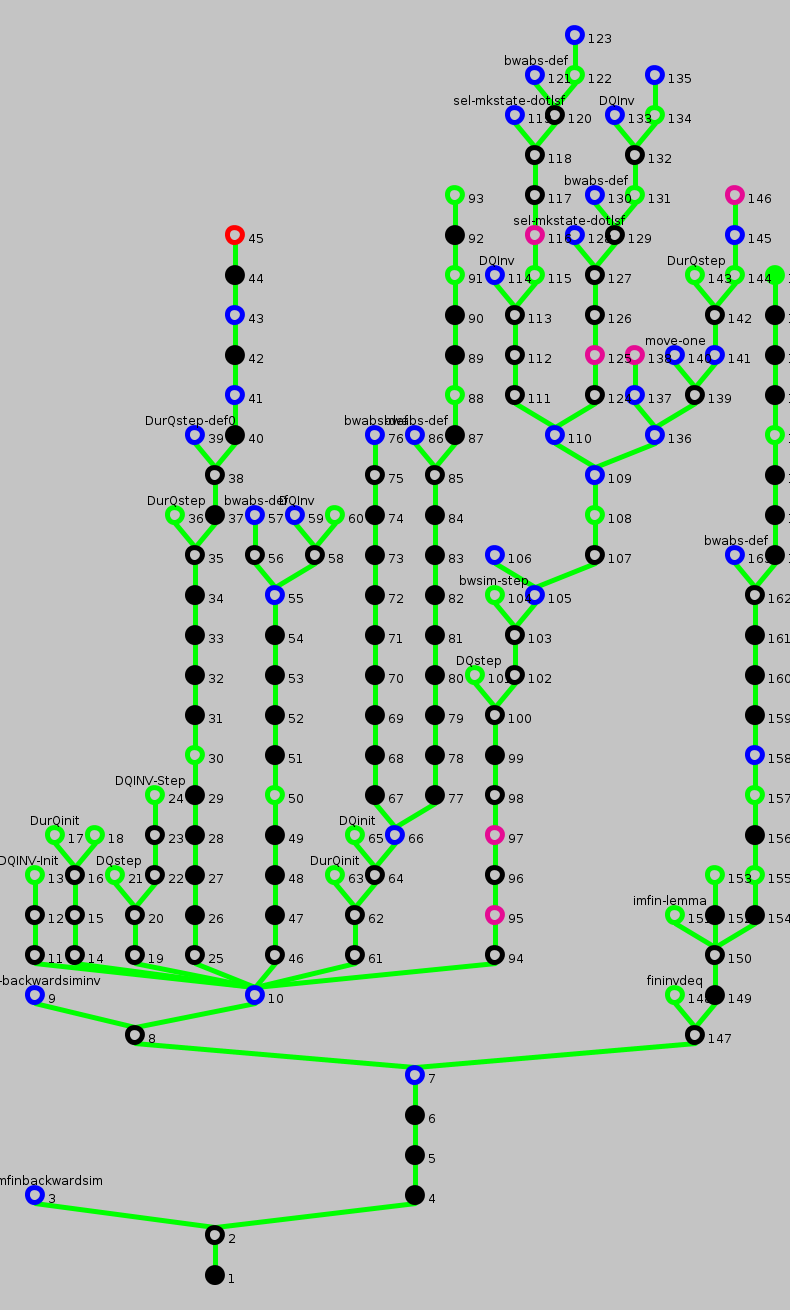
Proof Tree for bwsim (View conclusion)
The following image shows the proof tree of sequent calculus. The proved goal is at the bottom. You can click on the nodes to view additional rules. See here for details on colors in a proof tree.
| ⊦ imfinbwsim(CIOAut(DQinit, DQstep), AIOAut(DurQinit, DurQstep), bwabs, DQINV, λ durqs. DurQInv(durqs.gstate, durqs.lsf, durqs.pcf)) |
¬ imfinbwsim(CIOAut(DQinit, DQstep), AIOAut(DurQinit, DurQstep), bwabs, DQINV, λ durqs. DurQInv(durqs.gstate, durqs.lsf, durqs.pcf)) ⊦
| ¬ imfinbwsim(CIOAut(DQinit, DQstep), AIOAut(DurQinit, DurQstep), bwabs, DQINV, λ durqs. DurQInv(durqs.gstate, durqs.lsf, durqs.pcf)) ⊦ |
⊦ imfinbwsim(CIOAut(cstartf, cstepf), AIOAut(astartf, astepf), t, cINV, aINV) ↔ bwsim(CIOAut(cstartf, cstepf), AIOAut(astartf, astepf), t, cINV, aINV) ∧ (∀ cs. cINV(cs) → (∃ ass. ∀ as. t(cs, as) ∧ aINV(as) ↔ as ∈ ass))
¬ bwsim(CIOAut(DQinit, DQstep), AIOAut(DurQinit, DurQstep), bwabs, DQINV, λ durqs. DurQInv(durqs.gstate, durqs.lsf, durqs.pcf)) ∨ (∃ cs. ¬(DQINV(cs) → (∃ ass. ∀ as. bwabs(cs, as) ∧ DurQInv(as.gstate, as.lsf, as.pcf) ↔ as ∈ ass))) ⊦
Used terms: DurQinit, DQinit, DQINV, DQstep, bwabs, DurQstep, λ durqs. DurQInv(durqs.gstate, durqs.lsf, durqs.pcf)
| ⊦ imfinbwsim(CIOAut(cstartf, cstepf), AIOAut(astartf, astepf), t, cINV, aINV) ↔ bwsim(CIOAut(cstartf, cstepf), AIOAut(astartf, astepf), t, cINV, aINV) ∧ (∀ cs. cINV(cs) → (∃ ass. ∀ as. t(cs, as) ∧ aINV(as) ↔ as ∈ ass)) |
| ¬ bwsim(CIOAut(DQinit, DQstep), AIOAut(DurQinit, DurQstep), bwabs, DQINV, λ durqs. DurQInv(durqs.gstate, durqs.lsf, durqs.pcf)) ∨ (∃ cs. ¬(DQINV(cs) → (∃ ass. ∀ as. bwabs(cs, as) ∧ DurQInv(as.gstate, as.lsf, as.pcf) ↔ as ∈ ass))) ⊦ |
¬ bwsim(CIOAut(DQinit, DQstep), AIOAut(DurQinit, DurQstep), bwabs, DQINV, λ durqs. ∀ tid. durqs.lsf(tid).tid = tid) ∨ ¬(DQInv(dqs.gstate, dqs.lsf, dqs.pcf) ∧ fininvdeq(dqs.pcf) → (∃ ass. ∀ durqs. bwabs(dqs, durqs) ∧ (∀ tid. durqs.lsf(tid).tid = tid) ↔ durqs ∈ ass)) ⊦
Used simplifier rules: DQINV-def: ⊦ DQINV(dqs) ↔ DQInv(dqs.gstate, dqs.lsf, dqs.pcf) ∧ fininvdeq(dqs.pcf); ⊦ DurQLInv(gs, ls, pc) ↔ true; (s) ⊦ DurQGInv(gs) ↔ true; (s) ⊦ DurQInv(gs, lsf, pcf) ↔ DurQGInv(gs) ∧ (∀ tid. lsf(tid).tid = tid ∧ DurQLInv(gs, lsf(tid), pcf(tid))); (s)
| ¬ bwsim(CIOAut(DQinit, DQstep), AIOAut(DurQinit, DurQstep), bwabs, DQINV, λ durqs. ∀ tid. durqs.lsf(tid).tid = tid) ∨ ¬(DQInv(dqs.gstate, dqs.lsf, dqs.pcf) ∧ fininvdeq(dqs.pcf) → (∃ ass. ∀ durqs. bwabs(dqs, durqs) ∧ (∀ tid. durqs.lsf(tid).tid = tid) ↔ durqs ∈ ass)) ⊦ |
dqs = mkstate(gs, lsf, pcf), ¬ bwsim(CIOAut(DQinit, DQstep), AIOAut(DurQinit, DurQstep), bwabs, DQINV, λ durqs. ∀ tid. durqs.lsf(tid).tid = tid) ∨ ¬(DQInv(gs, lsf, pcf) ∧ fininvdeq(pcf) → (∃ ass. ∀ durqs. bwabs(dqs, durqs) ∧ (∀ tid. durqs.lsf(tid).tid = tid) ↔ durqs ∈ ass)) ⊦
Used simplifier rules: ⊦ (gstate = s.gstate ∧ lsf = s.lsf) ∧ pcf = s.pcf ↔ s = mkstate(gstate, lsf, pcf); (elim) Used terms: dqs, gstate, lsf, pcf
| dqs = mkstate(gs, lsf, pcf), ¬ bwsim(CIOAut(DQinit, DQstep), AIOAut(DurQinit, DurQstep), bwabs, DQINV, λ durqs. ∀ tid. durqs.lsf(tid).tid = tid) ∨ ¬(DQInv(gs, lsf, pcf) ∧ fininvdeq(pcf) → (∃ ass. ∀ durqs. bwabs(dqs, durqs) ∧ (∀ tid. durqs.lsf(tid).tid = tid) ↔ durqs ∈ ass)) ⊦ |
¬ bwsim(CIOAut(DQinit, DQstep), AIOAut(DurQinit, DurQstep), bwabs, DQINV, λ durqs. ∀ tid. durqs.lsf(tid).tid = tid) ∨ ¬(DQInv(gs, lsf, pcf) ∧ fininvdeq(pcf) → (∃ ass. ∀ durqs. bwabs(mkstate(gs, lsf, pcf), durqs) ∧ (∀ tid. durqs.lsf(tid).tid = tid) ↔ durqs ∈ ass)) ⊦
| ¬ bwsim(CIOAut(DQinit, DQstep), AIOAut(DurQinit, DurQstep), bwabs, DQINV, λ durqs. ∀ tid. durqs.lsf(tid).tid = tid) ∨ ¬(DQInv(gs, lsf, pcf) ∧ fininvdeq(pcf) → (∃ ass. ∀ durqs. bwabs(mkstate(gs, lsf, pcf), durqs) ∧ (∀ tid. durqs.lsf(tid).tid = tid) ↔ durqs ∈ ass)) ⊦ |
⊦ bwsim(CIOAut(DQinit, DQstep), AIOAut(DurQinit, DurQstep), bwabs, DQINV, λ durqs. ∀ tid. durqs.lsf(tid).tid = tid)
DQInv(gs, lsf, pcf), fininvdeq(pcf) ⊦ ∃ ass. ∀ durqs. bwabs(mkstate(gs, lsf, pcf), durqs) ∧ (∀ tid. durqs.lsf(tid).tid = tid) ↔ durqs ∈ ass
| ⊦ bwsim(CIOAut(DQinit, DQstep), AIOAut(DurQinit, DurQstep), bwabs, DQINV, λ durqs. ∀ tid. durqs.lsf(tid).tid = tid) |
⊦ bwsim(CIOAut(cstartf, cstepf), AIOAut(astartf, astepf), t, cINV, aINV) ↔ (∀ cs. cstartf(cs) → cINV(cs)) ∧ (∀ as. astartf(as) → aINV(as)) ∧ (∀ cs, a, cs0. cINV(cs) ∧ cstepf(cs, a, cs0) → cINV(cs0)) ∧ (∀ as, a, as0. aINV(as) ∧ astepf(as, a, as0) → aINV(as0)) ∧ (∀ cs. cINV(cs) → (∃ as. t(cs, as) ∧ aINV(as))) ∧ (∀ cs, as. cstartf(cs) ∧ t(cs, as) ∧ aINV(as) → astartf(as)) ∧ (∀ cs, a, cs0, as0. cINV(cs) ∧ cstepf(cs, a, cs0) ∧ t(cs0, as0) ∧ aINV(as0) → (∃ as. aINV(as) ∧ amove(AIOAut(astartf, astepf))(as, ⌜a '⌝ ^, as0) ∧ t(cs, as)))
⊦ (∀ cs. DQinit(cs) → DQINV(cs)) ∧ (∀ as. DurQinit(as) → (∀ tid. as.lsf(tid).tid = tid)) ∧ (∀ cs, aa, cs0. DQINV(cs) ∧ DQstep(cs, aa, cs0) → DQINV(cs0)) ∧ (∀ as, aa, as0. (∀ tid. as.lsf(tid).tid = tid) ∧ DurQstep(as, aa, as0) → (∀ tid. as0.lsf(tid).tid = tid)) ∧ (∀ cs. DQINV(cs) → (∃ as. bwabs(cs, as) ∧ (∀ tid. as.lsf(tid).tid = tid))) ∧ (∀ cs, as. DQinit(cs) ∧ bwabs(cs, as) ∧ (∀ tid. as.lsf(tid).tid = tid) → DurQinit(as)) ∧ (∀ cs, aa, cs0, as0. DQINV(cs) ∧ DQstep(cs, aa, cs0) ∧ bwabs(cs0, as0) ∧ (∀ tid. as0.lsf(tid).tid = tid) → (∃ as. (∀ tid. as.lsf(tid).tid = tid) ∧ amove(AIOAut(DurQinit, DurQstep))(as, ⌜aa '⌝ ^, as0) ∧ bwabs(cs, as)))
Used terms: DurQinit, DQinit, DQINV, DQstep, bwabs, DurQstep, λ durqs. ∀ tid. durqs.lsf(tid).tid = tid
| ⊦ bwsim(CIOAut(cstartf, cstepf), AIOAut(astartf, astepf), t, cINV, aINV) ↔ (∀ cs. cstartf(cs) → cINV(cs)) ∧ (∀ as. astartf(as) → aINV(as)) ∧ (∀ cs, a, cs0. cINV(cs) ∧ cstepf(cs, a, cs0) → cINV(cs0)) ∧ (∀ as, a, as0. aINV(as) ∧ astepf(as, a, as0) → aINV(as0)) ∧ (∀ cs. cINV(cs) → (∃ as. t(cs, as) ∧ aINV(as))) ∧ (∀ cs, as. cstartf(cs) ∧ t(cs, as) ∧ aINV(as) → astartf(as)) ∧ (∀ cs, a, cs0, as0. cINV(cs) ∧ cstepf(cs, a, cs0) ∧ t(cs0, as0) ∧ aINV(as0) → (∃ as. aINV(as) ∧ amove(AIOAut(astartf, astepf))(as, ⌜a '⌝ ^, as0) ∧ t(cs, as))) |
| ⊦ (∀ cs. DQinit(cs) → DQINV(cs)) ∧ (∀ as. DurQinit(as) → (∀ tid. as.lsf(tid).tid = tid)) ∧ (∀ cs, aa, cs0. DQINV(cs) ∧ DQstep(cs, aa, cs0) → DQINV(cs0)) ∧ (∀ as, aa, as0. (∀ tid. as.lsf(tid).tid = tid) ∧ DurQstep(as, aa, as0) → (∀ tid. as0.lsf(tid).tid = tid)) ∧ (∀ cs. DQINV(cs) → (∃ as. bwabs(cs, as) ∧ (∀ tid. as.lsf(tid).tid = tid))) ∧ (∀ cs, as. DQinit(cs) ∧ bwabs(cs, as) ∧ (∀ tid. as.lsf(tid).tid = tid) → DurQinit(as)) ∧ (∀ cs, aa, cs0, as0. DQINV(cs) ∧ DQstep(cs, aa, cs0) ∧ bwabs(cs0, as0) ∧ (∀ tid. as0.lsf(tid).tid = tid) → (∃ as. (∀ tid. as.lsf(tid).tid = tid) ∧ amove(AIOAut(DurQinit, DurQstep))(as, ⌜aa '⌝ ^, as0) ∧ bwabs(cs, as))) |
⊦ ∀ cs. DQinit(cs) → DQINV(cs)
⊦ ∀ as. DurQinit(as) → (∀ tid. as.lsf(tid).tid = tid)
⊦ ∀ cs, aa, cs0. DQINV(cs) ∧ DQstep(cs, aa, cs0) → DQINV(cs0)
⊦ ∀ as, aa, as0. (∀ tid. as.lsf(tid).tid = tid) ∧ DurQstep(as, aa, as0) → (∀ tid. as0.lsf(tid).tid = tid)
⊦ ∀ cs. DQINV(cs) → (∃ as. bwabs(cs, as) ∧ (∀ tid. as.lsf(tid).tid = tid))
⊦ ∀ cs, as. DQinit(cs) ∧ bwabs(cs, as) ∧ (∀ tid. as.lsf(tid).tid = tid) → DurQinit(as)
⊦ ∀ cs, aa, cs0, as0. DQINV(cs) ∧ DQstep(cs, aa, cs0) ∧ bwabs(cs0, as0) ∧ (∀ tid. as0.lsf(tid).tid = tid) → (∃ as. (∀ tid. as.lsf(tid).tid = tid) ∧ amove(AIOAut(DurQinit, DurQstep))(as, ⌜aa '⌝ ^, as0) ∧ bwabs(cs, as))
| ⊦ ∀ cs. DQinit(cs) → DQINV(cs) |
DQinit(dqs), ¬ DQINV(dqs) ⊦
| DQinit(dqs), ¬ DQINV(dqs) ⊦ |
⊦ DQinit(dqs) → DQINV(dqs)
Used terms: dqs
| ⊦ DQinit(dqs) → DQINV(dqs) |
| ⊦ ∀ as. DurQinit(as) → (∀ tid. as.lsf(tid).tid = tid) |
DurQinit(durqs) ⊦ ∀ tid. durqs.lsf(tid).tid = tid
| DurQinit(durqs) ⊦ ∀ tid. durqs.lsf(tid).tid = tid |
durqs.lsf(tid).tid ≠ tid, DurQinit(durqs) ⊦
| durqs.lsf(tid).tid ≠ tid, DurQinit(durqs) ⊦ |
⊦ DurQinit(durqs) ↔ durqs.gstate.queue = [] ∧ (∀ tid. durqs.pcf(tid) = idle ∧ durqs.lsf(tid).tid = tid)
durqs.gstate.queue = [], durqs.lsf(tid).tid ≠ tid, ∀ tid. durqs.pcf(tid) = idle ∧ durqs.lsf(tid).tid = tid ⊦
Used terms: durqs
| ⊦ DurQinit(durqs) ↔ durqs.gstate.queue = [] ∧ (∀ tid. durqs.pcf(tid) = idle ∧ durqs.lsf(tid).tid = tid) |
| durqs.gstate.queue = [], durqs.lsf(tid).tid ≠ tid, ∀ tid. durqs.pcf(tid) = idle ∧ durqs.lsf(tid).tid = tid ⊦ |
Used terms: tid
| ⊦ ∀ cs, aa, cs0. DQINV(cs) ∧ DQstep(cs, aa, cs0) → DQINV(cs0) |
DQINV(dqs), DQstep(dqs, aa, dqs0), ¬ DQINV(dqs0) ⊦
| DQINV(dqs), DQstep(dqs, aa, dqs0), ¬ DQINV(dqs0) ⊦ |
⊦ DQstep(dqs, aa, dqs0) ↔ (∃ ca. DQstep(dqs, ca, dqs0) ∧ aa = aabs(ca))
DQINV(dqs), ¬ DQINV(dqs0), ∃ ca. DQstep(dqs, ca, dqs0) ∧ aa = aabs(ca) ⊦
Used terms: dqs, aa, dqs0
| ⊦ DQstep(dqs, aa, dqs0) ↔ (∃ ca. DQstep(dqs, ca, dqs0) ∧ aa = aabs(ca)) |
| DQINV(dqs), ¬ DQINV(dqs0), ∃ ca. DQstep(dqs, ca, dqs0) ∧ aa = aabs(ca) ⊦ |
aa = aabs(ca), DQINV(dqs), DQstep(dqs, ca, dqs0), ¬ DQINV(dqs0) ⊦
| aa = aabs(ca), DQINV(dqs), DQstep(dqs, ca, dqs0), ¬ DQINV(dqs0) ⊦ |
⊦ DQINV(dqs) ∧ DQstep(dqs, ca, dqs0) → DQINV(dqs0)
Used simplifier rules: DQINV-def: ⊦ DQINV(dqs) ↔ DQInv(dqs.gstate, dqs.lsf, dqs.pcf) ∧ fininvdeq(dqs.pcf); Used terms: dqs, ca, dqs0
| ⊦ DQINV(dqs) ∧ DQstep(dqs, ca, dqs0) → DQINV(dqs0) |
| ⊦ ∀ as, aa, as0. (∀ tid. as.lsf(tid).tid = tid) ∧ DurQstep(as, aa, as0) → (∀ tid. as0.lsf(tid).tid = tid) |
DurQstep(durqs, aa, durqs0), ∀ tid. durqs.lsf(tid).tid = tid ⊦ ∀ tid. durqs0.lsf(tid).tid = tid
| DurQstep(durqs, aa, durqs0), ∀ tid. durqs.lsf(tid).tid = tid ⊦ ∀ tid. durqs0.lsf(tid).tid = tid |
durqs0.lsf(tid).tid ≠ tid, DurQstep(durqs, aa, durqs0), ∀ tid. durqs.lsf(tid).tid = tid ⊦
| durqs0.lsf(tid).tid ≠ tid, DurQstep(durqs, aa, durqs0), ∀ tid. durqs.lsf(tid).tid = tid ⊦ |
durqs0 = mkstate(ags, alsf, apcf), alsf(tid).tid ≠ tid, DurQstep(durqs, aa, durqs0), ∀ tid. durqs.lsf(tid).tid = tid ⊦
Used simplifier rules: ⊦ (gstate = s.gstate ∧ lsf = s.lsf) ∧ pcf = s.pcf ↔ s = mkstate(gstate, lsf, pcf); (elim) Used terms: durqs0, gstate, alsf, apcf
| durqs0 = mkstate(ags, alsf, apcf), alsf(tid).tid ≠ tid, DurQstep(durqs, aa, durqs0), ∀ tid. durqs.lsf(tid).tid = tid ⊦ |
alsf(tid).tid ≠ tid, DurQstep(durqs, aa, mkstate(ags, alsf, apcf)), ∀ tid. durqs.lsf(tid).tid = tid ⊦
| alsf(tid).tid ≠ tid, DurQstep(durqs, aa, mkstate(ags, alsf, apcf)), ∀ tid. durqs.lsf(tid).tid = tid ⊦ |
alsf(tid) = mkls(tid0, val, optval, val0, optval0), tid0 ≠ tid, DurQstep(durqs, aa, mkstate(ags, alsf, apcf)), ∀ tid. durqs.lsf(tid).tid = tid ⊦
Used simplifier rules: ⊦ (((tid = ls.tid ∧ ival = ls.ival) ∧ oval = ls.oval) ∧ value = ls.value) ∧ optval = ls.optval ↔ ls = mkls(tid, ival, oval, value, optval); (elim) Used terms: value, ival, oval, tid0, optval, alsf(tid)
| alsf(tid) = mkls(tid0, val, optval, val0, optval0), tid0 ≠ tid, DurQstep(durqs, aa, mkstate(ags, alsf, apcf)), ∀ tid. durqs.lsf(tid).tid = tid ⊦ |
durqs.lsf(tid).tid = tid, alsf(tid) = mkls(tid0, val, optval, val0, optval0), tid0 ≠ tid, DurQstep(durqs, aa, mkstate(ags, alsf, apcf)), ∀ tid. durqs.lsf(tid).tid = tid ⊦
Used terms: tid
| durqs.lsf(tid).tid = tid, alsf(tid) = mkls(tid0, val, optval, val0, optval0), tid0 ≠ tid, DurQstep(durqs, aa, mkstate(ags, alsf, apcf)), ∀ tid. durqs.lsf(tid).tid = tid ⊦ |
alsf0(tid).tid = tid, alsf(tid) = mkls(tid0, val, optval, val0, optval0), durqs = mkstate(ags0, alsf0, apcf0), tid0 ≠ tid, DurQstep(durqs, aa, mkstate(ags, alsf, apcf)), ∀ tid. alsf0(tid).tid = tid ⊦
Used simplifier rules: ⊦ (gstate = s.gstate ∧ lsf = s.lsf) ∧ pcf = s.pcf ↔ s = mkstate(gstate, lsf, pcf); (elim) Used terms: durqs, gstate, alsf0, apcf0
| alsf0(tid).tid = tid, alsf(tid) = mkls(tid0, val, optval, val0, optval0), durqs = mkstate(ags0, alsf0, apcf0), tid0 ≠ tid, DurQstep(durqs, aa, mkstate(ags, alsf, apcf)), ∀ tid. alsf0(tid).tid = tid ⊦ |
alsf0(tid).tid = tid, alsf(tid) = mkls(tid0, val, optval, val0, optval0), tid0 ≠ tid, DurQstep(mkstate(ags0, alsf0, apcf0), aa, mkstate(ags, alsf, apcf)), ∀ tid. alsf0(tid).tid = tid ⊦
| alsf0(tid).tid = tid, alsf(tid) = mkls(tid0, val, optval, val0, optval0), tid0 ≠ tid, DurQstep(mkstate(ags0, alsf0, apcf0), aa, mkstate(ags, alsf, apcf)), ∀ tid. alsf0(tid).tid = tid ⊦ |
alsf(tid) = mkls(tid0, val, optval, val0, optval0), alsf0(tid) = mkls(tid1, val1, optval1, val2, optval2), tid1 = tid, tid0 ≠ tid, DurQstep(mkstate(ags0, alsf0, apcf0), aa, mkstate(ags, alsf, apcf)), ∀ tid. alsf0(tid).tid = tid ⊦
Used simplifier rules: ⊦ (((tid = ls.tid ∧ ival = ls.ival) ∧ oval = ls.oval) ∧ value = ls.value) ∧ optval = ls.optval ↔ ls = mkls(tid, ival, oval, value, optval); (elim) Used terms: value, ival, oval, tid1, optval1, alsf0(tid)
| alsf(tid) = mkls(tid0, val, optval, val0, optval0), alsf0(tid) = mkls(tid1, val1, optval1, val2, optval2), tid1 = tid, tid0 ≠ tid, DurQstep(mkstate(ags0, alsf0, apcf0), aa, mkstate(ags, alsf, apcf)), ∀ tid. alsf0(tid).tid = tid ⊦ |
alsf(tid) = mkls(tid0, val, optval, val0, optval0), alsf0(tid) = mkls(tid, val1, optval1, val2, optval2), tid0 ≠ tid, DurQstep(mkstate(ags0, alsf0, apcf0), aa, mkstate(ags, alsf, apcf)), ∀ tid. alsf0(tid).tid = tid ⊦
| alsf(tid) = mkls(tid0, val, optval, val0, optval0), alsf0(tid) = mkls(tid, val1, optval1, val2, optval2), tid0 ≠ tid, DurQstep(mkstate(ags0, alsf0, apcf0), aa, mkstate(ags, alsf, apcf)), ∀ tid. alsf0(tid).tid = tid ⊦ |
⊦ DurQstep(durqs, aa, durqs0) ↔ (∃ a. DurQstep(durqs, a, durqs0) ∧ aa = aabs(a))
alsf(tid) = mkls(tid0, val, optval, val0, optval0), alsf0(tid) = mkls(tid, val1, optval1, val2, optval2), tid0 ≠ tid, ∀ tid. alsf0(tid).tid = tid, ∃ a. DurQstep(mkstate(ags0, alsf0, apcf0), a, mkstate(ags, alsf, apcf)) ∧ aa = aabs(a) ⊦
Used terms: mkstate(ags0, alsf0, apcf0), aa, mkstate(ags, alsf, apcf)
| ⊦ DurQstep(durqs, aa, durqs0) ↔ (∃ a. DurQstep(durqs, a, durqs0) ∧ aa = aabs(a)) |
| alsf(tid) = mkls(tid0, val, optval, val0, optval0), alsf0(tid) = mkls(tid, val1, optval1, val2, optval2), tid0 ≠ tid, ∀ tid. alsf0(tid).tid = tid, ∃ a. DurQstep(mkstate(ags0, alsf0, apcf0), a, mkstate(ags, alsf, apcf)) ∧ aa = aabs(a) ⊦ |
alsf(tid) = mkls(tid0, val, optval, val0, optval0), alsf0(tid) = mkls(tid, val1, optval1, val2, optval2), tid0 ≠ tid, DurQstep(mkstate(ags0, alsf0, apcf0), a, mkstate(ags, alsf, apcf)), ∀ tid. alsf0(tid).tid = tid ⊦
| alsf(tid) = mkls(tid0, val, optval, val0, optval0), alsf0(tid) = mkls(tid, val1, optval1, val2, optval2), tid0 ≠ tid, DurQstep(mkstate(ags0, alsf0, apcf0), a, mkstate(ags, alsf, apcf)), ∀ tid. alsf0(tid).tid = tid ⊦ |
⊦ DurQstep(mkstate(gs, lsf, pcf), a, durqs0) ↔ (a = globalACrash ⊃ durqs0 = mkstate(gs, lsf, λ tid. (pcf(tid) = idle ⊃ idle;crashed)) ;∃ tid. pre(gs, lsf(tid), pcf(tid), a) ∧ durqs0 = mkstate(gstepf(gs, lsf(tid), pcf(tid), a), lsf(tid; lstepf(gs, lsf(tid), pcf(tid), a)), pcf(tid; pcstepf(gs, lsf(tid), pcf(tid), a))) )
alsf(tid) = mkls(tid0, val, optval, val0, optval0), alsf0(tid) = mkls(tid, val1, optval1, val2, optval2), tid0 ≠ tid, (a = globalACrash ⊃ mkstate(ags, alsf, apcf) = mkstate(ags0, alsf0, λ tid. (apcf0(tid) = idle ⊃ idle;crashed)) ;∃ tid. pre(ags0, alsf0(tid), apcf0(tid), a) ∧ mkstate(ags, alsf, apcf) = mkstate (gstepf(ags0, alsf0(tid), apcf0(tid), a), alsf0(tid; lstepf(ags0, alsf0(tid), apcf0(tid), a)), apcf0(tid; pcstepf(ags0, alsf0(tid), apcf0(tid), a))) ), ∀ tid. alsf0(tid).tid = tid ⊦
Used terms: mkstate(ags, alsf, apcf), alsf0, a, ags0, apcf0
| ⊦ DurQstep(mkstate(gs, lsf, pcf), a, durqs0) ↔ (a = globalACrash ⊃ durqs0 = mkstate(gs, lsf, λ tid. (pcf(tid) = idle ⊃ idle;crashed)) ;∃ tid. pre(gs, lsf(tid), pcf(tid), a) ∧ durqs0 = mkstate(gstepf(gs, lsf(tid), pcf(tid), a), lsf(tid; lstepf(gs, lsf(tid), pcf(tid), a)), pcf(tid; pcstepf(gs, lsf(tid), pcf(tid), a))) ) |
| alsf(tid) = mkls(tid0, val, optval, val0, optval0), alsf0(tid) = mkls(tid, val1, optval1, val2, optval2), tid0 ≠ tid, (a = globalACrash ⊃ mkstate(ags, alsf, apcf) = mkstate(ags0, alsf0, λ tid. (apcf0(tid) = idle ⊃ idle;crashed)) ;∃ tid. pre(ags0, alsf0(tid), apcf0(tid), a) ∧ mkstate(ags, alsf, apcf) = mkstate (gstepf(ags0, alsf0(tid), apcf0(tid), a), alsf0(tid; lstepf(ags0, alsf0(tid), apcf0(tid), a)), apcf0(tid; pcstepf(ags0, alsf0(tid), apcf0(tid), a))) ), ∀ tid. alsf0(tid).tid = tid ⊦ |
alsf(tid) = mkls(tid0, val, optval, val0, optval0), alsf0(tid) = mkls(tid, val1, optval1, val2, optval2), tid0 ≠ tid, (a = globalACrash ⊃ mkstate(ags, alsf, apcf) = mkstate(ags0, alsf0, λ tid. (apcf0(tid) = idle ⊃ idle;crashed)) ; pre(ags0, alsf0(tid1), apcf0(tid1), a) ∧ mkstate(ags, alsf, apcf) = mkstate (gstepf(ags0, alsf0(tid1), apcf0(tid1), a), alsf0(tid1; lstepf(ags0, alsf0(tid1), apcf0(tid1), a)), apcf0(tid1; pcstepf(ags0, alsf0(tid1), apcf0(tid1), a))) ), ∀ tid. alsf0(tid).tid = tid ⊦
| alsf(tid) = mkls(tid0, val, optval, val0, optval0), alsf0(tid) = mkls(tid, val1, optval1, val2, optval2), tid0 ≠ tid, (a = globalACrash ⊃ mkstate(ags, alsf, apcf) = mkstate(ags0, alsf0, λ tid. (apcf0(tid) = idle ⊃ idle;crashed)) ; pre(ags0, alsf0(tid1), apcf0(tid1), a) ∧ mkstate(ags, alsf, apcf) = mkstate (gstepf(ags0, alsf0(tid1), apcf0(tid1), a), alsf0(tid1; lstepf(ags0, alsf0(tid1), apcf0(tid1), a)), apcf0(tid1; pcstepf(ags0, alsf0(tid1), apcf0(tid1), a))) ), ∀ tid. alsf0(tid).tid = tid ⊦ |
alsf(tid) = mkls(tid0, val, optval, val0, optval0), alsf0(tid) = mkls(tid, val1, optval1, val2, optval2), mkstate(ags, alsf, apcf) = mkstate (gstepf(ags0, alsf0(tid1), apcf0(tid1), a), alsf0(tid1; lstepf(ags0, alsf0(tid1), apcf0(tid1), a)), apcf0(tid1; pcstepf(ags0, alsf0(tid1), apcf0(tid1), a))), a ≠ globalACrash, tid0 ≠ tid, pre(ags0, alsf0(tid1), apcf0(tid1), a), ∀ tid. alsf0(tid).tid = tid ⊦
Used simplifier rules: ⊦ mkstate(gstate, lsf, pcf) = mkstate(gstate0, lsf0, pcf0) ↔ gstate = gstate0 ∧ lsf = lsf0 ∧ pcf = pcf0; (ws) ⊦ mkls(tid, ival, oval, ival0, oval0) = mkls(tid0, ival1, oval1, ival2, oval2) ↔ tid = tid0 ∧ ival = ival1 ∧ oval = oval1 ∧ ival0 = ival2 ∧ oval0 = oval2; (ws)
| alsf(tid) = mkls(tid0, val, optval, val0, optval0), alsf0(tid) = mkls(tid, val1, optval1, val2, optval2), mkstate(ags, alsf, apcf) = mkstate (gstepf(ags0, alsf0(tid1), apcf0(tid1), a), alsf0(tid1; lstepf(ags0, alsf0(tid1), apcf0(tid1), a)), apcf0(tid1; pcstepf(ags0, alsf0(tid1), apcf0(tid1), a))), a ≠ globalACrash, tid0 ≠ tid, pre(ags0, alsf0(tid1), apcf0(tid1), a), ∀ tid. alsf0(tid).tid = tid ⊦ |
(tid1 = tid ⊃ lstepf(ags0, mkls(tid, val1, optval1, val2, optval2), apcf0(tid), a);mkls(tid, val1, optval1, val2, optval2)) = mkls(tid0, val, optval, val0, optval0), alsf0(tid) = mkls(tid, val1, optval1, val2, optval2), a ≠ globalACrash, tid0 ≠ tid, pre(ags0, alsf0(tid1), apcf0(tid1), a), ∀ tid. alsf0(tid).tid = tid ⊦
Used simplifier rules: ⊦ mkstate(gstate, lsf, pcf) = mkstate(gstate0, lsf0, pcf0) ↔ gstate = gstate0 ∧ lsf = lsf0 ∧ pcf = pcf0; (ws)
| (tid1 = tid ⊃ lstepf(ags0, mkls(tid, val1, optval1, val2, optval2), apcf0(tid), a);mkls(tid, val1, optval1, val2, optval2)) = mkls(tid0, val, optval, val0, optval0), alsf0(tid) = mkls(tid, val1, optval1, val2, optval2), a ≠ globalACrash, tid0 ≠ tid, pre(ags0, alsf0(tid1), apcf0(tid1), a), ∀ tid. alsf0(tid).tid = tid ⊦ |
alsf0(tid) = mkls(tid, val1, optval1, val2, optval2), lstepf(ags0, mkls(tid, val1, optval1, val2, optval2), apcf0(tid), a) = mkls(tid0, val, optval, val0, optval0), tid1 = tid, a ≠ globalACrash, tid0 ≠ tid, pre(ags0, alsf0(tid1), apcf0(tid1), a), ∀ tid. alsf0(tid).tid = tid ⊦
Used simplifier rules: ⊦ mkls(tid, ival, oval, ival0, oval0) = mkls(tid0, ival1, oval1, ival2, oval2) ↔ tid = tid0 ∧ ival = ival1 ∧ oval = oval1 ∧ ival0 = ival2 ∧ oval0 = oval2; (ws)
| alsf0(tid) = mkls(tid, val1, optval1, val2, optval2), lstepf(ags0, mkls(tid, val1, optval1, val2, optval2), apcf0(tid), a) = mkls(tid0, val, optval, val0, optval0), tid1 = tid, a ≠ globalACrash, tid0 ≠ tid, pre(ags0, alsf0(tid1), apcf0(tid1), a), ∀ tid. alsf0(tid).tid = tid ⊦ |
alsf0(tid) = mkls(tid, val1, optval1, val2, optval2), lstepf(ags0, mkls(tid, val1, optval1, val2, optval2), apcf0(tid), a) = mkls(tid0, val, optval, val0, optval0), a ≠ globalACrash, tid0 ≠ tid, pre(ags0, mkls(tid, val1, optval1, val2, optval2), apcf0(tid), a), ∀ tid. alsf0(tid).tid = tid ⊦
| alsf0(tid) = mkls(tid, val1, optval1, val2, optval2), lstepf(ags0, mkls(tid, val1, optval1, val2, optval2), apcf0(tid), a) = mkls(tid0, val, optval, val0, optval0), a ≠ globalACrash, tid0 ≠ tid, pre(ags0, mkls(tid, val1, optval1, val2, optval2), apcf0(tid), a), ∀ tid. alsf0(tid).tid = tid ⊦ |
Used simplifier rules: DurQPC freely generated by crashed, idle, invDeq, invEnq, ready, resDeq, resEnq;; ⊦ pre(gs, ls, resEnq, a) ↔ a = ARetEnq(ls.tid); (s) ⊦ mkls(tid, ival, oval, ival0, oval0).tid = tid; (s) ⊦ lstepf(gs, mkls(tid, ival, oval, value, optval), resEnq, ARetEnq(tid)) = mkls(tid, ival, oval, value, optval); (s) ⊦ mkls(tid, ival, oval, ival0, oval0) = mkls(tid0, ival1, oval1, ival2, oval2) ↔ tid = tid0 ∧ ival = ival1 ∧ oval = oval1 ∧ ival0 = ival2 ∧ oval0 = oval2; (ws) ⊦ pre(gs, ls, resDeq, a) ↔ a = ARetDeq(ls.tid, ls.oval); (s) ⊦ mkls(tid, ival, oval, ival0, oval0).oval = oval; (s) ⊦ lstepf(gs, mkls(tid, ival, oval, value, optval), resDeq, ARetDeq(tid, oval)) = mkls(tid, ival, oval, value, oval); (s) ⊦ pre(gs, ls, ready, a) ↔ (∃ value. a = AInvEnq(ls.tid, value)) ∨ a = AInvDeq(ls.tid); (s) ⊦ lstepf (gs, mkls(tid, ival, oval, value, optval), ready, AInvEnq(tid, value0)) = mkls(tid, value0, oval, value, optval); (s) ⊦ lstepf(gs, mkls(tid, ival, oval, value, optval), ready, AInvDeq(tid)) = mkls(tid, ival, oval, value, optval); (s) ⊦ pre(gs, ls, invEnq, a) ↔ a = ADoEnq(ls.tid); (s) ⊦ lstepf(gs, mkls(tid, ival, oval, value, optval), invEnq, ADoEnq(tid)) = mkls(tid, ival, oval, value, optval); (s) ⊦ pre(gs, ls, invDeq, a) ↔ a = ADoDeq(ls.tid); (s) ⊦ lstepf(gs, mkls(tid, ival, oval, value, optval), invDeq, ADoDeq(tid)) = mkls(tid, ival, (gs.queue = [] ⊃ Empty;Val(gs.queue.head)), value, optval); (s) ⊦ pre(gs, ls, idle, a) ↔ a = callARun(ls.tid); (s) ⊦ lstepf(gs, mkls(tid, ival, oval, value, optval), idle, callARun(tid)) = mkls(tid, ival, oval, value, optval); (s) ⊦ pre(gs, ls, crashed, a) ↔ false; (s)
| ⊦ ∀ cs. DQINV(cs) → (∃ as. bwabs(cs, as) ∧ (∀ tid. as.lsf(tid).tid = tid)) |
DQINV(dqs) ⊦ ∃ as. bwabs(dqs, as) ∧ (∀ tid. as.lsf(tid).tid = tid)
| DQINV(dqs) ⊦ ∃ as. bwabs(dqs, as) ∧ (∀ tid. as.lsf(tid).tid = tid) |
DQInv(dqs.gstate, dqs.lsf, dqs.pcf), fininvdeq(dqs.pcf) ⊦ ∃ as. bwabs(dqs, as) ∧ (∀ tid. as.lsf(tid).tid = tid)
Used simplifier rules: DQINV-def: ⊦ DQINV(dqs) ↔ DQInv(dqs.gstate, dqs.lsf, dqs.pcf) ∧ fininvdeq(dqs.pcf);
| DQInv(dqs.gstate, dqs.lsf, dqs.pcf), fininvdeq(dqs.pcf) ⊦ ∃ as. bwabs(dqs, as) ∧ (∀ tid. as.lsf(tid).tid = tid) |
dqs = mkstate(gs, lsf, pcf), DQInv(gs, lsf, pcf), fininvdeq(pcf) ⊦ ∃ as. bwabs(dqs, as) ∧ (∀ tid. as.lsf(tid).tid = tid)
Used simplifier rules: ⊦ (gstate = s.gstate ∧ lsf = s.lsf) ∧ pcf = s.pcf ↔ s = mkstate(gstate, lsf, pcf); (elim) Used terms: dqs, gstate, lsf, pcf
| dqs = mkstate(gs, lsf, pcf), DQInv(gs, lsf, pcf), fininvdeq(pcf) ⊦ ∃ as. bwabs(dqs, as) ∧ (∀ tid. as.lsf(tid).tid = tid) |
DQInv(gs, lsf, pcf), fininvdeq(pcf) ⊦ ∃ as. bwabs(mkstate(gs, lsf, pcf), as) ∧ (∀ tid. as.lsf(tid).tid = tid)
| DQInv(gs, lsf, pcf), fininvdeq(pcf) ⊦ ∃ as. bwabs(mkstate(gs, lsf, pcf), as) ∧ (∀ tid. as.lsf(tid).tid = tid) |
DQInv(gs, lsf, pcf), fininvdeq(pcf) ⊦ bwabs(mkstate(gs, lsf, pcf), mkstate(mkdgs(gs.queue), λ tid. bwlabsf(lsf(tid)), λ tid. bwabspcf(pcf(tid)))) ∧ (∀ tid. mkstate(mkdgs(gs.queue), λ tid. bwlabsf(lsf(tid)), λ tid. bwabspcf(pcf(tid))).lsf(tid).tid = tid)
Used terms: mkstate(mkdgs(gs.queue), λ tid. bwlabsf(lsf(tid)), λ tid. bwabspcf(pcf(tid)))
| DQInv(gs, lsf, pcf), fininvdeq(pcf) ⊦ bwabs(mkstate(gs, lsf, pcf), mkstate(mkdgs(gs.queue), λ tid. bwlabsf(lsf(tid)), λ tid. bwabspcf(pcf(tid)))) ∧ (∀ tid. mkstate(mkdgs(gs.queue), λ tid. bwlabsf(lsf(tid)), λ tid. bwabspcf(pcf(tid))).lsf(tid).tid = tid) |
DQInv(gs, lsf, pcf), fininvdeq(pcf) ⊦ bwabs (mkstate(gs, lsf, pcf), mkstate(mkdgs(gs.queue), λ tid. mkls(lsf(tid).tid, lsf(tid).ival, lsf(tid).oval, lsf(tid).value, lsf(tid).optval), λ tid. bwabspcf(pcf(tid)))) ∧ lsf(tid).tid = tid
Used simplifier rules: ⊦ mkls(tid, ival, oval, ival0, oval0).tid = tid; (s) ⊦ mkstate(gstate, lsf, pcf).lsf = lsf; (s) ⊦ bwlabsf(ls) = mkls(ls.tid, ls.ival, ls.oval, ls.value, ls.optval); (s)
| DQInv(gs, lsf, pcf), fininvdeq(pcf) ⊦ bwabs (mkstate(gs, lsf, pcf), mkstate(mkdgs(gs.queue), λ tid. mkls(lsf(tid).tid, lsf(tid).ival, lsf(tid).oval, lsf(tid).value, lsf(tid).optval), λ tid. bwabspcf(pcf(tid)))) ∧ lsf(tid).tid = tid |
gs = mkgs(queue), DQInv(gs, lsf, pcf), fininvdeq(pcf) ⊦ bwabs (mkstate(gs, lsf, pcf), mkstate(mkdgs(queue), λ tid. mkls(lsf(tid).tid, lsf(tid).ival, lsf(tid).oval, lsf(tid).value, lsf(tid).optval), λ tid. bwabspcf(pcf(tid)))) ∧ lsf(tid).tid = tid
Used simplifier rules: ⊦ queue = gs.queue ↔ gs = mkgs(queue); (elim) Used terms: gs, queue
| gs = mkgs(queue), DQInv(gs, lsf, pcf), fininvdeq(pcf) ⊦ bwabs (mkstate(gs, lsf, pcf), mkstate(mkdgs(queue), λ tid. mkls(lsf(tid).tid, lsf(tid).ival, lsf(tid).oval, lsf(tid).value, lsf(tid).optval), λ tid. bwabspcf(pcf(tid)))) ∧ lsf(tid).tid = tid |
DQInv(mkgs(queue), lsf, pcf), fininvdeq(pcf) ⊦ bwabs (mkstate(mkgs(queue), lsf, pcf), mkstate(mkdgs(queue), λ tid. mkls(lsf(tid).tid, lsf(tid).ival, lsf(tid).oval, lsf(tid).value, lsf(tid).optval), λ tid. bwabspcf(pcf(tid)))) ∧ lsf(tid).tid = tid
| DQInv(mkgs(queue), lsf, pcf), fininvdeq(pcf) ⊦ bwabs (mkstate(mkgs(queue), lsf, pcf), mkstate(mkdgs(queue), λ tid. mkls(lsf(tid).tid, lsf(tid).ival, lsf(tid).oval, lsf(tid).value, lsf(tid).optval), λ tid. bwabspcf(pcf(tid)))) ∧ lsf(tid).tid = tid |
lsf(tid) = mkls(tid0, obsEmpty, val, optval, val0, optval0), DQInv(mkgs(queue), lsf, pcf), fininvdeq(pcf) ⊦ bwabs (mkstate(mkgs(queue), lsf, pcf), mkstate(mkdgs(queue), λ tid. mkls(lsf(tid).tid, lsf(tid).ival, lsf(tid).oval, lsf(tid).value, lsf(tid).optval), λ tid. bwabspcf(pcf(tid)))) ∧ tid0 = tid
Used simplifier rules: ⊦ ( ( ((tid = ls.tid ∧ (obsEmpty ↔ ls.obsEmpty)) ∧ ival = ls.ival) ∧ oval = ls.oval) ∧ value = ls.value) ∧ optval = ls.optval ↔ ls = mkls(tid, obsEmpty, ival, oval, value, optval); (elim) Used terms: value, ival, obsEmpty, lsf(tid), oval, tid0, optval
| lsf(tid) = mkls(tid0, obsEmpty, val, optval, val0, optval0), DQInv(mkgs(queue), lsf, pcf), fininvdeq(pcf) ⊦ bwabs (mkstate(mkgs(queue), lsf, pcf), mkstate(mkdgs(queue), λ tid. mkls(lsf(tid).tid, lsf(tid).ival, lsf(tid).oval, lsf(tid).value, lsf(tid).optval), λ tid. bwabspcf(pcf(tid)))) ∧ tid0 = tid |
lsf(tid) = mkls(tid0, obsEmpty, val, optval, val0, optval0), DQInv(mkgs(queue), lsf, pcf), fininvdeq(pcf), ¬ bwabs (mkstate(mkgs(queue), lsf, pcf), mkstate(mkdgs(queue), λ tid. mkls(lsf(tid).tid, lsf(tid).ival, lsf(tid).oval, lsf(tid).value, lsf(tid).optval), λ tid. bwabspcf(pcf(tid)))) ⊦
lsf(tid) = mkls(tid0, obsEmpty, val, optval, val0, optval0), tid0 ≠ tid, DQInv(mkgs(queue), lsf, pcf), fininvdeq(pcf) ⊦
| lsf(tid) = mkls(tid0, obsEmpty, val, optval, val0, optval0), DQInv(mkgs(queue), lsf, pcf), fininvdeq(pcf), ¬ bwabs (mkstate(mkgs(queue), lsf, pcf), mkstate(mkdgs(queue), λ tid. mkls(lsf(tid).tid, lsf(tid).ival, lsf(tid).oval, lsf(tid).value, lsf(tid).optval), λ tid. bwabspcf(pcf(tid)))) ⊦ |
⊦ bwabs(mkstate(gs, lsf, pcf), mkstate(ags, alsf, apcf)) ↔ ags = mkdgs(gs.queue) ∧ (∀ tid. alsf(tid) = mkls(lsf(tid).tid, lsf(tid).ival, lsf(tid).oval, lsf(tid).value, lsf(tid).optval) ∧ apcf(tid) = bwabspcf(pcf(tid)) ∨ alsf(tid) = mkls(lsf(tid).tid, lsf(tid).ival, Empty, lsf(tid).value, lsf(tid).optval) ∧ pcf(tid) = invDeq ∧ apcf(tid) = resDeq ∧ lsf(tid).obsEmpty)
Used simplifier rules: ⊦ mkgs(queue).queue = queue; (s) ⊦ mkdgs(queue) = mkdgs(queue0) ↔ queue = queue0; (s) Used terms: mkgs(queue), λ tid. mkls (lsf(tid).tid, lsf(tid).ival, lsf(tid).oval, lsf(tid).value, lsf(tid).optval), lsf, mkdgs(queue), pcf, λ tid. bwabspcf(pcf(tid))
| ⊦ bwabs(mkstate(gs, lsf, pcf), mkstate(ags, alsf, apcf)) ↔ ags = mkdgs(gs.queue) ∧ (∀ tid. alsf(tid) = mkls(lsf(tid).tid, lsf(tid).ival, lsf(tid).oval, lsf(tid).value, lsf(tid).optval) ∧ apcf(tid) = bwabspcf(pcf(tid)) ∨ alsf(tid) = mkls(lsf(tid).tid, lsf(tid).ival, Empty, lsf(tid).value, lsf(tid).optval) ∧ pcf(tid) = invDeq ∧ apcf(tid) = resDeq ∧ lsf(tid).obsEmpty) |
| lsf(tid) = mkls(tid0, obsEmpty, val, optval, val0, optval0), tid0 ≠ tid, DQInv(mkgs(queue), lsf, pcf), fininvdeq(pcf) ⊦ |
⊦ DQInv(gs, lsf, pcf) ↔ DQGInv(gs) ∧ (∀ tid. lsf(tid).tid = tid ∧ DQLInv(gs, lsf(tid), pcf(tid)))
lsf(tid) = mkls(tid0, obsEmpty, val, optval, val0, optval0), tid0 ≠ tid, DQGInv(mkgs(queue)), fininvdeq(pcf), ∀ tid. lsf(tid).tid = tid ∧ DQLInv(mkgs(queue), lsf(tid), pcf(tid)) ⊦
Used terms: mkgs(queue), lsf, pcf
| ⊦ DQInv(gs, lsf, pcf) ↔ DQGInv(gs) ∧ (∀ tid. lsf(tid).tid = tid ∧ DQLInv(gs, lsf(tid), pcf(tid))) |
| lsf(tid) = mkls(tid0, obsEmpty, val, optval, val0, optval0), tid0 ≠ tid, DQGInv(mkgs(queue)), fininvdeq(pcf), ∀ tid. lsf(tid).tid = tid ∧ DQLInv(mkgs(queue), lsf(tid), pcf(tid)) ⊦ |
Used simplifier rules: ⊦ mkls(tid, obsEmpty, ival, oval, ival0, oval0).tid = tid; (s) Used terms: tid
| ⊦ ∀ cs, as. DQinit(cs) ∧ bwabs(cs, as) ∧ (∀ tid. as.lsf(tid).tid = tid) → DurQinit(as) |
DQinit(dqs), bwabs(dqs, durqs), ¬ DurQinit(durqs), ∀ tid. durqs.lsf(tid).tid = tid ⊦
| DQinit(dqs), bwabs(dqs, durqs), ¬ DurQinit(durqs), ∀ tid. durqs.lsf(tid).tid = tid ⊦ |
⊦ DurQinit(durqs) ↔ durqs.gstate.queue = [] ∧ (∀ tid. durqs.pcf(tid) = idle ∧ durqs.lsf(tid).tid = tid)
DQinit(dqs), bwabs(dqs, durqs), ∀ tid. durqs.lsf(tid).tid = tid, durqs.gstate.queue ≠ [] ∨ (∃ tid. ¬(durqs.pcf(tid) = idle ∧ durqs.lsf(tid).tid = tid)) ⊦
Used terms: durqs
| ⊦ DurQinit(durqs) ↔ durqs.gstate.queue = [] ∧ (∀ tid. durqs.pcf(tid) = idle ∧ durqs.lsf(tid).tid = tid) |
| DQinit(dqs), bwabs(dqs, durqs), ∀ tid. durqs.lsf(tid).tid = tid, durqs.gstate.queue ≠ [] ∨ (∃ tid. ¬(durqs.pcf(tid) = idle ∧ durqs.lsf(tid).tid = tid)) ⊦ |
⊦ DQinit(dqs) ↔ dqs.gstate.queue = [] ∧ (∀ tid. dqs.pcf(tid) = idle ∧ dqs.lsf(tid).tid = tid)
dqs.gstate.queue = [], bwabs(dqs, durqs), ∀ tid. durqs.lsf(tid).tid = tid, ∀ tid. dqs.pcf(tid) = idle ∧ dqs.lsf(tid).tid = tid, durqs.gstate.queue ≠ [] ∨ (∃ tid. ¬(durqs.pcf(tid) = idle ∧ durqs.lsf(tid).tid = tid)) ⊦
Used terms: dqs
| ⊦ DQinit(dqs) ↔ dqs.gstate.queue = [] ∧ (∀ tid. dqs.pcf(tid) = idle ∧ dqs.lsf(tid).tid = tid) |
| dqs.gstate.queue = [], bwabs(dqs, durqs), ∀ tid. durqs.lsf(tid).tid = tid, ∀ tid. dqs.pcf(tid) = idle ∧ dqs.lsf(tid).tid = tid, durqs.gstate.queue ≠ [] ∨ (∃ tid. ¬(durqs.pcf(tid) = idle ∧ durqs.lsf(tid).tid = tid)) ⊦ |
dqs.gstate.queue = [], durqs.gstate.queue ≠ [], bwabs(dqs, durqs), ∀ tid. dqs.pcf(tid) = idle ∧ dqs.lsf(tid).tid = tid, ∀ tid. durqs.lsf(tid).tid = tid ⊦
dqs.gstate.queue = [], bwabs(dqs, durqs), ∀ tid. dqs.pcf(tid) = idle ∧ dqs.lsf(tid).tid = tid, ∀ tid. durqs.lsf(tid).tid = tid, ∃ tid. ¬(durqs.pcf(tid) = idle ∧ durqs.lsf(tid).tid = tid) ⊦
| dqs.gstate.queue = [], durqs.gstate.queue ≠ [], bwabs(dqs, durqs), ∀ tid. dqs.pcf(tid) = idle ∧ dqs.lsf(tid).tid = tid, ∀ tid. durqs.lsf(tid).tid = tid ⊦ |
dqs.gstate.queue = [], durqs = mkstate(ags, alsf, apcf), ags.queue ≠ [], bwabs(dqs, durqs), ∀ tid. alsf(tid).tid = tid, ∀ tid. dqs.pcf(tid) = idle ∧ dqs.lsf(tid).tid = tid ⊦
Used simplifier rules: ⊦ (gstate = s.gstate ∧ lsf = s.lsf) ∧ pcf = s.pcf ↔ s = mkstate(gstate, lsf, pcf); (elim) Used terms: durqs, gstate, alsf, apcf
| dqs.gstate.queue = [], durqs = mkstate(ags, alsf, apcf), ags.queue ≠ [], bwabs(dqs, durqs), ∀ tid. alsf(tid).tid = tid, ∀ tid. dqs.pcf(tid) = idle ∧ dqs.lsf(tid).tid = tid ⊦ |
dqs.gstate.queue = [], ags.queue ≠ [], bwabs(dqs, mkstate(ags, alsf, apcf)), ∀ tid. dqs.pcf(tid) = idle ∧ dqs.lsf(tid).tid = tid, ∀ tid. alsf(tid).tid = tid ⊦
| dqs.gstate.queue = [], ags.queue ≠ [], bwabs(dqs, mkstate(ags, alsf, apcf)), ∀ tid. dqs.pcf(tid) = idle ∧ dqs.lsf(tid).tid = tid, ∀ tid. alsf(tid).tid = tid ⊦ |
dqs.gstate.queue = [], ags = mkdgs(queue), queue ≠ [], bwabs(dqs, mkstate(ags, alsf, apcf)), ∀ tid. alsf(tid).tid = tid, ∀ tid. dqs.pcf(tid) = idle ∧ dqs.lsf(tid).tid = tid ⊦
Used simplifier rules: ⊦ queue = gs.queue ↔ gs = mkdgs(queue); (elim) Used terms: ags, queue
| dqs.gstate.queue = [], ags = mkdgs(queue), queue ≠ [], bwabs(dqs, mkstate(ags, alsf, apcf)), ∀ tid. alsf(tid).tid = tid, ∀ tid. dqs.pcf(tid) = idle ∧ dqs.lsf(tid).tid = tid ⊦ |
dqs.gstate.queue = [], queue ≠ [], bwabs(dqs, mkstate(mkdgs(queue), alsf, apcf)), ∀ tid. dqs.pcf(tid) = idle ∧ dqs.lsf(tid).tid = tid, ∀ tid. alsf(tid).tid = tid ⊦
| dqs.gstate.queue = [], queue ≠ [], bwabs(dqs, mkstate(mkdgs(queue), alsf, apcf)), ∀ tid. dqs.pcf(tid) = idle ∧ dqs.lsf(tid).tid = tid, ∀ tid. alsf(tid).tid = tid ⊦ |
gs.queue = [], dqs = mkstate(gs, lsf, pcf), queue ≠ [], bwabs(dqs, mkstate(mkdgs(queue), alsf, apcf)), ∀ tid. alsf(tid).tid = tid, ∀ tid. pcf(tid) = idle ∧ lsf(tid).tid = tid ⊦
Used simplifier rules: ⊦ (gstate = s.gstate ∧ lsf = s.lsf) ∧ pcf = s.pcf ↔ s = mkstate(gstate, lsf, pcf); (elim) Used terms: dqs, gstate, lsf, pcf
| gs.queue = [], dqs = mkstate(gs, lsf, pcf), queue ≠ [], bwabs(dqs, mkstate(mkdgs(queue), alsf, apcf)), ∀ tid. alsf(tid).tid = tid, ∀ tid. pcf(tid) = idle ∧ lsf(tid).tid = tid ⊦ |
gs.queue = [], queue ≠ [], bwabs(mkstate(gs, lsf, pcf), mkstate(mkdgs(queue), alsf, apcf)), ∀ tid. pcf(tid) = idle ∧ lsf(tid).tid = tid, ∀ tid. alsf(tid).tid = tid ⊦
| gs.queue = [], queue ≠ [], bwabs(mkstate(gs, lsf, pcf), mkstate(mkdgs(queue), alsf, apcf)), ∀ tid. pcf(tid) = idle ∧ lsf(tid).tid = tid, ∀ tid. alsf(tid).tid = tid ⊦ |
gs = mkgs(queue0), queue0 = [], queue ≠ [], bwabs(mkstate(gs, lsf, pcf), mkstate(mkdgs(queue), alsf, apcf)), ∀ tid. alsf(tid).tid = tid, ∀ tid. pcf(tid) = idle ∧ lsf(tid).tid = tid ⊦
Used simplifier rules: ⊦ queue = gs.queue ↔ gs = mkgs(queue); (elim) Used terms: gs, queue0
| gs = mkgs(queue0), queue0 = [], queue ≠ [], bwabs(mkstate(gs, lsf, pcf), mkstate(mkdgs(queue), alsf, apcf)), ∀ tid. alsf(tid).tid = tid, ∀ tid. pcf(tid) = idle ∧ lsf(tid).tid = tid ⊦ |
queue ≠ [], bwabs(mkstate(mkgs([]), lsf, pcf), mkstate(mkdgs(queue), alsf, apcf)), ∀ tid. pcf(tid) = idle ∧ lsf(tid).tid = tid, ∀ tid. alsf(tid).tid = tid ⊦
| queue ≠ [], bwabs(mkstate(mkgs([]), lsf, pcf), mkstate(mkdgs(queue), alsf, apcf)), ∀ tid. pcf(tid) = idle ∧ lsf(tid).tid = tid, ∀ tid. alsf(tid).tid = tid ⊦ |
⊦ bwabs(mkstate(gs, lsf, pcf), mkstate(ags, alsf, apcf)) ↔ ags = mkdgs(gs.queue) ∧ (∀ tid. alsf(tid) = mkls(lsf(tid).tid, lsf(tid).ival, lsf(tid).oval, lsf(tid).value, lsf(tid).optval) ∧ apcf(tid) = bwabspcf(pcf(tid)) ∨ alsf(tid) = mkls(lsf(tid).tid, lsf(tid).ival, Empty, lsf(tid).value, lsf(tid).optval) ∧ pcf(tid) = invDeq ∧ apcf(tid) = resDeq ∧ lsf(tid).obsEmpty)
Used simplifier rules: ⊦ mkgs(queue).queue = queue; (s) ⊦ mkdgs(queue) = mkdgs(queue0) ↔ queue = queue0; (s) Used terms: mkgs([]), alsf, lsf, mkdgs(queue), pcf, apcf
| ⊦ bwabs(mkstate(gs, lsf, pcf), mkstate(ags, alsf, apcf)) ↔ ags = mkdgs(gs.queue) ∧ (∀ tid. alsf(tid) = mkls(lsf(tid).tid, lsf(tid).ival, lsf(tid).oval, lsf(tid).value, lsf(tid).optval) ∧ apcf(tid) = bwabspcf(pcf(tid)) ∨ alsf(tid) = mkls(lsf(tid).tid, lsf(tid).ival, Empty, lsf(tid).value, lsf(tid).optval) ∧ pcf(tid) = invDeq ∧ apcf(tid) = resDeq ∧ lsf(tid).obsEmpty) |
| dqs.gstate.queue = [], bwabs(dqs, durqs), ∀ tid. dqs.pcf(tid) = idle ∧ dqs.lsf(tid).tid = tid, ∀ tid. durqs.lsf(tid).tid = tid, ∃ tid. ¬(durqs.pcf(tid) = idle ∧ durqs.lsf(tid).tid = tid) ⊦ |
dqs.gstate.queue = [], bwabs(dqs, durqs), ∀ tid. durqs.lsf(tid).tid = tid, ∀ tid. dqs.pcf(tid) = idle ∧ dqs.lsf(tid).tid = tid ⊦ durqs.pcf(tid) = idle ∧ durqs.lsf(tid).tid = tid
| dqs.gstate.queue = [], bwabs(dqs, durqs), ∀ tid. durqs.lsf(tid).tid = tid, ∀ tid. dqs.pcf(tid) = idle ∧ dqs.lsf(tid).tid = tid ⊦ durqs.pcf(tid) = idle ∧ durqs.lsf(tid).tid = tid |
dqs.gstate.queue = [], durqs = mkstate(ags, alsf, apcf), bwabs(dqs, durqs), ∀ tid. dqs.pcf(tid) = idle ∧ dqs.lsf(tid).tid = tid, ∀ tid. alsf(tid).tid = tid ⊦ apcf(tid) = idle ∧ alsf(tid).tid = tid
Used simplifier rules: ⊦ (gstate = s.gstate ∧ lsf = s.lsf) ∧ pcf = s.pcf ↔ s = mkstate(gstate, lsf, pcf); (elim) Used terms: durqs, gstate, alsf, apcf
| dqs.gstate.queue = [], durqs = mkstate(ags, alsf, apcf), bwabs(dqs, durqs), ∀ tid. dqs.pcf(tid) = idle ∧ dqs.lsf(tid).tid = tid, ∀ tid. alsf(tid).tid = tid ⊦ apcf(tid) = idle ∧ alsf(tid).tid = tid |
dqs.gstate.queue = [], bwabs(dqs, mkstate(ags, alsf, apcf)), ∀ tid. alsf(tid).tid = tid, ∀ tid. dqs.pcf(tid) = idle ∧ dqs.lsf(tid).tid = tid ⊦ apcf(tid) = idle ∧ alsf(tid).tid = tid
| dqs.gstate.queue = [], bwabs(dqs, mkstate(ags, alsf, apcf)), ∀ tid. alsf(tid).tid = tid, ∀ tid. dqs.pcf(tid) = idle ∧ dqs.lsf(tid).tid = tid ⊦ apcf(tid) = idle ∧ alsf(tid).tid = tid |
gs.queue = [], dqs = mkstate(gs, lsf, pcf), bwabs(dqs, mkstate(ags, alsf, apcf)), ∀ tid. pcf(tid) = idle ∧ lsf(tid).tid = tid, ∀ tid. alsf(tid).tid = tid ⊦ apcf(tid) = idle ∧ alsf(tid).tid = tid
Used simplifier rules: ⊦ (gstate = s.gstate ∧ lsf = s.lsf) ∧ pcf = s.pcf ↔ s = mkstate(gstate, lsf, pcf); (elim) Used terms: dqs, gstate, lsf, pcf
| gs.queue = [], dqs = mkstate(gs, lsf, pcf), bwabs(dqs, mkstate(ags, alsf, apcf)), ∀ tid. pcf(tid) = idle ∧ lsf(tid).tid = tid, ∀ tid. alsf(tid).tid = tid ⊦ apcf(tid) = idle ∧ alsf(tid).tid = tid |
gs.queue = [], bwabs(mkstate(gs, lsf, pcf), mkstate(ags, alsf, apcf)), ∀ tid. alsf(tid).tid = tid, ∀ tid. pcf(tid) = idle ∧ lsf(tid).tid = tid ⊦ apcf(tid) = idle ∧ alsf(tid).tid = tid
| gs.queue = [], bwabs(mkstate(gs, lsf, pcf), mkstate(ags, alsf, apcf)), ∀ tid. alsf(tid).tid = tid, ∀ tid. pcf(tid) = idle ∧ lsf(tid).tid = tid ⊦ apcf(tid) = idle ∧ alsf(tid).tid = tid |
gs = mkgs(queue), queue = [], bwabs(mkstate(gs, lsf, pcf), mkstate(ags, alsf, apcf)), ∀ tid. pcf(tid) = idle ∧ lsf(tid).tid = tid, ∀ tid. alsf(tid).tid = tid ⊦ apcf(tid) = idle ∧ alsf(tid).tid = tid
Used simplifier rules: ⊦ queue = gs.queue ↔ gs = mkgs(queue); (elim) Used terms: gs, queue
| gs = mkgs(queue), queue = [], bwabs(mkstate(gs, lsf, pcf), mkstate(ags, alsf, apcf)), ∀ tid. pcf(tid) = idle ∧ lsf(tid).tid = tid, ∀ tid. alsf(tid).tid = tid ⊦ apcf(tid) = idle ∧ alsf(tid).tid = tid |
bwabs(mkstate(mkgs([]), lsf, pcf), mkstate(ags, alsf, apcf)), ∀ tid. alsf(tid).tid = tid, ∀ tid. pcf(tid) = idle ∧ lsf(tid).tid = tid ⊦ apcf(tid) = idle ∧ alsf(tid).tid = tid
| bwabs(mkstate(mkgs([]), lsf, pcf), mkstate(ags, alsf, apcf)), ∀ tid. alsf(tid).tid = tid, ∀ tid. pcf(tid) = idle ∧ lsf(tid).tid = tid ⊦ apcf(tid) = idle ∧ alsf(tid).tid = tid |
alsf(tid) = mkls(tid0, val, optval, val0, optval0), bwabs(mkstate(mkgs([]), lsf, pcf), mkstate(ags, alsf, apcf)), ∀ tid. pcf(tid) = idle ∧ lsf(tid).tid = tid, ∀ tid. alsf(tid).tid = tid ⊦ apcf(tid) = idle ∧ tid0 = tid
Used simplifier rules: ⊦ (((tid = ls.tid ∧ ival = ls.ival) ∧ oval = ls.oval) ∧ value = ls.value) ∧ optval = ls.optval ↔ ls = mkls(tid, ival, oval, value, optval); (elim) Used terms: value, ival, oval, tid0, optval, alsf(tid)
| alsf(tid) = mkls(tid0, val, optval, val0, optval0), bwabs(mkstate(mkgs([]), lsf, pcf), mkstate(ags, alsf, apcf)), ∀ tid. pcf(tid) = idle ∧ lsf(tid).tid = tid, ∀ tid. alsf(tid).tid = tid ⊦ apcf(tid) = idle ∧ tid0 = tid |
⊦ bwabs(mkstate(gs, lsf, pcf), mkstate(ags, alsf, apcf)) ↔ ags = mkdgs(gs.queue) ∧ (∀ tid. alsf(tid) = mkls(lsf(tid).tid, lsf(tid).ival, lsf(tid).oval, lsf(tid).value, lsf(tid).optval) ∧ apcf(tid) = bwabspcf(pcf(tid)) ∨ alsf(tid) = mkls(lsf(tid).tid, lsf(tid).ival, Empty, lsf(tid).value, lsf(tid).optval) ∧ pcf(tid) = invDeq ∧ apcf(tid) = resDeq ∧ lsf(tid).obsEmpty)
ags = mkdgs(mkgs([]).queue), alsf(tid) = mkls(tid0, val, optval, val0, optval0), ∀ tid. alsf(tid).tid = tid, ∀ tid. pcf(tid) = idle ∧ lsf(tid).tid = tid, ∀ tid. alsf(tid) = mkls(lsf(tid).tid, lsf(tid).ival, lsf(tid).oval, lsf(tid).value, lsf(tid).optval) ∧ apcf(tid) = bwabspcf(pcf(tid)) ∨ alsf(tid) = mkls(lsf(tid).tid, lsf(tid).ival, Empty, lsf(tid).value, lsf(tid).optval) ∧ pcf(tid) = invDeq ∧ apcf(tid) = resDeq ∧ lsf(tid).obsEmpty ⊦ apcf(tid) = idle ∧ tid0 = tid
Used terms: mkgs([]), alsf, lsf, ags, pcf, apcf
| ⊦ bwabs(mkstate(gs, lsf, pcf), mkstate(ags, alsf, apcf)) ↔ ags = mkdgs(gs.queue) ∧ (∀ tid. alsf(tid) = mkls(lsf(tid).tid, lsf(tid).ival, lsf(tid).oval, lsf(tid).value, lsf(tid).optval) ∧ apcf(tid) = bwabspcf(pcf(tid)) ∨ alsf(tid) = mkls(lsf(tid).tid, lsf(tid).ival, Empty, lsf(tid).value, lsf(tid).optval) ∧ pcf(tid) = invDeq ∧ apcf(tid) = resDeq ∧ lsf(tid).obsEmpty) |
| ags = mkdgs(mkgs([]).queue), alsf(tid) = mkls(tid0, val, optval, val0, optval0), ∀ tid. alsf(tid).tid = tid, ∀ tid. pcf(tid) = idle ∧ lsf(tid).tid = tid, ∀ tid. alsf(tid) = mkls(lsf(tid).tid, lsf(tid).ival, lsf(tid).oval, lsf(tid).value, lsf(tid).optval) ∧ apcf(tid) = bwabspcf(pcf(tid)) ∨ alsf(tid) = mkls(lsf(tid).tid, lsf(tid).ival, Empty, lsf(tid).value, lsf(tid).optval) ∧ pcf(tid) = invDeq ∧ apcf(tid) = resDeq ∧ lsf(tid).obsEmpty ⊦ apcf(tid) = idle ∧ tid0 = tid |
alsf(tid) = mkls(tid0, val, optval, val0, optval0), ∀ tid. alsf(tid) = mkls(lsf(tid).tid, lsf(tid).ival, lsf(tid).oval, lsf(tid).value, lsf(tid).optval) ∧ apcf(tid) = bwabspcf(pcf(tid)) ∨ alsf(tid) = mkls(lsf(tid).tid, lsf(tid).ival, Empty, lsf(tid).value, lsf(tid).optval) ∧ pcf(tid) = invDeq ∧ apcf(tid) = resDeq ∧ lsf(tid).obsEmpty, ∀ tid. pcf(tid) = idle ∧ lsf(tid).tid = tid, ∀ tid. alsf(tid).tid = tid ⊦ apcf(tid) = idle ∧ tid0 = tid
| alsf(tid) = mkls(tid0, val, optval, val0, optval0), ∀ tid. alsf(tid) = mkls(lsf(tid).tid, lsf(tid).ival, lsf(tid).oval, lsf(tid).value, lsf(tid).optval) ∧ apcf(tid) = bwabspcf(pcf(tid)) ∨ alsf(tid) = mkls(lsf(tid).tid, lsf(tid).ival, Empty, lsf(tid).value, lsf(tid).optval) ∧ pcf(tid) = invDeq ∧ apcf(tid) = resDeq ∧ lsf(tid).obsEmpty, ∀ tid. pcf(tid) = idle ∧ lsf(tid).tid = tid, ∀ tid. alsf(tid).tid = tid ⊦ apcf(tid) = idle ∧ tid0 = tid |
alsf(tid) = mkls(tid0, val, optval, val0, optval0), ∀ tid. alsf(tid).tid = tid, ∀ tid. pcf(tid) = idle ∧ lsf(tid).tid = tid, alsf(tid) = mkls(lsf(tid).tid, lsf(tid).ival, lsf(tid).oval, lsf(tid).value, lsf(tid).optval) ∧ apcf(tid) = bwabspcf(pcf(tid)) ∨ alsf(tid) = mkls(lsf(tid).tid, lsf(tid).ival, Empty, lsf(tid).value, lsf(tid).optval) ∧ pcf(tid) = invDeq ∧ apcf(tid) = resDeq ∧ lsf(tid).obsEmpty ⊦ apcf(tid) = idle ∧ tid0 = tid
Used terms: tid
| alsf(tid) = mkls(tid0, val, optval, val0, optval0), ∀ tid. alsf(tid).tid = tid, ∀ tid. pcf(tid) = idle ∧ lsf(tid).tid = tid, alsf(tid) = mkls(lsf(tid).tid, lsf(tid).ival, lsf(tid).oval, lsf(tid).value, lsf(tid).optval) ∧ apcf(tid) = bwabspcf(pcf(tid)) ∨ alsf(tid) = mkls(lsf(tid).tid, lsf(tid).ival, Empty, lsf(tid).value, lsf(tid).optval) ∧ pcf(tid) = invDeq ∧ apcf(tid) = resDeq ∧ lsf(tid).obsEmpty ⊦ apcf(tid) = idle ∧ tid0 = tid |
alsf(tid) = mkls(tid0, val, optval, val0, optval0), ∀ tid. pcf(tid) = idle ∧ lsf(tid).tid = tid, ∀ tid. alsf(tid).tid = tid, mkls(tid0, val, optval, val0, optval0) = mkls(lsf(tid).tid, lsf(tid).ival, lsf(tid).oval, lsf(tid).value, lsf(tid).optval) ∧ apcf(tid) = bwabspcf(pcf(tid)) ∨ mkls(tid0, val, optval, val0, optval0) = mkls(lsf(tid).tid, lsf(tid).ival, Empty, lsf(tid).value, lsf(tid).optval) ∧ pcf(tid) = invDeq ∧ apcf(tid) = resDeq ∧ lsf(tid).obsEmpty ⊦ apcf(tid) = idle ∧ tid0 = tid
| alsf(tid) = mkls(tid0, val, optval, val0, optval0), ∀ tid. pcf(tid) = idle ∧ lsf(tid).tid = tid, ∀ tid. alsf(tid).tid = tid, mkls(tid0, val, optval, val0, optval0) = mkls(lsf(tid).tid, lsf(tid).ival, lsf(tid).oval, lsf(tid).value, lsf(tid).optval) ∧ apcf(tid) = bwabspcf(pcf(tid)) ∨ mkls(tid0, val, optval, val0, optval0) = mkls(lsf(tid).tid, lsf(tid).ival, Empty, lsf(tid).value, lsf(tid).optval) ∧ pcf(tid) = invDeq ∧ apcf(tid) = resDeq ∧ lsf(tid).obsEmpty ⊦ apcf(tid) = idle ∧ tid0 = tid |
alsf(tid) = mkls(tid0, val, optval, val0, optval0), lsf(tid) = mkls(tid1, obsEmpty, val1, optval1, val2, optval2), ∀ tid. alsf(tid).tid = tid, ∀ tid. pcf(tid) = idle ∧ lsf(tid).tid = tid, mkls(tid0, val, optval, val0, optval0) = mkls(tid1, val1, optval1, val2, optval2) ∧ apcf(tid) = bwabspcf(pcf(tid)) ∨ mkls(tid0, val, optval, val0, optval0) = mkls(tid1, val1, Empty, val2, optval2) ∧ pcf(tid) = invDeq ∧ apcf(tid) = resDeq ∧ obsEmpty ⊦ apcf(tid) = idle ∧ tid0 = tid
Used simplifier rules: ⊦ ( ( ((tid = ls.tid ∧ (obsEmpty ↔ ls.obsEmpty)) ∧ ival = ls.ival) ∧ oval = ls.oval) ∧ value = ls.value) ∧ optval = ls.optval ↔ ls = mkls(tid, obsEmpty, ival, oval, value, optval); (elim) Used terms: value, ival, obsEmpty, lsf(tid), oval, tid1, optval1
| alsf(tid) = mkls(tid0, val, optval, val0, optval0), lsf(tid) = mkls(tid1, obsEmpty, val1, optval1, val2, optval2), ∀ tid. alsf(tid).tid = tid, ∀ tid. pcf(tid) = idle ∧ lsf(tid).tid = tid, mkls(tid0, val, optval, val0, optval0) = mkls(tid1, val1, optval1, val2, optval2) ∧ apcf(tid) = bwabspcf(pcf(tid)) ∨ mkls(tid0, val, optval, val0, optval0) = mkls(tid1, val1, Empty, val2, optval2) ∧ pcf(tid) = invDeq ∧ apcf(tid) = resDeq ∧ obsEmpty ⊦ apcf(tid) = idle ∧ tid0 = tid |
alsf(tid).tid = tid, alsf(tid) = mkls(tid0, val, optval, val0, optval0), lsf(tid) = mkls(tid1, obsEmpty, val1, optval1, val2, optval2), ∀ tid. pcf(tid) = idle ∧ lsf(tid).tid = tid, ∀ tid. alsf(tid).tid = tid, mkls(tid0, val, optval, val0, optval0) = mkls(tid1, val1, optval1, val2, optval2) ∧ apcf(tid) = bwabspcf(pcf(tid)) ∨ mkls(tid0, val, optval, val0, optval0) = mkls(tid1, val1, Empty, val2, optval2) ∧ pcf(tid) = invDeq ∧ apcf(tid) = resDeq ∧ obsEmpty ⊦ apcf(tid) = idle ∧ tid0 = tid
Used terms: tid
| alsf(tid).tid = tid, alsf(tid) = mkls(tid0, val, optval, val0, optval0), lsf(tid) = mkls(tid1, obsEmpty, val1, optval1, val2, optval2), ∀ tid. pcf(tid) = idle ∧ lsf(tid).tid = tid, ∀ tid. alsf(tid).tid = tid, mkls(tid0, val, optval, val0, optval0) = mkls(tid1, val1, optval1, val2, optval2) ∧ apcf(tid) = bwabspcf(pcf(tid)) ∨ mkls(tid0, val, optval, val0, optval0) = mkls(tid1, val1, Empty, val2, optval2) ∧ pcf(tid) = invDeq ∧ apcf(tid) = resDeq ∧ obsEmpty ⊦ apcf(tid) = idle ∧ tid0 = tid |
alsf(tid0) = mkls(tid0, val, optval, val0, optval0), lsf(tid0) = mkls(tid1, obsEmpty, val1, optval1, val2, optval2), apcf(tid0) ≠ idle, ∀ tid. pcf(tid) = idle ∧ lsf(tid).tid = tid, ∀ tid. alsf(tid).tid = tid, mkls(tid0, val, optval, val0, optval0) = mkls(tid1, val1, optval1, val2, optval2) ∧ apcf(tid0) = bwabspcf(pcf(tid0)) ∨ mkls(tid0, val, optval, val0, optval0) = mkls(tid1, val1, Empty, val2, optval2) ∧ pcf(tid0) = invDeq ∧ apcf(tid0) = resDeq ∧ obsEmpty ⊦
Used simplifier rules: ⊦ mkls(tid, ival, oval, ival0, oval0).tid = tid; (s)
| alsf(tid0) = mkls(tid0, val, optval, val0, optval0), lsf(tid0) = mkls(tid1, obsEmpty, val1, optval1, val2, optval2), apcf(tid0) ≠ idle, ∀ tid. pcf(tid) = idle ∧ lsf(tid).tid = tid, ∀ tid. alsf(tid).tid = tid, mkls(tid0, val, optval, val0, optval0) = mkls(tid1, val1, optval1, val2, optval2) ∧ apcf(tid0) = bwabspcf(pcf(tid0)) ∨ mkls(tid0, val, optval, val0, optval0) = mkls(tid1, val1, Empty, val2, optval2) ∧ pcf(tid0) = invDeq ∧ apcf(tid0) = resDeq ∧ obsEmpty ⊦ |
Used simplifier rules: ⊦ bwabspcf(idle) = idle; (s) ⊦ mkls(tid, obsEmpty, ival, oval, ival0, oval0).tid = tid; (s) ⊦ idle ≠ invDeq; (s) Used terms: tid0
| ⊦ ∀ cs, aa, cs0, as0. DQINV(cs) ∧ DQstep(cs, aa, cs0) ∧ bwabs(cs0, as0) ∧ (∀ tid. as0.lsf(tid).tid = tid) → (∃ as. (∀ tid. as.lsf(tid).tid = tid) ∧ amove(AIOAut(DurQinit, DurQstep))(as, ⌜aa '⌝ ^, as0) ∧ bwabs(cs, as)) |
DQINV(dqs), DQstep(dqs, aa, dqs0), bwabs(dqs0, durqs), ∀ tid. durqs.lsf(tid).tid = tid ⊦ ∃ as. (∀ tid. as.lsf(tid).tid = tid) ∧ amove(AIOAut(DurQinit, DurQstep))(as, ⌜aa '⌝ ^, durqs) ∧ bwabs(dqs, as)
| DQINV(dqs), DQstep(dqs, aa, dqs0), bwabs(dqs0, durqs), ∀ tid. durqs.lsf(tid).tid = tid ⊦ ∃ as. (∀ tid. as.lsf(tid).tid = tid) ∧ amove(AIOAut(DurQinit, DurQstep))(as, ⌜aa '⌝ ^, durqs) ∧ bwabs(dqs, as) |
dqs = mkstate(gs, lsf, pcf), DQINV(dqs), DQstep(dqs, aa, dqs0), bwabs(dqs0, durqs), ∀ tid. durqs.lsf(tid).tid = tid ⊦ ∃ as. (∀ tid. as.lsf(tid).tid = tid) ∧ amove(AIOAut(DurQinit, DurQstep))(as, ⌜aa '⌝ ^, durqs) ∧ bwabs(dqs, as)
Used simplifier rules: DQState freely generated by mkstate;;
| dqs = mkstate(gs, lsf, pcf), DQINV(dqs), DQstep(dqs, aa, dqs0), bwabs(dqs0, durqs), ∀ tid. durqs.lsf(tid).tid = tid ⊦ ∃ as. (∀ tid. as.lsf(tid).tid = tid) ∧ amove(AIOAut(DurQinit, DurQstep))(as, ⌜aa '⌝ ^, durqs) ∧ bwabs(dqs, as) |
DQINV(mkstate(gs, lsf, pcf)), DQstep(mkstate(gs, lsf, pcf), aa, dqs0), bwabs(dqs0, durqs), ∀ tid. durqs.lsf(tid).tid = tid ⊦ ∃ as. (∀ tid. as.lsf(tid).tid = tid) ∧ amove(AIOAut(DurQinit, DurQstep))(as, ⌜aa '⌝ ^, durqs) ∧ bwabs(mkstate(gs, lsf, pcf), as)
| DQINV(mkstate(gs, lsf, pcf)), DQstep(mkstate(gs, lsf, pcf), aa, dqs0), bwabs(dqs0, durqs), ∀ tid. durqs.lsf(tid).tid = tid ⊦ ∃ as. (∀ tid. as.lsf(tid).tid = tid) ∧ amove(AIOAut(DurQinit, DurQstep))(as, ⌜aa '⌝ ^, durqs) ∧ bwabs(mkstate(gs, lsf, pcf), as) |
dqs0 = mkstate(gs0, lsf0, pcf0), DQINV(mkstate(gs, lsf, pcf)), DQstep(mkstate(gs, lsf, pcf), aa, dqs0), bwabs(dqs0, durqs), ∀ tid. durqs.lsf(tid).tid = tid ⊦ ∃ as. (∀ tid. as.lsf(tid).tid = tid) ∧ amove(AIOAut(DurQinit, DurQstep))(as, ⌜aa '⌝ ^, durqs) ∧ bwabs(mkstate(gs, lsf, pcf), as)
Used simplifier rules: DQState freely generated by mkstate;;
| dqs0 = mkstate(gs0, lsf0, pcf0), DQINV(mkstate(gs, lsf, pcf)), DQstep(mkstate(gs, lsf, pcf), aa, dqs0), bwabs(dqs0, durqs), ∀ tid. durqs.lsf(tid).tid = tid ⊦ ∃ as. (∀ tid. as.lsf(tid).tid = tid) ∧ amove(AIOAut(DurQinit, DurQstep))(as, ⌜aa '⌝ ^, durqs) ∧ bwabs(mkstate(gs, lsf, pcf), as) |
DQINV(mkstate(gs, lsf, pcf)), DQstep(mkstate(gs, lsf, pcf), aa, mkstate(gs0, lsf0, pcf0)), bwabs(mkstate(gs0, lsf0, pcf0), durqs), ∀ tid. durqs.lsf(tid).tid = tid ⊦ ∃ as. (∀ tid. as.lsf(tid).tid = tid) ∧ amove(AIOAut(DurQinit, DurQstep))(as, ⌜aa '⌝ ^, durqs) ∧ bwabs(mkstate(gs, lsf, pcf), as)
| DQINV(mkstate(gs, lsf, pcf)), DQstep(mkstate(gs, lsf, pcf), aa, mkstate(gs0, lsf0, pcf0)), bwabs(mkstate(gs0, lsf0, pcf0), durqs), ∀ tid. durqs.lsf(tid).tid = tid ⊦ ∃ as. (∀ tid. as.lsf(tid).tid = tid) ∧ amove(AIOAut(DurQinit, DurQstep))(as, ⌜aa '⌝ ^, durqs) ∧ bwabs(mkstate(gs, lsf, pcf), as) |
DQInv(gs, lsf, pcf), DQstep(mkstate(gs, lsf, pcf), aa, mkstate(gs0, lsf0, pcf0)), bwabs(mkstate(gs0, lsf0, pcf0), durqs), fininvdeq(pcf), ∀ tid. durqs.lsf(tid).tid = tid ⊦ ∃ as. (∀ tid. as.lsf(tid).tid = tid) ∧ amove(AIOAut(DurQinit, DurQstep))(as, ⌜aa '⌝ ^, durqs) ∧ bwabs(mkstate(gs, lsf, pcf), as)
Used simplifier rules: DQINV-def: ⊦ DQINV(dqs) ↔ DQInv(dqs.gstate, dqs.lsf, dqs.pcf) ∧ fininvdeq(dqs.pcf); ⊦ mkstate(gstate, lsf, pcf).pcf = pcf; (s) ⊦ mkstate(gstate, lsf, pcf).lsf = lsf; (s) ⊦ mkstate(gstate, lsf, pcf).gstate = gstate; (s)
| DQInv(gs, lsf, pcf), DQstep(mkstate(gs, lsf, pcf), aa, mkstate(gs0, lsf0, pcf0)), bwabs(mkstate(gs0, lsf0, pcf0), durqs), fininvdeq(pcf), ∀ tid. durqs.lsf(tid).tid = tid ⊦ ∃ as. (∀ tid. as.lsf(tid).tid = tid) ∧ amove(AIOAut(DurQinit, DurQstep))(as, ⌜aa '⌝ ^, durqs) ∧ bwabs(mkstate(gs, lsf, pcf), as) |
⊦ DQstep(dqs, aa, dqs0) ↔ (∃ ca. DQstep(dqs, ca, dqs0) ∧ aa = aabs(ca))
DQInv(gs, lsf, pcf), bwabs(mkstate(gs0, lsf0, pcf0), durqs), fininvdeq(pcf), ∀ tid. durqs.lsf(tid).tid = tid, ∃ ca. DQstep(mkstate(gs, lsf, pcf), ca, mkstate(gs0, lsf0, pcf0)) ∧ aa = aabs(ca) ⊦ ∃ as. (∀ tid. as.lsf(tid).tid = tid) ∧ amove(AIOAut(DurQinit, DurQstep))(as, ⌜aa '⌝ ^, durqs) ∧ bwabs(mkstate(gs, lsf, pcf), as)
Used terms: mkstate(gs, lsf, pcf), aa, mkstate(gs0, lsf0, pcf0)
| ⊦ DQstep(dqs, aa, dqs0) ↔ (∃ ca. DQstep(dqs, ca, dqs0) ∧ aa = aabs(ca)) |
| DQInv(gs, lsf, pcf), bwabs(mkstate(gs0, lsf0, pcf0), durqs), fininvdeq(pcf), ∀ tid. durqs.lsf(tid).tid = tid, ∃ ca. DQstep(mkstate(gs, lsf, pcf), ca, mkstate(gs0, lsf0, pcf0)) ∧ aa = aabs(ca) ⊦ ∃ as. (∀ tid. as.lsf(tid).tid = tid) ∧ amove(AIOAut(DurQinit, DurQstep))(as, ⌜aa '⌝ ^, durqs) ∧ bwabs(mkstate(gs, lsf, pcf), as) |
aa = aabs(ca), DQInv(gs, lsf, pcf), DQstep(mkstate(gs, lsf, pcf), ca, mkstate(gs0, lsf0, pcf0)), bwabs(mkstate(gs0, lsf0, pcf0), durqs), fininvdeq(pcf), ∀ tid. durqs.lsf(tid).tid = tid ⊦ ∃ as. (∀ tid. as.lsf(tid).tid = tid) ∧ amove(AIOAut(DurQinit, DurQstep))(as, ⌜aa '⌝ ^, durqs) ∧ bwabs(mkstate(gs, lsf, pcf), as)
| aa = aabs(ca), DQInv(gs, lsf, pcf), DQstep(mkstate(gs, lsf, pcf), ca, mkstate(gs0, lsf0, pcf0)), bwabs(mkstate(gs0, lsf0, pcf0), durqs), fininvdeq(pcf), ∀ tid. durqs.lsf(tid).tid = tid ⊦ ∃ as. (∀ tid. as.lsf(tid).tid = tid) ∧ amove(AIOAut(DurQinit, DurQstep))(as, ⌜aa '⌝ ^, durqs) ∧ bwabs(mkstate(gs, lsf, pcf), as) |
⊦ bwabs(mkstate(gs0, lsf0, pcf0), durqs0) ∧ DQstep(mkstate(gs, lsf, pcf), ca, mkstate(gs0, lsf0, pcf0)) ∧ DQInv(gs, lsf, pcf) ∧ fininvdeq(pcf) ∧ a = absa(ca, durqs0.pcf) → (∃ durqs. (a = τ ⊃ durqs = durqs0;DurQstep(durqs, a, durqs0)) ∧ bwabs(mkstate(gs, lsf, pcf), durqs))
aa = aabs(ca), DQInv(gs, lsf, pcf), DQstep(mkstate(gs, lsf, pcf), ca, mkstate(gs0, lsf0, pcf0)), bwabs(mkstate(gs0, lsf0, pcf0), durqs), fininvdeq(pcf), bwabs(mkstate(gs0, lsf0, pcf0), durqs) ∧ DQstep(mkstate(gs, lsf, pcf), ca, mkstate(gs0, lsf0, pcf0)) ∧ DQInv(gs, lsf, pcf) ∧ fininvdeq(pcf) ∧ absa(ca, durqs.pcf) = absa(ca, durqs.pcf) → (∃ durqs1. (absa(ca, durqs.pcf) = τ ⊃ durqs1 = durqs;DurQstep(durqs1, absa(ca, durqs.pcf), durqs)) ∧ bwabs(mkstate(gs, lsf, pcf), durqs1)), ∀ tid. durqs.lsf(tid).tid = tid ⊦ ∃ as. (∀ tid. as.lsf(tid).tid = tid) ∧ amove(AIOAut(DurQinit, DurQstep))(as, ⌜aa '⌝ ^, durqs) ∧ bwabs(mkstate(gs, lsf, pcf), as)
Used terms: gs, lsf0, gs0, durqs, lsf, pcf0, ca, absa(ca, durqs.pcf), pcf
| ⊦ bwabs(mkstate(gs0, lsf0, pcf0), durqs0) ∧ DQstep(mkstate(gs, lsf, pcf), ca, mkstate(gs0, lsf0, pcf0)) ∧ DQInv(gs, lsf, pcf) ∧ fininvdeq(pcf) ∧ a = absa(ca, durqs0.pcf) → (∃ durqs. (a = τ ⊃ durqs = durqs0;DurQstep(durqs, a, durqs0)) ∧ bwabs(mkstate(gs, lsf, pcf), durqs)) |
| aa = aabs(ca), DQInv(gs, lsf, pcf), DQstep(mkstate(gs, lsf, pcf), ca, mkstate(gs0, lsf0, pcf0)), bwabs(mkstate(gs0, lsf0, pcf0), durqs), fininvdeq(pcf), bwabs(mkstate(gs0, lsf0, pcf0), durqs) ∧ DQstep(mkstate(gs, lsf, pcf), ca, mkstate(gs0, lsf0, pcf0)) ∧ DQInv(gs, lsf, pcf) ∧ fininvdeq(pcf) ∧ absa(ca, durqs.pcf) = absa(ca, durqs.pcf) → (∃ durqs1. (absa(ca, durqs.pcf) = τ ⊃ durqs1 = durqs;DurQstep(durqs1, absa(ca, durqs.pcf), durqs)) ∧ bwabs(mkstate(gs, lsf, pcf), durqs1)), ∀ tid. durqs.lsf(tid).tid = tid ⊦ ∃ as. (∀ tid. as.lsf(tid).tid = tid) ∧ amove(AIOAut(DurQinit, DurQstep))(as, ⌜aa '⌝ ^, durqs) ∧ bwabs(mkstate(gs, lsf, pcf), as) |
aa = aabs(ca), DQInv(gs, lsf, pcf), DQstep(mkstate(gs, lsf, pcf), ca, mkstate(gs0, lsf0, pcf0)), bwabs(mkstate(gs0, lsf0, pcf0), durqs), fininvdeq(pcf), ∀ tid. durqs.lsf(tid).tid = tid ⊦ ∃ as. (∀ tid. as.lsf(tid).tid = tid) ∧ amove(AIOAut(DurQinit, DurQstep))(as, ⌜aa '⌝ ^, durqs) ∧ bwabs(mkstate(gs, lsf, pcf), as), bwabs(mkstate(gs0, lsf0, pcf0), durqs) ∧ DQstep(mkstate(gs, lsf, pcf), ca, mkstate(gs0, lsf0, pcf0)) ∧ DQInv(gs, lsf, pcf) ∧ fininvdeq(pcf) ∧ absa(ca, durqs.pcf) = absa(ca, durqs.pcf)
aa = aabs(ca), DQInv(gs, lsf, pcf), DQstep(mkstate(gs, lsf, pcf), ca, mkstate(gs0, lsf0, pcf0)), bwabs(mkstate(gs0, lsf0, pcf0), durqs), fininvdeq(pcf), ∀ tid. durqs.lsf(tid).tid = tid, ∃ durqs1. (absa(ca, durqs.pcf) = τ ⊃ durqs1 = durqs;DurQstep(durqs1, absa(ca, durqs.pcf), durqs)) ∧ bwabs(mkstate(gs, lsf, pcf), durqs1) ⊦ ∃ as. (∀ tid. as.lsf(tid).tid = tid) ∧ amove(AIOAut(DurQinit, DurQstep))(as, ⌜aa '⌝ ^, durqs) ∧ bwabs(mkstate(gs, lsf, pcf), as)
| aa = aabs(ca), DQInv(gs, lsf, pcf), DQstep(mkstate(gs, lsf, pcf), ca, mkstate(gs0, lsf0, pcf0)), bwabs(mkstate(gs0, lsf0, pcf0), durqs), fininvdeq(pcf), ∀ tid. durqs.lsf(tid).tid = tid ⊦ ∃ as. (∀ tid. as.lsf(tid).tid = tid) ∧ amove(AIOAut(DurQinit, DurQstep))(as, ⌜aa '⌝ ^, durqs) ∧ bwabs(mkstate(gs, lsf, pcf), as), bwabs(mkstate(gs0, lsf0, pcf0), durqs) ∧ DQstep(mkstate(gs, lsf, pcf), ca, mkstate(gs0, lsf0, pcf0)) ∧ DQInv(gs, lsf, pcf) ∧ fininvdeq(pcf) ∧ absa(ca, durqs.pcf) = absa(ca, durqs.pcf) |
| aa = aabs(ca), DQInv(gs, lsf, pcf), DQstep(mkstate(gs, lsf, pcf), ca, mkstate(gs0, lsf0, pcf0)), bwabs(mkstate(gs0, lsf0, pcf0), durqs), fininvdeq(pcf), ∀ tid. durqs.lsf(tid).tid = tid, ∃ durqs1. (absa(ca, durqs.pcf) = τ ⊃ durqs1 = durqs;DurQstep(durqs1, absa(ca, durqs.pcf), durqs)) ∧ bwabs(mkstate(gs, lsf, pcf), durqs1) ⊦ ∃ as. (∀ tid. as.lsf(tid).tid = tid) ∧ amove(AIOAut(DurQinit, DurQstep))(as, ⌜aa '⌝ ^, durqs) ∧ bwabs(mkstate(gs, lsf, pcf), as) |
aa = aabs(ca), DQInv(gs, lsf, pcf), DQstep(mkstate(gs, lsf, pcf), ca, mkstate(gs0, lsf0, pcf0)), bwabs(mkstate(gs0, lsf0, pcf0), durqs), bwabs(mkstate(gs, lsf, pcf), durqs1), fininvdeq(pcf), (absa(ca, durqs.pcf) = τ ⊃ durqs1 = durqs;DurQstep(durqs1, absa(ca, durqs.pcf), durqs)), ∀ tid. durqs.lsf(tid).tid = tid ⊦ ∃ as. (∀ tid. as.lsf(tid).tid = tid) ∧ amove(AIOAut(DurQinit, DurQstep))(as, ⌜aa '⌝ ^, durqs) ∧ bwabs(mkstate(gs, lsf, pcf), as)
| aa = aabs(ca), DQInv(gs, lsf, pcf), DQstep(mkstate(gs, lsf, pcf), ca, mkstate(gs0, lsf0, pcf0)), bwabs(mkstate(gs0, lsf0, pcf0), durqs), bwabs(mkstate(gs, lsf, pcf), durqs1), fininvdeq(pcf), (absa(ca, durqs.pcf) = τ ⊃ durqs1 = durqs;DurQstep(durqs1, absa(ca, durqs.pcf), durqs)), ∀ tid. durqs.lsf(tid).tid = tid ⊦ ∃ as. (∀ tid. as.lsf(tid).tid = tid) ∧ amove(AIOAut(DurQinit, DurQstep))(as, ⌜aa '⌝ ^, durqs) ∧ bwabs(mkstate(gs, lsf, pcf), as) |
aa = aabs(ca), DQInv(gs, lsf, pcf), DQstep(mkstate(gs, lsf, pcf), ca, mkstate(gs0, lsf0, pcf0)), bwabs(mkstate(gs, lsf, pcf), durqs1), bwabs(mkstate(gs0, lsf0, pcf0), durqs), fininvdeq(pcf), (absa(ca, durqs.pcf) = τ ⊃ durqs1 = durqs;DurQstep(durqs1, absa(ca, durqs.pcf), durqs)), ∀ tid. durqs.lsf(tid).tid = tid ⊦ (∀ tid. durqs1.lsf(tid).tid = tid) ∧ amove(AIOAut(DurQinit, DurQstep))(durqs1, ⌜aa '⌝ ^, durqs) ∧ bwabs(mkstate(gs, lsf, pcf), durqs1)
Used terms: durqs1
| aa = aabs(ca), DQInv(gs, lsf, pcf), DQstep(mkstate(gs, lsf, pcf), ca, mkstate(gs0, lsf0, pcf0)), bwabs(mkstate(gs, lsf, pcf), durqs1), bwabs(mkstate(gs0, lsf0, pcf0), durqs), fininvdeq(pcf), (absa(ca, durqs.pcf) = τ ⊃ durqs1 = durqs;DurQstep(durqs1, absa(ca, durqs.pcf), durqs)), ∀ tid. durqs.lsf(tid).tid = tid ⊦ (∀ tid. durqs1.lsf(tid).tid = tid) ∧ amove(AIOAut(DurQinit, DurQstep))(durqs1, ⌜aa '⌝ ^, durqs) ∧ bwabs(mkstate(gs, lsf, pcf), durqs1) |
aa = aabs(ca), DQInv(gs, lsf, pcf), DQstep(mkstate(gs, lsf, pcf), ca, mkstate(gs0, lsf0, pcf0)), bwabs(mkstate(gs0, lsf0, pcf0), durqs), bwabs(mkstate(gs, lsf, pcf), durqs1), fininvdeq(pcf), (absa(ca, durqs.pcf) = τ ⊃ durqs1 = durqs;DurQstep(durqs1, absa(ca, durqs.pcf), durqs)), ∀ tid. durqs.lsf(tid).tid = tid ⊦ ∀ tid. durqs1.lsf(tid).tid = tid
aa = aabs(ca), DQInv(gs, lsf, pcf), DQstep(mkstate(gs, lsf, pcf), ca, mkstate(gs0, lsf0, pcf0)), bwabs(mkstate(gs0, lsf0, pcf0), durqs), bwabs(mkstate(gs, lsf, pcf), durqs1), fininvdeq(pcf), ¬ amove(AIOAut(DurQinit, DurQstep))(durqs1, ⌜aa '⌝ ^, durqs), (absa(ca, durqs.pcf) = τ ⊃ durqs1 = durqs;DurQstep(durqs1, absa(ca, durqs.pcf), durqs)), ∀ tid. durqs.lsf(tid).tid = tid ⊦
| aa = aabs(ca), DQInv(gs, lsf, pcf), DQstep(mkstate(gs, lsf, pcf), ca, mkstate(gs0, lsf0, pcf0)), bwabs(mkstate(gs0, lsf0, pcf0), durqs), bwabs(mkstate(gs, lsf, pcf), durqs1), fininvdeq(pcf), (absa(ca, durqs.pcf) = τ ⊃ durqs1 = durqs;DurQstep(durqs1, absa(ca, durqs.pcf), durqs)), ∀ tid. durqs.lsf(tid).tid = tid ⊦ ∀ tid. durqs1.lsf(tid).tid = tid |
aa = aabs(ca), absa(ca, durqs.pcf) = τ, durqs1 = durqs, DQInv(gs, lsf, pcf), DQstep(mkstate(gs, lsf, pcf), ca, mkstate(gs0, lsf0, pcf0)), bwabs(mkstate(gs, lsf, pcf), durqs1), bwabs(mkstate(gs0, lsf0, pcf0), durqs), fininvdeq(pcf), ∀ tid. durqs.lsf(tid).tid = tid ⊦ ∀ tid. durqs1.lsf(tid).tid = tid
aa = aabs(ca), absa(ca, durqs.pcf) ≠ τ, DQInv(gs, lsf, pcf), DQstep(mkstate(gs, lsf, pcf), ca, mkstate(gs0, lsf0, pcf0)), DurQstep(durqs1, absa(ca, durqs.pcf), durqs), bwabs(mkstate(gs, lsf, pcf), durqs1), bwabs(mkstate(gs0, lsf0, pcf0), durqs), fininvdeq(pcf), ∀ tid. durqs.lsf(tid).tid = tid ⊦ ∀ tid. durqs1.lsf(tid).tid = tid
| aa = aabs(ca), absa(ca, durqs.pcf) = τ, durqs1 = durqs, DQInv(gs, lsf, pcf), DQstep(mkstate(gs, lsf, pcf), ca, mkstate(gs0, lsf0, pcf0)), bwabs(mkstate(gs, lsf, pcf), durqs1), bwabs(mkstate(gs0, lsf0, pcf0), durqs), fininvdeq(pcf), ∀ tid. durqs.lsf(tid).tid = tid ⊦ ∀ tid. durqs1.lsf(tid).tid = tid |
aa = aabs(ca), absa(ca, durqs.pcf) = τ, durqs1 = durqs, durqs1.lsf(tid).tid ≠ tid, DQInv(gs, lsf, pcf), DQstep(mkstate(gs, lsf, pcf), ca, mkstate(gs0, lsf0, pcf0)), bwabs(mkstate(gs0, lsf0, pcf0), durqs), bwabs(mkstate(gs, lsf, pcf), durqs1), fininvdeq(pcf), ∀ tid. durqs.lsf(tid).tid = tid ⊦
| aa = aabs(ca), absa(ca, durqs.pcf) = τ, durqs1 = durqs, durqs1.lsf(tid).tid ≠ tid, DQInv(gs, lsf, pcf), DQstep(mkstate(gs, lsf, pcf), ca, mkstate(gs0, lsf0, pcf0)), bwabs(mkstate(gs0, lsf0, pcf0), durqs), bwabs(mkstate(gs, lsf, pcf), durqs1), fininvdeq(pcf), ∀ tid. durqs.lsf(tid).tid = tid ⊦ |
aa = aabs(ca), absa(ca, durqs.pcf) = τ, durqs.lsf(tid).tid ≠ tid, DQInv(gs, lsf, pcf), DQstep(mkstate(gs, lsf, pcf), ca, mkstate(gs0, lsf0, pcf0)), bwabs(mkstate(gs, lsf, pcf), durqs), bwabs(mkstate(gs0, lsf0, pcf0), durqs), fininvdeq(pcf), ∀ tid. durqs.lsf(tid).tid = tid ⊦
| aa = aabs(ca), absa(ca, durqs.pcf) = τ, durqs.lsf(tid).tid ≠ tid, DQInv(gs, lsf, pcf), DQstep(mkstate(gs, lsf, pcf), ca, mkstate(gs0, lsf0, pcf0)), bwabs(mkstate(gs, lsf, pcf), durqs), bwabs(mkstate(gs0, lsf0, pcf0), durqs), fininvdeq(pcf), ∀ tid. durqs.lsf(tid).tid = tid ⊦ |
⊦ DQInv(gs, lsf, pcf) ↔ DQGInv(gs) ∧ (∀ tid. lsf(tid).tid = tid ∧ DQLInv(gs, lsf(tid), pcf(tid)))
aa = aabs(ca), absa(ca, durqs.pcf) = τ, durqs.lsf(tid).tid ≠ tid, DQGInv(gs), DQstep(mkstate(gs, lsf, pcf), ca, mkstate(gs0, lsf0, pcf0)), bwabs(mkstate(gs0, lsf0, pcf0), durqs), bwabs(mkstate(gs, lsf, pcf), durqs), fininvdeq(pcf), ∀ tid. durqs.lsf(tid).tid = tid, ∀ tid. lsf(tid).tid = tid ∧ DQLInv(gs, lsf(tid), pcf(tid)) ⊦
Used terms: gs, lsf, pcf
| ⊦ DQInv(gs, lsf, pcf) ↔ DQGInv(gs) ∧ (∀ tid. lsf(tid).tid = tid ∧ DQLInv(gs, lsf(tid), pcf(tid))) |
| aa = aabs(ca), absa(ca, durqs.pcf) = τ, durqs.lsf(tid).tid ≠ tid, DQGInv(gs), DQstep(mkstate(gs, lsf, pcf), ca, mkstate(gs0, lsf0, pcf0)), bwabs(mkstate(gs0, lsf0, pcf0), durqs), bwabs(mkstate(gs, lsf, pcf), durqs), fininvdeq(pcf), ∀ tid. durqs.lsf(tid).tid = tid, ∀ tid. lsf(tid).tid = tid ∧ DQLInv(gs, lsf(tid), pcf(tid)) ⊦ |
lsf(tid).tid = tid, aa = aabs(ca), absa(ca, durqs.pcf) = τ, durqs.lsf(tid).tid ≠ tid, DQGInv(gs), DQLInv(gs, lsf(tid), pcf(tid)), DQstep(mkstate(gs, lsf, pcf), ca, mkstate(gs0, lsf0, pcf0)), bwabs(mkstate(gs, lsf, pcf), durqs), bwabs(mkstate(gs0, lsf0, pcf0), durqs), fininvdeq(pcf), ∀ tid. durqs.lsf(tid).tid = tid ⊦
Used terms: tid
| lsf(tid).tid = tid, aa = aabs(ca), absa(ca, durqs.pcf) = τ, durqs.lsf(tid).tid ≠ tid, DQGInv(gs), DQLInv(gs, lsf(tid), pcf(tid)), DQstep(mkstate(gs, lsf, pcf), ca, mkstate(gs0, lsf0, pcf0)), bwabs(mkstate(gs, lsf, pcf), durqs), bwabs(mkstate(gs0, lsf0, pcf0), durqs), fininvdeq(pcf), ∀ tid. durqs.lsf(tid).tid = tid ⊦ |
lsf(tid).tid = tid, aa = aabs(ca), absa(ca, durqs.pcf) = τ, durqs = mkstate(ags, alsf, apcf), durqs.lsf(tid).tid ≠ tid, DQGInv(gs), DQLInv(gs, lsf(tid), pcf(tid)), DQstep(mkstate(gs, lsf, pcf), ca, mkstate(gs0, lsf0, pcf0)), bwabs(mkstate(gs0, lsf0, pcf0), durqs), bwabs(mkstate(gs, lsf, pcf), durqs), fininvdeq(pcf), ∀ tid. durqs.lsf(tid).tid = tid ⊦
Used simplifier rules: DurQState freely generated by mkstate;;
| lsf(tid).tid = tid, aa = aabs(ca), absa(ca, durqs.pcf) = τ, durqs = mkstate(ags, alsf, apcf), durqs.lsf(tid).tid ≠ tid, DQGInv(gs), DQLInv(gs, lsf(tid), pcf(tid)), DQstep(mkstate(gs, lsf, pcf), ca, mkstate(gs0, lsf0, pcf0)), bwabs(mkstate(gs0, lsf0, pcf0), durqs), bwabs(mkstate(gs, lsf, pcf), durqs), fininvdeq(pcf), ∀ tid. durqs.lsf(tid).tid = tid ⊦ |
lsf(tid).tid = tid, aa = aabs(ca), absa(ca, mkstate(ags, alsf, apcf).pcf) = τ, mkstate(ags, alsf, apcf).lsf(tid).tid ≠ tid, DQGInv(gs), DQLInv(gs, lsf(tid), pcf(tid)), DQstep(mkstate(gs, lsf, pcf), ca, mkstate(gs0, lsf0, pcf0)), bwabs(mkstate(gs, lsf, pcf), mkstate(ags, alsf, apcf)), bwabs(mkstate(gs0, lsf0, pcf0), mkstate(ags, alsf, apcf)), fininvdeq(pcf), ∀ tid. mkstate(ags, alsf, apcf).lsf(tid).tid = tid ⊦
| lsf(tid).tid = tid, aa = aabs(ca), absa(ca, mkstate(ags, alsf, apcf).pcf) = τ, mkstate(ags, alsf, apcf).lsf(tid).tid ≠ tid, DQGInv(gs), DQLInv(gs, lsf(tid), pcf(tid)), DQstep(mkstate(gs, lsf, pcf), ca, mkstate(gs0, lsf0, pcf0)), bwabs(mkstate(gs, lsf, pcf), mkstate(ags, alsf, apcf)), bwabs(mkstate(gs0, lsf0, pcf0), mkstate(ags, alsf, apcf)), fininvdeq(pcf), ∀ tid. mkstate(ags, alsf, apcf).lsf(tid).tid = tid ⊦ |
⊦ mkstate(gstate, lsf, pcf).lsf = lsf
lsf(tid).tid = tid, aa = aabs(ca), absa(ca, mkstate(ags, alsf, apcf).pcf) = τ, alsf(tid).tid ≠ tid, DQGInv(gs), DQLInv(gs, lsf(tid), pcf(tid)), DQstep(mkstate(gs, lsf, pcf), ca, mkstate(gs0, lsf0, pcf0)), bwabs(mkstate(gs0, lsf0, pcf0), mkstate(ags, alsf, apcf)), bwabs(mkstate(gs, lsf, pcf), mkstate(ags, alsf, apcf)), fininvdeq(pcf), ∀ tid. alsf(tid).tid = tid ⊦
Used terms: ags, alsf, apcf
| ⊦ mkstate(gstate, lsf, pcf).lsf = lsf |
| lsf(tid).tid = tid, aa = aabs(ca), absa(ca, mkstate(ags, alsf, apcf).pcf) = τ, alsf(tid).tid ≠ tid, DQGInv(gs), DQLInv(gs, lsf(tid), pcf(tid)), DQstep(mkstate(gs, lsf, pcf), ca, mkstate(gs0, lsf0, pcf0)), bwabs(mkstate(gs0, lsf0, pcf0), mkstate(ags, alsf, apcf)), bwabs(mkstate(gs, lsf, pcf), mkstate(ags, alsf, apcf)), fininvdeq(pcf), ∀ tid. alsf(tid).tid = tid ⊦ |
⊦ bwabs(mkstate(gs, lsf, pcf), mkstate(ags, alsf, apcf)) ↔ ags = mkdgs(gs.queue) ∧ (∀ tid. alsf(tid) = mkls(lsf(tid).tid, lsf(tid).ival, lsf(tid).oval, lsf(tid).value, lsf(tid).optval) ∧ apcf(tid) = bwabspcf(pcf(tid)) ∨ alsf(tid) = mkls(lsf(tid).tid, lsf(tid).ival, Empty, lsf(tid).value, lsf(tid).optval) ∧ pcf(tid) = invDeq ∧ apcf(tid) = resDeq ∧ lsf(tid).obsEmpty)
lsf(tid).tid = tid, aa = aabs(ca), absa(ca, mkstate(ags, alsf, apcf).pcf) = τ, ags = mkdgs(gs.queue), alsf(tid).tid ≠ tid, DQGInv(gs), DQLInv(gs, lsf(tid), pcf(tid)), DQstep(mkstate(gs, lsf, pcf), ca, mkstate(gs0, lsf0, pcf0)), bwabs(mkstate(gs0, lsf0, pcf0), mkstate(ags, alsf, apcf)), fininvdeq(pcf), ∀ tid. alsf(tid).tid = tid, ∀ tid. alsf(tid) = mkls(lsf(tid).tid, lsf(tid).ival, lsf(tid).oval, lsf(tid).value, lsf(tid).optval) ∧ apcf(tid) = bwabspcf(pcf(tid)) ∨ alsf(tid) = mkls(lsf(tid).tid, lsf(tid).ival, Empty, lsf(tid).value, lsf(tid).optval) ∧ pcf(tid) = invDeq ∧ apcf(tid) = resDeq ∧ lsf(tid).obsEmpty ⊦
Used terms: gs, alsf, lsf, ags, pcf, apcf
| ⊦ bwabs(mkstate(gs, lsf, pcf), mkstate(ags, alsf, apcf)) ↔ ags = mkdgs(gs.queue) ∧ (∀ tid. alsf(tid) = mkls(lsf(tid).tid, lsf(tid).ival, lsf(tid).oval, lsf(tid).value, lsf(tid).optval) ∧ apcf(tid) = bwabspcf(pcf(tid)) ∨ alsf(tid) = mkls(lsf(tid).tid, lsf(tid).ival, Empty, lsf(tid).value, lsf(tid).optval) ∧ pcf(tid) = invDeq ∧ apcf(tid) = resDeq ∧ lsf(tid).obsEmpty) |
| lsf(tid).tid = tid, aa = aabs(ca), absa(ca, mkstate(ags, alsf, apcf).pcf) = τ, ags = mkdgs(gs.queue), alsf(tid).tid ≠ tid, DQGInv(gs), DQLInv(gs, lsf(tid), pcf(tid)), DQstep(mkstate(gs, lsf, pcf), ca, mkstate(gs0, lsf0, pcf0)), bwabs(mkstate(gs0, lsf0, pcf0), mkstate(ags, alsf, apcf)), fininvdeq(pcf), ∀ tid. alsf(tid).tid = tid, ∀ tid. alsf(tid) = mkls(lsf(tid).tid, lsf(tid).ival, lsf(tid).oval, lsf(tid).value, lsf(tid).optval) ∧ apcf(tid) = bwabspcf(pcf(tid)) ∨ alsf(tid) = mkls(lsf(tid).tid, lsf(tid).ival, Empty, lsf(tid).value, lsf(tid).optval) ∧ pcf(tid) = invDeq ∧ apcf(tid) = resDeq ∧ lsf(tid).obsEmpty ⊦ |
lsf(tid).tid = tid, aa = aabs(ca), absa(ca, mkstate(ags, alsf, apcf).pcf) = τ, ags = mkdgs(gs.queue), alsf(tid).tid ≠ tid, DQGInv(gs), DQLInv(gs, lsf(tid), pcf(tid)), DQstep(mkstate(gs, lsf, pcf), ca, mkstate(gs0, lsf0, pcf0)), bwabs(mkstate(gs0, lsf0, pcf0), mkstate(ags, alsf, apcf)), fininvdeq(pcf), ∀ tid. alsf(tid).tid = tid, alsf(tid) = mkls(lsf(tid).tid, lsf(tid).ival, lsf(tid).oval, lsf(tid).value, lsf(tid).optval) ∧ apcf(tid) = bwabspcf(pcf(tid)) ∨ alsf(tid) = mkls(lsf(tid).tid, lsf(tid).ival, Empty, lsf(tid).value, lsf(tid).optval) ∧ pcf(tid) = invDeq ∧ apcf(tid) = resDeq ∧ lsf(tid).obsEmpty ⊦
Used terms: tid
| lsf(tid).tid = tid, aa = aabs(ca), absa(ca, mkstate(ags, alsf, apcf).pcf) = τ, ags = mkdgs(gs.queue), alsf(tid).tid ≠ tid, DQGInv(gs), DQLInv(gs, lsf(tid), pcf(tid)), DQstep(mkstate(gs, lsf, pcf), ca, mkstate(gs0, lsf0, pcf0)), bwabs(mkstate(gs0, lsf0, pcf0), mkstate(ags, alsf, apcf)), fininvdeq(pcf), ∀ tid. alsf(tid).tid = tid, alsf(tid) = mkls(lsf(tid).tid, lsf(tid).ival, lsf(tid).oval, lsf(tid).value, lsf(tid).optval) ∧ apcf(tid) = bwabspcf(pcf(tid)) ∨ alsf(tid) = mkls(lsf(tid).tid, lsf(tid).ival, Empty, lsf(tid).value, lsf(tid).optval) ∧ pcf(tid) = invDeq ∧ apcf(tid) = resDeq ∧ lsf(tid).obsEmpty ⊦ |
Used simplifier rules: absa-def: ⊦ absa(ca, apcf0) = (∃ tid. ca = CheckEmp(tid) ⊃ (apcf0(ca.tid) = resDeq ⊃ ADoDeq(ca.tid);τ) ;bwabsa(ca) ); absa-def: ⊦ absa(ca, apcf0) = (∃ tid. ca = CheckEmp(tid) ⊃ (apcf0(ca.tid) = resDeq ⊃ ADoDeq(ca.tid);τ) ;bwabsa(ca) ); ⊦ mkstate(gstate, lsf, pcf).pcf = pcf; (s) ⊦ DQstep(mkstate(gs, lsf, pcf), a, dqs0) ↔ (a = globalCrash ⊃ dqs0 = mkstate(gs, lsf, λ tid. (pcf(tid) = idle ⊃ idle;crashed)) ;∃ tid. pre(gs, lsf(tid), pcf(tid), a) ∧ dqs0 = mkstate (gstepf(gs, lsf(tid), pcf(tid), a), lsf(tid; lstepf(gs, lsf(tid), pcf(tid), a)), pcf(tid; pcstepf(gs, lsf(tid), pcf(tid), a))) ); (s) ⊦ mkls(tid, ival, oval, ival0, oval0).tid = tid; (s)
| aa = aabs(ca), absa(ca, durqs.pcf) ≠ τ, DQInv(gs, lsf, pcf), DQstep(mkstate(gs, lsf, pcf), ca, mkstate(gs0, lsf0, pcf0)), DurQstep(durqs1, absa(ca, durqs.pcf), durqs), bwabs(mkstate(gs, lsf, pcf), durqs1), bwabs(mkstate(gs0, lsf0, pcf0), durqs), fininvdeq(pcf), ∀ tid. durqs.lsf(tid).tid = tid ⊦ ∀ tid. durqs1.lsf(tid).tid = tid |
aa = aabs(ca), durqs1.lsf(tid).tid ≠ tid, absa(ca, durqs.pcf) ≠ τ, DQInv(gs, lsf, pcf), DQstep(mkstate(gs, lsf, pcf), ca, mkstate(gs0, lsf0, pcf0)), DurQstep(durqs1, absa(ca, durqs.pcf), durqs), bwabs(mkstate(gs0, lsf0, pcf0), durqs), bwabs(mkstate(gs, lsf, pcf), durqs1), fininvdeq(pcf), ∀ tid. durqs.lsf(tid).tid = tid ⊦
| aa = aabs(ca), durqs1.lsf(tid).tid ≠ tid, absa(ca, durqs.pcf) ≠ τ, DQInv(gs, lsf, pcf), DQstep(mkstate(gs, lsf, pcf), ca, mkstate(gs0, lsf0, pcf0)), DurQstep(durqs1, absa(ca, durqs.pcf), durqs), bwabs(mkstate(gs0, lsf0, pcf0), durqs), bwabs(mkstate(gs, lsf, pcf), durqs1), fininvdeq(pcf), ∀ tid. durqs.lsf(tid).tid = tid ⊦ |
aa = aabs(ca), durqs1 = mkstate(ags, alsf, apcf), durqs1.lsf(tid).tid ≠ tid, absa(ca, durqs.pcf) ≠ τ, DQInv(gs, lsf, pcf), DQstep(mkstate(gs, lsf, pcf), ca, mkstate(gs0, lsf0, pcf0)), DurQstep(durqs1, absa(ca, durqs.pcf), durqs), bwabs(mkstate(gs, lsf, pcf), durqs1), bwabs(mkstate(gs0, lsf0, pcf0), durqs), fininvdeq(pcf), ∀ tid. durqs.lsf(tid).tid = tid ⊦
Used simplifier rules: DurQState freely generated by mkstate;;
| aa = aabs(ca), durqs1 = mkstate(ags, alsf, apcf), durqs1.lsf(tid).tid ≠ tid, absa(ca, durqs.pcf) ≠ τ, DQInv(gs, lsf, pcf), DQstep(mkstate(gs, lsf, pcf), ca, mkstate(gs0, lsf0, pcf0)), DurQstep(durqs1, absa(ca, durqs.pcf), durqs), bwabs(mkstate(gs, lsf, pcf), durqs1), bwabs(mkstate(gs0, lsf0, pcf0), durqs), fininvdeq(pcf), ∀ tid. durqs.lsf(tid).tid = tid ⊦ |
aa = aabs(ca), mkstate(ags, alsf, apcf).lsf(tid).tid ≠ tid, absa(ca, durqs.pcf) ≠ τ, DQInv(gs, lsf, pcf), DQstep(mkstate(gs, lsf, pcf), ca, mkstate(gs0, lsf0, pcf0)), DurQstep(mkstate(ags, alsf, apcf), absa(ca, durqs.pcf), durqs), bwabs(mkstate(gs0, lsf0, pcf0), durqs), bwabs(mkstate(gs, lsf, pcf), mkstate(ags, alsf, apcf)), fininvdeq(pcf), ∀ tid. durqs.lsf(tid).tid = tid ⊦
| aa = aabs(ca), mkstate(ags, alsf, apcf).lsf(tid).tid ≠ tid, absa(ca, durqs.pcf) ≠ τ, DQInv(gs, lsf, pcf), DQstep(mkstate(gs, lsf, pcf), ca, mkstate(gs0, lsf0, pcf0)), DurQstep(mkstate(ags, alsf, apcf), absa(ca, durqs.pcf), durqs), bwabs(mkstate(gs0, lsf0, pcf0), durqs), bwabs(mkstate(gs, lsf, pcf), mkstate(ags, alsf, apcf)), fininvdeq(pcf), ∀ tid. durqs.lsf(tid).tid = tid ⊦ |
⊦ mkstate(gstate, lsf, pcf).lsf = lsf
aa = aabs(ca), alsf(tid).tid ≠ tid, absa(ca, durqs.pcf) ≠ τ, DQInv(gs, lsf, pcf), DQstep(mkstate(gs, lsf, pcf), ca, mkstate(gs0, lsf0, pcf0)), DurQstep(mkstate(ags, alsf, apcf), absa(ca, durqs.pcf), durqs), bwabs(mkstate(gs, lsf, pcf), mkstate(ags, alsf, apcf)), bwabs(mkstate(gs0, lsf0, pcf0), durqs), fininvdeq(pcf), ∀ tid. durqs.lsf(tid).tid = tid ⊦
Used terms: ags, alsf, apcf
| ⊦ mkstate(gstate, lsf, pcf).lsf = lsf |
| aa = aabs(ca), alsf(tid).tid ≠ tid, absa(ca, durqs.pcf) ≠ τ, DQInv(gs, lsf, pcf), DQstep(mkstate(gs, lsf, pcf), ca, mkstate(gs0, lsf0, pcf0)), DurQstep(mkstate(ags, alsf, apcf), absa(ca, durqs.pcf), durqs), bwabs(mkstate(gs, lsf, pcf), mkstate(ags, alsf, apcf)), bwabs(mkstate(gs0, lsf0, pcf0), durqs), fininvdeq(pcf), ∀ tid. durqs.lsf(tid).tid = tid ⊦ |
⊦ bwabs(mkstate(gs, lsf, pcf), mkstate(ags, alsf, apcf)) ↔ ags = mkdgs(gs.queue) ∧ (∀ tid. alsf(tid) = mkls(lsf(tid).tid, lsf(tid).ival, lsf(tid).oval, lsf(tid).value, lsf(tid).optval) ∧ apcf(tid) = bwabspcf(pcf(tid)) ∨ alsf(tid) = mkls(lsf(tid).tid, lsf(tid).ival, Empty, lsf(tid).value, lsf(tid).optval) ∧ pcf(tid) = invDeq ∧ apcf(tid) = resDeq ∧ lsf(tid).obsEmpty)
aa = aabs(ca), ags = mkdgs(gs.queue), alsf(tid).tid ≠ tid, absa(ca, durqs.pcf) ≠ τ, DQInv(gs, lsf, pcf), DQstep(mkstate(gs, lsf, pcf), ca, mkstate(gs0, lsf0, pcf0)), DurQstep(mkstate(ags, alsf, apcf), absa(ca, durqs.pcf), durqs), bwabs(mkstate(gs0, lsf0, pcf0), durqs), fininvdeq(pcf), ∀ tid. durqs.lsf(tid).tid = tid, ∀ tid. alsf(tid) = mkls(lsf(tid).tid, lsf(tid).ival, lsf(tid).oval, lsf(tid).value, lsf(tid).optval) ∧ apcf(tid) = bwabspcf(pcf(tid)) ∨ alsf(tid) = mkls(lsf(tid).tid, lsf(tid).ival, Empty, lsf(tid).value, lsf(tid).optval) ∧ pcf(tid) = invDeq ∧ apcf(tid) = resDeq ∧ lsf(tid).obsEmpty ⊦
Used terms: gs, alsf, lsf, ags, pcf, apcf
| ⊦ bwabs(mkstate(gs, lsf, pcf), mkstate(ags, alsf, apcf)) ↔ ags = mkdgs(gs.queue) ∧ (∀ tid. alsf(tid) = mkls(lsf(tid).tid, lsf(tid).ival, lsf(tid).oval, lsf(tid).value, lsf(tid).optval) ∧ apcf(tid) = bwabspcf(pcf(tid)) ∨ alsf(tid) = mkls(lsf(tid).tid, lsf(tid).ival, Empty, lsf(tid).value, lsf(tid).optval) ∧ pcf(tid) = invDeq ∧ apcf(tid) = resDeq ∧ lsf(tid).obsEmpty) |
| aa = aabs(ca), ags = mkdgs(gs.queue), alsf(tid).tid ≠ tid, absa(ca, durqs.pcf) ≠ τ, DQInv(gs, lsf, pcf), DQstep(mkstate(gs, lsf, pcf), ca, mkstate(gs0, lsf0, pcf0)), DurQstep(mkstate(ags, alsf, apcf), absa(ca, durqs.pcf), durqs), bwabs(mkstate(gs0, lsf0, pcf0), durqs), fininvdeq(pcf), ∀ tid. durqs.lsf(tid).tid = tid, ∀ tid. alsf(tid) = mkls(lsf(tid).tid, lsf(tid).ival, lsf(tid).oval, lsf(tid).value, lsf(tid).optval) ∧ apcf(tid) = bwabspcf(pcf(tid)) ∨ alsf(tid) = mkls(lsf(tid).tid, lsf(tid).ival, Empty, lsf(tid).value, lsf(tid).optval) ∧ pcf(tid) = invDeq ∧ apcf(tid) = resDeq ∧ lsf(tid).obsEmpty ⊦ |
aa = aabs(ca), ags = mkdgs(gs.queue), alsf(tid).tid ≠ tid, absa(ca, durqs.pcf) ≠ τ, DQInv(gs, lsf, pcf), DQstep(mkstate(gs, lsf, pcf), ca, mkstate(gs0, lsf0, pcf0)), DurQstep(mkstate(ags, alsf, apcf), absa(ca, durqs.pcf), durqs), bwabs(mkstate(gs0, lsf0, pcf0), durqs), fininvdeq(pcf), ∀ tid. durqs.lsf(tid).tid = tid, alsf(tid) = mkls(lsf(tid).tid, lsf(tid).ival, lsf(tid).oval, lsf(tid).value, lsf(tid).optval) ∧ apcf(tid) = bwabspcf(pcf(tid)) ∨ alsf(tid) = mkls(lsf(tid).tid, lsf(tid).ival, Empty, lsf(tid).value, lsf(tid).optval) ∧ pcf(tid) = invDeq ∧ apcf(tid) = resDeq ∧ lsf(tid).obsEmpty ⊦
Used terms: tid
| aa = aabs(ca), ags = mkdgs(gs.queue), alsf(tid).tid ≠ tid, absa(ca, durqs.pcf) ≠ τ, DQInv(gs, lsf, pcf), DQstep(mkstate(gs, lsf, pcf), ca, mkstate(gs0, lsf0, pcf0)), DurQstep(mkstate(ags, alsf, apcf), absa(ca, durqs.pcf), durqs), bwabs(mkstate(gs0, lsf0, pcf0), durqs), fininvdeq(pcf), ∀ tid. durqs.lsf(tid).tid = tid, alsf(tid) = mkls(lsf(tid).tid, lsf(tid).ival, lsf(tid).oval, lsf(tid).value, lsf(tid).optval) ∧ apcf(tid) = bwabspcf(pcf(tid)) ∨ alsf(tid) = mkls(lsf(tid).tid, lsf(tid).ival, Empty, lsf(tid).value, lsf(tid).optval) ∧ pcf(tid) = invDeq ∧ apcf(tid) = resDeq ∧ lsf(tid).obsEmpty ⊦ |
⊦ DQInv(gs, lsf, pcf) ↔ DQGInv(gs) ∧ (∀ tid. lsf(tid).tid = tid ∧ DQLInv(gs, lsf(tid), pcf(tid)))
aa = aabs(ca), ags = mkdgs(gs.queue), alsf(tid).tid ≠ tid, absa(ca, durqs.pcf) ≠ τ, DQGInv(gs), DQstep(mkstate(gs, lsf, pcf), ca, mkstate(gs0, lsf0, pcf0)), DurQstep(mkstate(ags, alsf, apcf), absa(ca, durqs.pcf), durqs), bwabs(mkstate(gs0, lsf0, pcf0), durqs), fininvdeq(pcf), ∀ tid. durqs.lsf(tid).tid = tid, ∀ tid. lsf(tid).tid = tid ∧ DQLInv(gs, lsf(tid), pcf(tid)), alsf(tid) = mkls(lsf(tid).tid, lsf(tid).ival, lsf(tid).oval, lsf(tid).value, lsf(tid).optval) ∧ apcf(tid) = bwabspcf(pcf(tid)) ∨ alsf(tid) = mkls(lsf(tid).tid, lsf(tid).ival, Empty, lsf(tid).value, lsf(tid).optval) ∧ pcf(tid) = invDeq ∧ apcf(tid) = resDeq ∧ lsf(tid).obsEmpty ⊦
Used terms: gs, lsf, pcf
| ⊦ DQInv(gs, lsf, pcf) ↔ DQGInv(gs) ∧ (∀ tid. lsf(tid).tid = tid ∧ DQLInv(gs, lsf(tid), pcf(tid))) |
| aa = aabs(ca), ags = mkdgs(gs.queue), alsf(tid).tid ≠ tid, absa(ca, durqs.pcf) ≠ τ, DQGInv(gs), DQstep(mkstate(gs, lsf, pcf), ca, mkstate(gs0, lsf0, pcf0)), DurQstep(mkstate(ags, alsf, apcf), absa(ca, durqs.pcf), durqs), bwabs(mkstate(gs0, lsf0, pcf0), durqs), fininvdeq(pcf), ∀ tid. durqs.lsf(tid).tid = tid, ∀ tid. lsf(tid).tid = tid ∧ DQLInv(gs, lsf(tid), pcf(tid)), alsf(tid) = mkls(lsf(tid).tid, lsf(tid).ival, lsf(tid).oval, lsf(tid).value, lsf(tid).optval) ∧ apcf(tid) = bwabspcf(pcf(tid)) ∨ alsf(tid) = mkls(lsf(tid).tid, lsf(tid).ival, Empty, lsf(tid).value, lsf(tid).optval) ∧ pcf(tid) = invDeq ∧ apcf(tid) = resDeq ∧ lsf(tid).obsEmpty ⊦ |
lsf(tid).tid = tid, aa = aabs(ca), ags = mkdgs(gs.queue), alsf(tid).tid ≠ tid, absa(ca, durqs.pcf) ≠ τ, DQGInv(gs), DQLInv(gs, lsf(tid), pcf(tid)), DQstep(mkstate(gs, lsf, pcf), ca, mkstate(gs0, lsf0, pcf0)), DurQstep(mkstate(ags, alsf, apcf), absa(ca, durqs.pcf), durqs), bwabs(mkstate(gs0, lsf0, pcf0), durqs), fininvdeq(pcf), ∀ tid. durqs.lsf(tid).tid = tid, alsf(tid) = mkls(lsf(tid).tid, lsf(tid).ival, lsf(tid).oval, lsf(tid).value, lsf(tid).optval) ∧ apcf(tid) = bwabspcf(pcf(tid)) ∨ alsf(tid) = mkls(lsf(tid).tid, lsf(tid).ival, Empty, lsf(tid).value, lsf(tid).optval) ∧ pcf(tid) = invDeq ∧ apcf(tid) = resDeq ∧ lsf(tid).obsEmpty ⊦
Used terms: tid
| lsf(tid).tid = tid, aa = aabs(ca), ags = mkdgs(gs.queue), alsf(tid).tid ≠ tid, absa(ca, durqs.pcf) ≠ τ, DQGInv(gs), DQLInv(gs, lsf(tid), pcf(tid)), DQstep(mkstate(gs, lsf, pcf), ca, mkstate(gs0, lsf0, pcf0)), DurQstep(mkstate(ags, alsf, apcf), absa(ca, durqs.pcf), durqs), bwabs(mkstate(gs0, lsf0, pcf0), durqs), fininvdeq(pcf), ∀ tid. durqs.lsf(tid).tid = tid, alsf(tid) = mkls(lsf(tid).tid, lsf(tid).ival, lsf(tid).oval, lsf(tid).value, lsf(tid).optval) ∧ apcf(tid) = bwabspcf(pcf(tid)) ∨ alsf(tid) = mkls(lsf(tid).tid, lsf(tid).ival, Empty, lsf(tid).value, lsf(tid).optval) ∧ pcf(tid) = invDeq ∧ apcf(tid) = resDeq ∧ lsf(tid).obsEmpty ⊦ |
Used simplifier rules: absa-def: ⊦ absa(ca, apcf0) = (∃ tid. ca = CheckEmp(tid) ⊃ (apcf0(ca.tid) = resDeq ⊃ ADoDeq(ca.tid);τ) ;bwabsa(ca) ); absa-def: ⊦ absa(ca, apcf0) = (∃ tid. ca = CheckEmp(tid) ⊃ (apcf0(ca.tid) = resDeq ⊃ ADoDeq(ca.tid);τ) ;bwabsa(ca) ); ⊦ DQstep(mkstate(gs, lsf, pcf), a, dqs0) ↔ (a = globalCrash ⊃ dqs0 = mkstate(gs, lsf, λ tid. (pcf(tid) = idle ⊃ idle;crashed)) ;∃ tid. pre(gs, lsf(tid), pcf(tid), a) ∧ dqs0 = mkstate (gstepf(gs, lsf(tid), pcf(tid), a), lsf(tid; lstepf(gs, lsf(tid), pcf(tid), a)), pcf(tid; pcstepf(gs, lsf(tid), pcf(tid), a))) ); (s) ⊦ mkls(tid, ival, oval, ival0, oval0).tid = tid; (s)
| aa = aabs(ca), DQInv(gs, lsf, pcf), DQstep(mkstate(gs, lsf, pcf), ca, mkstate(gs0, lsf0, pcf0)), bwabs(mkstate(gs0, lsf0, pcf0), durqs), bwabs(mkstate(gs, lsf, pcf), durqs1), fininvdeq(pcf), ¬ amove(AIOAut(DurQinit, DurQstep))(durqs1, ⌜aa '⌝ ^, durqs), (absa(ca, durqs.pcf) = τ ⊃ durqs1 = durqs;DurQstep(durqs1, absa(ca, durqs.pcf), durqs)), ∀ tid. durqs.lsf(tid).tid = tid ⊦ |
aa = aabs(ca), absa(ca, durqs.pcf) = τ, durqs1 = durqs, DQInv(gs, lsf, pcf), DQstep(mkstate(gs, lsf, pcf), ca, mkstate(gs0, lsf0, pcf0)), bwabs(mkstate(gs, lsf, pcf), durqs1), bwabs(mkstate(gs0, lsf0, pcf0), durqs), fininvdeq(pcf), ¬ amove(AIOAut(DurQinit, DurQstep))(durqs1, ⌜aa '⌝ ^, durqs), ∀ tid. durqs.lsf(tid).tid = tid ⊦
aa = aabs(ca), absa(ca, durqs.pcf) ≠ τ, DQInv(gs, lsf, pcf), DQstep(mkstate(gs, lsf, pcf), ca, mkstate(gs0, lsf0, pcf0)), DurQstep(durqs1, absa(ca, durqs.pcf), durqs), bwabs(mkstate(gs, lsf, pcf), durqs1), bwabs(mkstate(gs0, lsf0, pcf0), durqs), fininvdeq(pcf), ¬ amove(AIOAut(DurQinit, DurQstep))(durqs1, ⌜aa '⌝ ^, durqs), ∀ tid. durqs.lsf(tid).tid = tid ⊦
| aa = aabs(ca), absa(ca, durqs.pcf) = τ, durqs1 = durqs, DQInv(gs, lsf, pcf), DQstep(mkstate(gs, lsf, pcf), ca, mkstate(gs0, lsf0, pcf0)), bwabs(mkstate(gs, lsf, pcf), durqs1), bwabs(mkstate(gs0, lsf0, pcf0), durqs), fininvdeq(pcf), ¬ amove(AIOAut(DurQinit, DurQstep))(durqs1, ⌜aa '⌝ ^, durqs), ∀ tid. durqs.lsf(tid).tid = tid ⊦ |
aa = aabs(ca), absa(ca, durqs.pcf) = τ, durqs1 = durqs, aa ≠ τ, DQInv(gs, lsf, pcf), DQstep(mkstate(gs, lsf, pcf), ca, mkstate(gs0, lsf0, pcf0)), bwabs(mkstate(gs0, lsf0, pcf0), durqs), bwabs(mkstate(gs, lsf, pcf), durqs1), fininvdeq(pcf), ¬ amove(AIOAut(DurQinit, DurQstep))(durqs1, ⌜aa '⌝ ^, durqs), ∀ tid. durqs.lsf(tid).tid = tid ⊦
Used simplifier rules: absa-def: ⊦ absa(ca, apcf0) = (∃ tid. ca = CheckEmp(tid) ⊃ (apcf0(ca.tid) = resDeq ⊃ ADoDeq(ca.tid);τ) ;bwabsa(ca) ); ⊦ DQstep(mkstate(gs, lsf, pcf), a, dqs0) ↔ (a = globalCrash ⊃ dqs0 = mkstate(gs, lsf, λ tid. (pcf(tid) = idle ⊃ idle;crashed)) ;∃ tid. pre(gs, lsf(tid), pcf(tid), a) ∧ dqs0 = mkstate (gstepf(gs, lsf(tid), pcf(tid), a), lsf(tid; lstepf(gs, lsf(tid), pcf(tid), a)), pcf(tid; pcstepf(gs, lsf(tid), pcf(tid), a))) ); (s) ⊦ ⌜τ '⌝ ^ = []; (s) ⊦ amove(AIOAut(startf, stepf))(s, [], s); (s) Used formulas: aa = τ
| aa = aabs(ca), absa(ca, durqs.pcf) = τ, durqs1 = durqs, aa ≠ τ, DQInv(gs, lsf, pcf), DQstep(mkstate(gs, lsf, pcf), ca, mkstate(gs0, lsf0, pcf0)), bwabs(mkstate(gs0, lsf0, pcf0), durqs), bwabs(mkstate(gs, lsf, pcf), durqs1), fininvdeq(pcf), ¬ amove(AIOAut(DurQinit, DurQstep))(durqs1, ⌜aa '⌝ ^, durqs), ∀ tid. durqs.lsf(tid).tid = tid ⊦ |
Used simplifier rules: absa-def: ⊦ absa(ca, apcf0) = (∃ tid. ca = CheckEmp(tid) ⊃ (apcf0(ca.tid) = resDeq ⊃ ADoDeq(ca.tid);τ) ;bwabsa(ca) ); absa-def: ⊦ absa(ca, apcf0) = (∃ tid. ca = CheckEmp(tid) ⊃ (apcf0(ca.tid) = resDeq ⊃ ADoDeq(ca.tid);τ) ;bwabsa(ca) ); absa-def: ⊦ absa(ca, apcf0) = (∃ tid. ca = CheckEmp(tid) ⊃ (apcf0(ca.tid) = resDeq ⊃ ADoDeq(ca.tid);τ) ;bwabsa(ca) ); absa-def: ⊦ absa(ca, apcf0) = (∃ tid. ca = CheckEmp(tid) ⊃ (apcf0(ca.tid) = resDeq ⊃ ADoDeq(ca.tid);τ) ;bwabsa(ca) ); absa-def: ⊦ absa(ca, apcf0) = (∃ tid. ca = CheckEmp(tid) ⊃ (apcf0(ca.tid) = resDeq ⊃ ADoDeq(ca.tid);τ) ;bwabsa(ca) ); absa-def: ⊦ absa(ca, apcf0) = (∃ tid. ca = CheckEmp(tid) ⊃ (apcf0(ca.tid) = resDeq ⊃ ADoDeq(ca.tid);τ) ;bwabsa(ca) ); absa-def: ⊦ absa(ca, apcf0) = (∃ tid. ca = CheckEmp(tid) ⊃ (apcf0(ca.tid) = resDeq ⊃ ADoDeq(ca.tid);τ) ;bwabsa(ca) ); absa-def: ⊦ absa(ca, apcf0) = (∃ tid. ca = CheckEmp(tid) ⊃ (apcf0(ca.tid) = resDeq ⊃ ADoDeq(ca.tid);τ) ;bwabsa(ca) ); absa-def: ⊦ absa(ca, apcf0) = (∃ tid. ca = CheckEmp(tid) ⊃ (apcf0(ca.tid) = resDeq ⊃ ADoDeq(ca.tid);τ) ;bwabsa(ca) ); absa-def: ⊦ absa(ca, apcf0) = (∃ tid. ca = CheckEmp(tid) ⊃ (apcf0(ca.tid) = resDeq ⊃ ADoDeq(ca.tid);τ) ;bwabsa(ca) ); absa-def: ⊦ absa(ca, apcf0) = (∃ tid. ca = CheckEmp(tid) ⊃ (apcf0(ca.tid) = resDeq ⊃ ADoDeq(ca.tid);τ) ;bwabsa(ca) ); DQAction freely generated by globalCrash, τ, CheckEmp, DoDeq, DoDeqEmpty, DoEnq, InvDeq, InvEnq, RetDeq, RetEnq, callRun ;; ⊦ CheckEmp(tid) ≠ callRun(tid0); (s) ⊦ bwabsa(callRun(tid)) = callARun(tid); (s) ⊦ callARun(tid) ≠ τ; (s) ⊦ CheckEmp(tid) ≠ RetEnq(tid0); (s) ⊦ bwabsa(RetEnq(tid)) = ARetEnq(tid); (s) ⊦ ARetEnq(tid) ≠ τ; (s) ⊦ CheckEmp(tid) ≠ RetDeq(tid0, optval); (s) ⊦ bwabsa(RetDeq(tid, optval)) = ARetDeq(tid, optval); (s) ⊦ ARetDeq(tid, optval) ≠ τ; (s) ⊦ CheckEmp(tid) ≠ InvEnq(tid0, val); (s) ⊦ bwabsa(InvEnq(tid, val)) = AInvEnq(tid, val); (s) ⊦ AInvEnq(tid, val) ≠ τ; (s) ⊦ CheckEmp(tid) ≠ InvDeq(tid0); (s) ⊦ bwabsa(InvDeq(tid)) = AInvDeq(tid); (s) ⊦ AInvDeq(tid) ≠ τ; (s) ⊦ CheckEmp(tid) ≠ DoEnq(tid0); (s) ⊦ bwabsa(DoEnq(tid)) = ADoEnq(tid); (s) ⊦ ADoEnq(tid) ≠ τ; (s) ⊦ CheckEmp(tid) ≠ DoDeqEmpty(tid0); (s) ⊦ bwabsa(DoDeqEmpty(tid)) = τ; (s) ⊦ aabs(DoDeqEmpty(tid)) = τ; (s) ⊦ CheckEmp(tid) ≠ DoDeq(tid0); (s) ⊦ bwabsa(DoDeq(tid)) = ADoDeq(tid); (s) ⊦ ADoDeq(tid) ≠ τ; (s) ⊦ CheckEmp(tid) = CheckEmp(tid0) ↔ tid = tid0; (s) ⊦ CheckEmp(tid).tid = tid; (s) ⊦ aabs(CheckEmp(tid)) = τ; (s) ⊦ CheckEmp(tid) ≠ τ; (s) ⊦ bwabsa(τ) = τ; (s) ⊦ aabs(τ) = τ; (s) ⊦ CheckEmp(tid) ≠ globalCrash; (s) ⊦ bwabsa(globalCrash) = globalACrash; (s) ⊦ globalACrash ≠ τ; (s)
| aa = aabs(ca), absa(ca, durqs.pcf) ≠ τ, DQInv(gs, lsf, pcf), DQstep(mkstate(gs, lsf, pcf), ca, mkstate(gs0, lsf0, pcf0)), DurQstep(durqs1, absa(ca, durqs.pcf), durqs), bwabs(mkstate(gs, lsf, pcf), durqs1), bwabs(mkstate(gs0, lsf0, pcf0), durqs), fininvdeq(pcf), ¬ amove(AIOAut(DurQinit, DurQstep))(durqs1, ⌜aa '⌝ ^, durqs), ∀ tid. durqs.lsf(tid).tid = tid ⊦ |
⊦ stepf(s, a, s0) ∧ AIOAut?(AIOAut(startf, stepf)) → amove(AIOAut(startf, stepf))(s, ⌜a '⌝ ^, s0)
aa = aabs(ca), absa(ca, durqs.pcf) ≠ τ, DQInv(gs, lsf, pcf), DQstep(mkstate(gs, lsf, pcf), ca, mkstate(gs0, lsf0, pcf0)), DurQstep(durqs1, absa(ca, durqs.pcf), durqs), bwabs(mkstate(gs0, lsf0, pcf0), durqs), bwabs(mkstate(gs, lsf, pcf), durqs1), fininvdeq(pcf), ¬ amove(AIOAut(DurQinit, DurQstep))(durqs1, ⌜aa '⌝ ^, durqs), ∀ tid. durqs.lsf(tid).tid = tid ⊦ DurQstep(durqs1, aa, durqs) ∧ AIOAut?(AIOAut(DurQinit, DurQstep))
Used terms: DurQstep, DurQinit, durqs1, aa, durqs
| ⊦ stepf(s, a, s0) ∧ AIOAut?(AIOAut(startf, stepf)) → amove(AIOAut(startf, stepf))(s, ⌜a '⌝ ^, s0) |
| aa = aabs(ca), absa(ca, durqs.pcf) ≠ τ, DQInv(gs, lsf, pcf), DQstep(mkstate(gs, lsf, pcf), ca, mkstate(gs0, lsf0, pcf0)), DurQstep(durqs1, absa(ca, durqs.pcf), durqs), bwabs(mkstate(gs0, lsf0, pcf0), durqs), bwabs(mkstate(gs, lsf, pcf), durqs1), fininvdeq(pcf), ¬ amove(AIOAut(DurQinit, DurQstep))(durqs1, ⌜aa '⌝ ^, durqs), ∀ tid. durqs.lsf(tid).tid = tid ⊦ DurQstep(durqs1, aa, durqs) ∧ AIOAut?(AIOAut(DurQinit, DurQstep)) |
aa = aabs(ca), absa(ca, durqs.pcf) ≠ τ, DQInv(gs, lsf, pcf), DQstep(mkstate(gs, lsf, pcf), ca, mkstate(gs0, lsf0, pcf0)), DurQstep(durqs1, absa(ca, durqs.pcf), durqs), bwabs(mkstate(gs, lsf, pcf), durqs1), bwabs(mkstate(gs0, lsf0, pcf0), durqs), fininvdeq(pcf), ¬ DurQstep(durqs1, aa, durqs), ¬ amove(AIOAut(DurQinit, DurQstep))(durqs1, ⌜aa '⌝ ^, durqs), ∀ tid. durqs.lsf(tid).tid = tid ⊦
Used simplifier rules: absa-def: ⊦ absa(ca, apcf0) = (∃ tid. ca = CheckEmp(tid) ⊃ (apcf0(ca.tid) = resDeq ⊃ ADoDeq(ca.tid);τ) ;bwabsa(ca) ); DurQ-Automaton: ⊦ AIOAut?(AIOAut(DurQinit, DurQstep)); ⊦ DQstep(mkstate(gs, lsf, pcf), a, dqs0) ↔ (a = globalCrash ⊃ dqs0 = mkstate(gs, lsf, λ tid. (pcf(tid) = idle ⊃ idle;crashed)) ;∃ tid. pre(gs, lsf(tid), pcf(tid), a) ∧ dqs0 = mkstate (gstepf(gs, lsf(tid), pcf(tid), a), lsf(tid; lstepf(gs, lsf(tid), pcf(tid), a)), pcf(tid; pcstepf(gs, lsf(tid), pcf(tid), a))) ); (s)
| aa = aabs(ca), absa(ca, durqs.pcf) ≠ τ, DQInv(gs, lsf, pcf), DQstep(mkstate(gs, lsf, pcf), ca, mkstate(gs0, lsf0, pcf0)), DurQstep(durqs1, absa(ca, durqs.pcf), durqs), bwabs(mkstate(gs, lsf, pcf), durqs1), bwabs(mkstate(gs0, lsf0, pcf0), durqs), fininvdeq(pcf), ¬ DurQstep(durqs1, aa, durqs), ¬ amove(AIOAut(DurQinit, DurQstep))(durqs1, ⌜aa '⌝ ^, durqs), ∀ tid. durqs.lsf(tid).tid = tid ⊦ |
⊦ DurQstep(durqs, aa, durqs0) ↔ (∃ a. DurQstep(durqs, a, durqs0) ∧ aa = aabs(a))
aa = aabs(ca), absa(ca, durqs.pcf) ≠ τ, DQInv(gs, lsf, pcf), DQstep(mkstate(gs, lsf, pcf), ca, mkstate(gs0, lsf0, pcf0)), DurQstep(durqs1, absa(ca, durqs.pcf), durqs), bwabs(mkstate(gs0, lsf0, pcf0), durqs), bwabs(mkstate(gs, lsf, pcf), durqs1), fininvdeq(pcf), ¬ amove(AIOAut(DurQinit, DurQstep))(durqs1, ⌜aa '⌝ ^, durqs), ∀ tid. durqs.lsf(tid).tid = tid, ∀ a. ¬(DurQstep(durqs1, a, durqs) ∧ aa = aabs(a)) ⊦
Used terms: durqs1, aa, durqs
| ⊦ DurQstep(durqs, aa, durqs0) ↔ (∃ a. DurQstep(durqs, a, durqs0) ∧ aa = aabs(a)) |
| aa = aabs(ca), absa(ca, durqs.pcf) ≠ τ, DQInv(gs, lsf, pcf), DQstep(mkstate(gs, lsf, pcf), ca, mkstate(gs0, lsf0, pcf0)), DurQstep(durqs1, absa(ca, durqs.pcf), durqs), bwabs(mkstate(gs0, lsf0, pcf0), durqs), bwabs(mkstate(gs, lsf, pcf), durqs1), fininvdeq(pcf), ¬ amove(AIOAut(DurQinit, DurQstep))(durqs1, ⌜aa '⌝ ^, durqs), ∀ tid. durqs.lsf(tid).tid = tid, ∀ a. ¬(DurQstep(durqs1, a, durqs) ∧ aa = aabs(a)) ⊦ |
aa = aabs(ca), absa(ca, durqs.pcf) ≠ τ, DQInv(gs, lsf, pcf), DQstep(mkstate(gs, lsf, pcf), ca, mkstate(gs0, lsf0, pcf0)), DurQstep(durqs1, absa(ca, durqs.pcf), durqs), bwabs(mkstate(gs, lsf, pcf), durqs1), bwabs(mkstate(gs0, lsf0, pcf0), durqs), fininvdeq(pcf), ¬ amove(AIOAut(DurQinit, DurQstep))(durqs1, ⌜aa '⌝ ^, durqs), ∀ tid. durqs.lsf(tid).tid = tid ⊦ DurQstep(durqs1, absa(ca, durqs.pcf), durqs) ∧ aa = aabs(absa(ca, durqs.pcf))
Used terms: absa(ca, durqs.pcf)
| aa = aabs(ca), absa(ca, durqs.pcf) ≠ τ, DQInv(gs, lsf, pcf), DQstep(mkstate(gs, lsf, pcf), ca, mkstate(gs0, lsf0, pcf0)), DurQstep(durqs1, absa(ca, durqs.pcf), durqs), bwabs(mkstate(gs, lsf, pcf), durqs1), bwabs(mkstate(gs0, lsf0, pcf0), durqs), fininvdeq(pcf), ¬ amove(AIOAut(DurQinit, DurQstep))(durqs1, ⌜aa '⌝ ^, durqs), ∀ tid. durqs.lsf(tid).tid = tid ⊦ DurQstep(durqs1, absa(ca, durqs.pcf), durqs) ∧ aa = aabs(absa(ca, durqs.pcf)) |
aa = aabs(ca), aa ≠ aabs(absa(ca, durqs.pcf)), absa(ca, durqs.pcf) ≠ τ, DQInv(gs, lsf, pcf), DQstep(mkstate(gs, lsf, pcf), ca, mkstate(gs0, lsf0, pcf0)), DurQstep(durqs1, absa(ca, durqs.pcf), durqs), bwabs(mkstate(gs0, lsf0, pcf0), durqs), bwabs(mkstate(gs, lsf, pcf), durqs1), fininvdeq(pcf), ¬ amove(AIOAut(DurQinit, DurQstep))(durqs1, ⌜aa '⌝ ^, durqs), ∀ tid. durqs.lsf(tid).tid = tid ⊦
| aa = aabs(ca), aa ≠ aabs(absa(ca, durqs.pcf)), absa(ca, durqs.pcf) ≠ τ, DQInv(gs, lsf, pcf), DQstep(mkstate(gs, lsf, pcf), ca, mkstate(gs0, lsf0, pcf0)), DurQstep(durqs1, absa(ca, durqs.pcf), durqs), bwabs(mkstate(gs0, lsf0, pcf0), durqs), bwabs(mkstate(gs, lsf, pcf), durqs1), fininvdeq(pcf), ¬ amove(AIOAut(DurQinit, DurQstep))(durqs1, ⌜aa '⌝ ^, durqs), ∀ tid. durqs.lsf(tid).tid = tid ⊦ |
Used simplifier rules: absa-def: ⊦ absa(ca, apcf0) = (∃ tid. ca = CheckEmp(tid) ⊃ (apcf0(ca.tid) = resDeq ⊃ ADoDeq(ca.tid);τ) ;bwabsa(ca) ); aabs-Acrash: ⊦ aabs(globalACrash) = globalCRASH; absa-def: ⊦ absa(ca, apcf0) = (∃ tid. ca = CheckEmp(tid) ⊃ (apcf0(ca.tid) = resDeq ⊃ ADoDeq(ca.tid);τ) ;bwabsa(ca) ); aabs-DurQtau: ⊦ aabs(τ) = τ; absa-def: ⊦ absa(ca, apcf0) = (∃ tid. ca = CheckEmp(tid) ⊃ (apcf0(ca.tid) = resDeq ⊃ ADoDeq(ca.tid);τ) ;bwabsa(ca) ); aabs-ADoDeq: ⊦ aabs(ADoDeq(tid)) = τ; absa-def: ⊦ absa(ca, apcf0) = (∃ tid. ca = CheckEmp(tid) ⊃ (apcf0(ca.tid) = resDeq ⊃ ADoDeq(ca.tid);τ) ;bwabsa(ca) ); aabs-ADoDeq: ⊦ aabs(ADoDeq(tid)) = τ; absa-def: ⊦ absa(ca, apcf0) = (∃ tid. ca = CheckEmp(tid) ⊃ (apcf0(ca.tid) = resDeq ⊃ ADoDeq(ca.tid);τ) ;bwabsa(ca) ); aabs-DurQtau: ⊦ aabs(τ) = τ; absa-def: ⊦ absa(ca, apcf0) = (∃ tid. ca = CheckEmp(tid) ⊃ (apcf0(ca.tid) = resDeq ⊃ ADoDeq(ca.tid);τ) ;bwabsa(ca) ); aabs-ADoEnq: ⊦ aabs(ADoEnq(tid)) = τ; absa-def: ⊦ absa(ca, apcf0) = (∃ tid. ca = CheckEmp(tid) ⊃ (apcf0(ca.tid) = resDeq ⊃ ADoDeq(ca.tid);τ) ;bwabsa(ca) ); aabs-AInvDeq: ⊦ aabs(AInvDeq(tid)) = InvDEQ(tid); absa-def: ⊦ absa(ca, apcf0) = (∃ tid. ca = CheckEmp(tid) ⊃ (apcf0(ca.tid) = resDeq ⊃ ADoDeq(ca.tid);τ) ;bwabsa(ca) ); aabs-AInvEnq: ⊦ aabs(AInvEnq(tid, val)) = InvENQ(tid, val); absa-def: ⊦ absa(ca, apcf0) = (∃ tid. ca = CheckEmp(tid) ⊃ (apcf0(ca.tid) = resDeq ⊃ ADoDeq(ca.tid);τ) ;bwabsa(ca) ); aabs-AResDeq: ⊦ aabs(ARetDeq(tid, optval)) = ResDEQ(tid, optval); absa-def: ⊦ absa(ca, apcf0) = (∃ tid. ca = CheckEmp(tid) ⊃ (apcf0(ca.tid) = resDeq ⊃ ADoDeq(ca.tid);τ) ;bwabsa(ca) ); aabs-AResEnq: ⊦ aabs(ARetEnq(tid)) = ResENQ(tid); absa-def: ⊦ absa(ca, apcf0) = (∃ tid. ca = CheckEmp(tid) ⊃ (apcf0(ca.tid) = resDeq ⊃ ADoDeq(ca.tid);τ) ;bwabsa(ca) ); aabs-callARun: ⊦ aabs(callARun(tid)) = CallRUN(tid); DQAction freely generated by globalCrash, τ, CheckEmp, DoDeq, DoDeqEmpty, DoEnq, InvDeq, InvEnq, RetDeq, RetEnq, callRun ;; ⊦ aabs(callRun(tid)) = CallRUN(tid); (s) ⊦ CheckEmp(tid) ≠ callRun(tid0); (s) ⊦ bwabsa(callRun(tid)) = callARun(tid); (s) ⊦ CallRUN(tid) = CallRUN(tid0) ↔ tid = tid0; (s) ⊦ aabs(RetEnq(tid)) = ResENQ(tid); (s) ⊦ CheckEmp(tid) ≠ RetEnq(tid0); (s) ⊦ bwabsa(RetEnq(tid)) = ARetEnq(tid); (s) ⊦ ResENQ(tid) = ResENQ(tid0) ↔ tid = tid0; (s) ⊦ aabs(RetDeq(tid, optval)) = ResDEQ(tid, optval); (s) ⊦ CheckEmp(tid) ≠ RetDeq(tid0, optval); (s) ⊦ bwabsa(RetDeq(tid, optval)) = ARetDeq(tid, optval); (s) ⊦ ResDEQ(tid, optval) = ResDEQ(tid0, optval0) ↔ tid = tid0 ∧ optval = optval0; (ws) ⊦ aabs(InvEnq(tid, val)) = InvENQ(tid, val); (s) ⊦ CheckEmp(tid) ≠ InvEnq(tid0, val); (s) ⊦ bwabsa(InvEnq(tid, val)) = AInvEnq(tid, val); (s) ⊦ InvENQ(tid, val) = InvENQ(tid0, val0) ↔ tid = tid0 ∧ val = val0; (ws) ⊦ aabs(InvDeq(tid)) = InvDEQ(tid); (s) ⊦ CheckEmp(tid) ≠ InvDeq(tid0); (s) ⊦ bwabsa(InvDeq(tid)) = AInvDeq(tid); (s) ⊦ InvDEQ(tid) = InvDEQ(tid0) ↔ tid = tid0; (s) ⊦ aabs(DoEnq(tid)) = τ; (s) ⊦ CheckEmp(tid) ≠ DoEnq(tid0); (s) ⊦ bwabsa(DoEnq(tid)) = ADoEnq(tid); (s) ⊦ aabs(DoDeqEmpty(tid)) = τ; (s) ⊦ CheckEmp(tid) ≠ DoDeqEmpty(tid0); (s) ⊦ bwabsa(DoDeqEmpty(tid)) = τ; (s) ⊦ aabs(DoDeq(tid)) = τ; (s) ⊦ CheckEmp(tid) ≠ DoDeq(tid0); (s) ⊦ bwabsa(DoDeq(tid)) = ADoDeq(tid); (s) ⊦ aabs(CheckEmp(tid)) = τ; (s) ⊦ CheckEmp(tid) = CheckEmp(tid0) ↔ tid = tid0; (s) ⊦ CheckEmp(tid).tid = tid; (s) ⊦ ADoDeq(tid) ≠ τ; (s) ⊦ aabs(τ) = τ; (s) ⊦ CheckEmp(tid) ≠ τ; (s) ⊦ bwabsa(τ) = τ; (s) ⊦ aabs(globalCrash) = globalCRASH; (s) ⊦ CheckEmp(tid) ≠ globalCrash; (s) ⊦ bwabsa(globalCrash) = globalACrash; (s)
| DQInv(gs, lsf, pcf), fininvdeq(pcf) ⊦ ∃ ass. ∀ durqs. bwabs(mkstate(gs, lsf, pcf), durqs) ∧ (∀ tid. durqs.lsf(tid).tid = tid) ↔ durqs ∈ ass |
⊦ fininvdeq(pcf) ↔ (∃ tids. ∀ tid. pcf(tid) = invDeq ↔ tid ∈ tids)
DQInv(gs, lsf, pcf), ∃ tids. ∀ tid. pcf(tid) = invDeq ↔ tid ∈ tids ⊦ ∃ ass. ∀ durqs. bwabs(mkstate(gs, lsf, pcf), durqs) ∧ (∀ tid. durqs.lsf(tid).tid = tid) ↔ durqs ∈ ass
Used terms: pcf
| ⊦ fininvdeq(pcf) ↔ (∃ tids. ∀ tid. pcf(tid) = invDeq ↔ tid ∈ tids) |
| DQInv(gs, lsf, pcf), ∃ tids. ∀ tid. pcf(tid) = invDeq ↔ tid ∈ tids ⊦ ∃ ass. ∀ durqs. bwabs(mkstate(gs, lsf, pcf), durqs) ∧ (∀ tid. durqs.lsf(tid).tid = tid) ↔ durqs ∈ ass |
DQInv(gs, lsf, pcf), ∀ tid. pcf(tid) = invDeq ↔ tid ∈ tids ⊦ ∃ ass. ∀ durqs. bwabs(mkstate(gs, lsf, pcf), durqs) ∧ (∀ tid. durqs.lsf(tid).tid = tid) ↔ durqs ∈ ass
| DQInv(gs, lsf, pcf), ∀ tid. pcf(tid) = invDeq ↔ tid ∈ tids ⊦ ∃ ass. ∀ durqs. bwabs(mkstate(gs, lsf, pcf), durqs) ∧ (∀ tid. durqs.lsf(tid).tid = tid) ↔ durqs ∈ ass |
∀ tid. tid ∈ tids ↔ pcf(tid) = invDeq, DQInv(gs, lsf, pcf), tids0 ⊆ tids ⊦ ∃ ass. ∀ as. bwabs(mkstate(gs, lsf, pcf), as) ∧ DurQInv(as.gstate, as.lsf, as.pcf) ∧ (∀ tid. ¬ tid ∈ tids0 → as.pcf(tid) = bwabspcf(pcf(tid)) ∧ as.lsf(tid) = bwlabsf(lsf(tid))) ↔ as ∈ ass
DQInv(gs, lsf, pcf), ∀ tid. pcf(tid) = invDeq ↔ tid ∈ tids ⊦ ∃ ass. ∀ durqs. bwabs(mkstate(gs, lsf, pcf), durqs) ∧ (∀ tid. durqs.lsf(tid).tid = tid) ↔ durqs ∈ ass, (∀ tid. tid ∈ tids ↔ pcf(tid) = invDeq) ∧ tids ⊆ tids
DQInv(gs, lsf, pcf), ∀ tid. pcf(tid) = invDeq ↔ tid ∈ tids, ∃ ass. ∀ as. bwabs(mkstate(gs, lsf, pcf), as) ∧ DurQInv(as.gstate, as.lsf, as.pcf) ∧ (∀ tid. ¬ tid ∈ tids → as.pcf(tid) = bwabspcf(pcf(tid)) ∧ as.lsf(tid) = bwlabsf(lsf(tid))) ↔ as ∈ ass ⊦ ∃ ass. ∀ durqs. bwabs(mkstate(gs, lsf, pcf), durqs) ∧ (∀ tid. durqs.lsf(tid).tid = tid) ↔ durqs ∈ ass
Used terms: gs, tids, lsf, tids, pcf
| ∀ tid. tid ∈ tids ↔ pcf(tid) = invDeq, DQInv(gs, lsf, pcf), tids0 ⊆ tids ⊦ ∃ ass. ∀ as. bwabs(mkstate(gs, lsf, pcf), as) ∧ DurQInv(as.gstate, as.lsf, as.pcf) ∧ (∀ tid. ¬ tid ∈ tids0 → as.pcf(tid) = bwabspcf(pcf(tid)) ∧ as.lsf(tid) = bwlabsf(lsf(tid))) ↔ as ∈ ass |
| DQInv(gs, lsf, pcf), ∀ tid. pcf(tid) = invDeq ↔ tid ∈ tids ⊦ ∃ ass. ∀ durqs. bwabs(mkstate(gs, lsf, pcf), durqs) ∧ (∀ tid. durqs.lsf(tid).tid = tid) ↔ durqs ∈ ass, (∀ tid. tid ∈ tids ↔ pcf(tid) = invDeq) ∧ tids ⊆ tids |
¬(tid ∈ tids ↔ pcf(tid) = invDeq), DQInv(gs, lsf, pcf), ∀ tid. pcf(tid) = invDeq ↔ tid ∈ tids ⊦ ∃ ass. ∀ durqs. bwabs(mkstate(gs, lsf, pcf), durqs) ∧ (∀ tid. durqs.lsf(tid).tid = tid) ↔ durqs ∈ ass
Used simplifier rules: ⊦ # s = # s0 → (s ⊆ s0 ↔ s = s0); (s)
| ¬(tid ∈ tids ↔ pcf(tid) = invDeq), DQInv(gs, lsf, pcf), ∀ tid. pcf(tid) = invDeq ↔ tid ∈ tids ⊦ ∃ ass. ∀ durqs. bwabs(mkstate(gs, lsf, pcf), durqs) ∧ (∀ tid. durqs.lsf(tid).tid = tid) ↔ durqs ∈ ass |
Used terms: tid
| DQInv(gs, lsf, pcf), ∀ tid. pcf(tid) = invDeq ↔ tid ∈ tids, ∃ ass. ∀ as. bwabs(mkstate(gs, lsf, pcf), as) ∧ DurQInv(as.gstate, as.lsf, as.pcf) ∧ (∀ tid. ¬ tid ∈ tids → as.pcf(tid) = bwabspcf(pcf(tid)) ∧ as.lsf(tid) = bwlabsf(lsf(tid))) ↔ as ∈ ass ⊦ ∃ ass. ∀ durqs. bwabs(mkstate(gs, lsf, pcf), durqs) ∧ (∀ tid. durqs.lsf(tid).tid = tid) ↔ durqs ∈ ass |
DQInv(gs, lsf, pcf), ∀ tid. pcf(tid) = invDeq ↔ tid ∈ tids, ∀ as. bwabs(mkstate(gs, lsf, pcf), as) ∧ (∀ tid. as.lsf(tid).tid = tid) ∧ (∀ tid. ¬ tid ∈ tids → as.pcf(tid) = bwabspcf(pcf(tid)) ∧ as.lsf(tid) = mkls(lsf(tid).tid, lsf(tid).ival, lsf(tid).oval, lsf(tid).value, lsf(tid).optval)) ↔ as ∈ ass ⊦ ∃ ass. ∀ durqs. bwabs(mkstate(gs, lsf, pcf), durqs) ∧ (∀ tid. durqs.lsf(tid).tid = tid) ↔ durqs ∈ ass
Used simplifier rules: ⊦ bwlabsf(ls) = mkls(ls.tid, ls.ival, ls.oval, ls.value, ls.optval); (s) ⊦ DurQLInv(gs, ls, pc) ↔ true; (s) ⊦ DurQGInv(gs) ↔ true; (s) ⊦ DurQInv(gs, lsf, pcf) ↔ DurQGInv(gs) ∧ (∀ tid. lsf(tid).tid = tid ∧ DurQLInv(gs, lsf(tid), pcf(tid))); (s)
| DQInv(gs, lsf, pcf), ∀ tid. pcf(tid) = invDeq ↔ tid ∈ tids, ∀ as. bwabs(mkstate(gs, lsf, pcf), as) ∧ (∀ tid. as.lsf(tid).tid = tid) ∧ (∀ tid. ¬ tid ∈ tids → as.pcf(tid) = bwabspcf(pcf(tid)) ∧ as.lsf(tid) = mkls(lsf(tid).tid, lsf(tid).ival, lsf(tid).oval, lsf(tid).value, lsf(tid).optval)) ↔ as ∈ ass ⊦ ∃ ass. ∀ durqs. bwabs(mkstate(gs, lsf, pcf), durqs) ∧ (∀ tid. durqs.lsf(tid).tid = tid) ↔ durqs ∈ ass |
DQInv(gs, lsf, pcf), ∀ as. bwabs(mkstate(gs, lsf, pcf), as) ∧ (∀ tid. as.lsf(tid).tid = tid) ∧ (∀ tid. ¬ tid ∈ tids → as.pcf(tid) = bwabspcf(pcf(tid)) ∧ as.lsf(tid) = mkls(lsf(tid).tid, lsf(tid).ival, lsf(tid).oval, lsf(tid).value, lsf(tid).optval)) ↔ as ∈ ass, ∀ tid. pcf(tid) = invDeq ↔ tid ∈ tids ⊦ ∀ durqs. bwabs(mkstate(gs, lsf, pcf), durqs) ∧ (∀ tid. durqs.lsf(tid).tid = tid) ↔ durqs ∈ ass
Used terms: ass
| DQInv(gs, lsf, pcf), ∀ as. bwabs(mkstate(gs, lsf, pcf), as) ∧ (∀ tid. as.lsf(tid).tid = tid) ∧ (∀ tid. ¬ tid ∈ tids → as.pcf(tid) = bwabspcf(pcf(tid)) ∧ as.lsf(tid) = mkls(lsf(tid).tid, lsf(tid).ival, lsf(tid).oval, lsf(tid).value, lsf(tid).optval)) ↔ as ∈ ass, ∀ tid. pcf(tid) = invDeq ↔ tid ∈ tids ⊦ ∀ durqs. bwabs(mkstate(gs, lsf, pcf), durqs) ∧ (∀ tid. durqs.lsf(tid).tid = tid) ↔ durqs ∈ ass |
DQInv(gs, lsf, pcf), ∀ tid. pcf(tid) = invDeq ↔ tid ∈ tids, ∀ as. bwabs(mkstate(gs, lsf, pcf), as) ∧ (∀ tid. as.lsf(tid).tid = tid) ∧ (∀ tid. ¬ tid ∈ tids → as.pcf(tid) = bwabspcf(pcf(tid)) ∧ as.lsf(tid) = mkls(lsf(tid).tid, lsf(tid).ival, lsf(tid).oval, lsf(tid).value, lsf(tid).optval)) ↔ as ∈ ass ⊦ bwabs(mkstate(gs, lsf, pcf), durqs) ∧ (∀ tid. durqs.lsf(tid).tid = tid) ↔ durqs ∈ ass
| DQInv(gs, lsf, pcf), ∀ tid. pcf(tid) = invDeq ↔ tid ∈ tids, ∀ as. bwabs(mkstate(gs, lsf, pcf), as) ∧ (∀ tid. as.lsf(tid).tid = tid) ∧ (∀ tid. ¬ tid ∈ tids → as.pcf(tid) = bwabspcf(pcf(tid)) ∧ as.lsf(tid) = mkls(lsf(tid).tid, lsf(tid).ival, lsf(tid).oval, lsf(tid).value, lsf(tid).optval)) ↔ as ∈ ass ⊦ bwabs(mkstate(gs, lsf, pcf), durqs) ∧ (∀ tid. durqs.lsf(tid).tid = tid) ↔ durqs ∈ ass |
DQInv(gs, lsf, pcf), bwabs(mkstate(gs, lsf, pcf), durqs) ∧ (∀ tid. durqs.lsf(tid).tid = tid) ∧ (∀ tid. ¬ tid ∈ tids → durqs.pcf(tid) = bwabspcf(pcf(tid)) ∧ durqs.lsf(tid) = mkls(lsf(tid).tid, lsf(tid).ival, lsf(tid).oval, lsf(tid).value, lsf(tid).optval)) ↔ durqs ∈ ass, ∀ tid. pcf(tid) = invDeq ↔ tid ∈ tids ⊦ bwabs(mkstate(gs, lsf, pcf), durqs) ∧ (∀ tid. durqs.lsf(tid).tid = tid) ↔ durqs ∈ ass
Used terms: durqs
| DQInv(gs, lsf, pcf), bwabs(mkstate(gs, lsf, pcf), durqs) ∧ (∀ tid. durqs.lsf(tid).tid = tid) ∧ (∀ tid. ¬ tid ∈ tids → durqs.pcf(tid) = bwabspcf(pcf(tid)) ∧ durqs.lsf(tid) = mkls(lsf(tid).tid, lsf(tid).ival, lsf(tid).oval, lsf(tid).value, lsf(tid).optval)) ↔ durqs ∈ ass, ∀ tid. pcf(tid) = invDeq ↔ tid ∈ tids ⊦ bwabs(mkstate(gs, lsf, pcf), durqs) ∧ (∀ tid. durqs.lsf(tid).tid = tid) ↔ durqs ∈ ass |
DQInv(gs, lsf, pcf), bwabs(mkstate(gs, lsf, pcf), durqs), ¬ durqs ∈ ass, bwabs(mkstate(gs, lsf, pcf), durqs) ∧ (∀ tid. durqs.lsf(tid).tid = tid) ∧ (∀ tid. ¬ tid ∈ tids → durqs.pcf(tid) = bwabspcf(pcf(tid)) ∧ durqs.lsf(tid) = mkls(lsf(tid).tid, lsf(tid).ival, lsf(tid).oval, lsf(tid).value, lsf(tid).optval)) ↔ durqs ∈ ass, ∀ tid. pcf(tid) = invDeq ↔ tid ∈ tids, ∀ tid. durqs.lsf(tid).tid = tid ⊦
| DQInv(gs, lsf, pcf), bwabs(mkstate(gs, lsf, pcf), durqs), ¬ durqs ∈ ass, bwabs(mkstate(gs, lsf, pcf), durqs) ∧ (∀ tid. durqs.lsf(tid).tid = tid) ∧ (∀ tid. ¬ tid ∈ tids → durqs.pcf(tid) = bwabspcf(pcf(tid)) ∧ durqs.lsf(tid) = mkls(lsf(tid).tid, lsf(tid).ival, lsf(tid).oval, lsf(tid).value, lsf(tid).optval)) ↔ durqs ∈ ass, ∀ tid. pcf(tid) = invDeq ↔ tid ∈ tids, ∀ tid. durqs.lsf(tid).tid = tid ⊦ |
DQInv(gs, lsf, pcf), bwabs(mkstate(gs, lsf, pcf), durqs), ¬ durqs ∈ ass, ¬ tid ∈ tids, ∀ tid. durqs.lsf(tid).tid = tid, ∀ tid. pcf(tid) = invDeq ↔ tid ∈ tids ⊦ durqs.pcf(tid) = bwabspcf(pcf(tid)) ∧ durqs.lsf(tid) = mkls(lsf(tid).tid, lsf(tid).ival, lsf(tid).oval, lsf(tid).value, lsf(tid).optval)
| DQInv(gs, lsf, pcf), bwabs(mkstate(gs, lsf, pcf), durqs), ¬ durqs ∈ ass, ¬ tid ∈ tids, ∀ tid. durqs.lsf(tid).tid = tid, ∀ tid. pcf(tid) = invDeq ↔ tid ∈ tids ⊦ durqs.pcf(tid) = bwabspcf(pcf(tid)) ∧ durqs.lsf(tid) = mkls(lsf(tid).tid, lsf(tid).ival, lsf(tid).oval, lsf(tid).value, lsf(tid).optval) |
durqs = mkstate(ags, alsf, apcf), DQInv(gs, lsf, pcf), bwabs(mkstate(gs, lsf, pcf), durqs), ¬ durqs ∈ ass, ¬ tid ∈ tids, ∀ tid. pcf(tid) = invDeq ↔ tid ∈ tids, ∀ tid. alsf(tid).tid = tid ⊦ apcf(tid) = bwabspcf(pcf(tid)) ∧ alsf(tid) = mkls(lsf(tid).tid, lsf(tid).ival, lsf(tid).oval, lsf(tid).value, lsf(tid).optval)
Used simplifier rules: ⊦ (gstate = s.gstate ∧ lsf = s.lsf) ∧ pcf = s.pcf ↔ s = mkstate(gstate, lsf, pcf); (elim) Used terms: durqs, gstate, alsf, apcf
| durqs = mkstate(ags, alsf, apcf), DQInv(gs, lsf, pcf), bwabs(mkstate(gs, lsf, pcf), durqs), ¬ durqs ∈ ass, ¬ tid ∈ tids, ∀ tid. pcf(tid) = invDeq ↔ tid ∈ tids, ∀ tid. alsf(tid).tid = tid ⊦ apcf(tid) = bwabspcf(pcf(tid)) ∧ alsf(tid) = mkls(lsf(tid).tid, lsf(tid).ival, lsf(tid).oval, lsf(tid).value, lsf(tid).optval) |
DQInv(gs, lsf, pcf), bwabs(mkstate(gs, lsf, pcf), mkstate(ags, alsf, apcf)), ¬ mkstate(ags, alsf, apcf) ∈ ass, ¬ tid ∈ tids, ∀ tid. alsf(tid).tid = tid, ∀ tid. pcf(tid) = invDeq ↔ tid ∈ tids ⊦ apcf(tid) = bwabspcf(pcf(tid)) ∧ alsf(tid) = mkls(lsf(tid).tid, lsf(tid).ival, lsf(tid).oval, lsf(tid).value, lsf(tid).optval)
| DQInv(gs, lsf, pcf), bwabs(mkstate(gs, lsf, pcf), mkstate(ags, alsf, apcf)), ¬ mkstate(ags, alsf, apcf) ∈ ass, ¬ tid ∈ tids, ∀ tid. alsf(tid).tid = tid, ∀ tid. pcf(tid) = invDeq ↔ tid ∈ tids ⊦ apcf(tid) = bwabspcf(pcf(tid)) ∧ alsf(tid) = mkls(lsf(tid).tid, lsf(tid).ival, lsf(tid).oval, lsf(tid).value, lsf(tid).optval) |
⊦ bwabs(mkstate(gs, lsf, pcf), mkstate(ags, alsf, apcf)) ↔ ags = mkdgs(gs.queue) ∧ (∀ tid. alsf(tid) = mkls(lsf(tid).tid, lsf(tid).ival, lsf(tid).oval, lsf(tid).value, lsf(tid).optval) ∧ apcf(tid) = bwabspcf(pcf(tid)) ∨ alsf(tid) = mkls(lsf(tid).tid, lsf(tid).ival, Empty, lsf(tid).value, lsf(tid).optval) ∧ pcf(tid) = invDeq ∧ apcf(tid) = resDeq ∧ lsf(tid).obsEmpty)
ags = mkdgs(gs.queue), DQInv(gs, lsf, pcf), ¬ mkstate(ags, alsf, apcf) ∈ ass, ¬ tid ∈ tids, ∀ tid. pcf(tid) = invDeq ↔ tid ∈ tids, ∀ tid. alsf(tid).tid = tid, ∀ tid. alsf(tid) = mkls(lsf(tid).tid, lsf(tid).ival, lsf(tid).oval, lsf(tid).value, lsf(tid).optval) ∧ apcf(tid) = bwabspcf(pcf(tid)) ∨ alsf(tid) = mkls(lsf(tid).tid, lsf(tid).ival, Empty, lsf(tid).value, lsf(tid).optval) ∧ pcf(tid) = invDeq ∧ apcf(tid) = resDeq ∧ lsf(tid).obsEmpty ⊦ apcf(tid) = bwabspcf(pcf(tid)) ∧ alsf(tid) = mkls(lsf(tid).tid, lsf(tid).ival, lsf(tid).oval, lsf(tid).value, lsf(tid).optval)
Used terms: gs, alsf, lsf, ags, pcf, apcf
| ⊦ bwabs(mkstate(gs, lsf, pcf), mkstate(ags, alsf, apcf)) ↔ ags = mkdgs(gs.queue) ∧ (∀ tid. alsf(tid) = mkls(lsf(tid).tid, lsf(tid).ival, lsf(tid).oval, lsf(tid).value, lsf(tid).optval) ∧ apcf(tid) = bwabspcf(pcf(tid)) ∨ alsf(tid) = mkls(lsf(tid).tid, lsf(tid).ival, Empty, lsf(tid).value, lsf(tid).optval) ∧ pcf(tid) = invDeq ∧ apcf(tid) = resDeq ∧ lsf(tid).obsEmpty) |
| ags = mkdgs(gs.queue), DQInv(gs, lsf, pcf), ¬ mkstate(ags, alsf, apcf) ∈ ass, ¬ tid ∈ tids, ∀ tid. pcf(tid) = invDeq ↔ tid ∈ tids, ∀ tid. alsf(tid).tid = tid, ∀ tid. alsf(tid) = mkls(lsf(tid).tid, lsf(tid).ival, lsf(tid).oval, lsf(tid).value, lsf(tid).optval) ∧ apcf(tid) = bwabspcf(pcf(tid)) ∨ alsf(tid) = mkls(lsf(tid).tid, lsf(tid).ival, Empty, lsf(tid).value, lsf(tid).optval) ∧ pcf(tid) = invDeq ∧ apcf(tid) = resDeq ∧ lsf(tid).obsEmpty ⊦ apcf(tid) = bwabspcf(pcf(tid)) ∧ alsf(tid) = mkls(lsf(tid).tid, lsf(tid).ival, lsf(tid).oval, lsf(tid).value, lsf(tid).optval) |
DQInv(gs, lsf, pcf), ¬ mkstate(mkdgs(gs.queue), alsf, apcf) ∈ ass, ¬ tid ∈ tids, ∀ tid. alsf(tid) = mkls(lsf(tid).tid, lsf(tid).ival, lsf(tid).oval, lsf(tid).value, lsf(tid).optval) ∧ apcf(tid) = bwabspcf(pcf(tid)) ∨ alsf(tid) = mkls(lsf(tid).tid, lsf(tid).ival, Empty, lsf(tid).value, lsf(tid).optval) ∧ pcf(tid) = invDeq ∧ apcf(tid) = resDeq ∧ lsf(tid).obsEmpty, ∀ tid. alsf(tid).tid = tid, ∀ tid. pcf(tid) = invDeq ↔ tid ∈ tids ⊦ apcf(tid) = bwabspcf(pcf(tid)) ∧ alsf(tid) = mkls(lsf(tid).tid, lsf(tid).ival, lsf(tid).oval, lsf(tid).value, lsf(tid).optval)
| DQInv(gs, lsf, pcf), ¬ mkstate(mkdgs(gs.queue), alsf, apcf) ∈ ass, ¬ tid ∈ tids, ∀ tid. alsf(tid) = mkls(lsf(tid).tid, lsf(tid).ival, lsf(tid).oval, lsf(tid).value, lsf(tid).optval) ∧ apcf(tid) = bwabspcf(pcf(tid)) ∨ alsf(tid) = mkls(lsf(tid).tid, lsf(tid).ival, Empty, lsf(tid).value, lsf(tid).optval) ∧ pcf(tid) = invDeq ∧ apcf(tid) = resDeq ∧ lsf(tid).obsEmpty, ∀ tid. alsf(tid).tid = tid, ∀ tid. pcf(tid) = invDeq ↔ tid ∈ tids ⊦ apcf(tid) = bwabspcf(pcf(tid)) ∧ alsf(tid) = mkls(lsf(tid).tid, lsf(tid).ival, lsf(tid).oval, lsf(tid).value, lsf(tid).optval) |
gs = mkgs(queue), DQInv(gs, lsf, pcf), ¬ mkstate(mkdgs(queue), alsf, apcf) ∈ ass, ¬ tid ∈ tids, ∀ tid. pcf(tid) = invDeq ↔ tid ∈ tids, ∀ tid. alsf(tid).tid = tid, ∀ tid. alsf(tid) = mkls(lsf(tid).tid, lsf(tid).ival, lsf(tid).oval, lsf(tid).value, lsf(tid).optval) ∧ apcf(tid) = bwabspcf(pcf(tid)) ∨ alsf(tid) = mkls(lsf(tid).tid, lsf(tid).ival, Empty, lsf(tid).value, lsf(tid).optval) ∧ pcf(tid) = invDeq ∧ apcf(tid) = resDeq ∧ lsf(tid).obsEmpty ⊦ apcf(tid) = bwabspcf(pcf(tid)) ∧ alsf(tid) = mkls(lsf(tid).tid, lsf(tid).ival, lsf(tid).oval, lsf(tid).value, lsf(tid).optval)
Used simplifier rules: ⊦ queue = gs.queue ↔ gs = mkgs(queue); (elim) Used terms: gs, queue
| gs = mkgs(queue), DQInv(gs, lsf, pcf), ¬ mkstate(mkdgs(queue), alsf, apcf) ∈ ass, ¬ tid ∈ tids, ∀ tid. pcf(tid) = invDeq ↔ tid ∈ tids, ∀ tid. alsf(tid).tid = tid, ∀ tid. alsf(tid) = mkls(lsf(tid).tid, lsf(tid).ival, lsf(tid).oval, lsf(tid).value, lsf(tid).optval) ∧ apcf(tid) = bwabspcf(pcf(tid)) ∨ alsf(tid) = mkls(lsf(tid).tid, lsf(tid).ival, Empty, lsf(tid).value, lsf(tid).optval) ∧ pcf(tid) = invDeq ∧ apcf(tid) = resDeq ∧ lsf(tid).obsEmpty ⊦ apcf(tid) = bwabspcf(pcf(tid)) ∧ alsf(tid) = mkls(lsf(tid).tid, lsf(tid).ival, lsf(tid).oval, lsf(tid).value, lsf(tid).optval) |
DQInv(mkgs(queue), lsf, pcf), ¬ mkstate(mkdgs(queue), alsf, apcf) ∈ ass, ¬ tid ∈ tids, ∀ tid. alsf(tid) = mkls(lsf(tid).tid, lsf(tid).ival, lsf(tid).oval, lsf(tid).value, lsf(tid).optval) ∧ apcf(tid) = bwabspcf(pcf(tid)) ∨ alsf(tid) = mkls(lsf(tid).tid, lsf(tid).ival, Empty, lsf(tid).value, lsf(tid).optval) ∧ pcf(tid) = invDeq ∧ apcf(tid) = resDeq ∧ lsf(tid).obsEmpty, ∀ tid. alsf(tid).tid = tid, ∀ tid. pcf(tid) = invDeq ↔ tid ∈ tids ⊦ apcf(tid) = bwabspcf(pcf(tid)) ∧ alsf(tid) = mkls(lsf(tid).tid, lsf(tid).ival, lsf(tid).oval, lsf(tid).value, lsf(tid).optval)
| DQInv(mkgs(queue), lsf, pcf), ¬ mkstate(mkdgs(queue), alsf, apcf) ∈ ass, ¬ tid ∈ tids, ∀ tid. alsf(tid) = mkls(lsf(tid).tid, lsf(tid).ival, lsf(tid).oval, lsf(tid).value, lsf(tid).optval) ∧ apcf(tid) = bwabspcf(pcf(tid)) ∨ alsf(tid) = mkls(lsf(tid).tid, lsf(tid).ival, Empty, lsf(tid).value, lsf(tid).optval) ∧ pcf(tid) = invDeq ∧ apcf(tid) = resDeq ∧ lsf(tid).obsEmpty, ∀ tid. alsf(tid).tid = tid, ∀ tid. pcf(tid) = invDeq ↔ tid ∈ tids ⊦ apcf(tid) = bwabspcf(pcf(tid)) ∧ alsf(tid) = mkls(lsf(tid).tid, lsf(tid).ival, lsf(tid).oval, lsf(tid).value, lsf(tid).optval) |
DQInv(mkgs(queue), lsf, pcf), ¬ mkstate(mkdgs(queue), alsf, apcf) ∈ ass, ¬ tid ∈ tids, ∀ tid. pcf(tid) = invDeq ↔ tid ∈ tids, ∀ tid. alsf(tid).tid = tid, ∀ tid. alsf(tid) = mkls(lsf(tid).tid, lsf(tid).ival, lsf(tid).oval, lsf(tid).value, lsf(tid).optval) ∧ apcf(tid) = bwabspcf(pcf(tid)) ∨ alsf(tid) = mkls(lsf(tid).tid, lsf(tid).ival, Empty, lsf(tid).value, lsf(tid).optval) ∧ pcf(tid) = invDeq ∧ apcf(tid) = resDeq ∧ lsf(tid).obsEmpty, alsf(tid) = mkls(lsf(tid).tid, lsf(tid).ival, lsf(tid).oval, lsf(tid).value, lsf(tid).optval) ∧ apcf(tid) = bwabspcf(pcf(tid)) ∨ alsf(tid) = mkls(lsf(tid).tid, lsf(tid).ival, Empty, lsf(tid).value, lsf(tid).optval) ∧ pcf(tid) = invDeq ∧ apcf(tid) = resDeq ∧ lsf(tid).obsEmpty ⊦ apcf(tid) = bwabspcf(pcf(tid)) ∧ alsf(tid) = mkls(lsf(tid).tid, lsf(tid).ival, lsf(tid).oval, lsf(tid).value, lsf(tid).optval)
Used terms: tid
| DQInv(mkgs(queue), lsf, pcf), ¬ mkstate(mkdgs(queue), alsf, apcf) ∈ ass, ¬ tid ∈ tids, ∀ tid. pcf(tid) = invDeq ↔ tid ∈ tids, ∀ tid. alsf(tid).tid = tid, ∀ tid. alsf(tid) = mkls(lsf(tid).tid, lsf(tid).ival, lsf(tid).oval, lsf(tid).value, lsf(tid).optval) ∧ apcf(tid) = bwabspcf(pcf(tid)) ∨ alsf(tid) = mkls(lsf(tid).tid, lsf(tid).ival, Empty, lsf(tid).value, lsf(tid).optval) ∧ pcf(tid) = invDeq ∧ apcf(tid) = resDeq ∧ lsf(tid).obsEmpty, alsf(tid) = mkls(lsf(tid).tid, lsf(tid).ival, lsf(tid).oval, lsf(tid).value, lsf(tid).optval) ∧ apcf(tid) = bwabspcf(pcf(tid)) ∨ alsf(tid) = mkls(lsf(tid).tid, lsf(tid).ival, Empty, lsf(tid).value, lsf(tid).optval) ∧ pcf(tid) = invDeq ∧ apcf(tid) = resDeq ∧ lsf(tid).obsEmpty ⊦ apcf(tid) = bwabspcf(pcf(tid)) ∧ alsf(tid) = mkls(lsf(tid).tid, lsf(tid).ival, lsf(tid).oval, lsf(tid).value, lsf(tid).optval) |
DQInv(mkgs(queue), lsf, pcf), ¬ mkstate(mkdgs(queue), alsf, apcf) ∈ ass, ¬ tid ∈ tids, ∀ tid. alsf(tid) = mkls(lsf(tid).tid, lsf(tid).ival, lsf(tid).oval, lsf(tid).value, lsf(tid).optval) ∧ apcf(tid) = bwabspcf(pcf(tid)) ∨ alsf(tid) = mkls(lsf(tid).tid, lsf(tid).ival, Empty, lsf(tid).value, lsf(tid).optval) ∧ pcf(tid) = invDeq ∧ apcf(tid) = resDeq ∧ lsf(tid).obsEmpty, ∀ tid. alsf(tid).tid = tid, ∀ tid. pcf(tid) = invDeq ↔ tid ∈ tids, alsf(tid) = mkls(lsf(tid).tid, lsf(tid).ival, lsf(tid).oval, lsf(tid).value, lsf(tid).optval) ∧ apcf(tid) = bwabspcf(pcf(tid)) ∨ alsf(tid) = mkls(lsf(tid).tid, lsf(tid).ival, Empty, lsf(tid).value, lsf(tid).optval) ∧ pcf(tid) = invDeq ∧ apcf(tid) = resDeq ∧ lsf(tid).obsEmpty ⊦ apcf(tid) = bwabspcf(pcf(tid)) ∧ alsf(tid) = mkls(lsf(tid).tid, lsf(tid).ival, lsf(tid).oval, lsf(tid).value, lsf(tid).optval)
| DQInv(mkgs(queue), lsf, pcf), ¬ mkstate(mkdgs(queue), alsf, apcf) ∈ ass, ¬ tid ∈ tids, ∀ tid. alsf(tid) = mkls(lsf(tid).tid, lsf(tid).ival, lsf(tid).oval, lsf(tid).value, lsf(tid).optval) ∧ apcf(tid) = bwabspcf(pcf(tid)) ∨ alsf(tid) = mkls(lsf(tid).tid, lsf(tid).ival, Empty, lsf(tid).value, lsf(tid).optval) ∧ pcf(tid) = invDeq ∧ apcf(tid) = resDeq ∧ lsf(tid).obsEmpty, ∀ tid. alsf(tid).tid = tid, ∀ tid. pcf(tid) = invDeq ↔ tid ∈ tids, alsf(tid) = mkls(lsf(tid).tid, lsf(tid).ival, lsf(tid).oval, lsf(tid).value, lsf(tid).optval) ∧ apcf(tid) = bwabspcf(pcf(tid)) ∨ alsf(tid) = mkls(lsf(tid).tid, lsf(tid).ival, Empty, lsf(tid).value, lsf(tid).optval) ∧ pcf(tid) = invDeq ∧ apcf(tid) = resDeq ∧ lsf(tid).obsEmpty ⊦ apcf(tid) = bwabspcf(pcf(tid)) ∧ alsf(tid) = mkls(lsf(tid).tid, lsf(tid).ival, lsf(tid).oval, lsf(tid).value, lsf(tid).optval) |
lsf(tid) = mkls(tid0, obsEmpty, val, optval, val0, optval0), DQInv(mkgs(queue), lsf, pcf), ¬ mkstate(mkdgs(queue), alsf, apcf) ∈ ass, ¬ tid ∈ tids, ∀ tid. pcf(tid) = invDeq ↔ tid ∈ tids, ∀ tid. alsf(tid).tid = tid, ∀ tid. alsf(tid) = mkls(lsf(tid).tid, lsf(tid).ival, lsf(tid).oval, lsf(tid).value, lsf(tid).optval) ∧ apcf(tid) = bwabspcf(pcf(tid)) ∨ alsf(tid) = mkls(lsf(tid).tid, lsf(tid).ival, Empty, lsf(tid).value, lsf(tid).optval) ∧ pcf(tid) = invDeq ∧ apcf(tid) = resDeq ∧ lsf(tid).obsEmpty, alsf(tid) = mkls(tid0, val, optval, val0, optval0) ∧ apcf(tid) = bwabspcf(pcf(tid)) ∨ alsf(tid) = mkls(tid0, val, Empty, val0, optval0) ∧ pcf(tid) = invDeq ∧ apcf(tid) = resDeq ∧ obsEmpty ⊦ apcf(tid) = bwabspcf(pcf(tid)) ∧ alsf(tid) = mkls(tid0, val, optval, val0, optval0)
Used simplifier rules: ⊦ ( ( ((tid = ls.tid ∧ (obsEmpty ↔ ls.obsEmpty)) ∧ ival = ls.ival) ∧ oval = ls.oval) ∧ value = ls.value) ∧ optval = ls.optval ↔ ls = mkls(tid, obsEmpty, ival, oval, value, optval); (elim) Used terms: value, ival, obsEmpty, lsf(tid), oval, tid0, optval
| lsf(tid) = mkls(tid0, obsEmpty, val, optval, val0, optval0), DQInv(mkgs(queue), lsf, pcf), ¬ mkstate(mkdgs(queue), alsf, apcf) ∈ ass, ¬ tid ∈ tids, ∀ tid. pcf(tid) = invDeq ↔ tid ∈ tids, ∀ tid. alsf(tid).tid = tid, ∀ tid. alsf(tid) = mkls(lsf(tid).tid, lsf(tid).ival, lsf(tid).oval, lsf(tid).value, lsf(tid).optval) ∧ apcf(tid) = bwabspcf(pcf(tid)) ∨ alsf(tid) = mkls(lsf(tid).tid, lsf(tid).ival, Empty, lsf(tid).value, lsf(tid).optval) ∧ pcf(tid) = invDeq ∧ apcf(tid) = resDeq ∧ lsf(tid).obsEmpty, alsf(tid) = mkls(tid0, val, optval, val0, optval0) ∧ apcf(tid) = bwabspcf(pcf(tid)) ∨ alsf(tid) = mkls(tid0, val, Empty, val0, optval0) ∧ pcf(tid) = invDeq ∧ apcf(tid) = resDeq ∧ obsEmpty ⊦ apcf(tid) = bwabspcf(pcf(tid)) ∧ alsf(tid) = mkls(tid0, val, optval, val0, optval0) |
lsf(tid) = mkls(tid0, obsEmpty, val, optval, val0, optval0), DQInv(mkgs(queue), lsf, pcf), ¬ mkstate(mkdgs(queue), alsf, apcf) ∈ ass, ¬ tid ∈ tids, ∀ tid. alsf(tid) = mkls(lsf(tid).tid, lsf(tid).ival, lsf(tid).oval, lsf(tid).value, lsf(tid).optval) ∧ apcf(tid) = bwabspcf(pcf(tid)) ∨ alsf(tid) = mkls(lsf(tid).tid, lsf(tid).ival, Empty, lsf(tid).value, lsf(tid).optval) ∧ pcf(tid) = invDeq ∧ apcf(tid) = resDeq ∧ lsf(tid).obsEmpty, ∀ tid. alsf(tid).tid = tid, ∀ tid. pcf(tid) = invDeq ↔ tid ∈ tids, alsf(tid) = mkls(tid0, val, optval, val0, optval0) ∧ apcf(tid) = bwabspcf(pcf(tid)) ∨ alsf(tid) = mkls(tid0, val, Empty, val0, optval0) ∧ pcf(tid) = invDeq ∧ apcf(tid) = resDeq ∧ obsEmpty ⊦ apcf(tid) = bwabspcf(pcf(tid)) ∧ alsf(tid) = mkls(tid0, val, optval, val0, optval0)
| lsf(tid) = mkls(tid0, obsEmpty, val, optval, val0, optval0), DQInv(mkgs(queue), lsf, pcf), ¬ mkstate(mkdgs(queue), alsf, apcf) ∈ ass, ¬ tid ∈ tids, ∀ tid. alsf(tid) = mkls(lsf(tid).tid, lsf(tid).ival, lsf(tid).oval, lsf(tid).value, lsf(tid).optval) ∧ apcf(tid) = bwabspcf(pcf(tid)) ∨ alsf(tid) = mkls(lsf(tid).tid, lsf(tid).ival, Empty, lsf(tid).value, lsf(tid).optval) ∧ pcf(tid) = invDeq ∧ apcf(tid) = resDeq ∧ lsf(tid).obsEmpty, ∀ tid. alsf(tid).tid = tid, ∀ tid. pcf(tid) = invDeq ↔ tid ∈ tids, alsf(tid) = mkls(tid0, val, optval, val0, optval0) ∧ apcf(tid) = bwabspcf(pcf(tid)) ∨ alsf(tid) = mkls(tid0, val, Empty, val0, optval0) ∧ pcf(tid) = invDeq ∧ apcf(tid) = resDeq ∧ obsEmpty ⊦ apcf(tid) = bwabspcf(pcf(tid)) ∧ alsf(tid) = mkls(tid0, val, optval, val0, optval0) |
Used terms: tid
The following image shows the proof tree of sequent calculus. The proved goal is at the bottom. You can click on the nodes to view additional rules. See here for details on colors in a proof tree.