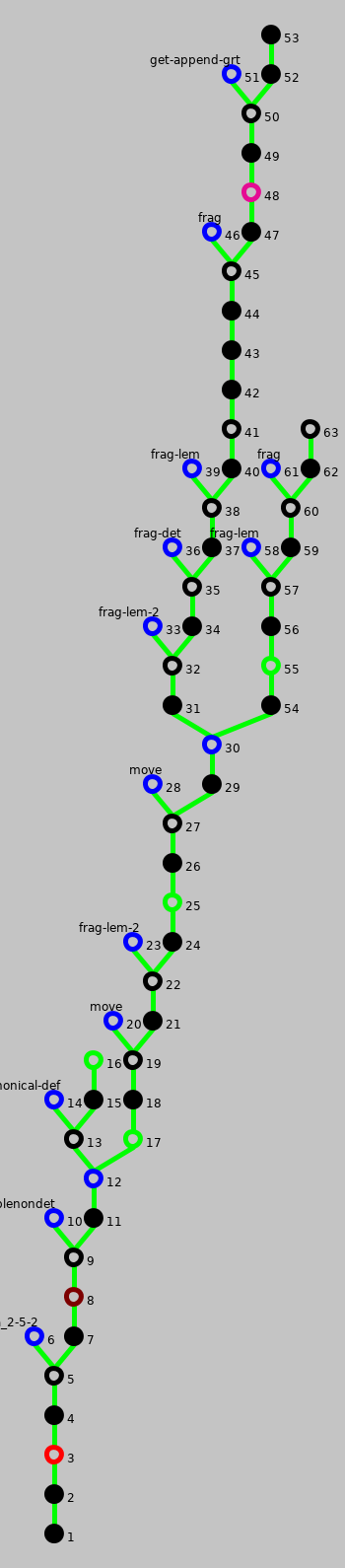
Proof Tree for behcan-limitclosed (View conclusion)
The following image shows the proof tree of sequent calculus. The proved goal is at the bottom. You can click on the nodes to view additional rules. See here for details on colors in a proof tree.
| ⊦ traceprop(tP) → limit-closed(albeh(can(tP))) |
traceprop(tP), ¬ limit-closed(albeh(can(tP))) ⊦
| traceprop(tP), ¬ limit-closed(albeh(can(tP))) ⊦ |
traceprop(tP), ¬ limit-closed(albeh(can(tP))) ⊦
| traceprop(tP), ¬ limit-closed(albeh(can(tP))) ⊦ |
ALIOAut(alstartf, alstepf) = can(tP), traceprop(tP), ¬ limit-closed(albeh(can(tP))) ⊦
Used simplifier rules: ALIOAutomaton freely generated by ALIOAut;;
| ALIOAut(alstartf, alstepf) = can(tP), traceprop(tP), ¬ limit-closed(albeh(can(tP))) ⊦ |
ALIOAut(alstartf, alstepf) = can(tP), traceprop(tP), ¬ limit-closed(albeh(ALIOAut(alstartf, alstepf))) ⊦
| ALIOAut(alstartf, alstepf) = can(tP), traceprop(tP), ¬ limit-closed(albeh(ALIOAut(alstartf, alstepf))) ⊦ |
⊦ fin(ALIOAut(startf, stepf)) → limit-closed(albeh(ALIOAut(startf, stepf)))
ALIOAut(alstartf, alstepf) = can(tP), traceprop(tP), ¬ limit-closed(albeh(ALIOAut(alstartf, alstepf))), fin(ALIOAut(alstartf, alstepf)) → limit-closed(albeh(ALIOAut(alstartf, alstepf))) ⊦
Used terms: alstartf, alstepf
| ⊦ fin(ALIOAut(startf, stepf)) → limit-closed(albeh(ALIOAut(startf, stepf))) |
| ALIOAut(alstartf, alstepf) = can(tP), traceprop(tP), ¬ limit-closed(albeh(ALIOAut(alstartf, alstepf))), fin(ALIOAut(alstartf, alstepf)) → limit-closed(albeh(ALIOAut(alstartf, alstepf))) ⊦ |
ALIOAut(alstartf, alstepf) = can(tP), traceprop(tP), ¬ fin(ALIOAut(alstartf, alstepf)), ¬ limit-closed(albeh(ALIOAut(alstartf, alstepf))) ⊦
| ALIOAut(alstartf, alstepf) = can(tP), traceprop(tP), ¬ fin(ALIOAut(alstartf, alstepf)), ¬ limit-closed(albeh(ALIOAut(alstartf, alstepf))) ⊦ |
ALIOAut(alstartf, alstepf) = can(tP), traceprop(tP), ¬ fin(ALIOAut(alstartf, alstepf)) ⊦
| ALIOAut(alstartf, alstepf) = can(tP), traceprop(tP), ¬ fin(ALIOAut(alstartf, alstepf)) ⊦ |
⊦ fin(ALIOAut(startf, stepf)) ↔ (∃ sl. ∀ s. startf(s) ↔ s ∈ sl) ∧ (∀ s1, β. ∃ sl. ∀ s2. almove(ALIOAut(startf, stepf))(s1, β, s2) ↔ s2 ∈ sl)
ALIOAut(alstartf, alstepf) = can(tP), traceprop(tP), (∀ alli. ¬(∀ al. alstartf(al) ↔ al ∈ alli)) ∨ (∃ al, β. ¬(∃ alli. ∀ al0. almove(ALIOAut(alstartf, alstepf))(al, β, al0) ↔ al0 ∈ alli)) ⊦
Used terms: alstepf, alstartf
| ⊦ fin(ALIOAut(startf, stepf)) ↔ (∃ sl. ∀ s. startf(s) ↔ s ∈ sl) ∧ (∀ s1, β. ∃ sl. ∀ s2. almove(ALIOAut(startf, stepf))(s1, β, s2) ↔ s2 ∈ sl) |
| ALIOAut(alstartf, alstepf) = can(tP), traceprop(tP), (∀ alli. ¬(∀ al. alstartf(al) ↔ al ∈ alli)) ∨ (∃ al, β. ¬(∃ alli. ∀ al0. almove(ALIOAut(alstartf, alstepf))(al, β, al0) ↔ al0 ∈ alli)) ⊦ |
ALIOAut(alstartf, alstepf) = can(tP), traceprop(tP), (∀ alli. ¬(∀ al. alstartf(al) ↔ al ∈ alli)) ∨ ¬(∃ alli. ∀ al0. almove(ALIOAut(alstartf, alstepf))(al, α, al0) ↔ al0 ∈ alli) ⊦
| ALIOAut(alstartf, alstepf) = can(tP), traceprop(tP), (∀ alli. ¬(∀ al. alstartf(al) ↔ al ∈ alli)) ∨ ¬(∃ alli. ∀ al0. almove(ALIOAut(alstartf, alstepf))(al, α, al0) ↔ al0 ∈ alli) ⊦ |
ALIOAut(alstartf, alstepf) = can(tP), traceprop(tP), ∀ alli. ¬(∀ al. alstartf(al) ↔ al ∈ alli) ⊦
ALIOAut(alstartf, alstepf) = can(tP), traceprop(tP) ⊦ ∃ alli. ∀ al0. almove(ALIOAut(alstartf, alstepf))(al, α, al0) ↔ al0 ∈ alli
| ALIOAut(alstartf, alstepf) = can(tP), traceprop(tP), ∀ alli. ¬(∀ al. alstartf(al) ↔ al ∈ alli) ⊦ |
⊦ can(tP) = ALIOAut(λ al. al = [], λ al, a, al1. al1 = al + a ' ∧ a ≠ τ ∧ tP(⌜al⌝ ) ∧ tP(⌜al1⌝ ))
ALIOAut(alstartf, alstepf) = ALIOAut(λ al. al = [], λ al, a, al1. al1 = al + a ' ∧ a ≠ τ ∧ tP(⌜al⌝ ) ∧ tP(⌜al1⌝ )), traceprop(tP), ∀ alli. ¬(∀ al. alstartf(al) ↔ al ∈ alli) ⊦
Used terms: tP
| ⊦ can(tP) = ALIOAut(λ al. al = [], λ al, a, al1. al1 = al + a ' ∧ a ≠ τ ∧ tP(⌜al⌝ ) ∧ tP(⌜al1⌝ )) |
| ALIOAut(alstartf, alstepf) = ALIOAut(λ al. al = [], λ al, a, al1. al1 = al + a ' ∧ a ≠ τ ∧ tP(⌜al⌝ ) ∧ tP(⌜al1⌝ )), traceprop(tP), ∀ alli. ¬(∀ al. alstartf(al) ↔ al ∈ alli) ⊦ |
traceprop(tP), ∀ alli. ¬(∀ al. al = [] ↔ al ∈ alli) ⊦
Used simplifier rules: ⊦ ALIOAut(startf, stepf) = ALIOAut(startf0, stepf0) ↔ startf = startf0 ∧ stepf = stepf0; (ws) a: ⊦ (x + y) + z = x + y + z; from specification list[actionstream] ⊦ ⌜x + y⌝ = ⌜x⌝ + ⌜y⌝ ; (s)
| traceprop(tP), ∀ alli. ¬(∀ al. al = [] ↔ al ∈ alli) ⊦ |
Used simplifier rules: ⊦ a ∈ b ' ↔ a = b; (s) Used terms: [] '
| ALIOAut(alstartf, alstepf) = can(tP), traceprop(tP) ⊦ ∃ alli. ∀ al0. almove(ALIOAut(alstartf, alstepf))(al, α, al0) ↔ al0 ∈ alli |
ALIOAut(alstartf, alstepf) = can(tP), traceprop(tP) ⊦ ∀ al0. almove(ALIOAut(alstartf, alstepf))(al, α, al0) ↔ al0 ∈ [], ∃ alli. ∀ al0. almove(ALIOAut(alstartf, alstepf))(al, α, al0) ↔ al0 ∈ alli
Used terms: []
| ALIOAut(alstartf, alstepf) = can(tP), traceprop(tP) ⊦ ∀ al0. almove(ALIOAut(alstartf, alstepf))(al, α, al0) ↔ al0 ∈ [], ∃ alli. ∀ al0. almove(ALIOAut(alstartf, alstepf))(al, α, al0) ↔ al0 ∈ alli |
ALIOAut(alstartf, alstepf) = can(tP), almove(ALIOAut(alstartf, alstepf))(al, α, al0), traceprop(tP) ⊦ ∃ alli. ∀ al0. almove(ALIOAut(alstartf, alstepf))(al, α, al0) ↔ al0 ∈ alli
Used simplifier rules: ⊦ ¬ a ∈ []; (s)
| ALIOAut(alstartf, alstepf) = can(tP), almove(ALIOAut(alstartf, alstepf))(al, α, al0), traceprop(tP) ⊦ ∃ alli. ∀ al0. almove(ALIOAut(alstartf, alstepf))(al, α, al0) ↔ al0 ∈ alli |
⊦ almove(ALIOAut(startf, stepf))(s1, β, s2) ↔ (∃ α, sl. alfrag*(ALIOAut(startf, stepf))(⌜sl⌝ , α) ∧ s1 = sl[0] ∧ s2 = sl.last ∧ α ^ = β)
ALIOAut(alstartf, alstepf) = can(tP), traceprop(tP), ∃ α0, alli. alfrag*(ALIOAut(alstartf, alstepf))(⌜alli⌝ , α0) ∧ al = alli[0] ∧ al0 = alli.last ∧ α0 ^ = α ⊦ ∃ alli. ∀ al0. almove(ALIOAut(alstartf, alstepf))(al, α, al0) ↔ al0 ∈ alli
Used terms: al0, α, al, alstepf, alstartf
| ⊦ almove(ALIOAut(startf, stepf))(s1, β, s2) ↔ (∃ α, sl. alfrag*(ALIOAut(startf, stepf))(⌜sl⌝ , α) ∧ s1 = sl[0] ∧ s2 = sl.last ∧ α ^ = β) |
| ALIOAut(alstartf, alstepf) = can(tP), traceprop(tP), ∃ α0, alli. alfrag*(ALIOAut(alstartf, alstepf))(⌜alli⌝ , α0) ∧ al = alli[0] ∧ al0 = alli.last ∧ α0 ^ = α ⊦ ∃ alli. ∀ al0. almove(ALIOAut(alstartf, alstepf))(al, α, al0) ↔ al0 ∈ alli |
ALIOAut(alstartf, alstepf) = can(tP), alfrag(ALIOAut(alstartf, alstepf))(⌜alli⌝ , ⌜al⌝ ), traceprop(tP) ⊦ ∃ alli0. ∀ al0. almove(ALIOAut(alstartf, alstepf))(alli[0], ⌜al⌝ ^, al0) ↔ al0 ∈ alli0
Used simplifier rules: ⊦ finp(⌜x⌝ ); (s) stream-fin-forward: ⊦ finp(σ) → (∃ x. ⌜x⌝ = σ); (forward) from specification stream-basic[actionstream] ⊦ alfrag*(ALIOAut(startf, stepf))(σ, β) ↔ alfrag(ALIOAut(startf, stepf))(σ, β) ∧ finp(β); (s)
| ALIOAut(alstartf, alstepf) = can(tP), alfrag(ALIOAut(alstartf, alstepf))(⌜alli⌝ , ⌜al⌝ ), traceprop(tP) ⊦ ∃ alli0. ∀ al0. almove(ALIOAut(alstartf, alstepf))(alli[0], ⌜al⌝ ^, al0) ↔ al0 ∈ alli0 |
alfrag(can(tP))(⌜alli⌝ , ⌜al⌝ ) ⊦ ⌜al⌝ ^ = ⌜al⌝
ALIOAut(alstartf, alstepf) = can(tP), ⌜al⌝ ^ = ⌜al⌝ , alfrag(ALIOAut(alstartf, alstepf))(⌜alli⌝ , ⌜al⌝ ), traceprop(tP) ⊦ ∃ alli0. ∀ al0. almove(ALIOAut(alstartf, alstepf))(alli[0], ⌜al⌝ ^, al0) ↔ al0 ∈ alli0
Used terms: tP, alli, al
| alfrag(can(tP))(⌜alli⌝ , ⌜al⌝ ) ⊦ ⌜al⌝ ^ = ⌜al⌝ |
| ALIOAut(alstartf, alstepf) = can(tP), ⌜al⌝ ^ = ⌜al⌝ , alfrag(ALIOAut(alstartf, alstepf))(⌜alli⌝ , ⌜al⌝ ), traceprop(tP) ⊦ ∃ alli0. ∀ al0. almove(ALIOAut(alstartf, alstepf))(alli[0], ⌜al⌝ ^, al0) ↔ al0 ∈ alli0 |
ALIOAut(alstartf, alstepf) = can(tP), ⌜al⌝ ^ = ⌜al⌝ , alfrag(ALIOAut(alstartf, alstepf))(⌜alli⌝ , ⌜al⌝ ), traceprop(tP) ⊦ ∃ alli0. ∀ al0. almove(ALIOAut(alstartf, alstepf))(alli[0], ⌜al⌝ , al0) ↔ al0 ∈ alli0
| ALIOAut(alstartf, alstepf) = can(tP), ⌜al⌝ ^ = ⌜al⌝ , alfrag(ALIOAut(alstartf, alstepf))(⌜alli⌝ , ⌜al⌝ ), traceprop(tP) ⊦ ∃ alli0. ∀ al0. almove(ALIOAut(alstartf, alstepf))(alli[0], ⌜al⌝ , al0) ↔ al0 ∈ alli0 |
ALIOAut(alstartf, alstepf) = can(tP), ⌜al⌝ ^ = ⌜al⌝ , alfrag(ALIOAut(alstartf, alstepf))(⌜alli⌝ , ⌜al⌝ ), traceprop(tP) ⊦ ∀ al0. almove(ALIOAut(alstartf, alstepf))(alli[0], ⌜al⌝ , al0) ↔ al0 ∈ (alli[0] + al)'
Used terms: (alli[0] + al)'
| ALIOAut(alstartf, alstepf) = can(tP), ⌜al⌝ ^ = ⌜al⌝ , alfrag(ALIOAut(alstartf, alstepf))(⌜alli⌝ , ⌜al⌝ ), traceprop(tP) ⊦ ∀ al0. almove(ALIOAut(alstartf, alstepf))(alli[0], ⌜al⌝ , al0) ↔ al0 ∈ (alli[0] + al)' |
ALIOAut(alstartf, alstepf) = can(tP), ⌜al⌝ ^ = ⌜al⌝ , ¬(almove(ALIOAut(alstartf, alstepf))(alli[0], ⌜al⌝ , al0) ↔ al0 = alli[0] + al), alfrag(ALIOAut(alstartf, alstepf))(⌜alli⌝ , ⌜al⌝ ), traceprop(tP) ⊦
Used simplifier rules: ⊦ a ∈ b ' ↔ a = b; (s)
| ALIOAut(alstartf, alstepf) = can(tP), ⌜al⌝ ^ = ⌜al⌝ , ¬(almove(ALIOAut(alstartf, alstepf))(alli[0], ⌜al⌝ , al0) ↔ al0 = alli[0] + al), alfrag(ALIOAut(alstartf, alstepf))(⌜alli⌝ , ⌜al⌝ ), traceprop(tP) ⊦ |
⊦ almove(ALIOAut(startf, stepf))(s1, β, s2) ↔ (∃ α, sl. alfrag*(ALIOAut(startf, stepf))(⌜sl⌝ , α) ∧ s1 = sl[0] ∧ s2 = sl.last ∧ α ^ = β)
ALIOAut(alstartf, alstepf) = can(tP), ⌜al⌝ ^ = ⌜al⌝ , alfrag(ALIOAut(alstartf, alstepf))(⌜alli⌝ , ⌜al⌝ ), traceprop(tP) ⊦ (∃ α, alli0. alfrag*(ALIOAut(alstartf, alstepf))(⌜alli0⌝ , α) ∧ alli[0] = alli0[0] ∧ al0 = alli0.last ∧ α ^ = ⌜al⌝ ) ↔ al0 = alli[0] + al
Used terms: al0, ⌜al⌝ , alli[0], alstepf, alstartf
| ⊦ almove(ALIOAut(startf, stepf))(s1, β, s2) ↔ (∃ α, sl. alfrag*(ALIOAut(startf, stepf))(⌜sl⌝ , α) ∧ s1 = sl[0] ∧ s2 = sl.last ∧ α ^ = β) |
| ALIOAut(alstartf, alstepf) = can(tP), ⌜al⌝ ^ = ⌜al⌝ , alfrag(ALIOAut(alstartf, alstepf))(⌜alli⌝ , ⌜al⌝ ), traceprop(tP) ⊦ (∃ α, alli0. alfrag*(ALIOAut(alstartf, alstepf))(⌜alli0⌝ , α) ∧ alli[0] = alli0[0] ∧ al0 = alli0.last ∧ α ^ = ⌜al⌝ ) ↔ al0 = alli[0] + al |
ALIOAut(alstartf, alstepf) = can(tP), ⌜al⌝ ^ = ⌜al⌝ , alfrag(ALIOAut(alstartf, alstepf))(⌜alli⌝ , ⌜al⌝ ), traceprop(tP) ⊦ (∃ α, alli0. alfrag(ALIOAut(alstartf, alstepf))(⌜alli0⌝ , α) ∧ finp(α) ∧ alli[0] = alli0[0] ∧ al0 = alli0.last ∧ α ^ = ⌜al⌝ ) ↔ al0 = alli[0] + al
Used simplifier rules: ⊦ alfrag*(ALIOAut(startf, stepf))(σ, β) ↔ alfrag(ALIOAut(startf, stepf))(σ, β) ∧ finp(β); (s)
| ALIOAut(alstartf, alstepf) = can(tP), ⌜al⌝ ^ = ⌜al⌝ , alfrag(ALIOAut(alstartf, alstepf))(⌜alli⌝ , ⌜al⌝ ), traceprop(tP) ⊦ (∃ α, alli0. alfrag(ALIOAut(alstartf, alstepf))(⌜alli0⌝ , α) ∧ finp(α) ∧ alli[0] = alli0[0] ∧ al0 = alli0.last ∧ α ^ = ⌜al⌝ ) ↔ al0 = alli[0] + al |
ALIOAut(alstartf, alstepf) = can(tP), ⌜al⌝ ^ = ⌜al⌝ , al0 ≠ alli[0] + al, alfrag(ALIOAut(alstartf, alstepf))(⌜alli⌝ , ⌜al⌝ ), traceprop(tP), ∃ α, alli0. alfrag(ALIOAut(alstartf, alstepf))(⌜alli0⌝ , α) ∧ finp(α) ∧ alli[0] = alli0[0] ∧ al0 = alli0.last ∧ α ^ = ⌜al⌝ ⊦
ALIOAut(alstartf, alstepf) = can(tP), ⌜al⌝ ^ = ⌜al⌝ , al0 = alli[0] + al, alfrag(ALIOAut(alstartf, alstepf))(⌜alli⌝ , ⌜al⌝ ), traceprop(tP) ⊦ ∃ α, alli0. alfrag(ALIOAut(alstartf, alstepf))(⌜alli0⌝ , α) ∧ finp(α) ∧ alli[0] = alli0[0] ∧ al0 = alli0.last ∧ α ^ = ⌜al⌝
| ALIOAut(alstartf, alstepf) = can(tP), ⌜al⌝ ^ = ⌜al⌝ , al0 ≠ alli[0] + al, alfrag(ALIOAut(alstartf, alstepf))(⌜alli⌝ , ⌜al⌝ ), traceprop(tP), ∃ α, alli0. alfrag(ALIOAut(alstartf, alstepf))(⌜alli0⌝ , α) ∧ finp(α) ∧ alli[0] = alli0[0] ∧ al0 = alli0.last ∧ α ^ = ⌜al⌝ ⊦ |
ALIOAut(alstartf, alstepf) = can(tP), alli[0] = alli0[0], ⌜al0⌝ ^ = ⌜al⌝ , ⌜al⌝ ^ = ⌜al⌝ , alli0.last ≠ alli0[0] + al, alfrag(ALIOAut(alstartf, alstepf))(⌜alli0⌝ , ⌜al0⌝ ), alfrag(ALIOAut(alstartf, alstepf))(⌜alli⌝ , ⌜al⌝ ), traceprop(tP) ⊦
Used simplifier rules: ⊦ finp(⌜x⌝ ); (s) stream-fin-forward: ⊦ finp(σ) → (∃ x. ⌜x⌝ = σ); (forward) from specification stream-basic[actionstream]
| ALIOAut(alstartf, alstepf) = can(tP), alli[0] = alli0[0], ⌜al0⌝ ^ = ⌜al⌝ , ⌜al⌝ ^ = ⌜al⌝ , alli0.last ≠ alli0[0] + al, alfrag(ALIOAut(alstartf, alstepf))(⌜alli0⌝ , ⌜al0⌝ ), alfrag(ALIOAut(alstartf, alstepf))(⌜alli⌝ , ⌜al⌝ ), traceprop(tP) ⊦ |
alfrag(can(tP))(⌜alli⌝ , ⌜al⌝ ) ⊦ ⌜al⌝ ^ = ⌜al⌝
ALIOAut(alstartf, alstepf) = can(tP), alli[0] = alli0[0], ⌜al⌝ ^ = ⌜al⌝ , ⌜al0⌝ ^ = ⌜al⌝ , ⌜al0⌝ ^ = ⌜al0⌝ , alli0.last ≠ alli0[0] + al, alfrag(ALIOAut(alstartf, alstepf))(⌜alli⌝ , ⌜al⌝ ), alfrag(ALIOAut(alstartf, alstepf))(⌜alli0⌝ , ⌜al0⌝ ), traceprop(tP) ⊦
Used terms: tP, alli0, al0
| alfrag(can(tP))(⌜alli⌝ , ⌜al⌝ ) ⊦ ⌜al⌝ ^ = ⌜al⌝ |
| ALIOAut(alstartf, alstepf) = can(tP), alli[0] = alli0[0], ⌜al⌝ ^ = ⌜al⌝ , ⌜al0⌝ ^ = ⌜al⌝ , ⌜al0⌝ ^ = ⌜al0⌝ , alli0.last ≠ alli0[0] + al, alfrag(ALIOAut(alstartf, alstepf))(⌜alli⌝ , ⌜al⌝ ), alfrag(ALIOAut(alstartf, alstepf))(⌜alli0⌝ , ⌜al0⌝ ), traceprop(tP) ⊦ |
ALIOAut(alstartf, alstepf) = can(tP), alli[0] = alli0[0], ⌜al0⌝ ^ = ⌜al0⌝ , alli0.last ≠ alli0[0] + al0, alfrag(ALIOAut(alstartf, alstepf))(⌜alli0⌝ , ⌜al0⌝ ), alfrag(ALIOAut(alstartf, alstepf))(⌜alli⌝ , ⌜al0⌝ ), traceprop(tP) ⊦
Used simplifier rules: ⊦ ⌜x⌝ = ⌜x0⌝ ↔ x = x0; (s)
| ALIOAut(alstartf, alstepf) = can(tP), alli[0] = alli0[0], ⌜al0⌝ ^ = ⌜al0⌝ , alli0.last ≠ alli0[0] + al0, alfrag(ALIOAut(alstartf, alstepf))(⌜alli0⌝ , ⌜al0⌝ ), alfrag(ALIOAut(alstartf, alstepf))(⌜alli⌝ , ⌜al0⌝ ), traceprop(tP) ⊦ |
alfrag(can(tP))(⌜alli⌝ , ⌜al⌝ ), alfrag(can(tP))(⌜alli0⌝ , ⌜al⌝ ), alli[0] = alli0[0] ⊦ alli = alli0
ALIOAut(alstartf, alstepf) = can(tP), alli[0] = alli0[0], ⌜al0⌝ ^ = ⌜al0⌝ , alli = alli0, alli0.last ≠ alli0[0] + al0, alfrag(ALIOAut(alstartf, alstepf))(⌜alli⌝ , ⌜al0⌝ ), alfrag(ALIOAut(alstartf, alstepf))(⌜alli0⌝ , ⌜al0⌝ ), traceprop(tP) ⊦
Used terms: tP, alli, al0, alli0
| alfrag(can(tP))(⌜alli⌝ , ⌜al⌝ ), alfrag(can(tP))(⌜alli0⌝ , ⌜al⌝ ), alli[0] = alli0[0] ⊦ alli = alli0 |
| ALIOAut(alstartf, alstepf) = can(tP), alli[0] = alli0[0], ⌜al0⌝ ^ = ⌜al0⌝ , alli = alli0, alli0.last ≠ alli0[0] + al0, alfrag(ALIOAut(alstartf, alstepf))(⌜alli⌝ , ⌜al0⌝ ), alfrag(ALIOAut(alstartf, alstepf))(⌜alli0⌝ , ⌜al0⌝ ), traceprop(tP) ⊦ |
ALIOAut(alstartf, alstepf) = can(tP), ⌜al0⌝ ^ = ⌜al0⌝ , alli0.last ≠ alli0[0] + al0, alfrag(ALIOAut(alstartf, alstepf))(⌜alli0⌝ , ⌜al0⌝ ), traceprop(tP) ⊦
| ALIOAut(alstartf, alstepf) = can(tP), ⌜al0⌝ ^ = ⌜al0⌝ , alli0.last ≠ alli0[0] + al0, alfrag(ALIOAut(alstartf, alstepf))(⌜alli0⌝ , ⌜al0⌝ ), traceprop(tP) ⊦ |
alfrag(can(tP))(⌜alli⌝ , ⌜al⌝ ), n < # alli ⊦ alli[n] = alli[0] + (al to n)
ALIOAut(alstartf, alstepf) = can(tP), alli0[# al0] = alli0[0] + (al0 to # al0), ⌜al0⌝ ^ = ⌜al0⌝ , alli0.last ≠ alli0[0] + al0, alfrag(ALIOAut(alstartf, alstepf))(⌜alli0⌝ , ⌜al0⌝ ), traceprop(tP) ⊦
Used simplifier rules: ⊦ alfrag(ALIOAut(startf, stepf))(⌜sl⌝ , ⌜al⌝ ) → (# al < # sl ↔ true); (ss) Used terms: tP, alli0, al0, # al0
| alfrag(can(tP))(⌜alli⌝ , ⌜al⌝ ), n < # alli ⊦ alli[n] = alli[0] + (al to n) |
| ALIOAut(alstartf, alstepf) = can(tP), alli0[# al0] = alli0[0] + (al0 to # al0), ⌜al0⌝ ^ = ⌜al0⌝ , alli0.last ≠ alli0[0] + al0, alfrag(ALIOAut(alstartf, alstepf))(⌜alli0⌝ , ⌜al0⌝ ), traceprop(tP) ⊦ |
ALIOAut(alstartf, alstepf) = can(tP), alli0[# al0] = alli0[0] + al0, ⌜al0⌝ ^ = ⌜al0⌝ , alli0.last ≠ alli0[0] + al0, alfrag(ALIOAut(alstartf, alstepf))(⌜alli0⌝ , ⌜al0⌝ ), traceprop(tP) ⊦
Used simplifier rules: ⊦ x to # x = x; (s)
| ALIOAut(alstartf, alstepf) = can(tP), alli0[# al0] = alli0[0] + al0, ⌜al0⌝ ^ = ⌜al0⌝ , alli0.last ≠ alli0[0] + al0, alfrag(ALIOAut(alstartf, alstepf))(⌜alli0⌝ , ⌜al0⌝ ), traceprop(tP) ⊦ |
ALIOAut(alstartf, alstepf) = can(tP), alli0[# al0] = alli0[0] + al0, ⌜al0⌝ ^ = ⌜al0⌝ , alli0 = alli + al ', al ≠ alli0[0] + al0, alli0 ≠ [], alfrag(ALIOAut(alstartf, alstepf))(⌜alli0⌝ , ⌜al0⌝ ), traceprop(tP) ⊦
Used simplifier rules: ⊦ ⌜[]⌝ = []; (s) ⊦ ¬ alfrag(ALIOAut(startf, stepf))([], α); (s) x ≠ [] ⊦ a = x.last ∧ y = x.butlast ↔ x = y + a '; (elim) Used terms: alli0, al, y
| ALIOAut(alstartf, alstepf) = can(tP), alli0[# al0] = alli0[0] + al0, ⌜al0⌝ ^ = ⌜al0⌝ , alli0 = alli + al ', al ≠ alli0[0] + al0, alli0 ≠ [], alfrag(ALIOAut(alstartf, alstepf))(⌜alli0⌝ , ⌜al0⌝ ), traceprop(tP) ⊦ |
ALIOAut(alstartf, alstepf) = can(tP), (alli + al ')[# al0] = hd(alli + al ') + al0, ⌜al0⌝ ^ = ⌜al0⌝ , al ≠ (alli + al ')[# al0], alfrag(ALIOAut(alstartf, alstepf))(⌜alli⌝ + ⌜al '⌝ , ⌜al0⌝ ), traceprop(tP) ⊦
Used simplifier rules: a: ⊦ (x + y) + z = x + y + z; from specification list[can-inst-IOstatestream] ⊦ ⌜x + y⌝ = ⌜x⌝ + ⌜y⌝ ; (s) ⊦ x + a ' ≠ []; (s) ⊦ x ≠ [] → x[0] = hd(x); (s)
| ALIOAut(alstartf, alstepf) = can(tP), (alli + al ')[# al0] = hd(alli + al ') + al0, ⌜al0⌝ ^ = ⌜al0⌝ , al ≠ (alli + al ')[# al0], alfrag(ALIOAut(alstartf, alstepf))(⌜alli⌝ + ⌜al '⌝ , ⌜al0⌝ ), traceprop(tP) ⊦ |
alli + al ' = al1 + alli0, ALIOAut(alstartf, alstepf) = can(tP), (alli + al ')[# al0] = al1 + al0, ⌜al0⌝ ^ = ⌜al0⌝ , alli + al ' ≠ [], al ≠ (alli + al ')[# al0], alfrag(ALIOAut(alstartf, alstepf))(⌜alli⌝ + ⌜al '⌝ , ⌜al0⌝ ), traceprop(tP) ⊦
Used simplifier rules: ⊦ x + y = [] ↔ x = [] ∧ y = []; (as) ⊦ a ' ≠ []; (s) a: ⊦ (x + y) + z = x + y + z; from specification list[can-inst-IOstatestream] x ≠ [] ⊦ a = hd(x) ∧ y = tl(x) ↔ x = a + y; (elim) Used terms: alli + al ', al1, y
| alli + al ' = al1 + alli0, ALIOAut(alstartf, alstepf) = can(tP), (alli + al ')[# al0] = al1 + al0, ⌜al0⌝ ^ = ⌜al0⌝ , alli + al ' ≠ [], al ≠ (alli + al ')[# al0], alfrag(ALIOAut(alstartf, alstepf))(⌜alli⌝ + ⌜al '⌝ , ⌜al0⌝ ), traceprop(tP) ⊦ |
alli + al ' = al1 ' + alli0, ALIOAut(alstartf, alstepf) = can(tP), (al1 ' + alli0)[# al0] = al1 + al0, ⌜al0⌝ ^ = ⌜al0⌝ , al ≠ al1 + al0, alfrag(ALIOAut(alstartf, alstepf))(⌜alli⌝ + ⌜al '⌝ , ⌜al0⌝ ), traceprop(tP), al = al1 ∨ al ∈ alli0, al1 ∈ alli ∨ al1 = al ⊦
Used simplifier rules: a: ⊦ (x + y) + z = x + y + z; from specification list[can-inst-IOstatestream] ⊦ a ∈ b ' ↔ a = b; (s) ⊦ a ∈ x + y ↔ a ∈ x ∨ a ∈ y; (s) ⊦ a ∈ b ' + x ↔ a = b ∨ a ∈ x; (s) in-14: ⊦ a ' + x = y → a ∈ y; (forward) from specification list[can-inst-IOstatestream] in-15: ⊦ x + a ' = y → a ∈ y; (forward) from specification list[can-inst-IOstatestream] ⊦ x + a ' ≠ []; (s) ⊦ a + x = a ' + x; (s)
| alli + al ' = al1 ' + alli0, ALIOAut(alstartf, alstepf) = can(tP), (al1 ' + alli0)[# al0] = al1 + al0, ⌜al0⌝ ^ = ⌜al0⌝ , al ≠ al1 + al0, alfrag(ALIOAut(alstartf, alstepf))(⌜alli⌝ + ⌜al '⌝ , ⌜al0⌝ ), traceprop(tP), al = al1 ∨ al ∈ alli0, al1 ∈ alli ∨ al1 = al ⊦ |
⊦ alfrag(ALIOAut(startf, stepf))(σ, β) ↔ # σ = # β + ⌜1⌝ ∧ (∀ n. ⌜n⌝ < # β → stepf(σ[n], β[n], σ[n +1]))
#(⌜alli⌝ + ⌜al '⌝ ) = # ⌜al0⌝ + ⌜1⌝ , alli + al ' = al1 ' + alli0, ALIOAut(alstartf, alstepf) = can(tP), (al1 ' + alli0)[# al0] = al1 + al0, ⌜al0⌝ ^ = ⌜al0⌝ , al ≠ al1 + al0, traceprop(tP), ∀ n. ⌜n⌝ < # ⌜al0⌝ → alstepf((⌜alli⌝ + ⌜al '⌝ )[n], ⌜al0⌝ [n], (⌜alli⌝ + ⌜al '⌝ )[n +1]), al1 ∈ alli ∨ al1 = al, al = al1 ∨ al ∈ alli0 ⊦
Used terms: ⌜al0⌝ , ⌜alli⌝ + ⌜al '⌝ , alstepf, alstartf
| ⊦ alfrag(ALIOAut(startf, stepf))(σ, β) ↔ # σ = # β + ⌜1⌝ ∧ (∀ n. ⌜n⌝ < # β → stepf(σ[n], β[n], σ[n +1])) |
| #(⌜alli⌝ + ⌜al '⌝ ) = # ⌜al0⌝ + ⌜1⌝ , alli + al ' = al1 ' + alli0, ALIOAut(alstartf, alstepf) = can(tP), (al1 ' + alli0)[# al0] = al1 + al0, ⌜al0⌝ ^ = ⌜al0⌝ , al ≠ al1 + al0, traceprop(tP), ∀ n. ⌜n⌝ < # ⌜al0⌝ → alstepf((⌜alli⌝ + ⌜al '⌝ )[n], ⌜al0⌝ [n], (⌜alli⌝ + ⌜al '⌝ )[n +1]), al1 ∈ alli ∨ al1 = al, al = al1 ∨ al ∈ alli0 ⊦ |
# alli = # al0, alli + al ' = al1 ' + alli0, ALIOAut(alstartf, alstepf) = can(tP), (al1 ' + alli0)[# al0] = al1 + al0, ⌜al0⌝ ^ = ⌜al0⌝ , al ≠ al1 + al0, traceprop(tP), ∀ n. n < # al0 → alstepf((al1 ' + alli0)[n], al0[n], alli0[n]), al = al1 ∨ al ∈ alli0, al1 ∈ alli ∨ al1 = al ⊦
Used simplifier rules: append-assoc: ⊦ (σ + σ1) + σ2 = σ + σ1 + σ2; from specification stream[can-inst-IOstatestream] c: ⊦ m + n = n + m; from specification nat-basic a: ⊦ (m + n0) + n1 = m + n0 + n1; from specification nat-basic ⊦ x = a ' + x0 → x[m + 1] = x0[m]; (s) a: ⊦ (x + y) + z = x + y + z; from specification list[can-inst-IOstatestream] ⊦ (⌜x⌝ + ⌜x0⌝ )[m] = (x + x0)[m]; (s) ⊦ m +1 = m + 1; (s) ⊦ ⌜x⌝ [n] = x[n]; (s) ⊦ ⌜m⌝ < ⌜n⌝ ↔ m < n; (s) ⊦ # ⌜x⌝ = ⌜# x⌝ ; (s) add-comm: ⊦ n∞1 + n∞2 = n∞2 + n∞1; from specification nat-inf add-assoc: ⊦ (n∞ + n∞1) + n∞2 = n∞ + n∞1 + n∞2; from specification nat-inf ⊦ ⌜n⌝ = ⌜n0⌝ ↔ n = n0; (s) ⊦ n∞ + ⌜0⌝ = n∞; (s) ⊦ m ≤ n → (⌜(* n)⌝ + n∞1 = ⌜(* m)⌝ + n∞2 ↔ ⌜n - m⌝ + n∞1 = n∞2); (s) ⊦ # a ' = 0 +1; (s) ⊦ # ⌜x⌝ = ⌜# x⌝ ; (s) ⊦ #(σ + σ1) = # σ + # σ1; (s)
| # alli = # al0, alli + al ' = al1 ' + alli0, ALIOAut(alstartf, alstepf) = can(tP), (al1 ' + alli0)[# al0] = al1 + al0, ⌜al0⌝ ^ = ⌜al0⌝ , al ≠ al1 + al0, traceprop(tP), ∀ n. n < # al0 → alstepf((al1 ' + alli0)[n], al0[n], alli0[n]), al = al1 ∨ al ∈ alli0, al1 ∈ alli ∨ al1 = al ⊦ |
# alli = # al0, alli + al ' = al1 ' + alli0, ALIOAut(alstartf, alstepf) = can(tP), (al1 ' + alli0)[# al0] = al1 + al0, ⌜al0⌝ ^ = ⌜al0⌝ , alli = al2 + alli1, al ≠ al1 + al0, traceprop(tP), ∀ n. n < # al0 → alstepf((al1 ' + alli0)[n], al0[n], alli0[n]), al1 ∈ alli ∨ al1 = al, al = al1 ∨ al ∈ alli0 ⊦
Used simplifier rules: actionlistlist freely generated by [], +;; ⊦ [] + x = x; (s) ⊦ a ' = b ' + x ↔ a = b ∧ x = []; (ws) ⊦ # [] = 0; (s) ⊦ # x = 0 ↔ x = []; (s) ⊦ ¬ a ∈ []; (s) ⊦ x + [] = x; (s) a: ⊦ (x + y) + z = x + y + z; from specification list[can-inst-IOstatestream] ⊦ # [] = 0; (s) ⊦ a '[0] = a; (s) ⊦ [] ^ = []; (s) ⊦ ⌜[]⌝ = []; (s) ⊦ x + [] = x; (s) a: ⊦ (x + y) + z = x + y + z; from specification list[actionstream]
| # alli = # al0, alli + al ' = al1 ' + alli0, ALIOAut(alstartf, alstepf) = can(tP), (al1 ' + alli0)[# al0] = al1 + al0, ⌜al0⌝ ^ = ⌜al0⌝ , alli = al2 + alli1, al ≠ al1 + al0, traceprop(tP), ∀ n. n < # al0 → alstepf((al1 ' + alli0)[n], al0[n], alli0[n]), al1 ∈ alli ∨ al1 = al, al = al1 ∨ al ∈ alli0 ⊦ |
# alli1 + 1 = # al0, ALIOAut(alstartf, alstepf) = can(tP), (al1 ' + alli1 + al ')[# al0] = al1 + al0, ⌜al0⌝ ^ = ⌜al0⌝ , al ≠ al1 + al0, traceprop(tP), ∀ n. n < # al0 → alstepf((al1 ' + alli1 + al ')[n], al0[n], (alli1 + al ')[n]) ⊦
Used simplifier rules: a: ⊦ (x + y) + z = x + y + z; from specification list[can-inst-IOstatestream] ⊦ a ∈ b ' ↔ a = b; (s) ⊦ a ∈ x + y ↔ a ∈ x ∨ a ∈ y; (s) in-15: ⊦ x + a ' = y → a ∈ y; (forward) from specification list[can-inst-IOstatestream] ⊦ a ∈ b ' + x ↔ a = b ∨ a ∈ x; (s) ⊦ a + x = a ' + x; (s) ⊦ m +1 = m + 1; (s) ⊦ #(a ' + x) = (# x)+1; (s) ⊦ a ' + x = b ' + y ↔ a = b ∧ x = y; (ws)
| # alli1 + 1 = # al0, ALIOAut(alstartf, alstepf) = can(tP), (al1 ' + alli1 + al ')[# al0] = al1 + al0, ⌜al0⌝ ^ = ⌜al0⌝ , al ≠ al1 + al0, traceprop(tP), ∀ n. n < # al0 → alstepf((al1 ' + alli1 + al ')[n], al0[n], (alli1 + al ')[n]) ⊦ |
⊦ ¬ n < # x → (x + y)[n] = y[n - # x]
# alli1 + 1 = # al0, ALIOAut(alstartf, alstepf) = can(tP), (alli1 + al ')[# al0 - # al1 '] = al1 + al0, ⌜al0⌝ ^ = ⌜al0⌝ , al ≠ al1 + al0, traceprop(tP), ¬ # al0 < # al1 ', ∀ n. n < # al0 → alstepf((al1 ' + alli1 + al ')[n], al0[n], (alli1 + al ')[n]) ⊦
Used simplifier rules: ⊦ n < # x → (x + y)[n] = x[n]; (s) a: ⊦ (x + y) + z = x + y + z; from specification list[can-inst-IOstatestream] ⊦ # a ' = 0 +1; (s) ⊦ m < 1 ↔ m = 0; (s) ⊦ # x = 0 ↔ x = []; (s) ⊦ a '[0] = a; (s) ⊦ x + [] = x; (s) a: ⊦ (x + y) + z = x + y + z; from specification list[actionstream] ⊦ [] ^ = []; (s) ⊦ ⌜[]⌝ = []; (s) ⊦ # [] = 0; (s) ⊦ m + n = 0 ↔ m = 0 ∧ n = 0; (ws) ⊦ # x = 0 ↔ x = []; (s) a: ⊦ (m + n0) + n1 = m + n0 + n1; from specification nat-basic c: ⊦ m + n = n + m; from specification nat-basic Used terms: # al0, alli1 + al ', al1 '
| ⊦ ¬ n < # x → (x + y)[n] = y[n - # x] |
| # alli1 + 1 = # al0, ALIOAut(alstartf, alstepf) = can(tP), (alli1 + al ')[# al0 - # al1 '] = al1 + al0, ⌜al0⌝ ^ = ⌜al0⌝ , al ≠ al1 + al0, traceprop(tP), ¬ # al0 < # al1 ', ∀ n. n < # al0 → alstepf((al1 ' + alli1 + al ')[n], al0[n], (alli1 + al ')[n]) ⊦ |
# alli1 + 1 = # al0, ALIOAut(alstartf, alstepf) = can(tP), (alli1 + al ')[# al0 - 1] = al1 + al0, ⌜al0⌝ ^ = ⌜al0⌝ , al ≠ al1 + al0, al0 ≠ [], traceprop(tP), ∀ n. n < # al0 → alstepf((al1 ' + alli1 + al ')[n], al0[n], (alli1 + al ')[n]) ⊦
Used simplifier rules: ⊦ # x = 0 ↔ x = []; (s) ⊦ m < 1 ↔ m = 0; (s) ⊦ # a ' = 0 +1; (s)
| # alli1 + 1 = # al0, ALIOAut(alstartf, alstepf) = can(tP), (alli1 + al ')[# al0 - 1] = al1 + al0, ⌜al0⌝ ^ = ⌜al0⌝ , al ≠ al1 + al0, al0 ≠ [], traceprop(tP), ∀ n. n < # al0 → alstepf((al1 ' + alli1 + al ')[n], al0[n], (alli1 + al ')[n]) ⊦ |
Used simplifier rules: ⊦ # x = 0 ↔ x = []; (s) ⊦ m + n = m + n0 ↔ n = n0; (s) a: ⊦ (m + n0) + n1 = m + n0 + n1; from specification nat-basic c: ⊦ m + n = n + m; from specification nat-basic ⊦ n = # x → (x + a ')[n] = a; (s) a: ⊦ (x + y) + z = x + y + z; from specification list[can-inst-IOstatestream] n ≠ 0 ⊦ m = n - 1 ↔ n = m + 1; (elim) Used terms: # al0, m
| ALIOAut(alstartf, alstepf) = can(tP), ⌜al⌝ ^ = ⌜al⌝ , al0 = alli[0] + al, alfrag(ALIOAut(alstartf, alstepf))(⌜alli⌝ , ⌜al⌝ ), traceprop(tP) ⊦ ∃ α, alli0. alfrag(ALIOAut(alstartf, alstepf))(⌜alli0⌝ , α) ∧ finp(α) ∧ alli[0] = alli0[0] ∧ al0 = alli0.last ∧ α ^ = ⌜al⌝ |
ALIOAut(alstartf, alstepf) = can(tP), ⌜al⌝ ^ = ⌜al⌝ , alfrag(ALIOAut(alstartf, alstepf))(⌜alli⌝ , ⌜al⌝ ), traceprop(tP) ⊦ ∃ α, alli0. alfrag(ALIOAut(alstartf, alstepf))(⌜alli0⌝ , α) ∧ finp(α) ∧ alli[0] = alli0[0] ∧ alli[0] + al = alli0.last ∧ α ^ = ⌜al⌝
| ALIOAut(alstartf, alstepf) = can(tP), ⌜al⌝ ^ = ⌜al⌝ , alfrag(ALIOAut(alstartf, alstepf))(⌜alli⌝ , ⌜al⌝ ), traceprop(tP) ⊦ ∃ α, alli0. alfrag(ALIOAut(alstartf, alstepf))(⌜alli0⌝ , α) ∧ finp(α) ∧ alli[0] = alli0[0] ∧ alli[0] + al = alli0.last ∧ α ^ = ⌜al⌝ |
ALIOAut(alstartf, alstepf) = can(tP), ⌜al⌝ ^ = ⌜al⌝ , alfrag(ALIOAut(alstartf, alstepf))(⌜alli⌝ , ⌜al⌝ ), traceprop(tP) ⊦ alfrag(ALIOAut(alstartf, alstepf))(⌜alli⌝ , ⌜al⌝ ) ∧ finp(⌜al⌝ ) ∧ alli[0] = alli[0] ∧ alli[0] + al = alli.last ∧ ⌜al⌝ ^ = ⌜al⌝
Used terms: ⌜al⌝ , alli
| ALIOAut(alstartf, alstepf) = can(tP), ⌜al⌝ ^ = ⌜al⌝ , alfrag(ALIOAut(alstartf, alstepf))(⌜alli⌝ , ⌜al⌝ ), traceprop(tP) ⊦ alfrag(ALIOAut(alstartf, alstepf))(⌜alli⌝ , ⌜al⌝ ) ∧ finp(⌜al⌝ ) ∧ alli[0] = alli[0] ∧ alli[0] + al = alli.last ∧ ⌜al⌝ ^ = ⌜al⌝ |
ALIOAut(alstartf, alstepf) = can(tP), ⌜al⌝ ^ = ⌜al⌝ , alli[0] + al ≠ alli.last, alfrag(ALIOAut(alstartf, alstepf))(⌜alli⌝ , ⌜al⌝ ), traceprop(tP) ⊦
Used simplifier rules: ⊦ finp(⌜x⌝ ); (s)
| ALIOAut(alstartf, alstepf) = can(tP), ⌜al⌝ ^ = ⌜al⌝ , alli[0] + al ≠ alli.last, alfrag(ALIOAut(alstartf, alstepf))(⌜alli⌝ , ⌜al⌝ ), traceprop(tP) ⊦ |
alfrag(can(tP))(⌜alli⌝ , ⌜al⌝ ), n < # alli ⊦ alli[n] = alli[0] + (al to n)
ALIOAut(alstartf, alstepf) = can(tP), alli[# al] = alli[0] + (al to # al), ⌜al⌝ ^ = ⌜al⌝ , alli[0] + al ≠ alli.last, alfrag(ALIOAut(alstartf, alstepf))(⌜alli⌝ , ⌜al⌝ ), traceprop(tP) ⊦
Used simplifier rules: ⊦ alfrag(ALIOAut(startf, stepf))(⌜sl⌝ , ⌜al⌝ ) → (# al < # sl ↔ true); (ss) Used terms: tP, alli, al, # al
| alfrag(can(tP))(⌜alli⌝ , ⌜al⌝ ), n < # alli ⊦ alli[n] = alli[0] + (al to n) |
| ALIOAut(alstartf, alstepf) = can(tP), alli[# al] = alli[0] + (al to # al), ⌜al⌝ ^ = ⌜al⌝ , alli[0] + al ≠ alli.last, alfrag(ALIOAut(alstartf, alstepf))(⌜alli⌝ , ⌜al⌝ ), traceprop(tP) ⊦ |
ALIOAut(alstartf, alstepf) = can(tP), alli[# al] = alli[0] + al, ⌜al⌝ ^ = ⌜al⌝ , alli[0] + al ≠ alli.last, alfrag(ALIOAut(alstartf, alstepf))(⌜alli⌝ , ⌜al⌝ ), traceprop(tP) ⊦
Used simplifier rules: ⊦ x to # x = x; (s)
| ALIOAut(alstartf, alstepf) = can(tP), alli[# al] = alli[0] + al, ⌜al⌝ ^ = ⌜al⌝ , alli[0] + al ≠ alli.last, alfrag(ALIOAut(alstartf, alstepf))(⌜alli⌝ , ⌜al⌝ ), traceprop(tP) ⊦ |
⊦ alfrag(ALIOAut(startf, stepf))(σ, β) ↔ # σ = # β + ⌜1⌝ ∧ (∀ n. ⌜n⌝ < # β → stepf(σ[n], β[n], σ[n +1]))
# ⌜alli⌝ = # ⌜al⌝ + ⌜1⌝ , ALIOAut(alstartf, alstepf) = can(tP), alli[# al] = alli[0] + al, ⌜al⌝ ^ = ⌜al⌝ , alli[0] + al ≠ alli.last, traceprop(tP), ∀ n. ⌜n⌝ < # ⌜al⌝ → alstepf(⌜alli⌝ [n], ⌜al⌝ [n], ⌜alli⌝ [n +1]) ⊦
Used terms: ⌜al⌝ , ⌜alli⌝ , alstepf, alstartf
| ⊦ alfrag(ALIOAut(startf, stepf))(σ, β) ↔ # σ = # β + ⌜1⌝ ∧ (∀ n. ⌜n⌝ < # β → stepf(σ[n], β[n], σ[n +1])) |
| # ⌜alli⌝ = # ⌜al⌝ + ⌜1⌝ , ALIOAut(alstartf, alstepf) = can(tP), alli[# al] = alli[0] + al, ⌜al⌝ ^ = ⌜al⌝ , alli[0] + al ≠ alli.last, traceprop(tP), ∀ n. ⌜n⌝ < # ⌜al⌝ → alstepf(⌜alli⌝ [n], ⌜al⌝ [n], ⌜alli⌝ [n +1]) ⊦ |
# al + 1 = # alli, ALIOAut(alstartf, alstepf) = can(tP), alli[# al] = alli[0] + al, ⌜al⌝ ^ = ⌜al⌝ , alli[0] + al ≠ alli.last, traceprop(tP), ∀ n. n < # al → alstepf(alli[n], al[n], alli[n + 1]) ⊦
Used simplifier rules: ⊦ ⌜x⌝ [n] = x[n]; (s) ⊦ m +1 = m + 1; (s) ⊦ ⌜x⌝ [n] = x[n]; (s) ⊦ ⌜m⌝ < ⌜n⌝ ↔ m < n; (s) ⊦ # ⌜x⌝ = ⌜# x⌝ ; (s) add-comm: ⊦ n∞1 + n∞2 = n∞2 + n∞1; from specification nat-inf add-assoc: ⊦ (n∞ + n∞1) + n∞2 = n∞ + n∞1 + n∞2; from specification nat-inf ⊦ ⌜n⌝ + ⌜m⌝ = ⌜n0⌝ ↔ n + m = n0; (s) ⊦ # ⌜x⌝ = ⌜# x⌝ ; (s)
| # al + 1 = # alli, ALIOAut(alstartf, alstepf) = can(tP), alli[# al] = alli[0] + al, ⌜al⌝ ^ = ⌜al⌝ , alli[0] + al ≠ alli.last, traceprop(tP), ∀ n. n < # al → alstepf(alli[n], al[n], alli[n + 1]) ⊦ |
Used simplifier rules: ⊦ #(x + y) = # x + # y; (s) ⊦ # a ' = 0 +1; (s) ⊦ m + n = m + n0 ↔ n = n0; (s) a: ⊦ (m + n0) + n1 = m + n0 + n1; from specification nat-basic c: ⊦ m + n = n + m; from specification nat-basic ⊦ n = # x → (x + a ')[n] = a; (s) a: ⊦ (x + y) + z = x + y + z; from specification list[can-inst-IOstatestream] ⊦ x ≠ [] → x[0] = hd(x); (s) ⊦ # [] = 0; (s) ⊦ m + n = 0 ↔ m = 0 ∧ n = 0; (ws) ⊦ # x = 0 ↔ x = []; (s) x ≠ [] ⊦ a = x.last ∧ y = x.butlast ↔ x = y + a '; (elim) Used terms: alli, al0, y
The following image shows the proof tree of sequent calculus. The proved goal is at the bottom. You can click on the nodes to view additional rules. See here for details on colors in a proof tree.