[Imprint][Data Privacy Statement][E-Mail]
View long theorem info.
View the proof.
Back to main index.
View the specification.
View theorem base summary,
View theorem base listing,
the used properties by spec,
the dependency list,
the symbol table,
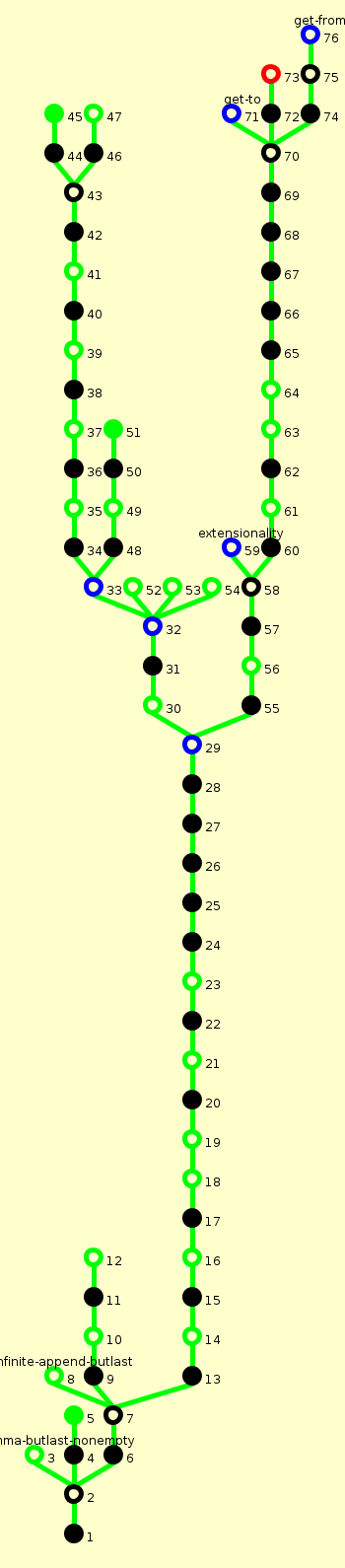
Proof step 1 from proof diag-theorem-butlast (conclusion)
(back to tree)
| ∀ n, a. nextl(n, a) ≠ [] ∧ nextl(n, a).head = a
⊦ ∃ σ, ii.
ii(0) = 0 ∧ σ[0] = a ∧ σ ≠ []
∧ (∀ n.
ii(n + 1) = ii(n) + # nextl(n, σ[ii(n)]) - 1 ∧ ⌜ii(n + 1)⌝ < # σ
∧ (σ from ii(n)) to # nextl(n, σ[ii(n)]) = ⌜nextl(n, σ[ii(n)])⌝ )
∧ (finp(σ) ⊃ ∃ n. # σ = ⌜ii(n) + 1⌝ ∧ (∀ m. n ≤ m → nextl(m, σ[ii(m)]) = σ[ii(m)] ' ∧ ii(n) = ii(m));∀ n. ∃ m. ii(m) ≤ n ∧ n < ii(m + 1)) |
Heuristic simplifier applied rule simplifier
And obtained the following new goals
- Proof step 2:
∀ n, a. nextl(n, a) ≠ [] ∧ nextl(n, a).head = a
⊦ ∃ σ, ii.
ii(0) = 0 ∧ σ[0] = a ∧ σ ≠ []
∧ (∀ n.
ii(n + 1) = ii(n) + # nextl(n, σ[ii(n)]) - 1 ∧ ⌜ii(n + 1)⌝ < # σ
∧ (σ from ii(n)) to # nextl(n, σ[ii(n)]) = ⌜nextl(n, σ[ii(n)])⌝ )
∧ (finp(σ)
⊃ ∃ n. # σ = ⌜ii(n)⌝ + ⌜1⌝ ∧ (∀ m. n ≤ m → nextl(m, σ[ii(m)]) = σ[ii(m)] ' ∧ ii(n) = ii(m))
;∀ n. ∃ m. ii(m) ≤ n ∧ n < ii(m + 1)
)
Rule argument
Additional information
Used simplifier rules:
c: ⊦ m + n = n + m; from specification nat-basic
a: ⊦ (m + n0) + n1 = m + n0 + n1; from specification nat-basic
⊦ ⌜m + n⌝ = ⌜m⌝ + ⌜n⌝ ; (s)
| ∀ n, a. nextl(n, a) ≠ [] ∧ nextl(n, a).head = a
⊦ ∃ σ, ii.
ii(0) = 0 ∧ σ[0] = a ∧ σ ≠ []
∧ (∀ n.
ii(n + 1) = ii(n) + # nextl(n, σ[ii(n)]) - 1 ∧ ⌜ii(n + 1)⌝ < # σ
∧ (σ from ii(n)) to # nextl(n, σ[ii(n)]) = ⌜nextl(n, σ[ii(n)])⌝ )
∧ (finp(σ)
⊃ ∃ n. # σ = ⌜ii(n)⌝ + ⌜1⌝ ∧ (∀ m. n ≤ m → nextl(m, σ[ii(m)]) = σ[ii(m)] ' ∧ ii(n) = ii(m))
;∀ n. ∃ m. ii(m) ≤ n ∧ n < ii(m + 1)
) |
User applied rule apply lemma
And obtained the following new goals
- Proof step 3:
∀ n, a. nextl(n, a) ≠ [] ⊦ ∃ lf. lf(0) = a ' ∧ (∀ n. lf(n + 1) = nextl(n, lf(n).last) ∧ lf(n) ≠ [])
- Proof step 4:
∀ n, a. nextl(n, a) ≠ [] ∧ nextl(n, a).head = a
⊦ ∀ n, a. nextl(n, a) ≠ [],
∃ σ, ii.
ii(0) = 0 ∧ σ[0] = a ∧ σ ≠ []
∧ (∀ n.
ii(n + 1) = ii(n) + # nextl(n, σ[ii(n)]) - 1 ∧ ⌜ii(n + 1)⌝ < # σ
∧ (σ from ii(n)) to # nextl(n, σ[ii(n)]) = ⌜nextl(n, σ[ii(n)])⌝ )
∧ (finp(σ)
⊃ ∃ n. # σ = ⌜ii(n)⌝ + ⌜1⌝ ∧ (∀ m. n ≤ m → nextl(m, σ[ii(m)]) = σ[ii(m)] ' ∧ ii(n) = ii(m))
;∀ n. ∃ m. ii(m) ≤ n ∧ n < ii(m + 1)
)
- Proof step 6:
∀ n, a. nextl(n, a) ≠ [] ∧ nextl(n, a).head = a, ∃ lf. lf(0) = a ' ∧ (∀ n. lf(n + 1) = nextl(n, lf(n).last) ∧ lf(n) ≠ [])
⊦ ∃ σ, ii.
ii(0) = 0 ∧ σ[0] = a ∧ σ ≠ []
∧ (∀ n.
ii(n + 1) = ii(n) + # nextl(n, σ[ii(n)]) - 1 ∧ ⌜ii(n + 1)⌝ < # σ
∧ (σ from ii(n)) to # nextl(n, σ[ii(n)]) = ⌜nextl(n, σ[ii(n)])⌝ )
∧ (finp(σ)
⊃ ∃ n. # σ = ⌜ii(n)⌝ + ⌜1⌝ ∧ (∀ m. n ≤ m → nextl(m, σ[ii(m)]) = σ[ii(m)] ' ∧ ii(n) = ii(m))
;∀ n. ∃ m. ii(m) ≤ n ∧ n < ii(m + 1)
)
Rule argument
spec: <toplevel>, name:nextl-lemma-butlast-nonempty,
seq:∀ n, a. nextl(n, a) ≠ []
⊦ ∃ lf. lf(0) = a ' ∧ (∀ n. lf(n + 1) = nextl(n, lf(n).last) ∧ lf(n) ≠ []),
subst:[nextl, a] → [nextl, a]
Additional information
Used terms: nextl, a
| ∀ n, a. nextl(n, a) ≠ [] ⊦ ∃ lf. lf(0) = a ' ∧ (∀ n. lf(n + 1) = nextl(n, lf(n).last) ∧ lf(n) ≠ []) |
| ∀ n, a. nextl(n, a) ≠ [] ∧ nextl(n, a).head = a
⊦ ∀ n, a. nextl(n, a) ≠ [],
∃ σ, ii.
ii(0) = 0 ∧ σ[0] = a ∧ σ ≠ []
∧ (∀ n.
ii(n + 1) = ii(n) + # nextl(n, σ[ii(n)]) - 1 ∧ ⌜ii(n + 1)⌝ < # σ
∧ (σ from ii(n)) to # nextl(n, σ[ii(n)]) = ⌜nextl(n, σ[ii(n)])⌝ )
∧ (finp(σ)
⊃ ∃ n. # σ = ⌜ii(n)⌝ + ⌜1⌝ ∧ (∀ m. n ≤ m → nextl(m, σ[ii(m)]) = σ[ii(m)] ' ∧ ii(n) = ii(m))
;∀ n. ∃ m. ii(m) ≤ n ∧ n < ii(m + 1)
) |
Heuristic simplifier applied rule simplifier
And obtained the following new goals
- Proof step 5:
nextl(n, a0) = [], ∀ n, a. nextl(n, a) ≠ [] ∧ nextl(n, a).head = a
⊦ ∃ σ, ii.
ii(0) = 0 ∧ σ[0] = a ∧ σ ≠ []
∧ (∀ n.
ii(n + 1) = ii(n) + # nextl(n, σ[ii(n)]) - 1 ∧ ⌜ii(n + 1)⌝ < # σ
∧ (σ from ii(n)) to # nextl(n, σ[ii(n)]) = ⌜nextl(n, σ[ii(n)])⌝ )
∧ (finp(σ)
⊃ ∃ n. # σ = ⌜ii(n)⌝ + ⌜1⌝ ∧ (∀ m. n ≤ m → nextl(m, σ[ii(m)]) = σ[ii(m)] ' ∧ ii(n) = ii(m))
;∀ n. ∃ m. ii(m) ≤ n ∧ n < ii(m + 1)
)
Rule argument
Additional information
| nextl(n, a0) = [], ∀ n, a. nextl(n, a) ≠ [] ∧ nextl(n, a).head = a
⊦ ∃ σ, ii.
ii(0) = 0 ∧ σ[0] = a ∧ σ ≠ []
∧ (∀ n.
ii(n + 1) = ii(n) + # nextl(n, σ[ii(n)]) - 1 ∧ ⌜ii(n + 1)⌝ < # σ
∧ (σ from ii(n)) to # nextl(n, σ[ii(n)]) = ⌜nextl(n, σ[ii(n)])⌝ )
∧ (finp(σ)
⊃ ∃ n. # σ = ⌜ii(n)⌝ + ⌜1⌝ ∧ (∀ m. n ≤ m → nextl(m, σ[ii(m)]) = σ[ii(m)] ' ∧ ii(n) = ii(m))
;∀ n. ∃ m. ii(m) ≤ n ∧ n < ii(m + 1)
) |
Heuristic quantifier closing applied rule all left
And closed the goal!
Rule argument
pos: left 2 terms: n, a0
Additional information
Used terms: n, a0
| ∀ n, a. nextl(n, a) ≠ [] ∧ nextl(n, a).head = a, ∃ lf. lf(0) = a ' ∧ (∀ n. lf(n + 1) = nextl(n, lf(n).last) ∧ lf(n) ≠ [])
⊦ ∃ σ, ii.
ii(0) = 0 ∧ σ[0] = a ∧ σ ≠ []
∧ (∀ n.
ii(n + 1) = ii(n) + # nextl(n, σ[ii(n)]) - 1 ∧ ⌜ii(n + 1)⌝ < # σ
∧ (σ from ii(n)) to # nextl(n, σ[ii(n)]) = ⌜nextl(n, σ[ii(n)])⌝ )
∧ (finp(σ)
⊃ ∃ n. # σ = ⌜ii(n)⌝ + ⌜1⌝ ∧ (∀ m. n ≤ m → nextl(m, σ[ii(m)]) = σ[ii(m)] ' ∧ ii(n) = ii(m))
;∀ n. ∃ m. ii(m) ≤ n ∧ n < ii(m + 1)
) |
Heuristic simplifier applied rule simplifier
And obtained the following new goals
- Proof step 7:
lf(0) = a ', ∀ n. lf(n + 1) = nextl(n, lf(n).last) ∧ lf(n) ≠ [], ∀ n, a. nextl(n, a) ≠ [] ∧ nextl(n, a).head = a
⊦ ∃ σ, ii.
ii(0) = 0 ∧ σ[0] = a ∧ σ ≠ []
∧ (∀ n.
ii(n + 1) = ii(n) + # nextl(n, σ[ii(n)]) - 1 ∧ ⌜ii(n + 1)⌝ < # σ
∧ (σ from ii(n)) to # nextl(n, σ[ii(n)]) = ⌜nextl(n, σ[ii(n)])⌝ )
∧ (finp(σ)
⊃ ∃ n. # σ = ⌜ii(n)⌝ + ⌜1⌝ ∧ (∀ m. n ≤ m → nextl(m, σ[ii(m)]) = σ[ii(m)] ' ∧ ii(n) = ii(m))
;∀ n. ∃ m. ii(m) ≤ n ∧ n < ii(m + 1)
)
Rule argument
Additional information
| lf(0) = a ', ∀ n. lf(n + 1) = nextl(n, lf(n).last) ∧ lf(n) ≠ [], ∀ n, a. nextl(n, a) ≠ [] ∧ nextl(n, a).head = a
⊦ ∃ σ, ii.
ii(0) = 0 ∧ σ[0] = a ∧ σ ≠ []
∧ (∀ n.
ii(n + 1) = ii(n) + # nextl(n, σ[ii(n)]) - 1 ∧ ⌜ii(n + 1)⌝ < # σ
∧ (σ from ii(n)) to # nextl(n, σ[ii(n)]) = ⌜nextl(n, σ[ii(n)])⌝ )
∧ (finp(σ)
⊃ ∃ n. # σ = ⌜ii(n)⌝ + ⌜1⌝ ∧ (∀ m. n ≤ m → nextl(m, σ[ii(m)]) = σ[ii(m)] ' ∧ ii(n) = ii(m))
;∀ n. ∃ m. ii(m) ≤ n ∧ n < ii(m + 1)
) |
User applied rule apply lemma
And obtained the following new goals
- Proof step 8:
∀ n. lf(n).last = lf(n + 1).head ∧ lf(n) ≠ []
⊦ ∃ σ, ii.
ii(0) = 0 ∧ (∀ n. ii(n + 1) = ii(n) + # lf(n) - 1 ∧ ⌜ii(n + 1)⌝ < # σ ∧ (σ from ii(n)) to # lf(n) = ⌜lf(n)⌝ )
∧ (∀ m, n. m ≤ n → ii(m) ≤ ii(n))
∧ (finp(σ) ⊃ ∃ n. # σ = ⌜ii(n) + 1⌝ ∧ (∀ m. n ≤ m → lf(m).tail = [] ∧ ii(m) = ii(n));∀ n. ∃ m. ii(m) ≤ n ∧ n < ii(m + 1))
- Proof step 9:
lf(0) = a ', ∀ n, a. nextl(n, a) ≠ [] ∧ nextl(n, a).head = a, ∀ n. lf(n + 1) = nextl(n, lf(n).last) ∧ lf(n) ≠ []
⊦ ∀ n. lf(n + 1).last = lf((n + 1) + 1).head ∧ lf(n + 1) ≠ [],
∃ σ, ii.
ii(0) = 0 ∧ σ[0] = a ∧ σ ≠ []
∧ (∀ n.
ii(n + 1) = ii(n) + # nextl(n, σ[ii(n)]) - 1 ∧ ⌜ii(n + 1)⌝ < # σ
∧ (σ from ii(n)) to # nextl(n, σ[ii(n)]) = ⌜nextl(n, σ[ii(n)])⌝ )
∧ (finp(σ)
⊃ ∃ n. # σ = ⌜ii(n)⌝ + ⌜1⌝ ∧ (∀ m. n ≤ m → nextl(m, σ[ii(m)]) = σ[ii(m)] ' ∧ ii(n) = ii(m))
;∀ n. ∃ m. ii(m) ≤ n ∧ n < ii(m + 1)
)
- Proof step 13:
lf(0) = a ', ∀ n, a. nextl(n, a) ≠ [] ∧ nextl(n, a).head = a, ∀ n. lf(n + 1) = nextl(n, lf(n).last) ∧ lf(n) ≠ [],
∃ σ, ii.
ii(0) = 0 ∧ (∀ n. ii(n + 1) = ii(n) + # lf(n + 1) - 1 ∧ ⌜ii(n + 1)⌝ < # σ ∧ (σ from ii(n)) to # lf(n + 1) = ⌜lf(n + 1)⌝ )
∧ (∀ m, n. m ≤ n → ii(m) ≤ ii(n))
∧ (finp(σ) ⊃ ∃ n. # σ = ⌜ii(n) + 1⌝ ∧ (∀ m. n ≤ m → lf(m + 1).tail = [] ∧ ii(m) = ii(n));∀ n. ∃ m. ii(m) ≤ n ∧ n < ii(m + 1))
⊦ ∃ σ, ii.
ii(0) = 0 ∧ σ[0] = a ∧ σ ≠ []
∧ (∀ n.
ii(n + 1) = ii(n) + # nextl(n, σ[ii(n)]) - 1 ∧ ⌜ii(n + 1)⌝ < # σ
∧ (σ from ii(n)) to # nextl(n, σ[ii(n)]) = ⌜nextl(n, σ[ii(n)])⌝ )
∧ (finp(σ)
⊃ ∃ n. # σ = ⌜ii(n)⌝ + ⌜1⌝ ∧ (∀ m. n ≤ m → nextl(m, σ[ii(m)]) = σ[ii(m)] ' ∧ ii(n) = ii(m))
;∀ n. ∃ m. ii(m) ≤ n ∧ n < ii(m + 1)
)
Rule argument
spec: <toplevel>, name:infinite-append-butlast,
seq:∀ n. lf(n).last = lf(n + 1).head ∧ lf(n) ≠ []
⊦ ∃ σ, ii.
ii(0) = 0
∧ (∀ n.
ii(n + 1) = ii(n) + # lf(n) - 1 ∧ ⌜ii(n + 1)⌝ < # σ
∧ (σ from ii(n)) to # lf(n) = ⌜lf(n)⌝ )
∧ (∀ m, n. m ≤ n → ii(m) ≤ ii(n))
∧ (finp(σ)
⊃ ∃ n.
# σ = ⌜ii(n) + 1⌝
∧ (∀ m. n ≤ m → lf(m).tail = [] ∧ ii(m) = ii(n))
;∀ n. ∃ m. ii(m) ≤ n ∧ n < ii(m + 1)
),
subst:[lf] → [λ n. lf(n + 1)]
Additional information
Used terms: λ n. lf(n + 1)
| ∀ n. lf(n).last = lf(n + 1).head ∧ lf(n) ≠ []
⊦ ∃ σ, ii.
ii(0) = 0 ∧ (∀ n. ii(n + 1) = ii(n) + # lf(n) - 1 ∧ ⌜ii(n + 1)⌝ < # σ ∧ (σ from ii(n)) to # lf(n) = ⌜lf(n)⌝ )
∧ (∀ m, n. m ≤ n → ii(m) ≤ ii(n))
∧ (finp(σ) ⊃ ∃ n. # σ = ⌜ii(n) + 1⌝ ∧ (∀ m. n ≤ m → lf(m).tail = [] ∧ ii(m) = ii(n));∀ n. ∃ m. ii(m) ≤ n ∧ n < ii(m + 1)) |
| lf(0) = a ', ∀ n, a. nextl(n, a) ≠ [] ∧ nextl(n, a).head = a, ∀ n. lf(n + 1) = nextl(n, lf(n).last) ∧ lf(n) ≠ []
⊦ ∀ n. lf(n + 1).last = lf((n + 1) + 1).head ∧ lf(n + 1) ≠ [],
∃ σ, ii.
ii(0) = 0 ∧ σ[0] = a ∧ σ ≠ []
∧ (∀ n.
ii(n + 1) = ii(n) + # nextl(n, σ[ii(n)]) - 1 ∧ ⌜ii(n + 1)⌝ < # σ
∧ (σ from ii(n)) to # nextl(n, σ[ii(n)]) = ⌜nextl(n, σ[ii(n)])⌝ )
∧ (finp(σ)
⊃ ∃ n. # σ = ⌜ii(n)⌝ + ⌜1⌝ ∧ (∀ m. n ≤ m → nextl(m, σ[ii(m)]) = σ[ii(m)] ' ∧ ii(n) = ii(m))
;∀ n. ∃ m. ii(m) ≤ n ∧ n < ii(m + 1)
) |
Heuristic simplifier applied rule simplifier
And obtained the following new goals
- Proof step 10:
lf(0) = a ', ∀ n. lf(n + 1) = nextl(n, lf(n).last) ∧ lf(n) ≠ [], ∀ n, a. nextl(n, a) ≠ [] ∧ nextl(n, a).head = a
⊦ ∃ σ, ii.
ii(0) = 0 ∧ σ[0] = a ∧ σ ≠ []
∧ (∀ n.
ii(n + 1) = ii(n) + # nextl(n, σ[ii(n)]) - 1 ∧ ⌜ii(n + 1)⌝ < # σ
∧ (σ from ii(n)) to # nextl(n, σ[ii(n)]) = ⌜nextl(n, σ[ii(n)])⌝ )
∧ (finp(σ)
⊃ ∃ n. # σ = ⌜ii(n)⌝ + ⌜1⌝ ∧ (∀ m. n ≤ m → nextl(m, σ[ii(m)]) = σ[ii(m)] ' ∧ ii(n) = ii(m))
;∀ n. ∃ m. ii(m) ≤ n ∧ n < ii(m + 1)
),
lf(n + 1).last = lf(2 + n).head ∧ lf(n + 1) ≠ []
Rule argument
Additional information
Used simplifier rules:
a: ⊦ (m + n0) + n1 = m + n0 + n1; from specification nat-basic
c: ⊦ m + n = n + m; from specification nat-basic
Proof step 10 from proof diag-theorem-butlast (previous step)
(back to tree)
| lf(0) = a ', ∀ n. lf(n + 1) = nextl(n, lf(n).last) ∧ lf(n) ≠ [], ∀ n, a. nextl(n, a) ≠ [] ∧ nextl(n, a).head = a
⊦ ∃ σ, ii.
ii(0) = 0 ∧ σ[0] = a ∧ σ ≠ []
∧ (∀ n.
ii(n + 1) = ii(n) + # nextl(n, σ[ii(n)]) - 1 ∧ ⌜ii(n + 1)⌝ < # σ
∧ (σ from ii(n)) to # nextl(n, σ[ii(n)]) = ⌜nextl(n, σ[ii(n)])⌝ )
∧ (finp(σ)
⊃ ∃ n. # σ = ⌜ii(n)⌝ + ⌜1⌝ ∧ (∀ m. n ≤ m → nextl(m, σ[ii(m)]) = σ[ii(m)] ' ∧ ii(n) = ii(m))
;∀ n. ∃ m. ii(m) ≤ n ∧ n < ii(m + 1)
),
lf(n + 1).last = lf(2 + n).head ∧ lf(n + 1) ≠ [] |
User applied rule all left
And obtained the following new goals
- Proof step 11:
lf(0) = a ', lf((n + 1) + 1) = nextl(n + 1, lf(n + 1).last), lf(n + 1) ≠ [], ∀ n, a. nextl(n, a) ≠ [] ∧ nextl(n, a).head = a,
∀ n. lf(n + 1) = nextl(n, lf(n).last) ∧ lf(n) ≠ []
⊦ ∃ σ, ii.
ii(0) = 0 ∧ σ[0] = a ∧ σ ≠ []
∧ (∀ n.
ii(n + 1) = ii(n) + # nextl(n, σ[ii(n)]) - 1 ∧ ⌜ii(n + 1)⌝ < # σ
∧ (σ from ii(n)) to # nextl(n, σ[ii(n)]) = ⌜nextl(n, σ[ii(n)])⌝ )
∧ (finp(σ)
⊃ ∃ n. # σ = ⌜ii(n)⌝ + ⌜1⌝ ∧ (∀ m. n ≤ m → nextl(m, σ[ii(m)]) = σ[ii(m)] ' ∧ ii(n) = ii(m))
;∀ n. ∃ m. ii(m) ≤ n ∧ n < ii(m + 1)
),
lf(n + 1).last = lf(2 + n).head ∧ lf(n + 1) ≠ []
Rule argument
pos: left 2 terms: n + 1 abort: F discard: F computed: F
Additional information
Used terms: n + 1
Proof step 11 from proof diag-theorem-butlast (previous step)
(back to tree)
| lf(0) = a ', lf((n + 1) + 1) = nextl(n + 1, lf(n + 1).last), lf(n + 1) ≠ [], ∀ n, a. nextl(n, a) ≠ [] ∧ nextl(n, a).head = a,
∀ n. lf(n + 1) = nextl(n, lf(n).last) ∧ lf(n) ≠ []
⊦ ∃ σ, ii.
ii(0) = 0 ∧ σ[0] = a ∧ σ ≠ []
∧ (∀ n.
ii(n + 1) = ii(n) + # nextl(n, σ[ii(n)]) - 1 ∧ ⌜ii(n + 1)⌝ < # σ
∧ (σ from ii(n)) to # nextl(n, σ[ii(n)]) = ⌜nextl(n, σ[ii(n)])⌝ )
∧ (finp(σ)
⊃ ∃ n. # σ = ⌜ii(n)⌝ + ⌜1⌝ ∧ (∀ m. n ≤ m → nextl(m, σ[ii(m)]) = σ[ii(m)] ' ∧ ii(n) = ii(m))
;∀ n. ∃ m. ii(m) ≤ n ∧ n < ii(m + 1)
),
lf(n + 1).last = lf(2 + n).head ∧ lf(n + 1) ≠ [] |
Heuristic simplifier applied rule simplifier
And obtained the following new goals
- Proof step 12:
lf(0) = a ', lf(2 + n) = nextl(n + 1, lf(n + 1).last), lf(n + 1).last ≠ lf(2 + n).head, lf(n + 1) ≠ [],
∀ n. lf(n + 1) = nextl(n, lf(n).last) ∧ lf(n) ≠ [], ∀ n, a. nextl(n, a) ≠ [] ∧ nextl(n, a).head = a
⊦ ∃ σ, ii.
ii(0) = 0 ∧ σ[0] = a ∧ σ ≠ []
∧ (∀ n.
ii(n + 1) = ii(n) + # nextl(n, σ[ii(n)]) - 1 ∧ ⌜ii(n + 1)⌝ < # σ
∧ (σ from ii(n)) to # nextl(n, σ[ii(n)]) = ⌜nextl(n, σ[ii(n)])⌝ )
∧ (finp(σ)
⊃ ∃ n. # σ = ⌜ii(n)⌝ + ⌜1⌝ ∧ (∀ m. n ≤ m → nextl(m, σ[ii(m)]) = σ[ii(m)] ' ∧ ii(n) = ii(m))
;∀ n. ∃ m. ii(m) ≤ n ∧ n < ii(m + 1)
)
Rule argument
Additional information
Used simplifier rules:
a: ⊦ (m + n0) + n1 = m + n0 + n1; from specification nat-basic
c: ⊦ m + n = n + m; from specification nat-basic
Proof step 12 from proof diag-theorem-butlast (previous step)
(back to tree)
| lf(0) = a ', lf(2 + n) = nextl(n + 1, lf(n + 1).last), lf(n + 1).last ≠ lf(2 + n).head, lf(n + 1) ≠ [],
∀ n. lf(n + 1) = nextl(n, lf(n).last) ∧ lf(n) ≠ [], ∀ n, a. nextl(n, a) ≠ [] ∧ nextl(n, a).head = a
⊦ ∃ σ, ii.
ii(0) = 0 ∧ σ[0] = a ∧ σ ≠ []
∧ (∀ n.
ii(n + 1) = ii(n) + # nextl(n, σ[ii(n)]) - 1 ∧ ⌜ii(n + 1)⌝ < # σ
∧ (σ from ii(n)) to # nextl(n, σ[ii(n)]) = ⌜nextl(n, σ[ii(n)])⌝ )
∧ (finp(σ)
⊃ ∃ n. # σ = ⌜ii(n)⌝ + ⌜1⌝ ∧ (∀ m. n ≤ m → nextl(m, σ[ii(m)]) = σ[ii(m)] ' ∧ ii(n) = ii(m))
;∀ n. ∃ m. ii(m) ≤ n ∧ n < ii(m + 1)
) |
User applied rule all left
And closed the goal!
Rule argument
pos: left 6 terms: n + 1, lf(n + 1).last abort: F discard: F computed: T
Additional information
Used terms: n + 1, lf(n + 1).last
Proof step 13 from proof diag-theorem-butlast (previous step)
(back to tree)
| lf(0) = a ', ∀ n, a. nextl(n, a) ≠ [] ∧ nextl(n, a).head = a, ∀ n. lf(n + 1) = nextl(n, lf(n).last) ∧ lf(n) ≠ [],
∃ σ, ii.
ii(0) = 0 ∧ (∀ n. ii(n + 1) = ii(n) + # lf(n + 1) - 1 ∧ ⌜ii(n + 1)⌝ < # σ ∧ (σ from ii(n)) to # lf(n + 1) = ⌜lf(n + 1)⌝ )
∧ (∀ m, n. m ≤ n → ii(m) ≤ ii(n))
∧ (finp(σ) ⊃ ∃ n. # σ = ⌜ii(n) + 1⌝ ∧ (∀ m. n ≤ m → lf(m + 1).tail = [] ∧ ii(m) = ii(n));∀ n. ∃ m. ii(m) ≤ n ∧ n < ii(m + 1))
⊦ ∃ σ, ii.
ii(0) = 0 ∧ σ[0] = a ∧ σ ≠ []
∧ (∀ n.
ii(n + 1) = ii(n) + # nextl(n, σ[ii(n)]) - 1 ∧ ⌜ii(n + 1)⌝ < # σ
∧ (σ from ii(n)) to # nextl(n, σ[ii(n)]) = ⌜nextl(n, σ[ii(n)])⌝ )
∧ (finp(σ)
⊃ ∃ n. # σ = ⌜ii(n)⌝ + ⌜1⌝ ∧ (∀ m. n ≤ m → nextl(m, σ[ii(m)]) = σ[ii(m)] ' ∧ ii(n) = ii(m))
;∀ n. ∃ m. ii(m) ≤ n ∧ n < ii(m + 1)
) |
Heuristic simplifier applied rule simplifier
And obtained the following new goals
- Proof step 14:
ii(0) = 0, lf(0) = a ',
(finp(σ) ⊃ # σ = ⌜ii(n)⌝ + ⌜1⌝ ∧ (∀ m. n ≤ m → lf(m + 1).tail = [] ∧ ii(m) = ii(n));∀ n. ∃ m. ii(m) ≤ n ∧ n < ii(m + 1)),
∀ n. ii(n + 1) = ii(n) + # lf(n + 1) - 1 ∧ ⌜ii(n + 1)⌝ < # σ ∧ (σ from ii(n)) to # lf(n + 1) = ⌜lf(n + 1)⌝ ,
∀ m, n. m ≤ n → ii(m) ≤ ii(n), ∀ n. lf(n + 1) = nextl(n, lf(n).last) ∧ lf(n) ≠ [], ∀ n, a. nextl(n, a) ≠ [] ∧ nextl(n, a).head = a
⊦ ∃ σ, ii.
ii(0) = 0 ∧ σ[0] = a ∧ σ ≠ []
∧ (∀ n.
ii(n + 1) = ii(n) + # nextl(n, σ[ii(n)]) - 1 ∧ ⌜ii(n + 1)⌝ < # σ
∧ (σ from ii(n)) to # nextl(n, σ[ii(n)]) = ⌜nextl(n, σ[ii(n)])⌝ )
∧ (finp(σ)
⊃ ∃ n. # σ = ⌜ii(n)⌝ + ⌜1⌝ ∧ (∀ m. n ≤ m → nextl(m, σ[ii(m)]) = σ[ii(m)] ' ∧ ii(n) = ii(m))
;∀ n. ∃ m. ii(m) ≤ n ∧ n < ii(m + 1)
)
Rule argument
Additional information
Used simplifier rules:
c: ⊦ m + n = n + m; from specification nat-basic
a: ⊦ (m + n0) + n1 = m + n0 + n1; from specification nat-basic
⊦ ⌜m + n⌝ = ⌜m⌝ + ⌜n⌝ ; (s)
Proof step 14 from proof diag-theorem-butlast (previous step)
(back to tree)
| ii(0) = 0, lf(0) = a ',
(finp(σ) ⊃ # σ = ⌜ii(n)⌝ + ⌜1⌝ ∧ (∀ m. n ≤ m → lf(m + 1).tail = [] ∧ ii(m) = ii(n));∀ n. ∃ m. ii(m) ≤ n ∧ n < ii(m + 1)),
∀ n. ii(n + 1) = ii(n) + # lf(n + 1) - 1 ∧ ⌜ii(n + 1)⌝ < # σ ∧ (σ from ii(n)) to # lf(n + 1) = ⌜lf(n + 1)⌝ ,
∀ m, n. m ≤ n → ii(m) ≤ ii(n), ∀ n. lf(n + 1) = nextl(n, lf(n).last) ∧ lf(n) ≠ [], ∀ n, a. nextl(n, a) ≠ [] ∧ nextl(n, a).head = a
⊦ ∃ σ, ii.
ii(0) = 0 ∧ σ[0] = a ∧ σ ≠ []
∧ (∀ n.
ii(n + 1) = ii(n) + # nextl(n, σ[ii(n)]) - 1 ∧ ⌜ii(n + 1)⌝ < # σ
∧ (σ from ii(n)) to # nextl(n, σ[ii(n)]) = ⌜nextl(n, σ[ii(n)])⌝ )
∧ (finp(σ)
⊃ ∃ n. # σ = ⌜ii(n)⌝ + ⌜1⌝ ∧ (∀ m. n ≤ m → nextl(m, σ[ii(m)]) = σ[ii(m)] ' ∧ ii(n) = ii(m))
;∀ n. ∃ m. ii(m) ≤ n ∧ n < ii(m + 1)
) |
User applied rule exists right
And obtained the following new goals
- Proof step 15:
ii(0) = 0, lf(0) = a ',
(finp(σ) ⊃ # σ = ⌜ii(n)⌝ + ⌜1⌝ ∧ (∀ m. n ≤ m → lf(m + 1).tail = [] ∧ ii(m) = ii(n));∀ n. ∃ m. ii(m) ≤ n ∧ n < ii(m + 1)),
∀ n, a. nextl(n, a) ≠ [] ∧ nextl(n, a).head = a, ∀ n. lf(n + 1) = nextl(n, lf(n).last) ∧ lf(n) ≠ [], ∀ m, n. m ≤ n → ii(m) ≤ ii(n),
∀ n. ii(n + 1) = ii(n) + # lf(n + 1) - 1 ∧ ⌜ii(n + 1)⌝ < # σ ∧ (σ from ii(n)) to # lf(n + 1) = ⌜lf(n + 1)⌝
⊦ ii(0) = 0 ∧ σ[0] = a ∧ σ ≠ []
∧ (∀ n.
ii(n + 1) = ii(n) + # nextl(n, σ[ii(n)]) - 1 ∧ ⌜ii(n + 1)⌝ < # σ
∧ (σ from ii(n)) to # nextl(n, σ[ii(n)]) = ⌜nextl(n, σ[ii(n)])⌝ )
∧ (finp(σ) ⊃ ∃ n. # σ = ⌜ii(n)⌝ + ⌜1⌝ ∧ (∀ m. n ≤ m → nextl(m, σ[ii(m)]) = σ[ii(m)] ' ∧ ii(n) = ii(m));∀ n. ∃ m. ii(m) ≤ n ∧ n < ii(m + 1))
Rule argument
pos: right 1 terms: σ, ii abort: F discard: T computed: T
Additional information
Used terms: σ, ii
Proof step 15 from proof diag-theorem-butlast (previous step)
(back to tree)
| ii(0) = 0, lf(0) = a ',
(finp(σ) ⊃ # σ = ⌜ii(n)⌝ + ⌜1⌝ ∧ (∀ m. n ≤ m → lf(m + 1).tail = [] ∧ ii(m) = ii(n));∀ n. ∃ m. ii(m) ≤ n ∧ n < ii(m + 1)),
∀ n, a. nextl(n, a) ≠ [] ∧ nextl(n, a).head = a, ∀ n. lf(n + 1) = nextl(n, lf(n).last) ∧ lf(n) ≠ [], ∀ m, n. m ≤ n → ii(m) ≤ ii(n),
∀ n. ii(n + 1) = ii(n) + # lf(n + 1) - 1 ∧ ⌜ii(n + 1)⌝ < # σ ∧ (σ from ii(n)) to # lf(n + 1) = ⌜lf(n + 1)⌝
⊦ ii(0) = 0 ∧ σ[0] = a ∧ σ ≠ []
∧ (∀ n.
ii(n + 1) = ii(n) + # nextl(n, σ[ii(n)]) - 1 ∧ ⌜ii(n + 1)⌝ < # σ
∧ (σ from ii(n)) to # nextl(n, σ[ii(n)]) = ⌜nextl(n, σ[ii(n)])⌝ )
∧ (finp(σ) ⊃ ∃ n. # σ = ⌜ii(n)⌝ + ⌜1⌝ ∧ (∀ m. n ≤ m → nextl(m, σ[ii(m)]) = σ[ii(m)] ' ∧ ii(n) = ii(m));∀ n. ∃ m. ii(m) ≤ n ∧ n < ii(m + 1)) |
Heuristic simplifier applied rule simplifier
And obtained the following new goals
- Proof step 16:
ii(0) = 0, lf(0) = a ',
(finp(σ) ⊃ # σ = ⌜ii(n)⌝ + ⌜1⌝ ∧ (∀ m. n ≤ m → lf(m + 1).tail = [] ∧ ii(m) = ii(n));∀ n. ∃ m. ii(m) ≤ n ∧ n < ii(m + 1)),
∀ n. ii(n + 1) = ii(n) + # lf(n + 1) - 1 ∧ ⌜ii(n + 1)⌝ < # σ ∧ (σ from ii(n)) to # lf(n + 1) = ⌜lf(n + 1)⌝ ,
∀ m, n. m ≤ n → ii(m) ≤ ii(n), ∀ n. lf(n + 1) = nextl(n, lf(n).last) ∧ lf(n) ≠ [], ∀ n, a. nextl(n, a) ≠ [] ∧ nextl(n, a).head = a
⊦ σ[0] = a ∧ σ ≠ [] ∧ ii(n0 + 1) = ii(n0) + # nextl(n0, σ[ii(n0)]) - 1 ∧ ⌜ii(n0 + 1)⌝ < # σ
∧ (σ from ii(n0)) to # nextl(n0, σ[ii(n0)]) = ⌜nextl(n0, σ[ii(n0)])⌝
∧ (finp(σ) ⊃ ∃ n. # σ = ⌜ii(n)⌝ + ⌜1⌝ ∧ (∀ m. n ≤ m → nextl(m, σ[ii(m)]) = σ[ii(m)] ' ∧ ii(n) = ii(m));∃ m. ii(m) ≤ n1 ∧ n1 < ii(m + 1))
Rule argument
Additional information
Proof step 16 from proof diag-theorem-butlast (previous step)
(back to tree)
| ii(0) = 0, lf(0) = a ',
(finp(σ) ⊃ # σ = ⌜ii(n)⌝ + ⌜1⌝ ∧ (∀ m. n ≤ m → lf(m + 1).tail = [] ∧ ii(m) = ii(n));∀ n. ∃ m. ii(m) ≤ n ∧ n < ii(m + 1)),
∀ n. ii(n + 1) = ii(n) + # lf(n + 1) - 1 ∧ ⌜ii(n + 1)⌝ < # σ ∧ (σ from ii(n)) to # lf(n + 1) = ⌜lf(n + 1)⌝ ,
∀ m, n. m ≤ n → ii(m) ≤ ii(n), ∀ n. lf(n + 1) = nextl(n, lf(n).last) ∧ lf(n) ≠ [], ∀ n, a. nextl(n, a) ≠ [] ∧ nextl(n, a).head = a
⊦ σ[0] = a ∧ σ ≠ [] ∧ ii(n0 + 1) = ii(n0) + # nextl(n0, σ[ii(n0)]) - 1 ∧ ⌜ii(n0 + 1)⌝ < # σ
∧ (σ from ii(n0)) to # nextl(n0, σ[ii(n0)]) = ⌜nextl(n0, σ[ii(n0)])⌝
∧ (finp(σ) ⊃ ∃ n. # σ = ⌜ii(n)⌝ + ⌜1⌝ ∧ (∀ m. n ≤ m → nextl(m, σ[ii(m)]) = σ[ii(m)] ' ∧ ii(n) = ii(m));∃ m. ii(m) ≤ n1 ∧ n1 < ii(m + 1)) |
User applied rule all left
And obtained the following new goals
- Proof step 17:
ii(0) = 0, ii(0 + 1) = ii(0) + # lf(0 + 1) - 1, lf(0) = a ', (σ from ii(0)) to # lf(0 + 1) = ⌜lf(0 + 1)⌝ , ⌜ii(0 + 1)⌝ < # σ,
(finp(σ) ⊃ # σ = ⌜ii(n)⌝ + ⌜1⌝ ∧ (∀ m. n ≤ m → lf(m + 1).tail = [] ∧ ii(m) = ii(n));∀ n. ∃ m. ii(m) ≤ n ∧ n < ii(m + 1)),
∀ n, a. nextl(n, a) ≠ [] ∧ nextl(n, a).head = a, ∀ n. lf(n + 1) = nextl(n, lf(n).last) ∧ lf(n) ≠ [], ∀ m, n. m ≤ n → ii(m) ≤ ii(n),
∀ n. ii(n + 1) = ii(n) + # lf(n + 1) - 1 ∧ ⌜ii(n + 1)⌝ < # σ ∧ (σ from ii(n)) to # lf(n + 1) = ⌜lf(n + 1)⌝
⊦ σ[0] = a ∧ σ ≠ [] ∧ ii(n0 + 1) = ii(n0) + # nextl(n0, σ[ii(n0)]) - 1 ∧ ⌜ii(n0 + 1)⌝ < # σ
∧ (σ from ii(n0)) to # nextl(n0, σ[ii(n0)]) = ⌜nextl(n0, σ[ii(n0)])⌝
∧ (finp(σ) ⊃ ∃ n. # σ = ⌜ii(n)⌝ + ⌜1⌝ ∧ (∀ m. n ≤ m → nextl(m, σ[ii(m)]) = σ[ii(m)] ' ∧ ii(n) = ii(m));∃ m. ii(m) ≤ n1 ∧ n1 < ii(m + 1))
Rule argument
pos: left 4 terms: 0 abort: F discard: F computed: F
Additional information
Used terms: 0
Proof step 17 from proof diag-theorem-butlast (previous step)
(back to tree)
| ii(0) = 0, ii(0 + 1) = ii(0) + # lf(0 + 1) - 1, lf(0) = a ', (σ from ii(0)) to # lf(0 + 1) = ⌜lf(0 + 1)⌝ , ⌜ii(0 + 1)⌝ < # σ,
(finp(σ) ⊃ # σ = ⌜ii(n)⌝ + ⌜1⌝ ∧ (∀ m. n ≤ m → lf(m + 1).tail = [] ∧ ii(m) = ii(n));∀ n. ∃ m. ii(m) ≤ n ∧ n < ii(m + 1)),
∀ n, a. nextl(n, a) ≠ [] ∧ nextl(n, a).head = a, ∀ n. lf(n + 1) = nextl(n, lf(n).last) ∧ lf(n) ≠ [], ∀ m, n. m ≤ n → ii(m) ≤ ii(n),
∀ n. ii(n + 1) = ii(n) + # lf(n + 1) - 1 ∧ ⌜ii(n + 1)⌝ < # σ ∧ (σ from ii(n)) to # lf(n + 1) = ⌜lf(n + 1)⌝
⊦ σ[0] = a ∧ σ ≠ [] ∧ ii(n0 + 1) = ii(n0) + # nextl(n0, σ[ii(n0)]) - 1 ∧ ⌜ii(n0 + 1)⌝ < # σ
∧ (σ from ii(n0)) to # nextl(n0, σ[ii(n0)]) = ⌜nextl(n0, σ[ii(n0)])⌝
∧ (finp(σ) ⊃ ∃ n. # σ = ⌜ii(n)⌝ + ⌜1⌝ ∧ (∀ m. n ≤ m → nextl(m, σ[ii(m)]) = σ[ii(m)] ' ∧ ii(n) = ii(m));∃ m. ii(m) ≤ n1 ∧ n1 < ii(m + 1)) |
Heuristic simplifier applied rule simplifier
And obtained the following new goals
- Proof step 18:
ii(0) = 0, ii(1) = # lf(1) - 1, lf(0) = a ', σ to # lf(1) = ⌜lf(1)⌝ , σ ≠ [], ⌜ii(1)⌝ < # σ,
(finp(σ) ⊃ # σ = ⌜ii(n)⌝ + ⌜1⌝ ∧ (∀ m. n ≤ m → lf(m + 1).tail = [] ∧ ii(m) = ii(n));∀ n. ∃ m. ii(m) ≤ n ∧ n < ii(m + 1)),
∀ n, a. nextl(n, a) ≠ [] ∧ nextl(n, a).head = a, ∀ n. lf(n + 1) = nextl(n, lf(n).last) ∧ lf(n) ≠ [], ∀ m, n. m ≤ n → ii(m) ≤ ii(n),
∀ n. ii(n + 1) = ii(n) + # lf(n + 1) - 1 ∧ ⌜ii(n + 1)⌝ < # σ ∧ (σ from ii(n)) to # lf(n + 1) = ⌜lf(n + 1)⌝
⊦ (finp(σ) ⊃ ∃ n. # σ = ⌜ii(n)⌝ + ⌜1⌝ ∧ (∀ m. n ≤ m → nextl(m, σ[ii(m)]) = σ[ii(m)] ' ∧ ii(n) = ii(m));∃ m. ii(m) ≤ n1 ∧ n1 < ii(m + 1))
∧ (σ from ii(n0)) to # nextl(n0, σ[ii(n0)]) = ⌜nextl(n0, σ[ii(n0)])⌝ ∧ ⌜ii(n0 + 1)⌝ < # σ
∧ ii(n0 + 1) = ii(n0) + # nextl(n0, σ[ii(n0)]) - 1 ∧ σ[0] = a
Rule argument
Additional information
Used simplifier rules:
⊦ ¬ n < 0; (s)
⊦ ⌜m⌝ < ⌜n⌝ ↔ m < n; (s)
⊦ # [] = ⌜0⌝ ; (s)
⊦ σ from 0 = σ; (s)
c: ⊦ m + n = n + m; from specification nat-basic
a: ⊦ (m + n0) + n1 = m + n0 + n1; from specification nat-basic
⊦ n + 0 = n; (s)
Proof step 18 from proof diag-theorem-butlast (previous step)
(back to tree)
| ii(0) = 0, ii(1) = # lf(1) - 1, lf(0) = a ', σ to # lf(1) = ⌜lf(1)⌝ , σ ≠ [], ⌜ii(1)⌝ < # σ,
(finp(σ) ⊃ # σ = ⌜ii(n)⌝ + ⌜1⌝ ∧ (∀ m. n ≤ m → lf(m + 1).tail = [] ∧ ii(m) = ii(n));∀ n. ∃ m. ii(m) ≤ n ∧ n < ii(m + 1)),
∀ n, a. nextl(n, a) ≠ [] ∧ nextl(n, a).head = a, ∀ n. lf(n + 1) = nextl(n, lf(n).last) ∧ lf(n) ≠ [], ∀ m, n. m ≤ n → ii(m) ≤ ii(n),
∀ n. ii(n + 1) = ii(n) + # lf(n + 1) - 1 ∧ ⌜ii(n + 1)⌝ < # σ ∧ (σ from ii(n)) to # lf(n + 1) = ⌜lf(n + 1)⌝
⊦ (finp(σ) ⊃ ∃ n. # σ = ⌜ii(n)⌝ + ⌜1⌝ ∧ (∀ m. n ≤ m → nextl(m, σ[ii(m)]) = σ[ii(m)] ' ∧ ii(n) = ii(m));∃ m. ii(m) ≤ n1 ∧ n1 < ii(m + 1))
∧ (σ from ii(n0)) to # nextl(n0, σ[ii(n0)]) = ⌜nextl(n0, σ[ii(n0)])⌝ ∧ ⌜ii(n0 + 1)⌝ < # σ
∧ ii(n0 + 1) = ii(n0) + # nextl(n0, σ[ii(n0)]) - 1 ∧ σ[0] = a |
User applied rule all left
And obtained the following new goals
- Proof step 19:
ii(1) = # lf(1) - 1, ii(0) = 0, lf(0) = a ', lf(n0 + 1) = nextl(n0, lf(n0).last), σ to # lf(1) = ⌜lf(1)⌝ , lf(n0) ≠ [], σ ≠ [],
⌜ii(1)⌝ < # σ,
(finp(σ) ⊃ # σ = ⌜ii(n)⌝ + ⌜1⌝ ∧ (∀ m. n ≤ m → lf(m + 1).tail = [] ∧ ii(m) = ii(n));∀ n. ∃ m. ii(m) ≤ n ∧ n < ii(m + 1)),
∀ n. ii(n + 1) = ii(n) + # lf(n + 1) - 1 ∧ ⌜ii(n + 1)⌝ < # σ ∧ (σ from ii(n)) to # lf(n + 1) = ⌜lf(n + 1)⌝ ,
∀ m, n. m ≤ n → ii(m) ≤ ii(n), ∀ n. lf(n + 1) = nextl(n, lf(n).last) ∧ lf(n) ≠ [], ∀ n, a. nextl(n, a) ≠ [] ∧ nextl(n, a).head = a
⊦ (finp(σ) ⊃ ∃ n. # σ = ⌜ii(n)⌝ + ⌜1⌝ ∧ (∀ m. n ≤ m → nextl(m, σ[ii(m)]) = σ[ii(m)] ' ∧ ii(n) = ii(m));∃ m. ii(m) ≤ n1 ∧ n1 < ii(m + 1))
∧ (σ from ii(n0)) to # nextl(n0, σ[ii(n0)]) = ⌜nextl(n0, σ[ii(n0)])⌝ ∧ ⌜ii(n0 + 1)⌝ < # σ
∧ ii(n0 + 1) = ii(n0) + # nextl(n0, σ[ii(n0)]) - 1 ∧ σ[0] = a
Rule argument
pos: left 9 terms: n0 abort: F discard: F computed: F
Additional information
Used terms: n0
Proof step 19 from proof diag-theorem-butlast (previous step)
(back to tree)
| ii(1) = # lf(1) - 1, ii(0) = 0, lf(0) = a ', lf(n0 + 1) = nextl(n0, lf(n0).last), σ to # lf(1) = ⌜lf(1)⌝ , lf(n0) ≠ [], σ ≠ [],
⌜ii(1)⌝ < # σ,
(finp(σ) ⊃ # σ = ⌜ii(n)⌝ + ⌜1⌝ ∧ (∀ m. n ≤ m → lf(m + 1).tail = [] ∧ ii(m) = ii(n));∀ n. ∃ m. ii(m) ≤ n ∧ n < ii(m + 1)),
∀ n. ii(n + 1) = ii(n) + # lf(n + 1) - 1 ∧ ⌜ii(n + 1)⌝ < # σ ∧ (σ from ii(n)) to # lf(n + 1) = ⌜lf(n + 1)⌝ ,
∀ m, n. m ≤ n → ii(m) ≤ ii(n), ∀ n. lf(n + 1) = nextl(n, lf(n).last) ∧ lf(n) ≠ [], ∀ n, a. nextl(n, a) ≠ [] ∧ nextl(n, a).head = a
⊦ (finp(σ) ⊃ ∃ n. # σ = ⌜ii(n)⌝ + ⌜1⌝ ∧ (∀ m. n ≤ m → nextl(m, σ[ii(m)]) = σ[ii(m)] ' ∧ ii(n) = ii(m));∃ m. ii(m) ≤ n1 ∧ n1 < ii(m + 1))
∧ (σ from ii(n0)) to # nextl(n0, σ[ii(n0)]) = ⌜nextl(n0, σ[ii(n0)])⌝ ∧ ⌜ii(n0 + 1)⌝ < # σ
∧ ii(n0 + 1) = ii(n0) + # nextl(n0, σ[ii(n0)]) - 1 ∧ σ[0] = a |
User applied rule all left
And obtained the following new goals
- Proof step 20:
ii(0) = 0, ii(1) = # lf(1) - 1, ii(n0 + 1) = ii(n0) + # lf(n0 + 1) - 1, lf(n0 + 1) = nextl(n0, lf(n0).last), lf(0) = a ',
σ to # lf(1) = ⌜lf(1)⌝ , (σ from ii(n0)) to # lf(n0 + 1) = ⌜lf(n0 + 1)⌝ , lf(n0) ≠ [], σ ≠ [], ⌜ii(1)⌝ < # σ,
⌜ii(n0 + 1)⌝ < # σ,
(finp(σ) ⊃ # σ = ⌜ii(n)⌝ + ⌜1⌝ ∧ (∀ m. n ≤ m → lf(m + 1).tail = [] ∧ ii(m) = ii(n));∀ n. ∃ m. ii(m) ≤ n ∧ n < ii(m + 1)),
∀ n, a. nextl(n, a) ≠ [] ∧ nextl(n, a).head = a, ∀ n. lf(n + 1) = nextl(n, lf(n).last) ∧ lf(n) ≠ [], ∀ m, n. m ≤ n → ii(m) ≤ ii(n),
∀ n. ii(n + 1) = ii(n) + # lf(n + 1) - 1 ∧ ⌜ii(n + 1)⌝ < # σ ∧ (σ from ii(n)) to # lf(n + 1) = ⌜lf(n + 1)⌝
⊦ (finp(σ) ⊃ ∃ n. # σ = ⌜ii(n)⌝ + ⌜1⌝ ∧ (∀ m. n ≤ m → nextl(m, σ[ii(m)]) = σ[ii(m)] ' ∧ ii(n) = ii(m));∃ m. ii(m) ≤ n1 ∧ n1 < ii(m + 1))
∧ (σ from ii(n0)) to # nextl(n0, σ[ii(n0)]) = ⌜nextl(n0, σ[ii(n0)])⌝ ∧ ⌜ii(n0 + 1)⌝ < # σ
∧ ii(n0 + 1) = ii(n0) + # nextl(n0, σ[ii(n0)]) - 1 ∧ σ[0] = a
Rule argument
pos: left 10 terms: n0 abort: F discard: F computed: F
Additional information
Used terms: n0
Proof step 20 from proof diag-theorem-butlast (previous step)
(back to tree)
| ii(0) = 0, ii(1) = # lf(1) - 1, ii(n0 + 1) = ii(n0) + # lf(n0 + 1) - 1, lf(n0 + 1) = nextl(n0, lf(n0).last), lf(0) = a ',
σ to # lf(1) = ⌜lf(1)⌝ , (σ from ii(n0)) to # lf(n0 + 1) = ⌜lf(n0 + 1)⌝ , lf(n0) ≠ [], σ ≠ [], ⌜ii(1)⌝ < # σ,
⌜ii(n0 + 1)⌝ < # σ,
(finp(σ) ⊃ # σ = ⌜ii(n)⌝ + ⌜1⌝ ∧ (∀ m. n ≤ m → lf(m + 1).tail = [] ∧ ii(m) = ii(n));∀ n. ∃ m. ii(m) ≤ n ∧ n < ii(m + 1)),
∀ n, a. nextl(n, a) ≠ [] ∧ nextl(n, a).head = a, ∀ n. lf(n + 1) = nextl(n, lf(n).last) ∧ lf(n) ≠ [], ∀ m, n. m ≤ n → ii(m) ≤ ii(n),
∀ n. ii(n + 1) = ii(n) + # lf(n + 1) - 1 ∧ ⌜ii(n + 1)⌝ < # σ ∧ (σ from ii(n)) to # lf(n + 1) = ⌜lf(n + 1)⌝
⊦ (finp(σ) ⊃ ∃ n. # σ = ⌜ii(n)⌝ + ⌜1⌝ ∧ (∀ m. n ≤ m → nextl(m, σ[ii(m)]) = σ[ii(m)] ' ∧ ii(n) = ii(m));∃ m. ii(m) ≤ n1 ∧ n1 < ii(m + 1))
∧ (σ from ii(n0)) to # nextl(n0, σ[ii(n0)]) = ⌜nextl(n0, σ[ii(n0)])⌝ ∧ ⌜ii(n0 + 1)⌝ < # σ
∧ ii(n0 + 1) = ii(n0) + # nextl(n0, σ[ii(n0)]) - 1 ∧ σ[0] = a |
Heuristic simplifier applied rule simplifier
And obtained the following new goals
- Proof step 21:
ii(n0 + 1) = ii(n0) + # lf(n0 + 1) - 1, ii(1) = # lf(1) - 1, ii(0) = 0, lf(0) = a ', lf(n0 + 1) = nextl(n0, lf(n0).last),
(σ from ii(n0)) to # lf(n0 + 1) = ⌜lf(n0 + 1)⌝ , σ to # lf(1) = ⌜lf(1)⌝ , lf(n0) ≠ [], σ ≠ [], ⌜ii(n0 + 1)⌝ < # σ,
⌜ii(1)⌝ < # σ,
(finp(σ) ⊃ # σ = ⌜ii(n)⌝ + ⌜1⌝ ∧ (∀ m. n ≤ m → lf(m + 1).tail = [] ∧ ii(m) = ii(n));∀ n. ∃ m. ii(m) ≤ n ∧ n < ii(m + 1)),
∀ n. ii(n + 1) = ii(n) + # lf(n + 1) - 1 ∧ ⌜ii(n + 1)⌝ < # σ ∧ (σ from ii(n)) to # lf(n + 1) = ⌜lf(n + 1)⌝ ,
∀ m, n. m ≤ n → ii(m) ≤ ii(n), ∀ n. lf(n + 1) = nextl(n, lf(n).last) ∧ lf(n) ≠ [], ∀ n, a. nextl(n, a) ≠ [] ∧ nextl(n, a).head = a
⊦ (finp(σ) ⊃ ∃ n. # σ = ⌜ii(n)⌝ + ⌜1⌝ ∧ (∀ m. n ≤ m → nextl(m, σ[ii(m)]) = σ[ii(m)] ' ∧ ii(n) = ii(m));∃ m. ii(m) ≤ n1 ∧ n1 < ii(m + 1))
∧ (σ from ii(n0)) to # nextl(n0, σ[ii(n0)]) = ⌜nextl(n0, σ[ii(n0)])⌝ ∧ ii(n0 + 1) = ii(n0) + # nextl(n0, σ[ii(n0)]) - 1 ∧ σ[0] = a
Rule argument
Additional information
Proof step 21 from proof diag-theorem-butlast (previous step)
(back to tree)
| ii(n0 + 1) = ii(n0) + # lf(n0 + 1) - 1, ii(1) = # lf(1) - 1, ii(0) = 0, lf(0) = a ', lf(n0 + 1) = nextl(n0, lf(n0).last),
(σ from ii(n0)) to # lf(n0 + 1) = ⌜lf(n0 + 1)⌝ , σ to # lf(1) = ⌜lf(1)⌝ , lf(n0) ≠ [], σ ≠ [], ⌜ii(n0 + 1)⌝ < # σ,
⌜ii(1)⌝ < # σ,
(finp(σ) ⊃ # σ = ⌜ii(n)⌝ + ⌜1⌝ ∧ (∀ m. n ≤ m → lf(m + 1).tail = [] ∧ ii(m) = ii(n));∀ n. ∃ m. ii(m) ≤ n ∧ n < ii(m + 1)),
∀ n. ii(n + 1) = ii(n) + # lf(n + 1) - 1 ∧ ⌜ii(n + 1)⌝ < # σ ∧ (σ from ii(n)) to # lf(n + 1) = ⌜lf(n + 1)⌝ ,
∀ m, n. m ≤ n → ii(m) ≤ ii(n), ∀ n. lf(n + 1) = nextl(n, lf(n).last) ∧ lf(n) ≠ [], ∀ n, a. nextl(n, a) ≠ [] ∧ nextl(n, a).head = a
⊦ (finp(σ) ⊃ ∃ n. # σ = ⌜ii(n)⌝ + ⌜1⌝ ∧ (∀ m. n ≤ m → nextl(m, σ[ii(m)]) = σ[ii(m)] ' ∧ ii(n) = ii(m));∃ m. ii(m) ≤ n1 ∧ n1 < ii(m + 1))
∧ (σ from ii(n0)) to # nextl(n0, σ[ii(n0)]) = ⌜nextl(n0, σ[ii(n0)])⌝ ∧ ii(n0 + 1) = ii(n0) + # nextl(n0, σ[ii(n0)]) - 1 ∧ σ[0] = a |
User applied rule all left
And obtained the following new goals
- Proof step 22:
ii(0) = 0, ii(1) = # lf(1) - 1, ii(n0 + 1) = ii(n0) + # lf(n0 + 1) - 1, lf(n0 + 1) = nextl(n0, lf(n0).last), lf(0) = a ',
lf(0 + 1) = nextl(0, lf(0).last), σ to # lf(1) = ⌜lf(1)⌝ , (σ from ii(n0)) to # lf(n0 + 1) = ⌜lf(n0 + 1)⌝ , lf(0) ≠ [], lf(n0) ≠ [], σ ≠ [],
⌜ii(1)⌝ < # σ, ⌜ii(n0 + 1)⌝ < # σ,
(finp(σ) ⊃ # σ = ⌜ii(n)⌝ + ⌜1⌝ ∧ (∀ m. n ≤ m → lf(m + 1).tail = [] ∧ ii(m) = ii(n));∀ n. ∃ m. ii(m) ≤ n ∧ n < ii(m + 1)),
∀ n, a. nextl(n, a) ≠ [] ∧ nextl(n, a).head = a, ∀ n. lf(n + 1) = nextl(n, lf(n).last) ∧ lf(n) ≠ [], ∀ m, n. m ≤ n → ii(m) ≤ ii(n),
∀ n. ii(n + 1) = ii(n) + # lf(n + 1) - 1 ∧ ⌜ii(n + 1)⌝ < # σ ∧ (σ from ii(n)) to # lf(n + 1) = ⌜lf(n + 1)⌝
⊦ (finp(σ) ⊃ ∃ n. # σ = ⌜ii(n)⌝ + ⌜1⌝ ∧ (∀ m. n ≤ m → nextl(m, σ[ii(m)]) = σ[ii(m)] ' ∧ ii(n) = ii(m));∃ m. ii(m) ≤ n1 ∧ n1 < ii(m + 1))
∧ (σ from ii(n0)) to # nextl(n0, σ[ii(n0)]) = ⌜nextl(n0, σ[ii(n0)])⌝ ∧ ii(n0 + 1) = ii(n0) + # nextl(n0, σ[ii(n0)]) - 1 ∧ σ[0] = a
Rule argument
pos: left 15 terms: 0 abort: F discard: F computed: F
Additional information
Used terms: 0
Proof step 22 from proof diag-theorem-butlast (previous step)
(back to tree)
| ii(0) = 0, ii(1) = # lf(1) - 1, ii(n0 + 1) = ii(n0) + # lf(n0 + 1) - 1, lf(n0 + 1) = nextl(n0, lf(n0).last), lf(0) = a ',
lf(0 + 1) = nextl(0, lf(0).last), σ to # lf(1) = ⌜lf(1)⌝ , (σ from ii(n0)) to # lf(n0 + 1) = ⌜lf(n0 + 1)⌝ , lf(0) ≠ [], lf(n0) ≠ [], σ ≠ [],
⌜ii(1)⌝ < # σ, ⌜ii(n0 + 1)⌝ < # σ,
(finp(σ) ⊃ # σ = ⌜ii(n)⌝ + ⌜1⌝ ∧ (∀ m. n ≤ m → lf(m + 1).tail = [] ∧ ii(m) = ii(n));∀ n. ∃ m. ii(m) ≤ n ∧ n < ii(m + 1)),
∀ n, a. nextl(n, a) ≠ [] ∧ nextl(n, a).head = a, ∀ n. lf(n + 1) = nextl(n, lf(n).last) ∧ lf(n) ≠ [], ∀ m, n. m ≤ n → ii(m) ≤ ii(n),
∀ n. ii(n + 1) = ii(n) + # lf(n + 1) - 1 ∧ ⌜ii(n + 1)⌝ < # σ ∧ (σ from ii(n)) to # lf(n + 1) = ⌜lf(n + 1)⌝
⊦ (finp(σ) ⊃ ∃ n. # σ = ⌜ii(n)⌝ + ⌜1⌝ ∧ (∀ m. n ≤ m → nextl(m, σ[ii(m)]) = σ[ii(m)] ' ∧ ii(n) = ii(m));∃ m. ii(m) ≤ n1 ∧ n1 < ii(m + 1))
∧ (σ from ii(n0)) to # nextl(n0, σ[ii(n0)]) = ⌜nextl(n0, σ[ii(n0)])⌝ ∧ ii(n0 + 1) = ii(n0) + # nextl(n0, σ[ii(n0)]) - 1 ∧ σ[0] = a |
Heuristic simplifier applied rule simplifier
And obtained the following new goals
- Proof step 23:
ii(0) = 0, ii(1) = # nextl(0, a) - 1, ii(n0 + 1) = ii(n0) + # lf(n0 + 1) - 1, lf(n0 + 1) = nextl(n0, lf(n0).last), lf(0) = a ',
lf(1) = nextl(0, a), σ to # nextl(0, a) = ⌜nextl(0, a)⌝ , (σ from ii(n0)) to # lf(n0 + 1) = ⌜lf(n0 + 1)⌝ , lf(n0) ≠ [], σ ≠ [],
⌜ii(1)⌝ < # σ, ⌜ii(n0 + 1)⌝ < # σ,
(finp(σ) ⊃ # σ = ⌜ii(n)⌝ + ⌜1⌝ ∧ (∀ m. n ≤ m → lf(m + 1).tail = [] ∧ ii(m) = ii(n));∀ n. ∃ m. ii(m) ≤ n ∧ n < ii(m + 1)),
∀ n, a. nextl(n, a) ≠ [] ∧ nextl(n, a).head = a, ∀ n. lf(n + 1) = nextl(n, lf(n).last) ∧ lf(n) ≠ [], ∀ m, n. m ≤ n → ii(m) ≤ ii(n),
∀ n. ii(n + 1) = ii(n) + # lf(n + 1) - 1 ∧ ⌜ii(n + 1)⌝ < # σ ∧ (σ from ii(n)) to # lf(n + 1) = ⌜lf(n + 1)⌝
⊦ (finp(σ) ⊃ ∃ n. # σ = ⌜ii(n)⌝ + ⌜1⌝ ∧ (∀ m. n ≤ m → nextl(m, σ[ii(m)]) = σ[ii(m)] ' ∧ ii(n) = ii(m));∃ m. ii(m) ≤ n1 ∧ n1 < ii(m + 1))
∧ (σ from ii(n0)) to # nextl(n0, σ[ii(n0)]) = ⌜nextl(n0, σ[ii(n0)])⌝ ∧ ii(n0 + 1) = ii(n0) + # nextl(n0, σ[ii(n0)]) - 1 ∧ σ[0] = a
Rule argument
Additional information
Used simplifier rules:
⊦ a ' ≠ []; (s)
⊦ a '.last = a; (s)
c: ⊦ m + n = n + m; from specification nat-basic
a: ⊦ (m + n0) + n1 = m + n0 + n1; from specification nat-basic
Proof step 23 from proof diag-theorem-butlast (previous step)
(back to tree)
| ii(0) = 0, ii(1) = # nextl(0, a) - 1, ii(n0 + 1) = ii(n0) + # lf(n0 + 1) - 1, lf(n0 + 1) = nextl(n0, lf(n0).last), lf(0) = a ',
lf(1) = nextl(0, a), σ to # nextl(0, a) = ⌜nextl(0, a)⌝ , (σ from ii(n0)) to # lf(n0 + 1) = ⌜lf(n0 + 1)⌝ , lf(n0) ≠ [], σ ≠ [],
⌜ii(1)⌝ < # σ, ⌜ii(n0 + 1)⌝ < # σ,
(finp(σ) ⊃ # σ = ⌜ii(n)⌝ + ⌜1⌝ ∧ (∀ m. n ≤ m → lf(m + 1).tail = [] ∧ ii(m) = ii(n));∀ n. ∃ m. ii(m) ≤ n ∧ n < ii(m + 1)),
∀ n, a. nextl(n, a) ≠ [] ∧ nextl(n, a).head = a, ∀ n. lf(n + 1) = nextl(n, lf(n).last) ∧ lf(n) ≠ [], ∀ m, n. m ≤ n → ii(m) ≤ ii(n),
∀ n. ii(n + 1) = ii(n) + # lf(n + 1) - 1 ∧ ⌜ii(n + 1)⌝ < # σ ∧ (σ from ii(n)) to # lf(n + 1) = ⌜lf(n + 1)⌝
⊦ (finp(σ) ⊃ ∃ n. # σ = ⌜ii(n)⌝ + ⌜1⌝ ∧ (∀ m. n ≤ m → nextl(m, σ[ii(m)]) = σ[ii(m)] ' ∧ ii(n) = ii(m));∃ m. ii(m) ≤ n1 ∧ n1 < ii(m + 1))
∧ (σ from ii(n0)) to # nextl(n0, σ[ii(n0)]) = ⌜nextl(n0, σ[ii(n0)])⌝ ∧ ii(n0 + 1) = ii(n0) + # nextl(n0, σ[ii(n0)]) - 1 ∧ σ[0] = a |
User applied rule all left
And obtained the following new goals
- Proof step 24:
nextl(0, a).head = a, ii(n0 + 1) = ii(n0) + # lf(n0 + 1) - 1, ii(1) = # nextl(0, a) - 1, ii(0) = 0, lf(1) = nextl(0, a), lf(0) = a ',
lf(n0 + 1) = nextl(n0, lf(n0).last), (σ from ii(n0)) to # lf(n0 + 1) = ⌜lf(n0 + 1)⌝ , σ to # nextl(0, a) = ⌜nextl(0, a)⌝ , lf(n0) ≠ [],
nextl(0, a) ≠ [], σ ≠ [], ⌜ii(n0 + 1)⌝ < # σ, ⌜ii(1)⌝ < # σ,
(finp(σ) ⊃ # σ = ⌜ii(n)⌝ + ⌜1⌝ ∧ (∀ m. n ≤ m → lf(m + 1).tail = [] ∧ ii(m) = ii(n));∀ n. ∃ m. ii(m) ≤ n ∧ n < ii(m + 1)),
∀ n. ii(n + 1) = ii(n) + # lf(n + 1) - 1 ∧ ⌜ii(n + 1)⌝ < # σ ∧ (σ from ii(n)) to # lf(n + 1) = ⌜lf(n + 1)⌝ ,
∀ m, n. m ≤ n → ii(m) ≤ ii(n), ∀ n. lf(n + 1) = nextl(n, lf(n).last) ∧ lf(n) ≠ [], ∀ n, a. nextl(n, a) ≠ [] ∧ nextl(n, a).head = a
⊦ (finp(σ) ⊃ ∃ n. # σ = ⌜ii(n)⌝ + ⌜1⌝ ∧ (∀ m. n ≤ m → nextl(m, σ[ii(m)]) = σ[ii(m)] ' ∧ ii(n) = ii(m));∃ m. ii(m) ≤ n1 ∧ n1 < ii(m + 1))
∧ (σ from ii(n0)) to # nextl(n0, σ[ii(n0)]) = ⌜nextl(n0, σ[ii(n0)])⌝ ∧ ii(n0 + 1) = ii(n0) + # nextl(n0, σ[ii(n0)]) - 1 ∧ σ[0] = a
Rule argument
pos: left 14 terms: 0, a abort: F discard: F computed: T
Additional information
Used terms: 0, a
Proof step 24 from proof diag-theorem-butlast (previous step)
(back to tree)
| nextl(0, a).head = a, ii(n0 + 1) = ii(n0) + # lf(n0 + 1) - 1, ii(1) = # nextl(0, a) - 1, ii(0) = 0, lf(1) = nextl(0, a), lf(0) = a ',
lf(n0 + 1) = nextl(n0, lf(n0).last), (σ from ii(n0)) to # lf(n0 + 1) = ⌜lf(n0 + 1)⌝ , σ to # nextl(0, a) = ⌜nextl(0, a)⌝ , lf(n0) ≠ [],
nextl(0, a) ≠ [], σ ≠ [], ⌜ii(n0 + 1)⌝ < # σ, ⌜ii(1)⌝ < # σ,
(finp(σ) ⊃ # σ = ⌜ii(n)⌝ + ⌜1⌝ ∧ (∀ m. n ≤ m → lf(m + 1).tail = [] ∧ ii(m) = ii(n));∀ n. ∃ m. ii(m) ≤ n ∧ n < ii(m + 1)),
∀ n. ii(n + 1) = ii(n) + # lf(n + 1) - 1 ∧ ⌜ii(n + 1)⌝ < # σ ∧ (σ from ii(n)) to # lf(n + 1) = ⌜lf(n + 1)⌝ ,
∀ m, n. m ≤ n → ii(m) ≤ ii(n), ∀ n. lf(n + 1) = nextl(n, lf(n).last) ∧ lf(n) ≠ [], ∀ n, a. nextl(n, a) ≠ [] ∧ nextl(n, a).head = a
⊦ (finp(σ) ⊃ ∃ n. # σ = ⌜ii(n)⌝ + ⌜1⌝ ∧ (∀ m. n ≤ m → nextl(m, σ[ii(m)]) = σ[ii(m)] ' ∧ ii(n) = ii(m));∃ m. ii(m) ≤ n1 ∧ n1 < ii(m + 1))
∧ (σ from ii(n0)) to # nextl(n0, σ[ii(n0)]) = ⌜nextl(n0, σ[ii(n0)])⌝ ∧ ii(n0 + 1) = ii(n0) + # nextl(n0, σ[ii(n0)]) - 1 ∧ σ[0] = a |
Heuristic simplifier applied rule simplifier
And obtained the following new goals
- Proof step 25:
nextl(0, a).head = a, ii(0) = 0, ii(1) = # nextl(0, a) - 1, ii(n0 + 1) = ii(n0) + # lf(n0 + 1) - 1, lf(n0 + 1) = nextl(n0, lf(n0).last),
lf(0) = a ', lf(1) = nextl(0, a), σ to # nextl(0, a) = ⌜nextl(0, a)⌝ , (σ from ii(n0)) to # lf(n0 + 1) = ⌜lf(n0 + 1)⌝ , lf(n0) ≠ [],
nextl(0, a) ≠ [], σ ≠ [], ⌜ii(1)⌝ < # σ, ⌜ii(n0 + 1)⌝ < # σ,
(finp(σ) ⊃ # σ = ⌜ii(n)⌝ + ⌜1⌝ ∧ (∀ m. n ≤ m → lf(m + 1).tail = [] ∧ ii(m) = ii(n));∀ n. ∃ m. ii(m) ≤ n ∧ n < ii(m + 1)),
∀ n, a. nextl(n, a) ≠ [] ∧ nextl(n, a).head = a, ∀ n. lf(n + 1) = nextl(n, lf(n).last) ∧ lf(n) ≠ [], ∀ m, n. m ≤ n → ii(m) ≤ ii(n),
∀ n. ii(n + 1) = ii(n) + # lf(n + 1) - 1 ∧ ⌜ii(n + 1)⌝ < # σ ∧ (σ from ii(n)) to # lf(n + 1) = ⌜lf(n + 1)⌝
⊦ (finp(σ) ⊃ ∃ n. # σ = ⌜ii(n)⌝ + ⌜1⌝ ∧ (∀ m. n ≤ m → nextl(m, σ[ii(m)]) = σ[ii(m)] ' ∧ ii(n) = ii(m));∃ m. ii(m) ≤ n1 ∧ n1 < ii(m + 1))
∧ (σ from ii(n0)) to # nextl(n0, σ[ii(n0)]) = ⌜nextl(n0, σ[ii(n0)])⌝ ∧ ii(n0 + 1) = ii(n0) + # nextl(n0, σ[ii(n0)]) - 1 ∧ σ[0] = a
Rule argument
Additional information
Proof step 25 from proof diag-theorem-butlast (previous step)
(back to tree)
| nextl(0, a).head = a, ii(0) = 0, ii(1) = # nextl(0, a) - 1, ii(n0 + 1) = ii(n0) + # lf(n0 + 1) - 1, lf(n0 + 1) = nextl(n0, lf(n0).last),
lf(0) = a ', lf(1) = nextl(0, a), σ to # nextl(0, a) = ⌜nextl(0, a)⌝ , (σ from ii(n0)) to # lf(n0 + 1) = ⌜lf(n0 + 1)⌝ , lf(n0) ≠ [],
nextl(0, a) ≠ [], σ ≠ [], ⌜ii(1)⌝ < # σ, ⌜ii(n0 + 1)⌝ < # σ,
(finp(σ) ⊃ # σ = ⌜ii(n)⌝ + ⌜1⌝ ∧ (∀ m. n ≤ m → lf(m + 1).tail = [] ∧ ii(m) = ii(n));∀ n. ∃ m. ii(m) ≤ n ∧ n < ii(m + 1)),
∀ n, a. nextl(n, a) ≠ [] ∧ nextl(n, a).head = a, ∀ n. lf(n + 1) = nextl(n, lf(n).last) ∧ lf(n) ≠ [], ∀ m, n. m ≤ n → ii(m) ≤ ii(n),
∀ n. ii(n + 1) = ii(n) + # lf(n + 1) - 1 ∧ ⌜ii(n + 1)⌝ < # σ ∧ (σ from ii(n)) to # lf(n + 1) = ⌜lf(n + 1)⌝
⊦ (finp(σ) ⊃ ∃ n. # σ = ⌜ii(n)⌝ + ⌜1⌝ ∧ (∀ m. n ≤ m → nextl(m, σ[ii(m)]) = σ[ii(m)] ' ∧ ii(n) = ii(m));∃ m. ii(m) ≤ n1 ∧ n1 < ii(m + 1))
∧ (σ from ii(n0)) to # nextl(n0, σ[ii(n0)]) = ⌜nextl(n0, σ[ii(n0)])⌝ ∧ ii(n0 + 1) = ii(n0) + # nextl(n0, σ[ii(n0)]) - 1 ∧ σ[0] = a |
Heuristic elimination applied rule apply elim lemma
And obtained the following new goals
- Proof step 26:
# nextl(0, a) = m0 + 1, nextl(0, a).head = a, ii(n0 + 1) = ii(n0) + # lf(n0 + 1) - 1, ii(1) = m0, ii(0) = 0, lf(1) = nextl(0, a), lf(0) = a ',
lf(n0 + 1) = nextl(n0, lf(n0).last), (σ from ii(n0)) to # lf(n0 + 1) = ⌜lf(n0 + 1)⌝ , σ to # nextl(0, a) = ⌜nextl(0, a)⌝ ,
# nextl(0, a) ≠ 0, lf(n0) ≠ [], nextl(0, a) ≠ [], σ ≠ [], ⌜ii(n0 + 1)⌝ < # σ, ⌜ii(1)⌝ < # σ,
(finp(σ) ⊃ # σ = ⌜ii(n)⌝ + ⌜1⌝ ∧ (∀ m. n ≤ m → lf(m + 1).tail = [] ∧ ii(m) = ii(n));∀ n. ∃ m. ii(m) ≤ n ∧ n < ii(m + 1)),
∀ n. ii(n + 1) = ii(n) + # lf(n + 1) - 1 ∧ ⌜ii(n + 1)⌝ < # σ ∧ (σ from ii(n)) to # lf(n + 1) = ⌜lf(n + 1)⌝ ,
∀ m, n. m ≤ n → ii(m) ≤ ii(n), ∀ n. lf(n + 1) = nextl(n, lf(n).last) ∧ lf(n) ≠ [], ∀ n, a. nextl(n, a) ≠ [] ∧ nextl(n, a).head = a
⊦ (finp(σ) ⊃ ∃ n. # σ = ⌜ii(n)⌝ + ⌜1⌝ ∧ (∀ m. n ≤ m → nextl(m, σ[ii(m)]) = σ[ii(m)] ' ∧ ii(n) = ii(m));∃ m. ii(m) ≤ n1 ∧ n1 < ii(m + 1))
∧ (σ from ii(n0)) to # nextl(n0, σ[ii(n0)]) = ⌜nextl(n0, σ[ii(n0)])⌝ ∧ ii(n0 + 1) = ii(n0) + # nextl(n0, σ[ii(n0)]) - 1 ∧ σ[0] = a
Rule argument
spec: nat, name:elim-pred-c, seq:n ≠ 0 ⊦ m = n - 1 ↔ n = m + 1,
subst:[n, m] → [# nextl(0, a), m0]
Additional information
Used simplifier rules:
⊦ # x = 0 ↔ x = []; (s)
n ≠ 0 ⊦ m = n - 1 ↔ n = m + 1; (elim)
Used terms: # nextl(0, a), m0
Proof step 26 from proof diag-theorem-butlast (previous step)
(back to tree)
| # nextl(0, a) = m0 + 1, nextl(0, a).head = a, ii(n0 + 1) = ii(n0) + # lf(n0 + 1) - 1, ii(1) = m0, ii(0) = 0, lf(1) = nextl(0, a), lf(0) = a ',
lf(n0 + 1) = nextl(n0, lf(n0).last), (σ from ii(n0)) to # lf(n0 + 1) = ⌜lf(n0 + 1)⌝ , σ to # nextl(0, a) = ⌜nextl(0, a)⌝ ,
# nextl(0, a) ≠ 0, lf(n0) ≠ [], nextl(0, a) ≠ [], σ ≠ [], ⌜ii(n0 + 1)⌝ < # σ, ⌜ii(1)⌝ < # σ,
(finp(σ) ⊃ # σ = ⌜ii(n)⌝ + ⌜1⌝ ∧ (∀ m. n ≤ m → lf(m + 1).tail = [] ∧ ii(m) = ii(n));∀ n. ∃ m. ii(m) ≤ n ∧ n < ii(m + 1)),
∀ n. ii(n + 1) = ii(n) + # lf(n + 1) - 1 ∧ ⌜ii(n + 1)⌝ < # σ ∧ (σ from ii(n)) to # lf(n + 1) = ⌜lf(n + 1)⌝ ,
∀ m, n. m ≤ n → ii(m) ≤ ii(n), ∀ n. lf(n + 1) = nextl(n, lf(n).last) ∧ lf(n) ≠ [], ∀ n, a. nextl(n, a) ≠ [] ∧ nextl(n, a).head = a
⊦ (finp(σ) ⊃ ∃ n. # σ = ⌜ii(n)⌝ + ⌜1⌝ ∧ (∀ m. n ≤ m → nextl(m, σ[ii(m)]) = σ[ii(m)] ' ∧ ii(n) = ii(m));∃ m. ii(m) ≤ n1 ∧ n1 < ii(m + 1))
∧ (σ from ii(n0)) to # nextl(n0, σ[ii(n0)]) = ⌜nextl(n0, σ[ii(n0)])⌝ ∧ ii(n0 + 1) = ii(n0) + # nextl(n0, σ[ii(n0)]) - 1 ∧ σ[0] = a |
Heuristic simplifier applied rule simplifier
And obtained the following new goals
- Proof step 27:
# nextl(0, a) = ii(1) + 1, nextl(0, a).head = a, ii(0) = 0, ii(n0 + 1) = ii(n0) + # lf(n0 + 1) - 1, lf(n0 + 1) = nextl(n0, lf(n0).last),
lf(0) = a ', lf(1) = nextl(0, a), σ to ii(1) + 1 = ⌜nextl(0, a)⌝ , (σ from ii(n0)) to # lf(n0 + 1) = ⌜lf(n0 + 1)⌝ , lf(n0) ≠ [], nextl(0, a) ≠ [],
σ ≠ [], ⌜ii(1)⌝ < # σ, ⌜ii(n0 + 1)⌝ < # σ,
(finp(σ) ⊃ # σ = ⌜ii(n)⌝ + ⌜1⌝ ∧ (∀ m. n ≤ m → lf(m + 1).tail = [] ∧ ii(m) = ii(n));∀ n. ∃ m. ii(m) ≤ n ∧ n < ii(m + 1)),
∀ n, a. nextl(n, a) ≠ [] ∧ nextl(n, a).head = a, ∀ n. lf(n + 1) = nextl(n, lf(n).last) ∧ lf(n) ≠ [], ∀ m, n. m ≤ n → ii(m) ≤ ii(n),
∀ n. ii(n + 1) = ii(n) + # lf(n + 1) - 1 ∧ ⌜ii(n + 1)⌝ < # σ ∧ (σ from ii(n)) to # lf(n + 1) = ⌜lf(n + 1)⌝
⊦ (finp(σ) ⊃ ∃ n. # σ = ⌜ii(n)⌝ + ⌜1⌝ ∧ (∀ m. n ≤ m → nextl(m, σ[ii(m)]) = σ[ii(m)] ' ∧ ii(n) = ii(m));∃ m. ii(m) ≤ n1 ∧ n1 < ii(m + 1))
∧ (σ from ii(n0)) to # nextl(n0, σ[ii(n0)]) = ⌜nextl(n0, σ[ii(n0)])⌝ ∧ ii(n0 + 1) = ii(n0) + # nextl(n0, σ[ii(n0)]) - 1 ∧ σ[0] = a
Rule argument
Additional information
Used simplifier rules:
⊦ # x = 0 ↔ x = []; (s)
Proof step 27 from proof diag-theorem-butlast (previous step)
(back to tree)
| # nextl(0, a) = ii(1) + 1, nextl(0, a).head = a, ii(0) = 0, ii(n0 + 1) = ii(n0) + # lf(n0 + 1) - 1, lf(n0 + 1) = nextl(n0, lf(n0).last),
lf(0) = a ', lf(1) = nextl(0, a), σ to ii(1) + 1 = ⌜nextl(0, a)⌝ , (σ from ii(n0)) to # lf(n0 + 1) = ⌜lf(n0 + 1)⌝ , lf(n0) ≠ [], nextl(0, a) ≠ [],
σ ≠ [], ⌜ii(1)⌝ < # σ, ⌜ii(n0 + 1)⌝ < # σ,
(finp(σ) ⊃ # σ = ⌜ii(n)⌝ + ⌜1⌝ ∧ (∀ m. n ≤ m → lf(m + 1).tail = [] ∧ ii(m) = ii(n));∀ n. ∃ m. ii(m) ≤ n ∧ n < ii(m + 1)),
∀ n, a. nextl(n, a) ≠ [] ∧ nextl(n, a).head = a, ∀ n. lf(n + 1) = nextl(n, lf(n).last) ∧ lf(n) ≠ [], ∀ m, n. m ≤ n → ii(m) ≤ ii(n),
∀ n. ii(n + 1) = ii(n) + # lf(n + 1) - 1 ∧ ⌜ii(n + 1)⌝ < # σ ∧ (σ from ii(n)) to # lf(n + 1) = ⌜lf(n + 1)⌝
⊦ (finp(σ) ⊃ ∃ n. # σ = ⌜ii(n)⌝ + ⌜1⌝ ∧ (∀ m. n ≤ m → nextl(m, σ[ii(m)]) = σ[ii(m)] ' ∧ ii(n) = ii(m));∃ m. ii(m) ≤ n1 ∧ n1 < ii(m + 1))
∧ (σ from ii(n0)) to # nextl(n0, σ[ii(n0)]) = ⌜nextl(n0, σ[ii(n0)])⌝ ∧ ii(n0 + 1) = ii(n0) + # nextl(n0, σ[ii(n0)]) - 1 ∧ σ[0] = a |
Heuristic elimination applied rule apply elim lemma
And obtained the following new goals
- Proof step 28:
# nextl(0, a) = ii(1) + 1, a0 = a, ii(n0 + 1) = ii(n0) + # lf(n0 + 1) - 1, ii(0) = 0, lf(1) = nextl(0, a), lf(0) = a ',
lf(n0 + 1) = nextl(n0, lf(n0).last), nextl(0, a) = a0 + x0, (σ from ii(n0)) to # lf(n0 + 1) = ⌜lf(n0 + 1)⌝ , σ to ii(1) + 1 = ⌜nextl(0, a)⌝ ,
lf(n0) ≠ [], nextl(0, a) ≠ [], σ ≠ [], ⌜ii(n0 + 1)⌝ < # σ, ⌜ii(1)⌝ < # σ,
(finp(σ) ⊃ # σ = ⌜ii(n)⌝ + ⌜1⌝ ∧ (∀ m. n ≤ m → lf(m + 1).tail = [] ∧ ii(m) = ii(n));∀ n. ∃ m. ii(m) ≤ n ∧ n < ii(m + 1)),
∀ n. ii(n + 1) = ii(n) + # lf(n + 1) - 1 ∧ ⌜ii(n + 1)⌝ < # σ ∧ (σ from ii(n)) to # lf(n + 1) = ⌜lf(n + 1)⌝ ,
∀ m, n. m ≤ n → ii(m) ≤ ii(n), ∀ n. lf(n + 1) = nextl(n, lf(n).last) ∧ lf(n) ≠ [], ∀ n, a. nextl(n, a) ≠ [] ∧ nextl(n, a).head = a
⊦ (finp(σ) ⊃ ∃ n. # σ = ⌜ii(n)⌝ + ⌜1⌝ ∧ (∀ m. n ≤ m → nextl(m, σ[ii(m)]) = σ[ii(m)] ' ∧ ii(n) = ii(m));∃ m. ii(m) ≤ n1 ∧ n1 < ii(m + 1))
∧ (σ from ii(n0)) to # nextl(n0, σ[ii(n0)]) = ⌜nextl(n0, σ[ii(n0)])⌝ ∧ ii(n0 + 1) = ii(n0) + # nextl(n0, σ[ii(n0)]) - 1 ∧ σ[0] = a
Rule argument
spec: list-data, name:elim-list-c,
seq:x ≠ [] ⊦ a = x.head ∧ y = x.tail ↔ x = a + y,
subst:[x, a, y] → [nextl(0, a), a0, x0]
Additional information
Used simplifier rules:
x ≠ [] ⊦ a = x.head ∧ y = x.tail ↔ x = a + y; (elim)
Used terms: nextl(0, a), a0, y
Proof step 28 from proof diag-theorem-butlast (previous step)
(back to tree)
| # nextl(0, a) = ii(1) + 1, a0 = a, ii(n0 + 1) = ii(n0) + # lf(n0 + 1) - 1, ii(0) = 0, lf(1) = nextl(0, a), lf(0) = a ',
lf(n0 + 1) = nextl(n0, lf(n0).last), nextl(0, a) = a0 + x0, (σ from ii(n0)) to # lf(n0 + 1) = ⌜lf(n0 + 1)⌝ , σ to ii(1) + 1 = ⌜nextl(0, a)⌝ ,
lf(n0) ≠ [], nextl(0, a) ≠ [], σ ≠ [], ⌜ii(n0 + 1)⌝ < # σ, ⌜ii(1)⌝ < # σ,
(finp(σ) ⊃ # σ = ⌜ii(n)⌝ + ⌜1⌝ ∧ (∀ m. n ≤ m → lf(m + 1).tail = [] ∧ ii(m) = ii(n));∀ n. ∃ m. ii(m) ≤ n ∧ n < ii(m + 1)),
∀ n. ii(n + 1) = ii(n) + # lf(n + 1) - 1 ∧ ⌜ii(n + 1)⌝ < # σ ∧ (σ from ii(n)) to # lf(n + 1) = ⌜lf(n + 1)⌝ ,
∀ m, n. m ≤ n → ii(m) ≤ ii(n), ∀ n. lf(n + 1) = nextl(n, lf(n).last) ∧ lf(n) ≠ [], ∀ n, a. nextl(n, a) ≠ [] ∧ nextl(n, a).head = a
⊦ (finp(σ) ⊃ ∃ n. # σ = ⌜ii(n)⌝ + ⌜1⌝ ∧ (∀ m. n ≤ m → nextl(m, σ[ii(m)]) = σ[ii(m)] ' ∧ ii(n) = ii(m));∃ m. ii(m) ≤ n1 ∧ n1 < ii(m + 1))
∧ (σ from ii(n0)) to # nextl(n0, σ[ii(n0)]) = ⌜nextl(n0, σ[ii(n0)])⌝ ∧ ii(n0 + 1) = ii(n0) + # nextl(n0, σ[ii(n0)]) - 1 ∧ σ[0] = a |
Heuristic simplifier applied rule simplifier
And obtained the following new goals
- Proof step 29:
# nextl(0, a) = ii(1) + 1, ii(0) = 0, ii(n0 + 1) = ii(n0) + # lf(n0 + 1) - 1, lf(n0 + 1) = nextl(n0, lf(n0).last), lf(0) = a ',
lf(1) = nextl(0, a), nextl(0, a) = a ' + x0, σ to ii(1) + 1 = ⌜nextl(0, a)⌝ , (σ from ii(n0)) to # lf(n0 + 1) = ⌜lf(n0 + 1)⌝ , lf(n0) ≠ [],
nextl(0, a) ≠ [], σ ≠ [], ⌜ii(1)⌝ < # σ, ⌜ii(n0 + 1)⌝ < # σ, a ∈ nextl(0, a),
(finp(σ) ⊃ # σ = ⌜ii(n)⌝ + ⌜1⌝ ∧ (∀ m. n ≤ m → lf(m + 1).tail = [] ∧ ii(m) = ii(n));∀ n. ∃ m. ii(m) ≤ n ∧ n < ii(m + 1)),
∀ n, a. nextl(n, a) ≠ [] ∧ nextl(n, a).head = a, ∀ n. lf(n + 1) = nextl(n, lf(n).last) ∧ lf(n) ≠ [], ∀ m, n. m ≤ n → ii(m) ≤ ii(n),
∀ n. ii(n + 1) = ii(n) + # lf(n + 1) - 1 ∧ ⌜ii(n + 1)⌝ < # σ ∧ (σ from ii(n)) to # lf(n + 1) = ⌜lf(n + 1)⌝
⊦ (finp(σ) ⊃ ∃ n. # σ = ⌜ii(n)⌝ + ⌜1⌝ ∧ (∀ m. n ≤ m → nextl(m, σ[ii(m)]) = σ[ii(m)] ' ∧ ii(n) = ii(m));∃ m. ii(m) ≤ n1 ∧ n1 < ii(m + 1))
∧ (σ from ii(n0)) to # nextl(n0, σ[ii(n0)]) = ⌜nextl(n0, σ[ii(n0)])⌝ ∧ ii(n0 + 1) = ii(n0) + # nextl(n0, σ[ii(n0)]) - 1 ∧ σ[0] = a
Rule argument
Additional information
Used simplifier rules:
a: ⊦ (x + y) + z = x + y + z; from specification list
in-14: ⊦ a ' + x = y → a ∈ y; (forward) from specification list
⊦ a + x = a ' + x; (s)
Proof step 29 from proof diag-theorem-butlast (previous step)
(back to tree)
| # nextl(0, a) = ii(1) + 1, ii(0) = 0, ii(n0 + 1) = ii(n0) + # lf(n0 + 1) - 1, lf(n0 + 1) = nextl(n0, lf(n0).last), lf(0) = a ',
lf(1) = nextl(0, a), nextl(0, a) = a ' + x0, σ to ii(1) + 1 = ⌜nextl(0, a)⌝ , (σ from ii(n0)) to # lf(n0 + 1) = ⌜lf(n0 + 1)⌝ , lf(n0) ≠ [],
nextl(0, a) ≠ [], σ ≠ [], ⌜ii(1)⌝ < # σ, ⌜ii(n0 + 1)⌝ < # σ, a ∈ nextl(0, a),
(finp(σ) ⊃ # σ = ⌜ii(n)⌝ + ⌜1⌝ ∧ (∀ m. n ≤ m → lf(m + 1).tail = [] ∧ ii(m) = ii(n));∀ n. ∃ m. ii(m) ≤ n ∧ n < ii(m + 1)),
∀ n, a. nextl(n, a) ≠ [] ∧ nextl(n, a).head = a, ∀ n. lf(n + 1) = nextl(n, lf(n).last) ∧ lf(n) ≠ [], ∀ m, n. m ≤ n → ii(m) ≤ ii(n),
∀ n. ii(n + 1) = ii(n) + # lf(n + 1) - 1 ∧ ⌜ii(n + 1)⌝ < # σ ∧ (σ from ii(n)) to # lf(n + 1) = ⌜lf(n + 1)⌝
⊦ (finp(σ) ⊃ ∃ n. # σ = ⌜ii(n)⌝ + ⌜1⌝ ∧ (∀ m. n ≤ m → nextl(m, σ[ii(m)]) = σ[ii(m)] ' ∧ ii(n) = ii(m));∃ m. ii(m) ≤ n1 ∧ n1 < ii(m + 1))
∧ (σ from ii(n0)) to # nextl(n0, σ[ii(n0)]) = ⌜nextl(n0, σ[ii(n0)])⌝ ∧ ii(n0 + 1) = ii(n0) + # nextl(n0, σ[ii(n0)]) - 1 ∧ σ[0] = a |
User applied rule cut formula
And obtained the following new goals
- Proof step 30:
# nextl(0, a) = ii(1) + 1, ii(n0 + 1) = ii(n0) + # lf(n0 + 1) - 1, ii(0) = 0, lf(1) = nextl(0, a), lf(0) = a ',
lf(n0 + 1) = nextl(n0, lf(n0).last), nextl(0, a) = a ' + x0, (σ from ii(n0)) to # lf(n0 + 1) = ⌜lf(n0 + 1)⌝ , σ to ii(1) + 1 = ⌜nextl(0, a)⌝ ,
lf(n0) ≠ [], nextl(0, a) ≠ [], σ ≠ [], ⌜ii(n0 + 1)⌝ < # σ, ⌜ii(1)⌝ < # σ, a ∈ nextl(0, a),
(finp(σ) ⊃ # σ = ⌜ii(n)⌝ + ⌜1⌝ ∧ (∀ m. n ≤ m → lf(m + 1).tail = [] ∧ ii(m) = ii(n));∀ n. ∃ m. ii(m) ≤ n ∧ n < ii(m + 1)),
∀ n. ii(n + 1) = ii(n) + # lf(n + 1) - 1 ∧ ⌜ii(n + 1)⌝ < # σ ∧ (σ from ii(n)) to # lf(n + 1) = ⌜lf(n + 1)⌝ ,
∀ m, n. m ≤ n → ii(m) ≤ ii(n), ∀ n. lf(n + 1) = nextl(n, lf(n).last) ∧ lf(n) ≠ [], ∀ n, a. nextl(n, a) ≠ [] ∧ nextl(n, a).head = a,
∀ n. σ[ii(n)] = lf(n).last
⊦ (finp(σ) ⊃ ∃ n. # σ = ⌜ii(n)⌝ + ⌜1⌝ ∧ (∀ m. n ≤ m → nextl(m, σ[ii(m)]) = σ[ii(m)] ' ∧ ii(n) = ii(m));∃ m. ii(m) ≤ n1 ∧ n1 < ii(m + 1))
∧ (σ from ii(n0)) to # nextl(n0, σ[ii(n0)]) = ⌜nextl(n0, σ[ii(n0)])⌝ ∧ ii(n0 + 1) = ii(n0) + # nextl(n0, σ[ii(n0)]) - 1 ∧ σ[0] = a
- Proof step 55:
# nextl(0, a) = ii(1) + 1, ii(n0 + 1) = ii(n0) + # lf(n0 + 1) - 1, ii(0) = 0, lf(1) = nextl(0, a), lf(0) = a ',
lf(n0 + 1) = nextl(n0, lf(n0).last), nextl(0, a) = a ' + x0, (σ from ii(n0)) to # lf(n0 + 1) = ⌜lf(n0 + 1)⌝ , σ to ii(1) + 1 = ⌜nextl(0, a)⌝ ,
lf(n0) ≠ [], nextl(0, a) ≠ [], σ ≠ [], ⌜ii(n0 + 1)⌝ < # σ, ⌜ii(1)⌝ < # σ, a ∈ nextl(0, a),
(finp(σ) ⊃ # σ = ⌜ii(n)⌝ + ⌜1⌝ ∧ (∀ m. n ≤ m → lf(m + 1).tail = [] ∧ ii(m) = ii(n));∀ n. ∃ m. ii(m) ≤ n ∧ n < ii(m + 1)),
∀ n. ii(n + 1) = ii(n) + # lf(n + 1) - 1 ∧ ⌜ii(n + 1)⌝ < # σ ∧ (σ from ii(n)) to # lf(n + 1) = ⌜lf(n + 1)⌝ ,
∀ m, n. m ≤ n → ii(m) ≤ ii(n), ∀ n. lf(n + 1) = nextl(n, lf(n).last) ∧ lf(n) ≠ [], ∀ n, a. nextl(n, a) ≠ [] ∧ nextl(n, a).head = a
⊦ ∀ n. σ[ii(n)] = lf(n).last,
(finp(σ) ⊃ ∃ n. # σ = ⌜ii(n)⌝ + ⌜1⌝ ∧ (∀ m. n ≤ m → nextl(m, σ[ii(m)]) = σ[ii(m)] ' ∧ ii(n) = ii(m));∃ m. ii(m) ≤ n1 ∧ n1 < ii(m + 1))
∧ (σ from ii(n0)) to # nextl(n0, σ[ii(n0)]) = ⌜nextl(n0, σ[ii(n0)])⌝ ∧ ii(n0 + 1) = ii(n0) + # nextl(n0, σ[ii(n0)]) - 1 ∧ σ[0] = a
Rule argument
fma: ∀ n. σ[ii(n)] = lf(n).last
Additional information
Used formulas: ∀ n. σ[ii(n)] = lf(n).last
Proof step 30 from proof diag-theorem-butlast (previous step)
(back to tree)
| # nextl(0, a) = ii(1) + 1, ii(n0 + 1) = ii(n0) + # lf(n0 + 1) - 1, ii(0) = 0, lf(1) = nextl(0, a), lf(0) = a ',
lf(n0 + 1) = nextl(n0, lf(n0).last), nextl(0, a) = a ' + x0, (σ from ii(n0)) to # lf(n0 + 1) = ⌜lf(n0 + 1)⌝ , σ to ii(1) + 1 = ⌜nextl(0, a)⌝ ,
lf(n0) ≠ [], nextl(0, a) ≠ [], σ ≠ [], ⌜ii(n0 + 1)⌝ < # σ, ⌜ii(1)⌝ < # σ, a ∈ nextl(0, a),
(finp(σ) ⊃ # σ = ⌜ii(n)⌝ + ⌜1⌝ ∧ (∀ m. n ≤ m → lf(m + 1).tail = [] ∧ ii(m) = ii(n));∀ n. ∃ m. ii(m) ≤ n ∧ n < ii(m + 1)),
∀ n. ii(n + 1) = ii(n) + # lf(n + 1) - 1 ∧ ⌜ii(n + 1)⌝ < # σ ∧ (σ from ii(n)) to # lf(n + 1) = ⌜lf(n + 1)⌝ ,
∀ m, n. m ≤ n → ii(m) ≤ ii(n), ∀ n. lf(n + 1) = nextl(n, lf(n).last) ∧ lf(n) ≠ [], ∀ n, a. nextl(n, a) ≠ [] ∧ nextl(n, a).head = a,
∀ n. σ[ii(n)] = lf(n).last
⊦ (finp(σ) ⊃ ∃ n. # σ = ⌜ii(n)⌝ + ⌜1⌝ ∧ (∀ m. n ≤ m → nextl(m, σ[ii(m)]) = σ[ii(m)] ' ∧ ii(n) = ii(m));∃ m. ii(m) ≤ n1 ∧ n1 < ii(m + 1))
∧ (σ from ii(n0)) to # nextl(n0, σ[ii(n0)]) = ⌜nextl(n0, σ[ii(n0)])⌝ ∧ ii(n0 + 1) = ii(n0) + # nextl(n0, σ[ii(n0)]) - 1 ∧ σ[0] = a |
User applied rule all left
And obtained the following new goals
- Proof step 31:
# nextl(0, a) = ii(1) + 1, ii(0) = 0, ii(n0 + 1) = ii(n0) + # lf(n0 + 1) - 1, lf(n0 + 1) = nextl(n0, lf(n0).last), lf(0) = a ',
lf(1) = nextl(0, a), nextl(0, a) = a ' + x0, σ to ii(1) + 1 = ⌜nextl(0, a)⌝ , (σ from ii(n0)) to # lf(n0 + 1) = ⌜lf(n0 + 1)⌝ , lf(n0) ≠ [],
nextl(0, a) ≠ [], σ ≠ [], ⌜ii(1)⌝ < # σ, ⌜ii(n0 + 1)⌝ < # σ, a ∈ nextl(0, a),
(finp(σ) ⊃ # σ = ⌜ii(n)⌝ + ⌜1⌝ ∧ (∀ m. n ≤ m → lf(m + 1).tail = [] ∧ ii(m) = ii(n));∀ n. ∃ m. ii(m) ≤ n ∧ n < ii(m + 1)),
∀ n. σ[ii(n)] = lf(n).last, ∀ n, a. nextl(n, a) ≠ [] ∧ nextl(n, a).head = a, ∀ n. lf(n + 1) = nextl(n, lf(n).last) ∧ lf(n) ≠ [],
∀ m, n. m ≤ n → ii(m) ≤ ii(n),
∀ n. ii(n + 1) = ii(n) + # lf(n + 1) - 1 ∧ ⌜ii(n + 1)⌝ < # σ ∧ (σ from ii(n)) to # lf(n + 1) = ⌜lf(n + 1)⌝
⊦ (finp(σ) ⊃ ∃ n. # σ = ⌜ii(n)⌝ + ⌜1⌝ ∧ (∀ m. n ≤ m → nextl(m, σ[ii(m)]) = σ[ii(m)] ' ∧ ii(n) = ii(m));∃ m. ii(m) ≤ n1 ∧ n1 < ii(m + 1))
∧ (σ from ii(n0)) to # nextl(n0, σ[ii(n0)]) = ⌜nextl(n0, σ[ii(n0)])⌝ ∧ ii(n0 + 1) = ii(n0) + # nextl(n0, σ[ii(n0)]) - 1 ∧ σ[0] = a
Rule argument
pos: left 17 terms: n0 abort: F discard: F computed: F
Additional information
Used terms: n0
Proof step 31 from proof diag-theorem-butlast (previous step)
(back to tree)
| # nextl(0, a) = ii(1) + 1, ii(0) = 0, ii(n0 + 1) = ii(n0) + # lf(n0 + 1) - 1, lf(n0 + 1) = nextl(n0, lf(n0).last), lf(0) = a ',
lf(1) = nextl(0, a), nextl(0, a) = a ' + x0, σ to ii(1) + 1 = ⌜nextl(0, a)⌝ , (σ from ii(n0)) to # lf(n0 + 1) = ⌜lf(n0 + 1)⌝ , lf(n0) ≠ [],
nextl(0, a) ≠ [], σ ≠ [], ⌜ii(1)⌝ < # σ, ⌜ii(n0 + 1)⌝ < # σ, a ∈ nextl(0, a),
(finp(σ) ⊃ # σ = ⌜ii(n)⌝ + ⌜1⌝ ∧ (∀ m. n ≤ m → lf(m + 1).tail = [] ∧ ii(m) = ii(n));∀ n. ∃ m. ii(m) ≤ n ∧ n < ii(m + 1)),
∀ n. σ[ii(n)] = lf(n).last, ∀ n, a. nextl(n, a) ≠ [] ∧ nextl(n, a).head = a, ∀ n. lf(n + 1) = nextl(n, lf(n).last) ∧ lf(n) ≠ [],
∀ m, n. m ≤ n → ii(m) ≤ ii(n),
∀ n. ii(n + 1) = ii(n) + # lf(n + 1) - 1 ∧ ⌜ii(n + 1)⌝ < # σ ∧ (σ from ii(n)) to # lf(n + 1) = ⌜lf(n + 1)⌝
⊦ (finp(σ) ⊃ ∃ n. # σ = ⌜ii(n)⌝ + ⌜1⌝ ∧ (∀ m. n ≤ m → nextl(m, σ[ii(m)]) = σ[ii(m)] ' ∧ ii(n) = ii(m));∃ m. ii(m) ≤ n1 ∧ n1 < ii(m + 1))
∧ (σ from ii(n0)) to # nextl(n0, σ[ii(n0)]) = ⌜nextl(n0, σ[ii(n0)])⌝ ∧ ii(n0 + 1) = ii(n0) + # nextl(n0, σ[ii(n0)]) - 1 ∧ σ[0] = a |
Heuristic simplifier applied rule simplifier
And obtained the following new goals
- Proof step 32:
# nextl(0, a) = ii(1) + 1, ii(n0 + 1) = ii(n0) + # lf(n0 + 1) - 1, ii(0) = 0, lf(1) = nextl(0, a), lf(0) = a ',
lf(n0 + 1) = nextl(n0, lf(n0).last), nextl(0, a) = a ' + x0, (σ from ii(n0)) to # lf(n0 + 1) = ⌜lf(n0 + 1)⌝ , σ to ii(1) + 1 = ⌜nextl(0, a)⌝ ,
lf(n0) ≠ [], nextl(0, a) ≠ [], σ ≠ [], ⌜ii(n0 + 1)⌝ < # σ, ⌜ii(1)⌝ < # σ, a ∈ nextl(0, a),
(finp(σ) ⊃ # σ = ⌜ii(n)⌝ + ⌜1⌝ ∧ (∀ m. n ≤ m → lf(m + 1).tail = [] ∧ ii(m) = ii(n));∀ n. ∃ m. ii(m) ≤ n ∧ n < ii(m + 1)),
∀ n. ii(n + 1) = ii(n) + # lf(n + 1) - 1 ∧ ⌜ii(n + 1)⌝ < # σ ∧ (σ from ii(n)) to # lf(n + 1) = ⌜lf(n + 1)⌝ ,
∀ m, n. m ≤ n → ii(m) ≤ ii(n), ∀ n. lf(n + 1) = nextl(n, lf(n).last) ∧ lf(n) ≠ [], ∀ n, a. nextl(n, a) ≠ [] ∧ nextl(n, a).head = a,
∀ n. σ[ii(n)] = lf(n).last
⊦ (finp(σ) ⊃ ∃ n. # σ = ⌜ii(n)⌝ + ⌜1⌝ ∧ (∀ m. n ≤ m → nextl(m, σ[ii(m)]) = σ[ii(m)] ' ∧ ii(n) = ii(m));∃ m. ii(m) ≤ n1 ∧ n1 < ii(m + 1))
∧ (σ from ii(n0)) to # nextl(n0, σ[ii(n0)]) = ⌜nextl(n0, σ[ii(n0)])⌝ ∧ ii(n0 + 1) = ii(n0) + # nextl(n0, σ[ii(n0)]) - 1 ∧ σ[0] = a
Rule argument
Additional information
Proof step 32 from proof diag-theorem-butlast (previous step)
(back to tree)
| # nextl(0, a) = ii(1) + 1, ii(n0 + 1) = ii(n0) + # lf(n0 + 1) - 1, ii(0) = 0, lf(1) = nextl(0, a), lf(0) = a ',
lf(n0 + 1) = nextl(n0, lf(n0).last), nextl(0, a) = a ' + x0, (σ from ii(n0)) to # lf(n0 + 1) = ⌜lf(n0 + 1)⌝ , σ to ii(1) + 1 = ⌜nextl(0, a)⌝ ,
lf(n0) ≠ [], nextl(0, a) ≠ [], σ ≠ [], ⌜ii(n0 + 1)⌝ < # σ, ⌜ii(1)⌝ < # σ, a ∈ nextl(0, a),
(finp(σ) ⊃ # σ = ⌜ii(n)⌝ + ⌜1⌝ ∧ (∀ m. n ≤ m → lf(m + 1).tail = [] ∧ ii(m) = ii(n));∀ n. ∃ m. ii(m) ≤ n ∧ n < ii(m + 1)),
∀ n. ii(n + 1) = ii(n) + # lf(n + 1) - 1 ∧ ⌜ii(n + 1)⌝ < # σ ∧ (σ from ii(n)) to # lf(n + 1) = ⌜lf(n + 1)⌝ ,
∀ m, n. m ≤ n → ii(m) ≤ ii(n), ∀ n. lf(n + 1) = nextl(n, lf(n).last) ∧ lf(n) ≠ [], ∀ n, a. nextl(n, a) ≠ [] ∧ nextl(n, a).head = a,
∀ n. σ[ii(n)] = lf(n).last
⊦ (finp(σ) ⊃ ∃ n. # σ = ⌜ii(n)⌝ + ⌜1⌝ ∧ (∀ m. n ≤ m → nextl(m, σ[ii(m)]) = σ[ii(m)] ' ∧ ii(n) = ii(m));∃ m. ii(m) ≤ n1 ∧ n1 < ii(m + 1))
∧ (σ from ii(n0)) to # nextl(n0, σ[ii(n0)]) = ⌜nextl(n0, σ[ii(n0)])⌝ ∧ ii(n0 + 1) = ii(n0) + # nextl(n0, σ[ii(n0)]) - 1 ∧ σ[0] = a |
User applied rule case distinction
And obtained the following new goals
- Proof step 33:
# nextl(0, a) = ii(1) + 1, ii(0) = 0, ii(n0 + 1) = ii(n0) + # lf(n0 + 1) - 1, lf(n0 + 1) = nextl(n0, lf(n0).last), lf(0) = a ',
lf(1) = nextl(0, a), nextl(0, a) = a ' + x0, σ to ii(1) + 1 = ⌜nextl(0, a)⌝ , (σ from ii(n0)) to # lf(n0 + 1) = ⌜lf(n0 + 1)⌝ , lf(n0) ≠ [],
nextl(0, a) ≠ [], σ ≠ [], ⌜ii(1)⌝ < # σ, ⌜ii(n0 + 1)⌝ < # σ, a ∈ nextl(0, a),
(finp(σ) ⊃ # σ = ⌜ii(n)⌝ + ⌜1⌝ ∧ (∀ m. n ≤ m → lf(m + 1).tail = [] ∧ ii(m) = ii(n));∀ n. ∃ m. ii(m) ≤ n ∧ n < ii(m + 1)),
∀ n. σ[ii(n)] = lf(n).last, ∀ n, a. nextl(n, a) ≠ [] ∧ nextl(n, a).head = a, ∀ n. lf(n + 1) = nextl(n, lf(n).last) ∧ lf(n) ≠ [],
∀ m, n. m ≤ n → ii(m) ≤ ii(n),
∀ n. ii(n + 1) = ii(n) + # lf(n + 1) - 1 ∧ ⌜ii(n + 1)⌝ < # σ ∧ (σ from ii(n)) to # lf(n + 1) = ⌜lf(n + 1)⌝
⊦ (finp(σ) ⊃ ∃ n. # σ = ⌜ii(n)⌝ + ⌜1⌝ ∧ (∀ m. n ≤ m → nextl(m, σ[ii(m)]) = σ[ii(m)] ' ∧ ii(n) = ii(m));∃ m. ii(m) ≤ n1 ∧ n1 < ii(m + 1))
- Proof step 52:
# nextl(0, a) = ii(1) + 1, ii(0) = 0, ii(n0 + 1) = ii(n0) + # lf(n0 + 1) - 1, lf(n0 + 1) = nextl(n0, lf(n0).last), lf(0) = a ',
lf(1) = nextl(0, a), nextl(0, a) = a ' + x0, σ to ii(1) + 1 = ⌜nextl(0, a)⌝ , (σ from ii(n0)) to # lf(n0 + 1) = ⌜lf(n0 + 1)⌝ , lf(n0) ≠ [],
nextl(0, a) ≠ [], (σ from ii(n0)) to # nextl(n0, σ[ii(n0)]) ≠ ⌜nextl(n0, σ[ii(n0)])⌝ , σ ≠ [], ⌜ii(1)⌝ < # σ, ⌜ii(n0 + 1)⌝ < # σ,
a ∈ nextl(0, a), (finp(σ) ⊃ # σ = ⌜ii(n)⌝ + ⌜1⌝ ∧ (∀ m. n ≤ m → lf(m + 1).tail = [] ∧ ii(m) = ii(n));∀ n. ∃ m. ii(m) ≤ n ∧ n < ii(m + 1)),
∀ n. σ[ii(n)] = lf(n).last, ∀ n, a. nextl(n, a) ≠ [] ∧ nextl(n, a).head = a, ∀ n. lf(n + 1) = nextl(n, lf(n).last) ∧ lf(n) ≠ [],
∀ m, n. m ≤ n → ii(m) ≤ ii(n),
∀ n. ii(n + 1) = ii(n) + # lf(n + 1) - 1 ∧ ⌜ii(n + 1)⌝ < # σ ∧ (σ from ii(n)) to # lf(n + 1) = ⌜lf(n + 1)⌝
⊦
- Proof step 53:
# nextl(0, a) = ii(1) + 1, ii(0) = 0, ii(n0 + 1) = ii(n0) + # lf(n0 + 1) - 1, lf(n0 + 1) = nextl(n0, lf(n0).last), lf(0) = a ',
lf(1) = nextl(0, a), nextl(0, a) = a ' + x0, σ to ii(1) + 1 = ⌜nextl(0, a)⌝ , (σ from ii(n0)) to # lf(n0 + 1) = ⌜lf(n0 + 1)⌝ ,
ii(n0 + 1) ≠ ii(n0) + # nextl(n0, σ[ii(n0)]) - 1, lf(n0) ≠ [], nextl(0, a) ≠ [], σ ≠ [], ⌜ii(1)⌝ < # σ, ⌜ii(n0 + 1)⌝ < # σ,
a ∈ nextl(0, a), (finp(σ) ⊃ # σ = ⌜ii(n)⌝ + ⌜1⌝ ∧ (∀ m. n ≤ m → lf(m + 1).tail = [] ∧ ii(m) = ii(n));∀ n. ∃ m. ii(m) ≤ n ∧ n < ii(m + 1)),
∀ n. σ[ii(n)] = lf(n).last, ∀ n, a. nextl(n, a) ≠ [] ∧ nextl(n, a).head = a, ∀ n. lf(n + 1) = nextl(n, lf(n).last) ∧ lf(n) ≠ [],
∀ m, n. m ≤ n → ii(m) ≤ ii(n),
∀ n. ii(n + 1) = ii(n) + # lf(n + 1) - 1 ∧ ⌜ii(n + 1)⌝ < # σ ∧ (σ from ii(n)) to # lf(n + 1) = ⌜lf(n + 1)⌝
⊦
- Proof step 54:
# nextl(0, a) = ii(1) + 1, ii(0) = 0, ii(n0 + 1) = ii(n0) + # lf(n0 + 1) - 1, lf(n0 + 1) = nextl(n0, lf(n0).last), lf(0) = a ',
lf(1) = nextl(0, a), nextl(0, a) = a ' + x0, σ to ii(1) + 1 = ⌜nextl(0, a)⌝ , (σ from ii(n0)) to # lf(n0 + 1) = ⌜lf(n0 + 1)⌝ , σ[0] ≠ a,
lf(n0) ≠ [], nextl(0, a) ≠ [], σ ≠ [], ⌜ii(1)⌝ < # σ, ⌜ii(n0 + 1)⌝ < # σ, a ∈ nextl(0, a),
(finp(σ) ⊃ # σ = ⌜ii(n)⌝ + ⌜1⌝ ∧ (∀ m. n ≤ m → lf(m + 1).tail = [] ∧ ii(m) = ii(n));∀ n. ∃ m. ii(m) ≤ n ∧ n < ii(m + 1)),
∀ n. σ[ii(n)] = lf(n).last, ∀ n, a. nextl(n, a) ≠ [] ∧ nextl(n, a).head = a, ∀ n. lf(n + 1) = nextl(n, lf(n).last) ∧ lf(n) ≠ [],
∀ m, n. m ≤ n → ii(m) ≤ ii(n),
∀ n. ii(n + 1) = ii(n) + # lf(n + 1) - 1 ∧ ⌜ii(n + 1)⌝ < # σ ∧ (σ from ii(n)) to # lf(n + 1) = ⌜lf(n + 1)⌝
⊦
Rule argument
pos: right 1
Additional information
Proof step 33 from proof diag-theorem-butlast (previous step)
(back to tree)
| # nextl(0, a) = ii(1) + 1, ii(0) = 0, ii(n0 + 1) = ii(n0) + # lf(n0 + 1) - 1, lf(n0 + 1) = nextl(n0, lf(n0).last), lf(0) = a ',
lf(1) = nextl(0, a), nextl(0, a) = a ' + x0, σ to ii(1) + 1 = ⌜nextl(0, a)⌝ , (σ from ii(n0)) to # lf(n0 + 1) = ⌜lf(n0 + 1)⌝ , lf(n0) ≠ [],
nextl(0, a) ≠ [], σ ≠ [], ⌜ii(1)⌝ < # σ, ⌜ii(n0 + 1)⌝ < # σ, a ∈ nextl(0, a),
(finp(σ) ⊃ # σ = ⌜ii(n)⌝ + ⌜1⌝ ∧ (∀ m. n ≤ m → lf(m + 1).tail = [] ∧ ii(m) = ii(n));∀ n. ∃ m. ii(m) ≤ n ∧ n < ii(m + 1)),
∀ n. σ[ii(n)] = lf(n).last, ∀ n, a. nextl(n, a) ≠ [] ∧ nextl(n, a).head = a, ∀ n. lf(n + 1) = nextl(n, lf(n).last) ∧ lf(n) ≠ [],
∀ m, n. m ≤ n → ii(m) ≤ ii(n),
∀ n. ii(n + 1) = ii(n) + # lf(n + 1) - 1 ∧ ⌜ii(n + 1)⌝ < # σ ∧ (σ from ii(n)) to # lf(n + 1) = ⌜lf(n + 1)⌝
⊦ (finp(σ) ⊃ ∃ n. # σ = ⌜ii(n)⌝ + ⌜1⌝ ∧ (∀ m. n ≤ m → nextl(m, σ[ii(m)]) = σ[ii(m)] ' ∧ ii(n) = ii(m));∃ m. ii(m) ≤ n1 ∧ n1 < ii(m + 1)) |
User applied rule case distinction
And obtained the following new goals
- Proof step 34:
# nextl(0, a) = ii(1) + 1, ii(n0 + 1) = ii(n0) + # lf(n0 + 1) - 1, ii(0) = 0, lf(1) = nextl(0, a), lf(0) = a ',
lf(n0 + 1) = nextl(n0, lf(n0).last), nextl(0, a) = a ' + x0, (σ from ii(n0)) to # lf(n0 + 1) = ⌜lf(n0 + 1)⌝ , σ to ii(1) + 1 = ⌜nextl(0, a)⌝ ,
lf(n0) ≠ [], nextl(0, a) ≠ [], σ ≠ [], ⌜ii(n0 + 1)⌝ < # σ, ⌜ii(1)⌝ < # σ, finp(σ), a ∈ nextl(0, a),
(finp(σ) ⊃ # σ = ⌜ii(n)⌝ + ⌜1⌝ ∧ (∀ m. n ≤ m → lf(m + 1).tail = [] ∧ ii(m) = ii(n));∀ n. ∃ m. ii(m) ≤ n ∧ n < ii(m + 1)),
∀ n. ii(n + 1) = ii(n) + # lf(n + 1) - 1 ∧ ⌜ii(n + 1)⌝ < # σ ∧ (σ from ii(n)) to # lf(n + 1) = ⌜lf(n + 1)⌝ ,
∀ m, n. m ≤ n → ii(m) ≤ ii(n), ∀ n. lf(n + 1) = nextl(n, lf(n).last) ∧ lf(n) ≠ [], ∀ n, a. nextl(n, a) ≠ [] ∧ nextl(n, a).head = a,
∀ n. σ[ii(n)] = lf(n).last
⊦ ∃ n. # σ = ⌜ii(n)⌝ + ⌜1⌝ ∧ (∀ m. n ≤ m → nextl(m, σ[ii(m)]) = σ[ii(m)] ' ∧ ii(n) = ii(m))
- Proof step 48:
# nextl(0, a) = ii(1) + 1, ii(n0 + 1) = ii(n0) + # lf(n0 + 1) - 1, ii(0) = 0, lf(1) = nextl(0, a), lf(0) = a ',
lf(n0 + 1) = nextl(n0, lf(n0).last), nextl(0, a) = a ' + x0, (σ from ii(n0)) to # lf(n0 + 1) = ⌜lf(n0 + 1)⌝ , σ to ii(1) + 1 = ⌜nextl(0, a)⌝ ,
lf(n0) ≠ [], nextl(0, a) ≠ [], σ ≠ [], ⌜ii(n0 + 1)⌝ < # σ, ⌜ii(1)⌝ < # σ, a ∈ nextl(0, a), ¬ finp(σ),
(finp(σ) ⊃ # σ = ⌜ii(n)⌝ + ⌜1⌝ ∧ (∀ m. n ≤ m → lf(m + 1).tail = [] ∧ ii(m) = ii(n));∀ n. ∃ m. ii(m) ≤ n ∧ n < ii(m + 1)),
∀ n. ii(n + 1) = ii(n) + # lf(n + 1) - 1 ∧ ⌜ii(n + 1)⌝ < # σ ∧ (σ from ii(n)) to # lf(n + 1) = ⌜lf(n + 1)⌝ ,
∀ m, n. m ≤ n → ii(m) ≤ ii(n), ∀ n. lf(n + 1) = nextl(n, lf(n).last) ∧ lf(n) ≠ [], ∀ n, a. nextl(n, a) ≠ [] ∧ nextl(n, a).head = a,
∀ n. σ[ii(n)] = lf(n).last
⊦ ∃ m. ii(m) ≤ n1 ∧ n1 < ii(m + 1)
Rule argument
pos: right 1
Additional information
Proof step 34 from proof diag-theorem-butlast (previous step)
(back to tree)
| # nextl(0, a) = ii(1) + 1, ii(n0 + 1) = ii(n0) + # lf(n0 + 1) - 1, ii(0) = 0, lf(1) = nextl(0, a), lf(0) = a ',
lf(n0 + 1) = nextl(n0, lf(n0).last), nextl(0, a) = a ' + x0, (σ from ii(n0)) to # lf(n0 + 1) = ⌜lf(n0 + 1)⌝ , σ to ii(1) + 1 = ⌜nextl(0, a)⌝ ,
lf(n0) ≠ [], nextl(0, a) ≠ [], σ ≠ [], ⌜ii(n0 + 1)⌝ < # σ, ⌜ii(1)⌝ < # σ, finp(σ), a ∈ nextl(0, a),
(finp(σ) ⊃ # σ = ⌜ii(n)⌝ + ⌜1⌝ ∧ (∀ m. n ≤ m → lf(m + 1).tail = [] ∧ ii(m) = ii(n));∀ n. ∃ m. ii(m) ≤ n ∧ n < ii(m + 1)),
∀ n. ii(n + 1) = ii(n) + # lf(n + 1) - 1 ∧ ⌜ii(n + 1)⌝ < # σ ∧ (σ from ii(n)) to # lf(n + 1) = ⌜lf(n + 1)⌝ ,
∀ m, n. m ≤ n → ii(m) ≤ ii(n), ∀ n. lf(n + 1) = nextl(n, lf(n).last) ∧ lf(n) ≠ [], ∀ n, a. nextl(n, a) ≠ [] ∧ nextl(n, a).head = a,
∀ n. σ[ii(n)] = lf(n).last
⊦ ∃ n. # σ = ⌜ii(n)⌝ + ⌜1⌝ ∧ (∀ m. n ≤ m → nextl(m, σ[ii(m)]) = σ[ii(m)] ' ∧ ii(n) = ii(m)) |
Heuristic simplifier applied rule simplifier
And obtained the following new goals
- Proof step 35:
# nextl(0, a) = ii(1) + 1, ii(n) + 1 = # x, ii(0) = 0, ii(n0 + 1) = ii(n0) + # lf(n0 + 1) - 1, lf(n0 + 1) = nextl(n0, lf(n0).last),
lf(0) = a ', lf(1) = nextl(0, a), nextl(0, a) = a ' + x0, x to ii(1) + 1 = nextl(0, a), (x from ii(n0)) to # lf(n0 + 1) = lf(n0 + 1), lf(n0) ≠ [],
nextl(0, a) ≠ [], x ≠ [], a ∈ nextl(0, a), ii(1) ≤ ii(n), ii(n0 + 1) ≤ ii(n), ∀ n, a. nextl(n, a) ≠ [] ∧ nextl(n, a).head = a,
∀ n. lf(n + 1) = nextl(n, lf(n).last) ∧ lf(n) ≠ [], ∀ m, n. m ≤ n → ii(m) ≤ ii(n), ∀ m. n ≤ m → lf(m + 1).tail = [] ∧ ii(m) = ii(n),
∀ n1. x[ii(n1)] = lf(n1).last,
∀ n1. ii(n1 + 1) = ii(n1) + # lf(n1 + 1) - 1 ∧ ¬ ii(n) < ii(n1 + 1) ∧ (x from ii(n1)) to # lf(n1 + 1) = lf(n1 + 1)
⊦ ∃ n1. ii(n1) + 1 = # x ∧ (∀ m. n1 ≤ m → nextl(m, x[ii(m)]) = x[ii(m)] ' ∧ ii(n1) = ii(m))
Rule argument
Additional information
Used simplifier rules:
⊦ ⌜x⌝ [n] = x[n]; (s)
add-comm: ⊦ n∞1 + n∞2 = n∞2 + n∞1; from specification nat-inf
add-assoc: ⊦ (n∞ + n∞1) + n∞2 = n∞ + n∞1 + n∞2; from specification nat-inf
⊦ ⌜n⌝ + ⌜m⌝ = ⌜n0⌝ ↔ n + m = n0; (s)
⊦ # ⌜x⌝ = ⌜# x⌝ ; (s)
⊦ ⌜x⌝ = ⌜x0⌝ ↔ x = x0; (s)
⊦ ⌜x⌝ to n = ⌜x to n⌝ ; (s)
⊦ ⌜x⌝ from n = ⌜x from n⌝ ; (s)
⊦ finp(⌜x⌝ ); (s)
⊦ ⌜x⌝ = [] ↔ x = []; (s)
stream-fin-forward: ⊦ finp(σ) → (∃ x. ⌜x⌝ = σ); (forward) from specification stream-basic
c: ⊦ m + n = n + m; from specification nat-basic
a: ⊦ (m + n0) + n1 = m + n0 + n1; from specification nat-basic
⊦ m < n + 1 ↔ ¬ n < m; (s)
⊦ n∞ = ⌜m⌝ + ⌜n0⌝ → (⌜n⌝ < n∞ ↔ n < m + n0); (s)
⊦ m < n ↔ ¬ n ≤ m; (ss)
Proof step 35 from proof diag-theorem-butlast (previous step)
(back to tree)
| # nextl(0, a) = ii(1) + 1, ii(n) + 1 = # x, ii(0) = 0, ii(n0 + 1) = ii(n0) + # lf(n0 + 1) - 1, lf(n0 + 1) = nextl(n0, lf(n0).last),
lf(0) = a ', lf(1) = nextl(0, a), nextl(0, a) = a ' + x0, x to ii(1) + 1 = nextl(0, a), (x from ii(n0)) to # lf(n0 + 1) = lf(n0 + 1), lf(n0) ≠ [],
nextl(0, a) ≠ [], x ≠ [], a ∈ nextl(0, a), ii(1) ≤ ii(n), ii(n0 + 1) ≤ ii(n), ∀ n, a. nextl(n, a) ≠ [] ∧ nextl(n, a).head = a,
∀ n. lf(n + 1) = nextl(n, lf(n).last) ∧ lf(n) ≠ [], ∀ m, n. m ≤ n → ii(m) ≤ ii(n), ∀ m. n ≤ m → lf(m + 1).tail = [] ∧ ii(m) = ii(n),
∀ n1. x[ii(n1)] = lf(n1).last,
∀ n1. ii(n1 + 1) = ii(n1) + # lf(n1 + 1) - 1 ∧ ¬ ii(n) < ii(n1 + 1) ∧ (x from ii(n1)) to # lf(n1 + 1) = lf(n1 + 1)
⊦ ∃ n1. ii(n1) + 1 = # x ∧ (∀ m. n1 ≤ m → nextl(m, x[ii(m)]) = x[ii(m)] ' ∧ ii(n1) = ii(m)) |
User applied rule exists right
And obtained the following new goals
- Proof step 36:
# nextl(0, a) = ii(1) + 1, ii(n) + 1 = # x, ii(n0 + 1) = ii(n0) + # lf(n0 + 1) - 1, ii(0) = 0, lf(1) = nextl(0, a), lf(0) = a ',
lf(n0 + 1) = nextl(n0, lf(n0).last), nextl(0, a) = a ' + x0, (x from ii(n0)) to # lf(n0 + 1) = lf(n0 + 1), x to ii(1) + 1 = nextl(0, a),
lf(n0) ≠ [], nextl(0, a) ≠ [], x ≠ [], a ∈ nextl(0, a), ii(n0 + 1) ≤ ii(n), ii(1) ≤ ii(n),
∀ n1. ii(n1 + 1) = ii(n1) + # lf(n1 + 1) - 1 ∧ ¬ ii(n) < ii(n1 + 1) ∧ (x from ii(n1)) to # lf(n1 + 1) = lf(n1 + 1),
∀ n1. x[ii(n1)] = lf(n1).last, ∀ m. n ≤ m → lf(m + 1).tail = [] ∧ ii(m) = ii(n), ∀ m, n. m ≤ n → ii(m) ≤ ii(n),
∀ n. lf(n + 1) = nextl(n, lf(n).last) ∧ lf(n) ≠ [], ∀ n, a. nextl(n, a) ≠ [] ∧ nextl(n, a).head = a
⊦ ii(n) + 1 = # x ∧ (∀ m. n ≤ m → nextl(m, x[ii(m)]) = x[ii(m)] ' ∧ ii(n) = ii(m))
Rule argument
pos: right 1 terms: n abort: F discard: T computed: T
Additional information
Used terms: n
Proof step 36 from proof diag-theorem-butlast (previous step)
(back to tree)
| # nextl(0, a) = ii(1) + 1, ii(n) + 1 = # x, ii(n0 + 1) = ii(n0) + # lf(n0 + 1) - 1, ii(0) = 0, lf(1) = nextl(0, a), lf(0) = a ',
lf(n0 + 1) = nextl(n0, lf(n0).last), nextl(0, a) = a ' + x0, (x from ii(n0)) to # lf(n0 + 1) = lf(n0 + 1), x to ii(1) + 1 = nextl(0, a),
lf(n0) ≠ [], nextl(0, a) ≠ [], x ≠ [], a ∈ nextl(0, a), ii(n0 + 1) ≤ ii(n), ii(1) ≤ ii(n),
∀ n1. ii(n1 + 1) = ii(n1) + # lf(n1 + 1) - 1 ∧ ¬ ii(n) < ii(n1 + 1) ∧ (x from ii(n1)) to # lf(n1 + 1) = lf(n1 + 1),
∀ n1. x[ii(n1)] = lf(n1).last, ∀ m. n ≤ m → lf(m + 1).tail = [] ∧ ii(m) = ii(n), ∀ m, n. m ≤ n → ii(m) ≤ ii(n),
∀ n. lf(n + 1) = nextl(n, lf(n).last) ∧ lf(n) ≠ [], ∀ n, a. nextl(n, a) ≠ [] ∧ nextl(n, a).head = a
⊦ ii(n) + 1 = # x ∧ (∀ m. n ≤ m → nextl(m, x[ii(m)]) = x[ii(m)] ' ∧ ii(n) = ii(m)) |
Heuristic simplifier applied rule simplifier
And obtained the following new goals
- Proof step 37:
# nextl(0, a) = ii(1) + 1, ii(n) + 1 = # x, ii(0) = 0, ii(n0 + 1) = ii(n0) + # lf(n0 + 1) - 1, lf(n0 + 1) = nextl(n0, lf(n0).last),
lf(0) = a ', lf(1) = nextl(0, a), nextl(0, a) = a ' + x0, x to ii(1) + 1 = nextl(0, a), (x from ii(n0)) to # lf(n0 + 1) = lf(n0 + 1), lf(n0) ≠ [],
nextl(0, a) ≠ [], x ≠ [], a ∈ nextl(0, a), ii(1) ≤ ii(n), ii(n0 + 1) ≤ ii(n), n ≤ m, ∀ n, a. nextl(n, a) ≠ [] ∧ nextl(n, a).head = a,
∀ n. lf(n + 1) = nextl(n, lf(n).last) ∧ lf(n) ≠ [], ∀ m, n. m ≤ n → ii(m) ≤ ii(n), ∀ m. n ≤ m → lf(m + 1).tail = [] ∧ ii(m) = ii(n),
∀ n1. x[ii(n1)] = lf(n1).last,
∀ n1. ii(n1 + 1) = ii(n1) + # lf(n1 + 1) - 1 ∧ ¬ ii(n) < ii(n1 + 1) ∧ (x from ii(n1)) to # lf(n1 + 1) = lf(n1 + 1)
⊦ nextl(m, x[ii(m)]) = x[ii(m)] ' ∧ ii(n) = ii(m)
Rule argument
Additional information
Proof step 37 from proof diag-theorem-butlast (previous step)
(back to tree)
| # nextl(0, a) = ii(1) + 1, ii(n) + 1 = # x, ii(0) = 0, ii(n0 + 1) = ii(n0) + # lf(n0 + 1) - 1, lf(n0 + 1) = nextl(n0, lf(n0).last),
lf(0) = a ', lf(1) = nextl(0, a), nextl(0, a) = a ' + x0, x to ii(1) + 1 = nextl(0, a), (x from ii(n0)) to # lf(n0 + 1) = lf(n0 + 1), lf(n0) ≠ [],
nextl(0, a) ≠ [], x ≠ [], a ∈ nextl(0, a), ii(1) ≤ ii(n), ii(n0 + 1) ≤ ii(n), n ≤ m, ∀ n, a. nextl(n, a) ≠ [] ∧ nextl(n, a).head = a,
∀ n. lf(n + 1) = nextl(n, lf(n).last) ∧ lf(n) ≠ [], ∀ m, n. m ≤ n → ii(m) ≤ ii(n), ∀ m. n ≤ m → lf(m + 1).tail = [] ∧ ii(m) = ii(n),
∀ n1. x[ii(n1)] = lf(n1).last,
∀ n1. ii(n1 + 1) = ii(n1) + # lf(n1 + 1) - 1 ∧ ¬ ii(n) < ii(n1 + 1) ∧ (x from ii(n1)) to # lf(n1 + 1) = lf(n1 + 1)
⊦ nextl(m, x[ii(m)]) = x[ii(m)] ' ∧ ii(n) = ii(m) |
User applied rule all left
And obtained the following new goals
- Proof step 38:
# nextl(0, a) = ii(1) + 1, ii(n) + 1 = # x, ii(n0 + 1) = ii(n0) + # lf(n0 + 1) - 1, ii(0) = 0, lf(1) = nextl(0, a), lf(0) = a ',
lf(n0 + 1) = nextl(n0, lf(n0).last), lf(m + 1) = nextl(m, lf(m).last), nextl(0, a) = a ' + x0, (x from ii(n0)) to # lf(n0 + 1) = lf(n0 + 1),
x to ii(1) + 1 = nextl(0, a), lf(m) ≠ [], lf(n0) ≠ [], nextl(0, a) ≠ [], x ≠ [], a ∈ nextl(0, a), n ≤ m, ii(n0 + 1) ≤ ii(n), ii(1) ≤ ii(n),
∀ n1. ii(n1 + 1) = ii(n1) + # lf(n1 + 1) - 1 ∧ ¬ ii(n) < ii(n1 + 1) ∧ (x from ii(n1)) to # lf(n1 + 1) = lf(n1 + 1),
∀ n1. x[ii(n1)] = lf(n1).last, ∀ m. n ≤ m → lf(m + 1).tail = [] ∧ ii(m) = ii(n), ∀ m, n. m ≤ n → ii(m) ≤ ii(n),
∀ n. lf(n + 1) = nextl(n, lf(n).last) ∧ lf(n) ≠ [], ∀ n, a. nextl(n, a) ≠ [] ∧ nextl(n, a).head = a
⊦ nextl(m, x[ii(m)]) = x[ii(m)] ' ∧ ii(n) = ii(m)
Rule argument
pos: left 19 terms: m abort: F discard: F computed: F
Additional information
Used terms: m
Proof step 38 from proof diag-theorem-butlast (previous step)
(back to tree)
| # nextl(0, a) = ii(1) + 1, ii(n) + 1 = # x, ii(n0 + 1) = ii(n0) + # lf(n0 + 1) - 1, ii(0) = 0, lf(1) = nextl(0, a), lf(0) = a ',
lf(n0 + 1) = nextl(n0, lf(n0).last), lf(m + 1) = nextl(m, lf(m).last), nextl(0, a) = a ' + x0, (x from ii(n0)) to # lf(n0 + 1) = lf(n0 + 1),
x to ii(1) + 1 = nextl(0, a), lf(m) ≠ [], lf(n0) ≠ [], nextl(0, a) ≠ [], x ≠ [], a ∈ nextl(0, a), n ≤ m, ii(n0 + 1) ≤ ii(n), ii(1) ≤ ii(n),
∀ n1. ii(n1 + 1) = ii(n1) + # lf(n1 + 1) - 1 ∧ ¬ ii(n) < ii(n1 + 1) ∧ (x from ii(n1)) to # lf(n1 + 1) = lf(n1 + 1),
∀ n1. x[ii(n1)] = lf(n1).last, ∀ m. n ≤ m → lf(m + 1).tail = [] ∧ ii(m) = ii(n), ∀ m, n. m ≤ n → ii(m) ≤ ii(n),
∀ n. lf(n + 1) = nextl(n, lf(n).last) ∧ lf(n) ≠ [], ∀ n, a. nextl(n, a) ≠ [] ∧ nextl(n, a).head = a
⊦ nextl(m, x[ii(m)]) = x[ii(m)] ' ∧ ii(n) = ii(m) |
Heuristic simplifier applied rule simplifier
And obtained the following new goals
- Proof step 39:
# nextl(0, a) = ii(1) + 1, ii(n) + 1 = # x, ii(0) = 0, ii(n0 + 1) = ii(n0) + # lf(n0 + 1) - 1, lf(m + 1) = nextl(m, lf(m).last),
lf(n0 + 1) = nextl(n0, lf(n0).last), lf(0) = a ', lf(1) = nextl(0, a), nextl(0, a) = a ' + x0, x to ii(1) + 1 = nextl(0, a),
(x from ii(n0)) to # lf(n0 + 1) = lf(n0 + 1), lf(m) ≠ [], lf(n0) ≠ [], nextl(0, a) ≠ [], x ≠ [], a ∈ nextl(0, a), ii(1) ≤ ii(n),
ii(n0 + 1) ≤ ii(n), n ≤ m, ∀ n, a. nextl(n, a) ≠ [] ∧ nextl(n, a).head = a, ∀ n. lf(n + 1) = nextl(n, lf(n).last) ∧ lf(n) ≠ [],
∀ m, n. m ≤ n → ii(m) ≤ ii(n), ∀ m. n ≤ m → lf(m + 1).tail = [] ∧ ii(m) = ii(n), ∀ n1. x[ii(n1)] = lf(n1).last,
∀ n1. ii(n1 + 1) = ii(n1) + # lf(n1 + 1) - 1 ∧ ¬ ii(n) < ii(n1 + 1) ∧ (x from ii(n1)) to # lf(n1 + 1) = lf(n1 + 1)
⊦ nextl(m, x[ii(m)]) = x[ii(m)] ' ∧ ii(n) = ii(m)
Rule argument
Additional information
Proof step 39 from proof diag-theorem-butlast (previous step)
(back to tree)
| # nextl(0, a) = ii(1) + 1, ii(n) + 1 = # x, ii(0) = 0, ii(n0 + 1) = ii(n0) + # lf(n0 + 1) - 1, lf(m + 1) = nextl(m, lf(m).last),
lf(n0 + 1) = nextl(n0, lf(n0).last), lf(0) = a ', lf(1) = nextl(0, a), nextl(0, a) = a ' + x0, x to ii(1) + 1 = nextl(0, a),
(x from ii(n0)) to # lf(n0 + 1) = lf(n0 + 1), lf(m) ≠ [], lf(n0) ≠ [], nextl(0, a) ≠ [], x ≠ [], a ∈ nextl(0, a), ii(1) ≤ ii(n),
ii(n0 + 1) ≤ ii(n), n ≤ m, ∀ n, a. nextl(n, a) ≠ [] ∧ nextl(n, a).head = a, ∀ n. lf(n + 1) = nextl(n, lf(n).last) ∧ lf(n) ≠ [],
∀ m, n. m ≤ n → ii(m) ≤ ii(n), ∀ m. n ≤ m → lf(m + 1).tail = [] ∧ ii(m) = ii(n), ∀ n1. x[ii(n1)] = lf(n1).last,
∀ n1. ii(n1 + 1) = ii(n1) + # lf(n1 + 1) - 1 ∧ ¬ ii(n) < ii(n1 + 1) ∧ (x from ii(n1)) to # lf(n1 + 1) = lf(n1 + 1)
⊦ nextl(m, x[ii(m)]) = x[ii(m)] ' ∧ ii(n) = ii(m) |
User applied rule all left
And obtained the following new goals
- Proof step 40:
# nextl(0, a) = ii(1) + 1, ii(n) + 1 = # x, x[ii(m)] = lf(m).last, ii(n0 + 1) = ii(n0) + # lf(n0 + 1) - 1, ii(0) = 0, lf(1) = nextl(0, a),
lf(0) = a ', lf(n0 + 1) = nextl(n0, lf(n0).last), lf(m + 1) = nextl(m, lf(m).last), nextl(0, a) = a ' + x0,
(x from ii(n0)) to # lf(n0 + 1) = lf(n0 + 1), x to ii(1) + 1 = nextl(0, a), lf(m) ≠ [], lf(n0) ≠ [], nextl(0, a) ≠ [], x ≠ [], a ∈ nextl(0, a),
n ≤ m, ii(n0 + 1) ≤ ii(n), ii(1) ≤ ii(n),
∀ n1. ii(n1 + 1) = ii(n1) + # lf(n1 + 1) - 1 ∧ ¬ ii(n) < ii(n1 + 1) ∧ (x from ii(n1)) to # lf(n1 + 1) = lf(n1 + 1),
∀ m. n ≤ m → lf(m + 1).tail = [] ∧ ii(m) = ii(n), ∀ m, n. m ≤ n → ii(m) ≤ ii(n), ∀ n. lf(n + 1) = nextl(n, lf(n).last) ∧ lf(n) ≠ [],
∀ n, a. nextl(n, a) ≠ [] ∧ nextl(n, a).head = a
⊦ nextl(m, x[ii(m)]) = x[ii(m)] ' ∧ ii(n) = ii(m)
Rule argument
pos: left 24 terms: m abort: F discard: T computed: F
Additional information
Used terms: m
Proof step 40 from proof diag-theorem-butlast (previous step)
(back to tree)
| # nextl(0, a) = ii(1) + 1, ii(n) + 1 = # x, x[ii(m)] = lf(m).last, ii(n0 + 1) = ii(n0) + # lf(n0 + 1) - 1, ii(0) = 0, lf(1) = nextl(0, a),
lf(0) = a ', lf(n0 + 1) = nextl(n0, lf(n0).last), lf(m + 1) = nextl(m, lf(m).last), nextl(0, a) = a ' + x0,
(x from ii(n0)) to # lf(n0 + 1) = lf(n0 + 1), x to ii(1) + 1 = nextl(0, a), lf(m) ≠ [], lf(n0) ≠ [], nextl(0, a) ≠ [], x ≠ [], a ∈ nextl(0, a),
n ≤ m, ii(n0 + 1) ≤ ii(n), ii(1) ≤ ii(n),
∀ n1. ii(n1 + 1) = ii(n1) + # lf(n1 + 1) - 1 ∧ ¬ ii(n) < ii(n1 + 1) ∧ (x from ii(n1)) to # lf(n1 + 1) = lf(n1 + 1),
∀ m. n ≤ m → lf(m + 1).tail = [] ∧ ii(m) = ii(n), ∀ m, n. m ≤ n → ii(m) ≤ ii(n), ∀ n. lf(n + 1) = nextl(n, lf(n).last) ∧ lf(n) ≠ [],
∀ n, a. nextl(n, a) ≠ [] ∧ nextl(n, a).head = a
⊦ nextl(m, x[ii(m)]) = x[ii(m)] ' ∧ ii(n) = ii(m) |
Heuristic simplifier applied rule simplifier
And obtained the following new goals
- Proof step 41:
# nextl(0, a) = ii(1) + 1, ii(n) + 1 = # x, x[ii(m)] = lf(m).last, ii(0) = 0, ii(n0 + 1) = ii(n0) + # lf(n0 + 1) - 1,
lf(m + 1) = nextl(m, x[ii(m)]), lf(n0 + 1) = nextl(n0, lf(n0).last), lf(0) = a ', lf(1) = nextl(0, a), nextl(0, a) = a ' + x0,
x to ii(1) + 1 = nextl(0, a), (x from ii(n0)) to # lf(n0 + 1) = lf(n0 + 1), lf(m) ≠ [], lf(n0) ≠ [], nextl(0, a) ≠ [], x ≠ [], a ∈ nextl(0, a),
ii(1) ≤ ii(n), ii(n0 + 1) ≤ ii(n), n ≤ m, ∀ n, a. nextl(n, a) ≠ [] ∧ nextl(n, a).head = a, ∀ n. lf(n + 1) = nextl(n, lf(n).last) ∧ lf(n) ≠ [],
∀ m, n. m ≤ n → ii(m) ≤ ii(n), ∀ m. n ≤ m → lf(m + 1).tail = [] ∧ ii(m) = ii(n),
∀ n1. ii(n1 + 1) = ii(n1) + # lf(n1 + 1) - 1 ∧ ¬ ii(n) < ii(n1 + 1) ∧ (x from ii(n1)) to # lf(n1 + 1) = lf(n1 + 1)
⊦ lf(m + 1) = x[ii(m)] ' ∧ ii(n) = ii(m)
Rule argument
Additional information
Proof step 41 from proof diag-theorem-butlast (previous step)
(back to tree)
| # nextl(0, a) = ii(1) + 1, ii(n) + 1 = # x, x[ii(m)] = lf(m).last, ii(0) = 0, ii(n0 + 1) = ii(n0) + # lf(n0 + 1) - 1,
lf(m + 1) = nextl(m, x[ii(m)]), lf(n0 + 1) = nextl(n0, lf(n0).last), lf(0) = a ', lf(1) = nextl(0, a), nextl(0, a) = a ' + x0,
x to ii(1) + 1 = nextl(0, a), (x from ii(n0)) to # lf(n0 + 1) = lf(n0 + 1), lf(m) ≠ [], lf(n0) ≠ [], nextl(0, a) ≠ [], x ≠ [], a ∈ nextl(0, a),
ii(1) ≤ ii(n), ii(n0 + 1) ≤ ii(n), n ≤ m, ∀ n, a. nextl(n, a) ≠ [] ∧ nextl(n, a).head = a, ∀ n. lf(n + 1) = nextl(n, lf(n).last) ∧ lf(n) ≠ [],
∀ m, n. m ≤ n → ii(m) ≤ ii(n), ∀ m. n ≤ m → lf(m + 1).tail = [] ∧ ii(m) = ii(n),
∀ n1. ii(n1 + 1) = ii(n1) + # lf(n1 + 1) - 1 ∧ ¬ ii(n) < ii(n1 + 1) ∧ (x from ii(n1)) to # lf(n1 + 1) = lf(n1 + 1)
⊦ lf(m + 1) = x[ii(m)] ' ∧ ii(n) = ii(m) |
User applied rule all left
And obtained the following new goals
- Proof step 42:
# nextl(0, a) = ii(1) + 1, ii(n) + 1 = # x, x[ii(m)] = lf(m).last, ii(n0 + 1) = ii(n0) + # lf(n0 + 1) - 1, ii(0) = 0, lf(1) = nextl(0, a),
lf(0) = a ', lf(n0 + 1) = nextl(n0, lf(n0).last), lf(m + 1) = nextl(m, x[ii(m)]), nextl(0, a) = a ' + x0,
(x from ii(n0)) to # lf(n0 + 1) = lf(n0 + 1), x to ii(1) + 1 = nextl(0, a), lf(m) ≠ [], lf(n0) ≠ [], nextl(0, a) ≠ [], x ≠ [], a ∈ nextl(0, a),
n ≤ m, ii(n0 + 1) ≤ ii(n), ii(1) ≤ ii(n), n ≤ m → lf(m + 1).tail = [] ∧ ii(m) = ii(n),
∀ n1. ii(n1 + 1) = ii(n1) + # lf(n1 + 1) - 1 ∧ ¬ ii(n) < ii(n1 + 1) ∧ (x from ii(n1)) to # lf(n1 + 1) = lf(n1 + 1),
∀ m, n. m ≤ n → ii(m) ≤ ii(n), ∀ n. lf(n + 1) = nextl(n, lf(n).last) ∧ lf(n) ≠ [], ∀ n, a. nextl(n, a) ≠ [] ∧ nextl(n, a).head = a
⊦ lf(m + 1) = x[ii(m)] ' ∧ ii(n) = ii(m)
Rule argument
pos: left 24 terms: m abort: F discard: T computed: T
Additional information
Used terms: m
Proof step 42 from proof diag-theorem-butlast (previous step)
(back to tree)
| # nextl(0, a) = ii(1) + 1, ii(n) + 1 = # x, x[ii(m)] = lf(m).last, ii(n0 + 1) = ii(n0) + # lf(n0 + 1) - 1, ii(0) = 0, lf(1) = nextl(0, a),
lf(0) = a ', lf(n0 + 1) = nextl(n0, lf(n0).last), lf(m + 1) = nextl(m, x[ii(m)]), nextl(0, a) = a ' + x0,
(x from ii(n0)) to # lf(n0 + 1) = lf(n0 + 1), x to ii(1) + 1 = nextl(0, a), lf(m) ≠ [], lf(n0) ≠ [], nextl(0, a) ≠ [], x ≠ [], a ∈ nextl(0, a),
n ≤ m, ii(n0 + 1) ≤ ii(n), ii(1) ≤ ii(n), n ≤ m → lf(m + 1).tail = [] ∧ ii(m) = ii(n),
∀ n1. ii(n1 + 1) = ii(n1) + # lf(n1 + 1) - 1 ∧ ¬ ii(n) < ii(n1 + 1) ∧ (x from ii(n1)) to # lf(n1 + 1) = lf(n1 + 1),
∀ m, n. m ≤ n → ii(m) ≤ ii(n), ∀ n. lf(n + 1) = nextl(n, lf(n).last) ∧ lf(n) ≠ [], ∀ n, a. nextl(n, a) ≠ [] ∧ nextl(n, a).head = a
⊦ lf(m + 1) = x[ii(m)] ' ∧ ii(n) = ii(m) |
Heuristic simplifier applied rule simplifier
And obtained the following new goals
- Proof step 43:
# nextl(0, a) = ii(1) + 1, ii(n) + 1 = # x, lf(m + 1).tail = [], x[ii(n)] = lf(m).last, ii(0) = 0, ii(n0 + 1) = ii(n0) + # lf(n0 + 1) - 1,
ii(m) = ii(n), lf(m + 1) = nextl(m, x[ii(n)]), lf(n0 + 1) = nextl(n0, lf(n0).last), lf(0) = a ', lf(1) = nextl(0, a), nextl(0, a) = a ' + x0,
x to ii(1) + 1 = nextl(0, a), (x from ii(n0)) to # lf(n0 + 1) = lf(n0 + 1), lf(m) ≠ [], lf(n0) ≠ [], lf(m + 1) ≠ x[ii(n)] ', nextl(0, a) ≠ [],
x ≠ [], a ∈ nextl(0, a), ii(1) ≤ ii(n), ii(n0 + 1) ≤ ii(n), n ≤ m, ∀ n, a. nextl(n, a) ≠ [] ∧ nextl(n, a).head = a,
∀ n. lf(n + 1) = nextl(n, lf(n).last) ∧ lf(n) ≠ [], ∀ m, n. m ≤ n → ii(m) ≤ ii(n),
∀ n1. ii(n1 + 1) = ii(n1) + # lf(n1 + 1) - 1 ∧ ¬ ii(n) < ii(n1 + 1) ∧ (x from ii(n1)) to # lf(n1 + 1) = lf(n1 + 1)
⊦
Rule argument
Additional information
Proof step 43 from proof diag-theorem-butlast (previous step)
(back to tree)
| # nextl(0, a) = ii(1) + 1, ii(n) + 1 = # x, lf(m + 1).tail = [], x[ii(n)] = lf(m).last, ii(0) = 0, ii(n0 + 1) = ii(n0) + # lf(n0 + 1) - 1,
ii(m) = ii(n), lf(m + 1) = nextl(m, x[ii(n)]), lf(n0 + 1) = nextl(n0, lf(n0).last), lf(0) = a ', lf(1) = nextl(0, a), nextl(0, a) = a ' + x0,
x to ii(1) + 1 = nextl(0, a), (x from ii(n0)) to # lf(n0 + 1) = lf(n0 + 1), lf(m) ≠ [], lf(n0) ≠ [], lf(m + 1) ≠ x[ii(n)] ', nextl(0, a) ≠ [],
x ≠ [], a ∈ nextl(0, a), ii(1) ≤ ii(n), ii(n0 + 1) ≤ ii(n), n ≤ m, ∀ n, a. nextl(n, a) ≠ [] ∧ nextl(n, a).head = a,
∀ n. lf(n + 1) = nextl(n, lf(n).last) ∧ lf(n) ≠ [], ∀ m, n. m ≤ n → ii(m) ≤ ii(n),
∀ n1. ii(n1 + 1) = ii(n1) + # lf(n1 + 1) - 1 ∧ ¬ ii(n) < ii(n1 + 1) ∧ (x from ii(n1)) to # lf(n1 + 1) = lf(n1 + 1)
⊦ |
User applied rule apply elim lemma
And obtained the following new goals
- Proof step 44:
# nextl(0, a) = ii(1) + 1, ii(n) + 1 = # x, lf(m + 1).tail = [], x[ii(n)] = lf(m).last, ii(m) = ii(n),
ii(n0 + 1) = ii(n0) + # lf(n0 + 1) - 1, ii(0) = 0, lf(m + 1) = [], lf(1) = nextl(0, a), lf(0) = a ', lf(n0 + 1) = nextl(n0, lf(n0).last),
lf(m + 1) = nextl(m, x[ii(n)]), nextl(0, a) = a ' + x0, (x from ii(n0)) to # lf(n0 + 1) = lf(n0 + 1), x to ii(1) + 1 = nextl(0, a), lf(m) ≠ [],
lf(n0) ≠ [], lf(m + 1) ≠ x[ii(n)] ', nextl(0, a) ≠ [], x ≠ [], a ∈ nextl(0, a), n ≤ m, ii(n0 + 1) ≤ ii(n), ii(1) ≤ ii(n),
∀ n1. ii(n1 + 1) = ii(n1) + # lf(n1 + 1) - 1 ∧ ¬ ii(n) < ii(n1 + 1) ∧ (x from ii(n1)) to # lf(n1 + 1) = lf(n1 + 1),
∀ m, n. m ≤ n → ii(m) ≤ ii(n), ∀ n. lf(n + 1) = nextl(n, lf(n).last) ∧ lf(n) ≠ [], ∀ n, a. nextl(n, a) ≠ [] ∧ nextl(n, a).head = a
⊦
- Proof step 46:
# nextl(0, a) = ii(1) + 1, ii(n) + 1 = # x, x[ii(n)] = lf(m).last, ii(m) = ii(n), ii(n0 + 1) = ii(n0) + # lf(n0 + 1) - 1, ii(0) = 0,
lf(1) = nextl(0, a), lf(0) = a ', lf(n0 + 1) = nextl(n0, lf(n0).last), lf(m + 1) = nextl(m, x[ii(n)]), lf(m + 1) = a0 + x1, nextl(0, a) = a ' + x0,
(x from ii(n0)) to # lf(n0 + 1) = lf(n0 + 1), x to ii(1) + 1 = nextl(0, a), x1 = [], lf(m + 1) ≠ [], lf(m) ≠ [], lf(n0) ≠ [],
lf(m + 1) ≠ x[ii(n)] ', nextl(0, a) ≠ [], x ≠ [], a ∈ nextl(0, a), n ≤ m, ii(n0 + 1) ≤ ii(n), ii(1) ≤ ii(n),
∀ n1. ii(n1 + 1) = ii(n1) + # lf(n1 + 1) - 1 ∧ ¬ ii(n) < ii(n1 + 1) ∧ (x from ii(n1)) to # lf(n1 + 1) = lf(n1 + 1),
∀ m, n. m ≤ n → ii(m) ≤ ii(n), ∀ n. lf(n + 1) = nextl(n, lf(n).last) ∧ lf(n) ≠ [], ∀ n, a. nextl(n, a) ≠ [] ∧ nextl(n, a).head = a
⊦
Rule argument
spec: list-data, name:elim-1,
seq: ⊦ x ≠ [] → (head = x.head ∧ tail = x.tail ↔ x = head + tail),
subst:[x, head, tail] → [lf(m + 1), a0, x1]
Additional information
Used simplifier rules:
⊦ x ≠ [] → (head = x.head ∧ tail = x.tail ↔ x = head + tail); (elim)
Used terms: lf(m + 1), head, tail
Proof step 44 from proof diag-theorem-butlast (previous step)
(back to tree)
| # nextl(0, a) = ii(1) + 1, ii(n) + 1 = # x, lf(m + 1).tail = [], x[ii(n)] = lf(m).last, ii(m) = ii(n),
ii(n0 + 1) = ii(n0) + # lf(n0 + 1) - 1, ii(0) = 0, lf(m + 1) = [], lf(1) = nextl(0, a), lf(0) = a ', lf(n0 + 1) = nextl(n0, lf(n0).last),
lf(m + 1) = nextl(m, x[ii(n)]), nextl(0, a) = a ' + x0, (x from ii(n0)) to # lf(n0 + 1) = lf(n0 + 1), x to ii(1) + 1 = nextl(0, a), lf(m) ≠ [],
lf(n0) ≠ [], lf(m + 1) ≠ x[ii(n)] ', nextl(0, a) ≠ [], x ≠ [], a ∈ nextl(0, a), n ≤ m, ii(n0 + 1) ≤ ii(n), ii(1) ≤ ii(n),
∀ n1. ii(n1 + 1) = ii(n1) + # lf(n1 + 1) - 1 ∧ ¬ ii(n) < ii(n1 + 1) ∧ (x from ii(n1)) to # lf(n1 + 1) = lf(n1 + 1),
∀ m, n. m ≤ n → ii(m) ≤ ii(n), ∀ n. lf(n + 1) = nextl(n, lf(n).last) ∧ lf(n) ≠ [], ∀ n, a. nextl(n, a) ≠ [] ∧ nextl(n, a).head = a
⊦ |
Heuristic simplifier applied rule simplifier
And obtained the following new goals
- Proof step 45:
# nextl(0, a) = ii(1) + 1, ii(n) + 1 = # x, [].tail = [], [] = nextl(m, x[ii(n)]), x[ii(n)] = lf(m).last, ii(m) = ii(n),
ii(n0 + 1) = ii(n0) + # lf(n0 + 1) - 1, ii(0) = 0, lf(m + 1) = [], lf(1) = nextl(0, a), lf(0) = a ', lf(n0 + 1) = nextl(n0, lf(n0).last),
nextl(0, a) = a ' + x0, (x from ii(n0)) to # lf(n0 + 1) = lf(n0 + 1), x to ii(1) + 1 = nextl(0, a), lf(n0) ≠ [], lf(m) ≠ [], nextl(0, a) ≠ [],
x ≠ [], a ∈ nextl(0, a), n ≤ m, ii(n0 + 1) ≤ ii(n), ii(1) ≤ ii(n),
∀ n1. ii(n1 + 1) = ii(n1) + # lf(n1 + 1) - 1 ∧ ¬ ii(n) < ii(n1 + 1) ∧ (x from ii(n1)) to # lf(n1 + 1) = lf(n1 + 1),
∀ m, n. m ≤ n → ii(m) ≤ ii(n), ∀ n. lf(n + 1) = nextl(n, lf(n).last) ∧ lf(n) ≠ [], ∀ n, a. nextl(n, a) ≠ [] ∧ nextl(n, a).head = a
⊦
Rule argument
Additional information
Used simplifier rules:
⊦ a ' ≠ []; (s)
Proof step 45 from proof diag-theorem-butlast (previous step)
(back to tree)
| # nextl(0, a) = ii(1) + 1, ii(n) + 1 = # x, [].tail = [], [] = nextl(m, x[ii(n)]), x[ii(n)] = lf(m).last, ii(m) = ii(n),
ii(n0 + 1) = ii(n0) + # lf(n0 + 1) - 1, ii(0) = 0, lf(m + 1) = [], lf(1) = nextl(0, a), lf(0) = a ', lf(n0 + 1) = nextl(n0, lf(n0).last),
nextl(0, a) = a ' + x0, (x from ii(n0)) to # lf(n0 + 1) = lf(n0 + 1), x to ii(1) + 1 = nextl(0, a), lf(n0) ≠ [], lf(m) ≠ [], nextl(0, a) ≠ [],
x ≠ [], a ∈ nextl(0, a), n ≤ m, ii(n0 + 1) ≤ ii(n), ii(1) ≤ ii(n),
∀ n1. ii(n1 + 1) = ii(n1) + # lf(n1 + 1) - 1 ∧ ¬ ii(n) < ii(n1 + 1) ∧ (x from ii(n1)) to # lf(n1 + 1) = lf(n1 + 1),
∀ m, n. m ≤ n → ii(m) ≤ ii(n), ∀ n. lf(n + 1) = nextl(n, lf(n).last) ∧ lf(n) ≠ [], ∀ n, a. nextl(n, a) ≠ [] ∧ nextl(n, a).head = a
⊦ |
Heuristic quantifier closing applied rule all left
And closed the goal!
Rule argument
pos: left 26 terms: m + 1
Additional information
Used terms: m + 1
Proof step 46 from proof diag-theorem-butlast (previous step)
(back to tree)
| # nextl(0, a) = ii(1) + 1, ii(n) + 1 = # x, x[ii(n)] = lf(m).last, ii(m) = ii(n), ii(n0 + 1) = ii(n0) + # lf(n0 + 1) - 1, ii(0) = 0,
lf(1) = nextl(0, a), lf(0) = a ', lf(n0 + 1) = nextl(n0, lf(n0).last), lf(m + 1) = nextl(m, x[ii(n)]), lf(m + 1) = a0 + x1, nextl(0, a) = a ' + x0,
(x from ii(n0)) to # lf(n0 + 1) = lf(n0 + 1), x to ii(1) + 1 = nextl(0, a), x1 = [], lf(m + 1) ≠ [], lf(m) ≠ [], lf(n0) ≠ [],
lf(m + 1) ≠ x[ii(n)] ', nextl(0, a) ≠ [], x ≠ [], a ∈ nextl(0, a), n ≤ m, ii(n0 + 1) ≤ ii(n), ii(1) ≤ ii(n),
∀ n1. ii(n1 + 1) = ii(n1) + # lf(n1 + 1) - 1 ∧ ¬ ii(n) < ii(n1 + 1) ∧ (x from ii(n1)) to # lf(n1 + 1) = lf(n1 + 1),
∀ m, n. m ≤ n → ii(m) ≤ ii(n), ∀ n. lf(n + 1) = nextl(n, lf(n).last) ∧ lf(n) ≠ [], ∀ n, a. nextl(n, a) ≠ [] ∧ nextl(n, a).head = a
⊦ |
Heuristic simplifier applied rule simplifier
And obtained the following new goals
- Proof step 47:
# nextl(0, a) = ii(1) + 1, a0 ' = nextl(m, x[ii(n)]), ii(n) + 1 = # x, x[ii(n)] = lf(m).last, ii(m) = ii(n),
ii(n0 + 1) = ii(n0) + # lf(n0 + 1) - 1, ii(0) = 0, lf(m + 1) = a0 ', lf(1) = nextl(0, a), lf(0) = a ', lf(n0 + 1) = nextl(n0, lf(n0).last),
nextl(0, a) = a ' + x0, (x from ii(n0)) to # lf(n0 + 1) = lf(n0 + 1), x to ii(1) + 1 = nextl(0, a), a0 ≠ x[ii(n)], lf(n0) ≠ [], lf(m) ≠ [],
nextl(0, a) ≠ [], x ≠ [], a ∈ nextl(0, a), n ≤ m, ii(n0 + 1) ≤ ii(n), ii(1) ≤ ii(n),
∀ n1. ii(n1 + 1) = ii(n1) + # lf(n1 + 1) - 1 ∧ ¬ ii(n) < ii(n1 + 1) ∧ (x from ii(n1)) to # lf(n1 + 1) = lf(n1 + 1),
∀ m, n. m ≤ n → ii(m) ≤ ii(n), ∀ n. lf(n + 1) = nextl(n, lf(n).last) ∧ lf(n) ≠ [], ∀ n, a. nextl(n, a) ≠ [] ∧ nextl(n, a).head = a
⊦
Rule argument
Additional information
Used simplifier rules:
⊦ a ' ≠ []; (s)
⊦ a ' = b ' ↔ a = b; (s)
a: ⊦ (x + y) + z = x + y + z; from specification list
⊦ x + [] = x; (s)
⊦ a + x = a ' + x; (s)
Proof step 47 from proof diag-theorem-butlast (previous step)
(back to tree)
| # nextl(0, a) = ii(1) + 1, a0 ' = nextl(m, x[ii(n)]), ii(n) + 1 = # x, x[ii(n)] = lf(m).last, ii(m) = ii(n),
ii(n0 + 1) = ii(n0) + # lf(n0 + 1) - 1, ii(0) = 0, lf(m + 1) = a0 ', lf(1) = nextl(0, a), lf(0) = a ', lf(n0 + 1) = nextl(n0, lf(n0).last),
nextl(0, a) = a ' + x0, (x from ii(n0)) to # lf(n0 + 1) = lf(n0 + 1), x to ii(1) + 1 = nextl(0, a), a0 ≠ x[ii(n)], lf(n0) ≠ [], lf(m) ≠ [],
nextl(0, a) ≠ [], x ≠ [], a ∈ nextl(0, a), n ≤ m, ii(n0 + 1) ≤ ii(n), ii(1) ≤ ii(n),
∀ n1. ii(n1 + 1) = ii(n1) + # lf(n1 + 1) - 1 ∧ ¬ ii(n) < ii(n1 + 1) ∧ (x from ii(n1)) to # lf(n1 + 1) = lf(n1 + 1),
∀ m, n. m ≤ n → ii(m) ≤ ii(n), ∀ n. lf(n + 1) = nextl(n, lf(n).last) ∧ lf(n) ≠ [], ∀ n, a. nextl(n, a) ≠ [] ∧ nextl(n, a).head = a
⊦ |
User applied rule all left
And closed the goal!
Rule argument
pos: left 27 terms: m, x[ii(n)] abort: F discard: F computed: T
Additional information
Used simplifier rules:
⊦ a '.head = a; (s)
Used terms: m, x[ii(n)]
Proof step 48 from proof diag-theorem-butlast (previous step)
(back to tree)
| # nextl(0, a) = ii(1) + 1, ii(n0 + 1) = ii(n0) + # lf(n0 + 1) - 1, ii(0) = 0, lf(1) = nextl(0, a), lf(0) = a ',
lf(n0 + 1) = nextl(n0, lf(n0).last), nextl(0, a) = a ' + x0, (σ from ii(n0)) to # lf(n0 + 1) = ⌜lf(n0 + 1)⌝ , σ to ii(1) + 1 = ⌜nextl(0, a)⌝ ,
lf(n0) ≠ [], nextl(0, a) ≠ [], σ ≠ [], ⌜ii(n0 + 1)⌝ < # σ, ⌜ii(1)⌝ < # σ, a ∈ nextl(0, a), ¬ finp(σ),
(finp(σ) ⊃ # σ = ⌜ii(n)⌝ + ⌜1⌝ ∧ (∀ m. n ≤ m → lf(m + 1).tail = [] ∧ ii(m) = ii(n));∀ n. ∃ m. ii(m) ≤ n ∧ n < ii(m + 1)),
∀ n. ii(n + 1) = ii(n) + # lf(n + 1) - 1 ∧ ⌜ii(n + 1)⌝ < # σ ∧ (σ from ii(n)) to # lf(n + 1) = ⌜lf(n + 1)⌝ ,
∀ m, n. m ≤ n → ii(m) ≤ ii(n), ∀ n. lf(n + 1) = nextl(n, lf(n).last) ∧ lf(n) ≠ [], ∀ n, a. nextl(n, a) ≠ [] ∧ nextl(n, a).head = a,
∀ n. σ[ii(n)] = lf(n).last
⊦ ∃ m. ii(m) ≤ n1 ∧ n1 < ii(m + 1) |
Heuristic simplifier applied rule simplifier
And obtained the following new goals
- Proof step 49:
# nextl(0, a) = ii(1) + 1, ii(0) = 0, ii(n0 + 1) = ii(n0) + # lf(n0 + 1) - 1, lf(n0 + 1) = nextl(n0, lf(n0).last), lf(0) = a ',
lf(1) = nextl(0, a), nextl(0, a) = a ' + x0, nf to ii(1) + 1 = nextl(0, a), (nf from ii(n0)) to # lf(n0 + 1) = lf(n0 + 1), lf(n0) ≠ [],
nextl(0, a) ≠ [], a ∈ nextl(0, a), ∀ n, a. nextl(n, a) ≠ [] ∧ nextl(n, a).head = a, ∀ n. lf(n + 1) = nextl(n, lf(n).last) ∧ lf(n) ≠ [],
∀ m, n. m ≤ n → ii(m) ≤ ii(n), ∀ n. ∃ m. ii(m) ≤ n ∧ n < ii(m + 1), ∀ n. nf(ii(n)) = lf(n).last,
∀ n2. ii(n2 + 1) = ii(n2) + # lf(n2 + 1) - 1 ∧ (nf from ii(n2)) to # lf(n2 + 1) = lf(n2 + 1)
⊦ ∃ m. ii(m) ≤ n1 ∧ n1 < ii(m + 1)
Rule argument
Additional information
Used simplifier rules:
⊦ ⌜x⌝ = ⌜x0⌝ ↔ x = x0; (s)
⊦ ⌜nf⌝ to n = ⌜nf to n⌝ ; (s)
⊦ ⌜nf⌝ from n = ⌜nf from n⌝ ; (s)
⊦ ⌜nf⌝ [n] = nf(n); (s)
⊦ ¬ finp(⌜nf⌝ ); (s)
⊦ [] ≠ ⌜nf⌝ ; (s)
stream-inf-forward: ⊦ ¬ finp(σ) → (∃ nf. ⌜nf⌝ = σ); (forward) from specification stream-basic
⊦ ⌜m⌝ < ∞; (s)
⊦ ¬ finp(σ) → # σ = ∞; (s)
Proof step 49 from proof diag-theorem-butlast (previous step)
(back to tree)
| # nextl(0, a) = ii(1) + 1, ii(0) = 0, ii(n0 + 1) = ii(n0) + # lf(n0 + 1) - 1, lf(n0 + 1) = nextl(n0, lf(n0).last), lf(0) = a ',
lf(1) = nextl(0, a), nextl(0, a) = a ' + x0, nf to ii(1) + 1 = nextl(0, a), (nf from ii(n0)) to # lf(n0 + 1) = lf(n0 + 1), lf(n0) ≠ [],
nextl(0, a) ≠ [], a ∈ nextl(0, a), ∀ n, a. nextl(n, a) ≠ [] ∧ nextl(n, a).head = a, ∀ n. lf(n + 1) = nextl(n, lf(n).last) ∧ lf(n) ≠ [],
∀ m, n. m ≤ n → ii(m) ≤ ii(n), ∀ n. ∃ m. ii(m) ≤ n ∧ n < ii(m + 1), ∀ n. nf(ii(n)) = lf(n).last,
∀ n2. ii(n2 + 1) = ii(n2) + # lf(n2 + 1) - 1 ∧ (nf from ii(n2)) to # lf(n2 + 1) = lf(n2 + 1)
⊦ ∃ m. ii(m) ≤ n1 ∧ n1 < ii(m + 1) |
User applied rule all left
And obtained the following new goals
- Proof step 50:
# nextl(0, a) = ii(1) + 1, ii(n0 + 1) = ii(n0) + # lf(n0 + 1) - 1, ii(0) = 0, lf(1) = nextl(0, a), lf(0) = a ',
lf(n0 + 1) = nextl(n0, lf(n0).last), nextl(0, a) = a ' + x0, (nf from ii(n0)) to # lf(n0 + 1) = lf(n0 + 1), nf to ii(1) + 1 = nextl(0, a),
lf(n0) ≠ [], nextl(0, a) ≠ [], a ∈ nextl(0, a), ∀ n2. ii(n2 + 1) = ii(n2) + # lf(n2 + 1) - 1 ∧ (nf from ii(n2)) to # lf(n2 + 1) = lf(n2 + 1),
∀ n. nf(ii(n)) = lf(n).last, ∀ m, n. m ≤ n → ii(m) ≤ ii(n), ∀ n. lf(n + 1) = nextl(n, lf(n).last) ∧ lf(n) ≠ [],
∀ n, a. nextl(n, a) ≠ [] ∧ nextl(n, a).head = a, ∃ m. ii(m) ≤ n1 ∧ n1 < ii(m + 1)
⊦ ∃ m. ii(m) ≤ n1 ∧ n1 < ii(m + 1)
Rule argument
pos: left 16 terms: n1 abort: F discard: T computed: F
Additional information
Used terms: n1
Proof step 50 from proof diag-theorem-butlast (previous step)
(back to tree)
| # nextl(0, a) = ii(1) + 1, ii(n0 + 1) = ii(n0) + # lf(n0 + 1) - 1, ii(0) = 0, lf(1) = nextl(0, a), lf(0) = a ',
lf(n0 + 1) = nextl(n0, lf(n0).last), nextl(0, a) = a ' + x0, (nf from ii(n0)) to # lf(n0 + 1) = lf(n0 + 1), nf to ii(1) + 1 = nextl(0, a),
lf(n0) ≠ [], nextl(0, a) ≠ [], a ∈ nextl(0, a), ∀ n2. ii(n2 + 1) = ii(n2) + # lf(n2 + 1) - 1 ∧ (nf from ii(n2)) to # lf(n2 + 1) = lf(n2 + 1),
∀ n. nf(ii(n)) = lf(n).last, ∀ m, n. m ≤ n → ii(m) ≤ ii(n), ∀ n. lf(n + 1) = nextl(n, lf(n).last) ∧ lf(n) ≠ [],
∀ n, a. nextl(n, a) ≠ [] ∧ nextl(n, a).head = a, ∃ m. ii(m) ≤ n1 ∧ n1 < ii(m + 1)
⊦ ∃ m. ii(m) ≤ n1 ∧ n1 < ii(m + 1) |
Heuristic simplifier applied rule simplifier
And obtained the following new goals
- Proof step 51:
# nextl(0, a) = ii(1) + 1, ii(n0 + 1) = ii(n0) + # lf(n0 + 1) - 1, ii(0) = 0, lf(1) = nextl(0, a), lf(0) = a ',
lf(n0 + 1) = nextl(n0, lf(n0).last), nextl(0, a) = a ' + x0, (nf from ii(n0)) to # lf(n0 + 1) = lf(n0 + 1), nf to ii(1) + 1 = nextl(0, a),
lf(n0) ≠ [], nextl(0, a) ≠ [], ii(m) < ii(m + 1), n1 < ii(m + 1), a ∈ nextl(0, a), ii(m) ≤ n1,
∀ n2. ii(n2 + 1) = ii(n2) + # lf(n2 + 1) - 1 ∧ (nf from ii(n2)) to # lf(n2 + 1) = lf(n2 + 1), ∀ n. nf(ii(n)) = lf(n).last,
∀ m, n. m ≤ n → ii(m) ≤ ii(n), ∀ n. lf(n + 1) = nextl(n, lf(n).last) ∧ lf(n) ≠ [], ∀ n, a. nextl(n, a) ≠ [] ∧ nextl(n, a).head = a
⊦ ∃ m. ii(m) ≤ n1 ∧ n1 < ii(m + 1)
Rule argument
Additional information
Used simplifier rules:
⊦ m < n → n ≠ 0; (s)
fle-01: ⊦ m ≤ n ∧ n < n0 → m < n0; (forward) from specification nat
f: ⊦ m < n → n ≠ 0; (forward) from specification nat-basic
Proof step 51 from proof diag-theorem-butlast (previous step)
(back to tree)
| # nextl(0, a) = ii(1) + 1, ii(n0 + 1) = ii(n0) + # lf(n0 + 1) - 1, ii(0) = 0, lf(1) = nextl(0, a), lf(0) = a ',
lf(n0 + 1) = nextl(n0, lf(n0).last), nextl(0, a) = a ' + x0, (nf from ii(n0)) to # lf(n0 + 1) = lf(n0 + 1), nf to ii(1) + 1 = nextl(0, a),
lf(n0) ≠ [], nextl(0, a) ≠ [], ii(m) < ii(m + 1), n1 < ii(m + 1), a ∈ nextl(0, a), ii(m) ≤ n1,
∀ n2. ii(n2 + 1) = ii(n2) + # lf(n2 + 1) - 1 ∧ (nf from ii(n2)) to # lf(n2 + 1) = lf(n2 + 1), ∀ n. nf(ii(n)) = lf(n).last,
∀ m, n. m ≤ n → ii(m) ≤ ii(n), ∀ n. lf(n + 1) = nextl(n, lf(n).last) ∧ lf(n) ≠ [], ∀ n, a. nextl(n, a) ≠ [] ∧ nextl(n, a).head = a
⊦ ∃ m. ii(m) ≤ n1 ∧ n1 < ii(m + 1) |
Heuristic quantifier closing applied rule exists right
And closed the goal!
Rule argument
pos: right 1 terms: m
Additional information
Used terms: m
Proof step 52 from proof diag-theorem-butlast (previous step)
(back to tree)
| # nextl(0, a) = ii(1) + 1, ii(0) = 0, ii(n0 + 1) = ii(n0) + # lf(n0 + 1) - 1, lf(n0 + 1) = nextl(n0, lf(n0).last), lf(0) = a ',
lf(1) = nextl(0, a), nextl(0, a) = a ' + x0, σ to ii(1) + 1 = ⌜nextl(0, a)⌝ , (σ from ii(n0)) to # lf(n0 + 1) = ⌜lf(n0 + 1)⌝ , lf(n0) ≠ [],
nextl(0, a) ≠ [], (σ from ii(n0)) to # nextl(n0, σ[ii(n0)]) ≠ ⌜nextl(n0, σ[ii(n0)])⌝ , σ ≠ [], ⌜ii(1)⌝ < # σ, ⌜ii(n0 + 1)⌝ < # σ,
a ∈ nextl(0, a), (finp(σ) ⊃ # σ = ⌜ii(n)⌝ + ⌜1⌝ ∧ (∀ m. n ≤ m → lf(m + 1).tail = [] ∧ ii(m) = ii(n));∀ n. ∃ m. ii(m) ≤ n ∧ n < ii(m + 1)),
∀ n. σ[ii(n)] = lf(n).last, ∀ n, a. nextl(n, a) ≠ [] ∧ nextl(n, a).head = a, ∀ n. lf(n + 1) = nextl(n, lf(n).last) ∧ lf(n) ≠ [],
∀ m, n. m ≤ n → ii(m) ≤ ii(n),
∀ n. ii(n + 1) = ii(n) + # lf(n + 1) - 1 ∧ ⌜ii(n + 1)⌝ < # σ ∧ (σ from ii(n)) to # lf(n + 1) = ⌜lf(n + 1)⌝
⊦ |
User applied rule all left
And closed the goal!
Rule argument
pos: left 18 terms: n0 abort: F discard: F computed: F
Additional information
Used terms: n0
Proof step 53 from proof diag-theorem-butlast (previous step)
(back to tree)
| # nextl(0, a) = ii(1) + 1, ii(0) = 0, ii(n0 + 1) = ii(n0) + # lf(n0 + 1) - 1, lf(n0 + 1) = nextl(n0, lf(n0).last), lf(0) = a ',
lf(1) = nextl(0, a), nextl(0, a) = a ' + x0, σ to ii(1) + 1 = ⌜nextl(0, a)⌝ , (σ from ii(n0)) to # lf(n0 + 1) = ⌜lf(n0 + 1)⌝ ,
ii(n0 + 1) ≠ ii(n0) + # nextl(n0, σ[ii(n0)]) - 1, lf(n0) ≠ [], nextl(0, a) ≠ [], σ ≠ [], ⌜ii(1)⌝ < # σ, ⌜ii(n0 + 1)⌝ < # σ,
a ∈ nextl(0, a), (finp(σ) ⊃ # σ = ⌜ii(n)⌝ + ⌜1⌝ ∧ (∀ m. n ≤ m → lf(m + 1).tail = [] ∧ ii(m) = ii(n));∀ n. ∃ m. ii(m) ≤ n ∧ n < ii(m + 1)),
∀ n. σ[ii(n)] = lf(n).last, ∀ n, a. nextl(n, a) ≠ [] ∧ nextl(n, a).head = a, ∀ n. lf(n + 1) = nextl(n, lf(n).last) ∧ lf(n) ≠ [],
∀ m, n. m ≤ n → ii(m) ≤ ii(n),
∀ n. ii(n + 1) = ii(n) + # lf(n + 1) - 1 ∧ ⌜ii(n + 1)⌝ < # σ ∧ (σ from ii(n)) to # lf(n + 1) = ⌜lf(n + 1)⌝
⊦ |
User applied rule all left
And closed the goal!
Rule argument
pos: left 18 terms: n0 abort: F discard: F computed: F
Additional information
Used terms: n0
Proof step 54 from proof diag-theorem-butlast (previous step)
(back to tree)
| # nextl(0, a) = ii(1) + 1, ii(0) = 0, ii(n0 + 1) = ii(n0) + # lf(n0 + 1) - 1, lf(n0 + 1) = nextl(n0, lf(n0).last), lf(0) = a ',
lf(1) = nextl(0, a), nextl(0, a) = a ' + x0, σ to ii(1) + 1 = ⌜nextl(0, a)⌝ , (σ from ii(n0)) to # lf(n0 + 1) = ⌜lf(n0 + 1)⌝ , σ[0] ≠ a,
lf(n0) ≠ [], nextl(0, a) ≠ [], σ ≠ [], ⌜ii(1)⌝ < # σ, ⌜ii(n0 + 1)⌝ < # σ, a ∈ nextl(0, a),
(finp(σ) ⊃ # σ = ⌜ii(n)⌝ + ⌜1⌝ ∧ (∀ m. n ≤ m → lf(m + 1).tail = [] ∧ ii(m) = ii(n));∀ n. ∃ m. ii(m) ≤ n ∧ n < ii(m + 1)),
∀ n. σ[ii(n)] = lf(n).last, ∀ n, a. nextl(n, a) ≠ [] ∧ nextl(n, a).head = a, ∀ n. lf(n + 1) = nextl(n, lf(n).last) ∧ lf(n) ≠ [],
∀ m, n. m ≤ n → ii(m) ≤ ii(n),
∀ n. ii(n + 1) = ii(n) + # lf(n + 1) - 1 ∧ ⌜ii(n + 1)⌝ < # σ ∧ (σ from ii(n)) to # lf(n + 1) = ⌜lf(n + 1)⌝
⊦ |
User applied rule all left
And closed the goal!
Rule argument
pos: left 18 terms: 0 abort: F discard: F computed: F
Additional information
Used simplifier rules:
⊦ a '.last = a; (s)
Used terms: 0
Proof step 55 from proof diag-theorem-butlast (previous step)
(back to tree)
| # nextl(0, a) = ii(1) + 1, ii(n0 + 1) = ii(n0) + # lf(n0 + 1) - 1, ii(0) = 0, lf(1) = nextl(0, a), lf(0) = a ',
lf(n0 + 1) = nextl(n0, lf(n0).last), nextl(0, a) = a ' + x0, (σ from ii(n0)) to # lf(n0 + 1) = ⌜lf(n0 + 1)⌝ , σ to ii(1) + 1 = ⌜nextl(0, a)⌝ ,
lf(n0) ≠ [], nextl(0, a) ≠ [], σ ≠ [], ⌜ii(n0 + 1)⌝ < # σ, ⌜ii(1)⌝ < # σ, a ∈ nextl(0, a),
(finp(σ) ⊃ # σ = ⌜ii(n)⌝ + ⌜1⌝ ∧ (∀ m. n ≤ m → lf(m + 1).tail = [] ∧ ii(m) = ii(n));∀ n. ∃ m. ii(m) ≤ n ∧ n < ii(m + 1)),
∀ n. ii(n + 1) = ii(n) + # lf(n + 1) - 1 ∧ ⌜ii(n + 1)⌝ < # σ ∧ (σ from ii(n)) to # lf(n + 1) = ⌜lf(n + 1)⌝ ,
∀ m, n. m ≤ n → ii(m) ≤ ii(n), ∀ n. lf(n + 1) = nextl(n, lf(n).last) ∧ lf(n) ≠ [], ∀ n, a. nextl(n, a) ≠ [] ∧ nextl(n, a).head = a
⊦ ∀ n. σ[ii(n)] = lf(n).last,
(finp(σ) ⊃ ∃ n. # σ = ⌜ii(n)⌝ + ⌜1⌝ ∧ (∀ m. n ≤ m → nextl(m, σ[ii(m)]) = σ[ii(m)] ' ∧ ii(n) = ii(m));∃ m. ii(m) ≤ n1 ∧ n1 < ii(m + 1))
∧ (σ from ii(n0)) to # nextl(n0, σ[ii(n0)]) = ⌜nextl(n0, σ[ii(n0)])⌝ ∧ ii(n0 + 1) = ii(n0) + # nextl(n0, σ[ii(n0)]) - 1 ∧ σ[0] = a |
Heuristic simplifier applied rule simplifier
And obtained the following new goals
- Proof step 56:
# nextl(0, a) = ii(1) + 1, ii(0) = 0, ii(n0 + 1) = ii(n0) + # lf(n0 + 1) - 1, lf(n0 + 1) = nextl(n0, lf(n0).last), lf(0) = a ',
lf(1) = nextl(0, a), nextl(0, a) = a ' + x0, σ to ii(1) + 1 = ⌜nextl(0, a)⌝ , (σ from ii(n0)) to # lf(n0 + 1) = ⌜lf(n0 + 1)⌝ ,
σ[ii(n2)] ≠ lf(n2).last, lf(n0) ≠ [], nextl(0, a) ≠ [], σ ≠ [], ⌜ii(1)⌝ < # σ, ⌜ii(n0 + 1)⌝ < # σ, a ∈ nextl(0, a),
(finp(σ) ⊃ # σ = ⌜ii(n)⌝ + ⌜1⌝ ∧ (∀ m. n ≤ m → lf(m + 1).tail = [] ∧ ii(m) = ii(n));∀ n. ∃ m. ii(m) ≤ n ∧ n < ii(m + 1)),
∀ n, a. nextl(n, a) ≠ [] ∧ nextl(n, a).head = a, ∀ n. lf(n + 1) = nextl(n, lf(n).last) ∧ lf(n) ≠ [], ∀ m, n. m ≤ n → ii(m) ≤ ii(n),
∀ n. ii(n + 1) = ii(n) + # lf(n + 1) - 1 ∧ ⌜ii(n + 1)⌝ < # σ ∧ (σ from ii(n)) to # lf(n + 1) = ⌜lf(n + 1)⌝
⊦ (finp(σ) ⊃ ∃ n. # σ = ⌜ii(n)⌝ + ⌜1⌝ ∧ (∀ m. n ≤ m → nextl(m, σ[ii(m)]) = σ[ii(m)] ' ∧ ii(n) = ii(m));∃ m. ii(m) ≤ n1 ∧ n1 < ii(m + 1))
∧ (σ from ii(n0)) to # nextl(n0, σ[ii(n0)]) = ⌜nextl(n0, σ[ii(n0)])⌝ ∧ ii(n0 + 1) = ii(n0) + # nextl(n0, σ[ii(n0)]) - 1 ∧ σ[0] = a
Rule argument
Additional information
Proof step 56 from proof diag-theorem-butlast (previous step)
(back to tree)
| # nextl(0, a) = ii(1) + 1, ii(0) = 0, ii(n0 + 1) = ii(n0) + # lf(n0 + 1) - 1, lf(n0 + 1) = nextl(n0, lf(n0).last), lf(0) = a ',
lf(1) = nextl(0, a), nextl(0, a) = a ' + x0, σ to ii(1) + 1 = ⌜nextl(0, a)⌝ , (σ from ii(n0)) to # lf(n0 + 1) = ⌜lf(n0 + 1)⌝ ,
σ[ii(n2)] ≠ lf(n2).last, lf(n0) ≠ [], nextl(0, a) ≠ [], σ ≠ [], ⌜ii(1)⌝ < # σ, ⌜ii(n0 + 1)⌝ < # σ, a ∈ nextl(0, a),
(finp(σ) ⊃ # σ = ⌜ii(n)⌝ + ⌜1⌝ ∧ (∀ m. n ≤ m → lf(m + 1).tail = [] ∧ ii(m) = ii(n));∀ n. ∃ m. ii(m) ≤ n ∧ n < ii(m + 1)),
∀ n, a. nextl(n, a) ≠ [] ∧ nextl(n, a).head = a, ∀ n. lf(n + 1) = nextl(n, lf(n).last) ∧ lf(n) ≠ [], ∀ m, n. m ≤ n → ii(m) ≤ ii(n),
∀ n. ii(n + 1) = ii(n) + # lf(n + 1) - 1 ∧ ⌜ii(n + 1)⌝ < # σ ∧ (σ from ii(n)) to # lf(n + 1) = ⌜lf(n + 1)⌝
⊦ (finp(σ) ⊃ ∃ n. # σ = ⌜ii(n)⌝ + ⌜1⌝ ∧ (∀ m. n ≤ m → nextl(m, σ[ii(m)]) = σ[ii(m)] ' ∧ ii(n) = ii(m));∃ m. ii(m) ≤ n1 ∧ n1 < ii(m + 1))
∧ (σ from ii(n0)) to # nextl(n0, σ[ii(n0)]) = ⌜nextl(n0, σ[ii(n0)])⌝ ∧ ii(n0 + 1) = ii(n0) + # nextl(n0, σ[ii(n0)]) - 1 ∧ σ[0] = a |
User applied rule all left
And obtained the following new goals
- Proof step 57:
# nextl(0, a) = ii(1) + 1, ii(n0 + 1) = ii(n0) + # lf(n0 + 1) - 1, ii(0) = 0, ii(n2 + 1) = ii(n2) + # lf(n2 + 1) - 1, lf(1) = nextl(0, a),
lf(0) = a ', lf(n0 + 1) = nextl(n0, lf(n0).last), nextl(0, a) = a ' + x0, (σ from ii(n0)) to # lf(n0 + 1) = ⌜lf(n0 + 1)⌝ ,
σ to ii(1) + 1 = ⌜nextl(0, a)⌝ , (σ from ii(n2)) to # lf(n2 + 1) = ⌜lf(n2 + 1)⌝ , σ[ii(n2)] ≠ lf(n2).last, lf(n0) ≠ [], nextl(0, a) ≠ [], σ ≠ [],
⌜ii(n0 + 1)⌝ < # σ, ⌜ii(1)⌝ < # σ, ⌜ii(n2 + 1)⌝ < # σ, a ∈ nextl(0, a),
(finp(σ) ⊃ # σ = ⌜ii(n)⌝ + ⌜1⌝ ∧ (∀ m. n ≤ m → lf(m + 1).tail = [] ∧ ii(m) = ii(n));∀ n. ∃ m. ii(m) ≤ n ∧ n < ii(m + 1)),
∀ n. ii(n + 1) = ii(n) + # lf(n + 1) - 1 ∧ ⌜ii(n + 1)⌝ < # σ ∧ (σ from ii(n)) to # lf(n + 1) = ⌜lf(n + 1)⌝ ,
∀ m, n. m ≤ n → ii(m) ≤ ii(n), ∀ n. lf(n + 1) = nextl(n, lf(n).last) ∧ lf(n) ≠ [], ∀ n, a. nextl(n, a) ≠ [] ∧ nextl(n, a).head = a
⊦ (finp(σ) ⊃ ∃ n. # σ = ⌜ii(n)⌝ + ⌜1⌝ ∧ (∀ m. n ≤ m → nextl(m, σ[ii(m)]) = σ[ii(m)] ' ∧ ii(n) = ii(m));∃ m. ii(m) ≤ n1 ∧ n1 < ii(m + 1))
∧ (σ from ii(n0)) to # nextl(n0, σ[ii(n0)]) = ⌜nextl(n0, σ[ii(n0)])⌝ ∧ ii(n0 + 1) = ii(n0) + # nextl(n0, σ[ii(n0)]) - 1 ∧ σ[0] = a
Rule argument
pos: left 21 terms: n2 abort: F discard: F computed: F
Additional information
Used terms: n2
Proof step 57 from proof diag-theorem-butlast (previous step)
(back to tree)
| # nextl(0, a) = ii(1) + 1, ii(n0 + 1) = ii(n0) + # lf(n0 + 1) - 1, ii(0) = 0, ii(n2 + 1) = ii(n2) + # lf(n2 + 1) - 1, lf(1) = nextl(0, a),
lf(0) = a ', lf(n0 + 1) = nextl(n0, lf(n0).last), nextl(0, a) = a ' + x0, (σ from ii(n0)) to # lf(n0 + 1) = ⌜lf(n0 + 1)⌝ ,
σ to ii(1) + 1 = ⌜nextl(0, a)⌝ , (σ from ii(n2)) to # lf(n2 + 1) = ⌜lf(n2 + 1)⌝ , σ[ii(n2)] ≠ lf(n2).last, lf(n0) ≠ [], nextl(0, a) ≠ [], σ ≠ [],
⌜ii(n0 + 1)⌝ < # σ, ⌜ii(1)⌝ < # σ, ⌜ii(n2 + 1)⌝ < # σ, a ∈ nextl(0, a),
(finp(σ) ⊃ # σ = ⌜ii(n)⌝ + ⌜1⌝ ∧ (∀ m. n ≤ m → lf(m + 1).tail = [] ∧ ii(m) = ii(n));∀ n. ∃ m. ii(m) ≤ n ∧ n < ii(m + 1)),
∀ n. ii(n + 1) = ii(n) + # lf(n + 1) - 1 ∧ ⌜ii(n + 1)⌝ < # σ ∧ (σ from ii(n)) to # lf(n + 1) = ⌜lf(n + 1)⌝ ,
∀ m, n. m ≤ n → ii(m) ≤ ii(n), ∀ n. lf(n + 1) = nextl(n, lf(n).last) ∧ lf(n) ≠ [], ∀ n, a. nextl(n, a) ≠ [] ∧ nextl(n, a).head = a
⊦ (finp(σ) ⊃ ∃ n. # σ = ⌜ii(n)⌝ + ⌜1⌝ ∧ (∀ m. n ≤ m → nextl(m, σ[ii(m)]) = σ[ii(m)] ' ∧ ii(n) = ii(m));∃ m. ii(m) ≤ n1 ∧ n1 < ii(m + 1))
∧ (σ from ii(n0)) to # nextl(n0, σ[ii(n0)]) = ⌜nextl(n0, σ[ii(n0)])⌝ ∧ ii(n0 + 1) = ii(n0) + # nextl(n0, σ[ii(n0)]) - 1 ∧ σ[0] = a |
Heuristic simplifier applied rule simplifier
And obtained the following new goals
- Proof step 58:
# nextl(0, a) = ii(1) + 1, ii(n2 + 1) = ii(n2) + # lf(n2 + 1) - 1, ii(0) = 0, ii(n0 + 1) = ii(n0) + # lf(n0 + 1) - 1,
lf(n0 + 1) = nextl(n0, lf(n0).last), lf(0) = a ', lf(1) = nextl(0, a), nextl(0, a) = a ' + x0, (σ from ii(n2)) to # lf(n2 + 1) = ⌜lf(n2 + 1)⌝ ,
σ to ii(1) + 1 = ⌜nextl(0, a)⌝ , (σ from ii(n0)) to # lf(n0 + 1) = ⌜lf(n0 + 1)⌝ , σ[ii(n2)] ≠ lf(n2).last, lf(n0) ≠ [], nextl(0, a) ≠ [], σ ≠ [],
⌜ii(n2 + 1)⌝ < # σ, ⌜ii(1)⌝ < # σ, ⌜ii(n0 + 1)⌝ < # σ, a ∈ nextl(0, a),
(finp(σ) ⊃ # σ = ⌜ii(n)⌝ + ⌜1⌝ ∧ (∀ m. n ≤ m → lf(m + 1).tail = [] ∧ ii(m) = ii(n));∀ n. ∃ m. ii(m) ≤ n ∧ n < ii(m + 1)),
∀ n, a. nextl(n, a) ≠ [] ∧ nextl(n, a).head = a, ∀ n. lf(n + 1) = nextl(n, lf(n).last) ∧ lf(n) ≠ [], ∀ m, n. m ≤ n → ii(m) ≤ ii(n),
∀ n. ii(n + 1) = ii(n) + # lf(n + 1) - 1 ∧ ⌜ii(n + 1)⌝ < # σ ∧ (σ from ii(n)) to # lf(n + 1) = ⌜lf(n + 1)⌝
⊦ (finp(σ) ⊃ ∃ n. # σ = ⌜ii(n)⌝ + ⌜1⌝ ∧ (∀ m. n ≤ m → nextl(m, σ[ii(m)]) = σ[ii(m)] ' ∧ ii(n) = ii(m));∃ m. ii(m) ≤ n1 ∧ n1 < ii(m + 1))
∧ (σ from ii(n0)) to # nextl(n0, σ[ii(n0)]) = ⌜nextl(n0, σ[ii(n0)])⌝ ∧ ii(n0 + 1) = ii(n0) + # nextl(n0, σ[ii(n0)]) - 1 ∧ σ[0] = a
Rule argument
Additional information
Proof step 58 from proof diag-theorem-butlast (previous step)
(back to tree)
| # nextl(0, a) = ii(1) + 1, ii(n2 + 1) = ii(n2) + # lf(n2 + 1) - 1, ii(0) = 0, ii(n0 + 1) = ii(n0) + # lf(n0 + 1) - 1,
lf(n0 + 1) = nextl(n0, lf(n0).last), lf(0) = a ', lf(1) = nextl(0, a), nextl(0, a) = a ' + x0, (σ from ii(n2)) to # lf(n2 + 1) = ⌜lf(n2 + 1)⌝ ,
σ to ii(1) + 1 = ⌜nextl(0, a)⌝ , (σ from ii(n0)) to # lf(n0 + 1) = ⌜lf(n0 + 1)⌝ , σ[ii(n2)] ≠ lf(n2).last, lf(n0) ≠ [], nextl(0, a) ≠ [], σ ≠ [],
⌜ii(n2 + 1)⌝ < # σ, ⌜ii(1)⌝ < # σ, ⌜ii(n0 + 1)⌝ < # σ, a ∈ nextl(0, a),
(finp(σ) ⊃ # σ = ⌜ii(n)⌝ + ⌜1⌝ ∧ (∀ m. n ≤ m → lf(m + 1).tail = [] ∧ ii(m) = ii(n));∀ n. ∃ m. ii(m) ≤ n ∧ n < ii(m + 1)),
∀ n, a. nextl(n, a) ≠ [] ∧ nextl(n, a).head = a, ∀ n. lf(n + 1) = nextl(n, lf(n).last) ∧ lf(n) ≠ [], ∀ m, n. m ≤ n → ii(m) ≤ ii(n),
∀ n. ii(n + 1) = ii(n) + # lf(n + 1) - 1 ∧ ⌜ii(n + 1)⌝ < # σ ∧ (σ from ii(n)) to # lf(n + 1) = ⌜lf(n + 1)⌝
⊦ (finp(σ) ⊃ ∃ n. # σ = ⌜ii(n)⌝ + ⌜1⌝ ∧ (∀ m. n ≤ m → nextl(m, σ[ii(m)]) = σ[ii(m)] ' ∧ ii(n) = ii(m));∃ m. ii(m) ≤ n1 ∧ n1 < ii(m + 1))
∧ (σ from ii(n0)) to # nextl(n0, σ[ii(n0)]) = ⌜nextl(n0, σ[ii(n0)])⌝ ∧ ii(n0 + 1) = ii(n0) + # nextl(n0, σ[ii(n0)]) - 1 ∧ σ[0] = a |
User applied rule apply rewrite lemma
And obtained the following new goals
- Proof step 59:
⊦ σ0 = σ1 ↔ # σ0 = # σ1 ∧ (∀ n. ⌜n⌝ < # σ0 → σ0[n] = σ1[n])
- Proof step 60:
#((σ from ii(n2)) to # lf(n2 + 1)) = # ⌜lf(n2 + 1)⌝ , # nextl(0, a) = ii(1) + 1, ii(n0 + 1) = ii(n0) + # lf(n0 + 1) - 1, ii(0) = 0,
ii(n2 + 1) = ii(n2) + # lf(n2 + 1) - 1, lf(1) = nextl(0, a), lf(0) = a ', lf(n0 + 1) = nextl(n0, lf(n0).last), nextl(0, a) = a ' + x0,
(σ from ii(n0)) to # lf(n0 + 1) = ⌜lf(n0 + 1)⌝ , σ to ii(1) + 1 = ⌜nextl(0, a)⌝ , σ[ii(n2)] ≠ lf(n2).last, lf(n0) ≠ [], nextl(0, a) ≠ [], σ ≠ [],
⌜ii(n0 + 1)⌝ < # σ, ⌜ii(1)⌝ < # σ, ⌜ii(n2 + 1)⌝ < # σ, a ∈ nextl(0, a),
(finp(σ) ⊃ # σ = ⌜ii(n)⌝ + ⌜1⌝ ∧ (∀ m. n ≤ m → lf(m + 1).tail = [] ∧ ii(m) = ii(n));∀ n. ∃ m. ii(m) ≤ n ∧ n < ii(m + 1)),
∀ n. ii(n + 1) = ii(n) + # lf(n + 1) - 1 ∧ ⌜ii(n + 1)⌝ < # σ ∧ (σ from ii(n)) to # lf(n + 1) = ⌜lf(n + 1)⌝ ,
∀ m, n. m ≤ n → ii(m) ≤ ii(n), ∀ n. lf(n + 1) = nextl(n, lf(n).last) ∧ lf(n) ≠ [], ∀ n, a. nextl(n, a) ≠ [] ∧ nextl(n, a).head = a,
∀ n. ⌜n⌝ < #((σ from ii(n2)) to # lf(n2 + 1)) → ((σ from ii(n2)) to # lf(n2 + 1))[n] = ⌜lf(n2 + 1)⌝ [n]
⊦ (finp(σ) ⊃ ∃ n. # σ = ⌜ii(n)⌝ + ⌜1⌝ ∧ (∀ m. n ≤ m → nextl(m, σ[ii(m)]) = σ[ii(m)] ' ∧ ii(n) = ii(m));∃ m. ii(m) ≤ n1 ∧ n1 < ii(m + 1))
∧ (σ from ii(n0)) to # nextl(n0, σ[ii(n0)]) = ⌜nextl(n0, σ[ii(n0)])⌝ ∧ ii(n0 + 1) = ii(n0) + # nextl(n0, σ[ii(n0)]) - 1 ∧ σ[0] = a
Rule argument
spec: stream, name:extensionality,
seq: ⊦ σ0 = σ1 ↔ # σ0 = # σ1 ∧ (∀ n. ⌜n⌝ < # σ0 → σ0[n] = σ1[n]),
subst:[σ1, σ0] → [⌜lf(n2 + 1)⌝ , (σ from ii(n2)) to # lf(n2 + 1)],
<all paths>
Additional information
Used terms: ⌜lf(n2 + 1)⌝ , (σ from ii(n2)) to # lf(n2 + 1)
Proof step 59 from proof diag-theorem-butlast (previous step)
(back to tree)
| ⊦ σ0 = σ1 ↔ # σ0 = # σ1 ∧ (∀ n. ⌜n⌝ < # σ0 → σ0[n] = σ1[n]) |
A spec-lemma
Proof step 60 from proof diag-theorem-butlast (previous step)
(back to tree)
| #((σ from ii(n2)) to # lf(n2 + 1)) = # ⌜lf(n2 + 1)⌝ , # nextl(0, a) = ii(1) + 1, ii(n0 + 1) = ii(n0) + # lf(n0 + 1) - 1, ii(0) = 0,
ii(n2 + 1) = ii(n2) + # lf(n2 + 1) - 1, lf(1) = nextl(0, a), lf(0) = a ', lf(n0 + 1) = nextl(n0, lf(n0).last), nextl(0, a) = a ' + x0,
(σ from ii(n0)) to # lf(n0 + 1) = ⌜lf(n0 + 1)⌝ , σ to ii(1) + 1 = ⌜nextl(0, a)⌝ , σ[ii(n2)] ≠ lf(n2).last, lf(n0) ≠ [], nextl(0, a) ≠ [], σ ≠ [],
⌜ii(n0 + 1)⌝ < # σ, ⌜ii(1)⌝ < # σ, ⌜ii(n2 + 1)⌝ < # σ, a ∈ nextl(0, a),
(finp(σ) ⊃ # σ = ⌜ii(n)⌝ + ⌜1⌝ ∧ (∀ m. n ≤ m → lf(m + 1).tail = [] ∧ ii(m) = ii(n));∀ n. ∃ m. ii(m) ≤ n ∧ n < ii(m + 1)),
∀ n. ii(n + 1) = ii(n) + # lf(n + 1) - 1 ∧ ⌜ii(n + 1)⌝ < # σ ∧ (σ from ii(n)) to # lf(n + 1) = ⌜lf(n + 1)⌝ ,
∀ m, n. m ≤ n → ii(m) ≤ ii(n), ∀ n. lf(n + 1) = nextl(n, lf(n).last) ∧ lf(n) ≠ [], ∀ n, a. nextl(n, a) ≠ [] ∧ nextl(n, a).head = a,
∀ n. ⌜n⌝ < #((σ from ii(n2)) to # lf(n2 + 1)) → ((σ from ii(n2)) to # lf(n2 + 1))[n] = ⌜lf(n2 + 1)⌝ [n]
⊦ (finp(σ) ⊃ ∃ n. # σ = ⌜ii(n)⌝ + ⌜1⌝ ∧ (∀ m. n ≤ m → nextl(m, σ[ii(m)]) = σ[ii(m)] ' ∧ ii(n) = ii(m));∃ m. ii(m) ≤ n1 ∧ n1 < ii(m + 1))
∧ (σ from ii(n0)) to # nextl(n0, σ[ii(n0)]) = ⌜nextl(n0, σ[ii(n0)])⌝ ∧ ii(n0 + 1) = ii(n0) + # nextl(n0, σ[ii(n0)]) - 1 ∧ σ[0] = a |
Heuristic simplifier applied rule simplifier
And obtained the following new goals
- Proof step 61:
#((σ from ii(n2)) to # lf(n2 + 1)) = ⌜# lf(n2 + 1)⌝ , # nextl(0, a) = ii(1) + 1, ii(n0 + 1) = ii(n0) + # lf(n0 + 1) - 1, ii(0) = 0,
ii(n2 + 1) = ii(n2) + # lf(n2 + 1) - 1, lf(1) = nextl(0, a), lf(0) = a ', lf(n0 + 1) = nextl(n0, lf(n0).last), nextl(0, a) = a ' + x0,
(σ from ii(n0)) to # lf(n0 + 1) = ⌜lf(n0 + 1)⌝ , σ to ii(1) + 1 = ⌜nextl(0, a)⌝ , σ[ii(n2)] ≠ lf(n2).last, lf(n0) ≠ [], nextl(0, a) ≠ [], σ ≠ [],
⌜ii(n0 + 1)⌝ < # σ, ⌜ii(1)⌝ < # σ, ⌜ii(n2 + 1)⌝ < # σ, a ∈ nextl(0, a),
(finp(σ) ⊃ # σ = ⌜ii(n)⌝ + ⌜1⌝ ∧ (∀ m. n ≤ m → lf(m + 1).tail = [] ∧ ii(m) = ii(n));∀ n. ∃ m. ii(m) ≤ n ∧ n < ii(m + 1)),
∀ n. ii(n + 1) = ii(n) + # lf(n + 1) - 1 ∧ ⌜ii(n + 1)⌝ < # σ ∧ (σ from ii(n)) to # lf(n + 1) = ⌜lf(n + 1)⌝ ,
∀ m, n. m ≤ n → ii(m) ≤ ii(n), ∀ n. lf(n + 1) = nextl(n, lf(n).last) ∧ lf(n) ≠ [], ∀ n, a. nextl(n, a) ≠ [] ∧ nextl(n, a).head = a,
∀ n3. n3 < # lf(n2 + 1) → ((σ from ii(n2)) to # lf(n2 + 1))[n3] = lf(n2 + 1)[n3]
⊦ (finp(σ) ⊃ ∃ n. # σ = ⌜ii(n)⌝ + ⌜1⌝ ∧ (∀ m. n ≤ m → nextl(m, σ[ii(m)]) = σ[ii(m)] ' ∧ ii(n) = ii(m));∃ m. ii(m) ≤ n1 ∧ n1 < ii(m + 1))
∧ (σ from ii(n0)) to # nextl(n0, σ[ii(n0)]) = ⌜nextl(n0, σ[ii(n0)])⌝ ∧ ii(n0 + 1) = ii(n0) + # nextl(n0, σ[ii(n0)]) - 1 ∧ σ[0] = a
Rule argument
Additional information
Used simplifier rules:
⊦ ⌜m⌝ < ⌜n⌝ ↔ m < n; (s)
⊦ ⌜x⌝ [n] = x[n]; (s)
⊦ # ⌜x⌝ = ⌜# x⌝ ; (s)
Proof step 61 from proof diag-theorem-butlast (previous step)
(back to tree)
| #((σ from ii(n2)) to # lf(n2 + 1)) = ⌜# lf(n2 + 1)⌝ , # nextl(0, a) = ii(1) + 1, ii(n0 + 1) = ii(n0) + # lf(n0 + 1) - 1, ii(0) = 0,
ii(n2 + 1) = ii(n2) + # lf(n2 + 1) - 1, lf(1) = nextl(0, a), lf(0) = a ', lf(n0 + 1) = nextl(n0, lf(n0).last), nextl(0, a) = a ' + x0,
(σ from ii(n0)) to # lf(n0 + 1) = ⌜lf(n0 + 1)⌝ , σ to ii(1) + 1 = ⌜nextl(0, a)⌝ , σ[ii(n2)] ≠ lf(n2).last, lf(n0) ≠ [], nextl(0, a) ≠ [], σ ≠ [],
⌜ii(n0 + 1)⌝ < # σ, ⌜ii(1)⌝ < # σ, ⌜ii(n2 + 1)⌝ < # σ, a ∈ nextl(0, a),
(finp(σ) ⊃ # σ = ⌜ii(n)⌝ + ⌜1⌝ ∧ (∀ m. n ≤ m → lf(m + 1).tail = [] ∧ ii(m) = ii(n));∀ n. ∃ m. ii(m) ≤ n ∧ n < ii(m + 1)),
∀ n. ii(n + 1) = ii(n) + # lf(n + 1) - 1 ∧ ⌜ii(n + 1)⌝ < # σ ∧ (σ from ii(n)) to # lf(n + 1) = ⌜lf(n + 1)⌝ ,
∀ m, n. m ≤ n → ii(m) ≤ ii(n), ∀ n. lf(n + 1) = nextl(n, lf(n).last) ∧ lf(n) ≠ [], ∀ n, a. nextl(n, a) ≠ [] ∧ nextl(n, a).head = a,
∀ n3. n3 < # lf(n2 + 1) → ((σ from ii(n2)) to # lf(n2 + 1))[n3] = lf(n2 + 1)[n3]
⊦ (finp(σ) ⊃ ∃ n. # σ = ⌜ii(n)⌝ + ⌜1⌝ ∧ (∀ m. n ≤ m → nextl(m, σ[ii(m)]) = σ[ii(m)] ' ∧ ii(n) = ii(m));∃ m. ii(m) ≤ n1 ∧ n1 < ii(m + 1))
∧ (σ from ii(n0)) to # nextl(n0, σ[ii(n0)]) = ⌜nextl(n0, σ[ii(n0)])⌝ ∧ ii(n0 + 1) = ii(n0) + # nextl(n0, σ[ii(n0)]) - 1 ∧ σ[0] = a |
User applied rule all left
And obtained the following new goals
- Proof step 62:
# nextl(0, a) = ii(1) + 1, #((σ from ii(n2)) to # lf(n2 + 1)) = ⌜# lf(n2 + 1)⌝ , ii(n2 + 1) = ii(n2) + # lf(n2 + 1) - 1, ii(0) = 0,
ii(n0 + 1) = ii(n0) + # lf(n0 + 1) - 1, lf(n0 + 1) = nextl(n0, lf(n0).last), lf(0) = a ', lf(1) = nextl(0, a), nextl(0, a) = a ' + x0,
σ to ii(1) + 1 = ⌜nextl(0, a)⌝ , (σ from ii(n0)) to # lf(n0 + 1) = ⌜lf(n0 + 1)⌝ , σ[ii(n2)] ≠ lf(n2).last, lf(n0) ≠ [], nextl(0, a) ≠ [], σ ≠ [],
⌜ii(n2 + 1)⌝ < # σ, ⌜ii(1)⌝ < # σ, ⌜ii(n0 + 1)⌝ < # σ, a ∈ nextl(0, a),
0 < # lf(n2 + 1) → ((σ from ii(n2)) to # lf(n2 + 1))[0] = lf(n2 + 1)[0],
(finp(σ) ⊃ # σ = ⌜ii(n)⌝ + ⌜1⌝ ∧ (∀ m. n ≤ m → lf(m + 1).tail = [] ∧ ii(m) = ii(n));∀ n. ∃ m. ii(m) ≤ n ∧ n < ii(m + 1)),
∀ n, a. nextl(n, a) ≠ [] ∧ nextl(n, a).head = a, ∀ n. lf(n + 1) = nextl(n, lf(n).last) ∧ lf(n) ≠ [], ∀ m, n. m ≤ n → ii(m) ≤ ii(n),
∀ n. ii(n + 1) = ii(n) + # lf(n + 1) - 1 ∧ ⌜ii(n + 1)⌝ < # σ ∧ (σ from ii(n)) to # lf(n + 1) = ⌜lf(n + 1)⌝
⊦ (finp(σ) ⊃ ∃ n. # σ = ⌜ii(n)⌝ + ⌜1⌝ ∧ (∀ m. n ≤ m → nextl(m, σ[ii(m)]) = σ[ii(m)] ' ∧ ii(n) = ii(m));∃ m. ii(m) ≤ n1 ∧ n1 < ii(m + 1))
∧ (σ from ii(n0)) to # nextl(n0, σ[ii(n0)]) = ⌜nextl(n0, σ[ii(n0)])⌝ ∧ ii(n0 + 1) = ii(n0) + # nextl(n0, σ[ii(n0)]) - 1 ∧ σ[0] = a
Rule argument
pos: left 25 terms: 0 abort: F discard: T computed: F
Additional information
Used terms: 0
Proof step 62 from proof diag-theorem-butlast (previous step)
(back to tree)
| # nextl(0, a) = ii(1) + 1, #((σ from ii(n2)) to # lf(n2 + 1)) = ⌜# lf(n2 + 1)⌝ , ii(n2 + 1) = ii(n2) + # lf(n2 + 1) - 1, ii(0) = 0,
ii(n0 + 1) = ii(n0) + # lf(n0 + 1) - 1, lf(n0 + 1) = nextl(n0, lf(n0).last), lf(0) = a ', lf(1) = nextl(0, a), nextl(0, a) = a ' + x0,
σ to ii(1) + 1 = ⌜nextl(0, a)⌝ , (σ from ii(n0)) to # lf(n0 + 1) = ⌜lf(n0 + 1)⌝ , σ[ii(n2)] ≠ lf(n2).last, lf(n0) ≠ [], nextl(0, a) ≠ [], σ ≠ [],
⌜ii(n2 + 1)⌝ < # σ, ⌜ii(1)⌝ < # σ, ⌜ii(n0 + 1)⌝ < # σ, a ∈ nextl(0, a),
0 < # lf(n2 + 1) → ((σ from ii(n2)) to # lf(n2 + 1))[0] = lf(n2 + 1)[0],
(finp(σ) ⊃ # σ = ⌜ii(n)⌝ + ⌜1⌝ ∧ (∀ m. n ≤ m → lf(m + 1).tail = [] ∧ ii(m) = ii(n));∀ n. ∃ m. ii(m) ≤ n ∧ n < ii(m + 1)),
∀ n, a. nextl(n, a) ≠ [] ∧ nextl(n, a).head = a, ∀ n. lf(n + 1) = nextl(n, lf(n).last) ∧ lf(n) ≠ [], ∀ m, n. m ≤ n → ii(m) ≤ ii(n),
∀ n. ii(n + 1) = ii(n) + # lf(n + 1) - 1 ∧ ⌜ii(n + 1)⌝ < # σ ∧ (σ from ii(n)) to # lf(n + 1) = ⌜lf(n + 1)⌝
⊦ (finp(σ) ⊃ ∃ n. # σ = ⌜ii(n)⌝ + ⌜1⌝ ∧ (∀ m. n ≤ m → nextl(m, σ[ii(m)]) = σ[ii(m)] ' ∧ ii(n) = ii(m));∃ m. ii(m) ≤ n1 ∧ n1 < ii(m + 1))
∧ (σ from ii(n0)) to # nextl(n0, σ[ii(n0)]) = ⌜nextl(n0, σ[ii(n0)])⌝ ∧ ii(n0 + 1) = ii(n0) + # nextl(n0, σ[ii(n0)]) - 1 ∧ σ[0] = a |
Heuristic simplifier applied rule simplifier
And obtained the following new goals
- Proof step 63:
#((σ from ii(n2)) to # lf(n2 + 1)) = ⌜# lf(n2 + 1)⌝ , # nextl(0, a) = ii(1) + 1, ii(n0 + 1) = ii(n0) + # lf(n0 + 1) - 1, ii(0) = 0,
ii(n2 + 1) = ii(n2) + # lf(n2 + 1) - 1, lf(1) = nextl(0, a), lf(0) = a ', lf(n0 + 1) = nextl(n0, lf(n0).last), nextl(0, a) = a ' + x0,
(σ from ii(n0)) to # lf(n0 + 1) = ⌜lf(n0 + 1)⌝ , σ to ii(1) + 1 = ⌜nextl(0, a)⌝ , σ[ii(n2)] ≠ lf(n2).last, lf(n0) ≠ [], nextl(0, a) ≠ [], σ ≠ [],
⌜ii(n0 + 1)⌝ < # σ, ⌜ii(1)⌝ < # σ, ⌜ii(n2 + 1)⌝ < # σ, a ∈ nextl(0, a),
lf(n2 + 1) ≠ [] → ((σ from ii(n2)) to # lf(n2 + 1))[0] = lf(n2 + 1).head,
(finp(σ) ⊃ # σ = ⌜ii(n)⌝ + ⌜1⌝ ∧ (∀ m. n ≤ m → lf(m + 1).tail = [] ∧ ii(m) = ii(n));∀ n. ∃ m. ii(m) ≤ n ∧ n < ii(m + 1)),
∀ n. ii(n + 1) = ii(n) + # lf(n + 1) - 1 ∧ ⌜ii(n + 1)⌝ < # σ ∧ (σ from ii(n)) to # lf(n + 1) = ⌜lf(n + 1)⌝ ,
∀ m, n. m ≤ n → ii(m) ≤ ii(n), ∀ n. lf(n + 1) = nextl(n, lf(n).last) ∧ lf(n) ≠ [], ∀ n, a. nextl(n, a) ≠ [] ∧ nextl(n, a).head = a
⊦ (finp(σ) ⊃ ∃ n. # σ = ⌜ii(n)⌝ + ⌜1⌝ ∧ (∀ m. n ≤ m → nextl(m, σ[ii(m)]) = σ[ii(m)] ' ∧ ii(n) = ii(m));∃ m. ii(m) ≤ n1 ∧ n1 < ii(m + 1))
∧ (σ from ii(n0)) to # nextl(n0, σ[ii(n0)]) = ⌜nextl(n0, σ[ii(n0)])⌝ ∧ ii(n0 + 1) = ii(n0) + # nextl(n0, σ[ii(n0)]) - 1 ∧ σ[0] = a
Rule argument
Additional information
Used simplifier rules:
⊦ x ≠ [] → x[0] = x.head; (s)
⊦ # x = 0 ↔ x = []; (s)
⊦ 0 < m ↔ m ≠ 0; (s)
Proof step 63 from proof diag-theorem-butlast (previous step)
(back to tree)
| #((σ from ii(n2)) to # lf(n2 + 1)) = ⌜# lf(n2 + 1)⌝ , # nextl(0, a) = ii(1) + 1, ii(n0 + 1) = ii(n0) + # lf(n0 + 1) - 1, ii(0) = 0,
ii(n2 + 1) = ii(n2) + # lf(n2 + 1) - 1, lf(1) = nextl(0, a), lf(0) = a ', lf(n0 + 1) = nextl(n0, lf(n0).last), nextl(0, a) = a ' + x0,
(σ from ii(n0)) to # lf(n0 + 1) = ⌜lf(n0 + 1)⌝ , σ to ii(1) + 1 = ⌜nextl(0, a)⌝ , σ[ii(n2)] ≠ lf(n2).last, lf(n0) ≠ [], nextl(0, a) ≠ [], σ ≠ [],
⌜ii(n0 + 1)⌝ < # σ, ⌜ii(1)⌝ < # σ, ⌜ii(n2 + 1)⌝ < # σ, a ∈ nextl(0, a),
lf(n2 + 1) ≠ [] → ((σ from ii(n2)) to # lf(n2 + 1))[0] = lf(n2 + 1).head,
(finp(σ) ⊃ # σ = ⌜ii(n)⌝ + ⌜1⌝ ∧ (∀ m. n ≤ m → lf(m + 1).tail = [] ∧ ii(m) = ii(n));∀ n. ∃ m. ii(m) ≤ n ∧ n < ii(m + 1)),
∀ n. ii(n + 1) = ii(n) + # lf(n + 1) - 1 ∧ ⌜ii(n + 1)⌝ < # σ ∧ (σ from ii(n)) to # lf(n + 1) = ⌜lf(n + 1)⌝ ,
∀ m, n. m ≤ n → ii(m) ≤ ii(n), ∀ n. lf(n + 1) = nextl(n, lf(n).last) ∧ lf(n) ≠ [], ∀ n, a. nextl(n, a) ≠ [] ∧ nextl(n, a).head = a
⊦ (finp(σ) ⊃ ∃ n. # σ = ⌜ii(n)⌝ + ⌜1⌝ ∧ (∀ m. n ≤ m → nextl(m, σ[ii(m)]) = σ[ii(m)] ' ∧ ii(n) = ii(m));∃ m. ii(m) ≤ n1 ∧ n1 < ii(m + 1))
∧ (σ from ii(n0)) to # nextl(n0, σ[ii(n0)]) = ⌜nextl(n0, σ[ii(n0)])⌝ ∧ ii(n0 + 1) = ii(n0) + # nextl(n0, σ[ii(n0)]) - 1 ∧ σ[0] = a |
User applied rule all left
And obtained the following new goals
- Proof step 64:
# nextl(0, a) = ii(1) + 1, #((σ from ii(n2)) to # lf(n2 + 1)) = ⌜# lf(n2 + 1)⌝ , ii(n2 + 1) = ii(n2) + # lf(n2 + 1) - 1, ii(0) = 0,
ii(n0 + 1) = ii(n0) + # lf(n0 + 1) - 1, lf(n0 + 1) = nextl(n0, lf(n0).last), lf(0) = a ', lf(1) = nextl(0, a), lf(n2 + 1) = nextl(n2, lf(n2).last),
nextl(0, a) = a ' + x0, σ to ii(1) + 1 = ⌜nextl(0, a)⌝ , (σ from ii(n0)) to # lf(n0 + 1) = ⌜lf(n0 + 1)⌝ , σ[ii(n2)] ≠ lf(n2).last, lf(n2) ≠ [],
lf(n0) ≠ [], nextl(0, a) ≠ [], σ ≠ [], ⌜ii(n2 + 1)⌝ < # σ, ⌜ii(1)⌝ < # σ, ⌜ii(n0 + 1)⌝ < # σ, a ∈ nextl(0, a),
lf(n2 + 1) ≠ [] → ((σ from ii(n2)) to # lf(n2 + 1))[0] = lf(n2 + 1).head,
(finp(σ) ⊃ # σ = ⌜ii(n)⌝ + ⌜1⌝ ∧ (∀ m. n ≤ m → lf(m + 1).tail = [] ∧ ii(m) = ii(n));∀ n. ∃ m. ii(m) ≤ n ∧ n < ii(m + 1)),
∀ n, a. nextl(n, a) ≠ [] ∧ nextl(n, a).head = a, ∀ n. lf(n + 1) = nextl(n, lf(n).last) ∧ lf(n) ≠ [], ∀ m, n. m ≤ n → ii(m) ≤ ii(n),
∀ n. ii(n + 1) = ii(n) + # lf(n + 1) - 1 ∧ ⌜ii(n + 1)⌝ < # σ ∧ (σ from ii(n)) to # lf(n + 1) = ⌜lf(n + 1)⌝
⊦ (finp(σ) ⊃ ∃ n. # σ = ⌜ii(n)⌝ + ⌜1⌝ ∧ (∀ m. n ≤ m → nextl(m, σ[ii(m)]) = σ[ii(m)] ' ∧ ii(n) = ii(m));∃ m. ii(m) ≤ n1 ∧ n1 < ii(m + 1))
∧ (σ from ii(n0)) to # nextl(n0, σ[ii(n0)]) = ⌜nextl(n0, σ[ii(n0)])⌝ ∧ ii(n0 + 1) = ii(n0) + # nextl(n0, σ[ii(n0)]) - 1 ∧ σ[0] = a
Rule argument
pos: left 24 terms: n2 abort: F discard: F computed: F
Additional information
Used terms: n2
Proof step 64 from proof diag-theorem-butlast (previous step)
(back to tree)
| # nextl(0, a) = ii(1) + 1, #((σ from ii(n2)) to # lf(n2 + 1)) = ⌜# lf(n2 + 1)⌝ , ii(n2 + 1) = ii(n2) + # lf(n2 + 1) - 1, ii(0) = 0,
ii(n0 + 1) = ii(n0) + # lf(n0 + 1) - 1, lf(n0 + 1) = nextl(n0, lf(n0).last), lf(0) = a ', lf(1) = nextl(0, a), lf(n2 + 1) = nextl(n2, lf(n2).last),
nextl(0, a) = a ' + x0, σ to ii(1) + 1 = ⌜nextl(0, a)⌝ , (σ from ii(n0)) to # lf(n0 + 1) = ⌜lf(n0 + 1)⌝ , σ[ii(n2)] ≠ lf(n2).last, lf(n2) ≠ [],
lf(n0) ≠ [], nextl(0, a) ≠ [], σ ≠ [], ⌜ii(n2 + 1)⌝ < # σ, ⌜ii(1)⌝ < # σ, ⌜ii(n0 + 1)⌝ < # σ, a ∈ nextl(0, a),
lf(n2 + 1) ≠ [] → ((σ from ii(n2)) to # lf(n2 + 1))[0] = lf(n2 + 1).head,
(finp(σ) ⊃ # σ = ⌜ii(n)⌝ + ⌜1⌝ ∧ (∀ m. n ≤ m → lf(m + 1).tail = [] ∧ ii(m) = ii(n));∀ n. ∃ m. ii(m) ≤ n ∧ n < ii(m + 1)),
∀ n, a. nextl(n, a) ≠ [] ∧ nextl(n, a).head = a, ∀ n. lf(n + 1) = nextl(n, lf(n).last) ∧ lf(n) ≠ [], ∀ m, n. m ≤ n → ii(m) ≤ ii(n),
∀ n. ii(n + 1) = ii(n) + # lf(n + 1) - 1 ∧ ⌜ii(n + 1)⌝ < # σ ∧ (σ from ii(n)) to # lf(n + 1) = ⌜lf(n + 1)⌝
⊦ (finp(σ) ⊃ ∃ n. # σ = ⌜ii(n)⌝ + ⌜1⌝ ∧ (∀ m. n ≤ m → nextl(m, σ[ii(m)]) = σ[ii(m)] ' ∧ ii(n) = ii(m));∃ m. ii(m) ≤ n1 ∧ n1 < ii(m + 1))
∧ (σ from ii(n0)) to # nextl(n0, σ[ii(n0)]) = ⌜nextl(n0, σ[ii(n0)])⌝ ∧ ii(n0 + 1) = ii(n0) + # nextl(n0, σ[ii(n0)]) - 1 ∧ σ[0] = a |
User applied rule all left
And obtained the following new goals
- Proof step 65:
#((σ from ii(n2)) to # lf(n2 + 1)) = ⌜# lf(n2 + 1)⌝ , # nextl(0, a) = ii(1) + 1, nextl(n2, lf(n2).last).head = lf(n2).last,
ii(n0 + 1) = ii(n0) + # lf(n0 + 1) - 1, ii(0) = 0, ii(n2 + 1) = ii(n2) + # lf(n2 + 1) - 1, lf(n2 + 1) = nextl(n2, lf(n2).last),
lf(1) = nextl(0, a), lf(0) = a ', lf(n0 + 1) = nextl(n0, lf(n0).last), nextl(0, a) = a ' + x0, (σ from ii(n0)) to # lf(n0 + 1) = ⌜lf(n0 + 1)⌝ ,
σ to ii(1) + 1 = ⌜nextl(0, a)⌝ , σ[ii(n2)] ≠ lf(n2).last, lf(n2) ≠ [], lf(n0) ≠ [], nextl(n2, lf(n2).last) ≠ [], nextl(0, a) ≠ [], σ ≠ [],
⌜ii(n0 + 1)⌝ < # σ, ⌜ii(1)⌝ < # σ, ⌜ii(n2 + 1)⌝ < # σ, a ∈ nextl(0, a),
lf(n2 + 1) ≠ [] → ((σ from ii(n2)) to # lf(n2 + 1))[0] = lf(n2 + 1).head,
(finp(σ) ⊃ # σ = ⌜ii(n)⌝ + ⌜1⌝ ∧ (∀ m. n ≤ m → lf(m + 1).tail = [] ∧ ii(m) = ii(n));∀ n. ∃ m. ii(m) ≤ n ∧ n < ii(m + 1)),
∀ n. ii(n + 1) = ii(n) + # lf(n + 1) - 1 ∧ ⌜ii(n + 1)⌝ < # σ ∧ (σ from ii(n)) to # lf(n + 1) = ⌜lf(n + 1)⌝ ,
∀ m, n. m ≤ n → ii(m) ≤ ii(n), ∀ n. lf(n + 1) = nextl(n, lf(n).last) ∧ lf(n) ≠ [], ∀ n, a. nextl(n, a) ≠ [] ∧ nextl(n, a).head = a
⊦ (finp(σ) ⊃ ∃ n. # σ = ⌜ii(n)⌝ + ⌜1⌝ ∧ (∀ m. n ≤ m → nextl(m, σ[ii(m)]) = σ[ii(m)] ' ∧ ii(n) = ii(m));∃ m. ii(m) ≤ n1 ∧ n1 < ii(m + 1))
∧ (σ from ii(n0)) to # nextl(n0, σ[ii(n0)]) = ⌜nextl(n0, σ[ii(n0)])⌝ ∧ ii(n0 + 1) = ii(n0) + # nextl(n0, σ[ii(n0)]) - 1 ∧ σ[0] = a
Rule argument
pos: left 24 terms: n2, lf(n2).last abort: F discard: F computed: T
Additional information
Used terms: n2, lf(n2).last
Proof step 65 from proof diag-theorem-butlast (previous step)
(back to tree)
| #((σ from ii(n2)) to # lf(n2 + 1)) = ⌜# lf(n2 + 1)⌝ , # nextl(0, a) = ii(1) + 1, nextl(n2, lf(n2).last).head = lf(n2).last,
ii(n0 + 1) = ii(n0) + # lf(n0 + 1) - 1, ii(0) = 0, ii(n2 + 1) = ii(n2) + # lf(n2 + 1) - 1, lf(n2 + 1) = nextl(n2, lf(n2).last),
lf(1) = nextl(0, a), lf(0) = a ', lf(n0 + 1) = nextl(n0, lf(n0).last), nextl(0, a) = a ' + x0, (σ from ii(n0)) to # lf(n0 + 1) = ⌜lf(n0 + 1)⌝ ,
σ to ii(1) + 1 = ⌜nextl(0, a)⌝ , σ[ii(n2)] ≠ lf(n2).last, lf(n2) ≠ [], lf(n0) ≠ [], nextl(n2, lf(n2).last) ≠ [], nextl(0, a) ≠ [], σ ≠ [],
⌜ii(n0 + 1)⌝ < # σ, ⌜ii(1)⌝ < # σ, ⌜ii(n2 + 1)⌝ < # σ, a ∈ nextl(0, a),
lf(n2 + 1) ≠ [] → ((σ from ii(n2)) to # lf(n2 + 1))[0] = lf(n2 + 1).head,
(finp(σ) ⊃ # σ = ⌜ii(n)⌝ + ⌜1⌝ ∧ (∀ m. n ≤ m → lf(m + 1).tail = [] ∧ ii(m) = ii(n));∀ n. ∃ m. ii(m) ≤ n ∧ n < ii(m + 1)),
∀ n. ii(n + 1) = ii(n) + # lf(n + 1) - 1 ∧ ⌜ii(n + 1)⌝ < # σ ∧ (σ from ii(n)) to # lf(n + 1) = ⌜lf(n + 1)⌝ ,
∀ m, n. m ≤ n → ii(m) ≤ ii(n), ∀ n. lf(n + 1) = nextl(n, lf(n).last) ∧ lf(n) ≠ [], ∀ n, a. nextl(n, a) ≠ [] ∧ nextl(n, a).head = a
⊦ (finp(σ) ⊃ ∃ n. # σ = ⌜ii(n)⌝ + ⌜1⌝ ∧ (∀ m. n ≤ m → nextl(m, σ[ii(m)]) = σ[ii(m)] ' ∧ ii(n) = ii(m));∃ m. ii(m) ≤ n1 ∧ n1 < ii(m + 1))
∧ (σ from ii(n0)) to # nextl(n0, σ[ii(n0)]) = ⌜nextl(n0, σ[ii(n0)])⌝ ∧ ii(n0 + 1) = ii(n0) + # nextl(n0, σ[ii(n0)]) - 1 ∧ σ[0] = a |
Heuristic simplifier applied rule simplifier
And obtained the following new goals
- Proof step 66:
#((σ from ii(n2)) to # lf(n2 + 1)) = ⌜# lf(n2 + 1)⌝ , # nextl(0, a) = ii(1) + 1, lf(n2 + 1).head = lf(n2).last,
((σ from ii(n2)) to # lf(n2 + 1))[0] = lf(n2).last, ii(n0 + 1) = ii(n0) + # lf(n0 + 1) - 1, ii(0) = 0,
ii(n2 + 1) = ii(n2) + # lf(n2 + 1) - 1, lf(n2 + 1) = nextl(n2, lf(n2).last), lf(1) = nextl(0, a), lf(0) = a ', lf(n0 + 1) = nextl(n0, lf(n0).last),
nextl(0, a) = a ' + x0, (σ from ii(n0)) to # lf(n0 + 1) = ⌜lf(n0 + 1)⌝ , σ to ii(1) + 1 = ⌜nextl(0, a)⌝ , σ[ii(n2)] ≠ lf(n2).last, lf(n2 + 1) ≠ [],
lf(n0) ≠ [], lf(n2) ≠ [], nextl(0, a) ≠ [], σ ≠ [], ⌜ii(n0 + 1)⌝ < # σ, ⌜ii(1)⌝ < # σ, ⌜ii(n2 + 1)⌝ < # σ, a ∈ nextl(0, a),
(finp(σ) ⊃ # σ = ⌜ii(n)⌝ + ⌜1⌝ ∧ (∀ m. n ≤ m → lf(m + 1).tail = [] ∧ ii(m) = ii(n));∀ n. ∃ m. ii(m) ≤ n ∧ n < ii(m + 1)),
∀ n. ii(n + 1) = ii(n) + # lf(n + 1) - 1 ∧ ⌜ii(n + 1)⌝ < # σ ∧ (σ from ii(n)) to # lf(n + 1) = ⌜lf(n + 1)⌝ ,
∀ m, n. m ≤ n → ii(m) ≤ ii(n), ∀ n. lf(n + 1) = nextl(n, lf(n).last) ∧ lf(n) ≠ [], ∀ n, a. nextl(n, a) ≠ [] ∧ nextl(n, a).head = a
⊦ (finp(σ) ⊃ ∃ n. # σ = ⌜ii(n)⌝ + ⌜1⌝ ∧ (∀ m. n ≤ m → nextl(m, σ[ii(m)]) = σ[ii(m)] ' ∧ ii(n) = ii(m));∃ m. ii(m) ≤ n1 ∧ n1 < ii(m + 1))
∧ (σ from ii(n0)) to # nextl(n0, σ[ii(n0)]) = ⌜nextl(n0, σ[ii(n0)])⌝ ∧ ii(n0 + 1) = ii(n0) + # nextl(n0, σ[ii(n0)]) - 1 ∧ σ[0] = a
Rule argument
Additional information
Proof step 66 from proof diag-theorem-butlast (previous step)
(back to tree)
| #((σ from ii(n2)) to # lf(n2 + 1)) = ⌜# lf(n2 + 1)⌝ , # nextl(0, a) = ii(1) + 1, lf(n2 + 1).head = lf(n2).last,
((σ from ii(n2)) to # lf(n2 + 1))[0] = lf(n2).last, ii(n0 + 1) = ii(n0) + # lf(n0 + 1) - 1, ii(0) = 0,
ii(n2 + 1) = ii(n2) + # lf(n2 + 1) - 1, lf(n2 + 1) = nextl(n2, lf(n2).last), lf(1) = nextl(0, a), lf(0) = a ', lf(n0 + 1) = nextl(n0, lf(n0).last),
nextl(0, a) = a ' + x0, (σ from ii(n0)) to # lf(n0 + 1) = ⌜lf(n0 + 1)⌝ , σ to ii(1) + 1 = ⌜nextl(0, a)⌝ , σ[ii(n2)] ≠ lf(n2).last, lf(n2 + 1) ≠ [],
lf(n0) ≠ [], lf(n2) ≠ [], nextl(0, a) ≠ [], σ ≠ [], ⌜ii(n0 + 1)⌝ < # σ, ⌜ii(1)⌝ < # σ, ⌜ii(n2 + 1)⌝ < # σ, a ∈ nextl(0, a),
(finp(σ) ⊃ # σ = ⌜ii(n)⌝ + ⌜1⌝ ∧ (∀ m. n ≤ m → lf(m + 1).tail = [] ∧ ii(m) = ii(n));∀ n. ∃ m. ii(m) ≤ n ∧ n < ii(m + 1)),
∀ n. ii(n + 1) = ii(n) + # lf(n + 1) - 1 ∧ ⌜ii(n + 1)⌝ < # σ ∧ (σ from ii(n)) to # lf(n + 1) = ⌜lf(n + 1)⌝ ,
∀ m, n. m ≤ n → ii(m) ≤ ii(n), ∀ n. lf(n + 1) = nextl(n, lf(n).last) ∧ lf(n) ≠ [], ∀ n, a. nextl(n, a) ≠ [] ∧ nextl(n, a).head = a
⊦ (finp(σ) ⊃ ∃ n. # σ = ⌜ii(n)⌝ + ⌜1⌝ ∧ (∀ m. n ≤ m → nextl(m, σ[ii(m)]) = σ[ii(m)] ' ∧ ii(n) = ii(m));∃ m. ii(m) ≤ n1 ∧ n1 < ii(m + 1))
∧ (σ from ii(n0)) to # nextl(n0, σ[ii(n0)]) = ⌜nextl(n0, σ[ii(n0)])⌝ ∧ ii(n0 + 1) = ii(n0) + # nextl(n0, σ[ii(n0)]) - 1 ∧ σ[0] = a |
Heuristic elimination applied rule apply elim lemma
And obtained the following new goals
- Proof step 67:
# nextl(0, a) = ii(1) + 1, #((σ from ii(n2)) to # lf(n2 + 1)) = ⌜# lf(n2 + 1)⌝ , ii(n2) + # lf(n2 + 1) = m0 + 1,
lf(n2 + 1).head = lf(n2).last, ((σ from ii(n2)) to # lf(n2 + 1))[0] = lf(n2).last, ii(n2 + 1) = m0, ii(0) = 0,
ii(n0 + 1) = ii(n0) + # lf(n0 + 1) - 1, lf(n0 + 1) = nextl(n0, lf(n0).last), lf(0) = a ', lf(1) = nextl(0, a), lf(n2 + 1) = nextl(n2, lf(n2).last),
nextl(0, a) = a ' + x0, σ to ii(1) + 1 = ⌜nextl(0, a)⌝ , (σ from ii(n0)) to # lf(n0 + 1) = ⌜lf(n0 + 1)⌝ , ii(n2) + # lf(n2 + 1) ≠ 0,
σ[ii(n2)] ≠ lf(n2).last, lf(n2 + 1) ≠ [], lf(n0) ≠ [], lf(n2) ≠ [], nextl(0, a) ≠ [], σ ≠ [], ⌜ii(n2 + 1)⌝ < # σ, ⌜ii(1)⌝ < # σ,
⌜ii(n0 + 1)⌝ < # σ, a ∈ nextl(0, a),
(finp(σ) ⊃ # σ = ⌜ii(n)⌝ + ⌜1⌝ ∧ (∀ m. n ≤ m → lf(m + 1).tail = [] ∧ ii(m) = ii(n));∀ n. ∃ m. ii(m) ≤ n ∧ n < ii(m + 1)),
∀ n, a. nextl(n, a) ≠ [] ∧ nextl(n, a).head = a, ∀ n. lf(n + 1) = nextl(n, lf(n).last) ∧ lf(n) ≠ [], ∀ m, n. m ≤ n → ii(m) ≤ ii(n),
∀ n. ii(n + 1) = ii(n) + # lf(n + 1) - 1 ∧ ⌜ii(n + 1)⌝ < # σ ∧ (σ from ii(n)) to # lf(n + 1) = ⌜lf(n + 1)⌝
⊦ (finp(σ) ⊃ ∃ n. # σ = ⌜ii(n)⌝ + ⌜1⌝ ∧ (∀ m. n ≤ m → nextl(m, σ[ii(m)]) = σ[ii(m)] ' ∧ ii(n) = ii(m));∃ m. ii(m) ≤ n1 ∧ n1 < ii(m + 1))
∧ (σ from ii(n0)) to # nextl(n0, σ[ii(n0)]) = ⌜nextl(n0, σ[ii(n0)])⌝ ∧ ii(n0 + 1) = ii(n0) + # nextl(n0, σ[ii(n0)]) - 1 ∧ σ[0] = a
Rule argument
spec: nat, name:elim-pred-c, seq:n ≠ 0 ⊦ m = n - 1 ↔ n = m + 1,
subst:[n, m] → [ii(n2) + # lf(n2 + 1), m0]
Additional information
Used simplifier rules:
⊦ m + n = 0 ↔ m = 0 ∧ n = 0; (ws)
⊦ # x = 0 ↔ x = []; (s)
a: ⊦ (m + n0) + n1 = m + n0 + n1; from specification nat-basic
c: ⊦ m + n = n + m; from specification nat-basic
n ≠ 0 ⊦ m = n - 1 ↔ n = m + 1; (elim)
Used terms: ii(n2) + # lf(n2 + 1), m0
Proof step 67 from proof diag-theorem-butlast (previous step)
(back to tree)
| # nextl(0, a) = ii(1) + 1, #((σ from ii(n2)) to # lf(n2 + 1)) = ⌜# lf(n2 + 1)⌝ , ii(n2) + # lf(n2 + 1) = m0 + 1,
lf(n2 + 1).head = lf(n2).last, ((σ from ii(n2)) to # lf(n2 + 1))[0] = lf(n2).last, ii(n2 + 1) = m0, ii(0) = 0,
ii(n0 + 1) = ii(n0) + # lf(n0 + 1) - 1, lf(n0 + 1) = nextl(n0, lf(n0).last), lf(0) = a ', lf(1) = nextl(0, a), lf(n2 + 1) = nextl(n2, lf(n2).last),
nextl(0, a) = a ' + x0, σ to ii(1) + 1 = ⌜nextl(0, a)⌝ , (σ from ii(n0)) to # lf(n0 + 1) = ⌜lf(n0 + 1)⌝ , ii(n2) + # lf(n2 + 1) ≠ 0,
σ[ii(n2)] ≠ lf(n2).last, lf(n2 + 1) ≠ [], lf(n0) ≠ [], lf(n2) ≠ [], nextl(0, a) ≠ [], σ ≠ [], ⌜ii(n2 + 1)⌝ < # σ, ⌜ii(1)⌝ < # σ,
⌜ii(n0 + 1)⌝ < # σ, a ∈ nextl(0, a),
(finp(σ) ⊃ # σ = ⌜ii(n)⌝ + ⌜1⌝ ∧ (∀ m. n ≤ m → lf(m + 1).tail = [] ∧ ii(m) = ii(n));∀ n. ∃ m. ii(m) ≤ n ∧ n < ii(m + 1)),
∀ n, a. nextl(n, a) ≠ [] ∧ nextl(n, a).head = a, ∀ n. lf(n + 1) = nextl(n, lf(n).last) ∧ lf(n) ≠ [], ∀ m, n. m ≤ n → ii(m) ≤ ii(n),
∀ n. ii(n + 1) = ii(n) + # lf(n + 1) - 1 ∧ ⌜ii(n + 1)⌝ < # σ ∧ (σ from ii(n)) to # lf(n + 1) = ⌜lf(n + 1)⌝
⊦ (finp(σ) ⊃ ∃ n. # σ = ⌜ii(n)⌝ + ⌜1⌝ ∧ (∀ m. n ≤ m → nextl(m, σ[ii(m)]) = σ[ii(m)] ' ∧ ii(n) = ii(m));∃ m. ii(m) ≤ n1 ∧ n1 < ii(m + 1))
∧ (σ from ii(n0)) to # nextl(n0, σ[ii(n0)]) = ⌜nextl(n0, σ[ii(n0)])⌝ ∧ ii(n0 + 1) = ii(n0) + # nextl(n0, σ[ii(n0)]) - 1 ∧ σ[0] = a |
Heuristic simplifier applied rule simplifier
And obtained the following new goals
- Proof step 68:
# nextl(0, a) = ii(1) + 1, #((σ from ii(n2)) to # lf(n2 + 1)) = ⌜# lf(n2 + 1)⌝ , ii(n2) + # lf(n2 + 1) = ii(n2 + 1) + 1,
lf(n2 + 1).head = lf(n2).last, ((σ from ii(n2)) to # lf(n2 + 1))[0] = lf(n2).last, ii(0) = 0, ii(n0 + 1) = ii(n0) + # lf(n0 + 1) - 1,
lf(n0 + 1) = nextl(n0, lf(n0).last), lf(0) = a ', lf(1) = nextl(0, a), lf(n2 + 1) = nextl(n2, lf(n2).last), nextl(0, a) = a ' + x0,
σ to ii(1) + 1 = ⌜nextl(0, a)⌝ , (σ from ii(n0)) to # lf(n0 + 1) = ⌜lf(n0 + 1)⌝ , σ[ii(n2)] ≠ lf(n2).last, lf(n2) ≠ [], lf(n0) ≠ [],
lf(n2 + 1) ≠ [], nextl(0, a) ≠ [], σ ≠ [], ⌜ii(n2 + 1)⌝ < # σ, ⌜ii(1)⌝ < # σ, ⌜ii(n0 + 1)⌝ < # σ, a ∈ nextl(0, a),
(finp(σ) ⊃ # σ = ⌜ii(n)⌝ + ⌜1⌝ ∧ (∀ m. n ≤ m → lf(m + 1).tail = [] ∧ ii(m) = ii(n));∀ n. ∃ m. ii(m) ≤ n ∧ n < ii(m + 1)),
∀ n, a. nextl(n, a) ≠ [] ∧ nextl(n, a).head = a, ∀ n. lf(n + 1) = nextl(n, lf(n).last) ∧ lf(n) ≠ [], ∀ m, n. m ≤ n → ii(m) ≤ ii(n),
∀ n. ii(n + 1) = ii(n) + # lf(n + 1) - 1 ∧ ⌜ii(n + 1)⌝ < # σ ∧ (σ from ii(n)) to # lf(n + 1) = ⌜lf(n + 1)⌝
⊦ (finp(σ) ⊃ ∃ n. # σ = ⌜ii(n)⌝ + ⌜1⌝ ∧ (∀ m. n ≤ m → nextl(m, σ[ii(m)]) = σ[ii(m)] ' ∧ ii(n) = ii(m));∃ m. ii(m) ≤ n1 ∧ n1 < ii(m + 1))
∧ (σ from ii(n0)) to # nextl(n0, σ[ii(n0)]) = ⌜nextl(n0, σ[ii(n0)])⌝ ∧ ii(n0 + 1) = ii(n0) + # nextl(n0, σ[ii(n0)]) - 1 ∧ σ[0] = a
Rule argument
Additional information
Used simplifier rules:
c: ⊦ m + n = n + m; from specification nat-basic
a: ⊦ (m + n0) + n1 = m + n0 + n1; from specification nat-basic
⊦ m + 1 ≠ 0; (s)
Proof step 68 from proof diag-theorem-butlast (previous step)
(back to tree)
| # nextl(0, a) = ii(1) + 1, #((σ from ii(n2)) to # lf(n2 + 1)) = ⌜# lf(n2 + 1)⌝ , ii(n2) + # lf(n2 + 1) = ii(n2 + 1) + 1,
lf(n2 + 1).head = lf(n2).last, ((σ from ii(n2)) to # lf(n2 + 1))[0] = lf(n2).last, ii(0) = 0, ii(n0 + 1) = ii(n0) + # lf(n0 + 1) - 1,
lf(n0 + 1) = nextl(n0, lf(n0).last), lf(0) = a ', lf(1) = nextl(0, a), lf(n2 + 1) = nextl(n2, lf(n2).last), nextl(0, a) = a ' + x0,
σ to ii(1) + 1 = ⌜nextl(0, a)⌝ , (σ from ii(n0)) to # lf(n0 + 1) = ⌜lf(n0 + 1)⌝ , σ[ii(n2)] ≠ lf(n2).last, lf(n2) ≠ [], lf(n0) ≠ [],
lf(n2 + 1) ≠ [], nextl(0, a) ≠ [], σ ≠ [], ⌜ii(n2 + 1)⌝ < # σ, ⌜ii(1)⌝ < # σ, ⌜ii(n0 + 1)⌝ < # σ, a ∈ nextl(0, a),
(finp(σ) ⊃ # σ = ⌜ii(n)⌝ + ⌜1⌝ ∧ (∀ m. n ≤ m → lf(m + 1).tail = [] ∧ ii(m) = ii(n));∀ n. ∃ m. ii(m) ≤ n ∧ n < ii(m + 1)),
∀ n, a. nextl(n, a) ≠ [] ∧ nextl(n, a).head = a, ∀ n. lf(n + 1) = nextl(n, lf(n).last) ∧ lf(n) ≠ [], ∀ m, n. m ≤ n → ii(m) ≤ ii(n),
∀ n. ii(n + 1) = ii(n) + # lf(n + 1) - 1 ∧ ⌜ii(n + 1)⌝ < # σ ∧ (σ from ii(n)) to # lf(n + 1) = ⌜lf(n + 1)⌝
⊦ (finp(σ) ⊃ ∃ n. # σ = ⌜ii(n)⌝ + ⌜1⌝ ∧ (∀ m. n ≤ m → nextl(m, σ[ii(m)]) = σ[ii(m)] ' ∧ ii(n) = ii(m));∃ m. ii(m) ≤ n1 ∧ n1 < ii(m + 1))
∧ (σ from ii(n0)) to # nextl(n0, σ[ii(n0)]) = ⌜nextl(n0, σ[ii(n0)])⌝ ∧ ii(n0 + 1) = ii(n0) + # nextl(n0, σ[ii(n0)]) - 1 ∧ σ[0] = a |
Heuristic elimination applied rule apply elim lemma
And obtained the following new goals
- Proof step 69:
#((σ from ii(n2)) to # lf(n2 + 1)) = ⌜# lf(n2 + 1)⌝ , # nextl(0, a) = ii(1) + 1, ii(n2) + # lf(n2 + 1) = ii(n2 + 1) + 1,
((σ from ii(n2)) to # lf(n2 + 1))[0] = lf(n2).last, a0 = lf(n2).last, ii(n0 + 1) = ii(n0) + # lf(n0 + 1) - 1, ii(0) = 0,
lf(n2 + 1) = nextl(n2, lf(n2).last), lf(1) = nextl(0, a), lf(0) = a ', lf(n0 + 1) = nextl(n0, lf(n0).last), lf(n2 + 1) = a0 + x1,
nextl(0, a) = a ' + x0, (σ from ii(n0)) to # lf(n0 + 1) = ⌜lf(n0 + 1)⌝ , σ to ii(1) + 1 = ⌜nextl(0, a)⌝ , σ[ii(n2)] ≠ lf(n2).last, lf(n2) ≠ [],
lf(n0) ≠ [], lf(n2 + 1) ≠ [], nextl(0, a) ≠ [], σ ≠ [], ⌜ii(n0 + 1)⌝ < # σ, ⌜ii(1)⌝ < # σ, ⌜ii(n2 + 1)⌝ < # σ, a ∈ nextl(0, a),
(finp(σ) ⊃ # σ = ⌜ii(n)⌝ + ⌜1⌝ ∧ (∀ m. n ≤ m → lf(m + 1).tail = [] ∧ ii(m) = ii(n));∀ n. ∃ m. ii(m) ≤ n ∧ n < ii(m + 1)),
∀ n. ii(n + 1) = ii(n) + # lf(n + 1) - 1 ∧ ⌜ii(n + 1)⌝ < # σ ∧ (σ from ii(n)) to # lf(n + 1) = ⌜lf(n + 1)⌝ ,
∀ m, n. m ≤ n → ii(m) ≤ ii(n), ∀ n. lf(n + 1) = nextl(n, lf(n).last) ∧ lf(n) ≠ [], ∀ n, a. nextl(n, a) ≠ [] ∧ nextl(n, a).head = a
⊦ (finp(σ) ⊃ ∃ n. # σ = ⌜ii(n)⌝ + ⌜1⌝ ∧ (∀ m. n ≤ m → nextl(m, σ[ii(m)]) = σ[ii(m)] ' ∧ ii(n) = ii(m));∃ m. ii(m) ≤ n1 ∧ n1 < ii(m + 1))
∧ (σ from ii(n0)) to # nextl(n0, σ[ii(n0)]) = ⌜nextl(n0, σ[ii(n0)])⌝ ∧ ii(n0 + 1) = ii(n0) + # nextl(n0, σ[ii(n0)]) - 1 ∧ σ[0] = a
Rule argument
spec: list-data, name:elim-list-c,
seq:x ≠ [] ⊦ a = x.head ∧ y = x.tail ↔ x = a + y,
subst:[x, a, y] → [lf(n2 + 1), a0, x1]
Additional information
Used simplifier rules:
x ≠ [] ⊦ a = x.head ∧ y = x.tail ↔ x = a + y; (elim)
Used terms: lf(n2 + 1), a0, y
Proof step 69 from proof diag-theorem-butlast (previous step)
(back to tree)
| #((σ from ii(n2)) to # lf(n2 + 1)) = ⌜# lf(n2 + 1)⌝ , # nextl(0, a) = ii(1) + 1, ii(n2) + # lf(n2 + 1) = ii(n2 + 1) + 1,
((σ from ii(n2)) to # lf(n2 + 1))[0] = lf(n2).last, a0 = lf(n2).last, ii(n0 + 1) = ii(n0) + # lf(n0 + 1) - 1, ii(0) = 0,
lf(n2 + 1) = nextl(n2, lf(n2).last), lf(1) = nextl(0, a), lf(0) = a ', lf(n0 + 1) = nextl(n0, lf(n0).last), lf(n2 + 1) = a0 + x1,
nextl(0, a) = a ' + x0, (σ from ii(n0)) to # lf(n0 + 1) = ⌜lf(n0 + 1)⌝ , σ to ii(1) + 1 = ⌜nextl(0, a)⌝ , σ[ii(n2)] ≠ lf(n2).last, lf(n2) ≠ [],
lf(n0) ≠ [], lf(n2 + 1) ≠ [], nextl(0, a) ≠ [], σ ≠ [], ⌜ii(n0 + 1)⌝ < # σ, ⌜ii(1)⌝ < # σ, ⌜ii(n2 + 1)⌝ < # σ, a ∈ nextl(0, a),
(finp(σ) ⊃ # σ = ⌜ii(n)⌝ + ⌜1⌝ ∧ (∀ m. n ≤ m → lf(m + 1).tail = [] ∧ ii(m) = ii(n));∀ n. ∃ m. ii(m) ≤ n ∧ n < ii(m + 1)),
∀ n. ii(n + 1) = ii(n) + # lf(n + 1) - 1 ∧ ⌜ii(n + 1)⌝ < # σ ∧ (σ from ii(n)) to # lf(n + 1) = ⌜lf(n + 1)⌝ ,
∀ m, n. m ≤ n → ii(m) ≤ ii(n), ∀ n. lf(n + 1) = nextl(n, lf(n).last) ∧ lf(n) ≠ [], ∀ n, a. nextl(n, a) ≠ [] ∧ nextl(n, a).head = a
⊦ (finp(σ) ⊃ ∃ n. # σ = ⌜ii(n)⌝ + ⌜1⌝ ∧ (∀ m. n ≤ m → nextl(m, σ[ii(m)]) = σ[ii(m)] ' ∧ ii(n) = ii(m));∃ m. ii(m) ≤ n1 ∧ n1 < ii(m + 1))
∧ (σ from ii(n0)) to # nextl(n0, σ[ii(n0)]) = ⌜nextl(n0, σ[ii(n0)])⌝ ∧ ii(n0 + 1) = ii(n0) + # nextl(n0, σ[ii(n0)]) - 1 ∧ σ[0] = a |
Heuristic simplifier applied rule simplifier
And obtained the following new goals
- Proof step 70:
# nextl(0, a) = ii(1) + 1, #((σ from ii(n2)) to # lf(n2 + 1)) = ⌜# lf(n2 + 1)⌝ , ii(n2) + # lf(n2 + 1) = ii(n2 + 1) + 1,
((σ from ii(n2)) to # lf(n2 + 1))[0] = lf(n2).last, ii(0) = 0, ii(n0 + 1) = ii(n0) + # lf(n0 + 1) - 1, lf(n0 + 1) = nextl(n0, lf(n0).last),
lf(0) = a ', lf(1) = nextl(0, a), lf(n2 + 1) = nextl(n2, lf(n2).last), lf(n2 + 1) = lf(n2).last ' + x1, nextl(0, a) = a ' + x0,
σ to ii(1) + 1 = ⌜nextl(0, a)⌝ , (σ from ii(n0)) to # lf(n0 + 1) = ⌜lf(n0 + 1)⌝ , σ[ii(n2)] ≠ lf(n2).last, lf(n2) ≠ [], lf(n0) ≠ [],
lf(n2 + 1) ≠ [], nextl(0, a) ≠ [], σ ≠ [], ⌜ii(n2 + 1)⌝ < # σ, ⌜ii(1)⌝ < # σ, ⌜ii(n0 + 1)⌝ < # σ, a ∈ nextl(0, a),
lf(n2).last ∈ lf(n2 + 1),
(finp(σ) ⊃ # σ = ⌜ii(n)⌝ + ⌜1⌝ ∧ (∀ m. n ≤ m → lf(m + 1).tail = [] ∧ ii(m) = ii(n));∀ n. ∃ m. ii(m) ≤ n ∧ n < ii(m + 1)),
∀ n, a. nextl(n, a) ≠ [] ∧ nextl(n, a).head = a, ∀ n. lf(n + 1) = nextl(n, lf(n).last) ∧ lf(n) ≠ [], ∀ m, n. m ≤ n → ii(m) ≤ ii(n),
∀ n. ii(n + 1) = ii(n) + # lf(n + 1) - 1 ∧ ⌜ii(n + 1)⌝ < # σ ∧ (σ from ii(n)) to # lf(n + 1) = ⌜lf(n + 1)⌝
⊦ (finp(σ) ⊃ ∃ n. # σ = ⌜ii(n)⌝ + ⌜1⌝ ∧ (∀ m. n ≤ m → nextl(m, σ[ii(m)]) = σ[ii(m)] ' ∧ ii(n) = ii(m));∃ m. ii(m) ≤ n1 ∧ n1 < ii(m + 1))
∧ (σ from ii(n0)) to # nextl(n0, σ[ii(n0)]) = ⌜nextl(n0, σ[ii(n0)])⌝ ∧ ii(n0 + 1) = ii(n0) + # nextl(n0, σ[ii(n0)]) - 1 ∧ σ[0] = a
Rule argument
Additional information
Used simplifier rules:
a: ⊦ (x + y) + z = x + y + z; from specification list
in-14: ⊦ a ' + x = y → a ∈ y; (forward) from specification list
⊦ a + x = a ' + x; (s)
Proof step 70 from proof diag-theorem-butlast (previous step)
(back to tree)
| # nextl(0, a) = ii(1) + 1, #((σ from ii(n2)) to # lf(n2 + 1)) = ⌜# lf(n2 + 1)⌝ , ii(n2) + # lf(n2 + 1) = ii(n2 + 1) + 1,
((σ from ii(n2)) to # lf(n2 + 1))[0] = lf(n2).last, ii(0) = 0, ii(n0 + 1) = ii(n0) + # lf(n0 + 1) - 1, lf(n0 + 1) = nextl(n0, lf(n0).last),
lf(0) = a ', lf(1) = nextl(0, a), lf(n2 + 1) = nextl(n2, lf(n2).last), lf(n2 + 1) = lf(n2).last ' + x1, nextl(0, a) = a ' + x0,
σ to ii(1) + 1 = ⌜nextl(0, a)⌝ , (σ from ii(n0)) to # lf(n0 + 1) = ⌜lf(n0 + 1)⌝ , σ[ii(n2)] ≠ lf(n2).last, lf(n2) ≠ [], lf(n0) ≠ [],
lf(n2 + 1) ≠ [], nextl(0, a) ≠ [], σ ≠ [], ⌜ii(n2 + 1)⌝ < # σ, ⌜ii(1)⌝ < # σ, ⌜ii(n0 + 1)⌝ < # σ, a ∈ nextl(0, a),
lf(n2).last ∈ lf(n2 + 1),
(finp(σ) ⊃ # σ = ⌜ii(n)⌝ + ⌜1⌝ ∧ (∀ m. n ≤ m → lf(m + 1).tail = [] ∧ ii(m) = ii(n));∀ n. ∃ m. ii(m) ≤ n ∧ n < ii(m + 1)),
∀ n, a. nextl(n, a) ≠ [] ∧ nextl(n, a).head = a, ∀ n. lf(n + 1) = nextl(n, lf(n).last) ∧ lf(n) ≠ [], ∀ m, n. m ≤ n → ii(m) ≤ ii(n),
∀ n. ii(n + 1) = ii(n) + # lf(n + 1) - 1 ∧ ⌜ii(n + 1)⌝ < # σ ∧ (σ from ii(n)) to # lf(n + 1) = ⌜lf(n + 1)⌝
⊦ (finp(σ) ⊃ ∃ n. # σ = ⌜ii(n)⌝ + ⌜1⌝ ∧ (∀ m. n ≤ m → nextl(m, σ[ii(m)]) = σ[ii(m)] ' ∧ ii(n) = ii(m));∃ m. ii(m) ≤ n1 ∧ n1 < ii(m + 1))
∧ (σ from ii(n0)) to # nextl(n0, σ[ii(n0)]) = ⌜nextl(n0, σ[ii(n0)])⌝ ∧ ii(n0 + 1) = ii(n0) + # nextl(n0, σ[ii(n0)]) - 1 ∧ σ[0] = a |
User applied rule apply rewrite lemma
And obtained the following new goals
- Proof step 71:
m < n, ¬ # σ < ⌜n⌝ ⊦ (σ to n)[m] = σ[m]
- Proof step 72:
#((σ from ii(n2)) to # lf(n2 + 1)) = ⌜# lf(n2 + 1)⌝ , # nextl(0, a) = ii(1) + 1, ii(n2) + # lf(n2 + 1) = ii(n2 + 1) + 1,
((σ from ii(n2)) to # lf(n2 + 1))[0] = lf(n2).last, ii(n0 + 1) = ii(n0) + # lf(n0 + 1) - 1, ii(0) = 0, lf(n2 + 1) = lf(n2).last ' + x1,
lf(n2 + 1) = nextl(n2, lf(n2).last), lf(1) = nextl(0, a), lf(0) = a ', lf(n0 + 1) = nextl(n0, lf(n0).last), nextl(0, a) = a ' + x0,
(σ from ii(n0)) to # lf(n0 + 1) = ⌜lf(n0 + 1)⌝ , σ to ii(1) + 1 = ⌜nextl(0, a)⌝ , σ[ii(n2)] ≠ lf(n2).last, lf(n2) ≠ [], lf(n0) ≠ [],
lf(n2 + 1) ≠ [], nextl(0, a) ≠ [], σ ≠ [], ⌜ii(n0 + 1)⌝ < # σ, ⌜ii(1)⌝ < # σ, ⌜ii(n2 + 1)⌝ < # σ, lf(n2).last ∈ lf(n2 + 1),
a ∈ nextl(0, a), (finp(σ) ⊃ # σ = ⌜ii(n)⌝ + ⌜1⌝ ∧ (∀ m. n ≤ m → lf(m + 1).tail = [] ∧ ii(m) = ii(n));∀ n. ∃ m. ii(m) ≤ n ∧ n < ii(m + 1)),
∀ n. ii(n + 1) = ii(n) + # lf(n + 1) - 1 ∧ ⌜ii(n + 1)⌝ < # σ ∧ (σ from ii(n)) to # lf(n + 1) = ⌜lf(n + 1)⌝ ,
∀ m, n. m ≤ n → ii(m) ≤ ii(n), ∀ n. lf(n + 1) = nextl(n, lf(n).last) ∧ lf(n) ≠ [], ∀ n, a. nextl(n, a) ≠ [] ∧ nextl(n, a).head = a
⊦ (finp(σ) ⊃ ∃ n. # σ = ⌜ii(n)⌝ + ⌜1⌝ ∧ (∀ m. n ≤ m → nextl(m, σ[ii(m)]) = σ[ii(m)] ' ∧ ii(n) = ii(m));∃ m. ii(m) ≤ n1 ∧ n1 < ii(m + 1))
∧ (σ from ii(n0)) to # nextl(n0, σ[ii(n0)]) = ⌜nextl(n0, σ[ii(n0)])⌝ ∧ ii(n0 + 1) = ii(n0) + # nextl(n0, σ[ii(n0)]) - 1 ∧ σ[0] = a,
0 < # lf(n2 + 1) ∧ ¬ #(σ from ii(n2)) < ⌜# lf(n2 + 1)⌝
- Proof step 74:
#((σ from ii(n2)) to # lf(n2 + 1)) = ⌜# lf(n2 + 1)⌝ , # nextl(0, a) = ii(1) + 1, ii(n2) + # lf(n2 + 1) = ii(n2 + 1) + 1,
(σ from ii(n2))[0] = lf(n2).last, ii(n0 + 1) = ii(n0) + # lf(n0 + 1) - 1, ii(0) = 0, lf(n2 + 1) = lf(n2).last ' + x1,
lf(n2 + 1) = nextl(n2, lf(n2).last), lf(1) = nextl(0, a), lf(0) = a ', lf(n0 + 1) = nextl(n0, lf(n0).last), nextl(0, a) = a ' + x0,
(σ from ii(n0)) to # lf(n0 + 1) = ⌜lf(n0 + 1)⌝ , σ to ii(1) + 1 = ⌜nextl(0, a)⌝ , σ[ii(n2)] ≠ lf(n2).last, lf(n2) ≠ [], lf(n0) ≠ [],
lf(n2 + 1) ≠ [], nextl(0, a) ≠ [], σ ≠ [], ⌜ii(n0 + 1)⌝ < # σ, ⌜ii(1)⌝ < # σ, ⌜ii(n2 + 1)⌝ < # σ, 0 < # lf(n2 + 1),
lf(n2).last ∈ lf(n2 + 1), a ∈ nextl(0, a), ¬ #(σ from ii(n2)) < ⌜# lf(n2 + 1)⌝ ,
(finp(σ) ⊃ # σ = ⌜ii(n)⌝ + ⌜1⌝ ∧ (∀ m. n ≤ m → lf(m + 1).tail = [] ∧ ii(m) = ii(n));∀ n. ∃ m. ii(m) ≤ n ∧ n < ii(m + 1)),
∀ n. ii(n + 1) = ii(n) + # lf(n + 1) - 1 ∧ ⌜ii(n + 1)⌝ < # σ ∧ (σ from ii(n)) to # lf(n + 1) = ⌜lf(n + 1)⌝ ,
∀ m, n. m ≤ n → ii(m) ≤ ii(n), ∀ n. lf(n + 1) = nextl(n, lf(n).last) ∧ lf(n) ≠ [], ∀ n, a. nextl(n, a) ≠ [] ∧ nextl(n, a).head = a
⊦ (finp(σ) ⊃ ∃ n. # σ = ⌜ii(n)⌝ + ⌜1⌝ ∧ (∀ m. n ≤ m → nextl(m, σ[ii(m)]) = σ[ii(m)] ' ∧ ii(n) = ii(m));∃ m. ii(m) ≤ n1 ∧ n1 < ii(m + 1))
∧ (σ from ii(n0)) to # nextl(n0, σ[ii(n0)]) = ⌜nextl(n0, σ[ii(n0)])⌝ ∧ ii(n0 + 1) = ii(n0) + # nextl(n0, σ[ii(n0)]) - 1 ∧ σ[0] = a
Rule argument
spec: stream, name:get-to,
seq:m < n, ¬ # σ < ⌜n⌝ ⊦ (σ to n)[m] = σ[m],
subst:[m, n, σ] → [0, # lf(n2 + 1), σ from ii(n2)], <all paths>
Additional information
Used terms: 0, # lf(n2 + 1), σ from ii(n2)
Proof step 71 from proof diag-theorem-butlast (previous step)
(back to tree)
| m < n, ¬ # σ < ⌜n⌝ ⊦ (σ to n)[m] = σ[m] |
A spec-lemma
Proof step 72 from proof diag-theorem-butlast (previous step)
(back to tree)
| #((σ from ii(n2)) to # lf(n2 + 1)) = ⌜# lf(n2 + 1)⌝ , # nextl(0, a) = ii(1) + 1, ii(n2) + # lf(n2 + 1) = ii(n2 + 1) + 1,
((σ from ii(n2)) to # lf(n2 + 1))[0] = lf(n2).last, ii(n0 + 1) = ii(n0) + # lf(n0 + 1) - 1, ii(0) = 0, lf(n2 + 1) = lf(n2).last ' + x1,
lf(n2 + 1) = nextl(n2, lf(n2).last), lf(1) = nextl(0, a), lf(0) = a ', lf(n0 + 1) = nextl(n0, lf(n0).last), nextl(0, a) = a ' + x0,
(σ from ii(n0)) to # lf(n0 + 1) = ⌜lf(n0 + 1)⌝ , σ to ii(1) + 1 = ⌜nextl(0, a)⌝ , σ[ii(n2)] ≠ lf(n2).last, lf(n2) ≠ [], lf(n0) ≠ [],
lf(n2 + 1) ≠ [], nextl(0, a) ≠ [], σ ≠ [], ⌜ii(n0 + 1)⌝ < # σ, ⌜ii(1)⌝ < # σ, ⌜ii(n2 + 1)⌝ < # σ, lf(n2).last ∈ lf(n2 + 1),
a ∈ nextl(0, a), (finp(σ) ⊃ # σ = ⌜ii(n)⌝ + ⌜1⌝ ∧ (∀ m. n ≤ m → lf(m + 1).tail = [] ∧ ii(m) = ii(n));∀ n. ∃ m. ii(m) ≤ n ∧ n < ii(m + 1)),
∀ n. ii(n + 1) = ii(n) + # lf(n + 1) - 1 ∧ ⌜ii(n + 1)⌝ < # σ ∧ (σ from ii(n)) to # lf(n + 1) = ⌜lf(n + 1)⌝ ,
∀ m, n. m ≤ n → ii(m) ≤ ii(n), ∀ n. lf(n + 1) = nextl(n, lf(n).last) ∧ lf(n) ≠ [], ∀ n, a. nextl(n, a) ≠ [] ∧ nextl(n, a).head = a
⊦ (finp(σ) ⊃ ∃ n. # σ = ⌜ii(n)⌝ + ⌜1⌝ ∧ (∀ m. n ≤ m → nextl(m, σ[ii(m)]) = σ[ii(m)] ' ∧ ii(n) = ii(m));∃ m. ii(m) ≤ n1 ∧ n1 < ii(m + 1))
∧ (σ from ii(n0)) to # nextl(n0, σ[ii(n0)]) = ⌜nextl(n0, σ[ii(n0)])⌝ ∧ ii(n0 + 1) = ii(n0) + # nextl(n0, σ[ii(n0)]) - 1 ∧ σ[0] = a,
0 < # lf(n2 + 1) ∧ ¬ #(σ from ii(n2)) < ⌜# lf(n2 + 1)⌝ |
Heuristic simplifier applied rule simplifier
And obtained the following new goals
- Proof step 73:
# nextl(0, a) = ii(1) + 1, #((σ from ii(n2)) to # lf(n2 + 1)) = ⌜# lf(n2 + 1)⌝ , ii(n2) + # lf(n2 + 1) = ii(n2 + 1) + 1,
((σ from ii(n2)) to # lf(n2 + 1))[0] = lf(n2).last, ii(0) = 0, ii(n0 + 1) = ii(n0) + # lf(n0 + 1) - 1, lf(n0 + 1) = nextl(n0, lf(n0).last),
lf(0) = a ', lf(1) = nextl(0, a), lf(n2 + 1) = nextl(n2, lf(n2).last), lf(n2 + 1) = lf(n2).last ' + x1, nextl(0, a) = a ' + x0,
σ to ii(1) + 1 = ⌜nextl(0, a)⌝ , (σ from ii(n0)) to # lf(n0 + 1) = ⌜lf(n0 + 1)⌝ , σ[ii(n2)] ≠ lf(n2).last, lf(n2) ≠ [], lf(n0) ≠ [],
lf(n2 + 1) ≠ [], nextl(0, a) ≠ [], σ ≠ [], ⌜ii(n2 + 1)⌝ < # σ, ⌜ii(1)⌝ < # σ, ⌜ii(n0 + 1)⌝ < # σ,
#(σ from ii(n2)) < ⌜# lf(n2 + 1)⌝ , a ∈ nextl(0, a), lf(n2).last ∈ lf(n2 + 1),
(finp(σ) ⊃ # σ = ⌜ii(n)⌝ + ⌜1⌝ ∧ (∀ m. n ≤ m → lf(m + 1).tail = [] ∧ ii(m) = ii(n));∀ n. ∃ m. ii(m) ≤ n ∧ n < ii(m + 1)),
∀ n, a. nextl(n, a) ≠ [] ∧ nextl(n, a).head = a, ∀ n. lf(n + 1) = nextl(n, lf(n).last) ∧ lf(n) ≠ [], ∀ m, n. m ≤ n → ii(m) ≤ ii(n),
∀ n. ii(n + 1) = ii(n) + # lf(n + 1) - 1 ∧ ⌜ii(n + 1)⌝ < # σ ∧ (σ from ii(n)) to # lf(n + 1) = ⌜lf(n + 1)⌝
⊦ (finp(σ) ⊃ ∃ n. # σ = ⌜ii(n)⌝ + ⌜1⌝ ∧ (∀ m. n ≤ m → nextl(m, σ[ii(m)]) = σ[ii(m)] ' ∧ ii(n) = ii(m));∃ m. ii(m) ≤ n1 ∧ n1 < ii(m + 1))
∧ (σ from ii(n0)) to # nextl(n0, σ[ii(n0)]) = ⌜nextl(n0, σ[ii(n0)])⌝ ∧ ii(n0 + 1) = ii(n0) + # nextl(n0, σ[ii(n0)]) - 1 ∧ σ[0] = a
Rule argument
Additional information
Used simplifier rules:
⊦ # x = 0 ↔ x = []; (s)
⊦ 0 < m ↔ m ≠ 0; (s)
Proof step 73 from proof diag-theorem-butlast (previous step)
(back to tree)
| # nextl(0, a) = ii(1) + 1, #((σ from ii(n2)) to # lf(n2 + 1)) = ⌜# lf(n2 + 1)⌝ , ii(n2) + # lf(n2 + 1) = ii(n2 + 1) + 1,
((σ from ii(n2)) to # lf(n2 + 1))[0] = lf(n2).last, ii(0) = 0, ii(n0 + 1) = ii(n0) + # lf(n0 + 1) - 1, lf(n0 + 1) = nextl(n0, lf(n0).last),
lf(0) = a ', lf(1) = nextl(0, a), lf(n2 + 1) = nextl(n2, lf(n2).last), lf(n2 + 1) = lf(n2).last ' + x1, nextl(0, a) = a ' + x0,
σ to ii(1) + 1 = ⌜nextl(0, a)⌝ , (σ from ii(n0)) to # lf(n0 + 1) = ⌜lf(n0 + 1)⌝ , σ[ii(n2)] ≠ lf(n2).last, lf(n2) ≠ [], lf(n0) ≠ [],
lf(n2 + 1) ≠ [], nextl(0, a) ≠ [], σ ≠ [], ⌜ii(n2 + 1)⌝ < # σ, ⌜ii(1)⌝ < # σ, ⌜ii(n0 + 1)⌝ < # σ,
#(σ from ii(n2)) < ⌜# lf(n2 + 1)⌝ , a ∈ nextl(0, a), lf(n2).last ∈ lf(n2 + 1),
(finp(σ) ⊃ # σ = ⌜ii(n)⌝ + ⌜1⌝ ∧ (∀ m. n ≤ m → lf(m + 1).tail = [] ∧ ii(m) = ii(n));∀ n. ∃ m. ii(m) ≤ n ∧ n < ii(m + 1)),
∀ n, a. nextl(n, a) ≠ [] ∧ nextl(n, a).head = a, ∀ n. lf(n + 1) = nextl(n, lf(n).last) ∧ lf(n) ≠ [], ∀ m, n. m ≤ n → ii(m) ≤ ii(n),
∀ n. ii(n + 1) = ii(n) + # lf(n + 1) - 1 ∧ ⌜ii(n + 1)⌝ < # σ ∧ (σ from ii(n)) to # lf(n + 1) = ⌜lf(n + 1)⌝
⊦ (finp(σ) ⊃ ∃ n. # σ = ⌜ii(n)⌝ + ⌜1⌝ ∧ (∀ m. n ≤ m → nextl(m, σ[ii(m)]) = σ[ii(m)] ' ∧ ii(n) = ii(m));∃ m. ii(m) ≤ n1 ∧ n1 < ii(m + 1))
∧ (σ from ii(n0)) to # nextl(n0, σ[ii(n0)]) = ⌜nextl(n0, σ[ii(n0)])⌝ ∧ ii(n0 + 1) = ii(n0) + # nextl(n0, σ[ii(n0)]) - 1 ∧ σ[0] = a |
User applied rule structural induction
And closed the goal!
Rule argument
indvar: σ
Additional information
Used simplifier rules:
stream freely generated by ⌜ ⌝, ⌜ ⌝;;
⊦ ⌜x⌝ = ⌜x0⌝ ↔ x = x0; (s)
⊦ ⌜x⌝ [n] = x[n]; (s)
⊦ 0 < m ↔ m ≠ 0; (s)
⊦ # x = 0 ↔ x = []; (s)
m < n ⊦ (nf to n)[m] = nf(m); (s)
⊦ ((nf from n))(0) = nf(n); (s)
⊦ ⌜nf⌝ from n = ⌜nf from n⌝ ; (s)
⊦ ⌜nf⌝ to n = ⌜nf to n⌝ ; (s)
⊦ # ⌜nf to n⌝ = ⌜n⌝ ; (s)
⊦ ⌜n⌝ = ⌜n0⌝ ↔ n = n0; (s)
⊦ ⌜nf⌝ [n] = nf(n); (s)
⊦ ⌜x⌝ = [] ↔ x = []; (s)
⊦ ⌜m⌝ < ⌜n⌝ ↔ m < n; (s)
⊦ finp(⌜x⌝ ); (s)
⊦ # ⌜x⌝ = ⌜# x⌝ ; (s)
⊦ ⌜n⌝ + ⌜m⌝ = ⌜n0⌝ ↔ n + m = n0; (s)
add-assoc: ⊦ (n∞ + n∞1) + n∞2 = n∞ + n∞1 + n∞2; from specification nat-inf
add-comm: ⊦ n∞1 + n∞2 = n∞2 + n∞1; from specification nat-inf
⊦ ⌜x⌝ from n = ⌜x from n⌝ ; (s)
⊦ ⌜x⌝ to n = ⌜x to n⌝ ; (s)
⊦ x ≠ [] → x[0] = x.head; (s)
eqle-one: ⊦ m = n + 1 ∧ n < n0 → m ≤ n0; (forward) from specification nat
¬ # x < n ⊦ #(x from n) = # x - n; (s)
⊦ m ≤ n ↔ ¬ n < m; (ss)
fle-01: ⊦ m ≤ n ∧ n < n0 → m < n0; (forward) from specification nat
lf: ⊦ m < n ∧ n < n0 → m +1 < n0; (forward) from specification nat-basic
trans: ⊦ n < n0 ∧ n0 < n1 → n < n1; (forward) from specification nat-basic
f: ⊦ m < n → n ≠ 0; (forward) from specification nat-basic
lf-02: ⊦ m < n ∧ m = n0 → n0 < n; (forward) from specification nat-basic
⊦ m < n → n ≠ 0; (s)
⊦ ¬ m + n < m; (s)
a: ⊦ (m + n0) + n1 = m + n0 + n1; from specification nat-basic
c: ⊦ m + n = n + m; from specification nat-basic
n0 ≤ n ⊦ n - n0 < m ↔ n < m + n0; (s)
⊦ m ≤ n → (n < m ↔ false); (s)
Proof step 74 from proof diag-theorem-butlast (previous step)
(back to tree)
| #((σ from ii(n2)) to # lf(n2 + 1)) = ⌜# lf(n2 + 1)⌝ , # nextl(0, a) = ii(1) + 1, ii(n2) + # lf(n2 + 1) = ii(n2 + 1) + 1,
(σ from ii(n2))[0] = lf(n2).last, ii(n0 + 1) = ii(n0) + # lf(n0 + 1) - 1, ii(0) = 0, lf(n2 + 1) = lf(n2).last ' + x1,
lf(n2 + 1) = nextl(n2, lf(n2).last), lf(1) = nextl(0, a), lf(0) = a ', lf(n0 + 1) = nextl(n0, lf(n0).last), nextl(0, a) = a ' + x0,
(σ from ii(n0)) to # lf(n0 + 1) = ⌜lf(n0 + 1)⌝ , σ to ii(1) + 1 = ⌜nextl(0, a)⌝ , σ[ii(n2)] ≠ lf(n2).last, lf(n2) ≠ [], lf(n0) ≠ [],
lf(n2 + 1) ≠ [], nextl(0, a) ≠ [], σ ≠ [], ⌜ii(n0 + 1)⌝ < # σ, ⌜ii(1)⌝ < # σ, ⌜ii(n2 + 1)⌝ < # σ, 0 < # lf(n2 + 1),
lf(n2).last ∈ lf(n2 + 1), a ∈ nextl(0, a), ¬ #(σ from ii(n2)) < ⌜# lf(n2 + 1)⌝ ,
(finp(σ) ⊃ # σ = ⌜ii(n)⌝ + ⌜1⌝ ∧ (∀ m. n ≤ m → lf(m + 1).tail = [] ∧ ii(m) = ii(n));∀ n. ∃ m. ii(m) ≤ n ∧ n < ii(m + 1)),
∀ n. ii(n + 1) = ii(n) + # lf(n + 1) - 1 ∧ ⌜ii(n + 1)⌝ < # σ ∧ (σ from ii(n)) to # lf(n + 1) = ⌜lf(n + 1)⌝ ,
∀ m, n. m ≤ n → ii(m) ≤ ii(n), ∀ n. lf(n + 1) = nextl(n, lf(n).last) ∧ lf(n) ≠ [], ∀ n, a. nextl(n, a) ≠ [] ∧ nextl(n, a).head = a
⊦ (finp(σ) ⊃ ∃ n. # σ = ⌜ii(n)⌝ + ⌜1⌝ ∧ (∀ m. n ≤ m → nextl(m, σ[ii(m)]) = σ[ii(m)] ' ∧ ii(n) = ii(m));∃ m. ii(m) ≤ n1 ∧ n1 < ii(m + 1))
∧ (σ from ii(n0)) to # nextl(n0, σ[ii(n0)]) = ⌜nextl(n0, σ[ii(n0)])⌝ ∧ ii(n0 + 1) = ii(n0) + # nextl(n0, σ[ii(n0)]) - 1 ∧ σ[0] = a |
Heuristic simplifier applied rule simplifier
And obtained the following new goals
- Proof step 75:
# nextl(0, a) = ii(1) + 1, ii(n2) + # lf(n2 + 1) = ii(n2 + 1) + 1, (σ from ii(n2))[0] = lf(n2).last, ii(0) = 0,
ii(n0 + 1) = ii(n0) + # lf(n0 + 1) - 1, lf(n0 + 1) = nextl(n0, lf(n0).last), lf(0) = a ', lf(1) = nextl(0, a), lf(n2 + 1) = nextl(n2, lf(n2).last),
lf(n2 + 1) = lf(n2).last ' + x1, nextl(0, a) = a ' + x0, σ to ii(1) + 1 = ⌜nextl(0, a)⌝ , (σ from ii(n0)) to # lf(n0 + 1) = ⌜lf(n0 + 1)⌝ ,
σ[ii(n2)] ≠ lf(n2).last, lf(n2) ≠ [], lf(n0) ≠ [], lf(n2 + 1) ≠ [], nextl(0, a) ≠ [], σ ≠ [], ⌜ii(n2 + 1)⌝ < # σ, ⌜ii(1)⌝ < # σ,
⌜ii(n0 + 1)⌝ < # σ, a ∈ nextl(0, a), lf(n2).last ∈ lf(n2 + 1), ¬ #(σ from ii(n2)) < ⌜# lf(n2 + 1)⌝ ,
(finp(σ) ⊃ # σ = ⌜ii(n)⌝ + ⌜1⌝ ∧ (∀ m. n ≤ m → lf(m + 1).tail = [] ∧ ii(m) = ii(n));∀ n. ∃ m. ii(m) ≤ n ∧ n < ii(m + 1)),
∀ n, a. nextl(n, a) ≠ [] ∧ nextl(n, a).head = a, ∀ n. lf(n + 1) = nextl(n, lf(n).last) ∧ lf(n) ≠ [], ∀ m, n. m ≤ n → ii(m) ≤ ii(n),
∀ n. ii(n + 1) = ii(n) + # lf(n + 1) - 1 ∧ ⌜ii(n + 1)⌝ < # σ ∧ (σ from ii(n)) to # lf(n + 1) = ⌜lf(n + 1)⌝
⊦ (finp(σ) ⊃ ∃ n. # σ = ⌜ii(n)⌝ + ⌜1⌝ ∧ (∀ m. n ≤ m → nextl(m, σ[ii(m)]) = σ[ii(m)] ' ∧ ii(n) = ii(m));∃ m. ii(m) ≤ n1 ∧ n1 < ii(m + 1))
∧ (σ from ii(n0)) to # nextl(n0, σ[ii(n0)]) = ⌜nextl(n0, σ[ii(n0)])⌝ ∧ ii(n0 + 1) = ii(n0) + # nextl(n0, σ[ii(n0)]) - 1 ∧ σ[0] = a
Rule argument
Additional information
Used simplifier rules:
⊦ # x = 0 ↔ x = []; (s)
⊦ 0 < m ↔ m ≠ 0; (s)
⊦ ⌜n⌝ = ⌜n0⌝ ↔ n = n0; (s)
¬ # σ < ⌜n⌝ ⊦ #(σ to n) = ⌜n⌝ ; (s)
Proof step 75 from proof diag-theorem-butlast (previous step)
(back to tree)
| # nextl(0, a) = ii(1) + 1, ii(n2) + # lf(n2 + 1) = ii(n2 + 1) + 1, (σ from ii(n2))[0] = lf(n2).last, ii(0) = 0,
ii(n0 + 1) = ii(n0) + # lf(n0 + 1) - 1, lf(n0 + 1) = nextl(n0, lf(n0).last), lf(0) = a ', lf(1) = nextl(0, a), lf(n2 + 1) = nextl(n2, lf(n2).last),
lf(n2 + 1) = lf(n2).last ' + x1, nextl(0, a) = a ' + x0, σ to ii(1) + 1 = ⌜nextl(0, a)⌝ , (σ from ii(n0)) to # lf(n0 + 1) = ⌜lf(n0 + 1)⌝ ,
σ[ii(n2)] ≠ lf(n2).last, lf(n2) ≠ [], lf(n0) ≠ [], lf(n2 + 1) ≠ [], nextl(0, a) ≠ [], σ ≠ [], ⌜ii(n2 + 1)⌝ < # σ, ⌜ii(1)⌝ < # σ,
⌜ii(n0 + 1)⌝ < # σ, a ∈ nextl(0, a), lf(n2).last ∈ lf(n2 + 1), ¬ #(σ from ii(n2)) < ⌜# lf(n2 + 1)⌝ ,
(finp(σ) ⊃ # σ = ⌜ii(n)⌝ + ⌜1⌝ ∧ (∀ m. n ≤ m → lf(m + 1).tail = [] ∧ ii(m) = ii(n));∀ n. ∃ m. ii(m) ≤ n ∧ n < ii(m + 1)),
∀ n, a. nextl(n, a) ≠ [] ∧ nextl(n, a).head = a, ∀ n. lf(n + 1) = nextl(n, lf(n).last) ∧ lf(n) ≠ [], ∀ m, n. m ≤ n → ii(m) ≤ ii(n),
∀ n. ii(n + 1) = ii(n) + # lf(n + 1) - 1 ∧ ⌜ii(n + 1)⌝ < # σ ∧ (σ from ii(n)) to # lf(n + 1) = ⌜lf(n + 1)⌝
⊦ (finp(σ) ⊃ ∃ n. # σ = ⌜ii(n)⌝ + ⌜1⌝ ∧ (∀ m. n ≤ m → nextl(m, σ[ii(m)]) = σ[ii(m)] ' ∧ ii(n) = ii(m));∃ m. ii(m) ≤ n1 ∧ n1 < ii(m + 1))
∧ (σ from ii(n0)) to # nextl(n0, σ[ii(n0)]) = ⌜nextl(n0, σ[ii(n0)])⌝ ∧ ii(n0 + 1) = ii(n0) + # nextl(n0, σ[ii(n0)]) - 1 ∧ σ[0] = a |
User applied rule apply rewrite lemma
And obtained the following new goals
Rule argument
spec: stream, name:get-from,
seq: ⊦ ⌜n⌝ + ⌜m⌝ < # σ → (σ from n)[m] = σ[n + m],
subst:[m, n, σ] → [0, ii(n2), σ], <all paths>
Additional information
Used simplifier rules:
⊦ n + 0 = n; (s)
a: ⊦ (m + n0) + n1 = m + n0 + n1; from specification nat-basic
c: ⊦ m + n = n + m; from specification nat-basic
⊦ n∞ + ⌜0⌝ = n∞; (s)
add-assoc: ⊦ (n∞ + n∞1) + n∞2 = n∞ + n∞1 + n∞2; from specification nat-inf
add-comm: ⊦ n∞1 + n∞2 = n∞2 + n∞1; from specification nat-inf
lsle-trans: ⊦ n∞ < n∞1 ∧ ¬ n∞2 < n∞1 → n∞ < n∞2; (forward) from specification nat-inf
⊦ ⌜m⌝ < ⌜n⌝ ↔ m < n; (s)
stream-fin-forward: ⊦ finp(σ) → (∃ x. ⌜x⌝ = σ); (forward) from specification stream-basic
⊦ ¬ finp(σ) → # σ = ∞; (s)
⊦ ⌜m⌝ < ∞; (s)
eqle-one: ⊦ m = n + 1 ∧ n < n0 → m ≤ n0; (forward) from specification nat
f: ⊦ m < n → n ≠ 0; (forward) from specification nat-basic
lf-02: ⊦ m < n ∧ m = n0 → n0 < n; (forward) from specification nat-basic
⊦ m < n → n ≠ 0; (s)
⊦ m + m0 ≤ m ↔ m0 = 0; (s)
⊦ # x = 0 ↔ x = []; (s)
Used terms: 0, ii(n2), σ
Proof step 76 from proof diag-theorem-butlast (previous step)
(back to tree)
| ⊦ ⌜n⌝ + ⌜m⌝ < # σ → (σ from n)[m] = σ[n + m] |
A spec-lemma
Proof Tree for diag-theorem-butlast
(View conclusion)
The following image shows the proof tree of sequent calculus. The
proved goal is at the bottom. You can click on the nodes to view
additional rules. See here for details on colors in a proof
tree.