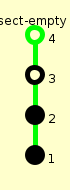
Proof step 3 from proof restrict-intersect-empty-write-add (previous step)
(back to tree)
| dom st ∩ s = ∅, st[a := d] \ (s -- a) ≠ st[a := d] ⊦ |
User applied rule apply rewrite lemma
And obtained the following new goals
Rule argument
spec: <toplevel>, name:restrict-intersect-empty, seq: ⊦ dom st ∩ s = ∅ → st \ s = st,
subst:[s, st] → [s -- a, st[a := d]], <all paths>
Additional information
Used simplifier rules:
dom-ins: ⊦ dom st[a := d] = dom st ++ a;
⊦ (s0 ++ a) ∩ (s1 -- a) = (s0 ∩ s1) -- a; (s)
int-a: ⊦ (s ∩ s0) ∩ s1 = s ∩ s0 ∩ s1; from specification polyset-union
int-c: ⊦ s ∩ s0 = s0 ∩ s; from specification polyset-union
⊦ s -- a = ∅ ↔ s = ∅ ∨ s = ∅ ++ a; (ws)
Used terms: s -- a, st[a := d]