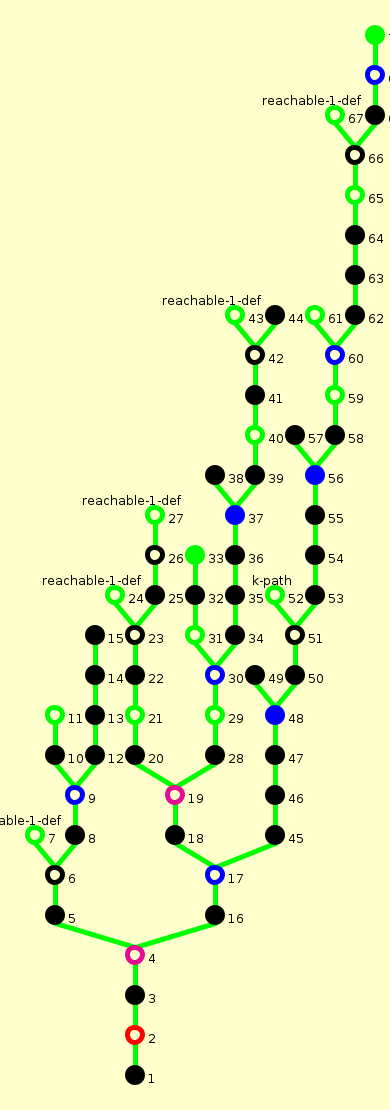
Proof Tree for reach-n-path-n (View conclusion)
The following image shows the proof tree of sequent calculus. The proved goal is at the bottom. You can click on the nodes to view additional rules. See here for details on colors in a proof tree.
| ⊦ n ≠ 0 → (reachable-n(h, n, r, r0) ↔ (∃ x. path(x, h) ∧ x.head = r ∧ x.last = r0 ∧ # x = n + 1)) |
n ≠ 0 ⊦ reachable-n(h, n, r, r0) ↔ (∃ x. path(x, h) ∧ x.head = r ∧ x.last = r0 ∧ # x = n + 1)
| n ≠ 0 ⊦ reachable-n(h, n, r, r0) ↔ (∃ x. path(x, h) ∧ x.head = r ∧ x.last = r0 ∧ # x = n + 1) |
n0 +1 ≠ 0, ∀ h, r, r0. n0 ≠ 0 → (reachable-n(h, n0, r, r0) ↔ (∃ x. path(x, h) ∧ x.head = r ∧ x.last = r0 ∧ # x = n0 + 1)) ⊦ reachable-n(h, n0 +1, r, r0) ↔ (∃ x. path(x, h) ∧ x.head = r ∧ x.last = r0 ∧ # x = n0 +1 + 1)
Used simplifier rules: nat freely generated by 0, +1;;
| n0 +1 ≠ 0, ∀ h, r, r0. n0 ≠ 0 → (reachable-n(h, n0, r, r0) ↔ (∃ x. path(x, h) ∧ x.head = r ∧ x.last = r0 ∧ # x = n0 + 1)) ⊦ reachable-n(h, n0 +1, r, r0) ↔ (∃ x. path(x, h) ∧ x.head = r ∧ x.last = r0 ∧ # x = n0 +1 + 1) |
n0 ≠ 0 → (∀ h, r, r0. reachable-n(h, n0, r, r0) ↔ (∃ x. path(x, h) ∧ x.head = r ∧ x.last = r0 ∧ # x = n0 + 1)) ⊦ (∃ r1. reachable-1(h, r, r1) ∧ reachable-n(h, n0, r1, r0)) ↔ (∃ x. path(x, h) ∧ x.head = r ∧ x.last = r0 ∧ # x = 2 + n0)
Used simplifier rules: reachable-n-rec: ⊦ reachable-n(h, n + 1, r, r0) ↔ (∃ r1. reachable-1(h, r, r1) ∧ reachable-n(h, n, r1, r0)); a: ⊦ (m + n0) + n1 = m + n0 + n1; from specification nat-basic c: ⊦ m + n = n + m; from specification nat-basic ⊦ m +1 = m + 1; (s) ⊦ m + 1 ≠ 0; (s)
| n0 ≠ 0 → (∀ h, r, r0. reachable-n(h, n0, r, r0) ↔ (∃ x. path(x, h) ∧ x.head = r ∧ x.last = r0 ∧ # x = n0 + 1)) ⊦ (∃ r1. reachable-1(h, r, r1) ∧ reachable-n(h, n0, r1, r0)) ↔ (∃ x. path(x, h) ∧ x.head = r ∧ x.last = r0 ∧ # x = 2 + n0) |
n0 = 0, n0 ≠ 0 → (∀ h, r, r0. reachable-n(h, n0, r, r0) ↔ (∃ x. path(x, h) ∧ x.head = r ∧ x.last = r0 ∧ # x = n0 + 1)) ⊦ (∃ r1. reachable-1(h, r, r1) ∧ reachable-n(h, n0, r1, r0)) ↔ (∃ x. path(x, h) ∧ x.head = r ∧ x.last = r0 ∧ # x = 2 + n0)
n0 = n +1, n0 ≠ 0 → (∀ h, r, r0. reachable-n(h, n0, r, r0) ↔ (∃ x. path(x, h) ∧ x.head = r ∧ x.last = r0 ∧ # x = n0 + 1)) ⊦ (∃ r1. reachable-1(h, r, r1) ∧ reachable-n(h, n0, r1, r0)) ↔ (∃ x. path(x, h) ∧ x.head = r ∧ x.last = r0 ∧ # x = 2 + n0)
Used simplifier rules: nat freely generated by 0, +1;;
| n0 = 0, n0 ≠ 0 → (∀ h, r, r0. reachable-n(h, n0, r, r0) ↔ (∃ x. path(x, h) ∧ x.head = r ∧ x.last = r0 ∧ # x = n0 + 1)) ⊦ (∃ r1. reachable-1(h, r, r1) ∧ reachable-n(h, n0, r1, r0)) ↔ (∃ x. path(x, h) ∧ x.head = r ∧ x.last = r0 ∧ # x = 2 + n0) |
⊦ reachable-1(h, r, r0) ↔ (∃ x. path(x, h) ∧ x.head = r ∧ x.last = r0 ∧ # x = 2)
Used simplifier rules: reachable-n-base: ⊦ reachable-n(h, 0, r, r0) ↔ r = r0;
| ⊦ reachable-1(h, r, r0) ↔ (∃ x. path(x, h) ∧ x.head = r ∧ x.last = r0 ∧ # x = 2) |
⊦ reachable-1(h, r, r0) ↔ r ≠ null ∧ r0 ≠ null ∧ r ∈ h ∧ r0 ∈ h ∧ h[r].nxt = r0
⊦ r ≠ null ∧ r0 ≠ null ∧ r ∈ h ∧ r0 ∈ h ∧ h[r].nxt = r0 ↔ (∃ x. path(x, h) ∧ x.head = r ∧ x.last = r0 ∧ # x = 2)
Used terms: r0, r, h
| ⊦ reachable-1(h, r, r0) ↔ r ≠ null ∧ r0 ≠ null ∧ r ∈ h ∧ r0 ∈ h ∧ h[r].nxt = r0 |
| ⊦ r ≠ null ∧ r0 ≠ null ∧ r ∈ h ∧ r0 ∈ h ∧ h[r].nxt = r0 ↔ (∃ x. path(x, h) ∧ x.head = r ∧ x.last = r0 ∧ # x = 2) |
⊦ r ≠ null ∧ h[r].nxt ≠ null ∧ r ∈ h ∧ h[r].nxt ∈ h ∧ h[r].nxt = r0 ↔ (∃ x. path(x, h) ∧ x.head = r ∧ x.last = r0 ∧ # x = 2)
| ⊦ r ≠ null ∧ h[r].nxt ≠ null ∧ r ∈ h ∧ h[r].nxt ∈ h ∧ h[r].nxt = r0 ↔ (∃ x. path(x, h) ∧ x.head = r ∧ x.last = r0 ∧ # x = 2) |
h[r].nxt = r0, h[r].nxt ≠ null, r ≠ null, r ∈ h, h[r].nxt ∈ h ⊦ ∃ x. path(x, h) ∧ x.head = r ∧ x.last = r0 ∧ # x = 2
∃ x. path(x, h) ∧ x.head = r ∧ x.last = r0 ∧ # x = 2 ⊦ r ≠ null ∧ h[r].nxt ≠ null ∧ r ∈ h ∧ h[r].nxt ∈ h ∧ h[r].nxt = r0
| h[r].nxt = r0, h[r].nxt ≠ null, r ≠ null, r ∈ h, h[r].nxt ∈ h ⊦ ∃ x. path(x, h) ∧ x.head = r ∧ x.last = r0 ∧ # x = 2 |
h[r].nxt ≠ null, r ≠ null, h[r].nxt ∈ h, r ∈ h ⊦ ∃ x. path(x, h) ∧ x.head = r ∧ x.last = h[x.head].nxt ∧ # x = 2
| h[r].nxt ≠ null, r ≠ null, h[r].nxt ∈ h, r ∈ h ⊦ ∃ x. path(x, h) ∧ x.head = r ∧ x.last = h[x.head].nxt ∧ # x = 2 |
Used simplifier rules: path-two: ⊦ path(r ' + r0 ', h) ↔ r ∈ h ∧ r0 ∈ h ∧ r ≠ null ∧ r0 ≠ null ∧ h[r].nxt = r0; ⊦ (x + a ').last = a; (s) ⊦ (a ' + x).head = a; (s) ⊦ #(x + y) = # x + # y; (s) ⊦ # a ' = 0 +1; (s) a: ⊦ (x + y) + z = x + y + z; from specification polylist Used terms: r ' + h[r].nxt '
| ∃ x. path(x, h) ∧ x.head = r ∧ x.last = r0 ∧ # x = 2 ⊦ r ≠ null ∧ h[r].nxt ≠ null ∧ r ∈ h ∧ h[r].nxt ∈ h ∧ h[r].nxt = r0 |
# x = 2, path(x, h) ⊦ x.head ≠ null ∧ h[x.head].nxt ≠ null ∧ x.head ∈ h ∧ h[x.head].nxt ∈ h ∧ h[x.head].nxt = x.last
| # x = 2, path(x, h) ⊦ x.head ≠ null ∧ h[x.head].nxt ≠ null ∧ x.head ∈ h ∧ h[x.head].nxt ∈ h ∧ h[x.head].nxt = x.last |
# x = 2, x = r + y, x ≠ [], path(x, h) ⊦ r ≠ null ∧ h[r].nxt ≠ null ∧ r ∈ h ∧ h[r].nxt ∈ h ∧ h[r].nxt = x.last
Used simplifier rules: ⊦ # [] = 0; (s) x ≠ [] ⊦ a = x.head ∧ y = x.tail ↔ x = a + y; (elim) Used terms: x, a, y
| # x = 2, x = r + y, x ≠ [], path(x, h) ⊦ r ≠ null ∧ h[r].nxt ≠ null ∧ r ∈ h ∧ h[r].nxt ∈ h ∧ h[r].nxt = x.last |
1 = # y, r ≠ null, path(r ' + y, h) ⊦ h[r].nxt = y.head ∧ h[r].nxt ∈ h ∧ h[r].nxt ≠ null
Used simplifier rules: path-first-in-H: ⊦ path(r ' + x, h) → (r ∈ h ↔ true); null-not-start-of-path: ⊦ ¬ path(null ' + x, h); a: ⊦ (x + y) + z = x + y + z; from specification polylist ⊦ # x = 1 → (y + x).last = x.head; (s) ⊦ a + x = a ' + x; (s) ⊦ a ' + x ≠ []; (s) c: ⊦ m + n = n + m; from specification nat-basic a: ⊦ (m + n0) + n1 = m + n0 + n1; from specification nat-basic n0 < n ⊦ (* n) = m0 + (* n0) ↔ n - n0 = m0; (s) ⊦ # a ' = 0 +1; (s) ⊦ #(x + y) = # x + # y; (s)
| 1 = # y, r ≠ null, path(r ' + y, h) ⊦ h[r].nxt = y.head ∧ h[r].nxt ∈ h ∧ h[r].nxt ≠ null |
Used simplifier rules: path-cons: ⊦ path(r ' + r0 ' + x, h) ↔ r ∈ h ∧ r ≠ null ∧ h[r].nxt = r0 ∧ path(r0 ' + x, h); path-first-in-H: ⊦ path(r ' + x, h) → (r ∈ h ↔ true); path-one: ⊦ path(r ', h) ↔ r ∈ h ∧ r ≠ null; ⊦ #(x + y) = # x + # y; (s) ⊦ # a ' = 0 +1; (s) ⊦ 1 = m + 1 ↔ m = 0; (s) ⊦ # x = 0 ↔ x = []; (s) a: ⊦ (m + n0) + n1 = m + n0 + n1; from specification nat-basic c: ⊦ m + n = n + m; from specification nat-basic ⊦ a ' + x ≠ []; (s) ⊦ a + x = a ' + x; (s) ⊦ x + [] = x; (s) a: ⊦ (x + y) + z = x + y + z; from specification polylist ⊦ # [] = 0; (s) x ≠ [] ⊦ a = x.head ∧ y = x.tail ↔ x = a + y; (elim) Used terms: y, a, y0
| n0 = n +1, n0 ≠ 0 → (∀ h, r, r0. reachable-n(h, n0, r, r0) ↔ (∃ x. path(x, h) ∧ x.head = r ∧ x.last = r0 ∧ # x = n0 + 1)) ⊦ (∃ r1. reachable-1(h, r, r1) ∧ reachable-n(h, n0, r1, r0)) ↔ (∃ x. path(x, h) ∧ x.head = r ∧ x.last = r0 ∧ # x = 2 + n0) |
∀ h0, r1, r2. (∃ r3. reachable-1(h0, r1, r3) ∧ reachable-n(h0, n, r3, r2)) ↔ (∃ x. path(x, h0) ∧ x.head = r1 ∧ x.last = r2 ∧ # x = 2 + n) ⊦ (∃ r1. reachable-1(h, r, r1) ∧ (∃ r2. reachable-1(h, r1, r2) ∧ reachable-n(h, n, r2, r0))) ↔ (∃ x. path(x, h) ∧ x.head = r ∧ x.last = r0 ∧ # x = 3 + n)
Used simplifier rules: reachable-n-rec: ⊦ reachable-n(h, n + 1, r, r0) ↔ (∃ r1. reachable-1(h, r, r1) ∧ reachable-n(h, n, r1, r0)); a: ⊦ (m + n0) + n1 = m + n0 + n1; from specification nat-basic c: ⊦ m + n = n + m; from specification nat-basic ⊦ m +1 = m + 1; (s) ⊦ m + 1 ≠ 0; (s)
| ∀ h0, r1, r2. (∃ r3. reachable-1(h0, r1, r3) ∧ reachable-n(h0, n, r3, r2)) ↔ (∃ x. path(x, h0) ∧ x.head = r1 ∧ x.last = r2 ∧ # x = 2 + n) ⊦ (∃ r1. reachable-1(h, r, r1) ∧ (∃ r2. reachable-1(h, r1, r2) ∧ reachable-n(h, n, r2, r0))) ↔ (∃ x. path(x, h) ∧ x.head = r ∧ x.last = r0 ∧ # x = 3 + n) |
∀ h0, r1, r2. (∃ r3. reachable-1(h0, r1, r3) ∧ reachable-n(h0, n, r3, r2)) ↔ (∃ x. path(x, h0) ∧ x.head = r1 ∧ x.last = r2 ∧ # x = 2 + n), ∃ r1. reachable-1(h, r, r1) ∧ (∃ r2. reachable-1(h, r1, r2) ∧ reachable-n(h, n, r2, r0)) ⊦ ∃ x. path(x, h) ∧ x.head = r ∧ x.last = r0 ∧ # x = 3 + n
∀ h0, r1, r2. (∃ r3. reachable-1(h0, r1, r3) ∧ reachable-n(h0, n, r3, r2)) ↔ (∃ x. path(x, h0) ∧ x.head = r1 ∧ x.last = r2 ∧ # x = 2 + n), ∃ x. path(x, h) ∧ x.head = r ∧ x.last = r0 ∧ # x = 3 + n ⊦ ∃ r1. reachable-1(h, r, r1) ∧ (∃ r2. reachable-1(h, r1, r2) ∧ reachable-n(h, n, r2, r0))
| ∀ h0, r1, r2. (∃ r3. reachable-1(h0, r1, r3) ∧ reachable-n(h0, n, r3, r2)) ↔ (∃ x. path(x, h0) ∧ x.head = r1 ∧ x.last = r2 ∧ # x = 2 + n), ∃ r1. reachable-1(h, r, r1) ∧ (∃ r2. reachable-1(h, r1, r2) ∧ reachable-n(h, n, r2, r0)) ⊦ ∃ x. path(x, h) ∧ x.head = r ∧ x.last = r0 ∧ # x = 3 + n |
reachable-1(h, r, r1), reachable-1(h, r1, r2), reachable-n(h, n, r2, r0), ∀ h0, r1, r2. (∃ r3. reachable-1(h0, r1, r3) ∧ reachable-n(h0, n, r3, r2)) ↔ (∃ x. path(x, h0) ∧ x.head = r1 ∧ x.last = r2 ∧ # x = 2 + n) ⊦ ∃ x. path(x, h) ∧ x.head = r ∧ x.last = r0 ∧ # x = 3 + n
| reachable-1(h, r, r1), reachable-1(h, r1, r2), reachable-n(h, n, r2, r0), ∀ h0, r1, r2. (∃ r3. reachable-1(h0, r1, r3) ∧ reachable-n(h0, n, r3, r2)) ↔ (∃ x. path(x, h0) ∧ x.head = r1 ∧ x.last = r2 ∧ # x = 2 + n) ⊦ ∃ x. path(x, h) ∧ x.head = r ∧ x.last = r0 ∧ # x = 3 + n |
n = 0, reachable-1(h, r1, r2), reachable-1(h, r, r1), reachable-n(h, n, r2, r0), ∀ h0, r1, r2. (∃ r3. reachable-1(h0, r1, r3) ∧ reachable-n(h0, n, r3, r2)) ↔ (∃ x. path(x, h0) ∧ x.head = r1 ∧ x.last = r2 ∧ # x = 2 + n) ⊦ ∃ x. path(x, h) ∧ x.head = r ∧ x.last = r0 ∧ # x = 3 + n
n = n0 +1, reachable-1(h, r1, r2), reachable-1(h, r, r1), reachable-n(h, n, r2, r0), ∀ h0, r1, r2. (∃ r3. reachable-1(h0, r1, r3) ∧ reachable-n(h0, n, r3, r2)) ↔ (∃ x. path(x, h0) ∧ x.head = r1 ∧ x.last = r2 ∧ # x = 2 + n) ⊦ ∃ x. path(x, h) ∧ x.head = r ∧ x.last = r0 ∧ # x = 3 + n
Used simplifier rules: nat freely generated by 0, +1;;
| n = 0, reachable-1(h, r1, r2), reachable-1(h, r, r1), reachable-n(h, n, r2, r0), ∀ h0, r1, r2. (∃ r3. reachable-1(h0, r1, r3) ∧ reachable-n(h0, n, r3, r2)) ↔ (∃ x. path(x, h0) ∧ x.head = r1 ∧ x.last = r2 ∧ # x = 2 + n) ⊦ ∃ x. path(x, h) ∧ x.head = r ∧ x.last = r0 ∧ # x = 3 + n |
reachable-1(h, r1, r0), reachable-1(h, r, r1), ∀ h0, r3, r4. reachable-1(h0, r3, r4) ↔ (∃ x. path(x, h0) ∧ x.head = r3 ∧ x.last = r4 ∧ # x = 2) ⊦ ∃ x. path(x, h) ∧ x.head = r ∧ x.last = r0 ∧ # x = 3
Used simplifier rules: reachable-n-base: ⊦ reachable-n(h, 0, r, r0) ↔ r = r0;
| reachable-1(h, r1, r0), reachable-1(h, r, r1), ∀ h0, r3, r4. reachable-1(h0, r3, r4) ↔ (∃ x. path(x, h0) ∧ x.head = r3 ∧ x.last = r4 ∧ # x = 2) ⊦ ∃ x. path(x, h) ∧ x.head = r ∧ x.last = r0 ∧ # x = 3 |
reachable-1(h, r, r1), reachable-1(h, r1, r0), ∀ h0, r3, r4. reachable-1(h0, r3, r4) ↔ (∃ x. path(x, h0) ∧ x.head = r3 ∧ x.last = r4 ∧ # x = 2) ⊦ path(r ' + r1 ' + r0 ', h) ∧ (r ' + r1 ' + r0 ').head = r ∧ (r ' + r1 ' + r0 ').last = r0 ∧ #(r ' + r1 ' + r0 ') = 3
Used terms: r ' + r1 ' + r0 '
| reachable-1(h, r, r1), reachable-1(h, r1, r0), ∀ h0, r3, r4. reachable-1(h0, r3, r4) ↔ (∃ x. path(x, h0) ∧ x.head = r3 ∧ x.last = r4 ∧ # x = 2) ⊦ path(r ' + r1 ' + r0 ', h) ∧ (r ' + r1 ' + r0 ').head = r ∧ (r ' + r1 ' + r0 ').last = r0 ∧ #(r ' + r1 ' + r0 ') = 3 |
reachable-1(h, r1, r0), reachable-1(h, r, r1), ∀ h0, r3, r4. reachable-1(h0, r3, r4) ↔ (∃ x. path(x, h0) ∧ x.head = r3 ∧ x.last = r4 ∧ # x = 2) ⊦ r ∈ h ∧ r ≠ null ∧ h[r].nxt = r1 ∧ h[r].nxt ∈ h ∧ h[h[r].nxt].nxt ∈ h ∧ h[r].nxt ≠ null ∧ h[h[r].nxt].nxt ≠ null ∧ h[h[r].nxt].nxt = r0
Used simplifier rules: path-cons: ⊦ path(r ' + r0 ' + x, h) ↔ r ∈ h ∧ r ≠ null ∧ h[r].nxt = r0 ∧ path(r0 ' + x, h); path-two: ⊦ path(r ' + r0 ', h) ↔ r ∈ h ∧ r0 ∈ h ∧ r ≠ null ∧ r0 ≠ null ∧ h[r].nxt = r0; a: ⊦ (x + y) + z = x + y + z; from specification polylist ⊦ # a ' = 0 +1; (s) ⊦ #(x + y) = # x + # y; (s) ⊦ (x + a ').last = a; (s) ⊦ (b ' + a ' + x).last = (a ' + x).last; (s) ⊦ (a ' + x).head = a; (s)
| reachable-1(h, r1, r0), reachable-1(h, r, r1), ∀ h0, r3, r4. reachable-1(h0, r3, r4) ↔ (∃ x. path(x, h0) ∧ x.head = r3 ∧ x.last = r4 ∧ # x = 2) ⊦ r ∈ h ∧ r ≠ null ∧ h[r].nxt = r1 ∧ h[r].nxt ∈ h ∧ h[h[r].nxt].nxt ∈ h ∧ h[r].nxt ≠ null ∧ h[h[r].nxt].nxt ≠ null ∧ h[h[r].nxt].nxt = r0 |
⊦ reachable-1(h, r, r0) ↔ r ≠ null ∧ r0 ≠ null ∧ r ∈ h ∧ r0 ∈ h ∧ h[r].nxt = r0
h[r].nxt = r1, r ≠ null, r1 ≠ null, reachable-1(h, r1, r0), r ∈ h, r1 ∈ h, ∀ h0, r3, r4. reachable-1(h0, r3, r4) ↔ (∃ x. path(x, h0) ∧ x.head = r3 ∧ x.last = r4 ∧ # x = 2) ⊦ r ∈ h ∧ r ≠ null ∧ h[r].nxt = r1 ∧ h[r].nxt ∈ h ∧ h[h[r].nxt].nxt ∈ h ∧ h[r].nxt ≠ null ∧ h[h[r].nxt].nxt ≠ null ∧ h[h[r].nxt].nxt = r0
Used terms: r1, r, h
| ⊦ reachable-1(h, r, r0) ↔ r ≠ null ∧ r0 ≠ null ∧ r ∈ h ∧ r0 ∈ h ∧ h[r].nxt = r0 |
| h[r].nxt = r1, r ≠ null, r1 ≠ null, reachable-1(h, r1, r0), r ∈ h, r1 ∈ h, ∀ h0, r3, r4. reachable-1(h0, r3, r4) ↔ (∃ x. path(x, h0) ∧ x.head = r3 ∧ x.last = r4 ∧ # x = 2) ⊦ r ∈ h ∧ r ≠ null ∧ h[r].nxt = r1 ∧ h[r].nxt ∈ h ∧ h[h[r].nxt].nxt ∈ h ∧ h[r].nxt ≠ null ∧ h[h[r].nxt].nxt ≠ null ∧ h[h[r].nxt].nxt = r0 |
h[r].nxt ≠ null, r ≠ null, reachable-1(h, h[r].nxt, r0), h[r].nxt ∈ h, r ∈ h, ∀ h0, r3, r4. reachable-1(h0, r3, r4) ↔ (∃ x. path(x, h0) ∧ x.head = r3 ∧ x.last = r4 ∧ # x = 2) ⊦ h[h[r].nxt].nxt ∈ h ∧ h[h[r].nxt].nxt ≠ null ∧ h[h[r].nxt].nxt = r0
| h[r].nxt ≠ null, r ≠ null, reachable-1(h, h[r].nxt, r0), h[r].nxt ∈ h, r ∈ h, ∀ h0, r3, r4. reachable-1(h0, r3, r4) ↔ (∃ x. path(x, h0) ∧ x.head = r3 ∧ x.last = r4 ∧ # x = 2) ⊦ h[h[r].nxt].nxt ∈ h ∧ h[h[r].nxt].nxt ≠ null ∧ h[h[r].nxt].nxt = r0 |
⊦ reachable-1(h, r, r0) ↔ r ≠ null ∧ r0 ≠ null ∧ r ∈ h ∧ r0 ∈ h ∧ h[r].nxt = r0
Used terms: r0, h[r].nxt, h
| ⊦ reachable-1(h, r, r0) ↔ r ≠ null ∧ r0 ≠ null ∧ r ∈ h ∧ r0 ∈ h ∧ h[r].nxt = r0 |
| n = n0 +1, reachable-1(h, r1, r2), reachable-1(h, r, r1), reachable-n(h, n, r2, r0), ∀ h0, r1, r2. (∃ r3. reachable-1(h0, r1, r3) ∧ reachable-n(h0, n, r3, r2)) ↔ (∃ x. path(x, h0) ∧ x.head = r1 ∧ x.last = r2 ∧ # x = 2 + n) ⊦ ∃ x. path(x, h) ∧ x.head = r ∧ x.last = r0 ∧ # x = 3 + n |
reachable-1(h, r, r1), reachable-1(h, r1, r2), reachable-1(h, r2, r3), reachable-n(h, n0, r3, r0), ∀ h0, r4, r5. (∃ r6. reachable-1(h0, r4, r6) ∧ (∃ r1. reachable-1(h0, r6, r1) ∧ reachable-n(h0, n0, r1, r5))) ↔ (∃ x. path(x, h0) ∧ x.head = r4 ∧ x.last = r5 ∧ # x = 3 + n0) ⊦ ∃ x. path(x, h) ∧ x.head = r ∧ x.last = r0 ∧ # x = 4 + n0
Used simplifier rules: reachable-n-rec: ⊦ reachable-n(h, n + 1, r, r0) ↔ (∃ r1. reachable-1(h, r, r1) ∧ reachable-n(h, n, r1, r0)); a: ⊦ (m + n0) + n1 = m + n0 + n1; from specification nat-basic c: ⊦ m + n = n + m; from specification nat-basic ⊦ m +1 = m + 1; (s)
| reachable-1(h, r, r1), reachable-1(h, r1, r2), reachable-1(h, r2, r3), reachable-n(h, n0, r3, r0), ∀ h0, r4, r5. (∃ r6. reachable-1(h0, r4, r6) ∧ (∃ r1. reachable-1(h0, r6, r1) ∧ reachable-n(h0, n0, r1, r5))) ↔ (∃ x. path(x, h0) ∧ x.head = r4 ∧ x.last = r5 ∧ # x = 3 + n0) ⊦ ∃ x. path(x, h) ∧ x.head = r ∧ x.last = r0 ∧ # x = 4 + n0 |
reachable-1(h, r2, r3), reachable-1(h, r1, r2), reachable-1(h, r, r1), reachable-n(h, n0, r3, r0), (∃ r6. reachable-1(h, r1, r6) ∧ (∃ r1. reachable-1(h, r6, r1) ∧ reachable-n(h, n0, r1, r0))) ↔ (∃ x. path(x, h) ∧ x.head = r1 ∧ x.last = r0 ∧ # x = 3 + n0) ⊦ ∃ x. path(x, h) ∧ x.head = r ∧ x.last = r0 ∧ # x = 4 + n0
Used terms: h, r1, r0
| reachable-1(h, r2, r3), reachable-1(h, r1, r2), reachable-1(h, r, r1), reachable-n(h, n0, r3, r0), (∃ r6. reachable-1(h, r1, r6) ∧ (∃ r1. reachable-1(h, r6, r1) ∧ reachable-n(h, n0, r1, r0))) ↔ (∃ x. path(x, h) ∧ x.head = r1 ∧ x.last = r0 ∧ # x = 3 + n0) ⊦ ∃ x. path(x, h) ∧ x.head = r ∧ x.last = r0 ∧ # x = 4 + n0 |
reachable-1(h, r, r1), reachable-1(h, r1, r2), reachable-1(h, r2, r3), reachable-n(h, n0, r3, r0) ⊦ ∃ x. path(x, h) ∧ x.head = r ∧ x.last = r0 ∧ # x = 4 + n0, ∃ x. path(x, h) ∧ x.head = r1 ∧ x.last = r0 ∧ # x = 3 + n0, ∃ r6. reachable-1(h, r1, r6) ∧ (∃ r1. reachable-1(h, r6, r1) ∧ reachable-n(h, n0, r1, r0))
reachable-1(h, r, r1), reachable-1(h, r1, r2), reachable-1(h, r2, r3), reachable-n(h, n0, r3, r0), ∃ x. path(x, h) ∧ x.head = r1 ∧ x.last = r0 ∧ # x = 3 + n0, ∃ r6. reachable-1(h, r1, r6) ∧ (∃ r1. reachable-1(h, r6, r1) ∧ reachable-n(h, n0, r1, r0)) ⊦ ∃ x. path(x, h) ∧ x.head = r ∧ x.last = r0 ∧ # x = 4 + n0
| reachable-1(h, r, r1), reachable-1(h, r1, r2), reachable-1(h, r2, r3), reachable-n(h, n0, r3, r0) ⊦ ∃ x. path(x, h) ∧ x.head = r ∧ x.last = r0 ∧ # x = 4 + n0, ∃ x. path(x, h) ∧ x.head = r1 ∧ x.last = r0 ∧ # x = 3 + n0, ∃ r6. reachable-1(h, r1, r6) ∧ (∃ r1. reachable-1(h, r6, r1) ∧ reachable-n(h, n0, r1, r0)) |
reachable-1(h, r2, r3), reachable-1(h, r1, r2), reachable-1(h, r, r1), reachable-n(h, n0, r3, r0) ⊦ ∃ x. path(x, h) ∧ x.head = r1 ∧ x.last = r0 ∧ # x = 3 + n0, ∃ x. path(x, h) ∧ x.head = r ∧ x.last = r0 ∧ # x = 4 + n0, reachable-1(h, r1, r2) ∧ (∃ r1. reachable-1(h, r2, r1) ∧ reachable-n(h, n0, r1, r0))
Used terms: r2
| reachable-1(h, r2, r3), reachable-1(h, r1, r2), reachable-1(h, r, r1), reachable-n(h, n0, r3, r0) ⊦ ∃ x. path(x, h) ∧ x.head = r1 ∧ x.last = r0 ∧ # x = 3 + n0, ∃ x. path(x, h) ∧ x.head = r ∧ x.last = r0 ∧ # x = 4 + n0, reachable-1(h, r1, r2) ∧ (∃ r1. reachable-1(h, r2, r1) ∧ reachable-n(h, n0, r1, r0)) |
reachable-1(h, r, r1), reachable-1(h, r1, r2), reachable-1(h, r2, r3), reachable-n(h, n0, r3, r0) ⊦ ∃ x. path(x, h) ∧ x.head = r ∧ x.last = r0 ∧ # x = 4 + n0, ∃ x. path(x, h) ∧ x.head = r1 ∧ x.last = r0 ∧ # x = 3 + n0, ∃ r1. reachable-1(h, r2, r1) ∧ reachable-n(h, n0, r1, r0)
| reachable-1(h, r, r1), reachable-1(h, r1, r2), reachable-1(h, r2, r3), reachable-n(h, n0, r3, r0) ⊦ ∃ x. path(x, h) ∧ x.head = r ∧ x.last = r0 ∧ # x = 4 + n0, ∃ x. path(x, h) ∧ x.head = r1 ∧ x.last = r0 ∧ # x = 3 + n0, ∃ r1. reachable-1(h, r2, r1) ∧ reachable-n(h, n0, r1, r0) |
Used terms: r3
| reachable-1(h, r, r1), reachable-1(h, r1, r2), reachable-1(h, r2, r3), reachable-n(h, n0, r3, r0), ∃ x. path(x, h) ∧ x.head = r1 ∧ x.last = r0 ∧ # x = 3 + n0, ∃ r6. reachable-1(h, r1, r6) ∧ (∃ r1. reachable-1(h, r6, r1) ∧ reachable-n(h, n0, r1, r0)) ⊦ ∃ x. path(x, h) ∧ x.head = r ∧ x.last = r0 ∧ # x = 4 + n0 |
# x = 3 + n0, path(x, h), reachable-1(h, x.head, r6), reachable-1(h, r6, r4), reachable-1(h, r2, r3), reachable-1(h, x.head, r2), reachable-1(h, r, x.head), reachable-n(h, n0, r4, x.last), reachable-n(h, n0, r3, x.last) ⊦ ∃ x0. path(x0, h) ∧ x0.head = r ∧ x0.last = x.last ∧ # x0 = 4 + n0
| # x = 3 + n0, path(x, h), reachable-1(h, x.head, r6), reachable-1(h, r6, r4), reachable-1(h, r2, r3), reachable-1(h, x.head, r2), reachable-1(h, r, x.head), reachable-n(h, n0, r4, x.last), reachable-n(h, n0, r3, x.last) ⊦ ∃ x0. path(x0, h) ∧ x0.head = r ∧ x0.last = x.last ∧ # x0 = 4 + n0 |
# x = 3 + n0, x = r0 + y, x ≠ [], path(x, h), reachable-1(h, r, r0), reachable-1(h, r0, r2), reachable-1(h, r2, r3), reachable-1(h, r6, r4), reachable-1(h, r0, r6), reachable-n(h, n0, r3, x.last), reachable-n(h, n0, r4, x.last) ⊦ ∃ x0. path(x0, h) ∧ x0.head = r ∧ x0.last = x.last ∧ # x0 = 4 + n0
Used simplifier rules: ⊦ # [] = 0; (s) ⊦ m + n = 0 ↔ m = 0 ∧ n = 0; (ws) a: ⊦ (m + n0) + n1 = m + n0 + n1; from specification nat-basic c: ⊦ m + n = n + m; from specification nat-basic x ≠ [] ⊦ a = x.head ∧ y = x.tail ↔ x = a + y; (elim) Used terms: x, a, y
| # x = 3 + n0, x = r0 + y, x ≠ [], path(x, h), reachable-1(h, r, r0), reachable-1(h, r0, r2), reachable-1(h, r2, r3), reachable-1(h, r6, r4), reachable-1(h, r0, r6), reachable-n(h, n0, r3, x.last), reachable-n(h, n0, r4, x.last) ⊦ ∃ x0. path(x0, h) ∧ x0.head = r ∧ x0.last = x.last ∧ # x0 = 4 + n0 |
1 + # y = 3 + n0, path(r0 ' + y, h), reachable-1(h, r0, r6), reachable-1(h, r6, r4), reachable-1(h, r2, r3), reachable-1(h, r0, r2), reachable-1(h, r, r0), reachable-n(h, n0, r4, (r0 ' + y).last), reachable-n(h, n0, r3, (r0 ' + y).last) ⊦ ∃ x0. path(x0, h) ∧ x0.head = r ∧ x0.last = (r0 ' + y).last ∧ # x0 = 4 + n0
Used simplifier rules: ⊦ a + x = a ' + x; (s) a: ⊦ (x + y) + z = x + y + z; from specification polylist ⊦ a ' + x ≠ []; (s) ⊦ # a ' = 0 +1; (s) ⊦ #(x + y) = # x + # y; (s)
| 1 + # y = 3 + n0, path(r0 ' + y, h), reachable-1(h, r0, r6), reachable-1(h, r6, r4), reachable-1(h, r2, r3), reachable-1(h, r0, r2), reachable-1(h, r, r0), reachable-n(h, n0, r4, (r0 ' + y).last), reachable-n(h, n0, r3, (r0 ' + y).last) ⊦ ∃ x0. path(x0, h) ∧ x0.head = r ∧ x0.last = (r0 ' + y).last ∧ # x0 = 4 + n0 |
1 + # y = 3 + n0, y = [], path(r0 ' + y, h), reachable-1(h, r, r0), reachable-1(h, r0, r2), reachable-1(h, r2, r3), reachable-1(h, r6, r4), reachable-1(h, r0, r6), reachable-n(h, n0, r3, (r0 ' + y).last), reachable-n(h, n0, r4, (r0 ' + y).last) ⊦ ∃ x0. path(x0, h) ∧ x0.head = r ∧ x0.last = (r0 ' + y).last ∧ # x0 = 4 + n0
1 + # y = 3 + n0, y ≠ [], path(r0 ' + y, h), reachable-1(h, r, r0), reachable-1(h, r0, r2), reachable-1(h, r2, r3), reachable-1(h, r6, r4), reachable-1(h, r0, r6), reachable-n(h, n0, r3, (r0 ' + y).last), reachable-n(h, n0, r4, (r0 ' + y).last) ⊦ ∃ x0. path(x0, h) ∧ x0.head = r ∧ x0.last = (r0 ' + y).last ∧ # x0 = 4 + n0
Used formulas: y = []
| 1 + # y = 3 + n0, y = [], path(r0 ' + y, h), reachable-1(h, r, r0), reachable-1(h, r0, r2), reachable-1(h, r2, r3), reachable-1(h, r6, r4), reachable-1(h, r0, r6), reachable-n(h, n0, r3, (r0 ' + y).last), reachable-n(h, n0, r4, (r0 ' + y).last) ⊦ ∃ x0. path(x0, h) ∧ x0.head = r ∧ x0.last = (r0 ' + y).last ∧ # x0 = 4 + n0 |
Used simplifier rules: c: ⊦ m + n = n + m; from specification nat-basic a: ⊦ (m + n0) + n1 = m + n0 + n1; from specification nat-basic n < n0 ⊦ (* n) ≠ m0 + (* n0); (s) ⊦ # [] = 0; (s)
| 1 + # y = 3 + n0, y ≠ [], path(r0 ' + y, h), reachable-1(h, r, r0), reachable-1(h, r0, r2), reachable-1(h, r2, r3), reachable-1(h, r6, r4), reachable-1(h, r0, r6), reachable-n(h, n0, r3, (r0 ' + y).last), reachable-n(h, n0, r4, (r0 ' + y).last) ⊦ ∃ x0. path(x0, h) ∧ x0.head = r ∧ x0.last = (r0 ' + y).last ∧ # x0 = 4 + n0 |
1 + # y = 3 + n0, y ≠ [], path(r0 ' + y, h), reachable-1(h, r0, r6), reachable-1(h, r6, r4), reachable-1(h, r2, r3), reachable-1(h, r0, r2), reachable-1(h, r, r0), reachable-n(h, n0, r4, y.last), reachable-n(h, n0, r3, y.last) ⊦ ∃ x0. path(x0, h) ∧ x0.head = r ∧ x0.last = y.last ∧ # x0 = 4 + n0
Used simplifier rules: a: ⊦ (x + y) + z = x + y + z; from specification polylist ⊦ x ≠ [] → (a ' + x).last = x.last; (s)
| 1 + # y = 3 + n0, y ≠ [], path(r0 ' + y, h), reachable-1(h, r0, r6), reachable-1(h, r6, r4), reachable-1(h, r2, r3), reachable-1(h, r0, r2), reachable-1(h, r, r0), reachable-n(h, n0, r4, y.last), reachable-n(h, n0, r3, y.last) ⊦ ∃ x0. path(x0, h) ∧ x0.head = r ∧ x0.last = y.last ∧ # x0 = 4 + n0 |
1 + # y = 3 + n0, y ≠ [], path(r0 ' + y, h), reachable-1(h, r, r0), reachable-1(h, r0, r2), reachable-1(h, r2, r3), reachable-1(h, r6, r4), reachable-1(h, r0, r6), reachable-n(h, n0, r3, y.last), reachable-n(h, n0, r4, y.last) ⊦ path(r + r0 + y, h) ∧ (r + r0 + y).head = r ∧ (r + r0 + y).last = y.last ∧ #(r + r0 + y) = 4 + n0
Used terms: r + r0 + y
| 1 + # y = 3 + n0, y ≠ [], path(r0 ' + y, h), reachable-1(h, r, r0), reachable-1(h, r0, r2), reachable-1(h, r2, r3), reachable-1(h, r6, r4), reachable-1(h, r0, r6), reachable-n(h, n0, r3, y.last), reachable-n(h, n0, r4, y.last) ⊦ path(r + r0 + y, h) ∧ (r + r0 + y).head = r ∧ (r + r0 + y).last = y.last ∧ #(r + r0 + y) = 4 + n0 |
1 + # y = 3 + n0, y ≠ [], path(r0 ' + y, h), reachable-1(h, r0, r6), reachable-1(h, r6, r4), reachable-1(h, r2, r3), reachable-1(h, r0, r2), reachable-1(h, r, r0), reachable-n(h, n0, r4, y.last), reachable-n(h, n0, r3, y.last) ⊦ r ∈ h ∧ r ≠ null ∧ h[r].nxt = r0 ∧ 2 + # y = 4 + n0
Used simplifier rules: path-cons: ⊦ path(r ' + r0 ' + x, h) ↔ r ∈ h ∧ r ≠ null ∧ h[r].nxt = r0 ∧ path(r0 ' + x, h); a: ⊦ (x + y) + z = x + y + z; from specification polylist c: ⊦ m + n = n + m; from specification nat-basic a: ⊦ (m + n0) + n1 = m + n0 + n1; from specification nat-basic ⊦ # a ' = 0 +1; (s) ⊦ #(x + y) = # x + # y; (s) ⊦ a + x = a ' + x; (s) ⊦ x ≠ [] → (a ' + x).last = x.last; (s) ⊦ (b ' + a ' + x).last = (a ' + x).last; (s) ⊦ (a ' + x).head = a; (s)
| 1 + # y = 3 + n0, y ≠ [], path(r0 ' + y, h), reachable-1(h, r0, r6), reachable-1(h, r6, r4), reachable-1(h, r2, r3), reachable-1(h, r0, r2), reachable-1(h, r, r0), reachable-n(h, n0, r4, y.last), reachable-n(h, n0, r3, y.last) ⊦ r ∈ h ∧ r ≠ null ∧ h[r].nxt = r0 ∧ 2 + # y = 4 + n0 |
⊦ reachable-1(h, r, r0) ↔ r ≠ null ∧ r0 ≠ null ∧ r ∈ h ∧ r0 ∈ h ∧ h[r].nxt = r0
1 + # y = 3 + n0, h[r].nxt = r0, r ≠ null, r0 ≠ null, y ≠ [], path(r0 ' + y, h), reachable-1(h, r0, r2), reachable-1(h, r2, r3), reachable-1(h, r6, r4), reachable-1(h, r0, r6), reachable-n(h, n0, r3, y.last), reachable-n(h, n0, r4, y.last), r ∈ h, r0 ∈ h ⊦ r ∈ h ∧ r ≠ null ∧ h[r].nxt = r0 ∧ 2 + # y = 4 + n0
Used terms: r0, r, h
| ⊦ reachable-1(h, r, r0) ↔ r ≠ null ∧ r0 ≠ null ∧ r ∈ h ∧ r0 ∈ h ∧ h[r].nxt = r0 |
| 1 + # y = 3 + n0, h[r].nxt = r0, r ≠ null, r0 ≠ null, y ≠ [], path(r0 ' + y, h), reachable-1(h, r0, r2), reachable-1(h, r2, r3), reachable-1(h, r6, r4), reachable-1(h, r0, r6), reachable-n(h, n0, r3, y.last), reachable-n(h, n0, r4, y.last), r ∈ h, r0 ∈ h ⊦ r ∈ h ∧ r ≠ null ∧ h[r].nxt = r0 ∧ 2 + # y = 4 + n0 |
Used simplifier rules: reachable-1-def: ⊦ reachable-1(h, r, r0) ↔ r ≠ null ∧ r0 ≠ null ∧ r ∈ h ∧ r0 ∈ h ∧ h[r].nxt = r0; c: ⊦ m + n = n + m; from specification nat-basic a: ⊦ (m + n0) + n1 = m + n0 + n1; from specification nat-basic n < n0 ⊦ m + (* n) = m0 + (* n0) ↔ m = m0 + (n0 - n); (s)
| ∀ h0, r1, r2. (∃ r3. reachable-1(h0, r1, r3) ∧ reachable-n(h0, n, r3, r2)) ↔ (∃ x. path(x, h0) ∧ x.head = r1 ∧ x.last = r2 ∧ # x = 2 + n), ∃ x. path(x, h) ∧ x.head = r ∧ x.last = r0 ∧ # x = 3 + n ⊦ ∃ r1. reachable-1(h, r, r1) ∧ (∃ r2. reachable-1(h, r1, r2) ∧ reachable-n(h, n, r2, r0)) |
# x = 3 + n, path(x, h), ∀ h0, r1, r2. (∃ r3. reachable-1(h0, r1, r3) ∧ reachable-n(h0, n, r3, r2)) ↔ (∃ x. path(x, h0) ∧ x.head = r1 ∧ x.last = r2 ∧ # x = 2 + n) ⊦ ∃ r1. reachable-1(h, x.head, r1) ∧ (∃ r2. reachable-1(h, r1, r2) ∧ reachable-n(h, n, r2, x.last))
| # x = 3 + n, path(x, h), ∀ h0, r1, r2. (∃ r3. reachable-1(h0, r1, r3) ∧ reachable-n(h0, n, r3, r2)) ↔ (∃ x. path(x, h0) ∧ x.head = r1 ∧ x.last = r2 ∧ # x = 2 + n) ⊦ ∃ r1. reachable-1(h, x.head, r1) ∧ (∃ r2. reachable-1(h, r1, r2) ∧ reachable-n(h, n, r2, x.last)) |
# x = 3 + n, x = r + y, x ≠ [], path(x, h), ∀ h0, r1, r2. (∃ r3. reachable-1(h0, r1, r3) ∧ reachable-n(h0, n, r3, r2)) ↔ (∃ x. path(x, h0) ∧ x.head = r1 ∧ x.last = r2 ∧ # x = 2 + n) ⊦ ∃ r1. reachable-1(h, r, r1) ∧ (∃ r2. reachable-1(h, r1, r2) ∧ reachable-n(h, n, r2, x.last))
Used simplifier rules: ⊦ # [] = 0; (s) ⊦ m + n = 0 ↔ m = 0 ∧ n = 0; (ws) a: ⊦ (m + n0) + n1 = m + n0 + n1; from specification nat-basic c: ⊦ m + n = n + m; from specification nat-basic x ≠ [] ⊦ a = x.head ∧ y = x.tail ↔ x = a + y; (elim) Used terms: x, a, y
| # x = 3 + n, x = r + y, x ≠ [], path(x, h), ∀ h0, r1, r2. (∃ r3. reachable-1(h0, r1, r3) ∧ reachable-n(h0, n, r3, r2)) ↔ (∃ x. path(x, h0) ∧ x.head = r1 ∧ x.last = r2 ∧ # x = 2 + n) ⊦ ∃ r1. reachable-1(h, r, r1) ∧ (∃ r2. reachable-1(h, r1, r2) ∧ reachable-n(h, n, r2, x.last)) |
1 + # y = 3 + n, path(r ' + y, h), ∀ h0, r1, r2. (∃ r3. reachable-1(h0, r1, r3) ∧ reachable-n(h0, n, r3, r2)) ↔ (∃ x. path(x, h0) ∧ x.head = r1 ∧ x.last = r2 ∧ # x = 2 + n) ⊦ ∃ r1. reachable-1(h, r, r1) ∧ (∃ r2. reachable-1(h, r1, r2) ∧ reachable-n(h, n, r2, (r ' + y).last))
Used simplifier rules: ⊦ a + x = a ' + x; (s) a: ⊦ (x + y) + z = x + y + z; from specification polylist ⊦ a ' + x ≠ []; (s) ⊦ # a ' = 0 +1; (s) ⊦ #(x + y) = # x + # y; (s)
| 1 + # y = 3 + n, path(r ' + y, h), ∀ h0, r1, r2. (∃ r3. reachable-1(h0, r1, r3) ∧ reachable-n(h0, n, r3, r2)) ↔ (∃ x. path(x, h0) ∧ x.head = r1 ∧ x.last = r2 ∧ # x = 2 + n) ⊦ ∃ r1. reachable-1(h, r, r1) ∧ (∃ r2. reachable-1(h, r1, r2) ∧ reachable-n(h, n, r2, (r ' + y).last)) |
1 + # y = 3 + n, y = [], path(r ' + y, h), ∀ h0, r1, r2. (∃ r3. reachable-1(h0, r1, r3) ∧ reachable-n(h0, n, r3, r2)) ↔ (∃ x. path(x, h0) ∧ x.head = r1 ∧ x.last = r2 ∧ # x = 2 + n) ⊦ ∃ r1. reachable-1(h, r, r1) ∧ (∃ r2. reachable-1(h, r1, r2) ∧ reachable-n(h, n, r2, (r ' + y).last))
1 + # y = 3 + n, y ≠ [], path(r ' + y, h), ∀ h0, r1, r2. (∃ r3. reachable-1(h0, r1, r3) ∧ reachable-n(h0, n, r3, r2)) ↔ (∃ x. path(x, h0) ∧ x.head = r1 ∧ x.last = r2 ∧ # x = 2 + n) ⊦ ∃ r1. reachable-1(h, r, r1) ∧ (∃ r2. reachable-1(h, r1, r2) ∧ reachable-n(h, n, r2, (r ' + y).last))
Used formulas: y = []
| 1 + # y = 3 + n, y = [], path(r ' + y, h), ∀ h0, r1, r2. (∃ r3. reachable-1(h0, r1, r3) ∧ reachable-n(h0, n, r3, r2)) ↔ (∃ x. path(x, h0) ∧ x.head = r1 ∧ x.last = r2 ∧ # x = 2 + n) ⊦ ∃ r1. reachable-1(h, r, r1) ∧ (∃ r2. reachable-1(h, r1, r2) ∧ reachable-n(h, n, r2, (r ' + y).last)) |
Used simplifier rules: c: ⊦ m + n = n + m; from specification nat-basic a: ⊦ (m + n0) + n1 = m + n0 + n1; from specification nat-basic n < n0 ⊦ (* n) ≠ m0 + (* n0); (s) ⊦ # [] = 0; (s)
| 1 + # y = 3 + n, y ≠ [], path(r ' + y, h), ∀ h0, r1, r2. (∃ r3. reachable-1(h0, r1, r3) ∧ reachable-n(h0, n, r3, r2)) ↔ (∃ x. path(x, h0) ∧ x.head = r1 ∧ x.last = r2 ∧ # x = 2 + n) ⊦ ∃ r1. reachable-1(h, r, r1) ∧ (∃ r2. reachable-1(h, r1, r2) ∧ reachable-n(h, n, r2, (r ' + y).last)) |
1 + # y = 3 + n, y ≠ [], path(r ' + y, h), ∀ h0, r1, r2. (∃ r3. reachable-1(h0, r1, r3) ∧ reachable-n(h0, n, r3, r2)) ↔ (∃ x. path(x, h0) ∧ x.head = r1 ∧ x.last = r2 ∧ # x = 2 + n) ⊦ ∃ r1. reachable-1(h, r, r1) ∧ (∃ r2. reachable-1(h, r1, r2) ∧ reachable-n(h, n, r2, y.last))
Used simplifier rules: a: ⊦ (x + y) + z = x + y + z; from specification polylist ⊦ x ≠ [] → (a ' + x).last = x.last; (s)
| 1 + # y = 3 + n, y ≠ [], path(r ' + y, h), ∀ h0, r1, r2. (∃ r3. reachable-1(h0, r1, r3) ∧ reachable-n(h0, n, r3, r2)) ↔ (∃ x. path(x, h0) ∧ x.head = r1 ∧ x.last = r2 ∧ # x = 2 + n) ⊦ ∃ r1. reachable-1(h, r, r1) ∧ (∃ r2. reachable-1(h, r1, r2) ∧ reachable-n(h, n, r2, y.last)) |
⊦ path(x, h) ↔ # x = 1 ∧ x.head ∈ h ∧ x.head ≠ null ∨ # x = 1 + 1 ∧ x.head ∈ h ∧ x.tail.head ∈ h ∧ x.head ≠ null ∧ x.tail.head ≠ null ∧ h[x.head].nxt = x.tail.head ∨ # x ≥ 1 + 1 ∧ x.head ∈ h ∧ x.head ≠ null ∧ h[x.head].nxt = x.tail.head ∧ path(x.tail, h)
1 + # y = 3 + n, y ≠ [], ∀ h0, r1, r2. (∃ r3. reachable-1(h0, r1, r3) ∧ reachable-n(h0, n, r3, r2)) ↔ (∃ x. path(x, h0) ∧ x.head = r1 ∧ x.last = r2 ∧ # x = 2 + n), #(r ' + y) = 1 ∧ (r ' + y).head ∈ h ∧ (r ' + y).head ≠ null ∨ #(r ' + y) = 1 + 1 ∧ (r ' + y).head ∈ h ∧ (r ' + y).tail.head ∈ h ∧ (r ' + y).head ≠ null ∧ (r ' + y).tail.head ≠ null ∧ h[(r ' + y).head].nxt = (r ' + y).tail.head ∨ #(r ' + y) ≥ 1 + 1 ∧ (r ' + y).head ∈ h ∧ (r ' + y).head ≠ null ∧ h[(r ' + y).head].nxt = (r ' + y).tail.head ∧ path((r ' + y).tail, h) ⊦ ∃ r1. reachable-1(h, r, r1) ∧ (∃ r2. reachable-1(h, r1, r2) ∧ reachable-n(h, n, r2, y.last))
Used terms: h, r ' + y
| ⊦ path(x, h) ↔ # x = 1 ∧ x.head ∈ h ∧ x.head ≠ null ∨ # x = 1 + 1 ∧ x.head ∈ h ∧ x.tail.head ∈ h ∧ x.head ≠ null ∧ x.tail.head ≠ null ∧ h[x.head].nxt = x.tail.head ∨ # x ≥ 1 + 1 ∧ x.head ∈ h ∧ x.head ≠ null ∧ h[x.head].nxt = x.tail.head ∧ path(x.tail, h) |
| 1 + # y = 3 + n, y ≠ [], ∀ h0, r1, r2. (∃ r3. reachable-1(h0, r1, r3) ∧ reachable-n(h0, n, r3, r2)) ↔ (∃ x. path(x, h0) ∧ x.head = r1 ∧ x.last = r2 ∧ # x = 2 + n), #(r ' + y) = 1 ∧ (r ' + y).head ∈ h ∧ (r ' + y).head ≠ null ∨ #(r ' + y) = 1 + 1 ∧ (r ' + y).head ∈ h ∧ (r ' + y).tail.head ∈ h ∧ (r ' + y).head ≠ null ∧ (r ' + y).tail.head ≠ null ∧ h[(r ' + y).head].nxt = (r ' + y).tail.head ∨ #(r ' + y) ≥ 1 + 1 ∧ (r ' + y).head ∈ h ∧ (r ' + y).head ≠ null ∧ h[(r ' + y).head].nxt = (r ' + y).tail.head ∧ path((r ' + y).tail, h) ⊦ ∃ r1. reachable-1(h, r, r1) ∧ (∃ r2. reachable-1(h, r1, r2) ∧ reachable-n(h, n, r2, y.last)) |
1 + # y = 3 + n, y ≠ [], ∀ h0, r1, r2. (∃ r3. reachable-1(h0, r1, r3) ∧ reachable-n(h0, n, r3, r2)) ↔ (∃ x. path(x, h0) ∧ x.head = r1 ∧ x.last = r2 ∧ # x = 2 + n), 1 = # y ∧ r ∈ h ∧ y.head ∈ h ∧ r ≠ null ∧ y.head ≠ null ∧ h[r].nxt = y.head ∨ 1 ≤ # y ∧ r ∈ h ∧ r ≠ null ∧ h[r].nxt = y.head ∧ path(y, h) ⊦ ∃ r1. reachable-1(h, r, r1) ∧ (∃ r2. reachable-1(h, r1, r2) ∧ reachable-n(h, n, r2, y.last))
Used simplifier rules: a: ⊦ (x + y) + z = x + y + z; from specification polylist ⊦ (a ' + x).tail = x; (s) ⊦ (a ' + x).head = a; (s) c: ⊦ m + n = n + m; from specification nat-basic a: ⊦ (m + n0) + n1 = m + n0 + n1; from specification nat-basic n0 < n ⊦ (* n) ≤ m0 + (* n0) ↔ n - n0 ≤ m0; (s) ⊦ n ≥ m ↔ m ≤ n; (s) ⊦ # a ' = 0 +1; (s) ⊦ #(x + y) = # x + # y; (s) n0 < n ⊦ (* n) = m0 + (* n0) ↔ n - n0 = m0; (s) ⊦ # x = 0 ↔ x = []; (s) ⊦ 1 = m + 1 ↔ m = 0; (s)
| 1 + # y = 3 + n, y ≠ [], ∀ h0, r1, r2. (∃ r3. reachable-1(h0, r1, r3) ∧ reachable-n(h0, n, r3, r2)) ↔ (∃ x. path(x, h0) ∧ x.head = r1 ∧ x.last = r2 ∧ # x = 2 + n), 1 = # y ∧ r ∈ h ∧ y.head ∈ h ∧ r ≠ null ∧ y.head ≠ null ∧ h[r].nxt = y.head ∨ 1 ≤ # y ∧ r ∈ h ∧ r ≠ null ∧ h[r].nxt = y.head ∧ path(y, h) ⊦ ∃ r1. reachable-1(h, r, r1) ∧ (∃ r2. reachable-1(h, r1, r2) ∧ reachable-n(h, n, r2, y.last)) |
1 + # y = 3 + n, y = r0 + y0, y ≠ [], ∀ h0, r1, r2. (∃ r3. reachable-1(h0, r1, r3) ∧ reachable-n(h0, n, r3, r2)) ↔ (∃ x. path(x, h0) ∧ x.head = r1 ∧ x.last = r2 ∧ # x = 2 + n), 1 = # y ∧ r ∈ h ∧ r0 ∈ h ∧ r ≠ null ∧ r0 ≠ null ∧ h[r].nxt = r0 ∨ 1 ≤ # y ∧ r ∈ h ∧ r ≠ null ∧ h[r].nxt = r0 ∧ path(y, h) ⊦ ∃ r1. reachable-1(h, r, r1) ∧ (∃ r2. reachable-1(h, r1, r2) ∧ reachable-n(h, n, r2, y.last))
Used simplifier rules: x ≠ [] ⊦ a = x.head ∧ y = x.tail ↔ x = a + y; (elim) Used terms: y, a, y0
| 1 + # y = 3 + n, y = r0 + y0, y ≠ [], ∀ h0, r1, r2. (∃ r3. reachable-1(h0, r1, r3) ∧ reachable-n(h0, n, r3, r2)) ↔ (∃ x. path(x, h0) ∧ x.head = r1 ∧ x.last = r2 ∧ # x = 2 + n), 1 = # y ∧ r ∈ h ∧ r0 ∈ h ∧ r ≠ null ∧ r0 ≠ null ∧ h[r].nxt = r0 ∨ 1 ≤ # y ∧ r ∈ h ∧ r ≠ null ∧ h[r].nxt = r0 ∧ path(y, h) ⊦ ∃ r1. reachable-1(h, r, r1) ∧ (∃ r2. reachable-1(h, r1, r2) ∧ reachable-n(h, n, r2, y.last)) |
1 + 1 + # y0 = 3 + n, ∀ h0, r1, r2. (∃ r3. reachable-1(h0, r1, r3) ∧ reachable-n(h0, n, r3, r2)) ↔ (∃ x. path(x, h0) ∧ x.head = r1 ∧ x.last = r2 ∧ # x = 2 + n), 1 = 1 + # y0 ∧ r ∈ h ∧ h[r].nxt ∈ h ∧ r ≠ null ∧ h[r].nxt ≠ null ∧ h[r].nxt = r0 ∨ 1 ≤ 1 + # y0 ∧ r ∈ h ∧ r ≠ null ∧ h[r].nxt = r0 ∧ path(h[r].nxt ' + y0, h) ⊦ ∃ r1. reachable-1(h, r, r1) ∧ (∃ r2. reachable-1(h, r1, r2) ∧ reachable-n(h, n, r2, (r0 ' + y0).last))
Used simplifier rules: ⊦ a + x = a ' + x; (s) a: ⊦ (x + y) + z = x + y + z; from specification polylist ⊦ # a ' = 0 +1; (s) ⊦ #(x + y) = # x + # y; (s) ⊦ a ' + x ≠ []; (s)
| 1 + 1 + # y0 = 3 + n, ∀ h0, r1, r2. (∃ r3. reachable-1(h0, r1, r3) ∧ reachable-n(h0, n, r3, r2)) ↔ (∃ x. path(x, h0) ∧ x.head = r1 ∧ x.last = r2 ∧ # x = 2 + n), 1 = 1 + # y0 ∧ r ∈ h ∧ h[r].nxt ∈ h ∧ r ≠ null ∧ h[r].nxt ≠ null ∧ h[r].nxt = r0 ∨ 1 ≤ 1 + # y0 ∧ r ∈ h ∧ r ≠ null ∧ h[r].nxt = r0 ∧ path(h[r].nxt ' + y0, h) ⊦ ∃ r1. reachable-1(h, r, r1) ∧ (∃ r2. reachable-1(h, r1, r2) ∧ reachable-n(h, n, r2, (r0 ' + y0).last)) |
1 + 1 + # y0 = 3 + n, y0 = [], ∀ h0, r1, r2. (∃ r3. reachable-1(h0, r1, r3) ∧ reachable-n(h0, n, r3, r2)) ↔ (∃ x. path(x, h0) ∧ x.head = r1 ∧ x.last = r2 ∧ # x = 2 + n), 1 = 1 + # y0 ∧ r ∈ h ∧ h[r].nxt ∈ h ∧ r ≠ null ∧ h[r].nxt ≠ null ∧ h[r].nxt = r0 ∨ 1 ≤ 1 + # y0 ∧ r ∈ h ∧ r ≠ null ∧ h[r].nxt = r0 ∧ path(h[r].nxt ' + y0, h) ⊦ ∃ r1. reachable-1(h, r, r1) ∧ (∃ r2. reachable-1(h, r1, r2) ∧ reachable-n(h, n, r2, (r0 ' + y0).last))
1 + 1 + # y0 = 3 + n, y0 ≠ [], ∀ h0, r1, r2. (∃ r3. reachable-1(h0, r1, r3) ∧ reachable-n(h0, n, r3, r2)) ↔ (∃ x. path(x, h0) ∧ x.head = r1 ∧ x.last = r2 ∧ # x = 2 + n), 1 = 1 + # y0 ∧ r ∈ h ∧ h[r].nxt ∈ h ∧ r ≠ null ∧ h[r].nxt ≠ null ∧ h[r].nxt = r0 ∨ 1 ≤ 1 + # y0 ∧ r ∈ h ∧ r ≠ null ∧ h[r].nxt = r0 ∧ path(h[r].nxt ' + y0, h) ⊦ ∃ r1. reachable-1(h, r, r1) ∧ (∃ r2. reachable-1(h, r1, r2) ∧ reachable-n(h, n, r2, (r0 ' + y0).last))
Used formulas: y0 = []
| 1 + 1 + # y0 = 3 + n, y0 = [], ∀ h0, r1, r2. (∃ r3. reachable-1(h0, r1, r3) ∧ reachable-n(h0, n, r3, r2)) ↔ (∃ x. path(x, h0) ∧ x.head = r1 ∧ x.last = r2 ∧ # x = 2 + n), 1 = 1 + # y0 ∧ r ∈ h ∧ h[r].nxt ∈ h ∧ r ≠ null ∧ h[r].nxt ≠ null ∧ h[r].nxt = r0 ∨ 1 ≤ 1 + # y0 ∧ r ∈ h ∧ r ≠ null ∧ h[r].nxt = r0 ∧ path(h[r].nxt ' + y0, h) ⊦ ∃ r1. reachable-1(h, r, r1) ∧ (∃ r2. reachable-1(h, r1, r2) ∧ reachable-n(h, n, r2, (r0 ' + y0).last)) |
Used simplifier rules: c: ⊦ m + n = n + m; from specification nat-basic a: ⊦ (m + n0) + n1 = m + n0 + n1; from specification nat-basic n < n0 ⊦ (* n) ≠ m0 + (* n0); (s) ⊦ # [] = 0; (s)
| 1 + 1 + # y0 = 3 + n, y0 ≠ [], ∀ h0, r1, r2. (∃ r3. reachable-1(h0, r1, r3) ∧ reachable-n(h0, n, r3, r2)) ↔ (∃ x. path(x, h0) ∧ x.head = r1 ∧ x.last = r2 ∧ # x = 2 + n), 1 = 1 + # y0 ∧ r ∈ h ∧ h[r].nxt ∈ h ∧ r ≠ null ∧ h[r].nxt ≠ null ∧ h[r].nxt = r0 ∨ 1 ≤ 1 + # y0 ∧ r ∈ h ∧ r ≠ null ∧ h[r].nxt = r0 ∧ path(h[r].nxt ' + y0, h) ⊦ ∃ r1. reachable-1(h, r, r1) ∧ (∃ r2. reachable-1(h, r1, r2) ∧ reachable-n(h, n, r2, (r0 ' + y0).last)) |
# y0 = n + 1, r ≠ null, y0 ≠ [], path(h[r].nxt ' + y0, h), r ∈ h, ∀ h0, r1, r2. (∃ r3. reachable-1(h0, r1, r3) ∧ reachable-n(h0, n, r3, r2)) ↔ (∃ x. path(x, h0) ∧ x.head = r1 ∧ x.last = r2 ∧ # x = 2 + n) ⊦ ∃ r1. reachable-1(h, r, r1) ∧ (∃ r2. reachable-1(h, r1, r2) ∧ reachable-n(h, n, r2, y0.last))
Used simplifier rules: a: ⊦ (x + y) + z = x + y + z; from specification polylist ⊦ x ≠ [] → (a ' + x).last = x.last; (s) c: ⊦ m + n = n + m; from specification nat-basic a: ⊦ (m + n0) + n1 = m + n0 + n1; from specification nat-basic ⊦ m ≤ m + n; (s) ⊦ # x = 0 ↔ x = []; (s) ⊦ 1 = m + 1 ↔ m = 0; (s) n < n0 ⊦ m + (* n) = m0 + (* n0) ↔ m = m0 + (n0 - n); (s)
| # y0 = n + 1, r ≠ null, y0 ≠ [], path(h[r].nxt ' + y0, h), r ∈ h, ∀ h0, r1, r2. (∃ r3. reachable-1(h0, r1, r3) ∧ reachable-n(h0, n, r3, r2)) ↔ (∃ x. path(x, h0) ∧ x.head = r1 ∧ x.last = r2 ∧ # x = 2 + n) ⊦ ∃ r1. reachable-1(h, r, r1) ∧ (∃ r2. reachable-1(h, r1, r2) ∧ reachable-n(h, n, r2, y0.last)) |
# y0 = n + 1, r ≠ null, y0 ≠ [], path(h[r].nxt ' + y0, h), r ∈ h, (∃ r3. reachable-1(h, h[r].nxt, r3) ∧ reachable-n(h, n, r3, y0.last)) ↔ (∃ x. path(x, h) ∧ x.head = h[r].nxt ∧ x.last = y0.last ∧ # x = 2 + n) ⊦ ∃ r1. reachable-1(h, r, r1) ∧ (∃ r2. reachable-1(h, r1, r2) ∧ reachable-n(h, n, r2, y0.last))
Used terms: h, h[r].nxt, y0.last
| # y0 = n + 1, r ≠ null, y0 ≠ [], path(h[r].nxt ' + y0, h), r ∈ h, (∃ r3. reachable-1(h, h[r].nxt, r3) ∧ reachable-n(h, n, r3, y0.last)) ↔ (∃ x. path(x, h) ∧ x.head = h[r].nxt ∧ x.last = y0.last ∧ # x = 2 + n) ⊦ ∃ r1. reachable-1(h, r, r1) ∧ (∃ r2. reachable-1(h, r1, r2) ∧ reachable-n(h, n, r2, y0.last)) |
# y0 = n + 1, r ≠ null, y0 ≠ [], path(h[r].nxt ' + y0, h), r ∈ h ⊦ ∃ r1. reachable-1(h, r, r1) ∧ (∃ r2. reachable-1(h, r1, r2) ∧ reachable-n(h, n, r2, y0.last)), ∃ x. path(x, h) ∧ x.head = h[r].nxt ∧ x.last = y0.last ∧ # x = 2 + n, ∃ r3. reachable-1(h, h[r].nxt, r3) ∧ reachable-n(h, n, r3, y0.last)
# y0 = n + 1, r ≠ null, y0 ≠ [], path(h[r].nxt ' + y0, h), r ∈ h, ∃ x. path(x, h) ∧ x.head = h[r].nxt ∧ x.last = y0.last ∧ # x = 2 + n, ∃ r3. reachable-1(h, h[r].nxt, r3) ∧ reachable-n(h, n, r3, y0.last) ⊦ ∃ r1. reachable-1(h, r, r1) ∧ (∃ r2. reachable-1(h, r1, r2) ∧ reachable-n(h, n, r2, y0.last))
| # y0 = n + 1, r ≠ null, y0 ≠ [], path(h[r].nxt ' + y0, h), r ∈ h ⊦ ∃ r1. reachable-1(h, r, r1) ∧ (∃ r2. reachable-1(h, r1, r2) ∧ reachable-n(h, n, r2, y0.last)), ∃ x. path(x, h) ∧ x.head = h[r].nxt ∧ x.last = y0.last ∧ # x = 2 + n, ∃ r3. reachable-1(h, h[r].nxt, r3) ∧ reachable-n(h, n, r3, y0.last) |
Used simplifier rules: ⊦ (a ' + x).head = a; (s) ⊦ x ≠ [] → (a ' + x).last = x.last; (s) ⊦ a + x = a ' + x; (s) ⊦ #(x + y) = # x + # y; (s) ⊦ # a ' = 0 +1; (s) a: ⊦ (x + y) + z = x + y + z; from specification polylist n < n0 ⊦ m + (* n) = m0 + (* n0) ↔ m = m0 + (n0 - n); (s) a: ⊦ (m + n0) + n1 = m + n0 + n1; from specification nat-basic c: ⊦ m + n = n + m; from specification nat-basic Used terms: h[r].nxt + y0
| # y0 = n + 1, r ≠ null, y0 ≠ [], path(h[r].nxt ' + y0, h), r ∈ h, ∃ x. path(x, h) ∧ x.head = h[r].nxt ∧ x.last = y0.last ∧ # x = 2 + n, ∃ r3. reachable-1(h, h[r].nxt, r3) ∧ reachable-n(h, n, r3, y0.last) ⊦ ∃ r1. reachable-1(h, r, r1) ∧ (∃ r2. reachable-1(h, r1, r2) ∧ reachable-n(h, n, r2, y0.last)) |
# x = 2 + n, # y0 = n + 1, x.head = h[r].nxt, x.last = y0.last, r ≠ null, y0 ≠ [], path(x, h), path(x.head ' + y0, h), reachable-1(h, x.head, r3), reachable-n(h, n, r3, y0.last), r ∈ h ⊦ ∃ r1. reachable-1(h, r, r1) ∧ (∃ r2. reachable-1(h, r1, r2) ∧ reachable-n(h, n, r2, y0.last))
| # x = 2 + n, # y0 = n + 1, x.head = h[r].nxt, x.last = y0.last, r ≠ null, y0 ≠ [], path(x, h), path(x.head ' + y0, h), reachable-1(h, x.head, r3), reachable-n(h, n, r3, y0.last), r ∈ h ⊦ ∃ r1. reachable-1(h, r, r1) ∧ (∃ r2. reachable-1(h, r1, r2) ∧ reachable-n(h, n, r2, y0.last)) |
# y0 = n + 1, # x = 2 + n, x.last = y0.last, r0 = h[r].nxt, x = r0 + y, r ≠ null, x ≠ [], y0 ≠ [], path(r0 ' + y0, h), path(x, h), reachable-1(h, r0, r3), reachable-n(h, n, r3, y0.last), r ∈ h ⊦ ∃ r1. reachable-1(h, r, r1) ∧ (∃ r2. reachable-1(h, r1, r2) ∧ reachable-n(h, n, r2, y0.last))
Used simplifier rules: ⊦ # [] = 0; (s) ⊦ m + n = 0 ↔ m = 0 ∧ n = 0; (ws) a: ⊦ (m + n0) + n1 = m + n0 + n1; from specification nat-basic c: ⊦ m + n = n + m; from specification nat-basic x ≠ [] ⊦ a = x.head ∧ y = x.tail ↔ x = a + y; (elim) Used terms: x, a, y
| # y0 = n + 1, # x = 2 + n, x.last = y0.last, r0 = h[r].nxt, x = r0 + y, r ≠ null, x ≠ [], y0 ≠ [], path(r0 ' + y0, h), path(x, h), reachable-1(h, r0, r3), reachable-n(h, n, r3, y0.last), r ∈ h ⊦ ∃ r1. reachable-1(h, r, r1) ∧ (∃ r2. reachable-1(h, r1, r2) ∧ reachable-n(h, n, r2, y0.last)) |
# y0 = n + 1, # y = n + 1, (h[r].nxt ' + y).last = y0.last, r ≠ null, y0 ≠ [], path(h[r].nxt ' + y0, h), path(h[r].nxt ' + y, h), reachable-1(h, h[r].nxt, r3), reachable-n(h, n, r3, y0.last), r ∈ h ⊦ ∃ r1. reachable-1(h, r, r1) ∧ (∃ r2. reachable-1(h, r1, r2) ∧ reachable-n(h, n, r2, y0.last))
Used simplifier rules: ⊦ a + x = a ' + x; (s) a: ⊦ (x + y) + z = x + y + z; from specification polylist ⊦ a ' + x ≠ []; (s) c: ⊦ m + n = n + m; from specification nat-basic a: ⊦ (m + n0) + n1 = m + n0 + n1; from specification nat-basic n < n0 ⊦ m + (* n) = m0 + (* n0) ↔ m = m0 + (n0 - n); (s) ⊦ # a ' = 0 +1; (s) ⊦ #(x + y) = # x + # y; (s)
| # y0 = n + 1, # y = n + 1, (h[r].nxt ' + y).last = y0.last, r ≠ null, y0 ≠ [], path(h[r].nxt ' + y0, h), path(h[r].nxt ' + y, h), reachable-1(h, h[r].nxt, r3), reachable-n(h, n, r3, y0.last), r ∈ h ⊦ ∃ r1. reachable-1(h, r, r1) ∧ (∃ r2. reachable-1(h, r1, r2) ∧ reachable-n(h, n, r2, y0.last)) |
# y = n + 1, # y0 = n + 1, (h[r].nxt ' + y).last = y0.last, r ≠ null, y0 ≠ [], path(h[r].nxt ' + y, h), path(h[r].nxt ' + y0, h), reachable-1(h, h[r].nxt, r3), reachable-n(h, n, r3, y0.last), r ∈ h ⊦ reachable-1(h, r, h[r].nxt) ∧ (∃ r2. reachable-1(h, h[r].nxt, r2) ∧ reachable-n(h, n, r2, y0.last))
Used terms: h[r].nxt
| # y = n + 1, # y0 = n + 1, (h[r].nxt ' + y).last = y0.last, r ≠ null, y0 ≠ [], path(h[r].nxt ' + y, h), path(h[r].nxt ' + y0, h), reachable-1(h, h[r].nxt, r3), reachable-n(h, n, r3, y0.last), r ∈ h ⊦ reachable-1(h, r, h[r].nxt) ∧ (∃ r2. reachable-1(h, h[r].nxt, r2) ∧ reachable-n(h, n, r2, y0.last)) |
⊦ reachable-1(h, r, r0) ↔ r ≠ null ∧ r0 ≠ null ∧ r ∈ h ∧ r0 ∈ h ∧ h[r].nxt = r0
# y0 = n + 1, # y = n + 1, (h[r].nxt ' + y).last = y0.last, r ≠ null, y0 ≠ [], path(h[r].nxt ' + y0, h), path(h[r].nxt ' + y, h), reachable-1(h, h[r].nxt, r3), reachable-n(h, n, r3, y0.last), r ∈ h ⊦ (r ≠ null ∧ h[r].nxt ≠ null ∧ r ∈ h ∧ h[r].nxt ∈ h ∧ h[r].nxt = h[r].nxt) ∧ (∃ r2. reachable-1(h, h[r].nxt, r2) ∧ reachable-n(h, n, r2, y0.last))
Used terms: h[r].nxt, r, h
| ⊦ reachable-1(h, r, r0) ↔ r ≠ null ∧ r0 ≠ null ∧ r ∈ h ∧ r0 ∈ h ∧ h[r].nxt = r0 |
| # y0 = n + 1, # y = n + 1, (h[r].nxt ' + y).last = y0.last, r ≠ null, y0 ≠ [], path(h[r].nxt ' + y0, h), path(h[r].nxt ' + y, h), reachable-1(h, h[r].nxt, r3), reachable-n(h, n, r3, y0.last), r ∈ h ⊦ (r ≠ null ∧ h[r].nxt ≠ null ∧ r ∈ h ∧ h[r].nxt ∈ h ∧ h[r].nxt = h[r].nxt) ∧ (∃ r2. reachable-1(h, h[r].nxt, r2) ∧ reachable-n(h, n, r2, y0.last)) |
# y = n + 1, # y0 = n + 1, (h[r].nxt ' + y).last = y0.last, r ≠ null, y0 ≠ [], path(h[r].nxt ' + y, h), path(h[r].nxt ' + y0, h), reachable-1(h, h[r].nxt, r3), reachable-n(h, n, r3, y0.last), r ∈ h ⊦ h[r].nxt ≠ null ∧ (∃ r2. reachable-1(h, h[r].nxt, r2) ∧ reachable-n(h, n, r2, y0.last))
Used simplifier rules: path-first-in-H: ⊦ path(r ' + x, h) → (r ∈ h ↔ true); a: ⊦ (x + y) + z = x + y + z; from specification polylist
| # y = n + 1, # y0 = n + 1, (h[r].nxt ' + y).last = y0.last, r ≠ null, y0 ≠ [], path(h[r].nxt ' + y, h), path(h[r].nxt ' + y0, h), reachable-1(h, h[r].nxt, r3), reachable-n(h, n, r3, y0.last), r ∈ h ⊦ h[r].nxt ≠ null ∧ (∃ r2. reachable-1(h, h[r].nxt, r2) ∧ reachable-n(h, n, r2, y0.last)) |
# y0 = n + 1, # y = n + 1, (h[r].nxt ' + y).last = y0.last, r ≠ null, y0 ≠ [], path(h[r].nxt ' + y0, h), path(h[r].nxt ' + y, h), reachable-1(h, h[r].nxt, r3), reachable-n(h, n, r3, y0.last), r ∈ h ⊦ ∃ r2. reachable-1(h, h[r].nxt, r2) ∧ reachable-n(h, n, r2, y0.last)
Used simplifier rules: null-not-start-of-path: ⊦ ¬ path(null ' + x, h); a: ⊦ (x + y) + z = x + y + z; from specification polylist
| # y0 = n + 1, # y = n + 1, (h[r].nxt ' + y).last = y0.last, r ≠ null, y0 ≠ [], path(h[r].nxt ' + y0, h), path(h[r].nxt ' + y, h), reachable-1(h, h[r].nxt, r3), reachable-n(h, n, r3, y0.last), r ∈ h ⊦ ∃ r2. reachable-1(h, h[r].nxt, r2) ∧ reachable-n(h, n, r2, y0.last) |
Used terms: r3
The following image shows the proof tree of sequent calculus. The proved goal is at the bottom. You can click on the nodes to view additional rules. See here for details on colors in a proof tree.